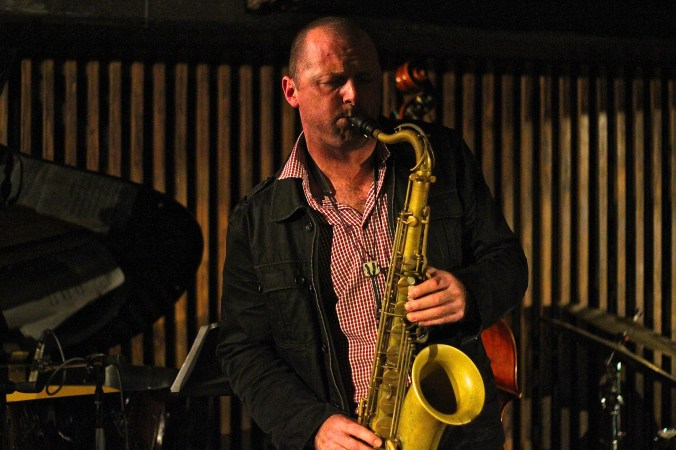
Jamie Oehlers NZ quartet@CJC

There are good gigs, bad gigs, predictable gigs and everything in between. Mostly we appreciate what is before us but just occasionally, we attend a gig that is every kind of wonderful. This was it.

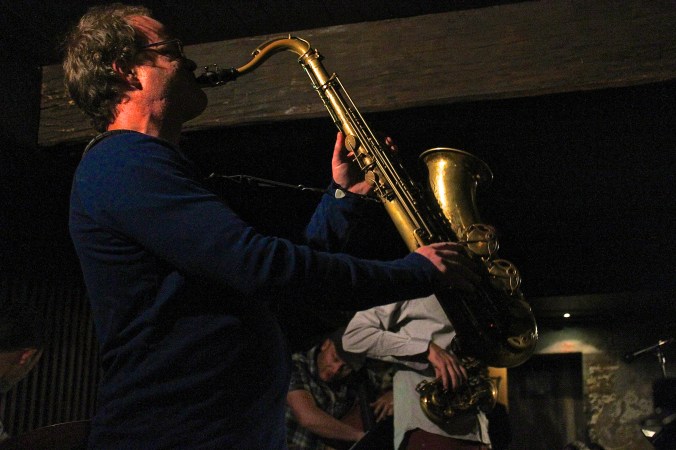
Jamie Oehlers has the sort of reputation that scares aspiring tenor players and creates life-long fans. This man is a monster on the tenor saxophone and no amount of scrambling for adjectives on my part is ever going to capture the intensity of his performance. Luckily I filmed much of the gig and so I will put up a number of cuts on You Tube over the coming weeks. This gig won’t be forgotten as it fizzed and washed over us like a blissful tsunami of sound.

Typical of many Australasian musicians Jamie Oehlers is self-effacing, and quietly humorous, but his down to earth persona remains intact only until he puts the horn in his mouth. Then we see confidence, elegance, fire-breathing and effortless virtuosity of a sort that almost defies belief. He is one of those musicians who reaches beyond the known, bringing the rhythm section and the audience along with him. His solos have an almost mystical coherence; as if guided by a universal logic that he is able to share with the audience.

Those who saw the performance at the CJC on the 19th September 2012 will understand exactly what I am saying.

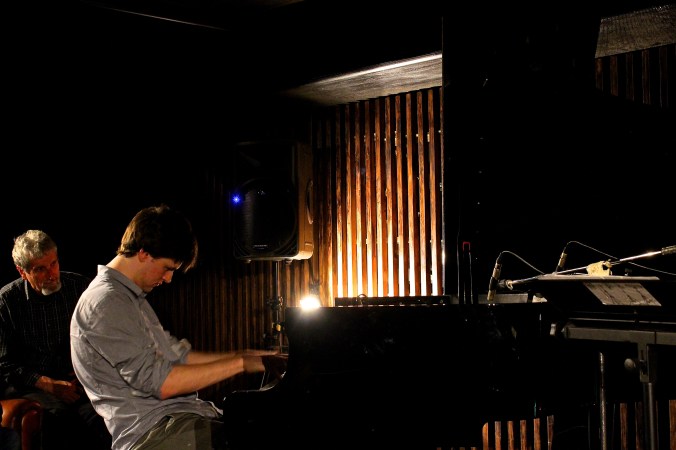
As marvellous as Jamie was, his local rhythm section was there for him every inch of the way. Not for the first time I marvelled as Kevin Field (piano) responded to every challenge, managing to inject a sense of originality and invention into a number of almost unassailable standards. Kevin stands out as a pianist as he understands perfectly which chords to accent, when to lay out and when to work harder behind the soloist. He is exactly the right pianist to play behind a talented visitor.

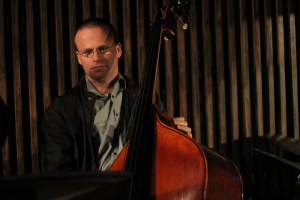
Oli Holland was so good during this gig that I embarrassed him with a bear hug afterwards. He could have been Reggie Garrison at one point as the urgent stabbing notes from his bass propelled the others on. Listen to the first clip below and particularly where Kevin is soloing. This unit was never less than in perfect lockstep.
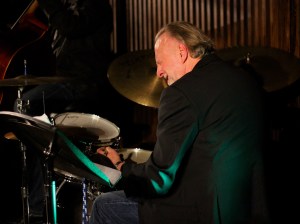
Frank Gibson on drums was equally marvellous. You never know how drummers will respond to high-octane material like this but he responded by reaching deep within and capturing every nuance of the set. I have never heard him perform better.

The first set began with the standard ‘On a Clear Day’ (Lane), ‘Alina’ AKA ‘Variation 11 from Suspended Night’ (Tomasz Stanko) [one of my favourite tunes], ‘Aisha’ (John Coltrane), ‘Take the Coltrane'( Ellington-Coltrane) , Portrait in Black and White ( Jobim) and more.

Near the end of the second set the band decided to play John Coltrane’s ‘Resolution’ from ‘A Love Supreme’ (1962). ‘A Love Supreme’ is hardly ever played and more is the pity. This avoidance relates to the holy grail status of ‘A Love Supreme’ among post Coltrane saxophonists. My view is that we should honour it and especially in this week. John Coltrane was born on September 23rd. It is a shame not to have all four movements performed together though; ‘Resolution’ is after all only a part of a mystical four piece puzzle which makes perfect sense when heard in its entirety.
Jamie stated the theme over and again, but each time working in subtle re-harmonisations and embarking upon brief angular explorations. We knew intuitively that we would end up in a place of almost unbearable intensity and we were on the edges of our seats in expectation. This was not a gate to be rushed and although we understood that, the anticipation was palpable. Tension and release is at the very essence of Jazz and Jamie achieve this end by stalking his prey in measured steps like a confident hunter.

‘Resolution’ is an Everest of a tune utilising Coltrane’s new-found ideas which were somewhere between hard bop and free. Jamie interpreted intelligently without trying to out do Coltrane. He made it his ‘Resolution’ as well. Kevin field was the same, as he took a more oblique approach than McCoy Tyner. This was a perfect homage without being a slavish imitation.

At the end of the gig we received an additional treat when Jamie asked Roger Manins to play. The best moment was when they played ‘On Green Dolphin Street‘ (Washington). With these two masters working the changes and probing every hidden corner of the melody, it reminded us that standards interpreted with integrity can sound as fresh as at first hearing.
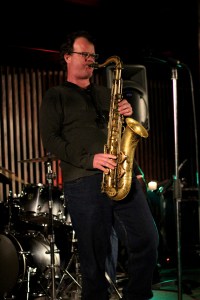
Jamie Oehlers lives in Australia where he runs a Jazz School. He has so many awards that storage must be problem (including being judged winner of the ‘World Saxophone Competition’ in Montreux by Charles Lloyd and Bruce Lundvall of Blue Note). He has put out 10 albums as leader as well as being sideman for the whose who of the Jazz world.

I ran into Jazz guitarist Dixon Nacey as I was leaving and he summed it up nicely. “Man I have just received a series of Jazz upper-cuts”.
James Wylie & Friends@CJC

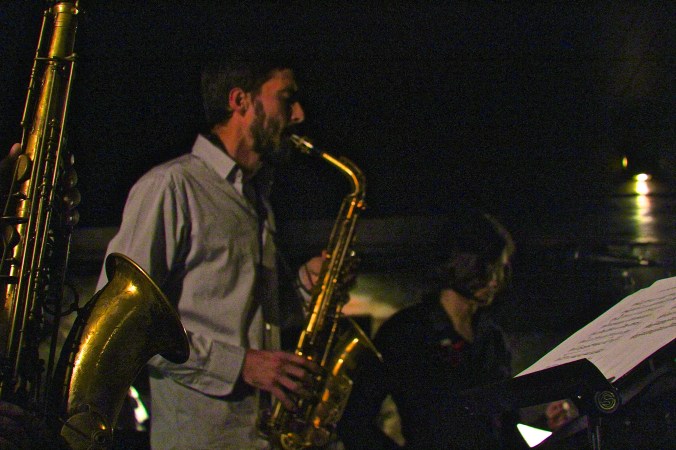
James Wylie is a respected saxophonist, clarinetist and composer who has played, studied and taught all over the world. He initially studied in Wellington where he attended the New Zealand School of Music. One and a half years ago he moved to Berlin and soon after that to Thessaloniki in Greece.

Those reading the CJC webpages eagerly look out for returning expats, as they very often bring new ideas back with them while still retaining a core of that ‘New Zealand sound’. James played alto saxophone on this gig and he demonstrated why the alto is rapidly becoming a popular instrument again. For years the popularity of the alto waned but happily that is no longer the case. Improvised music often gives the impression of being a ‘blue skies’ horizon where no boundaries exist. All freedom comes from discipline and it is the knowledge of what works best in a given situation that marks players apart. Chops count but musical taste counts too. James showed an intuitive understanding of this.

Tonal and textural contrasts add considerable depth to a performance and in this we were well served. We not only heard the multiple facets of James Wylie’s tasteful alto playing, but we benefited from the addition of Roger Manins tenor. This was a double dose of saxophone magic. The quartet was completed by two Christchurch expats, Richie Pickard on upright bass and Andrew Keegan on drums.

While their first number ‘The Mooche’ (Ellington) got our attention, the second number ‘Just in Time Contrafact’ (Wylie) simply demanded it. It was an outright cooker. Roger Manins particularly shines in these situations and as he and James worked the changes and stretched out, there were enthusiastic cheers from the audience. The sets contained a couple of originals, some well-known standards and seldom played tunes by Jazz greats like Monk. Best of all were the tunes we have never heard in a Jazz setting. ‘Wichita Lineman’ (Campbell-Webb) – [It is a little known fact but Glenn Campbell was one of the original Beach Boys], ‘I can’t help falling in Love With You’ (Elvis) , and a memorable version of the standard ‘For All We Know’.

Nat Cole and Billie Holliday sung this so memorably (and hauntingly) that post 50’s bands often shied away from it. That is a pity because it can still evoke all of the emotions that made it a popular classic. The band approached it in the way that the late 50’s piano-less quartets did. Playing contrapuntally while extracting the maximum beauty from the melody. In this style of playing the bass is pivotal and Richie Pickard was perfect.

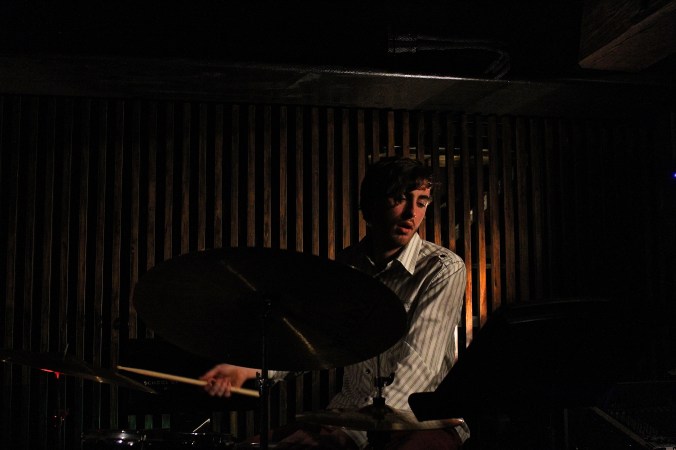
While the horns naturally took centre stage I never-the-less had my attention drawn to drummer Andrew Keegan again and again. The quality of New Zealand drummers often amaze and Andrew is a traps player I will keep an eye on. He is not overly busy but he has an in-the-pocket propulsive style. He listens carefully to what the others are doing and reacts in kind.

The last portion of the second set featured James interpretations of traditional Greek songs. My love of Mediterranean infused Jazz is constant and hearing Greek music was a treat. James interpreted the lovely melodic tunes (in crazy time signatures) with an ease that can only signify his deep interest in this music. In this portion he accompanied Greek singer Egli Katsiki. Her voice while a little soft at times resonated perfectly with the keening alto and between them they reached deep into the hearts of the spellbound listeners.

It was nice to have James here and I am keen to see where his musical journey takes him next (back here soon I hope).

Connor McAneny Trio – Matt Steele Trio@CJC

Connor@CJC

This gig was signalled by CJC Jazz club some months ago and as I am a real fan of piano trio’s I had looked forward to it.  It was hinted that this would be a duel, but both trio’s approached the gig from quite different perspectives and this makes comparisons a little redundant.   It was perhaps surprising as these are Auckland University Jazz Studies students and you would not expect to find such interesting stylistic diversity in young pianists.

While the gig was a tribute to Connor and Matt (and their sidemen), it was also a tribute to Kevin Field their teacher.   A gifted pianist who obviously encourages students to find their own voice.

The first up was the Connor McAneny trio.   Connor (piano), Cameron McArthur (bass) and Chris Wratt (drums).   The set began with the famous medium tempo hard bop classic ‘Inner Urge’ (by tenor man Joe Henderson).  There were also a number of interesting originals played with intriguing titles (e.g. Black Monday, Underwear) but my pick was the fabulous Lennie Tristano tune ‘317 East 32nd Street’.  I love Tristano tunes with their long probing lines and relentless forward propulsion.  When Lennie was around his drummers had to keep a subdued metronome-like beat, but that approach has gradually faded into the mists of time.   This is a tune that begs interpretation and interplay between piano, bass and drums is now a part of that exploration.  The constant however is the rhythmic momentum of the piano.  This is not an easy tune to play, but Connor executed it extremely well.  Chris Wratt met the challenge interestingly, as he kept the pulse while working hard against the bass lines.

Cameron McArthur has been noticeably stepping up this year and that he played in both trios while dealing effortlessly with the differing approaches is an indication of his growth as a musician.  Only a fortnight has passed since he played with the AJO at the Bennie Maupin, Dick Oatts concert where he acquitted himself well (Matt Steele also played with the AJO on that gig).  Cameron’s solo on ‘317 East 32nd Street’ was memorable.

Matt Steele is a pianist that I have been watching for some time and I have made no secret of my enthusiasm for his rapid progress as a musician.  With each passing month he navigates increasingly difficult territory and being challenged in a variety of gig situations is working for him.  There is a hint of the European Jazz pianists like Marcin Wasilewski in his playing, but there is also a boldness and clarity that is not often heard in a student.  It is partly the way he approaches a piece (allowing compositions room to breathe) and it his clean melodic touch.  He is a particularly animated player (making him hard to photograph) but the movement appears to give his tunes a strong sense of swing.   It was therefore no surprise when the first tune in his set was ‘Little One’ (Tomasz Stanko).   It originated from ‘Suspended Night – Variation v1’ but this version is a later incarnation.    That is why I was sure that knew it well, but could not place the title.  Matt also played some compositions of his own and these showed promise.

Once again Cameron Arthur was on bass and he dealt with this different material as adeptly as he dealt with Connors.

I had expected Matt to bring his usual Trio, but instead he used Cameron and well-respected Auckland drummer Stephen Thomas.  Stephen’s inclusion was inspired, as he brought a very different feel to the numbers.  While Jared had been adept in subtle colourist drumming, Stephen ramped up the proceedings by throwing constant challenges in the direction of the bass and piano.   That is not to say that his drumming was overly busy, but he did exactly what a drummer on a live gig should do; laid down a perfect improvisational platform while throwing in a few twists and turns of his own.

The trio communicated beautifully and they never lost sight of each other musically. 

I love to see emerging pianists in action and especially when they deliver.   The above trios convinced a seasoned audience that they were both worthy of future attention.