Spoilers of Utopia / Ruckus@CJC

The way that music is interpreted by the human brain is understood up to a point, but there are many mysteries remaining. The topic interests neuroscientists, fans and musicians alike. While pattern recognition is one the of the main hooks drawing us deeper into a piece of music, we also become bored if the pattern remains relentlessly familiar. That doesn’t rule out repeated notes or a vamp as the points of variance are incredibly subtle; groove music or John Cage compositions bear this out. Whether subtle or overt, educated Jazz audiences prefer music that challenges, delights, reveals or amazes.

Good Jazz and improvised music does this despite the few fans who slavishly confine themselves to a single era or style. Live gigs will drag you out of your comfort zone and here’s the thing. Music is a language and we learn by hearing the unfamiliar and comparing it with what we know. Learning language is an innate skill possessed by all humans. As we listen to what we are unsure of, our tastes grow proportionally. These days Dolphy, Ornette Coleman, Art Ensemble of Chicago, Carla Bley and Zorn have a solid foothold in our consciousness; just as Jackson Pollack makes overwhelming sense when seen on a gallery wall. Jazz listeners should always want more than sonic wallpaper.
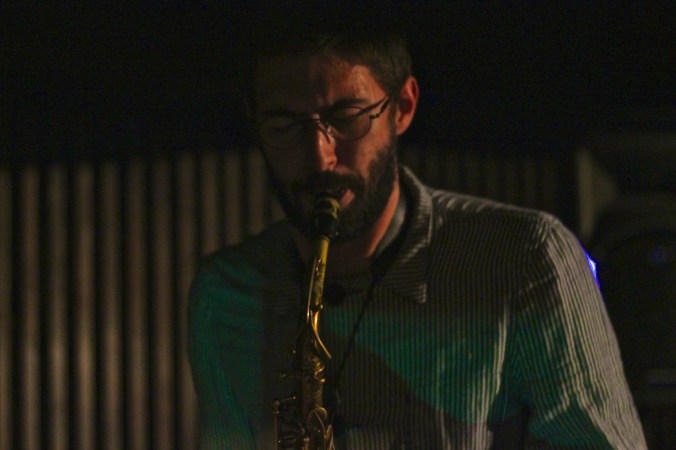
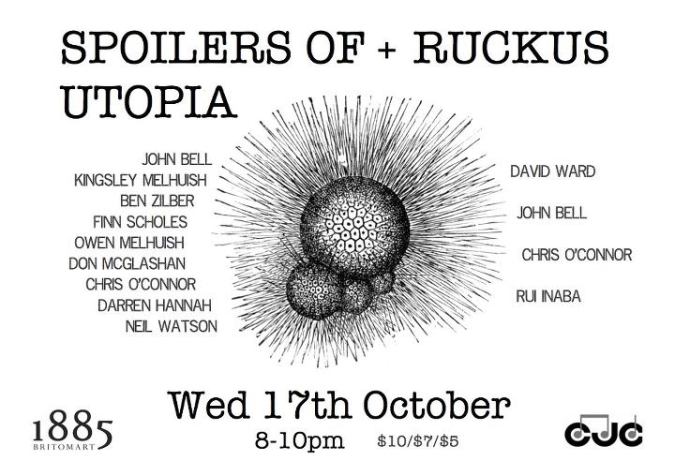
In keeping with Roger Manins enlightened approach as program director of the CJC (Creative Jazz Club), he had booked two very interesting groups to play on the 17th October 2012. First up was ‘Ruckus’, a quartet that was anything but run of the mill. The second was the out-brass ensemble (+ four), ‘Spoilers of Utopia’. What we got was joyful, challenging and outrageously humorous music. Music that was fiendishly clever without once resorting to introspective navel gazing.

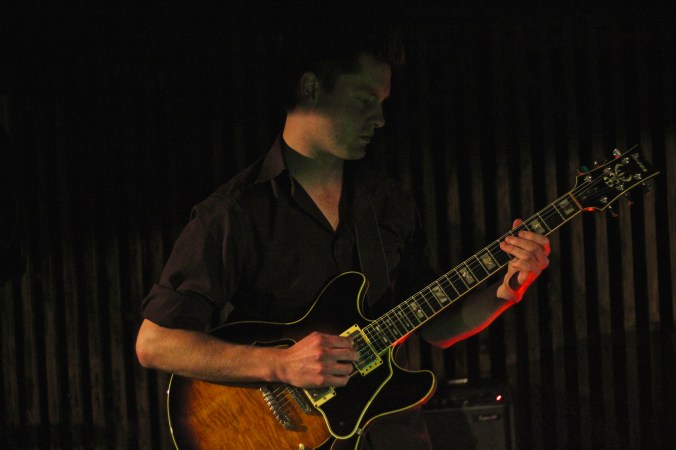
‘Ruckus’ led by David Ward, a fine guitarist who has assimilated a dozen guitar styles and then stepped free of them. He composed the tunes Ruckus played and they were a metaphor for the inventiveness and vibrancy of the New Zealand Jazz scene. The set list was interesting and the group showed real guts in their interpretations. No one cruised through this material and consequently the collective pulse was quickly amped to a point of high intensity. Some of this material was reminiscent of a Fellini soundtrack, while still managing to evoke real-time global references. It was modern in the best possible way while hinting at its musical origins. I like musical surprises and this music surprised me.
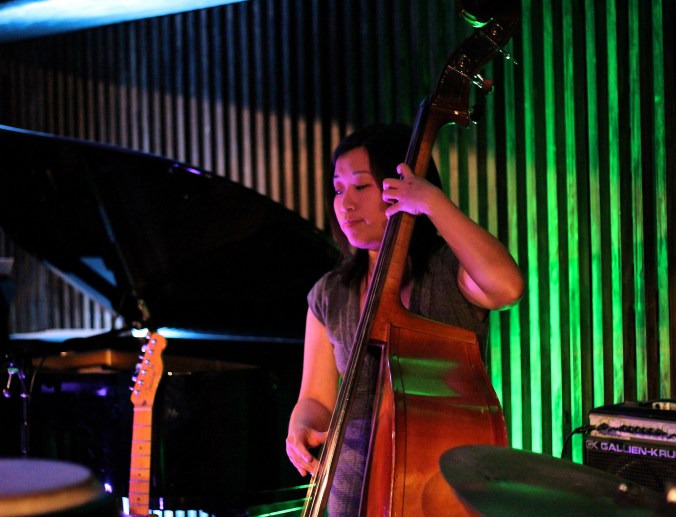
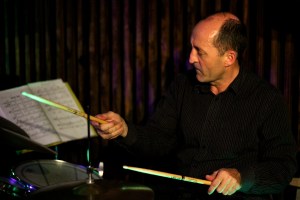
Club goers recognised two well-known locals in ‘Ruckus’, Chris O’Connor (d) and John Bell (vibes). I do not recall seeing the bass player Rui Inaba before but this unit really did come together. Chris and John had double duties this night as they were not only in ‘Ruckus’ but in the ‘Spoilers of Utopia’ as well.

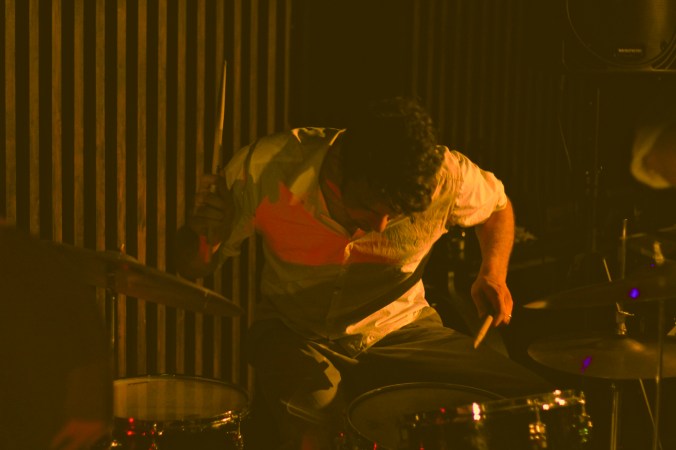
Chris is a drummer that I am very familiar with as his multifaceted approach to traps and percussion makes him a favourite on a number of scenes. He is one of the most talented, open and interesting drummers in New Zealand and it is always fascinating to watch how other drummers flock to hear him. Chris never rushes to fill any void as he understands how complete an implied or missed beat is. He has such a well honed sense of time that he can push at the fabric of reason without losing momentum . He also knows how to remain relaxed at the kit and how to say more with less. The fact that he is one of the nicest cats on the music scene is an added bonus.

John Bell is an extraordinary vibes player and he generally favours the free over the straight ahead. In Ruckus he showed that he is comfortable moving between both worlds. He can swing like ‘Hamp’ then merge that groove seamlessly into an irregular pulse. The one thing that stands out however is his musical courage. John shows an integrity that few vibists do. While a lovely ringing vibrato is what we most often associate with the vibes (early Gary Burton or Bags), the instrument is capable of more besides. He is recapturing the history of the vibraphone while showing us a possible future path. The vibraphone is a percussion instrument and that can easily be forgotten.

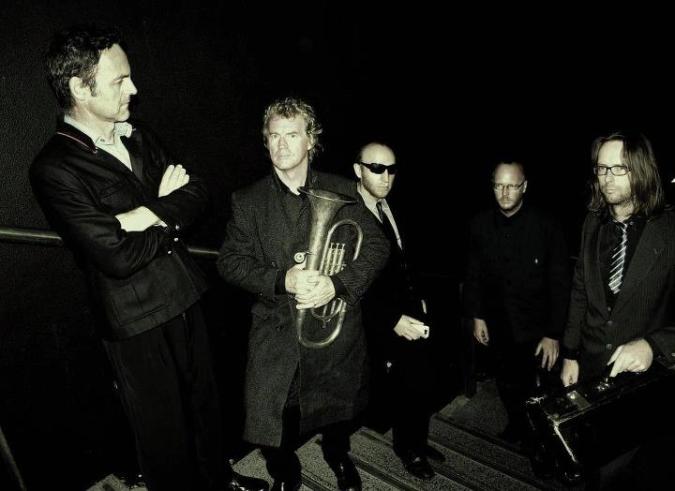
The Spoilers of Utopia (also ‘Tparty Spoilers of Utopia’) are a brass heavy ensemble and they are marching resolutely into new territory. While the charts are initially familiar they are never quite what you think. The genius of this music is its kaleidoscopic quality, as it reflects a thousand fractured images while somehow keeping the whole intact. We feel that we can almost grasp the essence; only to find the familiar deconstructed. A pack of travelling Jesters has skilfully woven a new cloth from the old and what was once orderly descends into a pleasant chaos. We follow the twists and turns and just as we fear we are lost…. a disciplined brass band marches out of the haze. This is a new take on tension and release and it really works for me.

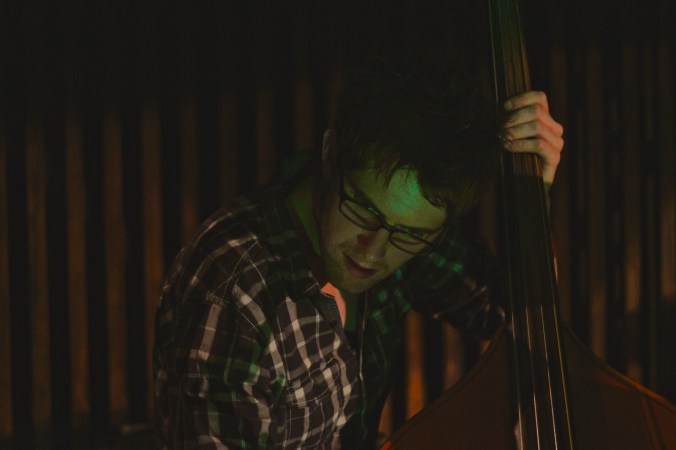
The ‘Spoilers of Utopia’ are usually a nonet and as anyone who knows me will verify, I just love a nonet. They are big enough to create to create the illusion of a larger unit but small enough to leave a sense of airiness. To balance out the five brass instruments there was Vibraphonist (John Bell), guitarist (Neil Watson), bass player(Darren Hannah) and drummer (Chris O’Connor). The Brass section were Kingsley Melhuish, Ben Ziber, Finn Scholes, Owen Melhuish, (Don McGlashan absent that night).

I know Finn Scholes having been wowed by his facility on the trumpet (or flugal horn) before. Neil Watson is also a familiar figure at the CJC and I noted how well his solid-body guitar sound fitted the brass dominant ensemble. I liked his contributions enormously and knowing his quirky offbeat take on life and music, it must have been a no-brainer to include him in the mix. There was also a degree of unison playing and with the unusual instrumental configurations, the timbre of the instruments merged to create a richer sound. George Shearing and Tristano grasped this long ago. Having Piano, vibes and/or guitar playing unison lines changed the sound. Putting vibes and guitar with brass was to produce a wonderful contrast. As the ensemble moved from order to chaos and back again I could feel the guiding spirit of John Bell at work: the demented dance instructor shimmering in darkness.

The track that I have selected from the ‘Spoilers of Utopia’ set is so good that I have watched it over and over. The tune is a hymn beloved of the Salvation Army bands, ‘We’re Marching to Zion’ (Sankey). Someone decided on the spot that a drum solo should occur in the middle. As the band proceeded the overall effect of this anarchic but strangely reverential wizardry brought us to our feet? The audience showed wild enthusiasm (and if you peered into the darkness and listened carefully, I swear you could hear Sankey laughing).

This comes from where Jazz began; brass marching bands and random instruments merging to form a new and riskier sound.

Thank you to Jen Sol for providing the video material (as I stupidly forgot my camera bag on that night)
Trudy Lile Quartet @ CJC

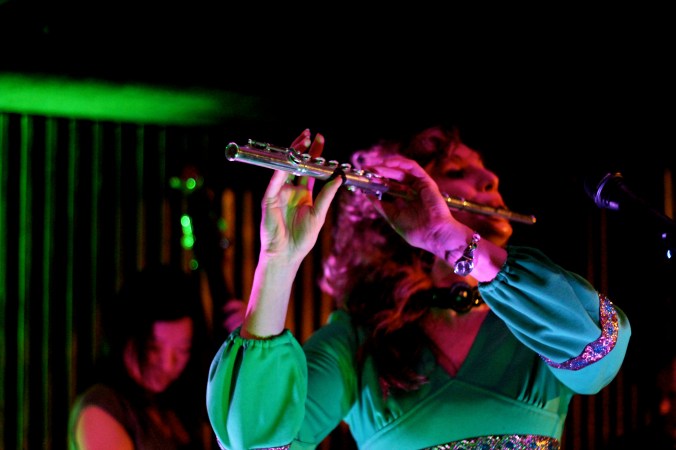
Jazz Flute is sometimes relegated to a place of lessor importance in the scheme of things and a few say that the instrument lacks the expression of the more ubiquitous reeds.   As with all things in Jazz it depends entirely on who is playing the instrument and how they apply themselves to the task.  If such naysayers had witnessed Trudy Lile on Wednesday the 10th of October 2012 at the CJC (Creative Jazz Club) they’d have swallowed their words.   This was expressive and extremely lively flute playing and no one with half a brain could doubt Lile’s supremacy on the instrument.  She is a master of extended flute technique but the effects are always applied tastefully.  

As well as being a premier Jazz flutist, Trudy Lile is also a composer and vocalist .  These three skills were all evident at the CJC gig as she showcased many of her own compositions.   The numbers were engaging and tended toward the melodic (as you would expect of flute compositions).

I have selected one of these compositions as a typical example (see You Tube clip).   Her ‘Kingston 787’ has a well-arranged head, which as it develops, becomes the perfect springboard for extended improvisation. With the vague promise of summer in the offing I was in the mood for this type of number.  Swinging and soaring like a skylark – a tune that pleased the ear and invited you along for the journey without losing you before the end.

‘Kingston 787’ is a great composition, referring to the famous South Island steam engine of that name.  There is ample precedent in Jazz for writing charts about steam trains and two of the most notable examples are Gerry Mulligan’s ‘The Age of Steam’ (who could forget ‘K-9 Pacific) and Oscar Peterson’s memorable ‘Night Train’.   Trains and jazz have always been linked as musicians rushed between gigs; writing charts to the clickity-clack.  

While there were a few numbers by other people there were seven Trudy Lile originals.   First up was a feisty tune named ‘Flute Salad’ (Lile), followed by ‘Winter Wind’ (Parlato), ‘Night Bird’ (Enrico Pieranunzi), ‘Emily’ (Lile), ‘If I Fell’ (Lennon/McCartney), ‘Kingston 787’ (Lile), ‘Hammond Sandwich’ (Lile), ‘The Laughing Song’ (Lile), ‘Smile Like That’ (E.Spaulding), ‘Frodo’s Mojo’ (Lile), ‘Gone By Lunchtime’ (Lile).  The choice of lessor known tunes by well-known musicians worked well as a contrast.  It offered comparisons and her own compositions stood up well against the likes of Pieranunzi.  For ‘If I Fell’ Trudy played piano and sang, accompanied only by a first year student Sam Swindells on guitar.  

Her regular band is Mark Baynes (piano), Jo Shum (upright bass) and Jason Orme (drums).   This unit has been together for some time and it shows.   I have caught Jo and Jason many times at gigs but this was the first time that I had heard Mark.   It proved a good introduction to his playing and the musical rapport between he and Trudy worked well.  Mark’s touch and voicings are different from the pianists we see regularly at the club and it is encouraging to see such stylistic diversity in our city.   Mark is a keen student of Brad Mehldau and this focus has undoubtedly shaped his approach to the instrument.

Jo gets better and better every time I see her as she has the ability to provide a solid cushion beneath the piano and flute – freeing up both as she holds the centre.  By contrast her soloing was highly melodic and perhaps it is this which makes her so right for working with Trudy.  When her amp failed mid number her loss from the mix was noticeable although the rest of the band played on without faltering.

Jason Orme is the other regular and he and Trudy go back a long way.   Jason is a versatile drummer who knows exactly what his job is.   For this gig he shared the drum duties with first year student Michael Harray.  Michael played drums for one number and percussion for several more.   On ‘Kingston 787’ we heard both drums and percussion.   They worked extremely well together – I like gigs with a percussionist and a drummer and Michael was superb.

Another student Joel Griffin played alto on one number and a jazz choir joined Trudy on another.   None of these students let Trudy down.

There is a significant thing to appreciate about Trudy Lile and that is her role as an enabler.   She teaches Jazz studies at the NZSM Massey Campus and is on a perpetual quest to promote, challenge and push her students into playing in situations like this.  Sharing your prized gigs with beginning students has its risks but the rewards are far greater.   It is only through being tested against more experienced players that they learn.

Trudy gives a lot to the Jazz scene but I’m not sure that it is always acknowledged.  When it comes to the academic world such dedication is all too often overlooked.  I have pondered this and wonder if old fashioned misogyny is at play.

The leading Jazz flute players in the world are now predominately women (Nicole Mitchell and Jamie Baum just won the Down Beat critics poll).   The students understand this issue perfectly as many have voiced it to me.   Progression in teaching or on the bandstand must be merit based and gender blind.

The CJC and especially Roger Manins set a very good example in this regard.

Michel Benebig B3 Master: Review of ‘Black Cap’ Album

This album confirms what those on the Pacific rim have long known and what is just dawning on the wider Jazz world.   We have a fully fledged B3 master in our midst and the time for proper acknowledgement is due.   ‘Black Cap’ should gain Michel Benebig the wider recognition that he deserves.

Michel has always been an artist with astonishing chops but like all great musicians he also has good judgement.  He knows when to lay out, when to comp gently and when to lay down a burning foot-thumping groove.  If you listen carefully you will hear how totally in the pocket this man is.  He sounds as if he could swing with one hand tied behind his back.  This is about timing, an innate sense of swing, a relentlessly propulsive groove but above all taste.    This is a sound that many aim for but few can master.

I will also mention his pedal work, which lays down such solid walking-bass lines that you shake your head in disbelief.  It made me pick up the album cover to see if I had missed a bass player .  This album has come to the attention of organ trio/quartet specialists and their praise for it has been strong.  The various comments have invariably drawn attention to the astonishing pedal work.

The numbers on ‘Black Cap’ are all Michel’s compositions and the track list is carefully balanced.   This is great groove music and that would be enough, but the album possesses an extra something – a presiding spirit that holds you until the last note.  I was already familiar with his ‘Brother Jack’; a tribute to Brother Jack McDuff.  On the album this is fast paced and crackling with energy.  In perfect contrast is the slow burner on track 6 – titled ‘Black Groove’.

These days Michel spends a lot of time away from his native New Caledonia, gigging up and down the western seaboard of the USA.  The other musicians on the album are all from the west coast and the line up is very impressive.

These guys are serious Los Angeles heavyweights and their biographies are simply staggering.  Saxophonist Doug Webb has played and recorded with everyone from Horace Silver to Quincy Jones and has worked on several Clint Eastwood films including ‘Mystic River’ and ‘Million Dollar Baby’.

Frank Potenza on guitar is well-known for his years with pianist Gene Harris.  He has played with Dizzy Gillespie, Harry ‘Sweets’ Edison (long a favourite of mine), James Moody and more.  He was a protegé of the immortal Joe Pass and no guitarist can carry higher credentials than that.

Lastly there is drummer Paul Kreibich.   He has worked with Carmen McCrae, Red Rodney, Kenny Burrell, The Woody Herman band and dozens of luminaries.  He was Ray Charles drummer for three years and spent considerable time with the Gene Harris quartet.  These are the very musicians to have in your corner if you have something special to say.  Michel does.

I would defy any lover of B3 Groove jazz to fault this album.  In this world of financial turmoil and endless conflict, this is the eternal balm.  Order it from Amazon as a CD or download – do it now.

Also an older review is located onhttps://jon4jaz.wordpress.com/2011/11/19/michel-benebig-soul-on-pacific-soul/

What: ‘Black Cap’

Where: Recorded in Pasadena USA 2012 – distributed by Rhombus Records – iTunes or Amazon

Who: Michel Benebig (leader, B3 organ, composer)

With: with Doug Web (sax) , Frank Potenza (guitar), Paul Kreibich (drums)

P J Koopman quartet (with James Wylie)@ CJC

P J Koopman and Thomas Botting joined the ‘music drain’ exodus to Australia two years ago but Auckland still draws them back from time to time.  When they do return they are always booked at the CJC Jazz Club and this invariably draws old friends and new.   PJ Koopman is one of those guitarists who makes it look easy, but like all dedicated musicians he works extremely hard at his craft.  The CJC gig on the 3rd of October featured many of the fast flowing post bop tunes that PJ excels at, but there was something else in the mix.  His repertoire soon expanded to include some country tinged material of the sort Bill Frisell and Bruce Forman exemplify and while there were only two such numbers, it gave the evening a flavour that it would otherwise not have had.  This had the feel of an interesting project in the making.  

Thomas may not have put on any physical weight but he has certainly beefed up his compositional credentials .   After a week of listening to Americana just prior to returning to New Zealand, he has composed a tune, which I will now include as a You Tube clip.   This is a great composition and one which they executed well.   The tune called ‘Wylie Coyote’  had been written to honour alto saxophonist James Wylie, who joined the band for this one gig.   James is an ex-pat Kiwi who lives in Thessaloniki Greece and was due to return there within hours of the gig finishing.   James is well-known for his oblique takes on country tunes and so this title was appropriate on so many levels.   His out of left field rendition of Wichita Lineman is a perennial favourite.  

P J Koopman was exactly the right guitarist to tackle this tune and I’m certain Thomas had that firmly in mind when he composed it.  I had not heard PJ do this type of material before, but the fact that he did it so well is scarcely surprising.   He has open ears, good mentors, great chops and above all taste.   His Frisell like slurred chords portrayed the roots of the genre (and perhaps his other influences); but without sacrificing his originality.  The other country tune was the gorgeous ‘Tennessee Waltz’ and the first few chords took me back to a film I saw in the 70’s.  Antonioni’s movie Zubritzki Point was a portrayal of the youth counterculture and its soundtrack has outlived the popularity of the movie.  The soundtrack featured Pink Floyd (‘Heart Beat Pig Meat’ – who could forget the exploding food in slow motion), The Grateful Dead and Jerry Garcia solo (playing etherial improvised licks while the actors writhed in a strange love-making frenzy which stirred up lots of desert dust).  best of all was the version of Tennessee Waltz which twanged out sweetly while tumbleweeds blew past a silent desert bar.    This track conjured up all that happy madness again and this is the power of good music.  

The drummer on the gig was Andrew Keegan, who has recently moved up from Christchurch to Auckland .   Andrew is an invaluable asset to the Auckland scene.   ‘Wylie Coyote’ was in 4/4 time but the feel was different because of the way the beats were accented.   Andrew handled his traps like he had been playing with these cats for months.   Nice work all round.