‘Encounters’ – Mark Isaacs – Dave Holland – Roy Haynes

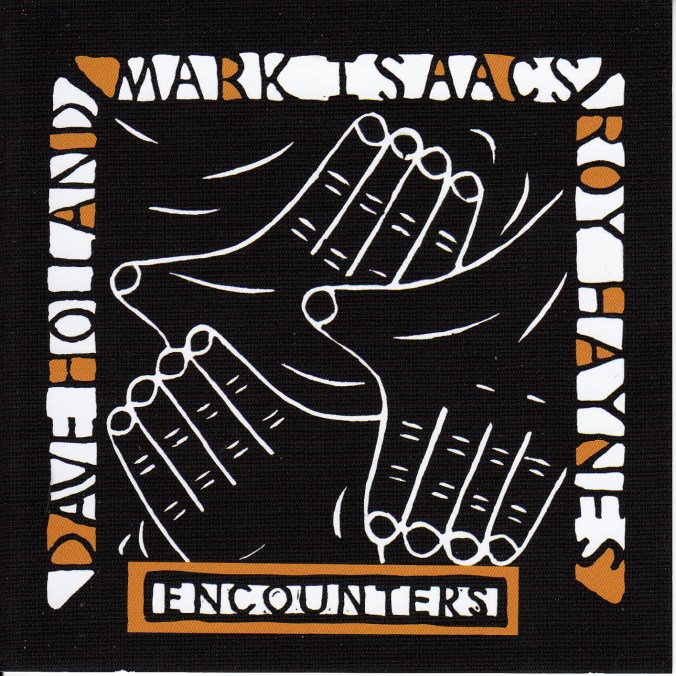
Mark Issacs Encounters

Mark Isaacs’ ground breaking ‘Encounters’ album has just been re-released for the third time and no wonder.  This is an important musical statement by any measure and it sits comfortably beside similar works by Jarrett and Corea.   I don’t say that lightly, as the aforementioned artists explorations into free improvisation set lofty benchmarks.

Mark Isaacs is somewhat of a prodigy as he works across all genres of Jazz, is a gifted composer and has a well established classical career.  His Jazz charts are particularly impressive as he often voices his pieces in modern and compelling ways.  As if that were not enough he has composed a symphony (recently performed by the Queensland Symphony Orchestra – I have heard this impressive work).  Because Mark is such a multi faceted artist it is harder to buttonhole him and perhaps that is the point.  Great musicians shouldn’t be pinned down.   It is the nature of improvised music that it constantly shifts like the coloured grains of sand in a great Mandala; elusive and yet leaving an indelible image behind.  When it’s done well the impressions that remain will outdo the notation.  This album achieves that.

Because the album has not been available since 1995 I hadn’t heard it before.  When I did it truly surprised me.  I was expecting a good album as the triumvirate of Isaacs, Holland and Haynes creates high expectations.  What I was unprepared for was just how deeply it affected me.   To explain this better a back-story is required .  An indication of how this album came to be.

The recording dates from 1988.  This was a time when the mainstream music world had become mired in techno-commercialism and to the credit of the Jazz community it chose to delve deeper into experimental music; pushing harder against musical boundaries.   This was the time of Jarrett’s ‘Changeless’ and ‘Dark Intervals’ albums and discriminating listeners were up for it.  Dave Holland was no stranger to this type of project as he had participated in and initiated many avant-garde projects since the sixties.   Mark Isaacs (an Australian) was in New York at the time having just heard some of his chamber works performed by the Australian Ensemble in Carnegie Hall.   He felt ready to record something challenging so he contacted Dave Holland who immediately agreed to participate.  I am not sure how Roy Haynes came to the project but the choice was fortuitous.  A bop-pioneer drummer who had played with Lester Young and Charlie Parker plus a cutting edge experimentalist bass player were on board.  Both had played in Miles Davis bands (but not at the same time).  Both had an interest in the avant-garde.

No rehearsals were held, no charts used and none of these artists had ever played together before.  What you have here is a tight rope act undertaken by an Australian, an ex-pat Englishman and a New Yorker.  The result could have fallen flat but what happened was truly amazing.  Deep intuitive communication and an interplay which sounded more like a trio that had been together for years, not minutes.  In this recording there is a profound sense of space and limitless vistas seem to unfold before you.  The album is just over thirty minutes long and packed within that thirty minutes is a world of diversity.   At certain points one or other of the musicians is leading the conversation, while at other points they appear to seize upon an idea at the same time.  This is artistry of the highest order and I urge anyone reading this to purchase a copy while stocks last.

It is available on iTunes but as an audiophile I recommend that you purchase the CD.  The recording quality is superb and the sound so immediate that you gain a real sense of the studio it was recorded in.  A lot of recordings could have been recorded anywhere, but this one conveys a sense of location.  Many of the ECM recordings have that feel and the Rainbow Studios in Oslo immediately come to mind.  The album was recorded at the Power Station studios in New York, which incidentally is where Jarrett’s ‘Changless’ was recorded at about the same time.

Twenty five years on, the album still sounds fresh and engaging.

The Album is available from Mark Isaacs Website: http://markisaacs.com/9-latest-news/13-encounters-with-dave-holland-roy-haynes-available-now
New Year 2014 – the fabric of creativity

IMG_8954

For many, music is a distant and pleasant soundtrack which augments their moments of relaxation.   Something to wallpaper the background while they chatter over a few drinks.  I am wired differently because my normal talkativeness ceases when even a faint echo of good music is heard; an off switch is flicked.  This pied piper effect has characterised my life and often made me late for appointments.  What is it that makes music so compelling to some and not to others and why is improvised music beguiling to those with that special antennae?

My earliest memory of Jazz is of a Louis Armstrong film.  I was a primary schooler and I made my long-suffering mother take me back twice.  Louis fascinated me in ways my relatives couldn’t quite fathom but they indulged me with an EP or two.  Ours was a classical music household.  Three years later I was walking down a street near my home when I heard a trumpet playing.   I could see the musician’s outline in the upstairs window as he played, weaving deftly around what I later learned was a Coleman Hawkins solo.  I stopped in the street, delighted and open-mouthed.   I have no idea how long I stood on the pavement gawking, but I vaguely recall being led inside and offered cocoa by the trumpeters mother.   The trumpeter and his mother were Polish refugees and they made me feel very welcome.  In the months that followed I called often and absorbed Miles, Lester Young, Dave Brubeck, Sweets Edison, Art Peper, Hampton Hawes, Billie Holiday, Basie, Ellington and more.  By the time I had connected with the groove-organ trios of Gene Ammons I was damned.  I would bunk off school and play Gene Ammons or Miles all day long, dancing about like a deranged fool.  The devils music had me by the throat.

IMG_8947 - Version 2

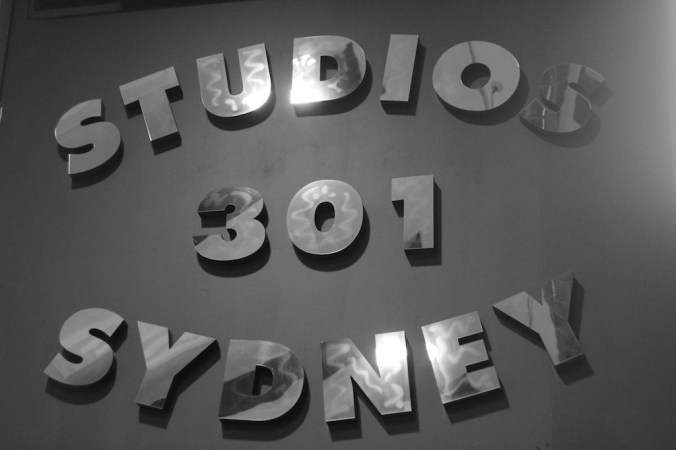
Half a century on the same music gods and their siren songs still exert power over me.  Enough to lure me to Australia at very short notice.  I had picked up some gossip from Australian musician friends, that my friend Roger Manins was doing a gig with Mike Nock, James Muller, Cameron Undy and Dave Goodman at the 505.  I have family in Sydney and so it was a no brainer.  Family, grandchildren and Jazz, perfect.   When I told Roger that I would be flying over for the gig he invited me to his ‘Hip Flask’ recording session at the famous 301 Studios in Alexandria.  I love recording studios and to hear a top rated unit like this recording in a famous studio was too good an opportunity to miss.  I applied for extra leave and altered my flight schedule to accommodate the extra day in the 301.  IMG_8963 - Version 2

The timing rested on a knife-edge as I had a gig to attend just hours before my flight to Australia.   I made the check-out with 4 minutes to spare.  The flight over on Virgin was abysmal.  I had a headache from lack of sleep and it was like being stuffed into a rubbish tin surrounded by bored, rude flight attendants who acted as if they were in a BBC spoof.  An Australian musician later commented that Virgin felt to him like it was piloted by overtired children.  IMG_9011 - Version 2

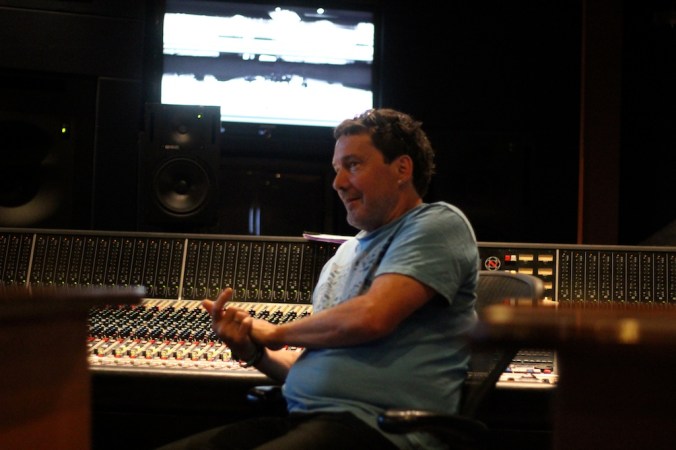
After clearing customs, I poured myself into a taxi and headed directly for the 301.  The industrial exterior gave little indication that I was standing outside an important recording studio.  The one where EST recorded their final album.  They buzzed me in and after navigating a series of corridors I pushed open a heavily padded door to find myself in an icy cool low-lit room with two technicians, a two-man film crew and the five cats from ‘Hip Flask’.   They were sitting around the mixing desk drinking coffee and listening over and over to the intro of a tune.  It sounded great.  This is what I had come for.  To capture the very act of creation.

IMG_9012 - Version 3 (1)

It is a special privilege to follow a creative process through from inception and I felt like a kid in a candy store.  This is exactly where I wanted to be and I soaked it up greedily.   My headache had vanished at the first note.  As the morning progressed the band would troop in and out of the studio.  Trying material, listening to it and repeating it if any one member expressed dissatisfaction.  Roger outlined his vision and set the tone, but after that he allowed a form of guided democracy to exist.  If they strayed from his vision he would talk them back round.

IMG_8939

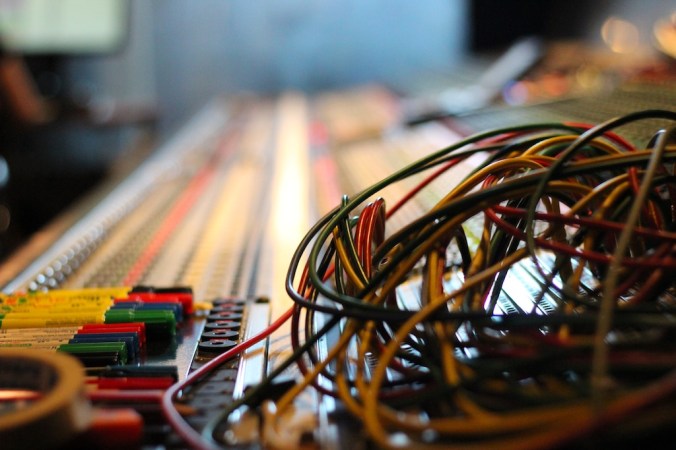
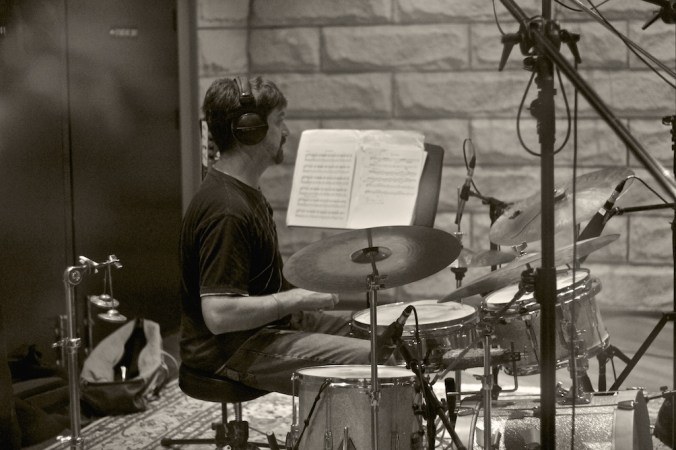
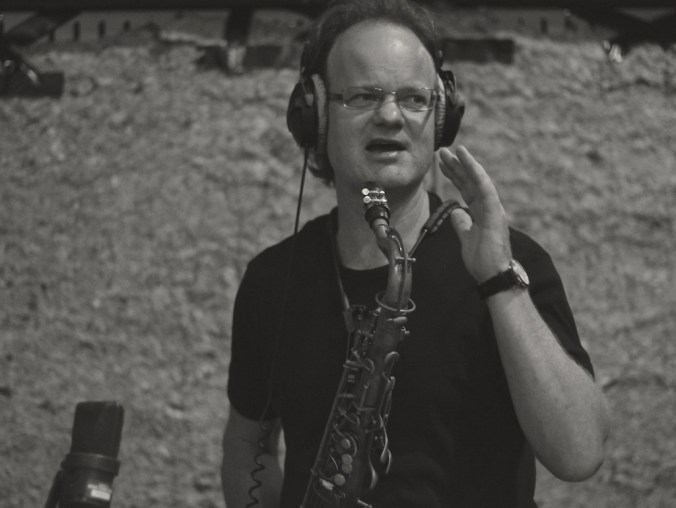
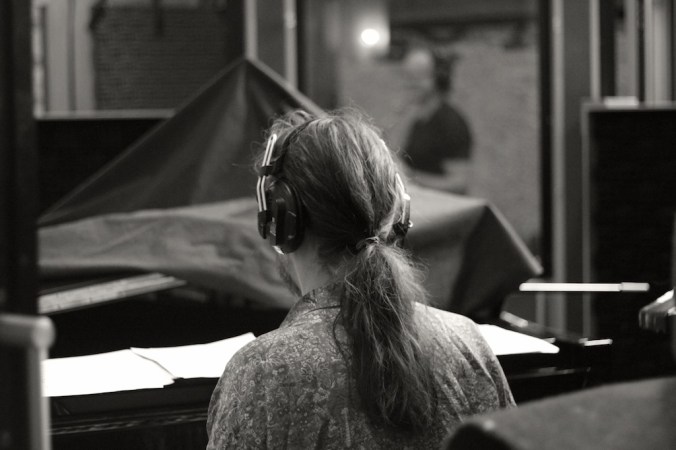
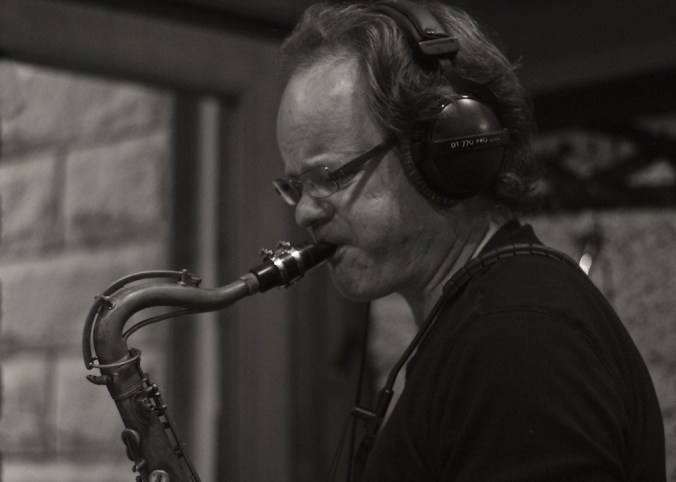
The sessions in the control room were all smiles and banter but a sense of purpose always ran through the proceedings like an unbreakable thread.  When they reached agreement they would return to the studio and assume their positions, baffled up and miked to such an extent that the bass drums and piano were barely visible above the wires, cover sheets and portable booths.  The band has an unusual configuration for a funk unit, being tenor Saxophone, Hammond B3, grand piano, drums and bass.  The saxophone, bass, piano and B3 were in the studio while the drums and the Leslie unit were both in isolation booths.   The studio space was big enough to accommodate an orchestra, but this quintet was squeezed into a corner and each baffled from the other in some way.

IMG_8955 - Version 2

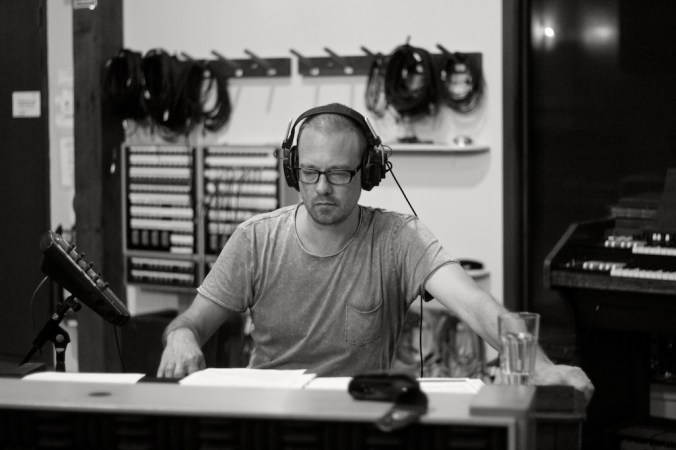
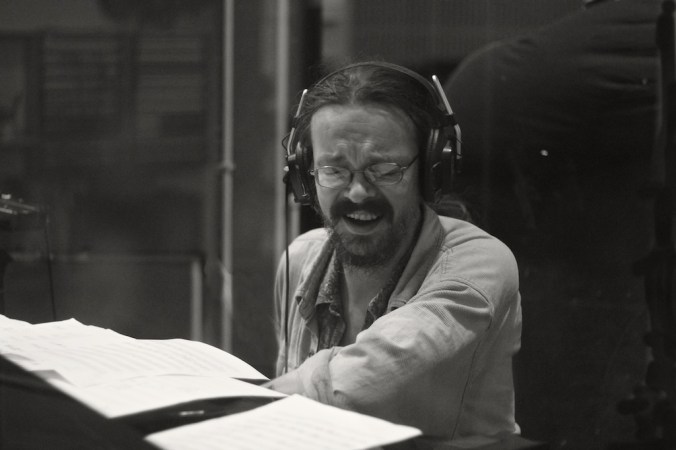
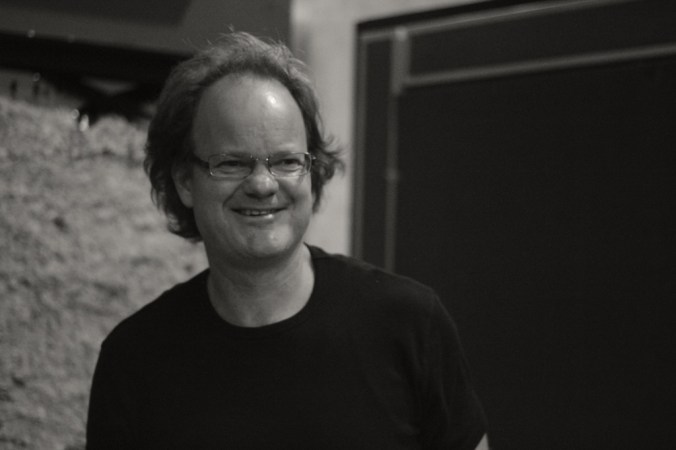
The quintet had recorded together before and even though their last recording was in 2007, their essence had survived intact.  As the session progressed I learnt a new word, ‘shoint’.  Roger and the organist Stu Hunter used it often and they would proclaim a satisfactory cut as being ‘Shointy’ or they would listen to the playbacks to see if they had ‘shoint’.   As far as I can ascertain the term describes a deep dirty groove that hits the musical ‘g’ spot.   While it is accurate to describe the recording as Jazz Funk, it is more than that.   The unusual pairing of two keyboards, the intuitive interaction and the quality of the musicianship gifted them with limitless options to draw upon.   Over all of this Roger Manins presided like an old time preacher, communicating with gestures, earthy licks on his Conn, diagrams and pithy Rogeresk phrases.  IMG_8969

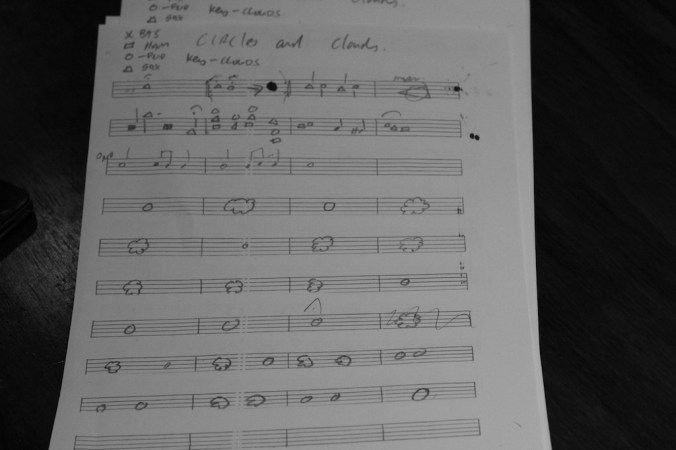
The most interesting moments came towards the end of the session when Roger produced a chart for ‘circles and clouds’.  The chart contained a few bars of musical phrases and then a series of symbols.  The ideas conveyed were beyond normal logic.  On most of the staves clouds were drawn and although these pieces were essentially free, there was a clear purpose underpinning them.  Roger had the concept firmly in his sights as he talked them through the vision or let the ideas develop in the studio until the concept was realised.  Stu Hunter would play a compellingly dissonant chord and then Adam Ponting and the others would grab a hold of what was unfolding and produce kaleidoscopic shapes, moving and shifting together like interchangeable chameleons.  When the idea was realised Roger would take them back into the control room and expand on what had gone before.  Roger, “OK you are clouds, circling a vast ocean.  Now if you look down you will see dolphins swimming and playing”.  One or other of the band then asked if there was a shoal of bait fish swimming near by.   The concepts developed and then they would repeat the process until a number of amazing miniatures were cut.  This filigree of beguiling patterns had been conjured up in that very hour.  Realised without an over reliance on written notation or oral language.  This was improvisation in its most profound form and I was lucky enough to hear and experience it.

IMG_8993 - Version 2

IMG_8988 - Version 2

IMG_9009 - Version 2

IMG_9003 - Version 2

IMG_8999 - Version 2

IMG_8956 - Version 2

My earlier question as to why some people fall deep within the web of music, while others let it wash over them unaffected, is not answered here.  This listener will never lose the magic and following bands like this guarantees that.  I am impatient to see what cuts survive and what is locked way in a vault.  When the album comes out and I can hardly wait, I will have heard more than most.  Every squeak, false start and profound moment is locked in my memory.  John Zorn said, “all sound is valid”.  I heard and witnessed an intensely creative process and I feel very lucky.

Who: ‘Hip Flask’ Roger Manins (tenor saxophone), Stu Hunter (Hammond B3), Adam Ponting (piano), Brendon Clarke (bass), Toby Hall (drums)

Where: Recording Session at 505 Studios, Sydney Australia.

This post is dedicated to Roger Manins my choice of best NZ artist for 2013.  Roger is not only deeply authentic and amazingly creative, but equally important he shares his vision and enables others to follow.