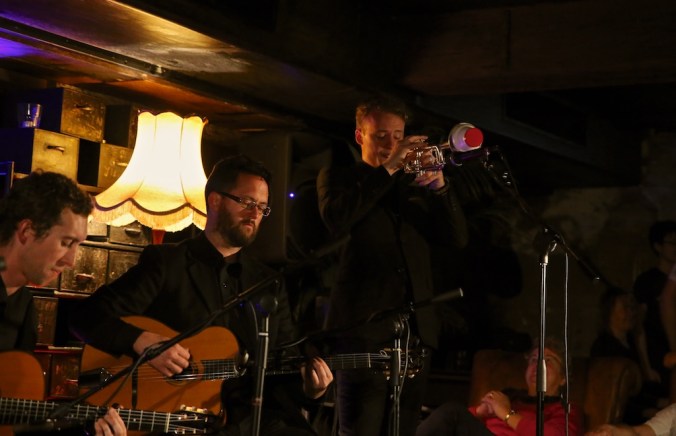
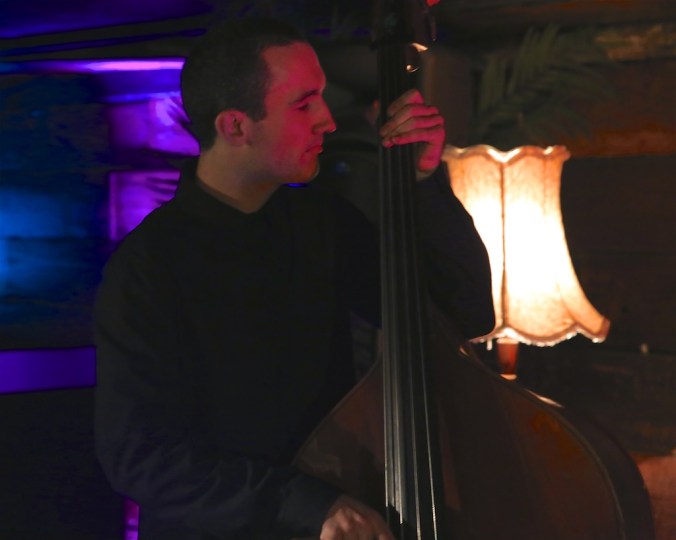
 Wellington has long possessed a gypsy soul and Jazz Manouche thrives there. In Auckland there are fewer such groups and the common form here is hybridised Gypsy. I am more familiar with these hybrid forms, but as a devotee of improvised music I possess many Django Reinhardt and Bireli Legrene recordings. The Black Spider Stomp are a traditional Gypsy Jazz group and everything about them shouts ‘du Quintet de Hot Club of France’. For a start they look the part in their slick black outfits and they mirror the traditional ensembles – three Manouche guitars, upright bass and clarinet (the clarinet player doubling on soprano and trumpet).
 The hallmark of gypsy authenticity is the ability to swing in a particular way, and Black Spider Stomp achieves this. In western European gypsy the absence of a percussion instrument places heavier emphasis on guitar led rhythm. The rhythm guitars are essential to the momentum with their striking ‘la pompe’ strum. This hard swinging pumping style is very distinctive, with its dark chromaticism, bent notes, adherence to certain voicings, rapid arpeggios, powerful rhythms and regular use of vibrato. The tunes are mostly in 4/4 with a heavy accent on two and four (although waltzes are also in the repertoire).
 The style is so distinctive that it owns the tunes whatever their origin. Once while traveling in the Carmargue I stopped at a typical Provencal village. As dusk fell a group of Gitano guitarists started playing in the square. The tune was maddeningly familiar and I wrongly thought – this is a Reinhardt composition. It stuck in my head for days and then the penny dropped. It was ‘My Way’ – the tune popularised by Paul Anka and Frank Sinatra. Recently I learned that it is actually a French pop tune. Talk about music travelling where it will. Another perennial favourite in Jazz Manouche is Stevie Wonder’s ‘Isn’t she lovely’. Manouche Jazz itself is a hybrid of American Jazz and Gypsy – and each of those musical influences are sources as vast as an ocean.
Music has origins …. but no fixed abode.
 The groups use of soprano saxophone (but in this case the straight-horn variant) is also authentic. While violinists like Stephane Grapelli regularly led Manouche ensembles (pre war), the arrival in Paris of horn playing musicians like Sydney Bechet influenced the post war style. Jazz Manouche reached maturity in Paris around the time of WW2 and it was so loved there, that a handful of Jazz loving occupying Nazi’s covertly protected it. The use of a trumpet intrigued me for two reasons. For a reeds musician to double on trumpet is rare – the embouchure is so different. Post millennium we seldom hear such a distinct nod to Louis Armstrong – or to the early swing trumpeters. Perhaps with Armstrong or Bubber Miley in mind, reeds and brass man Baron Oscar Laven treated us to the occasional muted growl and smear. His cheerful enthusiasm for all of his horns was obvious.
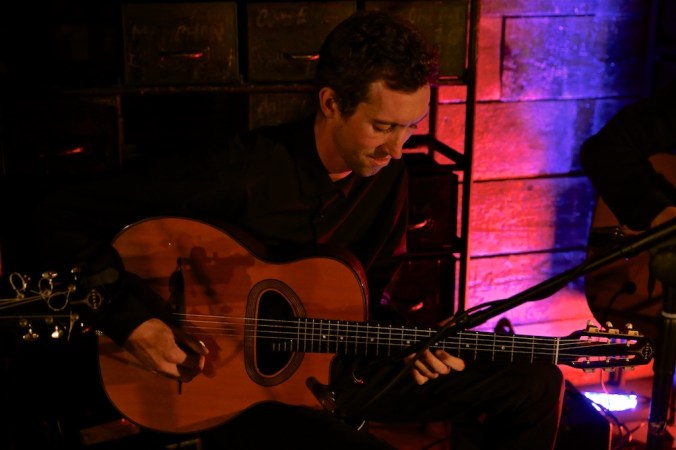
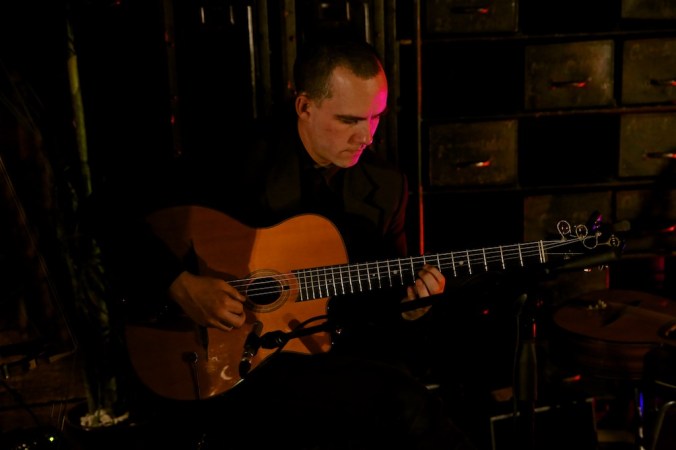
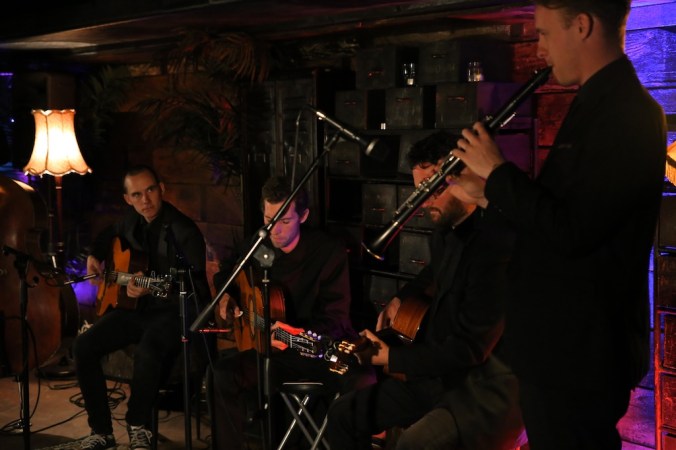 Guitars always fascinate me. These were obviously based on the famous Selmer ‘Maccaferri’ guitars favoured by Django. There are two main styles of Jazz Manouche guitar – the ‘D’ hole ‘large mouth’ with its broader rich tone and woody resonance (most often the lead guitar) and the ‘O’ hole ‘small mouth’, which is brighter in sound and has serious cut through. Solos from both were heard. These guitars are things of real beauty, earthy multi-hued wood-grained and framed in a blur of hands appearing from the darkness.
Nothing says acoustic quite like an array of wooden instruments carrying a gypsy tune.
Black Spider Stomp: Sam Thurston (guitar), James Quick (guitar), Adrian Jenson (guitar), Scott Maynard (upright bass), Baron Oscar Laven (woodwinds and brass) – find their work on Bandcamp – The gig took place at the CJC (Creative Jazz Club) 17th Feb 2016.
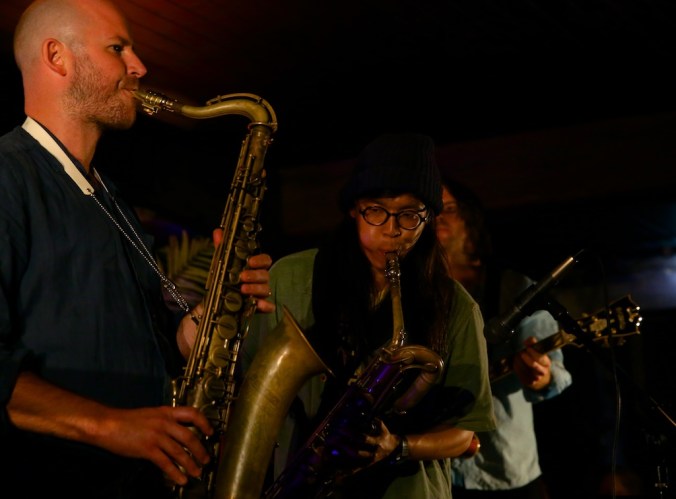 As a group of the worlds leading astrophysicists excitedly ran one last check. At the precise moment that the astonishing mathematical proofs confirmed Einstein’s theory of ‘gravitational waves’, the Circling Sun hit the CJC. This rare cosmic event released fresh gravitational waves which pulsed throughout central Auckland; altering the molecular structure of any ear within radius. It was an appropriate evening for the Sun to manifest this ‘climatic singularity’, preceded as it was by a dog-day as hot as any on record.
 The Circling Sun is more a phenomena than a group. They defy musical form and yet exist convincingly in their own orbit; circling an altered reality. As with all wonders there is much to appreciate. The intricacy of their many machines, the indelible sonic footprint and the sheer joy they bring. I took some guests down to the club that night. Flamenco artists Isabel Cuenca and Ian Sinclair (and Ian’s wife Zarina). I wondered how they would react to this wild unconstrained mix of free improvisation and world beat psychedelic Jazz. Isabel the Flamenco dancer was quick to respond. ‘This is amazing, it has deep passion’. Passion is the heart of many musics and like authenticity it is a vital component. Long live the avant-garde – long live passionate music – whatever the genre.
 In his seminal work “This is Your Brain on Music’ neuroscientist Daniel Levitin reveals the following. ‘A liking for dissonance is a development arising from deeper listening and on attaining musical maturity. A very young child prefers consonance over dissonance, the mature listener increasingly values contrast and enjoys having expectations confounded. After spending time listening to deeper or more complex music, lightweight consonant passionless music becomes boring. There is a neural basis for this’.
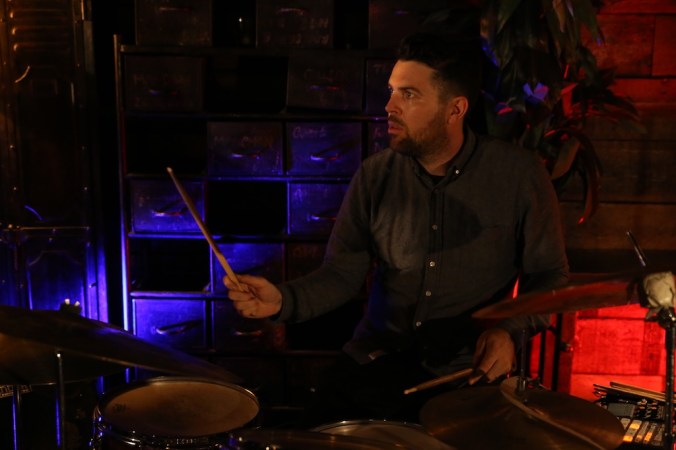
 The Montreal born Dyne was just the drummer for a band like this. His musical credentials are impeccable. His expertise extends well beyond the kit to that of producer and forward-looking experimentalist; electronic future beats, hip hop, house, afro beats, boogie funk and instrumental jazz. His work with Ladi6 has brought him to wider attention, but his own Lord Julien recordings and his deeply funky ‘Down in the Basement’ (Vol 2) cuts are well worth checking out. This band has few constraints and it gives him ample room to stretch.
 I have long been a Watson fan. The man is fearless and his musical ideas cross territory few others dare to traverse. His increasing mastery of the pedal steel already sets him apart, but his ventures into the experimental avant-garde with the instrument are unique in the New Zealand context. While an accomplished studio musician his preferred gigs are those without boundaries. With Watson you get Americana, blues, Jazz psychedelia or wild forays referencing Marc Ribot & Sonny Sharrock. The Sun suits his wild eclecticism.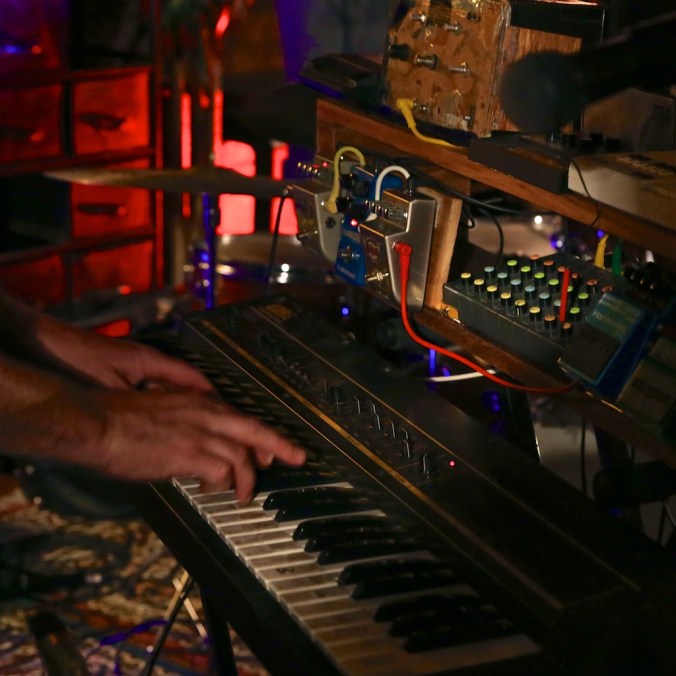
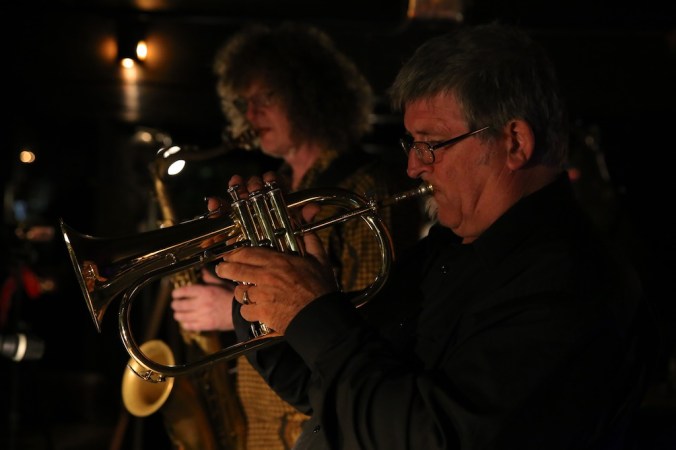 January was hot and wet and the CJC was on holiday. If like me, you are a regular attendee at the CJC (Creative Jazz Club) December to February is a long time between drinks. The El Nino humidity with its sullen skies and petulant storm threats rolled into February and suddenly we were back in business. The first gig of the year featured Craig Walters and Mike Booth. Walters, a well-known Sydney based tenor player, last performed at the club in 2012. Booth is a local and he features often; a gifted composer, arranger and trumpet/flugel player. Booth and Walters have a long history together.
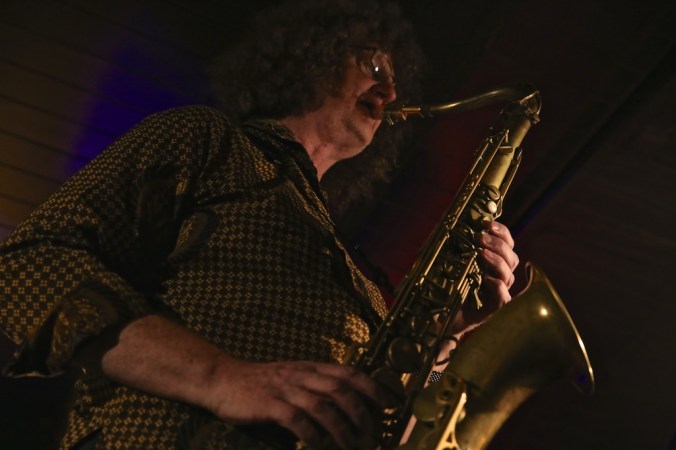 The first number was a Walters tune titled ‘Easy’. Booth played flugel and the relaxed fluid interplay between horns set us up nicely for the evening. Walters plays with real fluidity and his tone has a certain quality – a hint of mid to upper register sweetness not dissimilar to that of Ernie Watts – but with an earthier colour overlay. While the first tune eased us the into the gig the second tune grabbed our attention in a different way. ‘A Kings Ransom’ is a seldom played Booth tune and its complex rhythms gave the band a solid work out. Broadhurst delivered a wonderfully solo on this – Monkishly jagged and totally within the spirit of the composition.
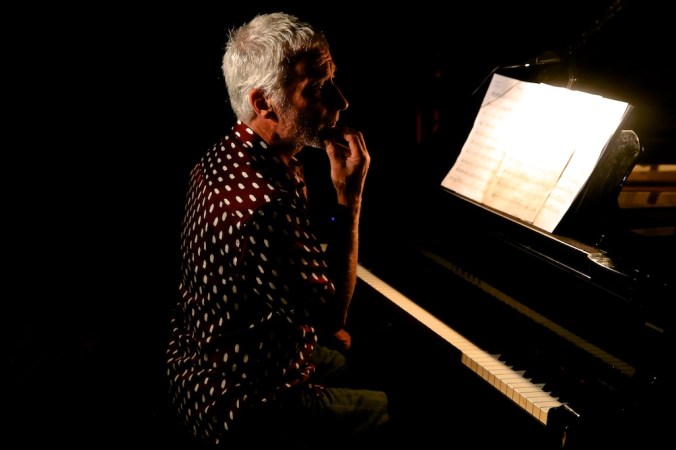 Towards the end of the second set they played Walters ‘As close as you’ll get’. If the title didn’t trigger any memories the first bar surely did. This was a tune that I’d heard way back in April 2012. Its intricate hooks and counterpoint nailed it within seconds. This was not a tune easily forgotten – in fact I happily replayed it in my head for weeks after the 2012 gig. I was not putting up video way back then but have chosen this cut to put up now.
 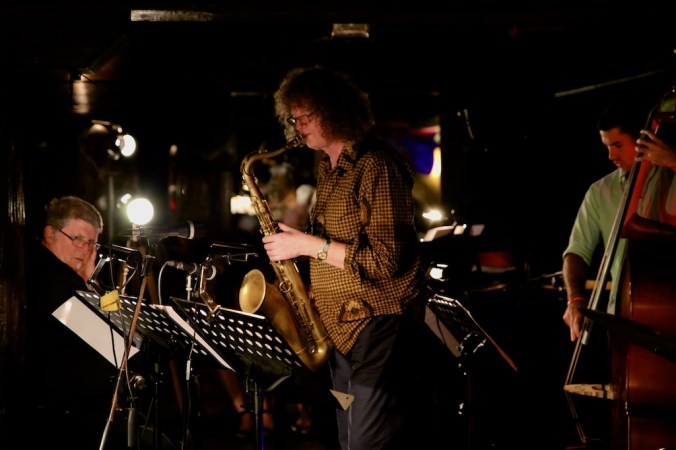 Last years attendance at the club was good and if Wednesday was anything to go by this years will be even better. There were many first time attendees and based upon the applause most will return. The artists create the music but they need engaged audiences to complete the circle. As the famous American bass player David Friesen said to us last year – ‘this is a virtuous circle and the magic only emerges when audience and musicians interlink. The sum of what comes from this interaction is often greater than the sum of its parts. Improvised live music at its best is profound and the thought that we might miss a wonderful and unique moment causes us to return time and again. That is how it works me anyhow.
 JazzLocal32.com