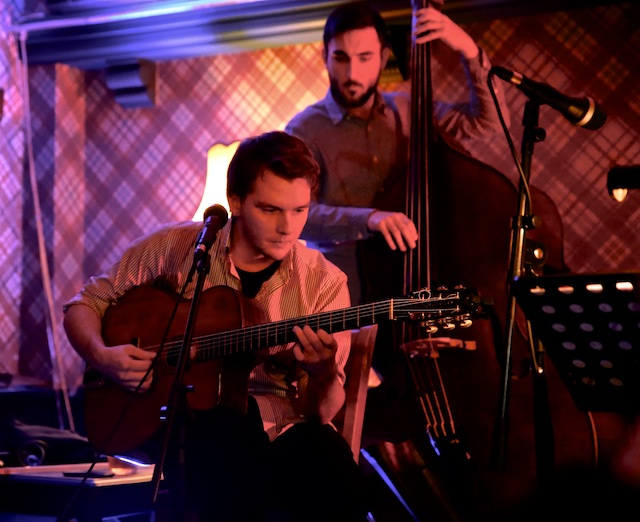
 This is the second gypsy swing project at the CJC in four months. The last gypsy gig brought us Wellington band Black Spider Stomp. This time, we experienced the local variant. Wellington is arguably the home of New Zealand Manouche, but it definitely exists around Auckland. Thanks to Caro Manins (La Luna) and Misha Kovalov we feasted on catchy melodic tunes, marvelled at their hard-swinging lines. ‘Twistin the Swing’ and ‘La Luna & the Gadjos’ worked their magic and swing, they certainly did. It doesn’t matter what your Jazz preferences, I defy anyone to keep their feet still during a spirited Manouche gig.
 This is a music that stirs heart and limbs, a holiday from the cerebral manifestations of improvised music. It makes you feel good and the desire to move with it is overwhelming; that is its charm. I recall a recent discussion with Roger Manins about the diversity of Australian improvised music and he said this. “learning to play in really diverse situations is important. It is a feature of the Sydney scene. One minute the musicians are playing in an avant-garde ensemble, then straight ahead and the next minute playing Trad or Manouche”. For developing musicians, learning to swing in bands like this is invaluable, whatever their eventual calling. It was, therefore, good to see up and coming younger musicians in these lineups.
 The first set was ‘Twistin the Swing’. A very tasty quartet led by the ensemble leader, composer/guitarist Misha Kovalov. The group featured two Manouche guitars, an upright bass, and a reeds player. Kovalov was a leader in every sense of the word, virtuosic in an almost offhand way and oozing good-natured charm. He made us smile and he made our feet tap; what more could you want in a Manouche leader. This was a hybrid kind of Manouche, as many of the latter-day manifestations are (a perfect example is Lagrene playing Stevie Wonders ‘Isn’t She Lovely’). We heard some Django Reinhart compositions, a familiar sounding Russian tune (whose name I can’t recall but it was a total riot) and a lot of Kovalov’s own compositions. These compositions varied in style between 40’s swing and acoustic blues; sometimes with crazy quotes embedded.
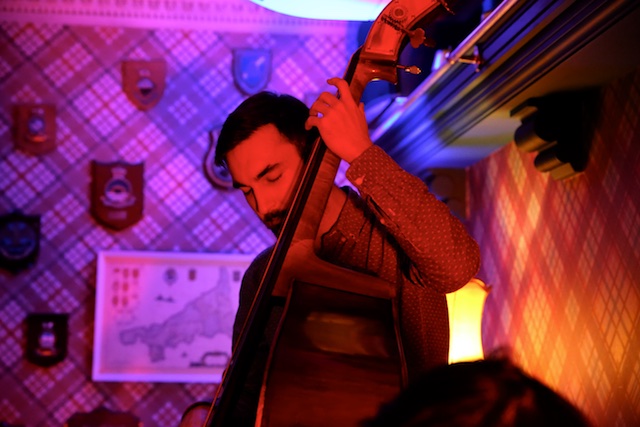
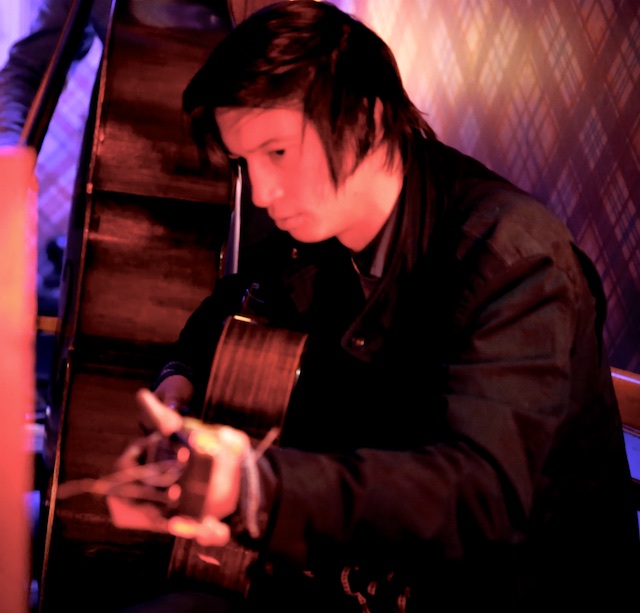
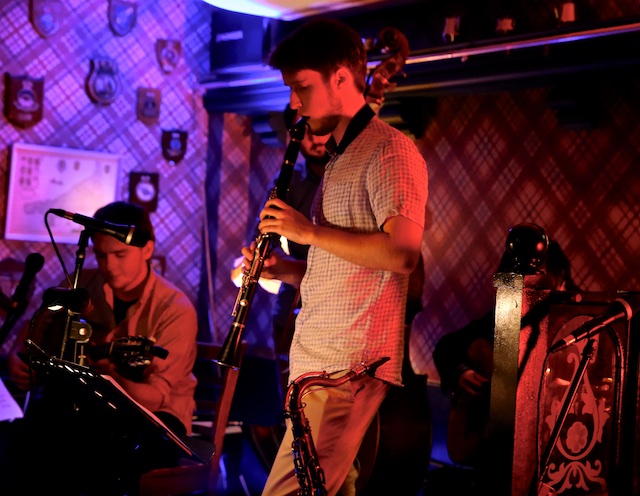 On rhythm guitar was Phillip Beatson, on clarinet and tenor saxophone Asher Truppman-Lattie and on upright bass Djordje Nikolic. Beatson was largely hidden from sight, working his solid rhythm guitar in the shadows; the others all took short solos. It was nice to hear Nikolic playing arco at times, good for a swing rhythm section. It was also good to hear the licorice stick played – a hard task master but especially rewarding in the swing context.
The second set brought leader, vocalist Caro Manins (La Luna) and tenor player Roger Manins to the bandstand (Manins replacing Truppman-Lattie). The band was ‘La Luna & the Gadjos’. This set was also unmistakably gypsy but with some Piaf and a few mainstream swing standards in the mix. Caro Manins has a terrific voice and we don’t hear her often enough. The audience reacted with real enthusiasm. Prior to the gig she had expressed some anxiety because a sudden cold had affected her vocal chords. She needn’t have worried. On the bandstand, her voice came through strongly. It was good to hear Piaf interpreted so well, a singer seldom heard by modern non-French audiences. The crowd pleasers from the second set were definitely the standards ‘Swing Brother Swing'(lyrics Billie Holiday) and the ever popular ‘Lullaby of the Leaves'(Bernice Petkere).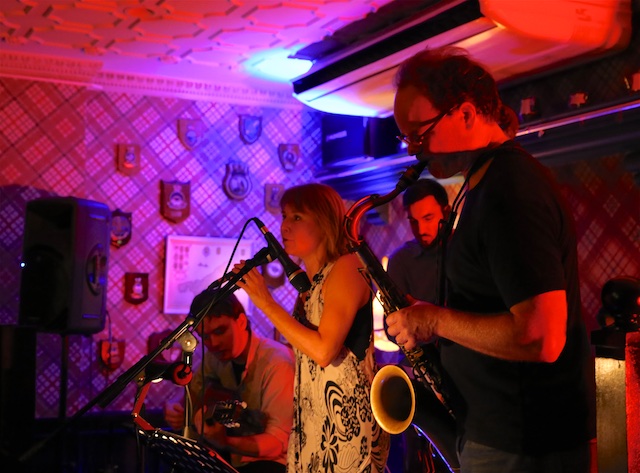
To add to the delights of Caro Manins vocals, Roger Manins was crooning on tenor saxophone. Not his fire-breathing post-Coltrane style, but gentle fills or perhaps laying down a muscular Ben Webster swing style solo, complete with vibrato notes which hung in the air, suspended only by breath. On a cold winter night, nothing warms you more.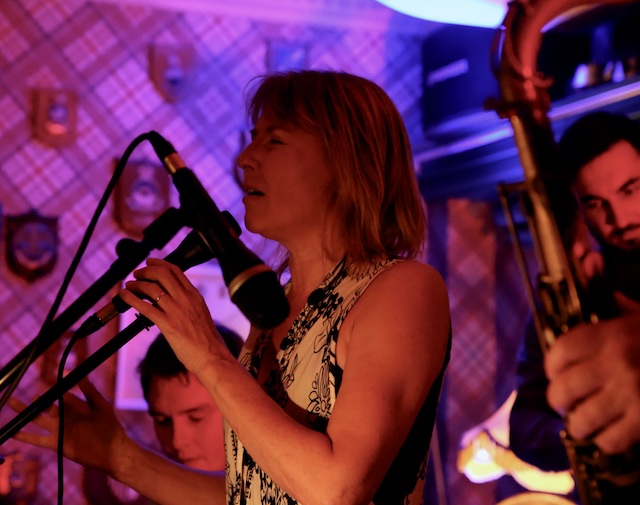 ‘Twistin the Swing: Misha Kovalov (leader, compositions, Manouche guitar), Phillip Beatson (rhythm guitar), Asher Truppman-Lattie (reeds), Djordge Nikolic (upright bass). ‘La Luna & the Gadjos‘: Caro Manins (leader, vocals), Misha Kovalov (guitar), Phillip Beatson (guitar), Roger Manins (tenor saxophone), Djordge Nikolic (upright bass) The gigs took place at the CJC (Creative Jazz Club), Albion Hotel, 18th May 2016.
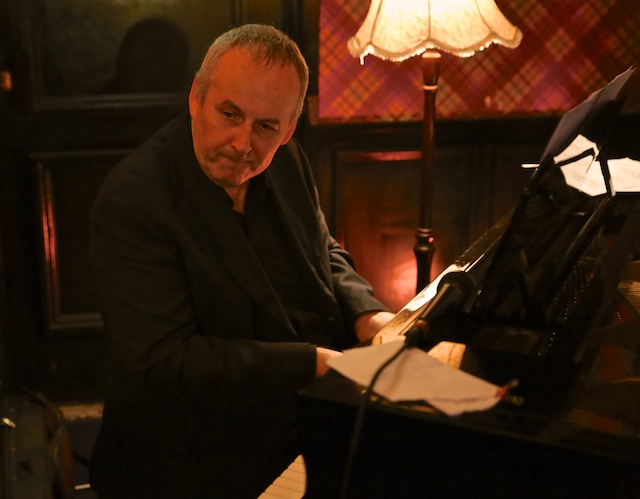 This is pianist Mark Donlon’s second appearance at the CJC (Creative Jazz Club). On this visit, his Shadowbird Quartet featured Aucklanders Roger Manins on Saxophone and Cameron McArthur on bass. The gig also brought Wellington drummer Lance Philip to the CJC for the first time. Both the bass player and the drummer have previously recorded with Donlon. The British-born pianist, educator, conductor is the senior lecturer at the New Zealand School of Music in Wellington
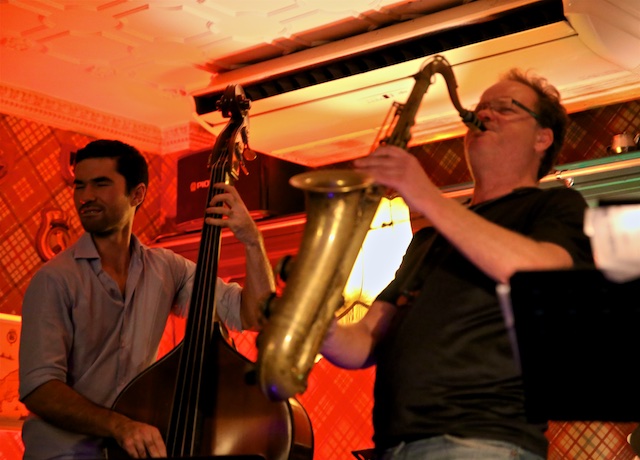 The first tune of the second set was ‘Nibiru’ and it was rich in narrative and melody. A thing of strange and compelling beauty. The piece began with a repeating pattern on piano, a pattern which shifted harmonically as it progressed. Over this Manins began by stating the melody – seldom straying far from the matrix in the opening stages. McArthur on bass intensified the mood by establishing a counter pattern and then repeatedly plucking at a single note, Philip free to add colour and texture – and he did. I liked this piece very much as it sounded both old and new (a nice effect if you can pull that off). The story behind it added another dimension entirely. ‘Nibiru’ is an imaginary planet beloved of conspiracy theorists, the ones who wear tin-foil helmets when venturing outside. The ones who see an absense of smoke as conclusive proof that the fire is well hidden. The planet evidently reveals itself to the chosen few and is the home of lizard people. I’m not so sure that the believers deserve a tune this nice. The tongue in cheek rendering of this odd belief is anything but ‘end of times’.
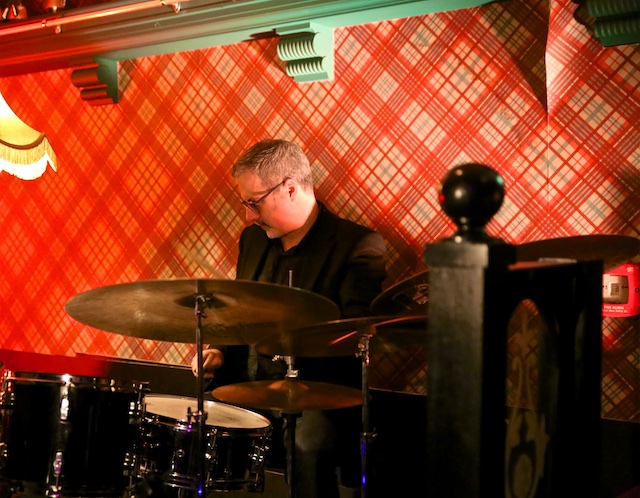 You would expect a group of musicians of this calibre to play well and they did. There are two Donlon albums out shortly and a few earlier ones available. Support local music by experiencing this artist or the bands various iterations. One place to do that will be at the Wellington Jazz Festival in early June.
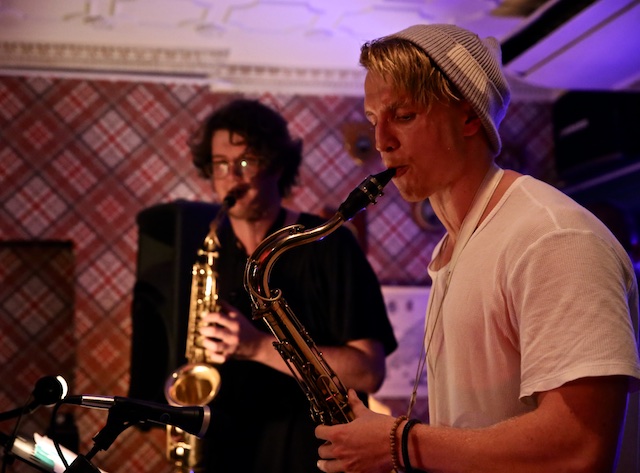 This year has seen a lot of international acts through the CJC (Creative Jazz Club), compelling musicians with interesting stories to tell and often with serious gig miles under their belt. As exciting as it is to see the high-end performers of the scene, it is just as important to recognise and evaluate those who might one day take their place. Not all will last the course, but the persistent and the passionate can make that journey. Standing in front of a discerning club audience tests young musicians in ways not easily replicated. Unlike the Jazz School environment, the musicians technical prowess is subservient to the authenticity they bring to the bandstand. Fluffing a line is more likely forgiven than delivering a technically perfect but lifeless performance. Sam Weeks and Sean Martin-Buss tested themselves and came through the fire relatively unscathed.
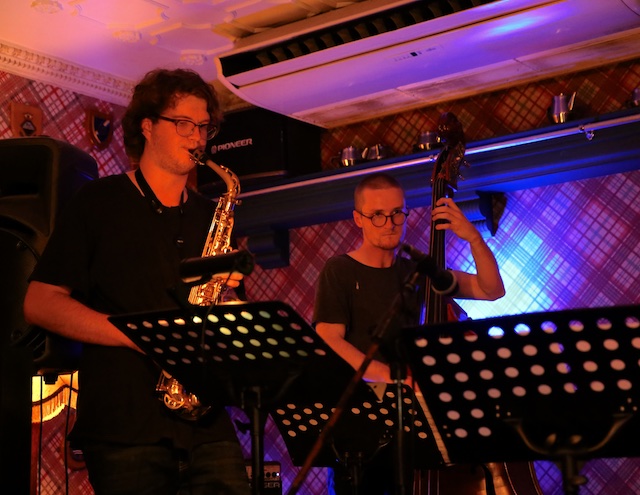 The gig was part of the emerging artists series and the musicians first time at the CJC as leaders. Both have previously played as sidemen at the club, but standing anonymously in a horn line is a different thing entirely. I am happy to give this gig the thumbs up as they performed well. It took the first few numbers for them to warm up properly, but warm up they did. The rest of the first set and the one after that delivered crackling performances. All of the material was their own and their writing skills were favourably displayed (especially those of Weeks). A piece titled ‘Missing Together’ by Weeks was a gem – opening with some tricky unison lines, followed by a few bars of counterpoint. They made it sound easy, but clearly, many of these compositions were not. The act of embracing the difficult is how a musician grows. I am glad they took some risks, as Jazz functions best in the absence of complacency.
 Sean Martin-Buss was on alto saxophone with Sam Weeks on tenor saxophone. Each gave the other ample room and the contrast between the horns was therefore amplified. They also differed stylistically and this gave an added piquancy to the gig. They made good use of interactive Banter, musician to audience and to each other. Off the wall comments came out of nowhere, and the audience included in the joke. The humour was not in the lines but in the offhand delivery. A very Kiwi type of onstage banter – self-effacing, mumblingly casual.
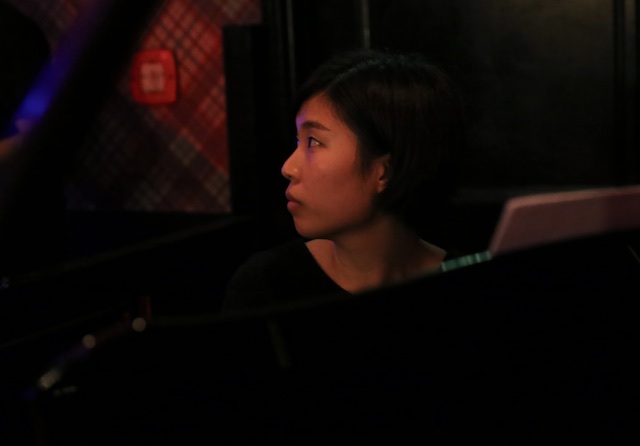
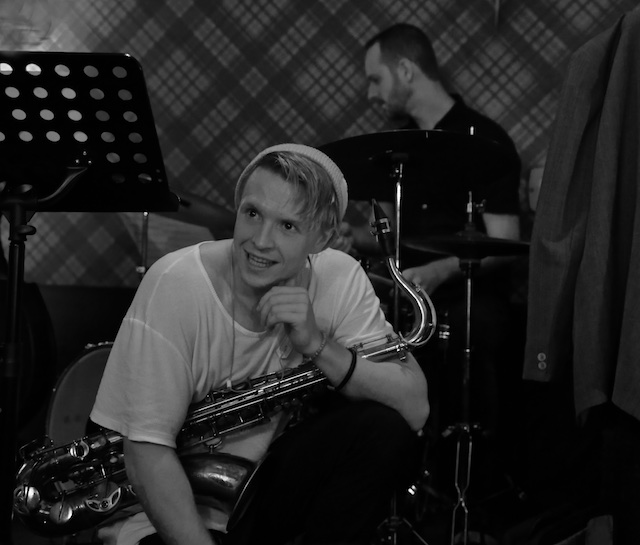 Emerging musicians are often tempted to rely heavily on musicians from their own graduate class. There is nothing wrong with that per se, but the first question is always, which musicians will serve the gig best? Again the co-leaders made good choices in Tristan Deck (drums) and Eamon Edmundson-Wells (upright bass). The remaining band member was Crystal Choi on piano. Deck and Edmundson-Wells perform in public regularly and both have earned considerable respect. They personify good musical taste. They have talent and better yet, they work extraordinarily well together. It was this combination that tightened up the performance – real assets. Choi was extremely interesting on this gig. I have sometimes noticed a tiny hesitancy in her delivery. On this night, her performance exuded confidence and several of her solos were stunning. The enthusiastic audience responded throughout the night.
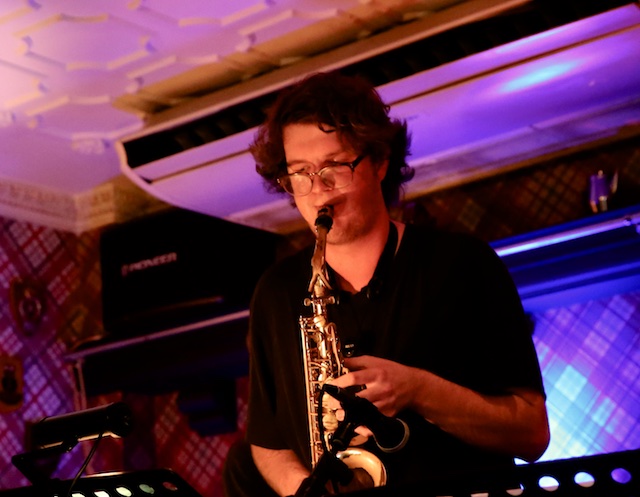 Although the leaders possess perfect vision and are clearly not Venetian, the project was ‘The Blind Venetians’. This was also the name of the final number of the last set; a roistering finale bringing down the cantilevered shutters at gigs end.
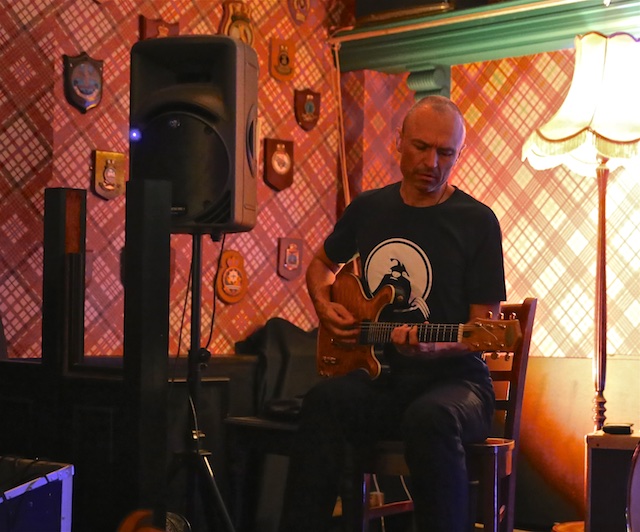 As I write this it is International Jazz Day, a UNESCO sponsored day honouring the diversity and depth of the world improvising scene. It was, therefore, serendipitous that Carl Dewhurst and Simon Barker brought ‘Showa 44’ to town – especially in the days immediately preceding the big celebration. This gig offered actual proof that the restless exploration of free-spirited improvisers, lives on undiminished. I have sometimes heard die-hard Jazz fans questioning free improvisation, believing that the music reached an unassailable peak in their favourite era. To quote Dexter Gordon. “Jazz is a living music. It is unafraid …. It doesn’t stand still, that’s how it survives“. While a particular coterie prefers their comfort zone, the music moves on without them. Younger ears hear the call and new audiences form. Life is a continuum and great art draws upon the energies about it for momentum. Improvised music is not a display in a history museum.
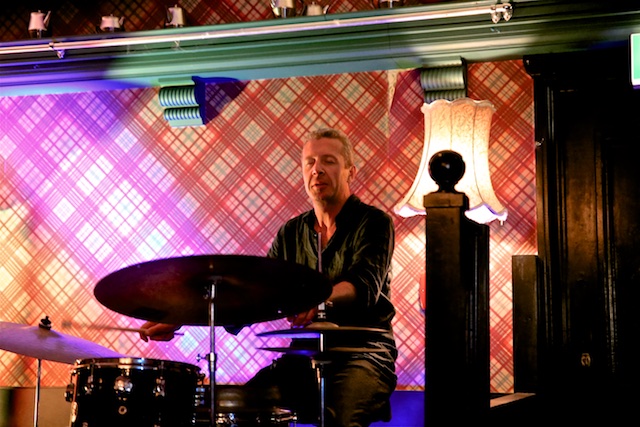 It is through listening to innovative live music that our ears sharpen. When sitting in front of a band like this the mysteries of sound become visceral. This was an extraordinary gig, at times loud and confronting, mesmerising, ambient and always cram-packed with subtlety. Fragments of melodic invention and patterns formed. Then subtly, without our realising it, they were gone, tantalising, promise-filled but illusory. We seldom noticed these micro changes as they were affected so skillfully – form and space changing minute by minute, new and yet strangely familiar – briefly reappearing as quicksilver loops before reinventing themselves.
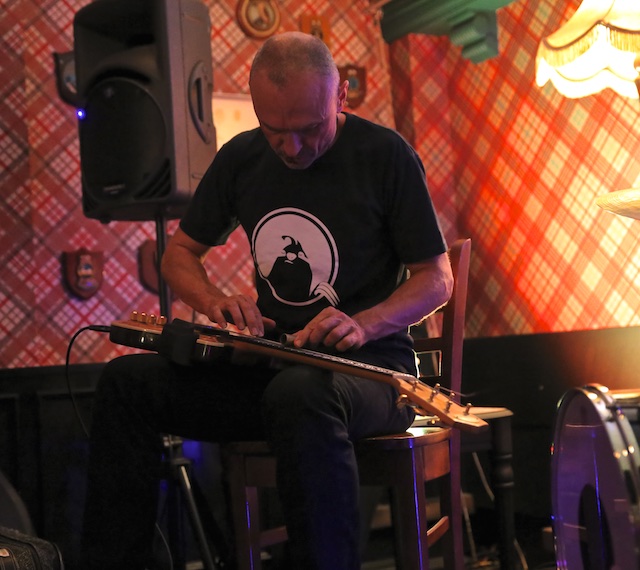 With the constraints of form and melody loosened new possibilities emerge. In inexperienced hands, the difficulties can overwhelm. In the hands of artists like these the freedom gives them superpowers. Time is displaced, tonality split into a prism of sound, patterns turned inside out. The first set was a single duo piece, ‘Improvisation one’ – unfolding over an hour and a quarter; Dewhurst and Barker, barely visible in the low light. This was about sculpting sound and seeing the musicians in shadow added a veneer of mystique. Dewhurst began quietly, his solid body guitar lying face up on his lap. The sound came in waves as he stroked and pushed at the strings, moving a slide – ever so slightly at first, causing microtonal shifts or new harmonics to form, modulating, striking the strings with a mallet or the palm of his hand. The illusion created, was of a single drone repeating. In reality, the sound was orchestral. As you listened, really listened, microtones, semitones and the occasional interval appeared over the drone. Barker providing multiple dimensions and astonishing colour, responding, reacting, crafting new directions.
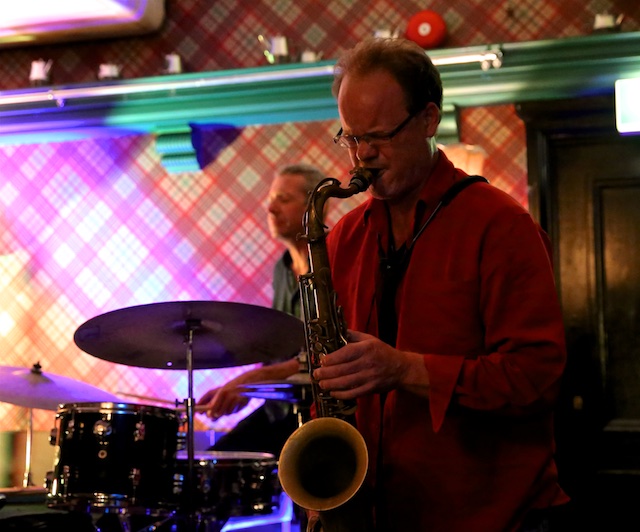 In this context, the drummer took on many roles, a foil to the guitarist, creating silken whispers, insistent flurries of beats and at times building to a heart-stopping crescendo. I found this music riveting and the audience obviously shared my view. In the quiet passages, you could hear a pin drop. If that’s not an indication of the musical maturity of modern Jazz audiences, nothing is. One of the prime functions of art is to confront, to challenge complacency. This music did that while gently leading us deeper inside sound itself. No one at the CJC regretted being on this journey. This is territory loosely mapped by the UK guitarist Derek Bailey, the Norwegian guitarist Aivind Aaset and the American guitarist Mary Halvorson. They may take a similar path, but this felt original, perhaps it is an Australian sound (with a Kiwi twist in Manins). The long multifaceted trance-like drones suggest that.
 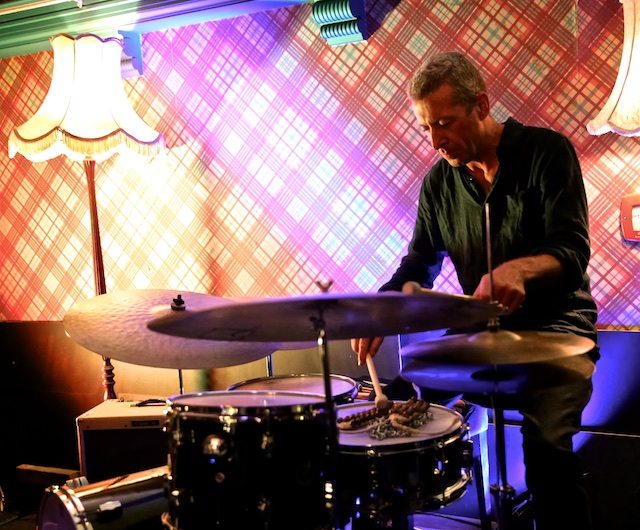 The second set was shorter, ‘Improvisation two’ had Roger Manins aboard. I should be immune to Manins surprises but he frequently catches me off guard. His breadth and depth appear limitless. ‘Improvisation Two’ began with a broader melodic palette. Dewhurst and Barker set the piece up and when Manins came in there was a stunning ECM feel created. Barker tap-tapping the high-hat and ride. Achingly beautiful phases hung in the air – then, surprisingly they eluded us, unravelling as Manins dug deeper – dissecting them note by note. These interactions give us a clue as to how this music works, each musician playing a phrase or pattern and then re-shaping it, passing the baton endlessly.
 JazzLocal32.com