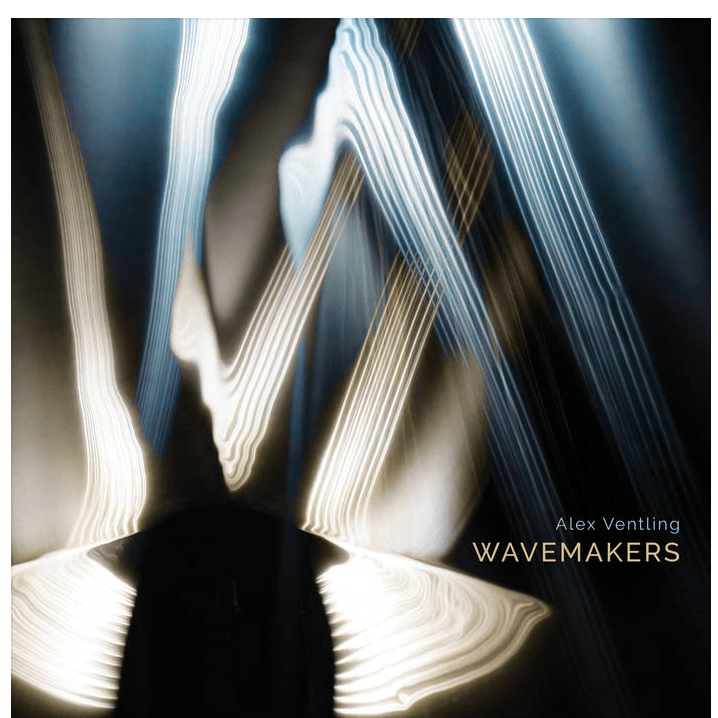
Wavemakers, Alex Ventling’s recent release, has him working with a new sound palette. During his time in Trondheim, he has developed an expansive and beautifully Nordic sound. He has always possessed an open and explorative spirit, but here, he has found a formula that allows his compositions to breathe unencumbered. His compositions float effortlessly, while depth and raw beauty fuel every phrase.
There is pulse and groove throughout, but the patterns morph and shift. Without a bass, the centre is more fluid, leaving room for a variety of interactions. The moody opening number, ‘Tracking’, is a good example with its gentle loping swing feel. Like footprints in a snowscape, it invites you into a beguiling, allusive world.
The piano opens with ostinato chords, followed by a lovely melodic progression. The lines rise seamlessly above the vamp, with violin and vibraphone mirroring the right hand of the pianist. The drummer adds gentle accents. This is very fine writing, and the execution is superb, with violin, vibraphone, piano and percussion playing as if one entity.
On Track two, a human voice is added, not singing lyrics but integrated as another instrument. This is something that the northern European world can lay a claim to; think Norma Winstone, Sidsel Endresen, and Urszula Dudziak. Throughout the album, these unusual instrumental pairings open up new vistas. ‘Trondheim 1, 2 & 3’ are open and crystalline. In those tracks, minimalism is to the fore; the voices arising and disappearing in succession.
Most impressive, though, is the final track, ‘Four Refractions’. This is an evocative folkloric piece of music. It brings joy to the listener, as it dances into the consciousness, and along with the rest of the album, it deserves to be listened to without outside distractions intruding. Tuva Halse, the violinist, is an impressive musician, and I first came across her when I was a judge in an international jazz competition. I knew within minutes that she and her band would be the winners in their category, and so it was. There is no greater pleasure than hearing young musicians living up to their promise.
Ventling has many talents, including filmmaking, as evidenced in the YouTube clip of the title track. Within days of posting, it had had an impressive 66k views. The album has attracted favourable notice, and the band will return to the studio sometime this year. Ventling is in Auckland over February, where you can hear him at the Audio Foundation on the 12th & 21st Feb.
The credits are: Alex Ventling, piano, synth, and compositions. Tuva Halse, Violin. Amund Stenøien, Vibraphone. August Giännestrand, drums & drum machine. Sissel Vera Pettersen, voice. The album is available through Bandcamp.
JazzLocal32.com was rated as one of the 50 best Jazz Blogs in the world by Feedspot. The author is a professional member of the Jazz Journalists Association, was a Judge in the 7VJC International Jazz Competition, is a poet & writer. Some of these posts appear on other sites with the author’s permission.

 JazzLocal32.com