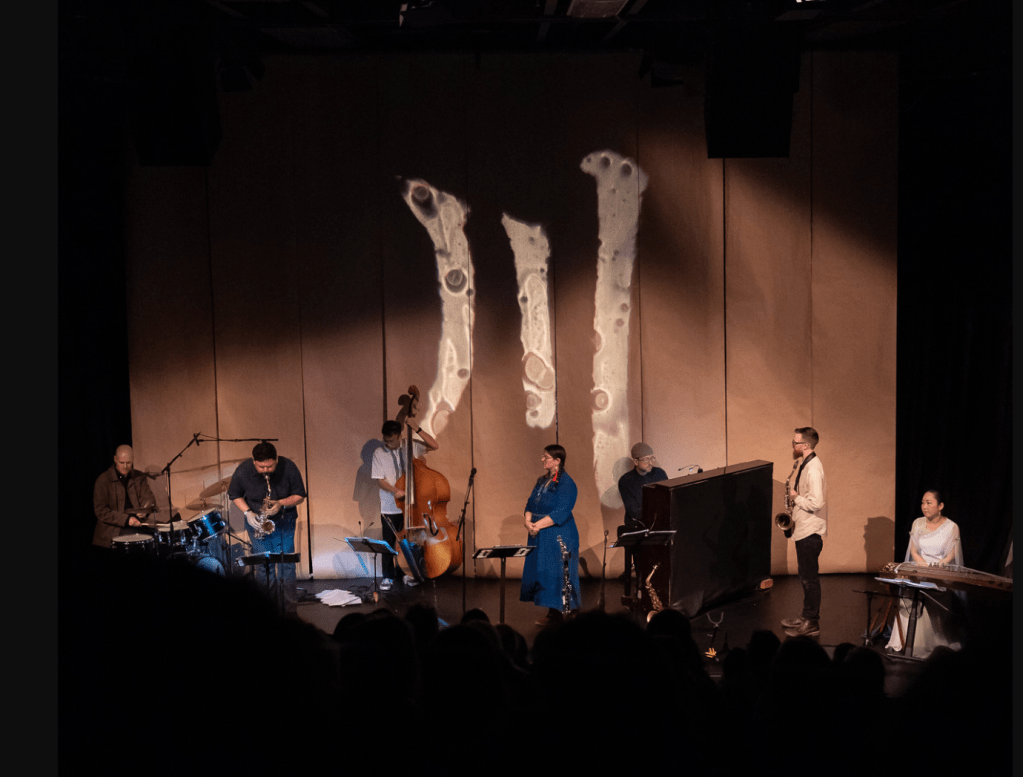
Those lucky enough to attend any of Jake Baxendale’s ‘Waypeople’ concerts last year will have anxiously awaited the release of this album and his release tour. It is music brimming with exotic textures and tasteful arrangements, but it is more besides. When I attended the concert, I sensed that I was hearing something important. It made a statement about the maturity and evolution of Aotearoa’s improvised music scene and also conveyed a message that the world needs to hear right now. This spoke to our times and cut deep.
Before the advent of written language, and for a good while after, important stories were poetised and sung. This enabled generations to memorise and pass on vital cultural knowledge. In fact, poems were sung and accompanied by musicians long after the arrival of the written word, and the practice of silent reading didn’t occur in the West until well into the Middle Ages (sometime between 900-1200 BCE), and in China, during the Song Dynasty (around 1100 CE).
To the ancients, reading was a communal activity, and so it was with the Tao Te Ching. It spread through oral transmission much like Homer’s epics. Therefore, while various texts are available today, hearing it with musical accompaniment feels right. To the Taoists, music deepened the connection with the natural world and awakened ancient memories. As the Tang Poet Li Bai wrote:
‘The monk from Shu with his green silk lute . . .
Has brought me by one touch of the strings,
The breath of pines in a thousand valleys’
‘Waypeople’ is an album that joins a journey begun over 2,500 years ago, and in doing so, it incorporates the cultural expressions and voices found on that journey. Here, the ancient wisdom of the Tao Te Ching is clothed in a contemporary jazz idiom, utilising the oldest of instruments, the human voice and accompanied by saxophones, clarinets, piano, vibraphone, trumpet, drums, flute, oboe and guzheng. The use of the guzheng is particularly relevant here, as it dates back to the time of Tao Te Ching itself.
Throughout the album, selected passages of the Tao Te Ching are sung or intoned. Some verses are urgent and imploring, others reflective–opposites are brought into balance. It is therefore entirely appropriate that the translation is that of beloved contemporary author, Ursula Le Guin. What these musicians have captured is the ebb, flow and essence of these important verses. A balance has been found between the old and new, and the ‘old master’ Lao Tzu would surely smile on this endeavour.
Our world today is like it was in the Warring States (475-221 BCE)– it is out of balance. It is obvious that humanity has again taken many wrong turns, so now is the time to retrace our steps and heed this ancient wisdom. Choose peace over war, quiet and reflection over clamour. So, attend the gig if it comes to your town, buy the album on Bandcamp, listen deeply and reflect. There is no time to lose. https://jakebaxendale.bandcamp.com/album/waypeople – or check out the teaser on YouTube
The musicians are from Wellington and Auckland. Chelsea Prastiti (voice), Jia Ling, (guzheng), Jake Baxendale (compositions, alto, tenor & baritone saxophones, clarinet & bass clarinet), Callum Passells (sopranino & alto saxophones), Daniel Hayles (piano & vibraphone), Johnny Lawrence (double bass), Cory Champion (drums & effects), Louisa Williamson (flute tk 2), Ben Hunt (trumpet tk 5), Kaito Walley (trombone tks 2 & 5), J Y Lee (flute tk 10), Millie Mannins (oboe tk 10) – btw how nice to see Roger Manins daughter in this lineup.
“No competition, no blame” – Tao Te Ching
JazzLocal32.com was rated as one of the 50 best Jazz Blogs in the world by Feedspot. The author is a professional member of the Jazz Journalists Association, a Judge in the 7VJC International Jazz Competition, and a poet & writer. Some of these posts appear on other sites with the author’s permission.
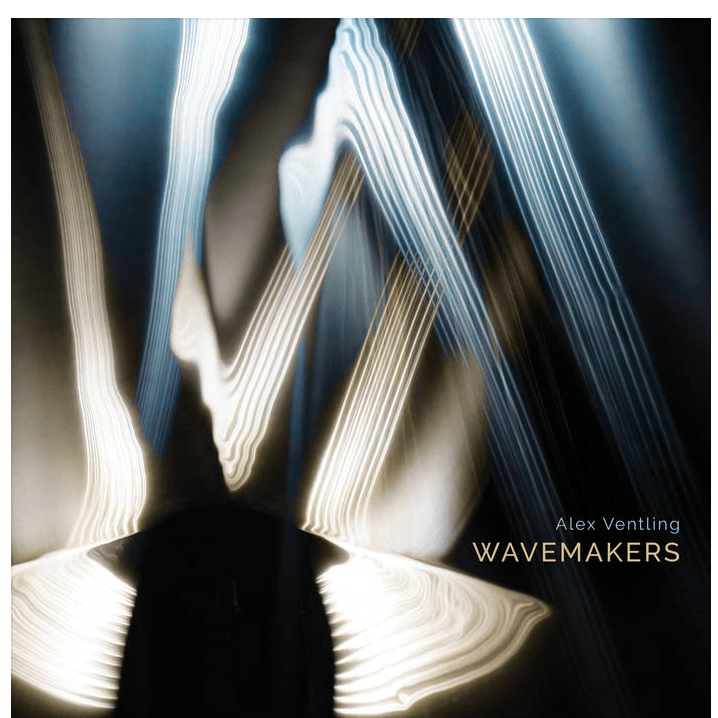
Wavemakers, Alex Ventling’s recent release, has him working with a new sound palette. During his time in Trondheim, he has developed an expansive and beautifully Nordic sound. He has always possessed an open and explorative spirit, but here, he has found a formula that allows his compositions to breathe unencumbered. His compositions float effortlessly, while depth and raw beauty fuel every phrase.
There is pulse and groove throughout, but the patterns morph and shift. Without a bass, the centre is more fluid, leaving room for a variety of interactions. The moody opening number, ‘Tracking’, is a good example with its gentle loping swing feel. Like footprints in a snowscape, it invites you into a beguiling, allusive world.
The piano opens with ostinato chords, followed by a lovely melodic progression. The lines rise seamlessly above the vamp, with violin and vibraphone mirroring the right hand of the pianist. The drummer adds gentle accents. This is very fine writing, and the execution is superb, with violin, vibraphone, piano and percussion playing as if one entity.
On Track two, a human voice is added, not singing lyrics but integrated as another instrument. This is something that the northern European world can lay a claim to; think Norma Winstone, Sidsel Endresen, and Urszula Dudziak. Throughout the album, these unusual instrumental pairings open up new vistas. ‘Trondheim 1, 2 & 3’ are open and crystalline. In those tracks, minimalism is to the fore; the voices arising and disappearing in succession.
Most impressive, though, is the final track, ‘Four Refractions’. This is an evocative folkloric piece of music. It brings joy to the listener, as it dances into the consciousness, and along with the rest of the album, it deserves to be listened to without outside distractions intruding. Tuva Halse, the violinist, is an impressive musician, and I first came across her when I was a judge in an international jazz competition. I knew within minutes that she and her band would be the winners in their category, and so it was. There is no greater pleasure than hearing young musicians living up to their promise.
Ventling has many talents, including filmmaking, as evidenced in the YouTube clip of the title track. Within days of posting, it had had an impressive 66k views. The album has attracted favourable notice, and the band will return to the studio sometime this year. Ventling is in Auckland over February, where you can hear him at the Audio Foundation on the 12th & 21st Feb.
The credits are: Alex Ventling, piano, synth, and compositions. Tuva Halse, Violin. Amund Stenøien, Vibraphone. August Giännestrand, drums & drum machine. Sissel Vera Pettersen, voice. The album is available through Bandcamp.
JazzLocal32.com was rated as one of the 50 best Jazz Blogs in the world by Feedspot. The author is a professional member of the Jazz Journalists Association, was a Judge in the 7VJC International Jazz Competition, is a poet & writer. Some of these posts appear on other sites with the author’s permission.
Nearly 30 years have passed since ECM released Nils Petter Molvær’s popular ‘Khmer’ album. It was a departure from the ECM fare of the day, and not without risk, but it found a receptive audience and sold like hot cakes. NPM (Molvær) laid down a new direction for Jazz, and the 1990s saw a subsequent rise of ambient-leaning improvised music (a genre variously labelled as Jazz acoustic/electronica, future jazz, Nu jazz, etc). It has exerted an increasingly pervasive influence on other Jazz forms over time.
Since the release of ‘Khmer’, NPM has released dozens of albums, and his status on the European jazz scene is unimpeachable. Many of his albums, such as the original ‘Khmer’, were studio-recorded, but, superb as those albums are, this music thrives on live performance. It is mostly danceable, and the club lighting and pulsating audience create a feedback loop, intensifying the atmosphere. In ‘Khmer Live in Bergen’, you can sense that added energy.
There is an unmistakable filmic quality to this mood-dominant music, conjuring up imaginary worlds that linger on the outer edge of reality. The listener is invited on a journey, and a narrative unfolds, but it remains elusive. Unless you immerse yourself. The song titles hint at a narrative, but the ebb and flow of the music fleshes it out. Ambient-leaning music always exalts mood over the strictures of form.
Song of Sand
Despite the title, this is not an exact recreation of the original ‘Khmer’ album. There is no ‘Khmer’ track, for instance, but there are four tracks from the original. As much as a fresh take on the title track might have appealed, the inclusion of ‘Song of Sand’ more than makes up for it. If ever a track evokes powerful dreamscapes, it is this. A distant pulse is heard, soft at first, followed by muffled voices – then the trumpet as the music becomes more immediate, the sound of a caravan navigating its way through dunes, perhaps – each step evenly paced, as it advances over the vast sand-blown landscape. Five of the tracks have appeared on other albums. Of those, I particularly liked ‘Vilderness’, with its Jon Hassell-like resonance, punchy basslines and soaring multiphonic interludes.
This is an ensemble in the truest sense, and in many ways, a traditional offering in fresh raiment. Everything you hear, including the samples, is created in real time. This is a collective improvisation that moves freely inside a flexible form. Sculpting sound in this way requires many deft hands. Four of the musicians played on the original ‘Khmer’ album: Molvær, Jan Bang, Eivind Aarset and Rune Arnesen. The full ensemble: Nils Petter Molvær (trumpet), Eivind Aarset (guitar & electronics), Jan Bang (live sampling), Pål “Strangefruit” Nyhus (DJ, MPC, programming), Audun Erlien (bass), Per Lindvall (drums), Rune Arnesen (drums, percussion).
It is on Edition Records and will be released on August 5, 2025. You can pre-order from Bandcamp now.
JazzLocal32.com was rated as one of the 50 best Jazz Blogs in the world by Feedspot. The author is a professional member of the Jazz Journalists Association, a Judge in the 7VJC International Jazz Competition, and a poet & writer. Some of these posts appear on other sites with the author’s permission.
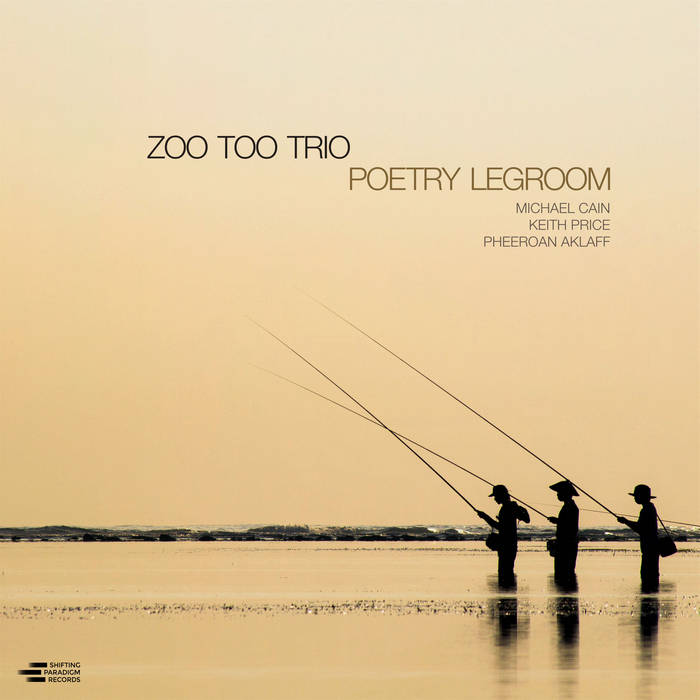
A few months ago, an album was recorded in New York that I couldn’t wait to get my hands on. The pre-release featured several tasty tracks, and its evocative cover image also intrigued. The stars were aligned for a significant album, and so it was. How could it miss with pianist Michael Cain, guitarist Keith Price and drummer Pheeroan akLaff?
It is one of those albums that jazz lovers, whatever their taste, are bound to enjoy. The cover art was prophetic, as its soft golden light and evocative silhouette figures characterised the music perfectly. It is an album to be played through, then played again, and each listening will delight. There’s a sense of place (or should I say places) evident, as the titles reference far-flung locations, but the most important maps traversed are those engraved on the human heart.
‘O’Neil’s Bay’ (Price) is lovely – a bluesy Americana-fused number. The bay in question is familiar to me, nestled against New Zealand’s forest-clad Waitākere Ranges–a hidden bay accessible only on foot. Price lives nearby and has captured the mystical essence of that wild, unspoiled coastline, keyboards, guitar and drums painting with sound.
Another track has the intriguing title ‘Poetry Legroom Okinawa Children’ (akLaff). It unfolds like a miniature suite, adding layer upon layer. Cain’s keyboards arpeggiate over Price’s shimmering chords; the mesmerising drums adding to the feeling of suspension. Like every track that unfolds, you sink inside, holding the moods carefully so as not to spoil the moment.
With ‘Solodos’ (Cain), you understand why Cain is such a well-regarded pianist. The history and the wonder of his music are encapsulated there.
In an album of gems, ‘Waxing Gibbous’ (Cain/Price) is the kicker. Underneath the tune’s languid minimalism, endless aural vistas unfold, displacing time and space into the eternal now. Never has spoken-word poetry been so carefully encapsulated, and the open-hearted colourist drumming of akLaff astounds.
All three musicians have written tunes for the album, and while their approaches differ, they drink from the same creative well. There are no burners, although a quiet intensity is evident as the meditative moods draw the listener into beguiling atmospheric worlds. We live in an era of madness, and albums like this are exactly what we need to assuage our battered senses. Shifting Paradigm Records Bandcamp and streamers.
JazzLocal32.com was rated as one of the 50 best Jazz Blogs in the world by Feedspot. The author is a professional member of the Jazz Journalists Association, a Judge in the 7VJC International Jazz Competition, and a poet & writer. Some of these posts appear on other sites with the author’s permission.
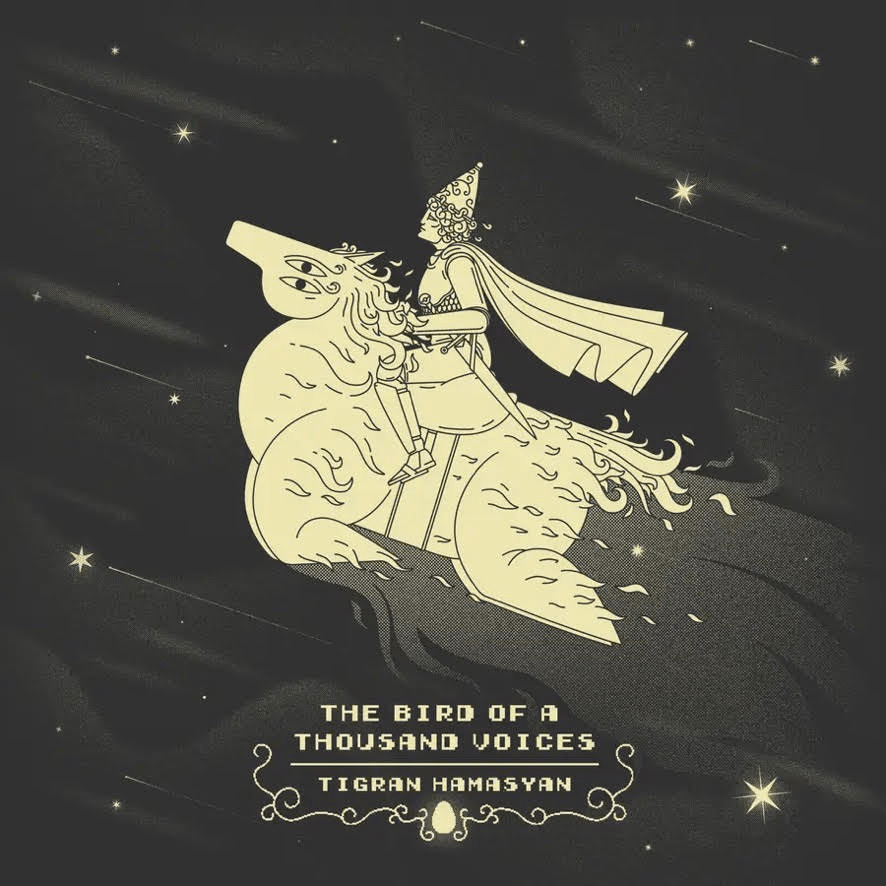
The Bird of a Thousand Voices is an astonishing project, and as I listened and wrote, I weighed up the various superlatives. No other term sufficed. And, to describe it as a concept or a themed album would woefully undervalue it too. The depth and breadth of Tigran Hamasyan’s project is breathtaking and evaluating it requires fulsome engagement. I am not implying that it is unapproachable as there are delightful melodies as light as air, and exotic rhythms to engage, but underlying every note are other worlds, endlessly unfolding–worlds that beg exploration.
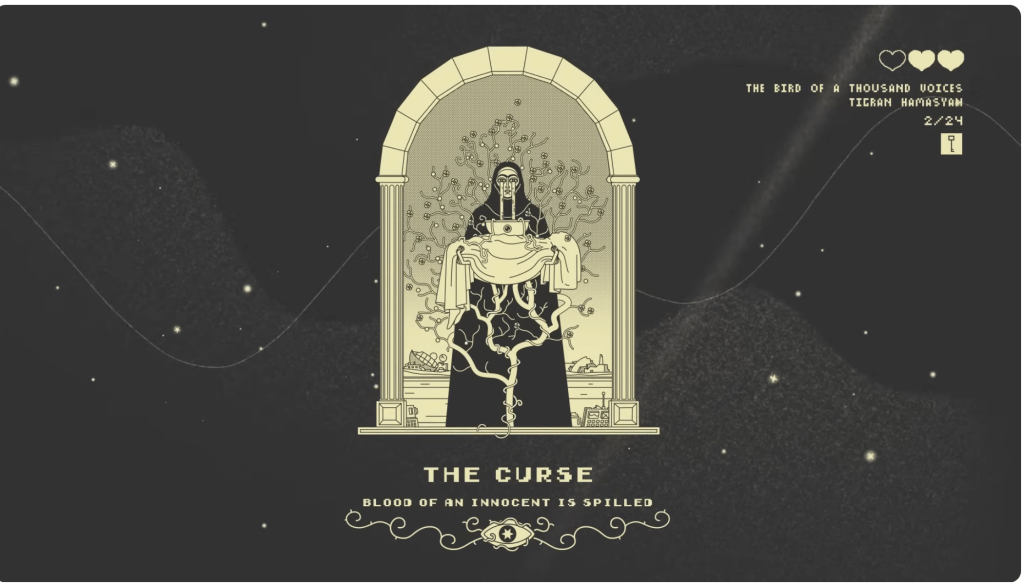
It is a transmedia project with the parts slotting together like pieces of a deliciously exotic puzzle. There is a film, an ancient manuscript, imaginative artworks, an interactive game, a stage show, and a timeless story, all wrapped in and around the extraordinary music of Tigran. It is utterly unique. His sound, touch, and visionary approach as he creates improvised music is singular, and few could pull this off so convincingly.
The project was inspired by an ancient Armenian folktale (Hazaran Blbul), involving an anthropomorphic bird. The fable tells of an era of great unrest, so the bird embarks on a spiritual quest, seeking world harmony. Still, as with all great quests, physical, spiritual and psychological difficulties are encountered along the way. Tigran states in his summary, that it struck him as a metaphor for the problems confronting today’s world; conflict, inequality and ecological disasters.
While the project references an ancient Armenian folktale, the bird theme is universal. Birds are sacred to most Middle Eastern, Mediterranean and Northern European cultures. They are frequently seen as messengers from the gods who can predict the future. Some believe they represent the soul or beauty and offer hope of peace. And, it is not just in myths. They warn us today of biodiversity loss, begging us to do better.
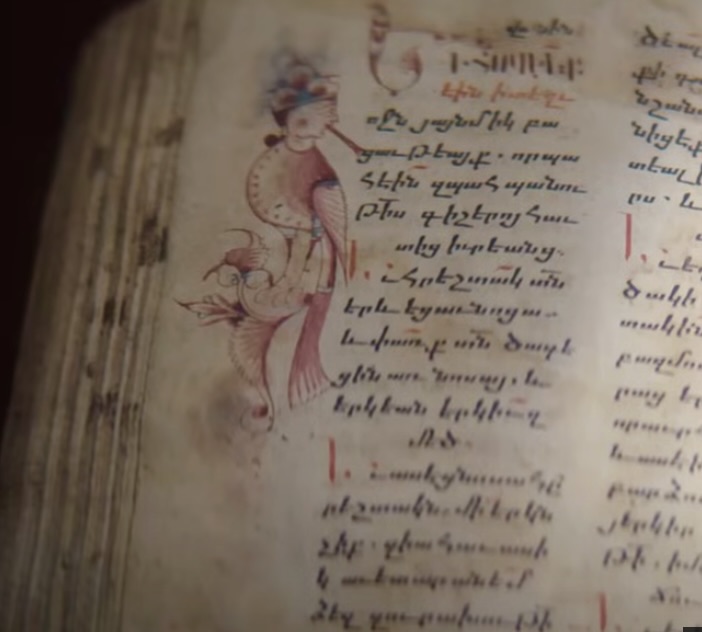
Among the promotional material is a video referencing a medieval illuminated manuscript from Armenia. Inside the manuscript, birds dance out of the vellum pages as Tigran’s Steinway is filmed being airlifted to a mountaintop, and the music dances too. Tigran’s distinctive pianism is immediately recognisable, but a deeper otherworldly quality appears during this recording. His delicate filigree motifs repeat and evolve, choirs or a single voice, echo key phrases and staccato percussive interludes rise, then fade; however, what stays with you is not technique but something more elemental. The project is a prime example of improvised music reaching beyond the familiar as improvised music should.
illustration excerpted from Armenian archives image
The album engages on many levels and should be enjoyed as the creators intended; by listening, watching, gaming, and contemplating. In collaboration with Tigran, Dutch filmmaker Ruben Van Leer has created cinematographic wonders integral to the music, as has illustrator Khoren Matevosyan. As you enter the website to participate in the game or to enjoy the illustrations and installations, you will find dozens of gifted collaborators credited. While there are too many to mention, the principal musicians are Tigran Hamasyan (piano, keyboards, drum programming, compositions, concept), Areni Agbabian (vocals), Sofia Jernberg (vocals), Vahram Sargsyan (vocals), Nate Wood (drums and bass).
The vinyl album can be purchased via tigranhamasyan.com His music is also available on the usual streaming platforms.
JazzLocal32.com was rated as one of the 50 best Jazz Blogs in the world by Feedspot. The author is a professional member of the Jazz Journalists Association, a Judge in the 7VJC International Jazz Competition, and a poet & writer. Some of these posts appear on other sites with the author’s permission.
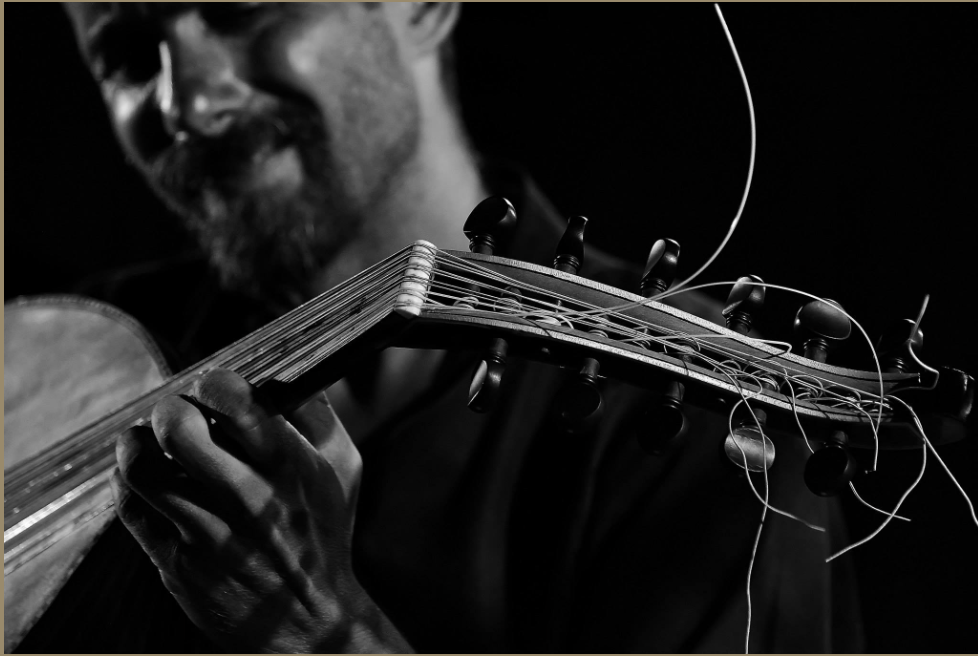
There is something about the oud that awakens the deepest of emotions. Like the sound of an ancient temple gong, it resonates soulfully. It is primarily a modal instrument, using ‘Maqams scales’, a system as complex and varied as the modes used by Coltrane. So, when the chance arose to interview a Jazz oud player, I jumped at it.
Mauro Sigura was born in Turin, where he began his Jazz career playing the bouzouki and guitar. Later, he moved to the island of Sardinia where he found a uniquely ancestral form of music, one for which he developed a deep musical connection. Since then, he has performed throughout the world and participated in numerous festivals. His ensembles reach beyond the confines of genre. They have originality, depth, rhythm and groove. Younger listeners especially, are hungry for such music.
I heard Sigura’s current Quartet while judging the Italian-based 7VirtualJazzClub competition. His entry enthused the judging panel and he deservedly picked up first prize in the Pros & Amateurs section. Shortly after, we exchanged contact details and set up the interview.
~ ~ ~
Mauro, congratulations again on your, 7VirtualJazzClub Competition win. Your music has a rare beauty which pulls on the heartstrings. It is as if you have unearthed a forgotten memory from the distant past. This effect may be evident because the oud is the forbear of many stringed instruments like the guitar, mandolin, bouzouki, lute etc. It is like an echo flowing through time, bringing past and present together.
Q. Could you tell me what the oud means to you, and why you chose it?
A. First of all, thank you for your kind words! As you said, the oud is an instrument that somehow crosses time, has an ancestral link with the cultures of the past, [it] tells of trade exchanges, travels, and meetings between cultures. I came to oud through bouzouki and Greek music, where it is easy to listen to an oud. Then, I started studying Ottoman classical music.
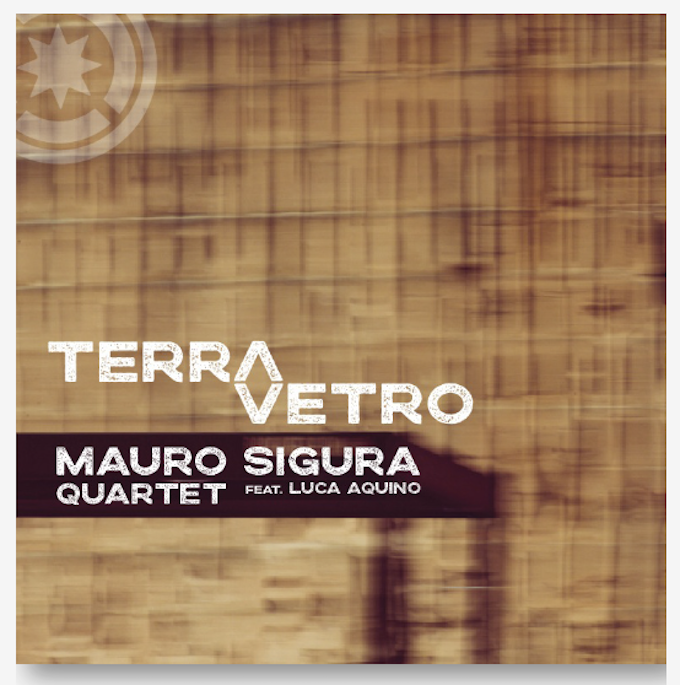
Q Your last album, Terravetro, paired the oud with a minimalist piano. On your recent album, Dunia, there was a Fender electric guitar and an electric bass. Did you have that relationship between ancient and modern in mind?
A. Yes, all my music always tries to connect distant places not only in space but also in time. everything must tie together, but the challenge is to try to do it in the most natural way possible.
Carthago (from Terravetro)
Q. Your recent quartet is great. It could be viewed as either mainstream jazz or as World Jazz. The contrasts and textures are interesting. Especially so with ‘La Danza di Amarech’. Notable are the tight bass lines and edgy drum rhythms, the oud’s earthiness against the electric guitar’s brighter sounds, and that hint of funk over Middle Eastern rhythms and melodies. Could you tease that out and provide an insight into your compositional approach?
A. It depends on the compositions. For example, in ‘La Danza di Amarech’ I started from the bass line and its connection with the drums, the theme came last. I often start from the bass line to then create the theme, then, once a basic theme has been defined, I intervene by inserting more jazz-like modulations. However, it is not a fixed rule, in fact sometimes I have an oud groove or a theme in my mind and that becomes the starting point, or it can start from a traditional rhythm of Ottoman music. For example, ‘Dunia’ is built on a traditional Ottoman rhythm in 10/8, [called] the ‘semai’.
Q. Tell me about your current quartet drummer. She is amazing.
A. Evita is amazing! She has ability,and creativity, she is an excellent composer, so she was able to give us useful advice in [the] studio. In Italy, she plays with the best musicians, such as Enrico Rava, but she often also plays with DeeDee Bridgewater. I saw her play in Sardinia in 2021 and I said: “this girl must play on my record at all costs!” and I succeeded. This year she released her first solo album as a singer-drummer, for Paolo Fresu’s record label. She has a great career ahead.
Q. Do you have any ongoing projects with this particular quartet?
A. It is a quartet that I created for Italy and Western Europe. In fact, with the acoustic quartet, I often play in Eastern Europe and I needed something more attractive to Central-Western Europe. So I’m working to try to propose it to these geographical areas. The album was released on October 8th, so we are still in a phase where Dunia is looking for the best direction.
Q. You record on ’S’Ard’, a Sardinian label but I see you were born in Turin.
Are your forebears from Sardinia?
A. My father was born in Sardinia, but my mother was born near Turin. In 2005 I moved to Sardinia, retracing the path taken by my grandparents in the 1950s, when they left Sardinia to go work in Turin.
Q. Sardinia has produced jazz greats like Paulo Fresu. It evokes an ancient past and a Phoenician connection. The bagpipes may have originated there, but is there an oud tradition?
A. No, there is a tradition of the guitar, but not of the oud, although some elements of the traditional Sardinian guitar certainly have a North African origin.
Q. You have a distinctive sound and approach. Different from Dhafer Youssef or Anouar Brahem. Part of that is due to the pairing of the instruments, but there appear to be regional influences too. Would you like to comment?
A. Yes, certainly, Sardinia, with its ancestral atmospheres, has a strong influence on my compositions. The spaces, the light, the nature are much stronger here than in other parts of Italy and the musical tradition is also very strong, alive and wild and this more or less unconsciously influences me every time. My next challenge will be to look for the influences that Phoenician, Carthaginian and Arab music have left in the Sardinian musical tradition, in particular in the vocal tradition. I would like to start from there, building a Sardinian project that justifies the presence of oud.
Q. Who are your musical influences?
A. Obviously, the ones already mentioned by you Dhafer Youssef or Anouar Brahem influenced me a lot, but also Jan Garbarek and Eivind Aarset. I am used to listening to all good music, from rock, to jazz, to pop to metal and I let myself be influenced by everything without prejudice. I have listened to a lot of Pat Metheny, Miles Davis, Kenny Garrett, but also traditional Greek music (rebetiko), Ottoman classical music, Arabic and Kurdish music, but in general I like all the traditional music. I am very interested in music played with a few simple instruments, especially the music of nomadic people. My music comes out of all this.
Q. I see you studied philosophy. Did any particular philosopher inform your approach to music?
A. No. Perhaps philosophy has influenced my approach to the concepts of my albums. I try to create the album around a concept, but beyond this, no. No philosopher has influenced me by directing me to music.
Q. You performed throughout Europe, but what grabbed my attention was that you performed in Petra, ‘the city that time forgot’. Tell me about that experience.
A. It was an amazing experience! We were invited by the Amman Jazz Festival and the Dante Alighieri Society in Jordan. When they [approached] us about the option for a concert in Petra, I couldn’t believe it. We played for the Bedouin community that lives inside the site. It was a concert for a few close friends, in a unique atmosphere suspended in time. While I was playing I found myself in a sort of emotional trance and I lost the sense of the duration of the concert. It was a strange sensation, but it was as if those rocks were carrying the music forward independently of us [as the players].
Q. Do you see yourself as being in or extending the Sufi oud tradition?
A. I’m very flattered by your question, but I don’t know the Sufi tradition well enough and I always want to have a respectful approach towards those elements of traditional cultures that I don’t know in depth. So, to answer your question I would say no, even if a certain idea of mystical-transcendent trance is present in many of my compositions. If we can take people to another, different, new place, where everyone is on the same level, then we can start talking again.
Q. Who was the vocalist on Dunia and were there any guest artists?
A. Her name is Elena Ledda and she is the most famous Sardinian singer and, also, one of the most famous in the Italian world music panorama. She gave me a great gift of herself by putting her splendid and unmistakable voice in the song. Elena is the only guest in Dunia.
Q. I look forward to hearing more of your albums. Thank you for your time and for the detailed and illuminating answers.
A. It has been my pleasure!
You can order these recordings from Mauro Sigura’s website, from S’Ard records, or locate them on Deezer, Spotify or Apple Music.
JazzLocal32.com was rated as one of the 50 best Jazz Blogs in the world by Feedspot. The author is a professional member of the Jazz Journalists Association, a Judge in the 7VJC International Jazz Competition, and a poet & writer. Some of these posts appear on other sites with the author’s permission.
News that a live recording of Alice Coltrane’s previously unreleased 1971 Carnegie Hall concert was about to drop caused excitement in Jazz circles. 2024, designated by Impulse ‘The Year of Alice’, will see other Alice projects realised, and Shiva Loka is the opener. The quality is great, even though it doesn’t have the degree of sound separation a studio recording has, but that is no bad thing. Being live, the album captures the excitement in the moment and invites us to breathe the spiritual air surrounding Coltrane. And as you take in what is unfolding, the sheer joy of it, it is impossible not to picture the audience sitting about you in rapt absorption. This is an immersive experience and, as such, it reveals the beating heart of Spiritual jazz.
There are four tracks and from the first note played you are present in that great hall. Track one ‘Journey in Satchidananda’ is a tranquil, mesmerising piece. At first, gentle cymbals reminiscent of a temple gong, then a long vamp on bass and with drums answering; out of nowhere, harp strings, Coltrane making them sing like a choir of celestial angels. At that point, you discern voices quietly chanting, followed by flute, then saxophone. The magic has arrived and it never leaves throughout.
The second track, while also tranquil, has a questioning spirit. Arpeggiating harp, arco bass, tiny percussion instruments and then the saxophones keening. Archie Shepp and Pharoah Sanders interact conversationally, as new sonic textures are opened up. An intensity develops as the album unfolds with the tranquil opening tunes followed by incrementally wilder, ecstatic pieces.
We hear two sides of Alice Coltrane in this recording. Both are astonishing in different ways and there is never a moment of doubt about who holds the musical centre. On the first two tracks, she reigns as a peaceful goddess; on the last two, surrounded by an army of titans, she is the epicentre of an ecstatic storm. There was a time when she was primarily regarded as the keeper of John’s flame, but here, she is revealed as the unrivalled queen of Spiritual Jazz, extending his legacy and claiming her own.
The last two tracks ‘Africa’ and ‘Leo’ are compositions by John Coltrane, but it would be wrong to regard these as mere covers as they transform the material into something not heard before. For these last two numbers, Coltrane switches from harp to piano and the fiery goddess radiates her power. She is percussive, with stinging chords, and snatches of chromaticism. Here, and in the last track especially, the rawness and power of the band has been fully unleashed. Thunderous percussion and pounding bass, staccato utterances from the horns and raining down on the keys, Coltrane’s hands.
It is hardly surprising that she chose these particular musicians as they have all been associated with her or John at some point. Coltrane on harp, piano and vocals, Pharoah Sanders on saxophones and flute (at times chanting through the flute), Archie Shepp on saxophones and flute, Jimmy Garrison and Cecil McBee on bass, Ed Blackwell and Clifford Jarvis on drums, Tulsi Reynolds on tamboura, Kumar Kramer on harmonium. As you listen you marvel at the beauty and raw power. It is an album that will stay with you for a long time. It is out on Impulse too, which explains the warm embrace of the sound.
The concert was recorded the year she released ‘Journey to Satchidananda’, her fourth Impulse album and not long after another acknowledged masterpiece ‘Ptah, the El Daoud’. My first thought was, why wait so long to release such an exceptional album, but on reflection, it was a good decision. Now is the time to fully acknowledge Alice Coltrane’s legacy. Available online or from the better local retail outlets.
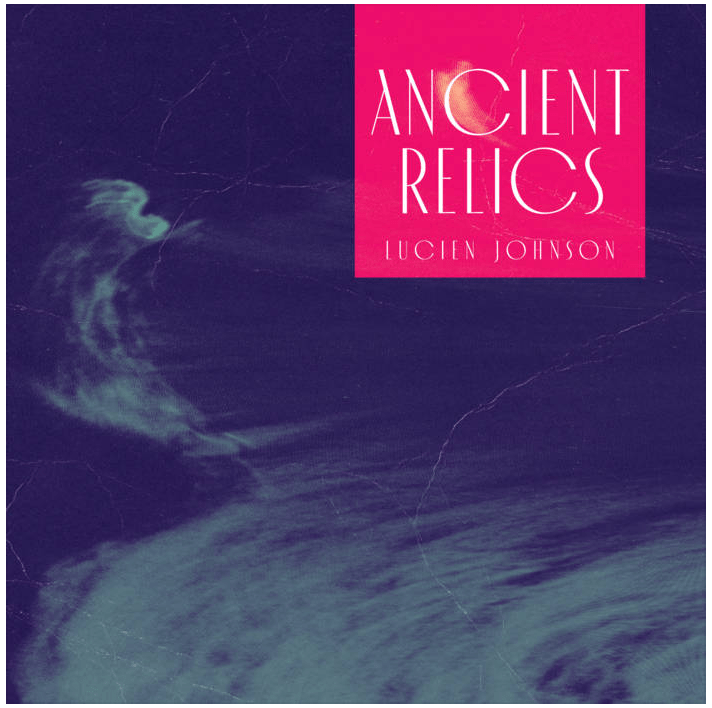
Ancient Relics ~ Lucien Johnson
As ‘The Year of Alice’ gets underway it is great to acknowledge this release by Aotearoa/New Zealand saxophonist-composer Lucien Johnson. It is fresh material that references the tradition of Astral/Spiritual Jazz and it does so with reverence while bringing a local perspective. It is natural for those born under our South Pacific skies to gaze upward; far-dreaming Pacific star-gazers discovered our islands. That sense of worlds beyond is evident throughout, as it references space clutter and objects left over from the past. It could also reference the cluttered inner orbits of our minds.
As the album begins, the unhurried pace appeals instantly, informing you that this is a place for deep listening. On the title track, ‘Ancient Relics’, Johnson’s effortless melodicism floats over texturally rich vamps reminiscent of drones while piano and harp shimmer, and merge. This opener is unmistakably Alice-like and wonderfully so. The languid measured bass lines are perfect too, anything more would have spoiled the mood, with the gentle pulse from percussion and drums, whispering, quietly through the mix.
My favourite tracks are ‘Space Junk’ and ‘Satellites’, evoking the wonders of space while reminding us of our responsibilities as galactic sojourners. Space is the theme, but closer to home than the distant stars. If ‘Ada’ refers to the protocol of distance between objects in orbit, then all of the tunes appear to reference space junk; the ever-increasing proliferation of satellites circling the Earth. A recent report pointed out that every reentry leaves debris and puts the Earth’s magnetic field at risk.
This is an exceptional group of musicians and the right ones to bring Johnson’s vision home. All are from Aotearoa/New Zealand, some receiving accolades beyond our shores. Johnson is better known in Europe where he gained a reputation playing in free-jazz ensembles and composing for theatre. Since returning he has quickly established himself as an important local recording artist, recently receiving a Jazz Tui for composition.
Jonathan Crayford on piano (also a Jazz Tui recipient), has a solid international reputation, often playing in London, New York and across Europe. Percussionist Julien Dyne is another internationally recognised artist as is harpist Natalia Lagi’itaua Mann. Rounding off the ensemble bassist Tom Callwood, and drummer Cory Champion, both respected musicians. I was especially delighted to see improvising harpist Mann in the lineup as it has been a while since I saw her perform. Her World-Jazz Rattle album ‘Pasif.Ist’ is an absolute gem.
The album is available at Rattle Records, Bandcamp
JazzLocal32.com was rated as one of the 50 best Jazz Blogs in the world by Feedspot. The author is a professional member of the Jazz Journalists Association, a Judge in the 7VJC International Jazz Competition, a contributor to All About Jazz, poet & writer. Some of these posts appear on other sites with the author’s permission.
Jim left us in January, and the shock of his unexpected passing robbed me of the right words. In the following weeks, I mulled over my inaction, wanting to do justice to his story? Then I caught covid and more time passed. While it is usual to post an obituary within days of someone passing, I paused and reflected. And as I deliberated, I could sense his presence, knowing that he would approve of my waiting until the right words appeared. Jim’s life was a Zen koan, and you can’t rush a koan.
We had spoken on the phone a week before he died and arranged a ‘hang’ in a nearby coffee bar. It was sometimes hard to catch him on the phone, but when he picked up you could feel the warmth radiating from the handset. The conversations were slow grooves. He would speak softly, radiate peace and intersperse his comments with periods of reflective silence. Jim seldom rushed his words, and the silences felt all the more weighty for it. He spoke as he played because he understood the power of space between sounds.
I had known him for over a decade, but I wished I had known him for longer. He was a musician’s musician; the term used to describe a player of significance but one who is scandalously under-acknowledged. He had been on the Jazz scene his entire adult life and had played alongside some of the greats, but his natural habitats were in the Spiritual Jazz and avant-garde scenes. Many assume that the music of the avant-garde is strident. In Jim’s hands, the music was reflective, spiritual and embedded in indigenous culture.
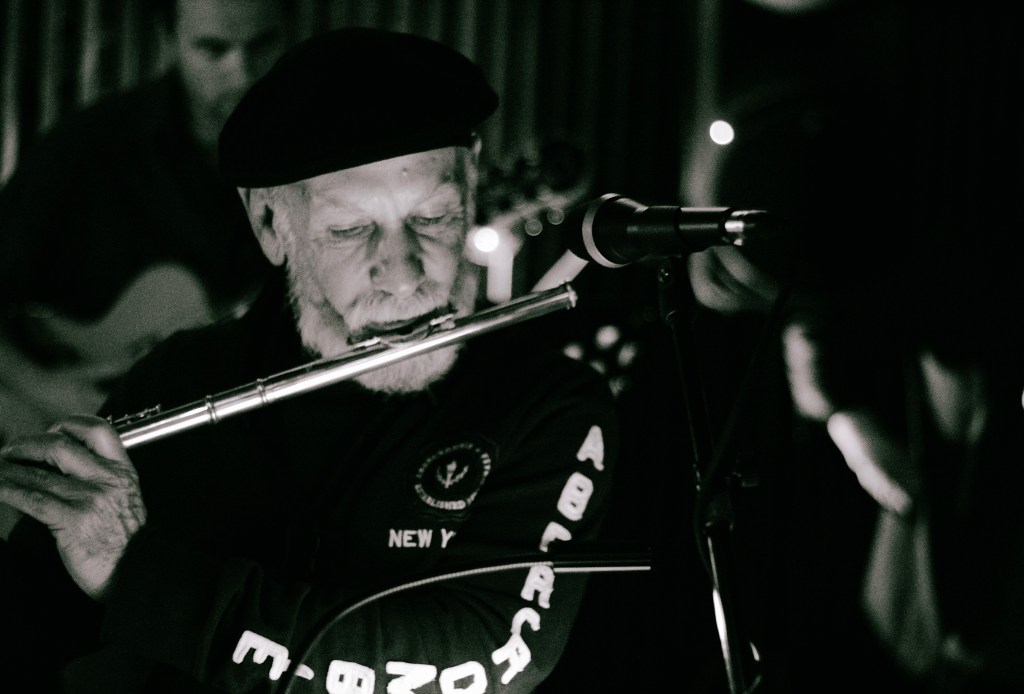
He could crack open a note and let it breathe in multi-phonic splendour. He could whisper into a flute and then unexpectedly send forth a flurry of breathy overtones. He had great chops and visionary ideas, but he was not egotistical. Jim was about the music and not about himself. He was an educator and an empowerer. It was about transmission – telling the story, enjoying the moment and passing on the flame.
He had written the liner notes for one of the first American Spiritual Jazz albums incorporating his Buddhist name (Tony Scott’s ‘Music for Zen Meditation). He’d recorded with poets and acolytes and played alongside Dave Liebman and Gary Peacock. He also had a presence on many New Zealand albums but seldom as a leader. At first, I put this down to modesty, but now I think otherwise. His musical journey inclined him towards humility; he possessed that in the best sense. Gentle souls leave softer footprints.
He gave more to music than he received; to understand why you should know something else about Jim, his long involvement with Zen Buddhism. It was a particular connection that we had. Each of us had connected with Buddhism in our youth which informed our attitude towards in-the-moment music. Although I meditated then, mine was of the Beat variety of Zen, remaining a lazy ‘psychedelic’ Buddhist. Jim took his practice seriously, spending time in Zen Mountain Monastery, Mt Tremper, upper New York State.
While on that scene he performed with other spiritually engaged Jazz musicians like Gary Peacock, Chris Dahlgren and Jay Weik. And amazingly, performed with famous Beat poets like Alan Ginsberg and Anne Waldman who had an association with the centre, and together, had set up the Jack Kerouac School of Disembodied Poetics at the Naropa Institute. In New York, he connected with Tony Scott and Dave Liebman. Later, Jim established a New Zealand Sangha in the ZMM lineage and brought out their first teacher.
I recall messaging him when I was last in San Francisco to tell him I was seeking the forgotten Jazz Clubs, the homes of lost poets and the San Francisco Zen Centre. Names leapt across the cyber-void, Black Hawk, Kerouac, Kaufman and DiPrima. Back and forth we messaged during that week. He, tapping out fragmentary reminisces of his Dharma experiences in America and recalling some of the Jazz musicians he’d encountered (eg. Jaco Pastorius, Rashid Ali, Arthur Rhames, Gary Peacock, Dave Leibman).
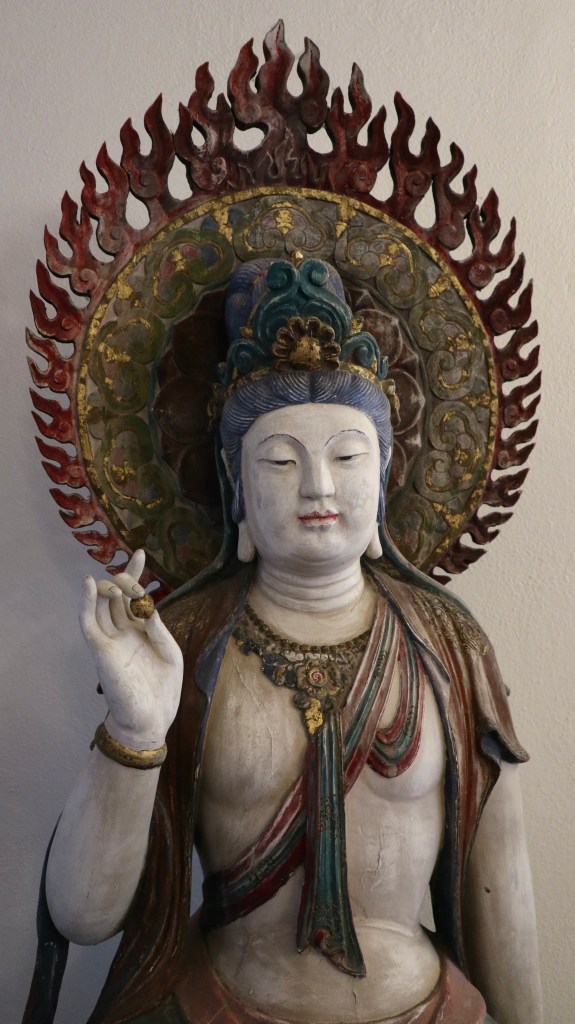
I, responded with pictures of a priceless Rupa as I stood in the Zen Centre Meditation room; buying a new translation of Han Shan’s Cold Mountain poems and sending him a picture of the cover. And me, reliving Ginsberg’s visions of Moloch as I wandered the corridors of his trippy nemesis, the Sir Francis Drake hotel. Buddhist practice, poetry and improvised music are old acquaintances. It was our instinctive connection.
I would bump into Jim at gigs. And he would say, “I hoped you’d be here, I have this for you” passing over a booklet on Finnish Jazz or a CD. He would press them into my hand without explanation and carry on talking about other things. These were Zen puzzles for me to unravel. I realised what treasures they were only later.
He came to my seventieth birthday, a house party where he enjoyed the young musicians playing. He was photographed, deploying his best smile as he posed among us. On that occasion, he handed me a bag of goodies, a limited edition double album – a live concert featuring Arthur Rhames, Jaco Pastorius and Rashid Ali. Handwritten by sharpie was the cryptic inscription ‘jimjazz ⅕’ – another koan to solve. Did he record this?
Important chroniclers like Norman Meehan have written about him, but I’m sure there is more to say. His family and musician friends will create a fuller discography, preserve his charts and update his filmography. It is important. Because he was not a self-promoter, he could surprise you when he appeared in line-ups. With Indian vocalists like Sandhya Sanjana, Tom Ludvigson & Trever Reekie’s Trip to the Moon band, at the NZ Music Awards, at numerous Jazz Festivals and on movie soundtracks. And he played and contributed to daughter Rosie Langabeer’s various out-ensembles. He played the flute on the ‘Mr Pip’ soundtrack and saxophone on daughter Rosie Langabeer’s soundtrack for the indie film GODPLEX
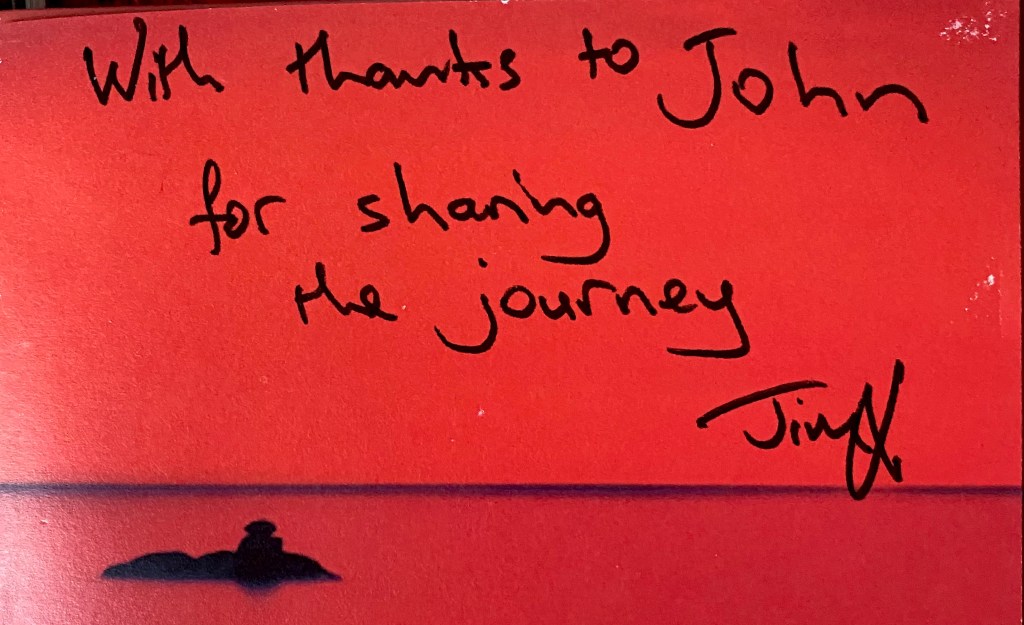
He released at least two notable local albums as a leader, but perhaps there are more? Jim’s Africa/Aroha album with Barry Young (SUPERBREW) was released as an LP by Ode in 1984 and re-released in 2007. It has remained popular with jazz lovers. Prophetically, his composition Aroha cropped up on the hospital Spotify playlist during his last hours. The album broke fresh ground in New Zealand with its freedom-tinged Afrobeat and World Jazz influences. It is gorgeous.
Around 2016 Jim undertook a research and performance project at the Auckland University Jazz School, where he was awarded a Masters’s Degree with first-class Honours. Out of that came his finest recording Secret Islands (Rattle). After recording, Jim phoned me and asked if I would write the liner notes and I was pleased to be on board. He also used my photographs.
I am an enthusiast of avant-garde music and a fan of Jim’s approach, so it was a labour of love. Secret Islands is one of a select group of albums that tells a New Zealand Jazz story. It could not have come from anywhere else. I had heard the band play a preview of the album and loved what I heard. The recording took things to another level. It featured an all-star lineup. With Jim’s vision and Rosie and the other player’s contributions, it was sure to hit a sweet spot. Later a live performance was reprised at the Audio Foundation with Jim on flute and tenor, Jeff Henderson on drums, Rosie Langabeer on Piano, Neil Feather on an experimental instrument and Eamon Edmundson-Wells on bass, with Roger Manins on Alto. It was a superb performance. I will never forget it. The Secret Islands album (clip above) featured Jim Langabeer on winds and reeds, Rosie Langabeer, piano and Fender Rhodes, Neil Watson, guitars, Eamon Edmundson-Welles, bass, Roger Manins, alto saxophone and Chris O’Connor, drums.
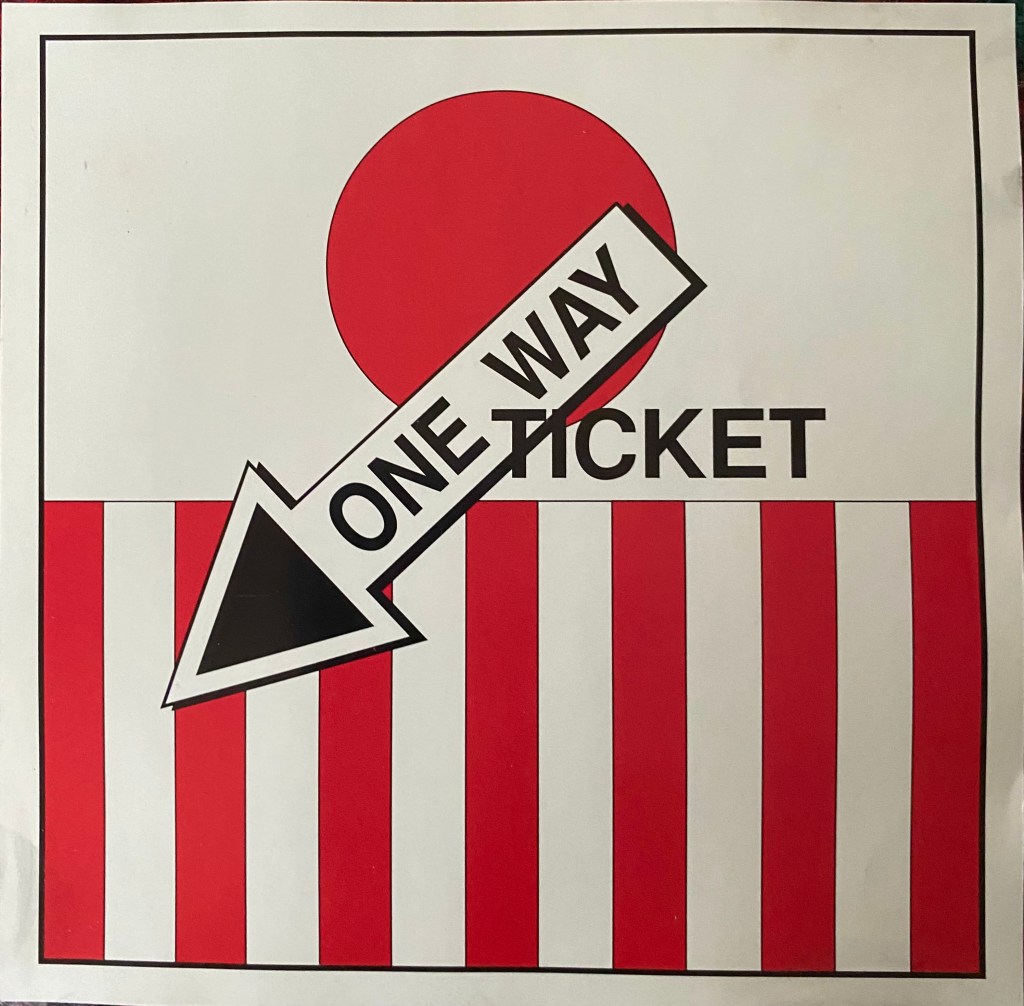
One last album that deserves mention is One Way Ticket – Daikajo. Released in 1995 by ‘Dharma Communications’ Zen Mountain Zen Monestry NY and produced by Jim. On it, he leads the ensemble on alto saxophone, silver flute and shakuhachi. Like most of Jim’s albums, it is Spiritual Jazz. A subgenre of improvised music that is experiencing revival worldwide.
Just before the first lockdown, I visited him at his Farm Cove home as I wanted to record an oral history. I switched on my recorder while the conversation ran for two or three hours. It often veered into the esoteric. When Ī played it back, I realised that I needed another session with a greater focus on Jim’s achievements. I can usually keep an interview on track, but in Jim’s case, words were like pebbles in a pond. A series of moments setting off ripples haiku-like.
Before I knew it the pandemic had arrived. I had lost my window of opportunity. Jim passed at the height of the second lockdown, and much as I wanted to attend his funeral, I couldn’t. I participated online and remembered him in silence, a copy of Secret Islands beside me and his tune Tangi playing softly in the other room. We loved Jim and mourn his untimely passing.
Footnote: The Rupa (Buddhist image) is an antique statue located in the San Francisco Zen Centre. It is likely the Bodhisattva Kuan Yin or Maitreya in Bodhisattva form. The video is Jim’s tune Ananda’s Midnight Blues which I filmed at CJC Jazz Club, Auckland. I have also included the clip ‘Tangi’ from Secret Islands. Lastly, I would like to fondly acknowledge Jim’s daughters, Rosie, Catherine and Celia Langabeer, and Jim’s partner Lyndsey Knight, who together, acted as fact-checkers.
JazzLocal32.com is rated one of the 50 best Jazz Blogs in the world by Feedspot. The author is a professional member of the Jazz Journalists Association, poet & writer.Some of these posts appear on other sites with the author’s permission.









 JazzLocal32.com