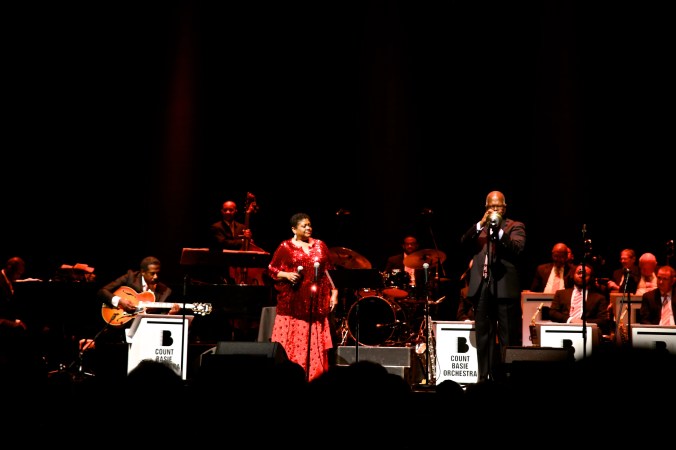
 There are a number of things that should be on every music lovers bucket list. Experiencing a Basie Orchestra gig live is one of them. This band has the history of modern music in its DNA and after 83 years on the road, they are in their prime. Goodman was always referred to as the ‘king of swing’ but in my view Basie was a better contender for that title. His brand of swing had it’s nascent stirrings in 1927 when Basie joined Bennie Moten. When that band folded he took many of the musicians with him to form the Basie Band in 1935. The Basie band possessed a unique sound, fueled by a nine-piece line up featuring legendary greats like Lester Young, ‘Papa’ Jo Jones and Walter Page. Johnny Hammond heard them in 1936 and invited them to New York where at his suggestion they expanded to become a thirteen piece jazz Orchestra. At this time they were joined by Freddie Green and others. Skillfully, they incorporated the nimbleness of the Kansas City small ensemble swing-feel into a new sound.
When we listened to the Orchestra in Auckland a few nights ago, every iteration of their 83 years was touched upon. Early and contemporary charts, the gorgeous highly arranged charts from Neil Hefti, Frank Foster and Quincey Jones ‘second testament’ era, some newly arranged material, plus a fabulous tribute to the Basie/Amstrong/Fitzgerald collaborations. Giving added weight to that celebration was the inclusion of vocalist Carmen Bradford. Bradford was originally hired by Basie himself and so she has a long association with the orchestra. Hers is a big voice and an instrument perfectly suited to Ella’s songbook. She is a Jazz vocalist in the traditional sense and it is no wonder that Basie gave her a shot. At times she sang duets with various of the band members, but it was when she and Scotty Barnhart got together that the sparks really flew. 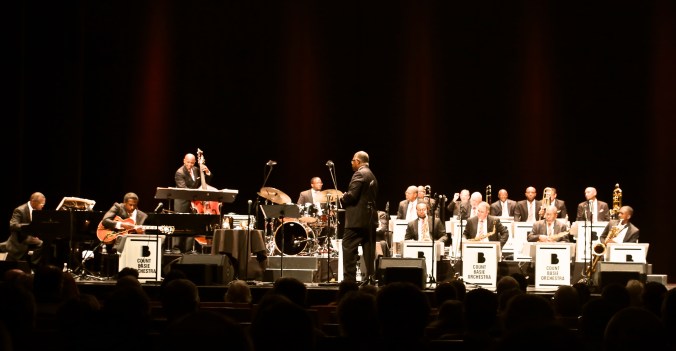
Barnhart, a two times Grammy winner is the musical director of the Basie orchestra and a featured soloist. His Louis Armstrong tribute captured not just ‘Pops’ but the great man’s contemporaries, an often overlooked cohort who deserve to be examined more often than they are. Modern trumpet styles are a long way removed from the street rich dirty growls and blues-infused storytelling of those times. A sound which always communicated a world of raw emotion and deep humanity. As the tribute tunes moved through the era, we heard everything from the lighter-hearted ‘A Tisket a Tasket’ (a traditional nursery rhyme), to Gershwin classics like ‘A Foggy Day in London Town’ or ‘Summertime’. Some of the numbers predated the Basie bands like ‘Struttin With Some Barbecue’ (Armstrong 1927) while others were more contemporary like the gorgeous arrangement of Stevie Wonders ‘Ma Cherie Amour’.
Among the most enjoyable moments were the sensitive trio rendition of ‘Hello Dolly’ (Herman) and the ever wonderful and always compelling Hefti arrangement of ‘April in Paris’ (Duke/Harburg). Doug Lawrence the tenor soloist astounded as always (I was sitting next to a young tenor player and his jaw dropped in amazement during Lawrence’s solos). These musicians are so tight that an atomic blast couldn’t separate them and they swing like crazy. I guess 84 years on the road will do that. I have seen this orchestra before and with any luck, I will see it again and again. There is only one thing you can say in summing up a Basie Orchestra performance; “ONE MORE TIME – please”.
The concert took place at the Aotea Centre, Auckland City, New Zealand, July 30, 2018
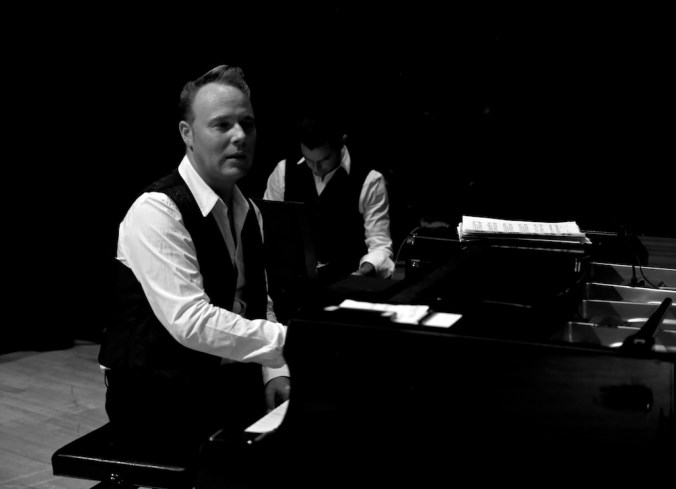 This piece was almost titled ‘my career as Jef Neve’s Driver’, but in the end, I shied away from that. In truth, my tenure as a roadie/driver was brief (although fulfilling). The term roadie was perhaps a bit of a stretch also because I only lifted one suitcase (and that was with help). I decided early in life that my ideal job was working as a roadie for a Jazz pianist. I figured that the obligation to lift heavy things would be minimal and that I could consume endless supplies of live improvised music. With regard to the first point, I was woefully under-researched. In Europe, Neve actually travels accompanied by his piano, but luckily for me, the airlines are reluctant to accept a piano as stow-on luggage. The Auckland airport pick-up went flawlessly (apart from the suitcase to person ratio which was resolved by Neve who is used to fitting notes into improbable spaces). As we drove, I chatted; easing my way into the story in true Gonzo journalist fashion. So there we were jammed into my car like Hanseatic cod; Jef, Pieter, Dieter and me; heading for a piano, a rhythm section and a string quartet. This was going to be fun.
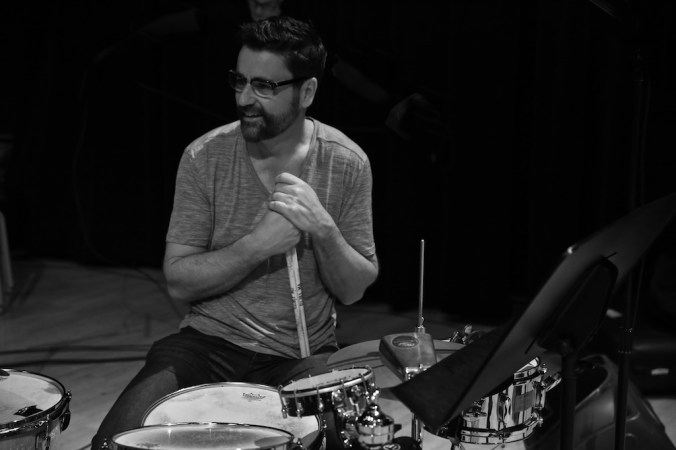 I met Neve once before and I have followed his career over the years. He is a major artist and a household name in Belguim. A year ago I passed through his beautiful city of Ghent, and I vividly recall a young woman behind the hotel counter asking me what I knew about the city. It was actually Robert Browning who introduced me to Ghent, but I replied Jef Neve. Oh yes, he’s famous she said. When I told her that I had once interviewed him, she was obviously impressed. In her eyes, I was no longer some grey haired tourist but a guy who had met Jef Neve.
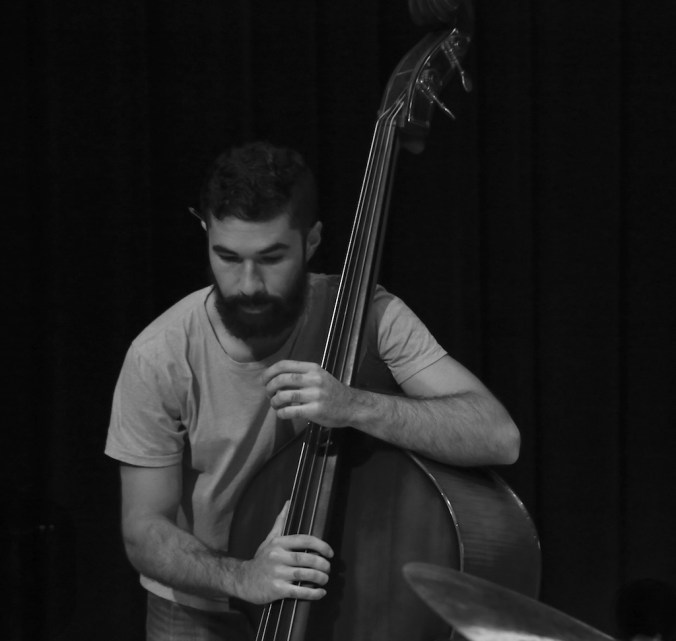 The KMC is a venue with good acoustics; not too dry – not too wet. It was once a television studio and before that the principal home of radio in New Zealand. Now it houses the UoA Jazz School and the School of dance. I found a swivel chair and slid my self across to the listening sweet spot as the trio rehearsed. Then, the string quartet turned up and the work began in earnest. Into that darkened space the music spirits descended; channelling themselves through Neve’s fingers and entering the musicians one by one. I sat there through four and a half hours of rehearsal; soaking up the sound; awestruck and utterly engrossed from start to finish. Cam McArthur was on bass and Ron Samsom on drums. Both are very fine musicians – on this gig they manifested as truly great musicians.
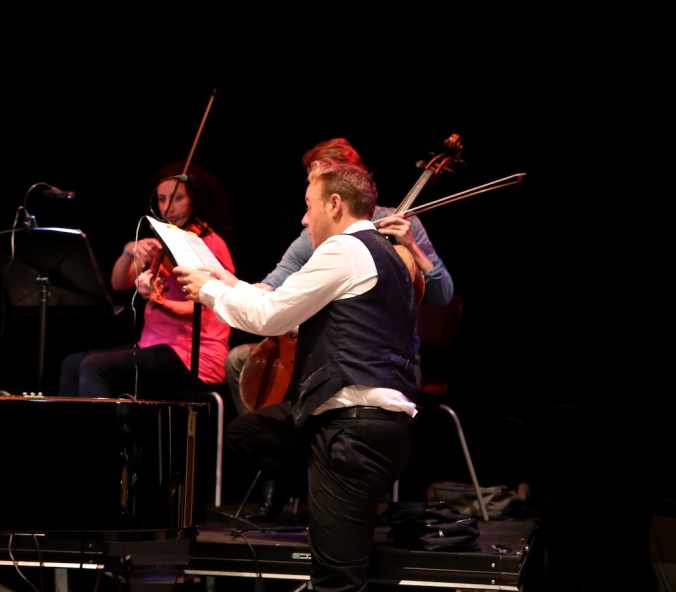 Experienced improvising musicians are quick to read cues; usually conveyed by a brief glance. Things can change in a moment as new ideas develop; it is a core skill – the ability to interpret subliminal signals and react accordingly. For a classical string quartet, it is different. Cues are generally pencilled into their charts or perhaps conveyed by a conductor. The Black Quartet tackled these difficult charts with vigour, questioning Neve throughout and writing in minute changes or subtle expression marks. I heard Neve remark afterwards how enormously impressed he was with their musicianship – “I would be happy to work with these musicians anytime”, he said. Throughout the day the musicians rehearsed the knotty bits and acclimatised themselves to function as an ensemble. Watching music like this take shape is a joy.
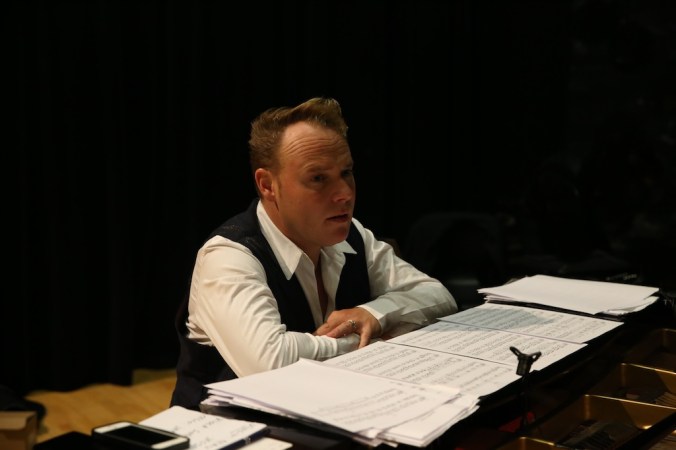 Concerts like this are underpinned by hard work and it usually takes a number of rehearsals to achieve tight ensemble playing. Occasionally I get to observe bands in rehearsal or in a recording studio and as the hours go by you can feel the energy shift. An evolution occurs as the music is properly understood and internalised. So it was with this ensemble and after hours of concentrated work, they breathed in unison. The key to this was Neve who is a gifted communicator and patience personified. When energy is harnessed in this way it becomes spirit. Neve had two assistants with him and as the ensemble poured over the charts these two quietly wove their magic. Both sat at consoles and throughout the day they tweaked, miked-up and fine-tuned the sound. The string section was miked to perfection, giving out a sweet woody sound but subtly amplified to exactly the right place in the mix. An audience is seldom aware of the hours a good sound technician puts in (that is unless they do a poor job). This was sound mixing as an art-form. The results were perfection.
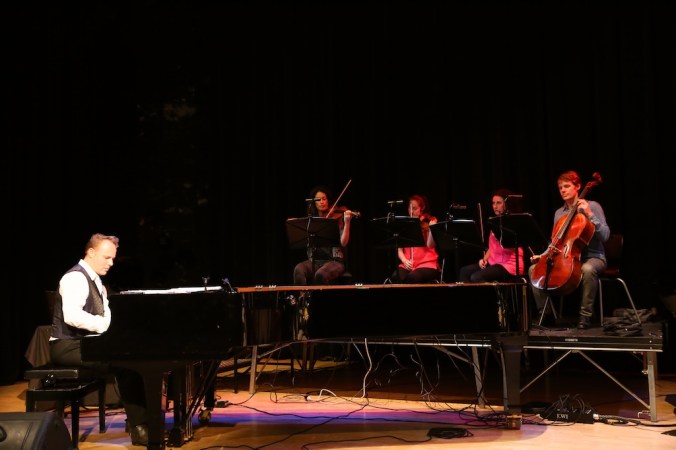 ‘Spirit Control’ is a lovely album. It is richly satisfying and with a clarity of purpose that cuts through genre and preconception. There is an orchestral quality to Neve’s piano so when the orchestra comes in or fades out the transition feels seamless. There are so many clever references in this music – often shimmering – mirage-like; Tango, folk, modern classical, Nordic improvised Ambient, even pop. This is, however, Jazz of the highest order. Not drawing on the blues but on the many musical forces of Neve’s continent. Jazz has many homes in the modern world. While most of the pieces on the album were played at the Auckland concert there were also new arrangements and pieces from previous albums. There were also hard swinging trio passages. During these, Samsom and McArthur were astounding, moving from arco bass or colourist drumming to a dizzying, exciting, take no prisoners swing. The cross-appeal of this album is evidenced by the fact that it appeared on the Belgium pop charts and stayed there for weeks.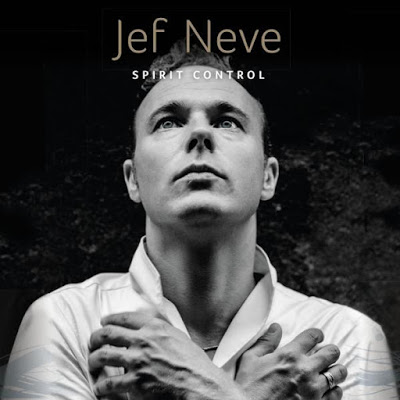
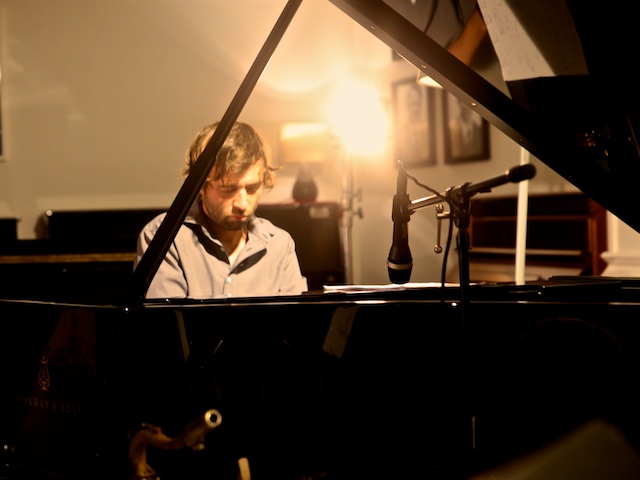
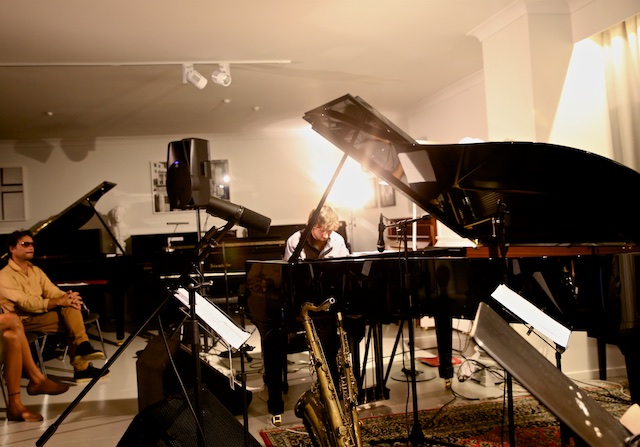 The Lewis Eady special concert featuring the Michal Martyniuk trio lived up to its promise. It’s not often I get to hear Martyniuk and more’s the pity because his playing resonates strongly with me. He attended the Auckland University Jazz School, but he doesn’t sound like his contemporaries as he brings his Polish origins to the keyboard. His is the approach of Wasilewsky and other modern young Polish improvisers. Rhythmically adventurous, melodically rich and with harmonies often referencing the twentieth century European classical composers. Polish Jazz developed in isolation and in secret, the Nazi’s forbad it and the Russians strongly discouraged it. From Krzysztof Komeda onwards the music communicated a unique sense of place, an authenticity, self-contained inventiveness and at times even wistfulness. The initial impetus came from covert listening to Radio America but the rich wellsprings of Chopin, eastern bloc avant-garde and mazurka are there too.
 They were joined on three numbers by saxophonist Nathan Haines, a long time mentor of Martyniuk’s. The concert marked a cross-road for Martyniuk as he and the trio departed for the Jakarta based Java Jazz Festival soon afterwards. This prestigious event is the biggest Jazz festival in the world and it bodes well that they were chosen to perform there. The festival is attended by well over 100,000 people and it pulls in the who’s who of the Jazz world. After the concert Martyniuk is travelling on to Europe (and Poland) where he hopes to intensify his studies and absorb more of the Jazz of his youth. He informed me that he would probably return in about a years time. That is something for local Jazz lovers to look forward to. The back room of the Lewis Eady complex is a good space acoustically, the audience embraced by an encompassing circle of grand pianos. There is a sense that these resting machines add sympathetic resonance to the performance, it certainly seemed so last Wednesday.
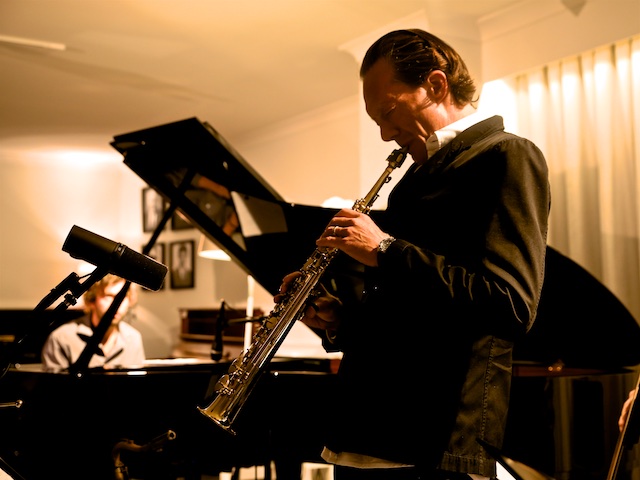 As the programme developed, the trio dived deep into the material. They demonstrated their skill as individual musicians, but also that they could play as a highly interactive unit. There was room for subtlety as well as bravura, together they sang. Having Haines join them rounded off the performance, especially on his trade mark cutting soprano. No one else locally sounds like him on that horn, he is a master of the instrument. As I listened, Haines brought to mind John Surman, an English improvising saxophonist who has a unique clarity of sound on the three horns he plays.
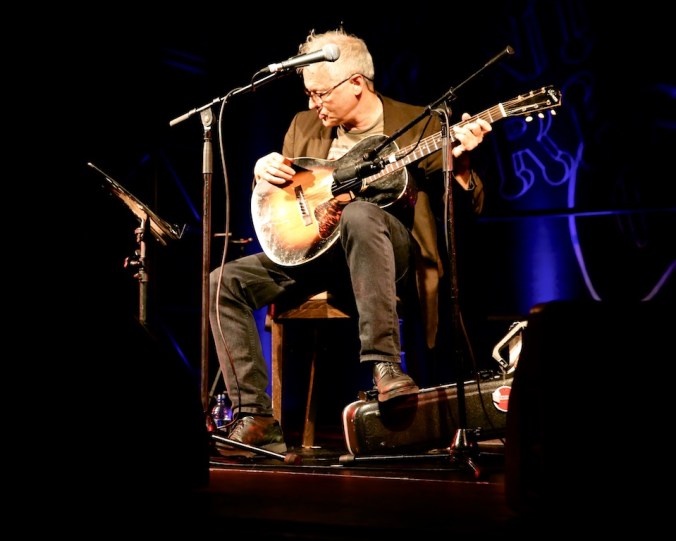 I am a Marc Ribot enthusiast so when local musician Neil Watson sent me a message to say that Ribot was coming to New Zealand I whooped for joy. My first thought was, wow, this will be the good shit. My next thought was, oh yeah I want to interview that cat about his musical and social activism. Watson was to open for him which pleased me. Watson was a good fit for this gig. An iconoclast multi genre improviser himself.
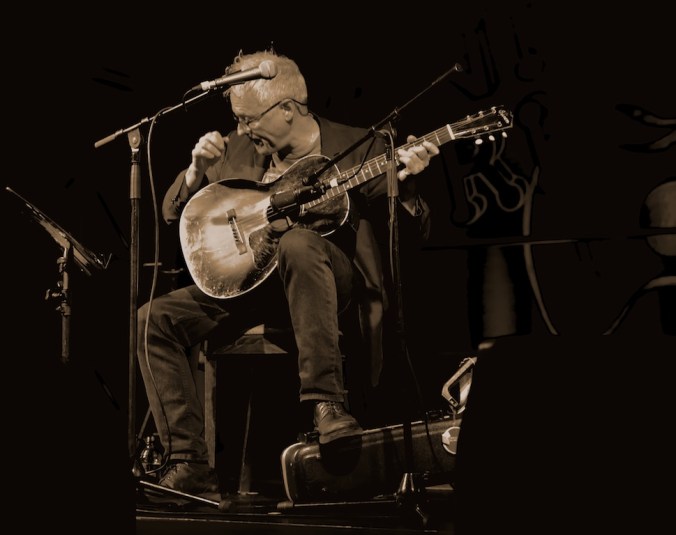 My first act on arriving at the venue was to approach the Tuning Fork floor manager and ask about photographs. He told me of a request from Ribot for absolute quiet. It was solo acoustic guitar, not Ceramic Dog and at Ribot’s request the venue turned off the air-conditioning and fridges. Camera clicks were obviously out of the question unless between numbers. I respected that and took photographs unobtrusively during moments of applause. This was a special gig that required a womb of engaged silence. Audience and musician locked into an embrace of sound.
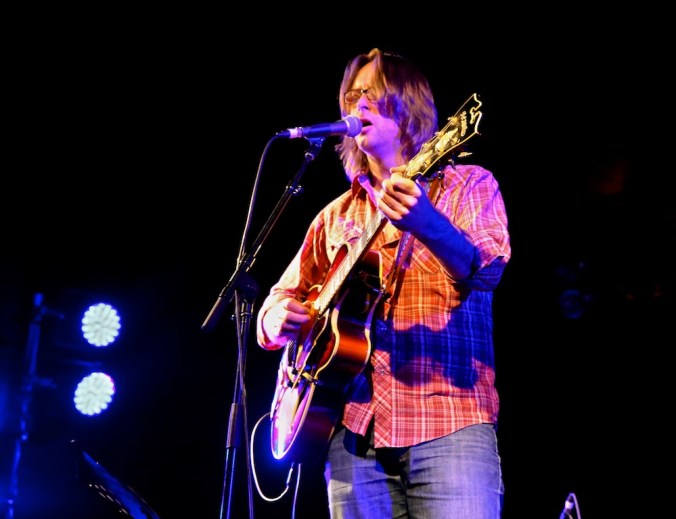 Footnote: Neil Watson acquitted himself well and added to the enjoyment of the evening. He played three types of electric guitar plus his pedal steel guitar; his set list ranging freely across genres. A Nirvana tune, a Hendrix referencing ‘Hear my train a comin’, a nice tune composed by his partner and the Kiwiana classic Blue Smoke as high points from his set.
 JazzLocal32.com