 Karangahape Road and the precincts around it are a natural home for adventurous and alternative music. If you walk the length, you are assailed by sights and sounds at variance to each other. Taken in their entirety they are oddly compatible. The jumble of colour and the bursts of noise as you pass a Karaoke bar or an uber cool eatery is counterbalanced by the languid notes from Shanghai Lils or the soft chatter emanating from Hookah smoking Kebab shop doorways. Woven into this oddness of streetwalkers and urban cool, are the alternative music joints. Down in basements, under the street or up narrow stairways. Thirsty Dog, Anthology, Audio Foundation, Wine Cellar. And at the top end of the strip, next to the old Jewish graveyard is the Backbeat Bar. High-quality alternative improvised music resides here on Wednesdays.
Takadimi is the brainchild of the gifted tabla player Manjit Singh and the CJC featured his band last Wednesday. This is a fusion band in the very best sense of the word as it fuses styles and complex rhythms with apparent ease. The music’s origins are clear but the tunes are not unduly anchored to them. We are living in an age when classical forms are not nailed down and in the west, the whole notion of musical purity is frequently overstated. The higher purpose of music is to connect on a human level and not to impress by showing off technical prowess. Takadimi connected deeply and spoke directly to our senses. They played improvised music but worked into the complex structures of Indian Talas. It felt as if both forms were respected.
The tunes were all introduced by the leader Manjit Singh, who would establish the rhythm by chanting a tala (or taal); then he would guide the ensemble into the open and freer air of jazz harmonies where collective (or solo) improvisation occurred. I have seen this band before and this felt like a step up. The soloists, in particular, showed a readiness to work with and enjoy the challenges presented by the complex polyrhythms. All of the musicians held the line and made it appear easy – it certainly was not. 
Underpinning everything were the rhythms and colours provided on the Tabla – an instrument long embedded into the Jazz repertoire. Anyone who has heard John McLoughlin, Jean Luc Ponty and Zakir Hussain together will understand how profound the association can be. It is therefore great to have such a fine tabla player in our midst and it our good luck that he is up for cross-genre collaborations.
The last time I heard Takadimi was at the Thirsty Dog; way down the other end of K’ Road. On that gig the lineup was different, this time the band had no guitar and the pianist Alan Brown had joined them. Singh could not have chosen better. Brown is well versed in the output of East European wunderkind Tigran Hamasyan. Hamasyan often counts in with talas and his beautiful Armenian styled rhythms are at times, very close to Indian forms. Brown is a master of complex rhythmic structures and capable of executing them without ever losing the groove. There were many fine performances but a standout was from Lukas Fritsch. His alto danced expertly through the tunes and for a young musician, he handled the complexities like a veteran. 
The clip that I have posted is a beautiful composition by the guru Ustad Fazal Qureshi and arranged by Manjit Singh. The Taal is Mishra Jaati – rendered as a polyrhythmic 7 over 4/4 time. On this track, Brown plays a synth instead of piano.
Takadimi: Manjit Singh (leader, tabla, arrangements), Alan Brown (piano, keyboards), Lukas Fritsch (alto saxophone), Denholm Orr (bass), Daniel Waterson (drums). The gig was at the Backbeat Bar, K’ Road, Auckland, CJC Creative Jazz Club, July 11, 2018.
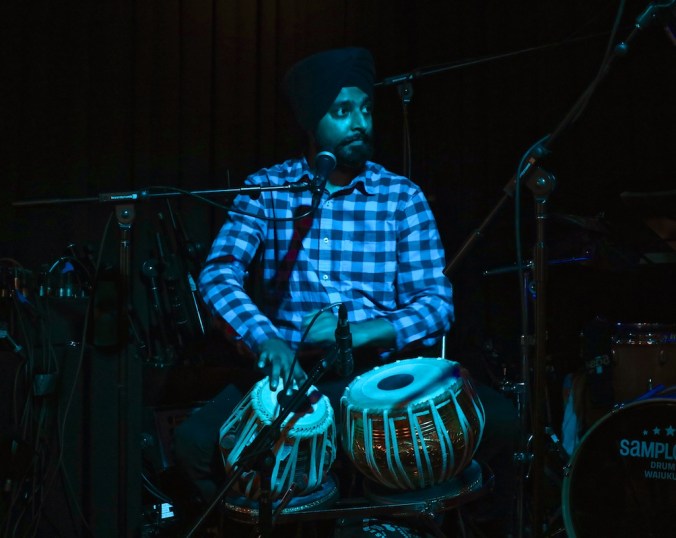 With emerging artists gigs you modify your expectations, but in this case, it was completely unnecessary. Both sets showcased great musicianship and originality. The first set was Manjit Singh and Takadimi; an Indian music/Jazz fusion project. Manjit Singh is not an emerging artist in the strictest sense, he is a highly experienced tabla player, composer and teacher in the two main traditional schools of Indian music (Northern and Carnatic). He has recently been doing a Jazz studies course at the UoA and this project arises from that. The traditional music he teaches is not that dissimilar to Jazz, as it has improvisation aspects and complex interwoven rhythms at its core. Singh also gave us an insight into another tradition, the ecstatic Sufi-influenced music of northwest India, Pakistan and central Asia – Again, a tradition that has fed the rich streams of Indian music and more recently, Jazz.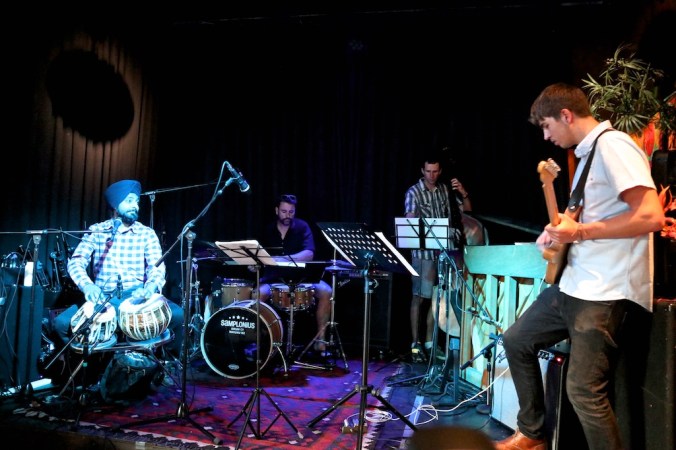
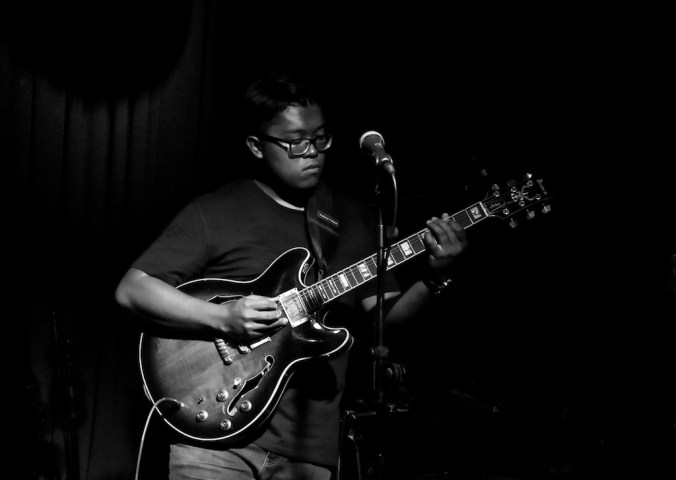
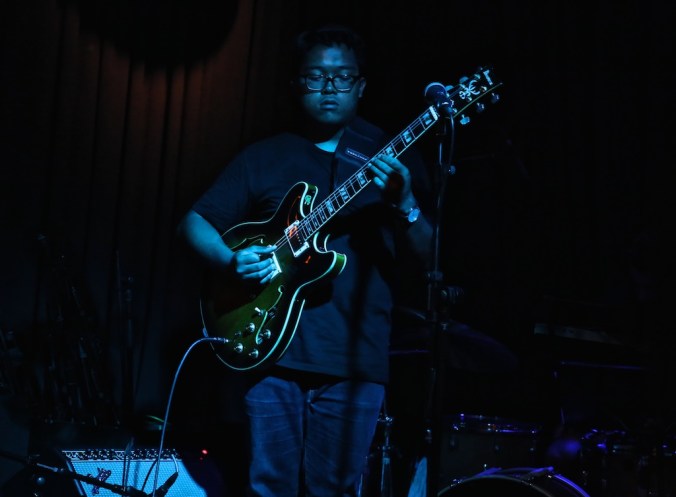
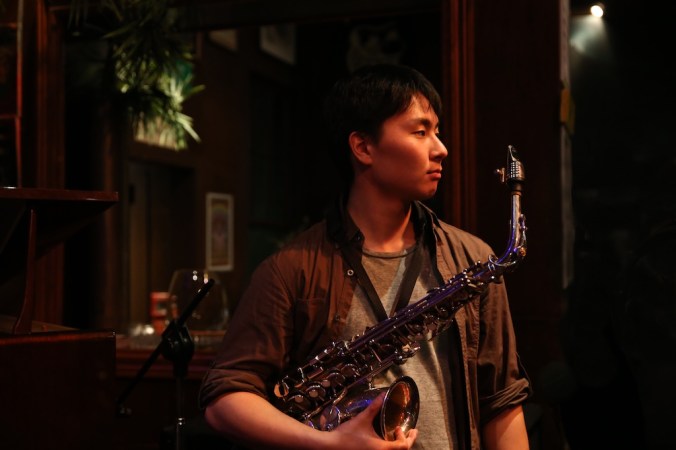 Last week brought us another emerging artist’s gig and this time it featured a Wellington band followed by an Auckland band. Each brought different aspects of improvised music to the bandstand and in a very nice touch, jammed together at the end; a happy meeting place between approaches. With so many international acts scheduled over coming months, it was great to see these young emerging bands given a shot: Again, this was good programming by the CJC.
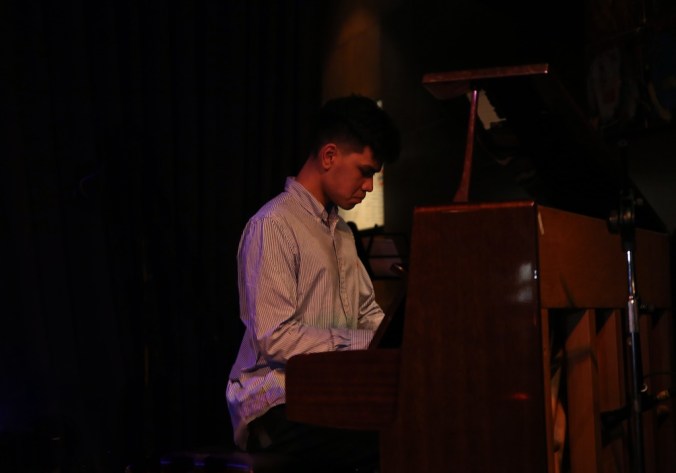
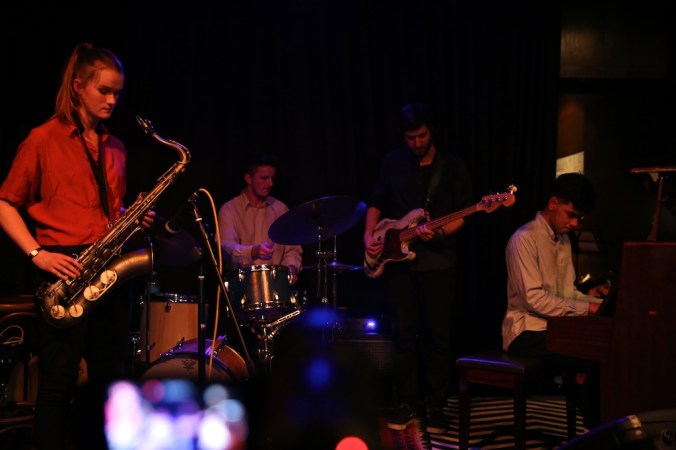 The Leo Coghini Quartet from Wellington took a straight ahead approach and it was obvious from the first number by Coghini, a solo rendering of ‘It Could Happen To You’ (Van Heusen/Burke), that he was an interesting pianist. He is classically trained, but with a good feel for swing oriented tunes. There were some nice originals in the set, but they were most comfortable on standards. I particularly liked the way they played Parker’s latin infused classic ‘My Little Suede Shoes’, also Kenny Garrett’s ‘Wayne’s Thang’. Both were approached in interesting ways (especially the nicely phrased Parker tune). The last number the quartet played was Stevie Wonders swinging groove classic ‘Isn’t She Lovely’ (which I have posted).
  In relation to ethnicity and gender, the modern New Zealand Jazz scene is increasingly reflective of the wider population; It is, therefore, good to see women picking up instruments that were once regarded as being exclusively in the male domain. Louisa Williamson was up front on tenor. She overcame some initial nervousness and played well. The other band members were electric bassist Zane Hawkins and Jeremy Richardson drums (both accomplished players).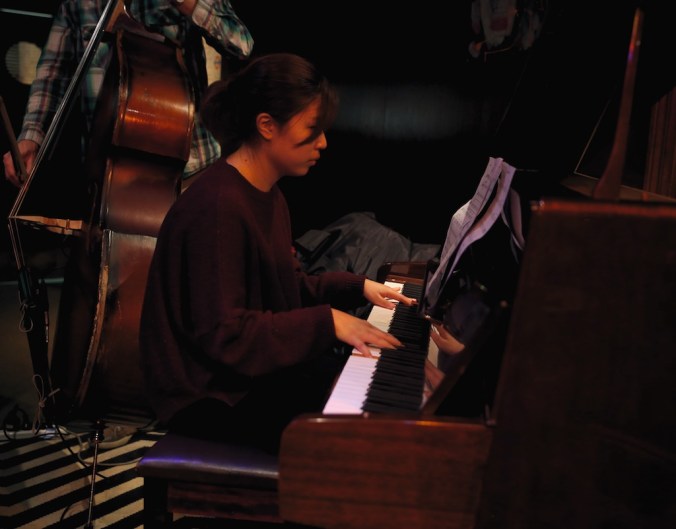
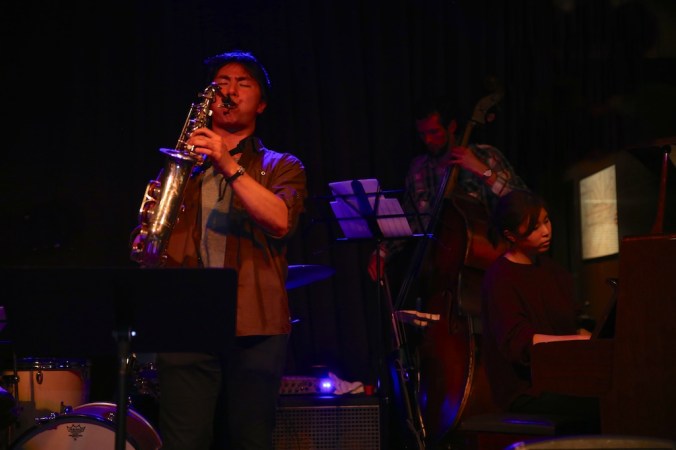 The tune ‘Within Hymn’ had clear references to Coltrane, but it was also interestingly modern. Although there were distinct parts to it, the piece made more sense as an entirety. It began with a bold statement on the horn, then unwound as it momentarily descended into chaos; next came the body of the piece, a building story, a probing at an idea, then changing again and ending with a climax. None of this would have been possible without the right support. Crystal Choi’s percussive chromaticism as she stabbed at the keyboard, the fourths, dissonant flurries; sometimes swinging as if to provide a counterbalance. Her solo was immaculate and each time I hear her now I’m amazed. Watching her musical journey encompass the avant-garde end of town and everywhere on the way is a treat.
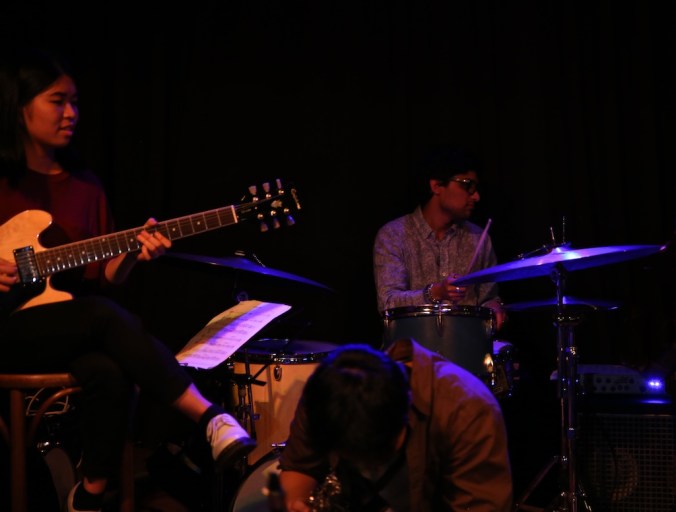 It was not just Choi who made this work, but Denholm Orr and Dean Rodrigues as well. Watch the clip through and judge for your self – these guys are amazing. Now a few bars of arco bass, now free or walking bass, and all the while, edgy polyrhythms dancing underneath. I was also pleased to see Kathleen Tomacruz on guitar – a very credible first gig for her.
 JazzLocal32.com