
Those lucky enough to attend any of Jake Baxendale’s ‘Waypeople’ concerts last year will have anxiously awaited the release of this album and his release tour. It is music brimming with exotic textures and tasteful arrangements, but it is more besides. When I attended the concert, I sensed that I was hearing something important. It made a statement about the maturity and evolution of Aotearoa’s improvised music scene and also conveyed a message that the world needs to hear right now. This spoke to our times and cut deep.
Before the advent of written language, and for a good while after, important stories were poetised and sung. This enabled generations to memorise and pass on vital cultural knowledge. In fact, poems were sung and accompanied by musicians long after the arrival of the written word, and the practice of silent reading didn’t occur in the West until well into the Middle Ages (sometime between 900-1200 BCE), and in China, during the Song Dynasty (around 1100 CE).
To the ancients, reading was a communal activity, and so it was with the Tao Te Ching. It spread through oral transmission much like Homer’s epics. Therefore, while various texts are available today, hearing it with musical accompaniment feels right. To the Taoists, music deepened the connection with the natural world and awakened ancient memories. As the Tang Poet Li Bai wrote:
‘The monk from Shu with his green silk lute . . .
Has brought me by one touch of the strings,
The breath of pines in a thousand valleys’
‘Waypeople’ is an album that joins a journey begun over 2,500 years ago, and in doing so, it incorporates the cultural expressions and voices found on that journey. Here, the ancient wisdom of the Tao Te Ching is clothed in a contemporary jazz idiom, utilising the oldest of instruments, the human voice and accompanied by saxophones, clarinets, piano, vibraphone, trumpet, drums, flute, oboe and guzheng. The use of the guzheng is particularly relevant here, as it dates back to the time of Tao Te Ching itself.
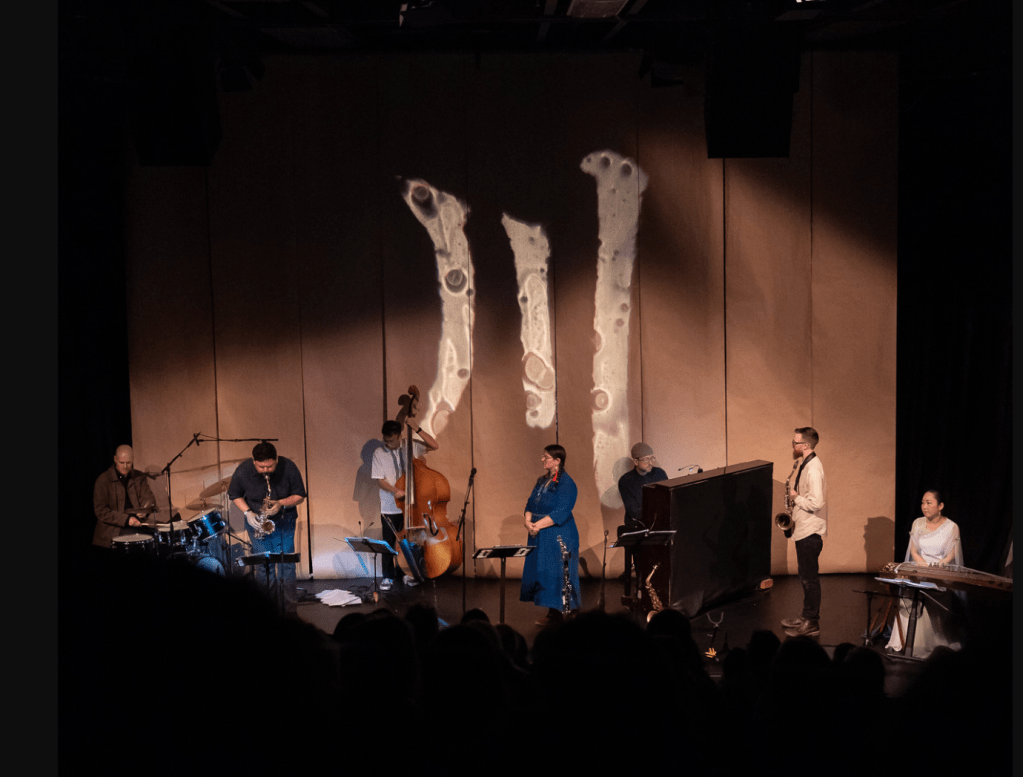
Throughout the album, selected passages of the Tao Te Ching are sung or intoned. Some verses are urgent and imploring, others reflective–opposites are brought into balance. It is therefore entirely appropriate that the translation is that of beloved contemporary author, Ursula Le Guin. What these musicians have captured is the ebb, flow and essence of these important verses. A balance has been found between the old and new, and the ‘old master’ Lao Tzu would surely smile on this endeavour.
Our world today is like it was in the Warring States (475-221 BCE)– it is out of balance. It is obvious that humanity has again taken many wrong turns, so now is the time to retrace our steps and heed this ancient wisdom. Choose peace over war, quiet and reflection over clamour. So, attend the gig if it comes to your town, buy the album on Bandcamp, listen deeply and reflect. There is no time to lose. https://jakebaxendale.bandcamp.com/album/waypeople – or check out the teaser on YouTube
The musicians are from Wellington and Auckland. Chelsea Prastiti (voice), Jia Ling, (guzheng), Jake Baxendale (compositions, alto, tenor & baritone saxophones, clarinet & bass clarinet), Callum Passells (sopranino & alto saxophones), Daniel Hayles (piano & vibraphone), Johnny Lawrence (double bass), Cory Champion (drums & effects), Louisa Williamson (flute tk 2), Ben Hunt (trumpet tk 5), Kaito Walley (trombone tks 2 & 5), J Y Lee (flute tk 10), Millie Mannins (oboe tk 10) – btw how nice to see Roger Manins daughter in this lineup.
“No competition, no blame” – Tao Te Ching
JazzLocal32.com was rated as one of the 50 best Jazz Blogs in the world by Feedspot. The author is a professional member of the Jazz Journalists Association, a Judge in the 7VJC International Jazz Competition, and a poet & writer. Some of these posts appear on other sites with the author’s permission.

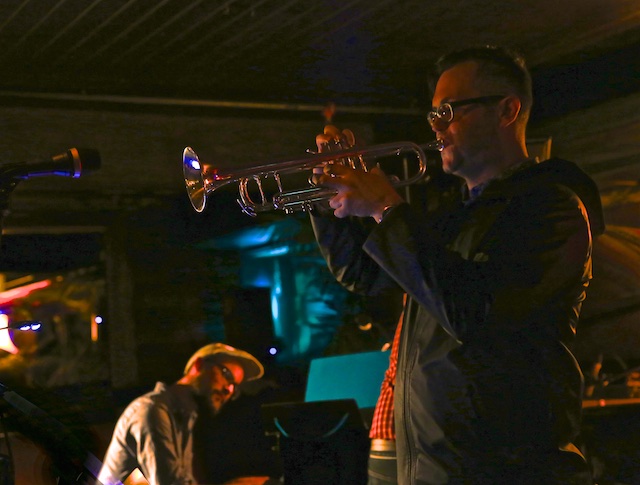 In spite of living at the other end of the Island, Lex French is a regular fixture at the CJC. It is hardly surprising since his popularity with Jazz audiences is ever-growing. There are not many trumpeters of French’s stature in New Zealand and it is our good fortune that he remains. He obtained his Masters from McGill University in Montreal, a university with a strong focus on brass. A university which had an ongoing association with the UK-based Canadian trumpeter Kenny Wheeler while he was among us. I mention Wheeler, because as I walked down the stairs to the club to set up my gear, I heard the unmistakable opening phrase from ‘Smatter’ coming out of the darkness. Just the opening phrase and then silence.
 It was so Wheeler-like, that I assumed someone was setting up a Wheeler album on the club sound system. As my eyes accustomed to the low light I saw French standing alone – repeating the phrase. French is not a one-trick pony; he is as modern as tomorrow, but at other times, old school respectful. He can punch out high notes or swing hard bop like a Blue Note artist back in the day. This is not a musician to pass up on.
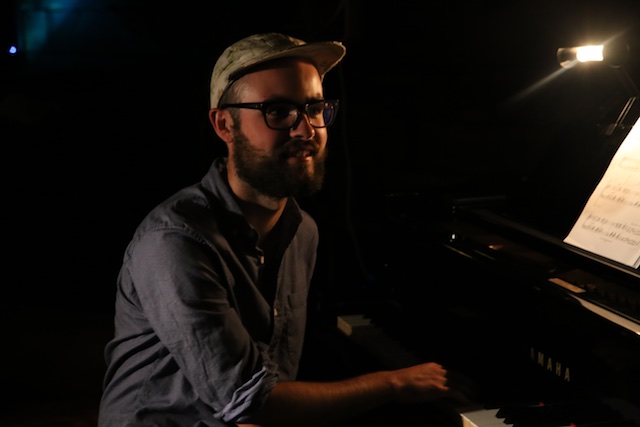
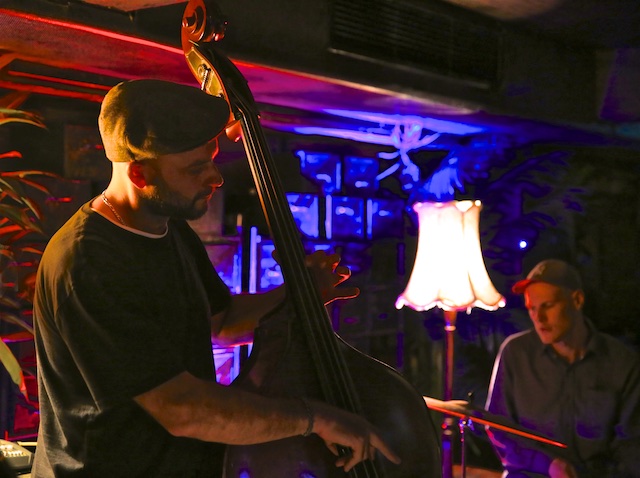 I particularly liked French’s compositions ‘Kasid’ from the first set. There were many reasons to like this; the musicians innovative explorations of the theme, the evocative middle-eastern mode underpinning it, and the fact that it referenced the wonderful Iraqi poet Abdulkareen Kasid. An achingly beautiful melody tinged through with bittersweet sadness, establishing itself delicately over a quietly incessant bass motif. When Steele came in, his opening chords were Oud like – giving the impression of soft strings jangling sweetly in the night air. I listen to a lot of middle-eastern improvised music and this performance stands beside the best of those. In the background, the drums tap tapped (like stones tumbling in a stream, and every so often swooshes).
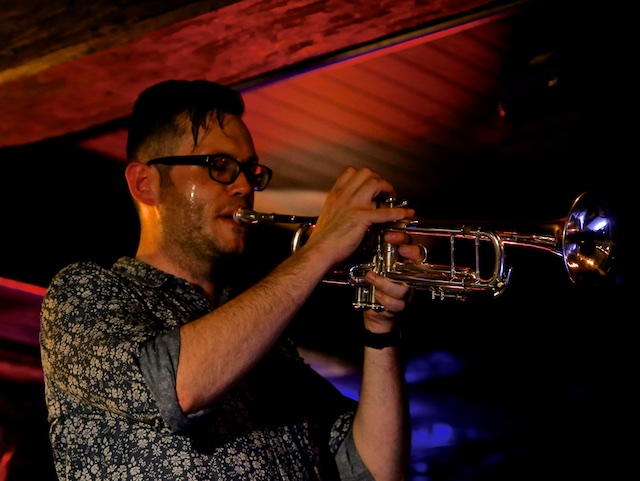 The poet Abdulkareem Kasid is new to me (and I have a huge collection of poetry). To discover a poet like this is exciting and I thank Lex French for this. What could be better than to experience a night of interesting music, and at the end, find a poet? I finish this with some words from that poet – listen to the piece as you read the lines – I did.
 It is always good when proved right and in the case of Matt Steele I certainly was. This was a superb gig and it confirmed the promise that I saw in Steele as a first year student. The ‘Master Brewers’ musicians are exactly what Steele needed at this stage in his development and he is clearly what they needed. There is a cohesion about this group and it extends beyond the music. This is a band of friends and because they spend a significant amount of time together, they are able to dive deeper into the material on hand. Most of the band is writing and being familiar with each others styles, they contribute compositions that serve the project well. Younger musicians often favour shorter term projects but I hope this unit continues for a while. When I last saw Steele perform it was at his honours recital and he was very much in charge. Now as leader, the reins are subtly loosened and the music benefits from this. With experience, leaders can confidently guide without over playing the role. That only works when the interactions and cues become second nature. In their best moments the ‘Master Brewers’ acted as a single entity; everyone maximising their options while retaining an awareness of the others.
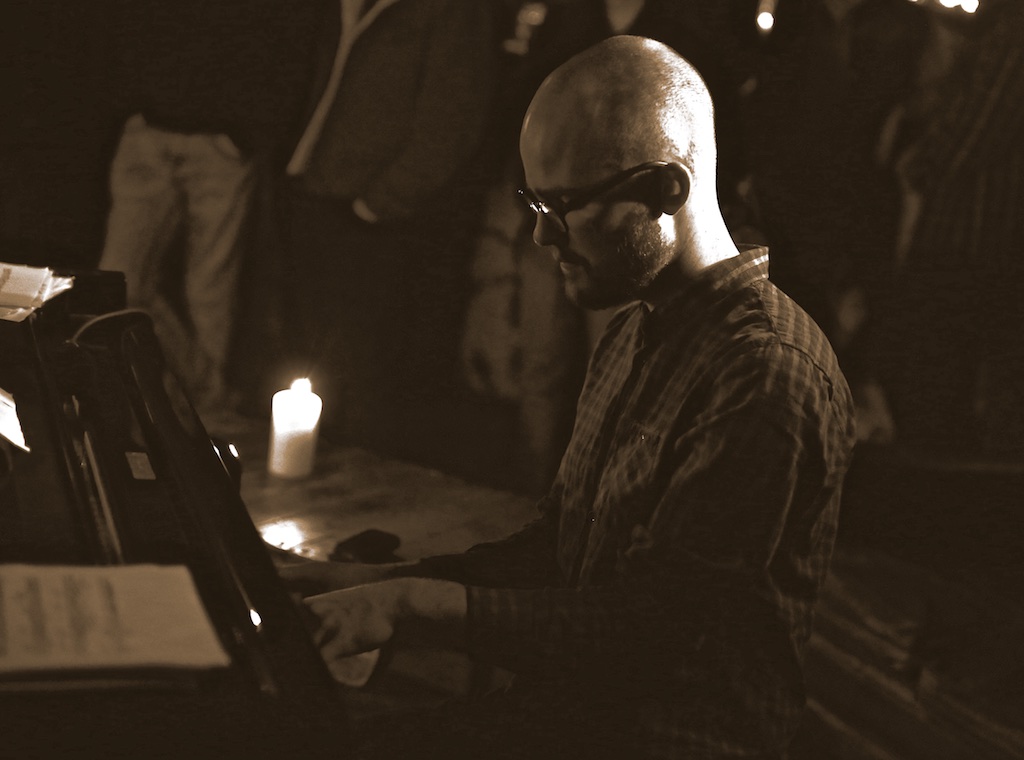 I immediately noticed that Steele’s voicings were darker. His interesting harmonic approach an outcome of an ever-growing musical maturity. There are certain aspects to Steele’s playing that stand out and during the gig these crystallised in my mind. These attributes are why I follow his career so attentively. He is self-effacing by nature, but that masks a ruthless striving for betterment. Ever reaching further, listening deeply, critically and taking risks. For all that he able to relax into the moment and as he grows musically this is more evident. The most difficult journey for any musician is finding a distinctive style and owning it. Steele is well on the way.
 Thanks to Roger Manins programming, Auckland audiences get to see good Wellington bands every few months. In this case the audience were unfamiliar with the musicians (apart from Steele), but what a treat this gig was. The band won us over quickly and by the time the second set began they were cooking. In spite of the modernistic approach and complex time signatures these guys have a definite pulse. They swing like crazy.
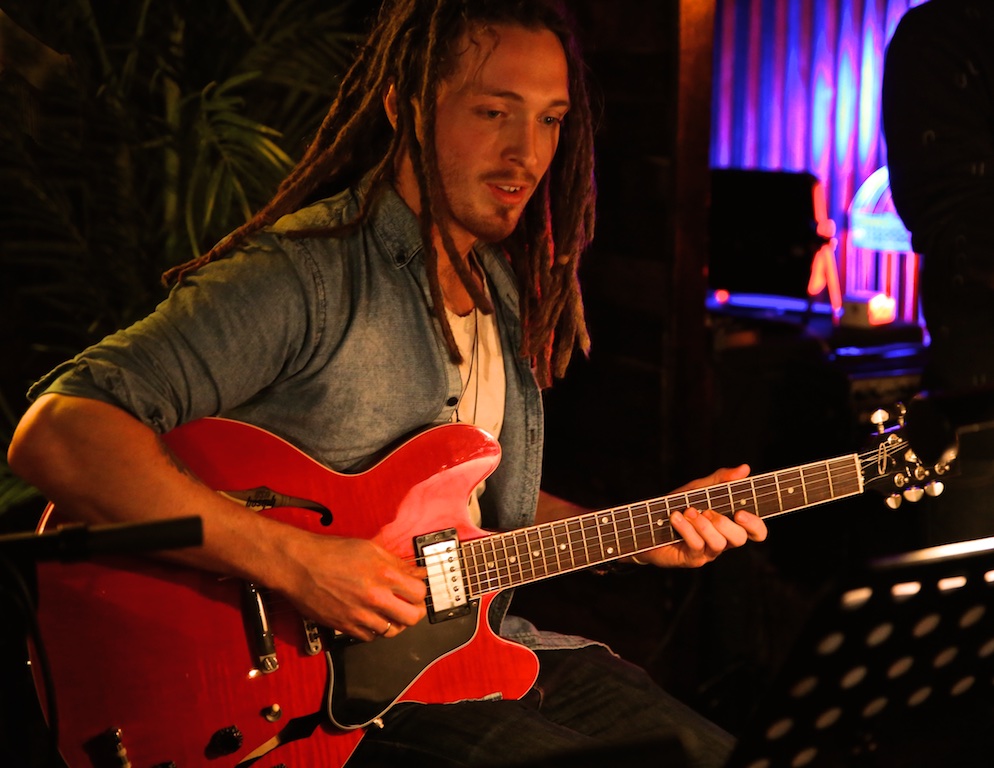
 Ashton Sellars had suffered a mishap with his guitar and he had to borrow one at short notice for the gig. He told me that it felt very different to his own older instrument, but no one would have guessed it by the way he was playing. Under his fingers the instrument sang. He favours longer fluid lines (with a hint of Bauer/Tristano), but his is very much a modern sound. His improvisations are thoughtful and they invite you along. While their music is often complex there is no ballast of needless weighty intellectualism. Piano and guitar keeping nicely apart unless comping in support. Both understanding when to lay out. Once again cohesion and a sense of common purpose drives them
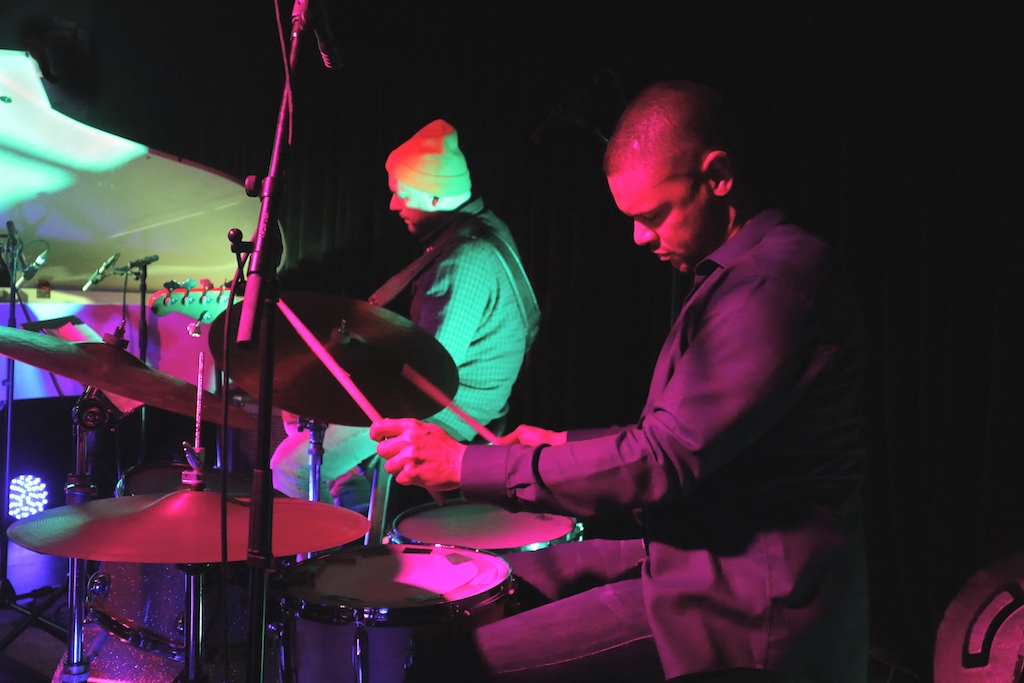
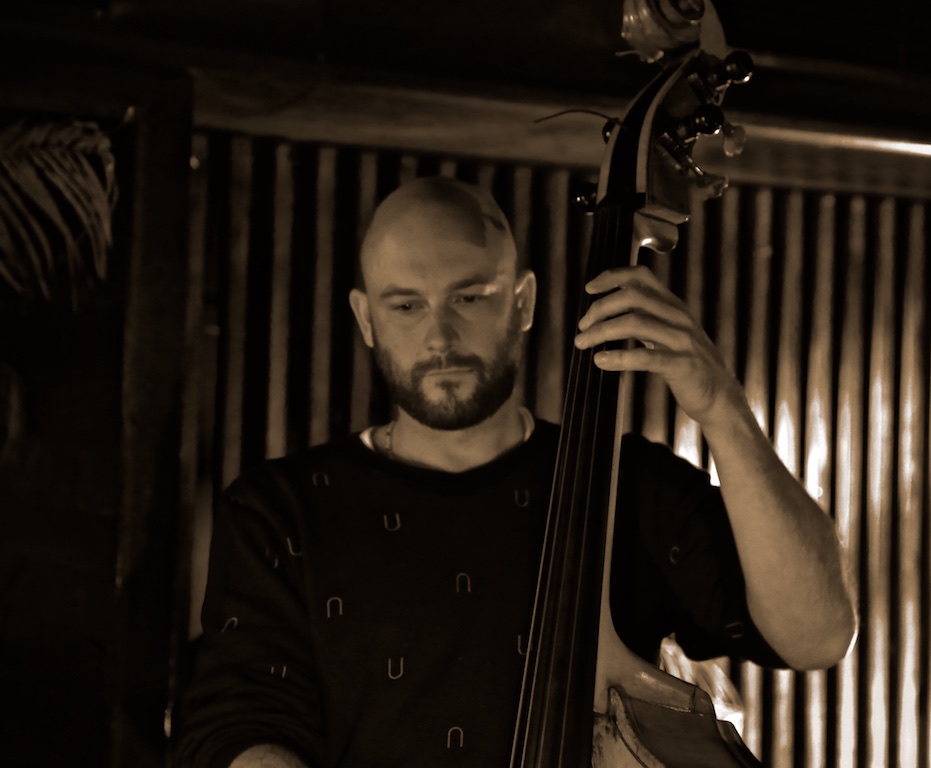
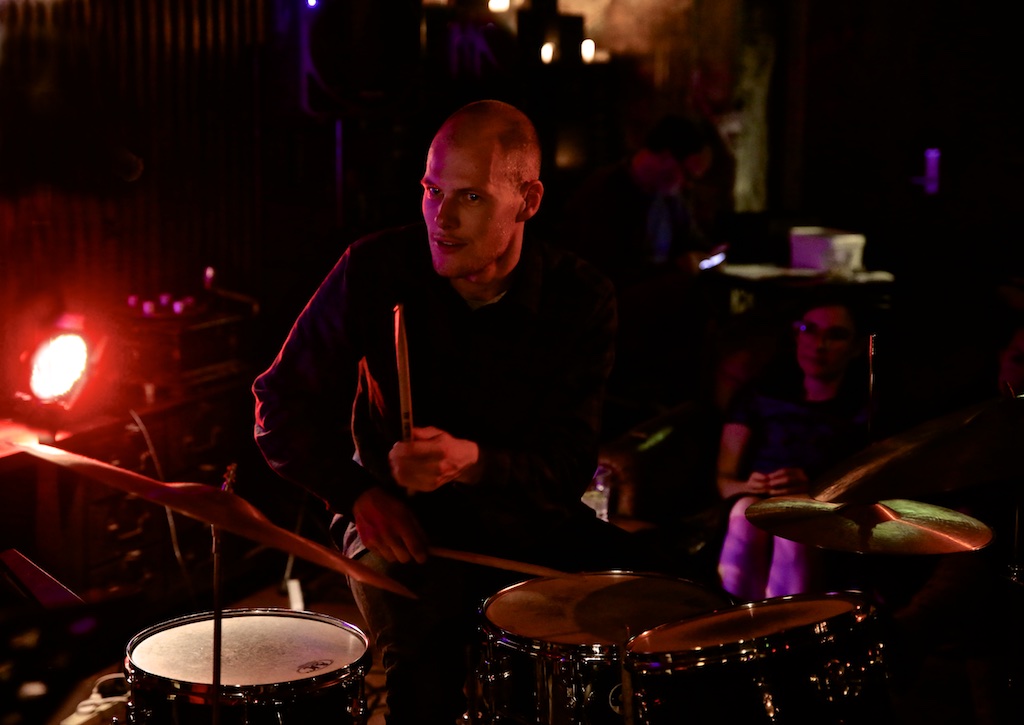 Johnny Lawrence played upright bass, maintaining the core rhythm duties. While he held the pulse intact, he could also solo very effectively. Like his band mates he fitted into the mix in exactly the right way. Cory Campion was also a strong presence, often giving colour or providing accents. Above all his compositions were strong. There is an increasing trend for drummers to compose and when they write like this it provides an interesting perspective. Drummers write differently and the ones I hear lately, write very well. Steele and Sellars contributed the most tunes and each wrote in their own distinctive style. Together those charts and this band gave us pure enjoyment.
 JazzLocal32.com