Waypeople ~ Jake Baxendale

Those lucky enough to attend any of Jake Baxendale’s ‘Waypeople’ concerts last year will have anxiously awaited the release of this album and his release tour. It is music brimming with exotic textures and tasteful arrangements, but it is more besides. When I attended the concert, I sensed that I was hearing something important. It made a statement about the maturity and evolution of Aotearoa’s improvised music scene and also conveyed a message that the world needs to hear right now. This spoke to our times and cut deep.

Before the advent of written language, and for a good while after, important stories were poetised and sung. This enabled generations to memorise and pass on vital cultural knowledge. In fact, poems were sung and accompanied by musicians long after the arrival of the written word, and the practice of silent reading didn’t occur in the West until well into the Middle Ages (sometime between 900-1200 BCE), and in China, during the Song Dynasty (around 1100 CE). 

To the ancients, reading was a communal activity, and so it was with the Tao Te Ching. It spread through oral transmission much like Homer’s epics. Therefore, while various texts are available today, hearing it with musical accompaniment feels right. To the Taoists, music deepened the connection with the natural world and awakened ancient memories. As the Tang Poet Li Bai wrote:

 ‘The monk from Shu with his green silk lute . . .

Has brought me by one touch of the strings,

The breath of pines in a thousand valleys’

‘Waypeople’ is an album that joins a journey begun over 2,500 years ago, and in doing so, it incorporates the cultural expressions and voices found on that journey. Here, the ancient wisdom of the Tao Te Ching is clothed in a contemporary jazz idiom, utilising the oldest of instruments, the human voice and accompanied by saxophones, clarinets, piano, vibraphone, trumpet, drums, flute, oboe and guzheng. The use of the guzheng is particularly relevant here, as it dates back to the time of Tao Te Ching itself. 
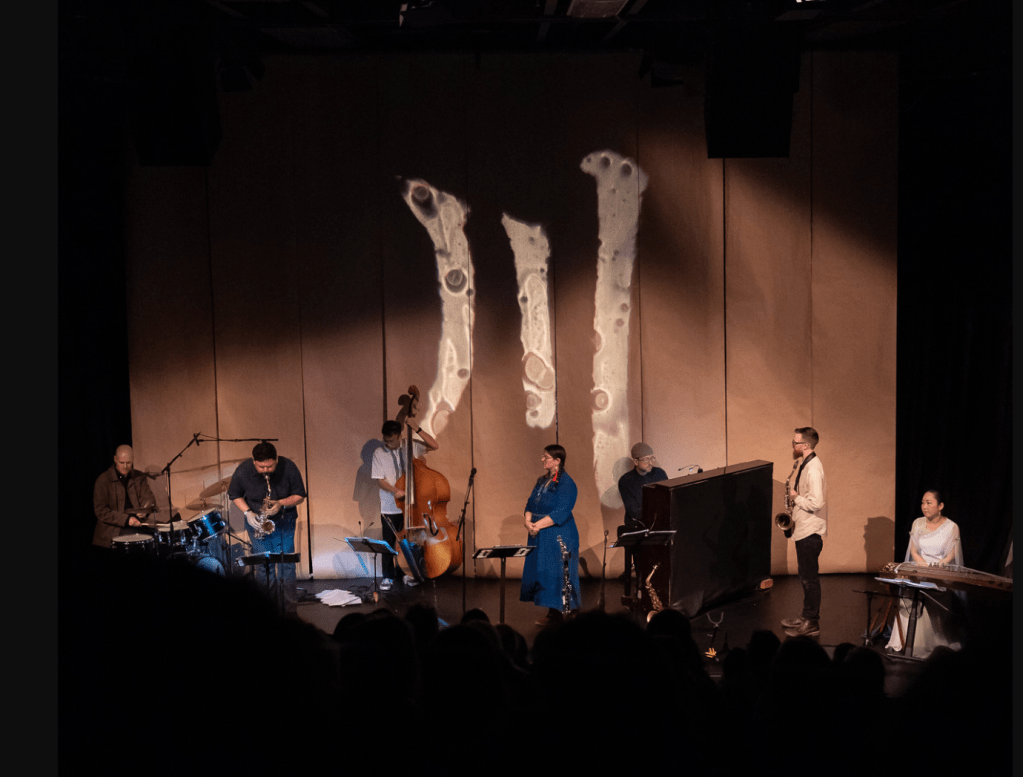
Throughout the album, selected passages of the Tao Te Ching are sung or intoned. Some verses are urgent and imploring, others reflective–opposites are brought into balance. It is therefore entirely appropriate that the translation is that of beloved contemporary author, Ursula Le Guin. What these musicians have captured is the ebb, flow and essence of these important verses. A balance has been found between the old and new, and the ‘old master’ Lao Tzu would surely smile on this endeavour. 

Our world today is like it was in the Warring States (475-221 BCE)– it is out of balance. It is obvious that humanity has again taken many wrong turns, so now is the time to retrace our steps and heed this ancient wisdom.  Choose peace over war, quiet and reflection over clamour. So, attend the gig if it comes to your town, buy the album on Bandcamp, listen deeply and reflect. There is no time to lose. https://jakebaxendale.bandcamp.com/album/waypeople – or check out the teaser on YouTube

The musicians are from Wellington and Auckland. Chelsea Prastiti (voice), Jia Ling, (guzheng), Jake Baxendale (compositions, alto, tenor & baritone saxophones, clarinet & bass clarinet), Callum Passells (sopranino & alto saxophones), Daniel Hayles (piano & vibraphone), Johnny Lawrence (double bass), Cory Champion (drums & effects), Louisa Williamson (flute tk 2), Ben Hunt (trumpet tk 5), Kaito Walley (trombone tks 2 & 5), J Y Lee (flute tk 10), Millie Mannins (oboe tk 10) – btw how nice to see Roger Manins daughter in this lineup. 

No competition, no blame” – Tao Te Ching

JazzLocal32.com was rated as one of the 50 best Jazz Blogs in the world by Feedspot. The author is a professional member of the Jazz Journalists Association, a Judge in the 7VJC International Jazz Competition, and a poet & writer. Some of these posts appear on other sites with the author’s permission. 
Bonita ~ Chelsea Prastiti

Chelsea Prastiti’s Bonita gig was a phantasmagoria of warm evocative sounds. I have the greatest respect for her work and in this case, she curated something rare; she conjured up the vibe from another place and time, and she did so without a hint of contrivance. The Brazil of the sixties and seventies with its Bossa Nova soundtrack was an era of infinite possibility. In the end, the dream was stolen by a repressive authoritarian regime but the music, a timeless gift to the world, lived on. Over the last half-century, the Jobim songbook, in particular, has remained popular, and while some interpretations have been breathtaking, others, have been pale imitations. 

What Prastiti has done here is both respectful and innovative. She has composed a suite of tunes that nails the vibe as it taps into the essence of New Wave Brasileira while evoking the founding era. The concept for this gig and many of the tunes were conceived years ago. Prastiti had other projects cooking back then, and so she waited her time. As it turns out, she timed it perfectly. With our borders closed, the desire for high-quality Kiwi music is at an all-time high. Audiences are not being distracted by ‘once again and for the very last time’ tours by fading greats, and the realisation is dawning that homegrown is often better. 

Stars above water below

Another plus for holding the gig now was that her friends and collaborators were all within reach: notably, Elizabeth Stokes and Ben Sinclair of ‘The Beths’. The recent winners in the Best Group category at the NZ Music Awards would probably have been back on a world tour right now, but the pandemic curtailed that. The ensemble members all go back quite a way with Prastiti and I believe that the warmth they radiate arises from those long-held connections. 

Cassandra

The ten-piece ensemble oozed a Brazilian vibe, with its flute players and fingerstyle acoustic guitar. Add to this the unmistakable rhythms of Samba and Bossa Nova and the course was set. There was a horn section of trumpet and a tenor saxophone and one of the flute players doubled on clarinet. Behind them was an upright bass, drum kit and percussion and in the darkness, and to one side, a piano. The arrangements were beautifully textured and the harmonies absolutely gorgeous. As well as the instrumental harmonies, there were vocal harmonies contributed by two of the instrumentalists (one being Stokes, who has a fabulous voice – the success of the Beths underscores that). Prastiti composed all of the tunes and arranged most of them. The other credits go to Sinclair who arranged Prism, Callum Passells who arranged Bumblebee and Kenji Iwamitsu-Holdaway who is co-credited for the composition titled ‘Stars Above and Water Below’. 

Chelsea Prastiti is one the most innovative vocalists to appear on the local scene and she is never afraid to take risks or to explore new territory. The rest of her ensemble were: Elizabeth Stokes on trumpet and vocals, Crystal Choi, who appeared last week, this time on piano and vocals; bringing a beautifully voiced minimalism to the proceedings and echoing Tom Jobim’s delicate spidery lines. Roger Manins was on tenor saxophone with fills and some tasteful solos – J Y lee played an edgy melodic flute (it is not his primary, but he brought expression to an instrument that in the wrong hands can lack it). Beside him was Ben Sinclair (bass guitarist from the Beths), alternating between clarinet and flute, the ever-reliable Adam Tobeck was on the drum kit, with Ron Samsom on percussion. Lastly, and hidden in the shadows was Michael Howell, utilising the voicings and fingerstyle of the Brazilian acoustic guitar. He absolutely nailed those warm pulsing rhythms which fell about us like a warm summer shower.  

Eleven years ago, I began this Jazz blog and one of my first posts was an opinion piece about this era. I looked back at it today for the first time since writing it, and apart from a few missing commas, it stands up. I was worried when I wrote it that it might get something wrong, but a Brazilian musicologist messaged me to thank me for it. Anyone wanting to gain an additional sense of this era could follow the link to my original post. It is an opinion piece, but it could serve as a springboard to more authoritative, Brazilian-sourced information. https://jazzlocal32.com/2011/06/07/wave-antonio-carlos-jobim/

The gig took place at Anthology K’Road for the CJC Creative Jazz Club, November 25, 2020

JazzLocal32.com was rated as one of the 50 best Jazz Blogs in the world by Feedspot. The author is a professional member of the Jazz Journalists Association. Many of these posts also appear on Radio13.co.nz – check it out.