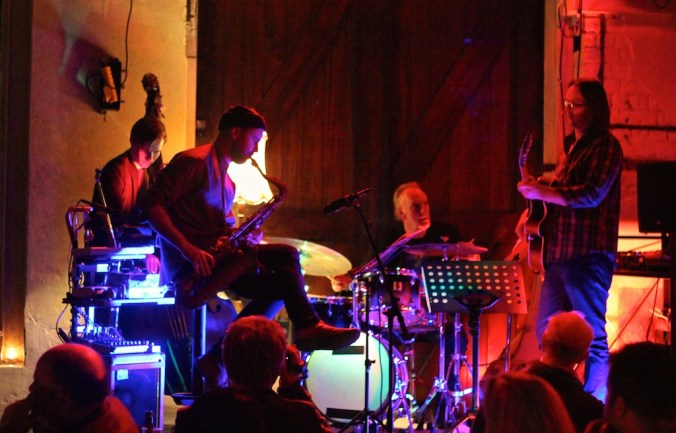
Neil Watson Four @ CJC

IMG_8034 - Version 2

I love any music that can be termed ‘Space Jazz’ or ‘Space Funk’.  I have no idea if this is a real genre but I follow it anyhow.  Living through the era of Sputnik and being caught up in the excitement that followed I was nudged in that direction by the events of the day.  After that I zeroed in on space themed music.  Some of it was corny (Telstar) and some was grandiose (Gustav Holst’s ‘The Planets’).  Not long after this I stumbled across Jazz and the sonic explorations perfectly fitted my longing for a music that evoked the wonders of space while encompassing the quirks of our humanity.   Music performed by artists who stood in awe at the edge of the universe and then stepped free of its limits.  IMG_8030 - Version 2
The Neil Watson Four is a recently formed Auckland band who have no fear of galactic explorations.  With the aid of a doogon (explained later), tenor saxophone, drum kit, upright bass and four overly fertile imaginations, they bent and pulled at the fabric of the universe.  This is a band that defies the norms and swallows genres whole.  There is no sense of deliberate eclecticism here and no self-conscious navel gazing.  It is original and you get the sense that what happens sometimes surprises the musicians.

The feeling is often that of organised chaos, a loose organic vibe that works well because they have entered into a collective state of being.  While Neil Watson pilots the ship there is no heavy controlling hand but his benign presence presides.  He has gifted his vision and let the possibilities unravel as they may.  IMG_8057 - Version 2
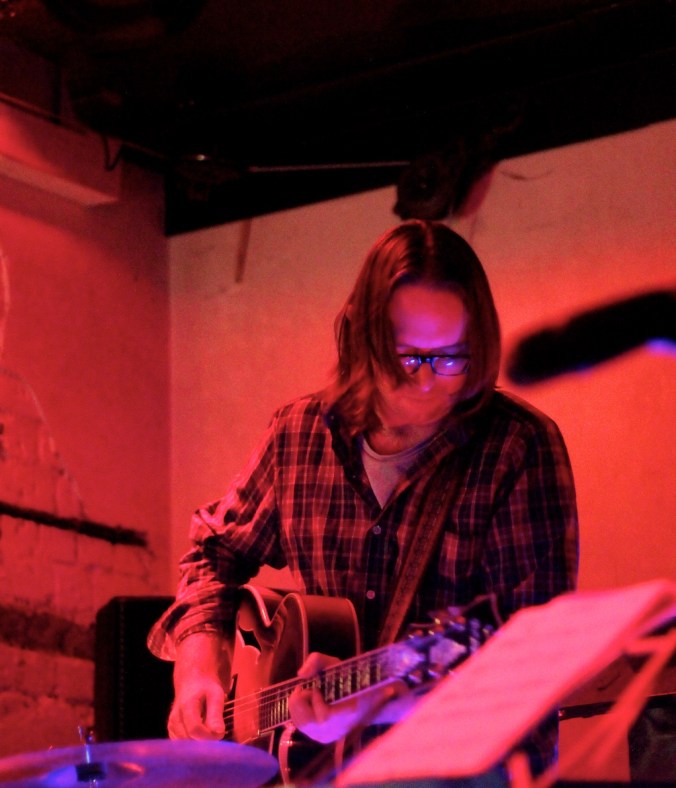
Neil Watson is not only a great guitarist but his sense of humour is original.  A sort of postmodern Zen; dropping casual asides into the banter in ways that confound.   The You Tube clip that I will post is ‘Renamed’.  When Neil announced that tune he casually added, “I hated the original name”.  This sort of humour leaves you momentarily confused and then laughing out loud.  They also played a lot of tunes named after children, girlfriends or spouses.   The tunes were all great and particularly ‘Renamed’ (Watson), ‘Eleanor’ (Dennison), ‘Rosie My Dear’ (Gibson) and ‘Theo’ (Allen).  There were ballads and country fare as well.  their rendition of ‘Danny Boy’ was so poignant that any Scots in the audience would have been fumbling in their sporrans for a tartan hanky.

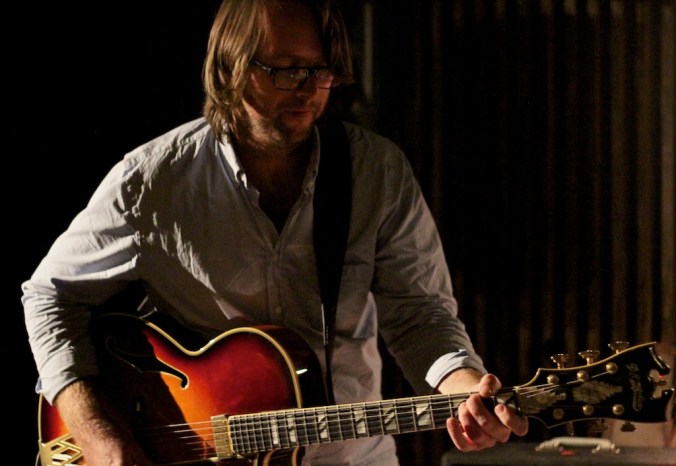
Neil Watson is an original guitarist and he is at his best when a leader.  He brings a rag-tag of interesting sounds and ideas to the bandstand and then knits them together.  There is also something akin to Zorn in much of this material.  Once the skeletal structure and the overall concept is in place the music is liberated.  The interactions between men and machines are fluid and what the audience sees will never be repeated.   For this to work well he needs the right collaborators and he has certainly struck gold this time.  IMG_8044
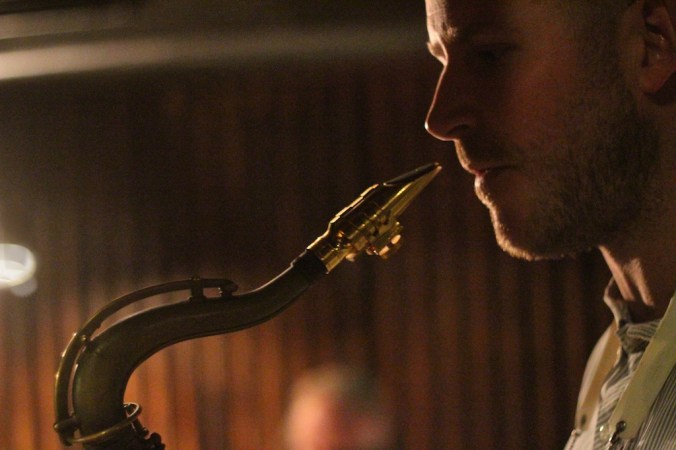
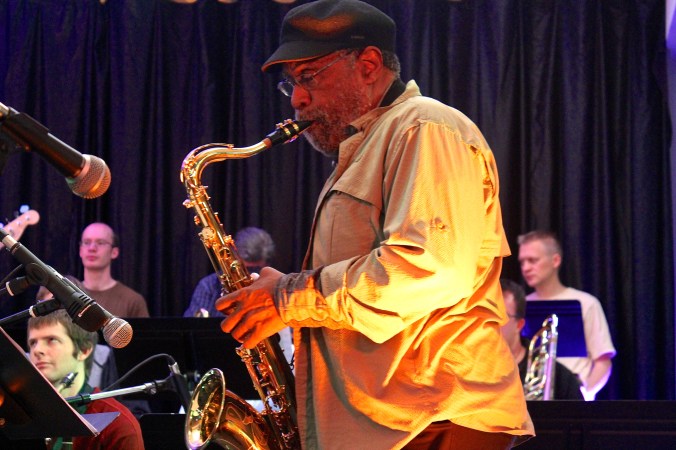
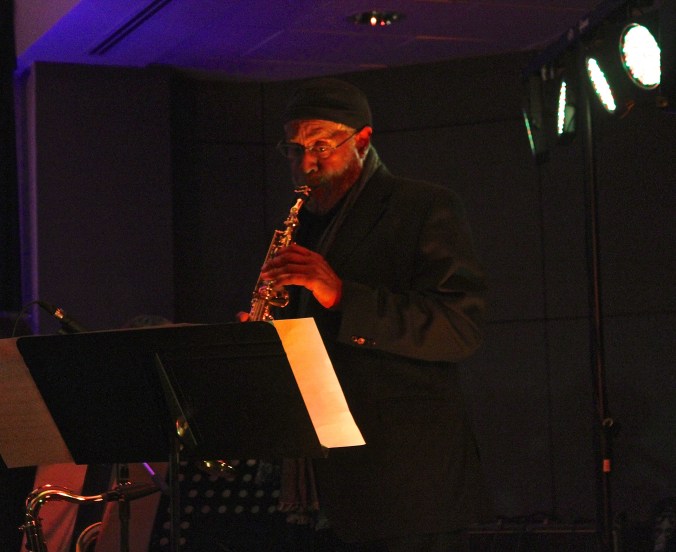
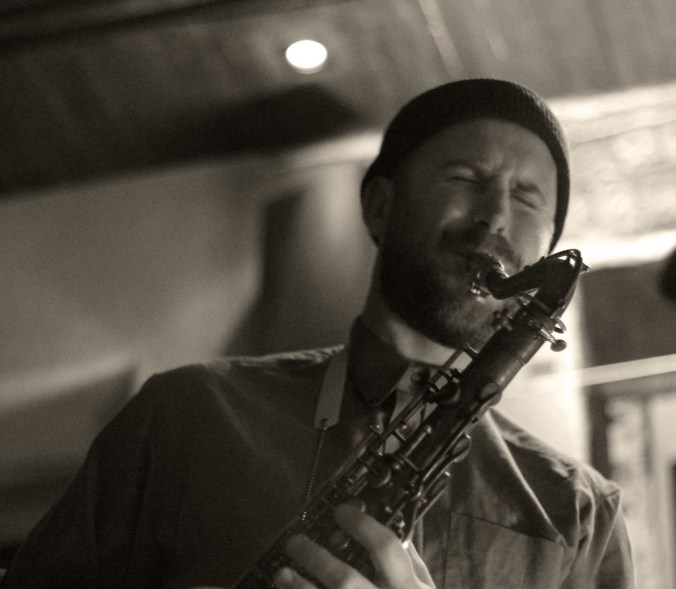
Cam Allen usually plays alto but he is also a fine tenor player.   I have also seen him manipulate a Moog to great effect.  On Wednesday night he played a Buescher ‘Big B’ Aristocrat and it gave out an earthy, and slightly raspy sound.  Word has it that it is a tricky beast to play but it sounded just right for this gig.   I risk committing heresy here but a Selmer would have been too clean for this music.  His interesting modal explorations and his flow of ideas mark him out as a gifted player.  This is hardly surprising as he honed his craft on the highly competitive American Jazz scene.  In this band he doubled on ‘doogon’.   This is very much a ‘Kiwi’ thing and it is best described as an array of electronic and acoustic sound enhancements strapped to a hardware-store hand truck.  Resembling a cross between a Dalek and an IED with its glowing blue lights, digital clock console and multiple knobs (many strapped on with duct tape); it can envelop the audience with shrieks that resemble a Banshee at a rocket launch.  IMG_8075 - Version 2
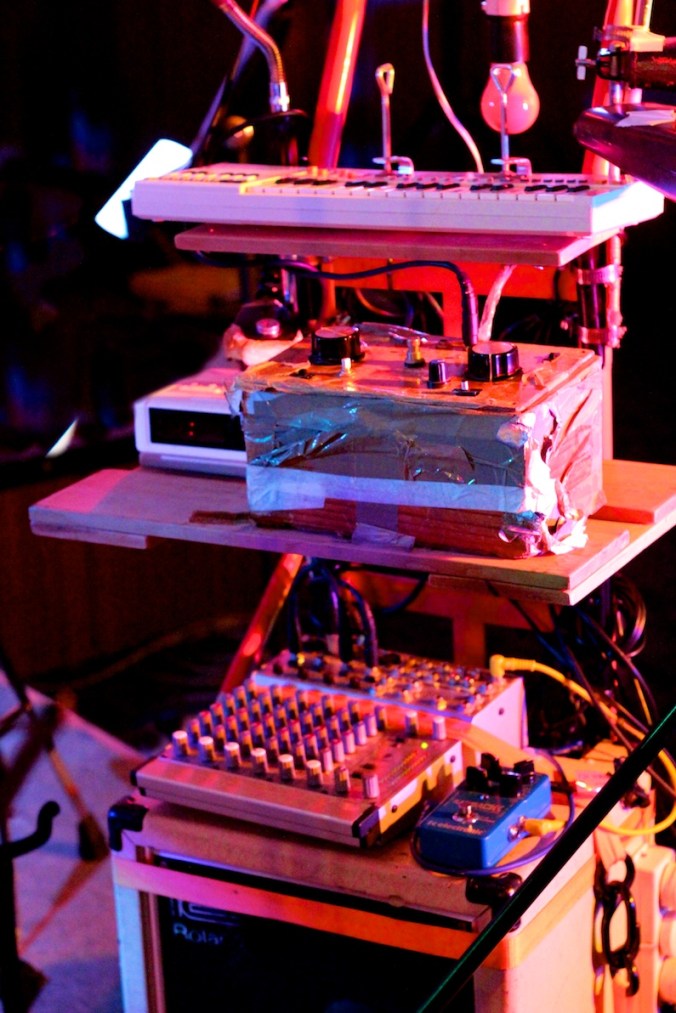
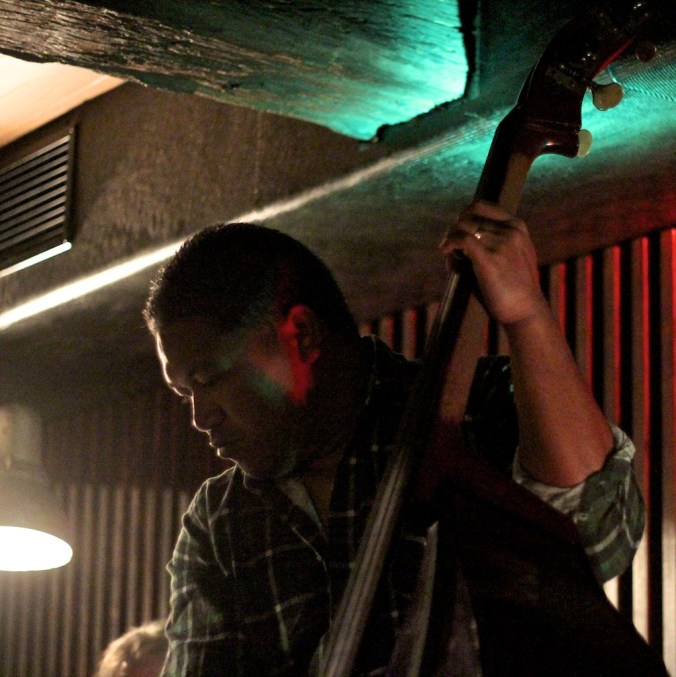
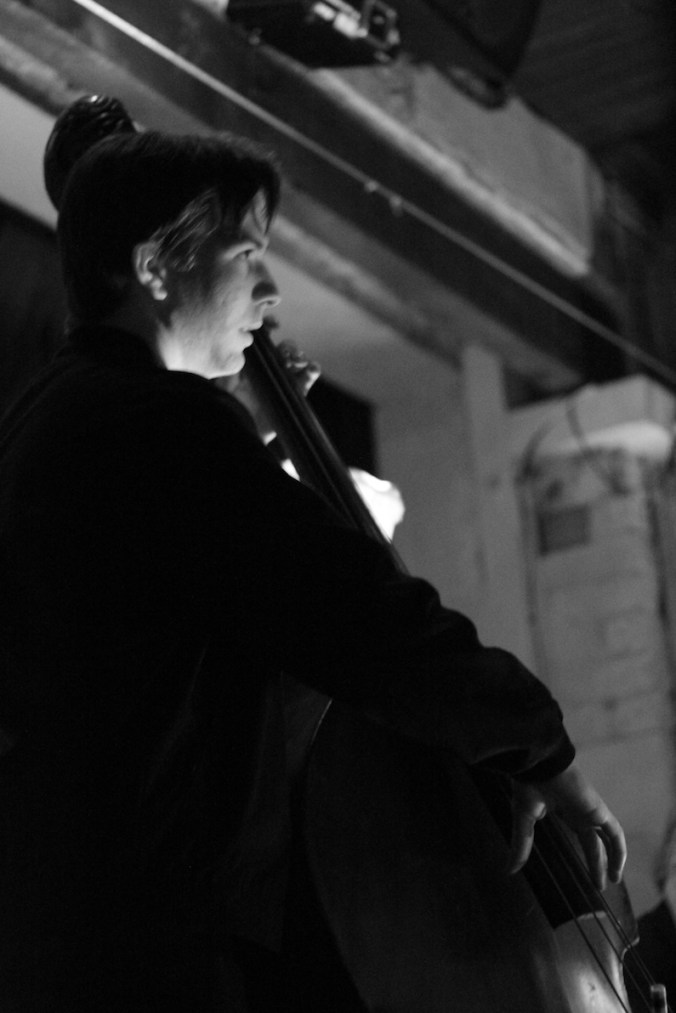
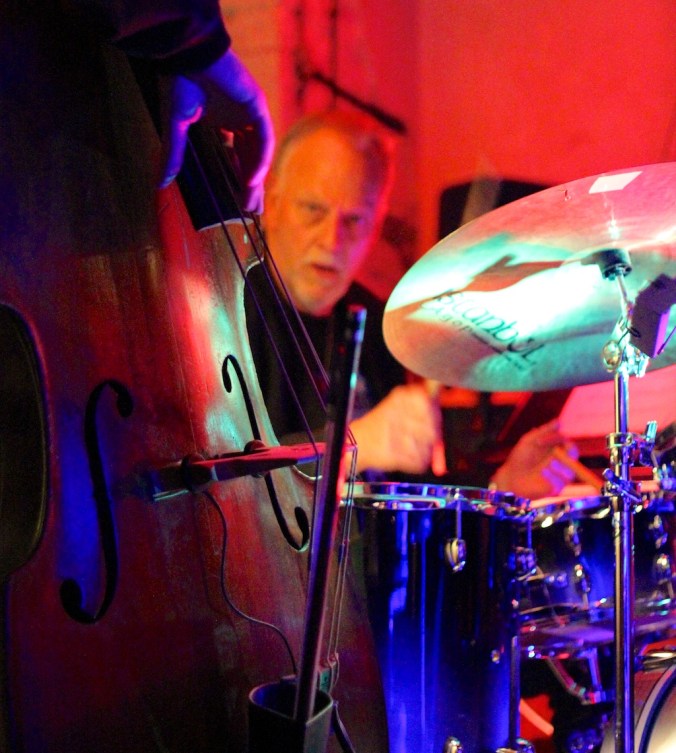
All of the instruments including the drums feed into this machine and the effects are astounding.  On upright bass was the respected Tom Dennison who used his arco technique to very good effect.  This bowing worked well with the Doogon, which under Allen’s guidance resonated in ways that would have astounded the instruments makers.  Dennison has a lovely rich tone and we heard plenty of that.  What can never be overlooked are his compositional skills (See an earlier post on his ‘Zoo’ album).  For this gig he contributed the lovely ‘Eleanor’ which he dedicated to his girlfriend.  He seldom appears at the CJC these days and it was a pleasure to see him there again.

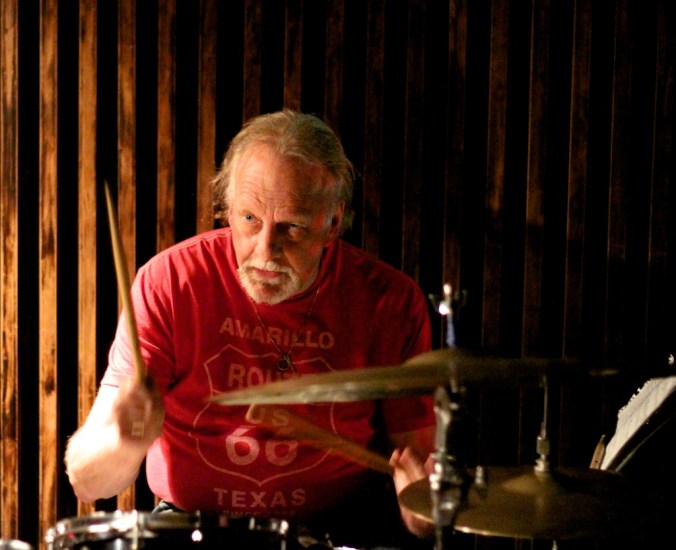
Perhaps the biggest masterstroke was adding Frank Gibson Jr into the mix.  This inclusion of a drummer most known for his Post Bop chops may have raised a few eyebrows at first, but Gibson is no stranger to fusion.  He demonstrated just how perfectly he can execute this material and he showed us all what free and imaginative drumming looks like.  I heard a band member saying later that having Frank behind them, lifted the whole performance.   IMG_8050 - Version 2
I am an unreformed devotee of music like this and whether you call it Space Funk, Space Jazz, Eclectic Fusion or just wild music I will be its cheer leader.   This is an itch that just begged to be scratched and I am glad that Neil gave us a taste of it.  Besides the wilder numbers there were one or two ballads to balance out the program.  Overall it was a very satisfying experience.

It was somehow fitting that the band performed on the day that NASA verified that Voyager One had left our solar system and entered interstellar space.  

Who: The Neil Watson Four.  Neil Watson (guitar), Cam Allen (tenor, doogon), Tom Dennison (bass), Frank Gibson Jr (drums).

Where: The CJC (Creative Jazz Club), 1885 Building, Brittomart, Auckland.

Photographs by John Fenton & Ben McNicoll

Frank Gibson – HardBopMobile

IMG_5926

Drummer Frank Gibson Jr has been a feature of the New Zealand Jazz scene for over 40 years.  He has accompanied and recorded with many of the greats and was one of a small cadre of Jazz musicians who remained visible at a time when Jazz was going through some very lean years.  These days we are most likely to hear him performing with his own unit the ‘HardBopMobile’ or with long time friends like keyboardist Murray McNabb or Neil Watson.

.  IMG_5940

I have seen this line up quite a few times and they offer up a solid programme of Hard Bop as the name suggests.   While they sometimes play perennial favourites, they generally prefer to dig into the overlooked tunes by the likes of Joe Henderson, Horace Silver or Monk.   With this material the band is on very firm ground.  Because of their familiarity with the genre and the material, they are able to bring fresh interpretations to the tunes.  Their approach is often surprisingly oblique.

Neil Watson

Neil Watson

Neil Watson is always adventurous on guitar and he has a joyfully quirky approach to tunes, while Cameron Allen (who is a well-respected saxophonist about town) approaches them from a more angular perspective.  The remaining band member is the popular Ben Turua (bass) and this turned out to be his last CJC (Creative Jazz Club) gig as he left for Australia soon after.

The gig was heavy on Monk compositions which were explored and probed from every angle.  It is not often that Monk’s ‘Hackensack’ is played; by a guitarist even less so.  To take it further out they loosened up the vibe and gave it a New Orleans feel.  This worked particularly well.  Other Monk tunes such as ‘Brilliant Corners’ (why this is not done more is beyond me) and ‘Ask Me Now’ occupied much of the set material.    They played Wes Montgomery’s ‘Jingles’, Ge Gee Gryce’s ‘Minority’ and a Sonny Sharrock tune ‘Little Rock’.  The free guitarist Sonny Sharrock is seldom heard these days and more is the pity.  Perhaps his hard edge and free fusion infused lines have faded with his passing?  I detect Neil’s deft hand in this last choice as he has a great liking for Sharrock.  Neil Watson also contributed a composition of his own and this probably confirms the rumour that he has been writing some new material of late.

IMG_5921 - Version 2

Bennie Maupin & Dick Oatts Massey University

Lovers of this music with a sense of its history will be aware that there have been markers of excellence laid down along the way. This is not about commercial success but a deeper and infinitely more subtle thing. A powerful vibe that seeps into the DNA of the music, acknowledged by all who have the ears to hear it. Bennie Maupin has laid down a number of such markers in his long career.

I have been listening to Bennie Maupin for most of my life but I suppose that it was Lee Morgan‘s ‘Live at the lighthouse’ album (Blue Note) that made me pay particular attention. The album had been cut at Hermosa Beach (Howard Rumsey’s ‘Lighthouse’) in July 1970. If I were to single out two tracks from that album they would be ‘Peyote’ which Bennie wrote and ‘Beehive’ by Harold Maybern. The former is a wonderful piece of lyrical writing with highly melodic hooks and subtle shifts in intensity which pull you ever deeper into the tune. The latter is a fiery burner that immediately tells you that Bennie is gazing at limitless improvisational horizons and flying free of known constraints.

Later that year he played so memorably on Miles ‘Bitches Brew’ (Columbia) and his bass clarinet on that album continued the groundbreaking work of Eric Dolphy. During the next decade he alternated between Herbie Hancock (‘Mwandishi’, ‘Headhunters’) and Miles (‘A Tribute to Jack Johnson’, ‘On The Corner’, ‘Big Fun’); while cutting his own first album as leader in 1974. ‘The Jewel in the Lotus’ (ECM) has been one of the most sought after albums in Jazz until its re-issue a few years ago. After that came ‘Slow Traffic to the Right’, ‘Moonscapes’, ‘Driving While Black on Intuition’, ‘Penumbra’ and ‘Early Reflections’. As a sideman he has played with the who’s who of the classic Jazz world including Horace Sliver and McCoy Tyner.

Immediately I heard about the Massey University concert featuring Dick Oatts and Bennie Maupin I asked the organisers if I could have a few words with the visitors. No Jazz writer would want to overlook an opportunity like this. I had been quite ill that week but no illness was going to stand in the way of this day.

Late Sunday morning on the day of the concert we met at a coffee bar near the Massey campus and while we ate I began a series of short conversations that ended up lasting until midnight. Dick is a friendly man with a big smile and a hint of the raconteur about him. Bennie is a little quieter, but you soon sense that he is taking everything in and he reveals an inner warmth as he gets to know you.

I had been burning to ask Bennie about his uncanny abilities as a multi reeds and winds player. “Why are there so few that master a range of horns” I asked? Like Dolphy before him Bennie has been extraordinarily proficient on all of his horns. When he was 18 years of age Eric Dolphy had handed him his flute saying, “show me how you play”. He then gave him an impromptu 40 minute flute lesson. What Bennie learned about technique in that short lesson was never forgotten.

He looked at me and said with deep reverence, “Dolphy was the greatest. Being a multi reeds and winds player is the path I was encouraged to take by those around me and in particular by my teacher Buddy Collette. There is no magic bullet, just very hard work. If you don’t maintain the maximum effort on each horn you quickly lose your edge”.

Because I loved ‘ Live at the Lighthouse ‘ so much I asked him about Harold Maybern’s ‘Beehive’. It is an incendiary tune bursting at the seams with raw energy. “Oh that tune was very hard the first time we played it”, said Bennie. “It was the velocity, but by the time we got to the ‘Lighthouse’, we were on top of it. That gig was recorded live and so we understood, no second takes. We could not even check the recording afterwards”. What Bennie, Jymie Merritt, Mickey Roker, Harold Maybern and Lee Morgan fused together was an energy infused miracle.

As we didn’t have much time before rehearsals we discussed his recordings as leader. ‘The Jewel in the Lotus’ (ECM 1974) is a gentle but profound masterpiece. The layering of instruments creates a soundscape that has space and incredible depth. In my mind this is not a fusion album but a manifesto of the spiritual mores of the 1970’s Jazz world. As with Herbie Hancock and Wayne Shorter, Bennie follows Nichiren Buddhism. An unpretentious spirituality quietly informs his work.

I learned that a Big Band version of the title track ‘The Jewel in the Lotus’ (Maupin), was to be played that night. They would also be playing ‘Water Torture’ (Maupin). This was transcribed and orchestrated by Mike Booth for the performance and Mike would be one of the few Kiwi musicians who could take on such a task in the limited timeframe. The result was praiseworthy and with Bennie on board it soared.

Dick Oatts (alto sax and other reeds) will be well-known to anyone who has followed the incarnations of the famous Thad Jones/Mel Lewis Big Band (Village Vanguard Orchestra). He is a mainstay of that orchestra and as I was soon to learn, his writing skills were honed to perfection. He has been to Auckland before and his return engagement was received with great enthusiasm. His extensive recordings as leader culminated with ‘Two Hearts’ (2009). This man is really across his music and his phenomenal chops, his focus and his writing skills all revealed themselves as the day proceeded.

Phil Broadhurst and the musicians then asked if I would like to attend the rehearsal. No second invitation needed.

What I witnessed was a highly informative music lesson. It is commonplace in Jazz for musicians who have never collaborated before to be thrown together. This is what Jazz musicians do. In these situations a musicians reading skills, memory and concentration are tested. When backing an iconic figure like Bennie Maupin or a gifted altoist like Dick Oatts, the risks intensify. This is when less experienced band members have to step up and the stretch is often a big one. The local musicians met that challenge on Sunday. In Jazz all higher learning stems from such experiences.

The program had been split into two segments. The first half was a sextet featuring Phil Broadhurst (piano), Frank Gibson Jnr (drums), Alberto Santorelli (bass), Neil Watson (guitar) – Bennie Maupin and Dick Oatts (saxophones). The second half was the Auckland Jazz Orchestra; first on their own and then with the visitors. Trudy Lile was featuring on Jazz Flute in a beautiful piece titled ‘Sogur Fjord’; a flute and orchestra chart which Mike Booth had brought back from Scandinavia some years ago.

When Bennie heard Trudy play he informed her. You will play up front with us in the first half as well. He then sat down and proceeded to write some parts for her. This writing on the fly was a feature of the afternoon and Dick Oatts was forever adjusting and rewriting charts to suit the instrumentation. This is a valuable skill that experienced professionals possess. In rehearsing the band Bennie would quietly raise his hand and ask for a subtle change. This was music under constant revision and aiming for the best outcome – an ideal improvisational vehicle.

Trudy had looked stunned for the briefest second and then she had focussed. She gave it everything and performed brilliantly.

The concert began at 8pm and it all came together as planned. The sextet plus Trudy played ‘Water Torture’ (Maupin), a reharmonisation of ‘Just Friends’ (‘Just Us’ Oatts) and several more numbers culminating with an impromptu performance of ‘Straight No Chaser’ (Monk). The second segment began with the AJO and Trudy, who were soon joined by Bennie and Dick.

If someone asked me today to choose my ten Desert Island tracks I would reel off nine and then add….oh and give me that Massey Concert AJO/Maupin version of ‘The Jewel and the Lotus’. To say that I enjoyed the tune would be a gross understatement.

The last number was ‘Naima’ and Dick Oatts was superb. He wove in all of the elements of the tune and then took it to new places. This was a display of passion and chops second to none. The performances on the night were all great and the AJO had raised the bar yet again.

Later as I ran Bennie and Dick back to their hotel I could not help but think. This has been the best of days.

I dedicate this post to Dr Cranshaw and to Kay, who kicked my ass and convinced me that I would find the strength to go.