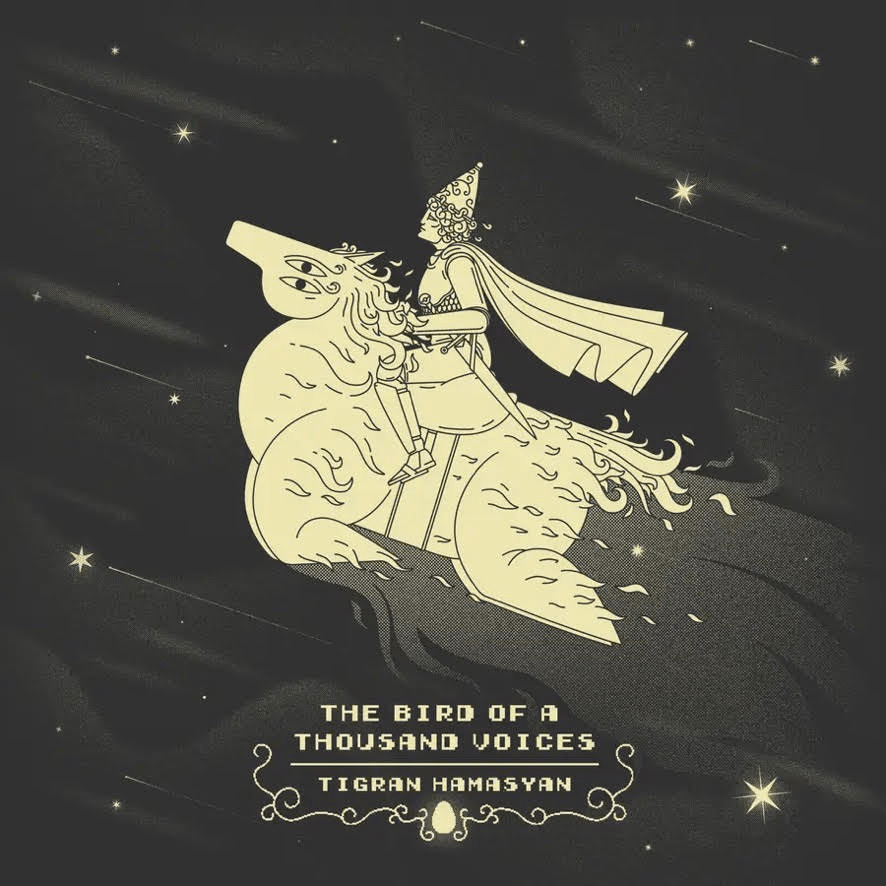
Tigran ~ The Bird of a Thousand Voices

The Bird of a Thousand Voices is an astonishing project, and as I listened and wrote, I weighed up the various superlatives. No other term sufficed. And, to describe it as a concept or a themed album would woefully undervalue it too. The depth and breadth of Tigran Hamasyan’s project is breathtaking and evaluating it requires fulsome engagement. I am not implying that it is unapproachable as there are delightful melodies as light as air, and exotic rhythms to engage, but underlying every note are other worlds, endlessly unfolding–worlds that beg exploration.

It is a transmedia project with the parts slotting together like pieces of a deliciously exotic puzzle. There is a film, an ancient manuscript, imaginative artworks, an interactive game, a stage show, and a timeless story, all wrapped in and around the extraordinary music of Tigran. It is utterly unique. His sound, touch, and visionary approach as he creates improvised music is singular, and few could pull this off so convincingly. 

The project was inspired by an ancient Armenian folktale (Hazaran Blbul), involving an anthropomorphic bird. The fable tells of an era of great unrest, so the bird embarks on a spiritual quest, seeking world harmony. Still, as with all great quests, physical, spiritual and psychological difficulties are encountered along the way. Tigran states in his summary, that it struck him as a metaphor for the problems confronting today’s world; conflict, inequality and ecological disasters. 

While the project references an ancient Armenian folktale, the bird theme is universal. Birds are sacred to most Middle Eastern, Mediterranean and Northern European cultures. They are frequently seen as messengers from the gods who can predict the future. Some believe they represent the soul or beauty and offer hope of peace. And, it is not just in myths. They warn us today of biodiversity loss, begging us to do better. 

Among the promotional material is a video referencing a medieval illuminated manuscript from Armenia. Inside the manuscript, birds dance out of the vellum pages as Tigran’s Steinway is filmed being airlifted to a mountaintop, and the music dances too. Tigran’s distinctive pianism is immediately recognisable, but a deeper otherworldly quality appears during this recording. His delicate filigree motifs repeat and evolve, choirs or a single voice, echo key phrases and staccato percussive interludes rise, then fade; however, what stays with you is not technique but something more elemental. The project is a prime example of improvised music reaching beyond the familiar as improvised music should. 
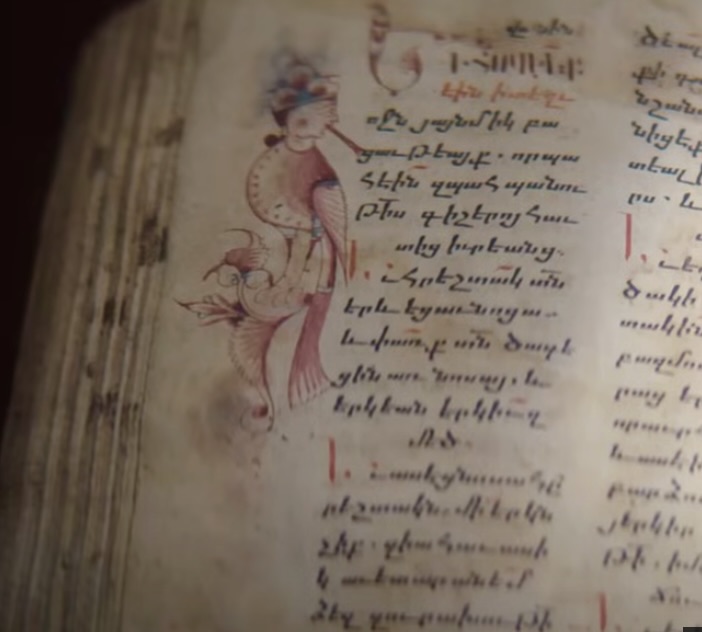
illustration excerpted from Armenian archives image

The album engages on many levels and should be enjoyed as the creators intended; by listening, watching, gaming, and contemplating. In collaboration with Tigran, Dutch filmmaker Ruben Van Leer has created cinematographic wonders integral to the music, as has illustrator Khoren Matevosyan. As you enter the website to participate in the game or to enjoy the illustrations and installations, you will find dozens of gifted collaborators credited. While there are too many to mention, the principal musicians are Tigran Hamasyan (piano, keyboards, drum programming, compositions, concept),  Areni Agbabian (vocals), Sofia Jernberg (vocals), Vahram Sargsyan (vocals), Nate Wood (drums and bass).    

A YouTube video showing aspects of the project is available: https://youtu.be/6vEVmU8PdvY?si=LVSrTpl6Puw3mucS and a visualiser track https://youtu.be/kxyFWewUvA0?si=FVpXPFPxW612_nZH

The vinyl album can be purchased via tigranhamasyan.com His music is also available on the usual streaming platforms. 

JazzLocal32.com was rated as one of the 50 best Jazz Blogs in the world by Feedspot. The author is a professional member of the Jazz Journalists Association, a Judge in the 7VJC International Jazz Competition, and a poet & writer. Some of these posts appear on other sites with the author’s permission. 
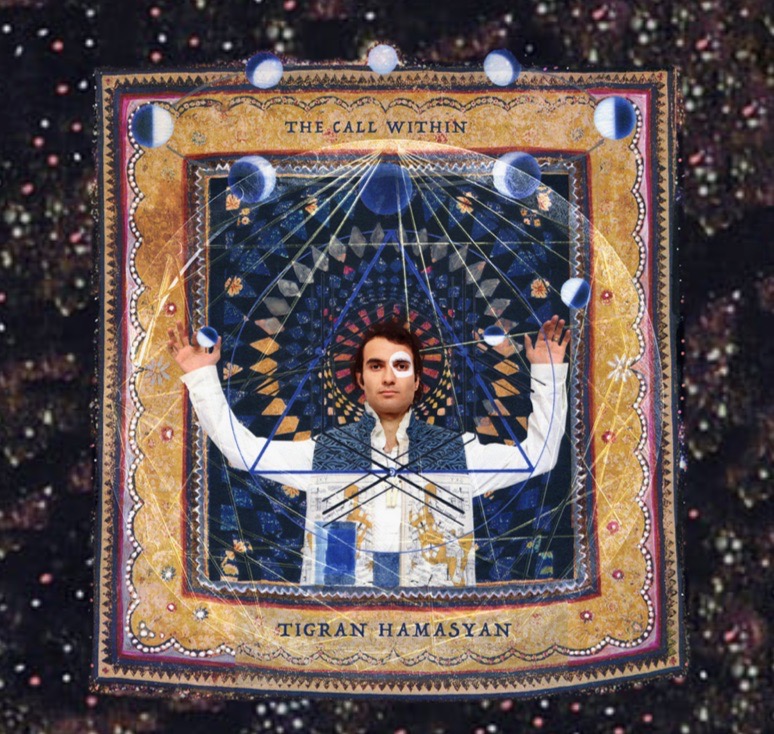


Tigran Hamasyan ~ The Call Within

Any album by the brilliant Armenian Jazz pianist Tigran Hamasyan is going to elevate our spirits, and his new release, ‘The Call Within’ does just that. The title suggests quiet introspection, but instead, a vast cosmology is revealed. It is infinitely expansive and any expectations of meditative reflection should therefore be set aside. In the album, Hamasyan utilises the richness of his birthplace Armenia, but in doing so he paints the tunes onto a broader canvas. 

‘The Call Within’ features a core trio plus guests. The guests however, are so well integrated into the mix that the unit feels like a medium-sized ensemble. Alongside Hamasyan: Evan Marien (bass) and Arthur Hnatek (drums). Guests: Tosin Abasi (guitar), Areni Agbabian (vocals) and Artyom Manukyan (cello). The generous use of keyboards interwoven with piano is also a factor in providing this unusually rich palette.  

The first track, ‘Levitation 21’ begins with a meditative chant over a simple motif. Then, without warning, the music comes at you like a freight train. This sudden mood switch is deftly executed and it sets up an other-worldly syncopation. The effect constantly catches you off guard as the tension rises then drops. It is call and response and it is stop-time, but not as we know it. 

The use of stop-time is even more pronounced on ‘Our Film’ and as the album progresses, the listener becomes aware of many such contrasts. Some of these contrasting figures are deftly interwoven, placing one inside of the other. The heavily percussive co-exists with gently rippling arpeggios, which by contrast, are played with extraordinary delicacy. And over this come the drums and bass who dance like magical dervishes. 

On ‘Old Maps’, rippling arpeggios introduce a celestial choir and the notes fall from Hamasyan’s fingertips like rain drops. I especially loved this track, as it felt like the universe singing to humanity. Poets and musicians are beguiled by maps and love them as archetypes. The maps theme is again updated in the last piece titled ‘New Maps

There are quieter moments as well, such as the intriguingly titled ‘At a Post-Historic Seashore’ but whatever the mood, your attention never flags. As each new vista appears you feel like a wayfarer on a beguiling quest. This is the genius of the album and what ever the phrase or section, you feel like it is was just for you. Throughout, Hamasyan draws on ancient Armenian scales and on modality. Perhaps that is why it sounds both familiar and exotic. 

At each turn, Hamasyan and his collaborators deliver energised performances and in doing so they shake us from our pandemic-induced inertia. This is the album we need right now. It is an affirmation of all that is wonderful in the world. It is European Jazz at its finest. Like three of his previous albums, this one has been released on the Warners ‘Nonesuch’ label. It is available through Bandcamp or from record stores.

Tigran Hamasyan (keyboards, piano, voices), Evan Marien (electric bass), Arthur Hnatek (drums) and with guests: Tosin Abasi (guitar), Areni Agbabian (vocals), Artyom Manukyan (cello)

JazzLocal32.com was rated as one of the 50 best Jazz Blogs in the world by Feedspot. The author is a professional member of the Jazz Journalists Association. Many of these posts also appear on Radio13.co.nz

‘Pasif.ist’ Natalia Mann – an Oriental Dreamscape

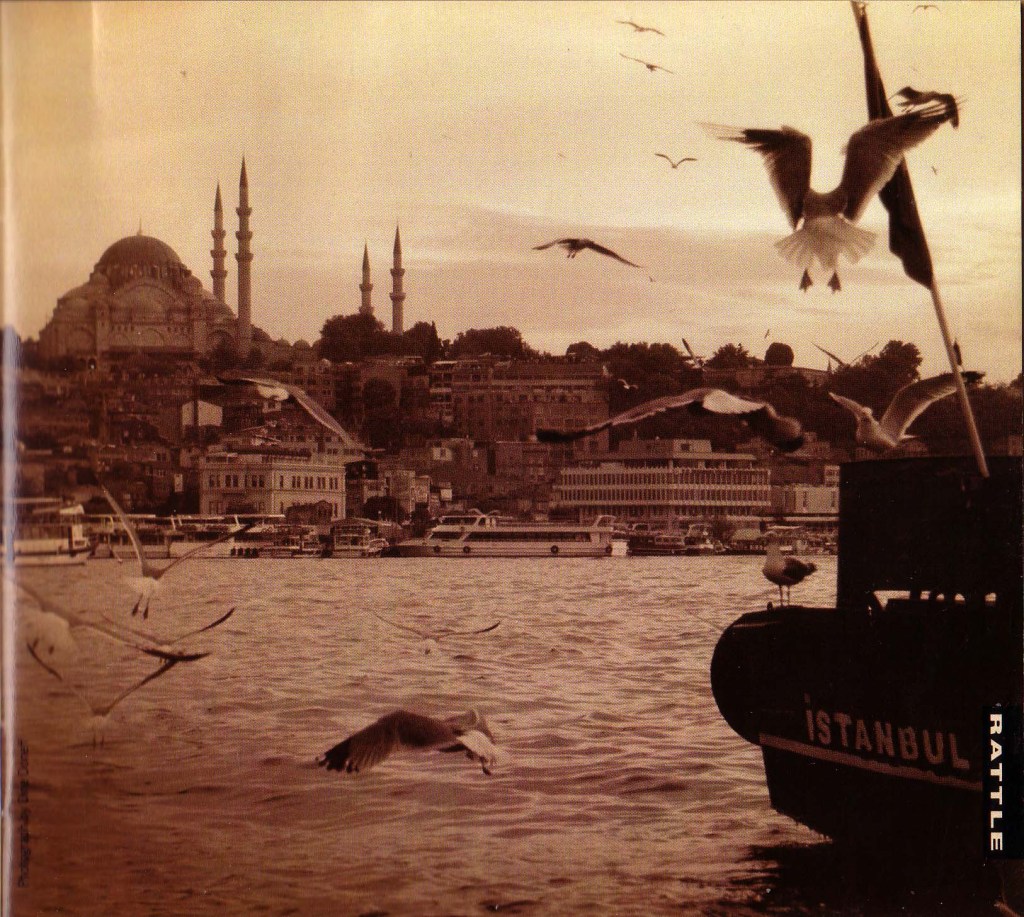
The music I cover here may not be Jazz in the purest sense but it is music that transcends the limitations of musical boundaries.  It has its own pulses and rhythms and it is improvised around themes.    This is a delicious orientalist dreamscape of the sort painted by Lord Leighton, Alma Tadema, Edward Lear and Eugene Delacroix.  It is redolent of sultry afternoons in an Ottoman palace or of the winding streets of Istanbul.   In the unfolding subtleties, one can hear the merest snatches of older themes; Constantinople and even Byzantium are hinted at but never confined.   This is not traditional Turkish music but an exotic vision of a landscape just beyond our reach.  This achieves what all great music does – connects us with a world that we would want to explore further.

In early December I received an email from Rattle Records inviting me to the ‘Pacif.ist’ CD launch and at that point I had scant information on the event.    I had every intention of requesting more details but the workaday world drowned me in trivia and I soon forgot.    One week later I was sitting in a meeting when the reminder flashed up on my iPhone; the launch was starting in an hour.

The venue was the spectacular Iron Bank building.   An imposing piece of modernist architecture towering far above the rainy Auckland streets.   The launch was held in an intimate minimalist space and the invited guests were mainly musicians associated with Rattle.  To one side of the dimly lit room was a beautiful red lacquered harp and beside it the barest bones of a drum kit (snare and cymbals).   Soon, harpist, Natalia Mann sat down to conduct a brief sound check and when she had finished I spoke to her about the lovely voicings that she was creating as she plucked and stroked the strings.   They were pianistic Jazz chords, but with all of the extensions added.   In the conversation that followed, we spoke of BeBop harpist Dorothy Ashby and of the later avant-garde stylist Alice Coltrane.   At this point, I was intrigued to hear the music, as this was a gap in my musical knowledge that I was very happy to fill.

I have long been a fan of Mediterranean, Middle Eastern Jazz and its Jazz/World Music offshoots, but I can’t recall ever hearing Turkish Musicians.   The launch used only a duo but they captured the mood perfectly – Natalia Mann (harp) and the well-known local, multi-instrumentalist Kody Neilson on drums. The album could perhaps be described as improvised World-Music but with Jazz inflexions – the sort that ECM presents so convincingly.   With top rated musicians like Tigran Hamasyan and Dhafer Youssef bridging the World/Jazz continuum we will see a lot more of this music on offer.   If you open your ears Jazzers and listen carefully, this gentle melodic music with its rich percussion will get to you.

After Natalia had returned to her busy life in Istanbul I conducted an email interview with her and this will be posted as an addendum to this post in a few days.

The Album Pacif.ist is available in download or hard copy from Rattle Records.    I would strongly urge buying the CD, as the artwork and liner notes are so good that it would be a crime against art to circumvent them. http://www.rattle.co.nz

The musicians on the album are; Natalia Mann (harp, compositions), Izzet Kizil (percussion & drums), Sercan Halili (classic Kemence & Alto Kemence), Abdullah Shakar (fretless bass & electric bass), Dine Doneff (double bass), Richard Nunns (taonga puoro [6]), Lucien Johnson (soprano & tenor sax [3]), Riki Gooch (percussion [1,2,3]), Naomi Jean O’Sullivan (gongs [9], co- writer), Serdar Pazarcioglu (violon [5]), Deniz Gungor (aqua [5]).   The album was mainly recorded in Turkey but with some instruments recorded in New Zealand.  That rich-voiced exotic string instrument you hear is the ancient Kemence (see interview).

After I had written this, I saw an article in the latest Downbeat about the growing Jazz scene in Turkey titled ‘Emerging Turks’.  The New York times has also highlighted this in a recent article.     Natalia is New Zealand born and of Samoan/European descent.   She is at present doing a master’s degree in Jazz at Skopje and is in demand with various European orchestras.   She loves Jazz and has projects on the way which will lean more in that direction.     

Istanbul – Pacif.ist cover art