Stephen Thomas Electric Band

Thomas 2 (1).jpgThe history of music is the history of instrument development and from the earliest of times, musicians have expanded the reach of their instruments. The mother of instruments, Al’ Oud was first documented 3500 years ago, but documenting the development of the drum is a nebulous task. It almost certainly arose in Africa and along the way it has undergone a multitude of modifications. On Wednesday there was another waypoint along the continuum under the forward-looking beats of Stephen Thomas. Thomas is a gifted drummer and percussionist and in his hands, the instrument takes on a new life by transcending the mundane. The gig arose out of his last years Masters recital and the focus was on extended technique; combining physical drum rhythms, electronics via a drum pad, prepared drum heads and samples. 

Improvisers are the masters of extended technique, but even so, it is comparatively rare to hear these effects applied to drums, winds or reeds in Jazz. The most obvious examples occurred during the 70’s fusion era, but post 70s Shorter and Harris, who carved a credible path, only a brave few have followed. In my view, it requires experienced musicians to do this well and Stephen Thomas is well qualified to realise this project. Done badly it can look like a botched attempt to blur technique deficiencies. Done well it is an opening into a brave new world and another set of tools to build on what has gone before.

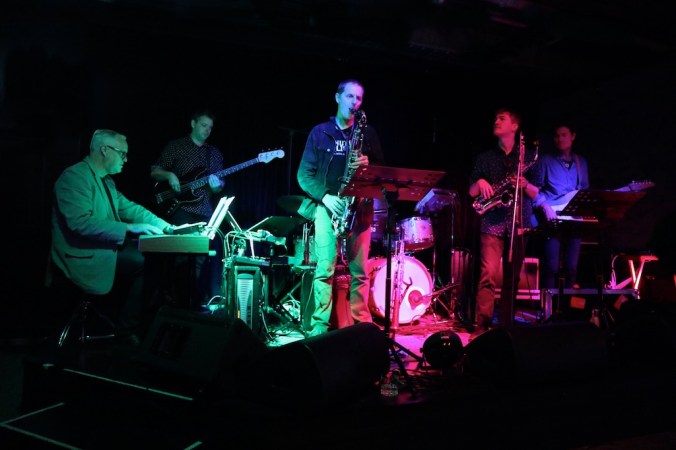
True to label, The Stephen Thomas Electric Band was wired and utilised effects, including the horn section. There were various configurations from sextet to duo and each configuration teased out a particular facet of the interesting compositions. The full line up was: drums (+ electronics), two saxophonists (+ electronics, one playing alto and the other playing tenor, soprano or Ewi). There was a keyboard player, an electric bass player and two electric guitarists (+ one guitarist playing prepared guitar). The horns often played in unison as did the bass and keyboard. With the octave or chorusing effect deployed, this made for a rich and full-throated palette of tonal colours.

I have posted two very different tunes from the gig, One is MG40 with the sextet and the other a duo between Thomas and Joel Vinsen (the latter on prepared guitar). If you listen closely to MG40, you will detect the echoes of a distant past. An echo from the 1950s in fact when the conductor Leonard Bernstein attempted to explain Jazz to a very young audience. That footage is hopelessly time-locked as the plummy voice of a high-brow white man ‘explaining black music’ overshadows the message. Notwithstanding, I have no doubt that many of the Bernstein Philharmonic attendees would go on to explore improvised music after hearing Benny Golson and the sextet perform. What Thomas does with this piece is both playful and respectful. Bernstein would get it and laugh out loud. MG40 refers to Mark Giuliani – a drummer on the same trailblazing path. 

The other piece I have posted involves the sextet. With Alan Brown on keyboards and Andy Smith on guitar, the piece soars as it morphs into a multi-layered groove piece, one reminiscent of the Fusion era. The overall sound has lots of bottom, with the bass effects and saxophone effects creating a surreal lower register cushion; over which Smith and Brown build towards the heart-stopping crescendo. This was a group of heavyweight performers with Chris Mason-Battley and Markus Fritsch the horn line. And none of it possible without the invention, vision and superior chops of Thomas. 
The Stephen Thomas Electric Band:  Stephen Thomas (drum kit, drum pad + effects, triggered samples, percussion, prepared drums), Alan Brown (digital keyboard), Andy Smith (guitar + effects), Chris Mason Battley (saxophones, Ewi + effects), Markus Fritsch (alto saxophone), Mostyn Cole (electric bass + effects), Joel Vinsen (prepared guitar + effects). The gig took place at Anthology, CJC Creative Jazz Club, 18 September 2019

Spirograph Studies @ CJC Auckland

SpirographThe Melbourne group Spirograph Studies was exactly as described, modern and eclectic. In this quartet, there were no horns to carve out melodic lines. Instead, a guitar and piano spun intricate layers one on the other, focussing more on well-crafted motifs and harmonic development. There was melody but it was mostly implied, nestling comfortably among richly dissonant textures and emerging out of the subtle interplay. It was often voice-led but not as we know it and the overall effect was beguiling.  
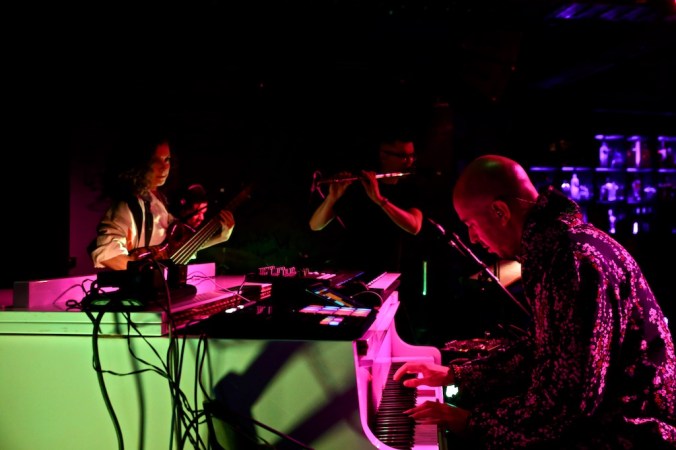
The playing was great but what also stood out were the compositions. What we experienced was an unmistakable Jazz Americana vibe. There were no actual Frisell tunes played but the great man’s essence hung in the air; residing most strongly in the interactions between leader Tamara Murphy and her bandmate Fran Swinn; Murphy the enabler and Swinn the ideal vehicle for realisation. As Swinn stroked the chords, the soulful utterances reeled us in; urged on by the bass. With music as delicately layered as this, no band member can afford veer off coarse and none did. This was a disciplined ensemble but in spite of that, the music flowed effortlessly. Their overall sound was warm and yet it tugged on the heartstrings, hinting at a distant sadness. The signature sound of Americana, where every note is weighted with nostalgia.


The other core band member was drummer James McLean. A drummer who showed his ability by responding appropriately to the textural subtleties and propelling the gentle swing feel. His brushwork was crisp and his stick-work understated so as to reside inside the music and not all over it.  The pianist on the ‘Kindness not Courtesy’ album was Luke Howard, but on their Australasian tour, his role was alternated with Sam Keevers. I have heard Keevers before as he is a well respected Australian pianist. For a long period, he held the piano chair in the Vince Jones group (a coveted position held before him by Barney McAll).  Having Keevers onboard during the New Zealand leg worked a treat. A skilled accompanist who knows a lot about supportive playing and comping. The Piano and guitar interacting seamlessly and moving in and around each other’s phrases like dance partners.  

The album titled ‘Kindness Not Courtesy’ is available from Bandcamp and the link can be followed here. spirographstudies.bandcamp.com/. The Auckland gig was at Anthology for the CJC Creative Jazz Club, 11 September 2019.

Spirograph Studies: Tamara Murphy (bass, compositions), Sam Keevers (piano), Fran Swinn (guitar), James McLean (drums). 

Mark de Clive-Lowe ~ Heritage Tour

De Clive-LoweMusic is the highest form of communication. It is universal. It reveals truths, tells stories, entertains, and in Mark de Clive-Lowe’s case, it evokes other realities. This was a masterclass in storytelling; an unfolding kaleidoscope where the contradictions and sublime realisations about the human condition were brought into focus. ‘Heritage 1 + 2’ the albums reflect his personal story, a journey of reconnection, an exploration of culture and of family history. He revealed it through moments of spoken narrative, but above all through his reverential musical examination of Japanese art forms. This was a musical journey where the highly personal overlapped the philosophical. It was a journey back to his Jazz roots and undertaken entirely on his own terms.  
At least twenty years have passed since I last heard MdCL perform in Auckland. Back then he was regarded as a youthful Jazz prodigy and people flocked to hear him.  Accompanying such acclaim comes expectations and that can be a straight jacket. It was the era of the media-hyped ‘young lions’, when up and coming Jazz musicians were expected to showcase standards and reclaim a glorious past. While the die-hards repeated their time-worn mantras, something else bubbled beneath the surface; musicians like MdCL shucked off others expectations; in his case moving a world away to engage with the hybrid music/dance scene in London. From there he moved on to LA where he built a solid and enduring reputation. These days Auckland has a flourishing improvised music scene and audiences value innovation. In this space, Jazz and other genres merge effortlessly. Because of that, it was exactly the right moment for MdCL to bring this project home. Auckland heard the call and the concerts reached capacity club audiences.   

When MdCL introduced the sets he talked about his childhood and of cultural disconnection. Experiences like this although disquieting feed the creative spirit. The recent album and the tour follow a time spent in Japan where he immersed himself in his mother’s culture. The album opens with ‘The Offering’ an apt and beguiling introduction piece. Like a ritual washing of hands before a tea ceremony, a moment to sweep away preconceptions. Another standout honoured his mother by evoking her family name. ‘Mizugaki’ is perhaps the most reflective and personal tune of the sets. This cross-cultural feel is evident from the opener to the tunes which follow. While the scales and moods speak of Japan, the interpretations belong to an improviser. Throughout, MdCL maintains this fine balancing act. Evoking the unique moods of the haiku or ink wash. Illusory moods that are best described in the Japanese as no English phrase is adequate. And to all of this, he brings his lived experience. A kiwi-born musician with a foot in many camps.

With the exception of two traditional folk tunes, the compositions (and arrangements) are his own, other elements of his musical journey are also evident: tasteful electronics, drum & bass, Jazz. For copies of the two albums and MdCL’s other recordings go to Bandcamp (links below). Perhaps we can lure him back more often as he certainly has a following here. On the New Zealand leg of his tour, he was joined by Marika Hodgson on electric bass, Myele Manzanza on drums (and in Auckland by Lewis McCallum on flute and alto). The Kiwi contingent sounded good alongside MdCL and for a return-home tour, there was a rightness to utilising Kiwi musicians. I have posted a tune from the Auckland gig titled ‘Silk Road’. The Silk Road carried music, ideas, goods and culture, travelling by any means and from Japan to Spain; and now New Zealand.   

https://markdeclivelowe.bandcamp.com/album/heritage

https://markdeclivelowe.bandcamp.com/album/heritage-ii 

Heritage (Auckland): Mark de Clive-Lowe (keys, electronic wizardry), Lewis MacCallum (alto saxophone, flute, effects), Marika Hodgson (e-bass), Myele Manzanza (drums). CJC Creative Jazz Club, Anthology, K’Road, 4 September 2019.

Eve de Castro-Robinson ~ The Gristle of Knuckles

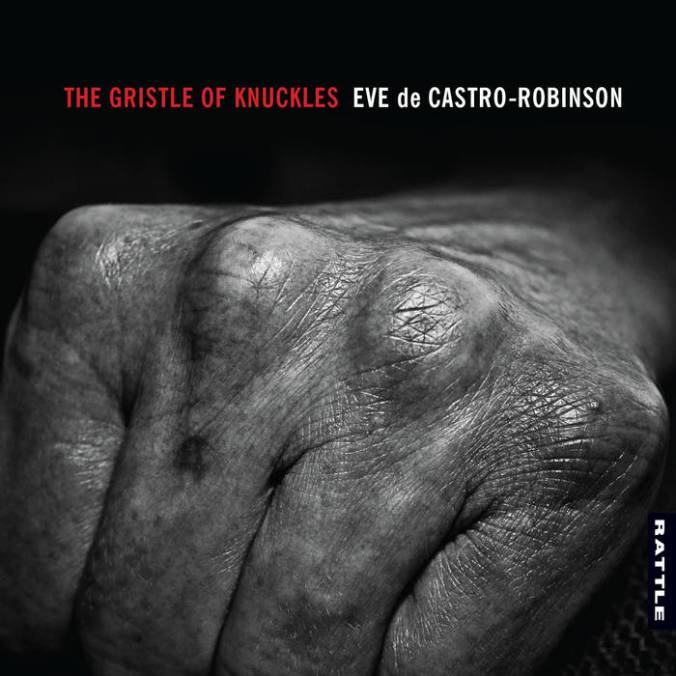
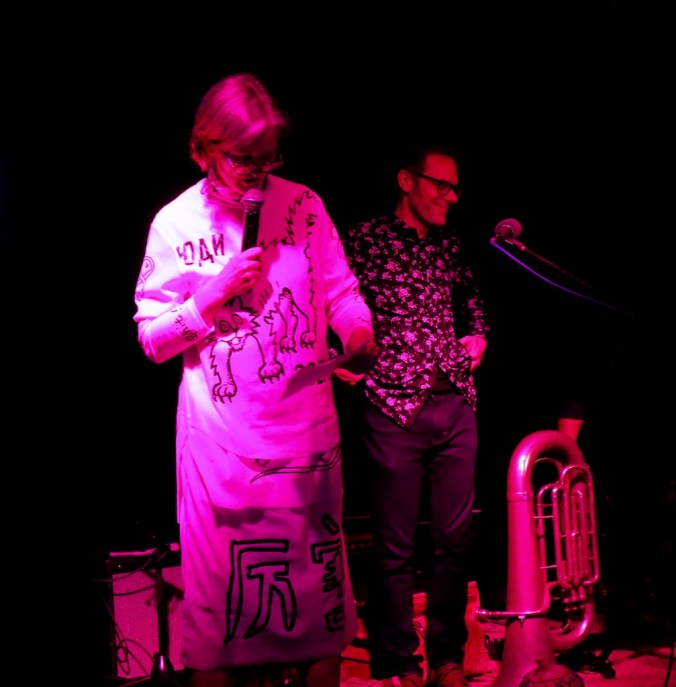
Eve de Castro-Robinson is Associate Professor of Composition at the University of Auckland. She is well known as a New Zealand classical composer and although widely acknowledged in that field, she is strongly associated with the improvising and experimental music community.  Those who attended the CJC Creative Jazz Club last Wednesday witnessed the scope of her compositional output, with compositions interpreted by a plethora of gifted improvisers. The night was a rare treat.  Last year de Castro-Robinson released an album titled ‘Gristle of Knuckles’ and on Wednesday we experienced a live performance. When introducing it she explained, ‘although I am described as a contemporary classical composer, I am best placed at the ‘arts’ end of that spectrum’. In this space genres, overlap and artificial barriers are torn down. Out of these collisions comes original and vibrant music.

While de Castro Robinson is primarily seen as a composer, she is also an enabler and a canny collaborator; expanding her vision through skilled pedagogy. The above project has her engaging with colleagues from the UoA Jazz school plus a handful of gifted musicians from the diaspora of the avant-garde. The project comes close to being conduction; guiding the improvisers with a feather-light touch, letting them find their truth as her works are re-imagined.  The pieces were composed over a period of years, taking us on a journey from the primal to the avant-garde.       

The first set opened with Roger Manins and Ron Samsom playing ‘Doggerel’. A multi-phonic utterance which set the mood. That was followed by a moving ensemble piece featuring Don McGlashan, Kingsley Melhuish, Keith Price, Kevin Field and Ron Samsom titled ‘The Long Dream of Waking’ (a Len Lye poem). That juxtaposition, duo to quintet, worked well, in fact, most of the compositions were quite unlike those preceding them. These contrasts were an integral part of the ebb and flow and the contrasts worked to the advantage of the whole. There was also another factor in play and it was significant. Between numbers, de Castro-Robinson introduced the pieces, not in the usual way but by telling stories. She has a terrific stage presence and while I shouldn’t be surprised by that, I was. Her talk is peppered with wry humour, that understated self-deprecating Kiwi humour. She quickly had us eating out of her hand and although not playing an instrument, was very much a performer herself. 

Everything was interesting, everything engaged. ‘Twitch’ featuring Kristian Larsen, a piece for piano (but kinetic and expansively sonic),  ‘Passion Flower’ played by Kevin Field, a work inspired by a painting and by ‘The March of Women’ composed by the suffragist Ethyl Smyth. The original is a feminist classic but under Fields fingers de Castro-Robinson’s tune it took on a moody reverential feel. Consciously or unconsciously and deep inside the voicings, it captured the mood of another ‘Passionflower’ the Billy Strayhorn masterpiece; a perfect alignment in my view. ConunDRUMS featured Samsom, Melhuish and Larsen, a delightful percussive exploration, a sculpture. ‘Stumbling Trains’ a fiery piece on cello played by Ashley Brown of NZTrio (and co-composed by him). Check out the embed and above all go to the Rattle site and check out Field’s interpretation of ‘Passion Flower’.


The second set opened with ‘Countercurrents’ a solo piece played by alto saxophonist Callum Passells. It began in a stairwell and moved among us, resonating beautifully as the figures and melodies filled the room progressively. ‘Small Blue’ had Field, Melhuish, Price and Samsom paired (a Tuba taking up a bass line), ‘Hau’ featured Mere Boynton on voice and crystal and Melhuish on Taonga Puora. This particular piece was a standout. An ancient-to-modern story of the passing of the spirit and told in a way that evokes New Zealand’s pre-colonial past. I defy anyone to listen to this and not experience a shiver run down the spine.  ‘Trouble Trouble Mind’ brought McGlashan back to the stage with Boynton, Price and Samsom. With two guitars a backing vocal and a raw bluesy feel, this was prime McGlashan territory. The vibe here hinted at a Dunedin punk sound. Rattle records Steve Garden also took to the stage with an array of vocal sounds on ‘The Gild’ (we often spot him launching a Rattle album but we forget that he is a drummer. His percussive vocalisations added quirky additions to the interactions between Samsom and Larsen).

On the face of it, the gig was a collection of interesting compositions, but it also felt a lot like theatre. However you describe it, it was great performance art and the audience loved it. The album can be purchased from Rattle at Bandcamp (as hard copies or high-quality downloads). The musicians were; Eve de Castro-Robinson (compositions and narration), Don McGlashan (guitar and voice), Kevin Field (piano), Roger Manins (tenor saxophone), Ron Samsom (drums and percussion),  Kingsley Melhuish (conches, tuba, Tango Puora, tenor horn), Kristian Larsen (piano, live sound, gilded cello), Kieth Price (guitar), Mere Boynton (voice, crystal glass), Steve Garden (sounds), Callum Passells (alto saxophone), Ashley Brown (cello).  The gig took place at Anthology, K’Road, CJC Creative Jazz Club, 28 August 2019.