New Year 2014 – the fabric of creativity

IMG_8954

For many, music is a distant and pleasant soundtrack which augments their moments of relaxation.   Something to wallpaper the background while they chatter over a few drinks.  I am wired differently because my normal talkativeness ceases when even a faint echo of good music is heard; an off switch is flicked.  This pied piper effect has characterised my life and often made me late for appointments.  What is it that makes music so compelling to some and not to others and why is improvised music beguiling to those with that special antennae?

My earliest memory of Jazz is of a Louis Armstrong film.  I was a primary schooler and I made my long-suffering mother take me back twice.  Louis fascinated me in ways my relatives couldn’t quite fathom but they indulged me with an EP or two.  Ours was a classical music household.  Three years later I was walking down a street near my home when I heard a trumpet playing.   I could see the musician’s outline in the upstairs window as he played, weaving deftly around what I later learned was a Coleman Hawkins solo.  I stopped in the street, delighted and open-mouthed.   I have no idea how long I stood on the pavement gawking, but I vaguely recall being led inside and offered cocoa by the trumpeters mother.   The trumpeter and his mother were Polish refugees and they made me feel very welcome.  In the months that followed I called often and absorbed Miles, Lester Young, Dave Brubeck, Sweets Edison, Art Peper, Hampton Hawes, Billie Holiday, Basie, Ellington and more.  By the time I had connected with the groove-organ trios of Gene Ammons I was damned.  I would bunk off school and play Gene Ammons or Miles all day long, dancing about like a deranged fool.  The devils music had me by the throat.
IMG_8947 - Version 2

Half a century on the same music gods and their siren songs still exert power over me.  Enough to lure me to Australia at very short notice.  I had picked up some gossip from Australian musician friends, that my friend Roger Manins was doing a gig with Mike Nock, James Muller, Cameron Undy and Dave Goodman at the 505.  I have family in Sydney and so it was a no brainer.  Family, grandchildren and Jazz, perfect.   When I told Roger that I would be flying over for the gig he invited me to his ‘Hip Flask’ recording session at the famous 301 Studios in Alexandria.  I love recording studios and to hear a top rated unit like this recording in a famous studio was too good an opportunity to miss.  I applied for extra leave and altered my flight schedule to accommodate the extra day in the 301.  IMG_8963 - Version 2
The timing rested on a knife-edge as I had a gig to attend just hours before my flight to Australia.   I made the check-out with 4 minutes to spare.  The flight over on Virgin was abysmal.  I had a headache from lack of sleep and it was like being stuffed into a rubbish tin surrounded by bored, rude flight attendants who acted as if they were in a BBC spoof.  An Australian musician later commented that Virgin felt to him like it was piloted by overtired children.  IMG_9011 - Version 2
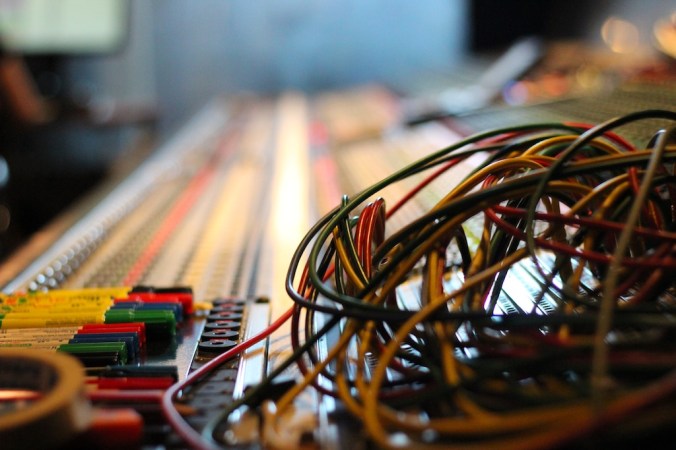
After clearing customs, I poured myself into a taxi and headed directly for the 301.  The industrial exterior gave little indication that I was standing outside an important recording studio.  The one where EST recorded their final album.  They buzzed me in and after navigating a series of corridors I pushed open a heavily padded door to find myself in an icy cool low-lit room with two technicians, a two-man film crew and the five cats from ‘Hip Flask’.   They were sitting around the mixing desk drinking coffee and listening over and over to the intro of a tune.  It sounded great.  This is what I had come for.  To capture the very act of creation.
IMG_9012 - Version 3 (1)

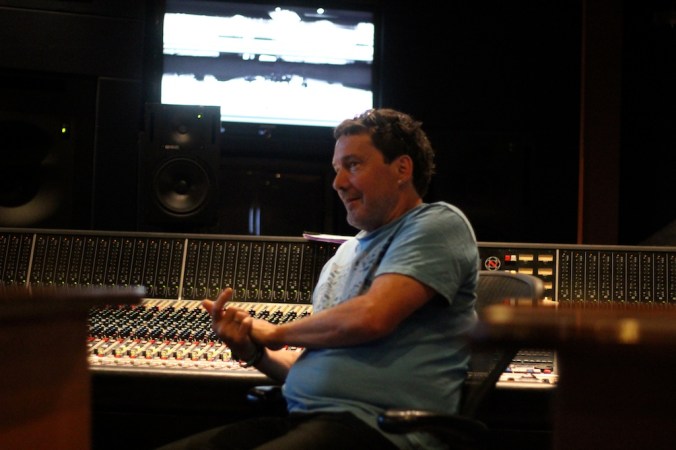
It is a special privilege to follow a creative process through from inception and I felt like a kid in a candy store.  This is exactly where I wanted to be and I soaked it up greedily.   My headache had vanished at the first note.  As the morning progressed the band would troop in and out of the studio.  Trying material, listening to it and repeating it if any one member expressed dissatisfaction.  Roger outlined his vision and set the tone, but after that he allowed a form of guided democracy to exist.  If they strayed from his vision he would talk them back round.

IMG_8939

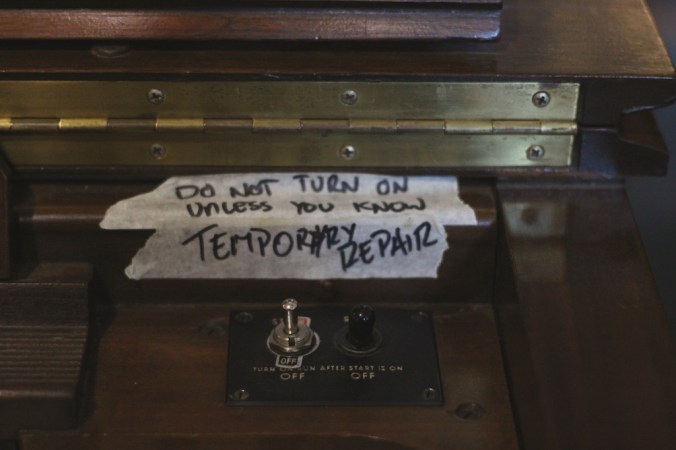
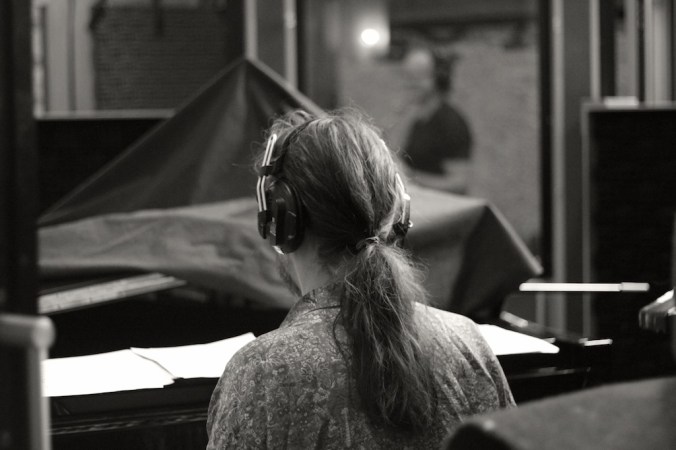
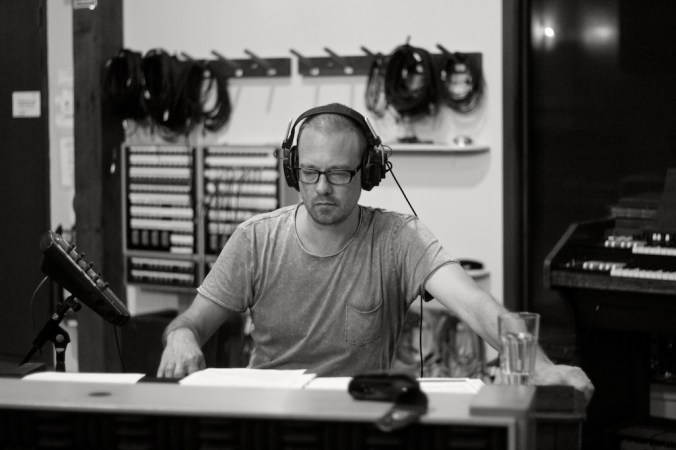
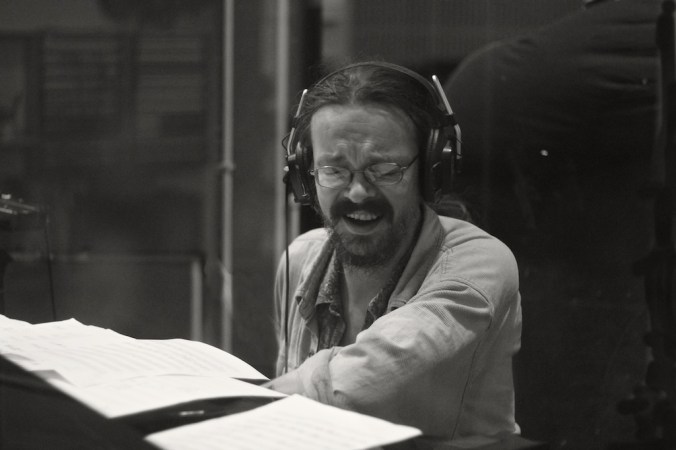
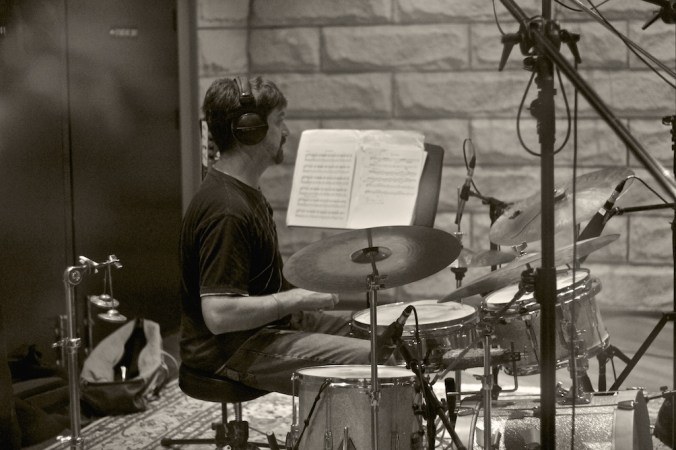
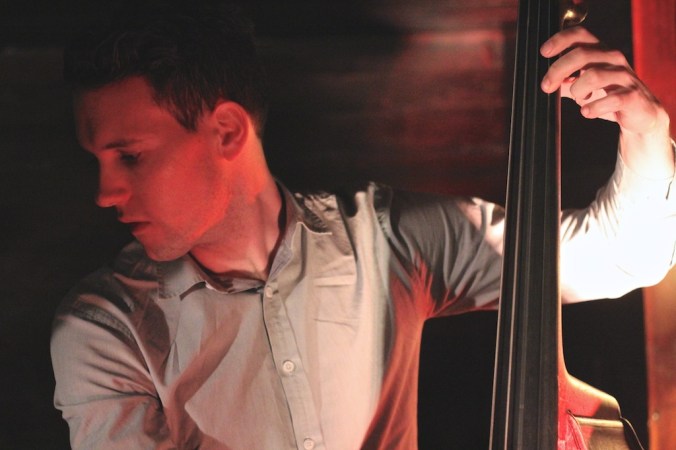
The sessions in the control room were all smiles and banter but a sense of purpose always ran through the proceedings like an unbreakable thread.  When they reached agreement they would return to the studio and assume their positions, baffled up and miked to such an extent that the bass drums and piano were barely visible above the wires, cover sheets and portable booths.  The band has an unusual configuration for a funk unit, being tenor Saxophone, Hammond B3, grand piano, drums and bass.  The saxophone, bass, piano and B3 were in the studio while the drums and the Leslie unit were both in isolation booths.   The studio space was big enough to accommodate an orchestra, but this quintet was squeezed into a corner and each baffled from the other in some way.
IMG_8955 - Version 2

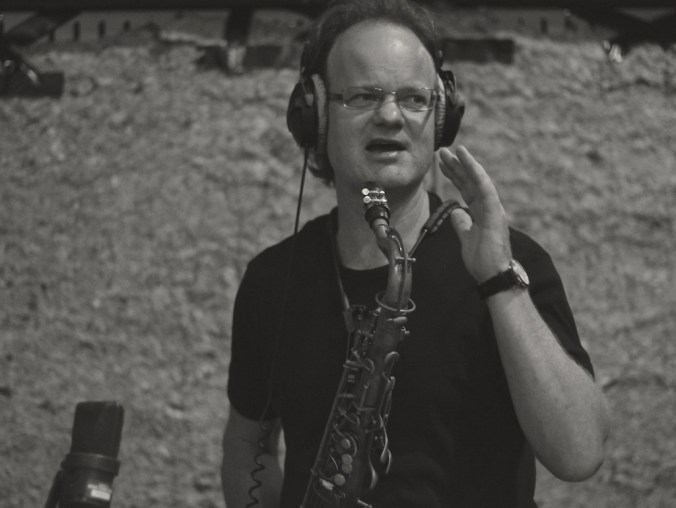
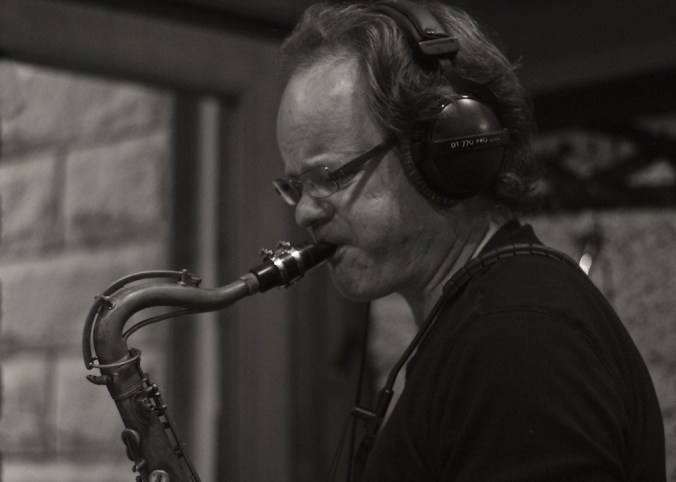
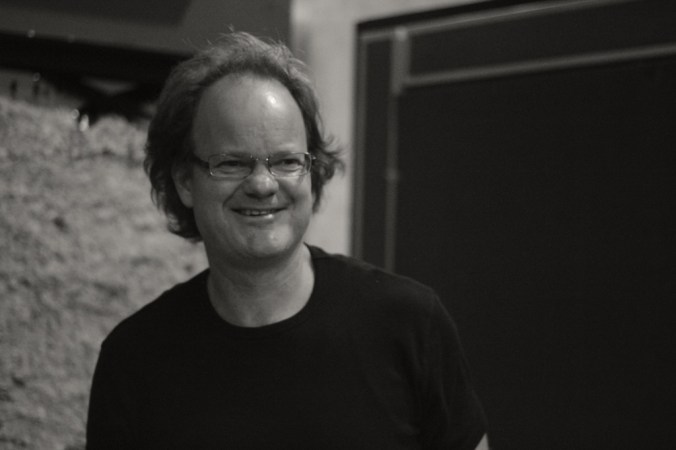
The quintet had recorded together before and even though their last recording was in 2007, their essence had survived intact.  As the session progressed I learnt a new word, ‘shoint’.  Roger and the organist Stu Hunter used it often and they would proclaim a satisfactory cut as being ‘Shointy’ or they would listen to the playbacks to see if they had ‘shoint’.   As far as I can ascertain the term describes a deep dirty groove that hits the musical ‘g’ spot.   While it is accurate to describe the recording as Jazz Funk, it is more than that.   The unusual pairing of two keyboards, the intuitive interaction and the quality of the musicianship gifted them with limitless options to draw upon.   Over all of this Roger Manins presided like an old time preacher, communicating with gestures, earthy licks on his Conn, diagrams and pithy Rogeresk phrases.  IMG_8969
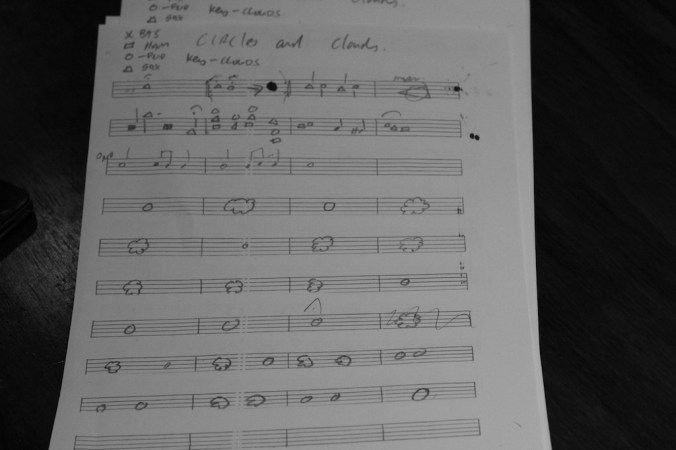
The most interesting moments came towards the end of the session when Roger produced a chart for ‘circles and clouds’.  The chart contained a few bars of musical phrases and then a series of symbols.  The ideas conveyed were beyond normal logic.  On most of the staves clouds were drawn and although these pieces were essentially free, there was a clear purpose underpinning them.  Roger had the concept firmly in his sights as he talked them through the vision or let the ideas develop in the studio until the concept was realised.  Stu Hunter would play a compellingly dissonant chord and then Adam Ponting and the others would grab a hold of what was unfolding and produce kaleidoscopic shapes, moving and shifting together like interchangeable chameleons.  When the idea was realised Roger would take them back into the control room and expand on what had gone before.  Roger, “OK you are clouds, circling a vast ocean.  Now if you look down you will see dolphins swimming and playing”.  One or other of the band then asked if there was a shoal of bait fish swimming near by.   The concepts developed and then they would repeat the process until a number of amazing miniatures were cut.  This filigree of beguiling patterns had been conjured up in that very hour.  Realised without an over reliance on written notation or oral language.  This was improvisation in its most profound form and I was lucky enough to hear and experience it.
IMG_8993 - Version 2

IMG_8988 - Version 2

IMG_9009 - Version 2

IMG_9003 - Version 2

IMG_8999 - Version 2

IMG_8956 - Version 2

My earlier question as to why some people fall deep within the web of music, while others let it wash over them unaffected, is not answered here.  This listener will never lose the magic and following bands like this guarantees that.  I am impatient to see what cuts survive and what is locked way in a vault.  When the album comes out and I can hardly wait, I will have heard more than most.  Every squeak, false start and profound moment is locked in my memory.  John Zorn said, “all sound is valid”.  I heard and witnessed an intensely creative process and I feel very lucky.

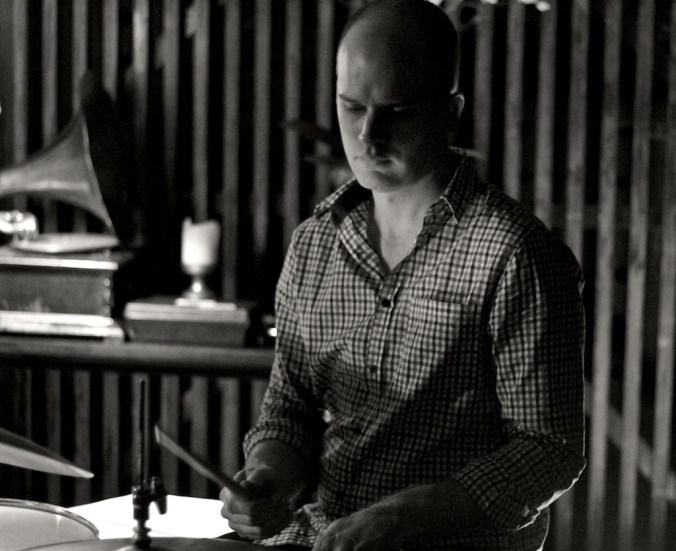
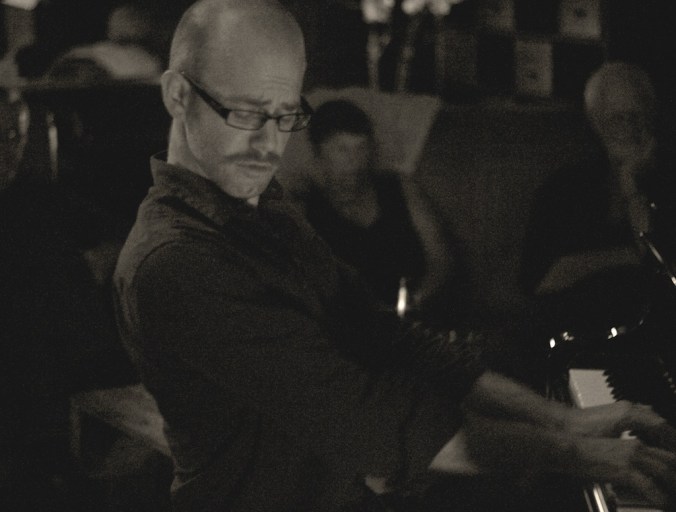
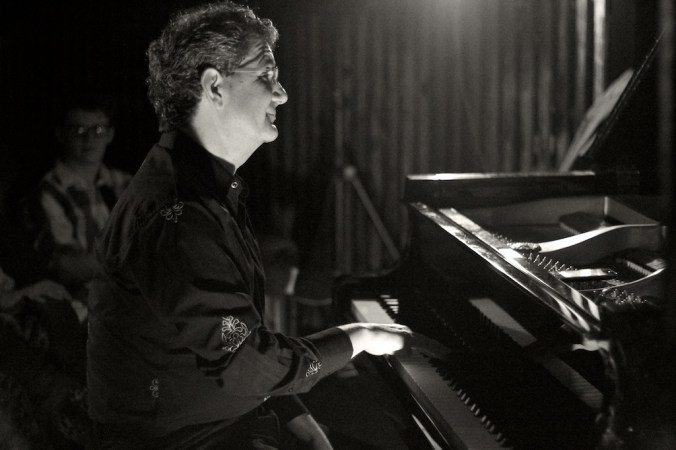
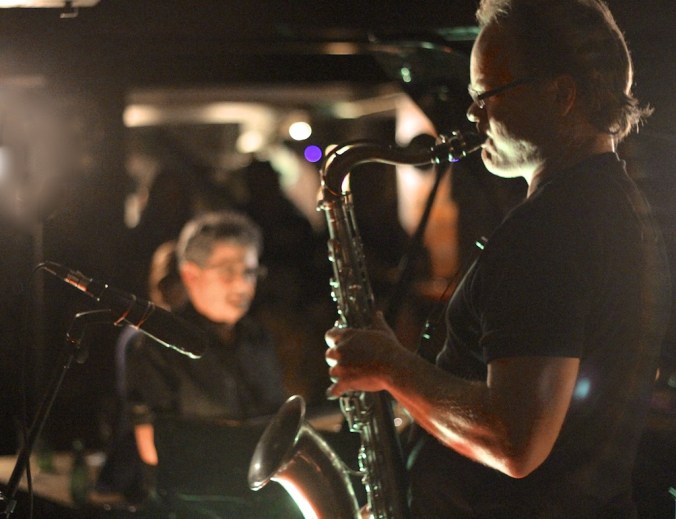
Who: ‘Hip Flask’ Roger Manins (tenor saxophone), Stu Hunter (Hammond B3), Adam Ponting (piano), Brendon Clarke (bass), Toby Hall (drums)

Where: Recording Session at 505 Studios, Sydney Australia.

This post is dedicated to Roger Manins my choice of best NZ artist for 2013.  Roger is not only deeply authentic and amazingly creative, but equally important he shares his vision and enables others to follow.
Steve Barry Trio@CJC November 2013

IMG_8799 - Version 2

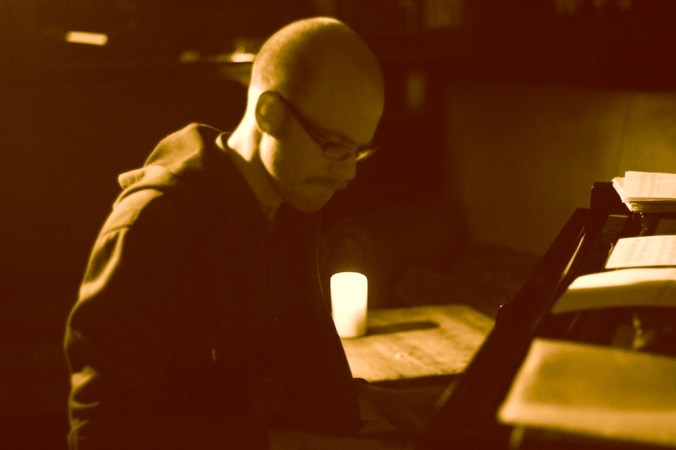
I have watched the career trajectory of Steve Barry for sometime and with each passing year the acclaim grows.  Just over a year ago he won the prestigious Bell Ward.  More recently he obtained second place in the ‘Australian Jazz artist of the year’ awards at Wangaratta 2013.  After winning a generous grant, enabling him to concentrate on his writing, he took time out for wood-shedding and further study.  He also travelled extensively.  He made use of this time by studying under piano masters like John Taylor.  From the outside his rise has the appearance of an effortless ascendancy, but the success of Steve’s trio arises from dedication and hard work.  His years of intensive study and relentless practice are now paying off.  As a result he plays with a maturity that is rare in younger artists and his unique approach to form is especially evident in his own reworked compositions and the often obscure but well-chosen ballads that he plays.

IMG_8782 - Version 2

There are two equally valid Jazz traditions around forming up combo’s and both can produce in-the-moment music.  At one end of the spectrum are groups formed just prior to a gig.   Hasty truncated rehearsals take place if time allows, but in some cases the musicians do not meet each other until they hit the bandstand.  At the other end are the groups like Jarretts Standards Trio, who are so familiar with each other that communication becomes intuitive.   Both situations have their pitfalls as the overly familiar can produce a certain complacency (Evans was sometimes guilty of this), while the seat of the pants line-ups can result in cues being missed.  Even good musicians fall at these hurdles but not so this trio.  The Steve Barry Trio has been together for over two years and they deliver royally.   The music sounds incredibly fresh each time we hear them and there is no lack of invention.   This is a special group with a unique ability to react to and challenge each other.   They are one of the finest piano trios in Australasia.

IMG_8794 - Version 2

I have heard Steve’s compositions many times, but on Wednesday it all seemed new.  They were the same familiar tunes with their complex time signature and moments of intense ostinato but they had somehow evolved.  Steve Barry is not an artist to rest on his laurels or to recycle old licks.  The most obvious changes occurred with the intro’s, which probed new pathways and took us on compelling journeys until we were again on familiar ground.   His intro’s and outro’s are something I look forward to, as they balance the pulse and swing.

I loved every note but the piece that really stood out was the seldom heard standard ‘More than you know’ (Vincent Youmans -1929).  This was covered by Teddy Wilson, Billie Holiday and others.  It is not heard much these days.  This slowly paced intensely beautiful ballad proved a good vehicle for improvisation and in the hands of this trio it was wonderful.  Steve stated the melody upfront and the richness of his voicings took my breath away.  There were subtle asides as the tune progressed, like a fine filigree partly obscuring the form.  Then about five minutes in a gentle swing section.

IMG_8814 - Version 2

You could not wish for better collaborators than Alex Boneham on bass and Tim Firth on drums.   Both are truly exceptional musicians.  There is a rich fatness to Alex Boneham’s tone which is all the more surprising as he was playing an old upright bass from the Auckland University School of Music.  In the hands of a master bassist, even an average instrument sounds rich and full toned.  His feel for time and note placement is perfect; deeply engaged and listening with big ears for every nuance.

Tim Firth also creates a buzz when he is in town and local drummers especially love to hear him.  Few can handle complex time signatures like he does and while he can play high octane tunes with edginess and fire, he can also execute brush work perfectly.   His brush work on ‘More than you know’ was understated (as it should be on a ballad) but as the tune progressed you were in no doubt about the value of his contribution.

This was one of those nights that gives Jazz a good name.

Who: The Steve Barry Trio – Steve Barry (leader and piano), Alex Boneham (upright bass), Tim Firth (drums)

Where: CJC (Creative Jazz Club), 1885 Britomart, Auckland on the 27th November 2013

Mark Isaacs @ CJC

IMG_8432 - Version 2

Pianist and composer Mark Isaacs has a rapidly growing international reputation and we were lucky to get him here.  Once again it was down to Roger Manins, who has wide connections in the Jazz world and we are eternally grateful for it.  Mark Isaacs has toured the world extensively and not only fronted a number of prestigious Jazz festivals, but also recorded with many world-renowned Jazz musicians.  Artists like Kenny Wheeler, Roy Haines, Adam Nussbaum and Dave Holland have appeared on his albums but as if that were not enough, he has two parallel musical careers.   Mark is also a classical pianist/composer of some stature and the conductor Vladimir Ashkenazy said this of his extraordinarily beautiful ‘Children’s Songs’.  “This wonderful cycle is highly inventive and inspiring, accessible to children and adults alike.  Very enjoyable and touching“.

The first thing to strike you about Mark is his intense passion for music, but his focus and drive have not in any way deterred him from exhibiting a cheerful, often extroverted demeanour.  He engaged easily with the CJC audience and his level of report with the band and especially Roger, made the gig all the more enjoyable.  Even though he had not played with drummer Frank Gibson Jr or Bass player Cameron McArthur before it felt like an established band.  He and Saxophonist Roger Manins go back a long way and perhaps because of this long-standing connection, what was billed as a standards gig, soon became so much more.  IMG_8456 - Version 2 (1)

The set kicked off with ‘Gone With the Wind’ (Allie Wrubel – 1937).  By coincidence this once popular but seldom heard tune was performed here by Mike Nock only months earlier.   Both artists appeared to briefly reference the brilliant but somewhat obscure Brubeck version, but each approached the tune in very different ways.  Mark Isaacs is another musician who has the history Jazz piano under his finger tips and as he worked his way into the tune I could hear brief echoes of the past greats.  I love this tune and especially when interpreted this well.

As the set list unfolded I realised that most of the standards were from the 1930’s.   It is not hard to fathom why, as the Great American Songbook tunes written in this period were second to none.  The gig,  subtitled as ‘Pennies From Heaven’, was later explained as being an inside joke.  Roger and Mark had embarked upon just such a project a decade ago and in their view the title scared off the potential audience.  More fool those who failed to turn up because this number in their hands was fresh, funny and satisfying.  ‘Pennies from Heaven’ (Johnny Burke/Arthur Johnston) is also from the 1930’s.

IMG_8441 - Version 2 (1)

The tune that I have posted is the perennial favourite ‘Someday My Prince Will Come’ (Frank Churchill – 1937).  Although non Jazz audiences would only associate this tune with Disney, it has a long and distinguished Jazz history.  Among the 100’s of well-loved versions are those by Oscar Peterson, Miles Davis, Dave Brubeck, Bill Evans, Wynton Kelly and Grant Green.  Playing a classic standard like this to a savvy Jazz audience can have its pitfalls as comparisons are inevitable.  The audience however lapped it up and from the stating of the melody through to the open-ended interpretation near the end, it was fabulous.  With Roger egging the band on and Mark responding in kind it could hardly be otherwise.

IMG_8428 - Version 2 (1)

There was a very nice solo by Cameron McArthur who astonishingly just keeps improving between gigs.  Frank Gibson Jr met Mark years ago but in spite of them trying to organise a gig it never happened until now.  In the event it was a happy confluence of inventiveness, exuberance and great musicianship.  Roger Manins was on form as usual, delivering fiery energised solos in a post Coltrane manner.

Mark Isaacs has the technique and the hunger to continually reach beyond.   Whether gently comping under a melodic bass solo or unwinding the melody to explore what lies beneath he engages us.  His probing left hand often pulls slightly back on what his right hand is playing and the tension created gives added impetus.  While his Classical compositions are informed by Jazz, the opposite is also true.  He will surely continue to do well in both worlds.

IMG_8473 - Version 2

As I left the club I picked up a copy of his Resurgence band’s ‘Duende’ album and put it on during the drive home.  It is an album of his own compositions.  What was immediately apparent was how well crafted the compositions were.  It was the sort of album that ECM might have released and the quality of the recording added to that impression.  As I listened on I heard some beautiful guitar work, not over stated but clean, inventive and crystalline.  Then I heard a human voice, wordlessly singing arranged lines as part the ensemble.  Easing over to the curb I picked up the album cover and flipped it over.

The personnel list would stop anyone in their tracks.  Mark Isaacs (piano), James Muller (guitars), Matt Keegan (reeds and percussion), Brett Hirst (bass), Tim Firth (drums), Briana Cowlishaw (vocal).  Matching this dream line up with those compositions was a masterstroke.   Muller and Isaacs communicate so very well.  It all made sense, the Kenny Wheeler connection, the skilled arranging and the promise of what may follow.   Mark Isaacs has the ears to absorb and the smarts to compose what works best for him.  This album certainly does.

Who: Mark Isaacs (piano, compositions, leader), Roger Manins (tenor saxophone), Cameron McArthur (upright bass), Frank Gibson Jr (drums).

Where: CJC (Creative Jazz Club), Britomart, 1885 Basement, Auckland, New Zealand on 2nd October 2013.

Album and contact details: ‘Duende’ (Gracemusic GROO4)

Mike Nock’s Australian Trio @ CJC 2013

IMG_8335 - Version 2 (1)

A lot’s been written about Mike Nock and he is well recorded.   In spite of this there is so much more to say and the unfolding story has come to define Australasian Jazz.  It would be accurate to describe him as one of the greatest musicians New Zealand has produced, but Mike Nock deserves evaluation on a much wider stage than Oceania.  As lucky as we feel owning him, he is a citizen of the world, highly ranked among the best that global Jazz has to offer.  IMG_8361 - Version 2

This was summed up by one of the audience; an American who has been following the international Jazz Scene for many years.  He shook his head in amazement and said “That was the best performance I have heard in ages”.  He asked about Mike’s history and I gave him a potted version.   “Oh yeah” he said.  “Well all of those years in America have given him that deep blues feel that only top players realise”.

I caught up with Mike before the gig and he was his usual friendly self.   Over dinner there were jokes and numerous war stories.  Because I have attended too many loud gigs my hearing is not quite as good as it was.  At one point the drummer James Waples said something to me which I missed entirely.  I apologised, explaining that my eyesight and hearing were failing me.   Mike leapt on the comment as quick as lightning, saying, “Man don’t worry.  That’s exactly what we like in a critic”.

There was the briefest of discussions between the band members about the set list, which ended in Mike saying, “We’ll figure it out as we go and you’ll know when you hear me start to play”.  While this is not unusual among Jazz musicians, it was evident that Mike would be digging into some obscure and unrehearsed standards during the evening.

IMG_8357 - Version 2

The spirit of Bernie McGann hung over us as he had passed the previous evening.  Mike spoke movingly of him and then he played one of Bernie’s compositions followed by ‘Bernie’s Tune’ (Bernie Miller) and the lovely old standard ‘No Moon at All’ (David Mann).  ‘No Moon at all’ is hardly ever played these days but it was once very popular.  It was famously recorded by Julie London, Nat Cole, Mel Torme and Anita O’Day.  There are more recent versions by Karrin Alyson and Brad Mehldau.  In Mike Nock’s hands this jaunty mid-tempo classic took on a deep bluesy feel and as it unfolded he achieved something that only the Jazz greats can manage.

The tune turned into something else; it was somehow transformed into ‘every tune’.  From the first few bars everyone smiled and many whispered in the dark, “Oh I must know this but I can’t recall the name”.  Like many probing improvisers Mike hummed and sang as he played.  As the piece unfolded something extraordinary happened.  People started quietly humming along with the trio; a deep connection  was made and it was primal.  I’m certain that many in the audience had never heard the tune before, but they thought that they had.   Keith Jarrett has often invoked this state of grace, finding a hidden place deep within the music.  So has Mike Nock.  Several musicians later commented that he had moved in and out of the song form and that the bluesy overlay had been utterly effective.  Another delightful old tune that the trio played was ‘Sweet Pumpkin’ (Ronnell Bright).

IMG_8370 - Version 2

On Drums was James Waples and he certainly lives up to his reputation.   He has featured on several of Mike’s albums and goes back a long way with Mike.   There is a subtlety to his drumming that is hard to put into words.  He is a powerful presence whether executing the softest brushwork or a driving upbeat tempo.  He has a great ear and knows when to push the others or hold back.  He is perfect for a multi faceted piano trio like this and I would go out of my way to hear him again.

Many Kiwi’s have forgotten (and many Australians will deliberately overlook the fact), but Brett Hirst is an expat New Zealander.   He is highly regarded on the Australian scene and like James he has had a long association with Mike.  When these three are in lockstep it is extraordinary.  Like the others Brett is a deep listener and clearly at ease in this open-ended format.  At one point in the program Mike stopped and said, “What shall we play now, something unexpected?”.   Then he added, “Oh I know, I will try this”.   Brett asked hopefully, “Can we know?”  The number had started before an answer could be given and he was immediately there.  Brett was up to handling any curve balls thrown and clearly relished them.

During the second set the trio were ready to take things further out and we sensed that they were in a zone where the communication is telepathic.  It is during these explorations that we see another side of their music.  Every interplay however subtle conveys layers of meaning and the spaces between the notes communicates a profundity.   This is art-music at its very best but for all that it is never far from its blues roots.   I have listened to Jazz across the globe and you would never, never hear better than this.

Who: Mike Nock (piano), Brett Hirst (bass), James Waples (drums).  www.mikenock.com

Where: CJC (Creative Jazz Club), Brittomart basement 1885 building, Auckland, New Zealand.

When: 18th September 2013

Mike Nock – albums reviewed

photo - Version 2

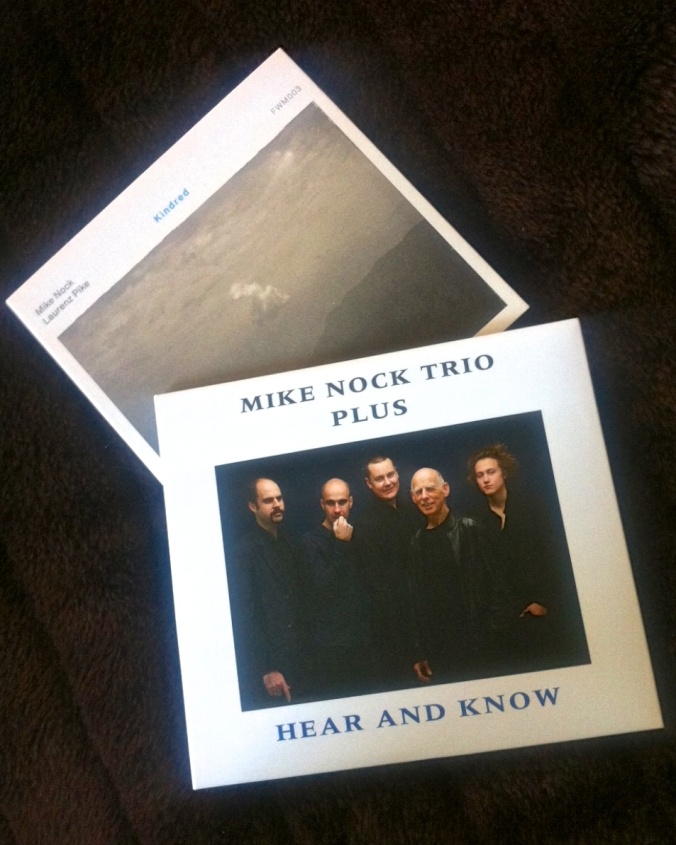
Mike Nock: Hear & Know / Kindred

Mike Nock is always capable of surprising and this has long been his hallmark.  A restless innovator and improviser who never settles on his laurels, Nock is surpassing himself yet again.  ‘Hear and Know’ was recorded in 2011 following his aptly named and deeply satisfying ‘Accumulation of Subtleties’ album.

On ‘Hear & Know’ he is again accompanied by brothers Ben Waples (Bass) & James Waples (drums).  There is an unmistakable synergy between these three and so adding Karl Laskowski (tenor sax) and Ken Allars (trumpet) had its risks.  While there is a different dynamic and altered textural qualities, the magic of intimacy is maintained.   It carries over much of the subtle interplay of the earlier album but creates a different range of moods as well.

I was always impressed by the subtle and profound sub-divisions of mood in the ancient Japanese Haiku.  The almost untranslatable ‘wabi-sabi’ are the moods invoked when we can almost touch something profound, sense it and appreciate the mood, but know that it will be forever illusive.  A further subdivision is ‘yugen’, which is the sense of mystery which underpins profound moments.  To define them more accurately is to lose the moment.    Mike Nock has achieved this for me compositionally and through his recording.   The moods are profound invoking deep and somehow unnamable emotions.

I felt this most strongly on the beautifully named and wonderfully crafted ‘The Sibylline Fragrance’ and later while listening to ‘After Satie’.   In the former piece there was an obvious reference to memory and our sense of smell, which is closely aligned with that.  Beyond that was something else, a sense of the history of this music.  Touching briefly on the past but rooted firmly in the now.   When music achieves this it is especially satisfying.   I have seen the trio performing and I have seen Ken Allars with the wonderful Jazzgroove  Mothership Orchestra.  Karl Laskowski was not previously known to me.   All of these musicians must feel pleased with this album.

‘Kindred’ is the more recent album and one with a pared back line up.  Featuring just Mike Nock on piano and drummer Lorenz Pike, this album seems denser in texture and more introspective.  Lorenz Pike is an interesting drummer and well-chosen; he is obviously colourist in tendency and that is the only choice for this music.  Once again Mike Nock has made a virtue out of contrast.  First impressions are often deceptive though and there is a degree of space and subtlety if we listen.  The stories unfolding are at times free and open but there is always an underlying thread.  The titles also fascinate me as they refer (as with the previous album) to a mixture of things past (references to the classical world), nature untamed and various private worlds.  I am a strong believer that improvised music benefits from narratives, not to define, but to augment the journey.

Mike has created subtle narratives out of the whole, which sit in the consciousness like Haiku.  There is something special about these two albums and I am certain that only Mike Nock could tell these particular stories.

What: Mike Nock – ‘Hear & Know’ and ‘Kindred’ albums FWM Records or visit http://www.mikenock.com

Where: You be able to hear Mike Nock in Auckland on Tuesday 23rd July 2013 at the CJC (Creative Jazz Club).