Jonathan Crayford @ CJC

IMG_9491 - Version 2

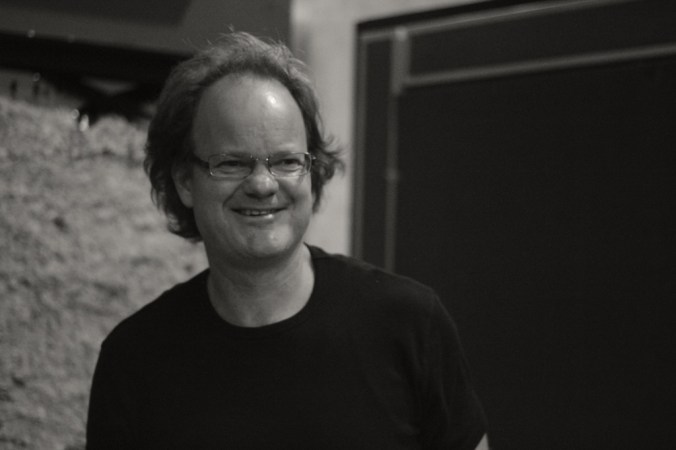
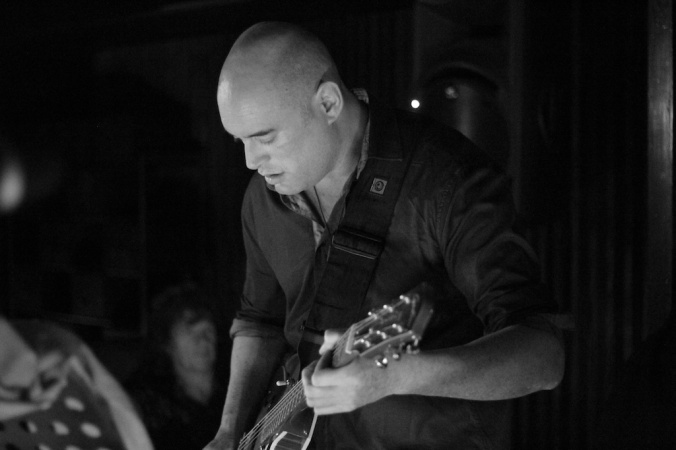
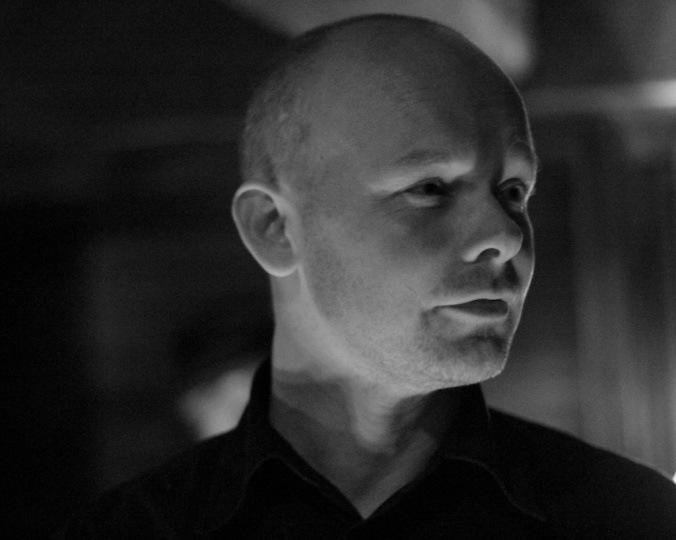
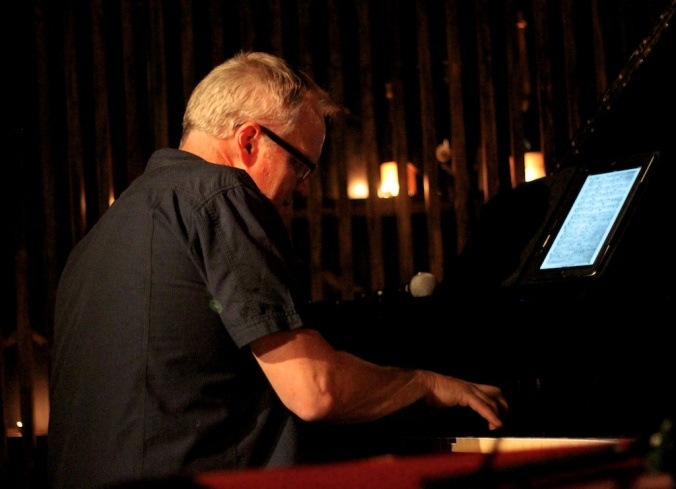
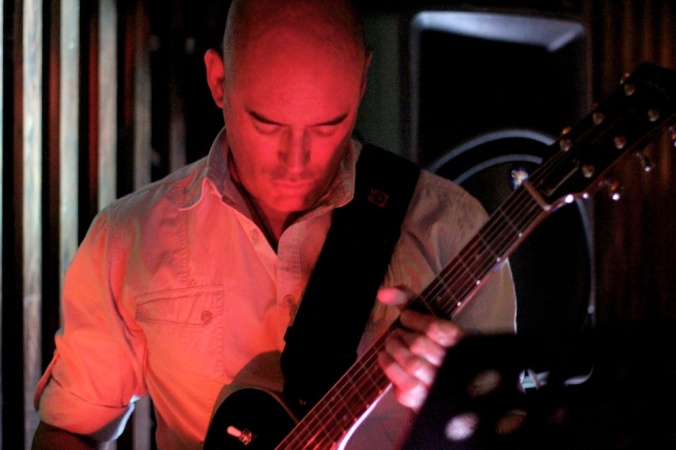
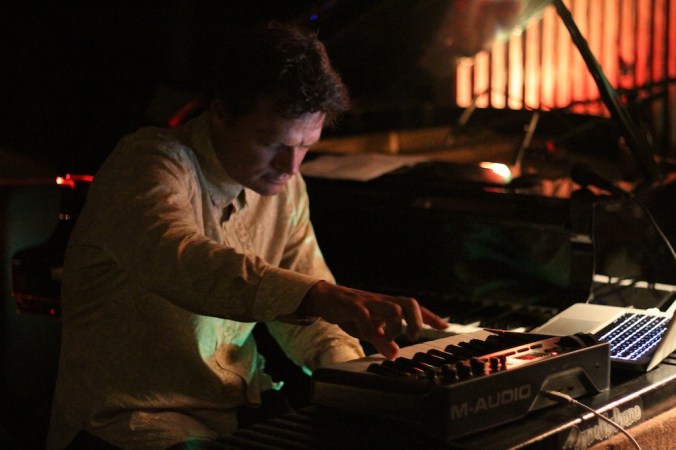
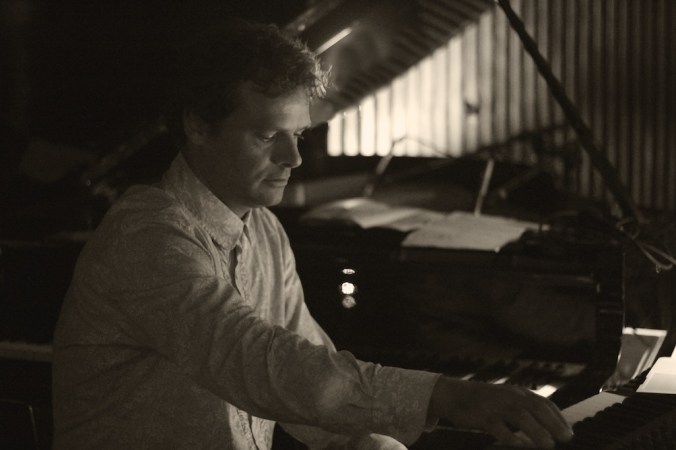
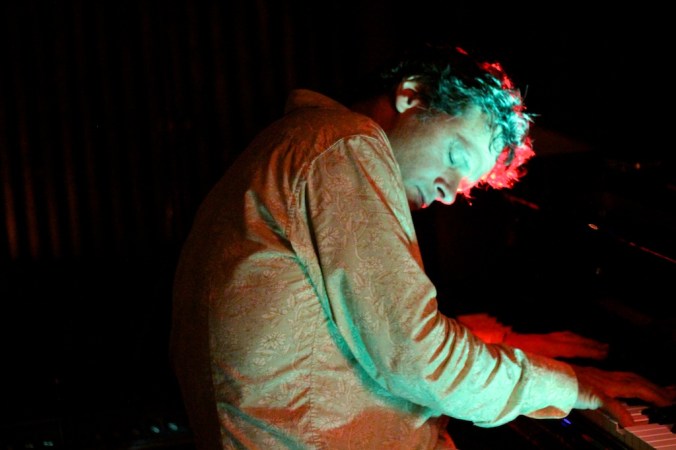
Jonathan Crayford has long intrigued me as a musician so I make a point of catching him when the situation presents itself.  He’s an artist embedded so deeply within his music that his persona reflects in those terms.  It’s as if he were the embodiment of sonic shapes and forms.

I have seen him perform on a number occasions but there’s no second guessing what will materialise on any given night.  His experiences in music lead him in many directions and all of them interesting.  While some describe him as genre busting, I think the descriptor is overly simplistic.  I have heard him perform a killing version of, “I Pity the Poor Immigrant” (Bob Dylan).  Yes, he appropriates the sounds about him and often performs with artists from outside of the Jazz spectrum, but at heart he’s an improvising musician.  No matter what notes he plays you can feel the integrity; the perpetual questioning of a deep level interpreter.  IMG_9576 - Version 2
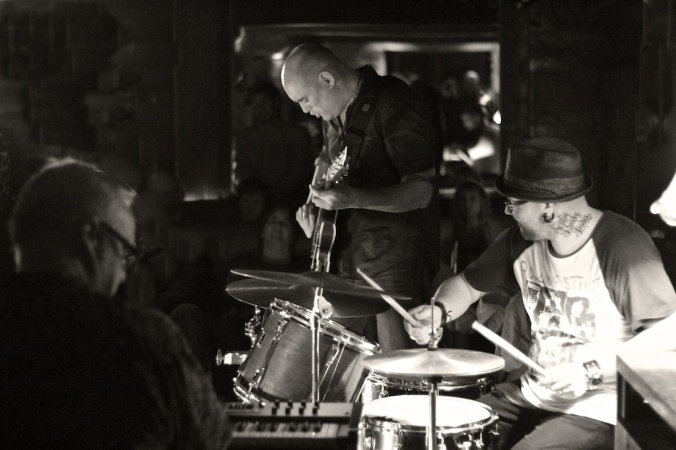
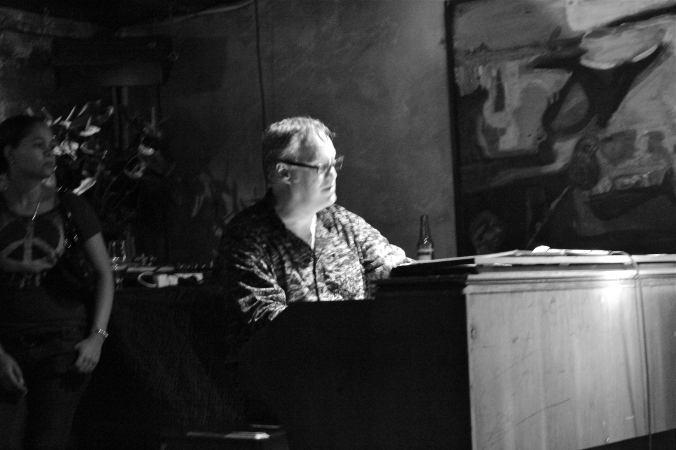
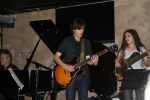
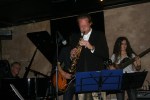
For the CJC gig he showcased a folder of new tunes; the charts interpreted by a six piece band that he had assembled for the gig.  As he explained, “this band is work shopping some new ideas which I will record later in Europe”.  The numbers were all in extended form, giving the musicians space to develop the themes and ideas.   Many of the tunes began and ended with a percussive vamp and as a groove established the horns congas, bass and drums swelled the sound.   The textures and complex layers of sound created an implied centre over which the soloists improvised.  Watching over this was the leader, a benevolent presence who knew just when exhort, when to extend or curtail a solo and when to pull the explorations back to the head.  The tune titles where intriguing also; ‘Groove 21’, ‘Strange Tune’ and others which told a more cerebral story.
IMG_9596 - Version 2

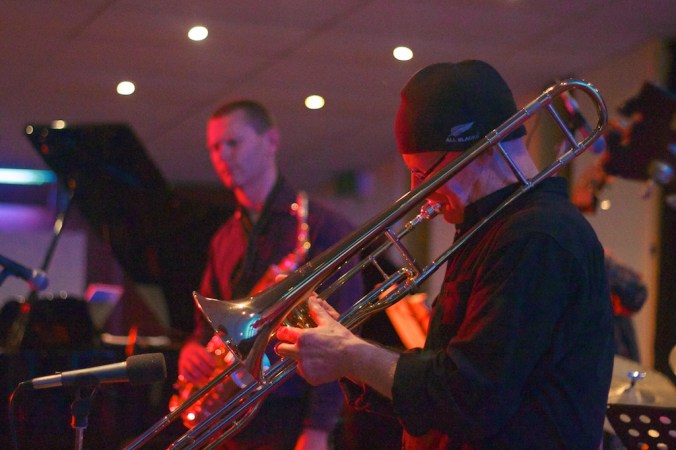
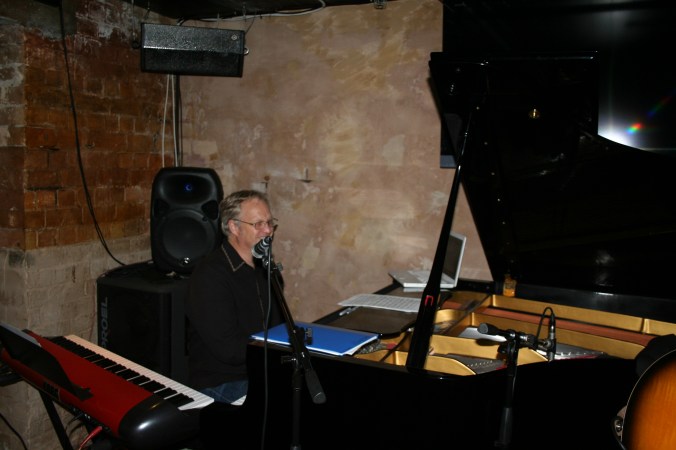
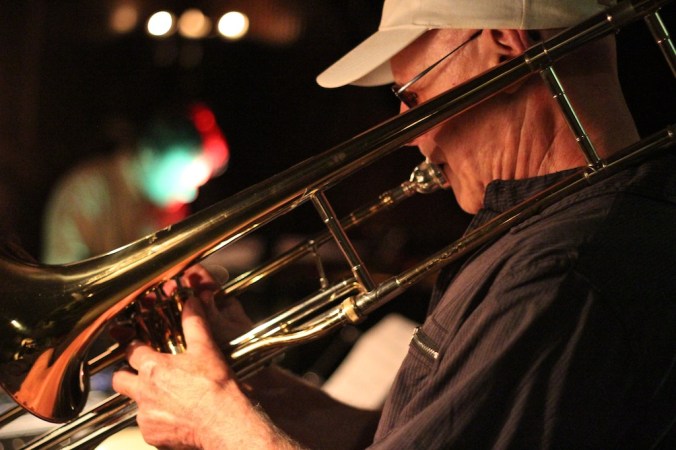
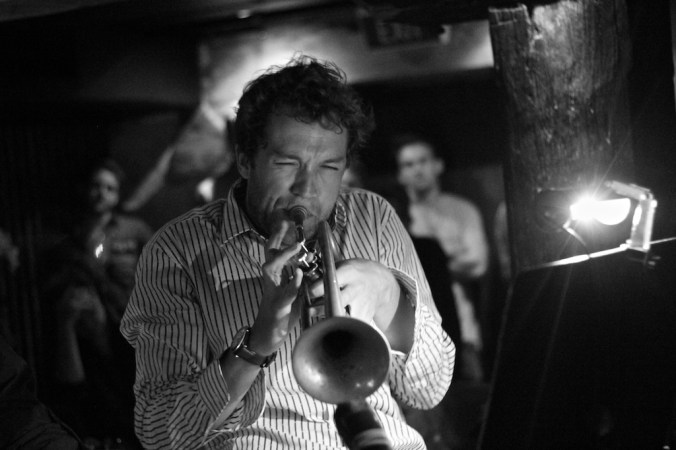
‘Bruno’s Dream’ in particular piqued my interest.  Jonathan Crayford has worked extensively on film scores and his association with the actor/musician Bruno Lawrence gives us the context for this piece.  After Bruno’s passing Jonathan dreamed this tune, a kaleidoscope of images as imagined through Bruno’s eyes.  This is wonderful expansive music and the band entered into the spirit of it.  As with all dreams the evolving and often surreal story has several parts.  In this piece we saw the best of Crayford’s keyboard artistry and writing skills.  There were solid solo performances by Kim Patterson on valve trombone and Finn Scholes on trumpet.  Kim Patterson is the elder statesman here, having recorded over his long career with most of the luminaries of New Zealand Jazz.    The last section of the tune, an intense modal sequence was a gift to Scholes, who grabbed the opportunity with glee mining it convincingly for all it’s worth (echoes of ‘Teo’).  IMG_9494 - Version 2
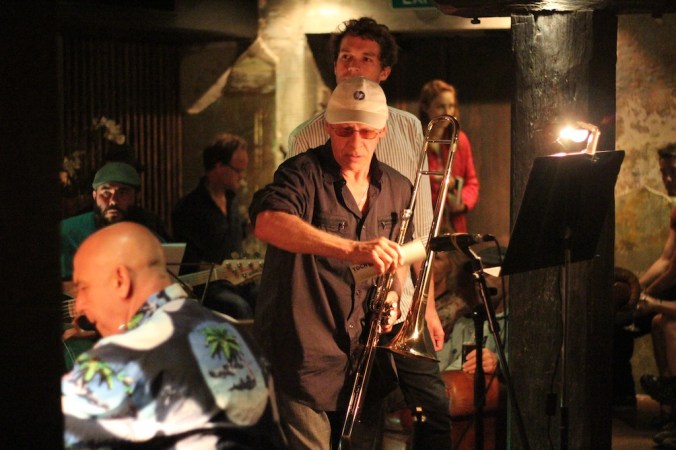
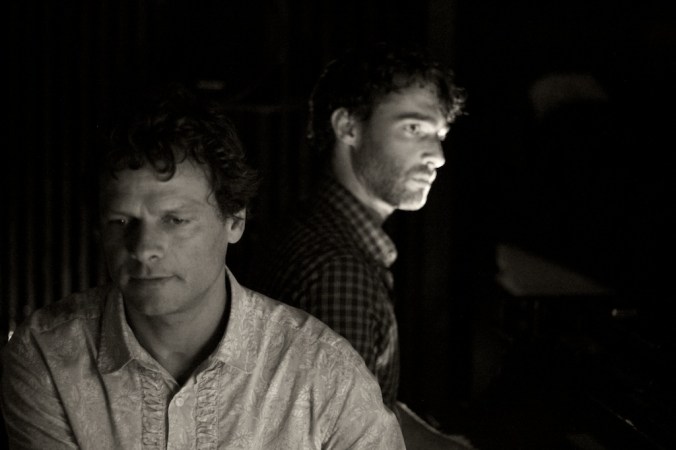
Early in the second set a brief change in pace occurred, when we heard a duet between Crayford and Patterson.  They performed the only standard of the evening, the gorgeous ‘Old Folks’ (Robison).  It lived up to its heart-string tugging potential.  At the end satisfied sighs were heard from the audience.  Piano and valve trombone work extremely well together and I was briefly minded of the duet recordings between Bob Brookmeyer and others.  IMG_9584 - Version 2
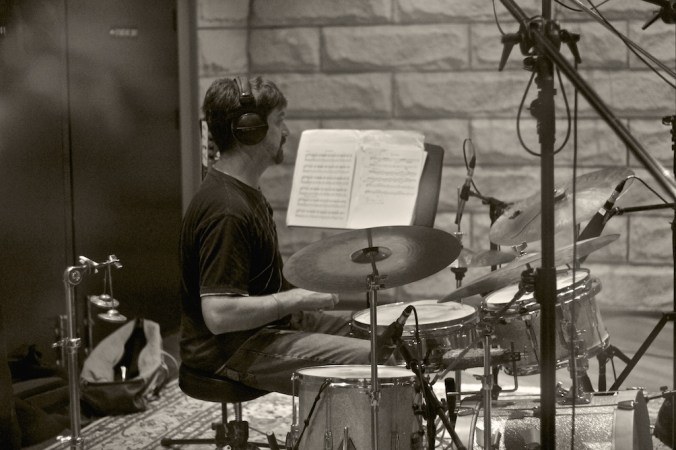
Having both traps drums and congas was integral to the sound as they added heft and edge.   On traps was Julien Dyne, an energetic and multi faceted drummer who has worked previously with Jonathan Crayford ( ‘Pins & Digits’ – Dyne’s album).   On congas (and facing the band) was Miguel Fuentes, a highly experienced percussionist who never flagged during the long and energised grooves.  The remaining band member was Chip Matthews on electric bass.  His presence was integral to the mix and he managed to provide  both an anchor and groove lines without crowding out the others.  The sound scape was dense at times and intentionally so, but the overall momentum was never lost.   With Jonathan Crayford at the helm this is hardly surprising.

The other departure from the format occurred when Jonathan invited Miles Crayford to sit in for a number.   Miles a pianist and keyboardist also, came to wider attention when he participated in Reuben Bradley’s award-winning ‘Resonator’ album.
IMG_9475 - Version 2

If you ask Jonathan Crayford where he lives now you will get vague answers.  He lives where the current project is happening and where the music is.   For the next two month’s he’ll be gigging around New Zealand and then returning to New York to mix and master his next album (with the well-known New York bassist Ben Street and drummer Dan Weiss).  The album is intriguingly named ‘Dark Light’.  Crayford tells me that he wrote the music during a long winter sojourn in London, where the seemingly endless days of low light are commonplace.  Having lived in London I understand this focus with radiating light.  The interplay and intensity of light occupies your thoughts there as it never does in sunnier climes.

If you Google this artist you’ll notice that he’s recorded as ‘currently living’ in Spain or Paris; throw in London and New York and the picture becomes a little clearer.   This is a musician chasing the music and living in the moment.  In Spain he records two solo albums, in New York trios and a sextet and then on to new projects in other cities.   We gladly claim him as an expat Kiwi but in reality he’s a citizen of the world.
IMG_9574 - Version 2

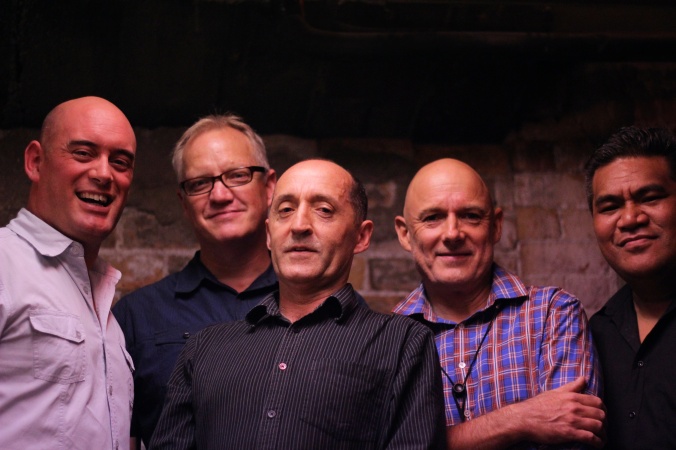
Who: Jonathan Crayford (piano, keyboards, compositions, leader), Kim Patterson (valve trombone, percussion), Finn Scholes (trumpet), Miguel Fuentes (percussion), Chip Matthews (electric bass), Julien Dyne (drums).

Where: CJC (Creative Jazz Club), 1885 Britomart, Auckland.  19th February 2014

Jonathan Crayford albums (and streamed samples) are available from his website, Rattle or iTunes –  jocray.com
New Year 2014 – the fabric of creativity

IMG_8954

For many, music is a distant and pleasant soundtrack which augments their moments of relaxation.   Something to wallpaper the background while they chatter over a few drinks.  I am wired differently because my normal talkativeness ceases when even a faint echo of good music is heard; an off switch is flicked.  This pied piper effect has characterised my life and often made me late for appointments.  What is it that makes music so compelling to some and not to others and why is improvised music beguiling to those with that special antennae?

My earliest memory of Jazz is of a Louis Armstrong film.  I was a primary schooler and I made my long-suffering mother take me back twice.  Louis fascinated me in ways my relatives couldn’t quite fathom but they indulged me with an EP or two.  Ours was a classical music household.  Three years later I was walking down a street near my home when I heard a trumpet playing.   I could see the musician’s outline in the upstairs window as he played, weaving deftly around what I later learned was a Coleman Hawkins solo.  I stopped in the street, delighted and open-mouthed.   I have no idea how long I stood on the pavement gawking, but I vaguely recall being led inside and offered cocoa by the trumpeters mother.   The trumpeter and his mother were Polish refugees and they made me feel very welcome.  In the months that followed I called often and absorbed Miles, Lester Young, Dave Brubeck, Sweets Edison, Art Peper, Hampton Hawes, Billie Holiday, Basie, Ellington and more.  By the time I had connected with the groove-organ trios of Gene Ammons I was damned.  I would bunk off school and play Gene Ammons or Miles all day long, dancing about like a deranged fool.  The devils music had me by the throat.

IMG_8947 - Version 2

Half a century on the same music gods and their siren songs still exert power over me.  Enough to lure me to Australia at very short notice.  I had picked up some gossip from Australian musician friends, that my friend Roger Manins was doing a gig with Mike Nock, James Muller, Cameron Undy and Dave Goodman at the 505.  I have family in Sydney and so it was a no brainer.  Family, grandchildren and Jazz, perfect.   When I told Roger that I would be flying over for the gig he invited me to his ‘Hip Flask’ recording session at the famous 301 Studios in Alexandria.  I love recording studios and to hear a top rated unit like this recording in a famous studio was too good an opportunity to miss.  I applied for extra leave and altered my flight schedule to accommodate the extra day in the 301.  IMG_8963 - Version 2

The timing rested on a knife-edge as I had a gig to attend just hours before my flight to Australia.   I made the check-out with 4 minutes to spare.  The flight over on Virgin was abysmal.  I had a headache from lack of sleep and it was like being stuffed into a rubbish tin surrounded by bored, rude flight attendants who acted as if they were in a BBC spoof.  An Australian musician later commented that Virgin felt to him like it was piloted by overtired children.  IMG_9011 - Version 2

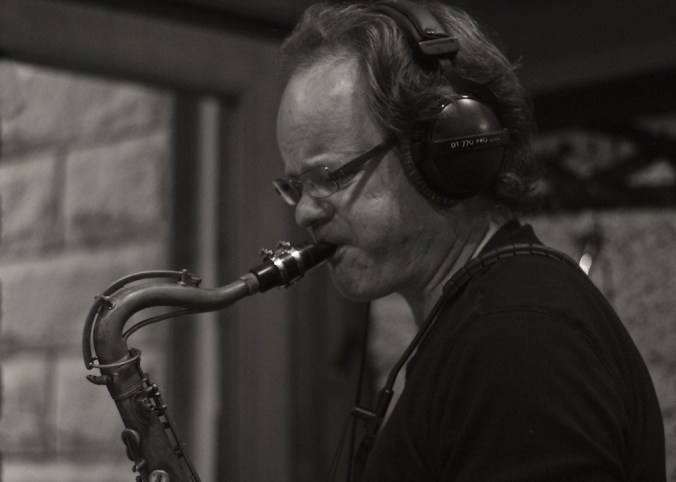
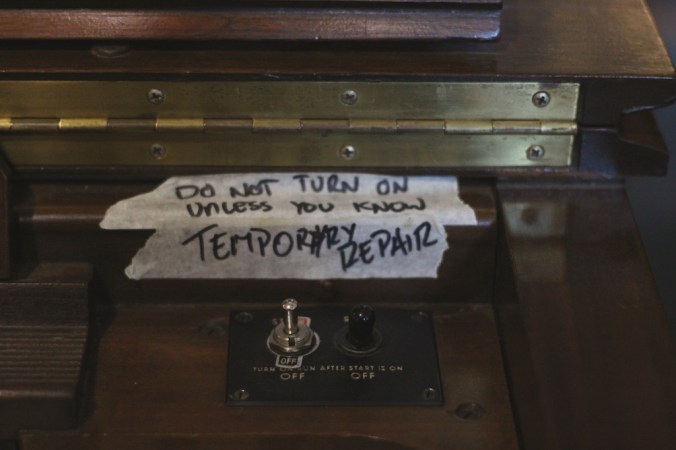
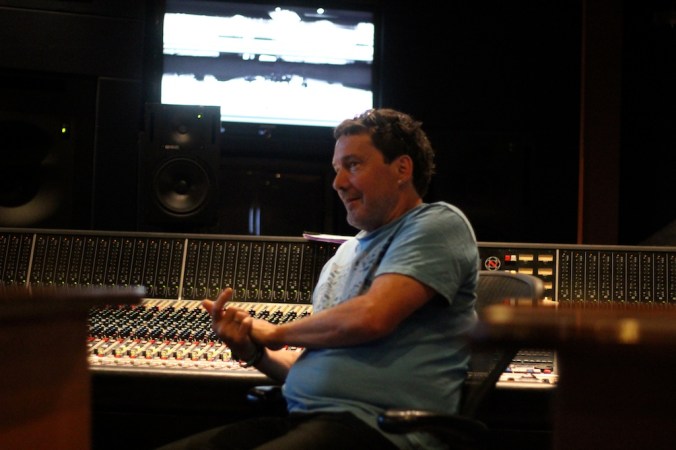
After clearing customs, I poured myself into a taxi and headed directly for the 301.  The industrial exterior gave little indication that I was standing outside an important recording studio.  The one where EST recorded their final album.  They buzzed me in and after navigating a series of corridors I pushed open a heavily padded door to find myself in an icy cool low-lit room with two technicians, a two-man film crew and the five cats from ‘Hip Flask’.   They were sitting around the mixing desk drinking coffee and listening over and over to the intro of a tune.  It sounded great.  This is what I had come for.  To capture the very act of creation.

IMG_9012 - Version 3 (1)

It is a special privilege to follow a creative process through from inception and I felt like a kid in a candy store.  This is exactly where I wanted to be and I soaked it up greedily.   My headache had vanished at the first note.  As the morning progressed the band would troop in and out of the studio.  Trying material, listening to it and repeating it if any one member expressed dissatisfaction.  Roger outlined his vision and set the tone, but after that he allowed a form of guided democracy to exist.  If they strayed from his vision he would talk them back round.

IMG_8939

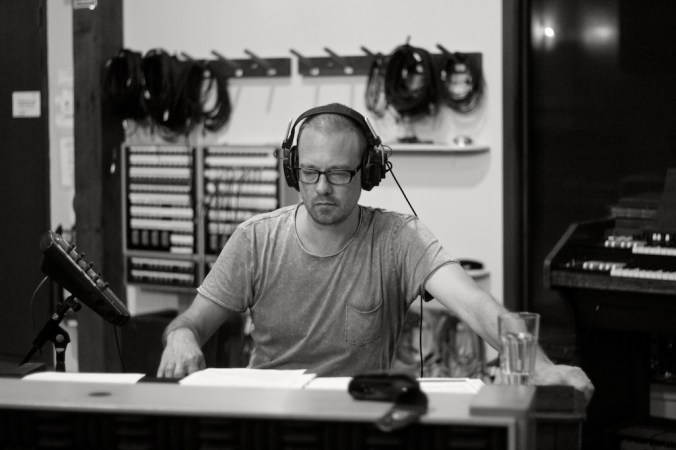
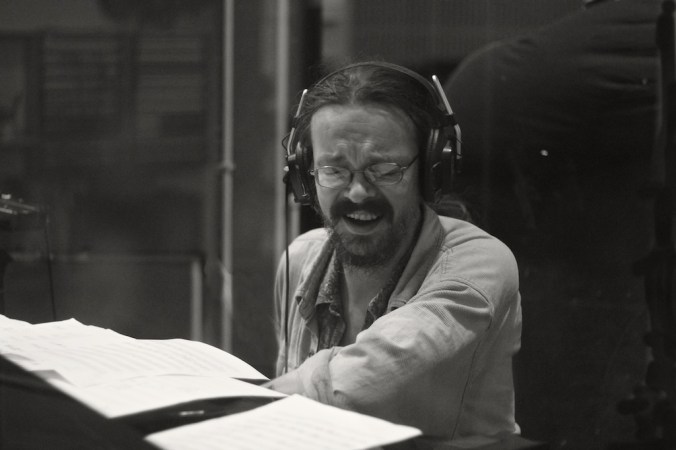
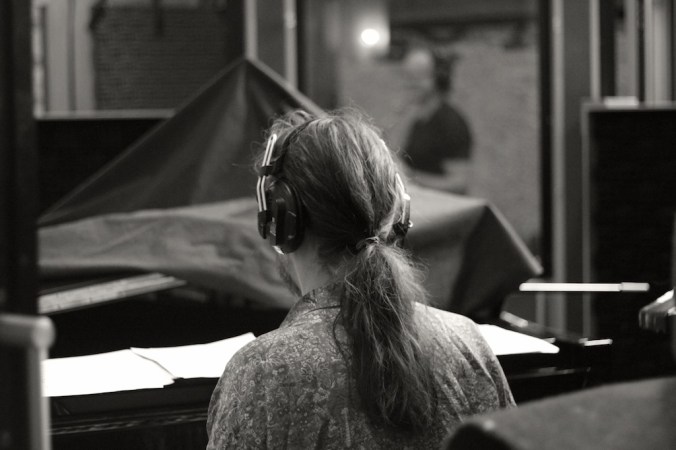
The sessions in the control room were all smiles and banter but a sense of purpose always ran through the proceedings like an unbreakable thread.  When they reached agreement they would return to the studio and assume their positions, baffled up and miked to such an extent that the bass drums and piano were barely visible above the wires, cover sheets and portable booths.  The band has an unusual configuration for a funk unit, being tenor Saxophone, Hammond B3, grand piano, drums and bass.  The saxophone, bass, piano and B3 were in the studio while the drums and the Leslie unit were both in isolation booths.   The studio space was big enough to accommodate an orchestra, but this quintet was squeezed into a corner and each baffled from the other in some way.

IMG_8955 - Version 2

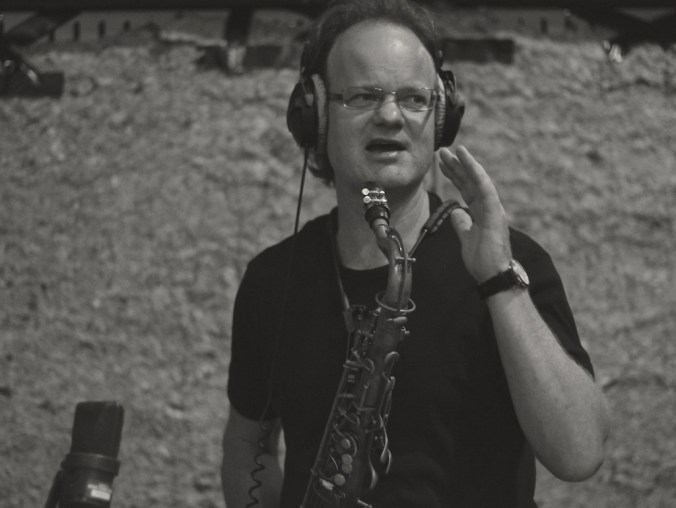
The quintet had recorded together before and even though their last recording was in 2007, their essence had survived intact.  As the session progressed I learnt a new word, ‘shoint’.  Roger and the organist Stu Hunter used it often and they would proclaim a satisfactory cut as being ‘Shointy’ or they would listen to the playbacks to see if they had ‘shoint’.   As far as I can ascertain the term describes a deep dirty groove that hits the musical ‘g’ spot.   While it is accurate to describe the recording as Jazz Funk, it is more than that.   The unusual pairing of two keyboards, the intuitive interaction and the quality of the musicianship gifted them with limitless options to draw upon.   Over all of this Roger Manins presided like an old time preacher, communicating with gestures, earthy licks on his Conn, diagrams and pithy Rogeresk phrases.  IMG_8969

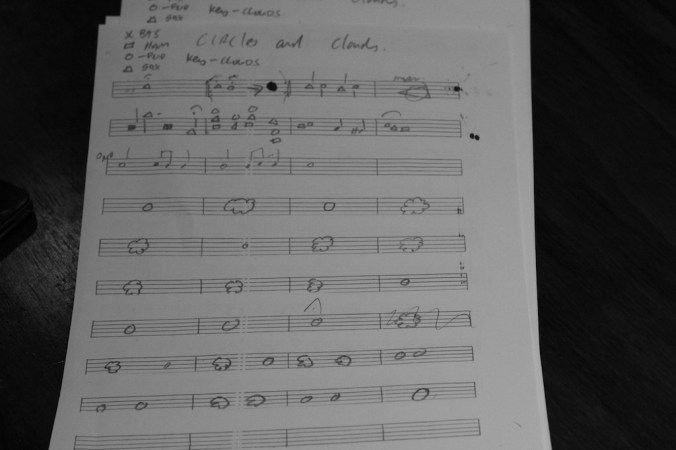
The most interesting moments came towards the end of the session when Roger produced a chart for ‘circles and clouds’.  The chart contained a few bars of musical phrases and then a series of symbols.  The ideas conveyed were beyond normal logic.  On most of the staves clouds were drawn and although these pieces were essentially free, there was a clear purpose underpinning them.  Roger had the concept firmly in his sights as he talked them through the vision or let the ideas develop in the studio until the concept was realised.  Stu Hunter would play a compellingly dissonant chord and then Adam Ponting and the others would grab a hold of what was unfolding and produce kaleidoscopic shapes, moving and shifting together like interchangeable chameleons.  When the idea was realised Roger would take them back into the control room and expand on what had gone before.  Roger, “OK you are clouds, circling a vast ocean.  Now if you look down you will see dolphins swimming and playing”.  One or other of the band then asked if there was a shoal of bait fish swimming near by.   The concepts developed and then they would repeat the process until a number of amazing miniatures were cut.  This filigree of beguiling patterns had been conjured up in that very hour.  Realised without an over reliance on written notation or oral language.  This was improvisation in its most profound form and I was lucky enough to hear and experience it.

IMG_8993 - Version 2

IMG_8988 - Version 2

IMG_9009 - Version 2

IMG_9003 - Version 2

IMG_8999 - Version 2

IMG_8956 - Version 2

My earlier question as to why some people fall deep within the web of music, while others let it wash over them unaffected, is not answered here.  This listener will never lose the magic and following bands like this guarantees that.  I am impatient to see what cuts survive and what is locked way in a vault.  When the album comes out and I can hardly wait, I will have heard more than most.  Every squeak, false start and profound moment is locked in my memory.  John Zorn said, “all sound is valid”.  I heard and witnessed an intensely creative process and I feel very lucky.

Who: ‘Hip Flask’ Roger Manins (tenor saxophone), Stu Hunter (Hammond B3), Adam Ponting (piano), Brendon Clarke (bass), Toby Hall (drums)

Where: Recording Session at 505 Studios, Sydney Australia.

This post is dedicated to Roger Manins my choice of best NZ artist for 2013.  Roger is not only deeply authentic and amazingly creative, but equally important he shares his vision and enables others to follow.

Alan Brown trio + 1@ CJC Oct 2013

IMG_8570 - Version 2

Alan Brown is such a gifted musician that we always expect something special from his club gigs.   The October gig not only lived up to expectations but found something extra to offer us.  Alan is always on safe ground with Dixon Nacey on guitar and Josh Sorenson on drums, as these musicians don’t need any warm up.  They have played together so often that their understanding of what is required is intuitive.  Deep energised mesmerising grooves are quickly established and maintained.  As we progressed through the first number, the warm grooves took us somewhere else.  Transported on mass to a place where winter became a distant memory.

 A state of grace, suspended somewhere between reality and a multi hued dream state.  This is a place where the familiar is transformed into the extraordinary and we felt incredibly happy about that.

IMG_8538 - Version 2

As I watched the interplay between these three I could not help wondering how that felt.  How it felt making that music, in that way and with that much soul.  The looks on their faces gave me the answer.  They also knew that this was one out of the bag and that some special chemistry was happening.   The Alan Brown trio were on fire and we were not just witnesses but integral to the performance.  There was a shared collective energy and we were each and every one of us connected in a web of pure creation.

I have written a lot about Alan over the last two years and he deserves every accolade thrown his way.   If this sounds like hyperbole I will quickly argue otherwise.  He consistently delivers performances and compositions that grab the attention and on nights like this he finds something extra.  The audiences from the High Street days have never forgotten ‘Blue Train’ and the fact that Alan keeps the crowds coming; still creating new audiences, speaks volumes.   This is not about reliving the glory days, but about bringing fresh and exciting perspectives to an ever unfolding musical output.

IMG_8544

Dixon Nacey is another musician who always pleases.   When ever I see that beautiful Godin guitar I know that something extraordinary could happen and this was just such a night.  Dixon is a musician who can communicate as much by his body language as by his soaring inventive solos.  You know how deeply he observes and engages because the evidence is in his face and at his fingertips.  When exchanges are being traded with drummer or keyboards, his expressions mirror the intensity.   When the solo or the interplay really works well, a huge smile lights up the bandstand.   That smile and those magical voicings tell us so much about the man and his music.

IMG_8545 - Version 2

The remaining trio member is Josh Sorenson and I have heard him on two or three previous occasions.  Josh has specialised in groove drumming and he is exceptionally good at it.  This is a specialist skill as there are a million deceptive subtleties built into it when done well.   I spoke to Josh at some length about this and what he told me was illuminating.  It is very hard work and although it sometimes appears straightforward it is not.  I gathered the impression that a night of holding such tight grooves together is more exhausting than bebop or rock drumming.  The concentration required to move around the kit while holding a tight multi faceted beat together is tremendous.  It is not just the concentration required, but the ability to sink into a beat in an almost trance like fashion.

Towards the end of the final number Josh launched into a drum solo and what unfolded was almost supernatural.  As he moved all over the kit, the deep-groove pulse never wavered by a fraction.  I have never seen this done before and I found it incredibly impressive.   That solo and in fact the whole number ‘Inciteful’ (had the audience on their feet, whooping and shouting with enthusiasm).  Sadly I had run out of video tape by then, but I did capture some of the magic.  IMG_8550 - Version 2

Part way through the gig we had another treat in store when the soulful Jazz Singer Chris Melville came to the band stand.  I like male Jazz singers and I worry that their numbers are so few.  Chris has a terrific voice and he tackled the old Juan Tizol standard  ‘Caravan’ in a mature and engaging way.   I enjoy listening to his interpretations and to the timbre of his voice, but noticed that it had a tendency to become a little lost in the acoustics of the room.  Some small adjustments to the sound levels would remedy that.   As the extraordinary Mark Murphy steps back and the fabulous velvety baritone Andy Bey performs less, there are other male singers coming forward like Jose James, Kurt Elling and Gregory Porter.  It is a tradition worth keeping and I  hope that we see continue to see singers like Chris keeping the faith.

We heard old favourites like ‘Shades of Blue’, some new material and even a rock classic from Led Zeppelin ‘No Quarter’.   ‘Charlie’s Here’ cast a warm bluesy aura over the room and I have put that up as a video link.   The kicker however was definitely ‘Inciteful’.  It was an amazing rendition packed with high-octane solos, clever ideas and groove so deep that even speleologists could never hope to explore it.

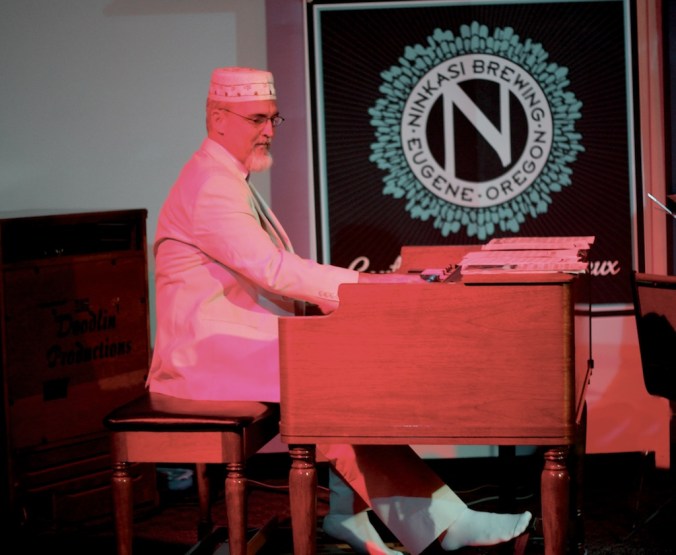
The organ was a Hammond SK2 which is not Alan’s usual keyboard.   Coupled to a Leslie Unit and the resulting sound was perfect.   This lighter modern offshoot of the C3/B3 certainly earned its stripes on this night.  It was just right for the room.

Who: Alan Brown (SK2 Hammond organ), Dixon Nacey (guitar), Josh Sorenson (drums).

Where: The (CJC) Creative Jazz Club), Britomart 1885 building, Auckland 16th October 2013

Michel Benebig ‘Yellow Purple’ review

Yellow Purple

When Michel Benebig played at the CJC late last year I learned about his coming tour of the West Coast of America.  Because I was going to San Francisco over January I arranged to meet him there, as I knew that he and Shem would have a new band on the road.   We kept in touch over the weeks that followed and he was getting a very good reception as he toured around.  It confirmed what I was reading; that B3 (with drums and guitar) bands are genuinely popular again.  This regained popularity is great news for Jazz audiences as the B3 line up is one of most audience pleasing and accessible in Jazz.  This comeback has not occurred by accident but it is due to the gifted players who are now emerging on the scene.  Michel Benebig is surely one of these and his name often crops up in the same breath as titans like Dr Lonnie Smith.  IMG_4556 - Version 2

I was staying in Bush Street which is in the ‘Lower Nobs Hill’ area of Frisco; just above Union Square.  When I got an update of Michel and Shem’s itinerary, it surprised me to see that one of his gigs was in that very street and so my son and I duly headed off there on the appointed night.  By ingrained habit we skirted the ‘Tenderloin’ and descended toward Hayes Valley.  A wisp of escaping sound told us that we had arrived and we entered a nicely appointed modern building, wedged in between two deco ones.  Leaving the temperate San Francisco winters night we wound down into the basement.  The warm sound of the B3, groove guitar and drums washing away any vestige of the night air.  My sons eyes lit up.  “Wow” he said.  “This sounds great” and it surely did.  This was the new band I had been keen to hear.

That particular band is almost the same as on the recent ‘Yellow Purple’ album (with the exception of the drummer Akira Tana).  Akira Tana is well-known around San Francisco where he had just recorded his big band album, followed by a gig at Yoshi’s.   With Michel on B3 (and such a beautiful machine it was to) and Shem on vocals they couldn’t go wrong.

IMG_4553 - Version 2

On guitar they had Carl Lockett who is an ideal groove merchant.   It was immediately obvious that his blues filled licks blended well with Michel’s and that indicated a great night was before us.  Carl Lockett has been a favourite with groove musicians for years having toured with Joey defrancesco, Jimmy Smith, Jimmy McGriff and Randy Crawford to name but a few.   With more than 15 recordings under his belt he was the right choice for this gig and for the ‘Yellow Purple’ album.  The album does not feature Akira Tana but instead the respected West Coast drummer James Levi appears.   He lays down a tight insistent groove and swings in ways that only truly experienced groove drummers can.   When you listen to the album you will notice how these guys listen to each other: in fact it’s hard to believe that the band hasn’t been together for years.  IMG_3289 - Version 2

Shem gave her usual polished performance whether delivering the Bessie Smith’s slow burner ‘It Won’t be You’ or the more uptempo ‘Keep it to Yourself’ by Sonny Boy Williamson.  She only features in two numbers on the album, but at the gig she sang many of her own compositions.   Shem is an engaging performer and especially when singing in her native French tongue.

All of the other compositions on ‘Yellow Purple’ are Michel’s and these are as much a strength as his killing organ work.   He is absolutely astonishing on B3 and to hear him is to be instantly transported back to the days of Jimmy McGriff or Brother Jack Macduff.   His ability to work those pedals, milk the grooves and swing so hard that it makes your head swim, marks him out as a true master.   The tracks ‘Yellow Purple’ and ‘Sunlight Special’ are especially strong.

New Caledonia can rightly feel proud of Michel.  He is reaching wider audiences every day and one day the South Pacific could lose him to the USA.  Grab a piece of this master musician now and be sure to buy this and any other of his albums as they become available (see below).   Anyone in Wellington early next month can see him in person so watch for the gigs announcements or contact Nick Granville.

What: ‘Yellow Purple’ – Michele Benebig (B3), Shem Benebig (vocals), Carl Lockett (guitar), James Levi (drums, percussion).

Where to buy: www.michelbenebig.com
Dream Weaver – Murray McNabb 1947 – 2013

IMG_7710 - Version 2

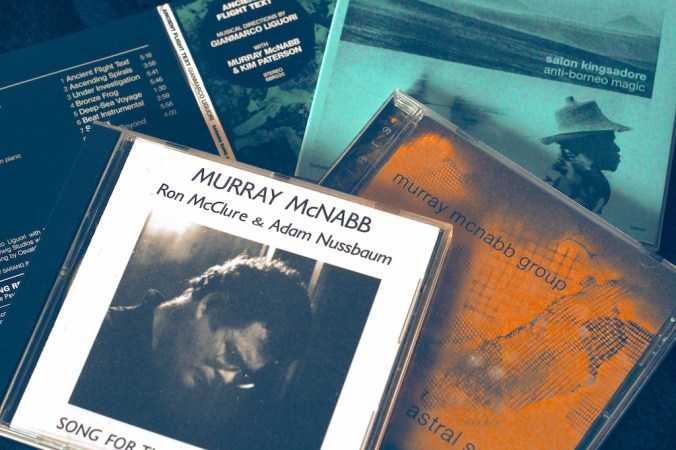
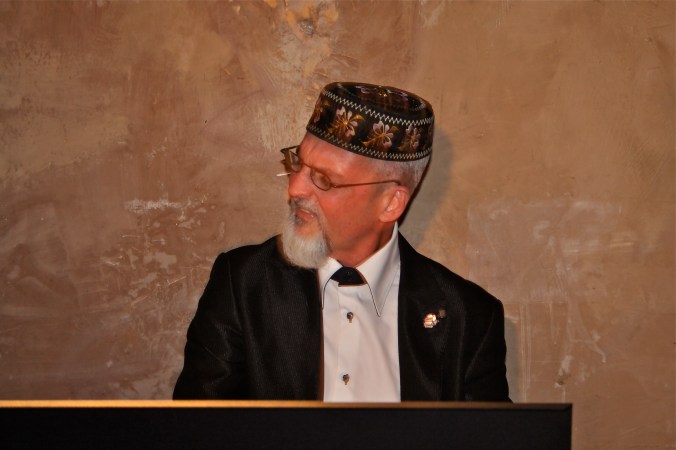
Murray McNabb left us on the 9th June 2013, just missing his scheduled gig at the Auckland Jazz & Blues Club.  His keyboards may have fallen silent but not so the band who played on out of respect. Mike Walker an old friend, was approached by Murray just days before he died, to stand in if he didn’t make the gig.  The gig may have invoked a plethora of memories and been tinged with sadness, but it was clear that Murray would live on through his musical legacy.  This was a musician who fearlessly patrolled the outer reaches of the sonic universe and I like to think that his ‘Astral Surfers’ album will be poured over by intergalactic cosmonaut’s as they look for clues or perhaps navigation hints from ‘Ancient Flight Texts’.

Frank Gibson Jr

Frank Gibson Jr

I was at Mt Albert Grammar at the same time as Murray and Frank Gibson, but they were more than a year ahead of me and both were prefects.  I was deeply into Jazz as a school boy and I knew that they were as well, but the gap between a fifth and a seventh former is sadly too far to bridge.  Fifth formers just didn’t hang with prefects and I regret that now.   I have followed Murray’s (and Franks’s) career ever since.

Murray McNabb was at the heart of the Auckland Jazz Scene and everyone respected his prodigious musical output.  The key to his music lies with the man, as music made him happy and improvised music even more so.  He was a man perpetually on the edge of a great adventure, navigating only by his innate sense of groove and an inner vision of the boundless vista’s that lay ahead.  Like Mike Nock he never settled for the ordinary, always pushing hard against the boundaries.   As much as I like his straight ahead records such as the lovely ‘Song for the Dream Weaver’, it is to his ‘out’ offerings that I return to again and again.

A largely self-taught keyboardist, he continued to explore the possibilities of Synths (and his beloved Fender Rhodes) during a period when others weren’t so keen.  In many ways improvised music has now come full cycle, as a younger generation continue the explorations, aided by clever machines and astonishing pedals.  Murray can take much credit for enabling a younger generation of local musicians to pick up on that.  His collaborations with Gianmarco Liguori in particular come to mind.  I regard ‘Ancient Flight Text’, a Liguori directed collaboration between him, Murray and Kim Paterson as a masterpiece.   If released by ECM, wide acclaim would follow.

Murray is known to all New Zealanders whether they realise it or not, as his collaborations with Murray Grindly produced film scores (e.g. Once were Warriors, Greenstone) and countless well-known TV adverts.  He never spoke ill of this work as it allowed him to simultaneously pursue his Jazz career.

The gig at the Auckland Jazz & Blues club was part wake (as old friends came up one by one to perform or to read eulogies) and part concert.   In my view it was Murray’s closest collaborators who stole the show and spoke for him best.  Frank Gibson Jr (drums), Kim Paterson (valve trombone), Neil Watson (guitar),  Denny Boreham (bass) and Stephen Morton-Jones (sax).   In Murray’s place was Mike Walker on piano.  During the second set the band played a Jazz fusion number composed by Murray years earlier.   Frank Gibson started the pulse with an insistent clipped beat similar to that used in Pharaohs Dance (Bitches Brew).  One-two, one-two, one-two, one-two.  The others moved in and out of the mix, weaving short phrases around the beat and creating layers of haunting sound.  No complex melody, harmonies that shimmered, as illusive as a mirage.  Out of this tribute I formed the strongest view of Murray’s output.  He seldom relied upon complex changes to achieve his ends.  Many of his compositions had no bridge or recognisable head.  He could say more by improvising against a drone or by working a simple vamp than almost anyone else on the scene.

Kim Paterson - Stephen Morton-Jones

Kim Paterson – Stephen Morton-Jones

Murray was a joyful explorer and he worked best when there was little chance of rescue.   His music was wonderful and he took that last step as bravely as he embarked upon all of his journeys.

For his recordings contact: www.sarangbang.co.nz

Blue Train – 2013

IMG_6313

I suspect that Blue Train has a following way beyond the traditional Jazz audiences and I can understand why.  Their hard-driving funk laden grooves are impossible to resist and so people tend to flock to any Blue Train gig.   Their audience occupies a broad age spectrum.  Blue Train mostly plays music that you can dance to and just occasionally the set list includes some Jazz space funk.   I’m a huge fan of this type of tripped out Jazz fusion, so if you like this sub-genre then find yourself some Blue Train recordings.  There is of course much more to Blue Train than Funk Fusion and their Jazz chops show in everything that they do.   Only highly competent Jazz musicians can play like this and only talented experienced musicians can write the material Alan does.   This band is an Auckland cultural institution, they are jaw droppingly good and that’s why people love them.  The Blue Train gigs are rare these days, as the band members all have other projects on the go.  Any whisper of gigs should put an urgent blip across your radar.   Tip: they will be at the Waiheke Jazz Festival this year – be there.

IMG_6336 - Version 2

The CJC (Creative Jazz Club) filled to capacity on the night and they soon stood three deep at the bar.   Blue Train was here again – the word had travelled.

Post millennium Jazz is a broad church and the younger audiences (and a few older ones like me) find this exciting.  Blue Train has been around for more than 20 years and in spite of a few attempts to pension the band off, the fans just wont let it die.  As a part of New Zealand’s improvised music heritage it deserves our ongoing support and respect.   Don’t for a minute expect a mere cover band recycling the glory days.  Blue Train are wisely resistant of resting on their laurels and after the ‘head’ of a tune they unravel the material in new and interesting ways.   They play older material and new.  Alan Brown’s compositions just keep on coming and they get better and better.   He is a seasoned performer and his keyboard skills will always astound.  As you listen you will  hear new ideas being tried and old ideas being turned on their head.  He is widely acknowledged as a great keyboardist but his piano skills are also considerable.  This was very evident on the 6th of March 2013.

IMG_6348

It was obvious that the band were thoroughly enjoying themselves and they stretched out as the tunes unfolded.  The CJC gig edged closer to its Jazz roots than would have been the case at Deschlers in the 90’s.  Those in the line up were mostly veteran band members, but there were some newer additions.   Dixon Nacey on guitar has played with Alan for years and he has previously appeared in Blue Train line ups.  He does not however go back as far as Jason Orme (drums) or Steve Sherriff (tenor and soprano saxophones).   The newer band member is Karika Turua (electric bass).

IMG_6335

Having Dixon Nacey in any band is always a treat and I always watch as his eyes fix on the other musicians – exhorting them to challenge him.  He listens carefully to what is unfolding and is always ready to back someone up or to step out with new ideas.   This is invariably done with a mile-wide grin and the looks of delight when he and Alan lock into an exchange is priceless.  As on his three previous gigs, he had his gorgeous Godin Guitar with him and once again I will confirm that this is a match made in heaven.

Many of the Blue Train musicians have contributed compositions over time and Steve Sherriff deserves special mention there.  He is well rounded horn player who can fit seamlessly into many situations (big band, straight ahead Jazz or funk).   His tenor and soprano work were especially captivating on this gig and when he and Dixon played unison lines it was hard to believe that there was not an additional horn in the line up.  Before the gig I ran into my niece and told her that it was nice to see her in the club.  She then told me that a former teacher of hers was in the band.   Who’s that I asked. “Mr Sherriff” she said.   When I saw her later she summed up her impression  “Wow who knew he played like that”.    He does.

IMG_6331

Jason Orme worked the grooves with finesse and enthusiasm and he knew how to play to the room.   The same applies to Karika Turua who dug into serious grooves that echoed in your mind for days afterwards.

The sound levels were just right for the club and this is where the bands experience played a part . Some younger (and a few older musicians) forget to adjust their volume to the room and the CJC is lively; especially if the drums and bass are overly loud.  Being professionals – Alan and Ben McNicoll (CJC sound and IT) got the job done properly.  IMG_6332

What and Who: ‘Blue Train’ – Alan Brown (keys), Steve Sherriff (saxes), Dixon Nacey (guitar), Karika Turua (electric bass), Jason Orme (drums).

When: Wednesday 6th March 2013

Where: CJC (Creative Jazz Club) – basement of the 1885 building Brittomart

Alan Brown@CJC (KMC Live launch)- C3 organ/guitar/drums

Alan Brown & C3

When ever Alan Brown brings a band to the CJC, the club fills to capacity.  Alan is well-known, deeply respected and he swings like crazy.  The ‘KMC Live’ release was always going to be a significant musical occasion, but on this night the sparks of inspiration flew between the band members and we witnessed something transcendent .  This was an incendiary gig that lifted our spirits; causing us to tap our feet uncontrollably and for some, to dance with abandon in the flickering shadows.   Alan had arrived earlier in the day, because dragging a heavy C3 organ down into a basement presented challenges.   The patience of Job and the strength of Hercules are required.  These wonderful organs with their bass pedals, wood-paneled console and double keyboard have probably caused preachers to swear when moving then.   It would not surprise me if some elected to rebuild the church round the organ rather than drag it up front.  It is our gain entirely that Alan achieved the translocation.   Hearing the wonderful bluesy phrases flow effortlessly from his fingers as they flew over the keyboards and seeing his feet pedaling out compelling bass lines was a rare treat.

Josh Sorenson

Dixon Nacey is without a shadow of doubt one of the best guitarists in New Zealand and it is a joy to watch him solo and interact with the other musicians.  During solos he will often close his eyes while weighing up the next step and his facial expressions reveal his commitment to the process as he dives ever deeper into the tune.  It is also a revelation to watch him in call and response situations.    When he and Alan are batting each other ideas, this often turns into good-natured un-armed combat.    Dixon watches intently while waiting for a challenge.  Occasionally calling to the others as if to say, “do your worst”.  When a musical phrase is tossed into the air he will smile gleefully and pounce on it, turning it about until it is fashioned into a thing of his own.  Josh Sorenson proved to be the perfect groove drummer as he locked down the beat and pulled the unit together.    This type of drumming requires specialist skills and Josh most certainly possesses these.

Tonight was the launch of Alan’s album ‘Live at the KMC’.   This was recorded at the Kenneth Meyers Centre back in September 2010 and choice of venue was fortuitous.    The venue is of historic importance as it has nurtured radio and TV in its infancy.    It is now part of the Auckland University School of Music (Creative Arts Section).  An acoustic gem.  Alan had recorded this gig thinking only that it could prove useful as a private resource.   One listen convinced him that he needed to release the material at some future date.

The set list at the CJC gig (and on the album) was a mix of Alan’s original tunes with three standards thrown in.   The standards  were ‘Maiden Voyage‘(Herbie Hancock) and ‘All Blues‘ (Miles Davis) and ‘Chank’ (John Scofield) – all arranged by Alan.   The rest of Alan’s compositions were; ‘Mr Raven’ (from the Blue Train days), ‘Charlie’s Here’, ‘Shades of Blue’, ‘In Fluence’, ‘Slight Return’, ‘Inciteful’.    ‘Shades of Blue’ was the best known of the originals while Alan’s interpretation of ‘Maiden Voyage’ was delightfully brooding and moody.  It was a nice take on this well-loved tune.  If I had to choose which of the tunes I liked best however I would probably say ‘Inciteful’.   This was played in extended form and it teased every ounce of inventiveness and musicianship out of the band.

On this night the stream of ideas kept coming, as fresh musical vistas were revealed.   Each one holding us in suspense until the next gem appeared.  This was organ/guitar/drum music at its best; intelligent, highly charged and full of joyous abandon.  A groove jazz trio of the sort you might find in East Philly or Montreal had been formed on our own doorstep.  This gig took place at the Creative Jazz Club (CJC) in Auckland New Zealand on the 18th April 2012

Dixon Nacey

Michel Benebig: soul on Pacific soul

Noumea resident Michel Benebig is a mavin of the B3 and its compact love-child the Nord C2. He is the sort of musician that sets the world to rights and sets your feet tapping.

He is a story-teller on the B3 organ (C2) and through his fingers flows the history of this wonderful instrument. The chords that he uses are rich and warm and capture the instruments journey from the African-American southern church’s to the Jazz heartland. While his voicings contain hints of the greats that he references like Brother Jack McDuff, Jimmy McGriff and Jimmy Smith; Michel is comfortably settled in his own style. He speaks with the unmistakable authority of a South Pacific Soul-Jazz master and it reinforces the view that Pacific Islands like New Caledonia and New Zealand have unique contributions to make to this music.

Michel was accompanied on tour by Shem Benebig (his wife) and the French drummer Johan Cazalas. Shem is a fabulous singer and she knows how to enhance the mood by a lowered tone, a hand gesture and a quick smile. When others were soloing she would stand a little to one side and dance; her movements contained more than a hint of the sensuous Kanak rhythms. Shem guided the proceedings with the consummate skill of a professional; holding the attention or directing it to the other musicians as required. No audience is ever going to be disappointed when this husband and wife team are performing. Johan was an observant and tasteful drummer. He would watch during a solo and lift the performance exactly when it was required. Never over-crowding the others and always supportive.

The band had a Kiwi horn section to assist them and if I heard correctly these guys had not seen the charts until a few hours before the performance. If that is true they did doubly well. The horns provided added heft to an already powerhouse sound and in doing so followed the best traditions of the Soul-Jazz genre. Ben McNicoll (Baritone sax), Chris Neilson (trumpet, flugal horn, alto sax), Jimmy Garden (tenor sax). The tight ensemble playing and a particularly lovely baritone solo by Ben earned them good applause.

The first set had begun with a tune called ‘Mr Jim‘. One full-throated blast from the organ and we were immediately locked into a warm soul-Jazz groove that never abated. As the night progressed we heard slow burners and heart stopping up tempo tunes. My favourite was a tribute to Jack McDuff titled ‘Captain Jack‘. This was not only a fitting tribute to the long departed B3 master, but an up-to-date comment on the Pacifica Jazz renaissance. Another tune Papillon about a tiny butterfly was a perfect vehicle for Shem and it tapped right into the ‘rythmes Kaneka‘. Michel could move from a quiet soulful chord to a stuttering tidal wave of sound in an eye blink and that is partly because of his chops and because of the unique qualities of this instrument.  An organist has to control many things at the same time but he is particularly required to control the following; Swell pedal, bass pedals and the two keyboards. When you consider what improvisers must do mentally and add in the above, this becomes a truly impressive feat.

I spoke to Michel at length during the break, and at the house-party a few days later. He is in the mould of great Jazz Musicians everywhere. Self effacing and engaging as a conversationalist. Full of wonderful stories about Joey DeFrancesco, Jimmy McGriff, Tony Monaco, Lewis Nash and others. As we talked I mentioned my liking for the great French B3 player great Eddy Louiss. “Oh yes Eddy Louiss is a monster” he said dropping his voice to a reverential whisper. “I met him in France a few years ago and it made my knees weak just to be in his presence”. I suspect that many up-and-coming B3 players will find meeting Michel has the same effect on them.

When music like this is playing it is good to be alive.

The New Fuse Box – The Wakem/Nielson Project

The Wakem/Nielson Project

When I received this CD in the post I knew very little about ‘The new Fuse Box‘ as I had only seen a few mentions of them online.     Happily I will never be in that state of ignorance again.     While this may not be your typical Jazz offering it is never-the-less highly enjoyable and as the Jazz scene in Auckland matures we are learning to appreciate a diversity of soundscapes.     This is not quite the raw and highly energised music of a live band but it is enjoyable, well arranged and beautifully articulated.   The music has a depth that may elude the listener at first play, but listen again and it will get under your skin and stay there.

This is essentially Kiwi music (Auckland music), and a sense of space and sunlight pervades the album.   Over the years I have come to recognise that there is a certain discernible quality when Jazz has developed in remote-from-the-centre locations; this sense of place exists in juxtaposition to the usual traditional aspects.    Scandinavian,  French, Italian, Sardinian, Spanish and German Jazz all have a unique something that would not have arisen had the music been made in America.   New Zealand Jazz is now claiming its own space.

There are fifteen tracks on the album and they skillfully mine a number of vibes.   There are funk infused tracks and soulfully slow tracks but they all seem to work as part of a cohesive whole.   Above all this music does not take itself too seriously as there is musical humour as well.   While I have many favourite tracks I simply cannot resist the intentionally over-the-top and utterly delightful ‘Bossa Tossa‘.     This track will put a big smile on your face.   There is also a filmic quality to this material and the best of Jazz movie-score writing is conjured up here.

All of the material has been composed and arranged by Lindsay Wakem (horns arranged by Chris Nielson).   Lindsay is terrific on piano and keyboards and I hope that he will give us longer solos on future releases as the piano is often back in the mix.   His piano playing has a crispness and clarity to it and I am keen to hear more.   ‘The New Fuse Box‘ is a multi- talented band and Chris Nielson the co-leader needs a mention at this point.   When I looked at the credits and I saw, ‘horns- Chris Nielson’ I was puzzled.   I phoned Lindsay and asked him if there were uncredited horn players.   I quickly learned that Chris is not only the trumpet section but that he plays all of the saxophone parts as well.   The charts are gorgeous and the multi-tracking so seamless that it is a struggle to imagine him playing all of these parts.   The drummer, on all tracks except one, is the well known and much respected Jason Orme (Blue Train etc).  Jason can take on any task in Jazz drumming and he is a an asset here.  The bass player is Phil Scorgie.  He and Lindsay go back a long way.  Other artists appear on single tracks and they are guitarists, Dean Kerr & Frans Huysmans – Kody Nielson drums.

Jazz is a music which teaches us something of history and struggle, but more importantly it is a music founded in the desire for change.   It is not a museum piece and so it should always explore and challenge the world around it.   This album does that and I look forward to more from them.   The ACT and ECM labels (both German) have profiled this sort of jazz to great advantage.     There is a real market for this material and I hope to see more of it.

ACT’s Lars Dannielson, Blue Note’s Bob Beldon and ECM’s Mathias Eick have paved the way and our own bands should now be welcomed into this interesting space.   The album is self produced and so for a copy contact:  lgwakem@xtra.co.nz

Alan Brown-‘Between the Spaces’ – CJC

Alan Brown at Keyboards - CJC

If this was a law court I would have to recuse myself immediately because I have a heavy bias in favour of anything Alan Brown does musically. Having said that it was hard to imagine how this very different lineup would sound, because the ‘Blue Train‘ magic has long been etched into my brain as the archetypal groove unit.

Alan is a superb keyboardist and band leader but above all he is a brilliant arranger and composer. It is the latter skills that have especially come to the fore with this band and the title track ‘Between the Spaces‘ gives more than a hint of the musical direction. ‘Blue Train‘- has always been a tightly focused hard-driving Jazz funk band and one which makes your feet tap uncontrollably. This band builds on that vibe but with new soundscapes opening up, endless possibilities are there to be tapped. Alan’s already impeccable writing skills have been surpassed here, because these charts are everything that an improvising band could hope for. It is ECM meets Funk and surprisingly it works perfectly. In my view Ode Records should talk to ECM’s Manfred Eicher about this group, as everyone would gain by the exchange.

As this was the launch of the ‘Between the Spaces‘ album I had been determined to get to the club early because I knew that seats would be hard to find. I was right because the club filled to capacity before the band had played a note. As with previous Alan Brown gigs the ages of those attending ranged from 18 to 60 plus.

The opening number ‘Sounding Out‘ was a foretaste of the great music that we were to hear throughout the two hours. Over the course of the evening we heard all of the tracks on the album in extended form plus two additional numbers that had not made the final cut. I was fascinated by the textures, rhythms and the colour tones that the new lineup was evoking. As each number unfolded, tight insistent bass lines were being laid down by Marika Hodgson while Alan would often set up a vamp; his left hand authoritatively setting the tone and rhythmic feel. He has an uncanny knack for capturing the essence of a tune while leaving adequate space for the others to build upon it. His deep in the pocket funky chords worked perfectly against his darting upper register flurries.

A treat for me was guitarist Andy Smith. He used quite a few pedals and his tone was midpoint between the Jazz and Rock spectrum. This is a territory well mapped out in modern Jazz guitar and Andy executed the twists and turns without overdoing it. He reminded me of Terje Rypdal at times but his obvious virtuosic abilities were kept tastefully in check and he is to be commended for that. I was especially pleased by his occasional use of the ‘chika-woka’ wah-wah effect when comping against multi layered grooves. Jono Sawyer (d) is already well-known about town and his musicality and his ability to support the band on a cushion of insistent beats rounded off a perfect unit. This group understood very well that great music demands some space between the notes.

As good as this band was, it was the inclusion of the guest musicians that lifted them to perfection. Their addition to the sound pallet showcased the shear brilliance of Alan’s concept and the pieces on which the three-piece string section and well-known saxophonist and flutist Nathan Haines played, lifted the performance into the realm of the sublime.

I have two favourite tracks on the album: The first is the angular, and wonderfully funky “The Dancer & Chess”. This number has complex time signatures but it is so well constructed that an implied centre imparts a level of simplicity that belies the more complex polyrhythms whirling around the changes. This is performed by the core quartet and the counterpoint between band members works well.

The second highly recommended piece is ‘Epilogue’ which features Nathan Haines extraordinary flute work. He weaves in and out of the tunes with such skill, beauty and dexterity that I was left open-mouthed. As if this were not riches enough, the swell of the violins and cello added a perfect layer into the mix. The slightly tart voicings of the strings showed Alan to be a master of composition. He had understood perfectly what was needed and ensured that any hint of sirup was eradicated by using just enough discord. Thomas Botting also featured in two numbers and he fitted seamlessly into the mix. Having an upright bass did not detract in any way from the well established vibe.

Immediately after descending the stairs I had purchased the first copy of ‘Between the Spaces’ put out for sale and it has not been off my Hi Fi since getting it home. If you have any love of Jazz Funk buy this CD and if you don’t buy it anyway because someone you know will be happy to appropriate it.

The core band is: Alan Brown (piano, Keyboards, arr, comp). Andy Smith (electric guitar), Marika Hodgson (electric 5 string bass), Jono Sawyer (drums) – string section; Stella Kim (violin) Annika Balzat (violin) Sally Kim (cello). Guest appearances; Thomas Botting (bass), Nathan Haines (soprano saxophone , flute).

‘Blue Train’ – New Zealand’s funk warriors

‘Blue Train’ have been around for about twenty years and most Auckland Jazz lovers will be very familiar with them.   On Wednesday night they returned to the CJC by popular demand and as anticipated the club filled up quickly with an expectant crowd.    This band is everything you could hope for if you are looking for a get-down & dirty – groove Jazz funk outfit.    Not only did they play well, but they hardly needed a glance at their charts.    They had a world of tunes already in their heads and they locked into each others wave-length so quickly that a collective brain appeared to possess them when they played.   Not all of the band members had been with them from the beginning but the band still meshed into a tight working unit and from the first number the crowd knew that their expectations would be more than met.

They opened with an Alan Brown number ‘Lets Dress Up‘ and it hit a real sweet-spot – deep groove heaven fed by a Fender Rhodes sound, funk guitar, electric bass, tenor sax and drums.  This sound put a ten-mile wide smile on our faces and if anyone had wanted dark and tortuous they’d have had to look elsewhere.    This jazz is about kinetic energy and a mesmerizing groove, which makes listeners feel that they could dive right into the music and swim in the ocean of sound.   The club was alive with happy people giving cries of encouragement.      After a while some in the crowd started dancing and before long the majority were either dancing, swaying or tapping the beat out on their chair arms.  In the second set the flailing hands of a man flickered across my sight line creating a strobe effect in the soft club lighting.   I just love it that Jazz like this absolutely compels people to dance.

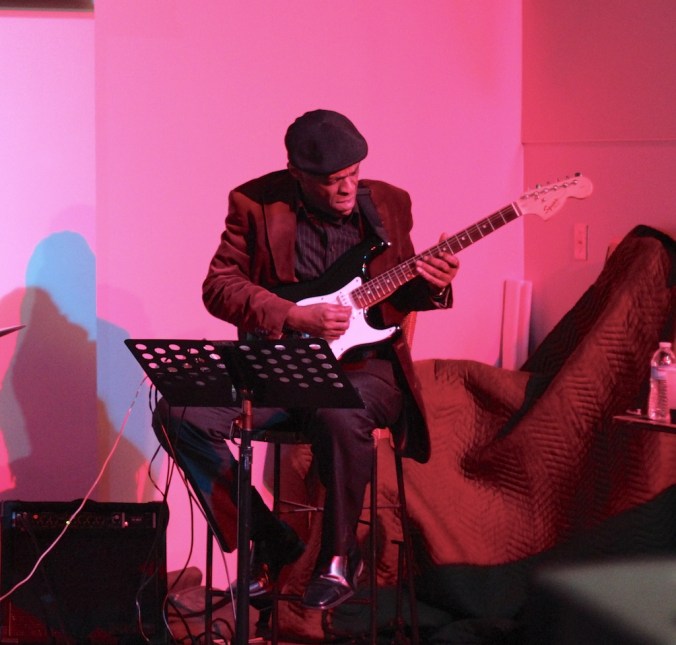
Alan Brown was clearly in charge of the unit and he would give an occasional glance to the soloists who needed no extra cues than that.     Andy played a few tracks on the club piano but would often switch to a small red electric keyboard mounted beside him: the latter holding a good bank of funk orientated sounds.   He would sometimes play both instruments at the same time.     With special guest Dixon Nacey on guitar this band was always going to hit the Jazz funk stratosphere, because this man is a monster on his red guitar and he can do the seemingly impossible without needing to think about the curve balls being thrown at him by Alan.

Steve Sherriff (soprano sax/ tenor sax) and Jason Orme (drums) are veterans of the group, but newer member Chip Mathews on bass did more than hold up his end. Chip is a skilled bassist and able to jump into any band I suspect.

Steve Sherriff is well-known about town and he can be seen working in a number of  Jazz styles.    While his tenor playing is always great, his soprano saxophone playing is free ranging and often ecstatic.    The band regularly hit fever pitch and the energy they floated on was ably abetted by Jason Orme’s high energy drumming.     Jason appeared to be using the locked in style made famous by Byron Landham and others; where he would enter into a powerful intense groove and then push the band as hard as he possibly could.    We just loved watching him.   This is as far from colourist drumming as it gets, but it is exactly the right style for a Jazz-funk unit like this.

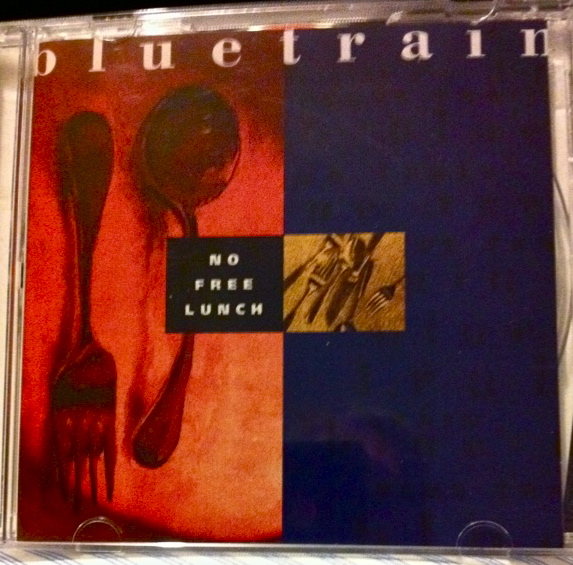
I eagerly await their new album which is due out next month.   See this band whenever you get the opportunity and purchase their CD’s.   The ‘Parachute label’s ‘Blue Train’ album ‘No Free Lunch‘ can still be found and a more recent organ trio album ‘All about time‘ is quite readily available (Alan Brown ‘Hammond’, Dixon Nacey ‘guitar’, Josh Serenson ‘drums’) – ‘Ode Records‘.

‘Blue Train’ clips are hard to find on You Tube but I did locate their version of ‘Nasty McFly” – this track was simply riotous on Wednesday  – enjoy.

Pat Martino – deep in the music

Pat Martino

Image via Wikipedia

Not too many months ago my Partner & I saw Pat Martino in ‘Birdland‘ and were captivated by his deep-in-the-groove East Philly style.    There could hardly have been a better place to hear him, as this is one of New York’s best Jazz clubs and a friendly intimate space.

Like most out-of-towners we loitered awhile in Times Square before walking the short block to ‘Birdland’.   I could hardly believe my luck at being able to see Pat in such a setting as I had become a fan some years earlier; having developed a taste for that whole Grant Green thing.

The first of the band members to step on stage was Tony Monaco the B3 player, quickly followed by the drummer Harvey Mason.   Soon Pat appeared with his shining custom-made black Benedetto guitar at the ready – a slightly built man who quickly lost himself deep within the music.  The band leapt into their first few numbers with an apparent relish.   Obviously enjoying what they do and perhaps that is the hallmark of this Chicago – East Philly guitar -organ-drum style.   Seeming to drop deeper and deeper into the groove and then characteristically locking into a phrase until the intensity becomes almost unbearable – then as suddenly dropping back into the melody again.

When Pat plays alongside Joey Defrancesco and Byron (Wookie) Landham the band is a force nine hurricane.    No drummer works as hard as ‘Wookie” with his powerhouse locked-in beat and no B3 player owns as much of the room as Joey D.   It was however just as interesting to hear Pat with this band and they proved to be solid performers.  Tony is great on the B3 and his tendency to grimace and mug as he reaches ever deeper into the groove did not unduly trouble me.   The drummer Harvey did what good groove-drummers do and locked into Pats sound.   After the faster offerings it was a pleasure to hear Pats well-loved version of ‘Blue in Green‘(Davis/Evans) and the warmth and perhaps the hint of sadness in his sound brought a tear to the eye.    The sound Pat gets from his specially wound strings is fat and warm and it hits you right where it should; in the heart.

I have just learned that Pat is about to play at ‘Yoshi’s‘ (Oakland) and I have urged my son and daughter-in-law to go if they can.  Pat may have an amazing and unique life story, but it is the warm looping bluesy sound that gets you in the end.

Herbie Hancock: Chameleon, Headhunter, visionary?

Even before septuagenarian Herbie Hancock rolled into town he had been sought out by most of the mainstream media.    This man fascinates people beyond the Jazz world and I suspect that everyone would give a different reason why.   Herbie is simply larger than life and terminal cool is his brand.   When asked by Lynne Freeman of Radio New Zealand whether he was going to spend the rest of his days fine tuning his impressive musical legacy he surprised her by replying, “Music is what I do but it is not who I am.  I am a human being and I want to work on real issues that effect ordinary people”.   A long time devout Buddhist (as is his close friend and long time collaborator Wayne Shorter) he exudes calm and speaks with commonsense.   Herbie does not buy into his star status; but to others he is never-the-less a living legend.
We could feel the excitement mounting as we waited for the show to begin and then right on 8 pm the lights dimmed and drummer Trevor Lawrence strode onto the stage   He laid down a solid mesmerizing beat until James Genus appeared, who then added to the groove on his electric bass.   Suddenly Herbie was on stage; grinning and bowing to the audience and the fun began.    He looked fit and ready to get-down to it.   The group swiftly ripped into an upbeat, spirited avante guard tinged piece (Actual Proof) that was more Ornette than Empyrean Isles.  I suspect that would have taken many out of their comfort zone and this was clearly the intention.   The mood was well set and throughout the concert Herbie skillfully used tension and release in enumerable ways.   As this amazingly high energy group moved through the varied repertoire you could see the joy on their faces.   James genus seldom took his eyes of Herbie and they played as a single entity.   We got spirited renditions of Hancock classics followed by highly atmospheric tunes (such as Joni Mitchell’s ‘court and spark’ from the Grammy winning ‘River’ album with Wayne Shorter).    ‘Court and spark’ and other songs were sung by the fourth band member, vocalist and violinist Kristina Train.  Her voice was smokey and appealing and the crowd loved her.   We heard a jazz version of Bob Dylan’s ‘the times they are a changing’ and Bob Marley’s ‘Exodus’ accompanied by pre-recorded Sudanese musicians.   ‘It’s 2011’ said Herbie as he pointed to the hard drive at the heart of his system. Herbie Hancock is the undisputed master of electronic keyboards and effects, but on Tuesday he reminded us that he still owned the acoustic piano chair as well.
This was the history of post 50’s Jazz and it was the perfect ethnomusicology lesson.    We heard Irish, African, folk music and classic delta blues but the master’s stamp was on all of it.   This edgy musical journey was still unmistakably Jazz.   In the middle portion of the concert however Herbie played solo piano, taking us on an impressionistic reflective journey through his Maiden Voyage albums.   The band came back to accompany him on ‘Cantaloupe Island’ in what was to end a half hour piano medley, which held every one in awe.  Even ‘Round about Midnight’ got an airing.  Not a sniffle , not a cough, even Keith would have been impressed.   The stuff that I loved best was his Headhunter funk and he swung and grooved that like crazy – deep down grooves played with boundless joyous energy.    At the end of the concert he brought on a visiting group of blues rockers; slide guitarist Derrick Trucks and his wife Susan Tedeschi (a loud singer who sounds a lot like Janis Joplin).      This was pure enjoyment from start to finish and if anyone thought that Jazz was in decline they should have seen the age-range of those present.   The faces of the audience as they came out told the whole story.

Groove Jazz

El Hombre Pat Martino

'El Hombre' Pat Martino, Birdland NYC

I was eagerly looking through the information about the up and coming visit from Sonny Rollins when I saw in the fine-print a list of the musicians who would be touring with him.    The inclusion of groove guitarist Peter Bernstein pleased me greatly    I am a fan of Peter Bernstein with his rapid fire, deep groove, Grant Green style.    He plays a lot in New York clubs and  when I was there recently I had hoped to see him.     As it turned out I missed him by a week but my desire to hear a Chicago – Philly style guitar, drums and organ trio was certainly fulfilled.   I turned up at ‘Birdland’ on a hot Autumn evening to find Pat Martino was playing and I thought that I had won the lottery.     My wife was a little horrified when she saw the ‘B3’ on the stage and I am the first to admit that it is an acquired taste.  Pat ‘El Hombre’ Martino played deep in the pocket and with an intensity that I have seldom witnessed.    His ‘Blue on Green’ was pure bliss and I still get a lump in my throat when I think of it.   Pat is a guitar hero on many levels and he didn’t disappoint that night.    He played his bop infused groove lines as if he were flying free of the world,with his trio in lock step.

Organ-Guitar Jazz is full throated, raunchy and intensely bluesy.   This style is redolent of an era when Jazz was losing part of its black audience to R & B and starting to fight back.   This funky backstreets music reclaimed some of that turf and found a home on what was termed the ‘Chitlins Circuit’.     Richard Groove Homes, Grant Green, Wes Montgomery, Pat Martino, Jimmy Smith, Brother Jack McDuff, Jimmy McGriff, Big John Patton. Shirley Scott and many others were associated with this style.     One of my favourites in this style was Gene Ammons (tenor sax) who liked to play the Chicago clubs when ever he could.    This was not often sadly because he was frequently in jail for narcotics violations.    His label Prestige indulged him and recored him frequently; knowing that he would be behind bars again before too long.     He is always associated with his ballad albums such as Gentle Jug (which his manager had insisted upon as a good career move), but I still like the badly recorded club dates such as the one where he is accompanied by Eddie Buster (B3) and Gerald Donavan (drums).  Those two are now long forgotten but didn’t they groove with ‘Jug’.    This is a happy music that sets the body swaying and I will often return to it after a period of listening to more cerebral offerings.   This is the intersection in my adolescent life where I discovered jazz and I have joyful memories of bunking off school and wearing out copies of an album called ‘The Chicago Sound’.

For this style of music look on You Tube for Pat Martino’s rendition of ‘Sunny’ with Joey DeFrancesco and prepare to be seriously ‘grooved’.