When the constellations align – Mike Nock @ CJC

Experiencing a Mike Nock band playing in an intimate club setting is quite different from catching his act in a large concert hall.    In one sense it doesn’t matter, as this cat can whip up a whirlwind of energy in any space, but seeing Mike in a small intimate club is as cool as it gets.  The immediacy of being up-close to a band like this is electrifying.

I had arrived early with a friend, but the club was already at near capacity and there were no available seats.  We were happy to stand as no one wanted to miss this night.    I leaned against the side of a leather couch crammed full of people while up front Roger adjusted his mouthpiece and Ron positioned his kit.  Then we saw Mike and Brett and the lighting was lowered.     As the band began to play it was obvious that they would not need any warming up because they were clearly as up for the gig as we were.    The opening number ‘Hop Skip & Jump’ was up-tempo and Roger just tore it up from the start.   To those who of us who love Mike Nock compositions this music was somehow familiar, but this was also the ‘sound of surprise’.

I am convinced that we could not have seen better in any New York club and in down town Auckland we soaked up the groove feeling lucky to be alive.  In the soft lighting  you could almost see the sparks of energy flying between the band members and the washes of blissful sound permeated every corner of the room.    This was seriously good shit.

Next up was ‘Komodo Dragon‘, a moody number that developed from a beguiling tune into an altogether more profound entity.  The placement of chords under Mikes hands is always a revelation as he knows how to mine an idea for deeper and infinitely subtler meanings.   His chords were sometimes bluesy, but then he would toss in an oblique voicing as if to bring about a subtle shift in the cosmos he was conjuring.   It was like watching an onion being peeled by a master chief.

I was also pleased to see Ron Samson (d) using a mix of mallets, sticks and brushes, as the sound palate that night demanded a more textural approach.   Like all good drummers he knew when to blend into the mix, as a loud overly showy drummer would have been out-of-place.  Roger Manins (ts) is simply a phenomenon and we are extremely lucky to have him resident in Auckland.   He lifted the intensity on ‘Komodo Dragon‘ to such a fever pitch that I actually stopped breathing at some points as the tension was building so much.    Roger is the master of tension and release and he can nimbly shift into double time and then some.        Brett Hirst (b) has been playing with Mike for years and it shows.   He is a terrific bass player and his solos and note placement that night were magical.     The band members were all great soloists but what is better they were able to act as a perfect ensemble.

The second number of the second set was a tune called ‘Homage’ and it began with a familiar chord progression (probably based on the changes of ‘All blues’).   Where it went next is hard to adequately describe, but this was one of the highlights of the evening for me.    Mike developed the theme quickly and as he did so he showed every ounce of his mastery on the key board.  He was tossing in fourths while his right hand darted over the keyboard.   I was immediately put in mind of the middle movement of ‘A Love Supreme‘.   The band was so deep in the groove on this number that the music reached heights beyond the sum of its parts.    To hear Roger playing with such strength and in such an ecstatic state was to be reminded of how Coltrane-like he can be.  As Roger played, Mike continued to ramp up the groove with his Tyner like chords and an overlay of chromaticism.  The band was apiece on this and it was a perfect moment – fresh ecstatic music that paid homage without actually being captured by the past it referenced.

Afterwards I had the chance to speak to Mike about his music and about the scene.   Mike is an easy-going cat off the band stand and he comes across as somewhat of a Jazz philosopher.   He has also retained a very Kiwi sense of humour which delighted me.    As soon as he has made a successful album Mike seems to reach beyond that for the next idea; never one to settle back and rest on his laurels.   Already knowing the answer, I asked him if he was still restlessly reaching beyond the now for newer musical ideas, or would he relax a bit?   He told me that it was his nature to search for a deeper meaning in the music and that he could not do otherwise.  “Some younger musicians than me sound a lot older than I do as they have settled into a safe fixed in time style.  That is not where I ever want to be”.   I told him how much I enjoyed the ECM ‘Ondas‘ label and he observed wryly , ” yeah man, everyone loves it…. now.  Is it even still in print?”.   He said that Manfred Eicher often told him how much he loved that album but as was often the case, it was way ahead of its time.    We also discussed his writing on the recent ‘Meeting of the waters‘ album which is a favourite of mine.   He told me that he felt good about that album but that distribution had been a problem (when was that not the case with Jazz).   Mike has hopes of bringing his ‘Accumulation of Subtleties‘ trio here soon and I would urge fans to grab a copy of that double album.

We talked briefly about the Auckland Jazz scene of our youth and he told me how pleased he was that Caroline, Roger ,Ben and Mike were now running the CJC.    He also said that he was grooved by the young cats wearing ‘pork pie’ hats, but that when he had gone to buy one had found that his head was too small.    “Age will do that” he said.   I quickly jumped in with information from a new longitudinal study which showed that humans actually reach their greatest analytical potential between the ages of 62 and 70 years of age.    He looked at me dismayed and said, “man you could have extended the time frame by a few years.  I am past 70”.

The set list was ‘Hop Skip Jump’, Komodo Dragon’, Gospel Dog’, ‘Joy Remembered’, ‘Transitions’- 2nd set – ‘Afternoon in Paris’, ‘Homage’, ‘Speak to the Golden Child’, ‘Triflin’ Jon’.
Hidden in plain sight; Joe Chambers

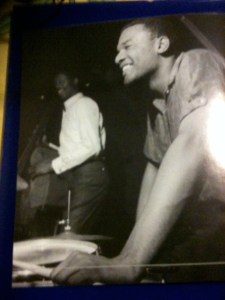
Sometimes we don’t see what is right under our noses and that was definitely the case with me and ace-drummer Joe Chambers.   We sometimes miss drummers or bass players because it is all too easy to be dazzled by the musicians on the horns or guitars.  In Joe Chambers’s case the leaders were cats who blazed with an almost unbearable intensity and this semi-eclipse had blinded me to the intricacies of a hard grooving and in-the-pocket drummer.

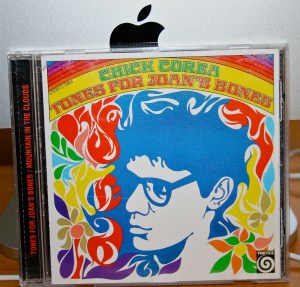
I was kicking back with a friend one night when he put on Chick Corea’s ‘Tones for Joan’s Bones’.   I had wanted to hear this album for years and now from the first bar the album got right under my skin; edgy, restless, forward-looking American 60’s Jazz  – featuring Chick Corea (p), Joe Farrell(ts)(fl), Woody Shaw (t), Steve Swallow (b) & Joe Chambers (d).   This was an era when Jazz, (no longer a popular music and competing with rock), let loose a tidal wave of open-ended creativity.  Caught between Ornette Coleman and a burgeoning rock scene, the confining ‘stays’ of Hardbop were suddenly loosened.    ‘Tones for Joan’s Bones’ is a truly great album of its type and the psychedelic art work on the cover is reason enough to buy a copy.   Chick Corea’s song ‘Litha’ with its chromatic mesmerizing energies was the big hook for me and as I listened I became hyper aware of the drummer.

The name Joe Chambers had been vaguely familiar and when I looked him up I was surprised to find that he was the drummer on dozens of my favourite albums.    Classic albums by Herbie Hancock, Bobby Hutcherson, Chic Corea and Freddy Hubbard etc.

As well as listening to the group as a whole we should also develop the ability to isolate the instruments as we listen.  When we do this it is possible to comprehend the levels of interaction and the individual flights of inventiveness.   Jazz is after all a collective enterprise that supports the individual in extraordinary ways.

There are circus acts where a reverse human pyramid is formed on the shoulders of a strongman.   While watching the climbers go higher and higher, we can forget that the whole formation would fail catastrophically if the person at the bottom were to miss-step.  Joe Chambers is the strongman who waits until everyone is standing on his shoulders and then raises them even higher.  This type of drummer carries a lot of weight and in moments of high tension, causes you to hold your breath in case he falls and the band tumbles to earth with him.   Such drummers can stretch time to breaking point as the tension increases and as quickly pull it in again when the outlier musicians need recalling.    Joe is a master of this tension and release.    I may have momentarily overlooked him but many modern rappers have not; zeroing-in frequently on his edgy rhythms.

Francis Wolf - Blue Note Records

Picture Francis Wolf - Blue Note

http://youtu.be/65LA1i6_LbE

Larry Koonse; Jazz Guitarist

Larry Koonse may be one of the nicest guys in Jazz but he is a killer guitarist.   He has recorded under his own name and toured or recorded extensively with such famous artists such as Bob Brookmeyer, Karrin Allyson, Mel Torme,  Joe La Barbera, Billy Childs, Terry Gibbs, Warne Marsh, Johnny Dankworth, Jimmy Rowles, Alan Broadbent, Charlie Haden, Toots Thielmans and many others.   At the invitation of Nelson Mandela and UNICEF he was once asked to perform in South Africa.   He has been the featured soloist with the LA Philharmonic plus other orchestras and has performed in Carnegie Hall.   He sometimes performs with his father Dave Koonse (who is also a jazz guitarist, having played at the ‘Lighthouse’ with John Grass).  Larry is a well seasoned and gifted musician and he is always a joy to listen to.

I first saw Larry perform when he came to New Zealand with Joe La Barbera and Tom Warrington.  It was Kiwi big band leader Roger Fox who had organised for the trio to come out here and many were grateful that he did.   Larry’s guitar playing captivated me throughout the concert and I marveled at how the Tom Warrington trio’s “You must believe in Spring’ could somehow reverence Bill Evens and Lennie Tristano at the same time.   Larry’s cool-style is perfectly balanced by the warm tones that he elicits from his guitar and in his playing you can hear hints of Johnny Smith, and even Bill Bauer.  I loved every note of it.

After the concert some of the band came out to mingle with the crowd and I got to speak to Larry about his music.  Joe La Barbera was there as well, chatting and signing CD covers .  Larry is a very friendly guy and we have met once since then and exchanged emails.   Making contact with world class musicians in clubs or after concerts is one of the great joys of being a jazz fan and I often wonder if that chance exists in any other musical genre.

I have many recordings featuring Larry and in each of them I hear new subtleties.  Sometimes his long lines are unmistakably of the Tristano school (especially in his co-led LA Jazz Quartet),but with the Tom Worrington trio he can sound closer to the style of Herb Ellis or Johnny Smith.   The best place to purchase Larry’s music is from the ‘Jazz Compass’ label online.   Alternately go to his next gig and purchase the music there.    He tells me that he will probably be in in New Zealand in Late May 2011 and I will certainly keep you posted on that.

The clip has Bruce Forman on the left and Larry Koonse on the right as you face the screen.

The sublime odyssey of Hank Jones

I have never met a Jazz aficionado who did not like the pianist Hank Jones.  Because he was still recording so frequently at age ninety one it was tempting to think that he would live for ever.   To see footage of Hank playing was to love him because he radiated a rare warmth and a humanity.  His early influences in Jazz piano were Fats Waller and Art Tatum.  He was also there from the inception of Bebop but somehow he seemed to span the whole history of Jazz in his chordal voicing; which stretched from stride to post bop .   Joyous music ran out of his fingers like water from a faucet and we loved him because he was a Jazz god living among us. He believed that good Jazz should be infused with the blues and he practiced what he preached.  As he got older you could hear him happily sigh and chuckle as he played.  His deep throated vocalisations though quiet, somehow gave additional joy to his already joyous swinging music.

Hank was born in 1918 into a musical Mississippi family and his younger brothers Thad and Elvin became Jazz greats in their own right.  In his later years wide-spread recognition came his way but his innate modesty meant that the praise washed over him.  Hank was a great teacher and he never failed to support up-and-coming musicians.  A number of careers benefited from his support and this was a gift that he bestowed right up until his passing.   Hank left us in 2010 and the loss is still keenly felt.  A visit to the official Hank Jones web site will lessen the blow, because as you hear him welcome you, the realisation comes that his legacy and above all his music will remain with us always.