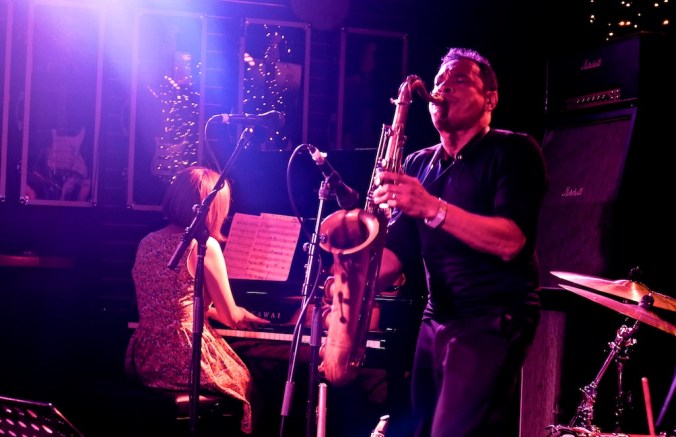
 Anyone who saw Jay Rodriguez play the last time he was in town will have tripped over themselves to catch him again last week. Rodriguez is a talented and engaging improviser and when he steps onto the bandstand he wins hearts from the get-go. This seemingly innate ability arises from a keen understanding of what will work best with a particular audience. He picks ups on and feeds off the energies in the room. He is also a skilled technician, but he is not there to show off his undoubted chops. His purpose is to involve and to engage at the deepest level; offering musicians and audience alike an unforgettable musical experience.
These days, dozens of talented musicians pour out of the prestigious Jazz schools and as good as they are, they often have a similar approach and sound. Over time the best of them shake this off, but it takes work and road experience to do so. While Rodriguez attended music school, he also gigged from a young age; cutting his musical teeth on the bandstand and learning his craft at the feet of masters (Tito D’Rivera, Phil Woods and Joe Henderson – playing lead alto with Tito Puente at 15 years of age). Those early days shaped his trajectory and enabled him to move effortlessly across the breath of the Jazz world – and later – traversing the wider music scene (Elvis Costello, Prince, Ribot etc). You gain the impression that every day on the road added a certain something to his sound. He can channel a raw Texas tenor sound in the same gig as he has people swooning over a ballad. Once this was a commonplace accomplishment, but as the old road warriors pass, we hear this stylistic breadth less and less.
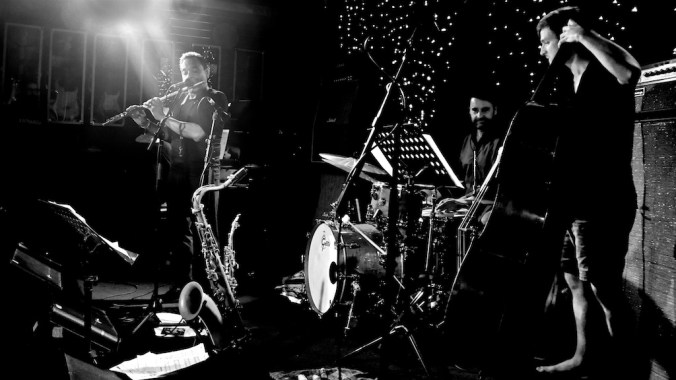
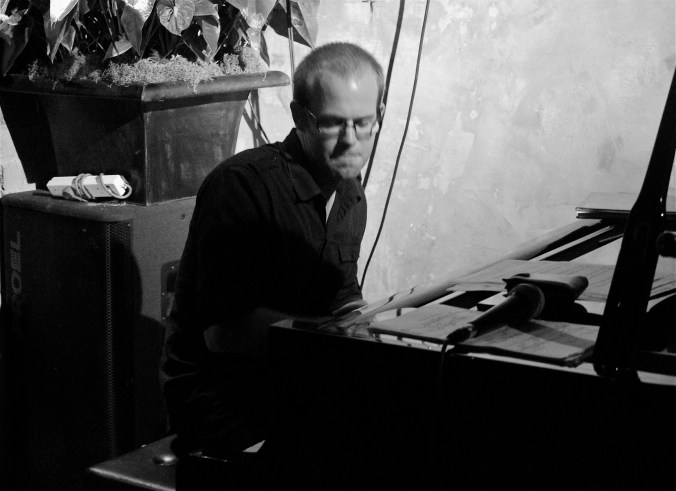
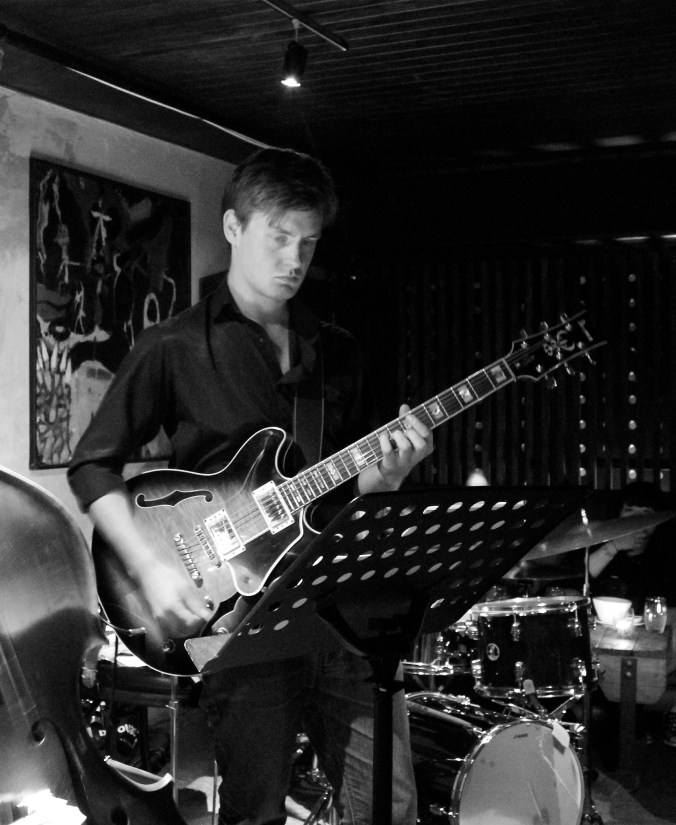
Here I must offer a disclaimer; I was involved in this Auckland gig. Rodriguez had reached out and generously suggested that we could join forces, adding some spoken word into his show. We had a number of exchanges while he was touring with Marc Ribot (the Songs of Resistance project). Various ideas were canvassed – unlike many improvisers, he is experienced in working with poets as he has associated with many including the late lamented Amiri Baraka. From across the time zones, we explored possible rehearsal times and as is often the case, a quick rehearsal just before the gig was the only possible option. When it came to hiring the band, he made another generous suggestion; he was happy to have some younger and freer spirited musicians on board – in fact, he welcomed that. Crystal Choi and Eamon Edmundson Wells joined Ron Samsom as the core group, with special guests Jonathan Crayford and myself appearing on select numbers.
Rodriguez is proficient on multi-reed and wind instruments and he frequently travels with most of them. This time he arrived with one flute, a soprano, and a tenor saxophone. When rehearsal time came he unpacked dozens of charts and spread them around clock fashion. My favourite author does this, slowly walking among short stories until an order is fixed. So it was with Rodriguez. We had been pre-warned that what was rehearsed would not necessarily be what was played, as he often changed things around as he read an audience (and often mid-tune by way of signals).
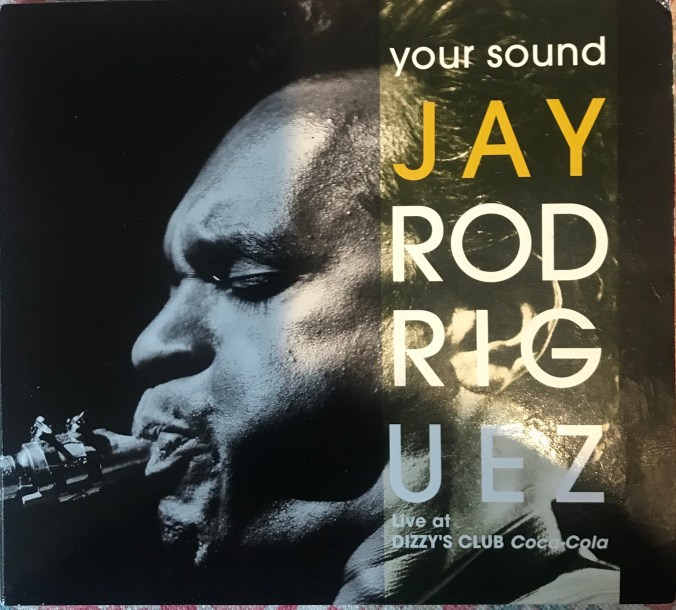
The setlist had a few well-chosen standards and of course, tunes from his critically acclaimed ‘Your Sound’ album. Although he amended the setlist as the gig progressed and extended numbers, fusing the tunes into a heady new amalgam, the performance had a flow that was preternatural. Working with a musician like this and trusting his instincts to guide you forward is exhilarating. I know that the band enjoyed themselves – the gig became bigger than the individual musicians and that how good gigs should work.
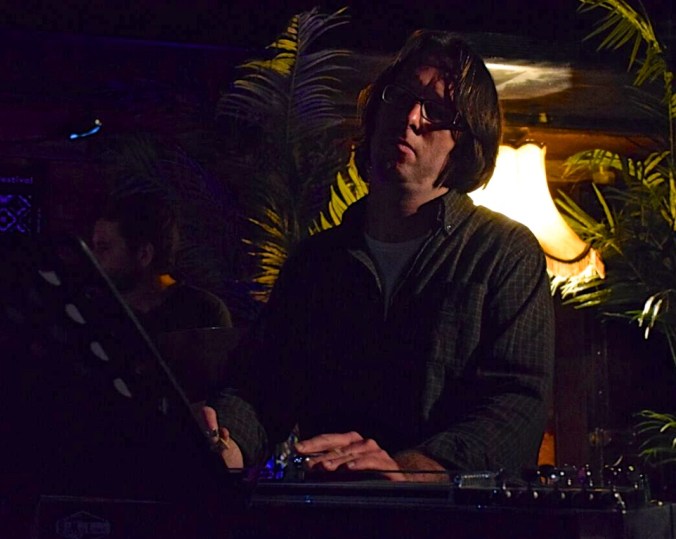
I have posted a longish clip from the gig, one which demonstrates the energies flowing between the musicians. The clip reminded me of the early Alice Coltrane projects. Deeply spiritual and unafraid to move with the vibe. Choi delighted the audience with her wholehearted engagement, moving from minimalist figures to crystalline arpeggios as the moment demanded. Edmundson Wells, like Choi, often appears on the avant-garde scene and was perfect for the gig. Samsom, the other experienced hand, offered solid support, creating a cushion and a heartbeat. Last, but not least was Crayford, a generous enabler, a mentor to musicians like Choi. He would normally have appeared as the listed keyboardist, as he and Rodriguez have a deep friendship and they collaborate when they can. This time he was heavily engaged in a project of his own and arrived back in town hours before the gig. He waited out the first set, respecting the established line-up, joining the band with keys for the second. This added a whole new dimension to an already great gig – creating the broader palette that Rodriguez thrives on. The capacity audience reacted to every facet of the gig with enthusiasm and Rodriguez return is eagerly anticipated.
In my case, the overall experience was particularly rewarding – a true learning experience – note to self – let my spoken lines breathe more at the start. When you fit words around live music quick decisions are required, Sometimes you have mere seconds to judge the rhythms of an unfamiliar tune. An opportunity like this is rare and precious and I’m glad I took it.
Jay Rodriguez: (tenor & soprano saxophone, flute), Crystal Choi (piano), Eamon Edmundson Wells (upright bass), Ron Samsom (drums, percussion), – guests Jonathan Crayford (keys), John Fenton (spoken word) – at ‘Backbeat’, CJC (Creative Jazz Club), 27 February, 2019 – Jef Rodriguez recent album ‘Your Sound’ is available on Amazon, through record stores or go to jayrodriguez.com

 In the months before Christmas, we were reeling from the twin body blows of Trump and Brexit. During this period of disbelieving paralysis, Norman Meehan, Paul Dyne and Hayden Chisholm came to town. What they played was a balm for our troubled souls, a sublime ballad gig. I reviewed the gig on November 27, 2016 (this site). A week later Norman Meehan and Tony Whincup launched a new book titled ‘New Zealand Jazz life’. This is a great read for anyone interested in New Zealand music history and a must for anyone interested in improvised music. Meehan’s prose is much like his playing, devoid of needless ornamentation but pleasing. he is a natural with words, but he also manages to impart vast amounts of information without the reader ever feeling force-fed. His interviews with significant New Zealand improvising musicians are carefully blended with personal observation. Musicians like Jim Langabeer, Lucian Johnson, Nathan Haines, Kim Paterson, Jeff Henderson, Anthony Donaldson, Frank Gibson jr and Roger Manins are featured. I highly recommend this book as a vital reference work and as a very good read. ‘New Zealand Jazz Life‘ is published by Victoria University Press and available at all good bookstores.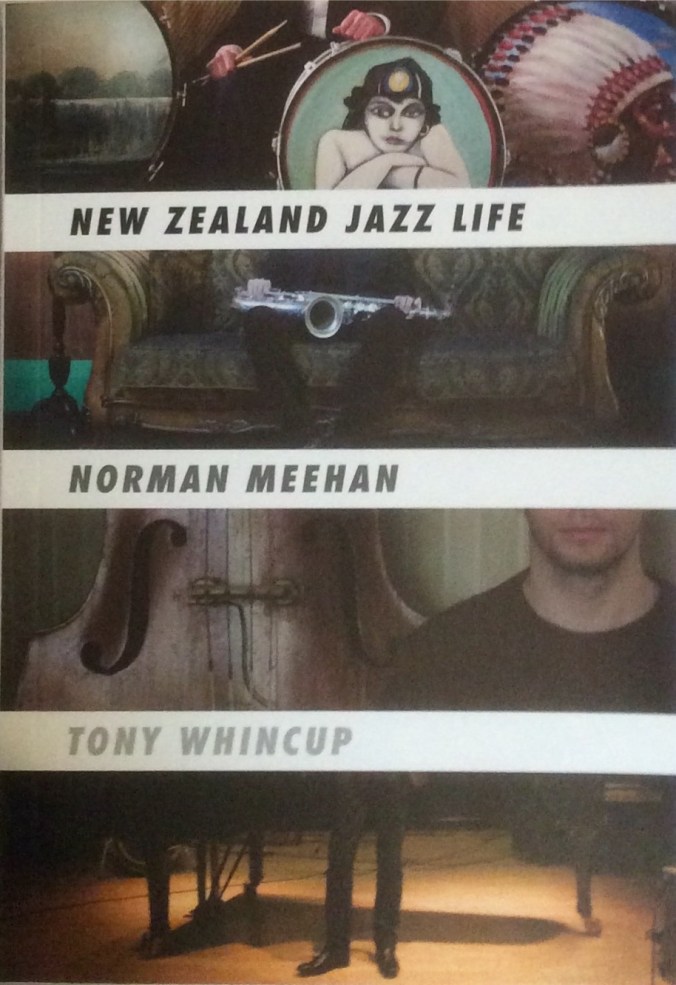
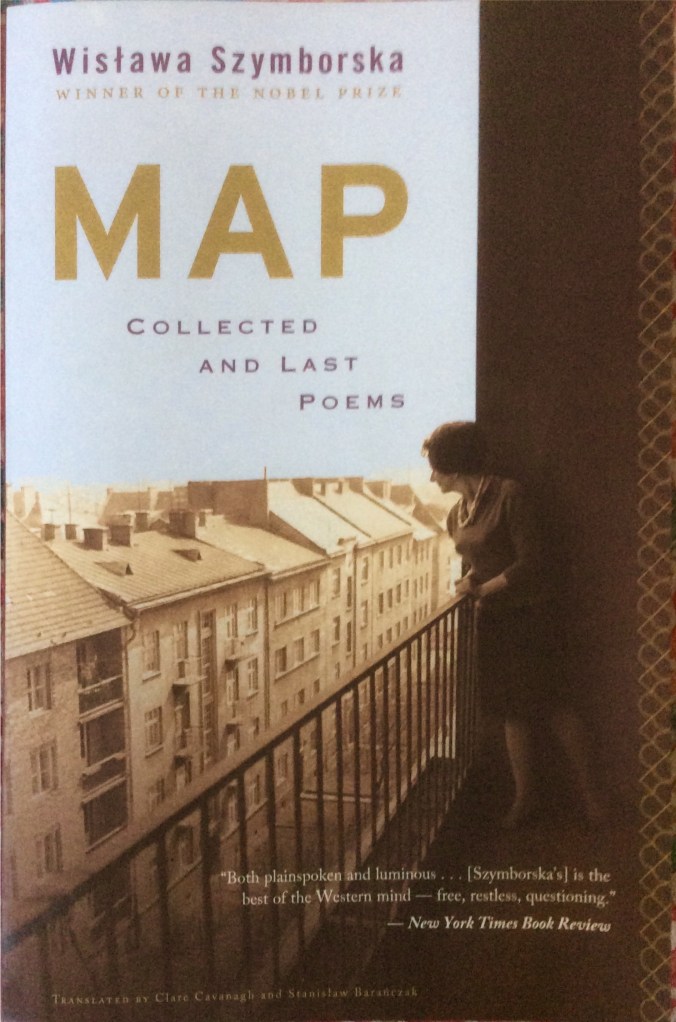 Her Maps‘ anthology has seldom been out of my hands since. Szymborska communicates the Polish experience like few others. She evokes a sense of impermanence, an un-belonging that has characterised Polish life for millennia. I am descended from Pomeranian Polish stock and perhaps this adds a particular resonance in my case. This is a window into a floating world surprisingly free of rancour. ‘Maps’ in translation is published by Mariner Books.
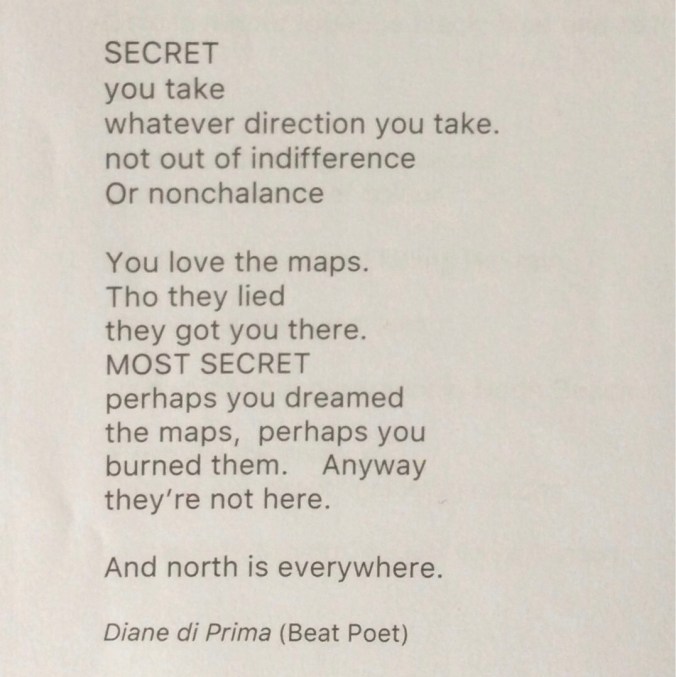
 The City Lights book shop in North Beach San Francisco has always been at the centre of my universe. Whenever I’m in that wonderful city I head there immediately. I had just spotted a verse from a Diane di Prima poem in a street pamphlet and I couldn’t wait to get a volume or two of her poetry. I have long been familiar with di Prima’s work, but the gifted female Beat poets were unfairly eclipsed by their male counterparts. A book published by Conari Press titled ‘Women of the Beat Generation’ is now back in print and it’s a good starting point for examining their body of work.
 di Prima is still with us and some of her best work is contained in a recent volume titled ‘The Poetry Prize’ published by the City Lights Foundation.
  Lastly I will post one of my own recent poems, which rounds off the theme of maps. I wrote this in the week before my journey began. As I was about to depart, a well-known New Zealand Jazz musician shared some travel tips with me, offering insights, drawing me an abstract map as guide. I was so pleased with it that I wrote this poem. I took his wonderful map with me and although I was unable to strictly follow it’s path, the spirit of it was an inner compass to guide me. It made me happy to have it near – now a prized possession, a travel memory, a manifest.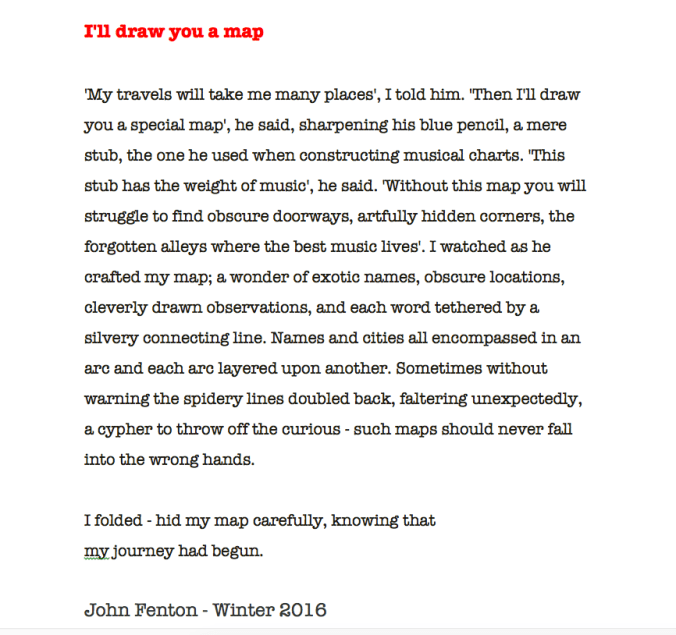
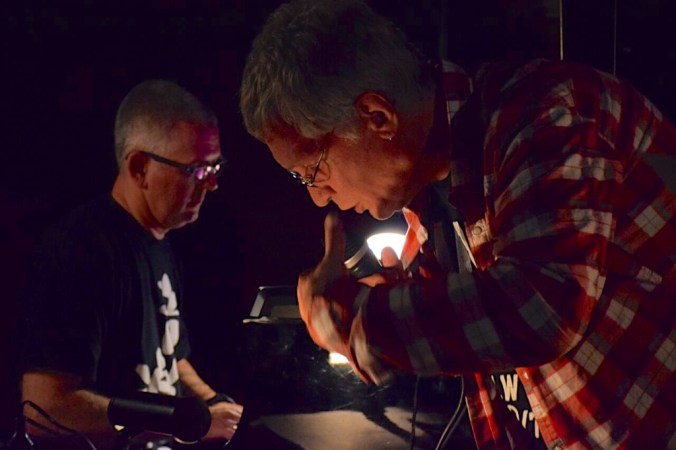 I made up my mind days before the Mexico City Blues gig that I would not, could not review it. It is some kind of crazy to review a gig where you’re in the band. Logic and custom sensibly warns you to walk swiftly in the opposite direction. The gig passed and I asked others if they would do the review; “You’re wrong man” they said, “You absolutely have to do it, but do it differently – tell a story about what it felt like performing for the first time, and what it felt like as a non musician being part of a high quality improvising band”. I thought about it for a while and gave in. In truth I had a world of stuff churning about in my brain and the subconscious urge to outline the experience was gnawing at me; my thoughts and impressions always seem to spill onto the page somehow (or into a poem) – so hell why not. It’s Gonzo journalism in its purest form; outlining crazy, using ones-self as the hapless protagonist.
 I confided my fears to a few knowledgeable friends, Chris Melville and poet Iain Sharp. Both were very sensible and reassuring in their advice; “Just own who you are man, own your voice. You know this stuff backwards and you know the music”, they said. When I explained the hazards of fitting existing verse to music, drummer Ron Samson told me, “Don’t worry man, we will follow you – your safe with us”. I discussed it further with Stephen and he gave me a set list. From that list I chose three poems that roughly matched the rhythms of tunes. For ‘Goodbye Pork Pie Hat’ (Mingus) I chose Kerouac’s chorus 66 from ‘Orizaba 210 Blues’, for ‘Blue in Green’ (Evans/Davis) I selected the beautiful mystical 1st chorus of ‘Desolation Blues’. I was sure that two poems would be more than enough, but as a precaution I prepared a third as back up – verse 116 of ‘Mexico City Blues’ to Horace Silvers ‘Peace’.
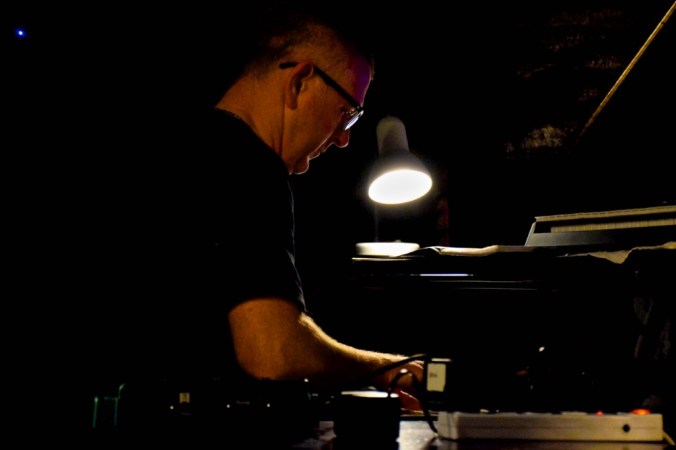
 Jazz gig rehearsals tend to follow a formula, but viewing this process from the outside and being part of it are two very different things. From the inside your inbuilt detached observer gets fired from the cannon of weirdness. You realise just how random Jazz rehearsals are. They begin what becomes a slow descent into the controlled accident. The first hour of any rehearsal is a ‘hang’, insider jokes, war stories and talk of gear and gizmos. Then a sudden flurry of activity follows; disembodied items of musical machinery miraculously forming into new shapes. If the rehearsals are in a Jazz club the activity takes place in semi darkness. Instruments, microphones and amplifiers joined by a spaghetti of wires as the musicians stumble over precarious piles of instrument cases and zip bags. “Oh shit this channel is dead – (from out of the darkness) – don’t worry its the cable – have another in my car – its parked a few streets away. Can we route the cable through the Hadron-Collider? – clip click – sorry false alarm”.
 Then came the truly random bit. “We can cue you in on each piece, or just dive in where ever you think best – we can follow”. The words ‘each piece’ threw me a curve ball. “I have only three poems printed off” I added lamely (or four if you counted a crumpled excerpt from ‘Desolation Angels’ tucked into the back of the folder). “No matter – just say anything – you’re a poet – it will be fine” said Stephen. Then I remembered the paperback of Kerouac’s ‘Book of Blues’ in my bag. “Great” said Stephen, “just pick the poems randomly – do it at the last-minute while we run through the head of each tune – perfect”. This was a band leader channeling the Zen Master – a role quite appropriate to a 1959 referencing gig – throwing me a Koan, an improbable musical puzzle, no escape route possible. When we got to the tune ‘Peace’ I gained confidence, “Ah I have something for this – yeah – Horace Silver”. At this point Stephen casually informed me that they were actually doing Ornette Coleman’s ‘Peace”, another tune entirely. Ornette, ORNETTE – holy crap – panic. Next the gig




 JazzLocal32.com