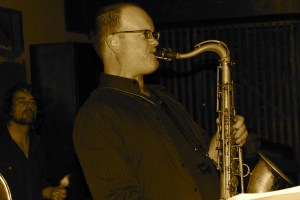
Sean Coffin (AUS)@ CJC

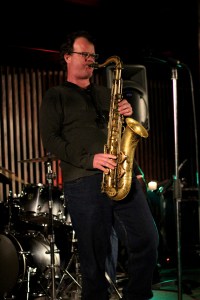
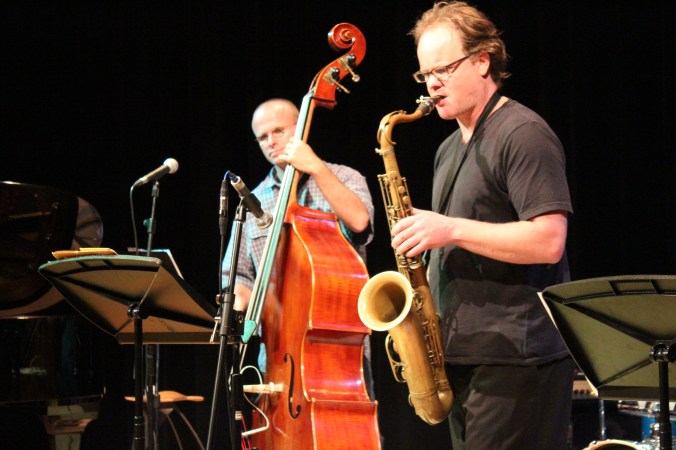
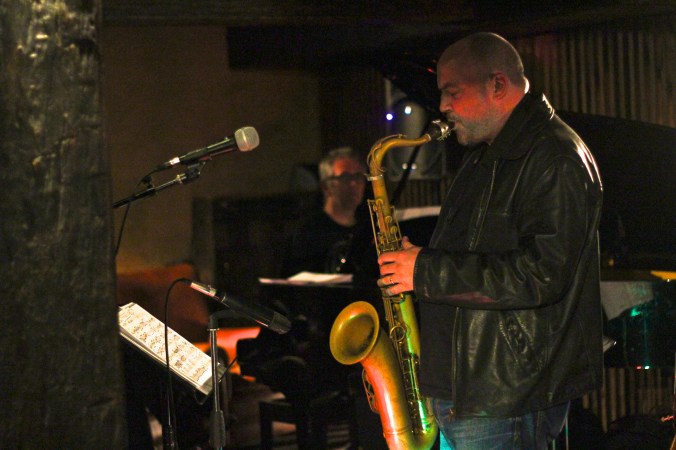
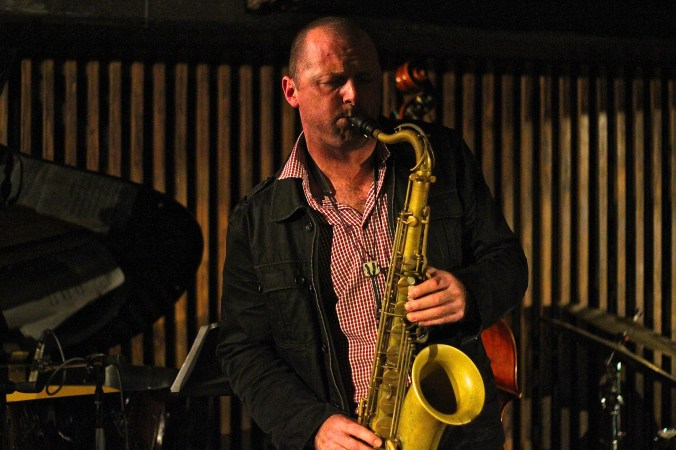
On Wednesday the 24th October we had an overseas visitor playing at the club, tenor saxophonist Sean Coffin.   This has been a great year for the Auckland Jazz scene and especially for the CJC (Creative Jazz Club) as a number of interesting local bands, out-of -towner’s, and overseas acts have appeared.  It’s the clubs imperative to offer genuine diversity, and this has caused the CJC to extend its reach.   Because Roger Manins has such a well established Australasian reputation and because the CJC is increasingly seen as a great club to play in, the net is ever-widening.   We are on the Oceania Jazz circuit fair and square.  
Sean Coffin is known in his native Australia for his stellar educational work, but it is his high level tenor playing that draws people to him.  He is among the best that Australia has to offer.   For many years he has been accompanied by his brother Greg (piano) and the work of this formidable pair is well recorded.   Sean studied at the Berklee School of Music and later as a postgraduate at the Manhattan  School of Music.  Among his many teachers I would single out George Garzone, as this world leading tenor player appears to have created a cadre of exceptional students in Australasia.  
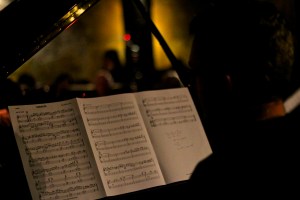
At the CJC Sean showcased his most recent compositions and they were mostly themed around his children.  This proved a good source of inspiration as the numbers ranged from heart-felt ballads to some faster paced offerings (one referenced children at play).   These lovingly drawn compositions were well crafted and executed and no one had difficulty relating to them.   It is arguably risky to focus exclusively on family material, but the gamble paid off because the improvisations were tender without once descending into introspective noodling.   The integrity of the compositions as Jazz vehicles was always evident.  A lovely ballad to ‘Garz’ (dedicated to George Garzone) rounded things off nicely.

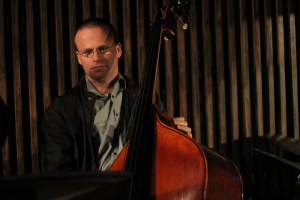
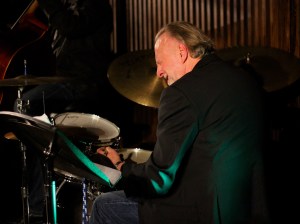
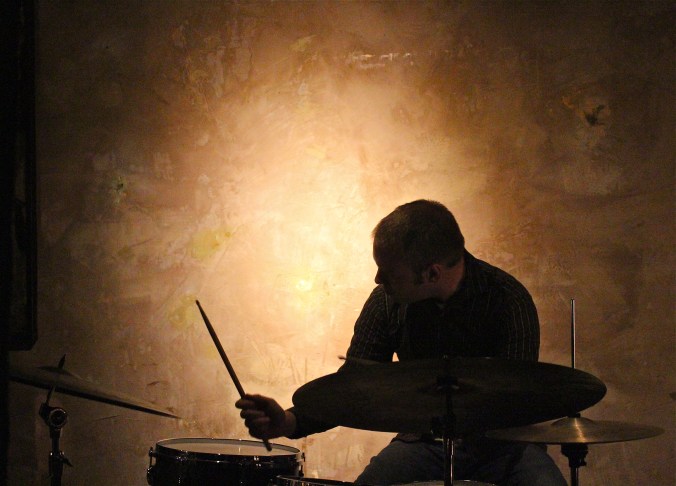
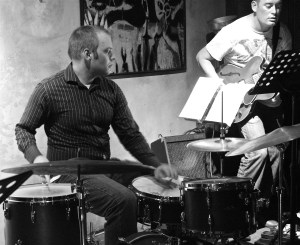
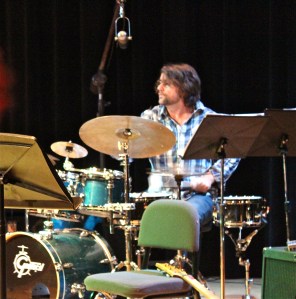
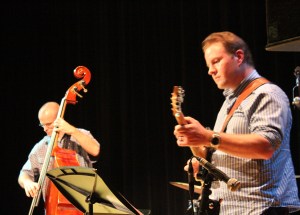
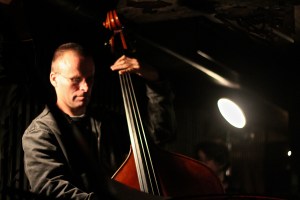
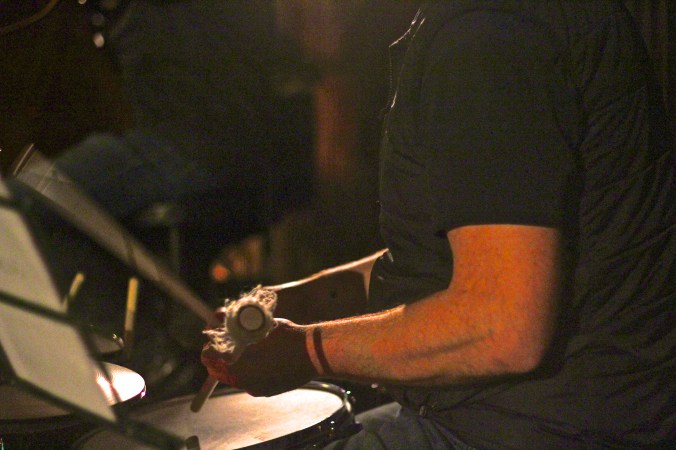
A local rhythm section was put together for this gig and in due deference to the visitor he was given the best.  Ron Sampsom (drums) and Oli Holland (upright bass).  With Kevin Field overseas, Dr Stephen Small took the piano chair.  No one needs to puzzle over my views on Ron Sampson and Oli Holland as my support for their work has been constant over time.  These two go way beyond the merely competent; they are solid, reliable musicians and they are also gutsy enough to handle new challenges without flinching.   Listening to them live or in a recorded situation will tell you everything you need to know.
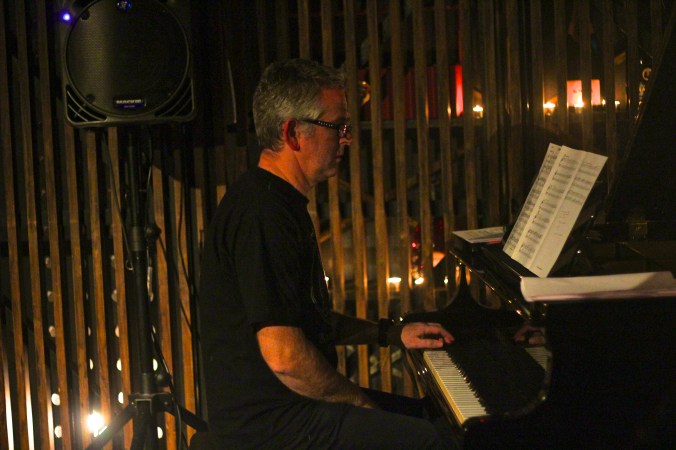
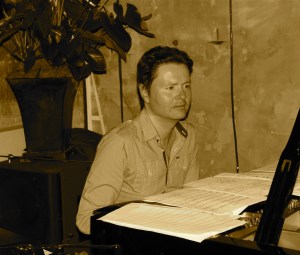
Seeing Stephen Small again was an unexpected pleasure, as the patch he normally patrols is on the periphery of the Jazz world.  Because he teaches classical piano at Auckland University it would be easy to overlook the fact that he has other strings to his bow.   He is a madman on keyboards and I have seen him cut loose on banks of synthesisers during a Jazz fusion gig.   To say that his fusion performance was riveting would be an understatement.  He created textural layers of sound which swirled and soared alternatively.  Put him together with a fusion versed guitarist like Nick Granville or Dixon Nacey and he will take your ears apart in the best possible way.  Stephen is also a highly talented, straight-ahead, post-bop pianist and judging by the whoops of delight as he negotiated his solo’s he needs to get down to the CJC more often.   I am casting my vote for one of his Jazz fusion gigs.
Sean worked hard all evening and at the end he invited Roger Manins to the bandstand.   There was obvious respect between the two men but that didn’t stop them from going hard out.  When the best tenor players occupy the same bandstand, it generally ends up being a joyful celebration rather than a cutting contest.   This was respectful but no quarter was given.
Jamie Oehlers NZ quartet@CJC

There are good gigs, bad gigs, predictable gigs and everything in between. Mostly we appreciate what is before us but just occasionally, we attend a gig that is every kind of wonderful. This was it.

Jamie Oehlers has the sort of reputation that scares aspiring tenor players and creates life-long fans. This man is a monster on the tenor saxophone and no amount of scrambling for adjectives on my part is ever going to capture the intensity of his performance. Luckily I filmed much of the gig and so I will put up a number of cuts on You Tube over the coming weeks. This gig won’t be forgotten as it fizzed and washed over us like a blissful tsunami of sound.

Typical of many Australasian musicians Jamie Oehlers is self-effacing, and quietly humorous, but his down to earth persona remains intact only until he puts the horn in his mouth. Then we see confidence, elegance, fire-breathing and effortless virtuosity of a sort that almost defies belief. He is one of those musicians who reaches beyond the known, bringing the rhythm section and the audience along with him. His solos have an almost mystical coherence; as if guided by a universal logic that he is able to share with the audience.

Those who saw the performance at the CJC on the 19th September 2012 will understand exactly what I am saying.

As marvellous as Jamie was, his local rhythm section was there for him every inch of the way. Not for the first time I marvelled as Kevin Field (piano) responded to every challenge, managing to inject a sense of originality and invention into a number of almost unassailable standards. Kevin stands out as a pianist as he understands perfectly which chords to accent, when to lay out and when to work harder behind the soloist. He is exactly the right pianist to play behind a talented visitor.

Oli Holland was so good during this gig that I embarrassed him with a bear hug afterwards. He could have been Reggie Garrison at one point as the urgent stabbing notes from his bass propelled the others on. Listen to the first clip below and particularly where Kevin is soloing. This unit was never less than in perfect lockstep.

Frank Gibson on drums was equally marvellous. You never know how drummers will respond to high-octane material like this but he responded by reaching deep within and capturing every nuance of the set. I have never heard him perform better.

The first set began with the standard ‘On a Clear Day’ (Lane), ‘Alina’ AKA ‘Variation 11 from Suspended Night’ (Tomasz Stanko) [one of my favourite tunes], ‘Aisha’ (John Coltrane), ‘Take the Coltrane'( Ellington-Coltrane) , Portrait in Black and White ( Jobim) and more.

Near the end of the second set the band decided to play John Coltrane’s ‘Resolution’ from ‘A Love Supreme’ (1962). ‘A Love Supreme’ is hardly ever played and more is the pity. This avoidance relates to the holy grail status of ‘A Love Supreme’ among post Coltrane saxophonists. My view is that we should honour it and especially in this week. John Coltrane was born on September 23rd. It is a shame not to have all four movements performed together though; ‘Resolution’ is after all only a part of a mystical four piece puzzle which makes perfect sense when heard in its entirety.

Jamie stated the theme over and again, but each time working in subtle re-harmonisations and embarking upon brief angular explorations. We knew intuitively that we would end up in a place of almost unbearable intensity and we were on the edges of our seats in expectation. This was not a gate to be rushed and although we understood that, the anticipation was palpable. Tension and release is at the very essence of Jazz and Jamie achieve this end by stalking his prey in measured steps like a confident hunter.

‘Resolution’ is an Everest of a tune utilising Coltrane’s new-found ideas which were somewhere between hard bop and free. Jamie interpreted intelligently without trying to out do Coltrane. He made it his ‘Resolution’ as well. Kevin field was the same, as he took a more oblique approach than McCoy Tyner. This was a perfect homage without being a slavish imitation.

At the end of the gig we received an additional treat when Jamie asked Roger Manins to play. The best moment was when they played ‘On Green Dolphin Street‘ (Washington). With these two masters working the changes and probing every hidden corner of the melody, it reminded us that standards interpreted with integrity can sound as fresh as at first hearing.

Jamie Oehlers lives in Australia where he runs a Jazz School. He has so many awards that storage must be problem (including being judged winner of the ‘World Saxophone Competition’ in Montreux by Charles Lloyd and Bruce Lundvall of Blue Note). He has put out 10 albums as leader as well as being sideman for the whose who of the Jazz world.

I ran into Jazz guitarist Dixon Nacey as I was leaving and he summed it up nicely. “Man I have just received a series of Jazz upper-cuts”.

‘Dr Dog’ takes the Jazz Pulse of Auckland

Animal lovers, children and Jazzers alike were delighted to learn that the ‘Dr Dog’ Jazz quartet would be performing in the Creative Jazz Club (CJC). This was somewhat of a dream band as it featured ‘I cani popolari‘ from the halls of academia; Roger Manins (tenor), Kevin Field (piano, Rhodes), Oli Holland (Bass) and Ron Samsom (drums).

The band having no clear leaders could follow their noses, but in spite of that they worked as one throughout the evening. In Jazz-dog years they represented around 317.4 years of experience and so their ability to act in a disciplined manner was hardly surprising. They took their lead from each other.

Roger had managed to sniff out the microphone first and so the job of introducing the band members and the numbers fell to him. An endless stream of puns and dog stories followed and at one point some frank observations on the variability of dog intelligence risked causing serious offense to Afghan owners. As none appeared to be present the crises was averted and the dog related compositions flowed in happy succession.

If anyone thought this to be a frivolous exercise, they should be disabused of that notion. This was a band which had ‘chops’ (OK I had to put that in), the ability to delight a crowd and a string of intelligent compositions to shine over.

It is expected that the canine metaphors and jokes will continue to dog this band for some years; peaking around 2014 before eventually subsiding. As a departure from the normal CD prize there was a meat raffle. A cat named Jason took that prize.

The music that we heard was so good that a few of us are going to lay a trail of sausages; leading from the Auckland University School of Music Jazz Programme to the nearest recording studio (Yorkie Street studios or Ratter Records).

In researching this Canine Jazz phenomena I recalled another dog band which had performed at the CJC . Guitarist Neil Watson’s ‘Zen Dogs’ performed at the club about a year ago. When I ran into Neil months later I asked him if ‘Zen Dogs’ would be performing again soon. He answered in that enigmatic way of all Zen masters. “Oh that was a concept band”. “But will they be performing again”, I asked?. “No the band was literally a concept – not an actual band”. Confused and pondering the meaning of this Koan, I could not help wondering. Had I imagined the entire gig?

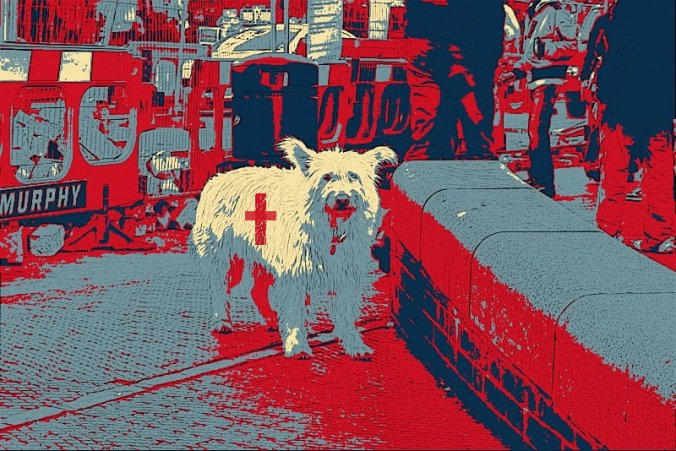
‘Dr Dog’ on the other hand is a band grounded in realty. A cartoon dog band entirely relevant to our times.

Footnotes: I have used sepia photographs to show respect, as they add a certain gravitas befitting the age and experience of the band. All photos are mine including ‘Dr Dog’ who was caught in Chelsea London and subjected to Photoshop without his permission. You will be pleased to learn that I managed to avoid using the following: barking up the wrong tree, woofers and Roger was a wag.

Alain Koetsier Band @ Finding Kiwi ‘Standards’

I have watched drummer Alain Koetsier perform over the last year and his credentials on the traps are unimpeachable.  Alain is a drummer with a modern feel and it is plain to see why so many of our top Jazz groups utilise him.  This was probably his first outing as leader and he had chosen wisely on two fronts.  His band mates were consummate professionals and their approach to the music was intuitive.  They interacted as if with one mind.  The second thing Alain did well was to select a set list of recent compositions by New Zealand Jazz Musicians.  I liked the concept.

People expect a band to play their own originals but when a set list focuses on a wider spectrum of Kiwi Jazz compositions it feels respectful.  It somehow lifts the tunes to another level of availability; a place of wider appreciation.  Doing this is a good start point in identifying our own ‘standards’ and some of the tunes played could well reach that bench mark.  As the scene continues to mature this will surely happen.

Alain & Dixon

Alain & Dixon

I was pleased to hear two tunes which had impressed me at recent gigs; ‘Dicey Moments’ by Oli Holland and the wonderful ‘Ancestral Dance’ by Nathan Haines.   Both of these new compositions are distinctive, clever and memorable.  Dixon Nacey compositions also catch the attention as he has a knack for locating the right hooks while providing a solid base for improvisation.The first set had contained ‘Bad Lamb’ (Dixon Nacey).    The tune had nice chordal voicings and the way it unfolded led us easily into the heart of the tune.

Another memorable number was ‘Tree Hugger’ by the Auckland-born bass player Matt Penman.   Matt has moved into the upper echelons of Jazz bass, occupying a respected place on the world scene.   Maybe he will return the compliment one day and acquaint North America with a few of the other compositions.

The gig was fun to experience and obviously fun to play as the musicians enjoyment of what they were doing was easy to discern.  Like many Jazz gigs there was a high degree of spontaneity and perhaps this came from being thrown in at the deep end.   Working musicians seldom have a lot of time to rehearse and when confronted by complex charts they appear to relish the prospect.

The musician that I was unfamiliar with was Pete France on tenor.   I know that he has played the CJC before and my friends tell me that they had hoped for his return one day.    His tone is rich and full and his improvised lines meaningful.   He is also relaxed on the bandstand and when you consider the calibre of his band mates this ease of manner speaks volumes.

Oli Holland

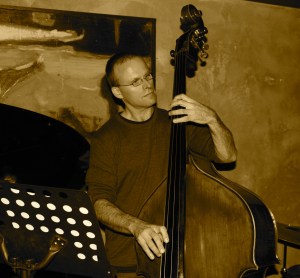
The band featured Oli Holland on bass.  His approach and focus drew you in inexorably as he demonstrated chops, impeccable timing and melodic invention.  His skills are considerable, as he can move from contrapuntal walking bass to melodic invention in an eye blink.   Oli gave his best, but then he always dies.

Pete France & Oli's hand

Lastly I come to Dixon Nacey.  His playing is widely appreciated throughout the NZ Jazz scene. As good as he is, he always strives to do better.   His compositions sing to us and his chordal work and rapidly executed lines astound.    It is good to be in a town where this man is playing and long may it continue.

Well done Alain – more please.

Oli Holland’s Shortland Street Gig

Oli Holland - Roger Manins

I recently received an invitation to Jazz Bassist Olivier Hollands DMA (Doctor of Musical Arts) recital.  It was titled ‘Dicey Moments’.  The gig was held in the Kenneth Myers centre at the top of Shortland Street.   This ornate crenellated building has a solid place in the history of New Zealand Music as it was formerly the home of the old Shortland Street TV studios. In its time the studio had hosted various radio orchestras and a few Jazz programs had emanated from there.  Stephen Small

When an experienced musician and gifted educator like Oli is performing a Doctorate recital it is bound to be an extraordinary gig.  Just playing a few standards would never cut it as the judging panel would certainly be looking for something unique and innovative.  In my view the performance easily met the required standard and all those who attended (mainly musicians) were deeply impressed.  Oli had written a number of complex charts for the recital and these conveyed a profound understanding of how improvised music can work.  While they were undoubtedly a challenge to play, they were still incredibly accessible to the listener.  The tunes flowed as fresh as a mountain stream and better yet they provided wonderful vehicles for the musicians to interpret and blow over.  Ron Samsom

I assume that the brief would be to choose band mates with considerable experience, solid reading skills and depth.  Band mates who would augment the vision, excel, but never overpower the lead instrument or the music.  These musicians were among the best on offer and they understood very well that this was about the music.  Oli remained firmly in control while encouraging the musicians and loosening the reigns when required; this is what a good leader does.

Oli had split the recital into two district halves; so to achieve a chiaroscuro effect and the appropriate contrast in styles, he had chosen two different bands.  One was a straight ahead jazz unit with Roger Manins on tenor, Kevin Field on piano and Ron Samsom on drums (Oli on upright bass).    The second unit was a fusion band with Dr Stephen Small keys, Nick Granville solid body guitar and Stephen Thomas drums.  Once again Oli played an upright bass, which worked exceptionally well, as the slap and bite provided a real contrast to the non acoustic instruments.  In the manner of all good leaders he joked with the audience.   “I used to agonise about the tune titles” he said, “but one day I had the profound realisation that it doesn’t matter what you name a tune. The next tune title has nothing what-so-ever to do with the music”.

The musicians gave their best and I have seldom heard any of them play better. The fusion half had the audience gasping in delight, as Nick Granville’s guitar, soared around Stephen Smalls fusion keyboard flurries.  The success of this recital is a tribute to the musicians but above all it is a tribute to Oli Holland.  His bass lines whether soloing or underpinning his charts worked perfectly.  Dr Oli it is then.

Nick & Oli

Nick Granville & Oli Holland