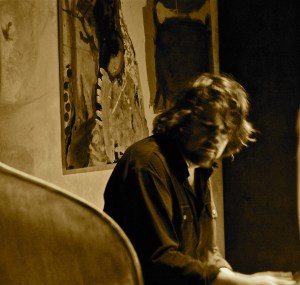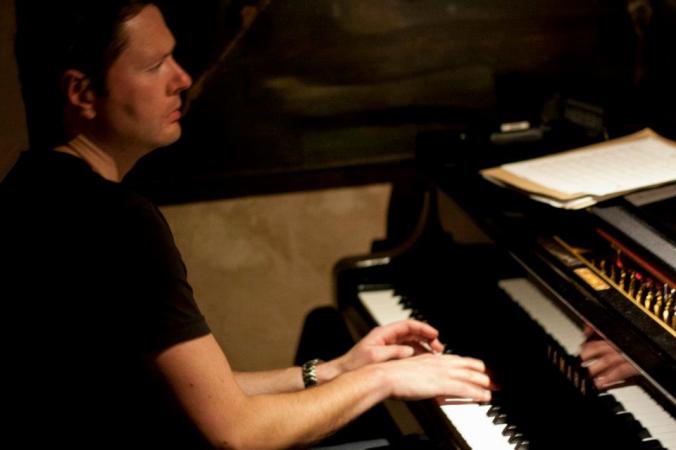
Matt Steele Trio

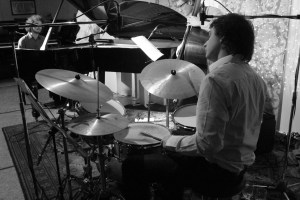
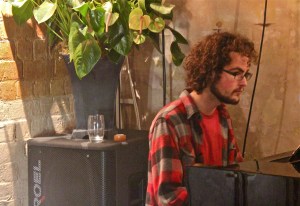
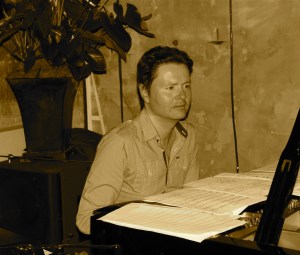
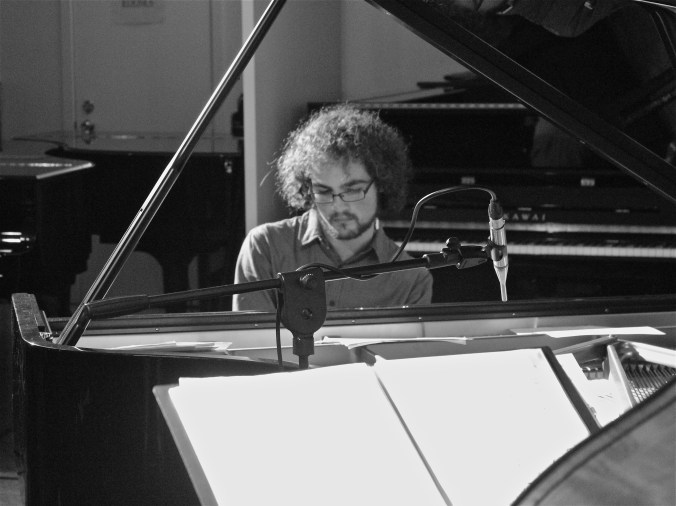
Matt Steele at the Steinway

About a year ago I was at a gig when my attention was drawn to a young pianist.   I soon learned that his name was Matt Steele and I wrote it down in a notebook; knowing that he would be one to watch.  As the months rolled by I would occasionally bump into him in the CJC Jazz Club or see him playing piano at the late night CJC Jam Sessions.

I had a strong feeling even then that he would develop into a really good pianist and my instincts were right.  At that time he was probably a first year Jazz Studies student, but now in the midpoint of his second year, we are seeing a mature and confident performer emerge.  He has the talent, taste and commitment to go where ever he wants.

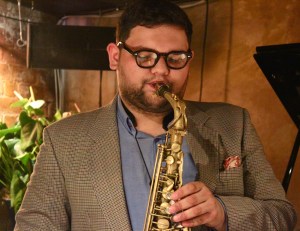
Jarad Desvaux de Marigny

While having chops is an obvious advantage there are other subtler factors which impress discerning listeners.  Matt can demonstrate a strong two-handed swinging-approach when called for, but it is his lightness of touch and his awareness of space that impresses most.   He has grasped the most important lesson of all and that is what to leave out.

Matt attends the University of Auckland Jazz Studies course and the tuition that he receives from Kevin Field is obviously yielding dividends.

Eamon Edmunson-Wells

On the 23rd of May Matt appeared as part of the Lewis Eady Emerging Talent series, which has a strong classical focus and doesn’t generally include a slot for jazz pianists.  They could not have chosen better than Matt as his playing was superb and the repertoire was perfectly suited to the occasion.

The program featured several works by the Polish Jazz trumpeter Tomasz Stanko and his wonder-kind pianist Marcin Wasilewski.  I was extremely pleased to see these masterpieces of modern Jazz included.  There is a real space for performing this material and there is not nearly enough of it.   Matt played some of his own compositions and they fitted in beside the Stanko, Bjork, Wasilewski, Kuhn and Carmichael perfectly.

It was also an added bonus that a lovely Steinway piano was available for the performance.

The clip below is from the Lewis Eady performance.  The number was composed by Bjork and played by Marcin Wasilewski on his album titled ‘Trio” (ECM).   Matt’s interpretation here is impressive.  I must also praise the sensitive drumming and great bass lines.  we should be under no illusion; pieces like this are difficult to execute.   Unlike a fast burner everything is revealed.   There were brave choices in the program but it worked extremely well.

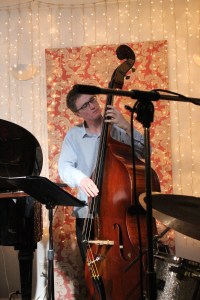
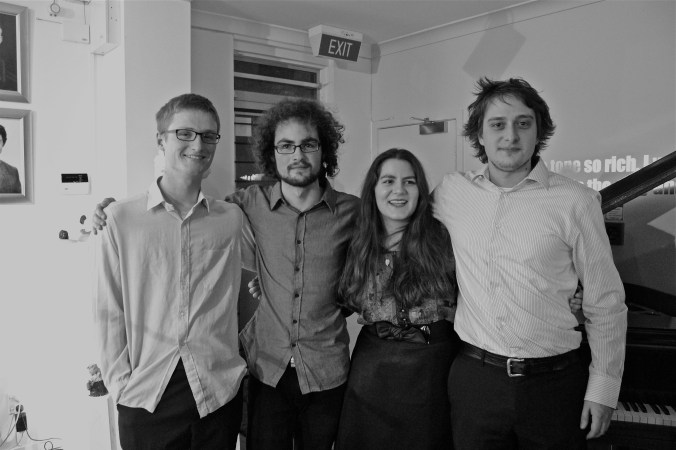
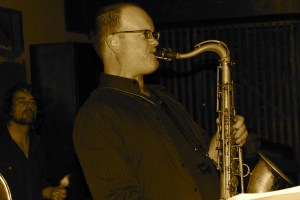
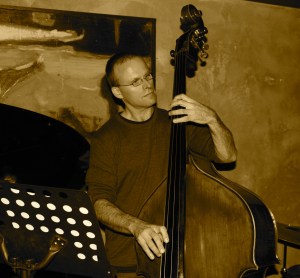
I had not seen Eamon and Jared before but I will watch for them in future.    This trio belongs together as their awareness of what is required of each other is highly developed.  I urge everyone to check them out.    Chelsea Prastiti joined them for one number and that was also great.

Alain Koetsier a top class drummer saw the clip and emailed me the following: “great stuff all round and very subtle drumming”.

Eamon, Matt, Chelsea & Jared

Jazz Track Blindfold test

This is a blindfold test with a slight twist in it. It will reveal who has been paying close attention to the Jazz press and who has a grasp of essential  Jazz history.

(1) Identity the tune, (2) The composer, (3) The original location where the recording occurred, (4) The trio members in the original album, (5) Name the original album, (6), Identify where this version was recorded, (7) Name the trio members who recorded this version, (8) Name the odd man out.

The tune was by genius bass player Scott LaFaro and titled ‘Gloria’s Step’.   It appeared on the famous ‘Bill Evans Live at the Village Vanguard‘ albums in the early sixties and tragically Scotty Lafaro died in a car crash within weeks of recording this masterpiece.    The third trio member was Paul Motian who became famous because of that recording.   What you are hearing is not from that album, nor from any of the hundreds of Bill Evans live or studio recordings available.

This version is by Chick Corea which I find quite amazing as it is a long way from Chick’s usual style.  He is accompanied here by Eddie Gomez and Paul Motian (both key Evans alumnae).   Chick is obviously the odd man out here (as he was never part of any Evans lineup), but he is brilliant on this two-CD tribute recording.   Eddie Gomez shows a different side as he consciously plays in a lower register than usual for him and can be heard intoning as he plays (like Slam Stewart).   The album is called ‘Further Explorations’ (Concord) after an Evans, Lafaro, Motian album called ‘Explorations’ (Riverside 1961).  Paul Motian died shortly after recording this, so his Jazz Journey began and ended playing tunes like Gloria’s Step.  It was recorded over several nights at the Blue Note in New York.

The Chelsea Prastiti Septet

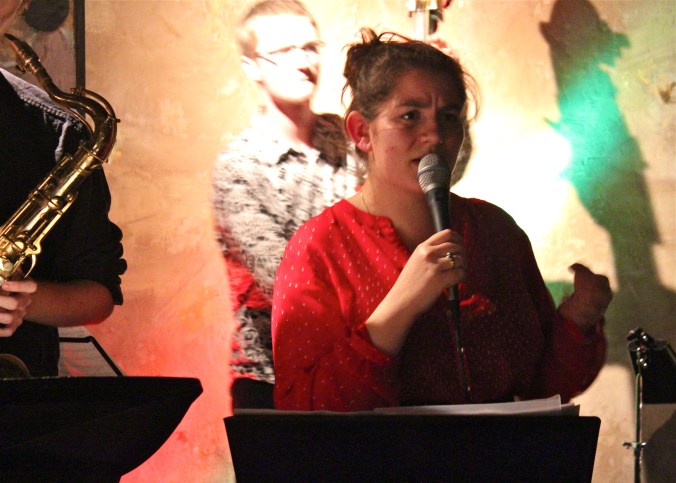
Chelsea

There are a surprising number of good Jazz musicians living in New Zealand and that is why the CJC is able to provide a varied and interesting programme at the club.  With Roger Manins as programme director the quality of the music is consistently high.  I may have come to expect that, but I can still be pleasantly surprised.

Chelsea Prastiti is studying Jazz at the University of Auckland and I have heard her sing once or twice before.   I knew that she was good but what took me by surprise was just how good.   This was not your routine standards programme but fresh and original Jazz singing at the highest level.   It was the sort of programme that a Sheila Jordan or a Norma Winstone might have embarked upon and in spite of the risks it was perfectly executed.

Matt Steele

Matt Steele is a pianist I enjoy greatly and he certainly justified his place in the band on this night.  Matt is in his third year and each time I see him play he gets better and better. His extended solo on ‘Bells’ was extraordinary and I cursed the gods for allowing my HD video tape to run out just before that.

Callum Passells was also in great form and he showed us again why he is so well-regarded as a musician.  His alto needed little coaxing as he worked the changes and the ideas flowed in happy succession.  Any band with Callum in can count itself lucky.

The band members were; Chelsea Prastiti (leader, vocals, arranger, composer), Callum Passells (alto sax), Matt Steele (piano), Elizabeth Stokes (Trumpet, Flugal), Asher Truppman Lattie (tenor sax), Eamon Edmunson-Wells (bass), Jared Desvaux de Marigny (drums).

Chelsea had arranged the numbers in the set and five of the songs were originals composed by her.  I will mention three numbers in particular as the contrast between these illustrates how well thought-out the programme was.  Second in the set was ‘Bells’ ( C Prastiti) and it was mind-blowing.   The band blew like crazy and each band member seemed to urge the others to greater heights.  Chelsea, Matt and Callum excelled themselves .   This is one of Chelsea’s compositions and it had all of the elements of great Jazz contained within its structure.   A tight arrangement, harmonic inventiveness, room for hard blowing and a structure that lent itself to out-improvisation.  I was standing near to Caroline (who teaches her at the University) and after the number we looked at each other in disbelief.   Even in the subdued lighting I could see tears in her eyes.

Callum Passells

The fourth number was a skillful arrangement of Maurice Ravel‘s.  The airy – ‘La Vallee Des Cloches’.   This was a fully arranged piece and with vocalese in the mix it was the perfect counterweight to what had preceded it.   Drums, bass, piano, voice, alto sax, tenor sax and fugal horn in perfect concert.

It was the last tune that had us all wishing that the music would never stop.  The composition was once again by Chelsea and called ‘Santa Muerte’ (the Mexican ‘Saint Death‘).    It  immediately brought to mind the madness and the wild beauty that is Mexico.    A hint of mariachi and a lot of jazz chops were on display.    I have included that as a You Tube Clip.

That a student so perfectly executed such difficult and exciting material is breathtaking – more please Chelsea and soon.

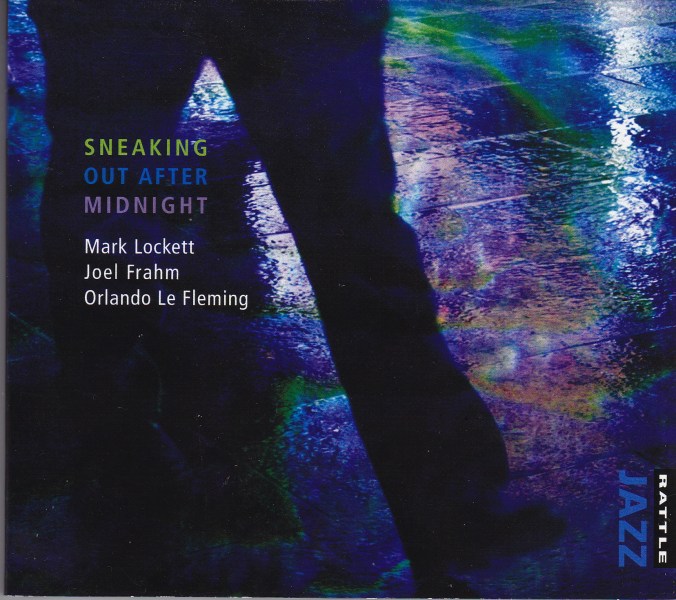
Mark Lockett – ‘Sneaking Out After Midnight’

Some weeks ago I received Rattle Records latest release.  It was Mark Lockett’s ‘Sneaking Out After Midnight’.   

It is a while since Mark left Wellington and he has obviously achieved much since then.   He is an educator, an innovator and a drummer with great chops.   When you look at who he has played with in the last decade and who his own teachers have been, the narrative falls into place.   This is an album that could not have been made by a lessor musician.

Mark is joined by two fine New York musicians; Joel Frahm (sax) and Orlando le Fleming (bass).   Joel Frahm has been around for a while and his album with Bill Charlap is one that immediately comes to mind.   He has been very much in demand around New York.    Orlando le Fleming (who was born in the UK) is equally impressive having also played with Bill Charlap and an impossibly long list of jazz notables.    These three were never going to be anything less than great when they joined forces.

It’s a nicely presented album with great artwork and even though cover art shouldn’t matter – actually it does.  Rattle always tries to present a complete package.

Good albums strive to break free of formulaic constraints and when a musical story is told in a fresh way this is achieved.   This is an album with an open, joyful and honest sound.   It is also Mark’s fourth album, which has allowed him to push harder at the musical boundaries.   His writing skills and his vision have made this a worthwhile journey.  

The Interview:


Q. Apart from the obvious subdivisions of genre do you have a view on what if anything makes NZ drummers so diverse in sound?

A. One of the many great things about being a musician in NZ is that you have to find your own voice and because there’s less competition musicians don’t have to perform to a certain technical level as to the all the other guys working on the same street as a musician in Melbourne or NY for that matter. Musicians in NZ have an opportunity like almost nowhere else in the world to find their own voice without being inhibited and from this a beautiful raw energy often emerges.

Q. Many drummers are writing now and in fact some of the most innovative compositions around are coming from the likes of John Hollenbeck, Matt Wilson, Eric Harland and Marilyn Mazur,who took the baton from Paul Motian and Jack DeJohnette. Why do you think this is as a drummer/composer?

A. I don’t often like compositions written by drummers and I think this is because they lack harmonic direction having said that I believe that more drummers are having lead their own bands these days to remain busy and employed and I don’t think this is a bad thing. Playing standards is great and I love doing it but when you play and tour a lot you can’t help but start looking for other musical vehicles from which to improvise.

Q. I have known about Joel Frahm for some time as he brought out an album with Bill Charlap (they are old friends). Orlando Le Fleming is an exciting bass player who has often worked with the amazing Lage Lund and Will Vincent among others. How did the collaboration come about?

A. A good friend of mine Aaron Choulai (piano player) got a chance to record with Tim Ries (sax player at the time with the rolling stones) in NYC some years back I first met Joel through that connection down at smalls jazz club. We bumped into each other several times over the years and I’ve always dug his playing. Another friend of mine happened to have Joel’s number so I called him up and he was really into it. Orlando was recommended to me by another great friend of mine and my current drum teacher Ari Hoenig.

Q. How was it working with these New Yorker’s.

A. Working with Joel and Orlando was the most amazing experience and one I’ll never forget.  These cats are true professionals in every sense of the word and two of the nicest, normal and most down to earth people one could wish for.

Q. How are things going in Australia for you?

A. I live in Melbourne and things are going great I’m very busy at present playing in several Peoples projects and planning my tour to NZ to promote the new cd dates are 3 July Wgtn Havana, 4th July Auck CJC and 5th July ChCh NMC at the conservatorium.

Q. Working without a chordal instrument brings different challenges and rewards. What are your feelings about working and recording with a sax, drum & bass trio.

A. I love this combination because it allows for a lot of musical freedom. It’s hard to find guitarists and piano players who are really skilled in comping.

Q. Is there anything that you would like to add about the album?

A. This album is my fourth release and I’m so excited about it, I think because it was a lot of fun to make and I grew up listening to these master musicians recorded with my hero’s eg Bill Stewart, Brian Blade etc I mean I use to sit in my flat in Wgtn in the 90’s and dream of playing with these cats and now a dream come true.

Thanks man we look forward to seeing you on your tour of NZ.    

Aucklander’s note; Mark will appear at the CJC 5th July

W: www.marklockett.com.au

E: mark@marklockett.com.au

Spiral @ CJC

Andrew Hall, David Hodkinson, Steve Harvie

Spiral is a band coming from a multi genre perspective with a sound blending funk, soul, samba, jazz and blues (and a hint of reggae).  They have a nice brassy sound and it is their horn dominated front line which pulls them closer to the Jazz end of the spectrum.

Spiral appeared at the CJC on Wednesday 9th April and in deference to a Jazz focussed audience they stretched out on a few numbers.   Their big exuberant sound easily dominated the room, with trumpet/flugal player Finn Scholes capturing a lot of attention with his occasional displays of bravura.   This is a band of many parts but for the CJC club audience it was the tightly executed high-spirited ensemble playing that they most warmed to.  When the band where playing the head arrangements they took the world by the scruff (sorry dog metaphors are hard to shake off this month).   They were so familiar with their material after performing around the country that the charts were only given a cursory glance.  It was that familiarity that brought the sound together and when a solid groove was called for the band delivered instinctively.

The leader of the band saxophonist, composer Andrew Hall was also the vocalist and most numbers began and ended with a few vocal choruses.   He took a number of tenor solos during the night and showed that he was in charge without hogging the limelight.   Andrew plays horns and winds but stuck to tenor on this night which gave more heft to the music.

Anthony Hunt was on keyboards and I liked his Jazz voicings.  He mostly used a Fender Rhodes sound.   He played a very nice Nord Stage and that instrument is capable of delivering anything that a band like this could demand from keys.

Finn Scholes is the player I am most familiar with.  His confidence on stage, his ability to introduce various stylistic concepts and his obvious chops make him the stand out.  We will be hearing and enjoying his playing for a long time to come I suspect.

Joel Vinsen played a nice Ibanez guitar and he utilised the variety of pedal effects at his disposal tastefully.  When the moods of the numbers changed it was his comping or licks that guided the others.  

Steve Harvie is a well-known drummer about town and he has played at the CJC before.  His drumming is tasteful and not over embellished.

Dave Hodkinson was on electric bass and he knew what his role was and performed convincingly.    In a small room an electric bass that is too high in the mix will drown out acoustic instruments.   He did not do this and his timing and lines were good.

Alex Berwick joined the band part way through the evening and his trombone added exactly what was needed to the overall sound.   He soloed nicely and reinforced the view that I had formed that the horn line were the stars.  

The ‘Troubles’ – John Rae & Lucien Johnson interview

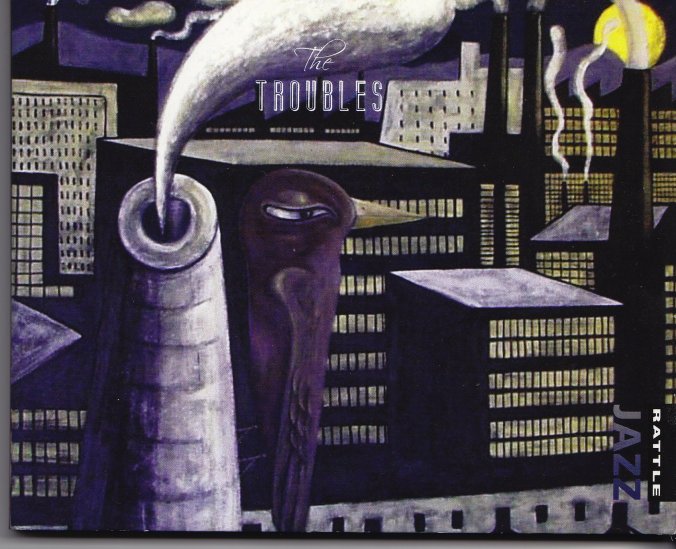
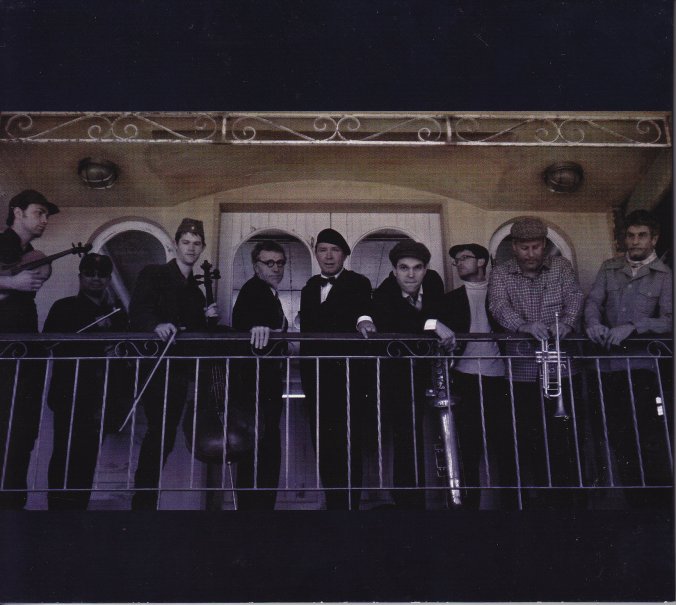
The Troubles Nonet

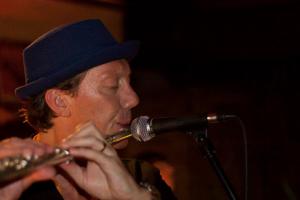
This e-interview was conducted over the 7th and 8th May 2012 – interviewer John Fenton for Jazz Local 32.    Those interviewed were John Rae (drummer, composer, arranger) and Lucien Johnson (alto & soprano saxophones, flute, composer, arranger).  ‘The Troubles’ is out on ‘Rattle Records‘ and was supported by Creative New Zealand.

Question: Time and place are important to both artists and audience and the interplay between them. I know that Wellington’s ‘Happy Bar’ has been a place to hear free improvised and experimental music for some time. The location and the vibe seem to be connected in this recording?

Lucien: I would say that Happy has been a largely supportive place and it’s nice to play on a stage, which is quite rare for jazz gigs in Wellington. Other than that though, since Happy stopped being a musician run place and turned into a business the vibe wasn’t quite the same – except for our Sunday nights! John may see things differently as he didn’t know it before, but I would say that any place that we have the capacity to virtually take over for the night we would see the same result. (A regular crowd of 50-80 enthusiastic and attentive listeners).

John Rae: All the above are true. Time and place are important. I’d been playing at Happy since I arrived in Wellington three years ago as the composer in residence at Victoria University and The Troubles are a part of a lineage. If there had been no Happy, Lucian wouldn’t have sat in with the group I was playing with, I may not have met Patrick, Dan or any of the other musicians who now make up The Troubles. But things move on. We now have another regular gig at Meow in Wellington and it’s going fantastically well. On a wider note, in Scotland we had a similar gig called Henry’s that ended up being an art’s council funded venue for jazz. We all know the financial difficulties of running a jazz gig and it is shameful that we have no problem funding classical venues to the tune of millions of dollars but can’t find what would be relative peanuts in comparison to support a jazz venue!

Question: While comparisons can be odious I was put in mind of an iconic and (at the time) controversial album that came out in 1969 “The Music Liberation Orchestra” Charlie Haden. Is that a fair comparison?

Lucien: I’m a big fan of the Liberation Music Orchestra, and the latter-day “Dream Keeper” is a personal favourite. I don’t know how aware John is of it though.

John Rae: It’s a wonderful comparison but purely accidental….

Question: You have no Carla Bley or Sam Browne on chordal instruments. Was that deliberate or happenstance?

Lucien: It was definitely a conscious decision. For a start there are no pianos at any venues in Wellington and we didn’t feel that there was anyone on piano or guitar who quite fit the bill anyway. We thought it would be more fun to have the strings acting as harmony players and/or have more open improvisations. I have avoided chordal instruments in my acoustic jazz groups except when I play with Jonathan Crayford.

John Rae: Yes it is. We like the freedom of not having a fixed harmonic instrument like guitar or piano.

Question: With a Nonet the sound palette and textures can have a big band feel. I sense that there has been serious writing and arranging done here. Is that my imagination or are there some well-arranged charts involved?

Lucien: There is very precise notation going on most of the time. The illusion of anarchy is due to familiarity and comfort with the material and the group.

John Rae: Lucian and I put a lot of thought into the writing. Personally I like my music to have a life of its own after my initial bit. So it’s important to write music that has an opportunity to breath and grow the more the musicians understand it. Or in other words, to treat the music with the contempt it deserves!

Question: How much of what we hear is free or changes based improvisation?

Lucien: A mixture, although when it’s free there is usually a tonal center present.

John Rae: A bit of both. I like musicians to dictate their own harmonic structures whilst soloing. Not always though and I have written tunes with changes but I hope that the improvisational aspects of my music allow the soloist to expand the harmonic possibilities as far or as simple as they want.

Question: I loved the way the band hinted at serious political topics but then appeared to instill humour and even an element is piss taking. Can you comment on that?

Lucien: John is quite political in this sense and contributes much of the humour (although musically Anthony’s percussion also adds this element). I prefer to leave both these things alone in music, without being extremely serious about it either. That’s just the way the group went with John’s personality present and I’m up for a laugh.

John Rae: I am a political animal but it’s important for me that people enjoy themselves whilst hearing my music. I’ve been around and played with ‘serious’ musicians most of my life and to be honest they now bore the pants of me. That’s not to say what I’m doing isn’t serious. It’s just that I’m over all the bullshit and let’s face it, in the current political climate if you didn’t laugh you’d cry.

Question: Is there anything you want to add?

John Rae: I love the jazz community here in New Zealand. It has some wonderful musicians and a lot going for it. On the other hand though it is really shit. No one seems to be asking the big questions. There is a lack of co-ordination, organization and vision. I look at what’s going on in Scotland and can’t help but compare it to here. No national jazz orchestra, no national jazz federation, jazz touring schemes, international profile etc and yet you can’t move for degree courses! As Niels-Henning Ørsted Pedersen the Danish jazz bassist said many years ago with regard to the Danish jazz scene, ‘it won’t improve until we stop making excuses’. The life of a jazz musician in NZ is incredibly hard. I believe it needn’t be soooo hard. It’s never going to be easy but through vision and togetherness we could make the living condition for jazz musicians a lot better. Ask any of the salaried brothers playing in any of the state funded orchestras if it’s possible!!!! I plan to have a gathering later this year of jazz musicians and people with an interest in the music to discuss some of the above and come out of it with a strategy on how to move the New Zealand Jazz scene forward. All together for the good fight….

Thanks guys that was an incredibly worthwhile exercise.

John Fenton – Jazz Local 32
‘The Troubles’ – Review

This is part one of two posts on ‘The Troubles’; An interview with John Rae and Lucien Johnson to follow in a day.

When I received a brief email from Steve at Rattle Records informing me that he was sending me two very interesting disks I sensed that he was excited about what was on offer.  When the tightly wrapped package arrived I wrestled ‘The Troubles’ from its box.  Putting it straight on, I was stunned by what I heard and I played it through twice, letting the sound wash over me.  Steve was right; this was special.

Jazz is supposed to be fresh and to convey the ‘sound of surprise’ and this was bloody surprising.  It immediately put me in mind of ‘The Liberation Music Orchestra’ or even Charles Mingus in the various incarnations of those bands.  Having said that this is very much a New Zealand sound.

The Troubles is performed by a Nonet with the instrumentation hinting at the albums context.  Adding a texture to the music; its wild but perfectly placed brush strokes marking it apart.

There is a string section of violin, cello and viola (Tristan Carter, Andrew Filmer, Charley Davenport) which contrasts nicely with the winds and reeds.  Lucien Johnson plays tenor sax, soprano and flute – Nick Van Dijk doubles on trumpet and trombone while Daniel Yeabsley plays alto, baritone and clarinet.   Add to the above the insistent drumming and shouts of John Rae, the bass of Patrick Bleakley and especially the percussion of Anthony Donaldson and you have a band that is capable of much.

The band had been playing at ‘Happy’ (a Wellington Bar renowned for experimental music) for some time and for a number of reasons this proved to be serendipitous.  What came together during those months is perfectly captured here.  This was recorded on one particular night and due to the exceptional musicianship of the band, the skillful writing and connectedness of everyone involved (including the loyal audience) we have a very special album.

Against the odds New Zealand Jazz is rapidly becoming identifiable as a separate and interesting entity.  Perhaps a subset of the Australasian-Pacific Jazz sound.  On the best Kiwi albums and in the clubs I hear this certain something and I want to confront the musical establishment and say, “Are you freakin deaf…can’t you hear this”?    This thing is ours, it can be wonderful and it is certainly worthy of proper attention.  New Zealand music is very diverse and this is a healthy thing.   Original and exciting bands are continually being formed, but in order for this vibrancy and originality to flourish the music must be better supported.     Here is an album that exemplifies this diversity and it says something unique about us and our place in a sometimes troubled world .

Support the band, buy the album but above all relax and enjoy it.  I defy anyone to dislike this roller-coaster ride through the worlds troubled spots.  It is a journey undertaken with deep humanity but also with a liberal helping of humour throughout.   A warm echo derived from the cacophony about us and filtered through an anarchic but sharply focussed Kiwi lens.

Purchase from Marbecks, JB HiFi, Real Groovy, or leading record stores – otherwise purchase directly from Rattle Records.

‘Dr Dog’ takes the Jazz Pulse of Auckland

Animal lovers, children and Jazzers alike were delighted to learn that the ‘Dr Dog’ Jazz quartet would be performing in the Creative Jazz Club (CJC). This was somewhat of a dream band as it featured ‘I cani popolari‘ from the halls of academia; Roger Manins (tenor), Kevin Field (piano, Rhodes), Oli Holland (Bass) and Ron Samsom (drums).

The band having no clear leaders could follow their noses, but in spite of that they worked as one throughout the evening. In Jazz-dog years they represented around 317.4 years of experience and so their ability to act in a disciplined manner was hardly surprising. They took their lead from each other.

Roger had managed to sniff out the microphone first and so the job of introducing the band members and the numbers fell to him. An endless stream of puns and dog stories followed and at one point some frank observations on the variability of dog intelligence risked causing serious offense to Afghan owners. As none appeared to be present the crises was averted and the dog related compositions flowed in happy succession.

If anyone thought this to be a frivolous exercise, they should be disabused of that notion. This was a band which had ‘chops’ (OK I had to put that in), the ability to delight a crowd and a string of intelligent compositions to shine over.

It is expected that the canine metaphors and jokes will continue to dog this band for some years; peaking around 2014 before eventually subsiding. As a departure from the normal CD prize there was a meat raffle. A cat named Jason took that prize.

The music that we heard was so good that a few of us are going to lay a trail of sausages; leading from the Auckland University School of Music Jazz Programme to the nearest recording studio (Yorkie Street studios or Ratter Records).

In researching this Canine Jazz phenomena I recalled another dog band which had performed at the CJC . Guitarist Neil Watson’s ‘Zen Dogs’ performed at the club about a year ago. When I ran into Neil months later I asked him if ‘Zen Dogs’ would be performing again soon. He answered in that enigmatic way of all Zen masters. “Oh that was a concept band”. “But will they be performing again”, I asked?. “No the band was literally a concept – not an actual band”. Confused and pondering the meaning of this Koan, I could not help wondering. Had I imagined the entire gig?

‘Dr Dog’ on the other hand is a band grounded in realty. A cartoon dog band entirely relevant to our times.

Footnotes: I have used sepia photographs to show respect, as they add a certain gravitas befitting the age and experience of the band. All photos are mine including ‘Dr Dog’ who was caught in Chelsea London and subjected to Photoshop without his permission. You will be pleased to learn that I managed to avoid using the following: barking up the wrong tree, woofers and Roger was a wag.

Kevin Field – ‘Field of Vision’ gig & album

Some die-hard Jazz fans complain that the modern jazz scene doesn’t produce enough music that sounds like that of the ‘classic era’.    This mythical era that they remember so fondly didn’t exist in the way they thought.  They forget that Louis Armstrong accused Dizzy Gillespie of playing ‘Chinese music’ and that Bill Evans was accused of not swinging.

The Jazz in any defined era has always sounded surprisingly different from the music that preceded it.   Jim Hall circa 2012 sounds nothing like the Jim Hall of the early ‘Pacific Jazz’ Era and why should he.   This is not a music to be set in aspic or to be kept in a hermetically sealed container to protect it from impurities.  Jazz is not a fragile dying art form but a vibrant improvised restless music that lives perpetually in the now.  As Whitney Balliett so famously said it is ‘the sound of surprise’.

Kevin Fields new album illustrates this premise perfectly. 

On Wednesday 25th April the CJC (Creative Jazz Club of Aotearoa) featured pianist Kevin Field as he promoted his ‘Field of Vision’ album.   Being a fan of Kevin’s, I had been quick to obtain a copy of the album and I was delighted by what I heard.  This was music with a deep groove and an unmistakable pulse.  The banks of synthesizers, the singers and the electric bass lines had given it a distinct Soul Jazz context.  Out of this came a series of mesmerizing grooves, which engulfed us in a way that made definitions quite meaningless.  As the band played at the CJC we sunk happily into a warm vibe that made the Autumn night seem very far away.  

The club gig kicked off with ‘See Happen’; a number that drew us deeper and deeper into a vamp while figures on the piano created a pleasing filigree by way of contrast.   The next number ‘imaginary friend’, opened the vistas wider.  On the album this was especially noticeable as the Steinway Grand, Fender Rhodes, Prophet T8 and Roland Jupiter 8 worked beautifully over the four piece string section

It had an almost cinematic feel to it and I could not help but be reminded of the work of Creed Taylor’s CTI label.  Instead of CTI’s Don Sebesky this album had utilised the services of Wayne Senior who arranged the string section.   The first airing of this material had been in the Kenneth Myers Centre and it was therefore fitting that Wayne Senior had been involved as his connection with the KMC goes back a long way.

The album was produced by Nathan Haines and his handiwork is evident throughout.  He plays alto flute, an ARP synth and is credited as co-composer on 4 of the 11 numbers.  The rest of the numbers were written by Kevin and they are probably his best work to date.

The band that Kevin brought to the CJC was a smaller unit than on the album and that is just as well because the club was packed.  A small club has a very different sound to a recording studio and the warmth and intimacy is the obvious benefit of being in that space.   When you buy the disk (and you should) you will notice a broader sound palette, a bigger line up and a crisper sound.  Both experiences are complimentary and anyone attending who has also purchased the album will count themselves lucky.  

Stephen Thomas had been brought in as drummer for the CJC gig and he had sweetened the deal by a congratulatory email that he sent to Kevin after the initial release.   “Man those were some sick grooves” he had messaged.  Kevin immediately confirmed him as right drummer for the gig.  Stephen is a terrific drummer and the choice was a good one.

Once again we saw Dixon Nacey perform and as always we watched open-mouthed.   This man is so good that it is frightening.  Completing the lineup were guests; Nathan Haines, Marjan Gorgani and Clo Chaperon (the latter had great soul voices).   All added something essential to the rich mix and in Nathan’s case this is only to be expected.

I would also like to mention Karika Turua.  He played a big Fender bass and his grooves although loud, were as big as his guitar.

There were a few quieter piano passages as well and on these we hear the crisp touch, the harmonic exploration and the crunched chords that have become so familiar to us in Kevin’s playing.  Kevin has many fans in New Zealand and most will have heard his previous piano trio album ‘Irony’ (Rattle Records).  Although different I would regard both as essential purchases as we follow Kevin Fields career.

The CJC band was: Kevin Field (Leader, Yamaha piano, Fender Rhodes, Synth) – Dixon Nacey (guitar) – Stephen Thomas (drums) – Karika Turua (bass) – Marjan Gorgani / Clo Chaperon (vocals) – guest Nathan Haines (alto flute, soprano sax).

On the album were: Kevin Field (Leader, Steinway piano, Fender Rhodes, Roland Jupiter 8, ARP Odyssey,Prophet T8  ) – Nathan Haines (ARP Odyssey, alto flute) – Dixon Nacey (guitar) – Joel Haines (guitar) – Mickey Ututaonga (drums) – Migual Fuentes (percussion) – Karika Turua (bass) – Bex Nabouta/ Marjan Gorgani/Kevin Mark Trail (vocals) – Cherie Matheson (backing vocals) – Miranda Adams/Justine Cormack (violins) – Robert Ashworth Viola) – Ashley Brown (Cello) – Chris Cox – (drum programming).

This album can be purchased in any major record store or for more information contact ‘Haven Music’ a division of ‘Warners Music NZ’.

All photographs by Peter Koopman – Gig venue/CJC Jazz club Auckland