Afterword – ‘Mother Tongue live’

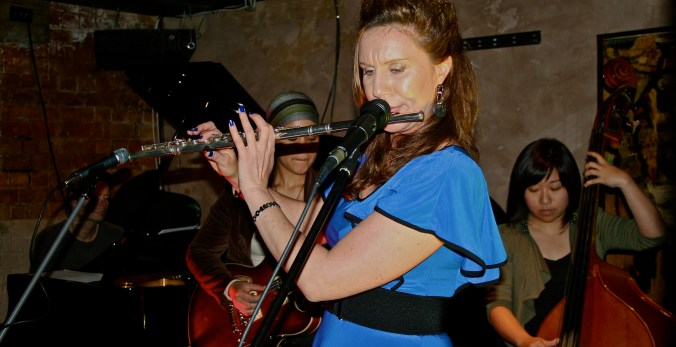
This was an amazing night of music and to those who missed it – shame on you. If you have a domestic air ticket lying about or are living in the lower North Island or South Island you can still catch the act (see previous post). Carolina is quite something on her ‘Mother Tongue’ recording but to see her perform live is to experience much more. She is a singer who should be experienced live because she is also a stellar performer. The intricate sinuous hand gestures as she sings, create an added texture to an already rich and evocative music.

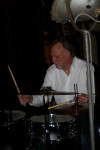
This band is first class and what they brought to the music was simply wonderful. Having two of Auckland’s best drummer/percussionists in the one band did not hurt at all. They were similar in style to Manu Katche and Nano Vasconcelos who have often performed together in such Jazz/World music. It was the second time that I had caught Chris O’Connor at a gig and I can see why he is so in demand – especially for intricate drum work like this. Ron Samsom’s skill on the drum kit was already very familiar to me and it was fascinating to watch these two percussion masters swap roles throughout the performance.

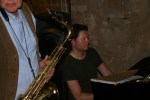
Roger Manins did not play his usual tenor saxophone but showed his chops on the bass clarinet (Eric Dolphy and others used this axe to great effect). The deeper and woodier sounds were entirely appropriate for this ancient music and Roger still managed to stretch out convincingly. He also played the more traditional clarinet and the flute.

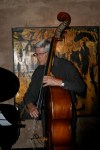
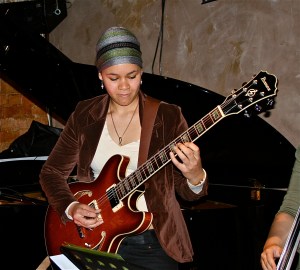
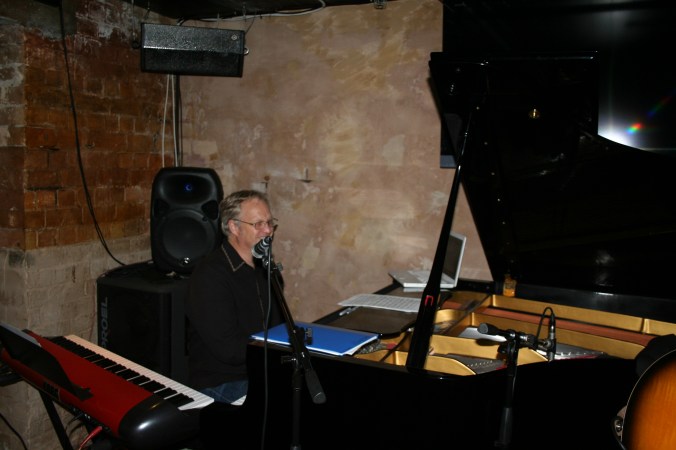
Nigel Gavin used a resonator guitar and a manouche guitar, and he stunned with his combination of lightening speed and middle eastern modal riffs. Although his guitars were amplified and had the usual array of pedals, his contributions were so well placed and appropriate to the music that it was hard to imagine the pieces without him. Kevin Field (piano), Matthias Erdrich (bass) and Jessica Hindin (violin) performed their parts with ease and this underscores their musicianship as none can have been that familiar with such diverse musical genres.

Apart from the Sephardic music we heard songs in Hebrew, English and Gaelic. There was also a standard, ‘Black is the colour’. This old english ballad was so beautifully executed that the audience seemed to hold their breath at each phrase. No one wanted to miss a single note.

I have long wondered why Jan Garbarek‘s compositions and arrangements are not used more by Jazz musicians and on Wednesday I had that view reinforced. A version of Garbarek’s arrangement of the traditional Nordic piece ‘Gula Gula‘ from ‘I took up the Runes‘ was played. It was the best version you could ever hope to hear and Carolina who is a gifted linguist had learned the Gaelic pronunciation of the song. During this piece the band stretched out and went crazy. It was one of those moments when you hoped that the music would never stop. If I have one plea it would be; perform more Garbarek compositions and arrangements please – perhaps with a bowed electric bass Eberhard Weber style.

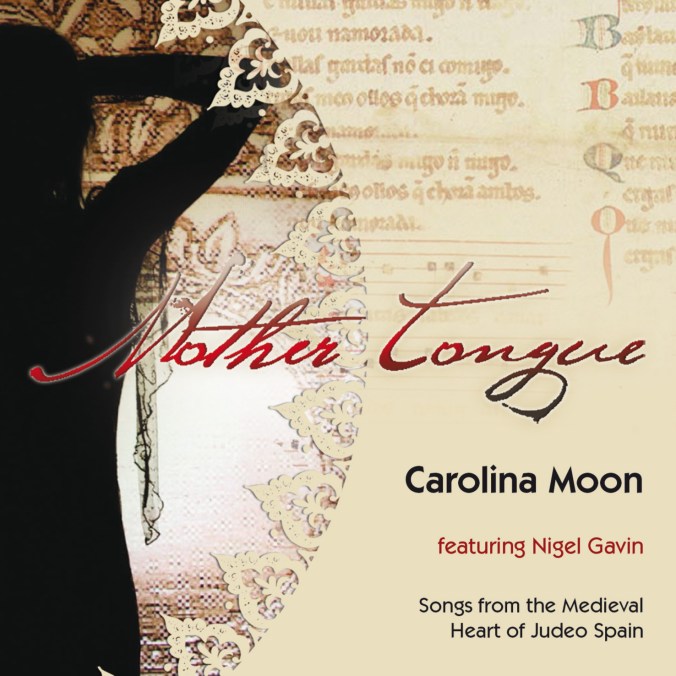
‘Mother Tongue’ – Carolina Moon (the Sephardic music of medieval Spain)

Carolina’s wonderful album ‘Mother Tongue’ is beguiling and all it takes is a single listen, for the mysterious beauty of this ancient music to stay with you forever.   This album speaks of medieval Spanish Sephardic culture with absolute authority and in partaking of the journey we are connected to a time and place most New Zealanders know little about.

The Moors ruled much of Southern Spain (Al Andalus) for nearly 700 years and what is little known is that they welcomed the Jewish diaspora to live among them.     This tolerance by Islamic Spain lasted until the Reconquista by the Catholic Christian armies of the north and after their arrival (15th century), the Judeo-Spanish faced the ultimatum of expulsion, conversion or death.  The songs of the Sepahardic Jewish are rich in imagery and the cadences of their unique language are evident in these sensual and often wistful songs.     Contained in this music are the rhythms of Arab, Hebrew and Spanish life.    A truelly blended music that has been deeply enriched by the streams that have fed it.    Ladino (Latin) is the term for this ancient language, which has also helped form the distinct Catalan variant of Spanish.

Carolina Moon (Mannins) is a fine Jazz singer but she is also a multi-lingual singer and well versed in other musical genres.  She is British by birth but has worked extensively as a musician and music teacher in the UK, Australia and for some time now New Zealand.   This is our gain.   The excellent arrangements on ‘Mother Tongue’ are Carolina’s and it is this factor, coupled with her unmistakably rich voice,  that gives the album that extra depth and authenticity.  It is obvious that she has invested everything in these performances.   This has never been just another gig for her

I would like to make mention of several songs that are on the album.  The first is the wonderful ‘Ondas’ (13th century Spanish).  The word in Spanish means wave or ripple and she could not have chosen a better track to open with.  The timbre of her voice is rich and filled with the passion and longing of the song.   At certain points the emotion is so visceral that it sends a shiver down the spine.     I have not reacted to a voice in that way since I last heard Sassy on ‘tenderly’.  The second and contrasting song is ‘Tres Hermanicas’ (track 8).    This is a traditional Sephardic song and the full band is used to very good effect.    Because of the arrangement and the rhythm it sounds closer to the Manouche traditions.

The accompanying musicians are all top rated and many are the cream of the Jazz world.   New Zealand’s finest acoustic guitarist Nigel Gavin is the only choice for this music, as his Manouche credentials and guitar chops are impeccable.    Kevin Field is on piano and once again he has managed to be the perfect accompanist. Caroline’s husband Roger Manins weaves his usual magic and his abilities as a multi reedist are manifest here.   Ron Samsom and Chris O’Connor (percussion and drums), Jessica Hindin (violin), Matthias Erdrich, Mostyn Cole, Steve Haines (acoustic bass).

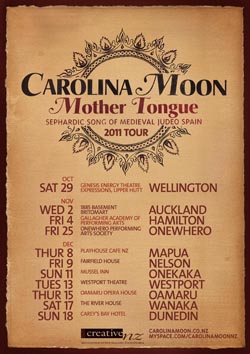
Every music lover should purchase a copy of this, which is produced and mixed by Steve Garden for Ode records (with the assistance of Creative NZ).    To learn more about this gifted artist go to;  http://www.moonmusik.com – better yet come and hear her perform live during the tour – underway at present.   The next performance is at the CJC (Basement of 1885 Galway St) Wednesday 2nd November.

Footnote: The first merger of western music and African Music was always thought to be Jazz, but musico- ethnologists are now pointing to Moorish Spain (over a 1000 years before), as the first time this occurred.    The improvising traditions are deep streams within all good music.

‘Melancholy Babes’ + Eric Boeren – out cats@CJC

Any club that was attempting to present a wide spectrum of Jazz styles would commit a sin of omission if they failed to include some of the more experimental Jazz on offer.    The CJC management have open ears and so on Wednesday they offered up the well-respected Wellington based new-jazz ensemble the ‘Melancholy Babes’ (plus guests).  The Melancholy Babes are: Jeff Henderson (alto sax), Anthony Donaldson (drums), Tom Callwood (bass) – [replaced by Gerard Crewdson (tuba)]. – special guest Eric Boerens (trumpet), John Bell (vibraphone).

The ‘Melancholy Babes’ appeared with guest trumpeter Eric Boeren of Amsterdam, who has long been touring the world and setting audiences on fire with his free ranging improvisation.    Eric has a long history in avant-garde music having played with titans like ‘Malachi Favors and  Roscoe Mitchel (of Art Ensemble of Chicago & AACM fame).   The usual Bass player (Tom Callwood) had been replaced for this gig by Gerard Crewdson on Tuba and a vibraphone was added for the last number (which occupied the entire second set). In Auckland we seldom get the chance to hear such groups, as Wellington is the New Zealand home of the experimental music scene.

In experimental music you are seldom going to get a gentle melodic swinging introduction to a tune and this is perhaps the point of the music.    It will find its own rhythms and develop an organic logic as the pieces progress.   The band opened with an explosion of sound and the force of it was initially startling.  The quick runs on the horns rose and fell, often ascending into squalls of sound or multi-phonic effects.  The insistent propulsive drum beats and the steady pulse of the tuba sent them even further out.     While the music was often wild, it took the sometimes incredulous audience along with it and as the journey progressed we felt ourselves to be part of what was unfolding.

At times the band would mysteriously coalesce into a gentler incarnation of its wilder self and in this reflective space, miniatures or tiny motifs would be crafted.  Perfect creations that stood apart, but somehow augmented the whole.  I was surprised at just how drawn into the process I had become and others felt the same.    We were hearing hints of something vaguely recognisable and intriguing, but for a number or two, just what, remained elusive .    Then it hit me; this felt like the history of Jazz and improvised music unfolding.    Rambunctious would be Buddy Bolden‘s swaggering up an ancient New Orleans street as the crowd egged them on.   1930’s Harlem bands, Hoe-downs & Jigs, raggedy defiant funeral marches.   They were all in the mix and our collective Jazz memory was being teased and refreshed.     I was not alone in arriving at this realisation as my friends Jason and Catherine and Sarah heard similar echoes arising from the music.

Having the Tuba was inspired as it gave the music a depth and a foothold in history that it would otherwise have lacked.   The Tuba nearly always took up the bass line in early Jazz as the bass would not have been heard above the brass dominant bands.   It was not until the advent of better recording techniques and amplification that double bass replaced it.   Tuba player Gerard Crewdson has solid credentials on the experimental scene and he understood exactly what was required.   There was also an element of word Jazz when Gerard intoned the story of the Melancholy Babe, while turning the pages of what looked like a very large comic book.  Like the music this was anarchic and humorous.  Many sacred cows were savaged on this night and if any cobwebs had been hiding in corners of the club they would have been blown away by the night’s performance.

Both Anthony and Jeff are well-known on the experimental music scene and I will hunt them out in Wellington one day soon.    Afterwards I talked to the band for some time and I was surprised to learn just how active the experimental Jazz scene is.   Anthony and I talked about Annette Peacock, the Black Saint label, Hat Art, the Art Ensemble of Chicago and Free Jazz music in general.    This sub-genre is certainly very well-respected around Europe, but in the USA it has a stronger following in some cities than in others.    Wellington it appears is solidly in the mix.

The night was fun and it was challenging.   I am glad I went. 

Brian Smith Band & Hard Bop heaven

Brian Smith - CJC gig

To list all of the famous artists that Brian Smith has accompanied in the Jazz/Soul/Pop world would make this a very long post. To name a few (Soul) Gladys Knight & the Pips, Dusty Springfield, (Jazz) Jon Hendricks, Annie Ross, Nat Adderly, Mark Murphy. Brian was also a founder member of ‘Nucleus’ with Ian Carr. He was for many years one of our most successful Jazz/Soul exports but in 1980 he returned to New Zealand. His ‘Moonlight Sax’ (1990) went platinum, was the album of the year and sold over 40,000 copies which is astounding for a Kiwi Album.

Last night this Jazz icon played at the CJC and with him were a number of well-known New Zealand Jazz musicians. The band was; Brian Smith (tenor sax, soprano sax), Kevin Field (piano), Kevin Haines (double bass), Frank Gibson Jnr (drums). They started with one of Brian’s own compositions titled ‘Blues for Teo‘ and the band got down to serious business immediately. They are a hard swinging unit and as they unpicked the tunes they wove a collective magic.

Brian was a commanding presence in the mix (which was hardly surprising) but his band-mates could not be faulted either for their ability to shine beside him. It struck me (and not for the first time) just how strong a presence Kevin Haines is. He and Frank were obviously on comfortable ground and they pushed boundaries because they could, and because they found new and interesting things to say. I have seldom heard Frank play better. Kevin Field is a very popular and talented local pianist and to have him in any band is simply to have the best. His crisp chord work and soaring solos are never less than perfect.

Jazz Musicians are often natural comedians and Brian is no exception. When introducing the second tune he said, “the band will practice for four bars and by then we should have a hang of it”. The tune was a George Chisholm original and in spite of the intro we heard no missteps. The tune ‘Seriously flawed (floored?)‘ was the first of a number of new charts by George Chisholm. These were great vehicles for the band and when they played the lovely Chisholm ballad ‘One for Martin‘ they struck the mother-lode. This piece was penned in remembrance of the much-loved Kiwi Jazz guitarist Martin Winch who died in May of this year. It was suggested to me recently that we only have the sudden influx of very promising Jazz guitarists around Auckland because of Martin’s influence and example.

This and other Chisholm tunes deserve to be played often (plea to local musicians). * George is a well-known trumpeter from the local scene having recorded in his own right and as a sideman with locals like Phil Broadhurst.

We heard fresh versions of standards like ‘My Funny Valentine‘ and best of all a few Wayne Shorter tunes. The darkly brooding and deep Shorter compositions are favourites of mine and any group who attempts them and executes them well has my appreciation. The groups rendition of ‘Black Nile‘. ‘Lester Leaves Town‘ and ‘Speak no Evil‘ were well done and as these are difficult tunes to get inside of, they must be commended.

Trudy Lile Quintet – CJC

Trudy Lile Quartet @ CJC

Trudy Lile is well-known around the New Zealand music scene as her multi genre flute playing skills take her into a number of diverse musical worlds.

On Wednesday she brought her new Jazz Quintet to the CJC . The lineup was: Trudy Lile (flute, vocals, leader), Kevin Field (piano), Andrea Groenewald (guitar, vocals), Jo Shum (bass) and Steve Harvey (drums). Many will already be familiar with her Latin/Jazz ‘Mojave’ Quartet. The only carry over from Mojave’s line up is the brilliant Auckland pianist Kevin Field. On the ‘Mojave’ ‘Well Dressed Standards‘ CD Trudy sings in addition to her flute work and her voice is well suited to the material she has chosen. Not surprisingly her flute work and singing are slightly more restrained on CD; but when she is playing in a Jazz club there is no hold back.

At the CJC Trudy’s band loosened up as Jazz audiences are used to a freer and more improvisational approach. As the evening progressed we were treated to snatches of overblown flute (often with vocal effects in the style of Sam Most or Rashaan Roland Kirk). The range of flute sounds evoked could shift from smooth-as-silk melodic lower register offerings to peppery high-end declamations that fired up the band. It was obvious that she liked the material she was presenting and that enthusiasm communicated well to the audience.

Unlike Trudy’s recent album (which is all standards), the set list on this night was mainly originals; mixed in with tunes like Herbie Hancock’s ‘Butterfly‘ and ‘Precious‘ by Esperanza Spalding. On those two numbers and others she and Andrea sang in duet and the contrast between their voices gave added colour. The material was beautifully executed and the band worked extremely well together.

Having pianist Kevin Field in a band is always a good thing and especially so where there is a singer to be accompanied. Kevin is not only a trio leader and innovator but he has that rare skill of being the perfect accompanist. Like Laurence Hobgood or Oscar Peterson he can place just the right notes and chords behind a singer while keeping out-of-the-way until his solo. I always enjoy seeing Andrea Groenewald perform and she sung and played well on this night. Her own tune ‘Paint the Sky‘ turned into a tour de force for the band and her guitar solo was a knock out. I have seen this performed a number of times and it keeps getting better, with Trudy’s flute adding new and interesting dimensions. Jo Shum was obviously enjoying herself as well and she and drummer Steve Harvey took some nice solos. Jo Shum (bass) was especially good on ‘Precious‘ (Esperanza Spalding) and the drum work on ‘Beverly ‘(Lile) impressed.

The flute is a relative late comer to Jazz – probably entering the music’s mainstream via its contacts with Latin American music. Frank Wess was one of the earlier practitioners of Jazz flute but names like Buddy Collette, Bud Shank, Sam Most, Rashaan Roland Kirk, Jerome Richardson, Eric Dolphy, James Spaulding and Charles Lloyd have established it firmly in the mainstream. While many of the above were flute specialists they were mostly saxophone players doubling on flute. Many modern practitioners do not double on reeds as the flute is their main axe.

This was a night when the gender diversity and musical diversity of the Auckland Jazz scene was manifest. The Auckland Jazz scene is growing rapidly and as it grows it brings with it maturity that comes from having real choice.

Andrea soloing@CJC - Trudy Lile band

Fig by Trudy Lile

Alan Brown-‘Between the Spaces’ – CJC

Alan Brown at Keyboards - CJC

If this was a law court I would have to recuse myself immediately because I have a heavy bias in favour of anything Alan Brown does musically. Having said that it was hard to imagine how this very different lineup would sound, because the ‘Blue Train‘ magic has long been etched into my brain as the archetypal groove unit.

Alan is a superb keyboardist and band leader but above all he is a brilliant arranger and composer. It is the latter skills that have especially come to the fore with this band and the title track ‘Between the Spaces‘ gives more than a hint of the musical direction. ‘Blue Train‘- has always been a tightly focused hard-driving Jazz funk band and one which makes your feet tap uncontrollably. This band builds on that vibe but with new soundscapes opening up, endless possibilities are there to be tapped. Alan’s already impeccable writing skills have been surpassed here, because these charts are everything that an improvising band could hope for. It is ECM meets Funk and surprisingly it works perfectly. In my view Ode Records should talk to ECM’s Manfred Eicher about this group, as everyone would gain by the exchange.

As this was the launch of the ‘Between the Spaces‘ album I had been determined to get to the club early because I knew that seats would be hard to find. I was right because the club filled to capacity before the band had played a note. As with previous Alan Brown gigs the ages of those attending ranged from 18 to 60 plus.

The opening number ‘Sounding Out‘ was a foretaste of the great music that we were to hear throughout the two hours. Over the course of the evening we heard all of the tracks on the album in extended form plus two additional numbers that had not made the final cut. I was fascinated by the textures, rhythms and the colour tones that the new lineup was evoking. As each number unfolded, tight insistent bass lines were being laid down by Marika Hodgson while Alan would often set up a vamp; his left hand authoritatively setting the tone and rhythmic feel. He has an uncanny knack for capturing the essence of a tune while leaving adequate space for the others to build upon it. His deep in the pocket funky chords worked perfectly against his darting upper register flurries.

A treat for me was guitarist Andy Smith. He used quite a few pedals and his tone was midpoint between the Jazz and Rock spectrum. This is a territory well mapped out in modern Jazz guitar and Andy executed the twists and turns without overdoing it. He reminded me of Terje Rypdal at times but his obvious virtuosic abilities were kept tastefully in check and he is to be commended for that. I was especially pleased by his occasional use of the ‘chika-woka’ wah-wah effect when comping against multi layered grooves. Jono Sawyer (d) is already well-known about town and his musicality and his ability to support the band on a cushion of insistent beats rounded off a perfect unit. This group understood very well that great music demands some space between the notes.

As good as this band was, it was the inclusion of the guest musicians that lifted them to perfection. Their addition to the sound pallet showcased the shear brilliance of Alan’s concept and the pieces on which the three-piece string section and well-known saxophonist and flutist Nathan Haines played, lifted the performance into the realm of the sublime.

I have two favourite tracks on the album: The first is the angular, and wonderfully funky “The Dancer & Chess”. This number has complex time signatures but it is so well constructed that an implied centre imparts a level of simplicity that belies the more complex polyrhythms whirling around the changes. This is performed by the core quartet and the counterpoint between band members works well.

The second highly recommended piece is ‘Epilogue’ which features Nathan Haines extraordinary flute work. He weaves in and out of the tunes with such skill, beauty and dexterity that I was left open-mouthed. As if this were not riches enough, the swell of the violins and cello added a perfect layer into the mix. The slightly tart voicings of the strings showed Alan to be a master of composition. He had understood perfectly what was needed and ensured that any hint of sirup was eradicated by using just enough discord. Thomas Botting also featured in two numbers and he fitted seamlessly into the mix. Having an upright bass did not detract in any way from the well established vibe.

Immediately after descending the stairs I had purchased the first copy of ‘Between the Spaces’ put out for sale and it has not been off my Hi Fi since getting it home. If you have any love of Jazz Funk buy this CD and if you don’t buy it anyway because someone you know will be happy to appropriate it.

The core band is: Alan Brown (piano, Keyboards, arr, comp). Andy Smith (electric guitar), Marika Hodgson (electric 5 string bass), Jono Sawyer (drums) – string section; Stella Kim (violin) Annika Balzat (violin) Sally Kim (cello). Guest appearances; Thomas Botting (bass), Nathan Haines (soprano saxophone , flute).

Susan Gai Dowling – CJC

Thelonious Monk, Minton's Playhouse, New York,...

Image via Wikipedia

Wednesdays offering at the CJC was Australian based Jazz singer Susan Gai Dowling.    Susan’s sidemen were Kiwi Jazz veterans Mike Walker (p), Pete McGregor (b), and Frank Gibson Jnr (d).   After hearing her sing I could understand why she was in demand on the Sydney scene after so many decades.    Her voice is warm and slightly smokey and above all it is a real Jazz voice.   At her command were all of those tricks of articulation that tend to separate Jazz singers out from the straight-ahead variety.    To underscore her Jazz credentials she announced that she would mainly sing ‘Monk’ tunes.  To up the anti even further there was also an extremely difficult Brubeck number thrown in, ‘Raggy Waltz’ ; in addition we heard ‘Very Early‘ (Bill Evans), Lady Bird, (Tad Dameron) and ‘Girl Talk‘ (Bobby Troupe).

Thelonious Monk was a genius of composition, but singing his tunes is arguably a risky business with all of those spiky  rhythms to contend with.  Others have put words to Monk and Carmen McRae was the standout in my view.    McRae has set a high bar to what is already a difficult proposition, but Susan approached the task with confidence.    She opened with a standard. ‘Old Devil Moon‘ and then tackled ‘Blue Monk‘.     As she progressed through the eight Monk tunes it was obvious that she was more than up to the task.     Like McRae her intonation and her ability to deal with the complexity of the tunes was impressive.  Mike Walker dealt with the angular percussive accents in the way that an accompanist should.  Not over-bearing and leaving enough room for the singer to tell her story.   The rest of the band got right in behind the singer and they deserve credit for their flawless performance because they had not been able to rehearse because of the tight timeframe.

Next was the lovely melody ‘Ask Me Now’.  It was a real treat and it enhanced the singers credentials as she captured the raw beauty and emotion of the tune.   The other Monk tunes were ‘Well You Needn’t‘, ‘Ugly Beauty‘, ‘In Walked Bud‘, ‘Ruby My Dear‘, ‘Monks Dream‘, & ‘Round Midnight‘.   ‘Ruby My Dear’ was lovingly executed and this iconic tune along with her rendition of the Evans classic ‘Very Early‘ were highlights.

Susan Gai Dowling and Mike Walker were off this week to play a gig in New York’s ‘Birdland’ club.

Phil Broadhurst Quartet – CJC ‘Delayed Reaction’ launch

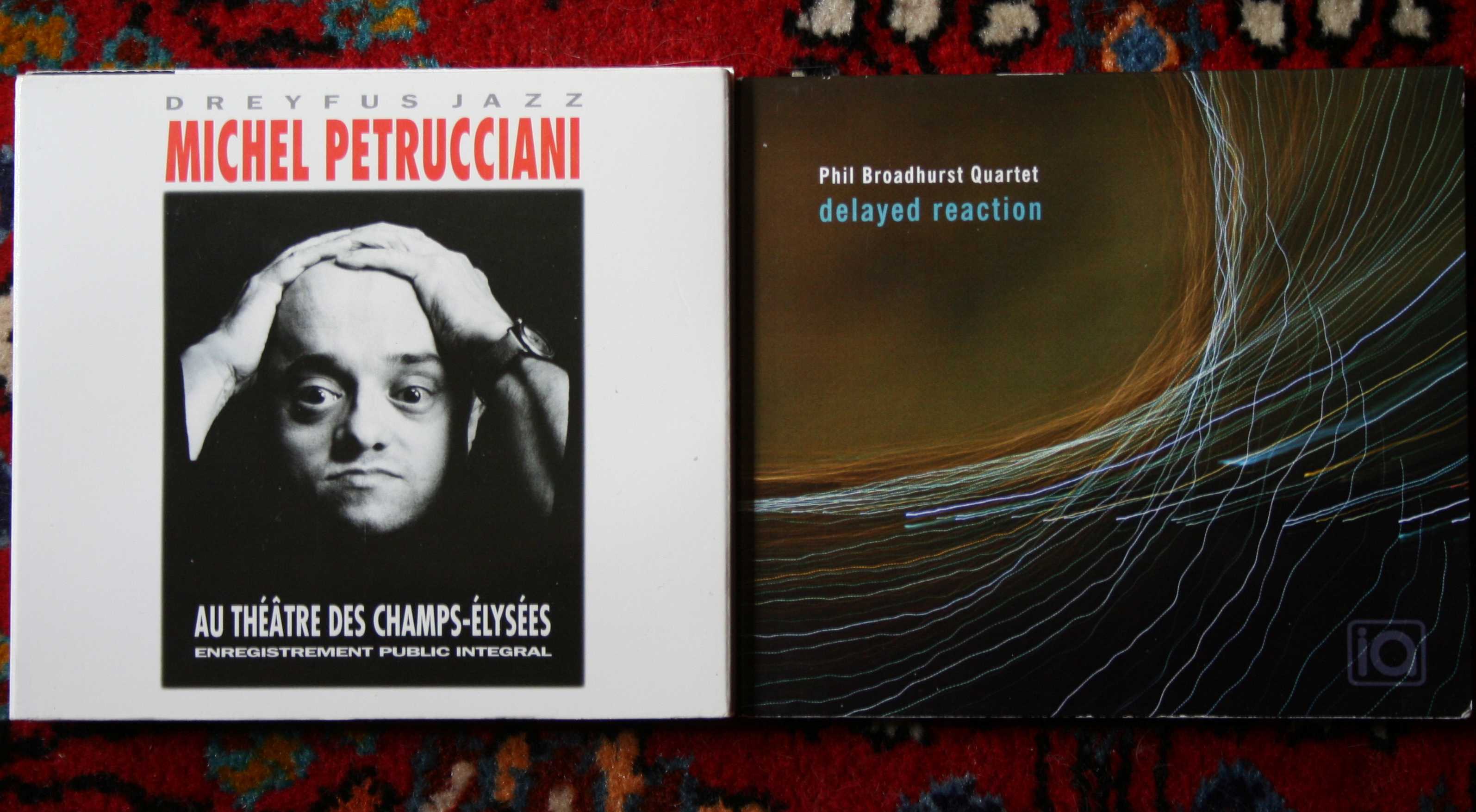
This was a special night because the band was simply superb and it was a special night because the music paid tribute to Michel Petrucciani.   Phil Broadhurst the leader of the quartet needs no introduction to New Zealand musicians as he has been the familiar face of Auckland Jazz forever. Whether playing as resident pianist in the London Bar ,accompanying visiting musicians or performing his role as senior tutor at the Massey University School of Jazz, Phil has been at the epicentre of the New Zealand Jazz scene.   He is a gifted artist and a prime enabler.

Wednesday was the official launch of the ‘Delayed Reaction’ CD which marked a milestone in what has been a long and interesting journey.   Not only for Phil, but also for those of us devoted to the music of Michel Petrucciani and who now get to share in the journey.   Phil has probably studied Petrucciani’s body of work more extensively than any other and this music is the evidence.

The quartet is: Phil Broadhurst (piano, leader, arr), Roger Manins (tenor sax), Olivier Holland (bass),  Alain Koetsier (drums).  – *guest Mike Booth (flugal horn)

The first set opened with ‘Brazilian like‘, a well-known Petrucciani composition.   This medium tempo number paid tribute to the original but Phil and Roger gave it a slightly more bluesy feel which added interesting dimensions to the tune.   When I listened to that particular track on the album, I realised that Phil had achieved a rare thing.   The voicing and percussive attack were unmistakably Petrucciani, but in managing to add some of the feel and spaciousness of the New Zealand musical landscape he made ‘Brazilian Like‘ ours as well.

Next was the title tune ‘Delayed Reaction'(Broadhurst).  The number built-in intensity without losing any of its beauty and the quartet were obviously focused on treating this original with the same respect as the Petrucciani compositions.   Throughout the two sets there was a perfect juxtaposition between Petrucciani compositions and Broadhurst originals.  Phil had reworked many of the Petrucciani tunes and the result was to create a very satisfying melange.    Other Petrucciani tunes played were; ‘Guadeloupe‘, and the wonderful ‘Looking up‘ – a tune brim full of exuberance and always conjuring up Michel Petrucciani’s infectious good humour which he maintained against all odds.  He would have liked what this band offered up.

Of the Broadhurst originals I particularly liked ‘Oranje‘ (so titled because it was the birthplace of M.P.) and the lovely trio piece titled ‘Matai Bay‘.   During this last evocative number the considerable skills of Olivier Holland (b) and  Alain Koetsier (d) were particularly in evidence.   On the rest of the numbers Roger Manins (ts) shone with his story-telling bluesy intensity.   His performances are consistent in this regard and it is my observation that any group he plays in, is lifted up a notch.

We also heard a few standards and the rendition of ‘You Walked Out of a Dream‘ was fabulous.  Phil increasingly threw challenges at the others and they responded in ways that had us on the edge of our seats.  Roger soon exploded into his solo and the exultant soulful wailing as he seemed to depart from the upper register, had everyone spellbound.   Mike Booths (fh) contribution was on ‘If I Should Lose you‘ and this was also well executed.

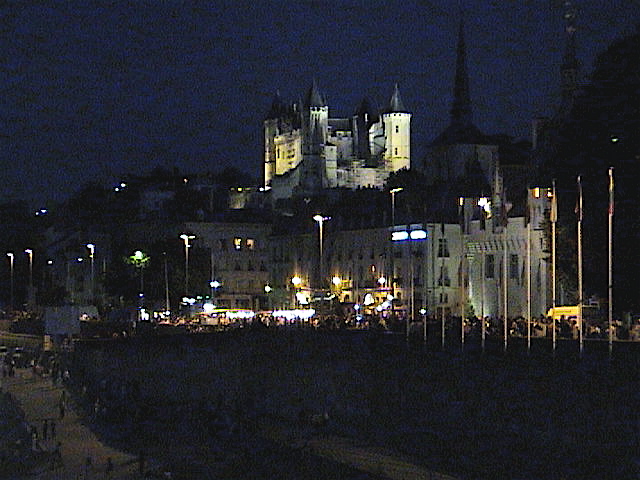
A few years ago my partner Darien and I were traveling through the ‘Loire Valley’ France and I spotted a road sign indicating that we were close to ‘Blois’ a town famous for its castles, château and its Houdini association.   It was not those things that drew me to stay there but its association with Michel Petrucciani.     He wrote a wonderful suite about the place; one section was titled ‘Night Sun in Blois‘.   Sitting on the ramparts of that ancient and stunningly beautiful city at dusk I could hear that piano piece echoing in my head as the sun filtered through the now dark mass of the surrounding  forest.    The Loire river was a shinning golden reflection way below us and I wondered if Petrucciani had sat on this very spot when he was inspired to write that tune.

That powerful memory had faded with time but it was sharply brought back to me as I listened to this tribute and I thank the quartet for that.

The album ‘Delayed Reaction’ is on ‘Independent Artists’, a New Zealand label associated with ‘Rattle’ records.

Chateau by night near Blois

Tricolour's above Blois

Trio White – CJC

Trio White @ CJC gig

I am a big fan of Jazz guitar and so I need no arm twisting to get me along to a Jazz Guitar gig.   Last Wednesday the CJC featured a local guitar trio (+ piano in second half).    I was not previously aware of ‘Trio White’ and so I was intrigued.    I soon learnt that this band knew exactly what they were about as they launched into the first set with fiery determination.

Trio White is composed of; Ben White (guitar), Joanne Shum (bass), Steve Harvie (drums)

From an overheard conversation I learned that they had been keen to play at the CJC for a while and were hungry to play in front of more Jazz audiences.   They have been together for a while and according to their promotional material formed in order to explore the most contemporary sounds of Jazz.

On Wednesday the group performed their own material,  but they do mention Kurt Rosenwinkel as an influence and I am not surprised.

While they treated us to some slower and more melodic numbers, the main thrust of their music was intense hard-driving; blowing jazz.  Their was no mistaking that Ben White was the leader and he worked the band hard as he executed his rapid fire runs up and down the neck of the guitar.   He also demonstrated some skillful chord work and comped when the bass took a solo, but the thrust of this hard-driving music came from the intense lines he tossed out.

It was hard to catch the song titles as the band did not pay terribly much attention to introducing tunes.   They began by launching straight into the music and only brief announcements followed; almost as an aside.    They were primed to play and that was all that mattered.

For the second set they were joined by Dr Stephen Small on piano and as you would expect a slightly more reflective vibe took over.   Having a piano added to a guitar trio changes the dynamic and the musicians have to be more aware of creating room for each other.   It can also free up a guitarist, as chords are less of an issue to be factored into the mix.

One number I did catch the title of was the ironically named ‘Untitled Tune‘.   For me it was the best number of the evening.    I loved it from start to finish – thoroughly enjoyable music.   The band communicated as a unit and were more aware of each other; responding in the best possible way to the challenges being laid down.

Following that was a slow burning groove number with a walking bass line that drove the tune relentlessly.   Joanne Shum held the centre and for this one track she and drummer Steve Harvie ruled the roost.    Dr Stephen Smalls piano was excellent as well and he did exactly what was expected of a pianist joining a piano trio.

In last weeks blog I speculated that this might well be the golden era of Auckland Jazz.   If that is the case then it is down to this CJC Jazz club and the dedication of Caroline, Roger, Ben and the others who work at this so tirelessly.     Keep them coming please, the magic is apparently endless.

Steve Barry Trio – CJC – The Golden Era of Kiwi Jazz?

Steve Barry

A jazz friend said to me after the Steve Barry gig, “perhaps this is the golden era of New Zealand Jazz”?   That stopped me in my tracks because I had posed the same question to another friend three weeks earlier – same words – same sentiment behind it.      We were shaking our heads in wonder at what we had just heard – seriously good Jazz at the CJC led by pianist Steve Barry and accompanied  by Alex Boneham (b) and Tim Firth (d).   Once again a Kiwi born artist was dazzling us with incredible music and it arguably matched the fare of a good New York venue.

These days Steve Barry is a fixture on the Sydney Jazz scene but his fame has spread beyond Antipodean shores.    That he is especially well known and greatly respected by musicians is hardly surprising as his chops are exceptional.   This is probably Jazz for grown ups as it tends toward the cerebral.   To those immersed in this music, treats like this are to be savoured and surprisingly they have come our way fairly frequently this year.

The first number opened with a complex interplay of polyrhythms – like a screw being tightened by degrees as the tension slowly built.   As the band coalesced,the momentum shifted and the air was filled with textured sheets of sound being skillfully laid down one atop the other.   The second track ‘Ambulation’ took a route that Brad Mehldau or Keith Jarrett might have taken – utterly modern in its approach.    This was a band that surprised again and again and for those paying attention to what was unfolding, there was a big pay-off.    Next we were treated to a few Jazz standards; the first of which was George Shearing’s ‘Conception‘.   After that the band moved to a slower paced offering as they executed one of the nicest versions of ‘I’ve grown accustomed to her Face‘ (Lerner & Loewe) that I have ever heard.   Gentle and exquisitely voiced piano, perfect brush work on the drums and a bass solo that worked perfectly.  The piece closed with a lovely arco bass and mallets and it was not hard to see why this juxtaposition of complex songs with gentle standards was pleasing to the audience.

What an adventurous pianist like this needs is risk taking partners and he had certainly chosen well with Alex Boneham and Tim Firth.   Boneham’s abilities were amply matched by Firth, who could move from colourist to hard-driving power-house with ease.  Some of his work on the snare left us genuinely astonished.

Although it hardly seemed possible the second set was pitched at a greater intensity than the first.     Those sitting near me were watching intently as each move by the musicians revealed new wonders.    The last number ‘706 Blues’ was riotous and fun, but as with the earlier numbers it was music with a twist.

This is indeed a golden era of Kiwi Jazz.

To listen go to:http://www.stevebarrymusic.com/live/

‘Blue Train’ – New Zealand’s funk warriors

‘Blue Train’ have been around for about twenty years and most Auckland Jazz lovers will be very familiar with them.   On Wednesday night they returned to the CJC by popular demand and as anticipated the club filled up quickly with an expectant crowd.    This band is everything you could hope for if you are looking for a get-down & dirty – groove Jazz funk outfit.    Not only did they play well, but they hardly needed a glance at their charts.    They had a world of tunes already in their heads and they locked into each others wave-length so quickly that a collective brain appeared to possess them when they played.   Not all of the band members had been with them from the beginning but the band still meshed into a tight working unit and from the first number the crowd knew that their expectations would be more than met.

They opened with an Alan Brown number ‘Lets Dress Up‘ and it hit a real sweet-spot – deep groove heaven fed by a Fender Rhodes sound, funk guitar, electric bass, tenor sax and drums.  This sound put a ten-mile wide smile on our faces and if anyone had wanted dark and tortuous they’d have had to look elsewhere.    This jazz is about kinetic energy and a mesmerizing groove, which makes listeners feel that they could dive right into the music and swim in the ocean of sound.   The club was alive with happy people giving cries of encouragement.      After a while some in the crowd started dancing and before long the majority were either dancing, swaying or tapping the beat out on their chair arms.  In the second set the flailing hands of a man flickered across my sight line creating a strobe effect in the soft club lighting.   I just love it that Jazz like this absolutely compels people to dance.

Alan Brown was clearly in charge of the unit and he would give an occasional glance to the soloists who needed no extra cues than that.     Andy played a few tracks on the club piano but would often switch to a small red electric keyboard mounted beside him: the latter holding a good bank of funk orientated sounds.   He would sometimes play both instruments at the same time.     With special guest Dixon Nacey on guitar this band was always going to hit the Jazz funk stratosphere, because this man is a monster on his red guitar and he can do the seemingly impossible without needing to think about the curve balls being thrown at him by Alan.

Steve Sherriff (soprano sax/ tenor sax) and Jason Orme (drums) are veterans of the group, but newer member Chip Mathews on bass did more than hold up his end. Chip is a skilled bassist and able to jump into any band I suspect.

Steve Sherriff is well-known about town and he can be seen working in a number of  Jazz styles.    While his tenor playing is always great, his soprano saxophone playing is free ranging and often ecstatic.    The band regularly hit fever pitch and the energy they floated on was ably abetted by Jason Orme’s high energy drumming.     Jason appeared to be using the locked in style made famous by Byron Landham and others; where he would enter into a powerful intense groove and then push the band as hard as he possibly could.    We just loved watching him.   This is as far from colourist drumming as it gets, but it is exactly the right style for a Jazz-funk unit like this.

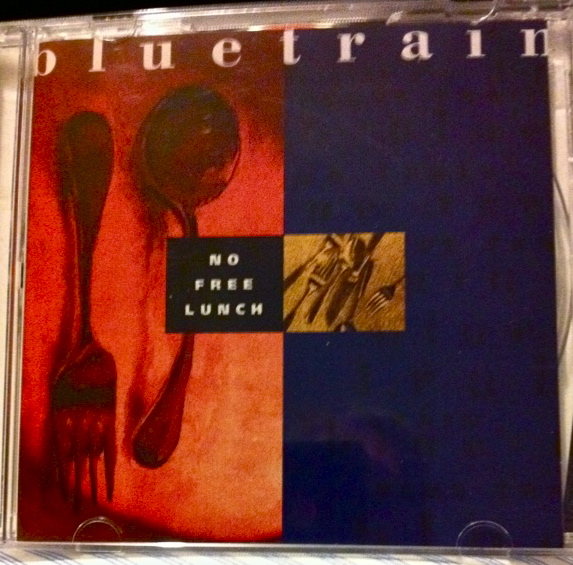
I eagerly await their new album which is due out next month.   See this band whenever you get the opportunity and purchase their CD’s.   The ‘Parachute label’s ‘Blue Train’ album ‘No Free Lunch‘ can still be found and a more recent organ trio album ‘All about time‘ is quite readily available (Alan Brown ‘Hammond’, Dixon Nacey ‘guitar’, Josh Serenson ‘drums’) – ‘Ode Records‘.

‘Blue Train’ clips are hard to find on You Tube but I did locate their version of ‘Nasty McFly” – this track was simply riotous on Wednesday  – enjoy.

When the constellations align – Mike Nock @ CJC

Experiencing a Mike Nock band playing in an intimate club setting is quite different from catching his act in a large concert hall.    In one sense it doesn’t matter, as this cat can whip up a whirlwind of energy in any space, but seeing Mike in a small intimate club is as cool as it gets.  The immediacy of being up-close to a band like this is electrifying.

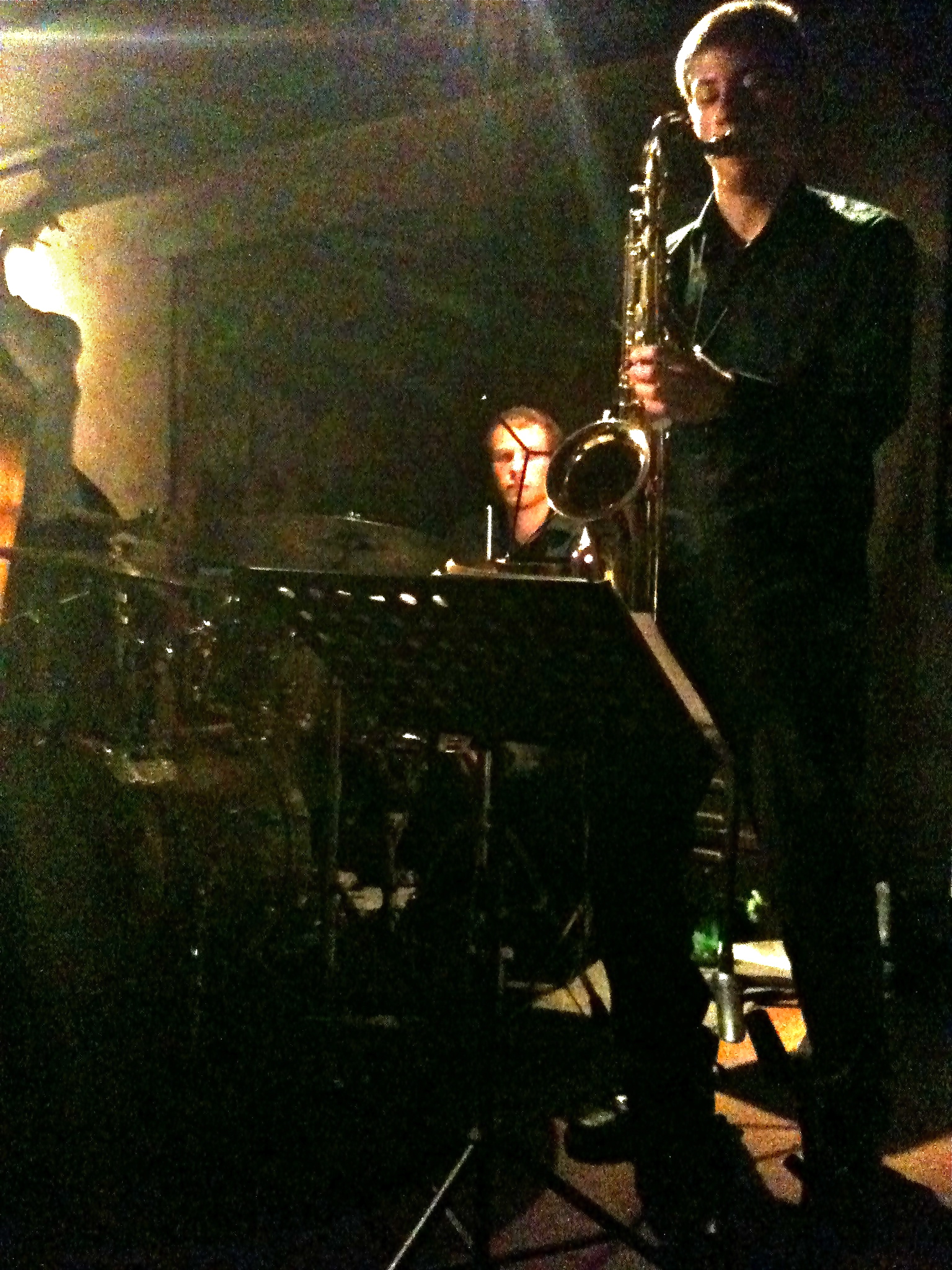
I had arrived early with a friend, but the club was already at near capacity and there were no available seats.  We were happy to stand as no one wanted to miss this night.    I leaned against the side of a leather couch crammed full of people while up front Roger adjusted his mouthpiece and Ron positioned his kit.  Then we saw Mike and Brett and the lighting was lowered.     As the band began to play it was obvious that they would not need any warming up because they were clearly as up for the gig as we were.    The opening number ‘Hop Skip & Jump’ was up-tempo and Roger just tore it up from the start.   To those who of us who love Mike Nock compositions this music was somehow familiar, but this was also the ‘sound of surprise’.

I am convinced that we could not have seen better in any New York club and in down town Auckland we soaked up the groove feeling lucky to be alive.  In the soft lighting  you could almost see the sparks of energy flying between the band members and the washes of blissful sound permeated every corner of the room.    This was seriously good shit.

Next up was ‘Komodo Dragon‘, a moody number that developed from a beguiling tune into an altogether more profound entity.  The placement of chords under Mikes hands is always a revelation as he knows how to mine an idea for deeper and infinitely subtler meanings.   His chords were sometimes bluesy, but then he would toss in an oblique voicing as if to bring about a subtle shift in the cosmos he was conjuring.   It was like watching an onion being peeled by a master chief.

I was also pleased to see Ron Samson (d) using a mix of mallets, sticks and brushes, as the sound palate that night demanded a more textural approach.   Like all good drummers he knew when to blend into the mix, as a loud overly showy drummer would have been out-of-place.  Roger Manins (ts) is simply a phenomenon and we are extremely lucky to have him resident in Auckland.   He lifted the intensity on ‘Komodo Dragon‘ to such a fever pitch that I actually stopped breathing at some points as the tension was building so much.    Roger is the master of tension and release and he can nimbly shift into double time and then some.        Brett Hirst (b) has been playing with Mike for years and it shows.   He is a terrific bass player and his solos and note placement that night were magical.     The band members were all great soloists but what is better they were able to act as a perfect ensemble.

The second number of the second set was a tune called ‘Homage’ and it began with a familiar chord progression (probably based on the changes of ‘All blues’).   Where it went next is hard to adequately describe, but this was one of the highlights of the evening for me.    Mike developed the theme quickly and as he did so he showed every ounce of his mastery on the key board.  He was tossing in fourths while his right hand darted over the keyboard.   I was immediately put in mind of the middle movement of ‘A Love Supreme‘.   The band was so deep in the groove on this number that the music reached heights beyond the sum of its parts.    To hear Roger playing with such strength and in such an ecstatic state was to be reminded of how Coltrane-like he can be.  As Roger played, Mike continued to ramp up the groove with his Tyner like chords and an overlay of chromaticism.  The band was apiece on this and it was a perfect moment – fresh ecstatic music that paid homage without actually being captured by the past it referenced.

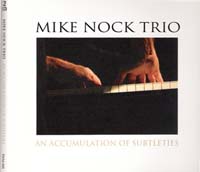
Afterwards I had the chance to speak to Mike about his music and about the scene.   Mike is an easy-going cat off the band stand and he comes across as somewhat of a Jazz philosopher.   He has also retained a very Kiwi sense of humour which delighted me.    As soon as he has made a successful album Mike seems to reach beyond that for the next idea; never one to settle back and rest on his laurels.   Already knowing the answer, I asked him if he was still restlessly reaching beyond the now for newer musical ideas, or would he relax a bit?   He told me that it was his nature to search for a deeper meaning in the music and that he could not do otherwise.  “Some younger musicians than me sound a lot older than I do as they have settled into a safe fixed in time style.  That is not where I ever want to be”.   I told him how much I enjoyed the ECM ‘Ondas‘ label and he observed wryly , ” yeah man, everyone loves it…. now.  Is it even still in print?”.   He said that Manfred Eicher often told him how much he loved that album but as was often the case, it was way ahead of its time.    We also discussed his writing on the recent ‘Meeting of the waters‘ album which is a favourite of mine.   He told me that he felt good about that album but that distribution had been a problem (when was that not the case with Jazz).   Mike has hopes of bringing his ‘Accumulation of Subtleties‘ trio here soon and I would urge fans to grab a copy of that double album.

We talked briefly about the Auckland Jazz scene of our youth and he told me how pleased he was that Caroline, Roger ,Ben and Mike were now running the CJC.    He also said that he was grooved by the young cats wearing ‘pork pie’ hats, but that when he had gone to buy one had found that his head was too small.    “Age will do that” he said.   I quickly jumped in with information from a new longitudinal study which showed that humans actually reach their greatest analytical potential between the ages of 62 and 70 years of age.    He looked at me dismayed and said, “man you could have extended the time frame by a few years.  I am past 70”.

The set list was ‘Hop Skip Jump’, Komodo Dragon’, Gospel Dog’, ‘Joy Remembered’, ‘Transitions’- 2nd set – ‘Afternoon in Paris’, ‘Homage’, ‘Speak to the Golden Child’, ‘Triflin’ Jon’.
Alex Churchill- Andrea Groenewald band – CJC

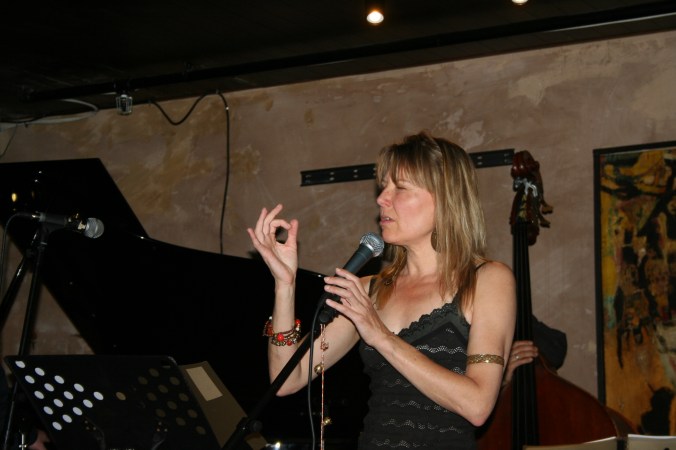
Alex Churchill (s) and Cameron Sangster (d)

Anyone running a Jazz club is unlikely to be hitting New Zealand’s ‘rich lister’ status anytime soon.    Success in the Jazz world has seldom been measured in dollars, but in a far richer currency – keeping the spirit of the music alive.     A successful club depends on maintaining good audiences, therefore dedicating a night to emerging-talent is arguably a risky proposition .    Jazz however is all about risk and it is certainly about supporting fresh talent; in this case the gamble was royally rewarded.     The Alex Churchill – Andrea Groenewald band may be youthful but when they hit their stride, age became an irrelevance.

What the audience saw were musicians of calibre and their obvious dedication to the music was evident.    While one or two of the earlier numbers were a little less focused than what was to follow, the band soon had the audience whooping delightedly at the joyous exuberant sounds they were hearing.   Everyone saw that this was to be another great night at the CJC.

They opened with a set of their own compositions and almost all of the band had contributed tunes.   I particularly liked ‘Paint the Sky‘ which I think was composed by Andrea and the bands playing on this was great.   They had warmed up and it showed in spades.   Alex has a post-Coltrane vibrato-less tenor sound but his tone is pleasing and warm when that is called for.   His nimble soloing was nicely augmented by Andrea comping behind him with clipped octave chords.  I think that the band realised early on just how much the audience were enjoying the gig and the mutual feedback loop worked exactly as it should.

The second set was dedicated to Pat Metheny’s music and I was intrigued to see how this would work.   I soon found out, because the rendition of “Have You Heard’ was pure bliss.   To hear Metheny’s music stripped of the pedal effects and dare I say occasional over-production, was pleasantly surprising.    They ripped into this number with the chops of a band that had been playing together for ever.

Andrea Groenewald (g)

Note perfect, joyfully exuberant and inspired.    Apart from the great solos on this number, what I loved most was Alex and Andrea paying the head arrangement in unison; but with Andrea’s voice adding an extra horn-line. To do this with less than perfect precision is to invite calamity but the band nailed it.

This was a great night and the band should feel extremely pleased with how it went.     I saw Roger the club manager smiling and given the numbers who attended and the enthusiasm of the audience we can hope for more emerging talent nights.    As for this band, they have stepped into the known and the emerging talent category will soon be behind them.   I would certainly go out on a cold night to see them again.

Having emerging bands of this quality in our own city bodes well for the future of Auckland Jazz.    I had seen two members of this band before (Cameron and Andrea) but the other three were unknown to me before now.

The band were; co-leaders Andrea Groenewald (g) & Alex Churchill (ts) – Renee Cosio (p), Nick Taylor (b), Cameron Sangster (d).

CJC – Ben Sinclair band – Manins/Koopman

The CJC always manages to find interesting lineups and the Ben Sinclair quartet and sextet (+2) was no exception.   This is a young band and the often ironic or whimsical song titles comprising the set material are also contemporary.    Ben is not long out of University and his chops as a fast developing Tenor player (doubling effectively on Alto) are evident.   The band opened the first set with a quartet lineup and a song titled ‘Printy‘ (dedicated to a favourite desktop printer).   The initial configuration was two Tenor Saxophones (Ben Sinclair + Jimmy Garden), Cameron McArthur (Bass) and Johnny White (Drums).    The Tenors focussed on unison playing or soloing and so there was only a slight nod towards chordal structure.   This was raw, inventive and occasionally challenging music and it underscored the tone of the numbers that followed.   By the third number the quartet had expanded to include two French-Horns and a Flugal, which enhanced the concept and added considerable texture and depth.    The groups sound was original, but during the fifth number, the second Tenor Sax player Jimmy Garden managed to toss in a brief quote from ‘Softly as a morning sunrise‘ which brought instant smiles of recognition from the audience.

The second set was headed by a three-part suite titled ‘The Bourne Trilogy‘ (referencing the movie).     For this suite the band was enhanced by the addition of Matt Steele (Piano); an often fiery and Tyner influenced soloist.   The octet was completed by Liz Stokes (Trumpet and Flugal), and the two French Horn players (one also a woman).   This trilogy showed how mature Ben’s writing is and when playing these charts the bands enjoyment of the material was obvious.   This suite worked on all levels and the nice soloing rounded out the performance.

Last but not least was ‘Snake Attack’.   The number was high energy and the band had tightened up on their delivery while allowing for free-flowing solos and a locked-together kick-ass groove.    Drummer Johnny White particularly caught my attention in this last number as he set up a tight ‘E.S.T.'(Magnus Ostrom) type beat (nicely accented by rim-shots).

The ‘Roger Manins regular jam session’ followed the CJC sets and that was the icing on the cake for me, as I got to hear the nucleus of Roger’s band for the first time.   The band set up in minutes and were soon playing their first number ‘Beatrice‘, which was profoundly beautiful and deep in-the-pocket from the first bar.    Roger (on Tenor) is a monster musical force and his band swings like a well oiled gate.   You always know when a Tenor player uses his axe as a confident extension of self; when every shade of meaning is conveyed without the musician needing to rely on an excess of notes.    He has chops to burn but more importantly he lets the music speak for itself.

For a number of months I have heard people speaking in reverential whispers about wunderkind guitarist Peter Koopman.    I just love Jazz guitar and so when I learned that he would perform as part of Roger’s band, I was pleased.  This guy is freakin amazing and to hear his rapid fire licks and intelligently constructed lines is to hear the very best that New Zealand Jazz guitar has to offer.    I would advise everyone to get down and hear this band as soon as they can as gifted musicians like Peter are likely to be sucked into the wider Jazz universe someday soon.   Matt Steele was on piano and extremely fine bass player Thomas Botting played as if his life depended on it (I have a weakness for bass played in the upper register).   This guy along with the highly energised drummer Johnny White powered the band.  Others joined the band at times including a singer (Chelsea) and a female Banjo player who tackled Mile Davis ‘Solar’ with confidence and ease.  With Peter and Roger exerting their benign influence; the less experienced musicians could not have been more supported.

I urge Jazz lovers to support this club and if the last months offerings are typical then you certainly wont be disappointed.

August gigs: Nock, Hirst, Manins & Samson

retiring at 80 yrs

For those who are easily led by their particular pied-piper there is live music to be had every week.   In the recent past Auckland live Jazz had been harder to find than other genres, but due to a happier alignment of the stars that is no longer a problem.

The big news is that Mike Nock (p) has been booked into the CJC for two nights – August 10th -11th.   I never miss a chance to see Mike when is in town and so I grabbed two of the first tickets on the market as they wont last long.   Seeing Mike in this warm intimate space will be pure magic.   He will be playing with Roger Manins (ts), Brett Hirst (b) Ron Sansom (d). The club is to be congratulated for bringing together such a line up and having such a good piano must have helped to clinch the deal.  For details and ticket prices follow the link from this site to the CJC (local clubs).   I urge you to become GJC members, visit the club or at least subscribe to the CJC gigs update.

As soon as I learned that the AJO (Auckland Jazz Orchestra) was playing at the Masonic in Devonport I notified a few friends.   I would gladly have attended with them having seen this big-band 6 days earlier, but work prevented me.   Here is a report from the Masonic gig (and about Merv Thomas):

Subject: Last night; Hi John, We went down to the Masonic last night and lucked in to Merv’s last performance.   His 80th birthday is today. He performed in a quintet with Bernie Allen and other ‘old’ friends and sang Tea for Two!  A large group of his family were there with several generations. Also a trombone quartet.  Happy birthday was sung, and some speeches.   I can’t imagine that this was his last blow.    A good night.  Those kids in the Jazz Orchestra are very talented.   Cheers Ruth.

Mike Booth the founder of the AJO has given me some forward dates for the bands gigs.   He said:  “We will be trying Thursdays [once a month at the Masonic Devonport] – There will be a cover charge and we will try this until the end of the year.  Starts Thursday 11 August.”

Lastly I will be going to see the Alex Churchill – Andrea Lisa band on the 3rd of August.    Andrea Groenewald (g) is someone to watch.  She and Alex Churchill have recently graduated from the Massey School of music (Albany campus).

Mike Nock trio

Mikes recent album

A Big Auckland Sound – CJC-AJO

Andrea on the bandstand

during a break
Resting AJO Brass  @CJC 

I may have become addicted to Jazz big-bands and so when the opportunity presented itself recently to sit in the fourth row at the Roger Fox – Alan Broadbent concert, I took it.   I survived that proximity with surprising ease and it was inevitable that I would need a bigger dose next time.    The sonic blast had not even wiped the smile from my face.

Now a month later I was attending a gig where the (AJO) ‘Auckland Jazz Orchestra‘ was playing and so I decided to test my limits.    Knowing that I could tolerate the maximum levels of exposure I sat in the front row.  So close in fact that the bell of  Andrew Hall’s Tenor Saxophone was only half a meter away.   This proved to be an excellent concert and to be that close was to feel part of the band by proxy.

The ‘Auckland Jazz Orchestra‘ is a collective; drawing on local talent who meet monthly to explore the Jazz big- band sound.   While clearly in the tradition of the great rehearsal bands like the Thad Jones band, they also appear to have striven to create an authentic Auckland vibe.    If this was their aim, then they have certainly succeeded.

Founding member Mike Booth (trumpet) is a Jazz veteran.  He has recently returned from overseas and his presence is strongly felt.  The other guiding presence is current conductor Tim Atkinson.   Both have written and arranged charts (as have other members of the band).   The ethos of this band is in fact to put a local stamp on the music and that excites me.  The territory bands of the pre-60’s American scene were legendary and they grew in stature by creating unique geographical identities.   Basie was identifiably KC, Goodman a Chicagoan etc.    This territorial competition acted as a real stimulus to the bands.  Originality and greatness grew directly out of that as they scrambled to make their mark .

The other vital factor was the schooling that the newer band members got from playing with the more experienced musicians.   Bill Crow, famous bassist, tells of being gently chided (or alternately encouraged) between numbers and this hot-house learning on-the-hoof communicated what his band mates expected of him.   He also recalls being schooled by members of the band between gigs.   Amazingly he had only just picked up the bass months before.  He soon attained iconic status and the big bands he worked in were part of his university.    This on-the-road education system for Jazz musicians has been an essential part of the mix in developing good reading and tight ensemble playing skills.   When the players solo, there is a cushion of warm sound embracing them and smaller groups seldom give that opportunity.

The band is: Alto saxes – Steve Sherriff, Theo Clearwater,  Tenor saxes – Jimmy Garden , Andrew Hall;  Bari Alex Churchill;  Trombones – Merv Thomas, Mike Ashton, Mike Young, Steve Taylor; Trumpets – Mike Booth,  Rowan Bolley, Jo Spiers, Pete Barwick; Drums – Cameron Sangster;  Bass – Thomas Botting;  Guitar – Andrea Groenewald;  Piano – Adam Fuhr.

The opening number ‘Green Dolphin Street‘ was brilliantly arranged by conductor Tim Atkinson.   The band quickly coalesced into a smooth unit as they moved into this and showed the skill of the band as a whole.   The other tune that leapt out and grabbed me was ‘All things in 5 & 3’ (composed & arranged by Mike Booth).    This was a wonderful number and it became evident that it had been written around the changes of ‘All the things you are’ – but in 5/4 & 3/4.   With Auckland-referencing tunes like ‘Rangitoto‘ and ‘On the water‘ (Mike Booth – part of the Auckland Harbour suite) a picture was being painted note by note.  Among the original tunes was the swinging bossa sounding ‘Lucky charms‘ (Tim Atkinson) and ‘Reservations‘ Andrew Hall.   We heard great solos by (new friend) Andrea Groeneveld (g), Steve Sherriff (as), Mike Booth(t) and Andrew Hall (ts).    It was also good to see the well-known Merv Thomas(tb) in the band among these considerably younger musicians.

The ‘Creative Jazz Club‘ is an intimate space and having a 17 piece band in that room made it all the more so.    A famous precedent would be the even smaller ‘Village Vanguard‘ in NY, which hosts the Thad Jones rehearsal band each Monday night.     The club was full and in Tardis fashion every new comer was able to find a space.   More of that please; my tolerance is far from reaching its limit.