Tim Sellars ‘Mukhlisa’ @ CJC

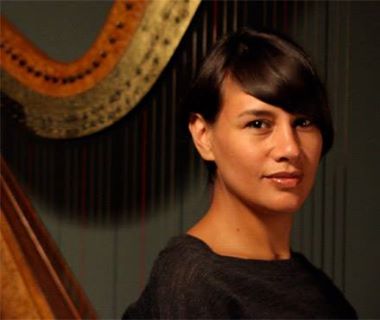
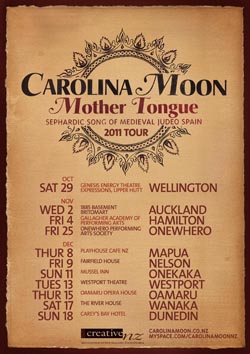
CJC Feb 5 2014 055I have long been drawn to middle eastern music, having commented on it in earlier blog posts. There are many reasons to like this rich musical stream, but what draws me are the interactions that occur when eastern and western improvised traditions meet in mutual respect. This is often labeled as World/Jazz, but implying that it is new hybrid is somewhat problematic.  Both improvised traditions have deep roots and a successful meeting acknowledges this. The blend of Jazz and middle eastern music is mainstream in the Mediterranean regions but not as well-known elsewhere.  Adventurous artists like Dhafer Youssef, Rabih Abou-Khalil and Anouar Brahem have gained prominence in the west through collaborations with the likes of Kenny Wheeler, Charlie Mariano, Steve Swallow, Tigran Hamasyan, Marcin Wasilewski and others. Jazz lovers in New Zealand and Australia have already experienced the ancient Sephardic music of Spain through Caroline Manins ‘Mother Tongue’ projects.  Also through Kiwi Jazz harpist Natalia Mann’s Turkish projects.  CJC Feb 5 2014 056 (1)Much of this music derives from the Sufi tradition but Sicilian and Flamenco Jazz fusions should not be overlooked either; both having rich Islamic and Jewish sources feeding them.  The Moors ruled Sicily for 400 years and southern Spain for 500 years.  Under the various Caliphates there was great religious tolerance and a spirit of scientific curiosity.  The arts and musical traditions merged and flourished in that benign space.

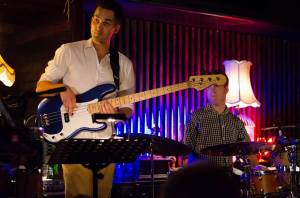
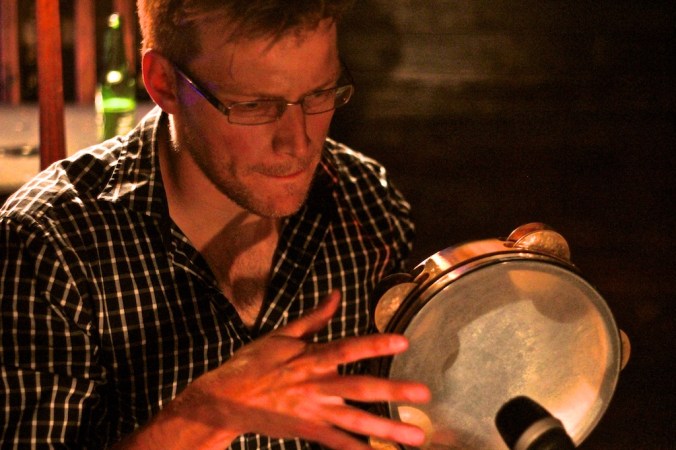
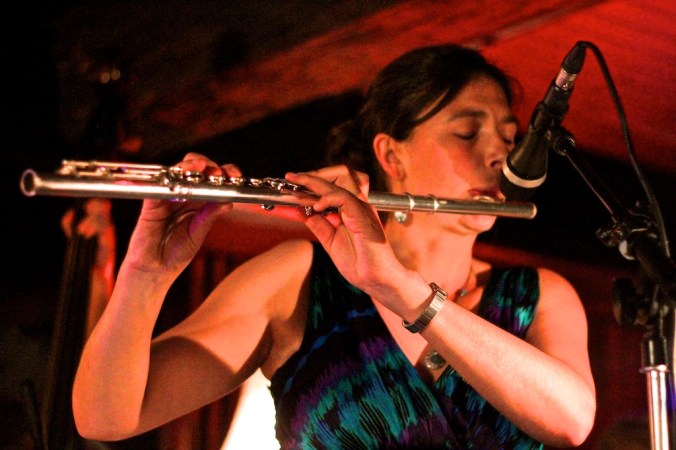
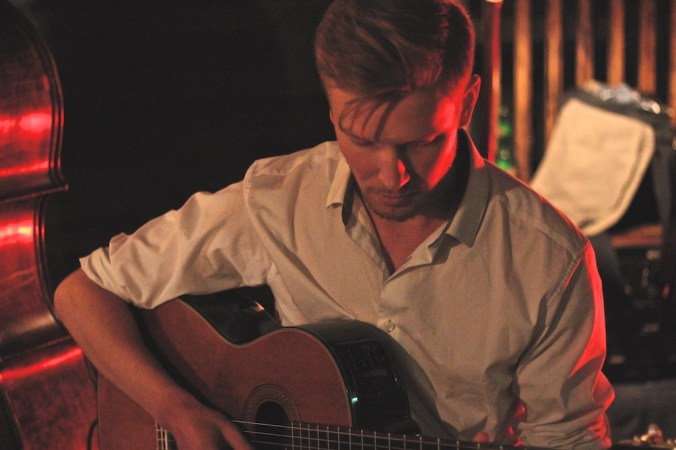
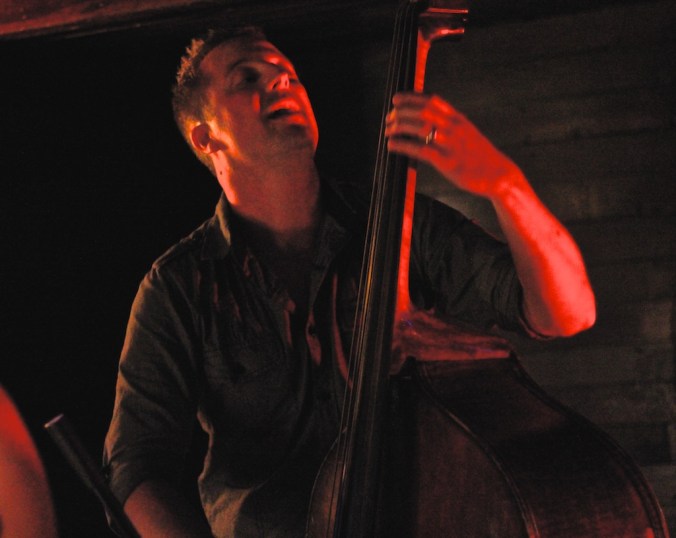
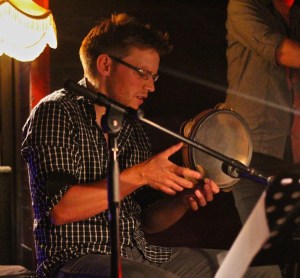
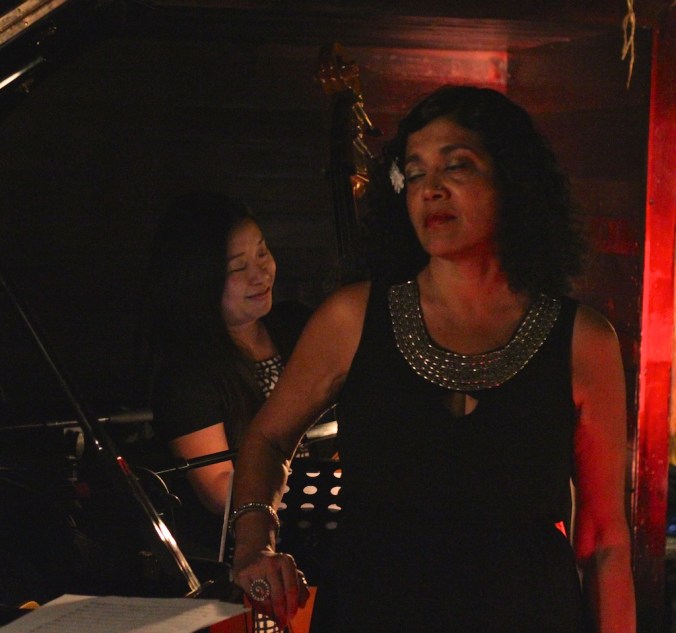
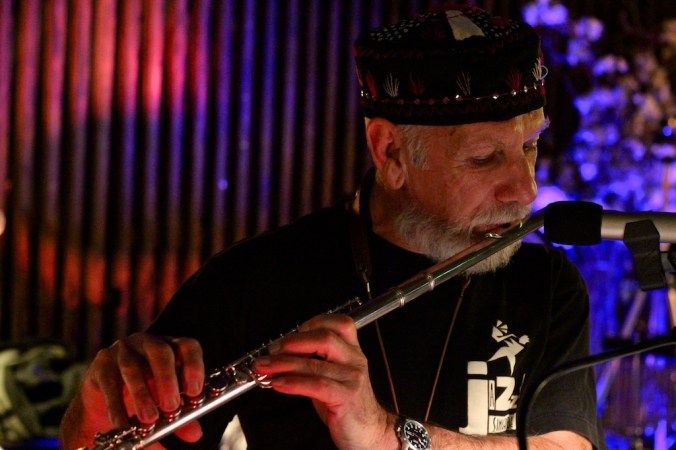
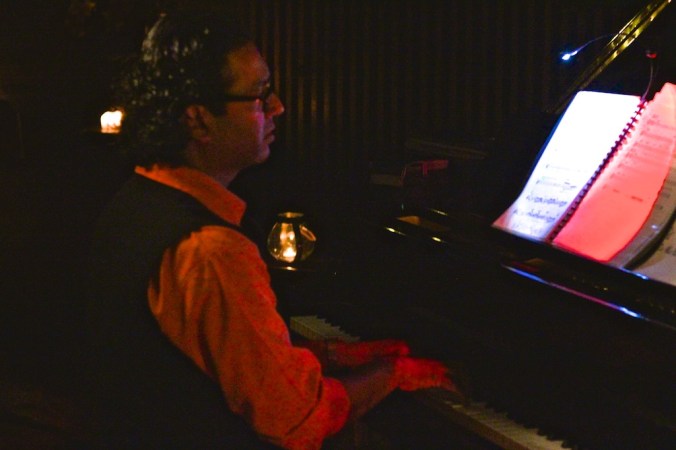
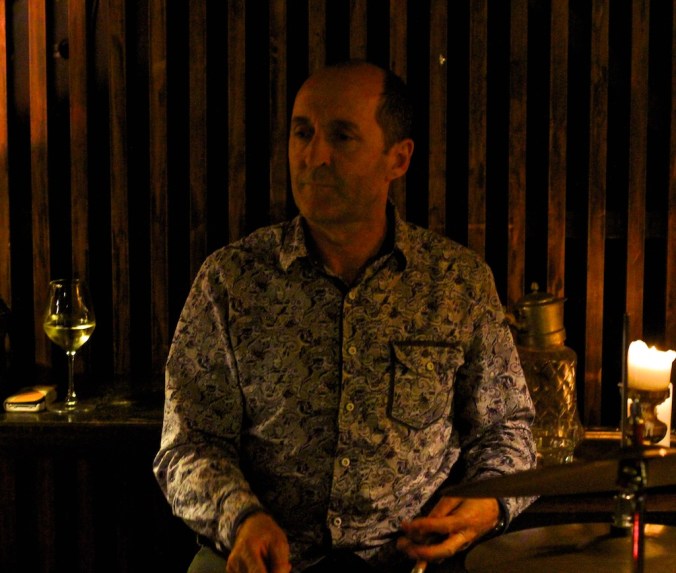
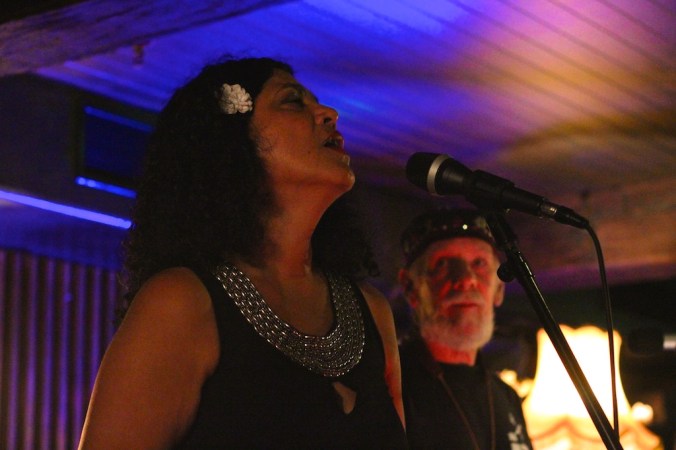
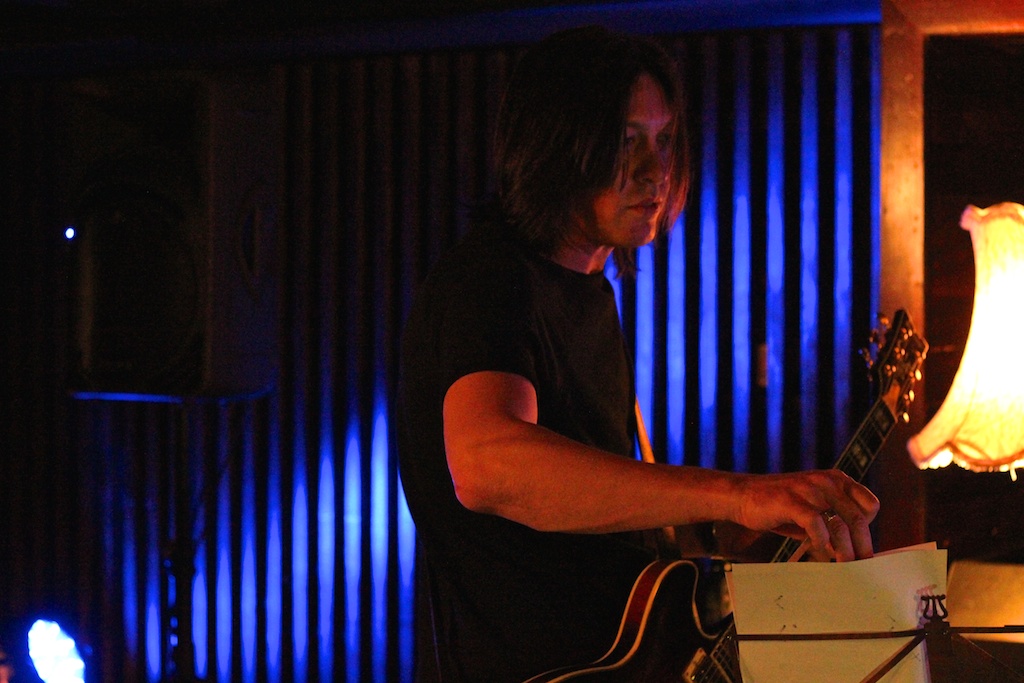
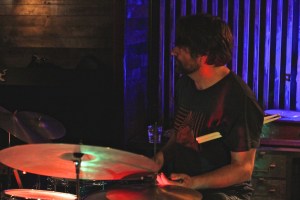
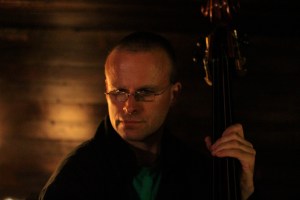
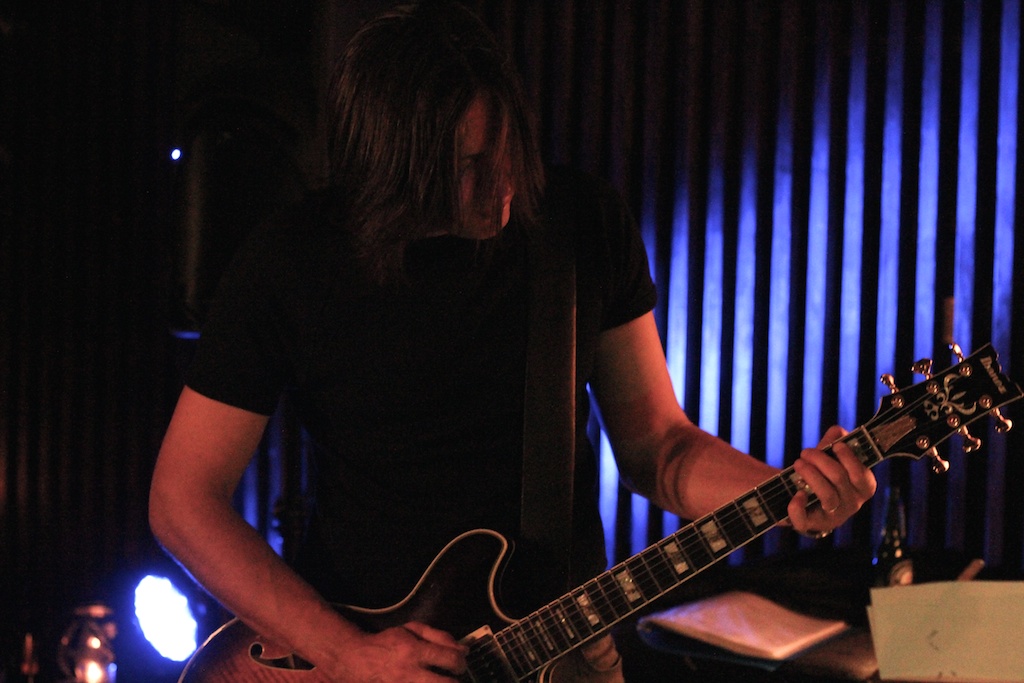
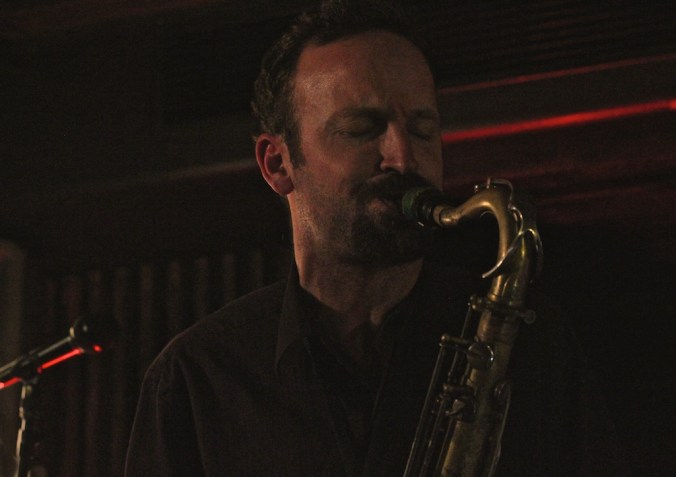
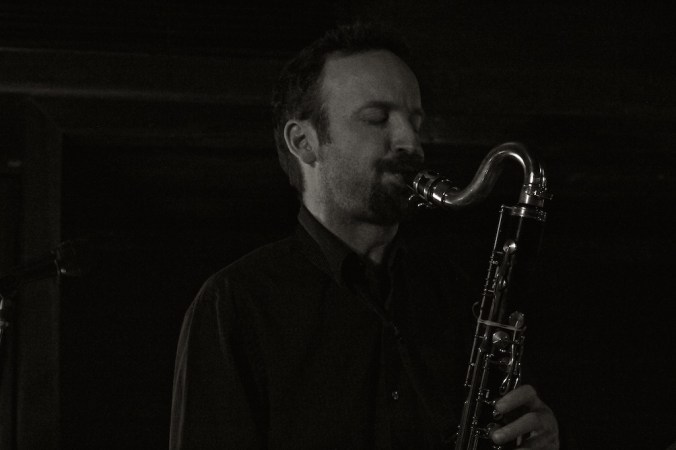
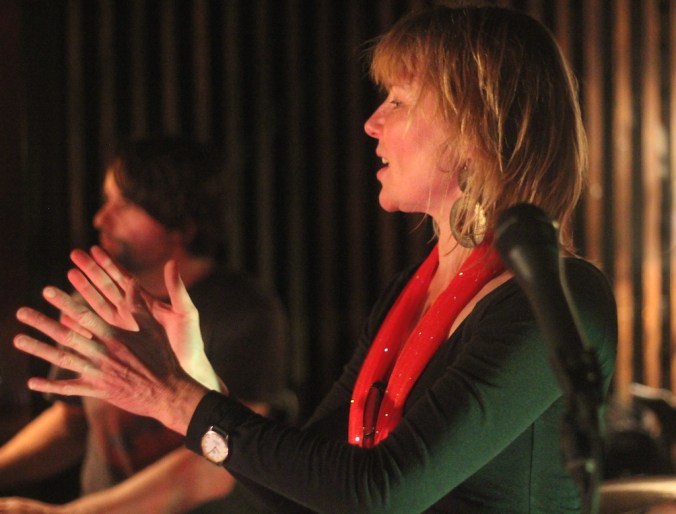
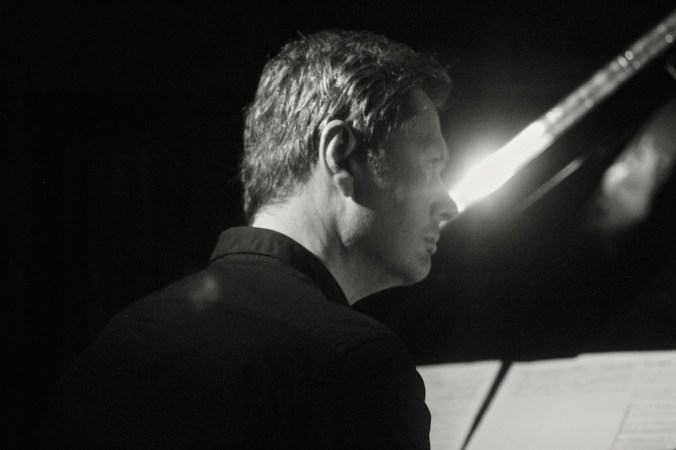
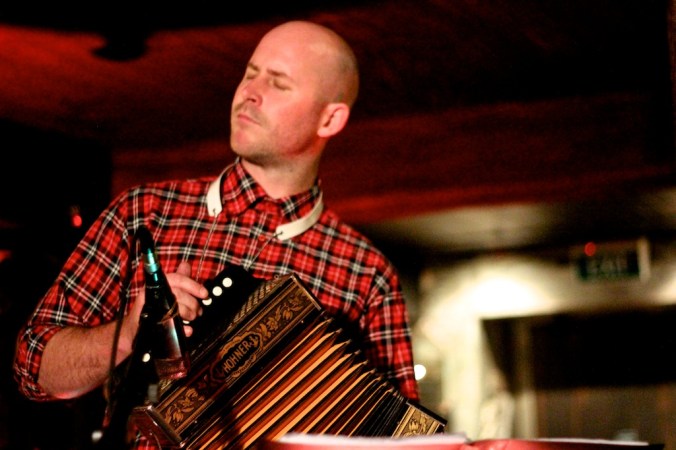
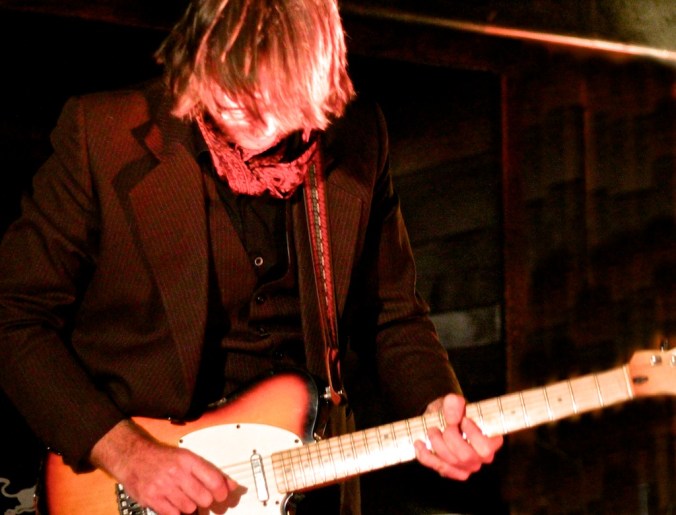
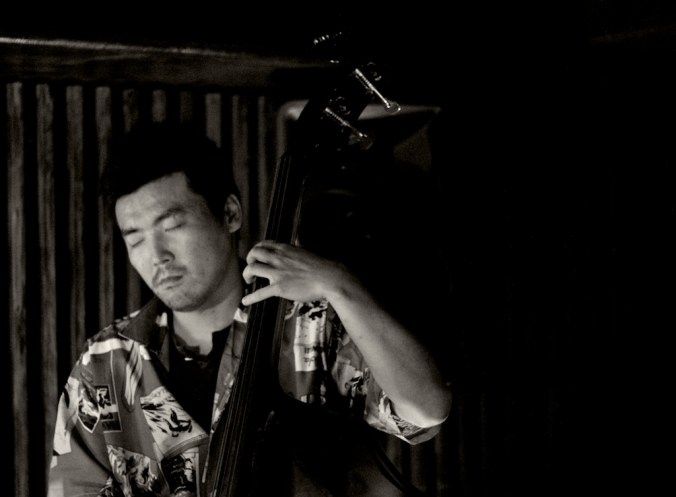
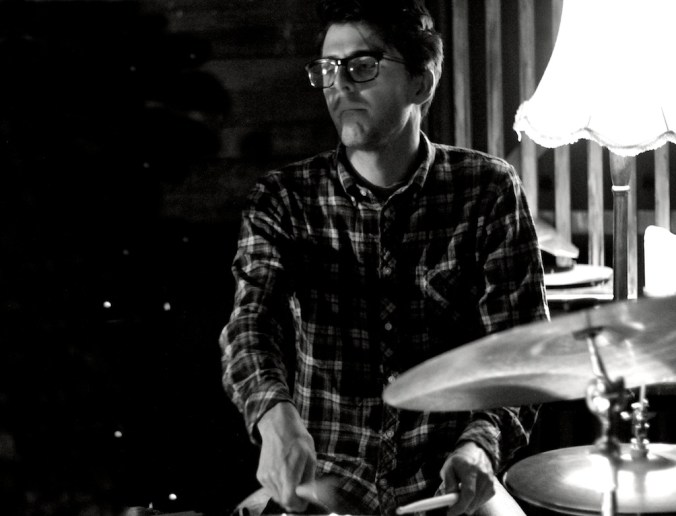
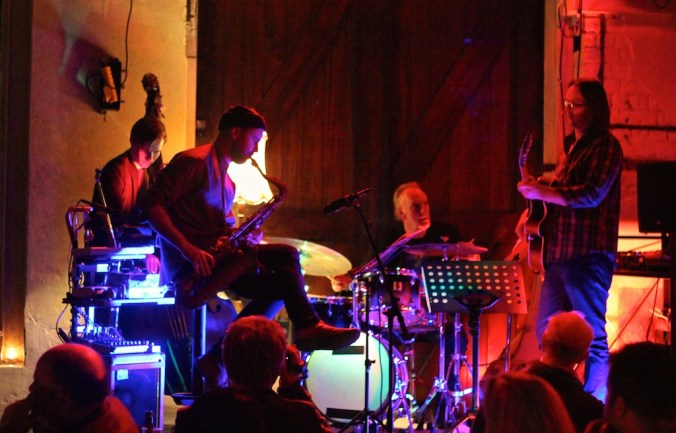
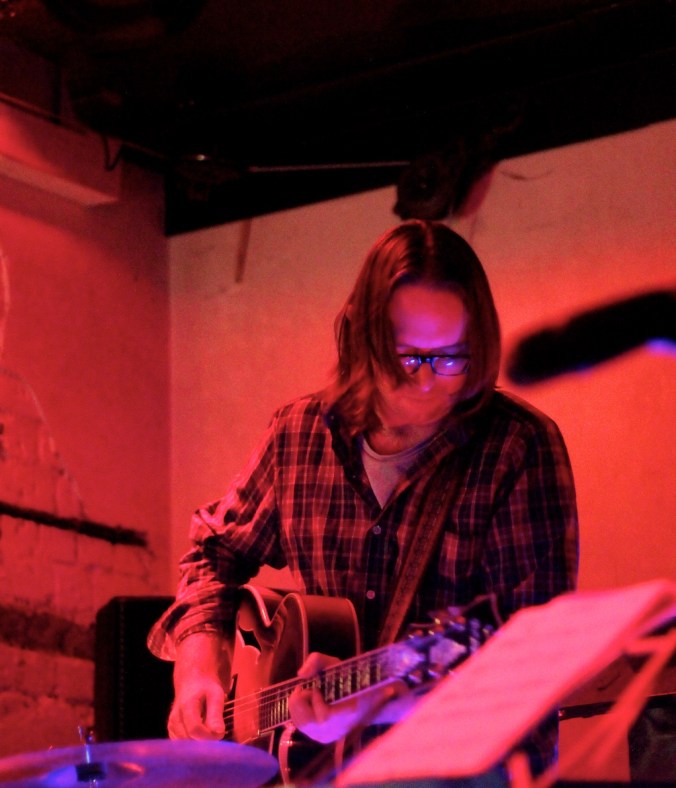
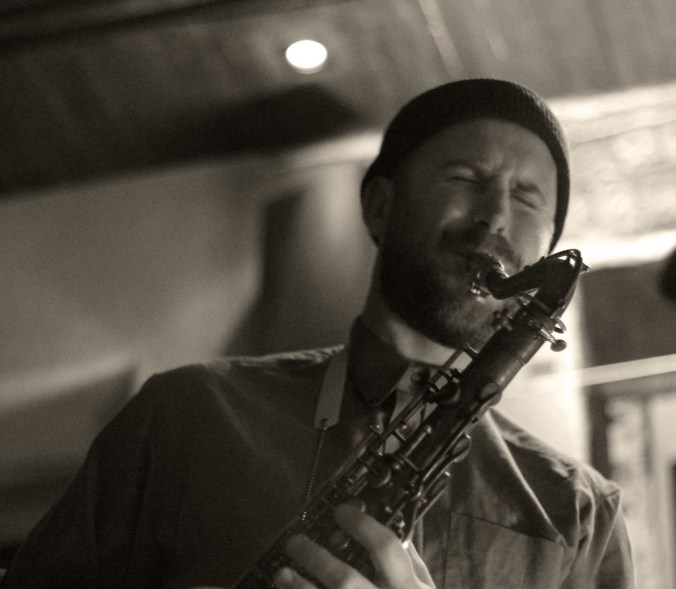
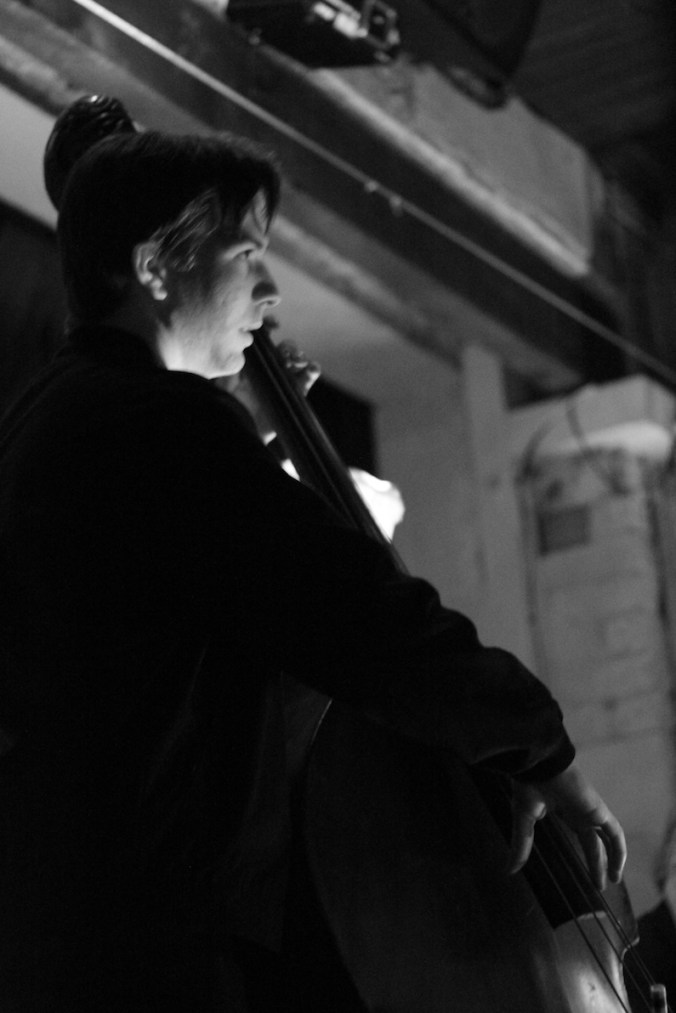
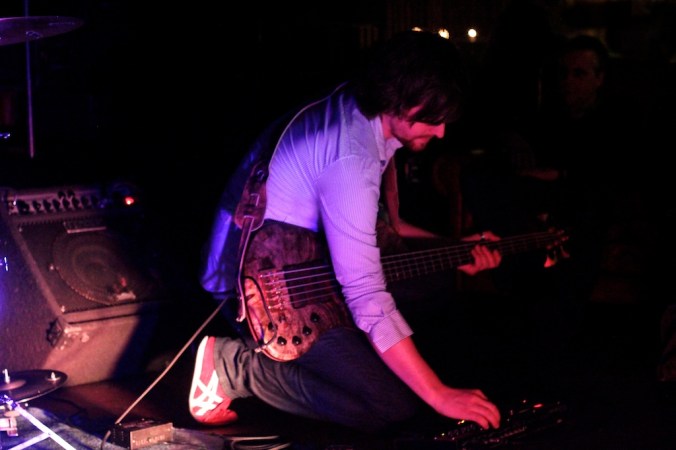
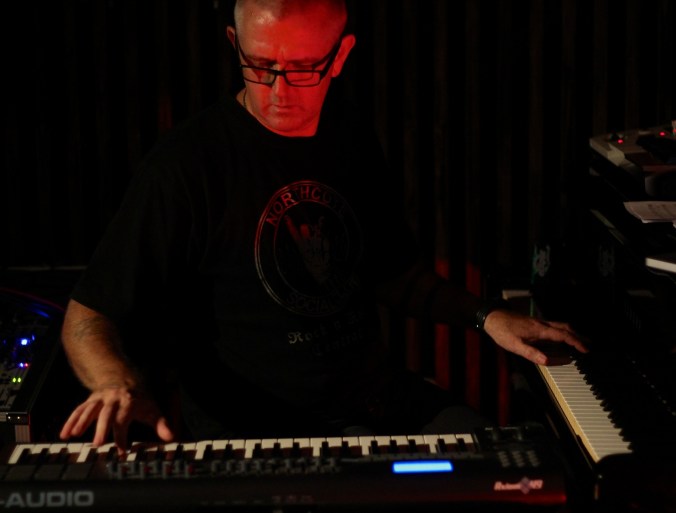
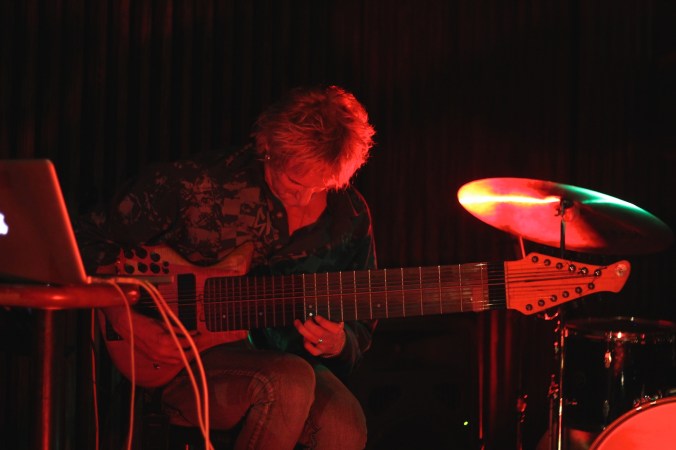
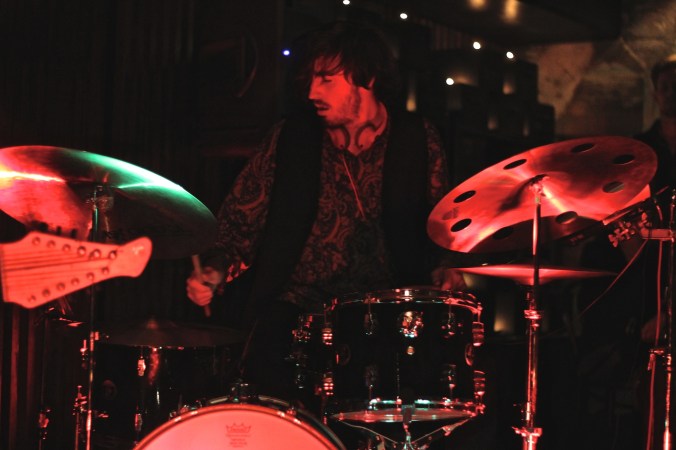
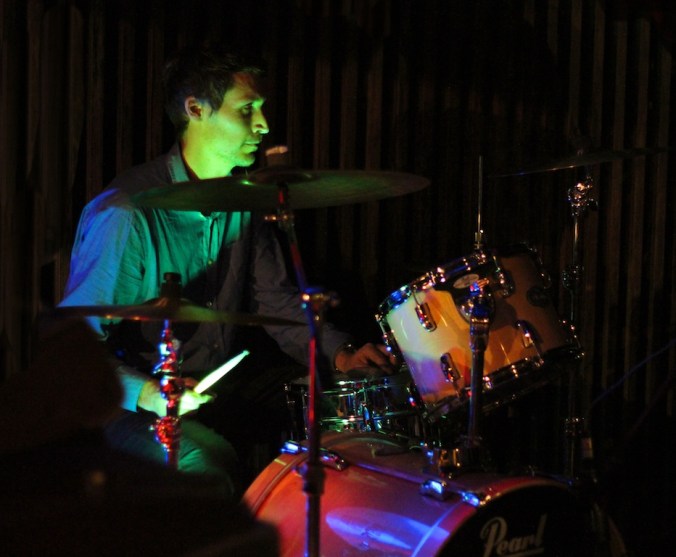
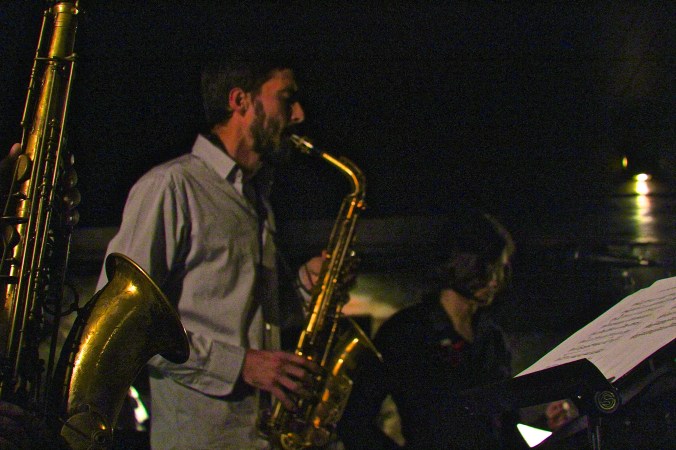
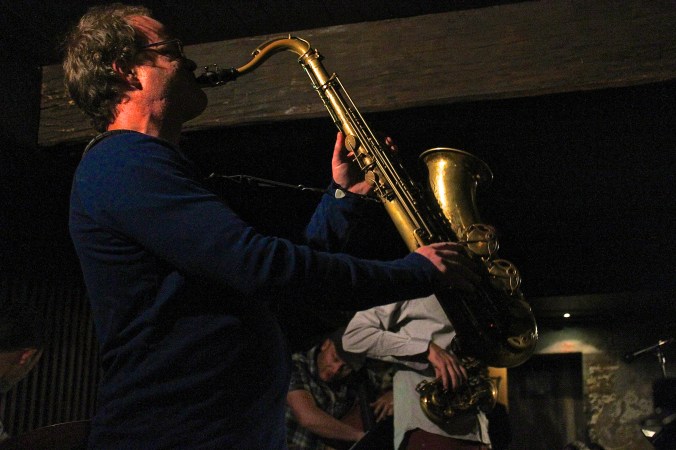
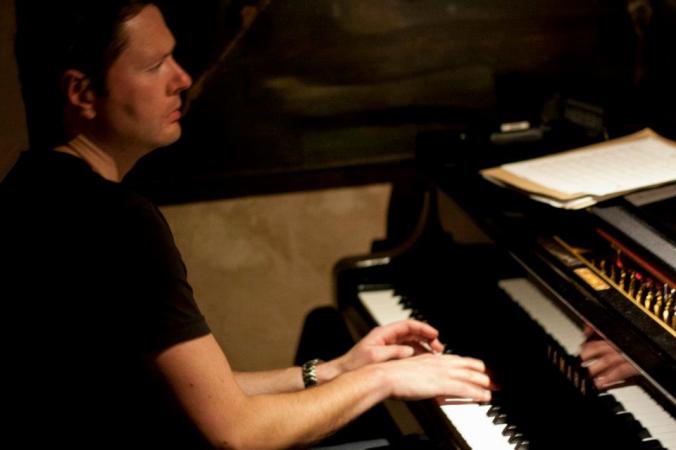
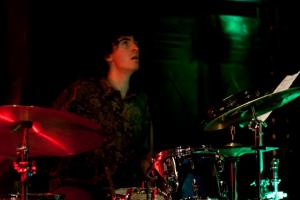
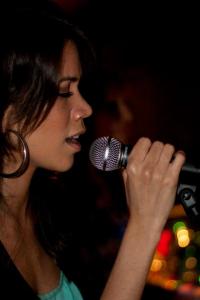
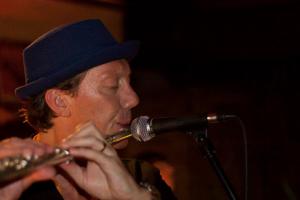
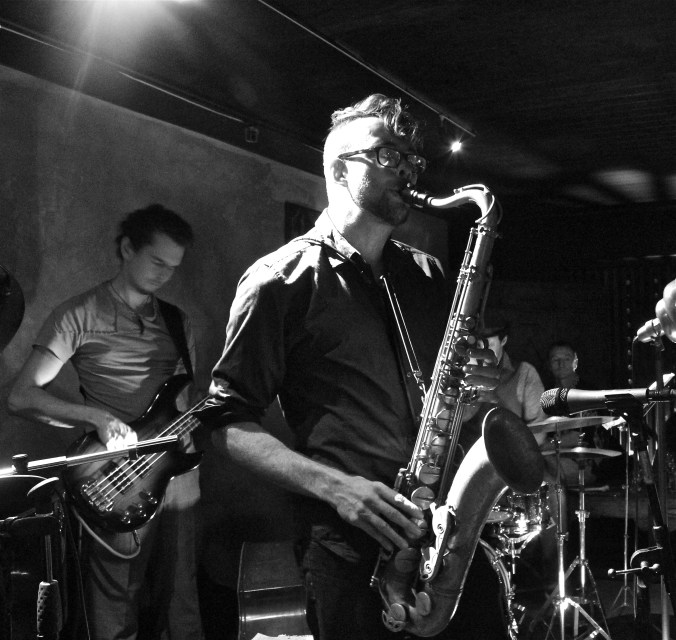
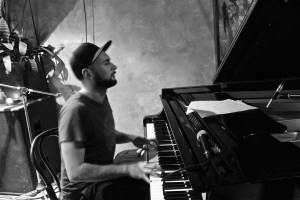
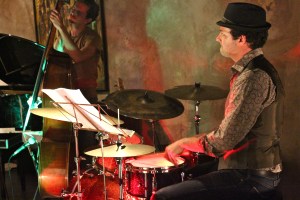
Tim Sellars is a drummer/percussionist who graduated from Canterbury University Jazz School with honours.  His studies led him to examine the rhythms and tunes of middle eastern music and he put together ‘Mukhlisa’ to further these explorations.  The Auckland line up features two artists who we are very familiar with, Glen Wagstaff on acoustic guitar and Tamara Smith on flutes.  For leader Tim Sellars, and for bassist Michael Story this was a first visit to the CJC.  Of the tunes chosen many were traditional but the largest number were by a modern writer of Middle Eastern music Joseph Tawadros.  His compositions fuse the traditional with Jazz and allow ample room for improvisation. CJC Feb 5 2014 061Watching Tim Sellars on percussion is eye-opening as he coaxes so many complex rhythms and sounds from his array of percussion instruments, that it beggars belief.  At times he used the Cajon (of African/Peruvian origin) but mostly he played frame drums (middle eastern). I love to hear the frame drum as it is the oldest instrument known to man. The genre includes the Riq (tambourine) which Tim played to perfection.  Being an amplified acoustic ensemble the sound worked well in the club space.  The guitar perhaps needed turning up a touch, to give it more bite. CJC Feb 5 2014 056Tamara was her usual impressive self and her control and mastery of the instrument was evident throughout.  She alternated between bass flute and alto flute; the tonal richness of both horns blending perfectly with the upright bass.  Bass player Michael Story understood the cues and worked with Tamara; resisting any impulse to overplay. Acoustic ensembles like this require discipline and subtlety; overly showy solos can dominate and obscure the filigree of woven sound.  Mukhlisa got that right and the solo work although appealing, was rightly subordinate to the overall integrity of the music. Glen Wagstaff is popular in Auckland and his charts for large ensembles have impressed club goers.  It was good to see him in a different context and many of us  eagerly await his album, which is due out in a month or so.

CJC Feb 5 2014 065 There is ample scope for a larger ensemble to grow out of this; perhaps one including arco Cello and Oud.

I am happy to see this music finding a home in New Zealand as it is a metaphor for a wider truth.  We are living through a troubled era when many western peoples are recoiling from Islamic images.  If they are only aware of conflict images or brutality then perhaps they are looking in the wrong places.  In this music resides harmony peace and humanity.

the composition is Phoenix by Joseph Tawadros.

Who: ‘Mukhlisa’ – Tim Sellars, Glen Wagstaff, Tamara Smith, Michael Story

Where: The CJC (Creative Jazz Club), Britomart 1885, Auckland 3rd February 2015

Sandhya Sanjana @ the CJC


IMG_3466 - Version 2

If you patrol the margins of the music world you will find inestimable treasures.  Beyond the notice of mainstream media and mainstream audiences there is a joyous revolution underway.   Not an austere revolution but one peopled by astonishing musicians, colourful characters and sonic explorers.  Like a good street protest, it is often bubbling with noise, insistent beats and a multiplicity of messages.  Last Wednesdays gig epitomised that.  The alternative music scene is often denigrated for its imagined ‘high brow’ complacency or its snobbish rigidity.  In this regard the Jazz police and lazy uninformed commentators have done improvised music a grave disservice.  Improvised music has been with us since the beginnings of art and the whole point of it is to shift the focus away from the mundane or the obvious.  The appropriation and assimilation of traditional forms is only a staring point.  Sandhya Sanjana and her gifted ensemble took the shamans path here; conjuring shapes and colours from the ether, re-harmonising, daring us to look at the familiar and the exotic from an entirely different vantage point.  This night cut right to the heart of improvised music.  Different worlds merged and they did so without compromising the integrity of the traditions they came from.  IMG_3487 - Version 2

This was World/Jazz singer Sandhya Sanjana’s night but we have Auckland’s Ben Fernandez to thank for organising the gig.  I had not heard Fernandez play before this, but had long been aware of his reputation as a gifted, successful and multifaceted pianist.  Some months ago he invited me to his ‘Raag time’ fusion gig, but sadly I was unable to attend as I was heading out-of-town.  Later he messaged me to say that he would teaming up with Ms Sanjana in November.  Gigs like this are irresistible to me as I am enthusiastic about all of the great improvised music traditions.  The merging of these traditions has risks, but done well it’s marvellous.  The successful assimilation of middle eastern rhythms and the idioms into Jazz has long been achieved in Europe.  Fusions of traditional Indian music and Jazz are now emerging across the globe and those with an open mind and the right ears are the happy beneficiaries.

IMG_3467 - Version 2

The band members were; Sandhya Sanjana (vocals, leader), Ben Fernandez (piano), Jim Langabeer (flute, reeds), Manjit Singh (tabla & vocals), Jo Shum (bass), Jason Orme (traps drums).  Anyone familiar with the Auckland Jazz scene and the Indian music scenes will know what a great lineup this is.

IMG_3495 - Version 2

Sandhya Sanjana is from Bombay, but based in Holland these days (Ben Fernandez is a Kiwi but he also hails from Bombay).  She has performed with the greats in the World/Jazz field like Alice Coltrane and Trilok Gurtu.   She has an easy confidence about her that informs her performance and under her guidance a seamless fusion of styles occurs.  With Fernandez you get another strong influence as he imparts a distinctly Latin feel.  This classical and Jazz trained musician has chops to burn.  Out of this melange of rich influences a vibrant new music emerges.  It is compelling and exciting to hear.  There is a constant visual and sonic interplay between singer, tabla, traps drums, piano, bass and reeds (winds).  The shifting rhythms creating intricate cycles that pulse and swing.

IMG_3464 - Version 2

Manjit Singh, originally from the Punjab is another Auckland resident and he is an acknowledged master of the Tabla and of Indian music.  I am often reminded of what a rich and diverse drum landscape we have in Auckland.  A world that I am still coming to grips with.  This man is a major talent and it is our good fortune that he is making forays into the Jazz/fusion music scene.  On traps was the veteran drummer Jason Orme and he was well-chosen.  The gig required a drummer who could play quietly but strongly and one who had the subtlety to interact with Singh.  On bass was Jo Shum who has not played at the CJC for some time.  She is an aware bass player and acquitted herself well.   Lastly was the reeds and winds player Jim Langabeer.  Langabeer is well-respected on the New Zealand scene and is one of a select group of doubling reeds musicians who are equally strong on flute (and he swings like a well oiled gate).   This gig had an embarrassment of riches and once again Roger Manins gets a big tick for his innovative programming.

IMG_3483 - Version 2

In the You Tube clip that I have put up, the breadth of Sanjana’s influences are immediately evident.  After a few bars of latin feel on piano we hear a Tala.  I know very little about the technical aspects of traditional Indian music but the rhythmic patterns (or Tala) are generally established early on.  This can also include a vocalised manifestation of the Tala rhythms.   Manjit Singh the Tabla player counted in the Tala and Sanjana responded with Mudras, claps and vocals .  The traps drummer and others responded to the patterns and so the piece built upon itself.  If done well, cross fertilised music is like water; it will soon find its own level.  This did.

Who:  Sandhya Sanjana (vocals, compositions, leader), Ben Fernandez (piano, arrangements), Jim Langabeer (winds & reeds), Jo Shum (bass), Manjit Singh (Tabla & vocals), Jason Orme (traps drums).

Where: CJC (Creative Jazz Club), Britomart 1885, Auckland, New Zealand.  5th November 2014

Joel Haines @ CJC 2014

IMG_3088 - Version 2

Guitar Jazz is a surprisingly diverse sub-genre of improvised music.  So many barriers are broken down that almost all current (and past) musical genres are embedded in the improvising guitarists lexicon (including Punk).  At first listening it might be surmised that gifted guitarist Joel Haines sits somewhere closer to the rock spectrum than to Jazz but his roots are much broader than that.  As his gigs unfold you can hear Americana, modern Jazz guitar, country and a plethora of other influences.  There is also the unmistakable influence of film, as his themes invoke pictures.  This is what improvised music is about; appropriation and transformation.  Nothing ruled in or out, nothing too free, too exploratory, too dissonant or melodic.

When you’ve been around New Zealand Jazz awhile you learn that Haines is one of the musicians that other musicians respect deeply.  Guitarists especially come to hear him and I spotted a few in the audience on this night.  The two sets kicked off as Haines sets always do; with Haines hunching into his semi-hollowbody guitar and playing with deep absorption.  There are never introductions or tune titles, just waves of compelling music.  Because he constructs his improvisations around soulful, bluesy and deeply melodic ideas, perhaps more so than other guitarists, there is a radiating warmth that emanates from the band stand.  Black Tee-shirt, nut-brown wood-grained guitar, skin tones reddened by the club lights and rays of warm enveloping music.  IMG_3090 - Version 2

To my ears there is always a tangible hint of Jimi Hendrix in his voicings.  Few improvising guitarists could occupy this space so convincingly.  It is the place that Hendrix was heading for in his last days, only thwarted by his demons.  A place begging for further exploration by anyone brave enough.  For all that, Haines is a modern guitarist, as much in the Scofield camp as he is Rock inflected.  A feeling of familiarity guides us through his explorations, a sense of something familiar that you can’t quite place.  This is gift that only the best musicians bring to a gig.  His improvising journeys appear anchored by the vignettes he creates at the beginning of a piece, often worked over short loops, ostinato bass, or a tight driving pulse from the drummer.  Themes stated, constantly expanded then contracted again.  IMG_3040 - Version 2

For trio partners he had Oli Holland on upright bass and Ron Samsom on drums.  Being multi faceted and highly experienced musicians they quickly found the heart of the music.  Samsom in particular found his way deftly to where he added the most value.  He has considerable experience in lineups like this, music which edges closer to Frisell than to Pass.  Near the end of the first set Roger Manins sat in for a number (a composition by Joel’s brother Nathan from a recent award-winning album).   The number added breadth to the gig as it gave us a different perspective; Roger played like a demon as always.  This was another good night at the CJC and they just keep coming.

IMG_3085 - Version 2

With the Auckland Jazz Festival shortly underway and a wealth of quality music on offer, I must echo what my friend Stu said, “This will surely be remembered as the golden age of Auckland Jazz and improvised music”.

Who: The Joel Haines Trio – Joel Haines (guitar), Oli Holland (bass), Ron Samsom (drums).

Where: CJC (Creative Jazz Club), 1885 Britomart, Auckland, New Zealand    – www.creativejazzclub.co.nz

Blair Latham trio @ CJC

IMG_2699 - Version 2

There are musicians who have the ability to create vibrant pictures out of sound, deftly carving shapes, daubing them with colour, texture, leaving images suspended in the air, as tantalising spectres. Blair Latham is one of these.  He brings to the bandstand a tropical exoticism, redolent of the central Americas, but somehow still Kiwi.

I first saw Latham at the Rogue & Vagabond during the Wellington Jazz Festival.  The project was to re-create the vibe of the Headhunters album and it certainly did.  In the hands of Hayles, Latham and others a wild, hyper-energised brew of sounds radiated among us.  They took the brief to its outer limits and for the audience (who were undoubtedly Hancock enthusiasts), it was an immensely satisfying experience.  As Latham’s tenor wailed, the milling crowd urged him on, each phase wilder than the last.   IMG_2694 - Version 2

The Rogue & Vagabond channeled North American funk grooves, this gig took us a long way south of that, to central Mexico.  A Mexico seen through Kiwi eyes, a musicians eyes, the eyes and ears of a careful observer.  The energies had shifted as well.   A more thoughtful approach was evident.  Latham was telling stories that came from the heart, from experience and reflecting the altered light and filtered sounds of that populous country.

blairlatham

As the band started playing there were powerful overwhelming images created.  I reached for my note pad and wrote the word Fellini.  This is how I heard it, the sounds of a happy and slightly chaotic Mexican circus, peopled by tumblers, clowns on stilts, parading animals and long lazy hours fuelled by Mezcal.  A rich mesmerising spectacle that took your breath away.  There were no high energy excursions, no roof blasting squalls of sound.  This was a journey of measured steps, full of subtleties.  At times the trio sounded like a bigger unit and as Latham switched between his rich woody bass clarinet and classic Selmer tenor saxophone, the effect amplified.  Each phrase, each line, hung in air long after the breath that created it had subsided.  There were a number of Latham’s compositions and some beautiful, haunting Mexican ballads.  Emotion and sentimentality are bound up in that world.  There is nothing buttoned-up about Mexican music.

Latham is unusual in New Zealand as his principal horns are bass clarinet and tenor saxophone. A handful of musicians double on bass clarinet, few are as proficient as he is.

It often happens that the best laid plans unravel unexpectedly.  The trio was initially advertised as Latham, David Ward & Chris O,Connor.  The trio we saw was Latham (bass clarinet, tenor saxophone, leader), Neil Watson (guitar, lap slide guitar), Stephen Thomas (drums).  I rate both Ward and O’Connor highly but this lineup worked extraordinarily well.  It was hard to believe that these musicians had not played together often.  The challenge of playing this music, reading these often complex charts, brought out the best in Watson and Thomas.   Both gifted musicians. both good readers.  Together they merged perfectly and we could see Latham’s pleasure at this.

IMG_4150

The drum charts called for a colourist approach, an oblique subtle rendering of  rhythms that were as much rooted in Mexican folk music as in avant guard jazz.  Thomas was exceptional as he tapped, scraped or made the kit whisper; even his solos were original and entirely appropriate.  This guy can tackle anything it seems.  Watson is a veteran of the unusual and a superb reader.  It was a joy to see him working counterpoint or even unison lines with Latham.  He is perfect for gigs like this as his unbridled imagination is not tethered to norms.  He moved between lap guitar and Fender solid body, enabling him to move closer to the Frissel like Americana sounds that so clearly influence him.   IMG_2663 - Version 2

The word Mexico brings to mind a jumble of exotic but occasionally troubling images.   For me the source is literature, films, art, photography and music.  The nearest that I got to Mexico was in books like ‘Under the Volcano'(Lowry), ‘On The Road’ (Kerouac) or ‘The Teachings of Don Yuan’ (Castaneda); in films like ‘The Night of the Iguana’, numerous cowboy movies; in crazy photographic images from the ‘night of the dead’ festival of Santa Muerte, in articles about the loathsome human traffickers or murderous drug cartels.  I have travelled extensively in Spain and down the Californian Coast, places where this beguiling country felt almost within reach.  This gig took me one step closer.  IMG_2654 - Version 2

“How’s the mezcal” he said. “Like ten yards of a barbed wire fence.  It nearly took the top of my head off.  I had a Tequila outside with the guitar hombre” – ‘Under the Volcano’ -Malcolm Lowry

Who: Blair Latham (bass clarinet, tenor saxophone), Neil Watson (guitars), Stephen Thomas (drums)

Where: CJC (Creative Jazz Club), 1885 Britomart, Auckland, New Zealand, 3rd September 2014   –   www.creativejazzclub.co.nz

Acapollinations/Carolina Moon @ CJC

IMG_0985 - Version 2

One of the strengths of the CJC (Creative Jazz Club) is its varied program.   Sixty years ago improvised music meant only one thing to the western world.  Mainstream Jazz.  From the late fifties onwards the music drew from an ever-widening array of influences, experiments with unusual and exotic instruments occurred, not always successful as the attempts were often self-conscious.  At worst they felt like a size twelve-foot being jammed into a size six shoe, at best they tantalised, leaving us wanting more.   Among the best of these explorations were Jimmy Giuffre’s.   A Texas tenor man with open ears and an innate ability to double on reeds and winds.  By the sixties his folk tinged Jazz with Jim Hall and Bill Crow (Train and the River) was considered mainstream.  By then Giuffre had moved on to explore open skies atonal explorations with Paul Bley and Steve Swallow and to dabble in the ‘third stream’.   The third stream referenced modern classical music as it sought to make a hybrid of the two forms.  Attempts to bring in the exotic sounds of the Mediterranean, in spite of Django, were slower coming.   The exotic of the sixties was more likely Cuban influenced Jazz or the music of Tom Jobim.   Both wonderful, but unmistakably music rooted in the Americas, in spite of their ancient African influences.

IMG_0944 - Version 2

Post millennium, there are interesting and innovative Jazz Projects proliferating across the globe.  ECM in particular has long been adept at broadening Jazz tastes and over the last two decades it is repeatedly voted as the best-loved Jazz Label.  Not once has it compromised its mission.  Not once has it tried to travel down the populist route.  It survives in a space where the iconic Jazz labels disappear, engulfed by amoral corporate machines or buried in an increasingly harsh market place.   One ECM album in particular comes to mind, a wonderful collaboration between premier Italian Jazz trumpeter Paulo Fresu and a traditional Corsican mens choir, ‘Mystico Mediterraneo’.   This acapella song form is combined with improvisation much like Caroline’s and Tui’s projects.  Improvising around ancient forms and bringing back deeply evocative all but forgotten songs.  This feels natural in 2014 and this brings me to the original point.   Jazz now coexists comfortably around a variety of genres, from deep Americana (Bill Frisell), to Middle Eastern music (Dhafer Youssef).  The self-consciousness is gone and the younger audiences in particular are more open.  This feels right in a globalised world and from an ethnomusicological view-point, it helps catalogue musics that are fast fading from thecollective memory.

IMG_0922 - Version 2

The ‘Acapollination’ project illustrates the above points perfectly.   This acapella group, four women (two established Jazz vocalists), explore the harmonies and rhythms of Bulgarian folk music.   I knew little of Bulgarian music but was keen to learn.  What I now know is that there is an ancient tradition of folk singing and that the style is quite distinct.  Differing markedly from other European or Slavonic music.  When Bulgaria became communist the authorities appropriated these folk songs and under their guiding hand they morphed in propaganda tools.  Complex meters became the norm, no longer left in the sole hands of peasants who had preserved them by oral tradition.  In some cases purged of unwelcome minority ethnic influences.  It is to the credit of Ron Samsom and the Auckland University Jazz School that this project was accepted.  There are many improvising traditions in the world, some new, some ancient.  When they meet new horizons open before us.  IMG_0940 - Version 2

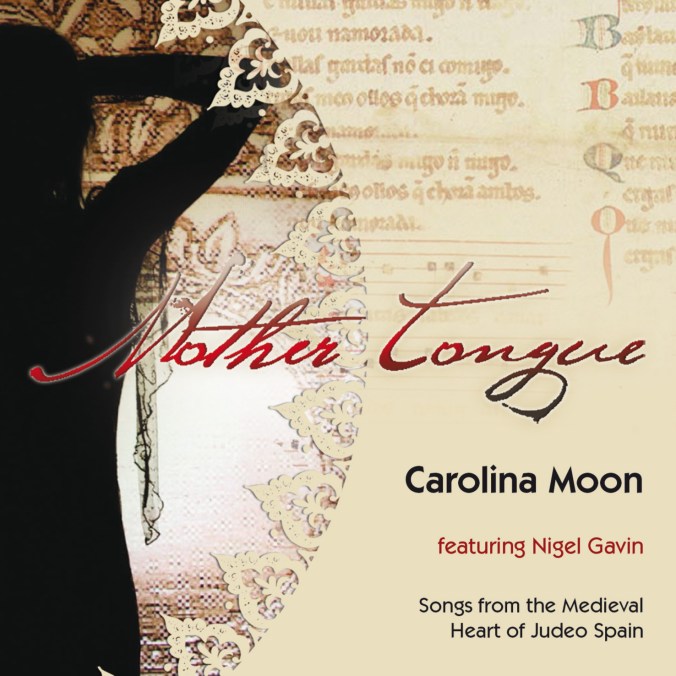
The second set was Carolina Moons Mother Tongue.  This project has been around for a few years and has travelled extensively.  There have been a few changes to the original line-up but the core performers remain.  Wherever the Mother Tongue project has appeared it’s received to wide acclaim.  Once again this is an ancient music, a hybrid form emerging from multiple sources in medieval Sephardic Spain.  Not only are the melodies of the Jewish Diaspora heard, but the songs of the Moors and the other races surrounding them.  This truly exotic and rich music just begs for modern interpretation and Carolina Moon has achieved that exceptionally well.   Her voice is wonderful and her arrangements perfect.  I have heard this group many times, but at each listening I gain new insights, fresh enjoyments.  They are evolving with time and different facets emerge or fade as they progress.   Nigel Gavin is always extraordinary but Roger Manins intense short modal improvisations on Bass Clarinet, Flute or Soprano saxophone make this special.   Carolina Moon, Roger Manins, Kevin Field, Ron Samsom and Nigel Gavin are the original members.  Cameron McArthur is a newer addition.  This is a cohesive working group and long may they remain so.  IMG_0959 - Version 2

What: Acapollinations – Tui Mamaki (leader, voice), Chelsea Prastiti (voice), Carolina Moon (voice), Siobhan Grace (voice).  acapollinations@gmail.com

What: Mother Tongue Project – Carolina Moon -Manins – (Leader, arranger, vocals, bells), Kevin Field (piano), Roger Manins (winds and reeds), Nigel Gavin (guitars), Cameron McArthur (bass), Ron Samsom (drums)   http://www.moonmusic.com

Where: CJC (Creative Jazz Club), Britomart 1885, Auckland New Zealand, 28th May 2014    www.creativejazzclub.co.nz


The Doughboys @ CJC

IMG_8738 - Version 2

Whenever Neil Watson and Cameron Allen appear one thing is certain.   The boundaries between realty and the surreal will be seriously blurred.  Their attempts to kick down the barriers between musical genres arises from a genuinely subversive urge.  This has nothing to do with academic posturing, as the music comes from raw passion.   People sometimes ask me why I listen to Zorn, Sun Ra, Ribot and others.   It is because those people understand something very important, ‘Art should disturb the comfortable and comfort the disturbed’.  Neil and Cameron understand this and their collaborators do also.

IMG_8736 - Version 2

The unsettling rumours started circulating a few months ago.   Evidently there was an improvising band around town called the ‘Doughboys’.  Musical blackguards.  Few knew where they played and most dared not enquire further lest the blackest rumours were true.  They fitted no particular niche and worse, they could veer dangerously across genres without signalling a warning.   What might scare some, only served to tantalise me.  Any band that plays foul piratical sea shanties, Hawaiian music, Americana, ancient country ballads, Hank Williams and Johnny Cash in a Jazz voice is going to interest me.

IMG_8742 - Version 2

As with all vagabonds they eventually washed into the CJC (Creative Jazz Club) one blustery night.   Roger Manins, a steadfast soul, well able to withstand the vicissitudes of public opinion booked them.  On the night they stood brazenly arrayed, defiant as piratical adventurers can be.  Ready to sing and to wildly improvise, often using the voicings and tropes of psychedelic jazz.   Either that or they played a song dead straight just to confound.  The instruments were as left-field as the bands dress sense.  Neil Watson had an array of stringed instruments and some pedals mounted on a plank.  He used a Mexican Fender ‘Stratocaster’, a ‘Hobner’ Guitar (this is a top-of-the-range knock off of a Hofner which he purchased in an Indian street stall) and lastly a Chinese made ‘special’ steel guitar.  Cameron Allen played an old melodeon squeeze box, a tenor saxophone and a ‘virtual’ Doogan (it was not visible to the audience).   Alex Freer and Rui Inaba lulled us into a false sense of security by playing relatively ordinary looking instruments, but when you looked closely there were frightening pirate fetishes tied to the them.

IMG_8743 - Version 2

I thought that they were terrific and Neil Watson’s hint of Neil Young (subverted by Bill Frisell voicings) worked for me.   At times they played the tunes dead straight and this only added to the surrealism of the evening.  Once they sung a hearty ditty but I was not fooled.  As I suspected, this softening up was precursor to a king hit.  In this case a punked out rendering of the ancient sea shanty ‘Spanish Ladies‘ which I will post as a video.  This is the sort of music that the downtown avant-garde cuts its teeth on.  Where else would you hear an authentic version of ‘Pearly Shells‘ followed by something Pink Floyd might have done if they’d studied under Marc Ribot.  Bless their black pirate hearts.

photo copy 5 - Version 2

Disclaimer: No cats were harmed in the photoshopping of the above picture – the pirate cat is named Zirky 

What: The Doughboys at the CJC (Creative Jazz Club) 1885 Britomart, Auckland 20th November 2013

Who: Neil Watson – aka ‘Geetar Scrim’ (guitars), Cameron Allen aka ‘Lee Shawnuff’ (melodion and tenor saxophone), Rui Inaba aka “Pork Baster’ (bass), Alex Freer aka ‘Daddy Gaucho’ (drums).

Natalia Mann update from Marseille

1467391_10201084445817972_2075128796_n

I interviewed Natalia Mann after the release of her very successful Rattle album ‘Pacif’ist’ and since then we have kept in touch .  Improvising harp players are a rare commodity, but things are slowly changing.  This year the Columbian harpist Edmar Castaneda won a major Jazz poll.  Natalia is simply killing at whatever she undertakes but her new trio brings her squarely into the jazz orbit.   Having gained a considerable reputation playing with various symphony orchestras and after undertaking a number experimental music projects, she is more than ready to enhance her improvisational credentials.   She has recently been playing to critical acclaim at Mediterranean Jazz festivals and this video clip was made for the AKBANK Jazz festival in Istanbul.  Her compositions are beguiling and exotic, while retaining an elusive mysterious quality.   This is music that leaves you wanting more.

Natalia is of Samoan Kiwi extraction but for some years she has lived in Istanbul.  She’s married to the Turkish percussionist Izzet Kizil who appears in the clip below.  She was most recently the recipient of the ‘ARts Pacifica’ award in her hometown of Wellington.  Having recently studied Jazz at Skopje University she is now engaging frequently with the improvising world.   This stunningly beautiful piece swings to its own pulses and rhythms; aided by solid bass work from Dine Donneff (Greece) and the perfectly executed percussion of husband Izzet Kitil (Turkey).

I have promised to take her to the CJC next time she is in Auckland and just maybe if we are lucky, we could talk her into performing?

Natalia is in Marseilles at present and she sent me this clip of her new Jazz trio a few days ago.   Kiwi musicians certainly do well in the world.

Neil Watson Four @ CJC

IMG_8034 - Version 2

I love any music that can be termed ‘Space Jazz’ or ‘Space Funk’.  I have no idea if this is a real genre but I follow it anyhow.  Living through the era of Sputnik and being caught up in the excitement that followed I was nudged in that direction by the events of the day.  After that I zeroed in on space themed music.  Some of it was corny (Telstar) and some was grandiose (Gustav Holst’s ‘The Planets’).  Not long after this I stumbled across Jazz and the sonic explorations perfectly fitted my longing for a music that evoked the wonders of space while encompassing the quirks of our humanity.   Music performed by artists who stood in awe at the edge of the universe and then stepped free of its limits.  IMG_8030 - Version 2

The Neil Watson Four is a recently formed Auckland band who have no fear of galactic explorations.  With the aid of a doogon (explained later), tenor saxophone, drum kit, upright bass and four overly fertile imaginations, they bent and pulled at the fabric of the universe.  This is a band that defies the norms and swallows genres whole.  There is no sense of deliberate eclecticism here and no self-conscious navel gazing.  It is original and you get the sense that what happens sometimes surprises the musicians.

The feeling is often that of organised chaos, a loose organic vibe that works well because they have entered into a collective state of being.  While Neil Watson pilots the ship there is no heavy controlling hand but his benign presence presides.  He has gifted his vision and let the possibilities unravel as they may.  IMG_8057 - Version 2

Neil Watson is not only a great guitarist but his sense of humour is original.  A sort of postmodern Zen; dropping casual asides into the banter in ways that confound.   The You Tube clip that I will post is ‘Renamed’.  When Neil announced that tune he casually added, “I hated the original name”.  This sort of humour leaves you momentarily confused and then laughing out loud.  They also played a lot of tunes named after children, girlfriends or spouses.   The tunes were all great and particularly ‘Renamed’ (Watson), ‘Eleanor’ (Dennison), ‘Rosie My Dear’ (Gibson) and ‘Theo’ (Allen).  There were ballads and country fare as well.  their rendition of ‘Danny Boy’ was so poignant that any Scots in the audience would have been fumbling in their sporrans for a tartan hanky.

Neil Watson is an original guitarist and he is at his best when a leader.  He brings a rag-tag of interesting sounds and ideas to the bandstand and then knits them together.  There is also something akin to Zorn in much of this material.  Once the skeletal structure and the overall concept is in place the music is liberated.  The interactions between men and machines are fluid and what the audience sees will never be repeated.   For this to work well he needs the right collaborators and he has certainly struck gold this time.  IMG_8044

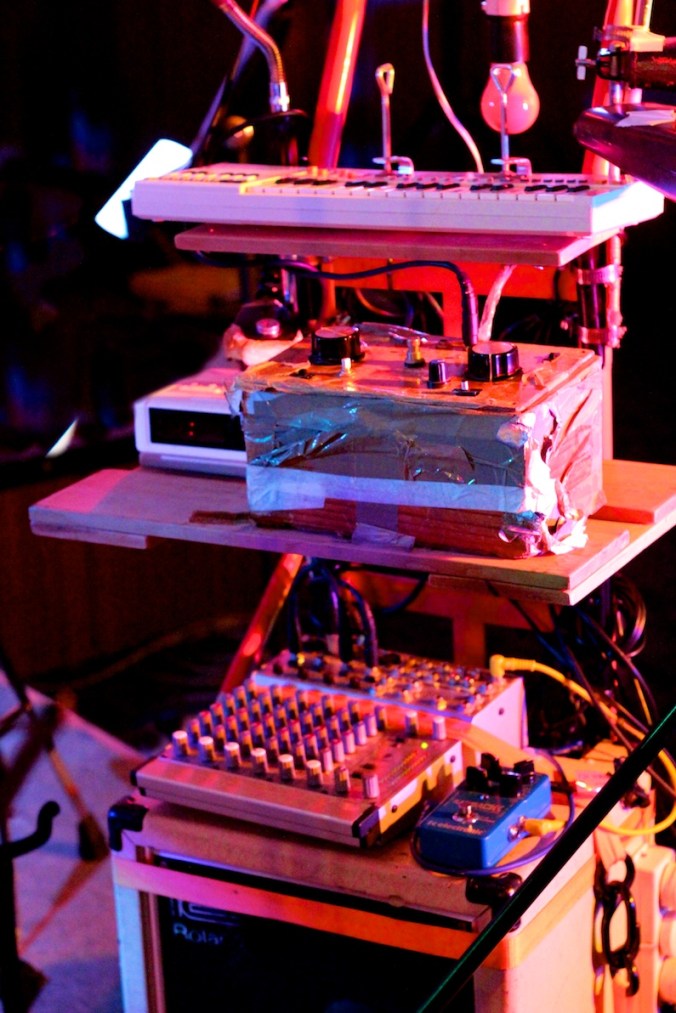
Cam Allen usually plays alto but he is also a fine tenor player.   I have also seen him manipulate a Moog to great effect.  On Wednesday night he played a Buescher ‘Big B’ Aristocrat and it gave out an earthy, and slightly raspy sound.  Word has it that it is a tricky beast to play but it sounded just right for this gig.   I risk committing heresy here but a Selmer would have been too clean for this music.  His interesting modal explorations and his flow of ideas mark him out as a gifted player.  This is hardly surprising as he honed his craft on the highly competitive American Jazz scene.  In this band he doubled on ‘doogon’.   This is very much a ‘Kiwi’ thing and it is best described as an array of electronic and acoustic sound enhancements strapped to a hardware-store hand truck.  Resembling a cross between a Dalek and an IED with its glowing blue lights, digital clock console and multiple knobs (many strapped on with duct tape); it can envelop the audience with shrieks that resemble a Banshee at a rocket launch.  IMG_8075 - Version 2

All of the instruments including the drums feed into this machine and the effects are astounding.  On upright bass was the respected Tom Dennison who used his arco technique to very good effect.  This bowing worked well with the Doogon, which under Allen’s guidance resonated in ways that would have astounded the instruments makers.  Dennison has a lovely rich tone and we heard plenty of that.  What can never be overlooked are his compositional skills (See an earlier post on his ‘Zoo’ album).  For this gig he contributed the lovely ‘Eleanor’ which he dedicated to his girlfriend.  He seldom appears at the CJC these days and it was a pleasure to see him there again.

Perhaps the biggest masterstroke was adding Frank Gibson Jr into the mix.  This inclusion of a drummer most known for his Post Bop chops may have raised a few eyebrows at first, but Gibson is no stranger to fusion.  He demonstrated just how perfectly he can execute this material and he showed us all what free and imaginative drumming looks like.  I heard a band member saying later that having Frank behind them, lifted the whole performance.   IMG_8050 - Version 2

I am an unreformed devotee of music like this and whether you call it Space Funk, Space Jazz, Eclectic Fusion or just wild music I will be its cheer leader.   This is an itch that just begged to be scratched and I am glad that Neil gave us a taste of it.  Besides the wilder numbers there were one or two ballads to balance out the program.  Overall it was a very satisfying experience.

It was somehow fitting that the band performed on the day that NASA verified that Voyager One had left our solar system and entered interstellar space.  

Who: The Neil Watson Four.  Neil Watson (guitar), Cam Allen (tenor, doogon), Tom Dennison (bass), Frank Gibson Jr (drums).

Where: The CJC (Creative Jazz Club), 1885 Building, Brittomart, Auckland.

Photographs by John Fenton & Ben McNicoll

Dream Weaver – Murray McNabb 1947 – 2013

IMG_7710 - Version 2

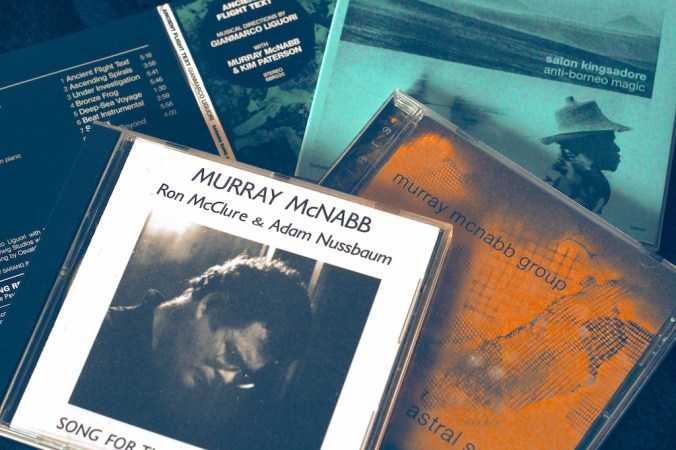
Murray McNabb left us on the 9th June 2013, just missing his scheduled gig at the Auckland Jazz & Blues Club.  His keyboards may have fallen silent but not so the band who played on out of respect. Mike Walker an old friend, was approached by Murray just days before he died, to stand in if he didn’t make the gig.  The gig may have invoked a plethora of memories and been tinged with sadness, but it was clear that Murray would live on through his musical legacy.  This was a musician who fearlessly patrolled the outer reaches of the sonic universe and I like to think that his ‘Astral Surfers’ album will be poured over by intergalactic cosmonaut’s as they look for clues or perhaps navigation hints from ‘Ancient Flight Texts’.

Frank Gibson Jr

Frank Gibson Jr

I was at Mt Albert Grammar at the same time as Murray and Frank Gibson, but they were more than a year ahead of me and both were prefects.  I was deeply into Jazz as a school boy and I knew that they were as well, but the gap between a fifth and a seventh former is sadly too far to bridge.  Fifth formers just didn’t hang with prefects and I regret that now.   I have followed Murray’s (and Franks’s) career ever since.

Murray McNabb was at the heart of the Auckland Jazz Scene and everyone respected his prodigious musical output.  The key to his music lies with the man, as music made him happy and improvised music even more so.  He was a man perpetually on the edge of a great adventure, navigating only by his innate sense of groove and an inner vision of the boundless vista’s that lay ahead.  Like Mike Nock he never settled for the ordinary, always pushing hard against the boundaries.   As much as I like his straight ahead records such as the lovely ‘Song for the Dream Weaver’, it is to his ‘out’ offerings that I return to again and again.

A largely self-taught keyboardist, he continued to explore the possibilities of Synths (and his beloved Fender Rhodes) during a period when others weren’t so keen.  In many ways improvised music has now come full cycle, as a younger generation continue the explorations, aided by clever machines and astonishing pedals.  Murray can take much credit for enabling a younger generation of local musicians to pick up on that.  His collaborations with Gianmarco Liguori in particular come to mind.  I regard ‘Ancient Flight Text’, a Liguori directed collaboration between him, Murray and Kim Paterson as a masterpiece.   If released by ECM, wide acclaim would follow.

Murray is known to all New Zealanders whether they realise it or not, as his collaborations with Murray Grindly produced film scores (e.g. Once were Warriors, Greenstone) and countless well-known TV adverts.  He never spoke ill of this work as it allowed him to simultaneously pursue his Jazz career.

The gig at the Auckland Jazz & Blues club was part wake (as old friends came up one by one to perform or to read eulogies) and part concert.   In my view it was Murray’s closest collaborators who stole the show and spoke for him best.  Frank Gibson Jr (drums), Kim Paterson (valve trombone), Neil Watson (guitar),  Denny Boreham (bass) and Stephen Morton-Jones (sax).   In Murray’s place was Mike Walker on piano.  During the second set the band played a Jazz fusion number composed by Murray years earlier.   Frank Gibson started the pulse with an insistent clipped beat similar to that used in Pharaohs Dance (Bitches Brew).  One-two, one-two, one-two, one-two.  The others moved in and out of the mix, weaving short phrases around the beat and creating layers of haunting sound.  No complex melody, harmonies that shimmered, as illusive as a mirage.  Out of this tribute I formed the strongest view of Murray’s output.  He seldom relied upon complex changes to achieve his ends.  Many of his compositions had no bridge or recognisable head.  He could say more by improvising against a drone or by working a simple vamp than almost anyone else on the scene.

Kim Paterson - Stephen Morton-Jones

Kim Paterson – Stephen Morton-Jones

Murray was a joyful explorer and he worked best when there was little chance of rescue.   His music was wonderful and he took that last step as bravely as he embarked upon all of his journeys.

For his recordings contact: www.sarangbang.co.nz

‘The Grid’ off the grid at the CJC

Tim Jago

Tim Jago

This band shakes all conceptions in the known musical universe and they do it by pillaging pieces of reality and cunningly re-assembling them into new and abstract forms. They are as brilliant as they are disarming. Getting under your skin with outrageous banter and constantly evolving story lines. Perhaps this is the future, laughing back at us, as we live in our bubbles of musical complacency?

It’s a little hard to define ‘The Grid’ by using existing musical terminology, so I will do so by drawing upon disparate references. If you were to add a pinch of Marc Ribot, Dvorak, R2D2, Kraftwork, Radiohead, Andre 3000, Willie Nelson and John Zorn into a crucible, you might create something approximating this band. In spite of the bands modernity, they have embarked upon a musical odyssey of classical proportions. Like Odysseus they’re building strange narratives as they navigate Siren’s and Cyclopes. Ever drifting into uncharted waters.

IMG_7621 - Version 2

The first number up was ‘Commodore 64’ from their first album. Since its inception this story has evolved into a saga (see video clip). The setting is somewhere in the future at a time when humans are replaced by robotic machines. The cyber children of these evolving machines have become bored with life and in order to alleviate that boredom they start copying human pop culture. A hipster culture develops and the young male machines start attending nightclubs in order to pick up cool hipster machine chicks. The goal is locating their ideal, a female robot dressed as a ‘Commodore 64’. I don’t think that Phillip K Dick could have bettered that storyline and the music is machine referencing, freaked out cyber nostalgia.

IMG_7612 - Version 2

Some other outrageous story-lines were as follows: Ben Vanderwal; “Don’t you just hate it when people make pretentious statements like – If Bach were alive today he would be an improviser” or “If Charlie Parker were alive today he would be in a ‘metal’ band“. He proceeded to say how distasteful and silly this sort statement was and then with a straight face announced his next tune as Dvorak’s third Symphony, the scherzo movement. Pausing before launching into their digitally enhanced heavy-metal tinged phantasy he added, “Of course if Dvorak were alive today he would be playing in this band”. Another tune intro was; “I am proud to relate that UNESCO has just voted this the tune most likely to bring about world peace”. They also told us that they would be playing a number from Ellington’s occult period ‘Satan’s doll’. It took a minute to sink in but when we heard the opening chords of Satin Doll we fell about laughing.

IMG_7608 - Version 2

There is much more to this band than outrageous humour, there is also outrageous music. They can slip between Willie Nelson and thrash-punk hardcore in ways that defy logic and in spite of the yawning stylistic chasms it all makes perfect sense at the time. It is later when the enormity of what you have just witnessed sinks in and you find yourself sitting in a confused state on the edge of your bed that you mutter WTF.

There is electronic wizardry aplenty at their disposal but that is not what stays with you. It is their musicality, their ability to connect and their cleverness. This band really can play and they impart strangely apposite history lessons as they go. The music can also turn on a dime, moving from the outer reaches of sanity to a gentle jazz ballad played over clever loops. I am absolutely certain that this sub genre of guitar trio will soon become more mainstream. Marc Ribot (Ceramic Dog) and Australia’s Song FWAA tread similar paths.

This is intelligent music and it requires mastery of the instruments plus mastery of a bewildering array of pedals, rattly things and clips. Making drums imitate machines or making guitars imitate an angel or a banshee is not a job for amateurs. All three band members are highly regarded on the world scene where they have gathered a multitude of accolades, awards and scholarships. Individually they have accompanied the cream of American artists such as Terrance Blanchard, Chris Potter, Chic Corea, Victor Wooten, Joe Lovano and others.

The Grid is primarily known as a Perth Band, but the USA could also claim them. In reality the band members now live in three cities and two countries. Ben Vanderwal (drums) is originally from Perth and so is Dane Alderson (electric bass) but Tim Jago (guitar) is from the USA where he lives and works at present. He has recently been working on a doctorate and teaching in Miami. Ben Vanderwal (who told the stories at the CJC) regularly plays with top US musicians and our own Frank Gibson Jr is credited as being his original teacher. Dane Alderson is the son of a jazz drummer and the winner of various prestigious awards. He plays an Aryel 5 string bass and like Tim Jago conjures up a world of wonderful sounds. My final comment on The Grid is; I hope that they comeback….soon.

Both of these clips are from earlier gigs – the stories and the instruments have evolved since then. The music is great as always.

Where: The CJC Creative Jazz Club 12th June 2013

What: The Grid

Who: Tim Jago, Ben Vanderwal, Dane Alderson

Stephen Small – special guest Hugh Masekela

IMG_6358 - Version 2

The 13th of March was a night of surprises.   I had been urging Roger Manins to lure Dr Stephen Small down to the CJC (Creative Jazz Club ) for months and here he was.  I told a friend that we would be in for an interesting and varied program.  How prescient I was.  Considering that he is such a well-rounded and accomplished pianist (and keyboardist) it often surprises me that knowledge of him in Jazz circles is not as great as it should be.  Stephen Small has a number of irons in the fire and his work across many musical genres can sometimes eclipse his accomplishments in specific  areas.  No one however should disregard his straight ahead or experimental Jazz playing abilities.

IMG_6374

His quartet set up their equipment, completed a brief sound check and then faded back into the darkness of the club while Stephen made last-minute adjustments to his keyboards.  Having set up his two keyboards he moved to the grand piano and picked up the microphone.   Some artists impart scant information about their set lists (even omitting to tell you what they have played).   Stephen is generous with information and his expansive discourse set up the evening nicely.

IMG_6388

He played solo piano for three or four numbers and the tunes came mainly from the Great American Songbook.  The focus for these pieces was the earlier half of the twentieth century.  During his introduction he talked about the interface between jazz, classical and popular music and to illustrate this melting pot he began with two standards.   First up was the perennial favourite,  ‘Spring Can Really Hang You up the Most’.   The beautiful version he settled on was Oscar Peterson’s.  The second tune ‘Angel Eyes’ (Matt Dennis) has a bluesy feel and the lush right hand voicings accented the subtle hints of stride in the lower register.  I love this standard and it was a delight to hear, as it is seldom played by instrumentalists these days.  More’s the pity.  The last piece in his solo set was an extract from George Gershwin’s ‘Rhapsody in Blue’ (see video clip).    All three were beautifully executed and they illustrated his point perfectly that Jazz is in a continuous process of renewal and will happily absorb the sounds of the day.   What is sometimes under-appreciated is that Jazz also influences and enriches other genres.  Modern pop or rock without its Jazz roots would arguably be a chirpy wasteland devoid of back beats.   Classical music is certainly not exempt either (e.g. Stravinsky and Ravel). IMG_6382 (1)

His next set shifted our focus to experimental music.  Stephen Small on two keyboards & piano, Johnny Fleury on Chapman Stick 12 string guitar, MC Chinga Style voice and Stephan Thomas drums.  I am particularly interested in such electronic explorations when they’re done well and these were.  The chordal instruments fed into an array of pedals and the whole set up was something that Bob Moog would have gone into orgasmic ecstasies over.   The Chapman Stick looks daunting to play as the fret board is double the width of most guitars.   It is largely tapped and not picked; giving rich voicings and strong resonant bass lines.   MC Chinga Style added an unusual dimension to the mix and his inclusion was spot on.    He was a benign presence, never dominating.   His contributions were occasional but extremely interesting.  A combination of scatting, boom box, subtle pops and clicks and always reinforcing what was occurring around him.   I have long thought that the human voice as an instrument, playing lines in an ensemble, is terribly under-utilised in Jazz.  ECM gets this right and we need more Norma Winstone’s in our line ups.

Hugh Masekela

Hugh Masekela

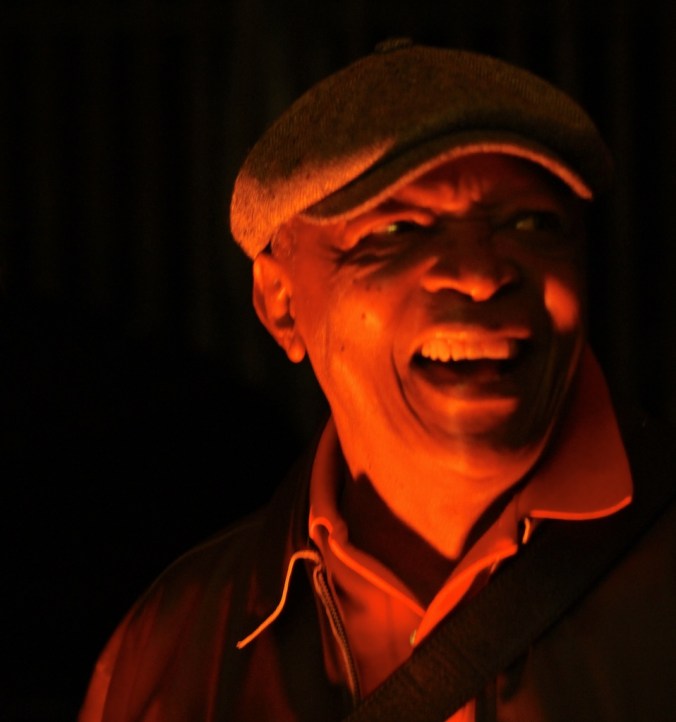
Somewhere in the middle of this set Caroline Manins went up to Stephen and whispered in his ear.   Stephen looked startled for a few seconds and then proceeded with his electronic wizardry.     Caroline then whispered in my ear, “there is someone I think you should meet”.    Leaning against the bar was Hugh Masekela, anti apartheid hero, Jazz icon, Afro Beat star.  In the subdued lighting with its soft red overtones it all seemed surreal.  The short 74 year old man stuck his hand out and smiled widely.  Then before I knew it he had enveloped me in a hug.   The great man hugged quite a few strangers that night and I suspect that all were enriched by the experience.    This was Hugh Masekela’s way of telling us that in a diverse and complex world, music can remove any barriers between us.  To paraphrase Herbie Hancock, “Music is what I do but finding a common cause with humanity is my real work”.   He has just been honoured by President Obama for his life’s work.

Cameron Ward

Cameron Ward

After the last of Stephen’s numbers Hugh Masekela asked Stephen to sit in while he, his guitarist and drummer played three numbers.  The crowd stood open-mouthed and a little star struck as the band began playing.   A guitar player from South Africa , a groove drummer from America and a Kiwi pianist – working with a Jazz hero.   Hugh placed the flugal horn to his lips and showed us that simple melody can say as much as complex harmony.  He never strayed too far from the melody but somehow his solo’s were all the more profound for that.  IMG_6412

He ended the set with Herbie Hancock’s ‘Cantaloupe Island’ and thanked us.  We slipped out into the warm night, feeling very pleased with ourselves for being in that place at the right time.

I have included a link to the Hugh Masekela concert review from N Z Musician.  The concert was a blast.

Who: Stephen Small (Keys) – with Johnny Fleury (stick), Stephen Thomas (traps) – Also: Hugh Masekela (flugal horn) plus two members of his band.

When: Wed 13th March 2013

Where: CJC (Creative Jazz Club) – 1885 building basement Brittomart

Foot Note From an Observer Interview – extract:

Q.”There was one occasion when the apartheid government tried to invite you back as an ‘honorary white’. How did that feel?

It was not only insulting, but it was like the height of comedy, right out of the fucking Marx Brothers.  The apartheid people were actors and they had to act out their part in their beliefs every day. That’s why we always saw them as being comedic.”

Salon Kingsadore @ CJC

Murray McNabb

It had been a very busy week for me and I had not paid too much attention to the CJC (Creative Jazz Club) website.   All I could recall about the gig was that it would be something different.   The instruments came into view as I descended the stairs and as my eyes accustomed to the gloom I saw Murray McNabb.   Murray is a veteran of the New Zealand Jazz scene and ‘different’ is exactly what he does best.  There was a bank of keyboards, numerous pedals, leads everywhere, a drum kit and two guitars barely visible in the back ground.  I quickly learned that this was the release gig for the second album by Salon Kingsadore – ‘Anti Borneo Magic’.  Yes the title gave more than a hint of what we were in for.  An exotic improvised trance like dreamscape.   After a hectic week that was exactly what I needed and from the first vamp I relaxed into the music.

Salon Kingsadore was formed in 2004 to write a soundtrack for a play and their works are styled – spontaneous cinematic compositions.  Not long after that first album they were invited to perform at a film release in Italy.  These projects appear to be under the creative guidance of Murray McNabb (keyboards) and Gianmarco Liguori (guitars).  The other band members are Hayden Sinclair (bass) and Steven Tait (drums).  Murray McNabb is a successful film score composer having written for films like ‘Once were Warriors’.  Steven Tait

I have seen Murray perform many times and his own compositions are notable for the way in which he mines simple themes in subtle and deceptively complex ways.  He is the master of ostinato.  There are often references to modal music in his compositions (Turkish Like) but tonight the fare was more tightly focused.  At first listen there was an impression that the drums, bass and guitar were playing the same motif over and again while Murray developed the themes and added fills and colour.   This was not the case as subtle variants and accented changes could be determined if you listened properly.  Continuous and spontaneous improvisation over a vamp requires certain disciplines and foremost among these is a keen awareness of space and dynamics.  This interactive process requires everyone to participate actively and when that happens the repetitive transforms itself into something profound.

This is music that takes some right out their comfort zone as it references such diverse sources as John Zorn, film music, African music, psychedelic fusion and even surf music.   Someone asked me if it was Jazz.  I would certainly place it within the spectrum of jazz, but as an outlier with strong filmic qualities.  I have listened to a lot of John Zorn, Manfred Schoof and psychedelic Jazz Fusion over the years and so this was never going to scare me.

After a long week I quickly relaxed into the aural dreamscape unfolding.  This is music that you can dive into, swim away from shore and float free in.

WHAT: Salon Kingsadore – ‘Anti-Borneo Music’. Album release.

WHERE: CJC Creative Jazz Club – 1885 Brittomart

WHO: Murray McNabb (keys), Gianmarco Liguori (guitars), Hayden Sinclair (bass), Steven Tait (drums). Sarang Bang Records www.sarangbang.co.nz

WHEN: December 5th 2012

James Wylie & Friends@CJC

James Wylie is a respected saxophonist, clarinetist and composer who has played, studied and taught all over the world. He initially studied in Wellington where he attended the New Zealand School of Music. One and a half years ago he moved to Berlin and soon after that to Thessaloniki in Greece.

Those reading the CJC webpages eagerly look out for returning expats, as they very often bring new ideas back with them while still retaining a core of that ‘New Zealand sound’. James played alto saxophone on this gig and he demonstrated why the alto is rapidly becoming a popular instrument again. For years the popularity of the alto waned but happily that is no longer the case. Improvised music often gives the impression of being a ‘blue skies’ horizon where no boundaries exist. All freedom comes from discipline and it is the knowledge of what works best in a given situation that marks players apart. Chops count but musical taste counts too. James showed an intuitive understanding of this.

Tonal and textural contrasts add considerable depth to a performance and in this we were well served. We not only heard the multiple facets of James Wylie’s tasteful alto playing, but we benefited from the addition of Roger Manins tenor. This was a double dose of saxophone magic. The quartet was completed by two Christchurch expats, Richie Pickard on upright bass and Andrew Keegan on drums.

While their first number ‘The Mooche’ (Ellington) got our attention, the second number ‘Just in Time Contrafact’ (Wylie) simply demanded it. It was an outright cooker. Roger Manins particularly shines in these situations and as he and James worked the changes and stretched out, there were enthusiastic cheers from the audience. The sets contained a couple of originals, some well-known standards and seldom played tunes by Jazz greats like Monk. Best of all were the tunes we have never heard in a Jazz setting. ‘Wichita Lineman’ (Campbell-Webb) – [It is a little known fact but Glenn Campbell was one of the original Beach Boys], ‘I can’t help falling in Love With You’ (Elvis) , and a memorable version of the standard ‘For All We Know’.

Nat Cole and Billie Holliday sung this so memorably (and hauntingly) that post 50’s bands often shied away from it. That is a pity because it can still evoke all of the emotions that made it a popular classic. The band approached it in the way that the late 50’s piano-less quartets did. Playing contrapuntally while extracting the maximum beauty from the melody. In this style of playing the bass is pivotal and Richie Pickard was perfect.

While the horns naturally took centre stage I never-the-less had my attention drawn to drummer Andrew Keegan again and again. The quality of New Zealand drummers often amaze and Andrew is a traps player I will keep an eye on. He is not overly busy but he has an in-the-pocket propulsive style. He listens carefully to what the others are doing and reacts in kind.

The last portion of the second set featured James interpretations of traditional Greek songs. My love of Mediterranean infused Jazz is constant and hearing Greek music was a treat. James interpreted the lovely melodic tunes (in crazy time signatures) with an ease that can only signify his deep interest in this music. In this portion he accompanied Greek singer Egli Katsiki. Her voice while a little soft at times resonated perfectly with the keening alto and between them they reached deep into the hearts of the spellbound listeners.

It was nice to have James here and I am keen to see where his musical journey takes him next (back here soon I hope).

Kevin Field – ‘Field of Vision’ gig & album

Some die-hard Jazz fans complain that the modern jazz scene doesn’t produce enough music that sounds like that of the ‘classic era’.    This mythical era that they remember so fondly didn’t exist in the way they thought.  They forget that Louis Armstrong accused Dizzy Gillespie of playing ‘Chinese music’ and that Bill Evans was accused of not swinging.

The Jazz in any defined era has always sounded surprisingly different from the music that preceded it.   Jim Hall circa 2012 sounds nothing like the Jim Hall of the early ‘Pacific Jazz’ Era and why should he.   This is not a music to be set in aspic or to be kept in a hermetically sealed container to protect it from impurities.  Jazz is not a fragile dying art form but a vibrant improvised restless music that lives perpetually in the now.  As Whitney Balliett so famously said it is ‘the sound of surprise’.

Kevin Fields new album illustrates this premise perfectly. 

On Wednesday 25th April the CJC (Creative Jazz Club of Aotearoa) featured pianist Kevin Field as he promoted his ‘Field of Vision’ album.   Being a fan of Kevin’s, I had been quick to obtain a copy of the album and I was delighted by what I heard.  This was music with a deep groove and an unmistakable pulse.  The banks of synthesizers, the singers and the electric bass lines had given it a distinct Soul Jazz context.  Out of this came a series of mesmerizing grooves, which engulfed us in a way that made definitions quite meaningless.  As the band played at the CJC we sunk happily into a warm vibe that made the Autumn night seem very far away.  

The club gig kicked off with ‘See Happen’; a number that drew us deeper and deeper into a vamp while figures on the piano created a pleasing filigree by way of contrast.   The next number ‘imaginary friend’, opened the vistas wider.  On the album this was especially noticeable as the Steinway Grand, Fender Rhodes, Prophet T8 and Roland Jupiter 8 worked beautifully over the four piece string section

It had an almost cinematic feel to it and I could not help but be reminded of the work of Creed Taylor’s CTI label.  Instead of CTI’s Don Sebesky this album had utilised the services of Wayne Senior who arranged the string section.   The first airing of this material had been in the Kenneth Myers Centre and it was therefore fitting that Wayne Senior had been involved as his connection with the KMC goes back a long way.

The album was produced by Nathan Haines and his handiwork is evident throughout.  He plays alto flute, an ARP synth and is credited as co-composer on 4 of the 11 numbers.  The rest of the numbers were written by Kevin and they are probably his best work to date.

The band that Kevin brought to the CJC was a smaller unit than on the album and that is just as well because the club was packed.  A small club has a very different sound to a recording studio and the warmth and intimacy is the obvious benefit of being in that space.   When you buy the disk (and you should) you will notice a broader sound palette, a bigger line up and a crisper sound.  Both experiences are complimentary and anyone attending who has also purchased the album will count themselves lucky.  

Stephen Thomas had been brought in as drummer for the CJC gig and he had sweetened the deal by a congratulatory email that he sent to Kevin after the initial release.   “Man those were some sick grooves” he had messaged.  Kevin immediately confirmed him as right drummer for the gig.  Stephen is a terrific drummer and the choice was a good one.

Once again we saw Dixon Nacey perform and as always we watched open-mouthed.   This man is so good that it is frightening.  Completing the lineup were guests; Nathan Haines, Marjan Gorgani and Clo Chaperon (the latter had great soul voices).   All added something essential to the rich mix and in Nathan’s case this is only to be expected.

I would also like to mention Karika Turua.  He played a big Fender bass and his grooves although loud, were as big as his guitar.

There were a few quieter piano passages as well and on these we hear the crisp touch, the harmonic exploration and the crunched chords that have become so familiar to us in Kevin’s playing.  Kevin has many fans in New Zealand and most will have heard his previous piano trio album ‘Irony’ (Rattle Records).  Although different I would regard both as essential purchases as we follow Kevin Fields career.

The CJC band was: Kevin Field (Leader, Yamaha piano, Fender Rhodes, Synth) – Dixon Nacey (guitar) – Stephen Thomas (drums) – Karika Turua (bass) – Marjan Gorgani / Clo Chaperon (vocals) – guest Nathan Haines (alto flute, soprano sax).

On the album were: Kevin Field (Leader, Steinway piano, Fender Rhodes, Roland Jupiter 8, ARP Odyssey,Prophet T8  ) – Nathan Haines (ARP Odyssey, alto flute) – Dixon Nacey (guitar) – Joel Haines (guitar) – Mickey Ututaonga (drums) – Migual Fuentes (percussion) – Karika Turua (bass) – Bex Nabouta/ Marjan Gorgani/Kevin Mark Trail (vocals) – Cherie Matheson (backing vocals) – Miranda Adams/Justine Cormack (violins) – Robert Ashworth Viola) – Ashley Brown (Cello) – Chris Cox – (drum programming).

This album can be purchased in any major record store or for more information contact ‘Haven Music’ a division of ‘Warners Music NZ’.

All photographs by Peter Koopman – Gig venue/CJC Jazz club Auckland

Ottignon Bros Tour – Crazy in the moment

Ottignon band @ CJC

Matt, Eden & Dan

Seeing the Ottignon Brothers perform is to be put in mind of a very clever vaudeville act. There may have been more gags in a vaudeville act (well that is not strictly true) but the interaction between band and audience was honed to perfection.  The jokes were often of a musical nature and none of them missed the mark. This was great fun, highly inventive music and above all top class entertainment.

I first saw the Ottignon brothers when they were living in New Zealand and again some years later after they had moved to Australia. Aron was regarded as a prodigy on piano and I recall seeing Matt performing high wire saxophone acts somewhere. The brothers are now scattered around the globe, with Aron living in Paris and Eden & Matt based in Sydney (but gigging all over). The Australasian tour gave us a chance to connect with their new music and for the brothers it was a chance to play together again after 8 years.   The audiences responded by packing out their gigs.

Watching them communicate on stage was fascinating because they didn’t appear to need the cues that others rely on.   This apparent telepathy was advantageous to them as they responded to each other with lightning speed. The spontaneous twists and turns of the gig required them to be fleet-footed.

Aron

The way they had arrived at their set list was fairly post-modern and to lesser musicians it would have been challenging.  Only days away from the first gig in Australia they had put up a Facebook post; requesting ‘friends’ to nominate the tunes they should play. To be selected, each tune needed to attract at least two votes and predictably the suggestions were quirky. ‘Black and Crazy Blues’ (Roland Kirk), ‘Eden’s ukulele Song’ (Eden singing with ukulele, composed days before the gig), ‘African Mailman’ (Nina Simone), ‘Running Up That Hill’ (Kate Bush), a Medley of Sly & The Family Stone numbers, The poem ‘Trees’ which had been suggested by their Grandmother (Edwardian war poet Joyce Kilmer), ‘God save the Goat’ etc.  You get the idea.

The diversity of the material held the audience’s attention throughout, but it was their good humour and the solid musicianship which clinched the deal.Eden & Dan

Each number was a little crazier than the last but there were a few numbers which will linger in my memory for quite some time.  When Matt played the ‘Sly and the Family Stone’ medley the tone on his tenor morphed into a deep breathy rich sound.   On ‘Its a Family Affair’ he reminded me of Pharaoh Sanders and I asked him about that after the gig.   He told me he had been taking an interest in some Ethiopian tenor players of late and that they cultivated that particular sound.  The other number that I liked was more of a novelty and that was when Matt played his iPhone using the ‘Gyro Synth’ app.   This looked easy but it is not (I know because I have the app).  Matt has played with Lou Reed, Brain Wilson and Mike Nock among others.

Throughout Aron laid down solid percussive grooves on the piano and lived up to his considerable reputation.  In Europe he fronts a group called ‘Aronas’ and is featured in a number of well-known bands.   Eden showed his chops on double bass and electric bass, but also ventured into song and ukulele as the set list demanded.   Eden is the leader of the ‘Sun Searchers Collective’.  Dan Kennedy was on drums for the New Zealand leg of the tour and Kiwi’s are familiar with his tight propulsive, energetic style.    Dan is a favourite at the CJC and they could not have picked better for this gig.

Matt performing on iPhone.

http://youtu.be/eSDbUwLIuXE

Aron pleasing large crowds in the South of France

http://youtu.be/O9ARpmvWrHU

Astral Surfers – Murray McNabb Band @ CJC

Murray McNabb

I have seen Murray McNabb perform many times over the years and it has often been said that he plots a course at variance to the mainstream.   If this is true it could also be said of many top Jazz musicians; they understand that Jazz audiences seldom want to hear endless note-perfect repetitions of previously played music.   Improvisation demands musical bravery and the Murray McNabb band has this essential quality.   The sharp-witted Zoot Sims summed up the sentiment when he said, “Jazz is the music where you never play the same way once”.

Auckland has of late been experiencing an explosion of Jazz creativity and the ‘Astral Surfers’ album is a fine example of this.   The album came out over a year ago and for some reason I had never located a copy.   I should have tried harder because the album is marvelous.  It gives a nod to the best Jazz of the 1960’s but the album is also very contempory.   This is a musical narrative (like ‘Zoo’) and the overall vibe is essential to the journey which unfolds. It is exactly as the title and track list suggests; a journey through exotic and often surreal landscapes. I am always up for this if the music is good and it is.

The album was created with a much larger pallete than the live band used at the CJC.   Apart from the core band of Murray McNabb (keyboards), Frank Gibson (drums), Neil Hannan (bass) and Stephen Morton-Jones (saxophones), additional members were present on the album.  Martin Winch (guitar), Basant Madhur (Tabla), William Yu (dulcimer) and Tanya Li (erhu).  All of the compositions are Murray McNabbs.

For me, there is a powerful presiding spirit hovering over this album and that is guitarist Martin Winch.   His passing late last year was felt deeply in the Auckland Jazz community and to have him recorded to such advantage here, makes the album a treasure for that reason alone.

The first two tracks on the album are ‘Marco Polo’s Return’ and Sub Continental’ .    These tracks draw on the shifting sounds and colours of the silk road.    Stephan Morton-Jones weaves engagingly in and out of a solid groove laid down by Murray, Frank and Neil, occasionally extracting microtonal effects from his soprano as he traverses foreign sounding scales.    The richness and diversity of the musical palette does not divert us from the core theme and that is as much down to Murray’s writing as to the musicianship of the band.   Adding tabla, dulcimer and erhu into the mix works, as they fit in well and enrich without overpowering.

The title track ‘Astral Surfers is also brilliant with Frank Gibson putting his experience and chops to the best possible use.   He makes sure that he does not overshadow the tabla while never-the-less blending in a few percussive tricks of his own.

It is the track ‘Snake’ that I like best.  It has a solid bass line and a nice melodic hook while providing a vehicle for improvisation.   Martin Winch can be heard playing against Murray’s engaging vamps while Stephen extracts alto gold from the deep groove.  Martin and Murray also provide convincing solos.

Many of Murray McNabbs compositions are modal or give the impression of being so.   He has developed the art of extracting profound messages from apparently simple progressions and the fact that they are so satisfying is due to his writing skills.

The band that fronted the CJC gig was the basic McNabb, Gibson, Hannan & Morton-Jones unit.   They got down to business and showed us that they did not need the extra instruments to create a big sound.   Murray had thrown a curve ball at Stephen by writing parts for two saxophones (to be played simultaneously) and Stephen in true Roland Kirk fashion had risen to the challenge.  I asked him after the gig if it had been daunting to play two saxophones at the same time and he admitted that he had needed to work hard in order to get there.   The fingering on a soprano and on an alto is the same, but a fourth apart.   This unison playing worked well and at times Stephen also used one of the instruments as a drone.   He joked afterwards that the biggest challenge would be playing counterpoint to himself.   Maybe that wasn’t a joke.

Many of the tunes played were not from the album and the first tune Scarborough Fair (trad) was a knockout.    This had been reworked into a near modal form and the rich voicings and nice ballad groove gave the band a freedom which they used to advantage.  Another tune that appealed was ‘Turkish Like’.    I intend to follow the McNabb band more closely in future but I will not be expecting more of the same as they tend not to do that.

Natalia Mann interview

Hi Natalia,

I would like to thank you for agreeing to this written interview as I know how busy you are.   This will serve as an addenda to the post on your album ‘Pacif.ist‘ and give context to the Pacifica/Turkish connection.  Above all it will provide an insight into the charts and your choice of ancient and modern instruments. (read in conjunction with previous blog)
Q. Can you tell me a little about the harp you played at the launch?     It seemed smaller like the Celtic harp and wonderfully ornate.  Was that the one that you played on the recording?
Hi John.
 The harp I played at the launch is a nylon strung harp made by Andrew Thom in Tasmania.  It is a standard size for larger celtic harps – 36 strings –  though they can come in any size.  The ornamentation is actually quite industrial – a silver aluminium frame with black dots, and some subtle functional wooden detail. It has a carbon fiber soundboard and an aluminium soundbox covered with leather. But the shape of the arch and column itself is amazingly organic, comparable to dripping glass, with a koru curl.  The “Holden Red” colour makes it quite sexy, like a stiletto.
I played this harp on one piece on the album – Time.  Although most of the pieces were written on lever harp, when it came to recording I preferred to use the concert harp – the sound is richer and deeper.  I used the lever harp on Time because the composition includes string bends that are a sounds you get particularly with levers.  For the rest of the recordings I used my Lyon & Healy Style 23 Concert Grand (a big classic ornate wooden harp like those you see in the orchestra).
Q. Is some of that music improvised or were you following a score (or Jazz chart)?
There is improvisation in all of the pieces except for Interlude for Grozda, which I wrote out very quickly one day and I played that from the notes because I really liked them.  Usually I make a kind of jazz chart with melody, and we go from there.  Generally my aim is to improvise, so we’ll play the first round from the sheet and then expand on the ideas after that.  I love the way Aksam Duasiturned out because there’s so much improvisation in it.  It had one of the most minimal charts.   Greenstones is a piece that is usually ‘set’, ie, I usually play pretty much the same thing every time. In this version on the album, there was an extra melody chasing me all the way to the studio that day.  It wanted to be included in the recording. So when I got there, I tried to make room for the extra phrase.  It resulted in an improvised introduction of 2 or 3 minutes which I think worked very nicely with Richard NunnsTaonga Puoro.
I love improvising, and if I’m not improvising, I don’t mind making mistakes so that I have to improvise my way out of them.  Even if I’m playing the set tune, it’s still got to feel like an improvisation.  That’s the good music.  That’s what I’m chasing.
Q. Were those compositions originals or created out of traditional motifs?
That begs the question ‘Is there such a thing as a completely original work’?  I try to keep things as original as possible.  I try to let the music tell me how it goes rather than the other way around.
The only piece in which I really used a particular template is the first part of Akşam Duasi (Evening Prayer).  That melody came about one day when Izzet and I were looking at a traditional Turkish rhythm called Hafif which is a single bar of 32 counts.  You say “Dum tek tek, Dum tek tek, Du-um te-ka du-um tek tek-a…”  like this.  I made up a melody to help me remember the rhythm, we liked it and it became one of our tunes.  The second half of that piece came about when we were having a lukewarm jam one afternoon and the ezan (call to prayer) began. Suddenly the instruments got hot and took off as if on their own accord, jamming along with the ezan.  It’s simple and it feels good – familiar but from where?
Certainly in my early compositions, I used things that were ‘evocative’ for me, colours and feels from genres I’m familiar with. Greenstones has obvious Celtic influences, but begins with what for me is a bassy Polynesian rowing rhythm.  I recall now that it’s melody was influenced by speech and the motivic nature of the Kanun (Turkish zither).  As I got more comfortable with composing, I became more excited by melodic or harmonic movements that would surprise me.  These days I spend more time trying to figure out what it is that I wrote.
Q. The quality of the percussion work was extraordinary and I gather that your husband is the drummer.   How many percussion instruments were used apart from a normal drum kit.
Yes, Izzet Kizil is an extraordinary percussionist, and is my husband, and is a big influence on my work.  He has a very advanced, distinctive, intuitive personal style.  In fact he is not really a drummer, even though he played kit on these recordings.  He specialises in Middle Eastern hand percussions.  His main instrument is the Turkish Darbuka.  The other instruments he used were Turkish Bendir (a frame drum similar to the Irish Bodhran, which he plays with hands and brushes),  Daf, a Kurdish and Persian frame drum like the bendir but with dangling rings on the inside of the drum which makes the thunder sound that I love.  You can hear him play Kanjira (a small hand-held Indian drum with one zil) and Kup or Gattam (Indian clay pot) on Uc Adim.  He also plays a number of small effects percussions like clusters of seeds and bells.  He sets himself up a little kit made of the above instruments and a small snare and cymbals, which he plays with hands, brushes and sticks.  In Butterfly Effect he also plays percussion with his voice and fingers hitting his mouth and throat.
There is another drummer on the album and that is Riki Gooch.  Because Izzet isn’t a regular drummer, Riki noticed that some of the grooves could use some firmer ‘laying down’, (Gul Cayi, Sunshine Sister, Uc Adim), and he added in some very sensitive cymbal and highhat to complement what Izzet had already done.  Riki and Izzet met in Wellington, spent time and played together, so it was a nice vibe rhythm section even though the recordings happened on either side of the globe.
Q. Is there any connection between your music and the Sufi musical tradition.    Many Jazz groups in southern Europe now use an Oud (Italy especially) and some extraordinary Sufi trained musicians like Dhafer Youseff are having an impact.   I have seen him perform twice and it was a profound musical experience.
I have been very influenced by the sounds of Sufi music and musicians in Turkey, primarily the guitarist Erkan Ogur, and his albumsFuad and  Hiç, the title of which is a Sufi concept meaning ‘anything and nothing’.  In fact Mevlana or Rumi, the father of Sufism, was based in the town of Konya in southern Turkey during his enlightenment period with the philosopher Şemş.  Today Konya is called ‘the kitchen’ of pure Turkish classical music particularly because it is connected strongly with the study of Mevlana.  When I first came to Istanbul, I played mainly with Turkish classical musicians in Sufistic concerts. I will add here that the reason I was very attracted to Turkish music was not only for it’s beauty, but also the fact that it is an artform which melds improvisation with the written note. Recently I performed repertoire from the Sufi composer Yunus Emre with a singer at a Mystical Music Festival.  At that performance I was encouraged to improvise deeply and generously, because this is one of the expressions of union with the divine.
Izzet comes from a Sufistic tradition – his father played percussion for religious reasons. Sufism is a liberal and mystical branch of Islam. Living in an Islamic country with lots of philosophical artists around, Sufism is an underlying feeling.  I think it has been entwined in the development of Turkish music over the centuries, recognisable in the sense of expansive space and melodies of emotional longing for the divine.  I work towards deepening this kind of energy in my music.
Q. Is there a strong Jazz community in Turkey?
Yes there is. It’s relatively small but dedicated.  There’s a club in Istanbul called Nardis which is a dedicated seven night quality jazz place where lots of great Turkish musicians play.   Izzet plays for a group called “Ilhan Erşahin’s Istanbul Sessions” which is a New York-Istanbul jazz triphop outfit which is very popular.  A lot of international jazz artists tour through Istanbul. There are lots of great Jazz festivals going on, musicians coming over from Europe and the states.
Q. I understand that you were born in New Zealand and are of Samoan descent.  Is that correct?   Is there a Pacific influence in your music?
I was born and grew up in Wellington, witha seven stint in Los Angeles in my childhood. My mother is Samoan and my father is Australian – Scottish English descent.  The album is entitled Pasif.ist because I think of it as Istanbul through a Pasifikan’s experience.  The music is my response to the local environment as someone who is from ‘somewhere else’ and far away.  This is the manner of the Pacific influence in my music.  It is also in the concept of feeling the vibe of the environment and being in harmony with it.  Taonga Puoro is the ultimate example of this in my opinion.  If I’m in Aotearoa with a harp, I’m inclined to play clean air music with intervals inspired by tui calls. In the Pacific Islands I’m inspired by the warmth and rhythms of the water and trees.  In fact, these experiences are my references.  The antipodes are fierce with nature.  So moving into the densely populated, polluted, urban environment and foreign soundscape of Istanbul, I both absorbed the experience and reacted to it.
Some things that are particularly Pacific to me are the introduction of Migration, inspired by bird calls and contemporary NZ classical music.  Greenstones is another one.  Seeing the social-political situation between Kurdish and Turkish communities here, it made me think about Maori and the other communities which have journeyed to Aotearoa.  In that piece I always imagine the West Coast of NZ, clear starry skies and cold air. Sunshine Sister (my homesick song) is a sunny island tune about laughing and joy, as is the second part of Aksam Duasi.  Like that, the influence weaves its way through the music.
One of the reasons I started writing tunes here was to find a middle ground where I could communicate better with my Turkish musician friends. One time at a first gig, I said to the band, “let’s just jam this one on a dub groove.”  Well, I started, the bass player came in with something slightly different, the drummer joined with something different again, the violinist changed it more and by the time it got to the second tabla player, I had no idea what we were playing, but it wasn’t any kind of dub that I recognised.  There were suddenly all these alien rhythms my ears were trying to process. It was pretty funny.  So I figured out that we all have different vocabularies according to our experiences. I wrote music that mixed my perspective with a local vibe – where there weren’t too many preset rules and everyone could bring their own interpretations.
Q How many strings on the violin like instrument?  It sounds similar to the Chinese Erhu.
The violin like instrument is the Classic Kemençe (keh-men-cheh) played by Sercan Halili.  It has a three string and a four string version, and in Time, Sercan plays an Alto Kemençe which he had designed for himself.  It is the first and only recording of that instrument.  I love it because it sounds like a raspy old man.  I love all the kemençes for their soulful vocal sound – so etheric.  The instrument is played with a bow, but balances between the knees rather than on the shoulder.  It has gut strings, and the tones are created by pressing against the strings with the backs of the fingernails. It is a very highly regarded Turkish instrument for its delicate and emotional nature. Mostly it is played in Turkish classical music settings; Sercan is quite adventurous.  He is a talented young player fluent in the Turkish classical world and working on a number of cross-over projects.
Q Have you considered doing an even more Jazz influenced album one day?   Your music on Pacif.ist swings.
Thanks man.  I like swinging. I love jazz.  I’m doing a Masters degree in Jazz at the moment, so I reckon there will be a few new tunes popping out that are more jazz influenced.
In fact the first piece of the next album is a jazz tune already.  We were going to put it on this album but felt it needed more time to mature.  That was a session with the great bass player Dine Doneff (aka Kostas Theodorou) from Thessaloniki.  I met him out in Skopje which is where I study jazz with the guitarist Toni Kitanovksi.  Dine later came to Istanbul to record on some pieces and it was such a great experience working with him.
Q.  Could you tell me your link with Rattle Records?   Steve is doing a fabulous job of recording NZ Music and a number of those albums are absolutely world-class (‘Zoo’ by Tom Dennison is my very favourite).
Steve Garden and Rattle Records have been fantastic.  I approached them with my demo a couple of years ago and asked if they’d be interested to release it on their label.  Happily, they said yes, and they’ve been really supportive throughout the process.  There are many artists for whom I have huge respect and admiration on the Rattle label, so I’m honoured to have my album in the same catalogue.  The recent output by Rattle of artists and new music is phenomenal and gorgeous.  Really a cool support for art music in NZ.  Many thanks to them.
Q. What is your connection to Bic – I gather that you have been recording with her?
I’ve been playing with Bic Runga since about 2006, when we did the Acoustic Winery Tour and I played in her band.  Since then we’ve worked together when we get the opportunity.  I recorded on Belle, the title track of her new album.  She invited me to play support for her recent national tour.  So I did the support performance, releasing Pasif.ist, and then I joined her and the band on stage for a couple of numbers.  We had a great tour, with Kody Neilsen and Michael Logie in the band.  I admire Bic’s stellar output and her musicality.  She’s always encouraged me to get my music out there.
I must thank you for the thought that you put into your answers Natalia.   I look forward to your next visit home and to any future albums.
Best wishes
John (Jazz Local 32)

‘Pasif.ist’ Natalia Mann – an Oriental Dreamscape

The music I cover here may not be Jazz in the purest sense but it is music that transcends the limitations of musical boundaries.  It has its own pulses and rhythms and it is improvised around themes.    This is a delicious orientalist dreamscape of the sort painted by Lord Leighton, Alma Tadema, Edward Lear and Eugene Delacroix.  It is redolent of sultry afternoons in an Ottoman palace or of the winding streets of Istanbul.   In the unfolding subtleties, one can hear the merest snatches of older themes; Constantinople and even Byzantium are hinted at but never confined.   This is not traditional Turkish music but an exotic vision of a landscape just beyond our reach.  This achieves what all great music does – connects us with a world that we would want to explore further.

In early December I received an email from Rattle Records inviting me to the ‘Pacif.ist’ CD launch and at that point I had scant information on the event.    I had every intention of requesting more details but the workaday world drowned me in trivia and I soon forgot.    One week later I was sitting in a meeting when the reminder flashed up on my iPhone; the launch was starting in an hour.

The venue was the spectacular Iron Bank building.   An imposing piece of modernist architecture towering far above the rainy Auckland streets.   The launch was held in an intimate minimalist space and the invited guests were mainly musicians associated with Rattle.  To one side of the dimly lit room was a beautiful red lacquered harp and beside it the barest bones of a drum kit (snare and cymbals).   Soon, harpist, Natalia Mann sat down to conduct a brief sound check and when she had finished I spoke to her about the lovely voicings that she was creating as she plucked and stroked the strings.   They were pianistic Jazz chords, but with all of the extensions added.   In the conversation that followed, we spoke of BeBop harpist Dorothy Ashby and of the later avant-garde stylist Alice Coltrane.   At this point, I was intrigued to hear the music, as this was a gap in my musical knowledge that I was very happy to fill.

I have long been a fan of Mediterranean, Middle Eastern Jazz and its Jazz/World Music offshoots, but I can’t recall ever hearing Turkish Musicians.   The launch used only a duo but they captured the mood perfectly – Natalia Mann (harp) and the well-known local, multi-instrumentalist Kody Neilson on drums. The album could perhaps be described as improvised World-Music but with Jazz inflexions – the sort that ECM presents so convincingly.   With top rated musicians like Tigran Hamasyan and Dhafer Youssef bridging the World/Jazz continuum we will see a lot more of this music on offer.   If you open your ears Jazzers and listen carefully, this gentle melodic music with its rich percussion will get to you.

After Natalia had returned to her busy life in Istanbul I conducted an email interview with her and this will be posted as an addendum to this post in a few days.

The Album Pacif.ist is available in download or hard copy from Rattle Records.    I would strongly urge buying the CD, as the artwork and liner notes are so good that it would be a crime against art to circumvent them. http://www.rattle.co.nz

The musicians on the album are; Natalia Mann (harp, compositions), Izzet Kizil (percussion & drums), Sercan Halili (classic Kemence & Alto Kemence), Abdullah Shakar (fretless bass & electric bass), Dine Doneff (double bass), Richard Nunns (taonga puoro [6]), Lucien Johnson (soprano & tenor sax [3]), Riki Gooch (percussion [1,2,3]), Naomi Jean O’Sullivan (gongs [9], co- writer), Serdar Pazarcioglu (violon [5]), Deniz Gungor (aqua [5]).   The album was mainly recorded in Turkey but with some instruments recorded in New Zealand.  That rich-voiced exotic string instrument you hear is the ancient Kemence (see interview).

After I had written this, I saw an article in the latest Downbeat about the growing Jazz scene in Turkey titled ‘Emerging Turks’.  The New York times has also highlighted this in a recent article.     Natalia is New Zealand born and of Samoan/European descent.   She is at present doing a master’s degree in Jazz at Skopje and is in demand with various European orchestras.   She loves Jazz and has projects on the way which will lean more in that direction.     

Istanbul – Pacif.ist cover art

Afterword – ‘Mother Tongue live’

This was an amazing night of music and to those who missed it – shame on you. If you have a domestic air ticket lying about or are living in the lower North Island or South Island you can still catch the act (see previous post). Carolina is quite something on her ‘Mother Tongue’ recording but to see her perform live is to experience much more. She is a singer who should be experienced live because she is also a stellar performer. The intricate sinuous hand gestures as she sings, create an added texture to an already rich and evocative music.

This band is first class and what they brought to the music was simply wonderful. Having two of Auckland’s best drummer/percussionists in the one band did not hurt at all. They were similar in style to Manu Katche and Nano Vasconcelos who have often performed together in such Jazz/World music. It was the second time that I had caught Chris O’Connor at a gig and I can see why he is so in demand – especially for intricate drum work like this. Ron Samsom’s skill on the drum kit was already very familiar to me and it was fascinating to watch these two percussion masters swap roles throughout the performance.

Roger Manins did not play his usual tenor saxophone but showed his chops on the bass clarinet (Eric Dolphy and others used this axe to great effect). The deeper and woodier sounds were entirely appropriate for this ancient music and Roger still managed to stretch out convincingly. He also played the more traditional clarinet and the flute.

Nigel Gavin used a resonator guitar and a manouche guitar, and he stunned with his combination of lightening speed and middle eastern modal riffs. Although his guitars were amplified and had the usual array of pedals, his contributions were so well placed and appropriate to the music that it was hard to imagine the pieces without him. Kevin Field (piano), Matthias Erdrich (bass) and Jessica Hindin (violin) performed their parts with ease and this underscores their musicianship as none can have been that familiar with such diverse musical genres.

Apart from the Sephardic music we heard songs in Hebrew, English and Gaelic. There was also a standard, ‘Black is the colour’. This old english ballad was so beautifully executed that the audience seemed to hold their breath at each phrase. No one wanted to miss a single note.

I have long wondered why Jan Garbarek‘s compositions and arrangements are not used more by Jazz musicians and on Wednesday I had that view reinforced. A version of Garbarek’s arrangement of the traditional Nordic piece ‘Gula Gula‘ from ‘I took up the Runes‘ was played. It was the best version you could ever hope to hear and Carolina who is a gifted linguist had learned the Gaelic pronunciation of the song. During this piece the band stretched out and went crazy. It was one of those moments when you hoped that the music would never stop. If I have one plea it would be; perform more Garbarek compositions and arrangements please – perhaps with a bowed electric bass Eberhard Weber style.

‘Mother Tongue’ – Carolina Moon (the Sephardic music of medieval Spain)

Carolina’s wonderful album ‘Mother Tongue’ is beguiling and all it takes is a single listen, for the mysterious beauty of this ancient music to stay with you forever.   This album speaks of medieval Spanish Sephardic culture with absolute authority and in partaking of the journey we are connected to a time and place most New Zealanders know little about.

The Moors ruled much of Southern Spain (Al Andalus) for nearly 700 years and what is little known is that they welcomed the Jewish diaspora to live among them.     This tolerance by Islamic Spain lasted until the Reconquista by the Catholic Christian armies of the north and after their arrival (15th century), the Judeo-Spanish faced the ultimatum of expulsion, conversion or death.  The songs of the Sepahardic Jewish are rich in imagery and the cadences of their unique language are evident in these sensual and often wistful songs.     Contained in this music are the rhythms of Arab, Hebrew and Spanish life.    A truelly blended music that has been deeply enriched by the streams that have fed it.    Ladino (Latin) is the term for this ancient language, which has also helped form the distinct Catalan variant of Spanish.

Carolina Moon (Mannins) is a fine Jazz singer but she is also a multi-lingual singer and well versed in other musical genres.  She is British by birth but has worked extensively as a musician and music teacher in the UK, Australia and for some time now New Zealand.   This is our gain.   The excellent arrangements on ‘Mother Tongue’ are Carolina’s and it is this factor, coupled with her unmistakably rich voice,  that gives the album that extra depth and authenticity.  It is obvious that she has invested everything in these performances.   This has never been just another gig for her

I would like to make mention of several songs that are on the album.  The first is the wonderful ‘Ondas’ (13th century Spanish).  The word in Spanish means wave or ripple and she could not have chosen a better track to open with.  The timbre of her voice is rich and filled with the passion and longing of the song.   At certain points the emotion is so visceral that it sends a shiver down the spine.     I have not reacted to a voice in that way since I last heard Sassy on ‘tenderly’.  The second and contrasting song is ‘Tres Hermanicas’ (track 8).    This is a traditional Sephardic song and the full band is used to very good effect.    Because of the arrangement and the rhythm it sounds closer to the Manouche traditions.

The accompanying musicians are all top rated and many are the cream of the Jazz world.   New Zealand’s finest acoustic guitarist Nigel Gavin is the only choice for this music, as his Manouche credentials and guitar chops are impeccable.    Kevin Field is on piano and once again he has managed to be the perfect accompanist. Caroline’s husband Roger Manins weaves his usual magic and his abilities as a multi reedist are manifest here.   Ron Samsom and Chris O’Connor (percussion and drums), Jessica Hindin (violin), Matthias Erdrich, Mostyn Cole, Steve Haines (acoustic bass).

Every music lover should purchase a copy of this, which is produced and mixed by Steve Garden for Ode records (with the assistance of Creative NZ).    To learn more about this gifted artist go to;  http://www.moonmusik.com – better yet come and hear her perform live during the tour – underway at present.   The next performance is at the CJC (Basement of 1885 Galway St) Wednesday 2nd November.

Footnote: The first merger of western music and African Music was always thought to be Jazz, but musico- ethnologists are now pointing to Moorish Spain (over a 1000 years before), as the first time this occurred.    The improvising traditions are deep streams within all good music.

The New Fuse Box – The Wakem/Nielson Project

The Wakem/Nielson Project

When I received this CD in the post I knew very little about ‘The new Fuse Box‘ as I had only seen a few mentions of them online.     Happily I will never be in that state of ignorance again.     While this may not be your typical Jazz offering it is never-the-less highly enjoyable and as the Jazz scene in Auckland matures we are learning to appreciate a diversity of soundscapes.     This is not quite the raw and highly energised music of a live band but it is enjoyable, well arranged and beautifully articulated.   The music has a depth that may elude the listener at first play, but listen again and it will get under your skin and stay there.

This is essentially Kiwi music (Auckland music), and a sense of space and sunlight pervades the album.   Over the years I have come to recognise that there is a certain discernible quality when Jazz has developed in remote-from-the-centre locations; this sense of place exists in juxtaposition to the usual traditional aspects.    Scandinavian,  French, Italian, Sardinian, Spanish and German Jazz all have a unique something that would not have arisen had the music been made in America.   New Zealand Jazz is now claiming its own space.

There are fifteen tracks on the album and they skillfully mine a number of vibes.   There are funk infused tracks and soulfully slow tracks but they all seem to work as part of a cohesive whole.   Above all this music does not take itself too seriously as there is musical humour as well.   While I have many favourite tracks I simply cannot resist the intentionally over-the-top and utterly delightful ‘Bossa Tossa‘.     This track will put a big smile on your face.   There is also a filmic quality to this material and the best of Jazz movie-score writing is conjured up here.

All of the material has been composed and arranged by Lindsay Wakem (horns arranged by Chris Nielson).   Lindsay is terrific on piano and keyboards and I hope that he will give us longer solos on future releases as the piano is often back in the mix.   His piano playing has a crispness and clarity to it and I am keen to hear more.   ‘The New Fuse Box‘ is a multi- talented band and Chris Nielson the co-leader needs a mention at this point.   When I looked at the credits and I saw, ‘horns- Chris Nielson’ I was puzzled.   I phoned Lindsay and asked him if there were uncredited horn players.   I quickly learned that Chris is not only the trumpet section but that he plays all of the saxophone parts as well.   The charts are gorgeous and the multi-tracking so seamless that it is a struggle to imagine him playing all of these parts.   The drummer, on all tracks except one, is the well known and much respected Jason Orme (Blue Train etc).  Jason can take on any task in Jazz drumming and he is a an asset here.  The bass player is Phil Scorgie.  He and Lindsay go back a long way.  Other artists appear on single tracks and they are guitarists, Dean Kerr & Frans Huysmans – Kody Nielson drums.

Jazz is a music which teaches us something of history and struggle, but more importantly it is a music founded in the desire for change.   It is not a museum piece and so it should always explore and challenge the world around it.   This album does that and I look forward to more from them.   The ACT and ECM labels (both German) have profiled this sort of jazz to great advantage.     There is a real market for this material and I hope to see more of it.

ACT’s Lars Dannielson, Blue Note’s Bob Beldon and ECM’s Mathias Eick have paved the way and our own bands should now be welcomed into this interesting space.   The album is self produced and so for a copy contact:  lgwakem@xtra.co.nz

Herbie Hancock: Chameleon, Headhunter, visionary?

Even before septuagenarian Herbie Hancock rolled into town he had been sought out by most of the mainstream media.    This man fascinates people beyond the Jazz world and I suspect that everyone would give a different reason why.   Herbie is simply larger than life and terminal cool is his brand.   When asked by Lynne Freeman of Radio New Zealand whether he was going to spend the rest of his days fine tuning his impressive musical legacy he surprised her by replying, “Music is what I do but it is not who I am.  I am a human being and I want to work on real issues that effect ordinary people”.   A long time devout Buddhist (as is his close friend and long time collaborator Wayne Shorter) he exudes calm and speaks with commonsense.   Herbie does not buy into his star status; but to others he is never-the-less a living legend.
We could feel the excitement mounting as we waited for the show to begin and then right on 8 pm the lights dimmed and drummer Trevor Lawrence strode onto the stage   He laid down a solid mesmerizing beat until James Genus appeared, who then added to the groove on his electric bass.   Suddenly Herbie was on stage; grinning and bowing to the audience and the fun began.    He looked fit and ready to get-down to it.   The group swiftly ripped into an upbeat, spirited avante guard tinged piece (Actual Proof) that was more Ornette than Empyrean Isles.  I suspect that would have taken many out of their comfort zone and this was clearly the intention.   The mood was well set and throughout the concert Herbie skillfully used tension and release in enumerable ways.   As this amazingly high energy group moved through the varied repertoire you could see the joy on their faces.   James genus seldom took his eyes of Herbie and they played as a single entity.   We got spirited renditions of Hancock classics followed by highly atmospheric tunes (such as Joni Mitchell’s ‘court and spark’ from the Grammy winning ‘River’ album with Wayne Shorter).    ‘Court and spark’ and other songs were sung by the fourth band member, vocalist and violinist Kristina Train.  Her voice was smokey and appealing and the crowd loved her.   We heard a jazz version of Bob Dylan’s ‘the times they are a changing’ and Bob Marley’s ‘Exodus’ accompanied by pre-recorded Sudanese musicians.   ‘It’s 2011’ said Herbie as he pointed to the hard drive at the heart of his system. Herbie Hancock is the undisputed master of electronic keyboards and effects, but on Tuesday he reminded us that he still owned the acoustic piano chair as well.
This was the history of post 50’s Jazz and it was the perfect ethnomusicology lesson.    We heard Irish, African, folk music and classic delta blues but the master’s stamp was on all of it.   This edgy musical journey was still unmistakably Jazz.   In the middle portion of the concert however Herbie played solo piano, taking us on an impressionistic reflective journey through his Maiden Voyage albums.   The band came back to accompany him on ‘Cantaloupe Island’ in what was to end a half hour piano medley, which held every one in awe.  Even ‘Round about Midnight’ got an airing.  Not a sniffle , not a cough, even Keith would have been impressed.   The stuff that I loved best was his Headhunter funk and he swung and grooved that like crazy – deep down grooves played with boundless joyous energy.    At the end of the concert he brought on a visiting group of blues rockers; slide guitarist Derrick Trucks and his wife Susan Tedeschi (a loud singer who sounds a lot like Janis Joplin).      This was pure enjoyment from start to finish and if anyone thought that Jazz was in decline they should have seen the age-range of those present.   The faces of the audience as they came out told the whole story.

Beautiful Tunisian Oud Jazz

These You Tube live recordings will please some while others will dislike them.  That is of no real matter because Jazz has never tried to be all things to all people.   Jazz is a restless music and throughout its history it has taken on the voicings and ethos of other musical traditions (often making them its own).   Dizzy, Miles, Coltrane , Latef and others never stopped listening for new and exotic sounds and a lot of excellent music resulted from their interest in non-American music traditions.  

I saw Dhafer Yussef at an International Jazz festival and I will never forget the experience. His band performed breathtaking improvised music, jazz as we know it, but often around very ancient themes. It felt to me like a wonderful addition to the Jazz lexicon. Dhafer is a Sufi and the Sufi traditions are an ancient expression of Islamic culture. Sufi’s follow a mystical peaceable tradition which is gradually becoming better known in the west. Great poets, like Rumi, Hafez, Bulleh Shah and Khwaja Ghulam Farid are of this tradition. Qawwali is the best known form of Sufi music, however music is also central to the whirling dervishes and the ceremony of Sema uses a slow, sedate form of music featuring the Turkish flute and the ney. The West African Gnawa is another form (Randy Westen and Dizzy referenced this).

Dhafer Youssef (Arabic: ظافر يوسف‎) (born 1967 in Teboulba, Tunisia) is a composer, singer,and oud player. He developed an interest in jazz at an early age and clandestinely listened to it during his education at Qur’anic school.[1] He later left Tunisia to start a jazz career and has lived in Europe since 1990, usually in Paris or Vienna. He has played at many of the premier mainstream Jazz Festivals in the world and is mentioned on the USA based ‘All About Jazz’ website. I have been interested to note the number of Arab and Israeli Jazz musicians routinely mentioned in Down Beat and Jazz Times lately. The second clip features a stunning young Arab pianist Tigran Hamasyan and his Moorish Jazz style is quite beguiling. In this second piece the music builds in intensity and I suspect that this is part of the tradition (note the movement of the hands to enhance the vocalese).

Night in Tunisia

Youssef Dhafer at Moers Festival, June 2006, G...

Image via Wikipedia

In the mid nineties I was lucky enough to visit Switzerland for two weeks. Walking happily and aimlessly around the beautiful shores of Lac Lemon, Geneva, one summer evening, I came across five North African musicians playing entrancing modal melodies on the traditional instruments of their region. As I recall there was an Oud, hand drums, a reed instrument and several other stringed instruments.  I stopped to listen and during a break in the music asked them the obligatory, “what country are you from?”  “Tunisia” they called out with huge grins indicating their traditional costumes.  “Dizzy Gillespie”,  I said turning to my friend Michael as I threw a few Swiss francs into the cap that lay in front of them. We had hardly walked on a dozen steps when a cheerful cry of  “hey English” accosted us.  As we turned round the musicians began channeling Dizzy and to my ears that version of ‘Night in Tunisia” sounded just wonderful. I marvelled that they should know that 1940’s American Be-Bop warhorse because they were barely more than teens.  Jazz can truly be a world-music.

Some years ago I listened to a not-so-successful attempt to use an Oud in Jazz. The band was about in the late 1950’s and the ‘fusion’ was far from convincing; a novelty at best.  As the ECM label broadened the scope of its Jazz offerings I began to hear marvelous improvised music on the Oud. In the late 90’s I purchased several CD’s by Tunisian Oud player Anouar Brahem (a Keith Jarrett influenced musician). The Oud creates a wonderful soundscape and the deep improvisations the instrument is capable of adds much to the musical lexicon.

In 2009 at the Wellington Jazz festival I decided on a whim to go to an additional concert. The group was lead by Sufi Tunisian Oud player Dhafer Youssef.  This concert was up-there  as an experience and I enjoyed every note. His band consisted of Marcin Wasilewski (piano), Michal Miskiewiscz (drums) and a great Canadian arco-stick-bass player whose name now eludes me. Dhafer sung his other worldly songs and played the Oud and the crowd was entranced.  Having the heart of the utterly brilliant Tomasz Stanko band as his rhythm section did not hurt either.
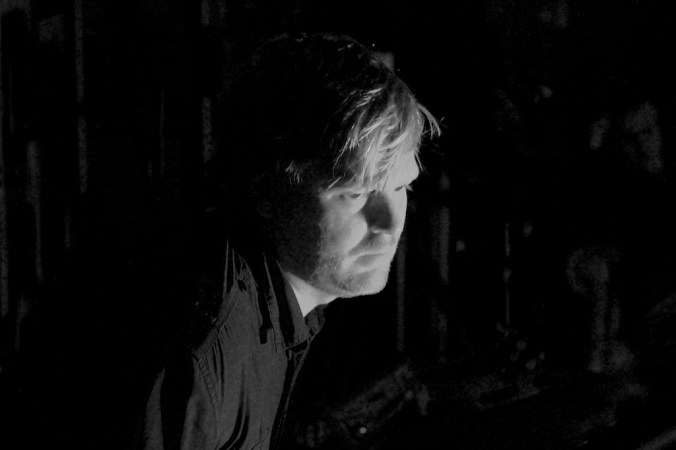
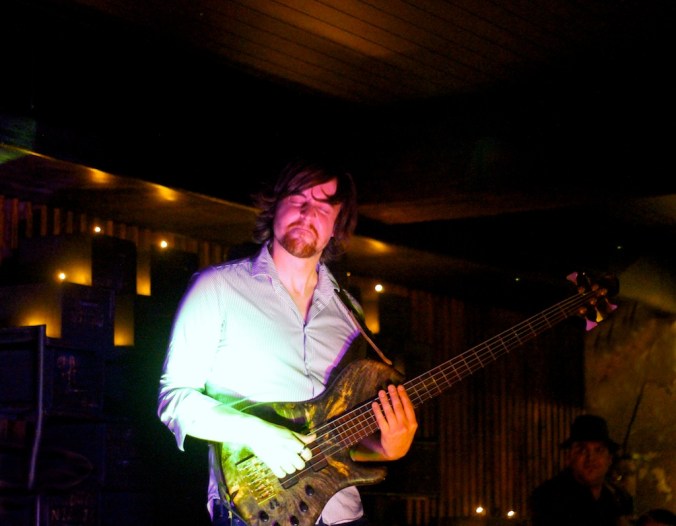
The Oud is just fine by me.