Dan Costa ~ Pianist & Composer

.

Dan Costa was born in London to Portuguese and Italian parents. He has lived in eight countries. I mention this, because Dan is somewhat of a troubadour, frequently travelling from country to country and always absorbing the musical influences. He listens carefully, interprets, and then takes it to a new level entirely, and this 

brings something essential to his music. It is not so much a sense of place but a sense of the world at large and its limitless possibilities. Nowhere is this more evident than in his second album ‘Skyness’. Check it out on the streaming platforms, and like me, you will return again and again. It is rare to encounter music with such heart-stopping beauty.    

Costa is an interesting interview subject, partly because he is so well travelled, but also because he is expansive and erudite. In fact, he speaks eight languages and judging by his English, many fluently. He is an internationalist and an environmentalist. He is also an advocate for animal rights. All of the above illustrates the point that a good musician is not just about the notes. Character and lived experience are the ‘finishing school. This is refreshing to encounter.

Costa is deeply influenced by Brazilian Jazz, but I can detect other Latin influences like Flamenco and Fado. He is a thoughtful player who makes every note count. His voicings and time feel, especially at the slower tempos, are impeccable. It is no wonder that such fulsome praise is being heaped upon him by the likes of Jazziz, Jazz Word, Jazz Weekly, Musica Brasiliero, New York Music Daily etc. 

And his collaborations with the likes of Randy Brecker, Seamus Blake, Hermeto Pascoal and the wonderful Ivan Lins have crafted wonder upon wonder. He creates such open vehicles; composed and arranged so as to invite maximum participation. The musicians he has worked with are quick to say so and their praise keeps coming.

His prior recorded output has set him on an interesting journey, so his newest album ‘Beams’ will be eagerly anticipated. It is about light in its different forms. With him on ‘Beams’ his core trio, John Patitucci and Paulinho Vicente, with guests Mike Stern, Dave Douglas, Dave Liebman, Anne Bocatto, Hermeto Pascoal and Teco Cardoso. The album teaser is posted here and I can’t wait to hear the rest of it. For information on albums and tours, go to his website www.dancosta.net

 JL32  Good evening Dan. Thank you for giving me a few hours out of your busy schedule. As a traveller myself, I must say that I am impressed by how much of the planet you have covered to date. 

DC  Hi John, nice to connect, Yes, I have lived in eight countries and travelled to around 60 as a musician or tourist, but there is still a lot to see. It is an interesting world and I hope to live in more countries and to keep travelling. One of my friends is buying a house but I am not interested in that for me. I think that you need to live in a country for at least two years. That’s how you get to know the culture. It removes the fear of the unknown when you do that. 

JL32 Increases empathy and negates racism right? 

DC Exactly, music is also a multinational language and one that has many dialects but it brings people together.  I like to associate the sounds I hear with colours. Harmony is just colour. I am looking at the painting behind you as we speak and I am immediately thinking of the French impressionist composers. 

JL32  The painting is impressionistic and is of forest and sky.  I love forests, the older the better.

DC Then you should visit the Amazon. When I was living in Brazil I spent some nights in the Amazon rainforest and in fact the title of my first album ‘Suite Tres Rios’ is inspired by the meeting of two great rivers in the Amazon. These rivers meet but keep their different colours. It’s a fairly unique phenomenon and it is a bit like my parents who each kept their unique cultures intact. That was my experience as I grew up. It was like two rivers meeting and when we moved to France or England new colours were introduced. Each keeps its essence but interacts. So the tunes on that album were inspired by the Amazon. For instance, one track is about the stars above the rainforest, the clearest stars I’ve ever seen.  

And my album Skyness was inspired by the blue of Greek Island skies. The skies above the Greek Islands are different to other places.  (We digress here into a long discussion on sky colours and rivers, so I recommend Cape Reinga where ocean and sea meet, as do the different colours touch each other)  

JL32  Tell me about the Brazillian singer-songwriter Ivan Lins. I love his voice and I first encountered him on a recording with trumpeter Paulo Fresu and the Sardinian Jazz Orchestra.

DC  I wrote to him asking him if he was interested in recording with me and I was pleased when he replied enthusiastically. He has written many great songs but we settled on ‘Love Dance’ which is one of the most recorded songs in musical history (everyone from Joe Pass, Quincey Jones, Sarah Vaughan and even Sting has recorded it). It is a love song and harmonically it has many interesting twists. He also has a house in Portugal so we recorded there and it was a nice experience as we recorded it in one or two takes. The studio was booked for two hours but most of the time was spent talking. He is a person who likes to be near different oceans or rivers. We had that in common, and we also connected because we like delving into musical styles. 

JL32  And you collaborated with Randy Becker (check out the teaser on YouTube). I love that, he is another musician who has an affinity with South American music. Brazilian music is sometimes referred to as the ‘other swing’. 

DC  Yes, 1917 was the date of the first Jazz recording and also the first Samba recording. So with Randy Brecker, the tune was already recorded on my album ‘Skyness’ inspired by the feeling of closeness to Mediterranean skies and by the notion of international togetherness. I had originally recorded the tune solo, so I wanted to re-release it with Randy and he loved it. 

JL32  What a great tune ‘Iremia’ is and how beautifully you both improvise around the melody lines. 

DC  So he came in on top and it was a special moment for me as he has played with some of the greatest stars in musical history. And many of the people who I recorded my first album with were also on his Grammy-winning album Randy In Brazil. The tune you mention is not Latin but the meaning of the name Iremia is peace in Greek. By coincidence, it was re-released at the moment the war started in Ukraine. It got quite a bit of attention, especially in Italy and it was featured on Sky News. This message of peace should be there at all times, but in times of war, more so. When I wrote it I was living on Paros in the Cyclades Islands, so it is about tranquillity and peace.

JL32  I must ask here. Do you have a working trio or involve different musicians in each project? Or to come at it slightly differently, is there a configuration that you prefer working with, solo, trio, quartet, or larger unit?

DC That is an excellent question. I am comfortable in all formats, in fact, the first concert will be in Hamilton with a big band.  I have worked with orchestras but not with my music, but on every album, there is a different type of lineup. I enjoy that.

JL32 I love the tune ‘Skyness’, it is the sheer beauty and architecture of it. Those voicings, the time feel like your left hand is gently pushing at your right hand, conversationally, and by the time Seamus Blake comes in we are mesmerised.  

DC  My third album ‘Live In California’ was a solo album, my next album will be a trio with special guests. One month ago I recorded in New York with John Patitucci and I enjoyed that. But to answer your question, no particular format and I like to give a voice to everyone. 

JL32  I saw Patitucci in a Roman amphitheatre, Verona, with Wayne Shorter, Danilo Perez and Brian Blade. Not an experience that I will forget. What’s the album called?

DC ‘Beams’ as in light, with John Patitucci and Paulinho Vicente as the core trio. The guests are Mike Stern, Hermeto Pascoal, Dave Douglas and singer Anne Boccato. Oh, and the saxophonist Tecō Cardosa, who is the only musician to appear on multiple of my albums. But I would record again with any of the above. I like the Brazilian percussionist Teco Cardosa very much. He is a multi-instrumentalist and plays flute, saxophone and percussion. There is really something special about him. He features in the piece ‘Compelling’ on the second album.

JL32  Yes an amazing and energetic track. People who don’t know this album or that piece need to check it out ASAP (on streaming platforms. Sadly, the physical album is hard to find but I located one). 

DC I created a video for World Earth Day which is on my website. That was recorded with Teco on the flute. It is one of my favourite pieces as I really like the fusion of the flute and piano. What do you think about that combination? 

JL32  Flute and piano and flute over a modal groove interests me greatly. Although it was always a significant presence in Brazilian Jazz, in American Jazz over the second half of the twentieth century the flute was often regarded as an instrument lacking sufficient expression. People who said that were clearly not paying attention and had not listened closely to Yusef Lateef, or Bennie Maupin. It is now regarded as an essential primary instrument as a renewed interest in Spiritual Jazz is evident. Yes, I love the combination.  

DC  I have several passions and interests beyond music. Things I have studied at University. I have worked as a language educator, I also studied philosophy for a time and history, both of which are interests of yours, I think. I’ve also worked a lot on environmental issues and especially animal rights. I am a vegetarian. Environmental aesthetics is extremely important and often overlooked. The environment and not only in the ecological sense but in everything that we do. And all of this is linked to my music. They are not separate worlds. 

The new album is called Beams because it is a celebration of light in different forms, the light that shines too and from you. The album refers to physical light for example, the tune ‘Star Dial’ which I recorded with Dave Liebman. Then there is also the more metaphysical light. The light which shines from Animals. I wrote a tune called  ‘Paw Prints’ when I was living on Pados, written for a dog that I saw mistreated (a homophone and play on the Shorter standard Foot Prints). And then a tune with Mike Stern called ‘Sparks in Motion’ which is about celebrating the city, the light of a city. 

JL32  When you release an album, do you have a preferred label?  

DC Self-release gives me my independence. Berkeley these days teaches musicians to do it for themselves and learn about the business that way, rather than waiting for a manager or a label to snap you up. Ethics and proper respect for music should be the impetus. Commodification makes an art form into something else. 

JL32  Well, we’ve been talking for hours and I know it’s late there. Thank you for your insights and for your music. I have enjoyed it and I hope that your tour goes well. I am sure that anyone listening to your music live will be as delighted with it as I am.

DC  I hope to see you at the concerts, John.

JL32  Ki kite

JazzLocal32.com is rated as one of the 50 best Jazz Blogs in the world by Feedspot. The author is a professional member of the Jazz Journalists Association, poet & writer. Some of these posts appear on other sites with the author’s permission

Jonathan Crayford Trio Christmas 2021

After a hundred and seven days in isolation, five days of equivocation and an anxious twenty minutes hunting for a parking space, there I was in the front row of the CJC Jazz Club; poised expectantly as the pianist’s fingers were about to descend. It was not as if I had been deprived of music during lockdown because my ears had been exploring a mélange of sounds. In fact, my noise-cancelling headphones had become such a fixture that I felt awkward without them. So what had I missed? I had missed sitting with friends, the hushed buzz of conversation before a first set and that feeling of joy as the lights lower. Live Jazz in an intimate setting is a unique experience, and for me, an addictive one. As Nietzsche said, a life lived without music would be a mistake.

I approach Jonathan Crayford gigs with high expectations and I am never disappointed. Even the occasional gigs in crowded streetside bars yield gold; but in a listening venue with a nice piano, you get the best of him. All good musicians feed on an enthusiastic audience, but with Crayford, there is a discernable x-factor, something quite beyond the ordinary. It is difficult to put into words, and I have approached this on previous occasions. You can see it in his gaze as he leans toward a piano, but it is also in his verbal engagements with an audience. When he talks and plays he is reaching beyond. Beyond a room, a city, a country. Gazing into the cosmos for inspiration.
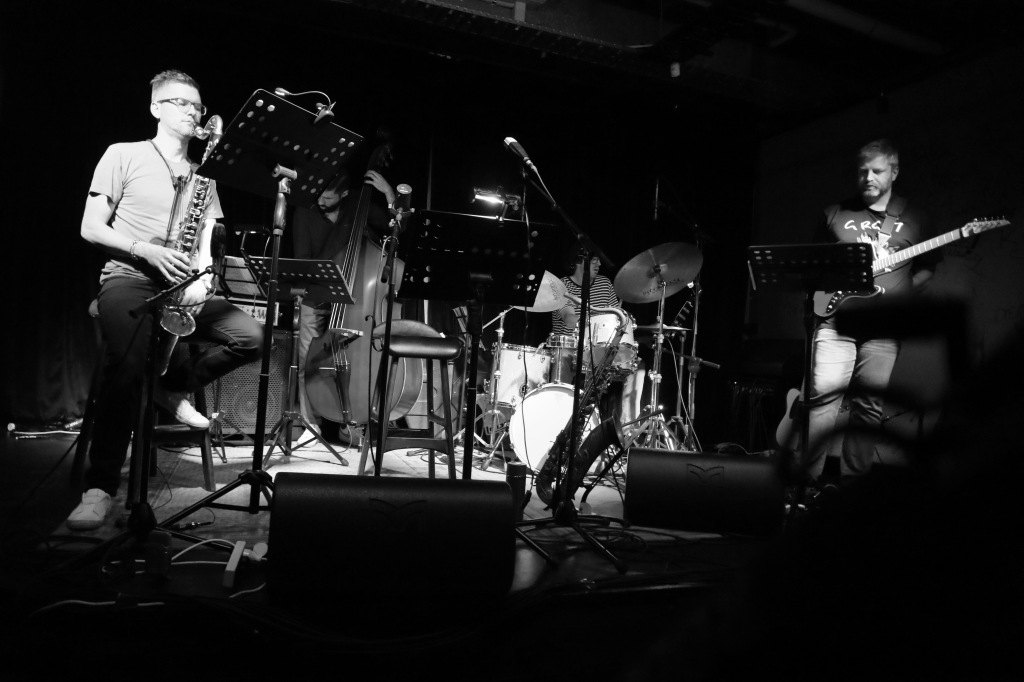
His talk is peppered with a sense of place, or with improbable events and observations as he weaves them into intimate and odd narratives. A park bench in Central Park, a book read in Paris, a philosophical discussion with a homeless person. Pavement tee-shirt manufacturing — bikes in space! He talks as if new worlds and indeed the cosmos falls easily under his gaze and that is reflected in his music. To make extraordinary music requires seeing beyond the mundane. The interesting thing, however unexpected, is that for a moment, we hear through brand new ears. That is his gift. 
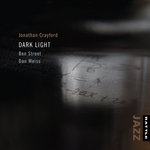
The gig featured a selection of Crayford’s compositions and all were extracted from his acclaimed New York Trio albums on Rattle. Anything from East-West Moon or Dark Light will please and fresh interpretations with a newly configured trio are always welcome. All three musicians were obviously pleased to be gigging again and I know that drummer Ron Samsom and bass player Cameron McArthur relished the opportunity to tackle these works. All three dug in and delivered as I knew they would.

If by some unfortunate oversight you have not heard East-West Moon or the earlier album, Dark Light, you need to remedy that over the Christmas break. I would urge you to bypass the streamers and purchase the album, or at least download it in WAV from www.rattle-records.bandcamp  Support Kiwi music. 

The CJC live trio: Jonathan Crayford (piano), Cameron McArthur (bass), Ron Samsom (drums) 

The NY album trio: Jonathan Crayford (piano), Ben Street (bass), Dan Weiss (drums) – Rattle Records (Rattle Jazz)

JazzLocal32.com is rated as one of the 50 best Jazz Blogs in the world by Feedspot. The author is a professional member of the Jazz Journalists Association, poet & writer.Some of these posts appear on related sites

Andy Sugg NZ Tour

With the opening of borders between New Zealand and Australia, it was hoped that improvising musicians could begin touring again. Apart from three returnees and several stragglers who chose to shelter in place, we had not seen an international for fifteen months. Unfortunately, the pandemic reestablished itself in Australia and that window closed within a week of its opening. There was, however, one musician who timed it perfectly and that was saxophonist Andy Sugg. 

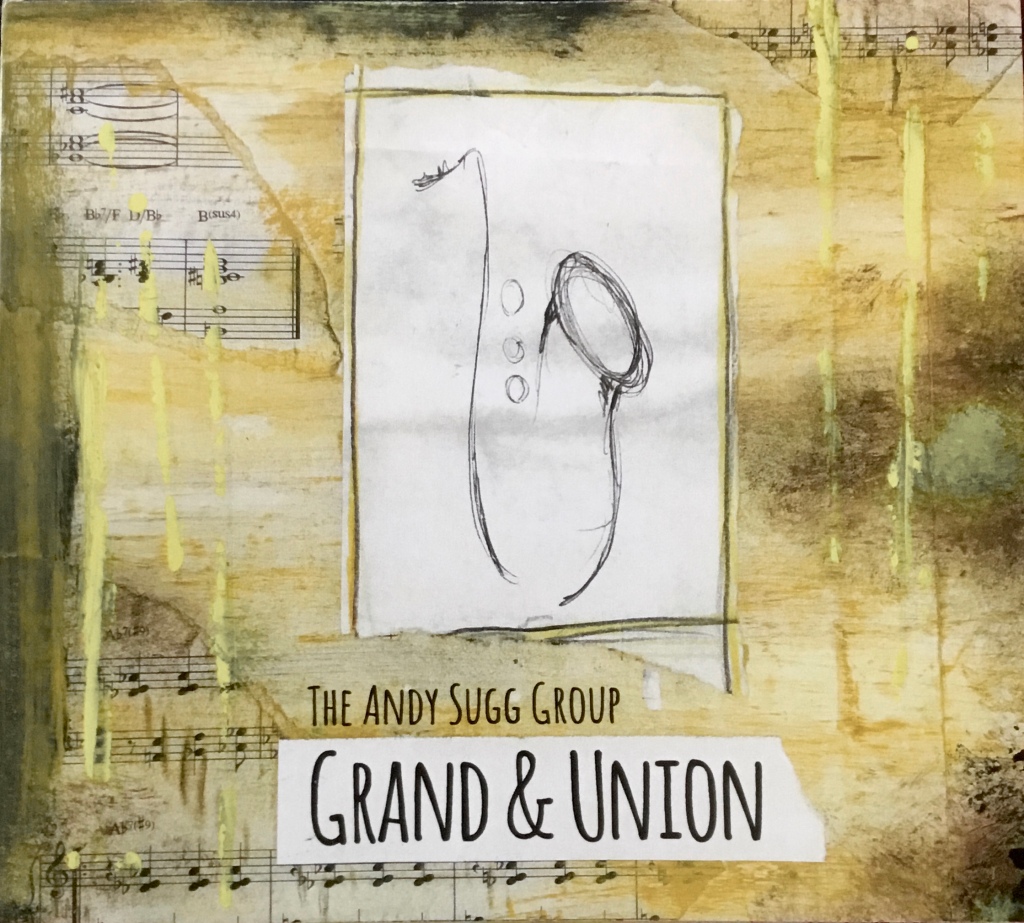
He flew out of Melbourne just days before another lockdown was announced and we were very pleased that he had slipped the net. Sugg is a gifted saxophonist with broad appeal and there was no better way to break the tour drought. The tour was billed as an album release but the setlist also included earlier compositions and two tasty standards. The album titled Grand & Union was recorded in New York in mid-2019 and released last year. For obvious reasons Sugg was unable to take to the road and certainly not with his New York-based bandmates. 

Grand & Union is a rail hub in Brooklyn but it is also a metaphor for the album. ‘A musical intersection where styles and motifs merge before moving somewhere else’. It is an album of diverse stylistic influences but the musicians’ craft a tasteful amalgam from the underlying base metals. In the liner notes, the leader mentions Stravinsky as a prime inspiration and ‘The Rite Stuff’ with its deep propulsive groove is the most overt reference; a stunning piece, which evokes the now without jettisoning the history underpinning it.  

Sugg is a particularly coherent improviser who takes a listener along as he tells his ear-catching stories, and his tone is particularly arresting. Warm as toast and seldom straying into the lower registers. On the soulful ‘Ruby Mei’, his sound reminded me of the great melodic improviser, Ernie Watts. Much credit is also due to his New York bandmates who are seasoned musicians all, and who worked as a tight cohesive unit. 

His Auckland gig featured a local rhythm section and they also acquitted themselves well. The first set opened with the title track Grand & Union and was followed by Ruby Mei and other tunes from the album, Then came a more expansive offering in several sections. This enabled Sugg and the band to stretch out. This was a gig of highly melodic offerings and as an added treat, the second set featured two popular standards. A musician said to me recently; playing a popular standard to a discriminating audience, means, that you must play it extremely well and you must insert something of yourself into it. They did. The standards were the gorgeous ‘Someday My Prince Will Come (Churchill/Morey) and the much loved ‘In a Sentimental Mood’ (Ellington). The audience shouted their approval, obviously delighted.  I have posted a YouTube clip from the Auckland gig. 

While each of the local musicians has experience playing with offshore artists, considering how long that has been, they were very much on form. Of particular note was Wellington drummer Mark Lockett. I could hear people commenting enthusiastically about his drumming between numbers. They were right to comment as he pulled one out of the bag that night. He and Sugg go back a long way and the connection was obvious. 

The gig took place at Anthology for the CJC Creative Jazz Club on 14 July 2021. I recommend the album and it’s worth checking out Sugg’s earlier album also. To order physical copies, download or stream, visit AndySugg.Bandcamp.com    

The album personnel: Andy Sugg/tenor saxophone. Brett Williams/piano & keyboards, Alex Claffy/acoustic & electric bass, Jonathan Barber/drums.

Gig personnel: Andy Sugg/tenor saxophone, Keven Field/piano, Mostyn Cole/acoustic bass, Mark Lockett/drums

JazzLocal32.com is rated as one of the 50 best Jazz Blogs in the world by Feedspot. The author is a professional member of the Jazz Journalists Association, poet & writer. Some of these posts appear on related sites

O’Connor/Derrick/Johnson

Last Wednesday’s CJC gig brought us a feast of truly adventurous music and it was beautifully executed. It was ‘free’ and ‘experimental’ and although within the improvised music spectrum, it is probable that many in the audience would not have encountered a prepared piano before. At the heart of the trio was the critically acclaimed pianist Hermione Johnson with drummer Chris O’Connor and reeds player Reuben Derrick. Anyone unfamiliar with a ‘prepared piano’ trio performance could not have wished for a better introduction. 

The beauty of experimental music is that you can put away the straight jacket of preconception and bring your imaginings to bear. New and unexpected worlds can be crafted out of the fragmentary detritus of the old. This is surely the ultimate purpose of improvised music. Freeing us from the tyranny of the obvious. 

This performance dove into the heart of sonority; creating sounds not generally associated with the instruments that made them. The piano had been prepared before the audience arrived and I wish that I had seen it. I have been lucky enough to witness this ritual on previous occasions, and ritual it is. There is a concentrated delicacy required in instaling the objects which muffle or extend the range of a piano. It is an installation and the precursor of new music. Items like chopsticks are inserted precisely between adjacent strings or perhaps a metal bowl is positioned. Few if any in New Zealand exceed the artistry of Johnson in this regard. 

Excerpts from concert

And it was not only the piano that reached for new sounds. No one thinks twice when they hear an instrument’s range extended by electronic means, nor should they when this is achieved acoustically. O’Connor, the drummer’s drummer is the most familiar to CJC audiences. He is one of Aotearoa’s best-loved and most adventurous drummers as he sits astride many genres with deceptive ease. During this performance, he added colour via fingers, mallets, sticks, gongs or rims, and no available surface or drum position was left unexplored. And he underscored the deep pulse emanating from the piano, tapping out some passages with surprising delicacy. 

Completing the trio was Christchurch based reeds player Derrick. The last time I saw him perform was in 2013 with his ‘Hound Dogs’. That particular unit performed a Monk heavy set that was well-received as I recall. Since then he has travelled extensively to places like Warsaw, Colombo, Vienna and Ljubljana. He is a noted composer and has collaborated across many cultural traditions. His fluency on the clarinet automatically singles him out, as the instrument is famous for punishing anyone who takes it up half-heartedly. On this gig, he doubled on tenor saxophone and his uncanny ability to locate the acoustic possibilities on both was evident. It’s a pity that he doesn’t live closer, I am up for more of what he has to offer.

Derrick, O’Connor, Johnson

This was music but it was also performance art of the highest order. It stretched us as improvised music should. It was wonderful. The only way that I can begin to do it justice is by abandoning written syntax. Filigree, texture, tropical thunder, raindrops, gamelan orchestra, quasar, delicate motifs, deep pulse, sighs, dance, hot tiles, exquisite, exotic. It reminded me of the first time that I heard Bley/Giuffre/Swallow’s Freefall.  My ears were realigned after that experience.     

Hermione Johnson (prepared grand piano), Chris O’Connor (drums, percussion), Reuben Derrick (clarinet, tenor saxophone). The gig took place at Anthology, for the CJC Jazz Club, 7 July 2021

JazzLocal32.com is rated as one of the 50 best Jazz Blogs in the world by Feedspot. The author is a professional member of the Jazz Journalists Association, poet & writer. Some of these posts appear on related sites

Henrique Morales Sextet

As pandemic upheavals continue, in New Zealand we count ourselves lucky. Not only are we one of the safest nations on earth at present, but we have also been experiencing more live music than most. Over recent months various streams of Latin music have come our way and last week we heard the Brazilian born Kiwi Henrique Morales at the CJC Jazz club. 

Morales has just released his first New Zealand album as leader ‘Alô Brasil’.  He has long been the frontman for the funky Batucada Sound Machine and Santiago Soul Stars and his current band is increasingly popular around town. His musical journey began at a young age in South Brasil, soon bringing him into contact with the most respected musicians of his region. This grounding proved fortuitous as it enabled him to become familiar with the many styles of Latin American music and in particular the regional variations of Brazilian music. 

While the music of central America frequently sheds sparks, the Brazilian musical styles are generally associated with a different vibe. They feel like a warm embrace.  Once the Jazz world had encountered Yao Gilberto, Elis Regina and the towering twentieth-century genius Tom Jobim, the linking of the two swing based styles was conjoined forever. Brazilian music in all its forms remains popular throughout the world and western influences like reggae and Jazz have readily been adapted and absorbed. Morales interprets the many styles of his home country including Brazilian popular music and Latin Jazz fusion. The material was mostly original compositions by Morales.

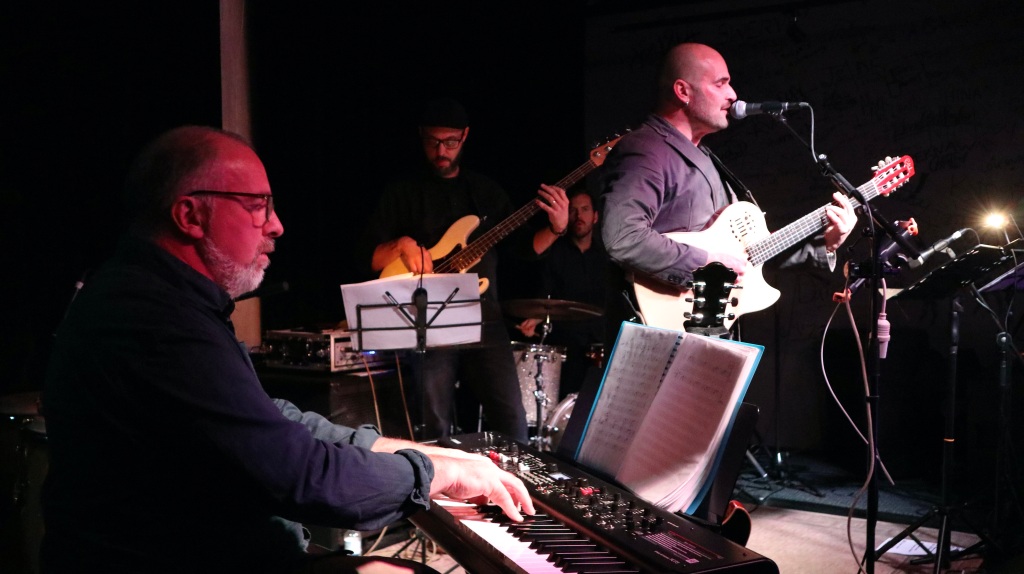
He appeared at the CJC with a slightly different lineup to that on the album. The saxophonist Thabani Gapara had been replaced by Daniel McKenzie. The remaining band members were Mark Baynes on the keyboard, Gustavo Ferreira on the bass, Jono Sawyer on drums and Fabio Camera on percussion. I liked the arrangements as they never overwhelmed the warm rhythmic pulse and the melodicism, both of which are so central to this music. 

After a long absence from the club, it is good to see Dr Mark Baynes back (twice in a month).  He has been concentrating on Latin musical styles for some time now and I can think of no one else locally who is better fitted to accompany South American artists on piano. He also brings his Jazz credentials to the music. His playing was a highlight for me with his Jarrett like vocalisations (freeing the spirit) and his Latin swing feel. Another treat was hearing the soft rich tone Morales evoked as he plucked the strings of his Godin A6 Ultra, a prince among guitars and perfect for Morales’s music. For a copy of the album check out a local store or best of all catch the band around town. 


JazzLocal32.com is rated as one of the 50 best Jazz Blogs in the world by Feedspot. The author is a professional member of the Jazz Journalists Association, poet & writer. Some of these posts appear on related sites.

CTI All-Stars Tribute

Jazz Funk is a subgenre of Jazz and although it draws on R & B and Soul it is a distinct niche. While it draws on many sources, it never completely overlaps them. It is a black American sound. it is accessible with a strong backbeat, good arrangements and shorter but tightly focussed solos. Above all it is danceable and that brings joy. Back in the seventies, it received a measure of grief from both sides of the spectrum. Jazz purists complained that It was not cerebral enough or too reliant on electric instruments while some in the broader music press complained that it was too much like mainstream Jazz. 

From today’s perspective, such nonsense is laughable. When Jimmy Smith, Gil Scott-Heron, Herbie Hancock, George Benson and Freddy Hubbard started releasing stunning Jazz Funk albums the naysayers were left with album sized chunks of egg on their faces. 

A few days ago Ben McNicoll brought his popular Jazz Funk unit to the CJC. His unit is called the CTI All-stars Tribute band and the reference is a potent one. The original CTI Allstars were leaders who came together for a large California concert: George Benson, Freddie Hubbard, Hubert Laws, Stanley Turrentine, Hank Crawford, Johnny Hammond, Ron Carter, Billy Cobham and Airto Moreira. The CTI label was the brainchild of record producer Creed Taylor. 

Povo

A man whose legacy is incalculable. He worked at Bethlehem Records, ABC-Paramount, Verve, Impulse and A&M before founding CTI (and its imprints). He signed John Coltrane for Impulse, Antonio Carlos Jobim and Stan Getz to Verve. He signed Oliver Nelson, Gil Evans, Bill Evans, Wes Montgomery and many more. His last great project, the CTI label captured a moment in Jazz history, bringing with it those warm funk-infused albums and for a time, a wider audience.  

Crab Apple

McNicoll is a musician who puts in the hard yards and he captured the CTI vibe perfectly. While featuring a gig of covers is not a CJC thing, this was much more than that. Yes, CTI covers were aired, but only in the context of an over-arching project. McNichol’s band offered us a valuable window into this epoch and his selection of overlooked standards captured the vibe to a tee.  It was great to see these numbers aired as they are often left languishing in the shadows. 

The tunes were infectious and they soon brought people to their feet and on a chilly winters night, what could be better? They were tunes redolent of an era and they were happy tunes. For those in the audience around during the seventies, they brought back fond memories, for the rest, the joy of discovery. Among the tunes played were Freddy Hubbards ‘Red Clay’, ‘Gibraltar’ and ‘Povo’. The ‘Taxi’ theme, Herbie Hancock’s ‘Hornet (a funky tune written around two notes), A Bob James and a Wayne Shorter tune and very pleasingly Idris Muhammed’s ‘Crab Apple’, a Louisiana funk classic. This is the music that you can hear in the New Orleans clubs. A unique sound that rides a groove to the moon and back. 

McNicoll

I have put up the ‘Povo’ and ‘Crab Apple’ cuts. The band featured Ben McNicolls on baritone saxophone, soprano saxophone and tenor saxophone, Joe Kaptein on Rhodes, Mostyn Cole on electric bass, Kurt Dyer on percussion, Andy Keegan on drums and special guest Jason Herbert on guitar.  The gig was at Anthology, CJC Jazz Club, 9 June 2021.

I would also like to acknowledge McNicoll for his tireless work on behalf of the Auckland Jazz scene. Most know him as the person who introduces the gigs each week, but the observant will be aware that he also helps set-up and pack-down; he does the sound checks and sits at the ‘desk’ and on top of that he frequently organises gigs for other musicians. He is a prime example of how a not-for-profit organisation remains functional. In short, he us the archetypal (unpaid) A & R person.


JazzLocal32.com was rated as one of the 50 best Jazz Blogs in the world by Feedspot. The author is a professional member of the Jazz Journalists Association, poet & writer. Some of these posts appear on related sites.

Steve Barry Quartet

I clearly recall the first time I heard Steve Barry. It was around eleven years ago at the1885. He was not long back from Australia, bringing with him bass player Alex Boneham and drummer Tim Firth. At that time the Creative Jazz Club was located in a dark atmospheric basement; an ill-lit venue bordering on gloomy and perfect for a Jazz club. You would grab a drink, sink into a well-worn leather armchair with broken webbing and wait for the band to begin. 

The music that night was unforgettable. Somewhat denser than I was accustomed to at the time, but never-the-less fully engaging and exciting. When the second tune was announced I pushed record on my iPhone because I knew that I was hearing a piece of music that merited further attention. It was a tune that he was working on and it would appear on his first album a short time later. That was the year of Aaron Parks and his Invisible Cinema, and Barry’s tune was titled ‘Parks’. I listened to that phone clip an awful lot over the following months and I could hear the future. 

Each time Barry has appeared in New Zealand he has showcased fresh ideas. He is a forward-thinking and innovative composer/pianist and as such he never rests on his laurels. Although born in New Zealand, Australia claimed him long ago. He is popular there, has obtained a doctorate and awards there and teaches at the Sydney Con. As expected, he brought us new compositions this visit, but as I listened I was also reminded of that first gig. While he moves on constantly and is not composing or playing in the way he did back then, there is still a hint of that younger player. Of past learnings gathered and picked through as he builds fresh iterations, crafted in part from the bones. I am not surprised that he studied with Craig Taborn.

His compositions are no doubt demanding and require good responsive players. He had assembled just such a crew for his CJC Anthology gig. Callum Passels on alto, Cameron McArthur on bass and Ron Samsom on drums. Local musicians of the highest quality. Passels has a gorgeous tone, but what sets him apart is his ability to push at the boundaries. His best work occurs when playing compositions that afford him certain freedoms and these compositions worked well for him. At times he would run over the lines which contrasted nicely with his tight unison playing. The sort of advanced musical thinking I associate with Warne Marsh. Perhaps because this was a quartet, the music also felt more spacious. The density and serialism were still evident but as always with Barry, there were fresh vistas revealed at each turn. 

The gig took place at Anthology K’Road for the (CJC Creative Jazz Club). 2 June 2021. For Barry’s album visit Rattle Records or stevebarrymusic.bandcamp.com

JazzLocal32.com was rated as one of the 50 best Jazz Blogs in the world by Feedspot. The author is a professional member of the Jazz Journalists Association, poet & writer. Some of these posts appear on related sites.

Mireya Ramos

Mireya Ramos was an unexpected musical treat because our borders, with very few exceptions, have been long closed to all but Kiwi returnees (and most recently Australian tourists). Ramos is from New York. Very few international musicians have managed to cross the border, and only if they obtained an exemption and subjected themselves to a strict quarantine. 

With the Australian Bubble just opened I assumed that Ramos must have come from Australia, but in fact, she arrived here with her acclaimed Flor de Toloache all-female Mariachi styled band to perform at WOMAD 2020. Within days of arrival, the borders had closed behind her. For many pre-lockdown international visitors, the border closure proved to be a silver lining as visas were extended and they could avoid the horrors unfolding elsewhere in the world.  

Mireya Ramos is a multi Grammy-nominated (and winning) artist and although the rest of her all-female mariachi band members returned home, she and her partner Andy Averbuch did what creatives do best, they got busy. During the year she has recorded and toured the country and her gigs have attracted enthusiastic audiences everywhere. Her CJC gig featured a variety of Latin and Central American styles with the addition of popular standards.   

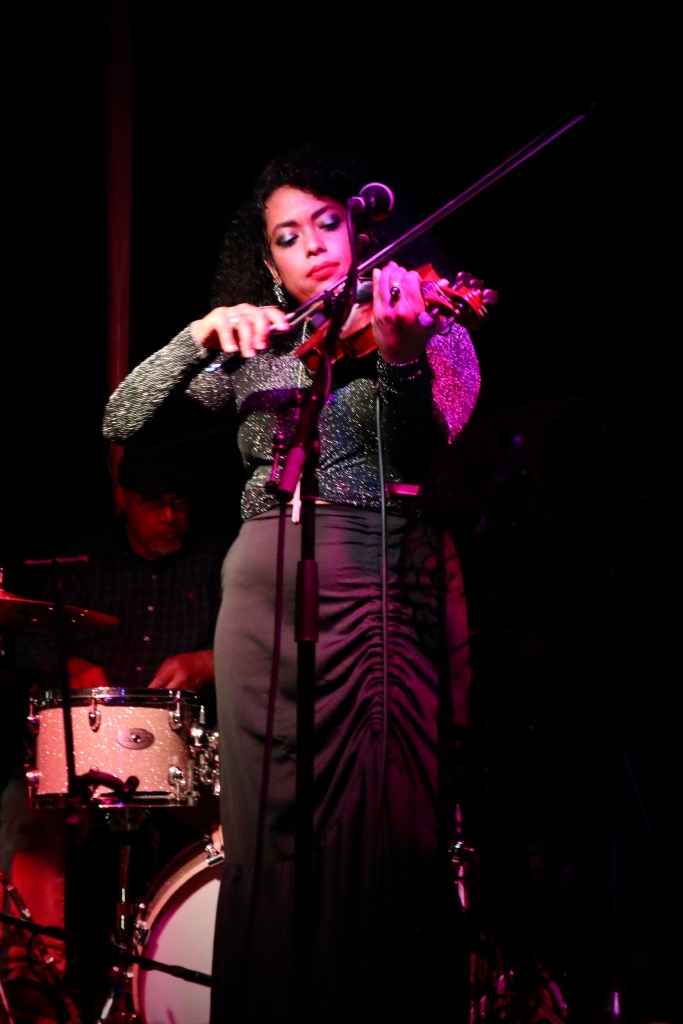
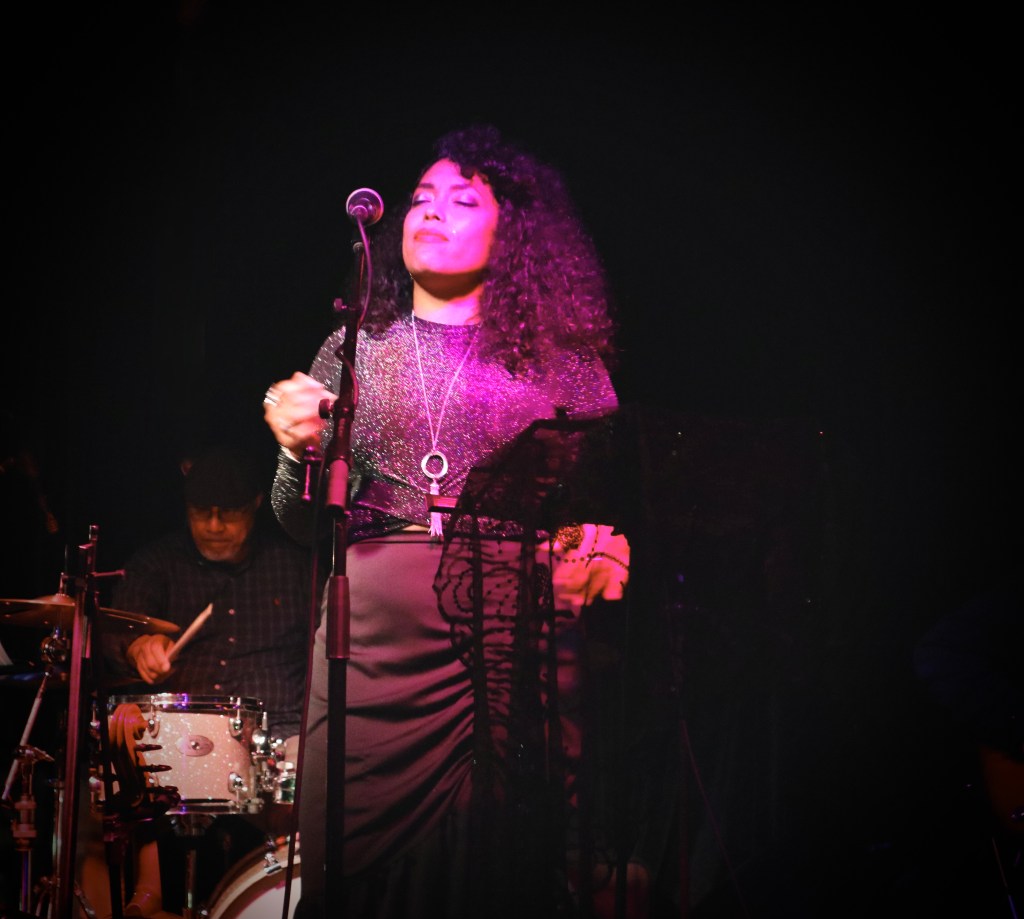
Her music draws on many genres, but all coloured by a stylistic uniqueness. She is both a vocalist and a violinist and that appealed as well. The violin is not unknown in improvised music, but sadly it is still uncommon. I am fond of the violin in Jazz and Jazz fusion styles and particularly so with Argentinean music. 

Listening Jazz audiences are always eager to hear traditional and blended South American music. A good example was the version of ‘Fever’ which morphed into an Afro-Cuban groove. Of all the tunes, that appealed to me the most. It is not often that we get to hear the many and varied Latin styles and whenever we do, we are left wanting more.   

Guitarist Andy Averbuch and Bass player Alex Griffith had opportunities to stretch out during solos and they made the most of that, but when Dr Mark Baynes and Lance Bentley locked into a Clave, the magic happened. Ramos has been received enthusiastically in New Zealand and after the pandemic recedes, I am sure that she will be encouraged to return. The band: Mireya Ramos (vocals @ violin), Andy Averbuch (guitar), Dr Mark Baynes (piano, keys), Alex Griffith (bass), Lance Bently (drums).

JazzLocal32.com was rated as one of the 50 best Jazz Blogs in the world by Feedspot. The author is a professional member of the Jazz Journalists Association, poet & writer. Some of these posts appear on related sites.

New Dog Extra Strength

The genesis of DOG goes back a long way as I first reviewed them in 2012. Over that period they have gained various accolades and awards. They are Dr Lonnie Smith in reverse because the group began their journey as Dr DOG but then ditched the title to better accord with their egalitarian street-dog ethos. Their reputation extends well beyond New Zealand shores and their second album was recorded with guest Australian guitarist James Muller. They have two albums out on Rattle and both are exceptional. 

Their first album featured the core group, and each of them contributed compositions: Roger Manins, Kevin Field, Oli Holland and Ron Samsom, The second album followed the same pattern, but with James Muller contributing as well. These are all exceptional players and the albums have allowed them to place a deeper focus on their writing skills. When musicians of this ability come together they are better able to push past arbitrary limits. 

Ten years on there is a new guest in the lineup and as always there are new compositions from everyone. I hope that this recent gig is the prelude to a third album because together this iteration is crackling hot. With guitarist Keith Price on board, they moved into fresh territory and alongside the burners, there were touches of big-vista Americana. No wonder the gig was billed as the New Extra Strength Dog. At times it was Industrial strength.

Although the group is co-led, Roger Manins is the compare. Any gig that he fronts will have X-factor and this was no exception. The first set opened with a tune by Price and it was blistering. From the front row, it was like being in a jet-stream but it was not just bluster. Price is a terrific composer and this tune rode a freight train of tension and breathtaking harmonic shifts. It was initially titled #3unnamed, but now titled ‘Karangahape’ (a nearby street with interesting tensions). That set the pace. 

With one exception (the encore), these were all new tunes and each complemented the other. This was a feast of good writing, tunes played and written by musicians at the top of their game. In spite of their long association, it is obvious that these guys enjoy playing together. The respect and warmth shine through the music. They are in sync because they respect the music and each other. The large club audience picked up on that, thus completing the virtuous circle.

I  have posted the first and last gig tunes as YouTube clips. ‘Karangahape’ (Price) and ‘Schwiben Jam’ (Manins). Both of the DOG albums remain popular and they are available from stores or directly from Rattle (and on Bandcamp). If you don’t own copies grab one now, and if you do, buy one for a friend. We are lucky to have artists of this calibre in Auckland and if we show our support, more albums will surely follow. www.rattle-records.bandcamp.com 

Keith Price

JazzLocal32.com was rated as one of the 50 best Jazz Blogs in the world by Feedspot. The author is a professional member of the Jazz Journalists Association, poet & writer. Some of these posts appear on related sites.

Mark Lockett Quartet

The Spirit of Ornette Coleman hung in the air last Wednesday, manifesting itself in the form of the Mark Lockett Quartet. It was a quartet devoid of chordal instruments. It was Coleman, not Mulligan. It was original music and an example of Coleman induced Lockdown creativity. The inspiration may have come from Coleman’s approach, but Lockett is a true original. He drums musically and tells stories at every turn. His tune titles, his solos and his announcements are tales from a true raconteur. He is a storyteller with an open vocabulary.   

I am always enthusiastic about a Lockett gig and with Lucien Johnson in the line-up, it was a sinch. I have reviewed several of Johnson’s albums, the last one, Wax///Wane, was especially fine. Like Lockett, he is adventurous and his musical fearlessness was an asset here. While Lockett composed the tunes (excepting two Monk tunes), Johnson was the principal arranger. 

The resulting gig was a tribute to freedom. The sort that shocked in 1959 and doesn’t know. Colman never abandoned the rules, he just invented new ones. His hard to nail down theory of ‘harmolodics’, an evolving rearrangement of hierarchy, with harmony, melody, speed, rhythm, time and phrases jostling for equality. I think that he would have enjoyed this gig as he never wanted followers. What he wanted, was fellow travellers and he found that with this band.

I can’t recall when I last saw a trumpeter, Oscar Laven. He was smokin’ last Wednesday and his forthrightness and bright tone, balanced out the thoughtful and softer toned explorations of Johnson on tenor saxophone. Everyone took solos and the notes they blew added something worthwhile. Behind them and pounding out meaty basslines was Umar Zakaria. We saw Zakaria recently when he fronted his own gig. Here, he was at his best, a Mingus like figure powering the music to greater heights. He was just the right anchor and the others benefitted from his solid earthy cushion.   

As the tour progresses throughout the Islands, the audiences will find much to enjoy, and as a bonus, they will hear Lockett’s tall tales of New York and elsewhere. His banter is worth the ticket price alone and if you add to that the joy of fresh sounding music, it’s a bargain. 

Mark Lockett Quartet: Mark Lockett (drums), Lucien Johnson (tenor saxophone), Oscar Laven (trumpet), Umar Zakaria (upright bass). The gig was at Anthology, CJC Creative Jazz Club, 22 April 2021.

JazzLocal32.com was rated as one of the 50 best Jazz Blogs in the world by Feedspot. The author is a professional member of the Jazz Journalists Association, poet & writer. Some of these posts appear on related sites.

Michal Martyniuk Trio + Dixon Nacey

The old adage ‘good things are worth waiting for’ proved correct last Wednesday. After two lockdown cancellations, the Michal Martyniuk Trio (+ Dixon Nacey), finally performed their long-awaited CJC gig. There had been much anticipation as the band is popular, and when the gig finally happened, everyone was excited. The European continent is a long way away and so we don’t hear many European bands live. The Martyniuk Trio (whether playing alongside Kiwi or Polish musicians), always manages to capture a piece of that northern vibe for us. 

I have previously reviewed Martyniuk gigs and they never disappoint. I like them because they are uplifting. I like them for their melodic and harmonic richness. Martyniuk is a gifted pianist, but his compositions and arrangements are real standouts. The Awakening, The Opening’ Jazz Dance etc. His tunes feel like modern standards and I never tire of hearing them interpreted afresh. He doesn’t rest on his laurels either, bringing memorable new tunes to the bandstand with each gig. 

A case in question was a soulful tribute to Lyle Mays (For Lyle). A reflective ballad, celebrating a creative giant now lost to us. The tune, captured the essence of Mays the musician while evoking sadness at his untimely passing. It was also somehow fitting that Martyniuk’s own tunes should be bookended by two Metheny tunes. Metheny’s and Martyniuk’s had been the last gigs I attended in the hours prior to the first lockdown. When tours stopped I recall wondering; when will I ever hear live music again? I listened to both Metheny and Martyniuk over the turbulent months that followed and recaptured the joy of those events. We are lucky to have live music again, and especially when so many others are deprived of it.

Another obvious reason for adding Metheny tunes to a programme of originals was the inclusion of Dixon Nacey in the band. Nacey’s interpretations of Metheny tunes are standouts. During recent gigs, he has introduced many of these into his repertoire and to much acclaim. He was very much on form last week and his soaring smooth as silk delivery filled the room. His warm sound also complimented the richness of the Martyniuk compositions. One of Nacey’s own compositions was also played.

Videoing this gig proved extremely difficult, as the room was dark and the sightlines impossible. It was also a packed house and so capturing the sound from a suitable location was compromised Those who want to hear more of the group should buy an album or go see them live.

The remaining band members, Cameron McArthur (bass) and Ron Samsom (drums) have long been part of the Martyniuk trio (NZ), having played with him for years and having appeared with him at ‘Java Jazz’. They are highly experienced musician’s and familiar with the material so they can explore its facets.  

Dixon Nacey

My recommendation is to buy Martyniuk’s records and to check out some of the recent YouTube vids captured in his native Poland or Auckland. I don’t know how long he will remain in New Zealand as his career in Poland is on the rise. While he remains here, do check his band out.  It’s a treat you should not deny yourself – from michalmartyniuk.bandcamp.com

The gig was at Anthology, CJC Creative Jazz Club, Wed 14 2021. Michal Martyniuk (piano), Dixon Nacey (guitar), Cameron McArthur (bass), Ron Samsom (drums).  

JazzLocal32.com was rated as one of the 50 best Jazz Blogs in the world by Feedspot. The author is a professional member of the Jazz Journalists Association, poet & writer. Some of these posts appear on related sites.

Wouldland ~ Michael Gianan

Michael Gianan’s ‘Wouldland’ gig caught my attention immediately.  First off, was that wonderfully evocative title (and accompanying poster), suggesting a balm to ease our way through troubled times. For a lover of forests and explorative sounds, it was irresistible. I was hopeful that this event would hit the mark because I have kept an eye on the leader’s trajectory since he graduated with honours from UoA Jazz School two years ago. During that time he has been associated with some diverse and interesting bands. This was his second CJC gig as a leader and the proof was to be in the pudding. 

The gig title suggested an elemental offering and in many ways it was. While it referenced many ideas and styles, all were distilled to their essence. Out of this, Gianan had forged a clear vision. It was a surprisingly mature offering and his strength as a leader became apparent as the sets progressed. He knew exactly what he wanted from the musicians and he signalled his intentions as the tunes progressed. The compositions, while structured, did not confine the musicians. They were pieces written with the ensemble in mind.  

It was particularly evident in the head arrangements, which were anchors for the developments which arose from them. Brief exchanges between guitar and saxophone, momentarily broke free of the structure, and this contrasted with the steady bass lines and drum pulses. There were burners and ballads, and every twist and tune seemed to balance what had preceded it. 

Gianan’s guitar can be either nimble or deliberate, but he never tries to make it just about him. His comping is supportive while the flurry of exchanges with the other musicians are to the point. Gianan’s Jazz school alumni Lukas Fritsch was the perfect foil for him here. His alto lines tight in the heads, and stretching during exchanges. His lines are often elided and I like that, he can say a lot with what he leaves out. Knowing when to leave space is important and again this says something about the quality of the compositions. 

Completing the line up were two experienced musicians, Bass player Mostyn Cole and drummer Ron Samsom. Cole’s electric bass work has appeal. There were fragments of vibrato-tinged melody, played in unison; at other times a pumping groove. He was a late addition to the lineup and a good choice. We expect much from Samsom and we are never disappointed. He seemed to relish playing alongside his former pupil. He was on fire. 

I have put up a clip titled ‘Manara’. Unfortunately, the battery on my Rode mic gave out, so the filming relied on the camera mic. It is not ideal, but the music shines through. All of the compositions were Gianan’s. The tune titles were intriguing and added something to the vibe. Often Jazz musicians pay scant attention to titles, but not so with Gianan ( Wouldland’  ‘B B Tressler’  ‘Maegraeneous’ ‘Astigmatisn’ Manares etc). Enigmatic titles can add value and these felt like they belonged to the tunes.

It is noticeable when a gig flows naturally. Afterwards, something remains with you, an essence, not just a tune, but a sense of what the musician is communicating.  At times, this gig evoked a wistful feel, but it mostly suggested what could be. I for one will wait for what comes next with interest. 

The gig was at Anthology, CJC Jazz Club Auckland 7 April 2021 Michael Gianan (guitar), Lukas Fritsch (alto saxophone), Mostyn Cole (electric bass), Ron Samsom (drums). 

JazzLocal32.com was rated as one of the 50 best Jazz Blogs in the world by Feedspot. The author is a professional member of the Jazz Journalists Association. Some of these posts appear on other sites by arrangement.

Ruckus, 2021

For those who don’t live where we live, live gig reports could feel like salt rubbed into a wound. I write from a warm Pacific Island. A place where the virus is not in the community but where we can roam free (we don’t have snakes) and where we have live music available. We have had two short sharp lockdowns this year and as we emerged from each of them, the music venues filled up with enthusiastic punters; so what better way to exit the last lockdown but with joyful noise. Ruckus is a genre defying, assemblage of anarchic improvisers under the guidance of David Ward. 

 Last week saw the inclusion of saxophonist J. Y. Lee in the Ruckus lineup and his bold delivery added piquancy. There were three Monk tunes performed, and on these, Lee played Baritone saxophone. The richer palette worked well and the contrasting instrumentation gave the jagged bouncing lines of Monk’s compositions a rich earthy feel.  Ruckus is one of several local groups which invariably include Monk tunes in their repertoire. Ward’s quirky Monk arrangements are always worth listening to.

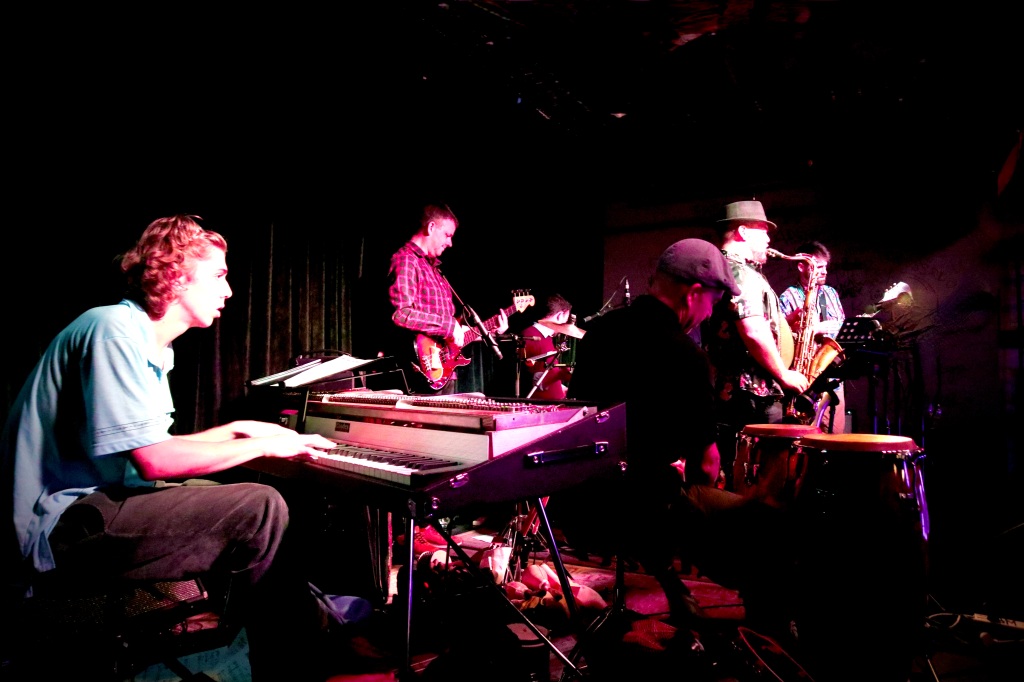
Ward’s arrangements for Ruckus are also notable for their eclecticism, their lack of cliche. blues, Americana, latin tinge, free and swing and all fused into a jazz-grounded brew. There were folksy ballads and a tango referencing tune (I have posted the latter). This time, there was less Americana influence but it was still evident. The band’s sound is crafted from pedal steel guitar, a standard electric guitar (or guitars), drums, upright bass and multiple saxophones. 

As always, Neil Watson alternated between pedal steel guitar and standard electric guitar. He and Ward are old hands at this material and they play off each other well. When both played guitar they never got in each other’s way, throwing challenging lines between them or else comping quietly as they laid down a cushion for the other. 

Eamon Edmundson Wells upright bass work stood out on this gig. He sounded great. This is the type of band where he is at his best, the type of band where a degree of freedom is afforded him.  Tristan Deck again proved his worth as a multi-faceted and capable drummer. I loved the stick work on the tango-esque number.

JazzLocal32.com was rated as one of the 50 best Jazz Blogs in the world by Feedspot. The author is a professional member of the Jazz Journalists Association. Some of the posts also appear on other sites.

Dixon Nacey Band ~ CJC December 2020

With 2020 nearly done, the penultimate gig at the CJC was an optimistic signpost; signalling hope and possibility. After a long and turbulent year, the music had bounced back better than ever and in spite of the obstacles along the way new energies were flowing. In amongst the offerings from our up-and-coming artists were gigs and albums by our finest. Last Wednesday’s Dixon Nacey Band and the release of Kevin Field’s ‘Soundtology’, stand out as musical high points. In a year of plague and pestilence, the music only grew stronger. There is a thing about genuine creatives; when the bats start to circle, they work with the chaos and create better. Dixon Nacey is very much in that category; what an extraordinary musician. 

Nacey appeared this time, with the same lineup that accompanied him on his Tui award-winning ‘Edge of Chaos’ album. There were numbers from the album, plus a few new tunes. In addition, he played a blues and two arrangements of Pat Metheny tunes which delighted everyone. I had missed his Ponsonby Road Metheny gig, which everyone who attended, raved about for weeks afterwards. 

Punching Bag (Nacey)

Nacey is a musician who keeps moving forward, and with each passing year, he reaches new heights. He is less inclined these days to rely on pedals and an uncluttered spaciousness is evident in many of his compositions. What he has absorbed has now been internalised, so there is no over-thinking, and out of that comes clarity and a cleaner sound. This enables him to say more and to give deeper meaning to the notes and phrases and underlying everything is some great writing. Playing like this demonstrates the best features of his Godin guitar, which in return, reveals its best self. The tune above is a recent Nacey composition. New Zealand Jazz at its finest.

And Then I knew (Metheny)

The band were superb and the tricky unison lines were executed well. Roger Manins is an excellent reader, and you could not have slid a cigarette paper between his and Nacey’s lines in the head arrangements. And behind those, adding fills or comping unobtrusively was Kevin Field. Responding exactly as he should and consequently giving the music a floating quality. There were rhythmic complexities on many of the numbers, but because they were navigated so well, they were rendered as easy. One or two pieces came close to being a shuffle beat, but not quite. This was a layered sound and the complexity of the overlaying time signatures needed skilled craftsman to make them fit properly. The reason it held together so well was down to Oli Holland on bass and Andy Keegan on drums. This is how a tight unit should function. What we got was a superb night of engaging music and it brought us end-of-year joy.

Dixon Nacey: guitar, arrangements, compositions – Roger Manins : tenor saxophone – Kevin Field: piano – Olivier Holland : bass – Andy Keegan : drums

The gig took place at Anthology K’Road for the CJC Creative Jazz Club, December 9, 2020

JazzLocal32.com was rated as one of the 50 best Jazz Blogs in the world by Feedspot. The author is a professional member of the Jazz Journalists Association. Many of these posts also appear on Radio13.co.nz – check it out.

Choi/Howell ~ Kõmanawa

Kômanawa is a duo, and duos are seldom heard in the bigger Jazz clubs. The gig was billed as a first for the CJC, but what of ‘Showa 44’ I thought? That was an Australian duo featuring Carl Dewhurst & Simon Barker, so I checked back, and although Showa 44 was a duo, they had included Roger Manins as guest. So yes, Kõmanawa was a first. 

There is a unique kind of intimacy to a Jazz duo performance and it is quite unlike other configurations. It is a fluid conversation between equals and in that regard Chrystal Choi and Michael Howell were well matched. They may have different styles, but they are both attentive listeners and they showed respect for each other’s musical space. 

Over the years there have been plenty of fabulous Jazz duos and the best of the duo albums remain perennially popular: Charley Haden & Pat Metheny, (also Haden with Hank Jones or Kenny Barron), Bill Evans & Jim Hall, and my favourite, Carla Bley & Steve Swallow. The Jazz duo is a unique form and especially suited to nuanced musical conversations.  Out of that a skillful interplay arises. People took particular note when Evans cut the two albums with Hall, because a piano and guitar can all too easily occupy the same register and get in each-others way. 

All of the above had been assimilated by this duo and they wove around each other with care. Their performance was also warm and engaging, and as they played, you felt like you were eavesdropping on an intimate conversation. That is how a duo performance works best, avoiding any fireworks, and by modulating showiness. The audience got that and paid close attention. 

While both musicians contributed tunes, the majority were from Choi. I was so engaged that I failed to notice that I had not switched on the external camera mic. The absence of the small green light dawned on me just before the end of the gig and the tune that I most wanted to post is recorded as a well-choreographed silent movie. The tune in question was titled ‘Playground Song’ (Choi) and it swung softly like a Carla Bley/Swallow tune. You will have to take my word for that, but it really did. There is an EP or an LP waiting to happen here, and I hope that they record this material. I captured only one tune, the second to last tune. It is an arrangement of a tune that Choi wrote for her Indie pop group.

Throughout, Choi moved between the piano and vintage Wurlitzer, Howell sometimes used a slide and produced wonderfully atmospheric sounds. The gig took place at the Creative Jazz Club, Anthology, November 18, 2020.

JazzLocal32.com was rated as one of the 50 best Jazz Blogs in the world by Feedspot. The author is a professional member of the Jazz Journalists Association. Many of these posts also appear on Radio13.co.nz – check it out.

Kevin Field ~ Soundtology

With closed borders and venue restrictions biting, the release date for Kevin Field’s ‘Soundtology’ album became a movable feast. The original proposal would have seen some of his New York band appear, but because of the pandemic, that plan was ditched. If he was flustered by these frustrating circumstances it didn’t show. Making a virtue out of necessity he engaged local musicians and launched his album anyway. It was a night to remember.

Field is one of our finest musicians and his reputation stretches far beyond these shores. He has previously recorded with highly-rated New York Jazz musicians and also with the best of New Zealand’s improvisers. As an adventurous musician, Field eschews stasis and his developmental arc is particularly evident with this latest album. He is an artist who arrives at a successful formula and then turns it on its head. With each album, he makes references to his earlier works, and then he moves foreword. Everything that has gone before becomes a springboard to a new moment and each iteration is better than that preceding it. 

There is a lot to like about Fields new album ‘Soundtology’. The tunes are sublimely melodic, and as always, his trademark harmonic developments astound. I have always enjoyed his avoidance of cliche and in this case, there is something else. Even when upbeat, the tunes feel more contemplative, and the space afforded, lets the music speak with clarity.  This is the album of a mature composer and it is deserving of wide acclaim.

‘Good Friday’ Live in Auckland

The album has eleven tunes and features two quartets (alternating throughout). This provides contrast while not affecting the flow and continuity. All of these tunes belong together and each unit locates something special. The first quartet features Field (Piano Rhodes),  Nir Felder (guitar), Orlando Le Fleming (bass) and Charles Haynes (drums). The second quartet has Field (piano, Rhodes) Mike Moreno (guitar), Matt Penman (bass) and Nate Wood (drums). These are heavy hitters and Field could not have chosen better crews to spin gold out of his compositions. I was immediately drawn to the inclusion of Moreno, one of the worlds great guitar improvisers. I once flew to Sydney just to catch a concert of his. 

‘Soundtology’ is a beautifully presented album and it was recorded to perfection.  It is an album to be enjoyed on many levels; for its beauty and freshness and for its accessibility. If ever there was an example of complex music made to sound easy, it is here. The tunes are beguiling and memorable, but underlying them are twists and turns which elevate the tunes into listening adventures. A good example is the first track Quintus Maximus. It opens over an ostinato sequence, where a broken rhythmic pattern is established by bass and Rhodes. The intro is a teaser as it hints at possible directions without necessarily committing to them; then the melody soars and brings it together until the underlying ostinato phrases reappear. An interesting and enjoyable piece of music. 

The second tune, ‘Good Friday’ is a great composition. It is among the most melodic of Fields tunes and it has been around since he first recorded it on his 2012 Warner release ‘Field of Vision’. Back in 2012, the tune was a slower-paced offering. Over the last few years, I have heard it performed often; now, it has emerged as a punchier version of its former self. It is fascinating to hear good tunes like this under constant development. This is what Field does and it is his impulse toward reinvention that elevates him beyond the pack.  It is not surprising that he was recently awarded a doctorate.

There is no better example of its ongoing trajectory than the version of Good Friday we heard at Wednesday’s live performance. It had been rearranged to include a bass clarinet and a soprano saxophone. There were two guitarists as in the album, but the addition of the horns gave us yet another vantage point from which to examine the composition. A band member told me afterwards that the charts were interestingly structured. They forced the soloists to think outside of the square and to avoid any formulaic approach. 

‘People factory’ was the perfect vehicle for Moreno, Penman and Wood. This number is like silk in a ruffling breeze, I have never heard Moreno sound better (and he always sounds good). The responsiveness Field extracts from Wood and Penman is also marvellous. This is seamless interplay at its best.  Actually, everything is great on this album and there’s plenty of variety.  This one is 4.5 stars. My advice is, buy multiple copies and impress everyone with your hip good taste.

‘Soundtology’ by Keven Field ~ Released on TimezoneRecords.com 2020

Album: Keven Field (piano, Fender Rhodes), Mike Moreno, Nir Felder (guitar), Matt Penman, Orlando Le    Fleming (bass), Charles Hayes, Nate Wood (drums).   

Live gig: Kevin Field (piano, Fender Rhodes), Michael Howell & Kieth Price (guitars), Nathan Haines (tenor, soprano saxophones), Lewis McCallum (bass clarinet), Cam McArthur (bass), Stephen Thomas (drums).

The live gig took place at Anthology K’Road for the CJC Creative Jazz Club, November 11, 2020

JazzLocal32.com was rated as one of the 50 best Jazz Blogs in the world by Feedspot. The author is a professional member of the Jazz Journalists Association. Many of these posts also appear on Radio13.co.nz – check it out.

Caitlin Smith ~ You have reached your destination

This has been a season of upheavals and delays, and Caitlin Smith’s album, ‘You Have Reached Your Destination’ was no exception’. The gig sold out long ago, but then it was delayed twice. It finally went ahead last Wednesday and there was a rush to get a good seat. In typical kiwi fashion, what passes for a queue had formed; a ragged line, reordering itself in illogical surges as it snaked across the footpath of K’ Road. Smith is popular and like many vocalists, she has followers from across the music spectrum. 

She brought a medium-sized ensemble with her, including backing vocalists, piano, keyboards, two guitars, drums, basses and a pedal-steel/slide-guitarist. I am used to hearing Smith with her trio, but this was new to me. 

The band had a warm and enveloping sound, with Smith, clearly relishing the energy surrounding her. She has a strong voice, and it cut through. The first number was pure Americana, not just because of the pedal steel guitar, but the organ and backing vocals, and above all the lyrics. On several of the later numbers, they were joined by the gifted Nigel Gavin, and if anyone can channel authentic Americana he can. 

The setlist followed the album order (minus a few tunes). There were few introductions, and this was intentional. The night was about letting the music speak and to achieve that best it needed an uninterrupted flow.  I enjoyed the gig and couldn’t wait to hear the recorded album. 

The physical album comes in exceptionally beautiful packaging, and importantly, the front cover has a brail title. In doing so, the senses are immediately directed within, or as Smith puts it, ‘let your ears guide you through this experience without other sensual distractions’. It was an invitation to a deep listening experience. The first tune, Grand Companion, was the perfect start point and from that point on you are guided between tracks by footsteps.

Much as Joni Mitchel or Rickie Lee Jones did, Smith uses predominantly Jazz Musicians in her bands. Musicians who can respond to nuance and work with her (not just back her). On the album’s opening track, Grand Companion, you hear John Bell on vibes, and what an inspired choice. His silken fills adding textural contrast: and Keven Field on Rhodes and piano. The live gig featured 10 musicians, but the album has a bigger cast (for example, pedal steel guitarist Janek Croydon, other backing vocalists and drummers). Paul Symons picked up this role on Wednesday and he doubled on slide guitar and vocals. The well known Aaron Coddel on bass(s).

On both the album and at the gig, the interaction between the chordal instruments was central. What a delight to hear Alan Brown and Kevin Field finishing each other’s musical sentences or trading fills. And Dixon Nacey, a guitarist who can accompany a vocalist with incredible sensitivity and a first-choice musician for a gig like this. 

Track two ‘The Story so Far’ has a southern soul feel and the backing singers are the icing on a beautiful cake. ‘No Mans Land’ picks up the overarching theme of the album which is self-realisation on a sometimes difficult journey. Prayer for a miracle reminds me of Patrice Rushen’s disco-funk, ‘Tug of War’ closer to a straight-ahead Jazz number. 

This is an honest album that touches on loves lost, inner struggles and sobriety. Smith is sight impaired, but she never complains. It is part of who she is, and she occasionally jokes about it. In between numbers, a few band members slipped off stage to grab a drink and when it was time to call them back, she said, ‘I can see what you’re doing’. ‘What can you see’ yelled someone in the front row, ‘Very little actually’ she replied, grinning. 

When I looked at the album liner notes, I was surprised to see when it was recorded. This album is a gem. It was worth the wait and I hope it puts Smith where she deserves to be; a widely acknowledged vocalist among our greatest. It has been over 10 years in gestation and now it has arrived. It is a credit to Smith and to all involved, and it also underscores just what magnificent work Roundhead Studios do. As I played it through, a tug of emotion brought a lump to my throat. The mahi paid off royally and the wait was worth it, we have our own Joni.

Album: Caitlin Smith (vocals, Wurlitzer, and compositions), Kevin Field (piano, Rhodes), Alan Brown (keys, B3), John Bell (vibes), Janek Croydon (pedal steel), Dixon Nacey (guitar), Aaron Coddel (bass), Nick Gaffaney (drums), Chris OConnor (drums), Jeremy Hoenig (tabla loop), Finn Scholes (trumpet), Oliver Emmitt (trombone), vocal backing: Mate Ngaropo, Rebecca Le Harle, Callie Blood. 

Gig: Caitlin Smith (vocals, piano), Kevin Field (piano), Alan Brown (keys), Dixon Nacey (guitar), Nigel Gavin (guitar), Aaron Coddel (bass), Paul Symons (pedal steel, slide guitar, vocals), Jono Sawyer drums, Callie Blood + Chelsea Prastiti (backing vocals).

 The gig took place at Anthology K’Road for the CJC Creative Jazz Club, Nov 4, 2020. Order the album from stores or Caitlin Smith.com

JazzLocal32.com was rated as one of the 50 best Jazz Blogs in the world by Feedspot. The author is a professional member of the Jazz Journalists Association. Many of these posts also appear on Radio13.co.nz – check it out.

Clo Chaperon ~ Chapters

The usual fare of the CJC (Creative Jazz Club) is the instrumental gig, but over the last fortnight, the club has featured two vocalists. Vocalists have a broad appeal and can bring different audiences to a Jazz club. This is a good thing and it helps with the club outreach and kaupapa. Last week brought Clo Chaperon to the bandstand and although she has been performing around town for several years, this was her first solo gig at the club. On two previous occasions, she has appeared in bands led by the popular pianist, Kevin Field. 

Wednesday was the release of her ‘Chapters’ EP, featuring five of her own compositions and it was her first release. She kept the EP numbers for the second set and during the first set, we heard a selection of tunes that had influenced her musical journey. The list was an eclectic offering of Jazz standards and all of them interesting.

There were surprises like Something Cool, a tune written by Bill Barnes in 1954, first released by the wonderful June Christy where she was accompanied by the Pete Rugolo Orchestra. Christy wrote the lyrics (check out the 1959 video from the Playboy Penthouse).  Material like this gets lost in time and big ups to Chaperon for including it. There were modern Jazz standards like Butterfly (Hancock – Gretchen Parlato version) and some soulful numbers like ‘Jazz is Nothing but Soul’. The perennial favourite ‘Dat Dere’ by Bobby Timmons also went down a treat. You can’t miss with that particular number as it conveys such a sense of joy.  

Her own compositions leaned toward modern soul-jazz or ballads and they were an indication of her future direction. I liked the arrangements (possibly by Nacey), and the tune that I have posted is titled ‘Holding On’. It has a funky propulsive groove and a nice vibe. This is reminiscent of her vocals on the Field Album. 

Chaperon has a presence on stage, and she is down with a pleasing line of banter. This is an essential accoutrement for a vocalist as people respond instantly to warm human interactions. Expressive vocalists know that they are selling the lyrics and that a stone-faced look is a turn-off. 

Having Dixon Nacey on the bandstand was of unmistakable benefit. He is a strong player with a distinctive style, but on this occasion, his job was one of support. He kept his solos short and his comping was nicely understated: he was not showy, but every note counted. This is the hallmark mark of professional, making others sound good. 

Peter Leupolu, Mostyn Cole, Percy Watson and Stephen Thomas rounded off the group and it was nice to see the percussionist in the lineup. Adding percussion was especially appropriate, given Chaperons French Mauritian, Sega heritage. Perhaps we will hear some of those traditional songs interpreted sometime soon. I hope so. If you wish to purchase her album, she is contactable through her website clochaperon.com

The gig took place at Anthology K’Road for the CJC Creative Jazz Club, October 28, 2020. Clo Chaperon (Vocals) Peter Leupolu (piano & keys), Mostyn Cole (bass), Percy Watson (percussion) and Stephen Thomas (drums).

JazzLocal32.com was rated as one of the 50 best Jazz Blogs in the world by Feedspot. The author is a professional member of the Jazz Journalists Association. Many of these posts also appear on Radio13.co.nz – check it out.

Haines/Crayford/Singh

Any jazz club gig involving Nathan Haines, Jonathan Crayford and Manjit Singh is bound to catch the attention. It was programmed to occur months ago and unsurprisingly tickets sold out so quickly that many missed out. Then, out of the blue, the virus crept back among us and we found ourselves back in lockdown. There was a new date suggested, but for safety reasons that did not transpire, and we waited. October brought us warm weather, freedom of movement, and above all, it gave us our gigs back. This time the Haines/Crayford/Singh gig actually happened and more tickets were released as restrictions no longer applied. 

The gig was a fusion of Jazz and the Indian musical traditions and in particular the northern styles. Accompanying them on harmonium and with vocals as a guest artist was Daljeet Kaur, the wife of Tabla player Manjit Singh. Chelsea Prastiti also appeared as a guest artist on one number. To pull off this type of fusion and yet do so respectfully, requires careful programming and good musicianship. The three co-leaders were particularly suited to this task. 

Singh was a respected Tabla player and teacher long before he travelled from the Punjab region to New Zealand. He has since completed a musicology degree at Auckland University and his involvement with the UoA Jazz School brought him into frequent contact with local jazz musicians. Haines and Crayford are internationally renowned and together they are a versatile dream-team. Bringing Singh into their orbit made perfect sense as both can comfortably play outside of the strictures of genre. 

There are particular subtleties to Indian music and perhaps most formidably the rhythms. The scales, although model, and thus familiar to Jazz practitioners also have aspects of difference. The northern Indian scale has twelve notes and is moveable. When western harmonies are added, unusual challenges crop up. Jazz, however, is the art form of flexibility and its practitioners thrive on playing over drones and exploring harmonies. I believe that is why this worked so well. 

As soon as I heard the harmonium and tabla together I was transported back in time; back to a night in the Himalayan foothills where I once heard a wandering troupe play. Two youths who we had befriended in Katmandu, called by late one night and led us up into the mountains. We walked in the moonlight and eventually arrived at a rustic farmhouse; cattle on the ground floor, a farmer ushering us up a ladder to the first level. A troupe of wandering musicians who crossed borders secretly at night and played in private homes by invitation only. A four-piece unit of sitar, tambura, flute, harmonium and vocals. They were brilliant. Not the sort of thing anyone could forget.   

I had always assumed that that the harmonium was a traditional Indian instrument, but I have since learned, that it came from the West around 250 years ago. Once adopted by Indian musicians, it was modified, and it entered the repertoire of the northern part of the sub-continent. Its entry was not without controversy. Because it sits at the juncture between east and west, it feels an appropriate instrument to bring to an Indian, Jazz fusion gig. 

There were a number of original tunes, a classical piece, a Beatles tune and an old Pakistani folk tune. The arrangement of Norwegian Wood was well adapted. The Beatles had been exploring modal Indian music at the time. When Chelsea Prastiti joined them, she and Daljeet Kaur sang a New Zealand composition, Olympic Girl. That number received wild applause, but my favourite segment was when the trio played Heitor Villa-Lobos Bachianas Brasileiras No 5. This gorgeous tune with its sensual Latin rhythms and Spanish tinge has been played and adapted by Jazz musicians before – notably by Wayne Shorter. The trio’s version paid it homage in the very best way. 

 Nathan Haines|flutes, soprano saxophone – Jonathan Crayford | piano & keys – Manjit Sigh | Tabla, tala & percussion – Daljeet Kaur | harmonium & vocals – Chelsea Prastiti | vocals

The gig took place at Anthology K’Road for the CJC Creative Jazz Club, October 21, 2020

JazzLocal32.com was rated as one of the 50 best Jazz Blogs in the world by Feedspot. The author is a professional member of the Jazz Journalists Association. Many of these posts also appear on Radio13.co.nz – check it out.

Kang / Rainey ~ Christchurch

Last weeks CJC/Anthology gig brought the Christchurch Brad Kang/ Jimmy Rainey duo to Auckland. While I have heard both artists before, this gig was a step up for them. Both looked comfortable on the bandstand and their confidence was justified. It is always a pleasure to witness early promise being realised and while neither could be considered veterans, both have received a measure of favourable attention. Both are well travelled and tested in the wider Jazz world.

I am more familiar with guitarist Kang as he has gigged in Auckland several times. The last time he played here he was just about to depart for the USA and that and his other trips have yielded dividends. He was always a competent player but a noticeable change has occurred. He is now playing fewer notes and the way he phrases resonates. I know that he has studied with Mike Moreno and it showed. The virtuosity is still there, but never at the expense of the music itself. 

The last time I heard Rainey was at a CJC emerging artists gig but much has happened since then. He has benefited from overseas experience and his exposure to new ideas; particularly in his writing. This is a duo that writes to their strengths and because they understand that, they can play up a storm in consequence. At one point Rainey studied in Amsterdam, a Jazz loving genre-diverse proving ground. Anyone who has attended ‘Bim’ gigs will know what I mean. There’s a lot of freedom and innovation happening in that city.

From the first to the last tune they held us. The tunes while of varying tempos and alternating between the two composers, all spoke of the now. This is the type of music that is owned by younger players. It was unselfconsciously forward-looking and immediately brought ‘James Farm’ to mind. It did not lean heavily on harmony but the harmonic development was implied; there were clean unison lines and above all, the melody dominated. It was evident on the tune Spiral, where the cascade of lines emerged in sonic waves, while behind them piano, bass and drums carved up the rhythms. 

And this was made possible by the skilled anchoring of Tom Botting’s bass lines and by the steady pulse from drummer Adam Tobeck. With Field, comping minimally the effect was enhanced. Wise heads and good players always adjust to accommodate. If he was alive today, it is tempting to think that Tristano might have embraced this direction?

The first tune Herfst was a majestic and evocative composition by Rainey. Herfst is a Dutch word meaning August (majestic and the season). This was a good warm-up tune as it gave us an idea of what would follow and the course once set, remained steady.  Other tunes that Rainey penned were ‘Daze’ and ‘jubilate’. As well as the piece that I have posted on YouTube (Spiral), Kang composed ‘Passing Thoughts’ ‘A Quiet Place’ and ’Five Five Four’. 

Brad Kang|guitar, Jimmy Rainey|tenor saxophone, Kevin Field|piano, Tom Botting|bass, Adam Tobeck|drums. The gig took place at Anthology K’Road for the CJC Creative Jazz Club October14, 2020

JazzLocal32.com was rated as one of the 50 best Jazz Blogs in the world by Feedspot. The author is a professional member of the Jazz Journalists Association. Many of these posts also appear on Radio13.co.nz – check it out.

JCJ ~ Baxendale /Allardice /Lovell-Smith

As our local pandemic restrictions were lifted, so our spirits rose, and the easing brought us, welcome travellers, from Wellington. It felt like our old lives were creeping back, but we should not underestimate how difficult these lockdowns have been for musicians. They are performing again, but with fewer venues, and reduced availability of flights. To top that there is the perpetual hassle of finding affordable accommodation. Because this is a new reality, music lovers need to redouble their commitment; religiously attending gigs, purchasing albums and getting the word about town. Luckily, Jazz audiences get that and there was a solid audience on Wednesday. 

The Band is named JCJ, which may or may not be a play on Auckland’s CJC Jazz Club; it does, however, align with the initials of the co-leaders forenames: Jasmine Lovell-Smith, Callum Allardice and Jake Baxendale. Together they represent a formidable presence on the bandstand with their international experience, various awards and accolades. In addition, the gig leaned heavily on their much-vaunted compositional skills. All have appeared on successful albums but never together as a co-led unit.

The soprano is Lovell-Smith’s primary horn and it shows. She is dextrous and inventive, she conveys deep emotion or surprises, but of equal appeal is her tone. There is a depth to it and because of that, she can move from the reflective to the edgy as naturally as breathing. When you hear her playing a ballad, it is tempting to think, how beautiful — that’s her forte then; but she will play completely free on the next number. I have heard her in a free ensemble and she’s as comfortable there as when tugging at the heartstrings with a lovely folksy ballad. 

Baxendale like his co-leaders is Wellington-based and we have seen him in a variety of visiting bands since the Creative Jazz Club’s earliest days. Aucklanders will likely associate him with ‘The JAC’ ‘Antipodes’ or ‘The Troubles’, but he has fronted or played in a number of Wellington bands. He is primarily regarded as an alto player, but on this gig, he played mainly bass clarinet. The instruments earthy underpinning, providing a lush cushion beneath the airy registers of the soprano and guitar.  

Allardice has had a long and fruitful association with Baxendale. They often share a bandstand, they have toured together, and both have won prestigious awards. I have always liked his tone on guitar, which is best described as silken. The first time I heard him perform there was an unmistakeable Rosenwinkel influence, but now I am hearing an original voice. His compositional skills have always been a forte and these were very much in evidence during this gig. 

The set opened with a gorgeous number by Lovell-Smith. It was titled ‘leaves of grass’ and its Whitman reference was apt. Whitman was the bravest of poets and a favourite with Jazz composers (‘I Sing the Body Electric’ Weather Report or tributes by Fred Hersch). And this was not the only literary reference by Lovell-Smith as a later tune was titled ‘The Pillow Book’ — this had an appropriately Japanese vibe.  Her other tune ‘Song for May’ is a stunner. I have heard it before as it is on her New York album ‘Towering Poppies’.  I would have put it up as a video, but a music stand had obliterated all view of her (note to artists: if you are being filmed, angle the music stands sideways or keep them low).  

Allardice’s compositions were as intriguing as ever, his moody ‘Dark Love’ and especially his upbeat tune with a beautifully memorable intro titled ‘Peaceful’. Baxendale brought some great tunes as well, and as he often does, he injected some off-beat humour. A tune titled ’Sleep (a glimpse of Plimpse)’ recounted a guilt-wracked dream. His tune ‘The Test’ was all that remained, of a failed attempt to break into the fantasy gaming genre (I think that I got that right). It was free-ranging and delightful and I have put that up as a video clip.

The pick-up rhythm section were Aucklanders. All three have been delighting Auckland audiences for years. To have them playing together and bouncing off a Wellington lineup was a rare treat. Firstly, Crystal Choi, who never puts a foot wrong and who is one of Auckland’s most inventive pianists. She is similar to her bass playing friend and bandmate, Eamon Edmundson Wells. Both lean heavily toward the avant-garde. On drums, there was Julien Dyne. Dyne is a powerhouse drummer and his beyond-genre approach allows him to excel in any given situation.  These three are the other reason that I put up ‘The Test’ video clip. This is a space that the Aucklanders relish, and the Wellingtonians matched them note for note. A little freedom never hurts a gig. 

JCJ were Jasmine Lovell-Smith (soprano saxophone), Jake Baxendale (alto saxophone & bass clarinet), Callum Allardice (guitar) with – Crystal Choi (piano), Eamon Edmundson Wells (bass) and Julien Dyne (drums). The gig was held at Anthology, CJC Creative Jazz Club, K’Road, Auckland October 7, 2020.

JazzLocal32.com was rated as one of the 50 best Jazz Blogs in the world by Feedspot. The author is a professional member of the Jazz Journalists Association. Many of these posts also appear on Radio13.co.nz – check it out.

Frank Gibson Jr ~ New Bop Quintet

Frank Gibson Jr is a legendary figure on the New Zealand Jazz scene. A drummer like his father before him and a Jazz touchstone throughout much of my life. He and I attended the same Grammar school and although he and Murray McNab were two years ahead of me, they were known even then as being cool Jazz- guys. Gibson’s love of Monk and of the Hard Bop era has always been his thing, and it is evidenced in his gigs. No one about town does it better. 

With the New Bop Quintet, we get a fresh Gibson line up this time; within minutes of hitting the stage, they’d recaptured the joy of that era. The setlist was broad and included a few tunes that we seldom hear; it also included a nicely penned original by bass player Cameron McArthur titled ‘Three Up, Three Down’. There was only one Monk tune (Straight no Chaser), and the applause after that was thunderous. Everyone loves Monk. 

As an opener, the band gave a crackling rendition of a favourite Shorter tune ’Speak No Evil’ and there is no better way to commence a standards gig. Gibson is a strong drummer and his style exemplifies this era; his bop-influenced grooves being unmistakable. In this unit, he has changed things up by including some different musicians. This gave the gig an interesting edge and it worked a treat.  Keven Field could fit into any line-up, but he is seldom in a Hard Bop unit. His distinctive harmonic approach edged the sets into new territory, and everyone stepped up to meet the challenge. 

You could not have a Hard Bop gig without featuring Benny Golson tunes; there were two of them, ‘Along Came Betty’ and ‘Stablemates’. These are essential Hard Bop classics, and no one ever tires of them. The tune which really stood out though was a seldom played composition by Dexter Gordon, ’Soy Califa’. This was the opening track on his ‘A Swingin’Affair’ album and once heard, loved forever. To do justice to a tune like this requires chops and bravery and the evidence of both was very much on display last Wednesday.  

On ‘Soy Califa’, the opening drum beats and the tightly executed head arrangement hooked us, then Pete France took it to a different level entirely. He and Mike Booth gave memorable solos. It is a common complaint that we see too little of France (a Scottish born saxophonist). He is highly regarded about town and when his tenor-saxophone sings, it is wonderful to behold.  I have posted a clip of New Bop’s ‘Soy Califa’.

Soy Califa (Gordon)

There were also flawless performances from Mike Booth, as this is the style and era where we hear the best of him. He and France were very well matched and as the band played on, you could feel their enjoyment and their deep love for this music. Field and McArthur while hidden in darkness, were the essential ingredients that rounded off a heady brew.

Whether it’s playing with locals or with Jazz greats, travelling or teaching, Gibson has achieved much in his life; to top that off he has recently gained a doctorate.  This was the first CJC gig as we emerged from the second lockdown and it attracted a capacity audience. It was great to have the music back and nice to have it ushered in by a quality Hard Bop unit like this. 

New Bop Quintet: Frank Gibson (drums), Mike Booth (trumpet), Pete France (tenor saxophone), Kevin Field (piano), Cameron McArthur (upright bass). The gig took place at the CJC (Creative Jazz Club), Anthology, K’Road, Auckland. September 30, 2020. 

Passells/Howell/Deck

This trio has been around for a while, but the musicians are all active with a variety of other projects. They frequently appear as sidemen and they first teamed up during their Auckland University Jazz School years. Passells has been teaching, composing, appearing as an altoist (and a drummer), and adding his skills to some adventurous and diverse projects. Howell is a member of various bands, such as the Jazz Tui nominated Alchemy and the Jazz Tui Award winning GRG67 who launched their second album recently. It was reviewed on this site. Deck is a gifted and versatile drummer and his work as a member of the much lauded Indie Pop group The Beths is as noteworthy as his Jazz offerings.  He is also a member of GRG67.

 As a composer and a performer,  Passells takes a path less followed. He’s a melodicist and often appears in units where the arc is not reliant on chordal harmonies.  This moves the attention to melody, and most of all, it reveals his lovely tone. The alto is an unusual instrument in this regard, as its tonal qualities can alter markedly, depending on who plays it. Perhaps, because it is aligned so closely to the human voice? It has also been suggested that the airway of an alto player can exert a stronger influence than with other horns. While a tenor can also be individualised, it is more inclined to speak on its own terms. Passells alto voice is distinctive,

There was no bass with this unit and without such anchoring, the melody lines seemed to float unencumbered. When the alto was playing the guitar would either play unison lines, lay out or provide timely interjections. The reverse occurred when Howell played. The drums however, were a solid presence and provided continuity and momentum. As a result, the tunes felt conversational and at times, thoughtful. And the ears followed the musical dialogue easily, in spite of the elided grammar. Passells introduced the tunes as he usually does and his trade-mark humour was evident. He has an easy going banter, often self-deprecating, and laden with random references.

The band played in near darkness which provided atmosphere, but made filming a difficult proposition. By the second set, the lighting had improved slightly and I have posted a tune from that set. The tune I posted is interesting, as there are frequent unison lines played, with guitar and alto speaking as one. It is reminiscent of Marsh with Konitz, but the drums pull the music in a different direction. Out of that confluence come interesting tensions. This is ripe territory for a group of this configuration and the seasoned listeners picked up on the various references. 

Callum Passells (alto sax), Michael Howell (guitar), Tristan Deck (drums)

The gig took place at Anthology K’Road, for the CJC, Auckland 22 July, 2020

GRG67 ~ Happy Place

The first gig after lockdown restrictions brought a record audience to the Creative Jazz Club.  Now, a week later, with a second gig achieving similar results, it is obvious that the thirst for quality live-improvised music in Auckland has not been dented. And what better way to whet the appetite than with the 2019 Tui Award-winning band, Roger Manins  GRG67. This is a truly magnificent quartet and it occupies a special place in the lexicon of Kiwi improvised music. Sitting at the juncture between free and inside, and doing so with an ease that pleases everyone.

Roger Manins is a drawcard and the highest level of playing is always expected of him. His long years of playing on the bandstand, and often in challenging situations, has honed his craft to a fine point. To burnish his already impeccable credentials he has now added a Doctorate of the Musical Arts to his resumé. Most of the compositions and arrangements on the album are Manins, but as with the previous GRG67 album, there is also a tune by Mostyn Cole featured. 

The GRG67 album The Thing won a Jazz Tui, but the band has not rested on its laurels. Happy Place is not just more of the same. On this album, the writing and playing have taken on an additional edge. It explores form in many oblique ways and then roams into freer air. They sounded cohesive before, but now they sound even more so. There is new confidence to their playing and it is nowhere more evident than with guitarist Michael Howell. 

Howell has long shown such promise and it is pleasing to see it realised. He took obvious delight in sparring with Manins and his solos were masterful. Tristan Deck on drums likewise. His role here was to stretch the ensemble, to urge them on when the moment called for it. He achieved that while never losing sight of his interactive role. Deck has many irons in the fire, but I wish we saw him playing here more often. On electric bass was Mostyn Cole, a regular bass player at CJC gigs. He is reliable and experienced and one of an elite group of first-call bass players when an overseas artist is in town. In this band, he was liberated from that role and his obvious delight in the music shone through. 

I have posted a clip titled ‘Frizz’ which is deliciously melodic. Listen to more tracks on Rattle Bandcamp, and if you do, purchase a copy. The tight unison lines on MayWayDay will blow you away and the free-spirited Shoint 67 will groove you to your soul. 

There were no weak links in this chain. They wove in and around each other and fired off crazy lines over urging pulses, and from the safety of our chairs, those present swayed along. This was also our happy place. So this is where Jazz sits in 2020. Forward-looking, but bringing the old into bright fresh spaces, and doing so without contrivance.  

Roger Manins (tenor saxophone)

Michael Howell (guitar)

Mostyn Cole (electric bass)

Tristan Deck (drums)

https://rattle-records.bandcamp.com/album/happy-place

Griffin / Chisholm / Meehan

Norman Meehan and Hayden Chisholm are always well received when they perform at Aucklands CJC Creative Jazz Club. There have been various iterations of their line ups over recent years and all of them compelling in different ways. The Unwind quartets attract big audiences and rightly so. This particular band was co-led by Chisholm, Meehan and Griffin, with Julien Dyne and Cameron McArthur rounding off the quintet. I was particularly delighted to see Hannah Griffin on the bill, as she occupies a unique and interesting musical space among improvising vocalists. The gig showcased iconic twentieth century New Zealand poets and Griffin’s impressive vocal skills were exactly what was required.   

Jazz lovers of a certain age often categorise vocalists according to how well they enunciate their lines. Whether that is important or not is debatable and it depends very much on context. I am generally more focused on phrasing and time feel and I like to hear a word stretched to fit an interpretation. If it’s a standard, then we know the words and having them messed with is part of the joy. I also listen to a lot of wordless vocal improvisors like Sidsel Endresen. 

When it comes to interpreting poems though, the clarity of the words does matter and Hannah Griffin gave a master class in balancing the many aspects of vocalisation. She does not merely intone a poem, she is part of the band and her melodicism is paramount in the mix. She can enunciate and still pay phrasing its due.

The first thing about this band is the way they respond to each other, sometimes finishing each others musical sentences. This seamless interaction is especially evident between the three leaders. Meehan is a master of understatement and his gentle swing can quickly bring a smile.  His default minimalism always serves the music well but it is on reflection that you realise just how powerful and judiciously placed those chords and sparkling runs are. He doesn’t require a percussive touch to make a big statement. I suspect that most of the arrangements are his as well. 

Chisholm always takes your breath away and from the first note, the emotional content in his playing is quite unmistakable. This is the sort of gorgeous alto playing seldom heard and you dwell on each note and phrase, marvelling at the purity of tone and the compelling story telling. His ability to deploy his multi-phonic technique, simply jaw dropping.

The other thing which grabs you is the sheer beauty of the bands sound. By that, I do not mean just pretty for it goes well beyond that. All of the emotions are engaged and the effect on a room is noticeable. Dyne is a popular local drummer who works across genres and who is sought after  around town. He has played with Meehan and Chisholm previously. Griffen has appeared predominantly with Meehan and in gigs similar to this. McArthur was the new-comer to this particular lineup but you wouldn’t think so. His reading abilities and his intuitive grasp of the music maintaining his usual high standard.   

At the previous Griffin, Chisholm, Meehan gig the band had Bill Manhire on stage, and as icing on the cake he introduced the poems. Gigs like that are hard acts to follow, but fast forward to 2020 and the band more than pulled it off. By extending the range of poets and poems our interest was engaged in new ways. My greatest pleasure was hearing more poems by the much lamented Dave Mitchell. More gigs like that please. You can purchase albums featuring these artists from Rattle Records at rattle-records.bandcomp.com

JazzLocal32.com was rated as one of the 50 best Jazz blogs in the world by Feedspot. The author is a professional member of the Jazz Journalists Association.