Rattle Records released these excellent albums a few weeks apart. They demonstrate that New Zealand’s improvising musicians are of the highest calibre. Both feature Hayden Chisholm, and the albums enrich each other as if by design, although recorded at opposite ends of the world.
Embers (Unwind)
This album is the fifth by Unwind, and their second as a trio. The Unwind albums have all been striking for their unadorned beauty, each feeling like a high point. Yet the inventiveness appears endless as they maintain their upward creative trajectory. Only the best musicians can react to each other with such nuance, their quietism filling any listening space.
Much rests on Hayden Chisholm’s alto saxophone sound, which is preternaturally pure. It’s as clean as Desmond or Konitz, yet utterly unique. It has softness, but a softness that conveys strength and a fluidity that affords him endless possibilities. When playing live, his impact on audiences is palpable. The flute-like alto sounds he creates speak with unusual clarity, creating a balm that the world needs. Feted internationally, known for his skilful use of micro-tonality and throat singing, all his strengths are evident on this album.
A distinctive sound like Chisholm’s requires just the right musicians. Norman Meehan and Paul Dyne are that. In part, because they have been bandmates for years, but it is more than familiarity. On bass, Dyne carries the weight effortlessly, while Meehan’s blues-infused minimalism says as much in between the spaces as in the moments when the hammer meets the wire. You can feel the weight of his ideas behind every note. Thoughtful musicians like this know best how to optimise opportunities. They react instinctively, and nothing is overthought.
The first number, ‘Around Again’, opens with Chisholm’s plaintive alto keening through the silence, then Meehan’s evocative gospel chords follow. It is an elegant piece and a lovely opening to an album brimming with gems. It exudes a gentle strength that is the hallmark of this band.
Another number, ‘Good Friday’, conjures subtle emotions. It captures a nostalgic essence, as if evoking a time long past. One we cannot fully recall – a reaction best described by the Japanese term ‘Sabi’. I have seldom heard a piece of Western music that captures that emotion as perfectly as this ballad. And everything in the album flows similarly. Meehan’s compositions are a joy.
During the album release concert, a particular moment had the audience gasping. After setting the shruti-board drone in motion, the alto began the intro. The pianist was ‘laying out’, listening intently, unaware that his foot had depressed a pedal. An ethereal resonance soon became evident as the harmonics of the alto reacted with the piano. Realising, Chisholm edged closer to the piano and worked with it. A sublime moment of happenstance that had musicians and audience smiling in delight.
It is our good fortune that Chisholm regularly returns to Aotearoa, the country of his birth. He has an extensive offshore discography, but when playing with old friends, there is a special Kiwi kind of synergy. A reminder that spiritual jazz lives here too. The album is available from Rattle Records in either digital or CD form. https://rattle.co.nz/catalogue/releases/embers
Release and Return (Chisholm/Crayford)
‘Release and Return’ is a duo album featuring Jonathan Crayford on piano and Hayden Chisholm on alto saxophone. It is another standout album, but in a different way from Unwind (reviewed above). It feels more exploratory and is not as consciously introspective. The album captures the joy of master musicians engaging without preconception. As a duo album, the sonorities can be explored more fully.
Both of these musicians are adept at working with harmonic resonances: Crayford, who prefers audiences to refrain from clapping until the decaying echoes of a final chord are exhausted, and Chisholm with his skillful use of microtonality.
Mature improvisers like these can draw on everything that they have experienced; it is what forms musical character. Both have travelled widely and listen with open minds to what other cultures or genres offer, be it classical, Carnatic, Spanish or Japanese traditions.
Crayford’s lovely ‘JC Ballad’ hints at Bach, and in Chisholm’s playing, the influence of Eastern musical traditions is evident, especially when he plays against a drone. In ‘Eldest Daughter’, the wistful opening tune (Crayford), the melody plays softly above, while Crayford’s right hand sounds at times like a feather stroking the strings of a Koto, his left hand, meanwhile, finds the pulse and swing.
Release and Return stirs deep emotional responses in the listener with its visceral lines, sometimes tender, sometimes raw, as the human condition is examined. This album speaks of freedom and the uncontrived nature of the music that makes it so.
The artists profiled here have some things in common. Both have Swiss heritage, work in countries other than the ones they were born in and take a fearless approach to improvising. They are separated in years and in experience but not in their approach. Both seek to extend the language of improvised music and have something interesting to say.
Alex Ventling ~ The View
This is a beautiful duo album; it will stay with you if you listen with open ears. It is fresh and original but snatches of the tradition are still evident, nestling in the compositions. From the opening track, ‘Spiders Steps’, Monkish elements creep in, as jagged spidery lines evolve into a gentle swing. The tune is perfectly rounded. It says a lot and yet does so concisely and simply. It is the perfect beginning for a superb album. Ventling’s pianism is evident throughout, but strikingly so in his resonant ‘In the Mists’. Good pianists know what to play and when, but gifted pianists understand how to sculpt sound and curate even the decaying chords. There are synths but they are used in ways that never once spoil the acoustic mood. That is so on ‘First Train to Finse’ which features guest artist Kim Paterson on trumpet. How lovely to hear him again in this ‘Silent Way’-like setting.
It is an album of surprises as the moods shift constantly. Importantly, they do so without once breaking the flow. Out of it all shines a radiant simplicity, a ‘mysterioso’ simplicity. One blended with oblique Monkish references and a northern European sensibility, a very Nordic soundscape, evoking open spaces, where the music breathes.
With Ventling is a gifted drummer, Phelan Burgoyne. He is the perfect foil for the pianist as he is a master of subtlety. He possesses an acute sonic awareness and understands how to work in the spaces between the notes. He is especially attuned to the harmonic possibilities as he adds his textural touches. This is a masterclass in colourist drumming and I cannot imagine any drummer doing better. He is co-credited as a composer, a collaboration which goes back years. Their synergy is evidenced in every minute of this recording.
This is a very mature album for a musician embarking on his musical journey. The album was released by the Trondheim label Sonic Transmission Records and is available on vinyl and digitally via Bandcamp (or the streamers).
Nik Bärtsch Ronin ~ Spin
Nik Bärtsch’s Ronin has been around since 2002, established following his earlier Ritual Groove Music album (2001). Since then Ronin has released 9 albums with cultural and musical influences scattered throughout; the most obvious being Steve Reich, John Cage and Morton Feldman. He was a drummer before he was a pianist and intricate rhythmic patterns and cycles are evident in everything he does. The other important influence is his abiding interest in Zen Buddhism and taken as a whole, those influences have coalesced, resulting in a unique musical path. His style has been dubbed Zen Funk, but it is improvised music of the highest order and the band has been delighting Jazz critics and Jazz-festival-goers for many years. His seven ECM albums brought him wide critical acclaim.
‘Spin’ works the rich seams opened in earlier albums. This band adheres to its minimalist principles while introducing freshness and open exploration. I have always been drawn to mesmeric or trance music, and this music is, but the tunes also invite quiet reflection. There is freedom within constraints, and that appeals to the heart and intellect.
The first track, ‘Modul 66’, was composed to showcase bass player Jeremias Keller, who recently joined the band. This highlights a subtle shift in emphasis, without changing the ever-present groove. The deep grooves are especially evident in ‘Modul 70-51’ which is mesmerising. A pulse that pulls you deeper into the music without once dulling the senses. This is achieved by surprising chordal and modulation shifts which function like Zen surprises. This is apparent in ‘Modul 40’ which is endlessly inventive.
The way this band works together is extraordinary, moving the emphasis mysteriously as they dance around each other like voodoo priests. It was recorded live at the Big Ears Festival, so ‘Spin’ should be enjoyed in one listening; each ‘module’ informs the next. I recommend that you listen with headphones or in a quiet room. It would be a shame to miss the subtlety. Nik Bärtsch (piano, Keyboard), Sha (bass clarinet, alto saxophone), Jeremias Keller (bass), Kasper Rast (drums). ‘Spin’ is self-released and available on Bandcamp or the streamers.
Other Recommendations to Check Out.
Rob Luft and Kit Downes are artists I have profiled before. Both appear on an interesting album by vocalist Paula Rae Gibson. The album, ‘The Roles We Play To Disappear’ has been referred to as ambient, electronica, and Avante-jazz. It seamlessly embraces many genres and is evidence of how improvised music is growing in multiple directions. Albums like this bring fresh audiences and that is a healthy thing. It is refreshing in these days of awful commercial music to see artists forging uncompromising artistic paths. It is available as a CD or download from Bandcamp.
Rob Luft and Elena Duni recently met with Manfred Eicher to discuss a new ECM release. This is welcome news as the first two releases were stunning. I interviewed Luft during lockdown and have reviewed his albums often. If you haven’t done so already check them out. My review of ‘Lost Ships’ is on this site at http://www.jazzlocal32.com/?s=Luft
Alex Ventling and Kim Paterson recorded on Ventling’s recent tour through New Zealand. ‘Conversations’ is a lovely standards album and is available on Spotify.
One of my favourite Jazz musicians Chris Cody (Sydney/France) has just released two interesting albums. The first is ‘Mountain To Sea’ with Sandy Evans, Tessie Overmyer and Lloyd Swanton. The second and most recent is ‘Under Ocean’, co-credited to Charlie Tait, an ambient improvised album conjuring powerful images. An interesting development from an artist who never fails to please. More on this soon.
JazzLocal32.com was rated as one of the 50 best Jazz Blogs in the world by Feedspot. The author is a professional member of the Jazz Journalists Association, a Judge in the 7VJC International Jazz Competition, and a poet & writer. Some of these posts appear on other sites with the author’s permission.
Dan Costa was born in London to Portuguese and Italian parents. He has lived in eight countries. I mention this, because Dan is somewhat of a troubadour, frequently travelling from country to country and always absorbing the musical influences. He listens carefully, interprets, and then takes it to a new level entirely, and this
brings something essential to his music. It is not so much a sense of place but a sense of the world at large and its limitless possibilities. Nowhere is this more evident than in his second album ‘Skyness’. Check it out on the streaming platforms, and like me, you will return again and again. It is rare to encounter music with such heart-stopping beauty.
Costa is an interesting interview subject, partly because he is so well travelled, but also because he is expansive and erudite. In fact, he speaks eight languages and judging by his English, many fluently. He is an internationalist and an environmentalist. He is also an advocate for animal rights. All of the above illustrates the point that a good musician is not just about the notes. Character and lived experience are the ‘finishing school. This is refreshing to encounter.
Costa is deeply influenced by Brazilian Jazz, but I can detect other Latin influences like Flamenco and Fado. He is a thoughtful player who makes every note count. His voicings and time feel, especially at the slower tempos, are impeccable. It is no wonder that such fulsome praise is being heaped upon him by the likes of Jazziz, Jazz Word, Jazz Weekly, Musica Brasiliero, New York Music Daily etc.
And his collaborations with the likes of Randy Brecker, Seamus Blake, Hermeto Pascoal and the wonderful Ivan Lins have crafted wonder upon wonder. He creates such open vehicles; composed and arranged so as to invite maximum participation. The musicians he has worked with are quick to say so and their praise keeps coming.
His prior recorded output has set him on an interesting journey, so his newest album ‘Beams’ will be eagerly anticipated. It is about light in its different forms. With him on ‘Beams’ his core trio, John Patitucci and Paulinho Vicente, with guests Mike Stern, Dave Douglas, Dave Liebman, Anne Bocatto, Hermeto Pascoal and Teco Cardoso. The album teaser is posted here and I can’t wait to hear the rest of it. For information on albums and tours, go to his website www.dancosta.net
JL32 Good evening Dan. Thank you for giving me a few hours out of your busy schedule. As a traveller myself, I must say that I am impressed by how much of the planet you have covered to date.
DC Hi John, nice to connect, Yes, I have lived in eight countries and travelled to around 60 as a musician or tourist, but there is still a lot to see. It is an interesting world and I hope to live in more countries and to keep travelling. One of my friends is buying a house but I am not interested in that for me. I think that you need to live in a country for at least two years. That’s how you get to know the culture. It removes the fear of the unknown when you do that.
JL32 Increases empathy and negates racism right?
DC Exactly, music is also a multinational language and one that has many dialects but it brings people together. I like to associate the sounds I hear with colours. Harmony is just colour. I am looking at the painting behind you as we speak and I am immediately thinking of the French impressionist composers.
JL32 The painting is impressionistic and is of forest and sky. I love forests, the older the better.
DC Then you should visit the Amazon. When I was living in Brazil I spent some nights in the Amazon rainforest and in fact the title of my first album ‘Suite Tres Rios’ is inspired by the meeting of two great rivers in the Amazon. These rivers meet but keep their different colours. It’s a fairly unique phenomenon and it is a bit like my parents who each kept their unique cultures intact. That was my experience as I grew up. It was like two rivers meeting and when we moved to France or England new colours were introduced. Each keeps its essence but interacts. So the tunes on that album were inspired by the Amazon. For instance, one track is about the stars above the rainforest, the clearest stars I’ve ever seen.
And my album Skyness was inspired by the blue of Greek Island skies. The skies above the Greek Islands are different to other places. (We digress here into a long discussion on sky colours and rivers, so I recommend Cape Reinga where ocean and sea meet, as do the different colours touch each other)
JL32 Tell me about the Brazillian singer-songwriter Ivan Lins. I love his voice and I first encountered him on a recording with trumpeter Paulo Fresu and the Sardinian Jazz Orchestra.
DC I wrote to him asking him if he was interested in recording with me and I was pleased when he replied enthusiastically. He has written many great songs but we settled on ‘Love Dance’ which is one of the most recorded songs in musical history (everyone from Joe Pass, Quincey Jones, Sarah Vaughan and even Sting has recorded it). It is a love song and harmonically it has many interesting twists. He also has a house in Portugal so we recorded there and it was a nice experience as we recorded it in one or two takes. The studio was booked for two hours but most of the time was spent talking. He is a person who likes to be near different oceans or rivers. We had that in common, and we also connected because we like delving into musical styles.
JL32 And you collaborated with Randy Becker (check out the teaser on YouTube). I love that, he is another musician who has an affinity with South American music. Brazilian music is sometimes referred to as the ‘other swing’.
DC Yes, 1917 was the date of the first Jazz recording and also the first Samba recording. So with Randy Brecker, the tune was already recorded on my album ‘Skyness’ inspired by the feeling of closeness to Mediterranean skies and by the notion of international togetherness. I had originally recorded the tune solo, so I wanted to re-release it with Randy and he loved it.
JL32 What a great tune ‘Iremia’ is and how beautifully you both improvise around the melody lines.
DC So he came in on top and it was a special moment for me as he has played with some of the greatest stars in musical history. And many of the people who I recorded my first album with were also on his Grammy-winning album Randy In Brazil. The tune you mention is not Latin but the meaning of the name Iremia is peace in Greek. By coincidence, it was re-released at the moment the war started in Ukraine. It got quite a bit of attention, especially in Italy and it was featured on Sky News. This message of peace should be there at all times, but in times of war, more so. When I wrote it I was living on Paros in the Cyclades Islands, so it is about tranquillity and peace.
JL32 I must ask here. Do you have a working trio or involve different musicians in each project? Or to come at it slightly differently, is there a configuration that you prefer working with, solo, trio, quartet, or larger unit?
DC That is an excellent question. I am comfortable in all formats, in fact, the first concert will be in Hamilton with a big band. I have worked with orchestras but not with my music, but on every album, there is a different type of lineup. I enjoy that.
JL32 I love the tune ‘Skyness’, it is the sheer beauty and architecture of it. Those voicings, the time feel like your left hand is gently pushing at your right hand, conversationally, and by the time Seamus Blake comes in we are mesmerised.
DC My third album ‘Live In California’ was a solo album, my next album will be a trio with special guests. One month ago I recorded in New York with John Patitucci and I enjoyed that. But to answer your question, no particular format and I like to give a voice to everyone.
JL32 I saw Patitucci in a Roman amphitheatre, Verona, with Wayne Shorter, Danilo Perez and Brian Blade. Not an experience that I will forget. What’s the album called?
DC ‘Beams’ as in light, with John Patitucci and Paulinho Vicente as the core trio. The guests are Mike Stern, Hermeto Pascoal, Dave Douglas and singer Anne Boccato. Oh, and the saxophonist Tecō Cardosa, who is the only musician to appear on multiple of my albums. But I would record again with any of the above. I like the Brazilian percussionist Teco Cardosa very much. He is a multi-instrumentalist and plays flute, saxophone and percussion. There is really something special about him. He features in the piece ‘Compelling’ on the second album.
JL32 Yes an amazing and energetic track. People who don’t know this album or that piece need to check it out ASAP (on streaming platforms. Sadly, the physical album is hard to find but I located one).
DC I created a video for World Earth Day which is on my website. That was recorded with Teco on the flute. It is one of my favourite pieces as I really like the fusion of the flute and piano. What do you think about that combination?
JL32 Flute and piano and flute over a modal groove interests me greatly. Although it was always a significant presence in Brazilian Jazz, in American Jazz over the second half of the twentieth century the flute was often regarded as an instrument lacking sufficient expression. People who said that were clearly not paying attention and had not listened closely to Yusef Lateef, or Bennie Maupin. It is now regarded as an essential primary instrument as a renewed interest in Spiritual Jazz is evident. Yes, I love the combination.
DC I have several passions and interests beyond music. Things I have studied at University. I have worked as a language educator, I also studied philosophy for a time and history, both of which are interests of yours, I think. I’ve also worked a lot on environmental issues and especially animal rights. I am a vegetarian. Environmental aesthetics is extremely important and often overlooked. The environment and not only in the ecological sense but in everything that we do. And all of this is linked to my music. They are not separate worlds.
The new album is called Beams because it is a celebration of light in different forms, the light that shines too and from you. The album refers to physical light for example, the tune ‘Star Dial’ which I recorded with Dave Liebman. Then there is also the more metaphysical light. The light which shines from Animals. I wrote a tune called ‘Paw Prints’ when I was living on Pados, written for a dog that I saw mistreated (a homophone and play on the Shorter standard Foot Prints). And then a tune with Mike Stern called ‘Sparks in Motion’ which is about celebrating the city, the light of a city.
JL32 When you release an album, do you have a preferred label?
DC Self-release gives me my independence. Berkeley these days teaches musicians to do it for themselves and learn about the business that way, rather than waiting for a manager or a label to snap you up. Ethics and proper respect for music should be the impetus. Commodification makes an art form into something else.
JL32 Well, we’ve been talking for hours and I know it’s late there. Thank you for your insights and for your music. I have enjoyed it and I hope that your tour goes well. I am sure that anyone listening to your music live will be as delighted with it as I am.
DC I hope to see you at the concerts, John.
JL32 Ki kite
JazzLocal32.com is rated as one of the 50 best Jazz Blogs in the world by Feedspot. The author is a professional member of the Jazz Journalists Association, poet & writer.Some of these posts appear on other sites with the author’s permission.
With the opening of borders between New Zealand and Australia, it was hoped that improvising musicians could begin touring again. Apart from three returnees and several stragglers who chose to shelter in place, we had not seen an international for fifteen months. Unfortunately, the pandemic reestablished itself in Australia and that window closed within a week of its opening. There was, however, one musician who timed it perfectly and that was saxophonist Andy Sugg.
He flew out of Melbourne just days before another lockdown was announced and we were very pleased that he had slipped the net. Sugg is a gifted saxophonist with broad appeal and there was no better way to break the tour drought. The tour was billed as an album release but the setlist also included earlier compositions and two tasty standards. The album titled Grand & Union was recorded in New York in mid-2019 and released last year. For obvious reasons Sugg was unable to take to the road and certainly not with his New York-based bandmates.
Grand & Union is a rail hub in Brooklyn but it is also a metaphor for the album. ‘A musical intersection where styles and motifs merge before moving somewhere else’. It is an album of diverse stylistic influences but the musicians’ craft a tasteful amalgam from the underlying base metals. In the liner notes, the leader mentions Stravinsky as a prime inspiration and ‘The Rite Stuff’ with its deep propulsive groove is the most overt reference; a stunning piece, which evokes the now without jettisoning the history underpinning it.
Sugg is a particularly coherent improviser who takes a listener along as he tells his ear-catching stories, and his tone is particularly arresting. Warm as toast and seldom straying into the lower registers. On the soulful ‘Ruby Mei’, his sound reminded me of the great melodic improviser, Ernie Watts. Much credit is also due to his New York bandmates who are seasoned musicians all, and who worked as a tight cohesive unit.
His Auckland gig featured a local rhythm section and they also acquitted themselves well. The first set opened with the title track Grand & Union and was followed by Ruby Mei and other tunes from the album, Then came a more expansive offering in several sections. This enabled Sugg and the band to stretch out. This was a gig of highly melodic offerings and as an added treat, the second set featured two popular standards. A musician said to me recently; playing a popular standard to a discriminating audience, means, that you must play it extremely well and you must insert something of yourself into it. They did. The standards were the gorgeous ‘Someday My Prince Will Come (Churchill/Morey) and the much loved ‘In a Sentimental Mood’ (Ellington). The audience shouted their approval, obviously delighted. I have posted a YouTube clip from the Auckland gig.
While each of the local musicians has experience playing with offshore artists, considering how long that has been, they were very much on form. Of particular note was Wellington drummer Mark Lockett. I could hear people commenting enthusiastically about his drumming between numbers. They were right to comment as he pulled one out of the bag that night. He and Sugg go back a long way and the connection was obvious.
The gig took place at Anthology for the CJC Creative Jazz Club on 14 July 2021. I recommend the album and it’s worth checking out Sugg’s earlier album also. To order physical copies, download or stream, visit AndySugg.Bandcamp.com
The album personnel: Andy Sugg/tenor saxophone. Brett Williams/piano & keyboards, Alex Claffy/acoustic & electric bass, Jonathan Barber/drums.
Gig personnel: Andy Sugg/tenor saxophone, Keven Field/piano, Mostyn Cole/acoustic bass, Mark Lockett/drums
JazzLocal32.com is rated as one of the 50 best Jazz Blogs in the world by Feedspot. The author is a professional member of the Jazz Journalists Association, poet & writer.Some of these posts appear on related sites.
Mireya Ramos was an unexpected musical treat because our borders, with very few exceptions, have been long closed to all but Kiwi returnees (and most recently Australian tourists). Ramos is from New York. Very few international musicians have managed to cross the border, and only if they obtained an exemption and subjected themselves to a strict quarantine.
With the Australian Bubble just opened I assumed that Ramos must have come from Australia, but in fact, she arrived here with her acclaimed Flor de Toloache all-female Mariachi styled band to perform at WOMAD 2020. Within days of arrival, the borders had closed behind her. For many pre-lockdown international visitors, the border closure proved to be a silver lining as visas were extended and they could avoid the horrors unfolding elsewhere in the world.
Mireya Ramos is a multi Grammy-nominated (and winning) artist and although the rest of her all-female mariachi band members returned home, she and her partner Andy Averbuch did what creatives do best, they got busy. During the year she has recorded and toured the country and her gigs have attracted enthusiastic audiences everywhere. Her CJC gig featured a variety of Latin and Central American styles with the addition of popular standards.
Her music draws on many genres, but all coloured by a stylistic uniqueness. She is both a vocalist and a violinist and that appealed as well. The violin is not unknown in improvised music, but sadly it is still uncommon. I am fond of the violin in Jazz and Jazz fusion styles and particularly so with Argentinean music.
Listening Jazz audiences are always eager to hear traditional and blended South American music. A good example was the version of ‘Fever’ which morphed into an Afro-Cuban groove. Of all the tunes, that appealed to me the most. It is not often that we get to hear the many and varied Latin styles and whenever we do, we are left wanting more.
Guitarist Andy Averbuch and Bass player Alex Griffith had opportunities to stretch out during solos and they made the most of that, but when Dr Mark Baynes and Lance Bentley locked into a Clave, the magic happened. Ramos has been received enthusiastically in New Zealand and after the pandemic recedes, I am sure that she will be encouraged to return. The band: Mireya Ramos (vocals @ violin), Andy Averbuch (guitar), Dr Mark Baynes (piano, keys), Alex Griffith (bass), Lance Bently (drums).
JazzLocal32.com was rated as one of the 50 best Jazz Blogs in the world by Feedspot. The author is a professional member of the Jazz Journalists Association, poet & writer.Some of these posts appear on related sites.
The Spirit of Ornette Coleman hung in the air last Wednesday, manifesting itself in the form of the Mark Lockett Quartet. It was a quartet devoid of chordal instruments. It was Coleman, not Mulligan. It was original music and an example of Coleman induced Lockdown creativity. The inspiration may have come from Coleman’s approach, but Lockett is a true original. He drums musically and tells stories at every turn. His tune titles, his solos and his announcements are tales from a true raconteur. He is a storyteller with an open vocabulary.
I am always enthusiastic about a Lockett gig and with Lucien Johnson in the line-up, it was a sinch. I have reviewed several of Johnson’s albums, the last one, Wax///Wane, was especially fine. Like Lockett, he is adventurous and his musical fearlessness was an asset here. While Lockett composed the tunes (excepting two Monk tunes), Johnson was the principal arranger.
The resulting gig was a tribute to freedom. The sort that shocked in 1959 and doesn’t know. Colman never abandoned the rules, he just invented new ones. His hard to nail down theory of ‘harmolodics’, an evolving rearrangement of hierarchy, with harmony, melody, speed, rhythm, time and phrases jostling for equality. I think that he would have enjoyed this gig as he never wanted followers. What he wanted, was fellow travellers and he found that with this band.
I can’t recall when I last saw a trumpeter, Oscar Laven. He was smokin’ last Wednesday and his forthrightness and bright tone, balanced out the thoughtful and softer toned explorations of Johnson on tenor saxophone. Everyone took solos and the notes they blew added something worthwhile. Behind them and pounding out meaty basslines was Umar Zakaria. We saw Zakaria recently when he fronted his own gig. Here, he was at his best, a Mingus like figure powering the music to greater heights. He was just the right anchor and the others benefitted from his solid earthy cushion.
As the tour progresses throughout the Islands, the audiences will find much to enjoy, and as a bonus, they will hear Lockett’s tall tales of New York and elsewhere. His banter is worth the ticket price alone and if you add to that the joy of fresh sounding music, it’s a bargain.
Mark Lockett Quartet: Mark Lockett (drums), Lucien Johnson (tenor saxophone), Oscar Laven (trumpet), Umar Zakaria (upright bass). The gig was at Anthology, CJC Creative Jazz Club, 22 April 2021.
JazzLocal32.com was rated as one of the 50 best Jazz Blogs in the world by Feedspot. The author is a professional member of the Jazz Journalists Association, poet & writer.Some of these posts appear on related sites.
Umar Zakaria is an easy-going soul, but on the bandstand, he is a sonic warrior. He evokes a Mingus like presence with his powerful resonating bass lines; pushing, urging, as he rides the momentum. Although he was situated behind the horn line, his presence was palpable. You could see him dancing in the shadows, as his bass moved frenetically, and your ears took you straight to the nexus of fingers and strings.
It is good to see that a band arising from Zakaria’s award-winning Fearless Music album survives. The album was marvellous and I would urge anyone who has not checked it out to do so. It brought a new perspective to New Zealand’s Jazz scene and one which we embraced. The album won the 2018 Jazz Tui against some very stiff opposition and deservedly so. It was a showcase for Zakaria’s compelling compositions, which drew upon the music of his Malaysian roots. It was a quartet featuring Roger Manins, Leo Coghini and Luther Hunt.
The current Fearless Music Collective has an expanded lineup. This time, there was a four-piece horn-line and that opened up new possibilities. Zakaria’s arrangements, in particular, were impressive, as the players were given room to interact organically. It was nowhere more evident than on ‘Deadline’ with its textural qualities and interwoven communicability. It kept to a simple theme but told a big story. It was slick and appealing, but with a controlled raggedness that you usually find in a New Orleans street-band (or in a Mingus ensemble).
The over-arching kaupapa of any collective is to provide a vehicle for its members to contribute, and they did. The compositions were varied in nature and often quirky, like the trombone players ’See You on the Launchpad’. Others were more reflective like Zakaria’s ‘100 Homes’, evoking the impermanence of his student years. Apart from the leader’s tunes, I was impressed by the pianist’s tune ‘Well Kept’, and the trumpeter’s titled ‘Freight Train’. The latter was a recreation of the trumpet led Hard-Bop era and it crackled with life. It is good to see young trumpet and trombone players coming through. Compared to Australia, New Zealand has lagged behind.
Throughout, however, it was the powerful presence of the bass which guided and spoke from the music’s heart. It was not that the bass overwhelmed, but that it spoke with such authoritative clarity. It was obviously a bass players band, and no one would wish it otherwise. The album can be sourced from https://www.umarzakaria.com or purchased from NZ retail outlets.
The Fearless Music Collective: Umar Zakaria (bass), George McLaurin (piano), James Guilford (trumpet), Martin Greshoff (trombone), Nicholas Baucke-Maunsell (alto saxophone), Aiden McCulloch (tenor saxophone), James Feekes (drums).
The gig took place at Anthology K’Road for the CJC Creative Jazz Club, December 9, 2020JazzLocal32.com was rated as one of the 50 best Jazz Blogs in the world by Feedspot. The author is a professional member of the Jazz Journalists Association.Many of these posts also appear on Radio13
Last weeks CJC/Anthology gig brought the Christchurch Brad Kang/ Jimmy Rainey duo to Auckland. While I have heard both artists before, this gig was a step up for them. Both looked comfortable on the bandstand and their confidence was justified. It is always a pleasure to witness early promise being realised and while neither could be considered veterans, both have received a measure of favourable attention. Both are well travelled and tested in the wider Jazz world.
I am more familiar with guitarist Kang as he has gigged in Auckland several times. The last time he played here he was just about to depart for the USA and that and his other trips have yielded dividends. He was always a competent player but a noticeable change has occurred. He is now playing fewer notes and the way he phrases resonates. I know that he has studied with Mike Moreno and it showed. The virtuosity is still there, but never at the expense of the music itself.
The last time I heard Rainey was at a CJC emerging artists gig but much has happened since then. He has benefited from overseas experience and his exposure to new ideas; particularly in his writing. This is a duo that writes to their strengths and because they understand that, they can play up a storm in consequence. At one point Rainey studied in Amsterdam, a Jazz loving genre-diverse proving ground. Anyone who has attended ‘Bim’ gigs will know what I mean. There’s a lot of freedom and innovation happening in that city.
From the first to the last tune they held us. The tunes while of varying tempos and alternating between the two composers, all spoke of the now. This is the type of music that is owned by younger players. It was unselfconsciously forward-looking and immediately brought ‘James Farm’ to mind. It did not lean heavily on harmony but the harmonic development was implied; there were clean unison lines and above all, the melody dominated. It was evident on the tune Spiral, where the cascade of lines emerged in sonic waves, while behind them piano, bass and drums carved up the rhythms.
And this was made possible by the skilled anchoring of Tom Botting’s bass lines and by the steady pulse from drummer Adam Tobeck. With Field, comping minimally the effect was enhanced. Wise heads and good players always adjust to accommodate. If he was alive today, it is tempting to think that Tristano might have embraced this direction?
The first tune Herfst was a majestic and evocative composition by Rainey. Herfst is a Dutch word meaning August (majestic and the season). This was a good warm-up tune as it gave us an idea of what would follow and the course once set, remained steady. Other tunes that Rainey penned were ‘Daze’ and ‘jubilate’. As well as the piece that I have posted on YouTube (Spiral), Kang composed ‘Passing Thoughts’ ‘A Quiet Place’ and ’Five Five Four’.
Brad Kang|guitar, Jimmy Rainey|tenor saxophone, Kevin Field|piano, Tom Botting|bass, Adam Tobeck|drums. The gig took place at Anthology K’Road for the CJC Creative Jazz Club October14, 2020
JazzLocal32.com was rated as one of the 50 best Jazz Blogs in the world by Feedspot. The author is a professional member of the Jazz Journalists Association.Many of these posts also appear on Radio13.co.nz – check it out.
As our local pandemic restrictions were lifted, so our spirits rose, and the easing brought us, welcome travellers, from Wellington. It felt like our old lives were creeping back, but we should not underestimate how difficult these lockdowns have been for musicians. They are performing again, but with fewer venues, and reduced availability of flights. To top that there is the perpetual hassle of finding affordable accommodation. Because this is a new reality, music lovers need to redouble their commitment; religiously attending gigs, purchasing albums and getting the word about town. Luckily, Jazz audiences get that and there was a solid audience on Wednesday.
The Band is named JCJ, which may or may not be a play on Auckland’s CJC Jazz Club; it does, however, align with the initials of the co-leaders forenames: Jasmine Lovell-Smith, Callum Allardice and Jake Baxendale. Together they represent a formidable presence on the bandstand with their international experience, various awards and accolades. In addition, the gig leaned heavily on their much-vaunted compositional skills. All have appeared on successful albums but never together as a co-led unit.
The soprano is Lovell-Smith’s primary horn and it shows. She is dextrous and inventive, she conveys deep emotion or surprises, but of equal appeal is her tone. There is a depth to it and because of that, she can move from the reflective to the edgy as naturally as breathing. When you hear her playing a ballad, it is tempting to think, how beautiful — that’s her forte then; but she will play completely free on the next number. I have heard her in a free ensemble and she’s as comfortable there as when tugging at the heartstrings with a lovely folksy ballad.
Baxendale like his co-leaders is Wellington-based and we have seen him in a variety of visiting bands since the Creative Jazz Club’s earliest days. Aucklanders will likely associate him with ‘The JAC’ ‘Antipodes’ or ‘The Troubles’, but he has fronted or played in a number of Wellington bands. He is primarily regarded as an alto player, but on this gig, he played mainly bass clarinet. The instruments earthy underpinning, providing a lush cushion beneath the airy registers of the soprano and guitar.
Allardice has had a long and fruitful association with Baxendale. They often share a bandstand, they have toured together, and both have won prestigious awards. I have always liked his tone on guitar, which is best described as silken. The first time I heard him perform there was an unmistakeable Rosenwinkel influence, but now I am hearing an original voice. His compositional skills have always been a forte and these were very much in evidence during this gig.
The set opened with a gorgeous number by Lovell-Smith. It was titled ‘leaves of grass’ and its Whitman reference was apt. Whitman was the bravest of poets and a favourite with Jazz composers (‘I Sing the Body Electric’ Weather Report or tributes by Fred Hersch). And this was not the only literary reference by Lovell-Smith as a later tune was titled ‘The Pillow Book’ — this had an appropriately Japanese vibe. Her other tune ‘Song for May’ is a stunner. I have heard it before as it is on her New York album ‘Towering Poppies’. I would have put it up as a video, but a music stand had obliterated all view of her (note to artists: if you are being filmed, angle the music stands sideways or keep them low).
Allardice’s compositions were as intriguing as ever, his moody ‘Dark Love’ and especially his upbeat tune with a beautifully memorable intro titled ‘Peaceful’. Baxendale brought some great tunes as well, and as he often does, he injected some off-beat humour. A tune titled ’Sleep (a glimpse of Plimpse)’ recounted a guilt-wracked dream. His tune ‘The Test’ was all that remained, of a failed attempt to break into the fantasy gaming genre (I think that I got that right). It was free-ranging and delightful and I have put that up as a video clip.
The pick-up rhythm section were Aucklanders. All three have been delighting Auckland audiences for years. To have them playing together and bouncing off a Wellington lineup was a rare treat. Firstly, Crystal Choi, who never puts a foot wrong and who is one of Auckland’s most inventive pianists. She is similar to her bass playing friend and bandmate, Eamon Edmundson Wells. Both lean heavily toward the avant-garde. On drums, there was Julien Dyne. Dyne is a powerhouse drummer and his beyond-genre approach allows him to excel in any given situation. These three are the other reason that I put up ‘The Test’ video clip. This is a space that the Aucklanders relish, and the Wellingtonians matched them note for note. A little freedom never hurts a gig.
JCJ were Jasmine Lovell-Smith (soprano saxophone), Jake Baxendale (alto saxophone & bass clarinet), Callum Allardice (guitar) with – Crystal Choi (piano), Eamon Edmundson Wells (bass) and Julien Dyne (drums). The gig was held at Anthology, CJC Creative Jazz Club, K’Road, Auckland October 7, 2020.
JazzLocal32.com was rated as one of the 50 best Jazz Blogs in the world by Feedspot. The author is a professional member of the Jazz Journalists Association.Many of these posts also appear on Radio13.co.nz – check it out.
My normal weekly post has been sitting in my ‘drafts’ folder for over two weeks. Since writing it, my attention has been focused elsewhere. Although in isolation, I am not referring to my personal situation but to the J JA‘Jazz on Lockdown’ project which has rallied Jazz Journalists from every corner of the globe and asked them to respond collectively to the pandemic. My colleagues and I are now working together using an online workspace and our individual blogs may be delayed. Those who are able to have volunteered to join an editing working group as we grapple with the challenges of a fast-moving situation. This is a Jazz Journalists Association project aimed at keeping improvised music current and to get updates to and from countries on lockdown.
Because of that, Spain first captured our attention. When the virus hit, a popular Jazz musician succumbed and soon every resident was under lockdown. As the virus spread, so did our focus and within days the problem had reached every country. One by one the great Jazz centres like New York closed and the iconic and much-loved Jazz clubs closed with them. When the city that never sleeps locks down, you know that you have urgent work to do. Jazz Journalists are not going to sit around moping; nor will we restrict ourselves to watching another era’s YouTube clips. It is the current musicians who need us the most. We are learning new ways of working and it is our intention to direct you to live gigs or the gigs of working musicians where we can.
We need Jazz fans and Improvised alternative music fans to keep buying current albums. If there is a live-stream concert with a tip-button give them a few dollars. This is a new version of the pass-the-bucket tradition which goes back to the earliest days of Jazz. Many of the live-streamed concerts will be free, some could be pay-per-view. Buy their music and on Bandcamp or their website if possible. ‘Jazz on Lockdown’ will inform you of the links.
The week before the virus arrived was a week of plenty in Auckland, but the above-named artists did not all appear in the same band. Nor at the same gig. They probably won’t mind if you think that though. Attending Ronnies a few years ago, I caught English pianist Kit Downes at the late show. This followed a sold-out earlier show featuring Kurt Elling. I informed Downes that my write up would begin ‘Elling opens for Downes at Ronnie Scotts’. He liked that.
Arriving in a rush, as if waiting for the cooler weather came Pat Metheny, Steve Barry, Mark de Clive-Lowe, Alchemy, Callum Passells, Trudy Lyle, Simona Smirnova, and Michael Martyniuk gigs. As always, painful choices were required.
Steve Barry Trio: Barry left Auckland many years ago; settling in Sydney and returning yearly to perform. Each time he visited there were new directions on offer, highly original material and each iteration offering glimpses of lesser-known composers. His recent albums have taken him into deeper waters still, moving beyond the mainstream. For those of us who like adventurous music, they have been compelling. Two albums were released last year. The first is on Earshift Music and the second on Rattle; both available on Bandcamp.
‘Blueprints and Vignettes’ trod a path reminiscent of 60’s Bley; boldly striking out for freer territory and edging its way confidently into the classical minimalist spaces. That album was followed by ‘Hatch’ which is an astonishing album of stark pared-back beauty. It is an album pointing to new possibilities in improvised music. This concert felt more exploratory, with denser compositions and jagged Monk-like moments. He played one Monk tune halfway through and this reinforced the connection.
Mark de Clive-Lowe: It was barely six months ago since de Clive-Lowe passed through Auckland during his ‘Heritage’ album release tour. He attracted capacity audiences then (and now). After years of living away from his home city, he is now reconnected to the Auckland improvised music scene and we hope that he will maintain that link. Having a room like ‘Anthology’ certainly helped, as its capacity is significant. During this tour, he treated us to a wider range of his innovative music; especially his Church Sessions. Showcasing the genre-busting underground gigs that he began in LA and which spread like wildfire throughout the world; giving fresh impetus to the improvised music scene and the endless possibilities looking forward.
On tour with de Clive-Lowe was the respected LA drummer Brandon Combs. A drummer who can hold down a groove beat while working it every which way; able to interact intuitively with the electronic beats generated by de Clive-Lowe as he dances across the multitude of keyboards and devices. Together with locals Nathan Haines and Marika Hodgson, they created wizardry of the highest order. This artist is the wizard of hybridity and we are happy to remind people that he came from this city. Live re-mix, dance, groove beats, jazz, whatever: it has all been captured, mined for its essence and released for our pleasure.
Alchemy Live: This was the first live performance of the ‘Alchemy’ project. It followed the successful release of the eponymous album which got good airplay and deserves ongoing attention. The concept was the brainchild of producer Mark Casey and its realisation by the musical director and Jazz pianist Kevin Field. The pianist has created some truly fine Jazz charts and the assemblage of musicians he brought into the project brought it home in spades. The tunes have been selected from the New Zealand songbook. Perennially popular and chart-busting classics like ‘Royals’ and ‘Glad I’m not a Kennedy’. Artists as diverse as Herbs, Split Enz and Phil Judd. Because of mounting travel restrictions, several of the artists on the recording were replaced for the live gig. New to us, was Jazz student vocalist Rachel Clarke and she won us over that night.
Pat Metheny: This concert had been long anticipated and it was only the second time that he has appeared in New Zealand. In spite of the looming health scare, the town hall was packed. This was a retrospective of sorts as it featured his best-known tunes. Who would not want to hear a fresh version of Song for Balboa or the joyous ‘Have you Heard’? I loved the concert but two quibbles. I didn’t like the way the piano was miked and mixed except for one number. Gwilym Simcock is a great pianist. It would be nice to hear him in a trio and with an acoustically mic’d up Steinway. The star of the show (Pat aside) was bass player Linda May Han Oh. How stunningly melodic and how sensitive she was in each situation she encountered; solos to die for.
Simona Smirnova: This was Smirnova’s third trip to Auckland. By the time she had arrived in the country, people were becoming cautious about attending crowded gigs. She still attracted a good audience and those who did come were delighted with her show. The setlist was similar to her last year’s show but in the bigger Anthology venue, it sounded stronger. Smirnova interacts extremely well with audiences and they respond in kind. Her beautiful ballads (accompanied on the Lithuanian Kanklas) and her upbeat Slavonic styled scatting were the highlights. Her material is delightfully exotic, being an original blend of Jazz, Lithuanian folk music and beyond. Her voice is simply beautiful and her zither playing beguiling. She was accompanied by Auckland veterans Alan Brown on keys, Cam McArthur on bass and this time, Jono Sawyer on drums & vocals). I have some nice footage which says it best.
Michal Martyniuk: The last gig I attended before isolating myself was the Michal Martyniuk Trio. I did not have video equipment with me but I captured the concert in high-quality audio. I will post on that shortly and will be adding sound clips. You can purchase Michal Martyniuk’s albums at michalmartyniuk.bandcamp.com His ‘Resonance’ album review can be viewed on this site if you enter his name in the search button.
‘Jazz On Lockdown‘ posts will now move to the principle page and the Jazz on Lockdown page will feature information and links from around the world as the information comes in.
The lockdowns won’t stop jazz! To assist musicians who’ve had performances canceled, get their music heard around the globe. The Jazz Journalists Association created a Jazz on Lockdown: Hear It Here community blog. For more click through to https://news.jazzjournalists.org/category/jazz-on-lockdown/.
The artists featured were:
Steve Barry (piano), Jacques Emery (bass), Alex Inman Hislop (drums),
Mark de Clive-Lowe (keys), Brandon Combes (drums), Marika Hodgson (bass), Nathan Haines (saxophones).
Marjan Nelson (v) Allana Goldsmith (v) Chelsea Prastiti (v) Lou’ana Whitney (v) Rachel Clarke (v) Kevin Field (piano), Roger Manins (saxophone), Mike Booth (trumpet), Mostyn Cole (bass) Ron Samsom (drums), Stephen Thomas (drums)
Pat Metheny, Gwilym Simcock, Antonio Sanchez, Linda May Han Oh
Simona Smirnova (v, Kanklas) Alan Brown (piano, keys), Cameron McArthur (bass), Jono Sawyer (drums).
Michal Martyniuk (piano), Cameron McArthur (drums), Ron Samsom (drums).
Norman Meehan and Hayden Chisholm are always well received when they perform at Aucklands CJC Creative Jazz Club. There have been various iterations of their line ups over recent years and all of them compelling in different ways. The Unwind quartets attract big audiences and rightly so. This particular band was co-led by Chisholm, Meehan and Griffin, with Julien Dyne and Cameron McArthur rounding off the quintet. I was particularly delighted to see Hannah Griffin on the bill, as she occupies a unique and interesting musical space among improvising vocalists. The gig showcased iconic twentieth century New Zealand poets and Griffin’s impressive vocal skills were exactly what was required.
Jazz lovers of a certain age often categorise vocalists according to how well they enunciate their lines. Whether that is important or not is debatable and it depends very much on context. I am generally more focused on phrasing and time feel and I like to hear a word stretched to fit an interpretation. If it’s a standard, then we know the words and having them messed with is part of the joy. I also listen to a lot of wordless vocal improvisors like Sidsel Endresen.
When it comes to interpreting poems though, the clarity of the words does matter and Hannah Griffin gave a master class in balancing the many aspects of vocalisation. She does not merely intone a poem, she is part of the band and her melodicism is paramount in the mix. She can enunciate and still pay phrasing its due.
The first thing about this band is the way they respond to each other, sometimes finishing each others musical sentences. This seamless interaction is especially evident between the three leaders. Meehan is a master of understatement and his gentle swing can quickly bring a smile. His default minimalism always serves the music well but it is on reflection that you realise just how powerful and judiciously placed those chords and sparkling runs are. He doesn’t require a percussive touch to make a big statement. I suspect that most of the arrangements are his as well.
Chisholm always takes your breath away and from the first note, the emotional content in his playing is quite unmistakable. This is the sort of gorgeous alto playing seldom heard and you dwell on each note and phrase, marvelling at the purity of tone and the compelling story telling. His ability to deploy his multi-phonic technique, simply jaw dropping.
The other thing which grabs you is the sheer beauty of the bands sound. By that, I do not mean just pretty for it goes well beyond that. All of the emotions are engaged and the effect on a room is noticeable. Dyne is a popular local drummer who works across genres and who is sought after around town. He has played with Meehan and Chisholm previously. Griffen has appeared predominantly with Meehan and in gigs similar to this. McArthur was the new-comer to this particular lineup but you wouldn’t think so. His reading abilities and his intuitive grasp of the music maintaining his usual high standard.
At the previous Griffin, Chisholm, Meehan gig the band had Bill Manhire on stage, and as icing on the cake he introduced the poems. Gigs like that are hard acts to follow, but fast forward to 2020 and the band more than pulled it off. By extending the range of poets and poems our interest was engaged in new ways. My greatest pleasure was hearing more poems by the much lamented Dave Mitchell. More gigs like that please. You can purchase albums featuring these artists from Rattle Records at rattle-records.bandcomp.com
JazzLocal32.com was rated as one of the 50 best Jazz blogs in the world by Feedspot. The author is a professional member of the Jazz Journalists Association.
It is seldom that we encounter a critically acclaimed New York Jazz Trumpeter with an Auckland tour itinerary, but this week the drought was broken. Charlie Porter is a versatile musician and one with impeccable credentials. He is a Grammy-winning artist whose star is on the rise. When you check out his bio you learn many things of interest, for instance, that he has parallel careers in Jazz and classical. The inclusion of Auckland was partly down to bass player Mat Fieldes (and of course Roger Manins). Fieldes is a popular musician who has recently returned from a long stint in New York and he has worked with Porter previously. Sharing the top billing was Grammy-nominated New York drummer David Rozenblatt. Rozenblatt is another musician who works across genres and like Porter, his Jazz chops are something to behold.
Charlie Porter
I arrived early and watched the brief rehearsals, noting that Porter exhibited a focussed down-to-business demeanour on the bandstand. The sort of discipline you need to survive in New York. As soon as he was satisfied he smiled and thanked the musicians, then moving among those setting up the club, he introduced himself, friendly and relaxed. These are the hallmarks of the professional. Playing with an unfamiliar rhythm section may be commonplace in Jazz but pulling together a good performance while on the road, and with pick-up musicians requires a good leader. Porter and Rozenblatt share a history, performing together often. The remainder of the group were Mat Fieldes (bass) and Dixon Nacey (guitar). The latter was meeting the two New Yorkers for the first time.
David Rozenblatt
Porter possesses a fulsome clean tone (think Brownie), but his rich strong sound can change in an instant when he swoops to the lower register, his trumpet emitting a dirty growl and rises as the bell emits a cascade of fluttering squeaks. While the growls and flutters are not dominant features of his playing they add vital splashes of contrast and colour. You can hear the deep south in his sound, and especially New Orleans, but on upbeat numbers, he can edge closer to the second Miles quintet. The elided phrases, the sting. His compositional strength was on show as well and although there were a variety of moods there was a logical arc to the setlist. His eponymous new album has the same logical progression and on that, there is an even greater stylistic variance. He is not a slave to style or even genre and perhaps this why he sounds so fresh.
Dixon Nacey
When performing before an audience Porter exudes easygoing confidence, that belies his years. Such confidence is usually found in older musicians, but check out his story and all of the above makes perfect sense. He was trained in classical trumpet and won a Fulbright scholarship to study in Paris, he was mentored by Winton Marsalis and is connected spiritually to the music of the deep south. During the evening he played one or two numbers which referenced New Orleans (particularly Rhumba for Sticky) and on his album, the tune ‘Morning Glory’ caught my attention. I have just returned from New Orleans and Morning Glory connected me back to Henry Red Allen.
David Rozenblatt’s drumming fascinated me. It was joy-filled, wildly exuberant but purged of unnecessary clutter. Many of the younger drummers I hear are time tricksters, and while this is impressive it can also clutter up a sound canvas. Rozenblatt had something of the swing drummer about him, but overlaying that was a colourist sensitivity, the warmth of a great rhythmic conversationalist. Fieldes was also right on the money. His melodicism and lovely time feel filling out the sound without getting in the way. We export many great bass players from New Zealand, but having Fieldes back on home ground is our good fortune. Dixon Nacey needs no introduction to either Aucklanders or to wider New Zealand. He is rightly regarded as one of our finest guitarists and consequently, his work schedule is frantic. Because of the many projects he juggles, he has less time to perform in local Jazz venues but happily, he was available for this. He is a favourite with club audiences and a draw in his own right. We have come to expect the best of him over the years as his trajectory is ever upward. He has long been noted for his Sco-like credentials but as we saw last Wednesday, he can adapt to a variety of improvising situations with ease.
I have posted a track from the gig titled ‘divergent paths’. It was the first up and it set the tone for a crackling evening to follow. To purchase the album go to www.charlieportermusic.com (digital downloads, CD’s and vinyl available. The posted track was supplied by Charlie Porter.
I was barely off the plane and my brain was full of dense fog, no doubt a legacy of San Francisco Karl who had been circling me like a spectre for a good month. I gamely fought the malaise off and because I am a creature of habit, dutifully made my way down to Auckland’s CJC Creative Jazz Club. In my experience, it pays never to miss a live improvised music gig, because if you do, you risk bitter regret. Believe me, I often lie awake lamenting a missed chance to see John McLaughlin.
Last week the Australian Duo, Emma Gilmartin and James Sherlock were on the bill accompanied by Christchurch Bass player Michael Story and Wellington drummer Mark Lockett. Lockett, who helped organise the tour, is a mainstay of the Wellington Jazz scene and offshore musicians like this arrive due to the skilful tour-on-a-shoestring wrangling of his ilk. We get to hear these Aussie, European and American bands in our New Zealand Jazz clubs, largely because of the work put in by a handful of dedicated musicians like Roger and Caro Manins (and Lockett). These organisers pitch in uncomplainingly as they lock down the events and we benefit as a result. Consequently, New Zealand has developed a rich improvised music circuit and a debt of gratitude is owed to the organisers (and to the volunteers who quietly assist).
Emma Gilmartin is a Melbourne based vocalist, composer and teacher and it was her first time performing in Auckland. She has received praise from the Australian music press and is one of an increasing number of gifted vocalists emerging out of the Australian Jazz scene. She is pitch-perfect and her appealing voice finds the corners of a room with ease. Like all good Jazz vocalists, she imparts a mood of engaging intimacy. Her co-leader on this tour, was guitarist James Sherlock, a notable musician and the perfect foil for a vocalist. An accompanist who understands how to enhance vocal performance by offering challenges and he knows how to comp without getting in the way. He is a gift to any vocalist.On solos, he also excels, at times bringing to mind earlier greats like an Oscar More (behind Nat Cole). Christchurch Bass player Michael Story rounded off the quartet nicely and it was obvious that he was enjoying himself. Again, he was the right person for the ensemble.
The program was a mix of tasteful standards and interesting originals. I have put up a clip which demonstrates the strengths of the quartet – witness the tasteful musicality of Lockett’s drum solo as the band digs into a swinging version of ‘Nica’s Dream’ by Horace Silver.Gilmartin appeared to be relishing her time in New Zealand and she announced that she would try and return next year. We hope so.
Emma Gilmartin (vocals), James Sherlock (guitar), Michael Story (bass), Mark Lockett (drums). The gig took place at Anthology, K’Road, for the CJC Creative Jazz Club, 4 December 2019
Louisa Williamson is a gifted young tenor saxophonist who has visited Auckland on previous occasions. This time, and for the first time, she visited as a bandleader, showcasing her beautiful compositions. I have always admired her tone and improvisational abilities, but this was a step up. Freed from the comfort of a band she knew well, she cast herself among an array of experienced Auckland musicians. Stephen Thomas on drums, Tom Dennison on bass and Michael Howell on guitar. The only Wellingtonian (besides Williamson) was pianist George Maclaurin and together as a band they delivered. This was engaging straight-ahead Jazz.
In the history of this music, only a handful of female tenor or baritone saxophonists have received their due. If Williamson keeps playing like this she will surely inspire others and that is how the music grows. She has already come to international attention when she became the first New Zealander to join the JM Jazz World Orchestra in 2016. She is at present working towards a Masters in composition at the NZSM. After hearing her compositions on this date, the outcome should prove interesting. Her tunes possess an appealing melodicism while underpinned by an unfussy harmonic cushion. It is post-bop mainstream but there is nothing stale about it.Afterwards, a band member from among the Auckland pick-ups remarked how well the charts were constructed.
I have put up the first tune from the first set titled ‘Slightly run-down’.A tune where the underlying motifs are opened up as the theme develops. It is a story with a beginning, middle and ending and it is told without artifice. Everything felt in balance, the short phrase of arco bass during a changeup, the staccato restatement of the theme on the guitar, and above all the horns careful parsing of the melody.
The keyboardist Maclaurin was familiar with the leader’s tunes and consequently, he was the perfect harmonic anchor point. He also delivered some nice solos. The Auckland contingent of Howell on guitar, Dennison on upright bass and Stephen Thomas on drums took no time in establishing their credentials. I was particularly happy to see Dennison on the bandstand as he is seldom seen at the club these days. A fine bass player who always finds the best notes; a melodicist and a musician who has an impeccable feel for time. Howell and Thomas we see regularly and both are deservedly popular with audiences. I look forward to Williamson’s continued journey as she is learning to show more of herself. Being the leader, she spoke and told stories and I hope she does more of that. Jazz is at its best when it shows some emotion and in live performance, the artist’s engagement with an audience is the X factor lifting the music ever higher.
Louisa Williamson Quintet: Louisa Williamson (tenor saxophone, compositions), George Maclaurin (keyboards), Michael Howell (guitar), Tom Dennison (upright bass), Stephen Thomas (guitar). The gig was at Anthology for the CJC Creative Jazz Club, 25 September 2019Louisa
Music is the highest form of communication. It is universal. It reveals truths, tells stories, entertains, and in Mark de Clive-Lowe’s case, it evokes other realities. This was a masterclass in storytelling; an unfolding kaleidoscope where the contradictions and sublime realisations about the human condition were brought into focus. ‘Heritage 1 + 2’ the albums reflect his personal story, a journey of reconnection, an exploration of culture and of family history. He revealed it through moments of spoken narrative, but above all through his reverential musical examination of Japanese art forms. This was a musical journey where the highly personal overlapped the philosophical. It was a journey back to his Jazz roots and undertaken entirely on his own terms.
At least twenty years have passed since I last heard MdCL perform in Auckland. Back then he was regarded as a youthful Jazz prodigy and people flocked to hear him.Accompanying such acclaim comes expectations and that can be a straight jacket. It was the era of the media-hyped ‘young lions’, when up and coming Jazz musicians were expected to showcase standards and reclaim a glorious past. While the die-hards repeated their time-worn mantras, something else bubbled beneath the surface; musicians like MdCL shucked off others expectations; in his case moving a world away to engage with the hybrid music/dance scene in London. From there he moved on to LA where he built a solid and enduring reputation. These days Auckland has a flourishing improvised music scene and audiences value innovation. In this space, Jazz and other genres merge effortlessly. Because of that, it was exactly the right moment for MdCL to bring this project home. Auckland heard the call and the concerts reached capacity club audiences.
When MdCL introduced the sets he talked about his childhood and of cultural disconnection. Experiences like this although disquieting feed the creative spirit. The recent album and the tour follow a time spent in Japan where he immersed himself in his mother’s culture. The album opens with ‘The Offering’ an apt and beguiling introduction piece. Like a ritual washing of hands before a tea ceremony, a moment to sweep away preconceptions. Another standout honoured his mother by evoking her family name. ‘Mizugaki’ is perhaps the most reflective and personal tune of the sets. This cross-cultural feel is evident from the opener to the tunes which follow. While the scales and moods speak of Japan, the interpretations belong to an improviser. Throughout, MdCL maintains this fine balancing act. Evoking the unique moods of the haiku or ink wash. Illusory moods that are best described in the Japanese as no English phrase is adequate. And to all of this, he brings his lived experience. A kiwi-born musician with a foot in many camps.
With the exception of two traditional folk tunes, the compositions (and arrangements) are his own, other elements of his musical journey are also evident: tasteful electronics, drum & bass, Jazz. For copies of the two albums and MdCL’s other recordings go to Bandcamp (links below). Perhaps we can lure him back more often as he certainly has a following here. On the New Zealand leg of his tour, he was joined by Marika Hodgson on electric bass, Myele Manzanza on drums (and in Auckland by Lewis McCallum on flute and alto). The Kiwi contingent sounded good alongside MdCL and for a return-home tour, there was a rightness to utilising Kiwi musicians. I have posted a tune from the Auckland gig titled ‘Silk Road’. The Silk Road carried music, ideas, goods and culture, travelling by any means and from Japan to Spain; and now New Zealand.
Subject to availability, Richard Hammond is the kind of bass player that you would consider first for an important gig or recording.He is known for his musicality, authenticity and above all for his deep groove. His upright-bass chops are immaculate, deep in-the-pocket; his electric bass, as punchy as a kicking mule. It is therefore unsurprising that he works among the elite ranks of New Yorks first-call session musicians. He also gigs around NYC, tours with well-known vocalists and works on shows like Hamilton.Sometimes, when the luck falls our way, he visits Aotearoa. This time he returned primarily to play bass at Nathan Haines ‘Shift Left’ Civic Theatre gig.The above show has garnered rave reviews.
Hammond has real presence and his human qualities shine through all that he does.I refer there to his warm and engaging persona, his instinctive friendliness and generosity. I mention those qualities because they appear to inform his playing. In his case, the man and his music are as one. Of late this has been a theme in my posts. I find myself increasingly looking inside the music to see if I can locate the human being behind the instrument. Seeking a musicians ability (or inability) to show us something of themselves. Such a manifestation can change a listeners perception and with improvised music, it is the bread and butter of good interactions. Hammond spends most of his time in the studio but he has never forgotten these essential communication skills. In live performance, this can be critical. It could be termed as ‘character’ and inevitably it feeds musical choices. A room filled with notes is one thing, but a room bubbling with musical life is quite another.
The setlist was a tribute to Hammond’s homeland. Apart from the two tunes written by a US musician, the rest were composed by Kiwis.It was great to hear these tunes reprised and especially with a fresh and fired-up lineup. The most significant contributor was Kevin Field whose talent for composition and arranging is well known. Nothing appears to unsettle Field. At one point the sound was lost from a monitor (and from the piano). He immediately moved to the Rhodes and as usual, played at the top of his game. I have posted the version of his tune ‘Good Friday’. A familiar tune with numerous iterations but perhaps, never played as joyfully as this; the bass lines from Hammond giving it supersonic lift-off.
The band were Richard Hammond (electric and upright bass), Kevin Field (piano and Rhodes),Michael Howell (guitar),Roger Manins (tenor saxophone), Stephen Thomas (drums) and guest vocalist Marjan. Together, they celebrated aspects of New Zealand improvised music’ much of it upbeat and funk orientated. Marjan showcased some of her own tunes plus a well known New Zealand tune ‘Brown Girl’ which had been reimagined as a Jazz tune by Kevin Field (more on that in a future post).
This is Hammonds third visit home in as many years and I hope that he makes it a regular fixture. We seldom hear electric bass like that.The gig took place at the CJC Creative Jazz Club, Anthology, K’Road, Auckland, New Zealand on 21 August 2019
Brad Kang has previously appeared at the CJC, but this time he was here with his own quintet. It is not too much of a stretch to say that most emerging Jazz guitarists during the last decade have demonstrated a liberal dose of Kurt Rosenwinkel in their playing. It is in their sound and their approach to melody and it was unmistakable with Kang. That clean bright tone and the fluent unison lines as he and saxophonist Louisa Williamson ran through the head arrangements.
His compositions were vehicles for showcasing a formidable technique and the tunes were internalised, allowing him to play the sets with barely a glance at his charts. It is common for older and more experienced musicians to internalise the music, but less common for younger musicians who like to keep the charts close at hand.Kang’s confident familiarity with the music paid dividends for him.
Kang and Williamson are a natural fit; not only when they run those tight unison head lines, but also during solos. Williamson adding a necessary weight to counter-balance Kang’s guitar, which mostly traverses the higher register. On stage, Williamson tends to hide behind the horn, giving little of her self away. That is, until she solos. Then, she’s suddenly authoritative and an expansive storyteller. Her tone rich and her fluency beyond question.
Unlike Williamson and Kaa, the pianist George Maclaurin was new to the audience as were bass player Hamish Smith and drummer Hikurangi Schaverien Kaa. They hail from either Wellington or Christchurch; part of a nationwide and pleasing renaissance invigorating the New Zealand Jazz scene.
Since his return from North Texas where he studied previously, Kang has become a fixture on the Wellington and Christchurch Jazz scenes. This New Zealand tour will be his last for a while as he is moving to New York shortly to study at the Manhattan School of Music.When he returns, his musical journey can be updated and he will no doubt share that with New Zealand audiences.
Brad Kang Quintet: Brad Kang (guitar), George MacLaurin (piano), Louisa Williamson (tenor saxophone), Hamish Smith (bass), Hikurangi Schaverien Kaa (drums), at Anthology, CJC Creative Jazz Club, 24th July 2019. Photograph by and with thanks to Barry Young.
As Wednesday nights at the new Anthology venue move into high gear, a tried and trusted CJC programming philosophy remains constant. To provide a quality venue for local and international musicians to showcase their original projects, and to provide a performance space that up and comers can aspire to. As before, two or three gig slots are kept for emerging artists, and this year those slots have expanded to include Wellingtonian and Christchurch improvisers. Performing on Wednesday were Wellington musicians Frank Talbot and Ella Dunbar-Wilcox. Both sets had the same rhythm section; pianist Kevin Field, Bassist Cam McArthur, and drummer Adam Tobeck.
First up was Frank Talbot. A tall tenor player with a clean tone and nimble articulation. Talbot is a recent graduate of the New Zealand School of Music and he is currently completing his honours degree. New Zealand produces many good tenor players and judging by Talbot’s confident performance on Wednesday, he will go from strength to strength. He is certainly making all of the right moves and testing himself in varied situations, so he will certainly be one to watch.On his setlist, there were all originals and I have posted his interesting tune ‘Inquisition’. I also liked ‘Intervalic’ and a moving tune (which I heard as) ‘Steak and kidney pies, no goodbyes’. The latter was dedicated to his mother who is going through very tough times health wise. A nice heart-felt tribute.
The second set featured Ella Dunbar-Wilcox. A vocalist in her third year of studies (also at the New Zealand School of Music). Her performance showed considerable maturity as she tackled some challenging arrangements and tunes. Not many emerging vocalists would tackle the more upbeat Coltrane tunes or a tricky stop-start McLorin Salvant arrangement. She navigated these charts with ease. I also liked the balance in her set list which provided us with pleasing contrasts. The cheerful, upbeat (and rarely heard) Bobby Timmons number ‘That There’. This followed her own ballad ‘Lonely Eyes’. Then there was ‘Night Hawks’, a reference to the Edward Hopper painting and capturing perfectly that sense of isolation and ennui.I have put up her interpretation of ‘I didn’t know what time it was’.
Engaging a quality local rhythm section for both sets was a sensible move. Field, McArthur, and Tobeck are adept accompanists and used to working with unfamiliar musicians. And more importantly, all have worked extensively with vocalists. This draws upon very different skills and in this regard especially, Field is superb.
Frank Talbot (tenor saxophone)
Ella Dunbar-Wilcox (vocals)
Rhythm Section: Kevin Field (piano), Cameron McArthur (upright bass), Adam Tobeck (drums) The gig was for the CJC (Creative Jazz Club) @ Anthology, K’Road, Auckland, 3 July 2019
The original‘Jazz Committee’ was formed while bass player Mat Fieldes was still living in New Zealand.Back then he had quite a few fans, and many who remembered him turned out for his recent CJC gig.Anthology, the new CJC venue, was packed to capacity and that was good news. A lot of water has flowed under the bridge since Fieldes left and New York has long been his base. When he arrived in that city 25 years ago he studied at Juilliard. From there he went on to establish a solid career that spans genres and continents. He has played with symphony orchestras, on Broadway and with out-jazz musicians like Ornette Colman. He is a master of fusion and comfortable with Hip Hop. That he is always in demand is a tribute to his abilities as the US music scene is extremely competitive. It is apparent to me, that our New Zealand bass players do very well in hothouse environments (e.g. Fieldes, Hammond, Penman).
It is not often that Fieldes gets back here as he has a busy performance schedule, but this time he was open to doing some local gigs. The vehicle, a collective, was an updated version of the ‘Jazz Committee’ now simply called ‘The Committee’.In its new incarnation, Fieldes is on upright bass and electric bass, Dixon Nacey on guitar, Roger Manins on tenor and Ron Samsom on drums. The program was fusion heavy or as Fieldes put it, ‘I don’t know if this is Jazz, I’ll let you decide’. Manins clarification muddied the waters further. ‘If you like it then it’s Jazz, and if you don’t, then it’s still Jazz’.
It was a compelling grab you by the collar type of music; it was punchy, improvised and drawing upon many streams; tilting towards an updated but funkier Return to Forever or Electric Miles vibe. Many of the tunes were Fieldes but the others submitted originals as well.Among them, Samsom’s funk offering, Nacey honouring Scofield and Manins showcasing his wonderful tune, Schwiben Jam (see clip). That tune featured on last years ‘No Dogs Allowed’ album and I am happy to see it in this setlist. Occasionally, I hear a tune that could become a standard or at the very least a local standard. Here it was in a different context and with Nacey and Fieldes steering it into fresh waters. It was immaculate and I hope that I hear it played often (perhaps, with Rhodes fills for additional texture and Nacey as a must-have).
It’s always interesting when the diaspora of improvising musicians return.They bring with them the stories of their new home and the influences of those who they’ve played alongside.It is also instructive to see how they interact with their old bandmates (and some new ones). If last Wednesday is anything to go by, the answer is, very well. This type of gig is increasingly important in our fast burgeoning scene. We have hit a sweet spot and the audiences are responding. When artists like Fieldes return there is cross-pollination. As a consequence, we are enriched. And just maybe, some of that essence finds its way back into the New York scene.
Committee: Mat Fieldes (upright & electric bass), Dixon Nacey (guitar),Roger Manins (tenor saxophone), Ron Samsom (drums). The gig was at Anthology, K’Road, Auckland, 19 June 2016
About eighteen months ago I was contacted by Jeff Henderson. He suggested, that I might be interested in a gig featuring two great Norwegian musicians who were passing through. I certainly was. The musicians were John Pal Inderberg and Hakon Mjaset Johansen. I was particularly interested because the baritone saxophonist John Pal Inderberg is associated with Lee Konitz and the late Warne Marsh. I make no bones about it, I am an unapologetic devotee of the Tristanoites. During that particular visit, the duo played a number of Scandinavian folk tunes and in their hands, these became melodic springboards for improvisation and a cloak for standards (with local bassist Eamon Edmundson-Wells). The Nordic region has a rich history of improvised music and it is therefore unsurprising that so many innovative US improvisers have ended up living and working there. With artists of this quality to work with why wouldn’t they? Inderberg and his band are great ambassadors.
Last week, John Pal Inderberg returned to New Zealand, but this time with his trio. Accompanying Inderberg was bass player Trygve Waldemar Fiske, and again, Johansen on drums. The gig was superb from start to finish and Inderberg’s trademark humour constantly delighted the audience. What we heard were new-sounding tunes, but inside these were older tunes, and in turn, many of the latter emanating from even older standards. These multilayered ‘reharmonisations’ are the bread and butter of skilled Jazz musicians and especially the Tristanoites. A beautifully modal folk tune became Cole Porter’s ‘You’d Be So Nice To Come Home To’ but with reharmonised Konitz lines adding to the sonic puzzle.The nearest thing to a straight ahead Jazz standard, and played as written, was their beautifully respectful rendition of the popular Benny Golson classic ‘Whisper Not’.
It was a night of extraordinary musicianship with the players communicating at the highest level. Inderberg is a master saxophonist and his baritone has a tonal quality few could emulate. A number of saxophonists play the ‘Bari’ as a doubling instrument but few make it their primary. In Inderberg’s hands, the mighty beast appeared to float. I recall noticing the same thing when watching a film of Gerry Mulligan, the weighty horn somehow defying gravity and as if imbued with a weightless quality. This lightness of being is, of course, an illusion. One bolstered by the nimble lines and airy tone.Every so often Inderberg would recite in Norwegian. Norwegian in triple-time, elevating the strangely accented utterances into an unusual form of ‘scat’. The other two, playing straight-men, would roll their eyes. Occasionally, and effectively, the trio would also sing an introduction; softly and movingly.This was a well-rounded show; free flowing but enjoyable from start to finish.
The bass and drums in a cordless setting are exposed and naked. Fiske and Johansen are great musicians and they demonstrated just how to meet that challenge. This was a master class in how to create a rich tapestry with a handful of well-chosen threads. Beautifully melodic bass lines with innovative solos and at times, singing arco bass. While the drumming was melodic, it was also orchestral; reaching across the entire spectrum of Jazz drumming and without once resorting to cliche (watch the clip). A Trio without a chordal instrument is not the norm, but they do hold a special place in Jazz. It’s about freedom and unencumbered melodic lines. It’s also about the interactions and of course, counterpoint.
There is an ideological synergy between Norway and New Zealand and long may such cultural exchanges continue. Norway is almost an antipodes away, but I sincerely hope the Inderberg Trio returns. This visit, like the last, was a rare treat.
Again, the CJC Creative Jazz Club has made good on its promise to deliver diverse and interesting projects.Last week saw a collaboration between the Bengali born sitar maestro Purbayan Chatterjee and the Auckland based World-Jazz fusion group Takadimi.What at first glance may appear to be an improbable collaboration – a famous Indian classical master and a Jazz fusion group was, in fact, a perfect alignment.Having Alan Brown on keys with Cam McArthur on bass and with the nimble, talented Daniel Waterson on drum kit, plus leader Manjit Singh on tabla – we expected and heard excellent music.
These two great improvising traditions, one ancient, the other emerging just over 100 years ago, are able to comprehend each other’s basic forms. Both traditions produce talented and versatile musicians who are thoroughly trained in song cycles, scales, and rhythms. A perfect illustration of this occurred last Wednesday when Maestro Chatterjee and Takadimi decided to create a spontaneous improvisation. With nothing prearranged, it began with an audience member asking about an ancient Greek scale called the Lydian Mode. All of the musicians were familiar with this mode and Maestro Chatterjee said that it was practically identical to the fundamentals of a particular Raga mode. He fingered the scale briefly on his sitar and then asked Alan Brown to form a motif using that scale. Thus began a cross-discipline, cross-cultural musical conversation like few I have heard.
Purbayan Chatterjee is a Bengali born musician residing in Mumbai. He has an international reputation and has performed in concert halls all over the world. The recipient of prestigious awards including the President of India award and with a discography which includes best selling albums. He was trained from a young age in the Northern or Hindustani School of Indian classical music. Like the famous tabla player Ustad Zakir Hussain (who he has performed with), he has frequently ventured into the Jazz/World fusion space. Auckland’s Takadimi, under the able leadership of the highly respected tabla player Manjit Singh, has for some years been exploring that same fusion space. Putting Maestro Chatterjee together with Takadimi was inspired. Together, they brought transcendent joy to our club and in a troubled world, this is a precious commodity.
The tone of the evening was set by the first offering which was a beautiful meditative raga performed in a classical style on sitar and tabla. I have been listening to Indian classical music since age 14, but I am certainly no authority. To the best of my knowledge, the basics are as follows. There are two main branches, the northern Hindustani and the southern or Carnatic branch. These, in turn, have many sub-genres and sub-styles, especially in the North. Both schools use the raga (usually a 7 note scale) performed over a drone. The structure begins with the Alap (in 3 sections) which is performed without the tabla and is a preparation or gradual development towards a climax. In this first phase, melodic ornaments and shapes are formed.The second major segment is the Gat (and Dhrupad) which is where the tabla joins in. The tabla introduces the complex meters that characterise Indian classical music and these are called tala (a cycle of weak and strong beats). Improvisation and interplay occur mainly in this second stage. Although the music is referred to as classical it does not refer to a fixed point in time. It is a constantly evolving music and new styles are still being developed within the classical framework.
I have posted an excerpt from the raga and also the spontaneous improvisation piece. This intensely beautiful music brought fitting closure to our tenure at Backbeat. We will miss the staff and the small club vibe, but it’s time to move to our new home, Anthology. The audiences have followed the club to new venues 5 times over the last 11 years. With such great music on offer, I am sure that this will continue. Purbayan Chatterjee summed up the vibe perfectly when he praised the audience. He plays in the worlds great concert halls but he told us that intimate clubs like this, with engaged cheerful audiences, are the best of places. His gift of the raga – perhaps an evening raga, felt like it was performed just for such an occasion. Thank you musicians – see you at Anthology for the All-Star, 3 Saxophone opening night. Click through to the CJC Creative Jazz Club web site.
The UK born Mark Donlon is an internationally renowned musician who joined the New Zealand School of Music as a senior lecturer in Jazz Piano in 2013. He has previously appeared at Auckland’s CJC, but never with a quintet. The small ensemble format is clearly a forte as it revealed his many skills. After hearing his recent recording and attending the CJC gig it was evident to me that this particular project hit a sweet spot. What we heard on Wednesday was something special.An evocative programme built around stories of displaced peoples.
There is no separating a good musician from their musical origins and Donlon wears his origins on his compositional sleeve. I am not referring to nationality but to something more ethereal. That wellspring of melodic and harmonic invention that bubbles from the musical homeland and feeds sonic identity. If I didn’t pick it up before I certainly did this time, an unmistakable sound.A sound manifest in John Taylor, John Surman and expat Canadian, Kenny Wheeler – perhaps it is strongest in Guildhall musicians. Wheeler was referenced several times and early into the first set the quintet played a superb version of his ‘Kind Folk’.Donlon’s original compositions, the rest, also capturing that very English and often wistful vibe. That and the slick head arrangements setting the tone – perfect vehicles for the tales he told.
This type of composition is sometimes characterised as sad (or dark), but I hear more than that in Donlon (or Wheeler). I prefer the word melancholy in its Shakespearian sense. “A melancholy of mine own, compounded of many simples, extracted from many objects, and indeed the sundry contemplation of my travels, which by rumination, wraps me in the most humorous sadness”. Shakespeare knew that emotion is seldom one dimensional.
The music also speaks of human dignity in the face of oppression, the titles traversing the sweep of history – of personal loss. There’s ‘Aleppo’, a lovely tune about a tragic city, trampled under the boots of sectarian and superpower violence – this, aptly told by juxtaposing dissonance and sweetness. There’s ‘Windrush’, the story of the Jamaican immigrants and their history of mistreatment – more recently at the hands of Brexiteer Amber Rudd. Then there’s ‘Zanj’, the old word for an African slave.While the topic may be grim, the musical treatment is not devoid of hope. Good composers do not resile from such difficult topics; they aim to touch our hearts, offer up hope, and this did.
That the album is so good is not surprising, given the New York heavyweights on board; Alex Sipiagin and Seamus Blake for starters.Appearing at the CJC was a Wellington lineup; Mark Donlon (piano), Louisa Williamson (saxophone), Luca Sturney (guitar), Lance Philip (drums) and Seth Boy (bass).It’s been a while since I heard Louisa Williamson and these days, she is everything that she is hyped to be. A stunning performer with a silky tone and a plethora of coherent ideas flowing from her horn. Her use of dynamics is minimal, but this is not a deficit.She conveys her message through skillful phrasing and the delivery of imaginative lines.I had not seen Luca Sturney before but his musical abilities are unmistakeable (what a nice sound and what solid solos). The same with Seth Boy.Lastly, there is Lance Philip, who along with Donlon, is the veteran in the lineup. An incredibly able drummer who covers all styles and who lifts any performance. Donlon was obviously thrilled to have him on the tour, and no wonder.
The track I have posted on YouTube is from the CJC gig and titled ‘Zanj’ – ‘The NY album is available from fuzzymoonrecords.co.uk or from Mark Donlon, New Zealand School of Music, Victoria University Wellington – he has a facebook page – The gig took place at Backbeat, for the CJC Creative Jazz Club, Auckland, 8 May 2019.
Album: Mark Donlon (piano, compositions), Alex Sipiagin (trumpet, flugelhorn), Seamus Blake(saxophone), Boris Kozlov (Bass), Donald Edwards (drums).
Auckland gig: Mark Donlon (piano), Louisa Williamson (saxophone), Luca Sturney (guitar), Seth Boy (bass), Lance Philip (drums)
Australia produces some fine vocal talents and Kate Wadey certainly fits that category.Her relative youth is contrasted by a stylistic maturity and when she sings you are transported. She has a way of engaging an audience and of personalising a story. It is a communicated sincerity, a something of herself that hangs in the air as the notes fall. She makes it look easy, but I doubt that mere happenstance lies behind her skilled delivery. It was the little things that caught my attention; the flashed smile during a lyrical punch line as if inviting you to share in a hidden aside. The way she moved from coy to world-weary in an instant – changing the pronunciation of certain vowels or consonants to good effect – and occasionally leaning back on a word.Holding it just long enough for its import to hit home.
Many vocalists sing ‘The Great American Songbook’ but with such universally loved and familiar tunes, choices must be made with care.Picking a few favourites and belting them out will only set you among the pack. To add distinction a fresh interpretation is needed. These days that means a reharmonisation or taking an angular approach to the tune. There is another way, however. Make the tunes your own while still approaching them in a traditional way. This is where superior storytelling skills and subtle vocal mannerisms come into play. The ability to inject freshness while referencing the best of what has gone before. She did this, not by mimicking the greats but by communicating the essence of what made those versions timeless.
As if to underscore this I found myself thinking of Anita O’Day and June Christy. It’s not that Wadey sounded like either, but there they were, living inside her delivery.That flash of vulnerability in a sideways glance, the vibrato-less hard hitting clean tone, The sass, the time feel, the supreme confidence – it is hard to put into words but it was all there without being overt.
The other strength was the way the setlist was put together.Both sets were opened with guitarist Peter Koopman playing instrumental originals. A good warm-up for what was to follow, Wadey launching into a spirited ‘East of the Sun, (and West of the Moon)’ or the lesser known standard, ‘There’s a Lull in my Life’, which was lush and beautiful. After that a composition of her own ‘The Moon Song’ – followed by a stunning rendition of ‘The Song is You’.It could be risky to perch such beautiful standards on each side of an original but the standards were as much enhanced by ‘The Moon Song’ as the converse.The last song in the first set, while from the ‘Songbook’, is seldom sung. What a great tune it is; ‘Nobody Else But Me’ (Kern/Hammerstein), and how clever to eliminate verses from the original. In doing this the song was modernised and brought into line with modern sensibilities without needing to change a word.She also achieved this in the second set with ‘Sweet Loraine’ – singing it woman to woman – earlier referencing the belated passing of the same-sex marriage legislation in her country.
On tour with her, was expat New Zealander Peter Koopman and it was good to see him in this role. Koopman is popular here and although we have seen him in many guises, never as vocal accompanist. With a musician as accomplished as this, it is a good test to see how they perform in a supportive role. Koopman was superb – never once making it about him and giving the vocalist exactly what she needed – pushing when required of him and fitting gorgeous chords neatly beneath the lyrics.On bass was Sydney musician Samuel Dobson, alternating between standard playing and arco to good effect, a long time musical associate of Wadey’s.Local musician Stephen Thomas was on drums and as superb as always. A duo number featured Wadey and Thomas doing ‘Goody, Goody’ (Maineck/Mercer) was a treat.I will put that up on YouTube shortly – I have posted a cut of ‘Nobody Else But Me’ with this post.There are a number of very good YouTube clips of Wadey but I highly recommend that you purchase her albums.‘Moon Songs’ & ‘A Hundred Years From Today’.
Wadey (vocals, compositions), Peter Koopman (guitar), Samuel Dobson (bass), Stephen Thomas (drums). The gig was at Backbeat for the CJC Creative Jazz Club, 24 April 2019Kate Wadey
March fifteenth began as good days should, with sunshine, a cool breeze off the ocean, and a message from a Jazz Journalist colleague in Australia. ‘Would I like to meet some award-winning Greek Jazz musicians’? I had stuff planned, but the plans were easily shelved and I drove from my leafy hilltop retreat into the city. The musicians had flown into Auckland to join a passing cruise ship and were only in town for eight hours. Ahead of them lay four months of playing standards, original material (if lucky), and the inevitable but often regrettable requests. We met up in a central city cafe. ‘John’, they yelled as I walked around the corner. For the briefest second, I wondered how they had recognised me, ascribing it to a Jazz sixth sense, then remembering my tee shirt was emblazoned with the words Prahu Jazz. We introduced ourselves, and headed for the waterfront at my suggestion, chatting as if we’d known each other for years. That’s the way in the Jazz community. You travel to a place you’ve never been before and someone will message you with the contact details of ‘cats’ to hang with. Such hangs generally follow a well-trodden path. ‘Do you know this or that cat – killing?’ Always followed by outrageous road stories and laughter.
Evgenia Karlafti is a B3 organist, pianist, and vocalist. Her husband Nester Dimopoulos is a guitarist. They were joined on the cruise by Argentinean bass player Julia Subatin and Mexican drummer Gerardo Lopez. Everyone spoke English which is lucky because I have no Greek or Spanish. After hours of discussing music, the topic took a political turn. Earlier the musicians had made a point of referencing the peaceful laid back Auckland vibe. I recall boasting that our geographical isolation, independent foreign policy, and nuclear-free legislation protected our Island from many of the problems besetting other parts of the world. “We are an independent social democracy very like Norway,” I said, little realising how strong the synergies were. I pointed towards the Pacific ocean at our doorstep, adding, “trouble is inclined to lose its way long before it reaches our shores”. We discussed the Greek political situation and I asked how the Syrian refugee situation had impacted on everyday life. We discussed compassion and the problem of compassion fatigue. We discussed Turkey and the unhelpful belligerence of President Recep Erdogan.
Evgenia and Nestor promised me a physical copy of their latest album titled ‘Cut to the chase’, messaged me a link and we agreed to meet up again when the ship was in port next. After we had parted I grabbed my phone and listened to a track from their album titled ‘Senior Citizen’. Perfect. As I drove home I recall thinking that this was a day among days and then I turned on the car radio. The news spoke of an attack on a Muslim community. I am used to hearing such reports. Tragedies which occur elsewhere – reported on by Christiane Amanpour or Lyse Doucet. In this case, I heard a tearful Kiwi voice. Had one of our foreign correspondents been caught up in a terror attack in London or Paris? The word Christchurch soon dispelled that notion and numbness set in as more facts emerged. A massacre of fifty innocents was happening on our soil and perpetrated by an Australian Neo-Nazi white supremacist. The carnage had started at around the exact time I was boasting about our immunity from such horrors. I don’t remember driving the rest of the way home.
Our amazing Prime Minister set the tone for what followed while we glued ourselves to the TV sets silently grieving. Why here we all asked and the Prime Minister gave us the answer we needed.“For those of you who are watching at home tonight, and questioning how this could have happened here, we, New Zealand, we were not a target because we are a safe harbour for those who hate. We were not chosen for this act of violence because we condone racism, or because we are an enclave for extremism. We were chosen for the very fact that we are none of those things. Because we represent diversity, kindness, compassion. A home for those who share our values. Refuge for those who need it. And those values will not and cannot be shaken by this attack”. Norway and New Zealand were now linked in more ways than I had ever imagined.
The next day New Zealand fell silently numb as people watched TV or visited the local mosque with flowers and cards. The Prime Minister’s words “They are us” rang out as we donated millions of dollars to the survivors and their families. Biker gangs offered themselves as bodyguards and our sadness grew as we contemplated the fifty innocents slain in our midst. Powerful images flashed across our screens. Jewish Rabbis, Imams, Anglicans, Catholics, Buddhists, Hindus and Coptic Christians arm in arm outside the Mosques. For the first time, our police carried weapons in public as our terror alert went from low to high. It had never been anything else but low. The unusual spectre of armed police, softened by the policewomen wearing headscarfs and clutching roses to their weapons. An entire nation heard the muezzin call the Adhan when the Islamic prayer rang from our Parliament the next day and from our public broadcast outlets. Surely, one of the most beautiful and evocative pieces of music ever conceived. For a day, following the lead of the Prime Minister, secular and Christian woman donned the hijab out of respect. 
This was an outrage hard to talk about; it was so new to us and so raw. We let the images guide us through our grief and as if urged by an unspoken force, started to debate our colonist past. The evils of racism and wrongs yet to be righted. Some days later I was back in our local Jazz club and the place was packed. There was no mention of the horror but it hung in the air. We had come there to be transported and to heal. Albert Ayler put it well when he said, ‘Music is the healing force of the universe’. On offer was Ron Samsom’s much-loved band ‘The Neutrino Funk Experience’. The band, understanding the vibe went absolutely wild as they sent their crazy danceable tunes heavenward. They turned happy into crazy happy and the barman, moved by it all, turned on the rock-effect strobe lighting. Each funk ridden note healed our bruised souls. We didn’t need overly complex or sad tunes; we just needed this.
Ted Gioia recently tweeted a finding by scientists, indicating that music may possess mass. A day later I read a piece by a prominent scientist reminding us of the absolute interconnectedness of life forms. It is likely then, that music is the glue; music that most ancient of languages. In my world, improvised music is super glue and the balm for all life’s ills.I have played both the Neutrino Funk Experience album and the Music Soup album endlessly during the last few weeks and with each hearing, my belief in humankind restores.
Dedicated to the victims of the Christchurch Massacre and to the musicians who heal us.
With thanks to Rom Samsom, Roger Manins, Grant Winterburn and Cam McArthur of The Neutrino Funk Experience & to Evgenia Karlafti and Nestor Dimopoulos of Music Soup.
From a young age, I chose improvised music as my soundtrack. The harmonies, in particular, intrigued as they sounded like real life. Full of rich contrasts and polyrhythms. By comparison, the endless radio replays of popular songs offered diminishing returns. The miracle of improvised music is that it promises depth, and if done well it reveals more with each listening. This sets a high bar for innovation, so when I hear musicians described as compelling and original, I check them out. Ben van Gelder and Reinier Baas are so described and after attending their gig I agree without reservation.
While theirs is essentially a European sound, it is also original. The compositions draw inspiration from identifiable sources but they also reach beyond the predictable. The music falling fresh to the ears and without a hint of over-reach. When musicians like this hit the road, a buzz proceeds them. Insightful reviews appear because the critics have something novel to pour over, and more importantly,respected musicians put the word about; ’don’t miss these guys, they’re heading your way and they’re astonishing’.Baas and van Gelder are a commanding stage presence, beguiling sound, musicality and something new to communicate.
In New Zealand, Baas & van Gelder appeared as a duo – the guitarist and alto saxophonist bathed in defused coloured light; their physical presence diminutive against the tower of amps looming behind. Calmly they adjusted their microphones, then Baas began. What followed caused jaws to drop, his voicing quite unlike anything we had heard before. A gently percussive and often discordant string of utterances which filled the room – winning us not by force but by persuasion. Then van Gelder began to play his alto – an altogether sweeter sound and contrasting perfectly with the guitar. When experienced as a whole the effect was quite extraordinary. It felt like a brand new dialect and one that was accessible, strangely beautiful also. Rarely, Baas would apply a pedal, but this music did not require electronic effects.As hard I try I can’t bring to mind any duo quite like this.The Jazz club was packed and many younger musicians sat upfront, eyes sparkling in delight as they took in every aspect of this exciting music.
Their recent album ‘Smash Hits’ is a must purchase for those who love innovation and fine writing. The tongue in cheek title, a good clue to what follows. If you gained the impression that the music might be confronting then I will disabuse you. An intense melodicism and raw beauty inform all that they do. ‘Smash Hits’ has them fronting the renowned Metropole Orkest – the Grammy-winning premier Jazz orchestra of the Netherlands (a big band and a classical orchestra combined). I couldn’t count the number of instruments in the YouTube clips but they are many and varied.Sometimes a large ensemble can muddy a composition, but not here. These charts are masterworks – the palette is clean and rich in texture – the pieces feeling incredibly modern. Yes, there are distant echoes of Gil Evans but these orchestrations stand strongly on their own feet.
The above clip ranks among the most beautiful pieces of arranged music that I have heard. Reinier Baas (guitar, arrangements, compositions), Ben van Gelder (alto saxophone, arrangements, compositions) – Backbeat, CJC Creative Jazz Club, Auckland, 13 March 2018
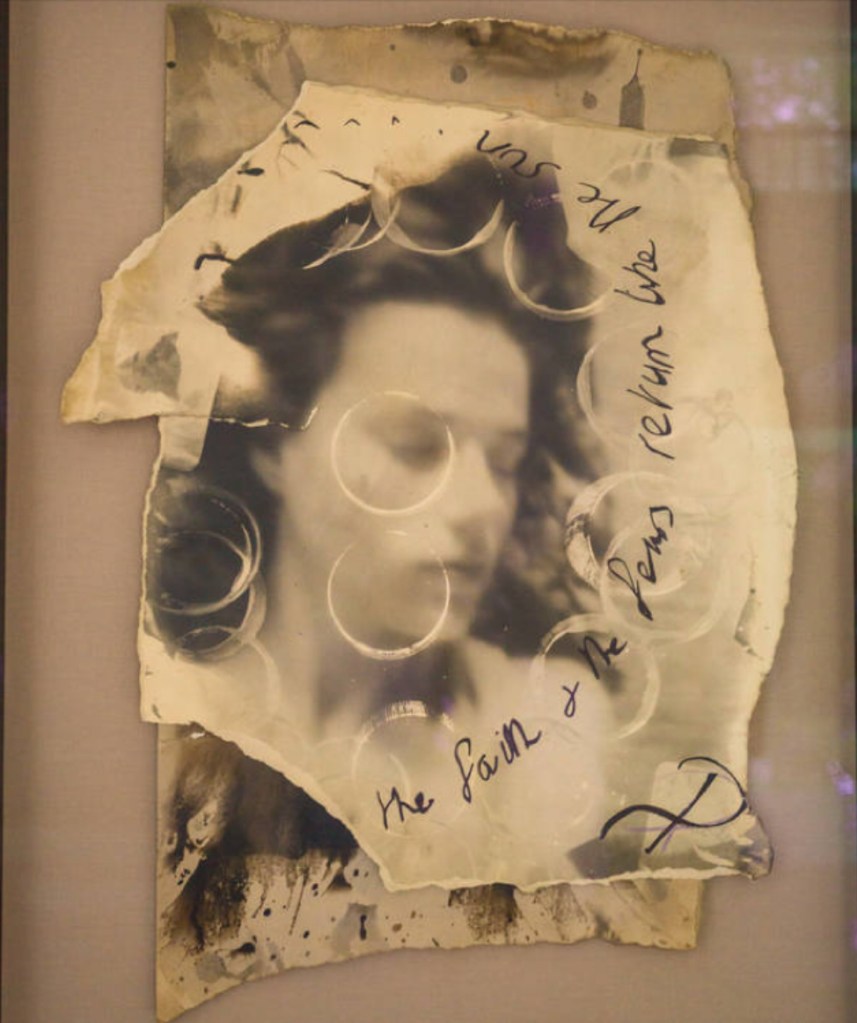
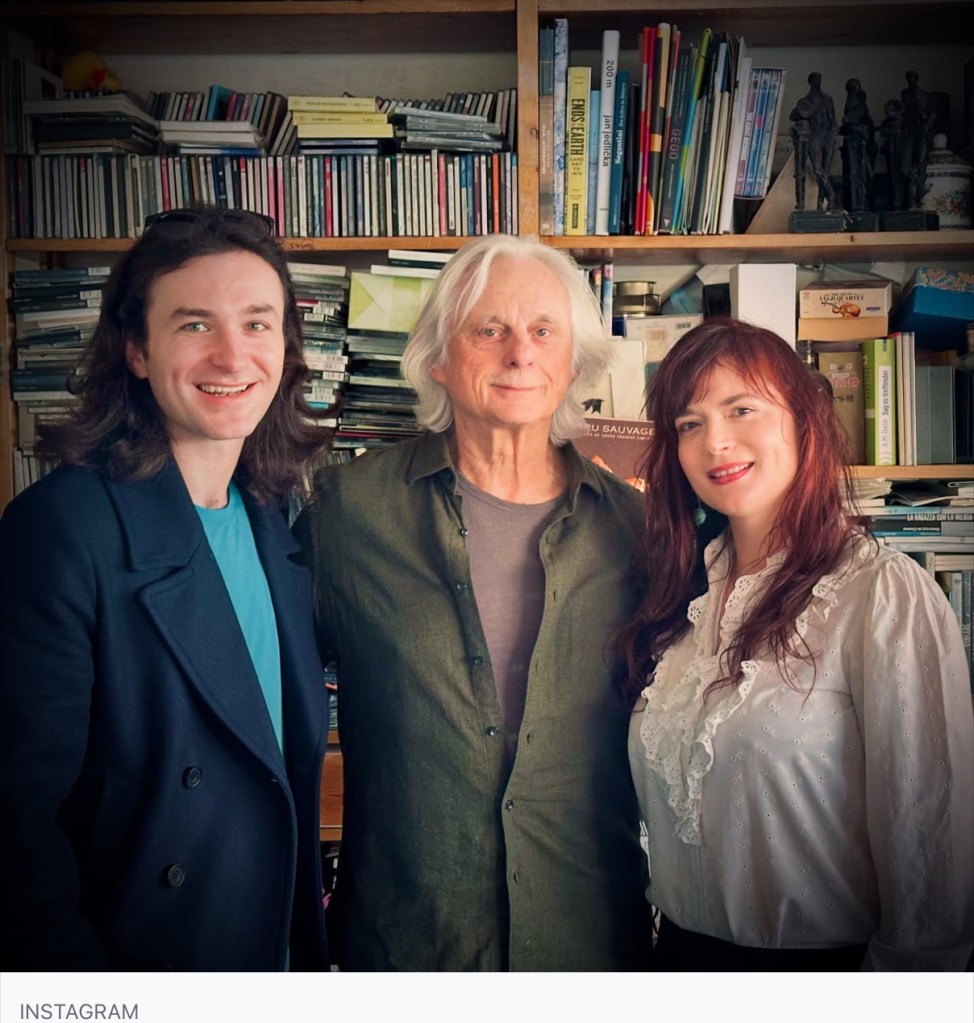

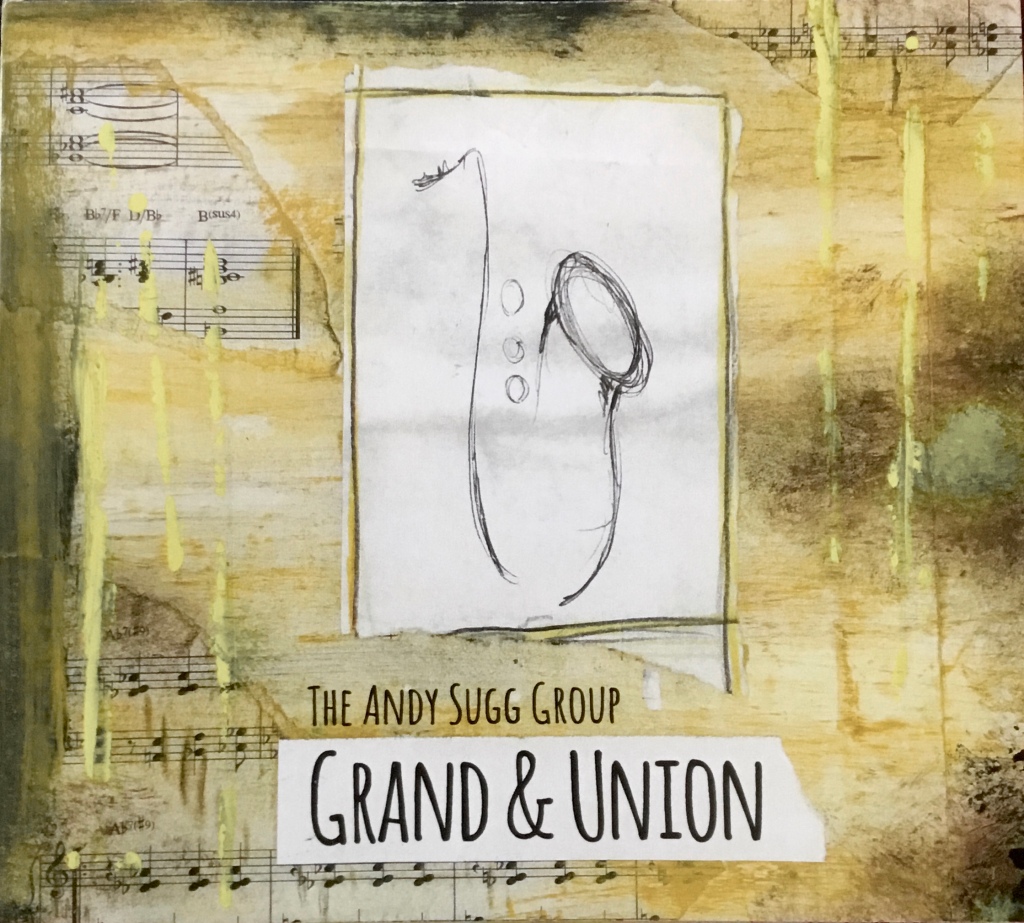


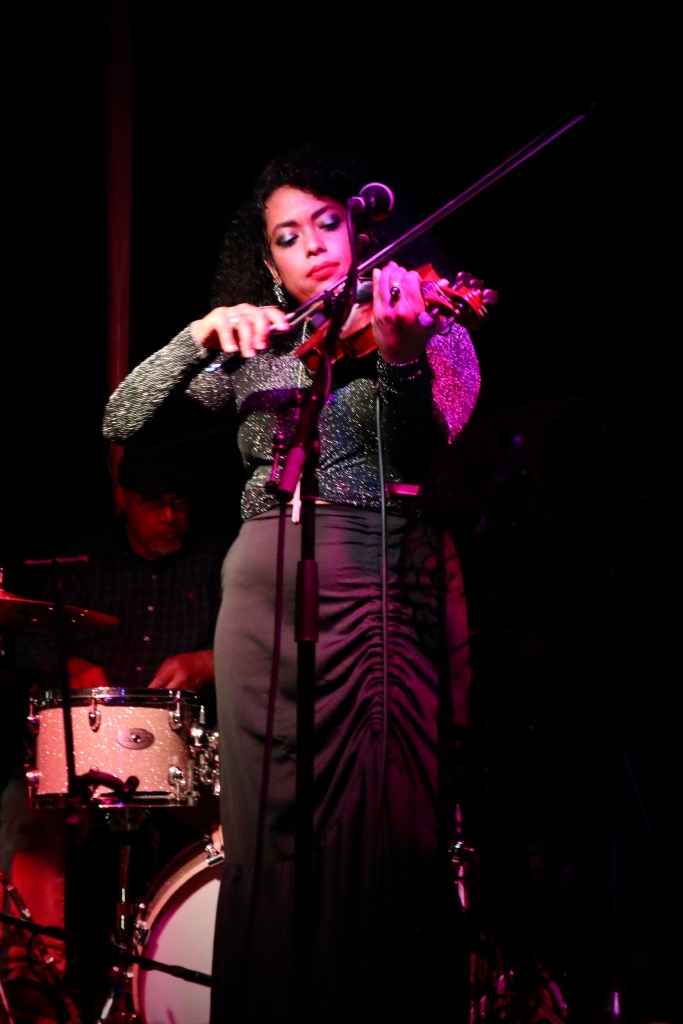
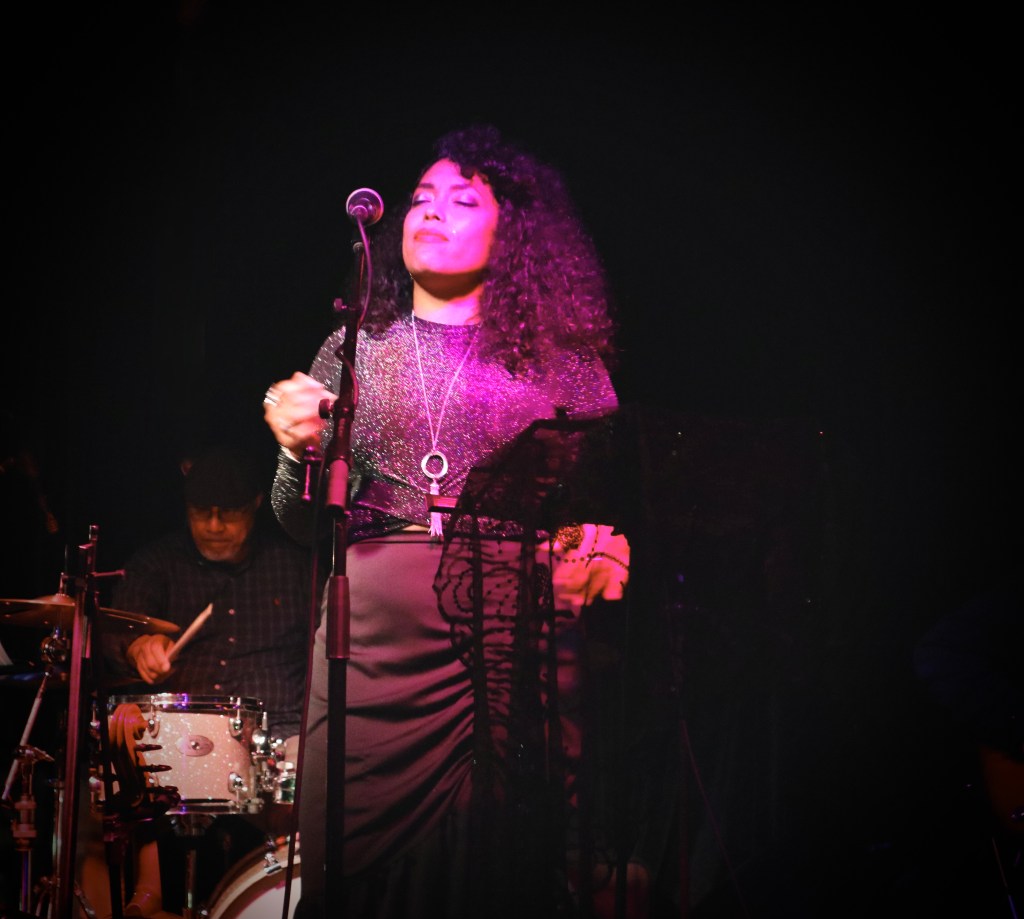
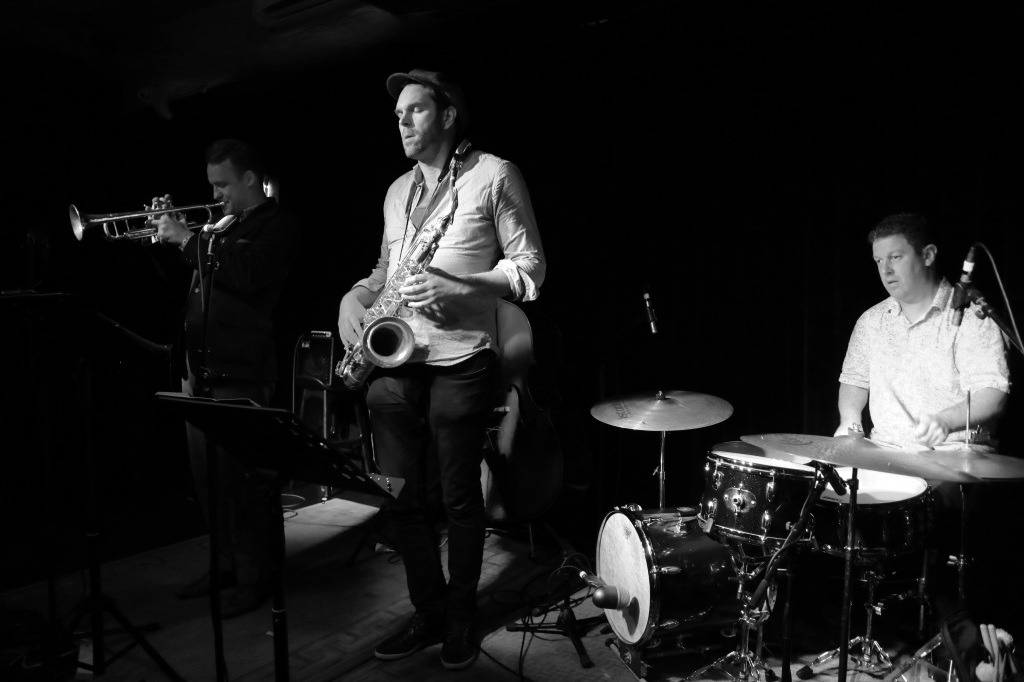

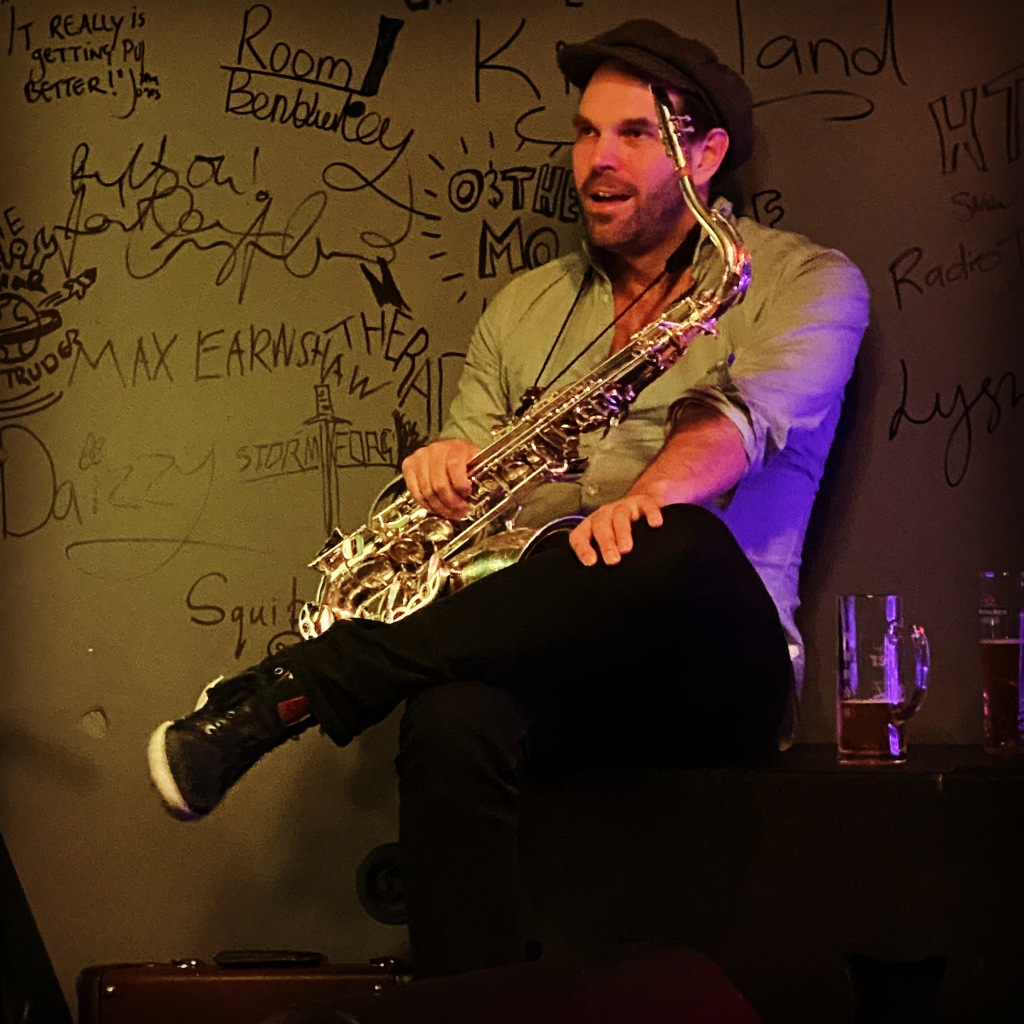


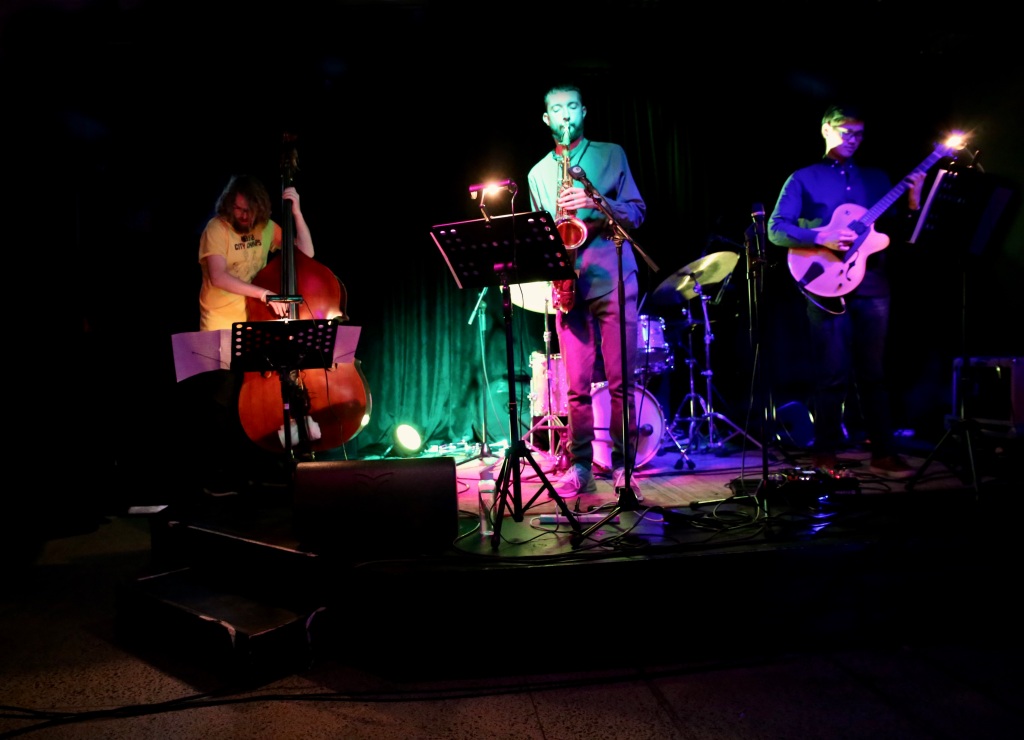
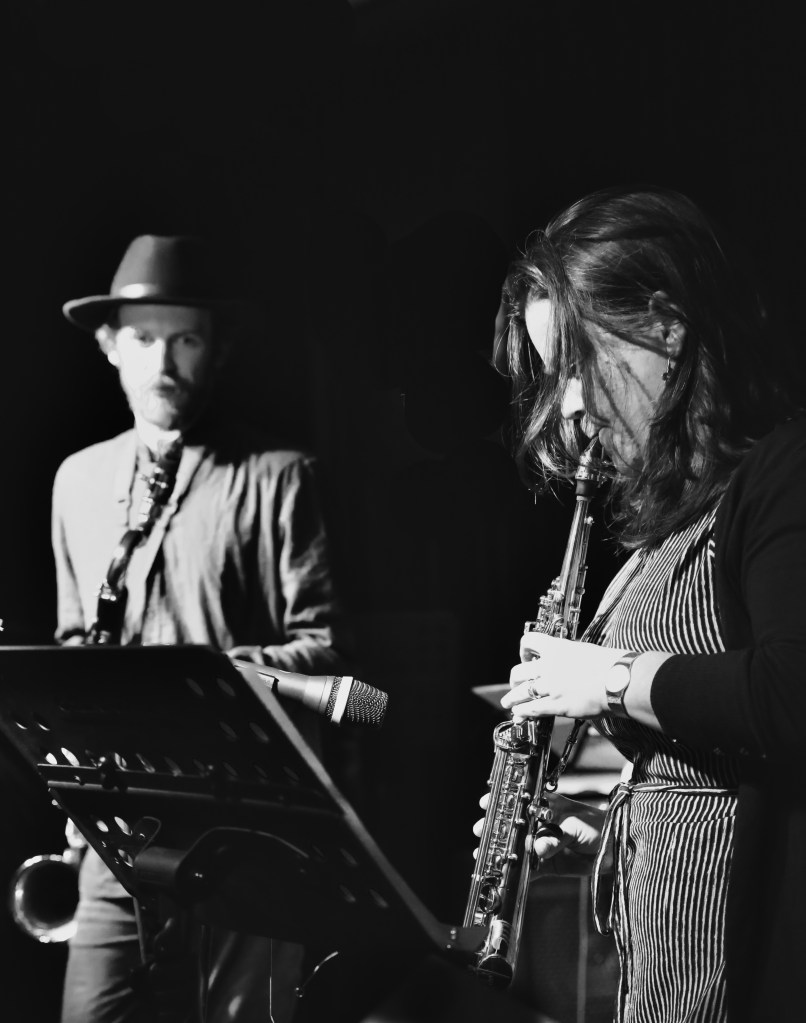
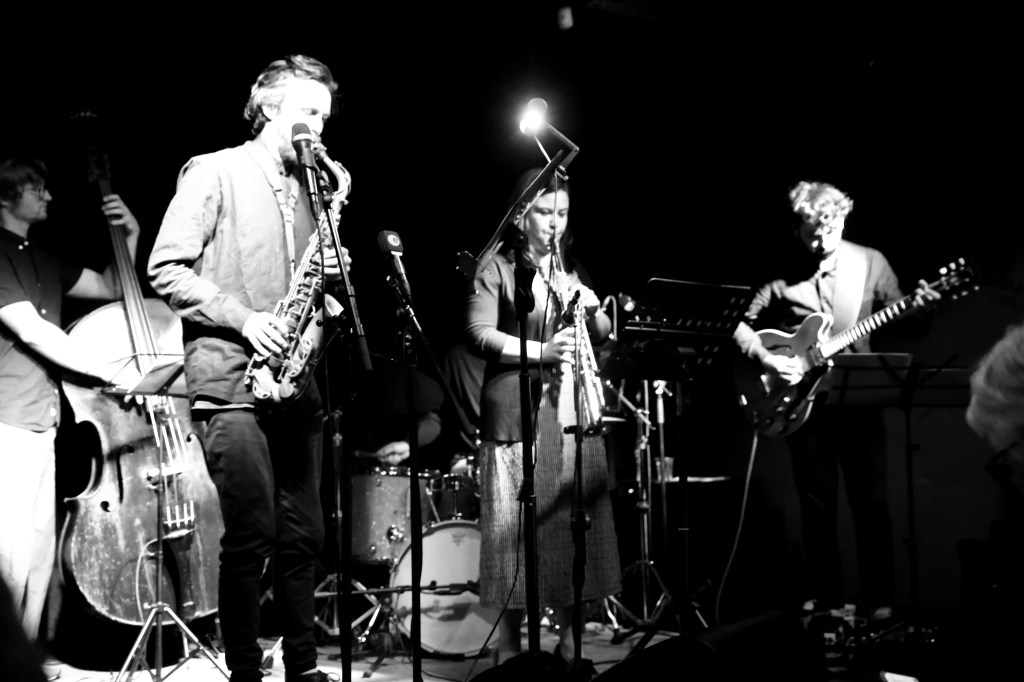

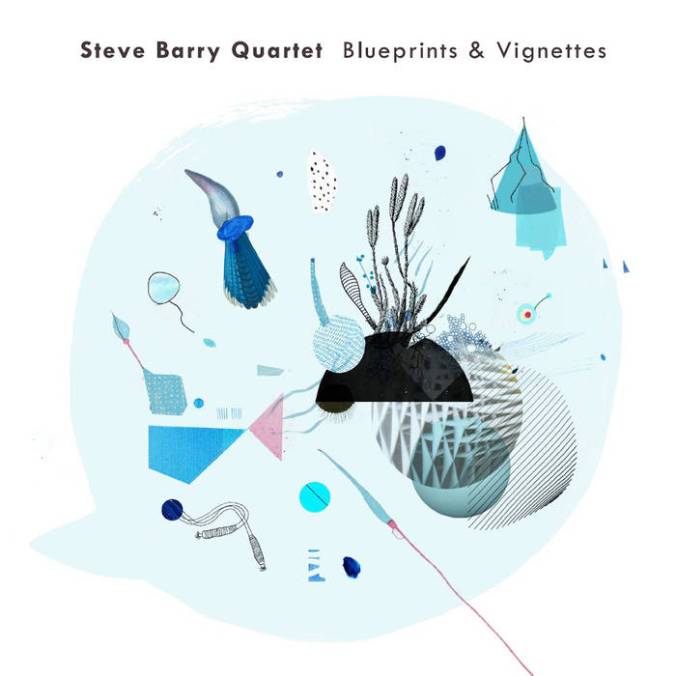
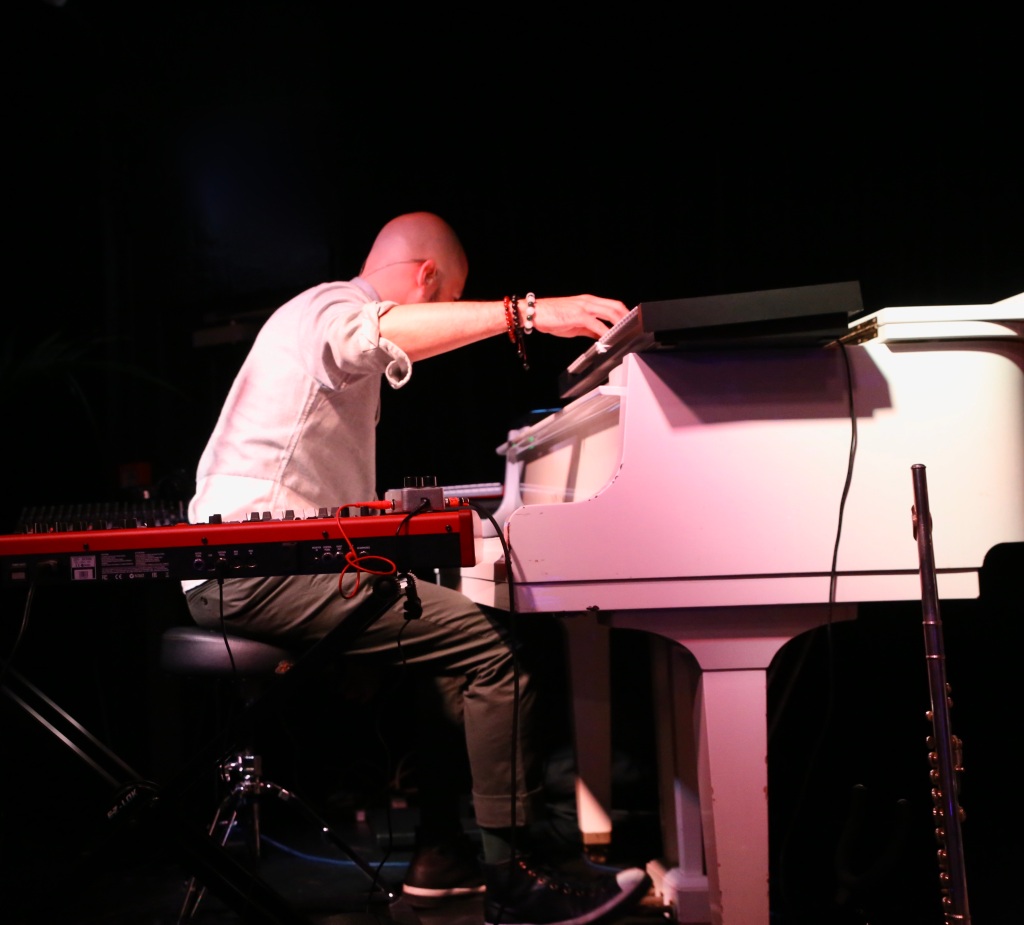
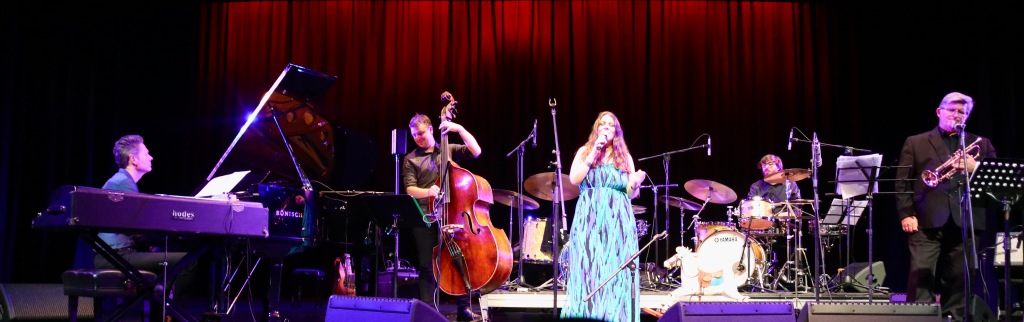
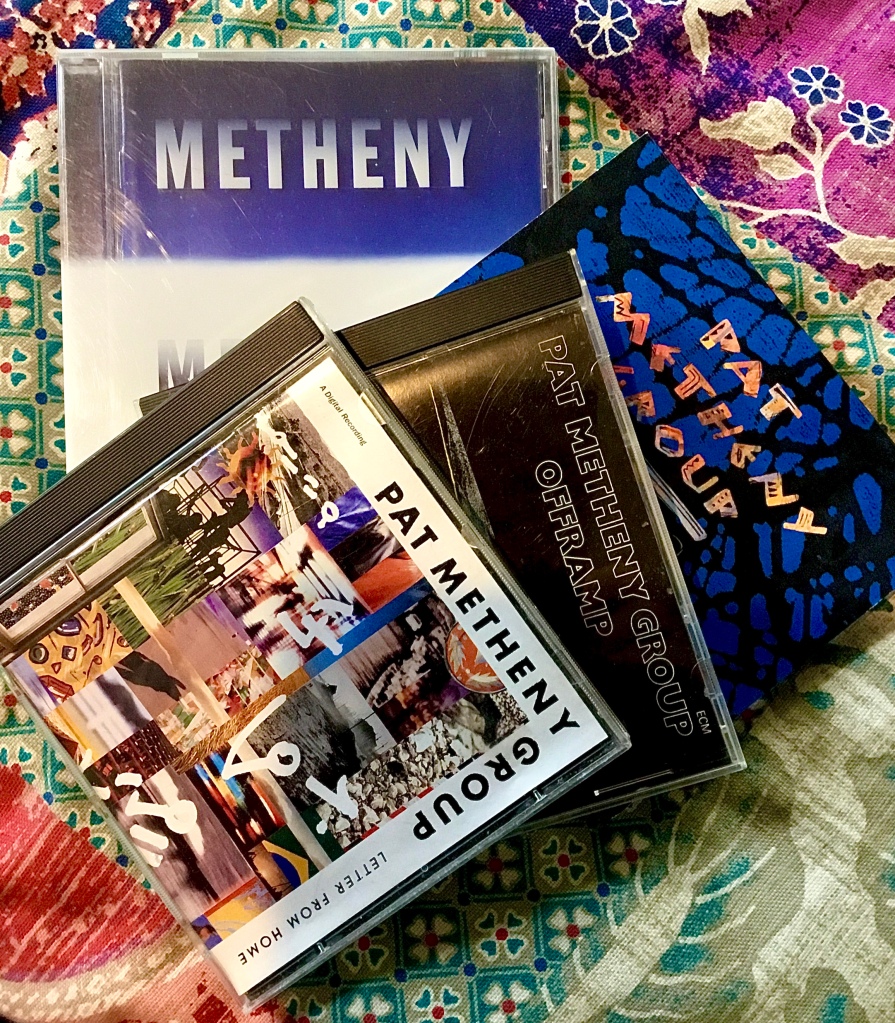
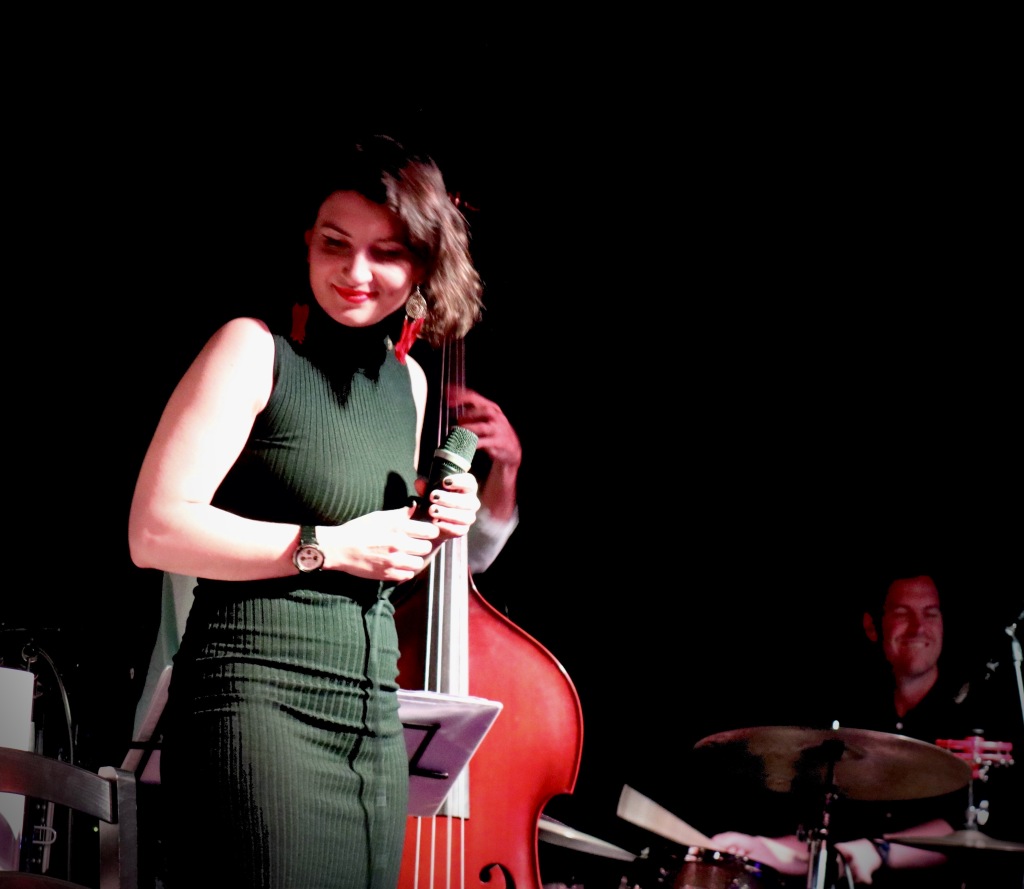

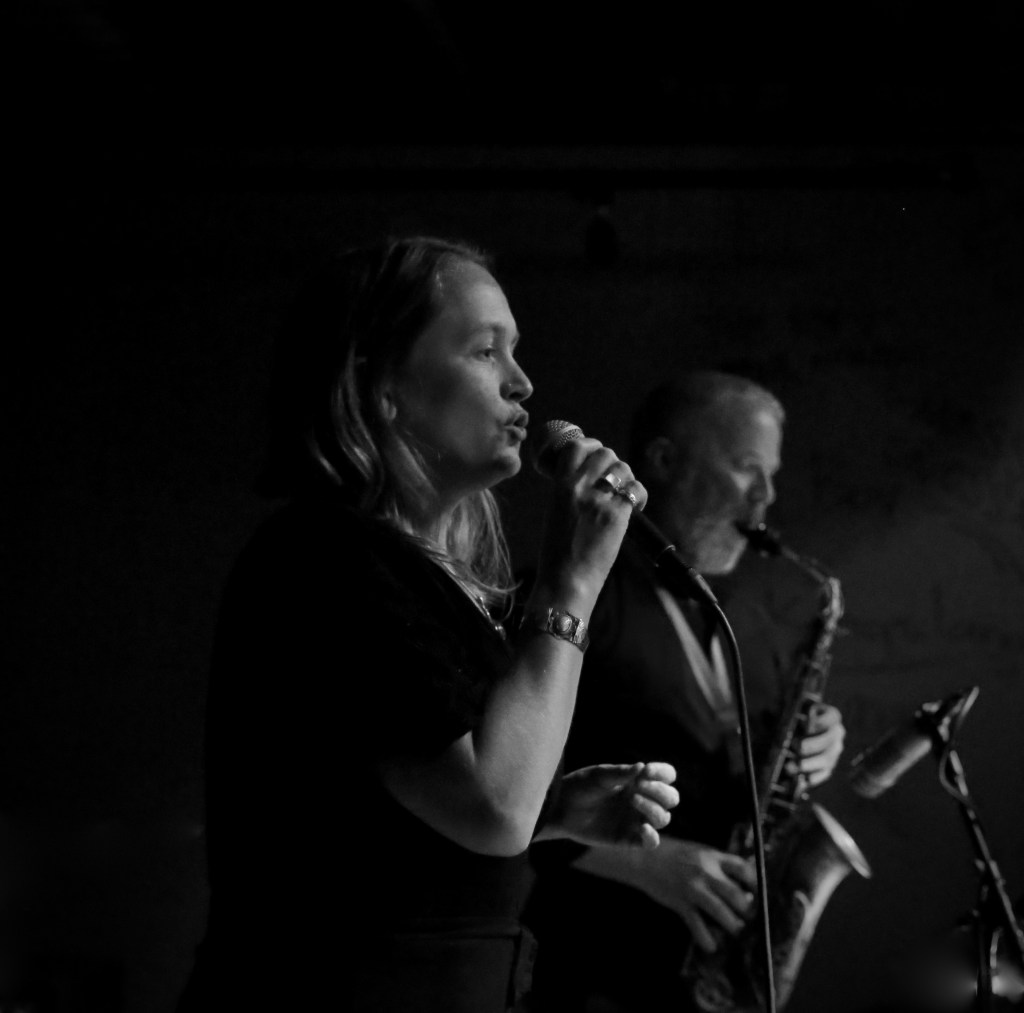

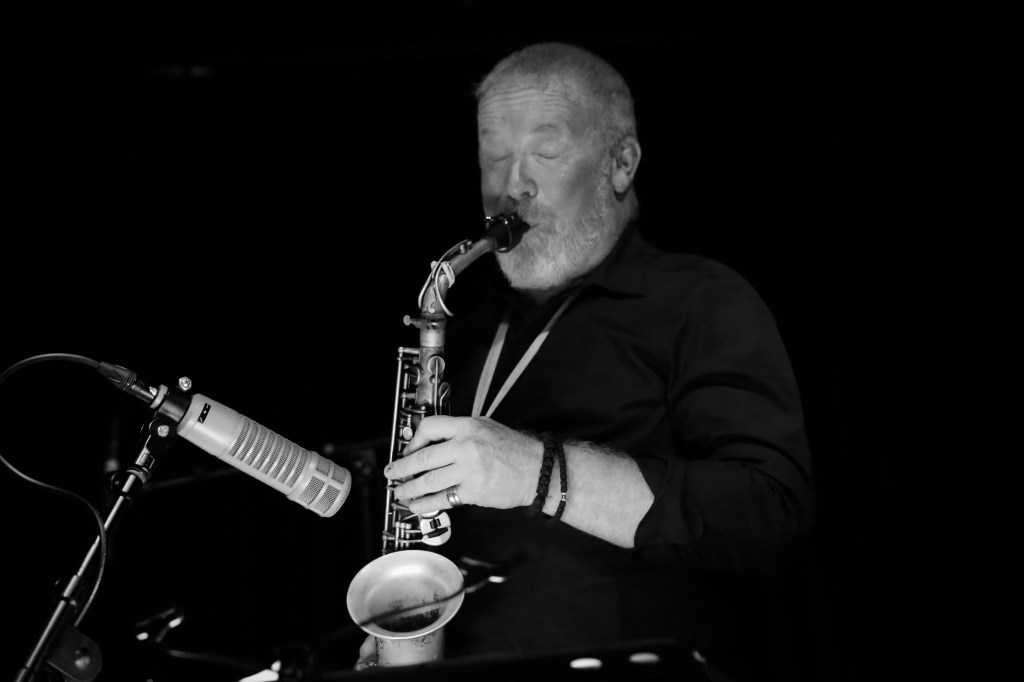
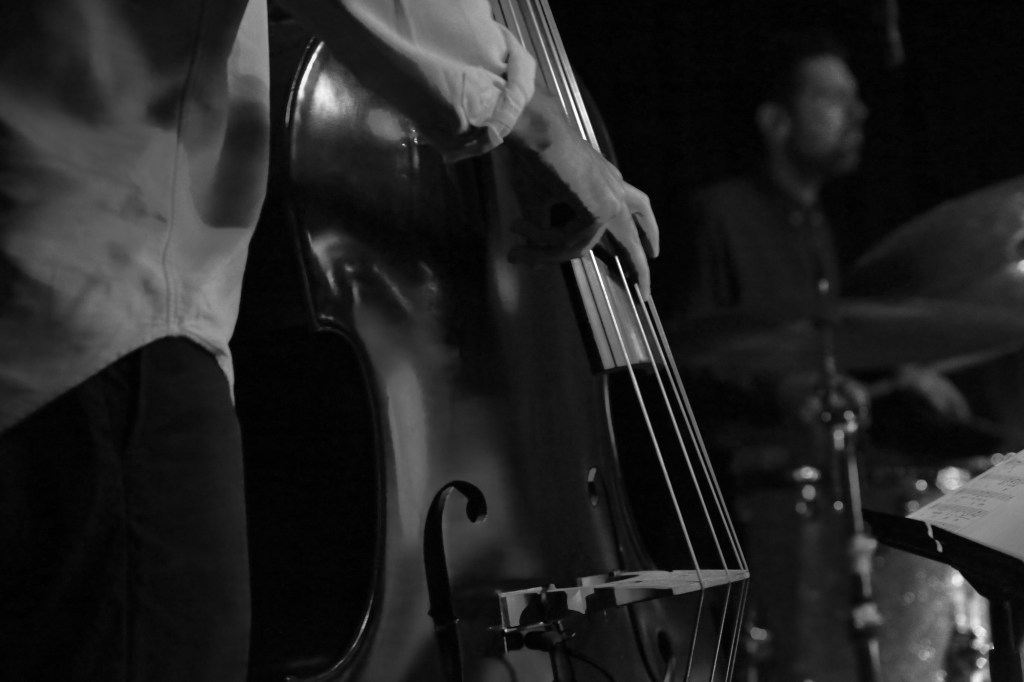
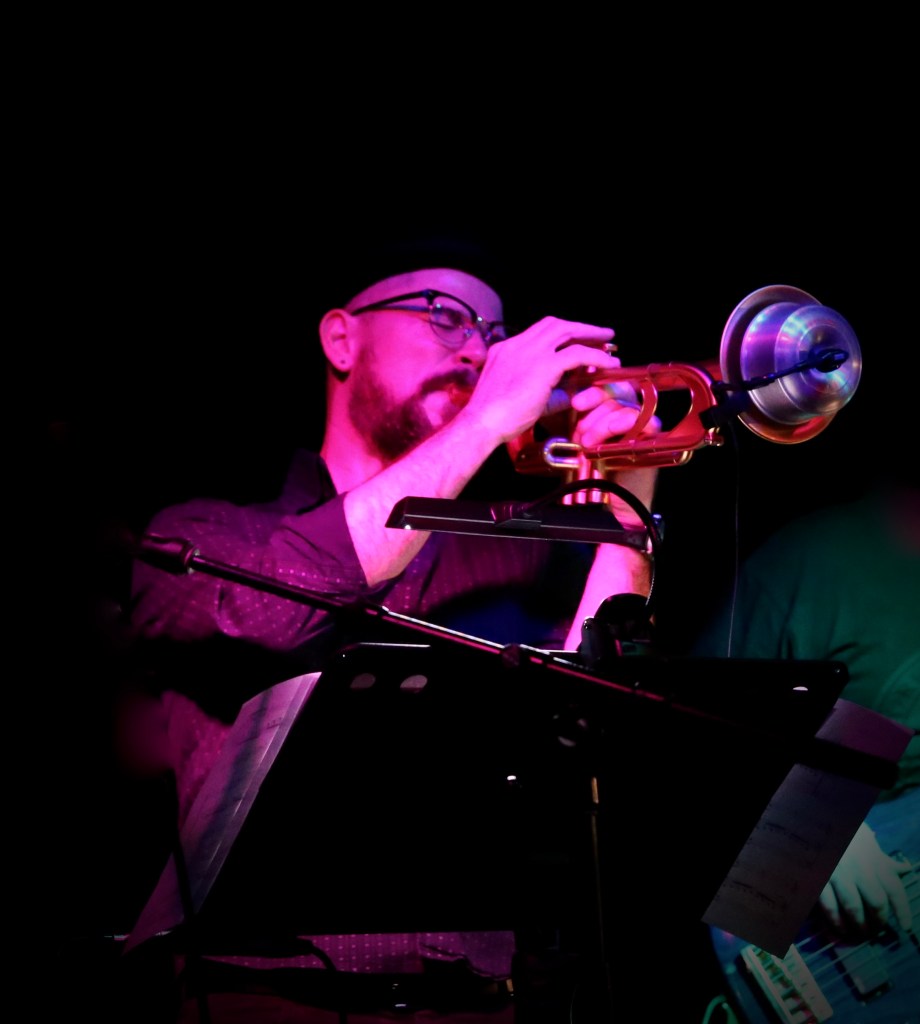
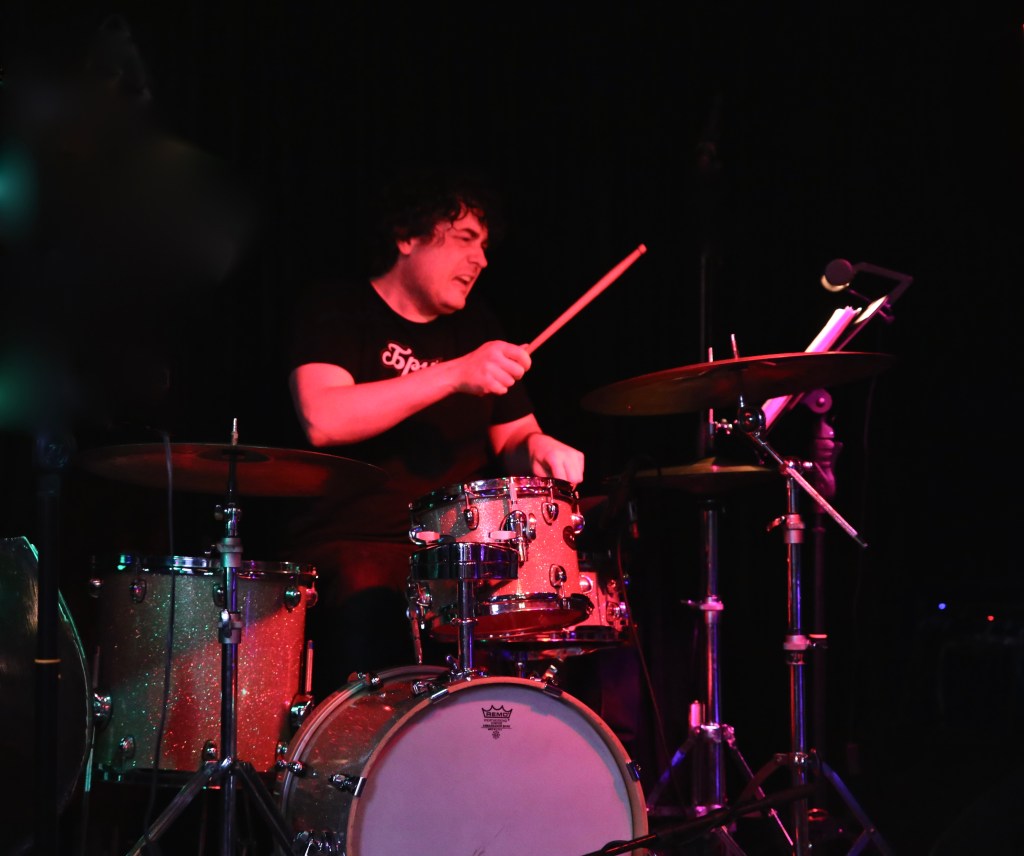
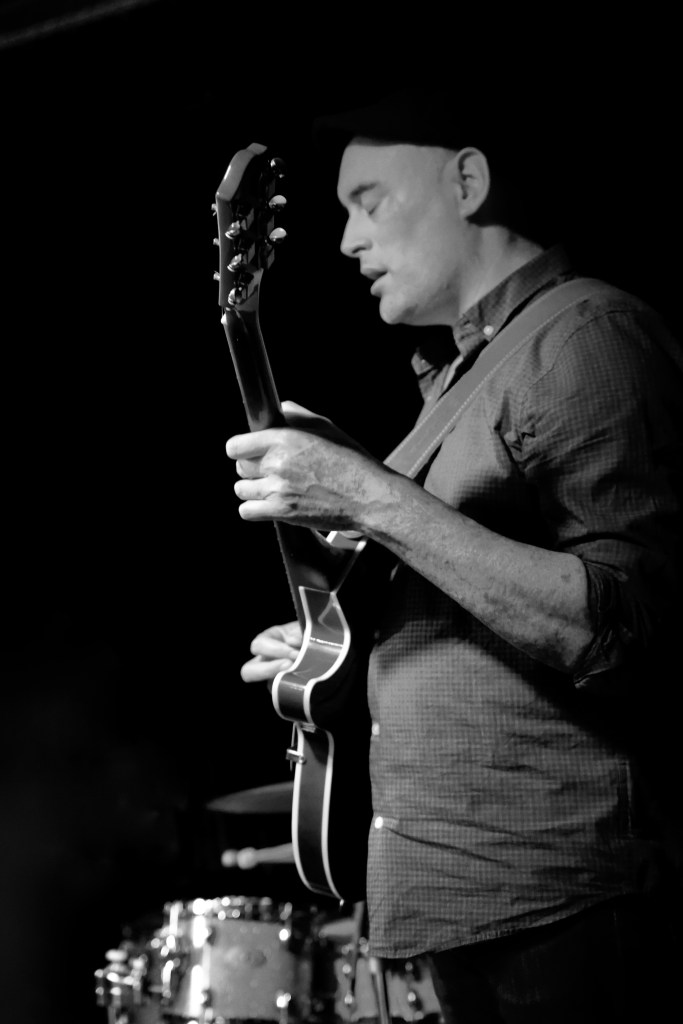

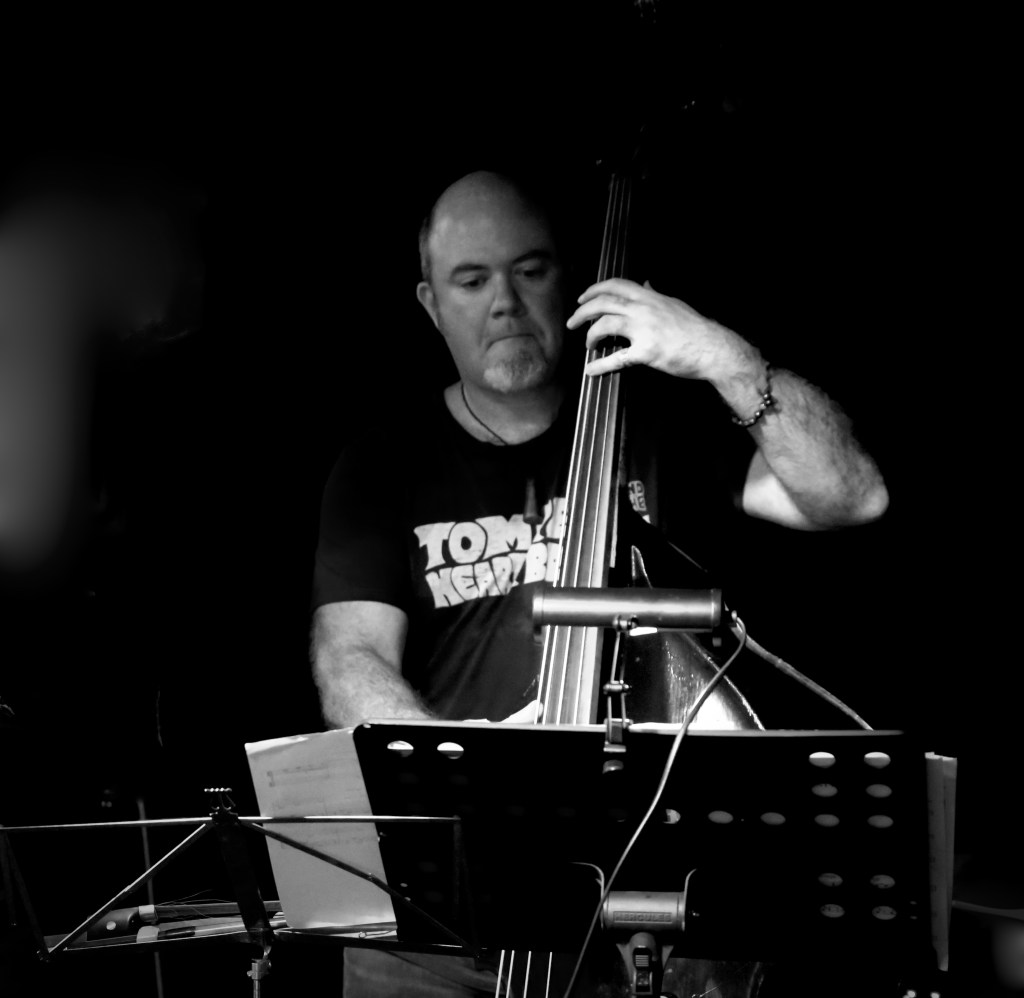
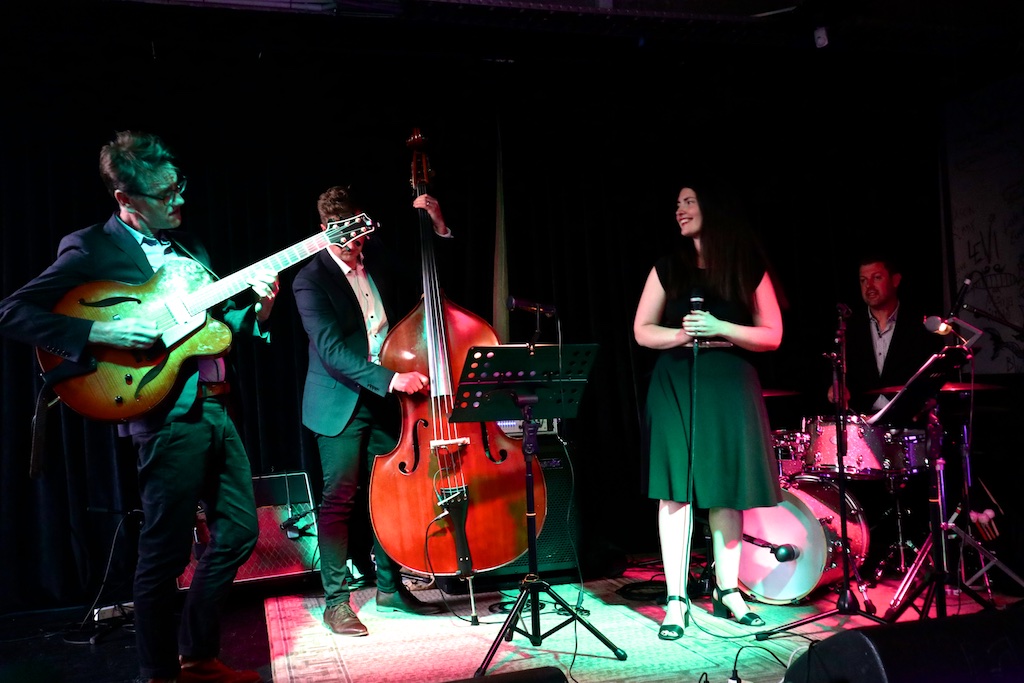 I was barely off the plane and my brain was full of dense fog, no doubt a legacy of San Francisco Karl who had been circling me like a spectre for a good month. I gamely fought the malaise off and because I am a creature of habit, dutifully made my way down to Auckland’s CJC Creative Jazz Club. In my experience, it pays never to miss a live improvised music gig, because if you do, you risk bitter regret. Believe me, I often lie awake lamenting a missed chance to see John McLaughlin.
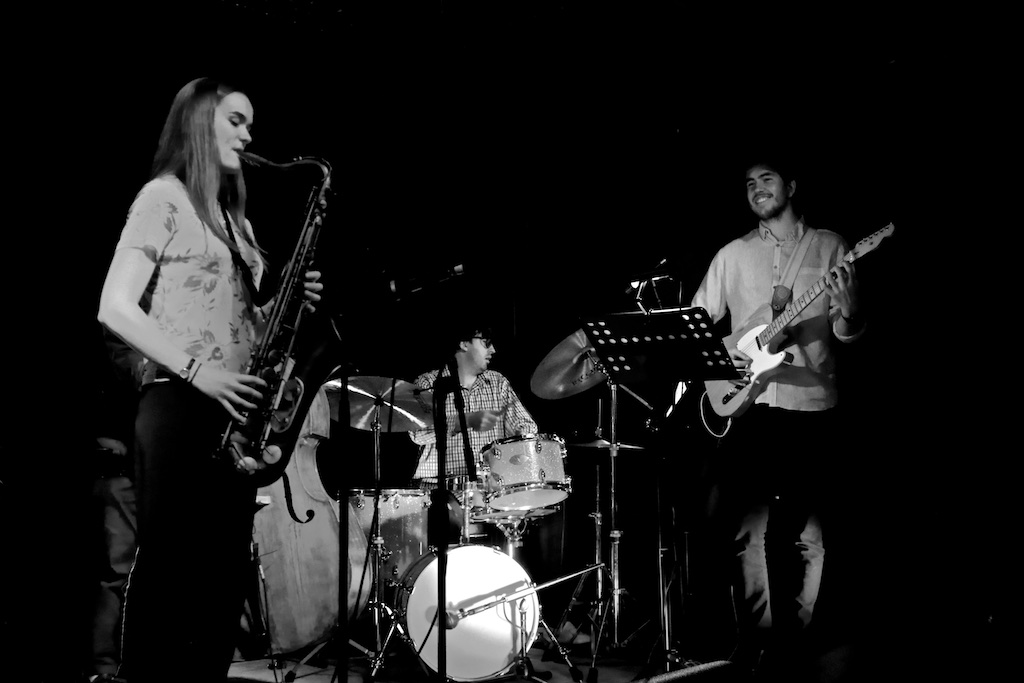 Louisa Williamson is a gifted young tenor saxophonist who has visited Auckland on previous occasions. This time, and for the first time, she visited as a bandleader, showcasing her beautiful compositions. I have always admired her tone and improvisational abilities, but this was a step up. Freed from the comfort of a band she knew well, she cast herself among an array of experienced Auckland musicians. Stephen Thomas on drums, Tom Dennison on bass and Michael Howell on guitar. The only Wellingtonian (besides Williamson) was pianist George Maclaurin and together as a band they delivered. This was engaging straight-ahead Jazz.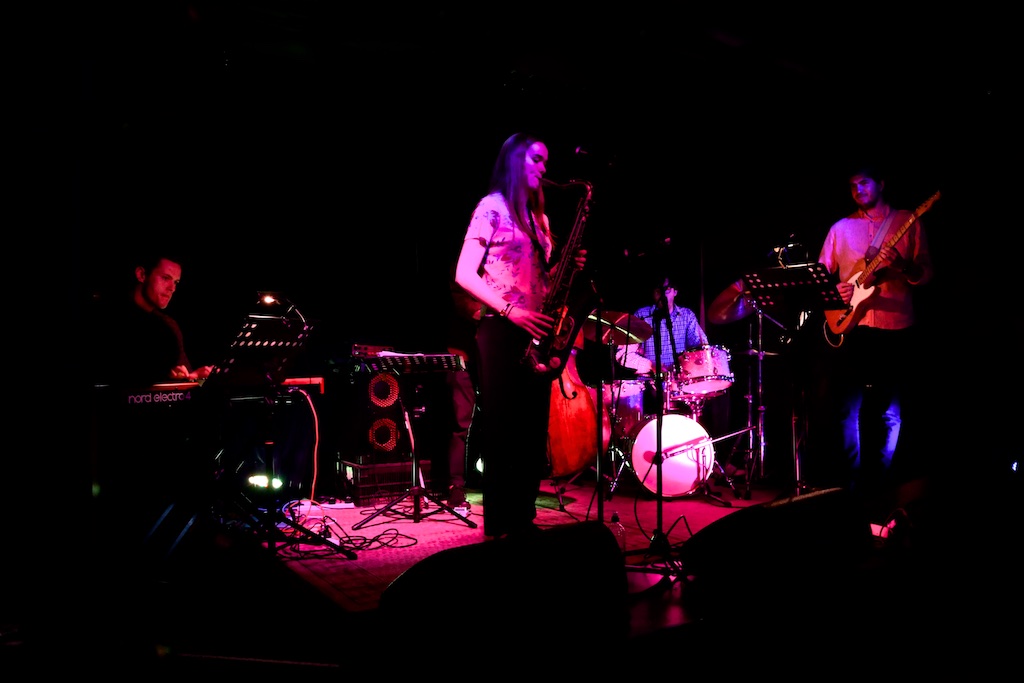
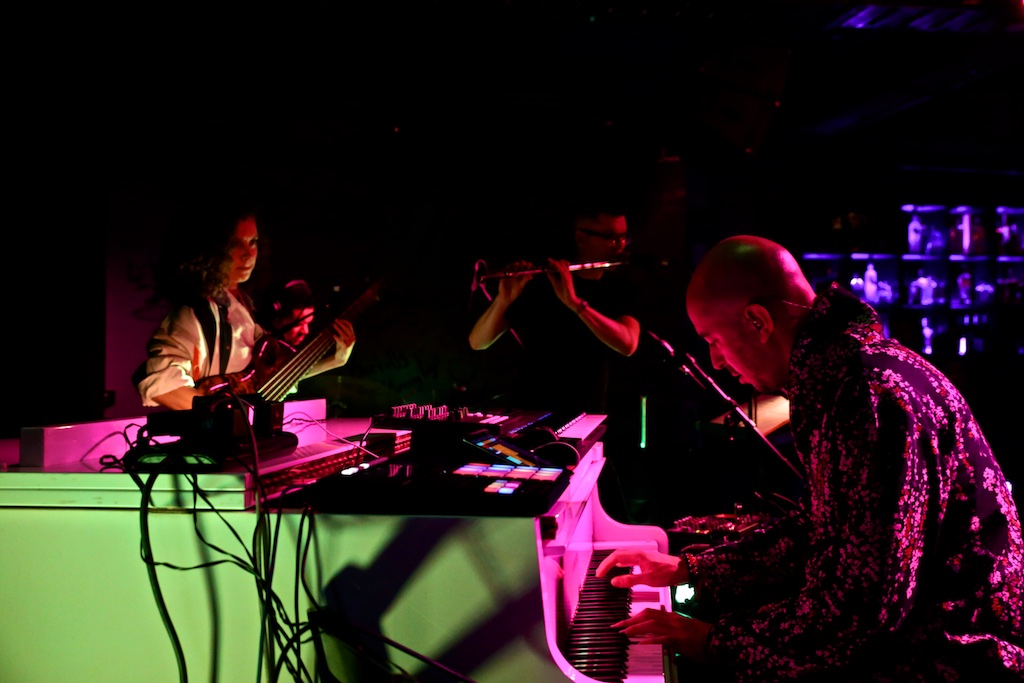 Music is the highest form of communication. It is universal. It reveals truths, tells stories, entertains, and in Mark de Clive-Lowe’s case, it evokes other realities. This was a masterclass in storytelling; an unfolding kaleidoscope where the contradictions and sublime realisations about the human condition were brought into focus. ‘Heritage 1 + 2’ the albums reflect his personal story, a journey of reconnection, an exploration of culture and of family history. He revealed it through moments of spoken narrative, but above all through his reverential musical examination of Japanese art forms. This was a musical journey where the highly personal overlapped the philosophical. It was a journey back to his Jazz roots and undertaken entirely on his own terms.
 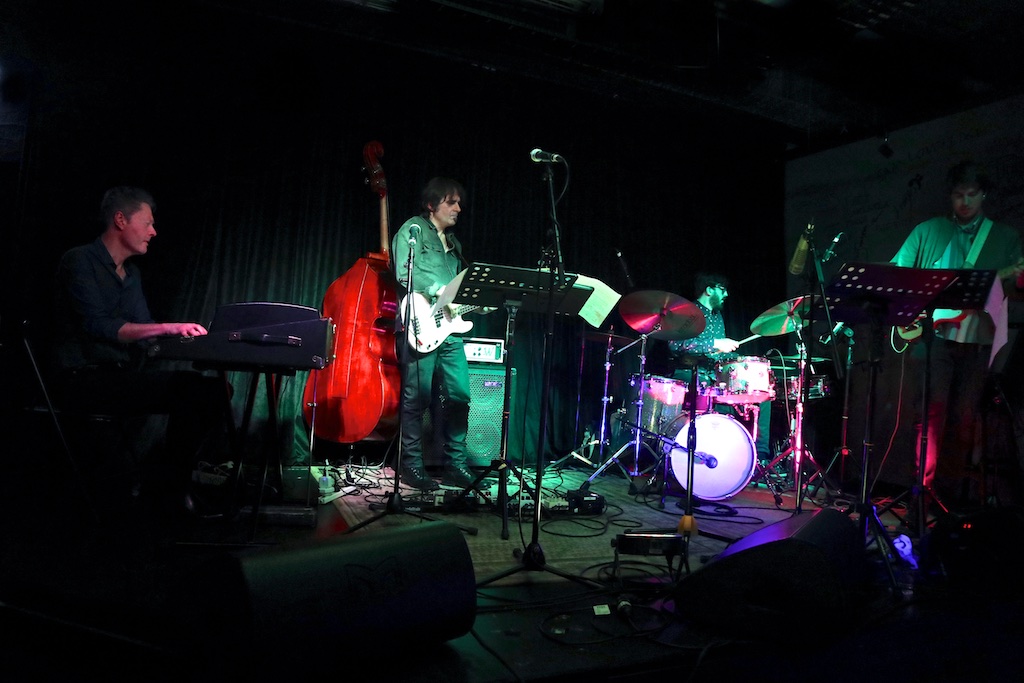 Subject to availability, Richard Hammond is the kind of bass player that you would consider first for an important gig or recording.
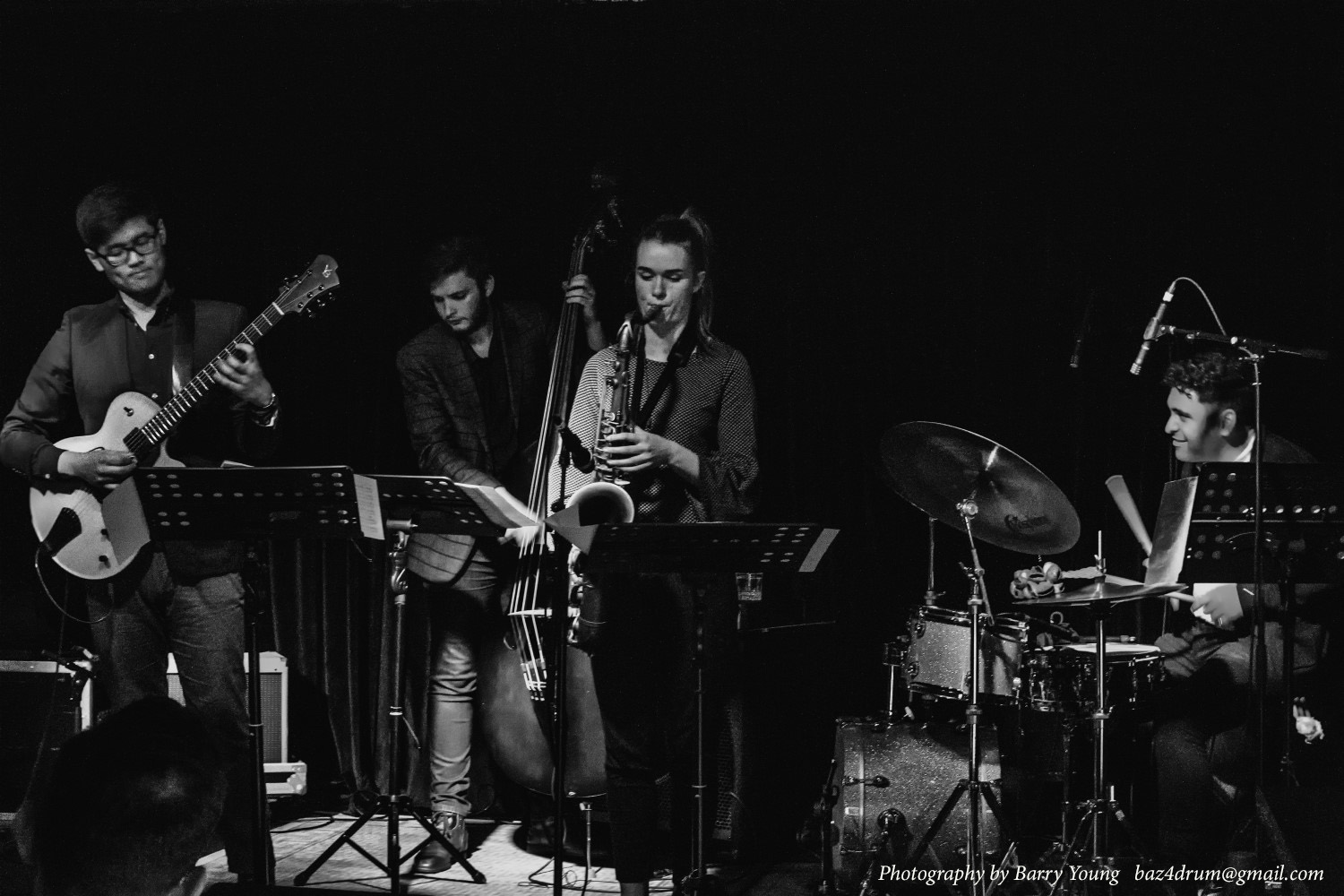 Brad Kang has previously appeared at the CJC, but this time he was here with his own quintet. It is not too much of a stretch to say that most emerging Jazz guitarists during the last decade have demonstrated a liberal dose of Kurt Rosenwinkel in their playing. It is in their sound and their approach to melody and it was unmistakable with Kang. That clean bright tone and the fluent unison lines as he and saxophonist Louisa Williamson ran through the head arrangements.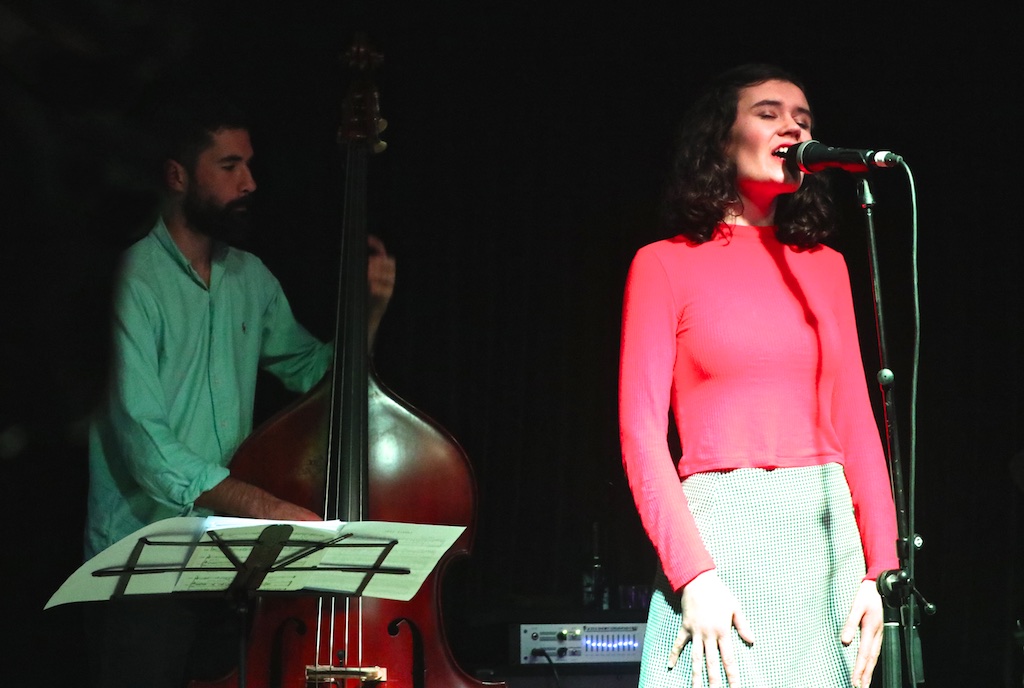

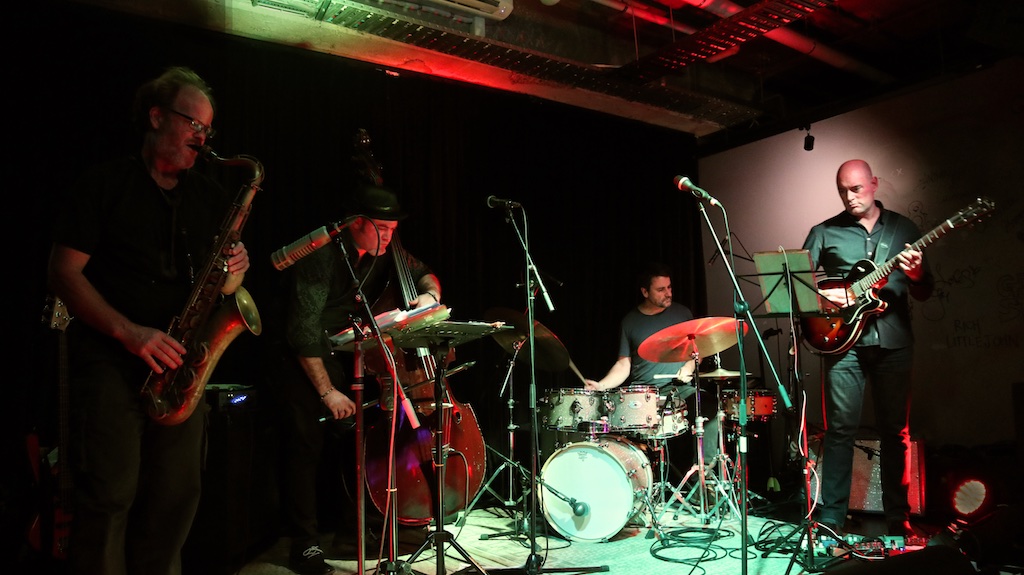 The original
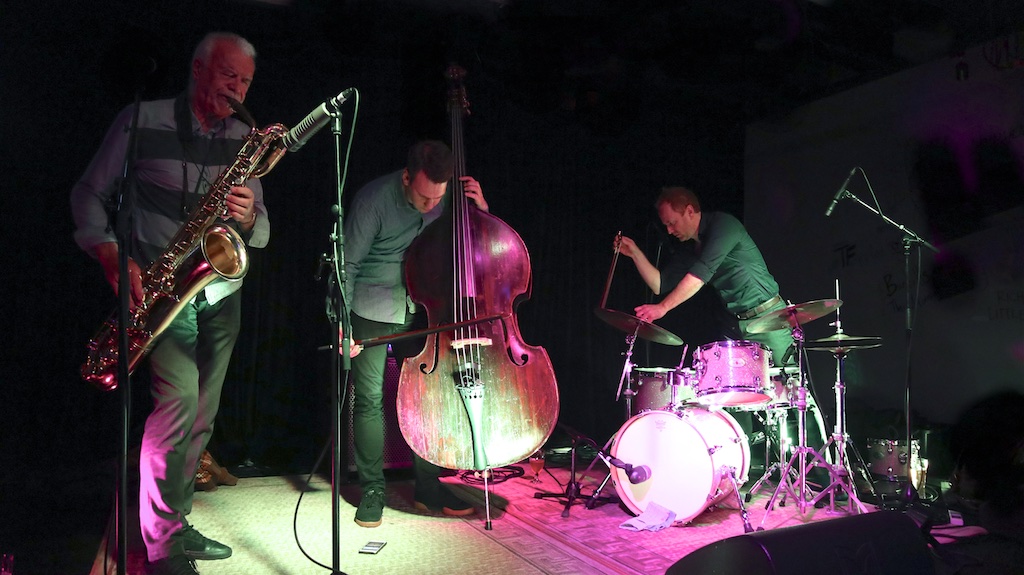 About eighteen months ago I was contacted by Jeff Henderson. He suggested, that I might be interested in a gig featuring two great Norwegian musicians who were passing through. I certainly was. The musicians were John Pal Inderberg and Hakon Mjaset Johansen. I was particularly interested because the baritone saxophonist John Pal Inderberg is associated with Lee Konitz and the late Warne Marsh. I make no bones about it, I am an unapologetic devotee of the Tristanoites. During that particular visit, the duo played a number of Scandinavian folk tunes and in their hands, these became melodic springboards for improvisation and a cloak for standards (with local bassist Eamon Edmundson-Wells). The Nordic region has a rich history of improvised music and it is therefore unsurprising that so many innovative US improvisers have ended up living and working there. With artists of this quality to work with why wouldn’t they? Inderberg and his band are great ambassadors.


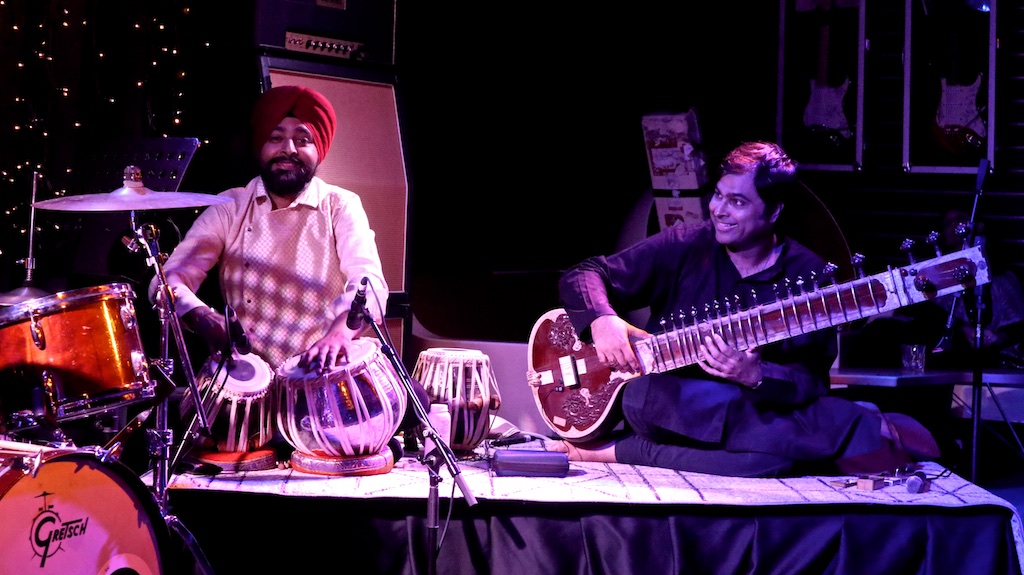 Again, the CJC Creative Jazz Club has made good on its promise to deliver diverse and interesting projects.
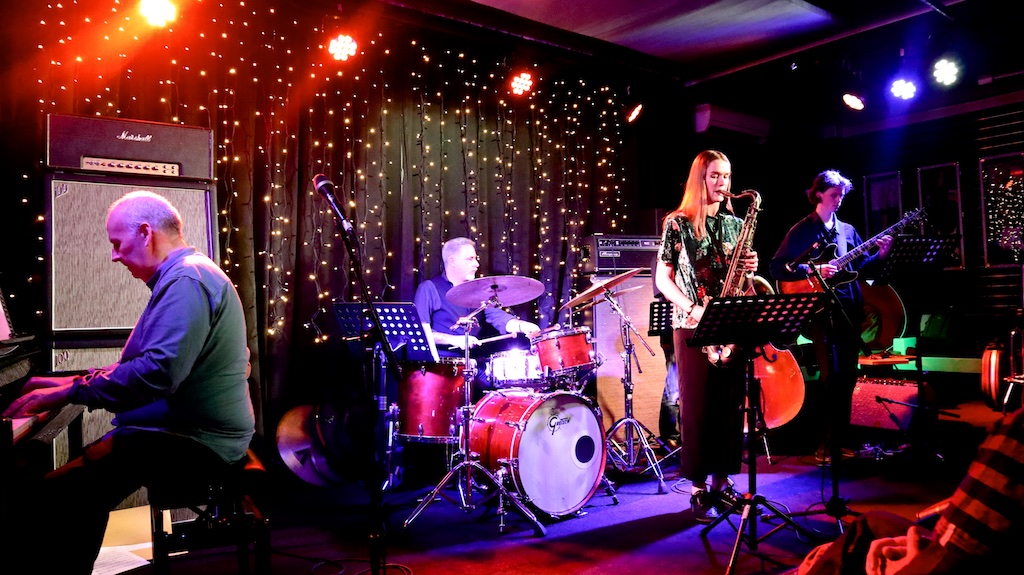 The UK born Mark Donlon is an internationally renowned musician who joined the New Zealand School of Music as a senior lecturer in Jazz Piano in 2013. He has previously appeared at Auckland’s CJC, but never with a quintet. The small ensemble format is clearly a forte as it revealed his many skills. After hearing his recent recording and attending the CJC gig it was evident to me that this particular project hit a sweet spot. What we heard on Wednesday was something special.

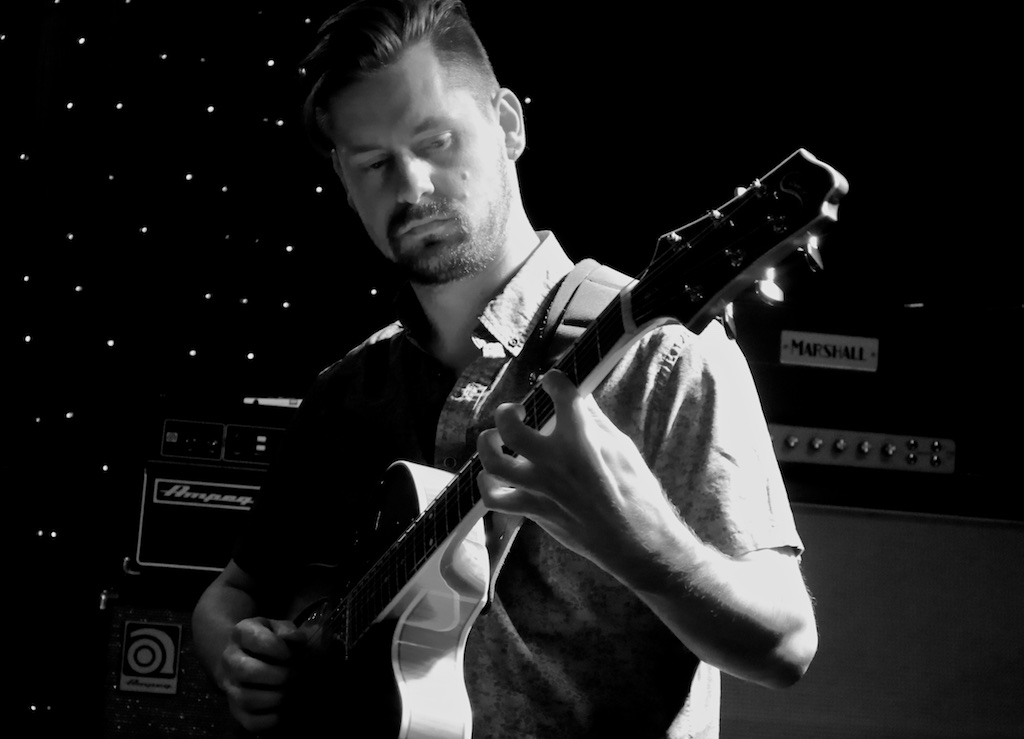
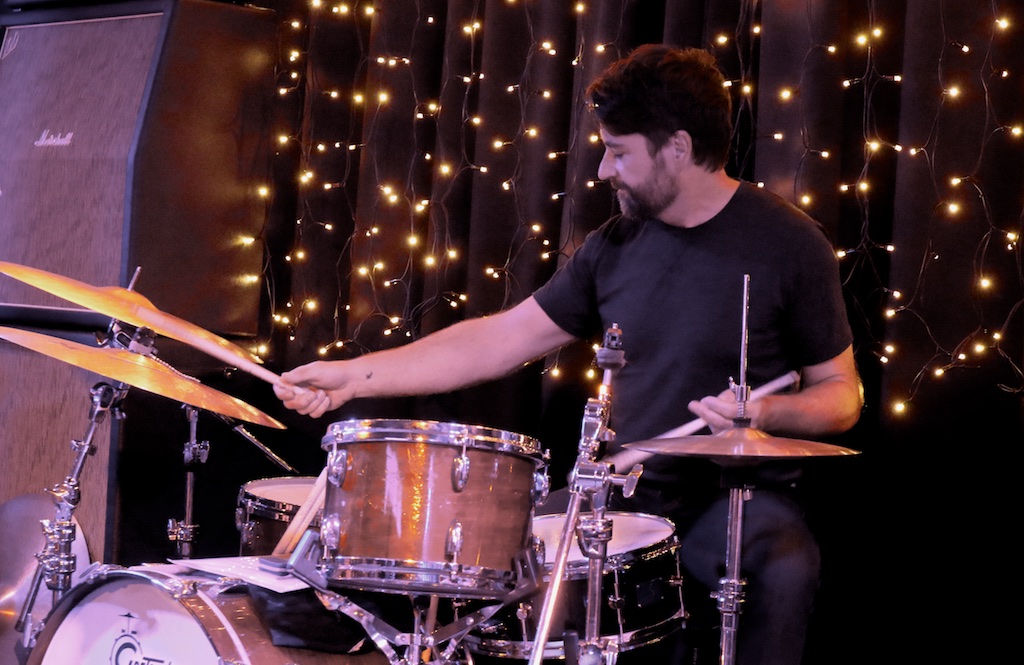 March fifteenth began as good days should, with sunshine, a cool breeze off the ocean, and a message from a Jazz Journalist colleague in Australia. ‘Would I like to meet some award-winning Greek Jazz musicians’? I had stuff planned, but the plans were easily shelved and I drove from my leafy hilltop retreat into the city. The musicians had flown into Auckland to join a passing cruise ship and were only in town for eight hours. Ahead of them lay four months of playing standards, original material (if lucky), and the inevitable but often regrettable requests. We met up in a central city cafe. ‘John’, they yelled as I walked around the corner. For the briefest second, I wondered how they had recognised me, ascribing it to a Jazz sixth sense, then remembering my tee shirt was emblazoned with the words Prahu Jazz. We introduced ourselves, and headed for the waterfront at my suggestion, chatting as if we’d known each other for years. That’s the way in the Jazz community. You travel to a place you’ve never been before and someone will message you with the contact details of ‘cats’ to hang with. Such hangs generally follow a well-trodden path. ‘Do you know this or that cat – killing?’ Always followed by outrageous road stories and laughter.
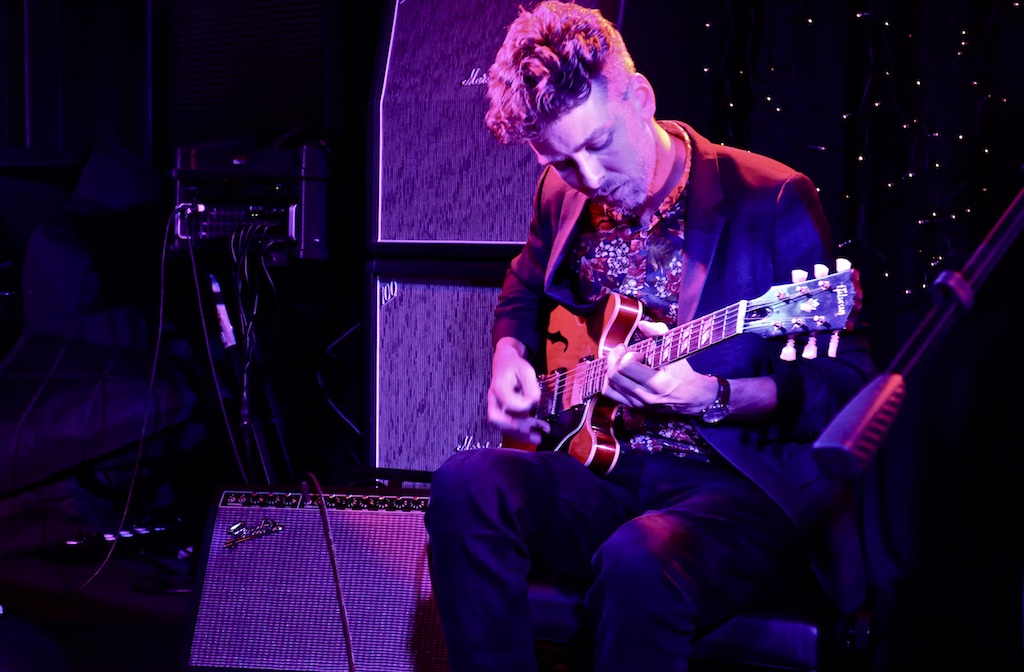 From a young age, I chose improvised music as my soundtrack. The harmonies, in particular, intrigued as they sounded like real life. Full of rich contrasts and polyrhythms. By comparison, the endless radio replays of popular songs offered diminishing returns. The miracle of improvised music is that it promises depth, and if done well it reveals more with each listening. This sets a high bar for innovation, so when I hear musicians described as compelling and original, I check them out. Ben van Gelder and Reinier Baas are so described and after attending their gig I agree without reservation.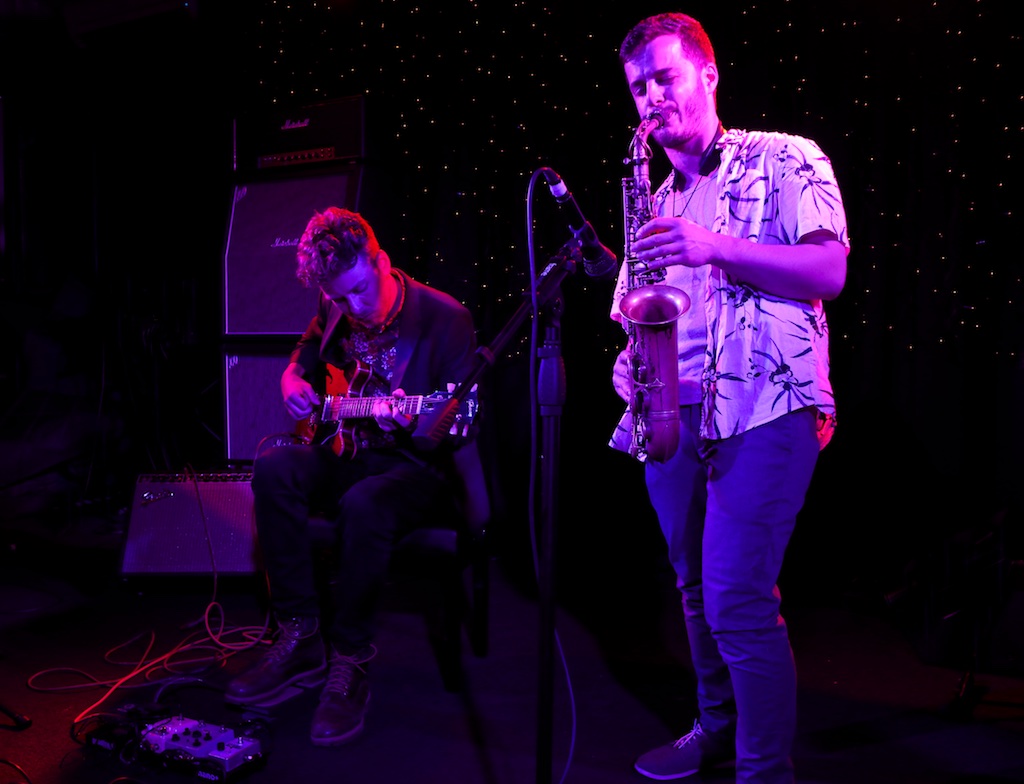
 JazzLocal32.com