Chelsea Prastiti was not long back from Cyprus when her band Leda’s Dream appeared at the Backbeat Bar. Prastiti is well known in the Auckland improvised music scene and especially so at the avant-garde end of town. She’s a compelling vocalist and composer who approaches her craft as a free spirit, unfettered by others expectations. When she sings she dives deep and puts herself out there fearlessly but her risk-taking is not a mere academic exercise; it cuts to the very heart of what it means to be a thinking, feeling human. Her compositions are therefore always interesting and out of that a raw beauty and an honesty arise. Although the ensemble played material that we have heard before, they sounded incredibly fresh – even different. Crystal Choi confined herself to accompanying vocals (no keys), Michael Howell stepped further into a measured chordal role and Callum Passells on alto and voice effects was the archetypal minimalist (saying a lot more with less). This felt very right and the re-configuration gave the ensemble a lot more freedom. They stretched out as the spirit took them and the first two tunes filled the entire first set. The voices, in particular, were liberated by the change and this gave wings to the melodic lines and mood. The harmonies were there in spades but that was not what drew you in. It was ‘mood’ and the pictures that those moods created. Prastiti’s is a brave path and I would expect no less from her. This is a musical space that is sparsely populated and more’s the pity. Think Sera Serpa (duos or trios), Think Norma Winstone (Azimuth 85) or perhaps the brilliant Nordic vocalist Sidsel Endresen (Endresen live with Jan Bang). In this ensemble, she has the musicians to give her the freedom she deserves. Passells, who is unafraid of soft trailing notes or of minimalism, Howell who can follow a vamp to eternity and make it sing, Choi who instinctively makes the right moves, and Eamon Edmundson-Wells and Tristen Deck who know when to lay out and when to add colour or texture. The music drew from free improvisation, standard Jazz and deep Folkloric wells. It did so without undue introspection. The band brought the audience along with them and the bouts of enthusiastic applause proved it. For some reason, and it was partly their attire, the gig felt like a postmodern version of a Pre-Raphaelite tableau. Oh yes indeed, that always works for me.
Leda’s Dream: Chelsea Prastiti (vocals, compositions), Crystal Choi (vocals), Michael Howell (guitar), Callum Passells (alto sax, sound effects), Eamon Edmundson-Wells (upright bass), Tristan Deck (drums), Backbeat Bar, 8 August 2018
Good Music always says something interesting; it’s a form of communication where a musical statement begins a process and a listener responds. With any innovative musical form, we need to bring something of ourselves to the equation. The more open our ears the better the experience. Gifted improvisers of all cultures understand these fundamentals and because of this they mostly tell old stories in new ways. Rarely and bravely, musicians hit us with stories not yet fixed in the popular imagination. Steve Barry and his collaborators have a foot in both camps. While this is adventurous material, it is also approachable to anyone with open ears. What we heard at the CJC was innovative but the archetypes of all music were located deep in the compositional structure. A careful listening revealed trace elements from composers like Stravinsky or Bley and perhaps even of indigenous music.
The first piece they opened with was titled ‘Grind’ – a composition inspired by Sydney traffic (much as Tristano utilised every street sound that floated through his NY window). The piece began as journeys do with determined momentum – a degree of clarity followed by a more frenetic stop-start feel as the piece progressed – then reflection. It appealed to me greatly and twelve minutes in, I knew that I was hearing something similar to the approach used by Bley/Guiffre/Swallow in ‘Freefall’. There are moments in musical history when profound change is signalled and that album was one of them. The critics of the time hated it of course but modern Jazz audiences have caught up. The new Barry album ‘Blueprints and Vignettes’ will not be regarded as controversial but as vital and forward-looking. Back then clubs took fright and closed their doors but no club owner worth their salt would miss booking this group.
Barry is an interesting pianist and composer and this project may be his best to date. At the CJC he was confronted with a basic upright piano, but he somehow transformed it into a new instrument entirely. Many in the audience were fascinated and approached him afterwards to enquire how he achieved this slight of hand. Clever miking and a constant repetitive damping of the soft pedal was evident, but I suspect that his rapid-fire staccatissimo touch contributed as much to the effect. I know that Barry has also explored Bartok and the classical modernists and this may hold some clues as well. Whether by happenstance or contrivance, the overall effect was enormously pleasing. There were set patterns and themes, but these altered, developed, as fresh ideas arose from them.
I was delighted to finally catch up with Dave Goodman (PhD), having heard him last at the 505 in Sydney (along with Mike Nock, Rog Manins, James Muller and Cameron Undy). Goodman is an enormously versatile drummer and a popular educator. His role here is varied, but often that of ‘colourist’. Rolling his sticks over the drum heads, or providing contrast with irregular taps on the snare or a muted ride cymbal – and entering these interesting conversations as an equal. The other trio member was Jeremy Rose on reeds (his horns, the alto saxophone and bass clarinet). He was just superb and every bold sound or whispered breath added new dimensions. It is seldom that we hear a bass clarinet and to hear one in a trio setting of this kind is even rarer. The clarinets woodiness and rich harmonics added texture, the alto, a hawk awaiting its moment then swooping purposefully. In spite of the varying tempos and moods, the album imparts a delicacy from start to finish. Live, they got the best out of the acoustics and venue piano. What a perfect sound palette Barry has chosen for this project and whether live or recorded, how satisfying the realisation.
The album ‘Blueprints and Vignettes’ is available from stevebarrymusic.bandcamp.com or from retail and online sources (I recommend Bandcamp). The album features Max Alduca on bass. The live gig took place at the Thirsty Dog for the CJC (Creative Jazz Club) – February 21, 2018.
It was a good way to begin a year of music, a good way to breathe life into two enervating steamy nights. Hayden Chisholm was back in the country and around him formed various duos, trios, and quartets. He performed two gigs in Auckland and the first was at the Audio Foundation in Poynton Lane. The venue has long been an important source of innovative music and each time I descend the stairs to the sub-basement I find interesting changes to the clubs configuration. It really is an excellent venue and perfect for what it offers. At first glance, the two nights appeared quite different. One free improvised and the other a set of reflective ballads. In reality, both gigs were reflective, melodic and approachable. The open-hearted humanity and communication skills of the participants made it so.
When Norman Meehan, Paul Dyne, and Hayden Chisholm appeared last year in the UoA Jazz School auditorium, the audience was taken aback by the sheer beauty of the performance. The alto saxophone is heard less often than its fatter sounding big brother the tenor and it is seldom heard like this. There was something about that particular performance that stopped people in their tracks. The beauty of the tone and the way the sound informed the improvisational approach. It’s not as if we had never heard an alto and piano before, but the unusual clarity and the perfect juxtaposition between horn and Meehan’s tasteful minimalism made it special. Unsurprisingly there were good audiences at both of the 2018 Auckland gigs.
At the Audio Foundation, there were no charts and only the briefest of interactions between musicians prior to the performance. The sets were mostly duos – one with John Bell on vibraphone, followed by another with experimental vocalist Chelsea Prastiti and lastly Jonathan Crayford on piano. Chisholm also recited prose and played over a drone on his Sruti Box. The final number of the evening was a quartet made up of all four musicians.
I have never witnessed a free gig quite like that as the communication was so exquisitely personal. More than musicians finishing each other’s sentences. More than the flow of fresh ideas; there was a sense of musicians revealing something intangible. From out of the fading harmonics and the quiet spaces came that extra something. The quiet revealing something on the edge of consciousness, something we often miss. Arising from – evocative like a Rilke poem – or a haiku. Bell stroked his mallets across the bars or responded with staccato – or soft taps and clicks, Prastiti offered cries and bell-like utterances, framed as wordless questions, Crayford explored resonant possibilities by using extended technique or by mesmerizing with darkly descending chords – opening up a dialogue which was met in kind – sometimes gentle, at other times like a flow of coloured sparks.
The Thirsty dog gig on the following night featured the trio of Chisholm, Meehan, and Dyne (adding drummer Julien Dyne in the second half). Late last year the core trio released their album titled ‘Unwind’. Many of the tunes we heard last Wednesday and last year are on the album – plus a few new compositions. The album is released on Rattle Records and is highly recommended. If you like thoughtful, beautiful music with integrity, this is for you. The compositions are all by Meehan and Chisholm (with the exception of an arrangement of Schumann’s ‘Sei Gegrusst Viel Tausendmal’ (arranged by Chisholm). On Wednesday we also heard a delightful composition by Paul Dyne the Bass player. Adding the younger Dyne in the second half changed the mood and again the contrast between the duo, trio and quartet added to the whole. Julien Dyne is a fine drummer and I wish he appeared more often.
I must also comment on Chisholm’s playing over the Srusi Box drones. I love to hear good musicians playing over a drone and the quieter and multi-harmonic effects of the Srusi Box provided subtle wonders. Several times while the drone was sounding, Chisholm took the saxophone away from his lips and appeared to blow across the reed from a distance. As he did, a disembodied whistling sound emerged from nowhere – adding to the fading harmonics of the drone. I have no idea how he did this but it was spellbinding. To a microtonal pioneer, this is probably bread and butter – to an entranced audience it was no less than magic. I hope to put up a clip from one or both gigs later – check back in a few weeks.
The live gigs on the 13th/14th February 2018 featured Hayden Chisholm, Norman Meehan, Paul Dyne, Julien Dyne, Jonathan Crayford, John Bell and Chelsea Prastiti.
As Alan Brown moves in new directions, he is leaving some extraordinary musical documents in his wake. Hot on the heels of his recent Alargo collaborations he releases a second solo album, ‘Composure’. Again, this is an ambient album and like Alargo it is meticulously crafted. It is a solo piano album but much more. Here, the minutiae of the sonic world are revealed and important ambient sounds which are often overlooked. In our busy modern lives, we drown in sonic overload. Here in Composure, the very essence of sound is explored, nurtured, curated, given wings. There is an incredible floating quality to these tracks and the effects are otherworldly, but this is a world beginning at Brown’s fingertips. A world that exists inside a Steinway D piano, an empty concert chamber; in places overlooked. There are faint sounds of the street present and other ‘found’ environmental sounds. These are present as breakthrough sound, loops or drones, adding texture and depth.
It is tempting to think that the pieces arose from written charts or pre-existing motifs, but they didn’t. This is spontaneous composition and formed in reaction to the sounds and the atmospheres of the moment. With the exception of the Scape drone effect on ‘Form of a Dream’, all other effects have been added after the exploration. The material in this album was recorded at the same time as ‘Silent Observer’ and this is a worthy successor. This music has no preconditions attached and the listener should engage in whatever way they wish. There are incalculable benefits from slowing our lives down and when we do we become deeper listeners, more nuanced in our approach to the frenetic world about us.
I have added the first track ‘Form of a Dream’ as a Bandcamp sound clip. I urge everyone to set up a free Bandcamp account – I do much of my listening there. You can buy physical albums, get high (or low) fidelity downloads, or stream. The artists also get a greater share than with other platforms. The Composure album is available from alanbrown.co.nz or from alanbrown.bandcamp.com
It was a foolish oversight on my part – I hadn’t visited Melbourne in fifteen years. I had seen quite a few Melbourne improvisers perform in Sydney or Auckland but failed to track them back to their native habitat. The last time I was there, Bennett’s Lane was still a thing, but closed for two weeks. That was the week between Christmas and New Year; that arid Jazzless desert in the live music calendar. With family now residing in Melbourne, I decided to atone for my sins and I headed off while the Jazz calendar was over-flowing with tasty offerings.
My first stop en route was Sydney where I met up with Mike Nock. That evening we caught a gig at the Foundry 616 where Nadje Nordhuis and James Shipp were playing. When Nock enters a venue the room rearranges itself. You immediately become aware of people in the dark interior, gathering quietly to pay their respects. It was great to see him looking so well and to hear about his new projects. We miss him in Auckland as he has not played here for over a year. I had previously seen Noordhuis perform when the Darcy James Argue band came through Auckland. She is a member of both the Darcy Argue and the Maria Schnieder ensembles – Shipp is a vibraphonist percussionist and ‘synthesisist’ and well-known in New York. The gig opened the Sydney Women’s Jazz Festival and it was well received. I was also delighted to catch up with Thomas Botting who played bass for that particular gig. A robustly healthy and startlingly fit Botting. After a few days with my daughter and grandchildren, I headed to the domestic airport and Melbourne.
To my delight, I was greeted at Melbourne Airport by large signs reading – ‘Welcome Home from Jail Granddad’. Aussie humour is unique and often intentionally embarrassing. Hiding behind false sensibilities is not an option. If you don’t like good-natured piss-take humour – go elsewhere (Kiwis get this). It is no accident that our lost, lamented and beloved Kiwi comedian John Clarke and the actor/comedian Bruno Lawrence settled there. A larrikin world-view runs through the music as well. There is a unique openness about much of Australian improvised music. It is of course informed by the Jazz roots of America, but strangely unbeholden to it. The musicians are liberal-minded and many are unashamedly strident in their political views – this can feed the music as well. New iterations of the Liberation Music Orchestra are forming in Melbourne and that makes perfect sense.
There were quite a few Melbourne musicians on my list and at the top was Barney McAll. It is no secret that I am fascinated by the depth and scope of McAll’s music and interviewing him is always an interesting experience. Some musicians go to great lengths to hide from personal scrutiny, believing that their music is all you need to know about them. That is an entirely valid viewpoint, but a curse if you’re a biographer or reviewer looking for context. When I review, I try to avoid armchair appraisals; attending live music whenever possible; eager to know something of the musician, the thought processes, philosophical leanings; hoping to look behind the mask. Possessing a stubborn belief that an artist and the music are two sides of an alchemic essence.
McAll texted me his address and I ventured out into the heat, trying to make sense of the train system. I got off somewhere in the outer suburbs; prophetically, somewhere near Mooroolbark. There was a bing and I looked at my phone. The text read, ‘Round the back your grace – ignore the dog’. McAll greeted me warmly and we went inside for a Vegemite crumpet. As he was wearing military-style camouflage, I didn’t dare tell him that Kiwis only eat Marmite (look up the great Marmageddon debate which erupted after the Christchurch earthquake). It is always a pleasure talking to McAll, but unforeseen things occur when your guard is down. He played me some new compositions, showed me a video he was working on and we discussed the coming year’s projects. Then unexpectedly, I found myself the subject. Being interviewed about my poetry and the duty of creative artists to get their work out there. As we talked, and as if it were the most natural thing in the world, he handed me a grinning ventriloquist’s dummy and sat another in the next chair. The discussion continued, was filmed in real time; two child-sized puppets and me; and the McAll directing it Fellini fashion. For more about McAll’s recent ‘Hearing The Blood’ album or his catalogue, go to iTunes, Spotify or www.extracelestialarts.bandcamp.com – read my recent blog post, December 4, 2017.
While I was there, McAll phoned Julien Wilson to find out his gig schedule for me. There was a gig of his on in Northcote and so I dashed back to the Jazz Corner hotel before heading out into the warm Melbourne night. It was an auspicious night to be out and about in Melbourne as the divisive and ill-considered same-sex marriage plebiscite had delivered a resounding yes vote. Whole inner suburbs were closed as revellers partied. Adding to the celebratory mood, a significant World Cup qualifying match was underway (which the Aussies subsequently won to the chagrin of Kiwis who lost their qualifying match). All of the above spells happy chaos in an art and sports-mad city. And I had music happening – lots of it. A scarfed man sitting opposite me on the tram was laughing and crying in turns. He was so drunk that his eyes revolved in opposite directions. Someone asked him if he was anticipating a win and he nodded chuckling, then just as quickly he cried inconsolably – ‘Cats are bastards’ he mumbled – ‘I just fell over one and hurt my arm’.
Jules Wilson is a tall friendly man and he plays like he lives with his heart on his sleeve. I have followed his Facebook posts and listened to his music for years; no-one is ever left wondering what his worldview is. Like many musicians, he loathes injustice or inequality and you can hear this manifest in his sound. Not in an angry way but in an earnest cajoling way, demanding that humanity ups it’s game. Creating original improvised music taps into a deep well of experience and with mature players, their character oozes through the notes. A lot of modern saxophonists have a raspiness to their tone and often produce a vibrato-less sound. Wilson has a rich full-bodied sound and it touches on an era when the tenor giants ruled the world. Appropriately there is often some breathy vibrato at the end of a phrase. This is not to say that he is an old-fashioned player because he isn’t. It is rather that the history is in that tone – ancient to modern.
There is another factor which could influence his tenor sound – he doubles on clarinet. The clarinet is the first horn he mastered. While many saxophonists treat that horn like a difficult inlaw, Wilson perseveres, regarding it with a begrudging affection. I was stunned by the beauty of his clarinet playing and how modern the instrument sounded in his hands (he played a fast-paced bop classic, not a ballad). I asked him in the break how he felt about the horn – “it’s a punishing unforgiving instrument, but I can’t bring myself to abandon it” he told me.
Wilson came sharply onto my radar with McAll’s extraordinary Mooroolbark album but he has long been one of Australia’s most successful Jazz Musicians. Winning the National Jazz Award in 1994, The Music Council of Australia Freedman Fellowship in 2006, The 2008 Bell Award – Artist of the Year, a Bell Award trifecta in 2014 and the APRA Art Music Award for Excellence in 2016. I have recently been listening to his back catalogue which is available on Band Camp (some CD albums are also still available). His output is diverse and all of it interesting – an edgy album with Jim Black, Mark Hellas and Steve Magnussen – several recordings with his popular trio (Stephen Grant on accordion and Stephen Magnusson on guitar) – an extraordinary couple of albums featuring Barney McAll on piano, Jonathan Zwartz bass and Allan Browne on drums. There are around twenty albums in all. All are worth a listen but his ‘This is Always’ album is an absolute gem (the live ‘This Narrow Isthmus’ which followed, likewise). The former harks back to a specific era in the best possible way – not as a tribute album, but as a rekindling of a bright flame.
The story behind the album is instructive as it takes us to the heart of an in-the-moment creative process. The musicians wanted to capture the vibe and style of the famous Prestige Meeting Sessions. McAll and Wilson swapped a few charts but had no detailed discussions – no rehearsals were scheduled. On the day of recording, the four turned up at the studio with a ‘first-take’ approach. No baffles and no headphones were used. This allowed for a sense of immediacy and real-time heightened interaction. McAll reimagining the piano styles of the era in passing – some Evans like intros and even using the locked hand’s style briefly. Wilson sending forth a flurry of swoon-worthy fat warm tones. None of this sounded contrived – it sounded like the present and past fused into a cohesive whole. The album is an important milestone in Australian music and no antipodean Jazz lover should be without a copy. It should not be regarded as a trip down memory lane, but as a testament to the eternal now. The unsuspecting will believe it to be a loved classic album of the Prestige-era and scratch their heads to place it.
When Bennetts Lane passed into history, the Melbourne club scene rose to the challenge. The Bennetts management (or some of them but minus the name – it’s a complicated story) opened a new club in the industrial heartland of Brunswick. The JazzLab is a stunning venue. Situated in a basement, it has all that old-school Jazz Club vibe but not at the expense of good taste. It is comfortable but not over-decorated (I have seen some shockers in other countries, trying so hard to be cool that they end up as museums to kitsch). More importantly, the sight lines are good and the acoustics great. I attended the JazzLab with expat Auckland musician Matt Steele and my son Jeremy and the gig was a treat. It was the album release of ‘Finding The Balance’ by the Paul Williamson Quintet. This was a solid unit with an inexhaustible array of talented firepower and good tunes. All were new to me except Jamie Oehlers, who I see perform regularly.
The unit had swags of punch and plenty of textural contrasts. It was big enough to sound like a larger ensemble at times, but the writing allowed individuals to shine. Oehlers was on fire, hitting sweet spot after sweet spot during solos – carving his path through the air like a titan. Closer to earth, but equally attention-grabbing was the leader Williamson – his sound control impressive – his trumpet speaking a very human dialect. I had not encountered Andrea Keller before, but her tasteful minimalist approach also caught my attention – it contrasted nicely with the fulsome horns. The remaining musicians a six-string electric bass player Christopher Hale and a very tasty drummer James Mclean. It was a great launch in an interesting venue – what could be better.
Keller, in particular, intrigued me, so I looked through the gig guide to see if she was playing elsewhere. My luck was in as she was leading an interesting trio at the Uptown Jazz Cafe in Fitzroy. The next night, was a warm one, and I walked to Fitzroy, pausing to eat street food on the way. Finally, I stumbled up the stairs to a very warm Uptown Jazz Cafe. The venue was not air-conditioned and ill-lit, but the gloom and the heat added to the ambiance. As the band set up, a shaft of dim orange light beamed on them, illuminating the trio as ghostly orange specters – enlarging and distorting their forms as it projected them onto a screen. The music bordered on avant-garde and the setting was therefore perfect.
The trio of piano, violin, and electric bass didn’t disappoint. Keller’s serialist credentials were very much on-show as she spun out a filigree of wonderfully intricate patterns. At first, appearing to be repeating motifs, but a more careful listening revealing otherwise. Finely detailed changes to the underlying structure guided the ear into a finely wrought lace work of notes. In this, I detected the influence of Riley or other adventurous souls. The violin and bass meeting the challenge, adding colour, texture, and melodic contrast (I didn’t catch their names). I had recently been listening to Terry Riley’s ‘Lazy Afternoon Among the Crocodiles’, so this gig was very pleasing to my ear.
I saw other gigs during the week, but the standouts were those mentioned. Melbourne is a city of the arts and a very European styled city. It is therefore not surprising that Jazz flourishes there. I have traveled through many of the worlds great cities in the past year, but this city is as Jazz rich as the best.
Alargo has been around for several years now and Primacy is their second album. The first Alargo album, Central Plateau, was great, but Primacy has that real wow factor. It is a testament to the extraordinary imagination and musicianship of Alan Brown and Kingsley Melhuish. They have created a world just beyond our grasp, but palpable for all that. The idea that two musicians can create such a cornucopia of sound is astonishing. It is divine trickery; it is music that lives everywhere but nowhere; it is quite wonderful.
This fulfils every requirement of a good ambient album: it references many genres and many moods but never overemphasis one aspect over another. It floats and shifts like moments in a dream and above all, it invokes an etherial sensory imagery. The kaleidoscope of patterns may elude the conscious mind but the subconscious mind will form its own associations. This is the philosophy behind ambient music. Perhaps its most valuable attribute is its evanescence, that elusive quality where images fade shortly after they are fixed upon. This is the stuff of quantum physics and of good improvising musicians. This is the essence of Primacy.
The first track opens with a drone which pulses gently. As the modulation shifts the rhythms shift with it – subtly at first, and then as more voices are added you find yourself lost in the journey. This is an Alice like a dreamscape, but there are no bad-tempered queens down this rabbit hole. The sensation of floating is constantly enhanced, as snippets of music come and go; disembodied voices hinting at places as far-flung as the Himalayas, an old European cathedral or the South Pacific; mesmerised we follow. This piece and those after taking you into deep space (or an interior somewhere very much like it). Anyone who enjoyed Kubrick’s ‘2001 A Space Odyssey’ will love this. The sound clip I have posted is the first track titled ‘Vocale’.
If you are a fan of ambient improvised music you should rush to grab a copy of Primacy. If you are unsure, then listen to the sample clip, close your eyes and let your imagination guide you. This album is as good as the best of the Nordic Ambient Albums and I’m sure that Manfred Eicher could not have improved on the mixing and mastering. Two Nordic Jazz Musicians visited New Zealand recently and we spoke about artists like Eivind Aarset and Jan Bang. This form of live improvised music is very popular in Scandinavian countries and Jazz audiences are on board with it. I hope that Primacy reaches the European continent. I am certain that it would do very well there.
Kingsley Melhuish features on: vocals, trumpet, Ocarina, Koauau, Tuba, Conch Shells, Percussion, Loops, iOS effects. Alan Brown is on: Keyboards, Synthesizers, Loops, iOS synths/effects. The album is available from Primacy-Alargo-Bandcamp.
The Roberto Magris albums came to my attention some years ago as I have an interest in Italian and Mediterranean Jazz forms. While his albums fall into the straight-ahead Jazz category, a careful listening reveals his strong Mediterranean and Latin influences. His latest album ‘The Roberto Magris Sextet live in Miami’ is his most recent release and it has a distinctly international feel. This is partly down to the classy lineup but more to its edgy Latin-tinged hardbop vibe. Magris is a pianist in the classic mould – wearing his influences on his sleeve and unashamedly so. In interviews and in previous albums he has cited pianists like Horace Silver, Elmo Hope, Duke Jordan and Sonny Clark. He has an abiding fondness for the bop and hardbop swingers but stylistically he incorporates much of his own journey as an Italian pianist. He is extremely well recorded and has been a sideman for luminaries like Kai Winding, Eddie ‘Lockjaw’ Davis and Sal Nistico. Of interest to me is his association with the west coast alto saxophonist Herb Geller. Magris is flawless in his articulation of ideas and his albums and his compositions don’t disappoint.
Given the above, it is unsurprising that Magris chose Brian Lynch in a leading role. The American born but outward looking Lynch is a significant presence in the Jazz world and particularly so on Latin projects. He has recorded extensively, has travelled everywhere and is a Grammy-winning artist. His solo’s here are impeccable, and like Magris, he favours a hardbop approach. This gives him an air of real authority.
On tenor saxophone is Jonathan Gomez, on bass (the renowned) Chuck Bergeron, on drums John Yarling and on percussion is Murph Aucamp. Magris is the musical director of a Kansas City based label ‘JMood Records‘ and this album and others can be sourced from there. I have put up a short clip ‘Blues for my sleeping Baby’, which reminds of the earlier East European pianist, Krzysztof Komeda. Magris is from Trieste, a once important free port on the Adriatic; a haven for great poets like Rilke and Joyce and now nestled quietly on the edge of faded empires. I visited there once and loved the place – I will certainly go again and when I do I will endeavour to track down a Magris gig.
This post and all on this site are by John Fenton, a photographer, videographer and professional member of the Jazz Journalists Association.
There are a finite number of notes in a scale or colours in the visual spectrum, but an infinite number of possibilities arise. Embracing the latter, multi-instrumentalist, multimedia sculptor and composer Finn Scholes constantly scans the landscape for new material. When he locates something shiny, he appropriates it as a magpie might, storing it in memory until he can bend it to a new purpose. A musician with few boundaries; a disruptor of complacency, his open ears and pioneering disposition equipping him well for his musical explorations. The genius of this music is that the listener will find any number of references, and each according to that persons taste. Any attempt to narrow the music down to a specific range of source materials, or to the prime influences, will, therefore, fall short; there is no correct answer.
There is an innate human urge to catalogue, look for pattern recognition and to compare and as I am a compulsive assembler of odd lists, I will offer up mine. This was: Bowie, Spaghetti Western movies, Surf guitar, Pink Floyd, a Mexican Soap opera, William Burrows, Lounge music, 70’s Jazz Space Funk, Bill Frisell and above all John Zorn (‘The Big Gundown’, ‘The Dreamers’). It was also Hokusai, psychedelic poster art and Crum The Bum comics. In my ears, it had Jazz sensibilities and in my eyes, it was the psychedelic Kings Cross of my youth.
The Wine Cellar is the perfect venue for such a launch. Down Karangahape Road you go, past the revellers and the sirens, past Shanghai Lils with its delightfully dissipated vibe, along to St Kevin’s Arcade, down the wide staircase and through the narrow door (surprisingly not the entrance to a broom closet). Into the bar, through the bar and under the arcade itself. A true home of the Avant-garde and of underground music. It is a vibing place where the sound of music-past leaks out of the air conditioning unit months later. It is so alternative, that the word ‘genre’ gets you chucked out by a hipster bearded bouncer. On this night it was jam-packed with sweating bodies and raised swaying arms; the temperature, so hot that you could fire porcelain. There was no room to swing a cat, but if you did, you would fell several hipsters. It was dark as a nun’s habit at the back while the front pulsed in dancing light. Multicoloured cartoons appeared and vanished just as quickly, playing on the instruments and the faces of the band. And meanwhile, the excitement grew – it had no means of escape.
Up front, washed over with film and comic strip characters, the Carnivorous Plant Society; an organic entity with technicolour tendrils; the core band plus a steady procession of guest artists waiting for their cues. Finn Scholes the leader, on a bank of analogue keyboards, an ancient vibraphone, a trumpet and a tuba. At the rear, his brother Tam on guitar, Tam’s partner Siobhanne Thompson on fiddle and vocals. To complete the family involvement, Jeff Scholes, the father of Finn and Tam, read improbable parables, parables which may or may not have had a deeper meaning. The rest of the core line up were Cass Basil (bass and vocals) and Alister Deverick on drums. On vocals during the live performance were Hayden Eastmond, Ed Casterlow and Hollie Fullbrook. Additional instrumentalists were Tim Stewart (trumpet), Nick Atkinson (saxophone) and Lisa Crawley (recorder). .
The Carnivorous Plant Society has been around for a while. I first reviewed them at a CJC gig in 2015 and liked the way they appropriated media; above all, I liked their vision. Now, two years later, after festival appearances and many gigs, they stand as a fully formed and highly compelling unit; living at the heart of Auckland’s alternative music scene, where the cross-over between bands and styles enriches everyone. Scholes plays with bands like Hopetown Brown, Audrey’s Dance, Swamp Thing, Avalanche City and the Zestnicks. He is also an occasional presence in Jazz studies student performance ensembles and in experimental or avant-garde music lineups. Scholes lives where music is evolving and where genres bleed into each other. A Jazz musician as the ghost in a bigger machine. His Jazz background will remain our secret.
The album will officially be released around March 2018. Additionally performing on the album are Lawrence Arabia, Don McGlashan, Hollie Fullbrook, Hayden Eastmond, Tiny Ruins. The band’s website is www.carnivorousplantsociety.com
My son and his girlfriend were home for Christmas, so I took them to the gig. Both live in central San Francisco and they are therefore familiar with the alternative music and experimental media scene in the Bay Area. The gig resonated strongly with them and they felt right at home. Buy the album, support alternative music and get along to the release gig if you can.
The Carnivorous Plant Society performed at The Wine Cellar, 183 Karangahape Road, St Kevin’s Arcade, Central Auckland on 22 December 2017.
At some point in human evolution, the majority of humans decided to stay put. In consequence, the hunter-gatherers and the pastoral nomads became outliers. As civilizations grew, agriculture grew and large enclosures and granaries grew along with them. Beyond the walls and the jumble of enclosures; largely unnoticed, often unseen, foraging continued unabated. The homeless on the streets forage, philosophers forage, writers forage, wild and domestic animals forage and above all improvisers forage.
Martin Kay’s gig was a tribute to foraging; highlighting the activities of foraging animals, creatures large and small and to the improbable life lessons, they impart. It was about cultivating absurdity and profundity in equal parts, it was about following the ancient herds using postmodern skills. It nibbled at reality until you saw it afresh, building on overlooked narratives, finding the things we often miss; a Zen Koan wrapped in sound.I first saw Kay in 2013 with ‘Song FWAA’. The post from then and the accompanying sound clip is still available on this site (use site search, type in Song FWAA). On Wednesday, his charts were for a larger ensemble. This time offering fresh insights; taking us further down the Rabbit hole. The pieces were of variable lengths and sometimes in parts. At some point during the second set, he played a piece titled ‘Ligeti’s Goat (I first heard that back in 2013). While the piece has melodic hooks and a basic structure, it is more, a surrealistic journey. A place where imagining, spoken narrative and musical narrative meet. Ligeti’s goat is vividly embedded in my memory; it is not a piece easily forgotten, a goat wandering through pastures, locating carrots (perhaps forbidden carrots), digesting the vegetables in that mysterious way of all ruminants.
There was a piece titled puffer fish, another called ‘Thrice mice’ (that chart in a minuscule script like mice prints) and a vampire piece titled ‘Once bitten once shy’. There was also an appealing piece about a tracker dog, selling his skills to those who might have need of them. None of this was an invitation to anthropomorphize – Kay’s animals spoke for themselves. He spends much of his time in New Zealand these days as his wife works here. For this project, he selected a group of local improvisers to form the ensemble; younger players with an open approach to improvisation. In this respect, the location favoured him, bringing the gifted Callum Passels into the group. Also featuring Crystal Choi, Michael Howell, Eamon Edmuson-Wells and Tristan Deck; each one of these having a stake in explorative improvised music. The only non-original piece was ‘Turkish Bath’ by the innovative trumpeter Don Ellis. For material similar to Kays, you need not look any further than Ellis or perhaps Henry Threadgill. It is good to have Kay in our midst, as he’s an interesting, often challenging and worthwhile composer. I have put up two clips – Turkish Bath and narrative about the Tracker Dog.
Let’s go – much as that dog goes / intently haphazard….not direction, ‘but each step an arrival’ (poet Denise Levertov 1923- 1997)
Forage: Martin Kay (tenor saxophone, compositions), Callum Passels (alto saxophone), Crystal Choi (keys), Eamon Edmunson-Wells (bass), Tristan Deck (drums). CJC Creative Jazz Club, Thirsty Dog, K’Rd, Auckland, 20 September 2017
Hearing people talk about the Chris Mason-Battley Group reminds me of the Hindu parable – the blind man and the Elephant. “Oh yeah, that guy has a smooth sweet sound’ one said as if that settled the matter. Well yes, he has got a smooth sound when playing a ballad, but anyone who thinks that defines his music has simply not been paying attention. This band has enormous depth; playing anything from a melodic ballad to music that is way off the grid. What we experienced on Wednesday was music with integrity; at times raw and inventive, drawing us into its heart, emotionally engaging and above all satisfying. The first number was ‘Mountain Song’ (by CMB); then they moved to a series of pieces from the CMB John Psathas project ‘Dialogos’ (progressing through excerpts from ‘Song for Simon’ and ‘Demonic Thesis’). As that set progressed we heard a new composition or two and lastly ‘Tahuna Caravan Park’ from his ‘Two Tides’ album. This gave us a broad sweep of his past projects and the Psathas album in particular. Dialogos was widely acclaimed as an exciting and bold step forward for the band – I can highly recommend the album (out on Rattle). Before the band left the stage for a break, Mason-Battley said; “That was the nice half – the second set is nasty half” (quoting from an album titled ‘The Jaberwocky comes to Town’ which had a ‘nice side’ and a ‘nasty side’.) As pleasing as the band were in the first set, they reached much deeper for the second; pulling out an utterly engaging and masterful performance. It began with several of the blacker pieces from ‘Dialogos’, ‘The Calenture Suite’. The drummer Stephen Thomas must be mentioned at this point – His work was integral to the overall performance and it underlined his maturity as a musician. At times subtle, at others incredibly complex – and all made to look easy in his hands. Thomas was extraordinary throughout and although a relative newcomer to this long-established band, his searing flames licked at their underbelly, an indispensible presence. In perfect contrast to the complex drum flurries was Sam Giles on electric bass. Giles is a master of the ostinato – repeated motifs, perfect time feel and the voodoo factor writ large. He is also an influence on the bands direction; favouring Zorn like explorations and paths less trodden. The CMB Group keyboardest is David Lines, an intersting and in my view under-rated musician. On this gig he played a Roland RD-700. What a beautiful piano and Rhodes sound. A machine hardly heard these days, replaced by the Nord Stage or modern Korgs. While the newer keyboards have more bells and whistles, I am unconvinced that their piano sound is an improvement. Perhaps it sounded so good because of Lines touch? He is not a busy pianist and every note counts, in this gig his often voice leading role was perfect for the project (his solos were stunning). I only wish we saw him more often.
As good as the rest were, Mason Battley stood out; especially on soprano and alto. He has a real stage presence and his luminous lines are always well conceived. It is great to hear him reaching ever deeper as time goes by. The number I have posted is a tune of his titled ‘Drum Dance 4 (Psathas)’; a Coltrane-esk exploration that exemplifies a way-point on their interesting journey. On that tune, everything is in perfect balance, Thomas taking a leading role while the others work off that, each bar taking us deeper, highly charged and sparse. The last tune of the evening was free and political. It was titled ‘The Emperor Has No Clothes’; an obvious reference to the greedy authoritarian amoral elites that hold sway in the world; particularly the Trump administration. It was free and it was raw emotion – in the background a loop recited ‘billions and billions’ – then, faintly at first, we heard the strains of ‘The Star Spangled Banner’. The band read the mood of the audience well with that one – people stomped and cheered afterwards as if someone had taken the words right out of their mouths and rendered them into abstract musical form.
CMB Group: Chris Mason-Battley (soprano, alto, tenor saxophones, compositions arrangements, electronics), David Lines (keyboards), Sam Giles (electric bass), Stephen Thomas (drums) @ CJC Creative Jazz Club, Thirsty Dog, K’Rd, Auckland, July 26, 2017
This was trippy stuff. A band that gnawed at the bones of form while the music swept us along; taking us ever deeper, forcing us to loosen our grip, as the waterfalls of sound consumed us. This was most definitely filmic music; throwing up subliminal specters like a Burroughs cut-up montage: an indie soundtrack, Voodoo but with four Papa Docs urging us toward trance.Attempts to confine improvised music within historic boundaries is plain foolishness. Never has this been more obvious to me than at last week’s ‘Monsters of The Deep’ gig. Superficially it sounded like, looked like classic fusion; but it was and it wasn’t. The keyboard instruments were classic analog, the lighting otherworldly; various delays, distortions or effects echoed across the room. While the overall vibe nodded in the direction of Jazz/Rock, the musical language was that of deep improvisation. The accessibility hiding worlds of complexity and there’s the wonder of it. Few local musicians could pull this off as well as Crayford and Haines did.The collaboration between Crayford and Haines is certainly not their first; that took place in New York a long time ago. Since then they have both gained international reputations, recording in the UK or in New York. Both have separately won the Best New Zealand Jazz album of the year during the last decade, both attract sizable audiences. These artists are generally offshore but we caught a break this year – they are domiciled in Auckland at the moment. While the project draws on various inspirational sources like Alice Coltrane and Igor Stravinsky it is also brimming with originality. This is ‘spiritual music’ of the highest order and it uses the devices of the Shaman: long intensifying vamps and hypnotic beats which slip deftly into the consciousness. Throughout the night, it was Haines who took the melodic path while Crayford provided magnificent architectural structures. If even one element was removed, the edifice could fail; this was a music built from layers, each balancing delicately on the one beneath; only exposed incrementally, like a nested Russian doll. Marika Hodgson was the perfect choice for running those long ostinato bass lines. Her time feel is impeccable and she creates a gut punch while blending seamlessly into the mix. Not many know it, but Crayford is also a gifted bass player – he knows exactly what is needed and he trusts Hodgson to deliver. The one musician that I had not seen before was Mickey Ututaonga. He has a long history with Haines and again he was a good choice. Because the music was so carefully balanced, the last thing it needed was a busy splashy drummer. Ututaonga synced with the others, his every beat enhancing the overall hypnotic effect. The other stars of the show were the instruments and pedals. For Crayford a Fender Rhodes and an equally vintage Clavinet; for Haines, his beautiful horns fed through a vintage SM7 Shure Microphone, then into a preamp and guitar FX board.
I have put up a clip titled ‘Stravinsky Thing‘ (Crayford). The piece is inspired by Igor Stravinsky; first an intro, then building slowly over a vamp, ratcheting up the tension on keyboards as an ostinato theme builds – the insistent bass line, the hypnotic drums, these freeing up the horns – soprano and tenor saxophones exploring; weaving in threads of vibrant colour. If only Stravinsky had been there – he was never afraid of modernity. These musicians are real monsters and their music is deep. I hope that they hang around in Auckland long enough to do it again.
Monsters of the Deep: Jonathan Crayford/Nathan Haines. Crayford (Clavinet, Rhodes, effects, compositions), Haines (tenor saxophone, soprano saxophone, flute, effects, compositions), Marika Hodgson (electric bass), Mickey Ututaonga (drums). CJC Creative Jazz Club, Thirsty Dog, K’Road, Auckland, June 21, 2017.
‘Leda’s Dream’ has been around for some time, but this is the ensemble’s first appearance at the CJC. When vocalist Chelsea Prastiti first conceived of the project, she saw it as a vehicle for unfettered collective improvisation. Her writing cleverly expands on that concept, encompassing real places, the past, abstract ideas, and opening the listener to endless possibility. There is a structure to her vision, but to grasp it you must let go of what you think you know. The pieces are mirage-like; if you look too closely they will disappear. As you listen, fragments of the familiar appear, then dissolve. These are seamless journeys; cleverly fusing reality with dreamscapes. Leda’s Dream is to be experienced and enjoyed, not pigeonholed.
This is avant-garde music, perhaps the bravest we have heard at the CJC this year. The traditional Jazz references were there, but the freedom to expand or contract themes characterised the tunes. During ‘Faster down ice’ I heard echoes of Mingus; driving, pulsating rhythms over which freedom was explored. Tristan Deck and Eamon Edmundson-Wells at the heart of this pulse (on drums and bass respectively). With a human voice in the mix, the ideas became multi-dimensional. The human voice is the oldest of instruments and when it moves beyond words, the forms which anchor it – a rawer emotion is exposed. Sometimes it is pretty or melodic, at other times a primal scream. Listening to this music is to experience sound on its own terms.Prastiti’s ‘Time Lapse Photography’ was filmic. Revealing the essence of unfolding plants – magical realism – biology expressed as music. In a similar vein was her piece,’Rain Flood’. As she sang, you experienced the droplets of water – falling slowly at first, then faster until they became a deluge. Communicating in this way is a gift few possess, the images seeming to emerge from nature or from experience, not from the musical form. I immediately thought of my favourite Bengali filmmaker Satyajit Ray and his mystical Monsoon scene from ‘Pather Panchali’. The effect created by Ray there, also swept us to the heart of a poignant interaction between man & nature (musically assisted in that case by Ravi Shankar and Mingus alumni Charlie Mariano).The Leda’s Dream ensemble are alumni from the UoA Jazz School. A lot of talent emerged during the years they attended and during this particular gig it coalesced. It was a pleasant surprise to see Crystal Choi playing this innovative abstract music. Choi is a musician who is fast evolving and growing in interesting ways. At Jazz school she stayed closer to traditional forms, or those referencing the folk infused ECM albums. Later I saw her giving a concert on solo piano, Jarrett like in its scope and quite wonderful. On Wednesday she embraced freedom. She was innovative, interactive and confident.
Callum Passells was the lead-horn on alto saxophone. Beside him in the front line for part of the gig was Liz Stokes on trumpet. Passells is especially comfortable in this space. Playing sparingly and never playing a note for the sake of it, each note meaning something. Michael Howel came on stage for the second set as the full Leda’s Dream experience emerged. First as a quintet then sextet and finally as a septet.
Leda’s Dream: Chelsea Prsatiti (voice, compositions), Chrystal Choi (piano, voice), Callum Passells (alto saxophone, voice), Liz Stokes (trumpet), Michael Howell (guitar), Eamon Edmudson-Wells (upright bass), Tristan Deck (drums), 16th May 2017, CJC Creative Jazz Club, Thirsty Dog, K’Rd Auckland.
Two years have passed since Mukhlisa was last in Auckland and locals jumped at the chance to see them again. They are not your usual improvising group, fusing an exotic blend of middle eastern music, folk, and Jazz in a way that sounds totally authentic. While far from being mere novelty entertainment, the music is still fun, and because of its integrity and musicianship, other musicians flock to hear them play. It is rare to see such complex music communicated so convincingly and that is the key to their longevity and success.
With rhythmically complex music like this, it is easy to misstep. With Mukhlisa there is no evidence of that; years of playing together has allowed them to play as if one entity. While faithful to the old melodies and rhythms, a newer genre resides here. This is hopeful music for the new millennium; in these times of willful ignorance and political tomfoolery, the best way to understand our fellow humans is through the universality of art. When political systems fail us, the arts always come to our rescue.
Tim Sellars is the group’s leader and he has kept Mukhlisa together for many years. That the music at this gig sounded so fresh, is a tribute to him. Sellars is a master of middle eastern percussion instruments, and on Wednesday he had four hand drums with him; a frame drum, Darabuka, Riq, and Cajon. The Riq while the smallest of his percussion instruments, is the most fascinating. In the right hands, it is astonishingly versatile and Sellars takes full advantage of its possibilities. The soundscape created, often polyrhythmic, is impressive enough, but when Sellars plays his hands dance as if choreographed.
On amplified acoustic guitar was Glen Wagstaff, a leader in his own right, his softer acoustic sound enhancing the ensemble. His unison lines and counterpoint, adding just the right touch – balancing out the brighter sound of the flute, augmenting the bass and percussion. Few local bass players could pull this music off as well as Michael Story, his lines requiring the utmost precision. Lastly, there was Tamara Smith on flute. What a joy to see her back in town. A wonderful musician who breathes fire and magic into her instrument and who delivers tight ensemble playing and marvelous solos. I wish we saw her more often.
The set list drew on three Sellars originals (all terrific tunes – especially his ‘Strategic Point’), a number of middle eastern tunes, a Bulgarian and a Korean tune. Mukhlisa has an album out titled ‘The Puzzle’.
Mukhlisa: Tim Sellars (leader, percussion), Glen Wagstaff (guitar), Tamara Smith (flute), Michael Story (double bass) – CJC Creative Jazz Club, Thirsty Dog, March 10, 2017
I always look forward to emerging artists nights at the CJC. They don’t happen often but when they do, they’re fun, full of surprise and most importantly they are hopeful events. It is usual for emerging artists to salt the mine with seasoned players. Both of the bands did well in that regard. The first band up was Misha Kourkov’s ‘Equitable Grooves’, a six-piece unit playing multi-genre Jazz focused music. The material was well written and at times ambitious. Aiming high on the bandstand is good because that is where real learning occurs. If you wish to extend your reach, then having Alan Brown on the piano is exactly what you need. With that sort of experience and groove behind you, you have a fail-safe mechanism. The set opened a little tentatively, but they quickly found their groove; the last two numbers were especially enjoyable.
Misha Kourkov is a strong tenor player. I like his playing in Oli Hollands ‘Jazz Attack’ and as a leader, he has real potential. Most younger players have discernible influences and with Kourkov it is Roger Manins. As he grows as a musician he is increasingly finding his own voice. The track that particularly took my fancy was ‘Friday night at the Cadillac Club’. Early rock and roll stole licks from Jazz. Now the tide has turned. On that number, the group mined the Happy Days vibe while sneaking in snaking bebop lines. The pairing of tenor and soprano worked well, suiting the material they played; the guitar completing the front line by adding a bluesy feel, nice solos, and textural richness. The soprano player, in particular, is one to watch, nice bass and drums also. A popular practice among emerging players is to create cryptic and often unpronounceable tune titles – if that was their aim, then both groups succeeded. The second set featured the ‘Exploding Rainbow Orchestra‘. This was a very different type of ensemble. Freer ranging, a bigger sound palette and an electric bass with the heavyweight punch of Bona. The bass player Joshua Worthington-Church who led the ensemble is accurately described as a maverick. His set list contained genuinely diverse material; gripping vamp-driven originals plus tunes from ‘Radiohead’ and ‘The Mint Chicks’. Under the leader’s guidance, the band took the material to a place close to my heart; a fusion of Jazz and psychedelia. I am happy to see this done, as the genre is all but forgotten. During the mid-seventies, that style of music was sacrificed on the altar of Jazz purism, a pompous battleground that tried to stifle genre exploration.
I have always loved the Belgium Jazz guitarist Philip Catherine. Today he is regarded as an elder statesman; admired for his work with Chet Baker, Mingus, Carla Bley, Dexter Gordon, Lagrene etc. His work with the psychedelic Jazz Fusion group ‘Focus’, or the amazingly tripped out violinist Jean-Luc Ponty, overlooked completely. This material is worthy of re-evaluation. With the Exploding Rainbows Orchestra, we moved closer to that. The band worked well as a unit but there was no doubt where the greatest strengths lay; Callum Passells and Chelsea Prastiti. A pair combining musical maturity with an inbuilt urge to push boundaries.
Music that lays down a vamp, has a locked-in drum groove, can free up the rest of the band. When there is less rigidity in the harmonic structure, and if the musicians are brave enough, they interact organically: that’s what this ensemble took advantage of. Passells on alto is a wonderful musician and he knows how to use space. When paired with Prastiti on vocals, otherworldly magic happens. In the background, almost hidden from sight, Crystal Choi layered moody fills and passages on a compact keyboard. The guitarist Michael Gianan took few risks, but his comping and his unison lines added another rich textural layer. I hope that this project continues – there are a few sound balance wrinkles to iron out, but hey, it really was a buzz.
Equitable Grooves: Misha Kourkov (leader, tenor saxophone) Alan Brown (piano), Nathan James (Guitar), Edwin Dolbel (bass), Daniel Reshtan (soprano ), Daniel Waterson (drums).
Exploding Rainbow Orchestra: Joshua Worthington-Church (Leader, electric bass), Callum Passells (alto saxophone), Sean Martin-Buss (tenor saxophone), Chelsea Prastiti (vocals), Crystal Choi (keyboards), Michael Gianan (guitar), David Harris (drums),
The event was at the CJC Creative Jazz Club, Thirsty Dog, 03 May 2017
The Australian and New Zealand improvising scenes are a homogenous entity and long may it remain so. If the traffic sometimes appears one-sided, that is a natural consequence of our artists moving to the bigger scene; the exchange benefiting both. Many of those who jump the Tasman do well and they always return for gigs, tours, or sometimes to conduct workshops. Without these exchanges with Australia and beyond, our improvised music scene would be the poorer. This traffic brings us a number of talented Australians, musicians who probably would not have the opportunity to come otherwise; those collegial connections count for something. Drummer Simon Barker is one of those.Barker was in Auckland early last year with Carl Dewhurst. Together they are the amazing ‘Showa44’, a duo which I reviewed during their visit. Anyone who follows Barker will know how versatile he is, and above all the musical integrity and originality he brings to whatever situation he is in. Barney McAll’s award-winning ‘Mooroolbark’ and ‘Showa44’ are very different propositions but Barker sits comfortably at the heart of both; of equal importance is his teaching. While in Auckland, he held a workshop at the Auckland University Jazz School and undertook three days of intensive one-on-one teaching with students (and established musicians). Students I spoke to said that they valued the opportunity enormously.The first set featured Barker solo. It is not often that a drummer performs solo and to pull that off requires something beyond mere drum chops. Barker brings something that is uniquely himself to the kit, and he is able to communicate a story, not just a beat. He began with a tribute to an obscure central North Island Polynesian drummer (sadly the name alludes me). He has never met this person but saw a clip of him performing in the traditional Polynesian, polyrhythmic style. He had a traditional wooden drum mounted beside his big tom and working between this and his kit, he created intricate cross rhythms, worthy of a row of skilled drummers.His second and shorter piece he described as a chant and it was. The hypnotic intensity carried the audience to the last beat; just as the first piece had. He is not only a storyteller on his instrument but he is capable of creating an orchestral sound. The audience loved it. The second set was something of an impromptu affair but none the less enjoyable for that. Also on stage for that set was Dixon Nacey, Olivier Holland, and Roger Manins. So busy was Barker’s schedule that the quartet had not found time to rehearse. Even the set list was once settled on the bandstand.They began with ‘All the things you are’ and turned it on its head. The introduction performed by Holland and Barker alone was a blast. Drummer and bass exchanging phrases, challenging each other, leavening the exchanges with humour. When Nacey and Manins came in they exposed the bones of the tune. It was well done and in spite of its raw originality, the echoes of the melody hung in the air as implied offerings. The remainder of the set were original compositions and a rendition of the complex but ever popular Oleo (Rollins). Keep visiting Australians, we value you.
If you valued social justice and critical thinking, 2016 was confronting. Politically, it was the universe turned on its head. Pre-enlightenment thinking unexpectedly overwhelmed rational thought, barely literate misogynist tweets replaced policy announcements and the media discourse collapsed into alphabet rubble. A constant throughout this mayhem was the focus of the creative sector. Writers still turned out exquisite prose, visual artists like Banksy spoke truth to power and improvising musicians played on. The year may have been chaotic, but good stuff happened in spite of it.
Alargo: During the last few months several recordings and books stood out for me and the first of these was the long anticipated Alan Brown-Kingsley Melhuish ‘Alargo’ album titled ‘Central Plateau‘. I first heard them at the Golden Dawn in Ponsonby Road and loved their atmospheric free-ranging explorations. Their palette is seemingly limitless as the two utilise a variety of instruments, loops and effects (eleven in all). These ranged from the oldest of instruments (Conch shells and horns) to live sampling and a variety of Synthesisers and keyboards.
In these hands, multi layered magic is woven into the mix. This is improvised music in the purist sense and it owes as much to the experimental innovators like Jon Hassell or Terry Riley as to anyone else. For Brown, in particular, the trajectory has been constant. It was inevitable that he should create an EP like this. His last album ‘Silent Observer’ took us deep into ambient territory. Now with the able assistance of the gifted multi instrumentalist Melhuish, a wonderful new soundscape is crafted. Jazz musicians have long played over drones or embraced mood over structural convention (locally, Gianmarco Liguori, Murray McNabb and Kim Paterson were early adaptors).
This is a local variant of the exciting explorations being undertaken by the Nordic ambient improvisers. It is however, a very New Zealand sound, as the sense of space, warmth and terrain evoked could only be ours. Last week I journeyed to the central North Island of Zealand where I spent time on the Desert Road and Central Plateau. I took this album with me and it was the perfect road trip soundtrack. The title of ‘Central Plateau‘ may refer to this particular place or perhaps to an imagined landscape. As I listened to the snow-fed mountain streams, and Tui, I marvelled at how perfectly Brown and Melhuish had captured the vibe. The album is available at alargo.bandcamp.com – in CD form or digitally.In the months before Christmas, we were reeling from the twin body blows of Trump and Brexit. During this period of disbelieving paralysis, Norman Meehan, Paul Dyne and Hayden Chisholm came to town. What they played was a balm for our troubled souls, a sublime ballad gig. I reviewed the gig on November 27, 2016 (this site). A week later Norman Meehan and Tony Whincup launched a new book titled ‘New Zealand Jazz life’. This is a great read for anyone interested in New Zealand music history and a must for anyone interested in improvised music. Meehan’s prose is much like his playing, devoid of needless ornamentation but pleasing. he is a natural with words, but he also manages to impart vast amounts of information without the reader ever feeling force-fed. His interviews with significant New Zealand improvising musicians are carefully blended with personal observation. Musicians like Jim Langabeer, Lucian Johnson, Nathan Haines, Kim Paterson, Jeff Henderson, Anthony Donaldson, Frank Gibson jr and Roger Manins are featured. I highly recommend this book as a vital reference work and as a very good read. ‘New Zealand Jazz Life‘ is published by Victoria University Press and available at all good bookstores.
Most Anticipated Albums 2017 –
Manins, Samsom, Holland, Field are rumoured to be recording a new ‘DOG‘ album. If it is anything like DOG one, we can expect a wonderful album. In December the band performed at the Thirsty Dog, and on all indications this will be a contender for another Jazz Tui. The band is simply extraordinary and it is impossible to fault them. ‘DOG’ is renown for showcasing great compositions, superb musicianship and for generating joyous excitement.
Meehan, Chisholm and Dyne have also finished recording and the album will be released sometime this year. Anyone who heard them on tour will certainly want the album. I will keep you posted on that.
Poetry:
I spent the northern Autumn travelling extensively throughout Europe and on the return journey I stopped off in San Francisco. Along the way I collected ‘found’ poetry. My self-imposed task was to record any poem (or fragment of a poem) scrawled on a wall or pavement, or in a street handout. These stumbled-upon poets were often unknown to me and this personalised anthology is the perfect trip reminder. As I moved from city to train, my bags become increasingly heavy with volumes of verse. In Gdansk, North Eastern Poland, I discovered the Nobel Prize winning poet Wislawa Szymborska. Her Maps‘ anthology has seldom been out of my hands since. Szymborska communicates the Polish experience like few others. She evokes a sense of impermanence, an un-belonging that has characterised Polish life for millennia. I am descended from Pomeranian Polish stock and perhaps this adds a particular resonance in my case. This is a window into a floating world surprisingly free of rancour. ‘Maps’ in translation is published by Mariner Books.The City Lights book shop in North Beach San Francisco has always been at the centre of my universe. Whenever I’m in that wonderful city I head there immediately. I had just spotted a verse from a Diane di Prima poem in a street pamphlet and I couldn’t wait to get a volume or two of her poetry. I have long been familiar with di Prima’s work, but the gifted female Beat poets were unfairly eclipsed by their male counterparts. A book published by Conari Press titled ‘Women of the Beat Generation’ is now back in print and it’s a good starting point for examining their body of work. di Prima is still with us and some of her best work is contained in a recent volume titled ‘The Poetry Prize’ published by the City Lights Foundation. Lastly I will post one of my own recent poems, which rounds off the theme of maps. I wrote this in the week before my journey began. As I was about to depart, a well-known New Zealand Jazz musician shared some travel tips with me, offering insights, drawing me an abstract map as guide. I was so pleased with it that I wrote this poem. I took his wonderful map with me and although I was unable to strictly follow it’s path, the spirit of it was an inner compass to guide me. It made me happy to have it near – now a prized possession, a travel memory, a manifest.
Every time an article appeared in the late twentieth century proclaiming the death of Modernism, another appeared shortly after; pointing out, rightly, that profound echoes of the movement will linger and intrigue a while yet. Perhaps because of when I was born, (immediately after the second war), this movement fascinates me and will until my last breath. It was a profound moment in the human journey when the hegemony of historical artistic values were challenged, discarded. Schoenberg, Coltrane, Brubeck, Riley, Colman, Matisse, Picasso, Miro. Pollock, Rothko, Eliot, Pound, Kerouac, and even Freud are defined by this impulse to move free from the received wisdom of history.
Those names and others were significant among the game-changing modernists. The paradox is, that once defined, accepted, the movement they arose from became part of conventional history. The energies arising from the Modernist impulse were profound and so powerful that counter-revolutions are endlessly trying to reset the clock – to recapture late 19th century values, a time when empires and financially powerful men determined our world view (the Trump, Brexit phenomena).Stephen Small is a wonderful pianist but he is much more than that. He conjures up musical projects that catch people unawares; original projects, affording us a viewpoint on life and art that we would not experience otherwise. The concept behind the first outing of the Mexico City Blues band was to look at, examine the Jazz of 1957, fusing it with the Beat poems of Jack Kerouac (Kerouac wrote Mexico City Blues in that year – see earlier post). This was in part a re-imagining, but also a fresh look through post millennial eyes. When Stephen Small takes on a project he brings to it an immense musical knowledge, but more importantly an eye for the unusual, for quirky detail (no artist, musician, writer or poet worth their salt can succeed without this). When artists do their job well they show us the world afresh.
Mexico City Blues 2016, unexpectedly took us into the heart of Eastern Bloc Europe during the immediate post-war era. What a marvellous idea and what extraordinary music we heard. By coincidence, just before this gig, I was travelling through the former Eastern Bloc and I gained a strong sense of the wonderful music existing there – a music largely obscured from the anglo-centric view, created in an era of strong disapproval and inside hermetically sealed borders. A small cadre of Poles, East Germans, Czechs, Romanians and Russians listened to Jazz when they could. Forbidden LP’s circulated, Radio America broadcasts were devoured and later on there were a handful of US State Department Goodwill Tours (aka propaganda). Small pointed out something important.
The Jazz that these musicians created, recorded, while referencing the American or Scandinavian music was also very much their own. They hated being told that Jazz was forbidden by the philistine authorities, but they were also suspicious of swallowing the US State Department line. Jazz is and should be by its very nature suspicious of any party line. There is a little Evans, Ellington and Brubeck in their music but what defines these artists is an uncompromising originality. I am a longtime time fan of Polish Jazz, as it is interestingly melodic and distinctive. The most important thing I learned while in Poland was that the ethnic Poles did not rebel against Russia out of any yearning for American capitalism, nor did they despise socialism. They just wanted the jackboots of Russia and Germany off their neck. Nations and art forms are happiest when finding their own way in their own time. Hearing this music is to glimpse the soul of an artistically suppressed people, finding hidden pathways towards the light.
The gig traversed the compositions of four 1950’s to 60’s era Eastern Bloc musicians and paid tribute to the experimental free improvised music of Russia. There was a distinct flavour to all of the pieces. They were lush without over ornamentation, marvellously inventive, moody and original (perhaps tinged with the dark romanticism of Slavonic literature). After hearing these composers, my interest is piqued enough to want to lift this corner of the Iron Curtin further.
The artist featured most was the amazing Krzysztof Komeda, a wonderful composer and interesting pianist whose dark and moody compositions are forever associated with Roman Polanski movies; a match made in heaven. Anyone who follows the Polish trumpeter Tomasz Stanko will have heard Komeda often (Stanko was in many of the Komeda bands). If you saw Polanski’s ‘Knife in the water’, ‘Rosemary’s Baby’ or ‘The Fearless Vampire Killers’ you have absorbed his music without realising it. ‘Astigmatic’ Komeda’s greatest album, is highly regarded to this day. It signals the first significant shift away from American Jazz sensibilities, establishing a new and predominantly European Jazz aesthetic. I once saw Polanski interviewed about his early movies and he spoke passionately about Komeda and his music. The Komeda compositions we heard were the achingly beautiful ‘Ballad for Bernt’ and ‘Crazy Girl’ (both from ‘Knife in the Water’).
First up was a solo piece, ‘Suite for Jazz Orchestra’ by the East German composer Pavel Blatny. Then Bassist Jo Shum joined Small for two Komeda numbers – following that the duo played ‘Gral’ by Ludwig Petrovsky (another East German). The last piece in the first set was a ballad by Murad Kazhlaev (an Azerbaijani). I have not seen Shum perform for some time but she was magical – her touch and instinctive feel for this interesting music adding deep resonance. The second set was free improvised music in the tradition of, and honouring the all but forgotten experimental improvisers of 1960’s Russia. For this set Small was joined by Dave Chechelashvili on modular synthesiser. As Small carved out motifs and themes, developing them and exploring the possibilities, Chechelashvili shaped the sound. Small’s Korg keyboard was split and connected with the modular synth; as patch cords were adjusted and knobs tweaked, we heard a music that you don’t expect from Communist Russia. Evidently and surprisingly, this was tolerated because it was perceived as artistic exploration. It was hard not to think of Glass, Reich or Riley and wonder at this parallel development.
Mexico City Blues: Stephen Small (piano, keyboards, concept), Jo Shum (double bass), Dave Chechelashvili (modular synth). November 2nd 2016, CJC (Creative Jazz Club), Albion Hotel, Auckland.
The alternative music scene in Auckland is surprisingly strong and although at times appearing hermetically sealed against the outside world, it flourishes in discrete self-contained units. There are no neon signs proclaiming ‘underground music found here. If you visit Karangahape Road on the right night, deploying a seismometer to the footpath outside St Kevin’s Arcade, or to the walls of the Parisian Tie Factory, the readings will red-line. The digital spikes are an indication of subterranean life. I love these basement venues and reclaiming them in the right way is an art form. The basements I refer to were once utilitarian storehouses from a bygone era, a monotoned boring past wearing walk shorts – now softened by memory. Now, they emit a frisson of mystique and risk – alternative music lives here. A towering presence in this shadowy world is musician Jeff Henderson.
The aptly named ‘Dreamville’ project came to my attention when Henderson appeared at the CJC in 2015 it floored me, the concept grounded in a reality we often overlook and at our peril. The primal bubbling energy underpinning sound itself. The first time I heard ‘Dreamville Jazzmares’ the lineup was different – a quintet; reeds, vibes, guitar, upright bass and drums. Now, the album features an octet and for the Auckland release, Henderson added an extra horn and electric bass. While it is tempting to reference a Sun Ra band or perhaps Zorn’s Electric Masada, this is overwhelmingly a manifestation of Henderson’s originality. A gifted composer, talented musician and tongue in cheek visionary.
Tom Rodwell, Anthony Donaldson
While the careful listener may initially find a lot that feels familiar, the familiar is illusionary, snatches of past and future, wearing clothes made of mist. The relationship with other projects is in the end superficial. This is important original work and there is no mistaking that. When listening to the Auckland release an additional realisation struck me. Rhythm is the dominant force in Henderson’s compositions. His deeply woven rhythms extend way beyond the drums and percussion (there are two drummers – at times three). Here every instrument is rhythmically charged under his guidance. During the live performance in Auckland Henderson often picked up a bright red parade bass drum. As he tapped out rhythms on the side or accented beats behind the complex interwoven trap drummers, a marvellous polyrhythmic effect occurred. An effect heard in Polynesian drumming. The beats, strums, wails and chords often fall in step – primal morse – dot-dash-dah in myriad combinations.
.
Phill Dadson, Jim Langabeer, Liz Stokes
The Dreamsville Wellington recording band is Jeff Henderson (alto, baritone, c-melody saxophones, voice, bass drum), Bridget Kelly (tenor saxophone, clarinet, bass clarinet), Gerard Crewdson (trumpet, trombone, tuba, voice), Daniel Beban (guitar), Julian Taylor (guitar), Tom Callwood (acoustic, electric bass), Joe McCallum (drums, Percussion), Anthony Donaldson (drums). This is a suite that lends itself to variation and interpretation like few others. Kelly and Crewdson worked well with Henderson, creating a cohesive multi-horn dialogue, rich in texture and fulsome. Having two drummers, two guitars, and a strong doubling bass player, gave the contrast and gut-punch required.
Chris O’Connor
The Auckland band were; Jeff Henderson (alto, c-melody, baritone saxes, voice, bass drum), Jim Langabeer (alto flute, sopranino, tenor, soprano saxes), Liz Stokes (trumpet, trombone), Tom Rodwell (guitar), Phill Dryson (guitar, voice), Tom Callwood (electric bass), Eamon Edmunson-Wells (upright bass), Anthony Donaldson (drums, percussion), Chris O’Connor (drums, percussion). Although different, this was a rich heady brew – the composition loosened, but always guided by Henderson’s astute hand. His method of guiding the composition riveting to onlookers, his signals unusual but effective, call and response signalling a new direction. An entire language developed – a ‘conduction’ that could lengthen, shorten or guide a musician towards untapped zones.
My favourite signal is his use of voice – eerie otherworldly high pitched vocal phrases – mimicking instruments, some of which have not yet been invented, strangely beautiful, deeply human. Langabeers alto flute was the counterweight, earthy, and sonorous, but his sopranino was freed from gravity (at times he played multiphonics on tenor or played two horns at once). Everyone gave their best – exhausted as they were afterwards.
The album is selling out fast but copies can be obtained or ordered from Henderson in Auckland or in Wellington from Slow Boat Records or Rough Peel. It is also available on Bandcamp at iiiirecords.bandcamp.com. I strongly advise ordering the double CD as it is a thing of beauty, the size of a penguin paperback. The artwork was created by band member Gerard Crewdson, a multi-talented artist, and musician. The images are exquisite with a subtle disquiet lurking behind the peaceful overarching beauty. Here I am minded of the engravings of John Buckland Wright (a New Zealand born illustrator and engraver who attained considerable fame in 1930s London). The live gig took place in the Wine Cellar on the 23rd of June 2016.
To the best of my knowledge, Jonathan Besser has not played at the CJC (Creative Jazz Club) before. While he is best known as an important composer for The New Zealand Symphony Orchestra, The New Zealand String Quartet and The Royal New Zealand Ballet, he is also a significant leader of small ensembles. Ensembles which venture far into the territory of experimental, electronic and improvised music. It is impossible to separate the man from his music. It is eclectic, original and often plaintive but generally with a sly twist of humour thrown in. In spite of his standing in the music world, Besser is modest. At the CJC he was happy to lead from the piano, which was in partial darkness and at the rear of the ensemble. His instructions were brief and staccato as if part of the unfolding suite. When he did pick up the microphone to speak to the audience he exuded an eccentric charm, bandstand asides peppered with self-effacing humour, garnished with sudden smiles.
I first encountered Besser’s work in 2011 when Rattle released ‘Campursari’. This is an amazing album featuring some of my favourite musicians (Chris O’Connor, John Bell, Nigel Gavin, Jim Langabeer etc). It resonated immediately as it referenced a number of genres that interest me. Ambient improvised music, crossover World/Jazz. The album is intensely filmic, deeply evocative of vast exotic landscapes and since obtaining a copy I have played it often.I met Besser briefly during Natalia Mann’s ‘Pacif.ist’ tour and later at the Auckland Art Gallery during the opening of Billy Apples ‘Sound Works’ exhibition. On that occasion, the Nathan Haines Quartet played Besser’s innovative compositions. I really hope that someone recorded that. It was extraordinary music, based upon prescribed letters of the alphabet. These were then allocated using the 12 tone scale as a formula to locate equivalent notes. The order of Billy Apple’s words dictating the order of notes.
The ‘Zestniks’ is a newer incarnation of the many Besser ensembles. The main focus of the CJC gig was the performance of ‘Gimel Music’, a suite composed by Besser and performed at the ‘Shir Madness Jewish Festival in Sydney in 2012’. Gimel is a Hebrew word associated with the third letter of the Hebrew alphabet (The Kabbalah, in particular, makes much of the mystical numeric and alphabetic association). 3/4 time, three chords, three inversions, three bars conjoined, the melody often running over the 3 bar lines, but never manifesting as waltz time. While not the complete story, embedded in the music were strong elements of Jewish music and to my ears, the distant echoes of Argentinian music.The music was not Klezmer and later I asked Besser about his influences – were there strong Jewish influences? “I am a Jewish man and I used Jewish scales, but apart from that no. I draw upon many, sources”. It interested him that I heard Argentinian references. “I have done Tango projects in the past and that is possible”. It was partly the combination of instruments, the delicious overlay of melancholia and the accents – not so far from the music of master musician Dino Saluzzi.The segments of music making up the suite seldom lasted longer than 4 minutes. The spaces between them brief. The mood seldom deviated from the wistful, evoking a sense of intangible longing – for something remembered – but just out of reach, a nostalgia as ancient as time itself. There were a few cheerful pieces as well, but I preferred the former. The Zestniks update themselves regularly, this time adding Caro Manins vocal lines, her wordless vocals followed the viola or clarinet in gentle unison. No one is better suited to this than Manins – she has worked with the likes of Norma Winstone after all.
The septet personnel at the CJC were, Jonathan Besser (piano, leader), Asher Truppman-Lattie (clarinet), Iselta Allison (viola), Finn Scholes (vibes, trumpet), Eamon Edmundson (double bass), Yair Katz (drums), Caro Manins (voice). The combination of voices worked well, viola and clarinet giving strength to the melodic figures. The vibes cutting deep into our psyche – at times ringing clear, then softening as melody dissolved into subtle counterpoint, woven into the piano lines, the latter adding harmonic depth. The drum kit interested me as it was not the Jazz kit we normally see. Larger drums and fewer of them, ride cymbal and high hat, the beat suited to this ancient to modern music. There was once talk of Besser recording for John Zorn’s Tzardik label and the synergies are obvious. That said, his current home with Rattle Records is an excellent fit.
Jonathan Besser and The Zestniks played at the Albion Hotel for the CJC (Creative Jazz Club), 15th June 2016.
As I write this it is International Jazz Day, a UNESCO sponsored day honouring the diversity and depth of the world improvising scene. It was, therefore, serendipitous that Carl Dewhurst and Simon Barker brought ‘Showa 44’ to town – especially in the days immediately preceding the big celebration. This gig offered actual proof that the restless exploration of free-spirited improvisers, lives on undiminished. I have sometimes heard die-hard Jazz fans questioning free improvisation, believing that the music reached an unassailable peak in their favourite era. To quote Dexter Gordon. “Jazz is a living music. It is unafraid …. It doesn’t stand still, that’s how it survives“. While a particular coterie prefers their comfort zone, the music moves on without them. Younger ears hear the call and new audiences form. Life is a continuum and great art draws upon the energies about it for momentum. Improvised music is not a display in a history museum.It is through listening to innovative live music that our ears sharpen. When sitting in front of a band like this the mysteries of sound become visceral. This was an extraordinary gig, at times loud and confronting, mesmerising, ambient and always cram-packed with subtlety. Fragments of melodic invention and patterns formed. Then subtly, without our realising it, they were gone, tantalising, promise-filled but illusory. We seldom noticed these micro changes as they were affected so skillfully – form and space changing minute by minute, new and yet strangely familiar – briefly reappearing as quicksilver loops before reinventing themselves.With the constraints of form and melody loosened new possibilities emerge. In inexperienced hands, the difficulties can overwhelm. In the hands of artists like these the freedom gives them superpowers. Time is displaced, tonality split into a prism of sound, patterns turned inside out. The first set was a single duo piece, ‘Improvisation one’ – unfolding over an hour and a quarter; Dewhurst and Barker, barely visible in the low light. This was about sculpting sound and seeing the musicians in shadow added a veneer of mystique. Dewhurst began quietly, his solid body guitar lying face up on his lap. The sound came in waves as he stroked and pushed at the strings, moving a slide – ever so slightly at first, causing microtonal shifts or new harmonics to form, modulating, striking the strings with a mallet or the palm of his hand. The illusion created, was of a single drone repeating. In reality, the sound was orchestral. As you listened, really listened, microtones, semitones and the occasional interval appeared over the drone. Barker providing multiple dimensions and astonishing colour, responding, reacting, crafting new directions.In this context, the drummer took on many roles, a foil to the guitarist, creating silken whispers, insistent flurries of beats and at times building to a heart-stopping crescendo. I found this music riveting and the audience obviously shared my view. In the quiet passages, you could hear a pin drop. If that’s not an indication of the musical maturity of modern Jazz audiences, nothing is. One of the prime functions of art is to confront, to challenge complacency. This music did that while gently leading us deeper inside sound itself. No one at the CJC regretted being on this journey. This is territory loosely mapped by the UK guitarist Derek Bailey, the Norwegian guitarist Aivind Aaset and the American guitarist Mary Halvorson. They may take a similar path, but this felt original, perhaps it is an Australian sound (with a Kiwi twist in Manins). The long multifaceted trance-like drones suggest that. The second set was shorter, ‘Improvisation two’ had Roger Manins aboard. I should be immune to Manins surprises but he frequently catches me off guard. His breadth and depth appear limitless. ‘Improvisation Two’ began with a broader melodic palette. Dewhurst and Barker set the piece up and when Manins came in there was a stunning ECM feel created. Barker tap-tapping the high-hat and ride. Achingly beautiful phases hung in the air – then, surprisingly they eluded us, unravelling as Manins dug deeper – dissecting them note by note. These interactions give us a clue as to how this music works, each musician playing a phrase or pattern and then re-shaping it, passing the baton endlessly.
This requires deep listening and turn on a dime responses; as the overarching but perpetually shifting theme guides them. By the time Manins had played for five minutes, the mood and pace had mysteriously changed. By fourteen minutes we were in free territory – at twenty minutes the Tom fell over. Barker swept it up and changed to brushes in an eye blink. The falling drum was seamlessly blended, a fresh percussive option. I have seldom seen such captivating responsive drumming. Making an accident a virtue.
I have watched the twenty-two-minute segment of ‘Improvisation two’ ten times in a row and it is just as jaw-dropping each time. It is not the purpose of this Blog to rate and compare, but if it were, I would need extra stars to do this gig justice.
Showa 44; Carl Dewhurst (guitar), Simon Barker (drums & percussion), with guest Roger Manins (tenor saxophone) – CJC (Creative Jazz Club), Albion Hotel, Auckland, New Zealand, April 27th, 2016.
Footnote: After posting this I spoke with Carl Dewhurst. I explained that I had an overwhelming sense of the Australian desert – hearing the textures and wide open spaces in the improvisations. In the end, I was overly cautious, not wanting to offend indigenous sensibilities, deleting a reference to the Didgeridoo and Clapsticks. After speaking to Carl I am adding the references back in here. He informs me that this project actually began in the vastness of the northern deserts, playing alongside indigenous Australians. I heard right.
As a group of the worlds leading astrophysicists excitedly ran one last check. At the precise moment that the astonishing mathematical proofs confirmed Einstein’s theory of ‘gravitational waves’, the Circling Sun hit the CJC. This rare cosmic event released fresh gravitational waves which pulsed throughout central Auckland; altering the molecular structure of any ear within radius. It was an appropriate evening for the Sun to manifest this ‘climatic singularity’, preceded as it was by a dog-day as hot as any on record.
There are five musicians in the Sun – four human and one android. On tenor saxophone, doogan & keyboards was Cameron Allen, on drums & electronics was Julien Dyne, on pedal steel guitar & electric guitar was Neil Watson and on electric & acoustic bass was Rui Inaba. When fine musicians like this play out-crazy music, influenced by sources as diverse as Yusef Lateef, Alice Coltrane, Mulato Astatke and Tom Waits, you know you are in for a wild and danceable ride. The doogan is a cunningly contrived android, assembled from antique parts and loosely controlled by Allen. It is an independent minded machine often exceeding the prime directive; a mechanical and musical ‘singularity’.The Circling Sun is more a phenomena than a group. They defy musical form and yet exist convincingly in their own orbit; circling an altered reality. As with all wonders there is much to appreciate. The intricacy of their many machines, the indelible sonic footprint and the sheer joy they bring. I took some guests down to the club that night. Flamenco artists Isabel Cuenca and Ian Sinclair (and Ian’s wife Zarina). I wondered how they would react to this wild unconstrained mix of free improvisation and world beat psychedelic Jazz. Isabel the Flamenco dancer was quick to respond. ‘This is amazing, it has deep passion’. Passion is the heart of many musics and like authenticity it is a vital component. Long live the avant-garde – long live passionate music – whatever the genre.In his seminal work “This is Your Brain on Music’ neuroscientist Daniel Levitin reveals the following. ‘A liking for dissonance is a development arising from deeper listening and on attaining musical maturity. A very young child prefers consonance over dissonance, the mature listener increasingly values contrast and enjoys having expectations confounded. After spending time listening to deeper or more complex music, lightweight consonant passionless music becomes boring. There is a neural basis for this’.
Instinctively, the Circling Sun understands this and they feed audiences a healthy diet of dissonance. At one point Watson called down thundering chordal dissonance (as the drum beats rained like Thor’s hammer and the keyboards created strangely intricate figures while the bass overlaid danceable grooves) . As Watson repeated the two chords over and over he varied them ever so slightly. It was recidivist mayhem, but there was a logic, a cosmic logic and a deep raw beauty in the onslaught. I loved every moment of it as I reeled from the sonic blows. Adding to the excitement was a strong kinetic effect, Watson dropping lower each time he struck the strings. Dyne dancing all over the kit. This was Ceramic Dog territory and done to great effect. Levitin talks of this also. ‘Experienced listeners often get more out of live music than recorded, because they read the musicians body language in micro detail. The body language of the musicians sharpens the listeners expectations’.The Montreal born Dyne was just the drummer for a band like this. His musical credentials are impeccable. His expertise extends well beyond the kit to that of producer and forward-looking experimentalist; electronic future beats, hip hop, house, afro beats, boogie funk and instrumental jazz. His work with Ladi6 has brought him to wider attention, but his own Lord Julien recordings and his deeply funky ‘Down in the Basement’ (Vol 2) cuts are well worth checking out. This band has few constraints and it gives him ample room to stretch.
Allen plays saxophone and a variety of other instruments. He has long been known for his hybrid mechanical/electronic creations. His tenor is a Buescher (a brassy beast of ancient lineage) and its earthy tone is always pleasing in Allen’s hands. In recent years he has given equal time to his android doogan and an assortment of strange keyboards. He flies in the face of the prevailing fad for tracking down quality analogue instruments. Instead he plunders the throw away machines from the early digital age. This is an interesting development, as the reason these instruments were often abandoned, was because they didn’t sound like the acoustic instruments they sought to emulate. They sounded like new instruments and fed through a variety of pedals they are reborn. This is a recurring theme of the new millennium, reoccupying old spaces in new ways. Recycling, conservation and ultra modernism in one package.I have long been a Watson fan. The man is fearless and his musical ideas cross territory few others dare to traverse. His increasing mastery of the pedal steel already sets him apart, but his ventures into the experimental avant-garde with the instrument are unique in the New Zealand context. While an accomplished studio musician his preferred gigs are those without boundaries. With Watson you get Americana, blues, Jazz psychedelia or wild forays referencing Marc Ribot & Sonny Sharrock. The Sun suits his wild eclecticism.
The remaining band member is Rui Inaba on bass. I have seen him play a number of times and most often with Watson. This is the first time I have seen him on electric bass and the instrument counterbalanced the free ranging explorations of the other three nicely. There was also a guest artist performing on Wednesday – the ever popular J Y Lee on Baritone saxophone. During one number Lee, Watson, Inaba, Dyne and Allen took the tune ‘outside’. It was mayhem and madness of the best kind. This is a very loud band and the enjoyment rang in my ears like summer locusts for days after the event.
Footnote: The doogan improves with age, but its strangest feature is an ability to time travel. As each improvement appears a proportionate regression in time occurs. When it first appeared it had wheels, an alarm clock and many more modern parts. The recent assemblage is altogether older – a regression to the beginning of the digital era. A small yellowed-plastic Cassio keyboard routed through various pedals and midi boxes, sitting opposite a mysterious plywood box. The box bristling with nobs, toggles and sporting an impressive amount of gaffer tape. Beside the pedals a Moog like instrument with an early AM transistor radio plugged into it. Below that an ancient weather-beaten Korg. The small wooden box is most intriguing and although it resembles the two-valve home made radios of my youth, I suspect that it is something like Orac (Google ‘Blake’s Seven’ for more information on Orac).
The Cycling Sun played at the CJC (Creative Jazz Club), 10th February 2016, They are Julien Dyne (drums, electronics), Cameron Allen (saxophone, doogan), Neil Watson (pedal and electric guitar), Rui Inaba (electric and acoustic bass)
Lately I have attended a number of music workshops. Although not a musician I gain a lot. They offer fascinating insights into the artists creative process and if your lucky, insights into a particular instrument. With music, the more you listen, learn, observe and delve, the more you gain. My reason for attending Susan Alcorn’s workshop was probably different from most attendees. The majority were guitarists anxious to glean practical information or wanting to be convinced that this complex instrument was for them. A handful of others sought knowledge for knowledges sake – dipping another toe in the water of sonic learning.
I like the warmth of the Pedal Steel guitar and I appreciate its hard won place in the landscape of modern improvised music. Learning something of its history and its quirks from an acknowledged master took me a step closer to the mystique of that quivering sound. Alcorn is very much at home in the world of experimental improvised music, but that was not always the case. After 30 years of playing country in places like Nashville and performing in the more orthodox styles she jumped ship.
She mentioned the influence of later Coltrane as one of the forces pulling her towards unfettered experimentation. She also spoke of a desire to explore composers like Messiaen and this required specialist tunings. She played us some Monk (as well as original compositions). Her take on Monk compositions was that they were architectural. “He starts with a well constructed base and as he builds up from the ground he plays with the form. He moves sideways creating an overhanging room but it is always balanced elsewhere”.
When younger she committed her self to a related instrument, (the Dobro) and eventually to the Pedal Steel – mastering the Pedal Steel did not come easily. There are many pedals and four knee levels to control. then there are the multiple tunings, a variable number of strings and a plethora of picking styles (also complex slide techniques to master). Few beginners get an easy ride and many don’t stay the course. Some tunings (e.g.Hawaiian) do not work for the blues and so double necked instruments are common – thus allowing for style changes from alternate tunings. Adding extra strings (or pedals) while increasing the options, also increases the complexities. It can take two to four years of practice before new tunings become ‘muscle memory’. Once down you have a world of sounds and possibilities at your fingertips.
In the 30’s and 40’s the instrument was universally popular and pedal steel orchestras proliferated across America. At that time Hawaiian music was particularly popular. Soon after the instrument found its was into Western Swing bands and Rockabilly bands (this is when pedals and stands were added – ‘console steels’). It found its way to mainstream Country music a little later, but it is less popular in that genre these days.
She gave us some insights into the origins of the instrument but pointed out that many of the popular theories are verging on the fanciful.
In the 1950’s you could buy the instruments in most US cities. Now only specialists carry them. Many like Alcorn go directly to a luthier for customised versions. Her 12 string tuning is unusual being C D F A C D E G A C E D. Having 7 pedals and knee levers give you more combinations. Unusually her instrument comes from an Australian luthier and is made of indigenous wood. She said that she wanted that deeply resonant bottom string so that she could play Messiaen (improvising musicians often customise their instruments). Here is a cut of her composition ‘Three Rivers’
The Nordic experimental Jazz trumpeter Nils Petter Molvaer uses Pedal Steel as a dominant part of his soundscape in’Switch’.
Fact file: In the 50’s a Pedal Steel guitar track hit number one in the Billboard pop charts with ‘Sleep Walk’.
A big thank you to Jeff Henderson and cohorts for their tireless efforts to bring us wonderful experimental music. Sounds we would not otherwise hear. If you want to hear superb and often experimental Pedal Steel guitar you should seek out cuts involving Auckland guitarist Neil Watson. There are some located on this blog
By the time the second week of the Auckland Jazz Festival arrived, I began to feel my age. I had already experienced a number of late night gigs and a further week of music stretched ahead of me. This was no time to flag, as some interesting and innovative music lay ahead. The festival programme structure provided audiences with variety. The depth and breadth of the improvising scene was on show and I wanted to see everything possible. The week started well with the Meehan/Griffin/Manhire poetry project (see earlier review for this). That gig brought a new audience and I was still buzzing come Tuesday.
On Tuesday night the AJO (Auckland Jazz Orchestra) shoehorned into the CJC for the release of their ‘Darkly Dreaming‘ album. The AJO have a growing fan base and this was an eagerly anticipated event. Having earlier witnessed the actual recording session and a pre-taste performance of the suite, I was happily expectant. With charts as demanding as this, a thoroughly rehearsed band is essential and I knew that they would be. It was clear that this would be the definitive live performance so I couldn’t wait to hear that first swell of sound and to get my hands on the album. I had volunteered for door duty that night, turning up early to help. I enjoy the Jazz orchestra set-up process – in this case nineteen musicians and a conductor configuring a behemoth in an impossibly small space. It was like witnessing Nasa scientists beginning the launch sequence. Instruments and gauges checked, tapped and rechecked, cabling run out; each adding a layer to the criss-cross tangle of shoes, stands and chairs. Soon there were rows of brassy instruments standing in an (almost) orderly line, with the odd human interloper spoiling their symmetry. Random buzzing sounds came from warming up lips; and all punctuated with honks and plucked notes from far-flung corners of the room. this is the counterfactual of the sounds that follow. Band leader Tim Atkinson composed and arranged the suite. He has carefully shaped this ground breaking project as befitting a work of this importance. This is a modern piece of music in the mould of Darcy James Argue. Richly textured, evocative of the title and especially in the warm multi layered dissonance that swells out of the quieter passages. The work has captured a mood and an orchestra going places. This is a moment which benchmarks the growing maturity of the Auckland Jazz scene and I am truly glad to have witnessed it. The overall performance on the night was flawless, but if anyone stood out it was altoist Callum Passels. His solo on ‘The Dark Passenger’ was wonderful. it was a feat of story telling, of mood and it oozed freedom – as if he had somehow escaped the confines of room and orchestra. Importantly, he managed this without once deviating from the logic of the composition. I urge people to purchase this album and I guarantee that you will play it over and again. On Wednesday I spent time with the Benny Lackner Trio. A popular USA/German (French) trio who seldom passed up an opportunity to playfully ambush each other and often along the lines of nationality. Their mock combative banter acting as a counterweight to the cohesion they showed on the bandstand. I have seen this trio three times as they have a long association with New Zealand. In my view they are the true successor to Sweden’s lost lamented EST, but there is more to them besides. Their approach is similar but additional elements inform their music. The influence of Lacker’s former teacher Brad Mehldau is discernible but the band is forging a new sound. This is the confident face of post millennium European Jazz. Never compromising, unafraid to appropriate elements from their native culture, and done without a hint of self-consciousness. These guys are heavyweights and we are bound to hear a lot more of them in years to come. The trio’s set list was a mix or originals and some very interesting covers. What was not composed by Lackner or by the drummer Chazarenc, were often unexpected tunes; Brahms, Cold Play, David Bowie, Rodriguez and Jimmy Hendrix. ‘If Six were Nine’ was simply stunning. Warmly familiar to those of us who remembered the rock original. Taking the bones of a 1960’s tune and infusing it with edgy lines and modern harmonic conceptions. I have long-held the view that the new standards will come from material exactly like this. None of the band were alive when this acid blues classic was cut in 1969, but their joy at performing it was evident. Jimi would have loved it. The bass player on this trip was Bruno Schorpe. When offered an upright bass he declined – choosing to remain on electric bass throughout. I’m glad that he did because the instrument had the bite to act as counterweight. Balancing out well the electronics and various effects of Lackner’s keyboards. Then there was drummer Matthieu Chazarenc. He has accompanied Lackner on previous trips and to my ears he is directly out of a great tradition. French Jazz drummers have a sound that is distinct. Like many of his compatriots Chazarenc’s sound is crisp, even dry; utilising dynamics in ways that younger drummers are often incapable of. A label like ACT must surely pick the trio up sometime soon. They would be a perfect fit – much as they would for ECM.
Thursday brought us ‘The JAC‘ from Wellington. A delightful octet shortlisted in the 2015 New Zealand Jazz awards for their ‘Nerve’ album. This project is clearly one that will remain with us for some time and if any band deserves to become an institution it is this one. A brassy octet with an orchestral yet airy sound and one which I am particularly enthusiastic about. This was the release gig for their newest album.
‘The Green Room‘ (out on Rattle.) Rattle has an uncanny Knack of locating the best of new Zealand music and presenting it in ways that even the big labels seldom manage. The album is beautifully recorded and live the JAC simply sparkle as they weave texture and into their shape shifting grooves. In many ways it is a band of equals as almost everyone stands out at some point. While there is an incredible tightness to their performance, they manage to loosen up enough to create rub and textural complexity. It is almost overkill to single out soloists with a cohesive group like this as every one is notable in some way or another. Altoist Jake Baxendale is their nominal leader and three of the compositions on the album are attributed to him (including the title track). If any number captures the essence of the group it is this. The solo on his tune Andalucia also captures a strong sense of place. I know Andalucia well and this is a convincing testimony.
It is hard to know where to start with Callum Allardice; he grows as a musician every time I hear him. His compositions are stunning and his guitar work so fluid and exciting that it defies belief. These are performances that stop you in your tracks and few New Zealand guitarists capture that particular sound. Lex French is another spectacular performer and we would hardly expect otherwise. He is now the leading local voice on that horn. Perhaps the most experienced player is Nick tipping who never puts a foot wrong. On the new album we hear him at his best. Convincing contributions by the likes of Chris Buckland, Matthew Alison and Shaun Anderson reinforce the view that this is an all-star band. Lastly there is pianist Daniel Milward. He has recently moved to Melbourne and his voice is particularly strong on the recording; more so than on the first album. Not a showy pianist but an extremely tasteful one who gets it just right. I have put up a sound clip of the Allardice Composition ‘The Heist’, as I have loved it since first hearing it (probably at the Tauranga Jazz Festival).
On the 24th I attended another Rattle Jazz album release. This time at the Auckland University Jazz School in the Kenneth Meyers Centre. The Chris Mason Battley Group were performing the album DIALOGOS; this arising from the music of celebrated New Zealand composer John Psathas. The project is exciting and while very much in the moment, a careful crafting is evident. If that sounds like a contradiction it is not. Improvised music is forever reaching beyond imposed structural limitations; the boundaries of convention. Without that restless outreach the music would wither on the vine. This is an example of the new music that you might find on ECM (or Rattle), it is minimalist and references the ethos of John Cage or perhaps even Zorn; it reaches the outer limits of the known. In Psathas words, “it is not arranging or adapting…(rather) a continuing of the composing process”. There are works or arrangements which re-imagine and examine a work from an outside perspective. That is not the case here. This is part of a developing story and the Psathas vision remains at its heart. I recently read a trilogy by a famous and highly respected author. He had intended to write a fourth volume but died before he could proceed. A year later another author picked up where the original author left off and achieved something extremely rare. He added to the body of work seamlessly; continuing the narrative in ways that were his own and entirely consistent with the original. Although a more serious work, DIAGOLOS was an unmitigated triumph. Mason-Battley is a thoughtful gifted musician, but we don’t see him perform about town very often. Any new project gets his undivided attention and that was the case here. Counter intuitively, it is his careful preparation which affords him the extraordinary freedom he demonstrates on the bandstand. During this performance he took us right to the edge; you gained the sense listening that he was pushing himself a little further with each phrase. It is at times like this that great music emerges. While adventurous with electronics, he evokes a classic Coltrane sound on his Soprano. There are a number of local musicians who double on soprano but few (if any) sound like Battley. The Chris Mason-Battley Group has been around for some time and the original group set New Zealand records for the number of downloads and albums purchased. For this project core members David Lines, Sam Giles and Mason-Battley remain with the addition of drummer Stephen Thomas. Unlike earlier configurations, there is no guitar. Bringing Thomas into the mix has worked extremely well. The drummer of choice for many gigs and a gifted percussionist in the fullest sense. Psathas music calls for sensitive drum work and Thomas has exactly the right approach. His understanding of subtle dynamics, time awareness and overall sensitivity to the project were very much on display. I also appreciated David Lines piano. Lines early classical training was evident in places and again this made him a very good choice for the project. The work required a pianist with a particular chordal approach. At times he was minimalist and with a particular approach to voice leading. Lines like the other four were indispensable to the project. Lastly there was Sam Giles – an electric bass player I wish I heard more often. Giles often leans towards the avant-garde and innovative projects. That is where he shines. The Last Auckland Jazz Festival gig I attended was the Alan Brown/Kingsley Melhuish Alargo project at the Golden Dawn. The Golden Dawn is the perfect place to wind down and a very good place to hear laid back grooves and experience deliciously exotic ambient adventures. This music creates a world we wished we lived in. A world of exotic grooves and shifting realities. Seeing and hearing is believing with Alargo, their sound as wide as the ocean and as deep (a little songbook reference there). What Brown and Melhuish are crafting is terrific. Sound shaped, altered, looped and all guiding you inexorably toward that fantasy world of improvised/groove Jazz/electronica. As wonderful as it is to watch, it is essentially a place in which to abandon yourself. As you dive in you feel the buffeting of warm grooves all about you, as the tiredness of a busy fortnight evaporates. I thought that I was an early discoverer of improvised ambient music but Brown was way ahead of me. We have often discussed this genre and we see it as a local space worth claiming. Melhuish was always going to end up beside Brown on this project; trumpet, pedals, programming, percussion and shells swimming around the keyboards. An otherworldly magic evoked by Browns deft fingers. I like to think that I gave this music a slight nudge along the way. This has been an interesting Jazz Festival and although it is cliched, there was something for everyone. From manouche through to the avant-garde. I loved that it retained the feeling of local and of intimacy – even when showcasing offshore bands. The CJC (Creative Jazz Club), Rattle Records, 1885 Britomart, Auckland University, Golden Dawn, Portland Public House, Hallertau, Ostro, Lot 23, One2One, Hotel DeBrett, Lewis Eady, The Refreshment Room, the Vic, The Wine Cellar and other venues deserve our heartfelt thanks. Above all its Ben McNicoll who we must acknowledge as he lost sleep and carried the heaviest load. We are also in the debt of Caro and Roger Manins for the part they played. The vision belongs to these innovators and what ever happens along the way, I hope that the Auckland Jazz Festival continues as the fine fringe festival they envisioned.
I made up my mind days before the Mexico City Blues gig that I would not, could not review it. It is some kind of crazy to review a gig where you’re in the band. Logic and custom sensibly warns you to walk swiftly in the opposite direction. The gig passed and I asked others if they would do the review; “You’re wrong man” they said, “You absolutely have to do it, but do it differently – tell a story about what it felt like performing for the first time, and what it felt like as a non musician being part of a high quality improvising band”. I thought about it for a while and gave in. In truth I had a world of stuff churning about in my brain and the subconscious urge to outline the experience was gnawing at me; my thoughts and impressions always seem to spill onto the page somehow (or into a poem) – so hell why not. It’s Gonzo journalism in its purest form; outlining crazy, using ones-self as the hapless protagonist.
Just over a week ago I got an email from Stephen Small. His email cut right to the chase; Would I consider performing Jack Kerouac’s poetry as part of his next gig. The invitation delighted me although I have a writers/photographers reticence about crawling out from behind the pen or the lens. Having read Kerouac from age fourteen I couldn’t resist. Those poems and that crazy-wonderful Beat vibe shaped my life and I needed to acknowledge that. I was certain that he wanted no more than one, or possibly two short verses; still daunting. I emailed Stephen asking how long we had to get this together. We’re up next Wednesday he replied, we will rehearse a few hours before the gig. Moments after agreeing a sense of terror overcame me; troublesome questions and self-doubt tumbled out the ether. Shit how do we do this, what will my voice sound like? Having never performed poems in front of an audience AND to music, I experienced brief bouts of wide-eyed terror over the next day. I confided my fears to a few knowledgeable friends, Chris Melville and poet Iain Sharp. Both were very sensible and reassuring in their advice; “Just own who you are man, own your voice. You know this stuff backwards and you know the music”, they said. When I explained the hazards of fitting existing verse to music, drummer Ron Samson told me, “Don’t worry man, we will follow you – your safe with us”. I discussed it further with Stephen and he gave me a set list. From that list I chose three poems that roughly matched the rhythms of tunes. For ‘Goodbye Pork Pie Hat’ (Mingus) I chose Kerouac’s chorus 66 from ‘Orizaba 210 Blues’, for ‘Blue in Green’ (Evans/Davis) I selected the beautiful mystical 1st chorus of ‘Desolation Blues’. I was sure that two poems would be more than enough, but as a precaution I prepared a third as back up – verse 116 of ‘Mexico City Blues’ to Horace Silvers ‘Peace’.
On the day of the gig crazy set in. It started with a series of small mishaps like an email and printer crash. I immediately recognised the portents. The Sirens of the unknown were calling me into uncharted waters. Luckily I had my three poems ready – printed off in large type (as befitting a person of my age). At the last-minute, as if by divine providence, I threw a paperback of Kerouac’s ‘Book of Blues’ poems into my bag and headed for rehearsal. What happened next was pure Zen. Jazz gig rehearsals tend to follow a formula, but viewing this process from the outside and being part of it are two very different things. From the inside your inbuilt detached observer gets fired from the cannon of weirdness. You realise just how random Jazz rehearsals are. They begin what becomes a slow descent into the controlled accident. The first hour of any rehearsal is a ‘hang’, insider jokes, war stories and talk of gear and gizmos. Then a sudden flurry of activity follows; disembodied items of musical machinery miraculously forming into new shapes. If the rehearsals are in a Jazz club the activity takes place in semi darkness. Instruments, microphones and amplifiers joined by a spaghetti of wires as the musicians stumble over precarious piles of instrument cases and zip bags. “Oh shit this channel is dead – (from out of the darkness) – don’t worry its the cable – have another in my car – its parked a few streets away. Can we route the cable through the Hadron-Collider? – clip click – sorry false alarm”.
Then the actual rehearsal begins; The rehearsal proper being tiny fragments of music accompanied by impossibly cryptic instructions in a language that sounds like computer machine code. “Twice through the head – I’ll lay out – transition to this key at 32 – we’ll play Kathy’s Waltz in 4/4 as 3/4 is way to corny”. None of this is reassuring to a first timer, but the band leader (Stephen) managed to communicate profound information subliminally. Above all and surprisingly, I learned that he had absolute confidence in me. This gifted me a deeper understanding of the leaders role. Zen Master. The communications were less about detail than vision, their main purpose to bind the collective and set them on a path to the promised land; a guiding hand in a deeply mystical process. On the band stand the subtlest of gestures hold the collective together. A glance is a cue or a change of plan – a call to ‘Jump now’ – everyone trusted to do the business – me included. I know poetry and especially Kerouac’s poetry – it was my job in the collective to sell that. Then came the truly random bit. “We can cue you in on each piece, or just dive in where ever you think best – we can follow”. The words ‘each piece’ threw me a curve ball. “I have only three poems printed off” I added lamely (or four if you counted a crumpled excerpt from ‘Desolation Angels’ tucked into the back of the folder). “No matter – just say anything – you’re a poet – it will be fine” said Stephen. Then I remembered the paperback of Kerouac’s ‘Book of Blues’ in my bag. “Great” said Stephen, “just pick the poems randomly – do it at the last-minute while we run through the head of each tune – perfect”. This was a band leader channeling the Zen Master – a role quite appropriate to a 1959 referencing gig – throwing me a Koan, an improbable musical puzzle, no escape route possible. When we got to the tune ‘Peace’ I gained confidence, “Ah I have something for this – yeah – Horace Silver”. At this point Stephen casually informed me that they were actually doing Ornette Coleman’s ‘Peace”, another tune entirely. Ornette, ORNETTE – holy crap – panic. Next the gig
I was tentative during my first seconds of delivery and that was entirely due to where my awareness was. I mistakenly looked out to see how it was coming across; people were giving me the thumbs up and the band sounded perfect. After that I just relaxed. Stephen’s final instructions were as brief as they were powerful. He leaned across and said to me; “There is only one thing to remember tonight and that’s to have fun”. Minutes into the gig the advice sank in and I did. As I relaxed the strangest thing happened. It was a quasi-mystical sort of thing and I can only explain it in those terms. All sense of self and separation vanished as I felt a golden thread of sound and colour run through me. I recall glancing about me and feeling totally at one with the band. These are exceptional musicians and I suspect that they were doing all the heavy lifting. They treated the poetry with respect and they treated me as an equal. As a non-musician I will never forget that. I was suddenly experiencing the music as an insider, a privileged viewpoint that few non musicians ever get to experience. I leaned across to Hadyn Godfrey (on trombone) and said, “Holy crap is it always this much fun, I’m totally tripping on this?”. As I read I started playing with the phrasing and found that as I moved, the band moved with me. Even more amazingly we managed to converse musically. Me clumsy and them eloquent, but it felt so fine, so damn fine. I have never previously experienced such power – the engine of a musical collective. I am a careful listener and I know this music backwards, but from the inside everything looks different. There is nowhere to hide but everything to gain; that’s what makes it so exciting.
The gig was about placing the famous Jazz standards of 1959 into a wider context. We all love these tunes, but few grasp the wider sociopolitical forces at work behind the times. These musicians were part of a vital modernist movement; A reaction against the suburban atrophy of racially segregated urban America. Miles, Colman, Coltrane, Brubeck, Mingus, Kerouac and the Beats were counter-culture warriors, bent on ushering in a better world. A place were fresh ideas, the arts and people mattered. I will not critique my performance, that is for others. What I will do however is comment on the extraordinary Stephen Small Group – the ‘Mexico City Blues’ musicians. Stephen Small is a man of broad musical tastes, real vision and very open ears. He empowered a wonderful band and under his skilful and subtle coaxing they gave it their best. His piano never gets in the way of others, but it adds amazing texture and substance to the performances. It is deeply in the blues tradition and lovely. Instinctively he knew who to hire and what to expect of them.
Olivier Holland brought his electric bass as well as his upright bass. I hadn’t previously heard Oli on electric bass, but he is simply killing. Ron is always marvellous and as a musician said to me, “With those beats pushing at your back and pulsating through your body anything seems possible”. Neil Watson on guitar and pedal steel is another talented musician; his feel for the blues is exceptional. He also has a happy grasp of the absurd and this is an essential prerequisite for any good improvising musician. Lastly there is Hadyn Godfrey, an experienced talented trombonist who effectively added electronics to his horn for this gig. The use of pedals, a small Moog and various forms of extended technique gave the gig an other-worldly dimension. 1959 never sounded so good.
I may never get to do this again but I will not forget this night. Stephen Small did what good leaders do. He made us all believe that the improbable could become magic. He took an idea from the margins and helped us realise it in a fresh way. Jazz at its best is a controlled accident, a high wire act, an intrepid exploration. For one truly wonderful night I was a small part of that.
Stephen Small Group: Mexico City Blues – Stephen Small (leader, piano, keys), Neil Watson (fender guitar, pedal steel guitar, electronics), Hadyn Godfrey (trombone, electronics), Olivier Holland (electric bass, upright bass), Ron Samsom (drums), John Fenton (Kerouac poems)
Special acknowledgement to Chris Melville for the photographs
There are a lot of interesting stories on the Jazz circuit and some of them more improbable than others. None more so than a gig dedicated to the Manukau Harbour mud crab Grg67 (Varunidae:Helice). This ten legged estuarine creature has inspired Roger Manins to name a band after him and to compose a significant number of tunes in his honour. I could say that environmental activism fuelled the gig (and in part it was), but the affection and respect Manins exhibits towards these crustaceans is more complex than that. It is the respect of a dedicated Flounder fisherman; coloured by the quirkiness of an improvising musician. To quote: “When we play these compositions there are sharp claws and a soft underbelly; at times we can move unpredictably sideways at great speed”. Manins demonstrated this to great effect as he swiftly shuffled in alternate directions. You couldn’t make this stuff up. As the gig unfolded he delighted the audience with his antics and with the subsequent ‘crab’ influenced compositions. Underneath the crusty carapace were a bunch of good tunes and as Manins inferred, they were tangentially tricky and replete with interesting musical twists. Good improvisers are always on the look out for new challenges, new ways to interpret the world about them. In putting together ‘Grg67’ a fresh vehicle for improvisation is born. By bringing in several less experienced musicians Manins has fulfilled an older imperative. To challenge and encourage those beginning the improvising journey. This is how it should work, but many older musicians forget that and remain in their comfort zones. Everyone stepped up here under Manins watchful eye.The crab which is the central focus of these sets is Greg, but as Manins so eloquently explains “Crabs don’t use the letter ‘E’. It something to do with their waste not want not utilitarianism”. Other tunes had titles like ‘Crab Empathy’. These tunes and the stories that surrounded them evoked powerful mental images. As the music washed over us you could sense the ebb and flow of the tides. You could easily imagine a predatory Flounder sending the ever watchful crabs scuttling into their burrows (Flounder are none too bright according to net fisherman).Michael Howell and Tristan Deck are the youngest members of the ensemble. Howell is a Jazz student and with each month his guitar work grows more impressive. As his confidence grows he stretches himself and playing with Manins is exactly what he needs. He is ready for the deep end of the crab pool. On this gig he played a borrowed Fender and it sat well with him. That Tristan Deck played so well did not surprise me at all; his career trajectory assured as he increasingly takes his place among the better Jazz drummers of the city. He was good when I saw him two years ago; now he is very good. For the second time this month Mostyn Cole appears at the CJC. This time he held the groove with electric bass. He is reliable and multi faceted. Again Manins showed how seamlessly he slots into very different situations. He presented a complex set of tunes to good effect, navigating break-neck tempos and fusing complexities with an inexhaustible supply of good humour.
Estuarine crabs like Grg67 are highly skilled marine engineers. Purifying and oxygenating their environment in innovative ways. They are unafraid to identify as gender non specific. If you see one amongst the Mangroves, spare a thought for it (or its 80 Kiwi cousins). They are a hard-working cog in the indigenous ecosystem and as deserving of a Jazz quartet as any animal. The crab you see might even be ‘Grg67’ or one of his offspring, so say hi while you’re at it.
The Clip is ‘Bennetts Radio Blues’ (Manins).
Grg67 : Roger Manins (leader, compositions, tenor sax), Michael Howell (Fender guitar), Mostyn Cole (electric bass), Tristan Deck (drums)
Last Wednesday the CJC took a step towards Robert Glasper’s ‘Black Radio’ project. At the time of its release the Glasper project shocked a few purists and delighted many others. It all depended on your point of view and your understanding of Jazz history. That particular album brought the ‘now’ of the urban streets into a Jazz recording; rap and urban soul coexisting with jazz keyboard harmonies. It is surprising that it shocked anyone! Surely this is an old story in the retelling. It is not hard to find earlier examples. George Russell’s ‘New York N.Y.’ and Gil Scott Heron’s output spring to mind. Words as poems, wordless vocals and instrumental Jazz are inextricably linked and always will be. Siobhan Leilani brought a Kiwi version of that to the Jazz club and we loved it. It felt in place and the nimble-footed danced. This constant reconnection with the streets is an essential part of our music and we forget it at our peril.The first set to play was the Andy Smith Trio. Smith has played at the club as sideman a number of times, but it has been quite a few years since he brought us a project of his own. I have always enjoyed his slick guitar work and especially when he plays with an Alan Brown band. This gig was different as it reached deeper into the modern Jazz guitar bag. Smith has always used pedals convincingly but this time he dialled the effects right back. This was a purer form of modern Jazz guitar and in taking that route the music must stand on its own. It did. I like his approach to harmony and his compositions are compelling vehicles for improvisation.The gig undoubtedly benefitted from having the gifted Stephen Thomas on drums. While a regular in the club it has been a few months since we saw him. Thomas is a drummer’s drummer and he can tackle any project and shine. He constantly pushed the others to greater heights and his solos were tasteful, un-showy and tightly focused. The bass player Russell McNaughton was new to me, but I will be mindful of his presence in future. I particularly liked his arco bass work on ‘The Gypsy’s Dress’. The first number ‘CJC’ (Smith) was a good opener. There were plenty of meaty hooks to reel us in and an ever radiating warmth to dispel the chill rain outside. When they played a tune named ‘Awakening’ I recognised it instantly, but couldn’t recall where I’d heard it (or which group played it). It is actually an older tune of Smith’s and I had remembered it from three or more years ago. Again a solid composition and the fact that it had stuck with me after one hearing underlines that. A very nice trio.Siobhan Leilani (Siobhan Grace) is an interesting musician and one I hope we see a lot more of. Her association with the UoA Jazz school has yielded dividends. She utilised the services of former and current students for this gig; her guest Chelsea Prastiti most notably. There is an inherent risk in putting a soulful Jazz rapper together with an experimental improvising vocalist. The risk was well worth taking. These two feed off each others energy on up numbers and a force field of ‘happy’ seemed to emanate from them. The opening numbers were more in the soul/Jazz idiom and these were compelling in very different way. The lyrics spoke of angst and identity and this worked well for Leilani. What impressed me most was the authenticity. The language and sentiments were honest; heart-felt and purely ‘street’. I am only sorry that she was not a little louder in the mix (when it comes to vocals my hearing is not as sharp as it once was). This was poetry and good poetry. Word play, syllables stressed for emphasis, cadence; telling a story in an original way.On piano was UoA student Sean Martin-Buss. He caught me completely by surprise with his confident piano accompaniment. I had only seen him perform once previously and that was on bass clarinet. He mostly took a two-handed approach, soloed well on two occasions and engaged in a brief but effective call and response routine with Prastiti. The drummer and electric bass player were unknown to me but again they gave good a good account of themselves. The pumping drum and bass groove was right for the music. On electric bass was Joshua Worthington-Church, on drums Olie O’Loughlin.This was another testament to the gig programming at the CJC. With rare exceptions every Wednesday night brings an original project. The decision to encourage innovation and originality pays off time and again. The audience now expects it and they wouldn’t turn up week after week for a diet of well-worn standards. With gigs like this a bitter Winter is flying by.Footnote:’lyrics and poetry are two sides of the same thing‘ (Levitin). Poetry purists often express disdain for song lyrics and especially rap lyrics. The same can occur in reverse when a rapper dismisses poetry as high brow. There is only good poetry and bad poetry. The earliest surviving piece of literature ‘The Gilgamesh’ was written in poetic form. The greatest epics in any language are Homers Iliad and the Odyssey; also written in verse and probably sung. If you want ancient earthy lyrics sung or chanted by a woman then try Sappho: Stuffy (male) scholars have tried for two and a half millennia to purify her verse. “Batter your breasts with your fists girls/tatter your dresses/its no use mother dear/I can’t finish my weaving/you may blame Aphrodite soft as she is/she has almost killed me for love of that boy” – Sappho born 612 BC
Andy Smith Trio: Andy Smith (guitar, composition), Russell McNaughton (bass), Stephen Thomas (drums) @ CJC (Creative Jazz Club) 22nd July 2015
Siobhan Leilani: Siobhan Leilani (vocals, composition), Sean Martin-Buss (piano), Joshua Worthington-Church (electric bass), Olie O’Loughlin (drums) – guest Chelsea Prastiti (vocals) @ CJC (Creative Jazz Club) 22nd July 2015
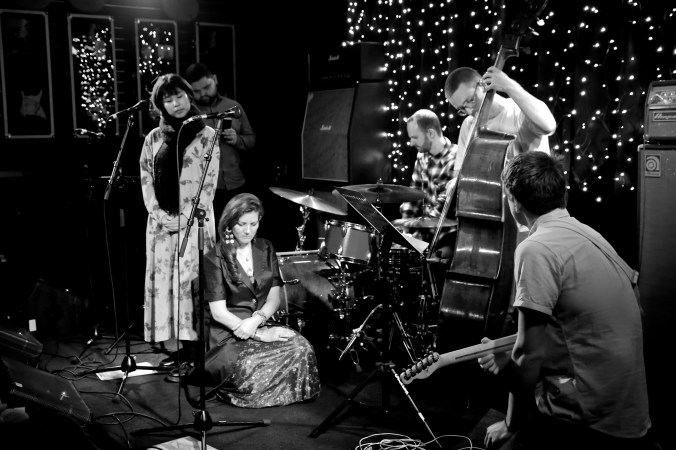 Chelsea Prastiti was not long back from Cyprus when her band Leda’s Dream appeared at the Backbeat Bar. Prastiti is well known in the Auckland improvised music scene and especially so at the avant-garde end of town. She’s a compelling vocalist and composer who approaches her craft as a free spirit, unfettered by others expectations. When she sings she dives deep and puts herself out there fearlessly but her risk-taking is not a mere academic exercise; it cuts to the very heart of what it means to be a thinking, feeling human. Her compositions are therefore always interesting and out of that a raw beauty and an honesty arise.
 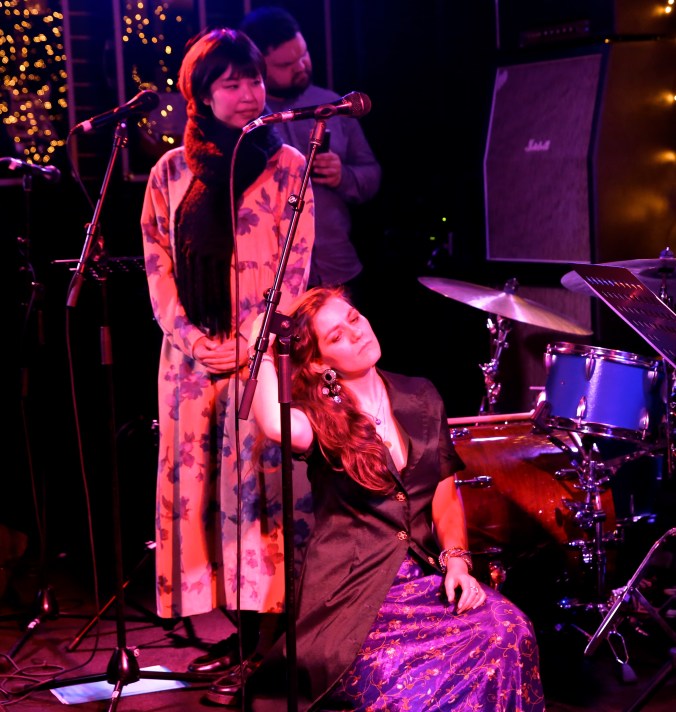 Although the ensemble played material that we have heard before, they sounded incredibly fresh – even different. Crystal Choi confined herself to accompanying vocals (no keys), Michael Howell stepped further into a measured chordal role and Callum Passells on alto and voice effects was the archetypal minimalist (saying a lot more with less). This felt very right and the re-configuration gave the ensemble a lot more freedom. They stretched out as the spirit took them and the first two tunes filled the entire first set. The voices, in particular, were liberated by the change and this gave wings to the melodic lines and mood. The harmonies were there in spades but that was not what drew you in. It was ‘mood’ and the pictures that those moods created.
 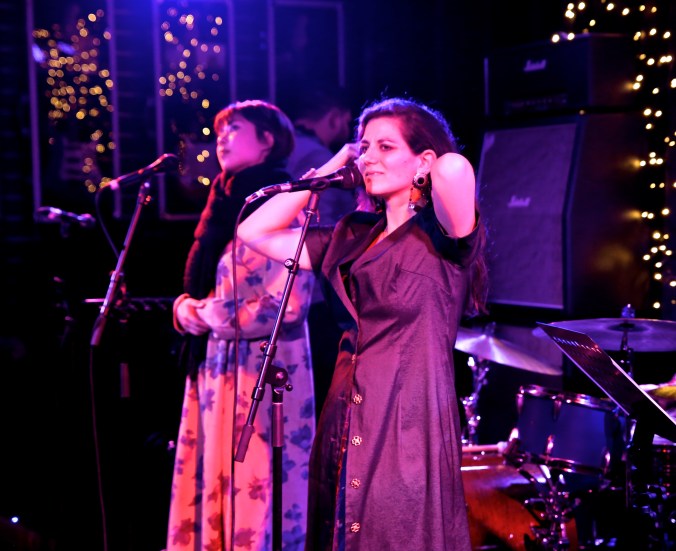 Prastiti’s is a brave path and I would expect no less from her. This is a musical space that is sparsely populated and more’s the pity. Think Sera Serpa (duos or trios), Think Norma Winstone (Azimuth 85) or perhaps the brilliant Nordic vocalist Sidsel Endresen (Endresen live with Jan Bang). In this ensemble, she has the musicians to give her the freedom she deserves. Passells, who is unafraid of soft trailing notes or of minimalism, Howell who can follow a vamp to eternity and make it sing, Choi who instinctively makes the right moves, and Eamon Edmundson-Wells and Tristen Deck who know when to lay out and when to add colour or texture. The music drew from free improvisation, standard Jazz and deep Folkloric wells. It did so without undue introspection. The band brought the audience along with them and the bouts of enthusiastic applause proved it. For some reason, and it was partly their attire, the gig felt like a postmodern version of a Pre-Raphaelite tableau. Oh yes indeed, that always works for me.
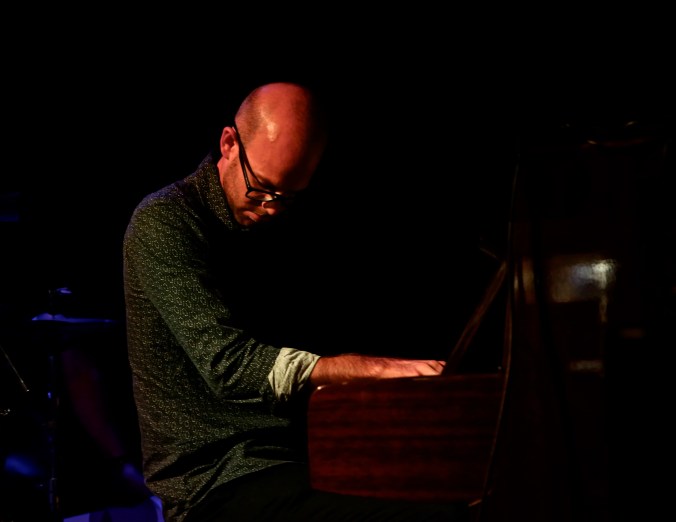 Good Music always says something interesting; it’s a form of communication where a musical statement begins a process and a listener responds. With any innovative musical form, we need to bring something of ourselves to the equation. The more open our ears the better the experience. Gifted improvisers of all cultures understand these fundamentals and because of this they mostly tell old stories in new ways. Rarely and bravely, musicians hit us with stories not yet fixed in the popular imagination. Steve Barry and his collaborators have a foot in both camps. While this is adventurous material, it is also approachable to anyone with open ears. What we heard at the CJC was innovative but the archetypes of all music were located deep in the compositional structure. A careful listening revealed trace elements from composers like Stravinsky or Bley and perhaps even of indigenous music.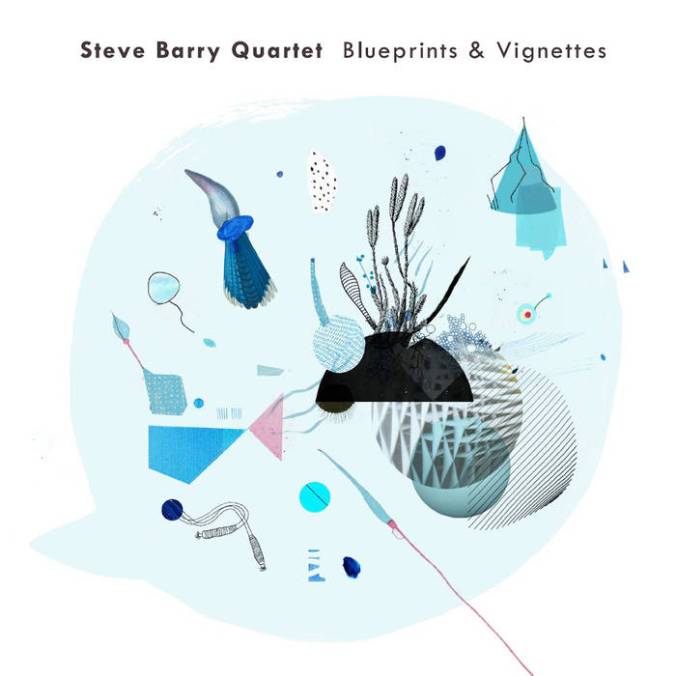
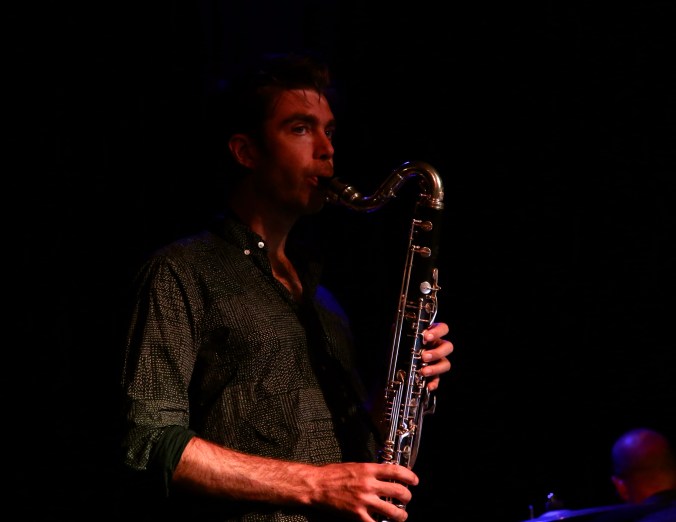
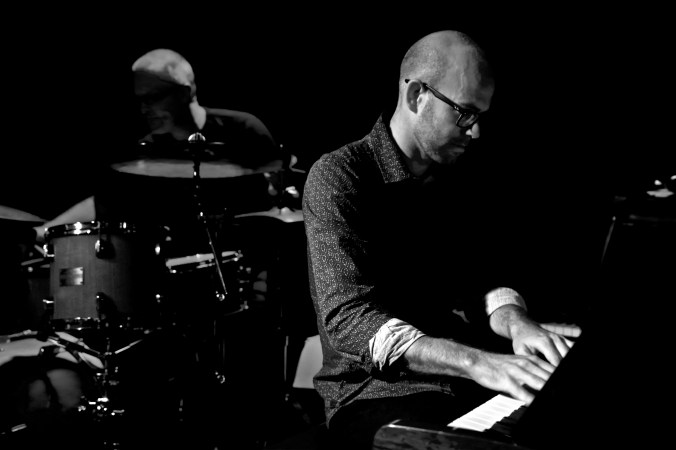
 It was a good way to begin a year of music, a good way to breathe life into two enervating steamy nights. Hayden Chisholm was back in the country and around him formed various duos, trios, and quartets. He performed two gigs in Auckland and the first was at the Audio Foundation in Poynton Lane. The venue has long been an important source of innovative music and each time I descend the stairs to the sub-basement I find interesting changes to the clubs configuration. It really is an excellent venue and perfect for what it offers. At first glance, the two nights appeared quite different. One free improvised and the other a set of reflective ballads. In reality, both gigs were reflective, melodic and approachable. The open-hearted humanity and communication skills of the participants made it so.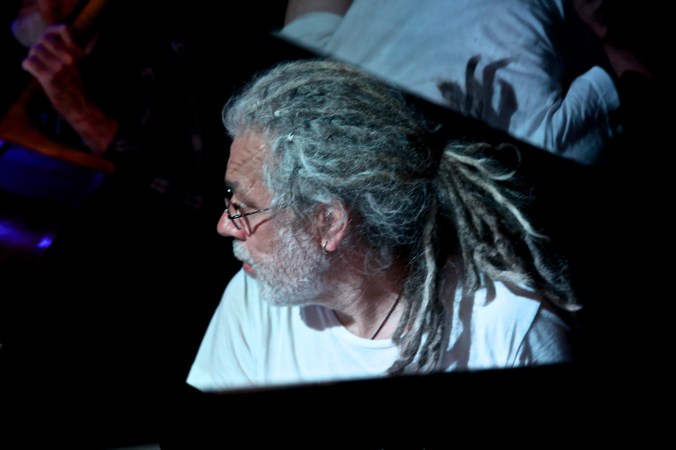
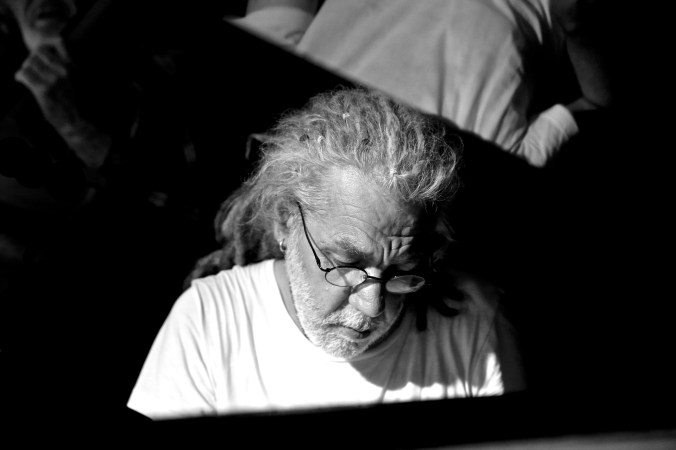 I have never witnessed a free gig quite like that as the communication was so exquisitely personal. More than musicians finishing each other’s sentences. More than the flow of fresh ideas; there was a sense of musicians revealing something intangible. From out of the fading harmonics and the quiet spaces came that extra something. The quiet revealing something on the edge of consciousness, something we often miss. Arising from – evocative like a Rilke poem – or a haiku. Bell stroked his mallets across the bars or responded with staccato – or soft taps and clicks, Prastiti offered cries and bell-like utterances, framed as wordless questions, Crayford explored resonant possibilities by using extended technique or by mesmerizing with darkly descending chords – opening up a dialogue which was met in kind – sometimes gentle, at other times like a flow of coloured sparks.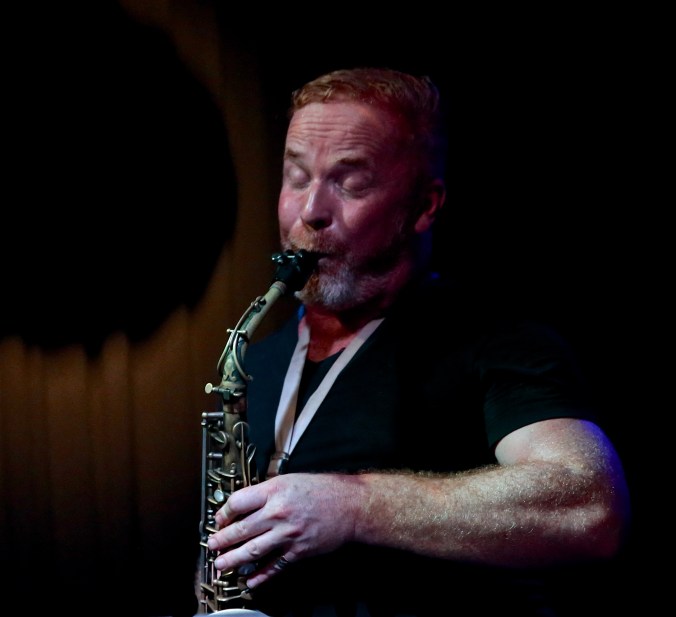
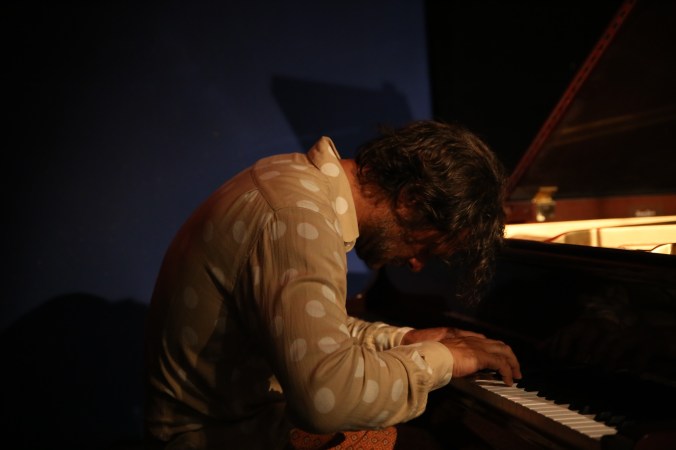
 As Alan Brown moves in new directions, he is leaving some extraordinary musical documents in his wake. Hot on the heels of his recent Alargo collaborations he releases a second solo album, ‘Composure’. Again, this is an ambient album and like Alargo it is meticulously crafted. It is a solo piano album but much more. Here, the minutiae of the sonic world are revealed and important ambient sounds which are often overlooked. In our busy modern lives, we drown in sonic overload. Here in Composure, the very essence of sound is explored, nurtured, curated, given wings. There is an incredible floating quality to these tracks and the effects are otherworldly, but this is a world beginning at Brown’s fingertips. A world that exists inside a Steinway D piano, an empty concert chamber; in places overlooked. There are faint sounds of the street present and other ‘found’ environmental sounds. These are present as breakthrough sound, loops or drones, adding texture and depth.
 It was a foolish oversight on my part – I hadn’t visited Melbourne in fifteen years. I had seen quite a few Melbourne improvisers perform in Sydney or Auckland but failed to track them back to their native habitat. The last time I was there, Bennett’s Lane was still a thing, but closed for two weeks. That was the week between Christmas and New Year; that arid Jazzless desert in the live music calendar. With family now residing in Melbourne, I decided to atone for my sins and I headed off while the Jazz calendar was over-flowing with tasty offerings.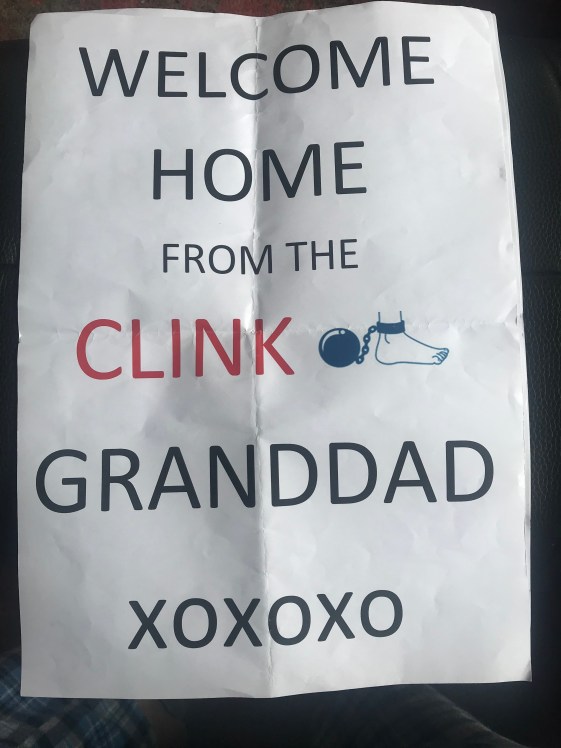

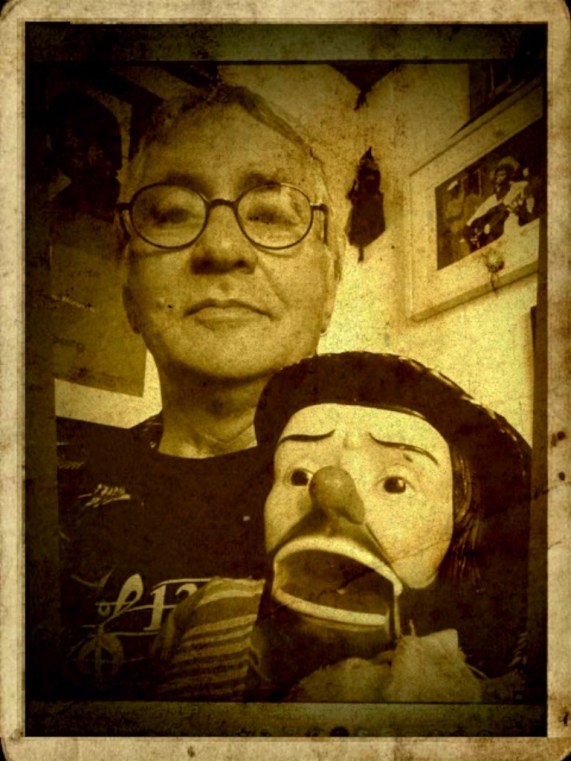


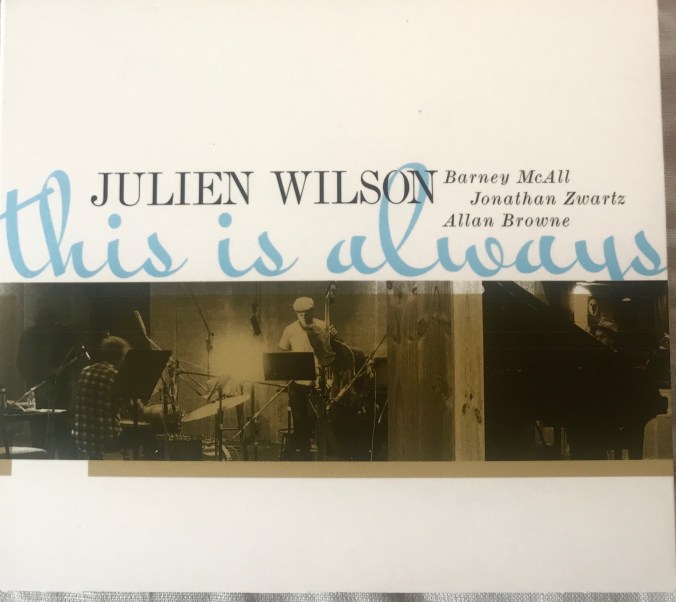


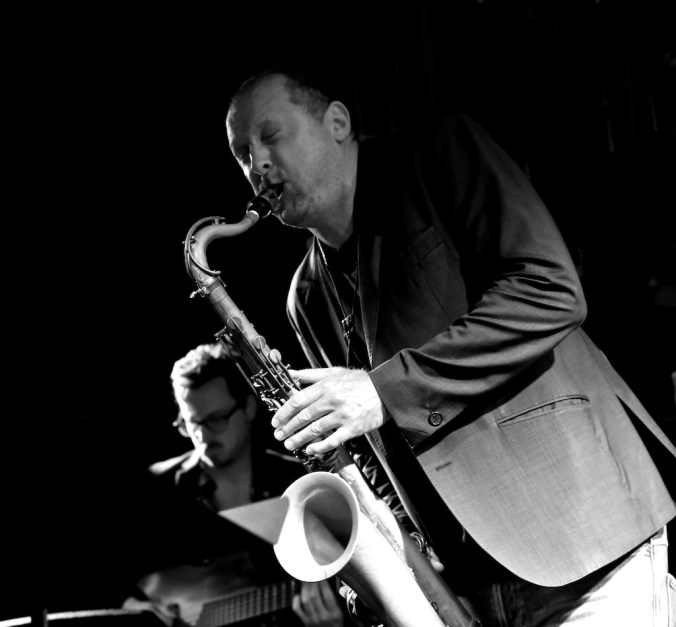
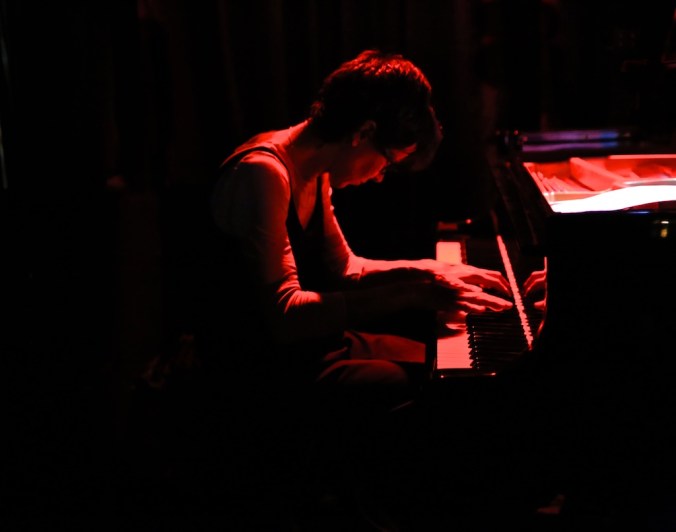
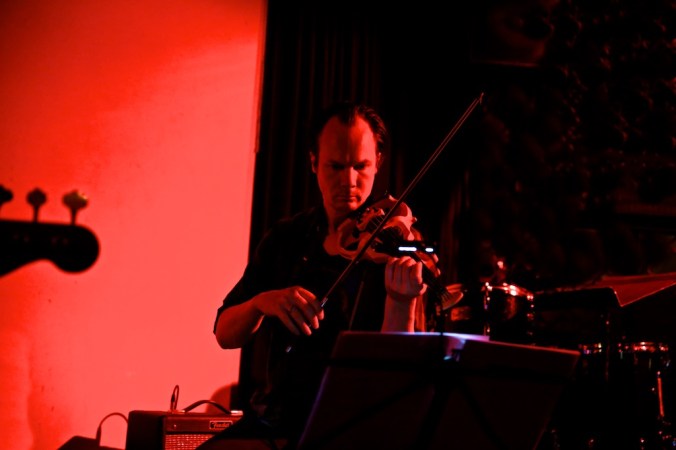

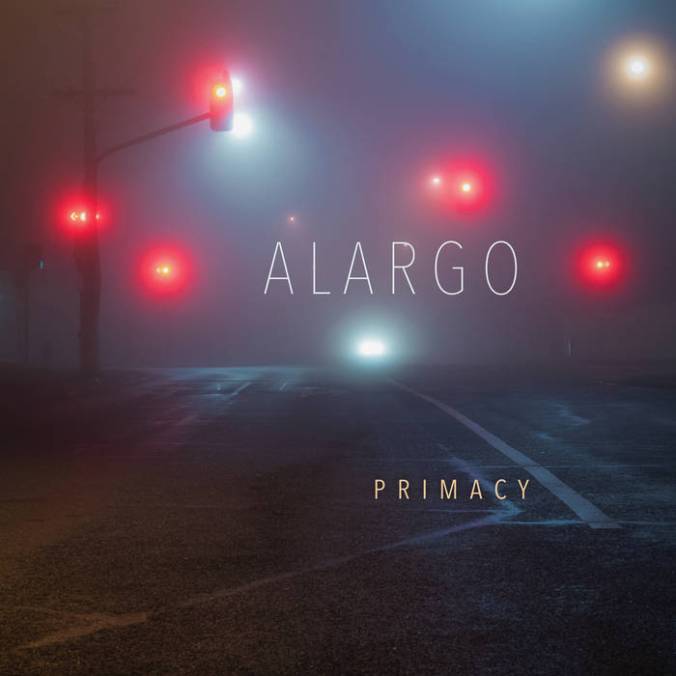


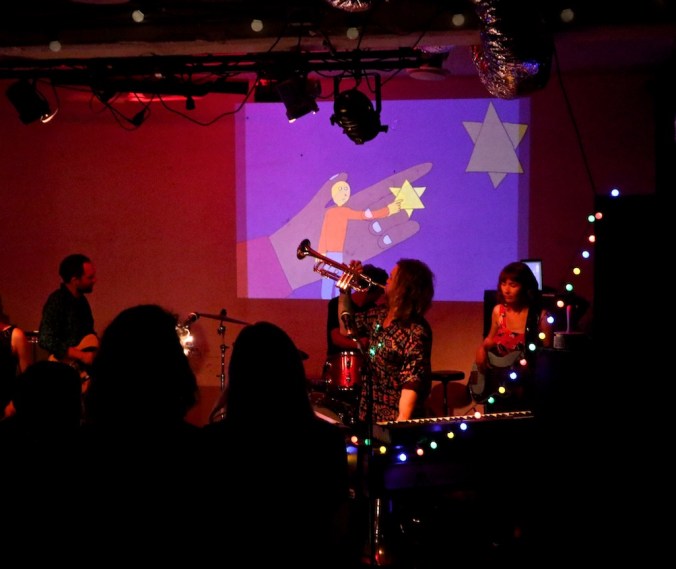 There are a finite number of notes in a scale or colours in the visual spectrum, but an infinite number of possibilities arise. Embracing the latter, multi-instrumentalist, multimedia sculptor and composer Finn Scholes constantly scans the landscape for new material. When he locates something shiny, he appropriates it as a magpie might, storing it in memory until he can bend it to a new purpose. A musician with few boundaries; a disruptor of complacency, his open ears and pioneering disposition equipping him well for his musical explorations. The genius of this music is that the listener will find any number of references, and each according to that persons taste. Any attempt to narrow the music down to a specific range of source materials, or to the prime influences, will, therefore, fall short; there is no correct answer.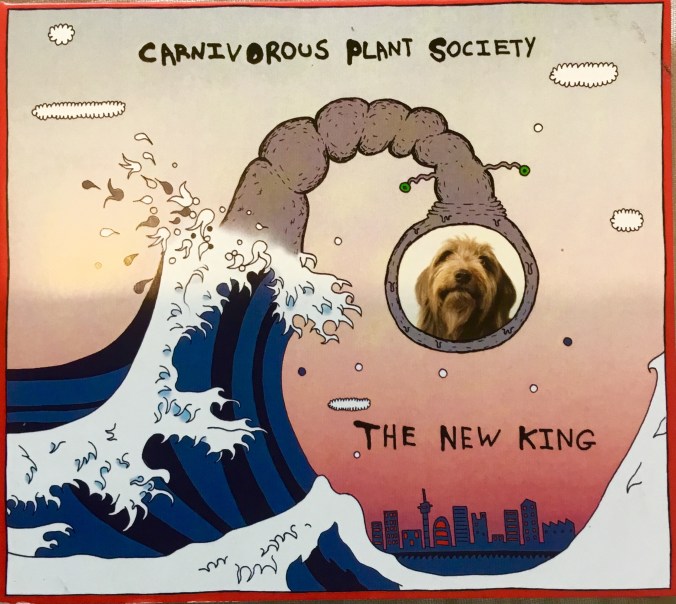

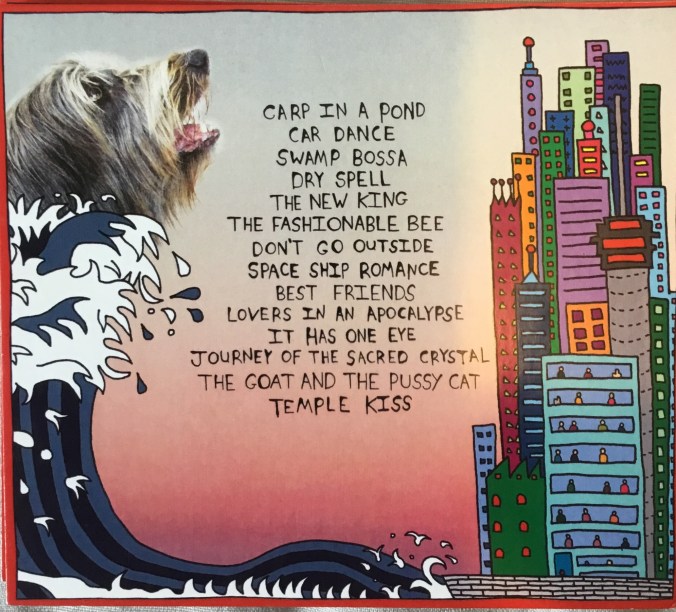

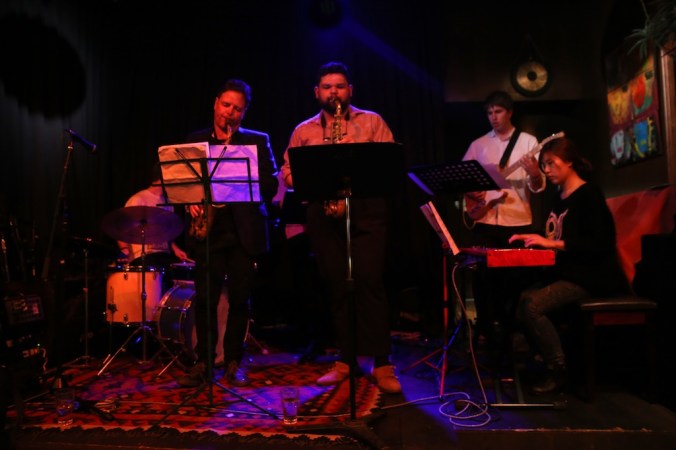 At some point in human evolution, the majority of humans decided to stay put. In consequence, the hunter-gatherers and the pastoral nomads became outliers. As civilizations grew, agriculture grew and large enclosures and granaries grew along with them. Beyond the walls and the jumble of enclosures; largely unnoticed, often unseen, foraging continued unabated. The homeless on the streets forage, philosophers forage, writers forage, wild and domestic animals forage and above all improvisers forage.
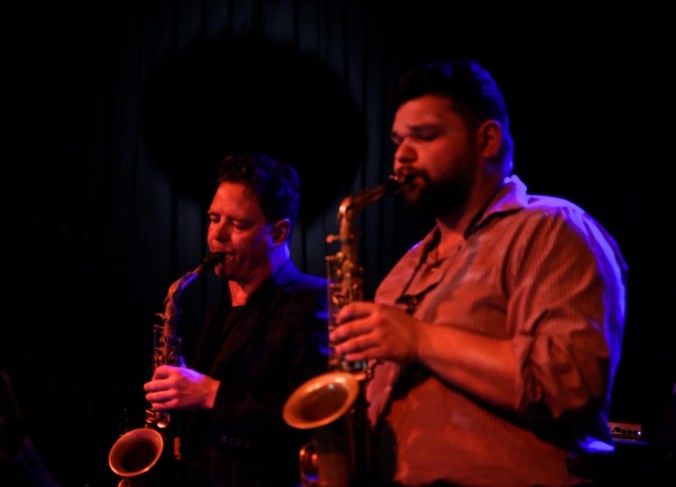 On Wednesday, his charts were for a larger ensemble. This time offering fresh insights; taking us further down the Rabbit hole. The pieces were of variable lengths and sometimes in parts. At some point during the second set, he played a piece titled ‘Ligeti’s Goat (I first heard that back in 2013). While the piece has melodic hooks and a basic structure, it is more, a surrealistic journey. A place where imagining, spoken narrative and musical narrative meet. Ligeti’s goat is vividly embedded in my memory; it is not a piece easily forgotten, a goat wandering through pastures, locating carrots (perhaps forbidden carrots), digesting the vegetables in that mysterious way of all ruminants.
 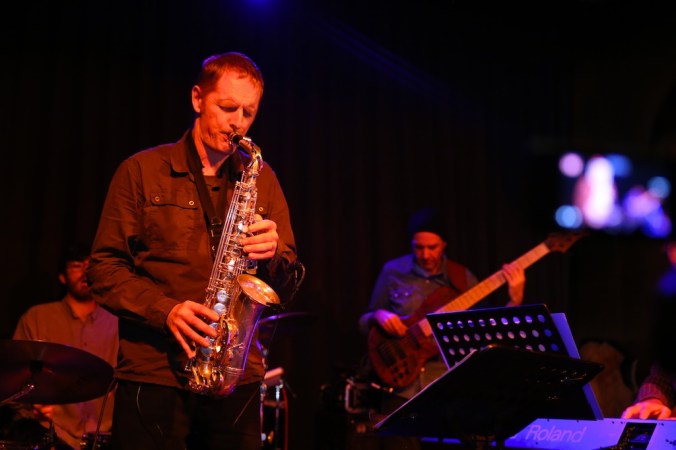 Hearing people talk about the Chris Mason-Battley Group reminds me of the Hindu parable – the blind man and the Elephant. “Oh yeah, that guy has a smooth sweet sound’ one said as if that settled the matter. Well yes, he has got a smooth sound when playing a ballad, but anyone who thinks that defines his music has simply not been paying attention. This band has enormous depth; playing anything from a melodic ballad to music that is way off the grid. What we experienced on Wednesday was music with integrity; at times raw and inventive, drawing us into its heart, emotionally engaging and above all satisfying.
 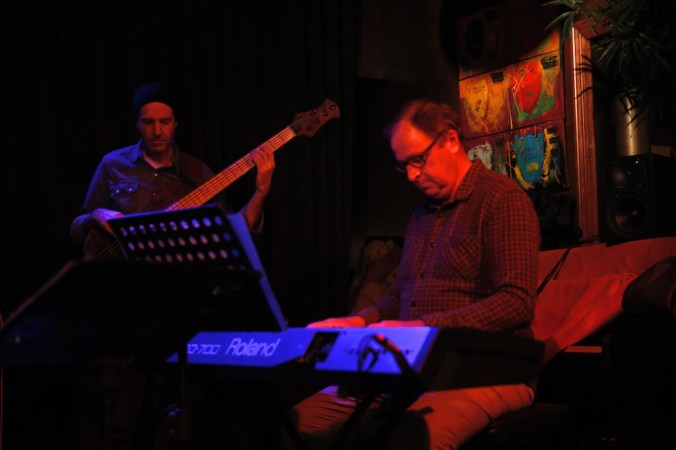 The first number was ‘Mountain Song’ (by CMB); then they moved to a series of pieces from the CMB John Psathas project ‘Dialogos’ (progressing through excerpts from ‘Song for Simon’ and ‘Demonic Thesis’). As that set progressed we heard a new composition or two and lastly ‘Tahuna Caravan Park’ from his ‘Two Tides’ album. This gave us a broad sweep of his past projects and the Psathas album in particular. Dialogos was widely acclaimed as an exciting and bold step forward for the band – I can highly recommend the album (out on Rattle). Before the band left the stage for a break, Mason-Battley said; “That was the nice half – the second set is nasty half” (quoting from an album titled ‘The Jaberwocky comes to Town’ which had a ‘nice side’ and a ‘nasty side’.)
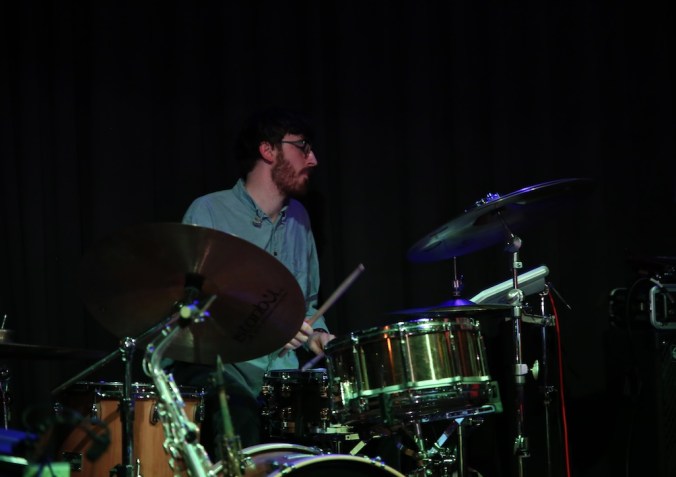 As pleasing as the band were in the first set, they reached much deeper for the second; pulling out an utterly engaging and masterful performance. It began with several of the blacker pieces from ‘Dialogos’, ‘The Calenture Suite’. The drummer Stephen Thomas must be mentioned at this point – His work was integral to the overall performance and it underlined his maturity as a musician. At times subtle, at others incredibly complex – and all made to look easy in his hands. Thomas was extraordinary throughout and although a relative newcomer to this long-established band, his searing flames licked at their underbelly, an indispensible presence. In perfect contrast to the complex drum flurries was Sam Giles on electric bass. Giles is a master of the ostinato – repeated motifs, perfect time feel and the voodoo factor writ large. He is also an influence on the bands direction; favouring Zorn like explorations and paths less trodden.
 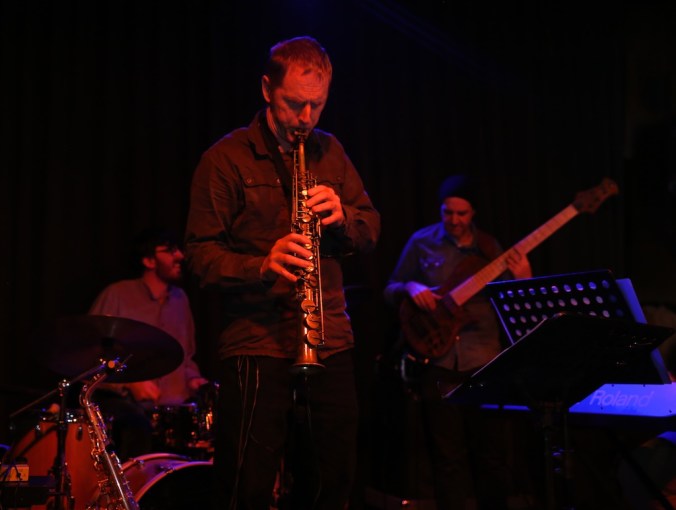 The CMB Group keyboardest is David Lines, an intersting and in my view under-rated musician. On this gig he played a Roland RD-700. What a beautiful piano and Rhodes sound. A machine hardly heard these days, replaced by the Nord Stage or modern Korgs. While the newer keyboards have more bells and whistles, I am unconvinced that their piano sound is an improvement. Perhaps it sounded so good because of Lines touch? He is not a busy pianist and every note counts, in this gig his often voice leading role was perfect for the project (his solos were stunning). I only wish we saw him more often.
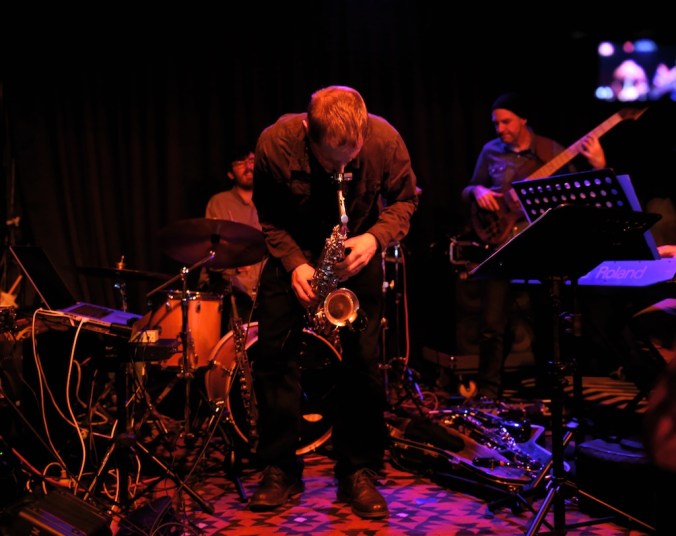 The last tune of the evening was free and political. It was titled ‘The Emperor Has No Clothes’; an obvious reference to the greedy authoritarian amoral elites that hold sway in the world; particularly the Trump administration. It was free and it was raw emotion – in the background a loop recited ‘billions and billions’ – then, faintly at first, we heard the strains of ‘The Star Spangled Banner’. The band read the mood of the audience well with that one – people stomped and cheered afterwards as if someone had taken the words right out of their mouths and rendered them into abstract musical form.
  This was trippy stuff. A band that gnawed at the bones of form while the music swept us along; taking us ever deeper, forcing us to loosen our grip, as the waterfalls of sound consumed us. This was most definitely filmic music; throwing up subliminal specters like a Burroughs cut-up montage: an indie soundtrack, Voodoo but with four Papa Docs urging us toward trance.
 Attempts to confine improvised music within historic boundaries is plain foolishness. Never has this been more obvious to me than at last week’s ‘Monsters of The Deep’ gig. Superficially it sounded like, looked like classic fusion; but it was and it wasn’t. The keyboard instruments were classic analog, the lighting otherworldly; various delays, distortions or effects echoed across the room. While the overall vibe nodded in the direction of Jazz/Rock, the musical language was that of deep improvisation. The accessibility hiding worlds of complexity and there’s the wonder of it. Few local musicians could pull this off as well as Crayford and Haines did.
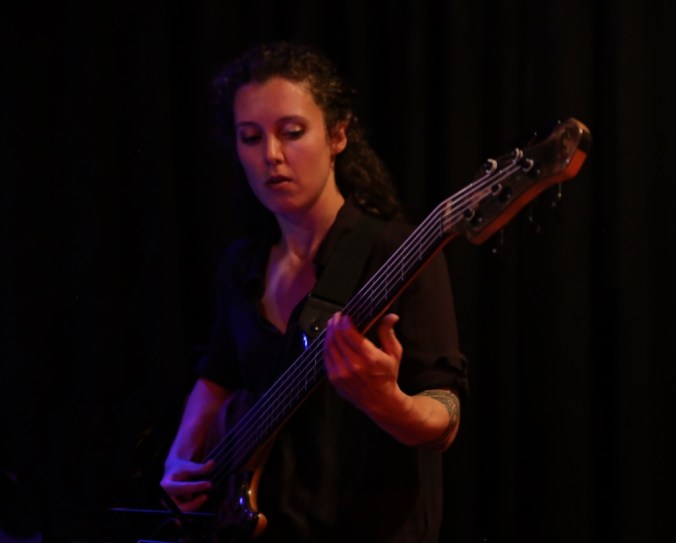 The collaboration between Crayford and Haines is certainly not their first; that took place in New York a long time ago. Since then they have both gained international reputations, recording in the UK or in New York. Both have separately won the Best New Zealand Jazz album of the year during the last decade, both attract sizable audiences. These artists are generally offshore but we caught a break this year – they are domiciled in Auckland at the moment.
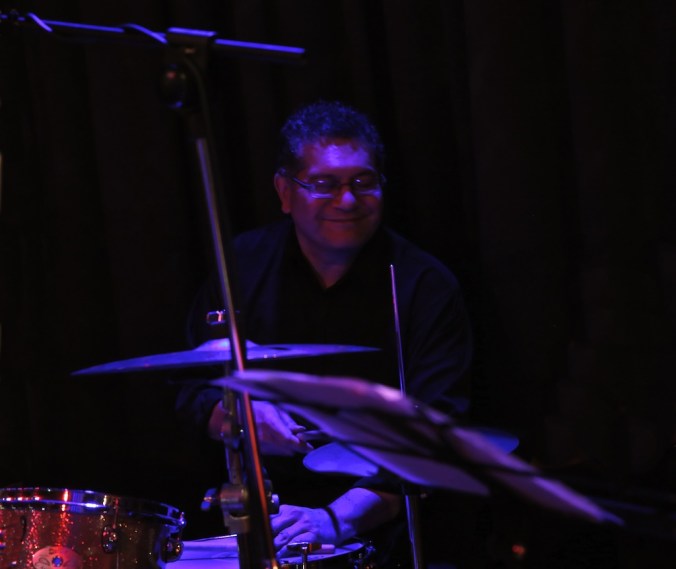 While the project draws on various inspirational sources like Alice Coltrane and Igor Stravinsky it is also brimming with originality. This is ‘spiritual music’ of the highest order and it uses the devices of the Shaman: long intensifying vamps and hypnotic beats which slip deftly into the consciousness. Throughout the night, it was Haines who took the melodic path while Crayford provided magnificent architectural structures. If even one element was removed, the edifice could fail; this was a music built from layers, each balancing delicately on the one beneath; only exposed incrementally, like a nested Russian doll. Marika Hodgson was the perfect choice for running those long ostinato bass lines. Her time feel is impeccable and she creates a gut punch while blending seamlessly into the mix. Not many know it, but Crayford is also a gifted bass player – he knows exactly what is needed and he trusts Hodgson to deliver. The one musician that I had not seen before was Mickey Ututaonga. He has a long history with Haines and again he was a good choice. Because the music was so carefully balanced, the last thing it needed was a busy splashy drummer. Ututaonga synced with the others, his every beat enhancing the overall hypnotic effect.
 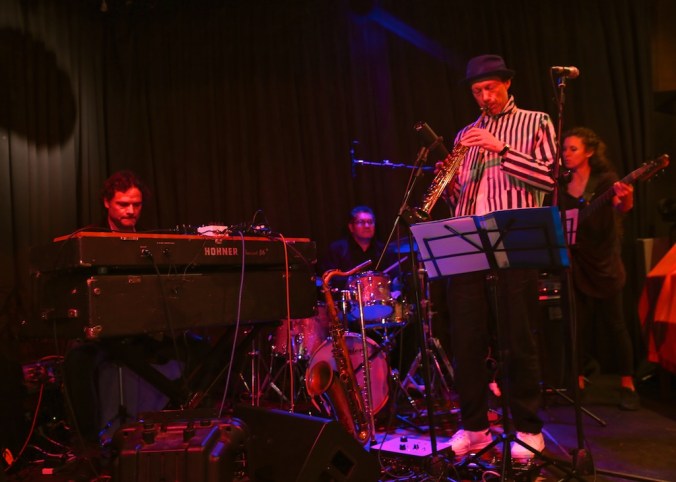 The other stars of the show were the instruments and pedals. For Crayford a Fender Rhodes and an equally vintage Clavinet; for Haines, his beautiful horns fed through a vintage SM7 Shure Microphone, then into a preamp and guitar FX board.
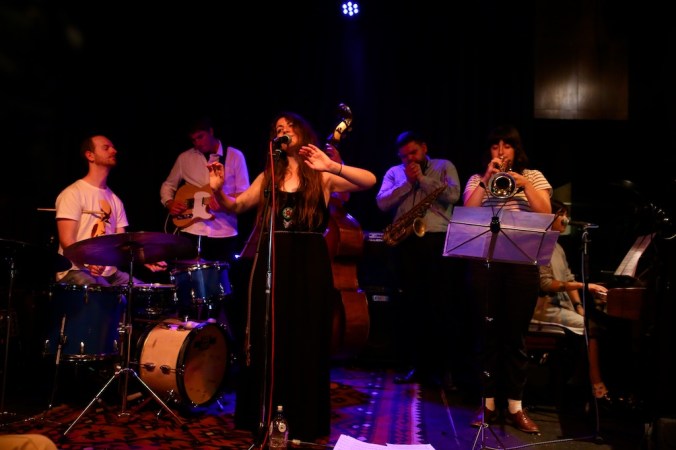 ‘Leda’s Dream’ has been around for some time, but this is the ensemble’s first appearance at the CJC. When vocalist Chelsea Prastiti first conceived of the project, she saw it as a vehicle for unfettered collective improvisation. Her writing cleverly expands on that concept, encompassing real places, the past, abstract ideas, and opening the listener to endless possibility. There is a structure to her vision, but to grasp it you must let go of what you think you know. The pieces are mirage-like; if you look too closely they will disappear. As you listen, fragments of the familiar appear, then dissolve. These are seamless journeys; cleverly fusing reality with dreamscapes. Leda’s Dream is to be experienced and enjoyed, not pigeonholed.
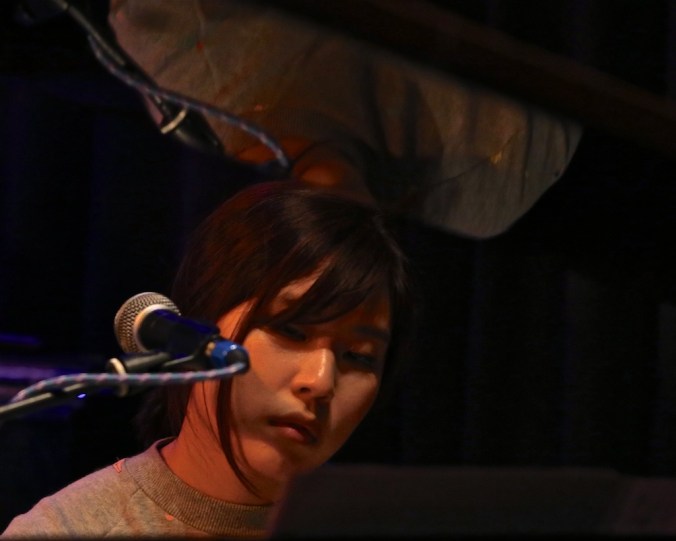 Prastiti’s ‘Time Lapse Photography’ was filmic. Revealing the essence of unfolding plants – magical realism – biology expressed as music. In a similar vein was her piece,’Rain Flood’. As she sang, you experienced the droplets of water – falling slowly at first, then faster until they became a deluge. Communicating in this way is a gift few possess, the images seeming to emerge from nature or from experience, not from the musical form. I immediately thought of my favourite Bengali filmmaker Satyajit Ray and his mystical Monsoon scene from ‘Pather Panchali’. The effect created by Ray there, also swept us to the heart of a poignant interaction between man & nature (musically assisted in that case by Ravi Shankar and Mingus alumni Charlie Mariano).
 The Leda’s Dream ensemble are alumni from the UoA Jazz School. A lot of talent emerged during the years they attended and during this particular gig it coalesced. It was a pleasant surprise to see Crystal Choi playing this innovative abstract music. Choi is a musician who is fast evolving and growing in interesting ways. At Jazz school she stayed closer to traditional forms, or those referencing the folk infused ECM albums. Later I saw her giving a concert on solo piano, Jarrett like in its scope and quite wonderful. On Wednesday she embraced freedom. She was innovative, interactive and confident.

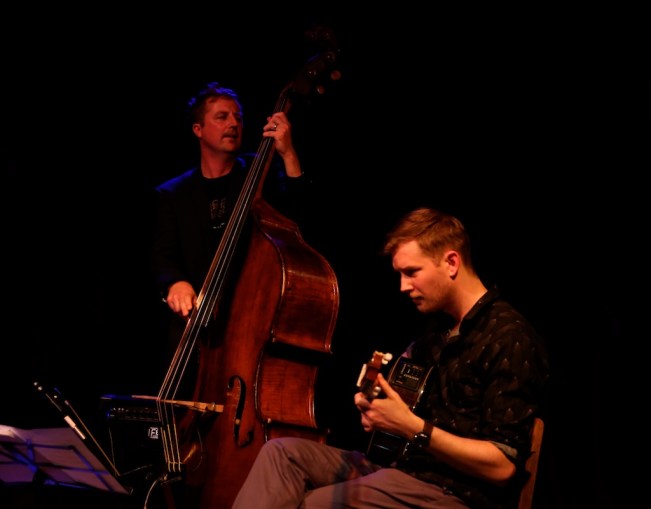
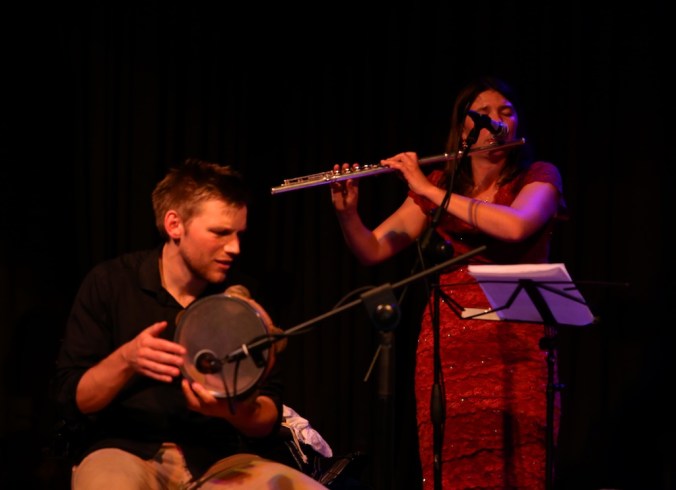
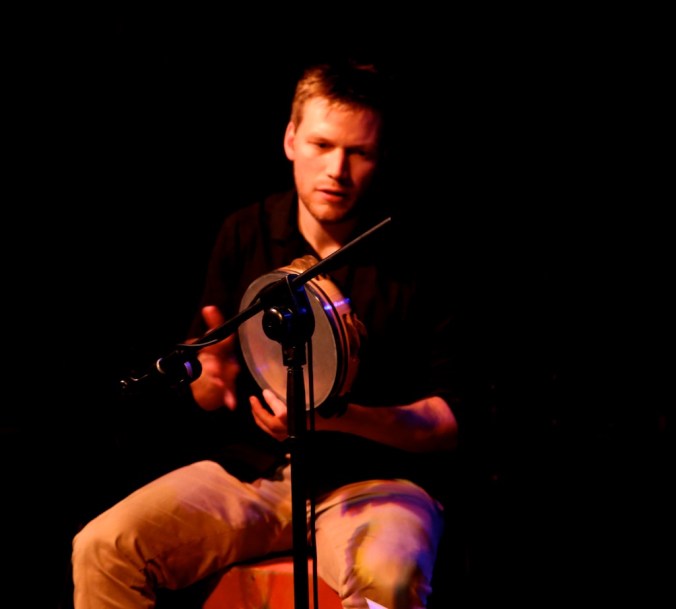
 I always look forward to emerging artists nights at the CJC. They don’t happen often but when they do, they’re fun, full of surprise and most importantly they are hopeful events. It is usual for emerging artists to salt the mine with seasoned players. Both of the bands did well in that regard. The first band up was Misha Kourkov’s ‘Equitable Grooves’, a six-piece unit playing multi-genre Jazz focused music. The material was well written and at times ambitious. Aiming high on the bandstand is good because that is where real learning occurs. If you wish to extend your reach, then having Alan Brown on the piano is exactly what you need. With that sort of experience and groove behind you, you have a fail-safe mechanism. The set opened a little tentatively, but they quickly found their groove; the last two numbers were especially enjoyable.
 The second set featured the ‘Exploding Rainbow Orchestra‘. This was a very different type of ensemble. Freer ranging, a bigger sound palette and an electric bass with the heavyweight punch of Bona. The bass player Joshua Worthington-Church who led the ensemble is accurately described as a maverick. His set list contained genuinely diverse material; gripping vamp-driven originals plus tunes from ‘Radiohead’ and ‘The Mint Chicks’. Under the leader’s guidance, the band took the material to a place close to my heart; a fusion of Jazz and psychedelia. I am happy to see this done, as the genre is all but forgotten. During the mid-seventies, that style of music was sacrificed on the altar of Jazz purism, a pompous battleground that tried to stifle genre exploration.
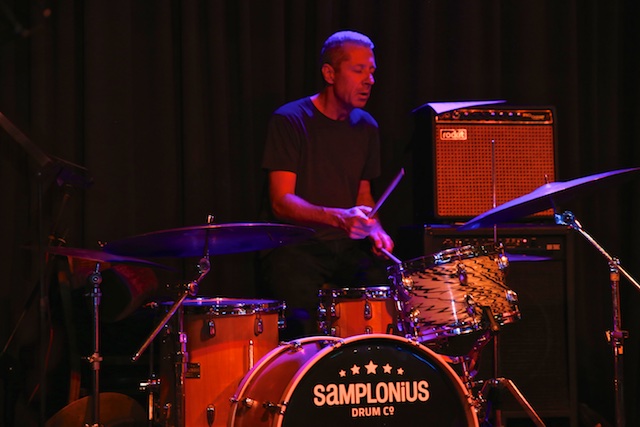 The Australian and New Zealand improvising scenes are a homogenous entity and long may it remain so. If the traffic sometimes appears one-sided, that is a natural consequence of our artists moving to the bigger scene; the exchange benefiting both. Many of those who jump the Tasman do well and they always return for gigs, tours, or sometimes to conduct workshops. Without these exchanges with Australia and beyond, our improvised music scene would be the poorer. This traffic brings us a number of talented Australians, musicians who probably would not have the opportunity to come otherwise; those collegial connections count for something. Drummer Simon Barker is one of those.
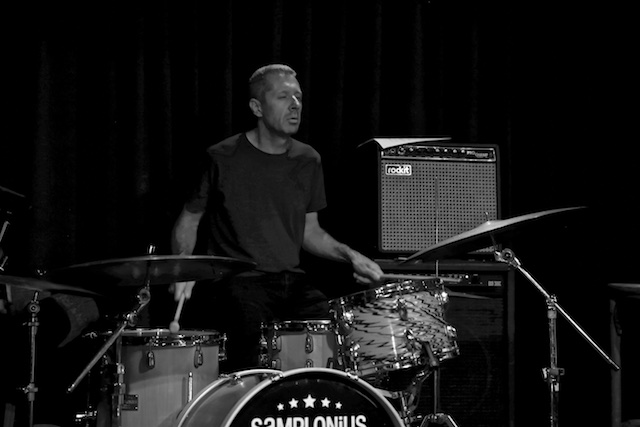 Barker was in Auckland early last year with Carl Dewhurst. Together they are the amazing ‘Showa44’, a duo which I reviewed during their visit. Anyone who follows Barker will know how versatile he is, and above all the musical integrity and originality he brings to whatever situation he is in. Barney McAll’s award-winning ‘Mooroolbark’ and ‘Showa44’ are very different propositions but Barker sits comfortably at the heart of both; of equal importance is his teaching. While in Auckland, he held a workshop at the Auckland University Jazz School and undertook three days of intensive one-on-one teaching with students (and established musicians). Students I spoke to said that they valued the opportunity enormously.
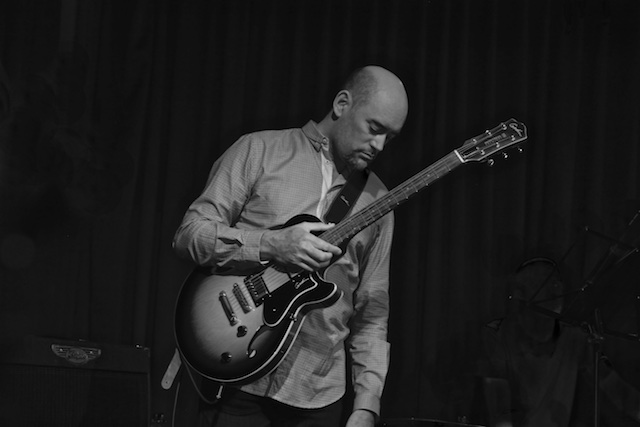 The first set featured Barker solo. It is not often that a drummer performs solo and to pull that off requires something beyond mere drum chops. Barker brings something that is uniquely himself to the kit, and he is able to communicate a story, not just a beat. He began with a tribute to an obscure central North Island Polynesian drummer (sadly the name alludes me). He has never met this person but saw a clip of him performing in the traditional Polynesian, polyrhythmic style. He had a traditional wooden drum mounted beside his big tom and working between this and his kit, he created intricate cross rhythms, worthy of a row of skilled drummers.
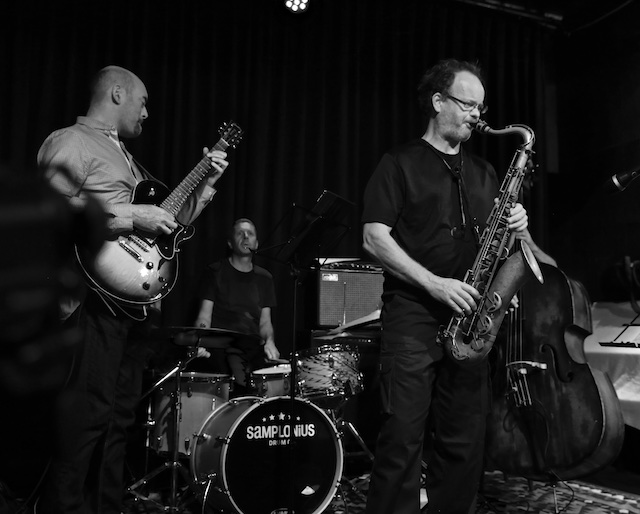 His second and shorter piece he described as a chant and it was. The hypnotic intensity carried the audience to the last beat; just as the first piece had. He is not only a storyteller on his instrument but he is capable of creating an orchestral sound. The audience loved it. The second set was something of an impromptu affair but none the less enjoyable for that. Also on stage for that set was Dixon Nacey, Olivier Holland, and Roger Manins. So busy was Barker’s schedule that the quartet had not found time to rehearse. Even the set list was once settled on the bandstand.
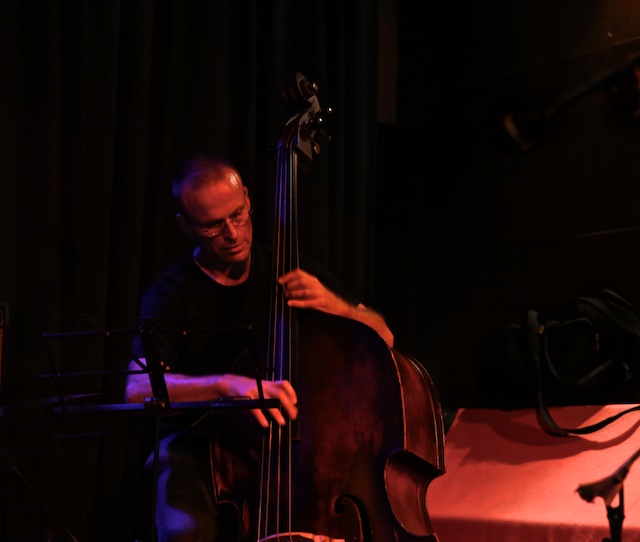 They began with ‘All the things you are’ and turned it on its head. The introduction performed by Holland and Barker alone was a blast. Drummer and bass exchanging phrases, challenging each other, leavening the exchanges with humour. When Nacey and Manins came in they exposed the bones of the tune. It was well done and in spite of its raw originality, the echoes of the melody hung in the air as implied offerings. The remainder of the set were original compositions and a rendition of the complex but ever popular Oleo (Rollins). Keep visiting Australians, we value you.
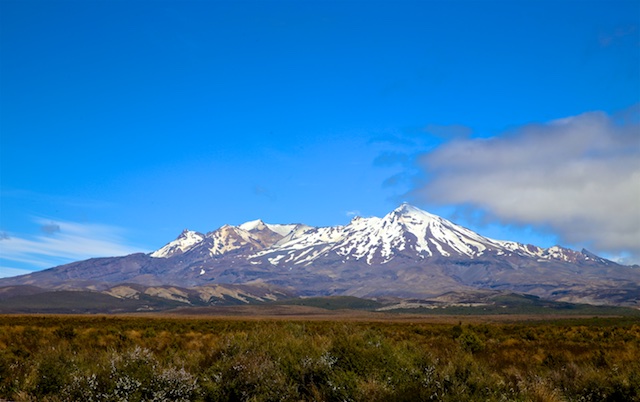 In the months before Christmas, we were reeling from the twin body blows of Trump and Brexit. During this period of disbelieving paralysis, Norman Meehan, Paul Dyne and Hayden Chisholm came to town. What they played was a balm for our troubled souls, a sublime ballad gig. I reviewed the gig on November 27, 2016 (this site). A week later Norman Meehan and Tony Whincup launched a new book titled ‘New Zealand Jazz life’. This is a great read for anyone interested in New Zealand music history and a must for anyone interested in improvised music. Meehan’s prose is much like his playing, devoid of needless ornamentation but pleasing. he is a natural with words, but he also manages to impart vast amounts of information without the reader ever feeling force-fed. His interviews with significant New Zealand improvising musicians are carefully blended with personal observation. Musicians like Jim Langabeer, Lucian Johnson, Nathan Haines, Kim Paterson, Jeff Henderson, Anthony Donaldson, Frank Gibson jr and Roger Manins are featured. I highly recommend this book as a vital reference work and as a very good read. ‘New Zealand Jazz Life‘ is published by Victoria University Press and available at all good bookstores.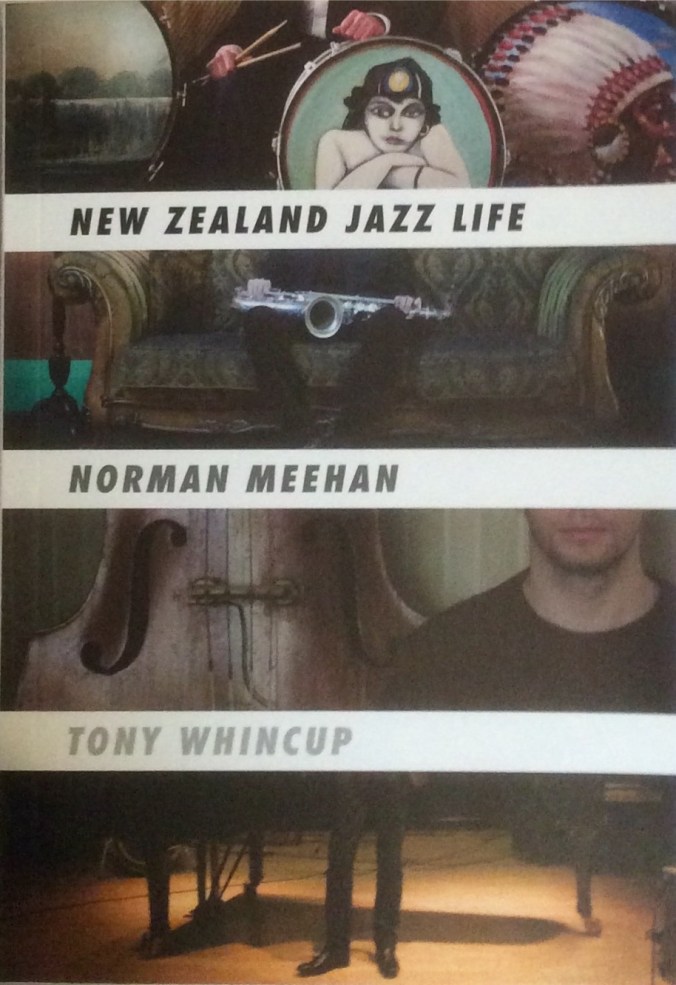
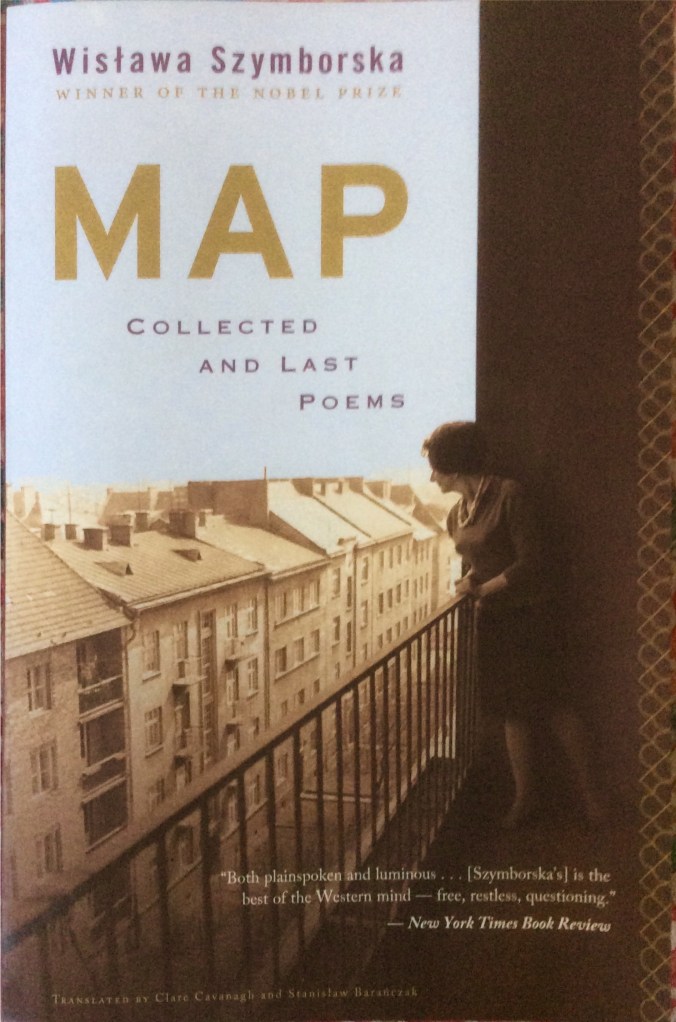 Her Maps‘ anthology has seldom been out of my hands since. Szymborska communicates the Polish experience like few others. She evokes a sense of impermanence, an un-belonging that has characterised Polish life for millennia. I am descended from Pomeranian Polish stock and perhaps this adds a particular resonance in my case. This is a window into a floating world surprisingly free of rancour. ‘Maps’ in translation is published by Mariner Books.
 The City Lights book shop in North Beach San Francisco has always been at the centre of my universe. Whenever I’m in that wonderful city I head there immediately. I had just spotted a verse from a Diane di Prima poem in a street pamphlet and I couldn’t wait to get a volume or two of her poetry. I have long been familiar with di Prima’s work, but the gifted female Beat poets were unfairly eclipsed by their male counterparts. A book published by Conari Press titled ‘Women of the Beat Generation’ is now back in print and it’s a good starting point for examining their body of work.
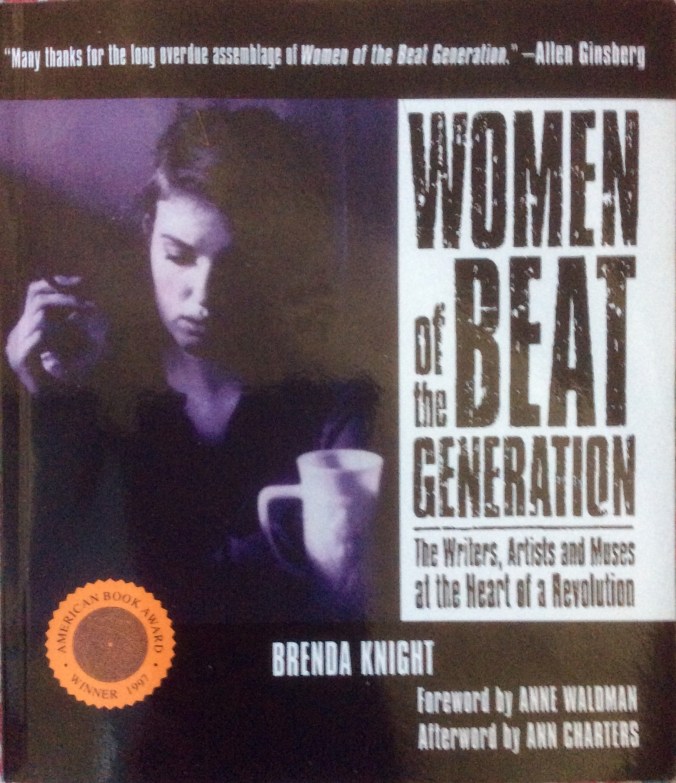 di Prima is still with us and some of her best work is contained in a recent volume titled ‘The Poetry Prize’ published by the City Lights Foundation.
 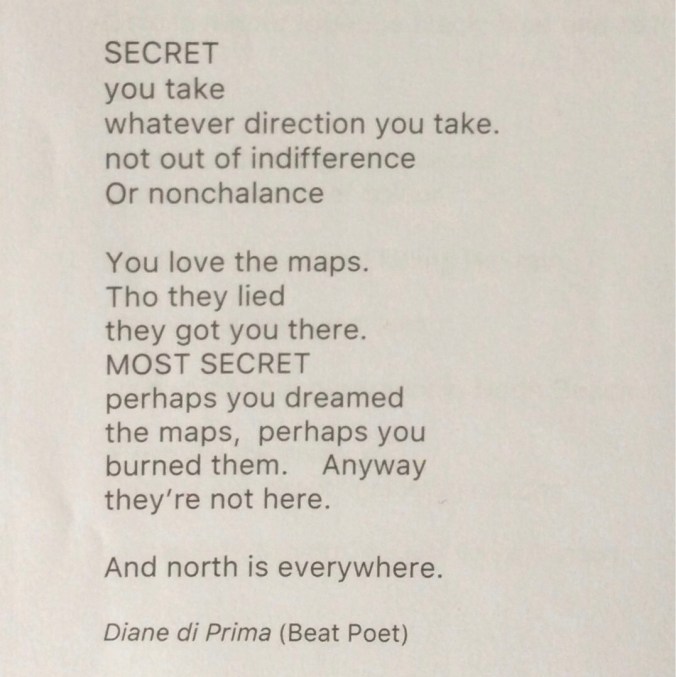 Lastly I will post one of my own recent poems, which rounds off the theme of maps. I wrote this in the week before my journey began. As I was about to depart, a well-known New Zealand Jazz musician shared some travel tips with me, offering insights, drawing me an abstract map as guide. I was so pleased with it that I wrote this poem. I took his wonderful map with me and although I was unable to strictly follow it’s path, the spirit of it was an inner compass to guide me. It made me happy to have it near – now a prized possession, a travel memory, a manifest.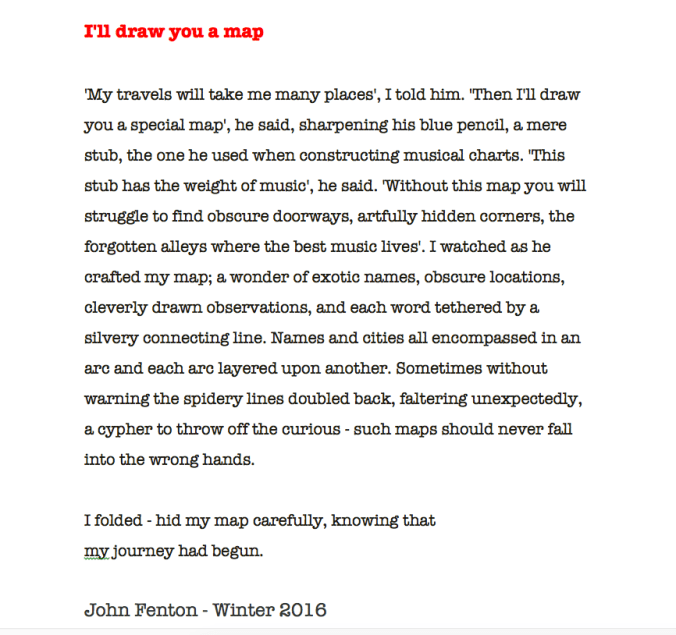
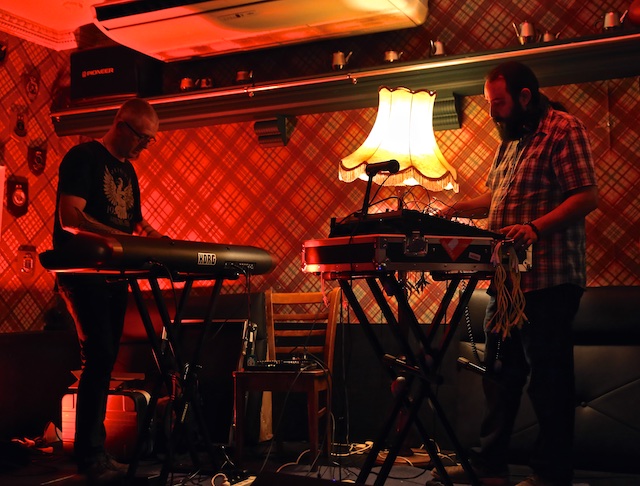 Every time an article appeared in the late twentieth century proclaiming the death of Modernism, another appeared shortly after; pointing out, rightly, that profound echoes of the movement will linger and intrigue a while yet. Perhaps because of when I was born, (immediately after the second war), this movement fascinates me and will until my last breath. It was a profound moment in the human journey when the hegemony of historical artistic values were challenged, discarded. Schoenberg, Coltrane, Brubeck, Riley, Colman, Matisse, Picasso, Miro. Pollock, Rothko, Eliot, Pound, Kerouac, and even Freud are defined by this impulse to move free from the received wisdom of history.
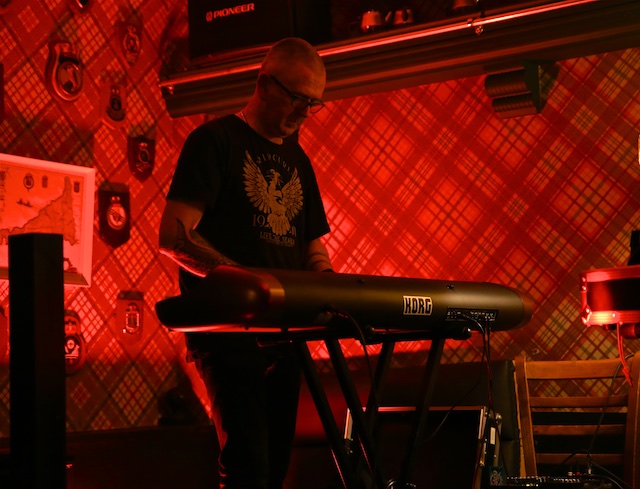 Stephen Small is a wonderful pianist but he is much more than that. He conjures up musical projects that catch people unawares; original projects, affording us a viewpoint on life and art that we would not experience otherwise. The concept behind the first outing of the Mexico City Blues band was to look at, examine the Jazz of 1957, fusing it with the Beat poems of Jack Kerouac (Kerouac wrote Mexico City Blues in that year – see earlier post). This was in part a re-imagining, but also a fresh look through post millennial eyes. When Stephen Small takes on a project he brings to it an immense musical knowledge, but more importantly an eye for the unusual, for quirky detail (no artist, musician, writer or poet worth their salt can succeed without this). When artists do their job well they show us the world afresh.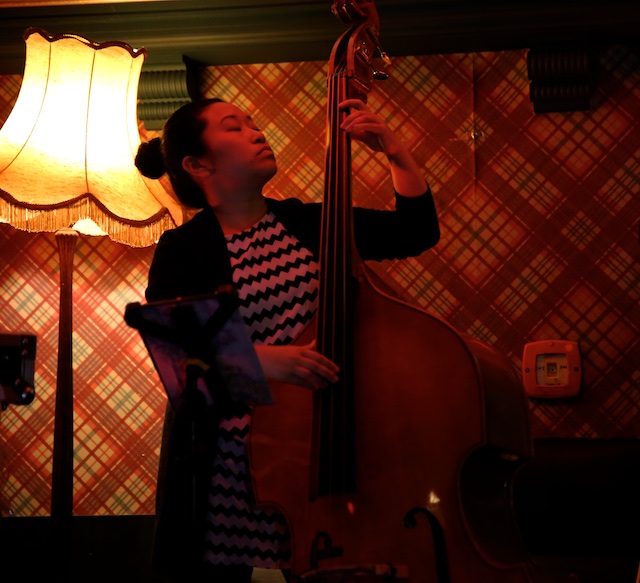
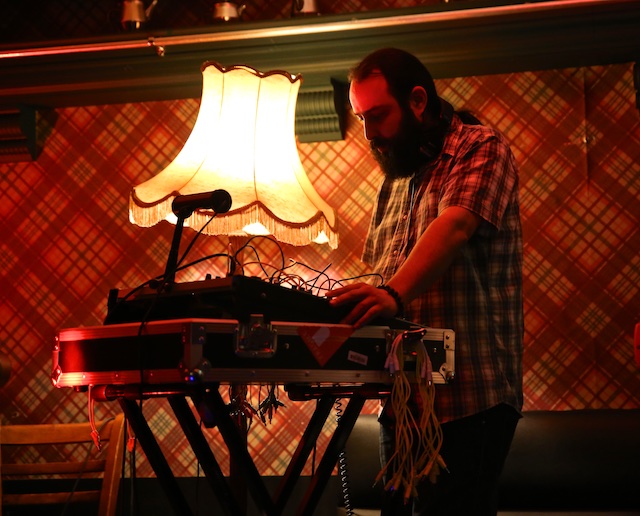
 The second set was free improvised music in the tradition of, and honouring the all but forgotten experimental improvisers of 1960’s Russia. For this set Small was joined by Dave Chechelashvili on modular synthesiser. As Small carved out motifs and themes, developing them and exploring the possibilities, Chechelashvili shaped the sound. Small’s Korg keyboard was split and connected with the modular synth; as patch cords were adjusted and knobs tweaked, we heard a music that you don’t expect from Communist Russia. Evidently and surprisingly, this was tolerated because it was perceived as artistic exploration. It was hard not to think of Glass, Reich or Riley and wonder at this parallel development.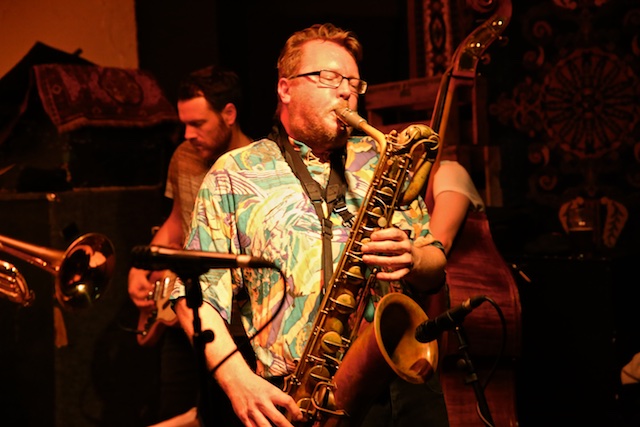
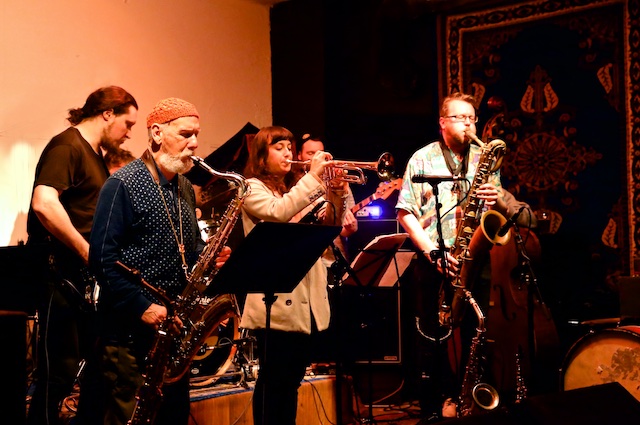
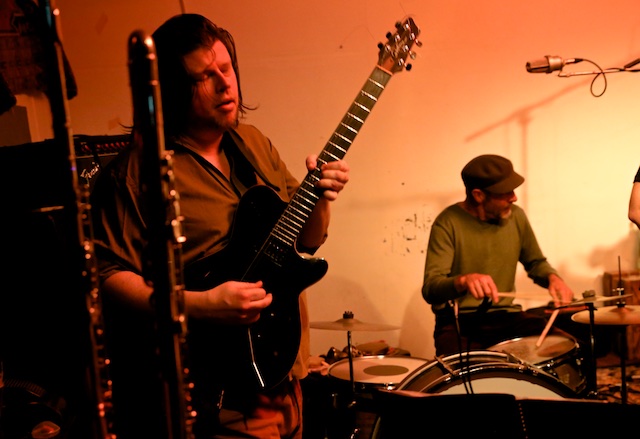
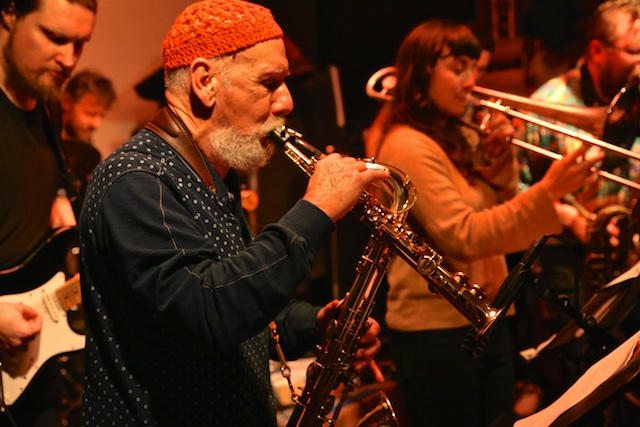
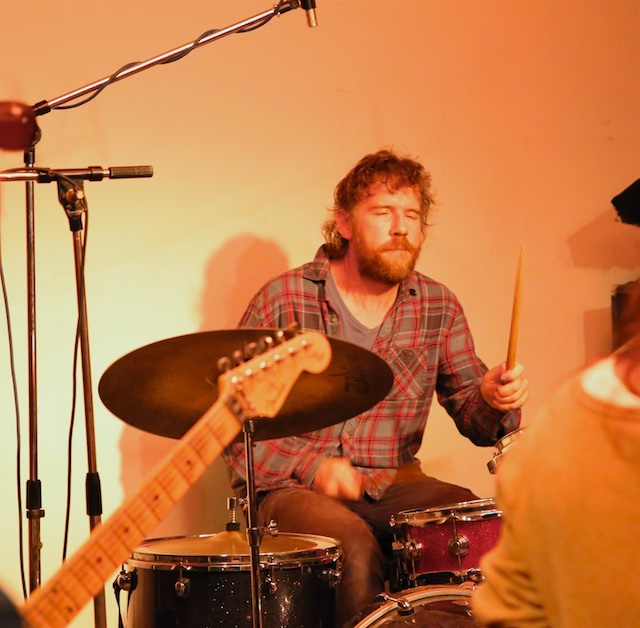
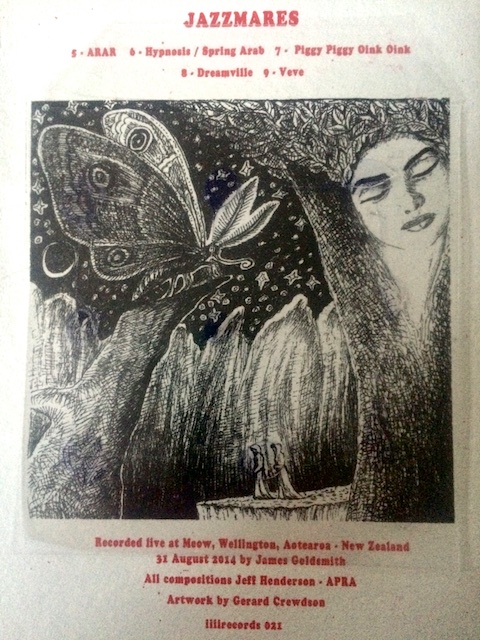
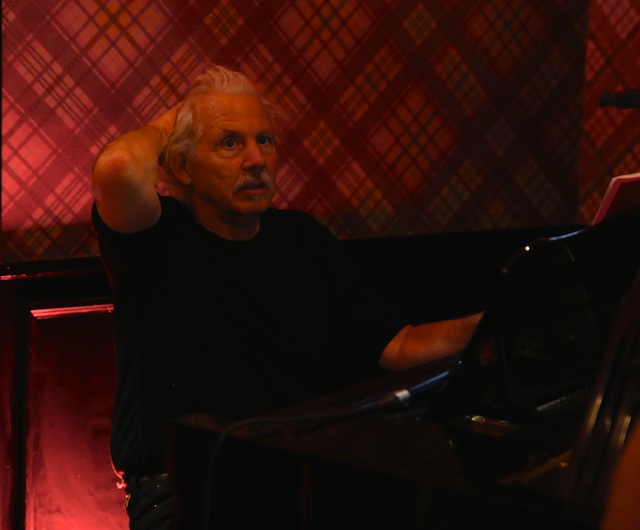 To the best of my knowledge, Jonathan Besser has not played at the CJC (Creative Jazz Club) before. While he is best known as an important composer for The New Zealand Symphony Orchestra, The New Zealand String Quartet and The Royal New Zealand Ballet, he is also a significant leader of small ensembles. Ensembles which venture far into the territory of experimental, electronic and improvised music. It is impossible to separate the man from his music. It is eclectic, original and often plaintive but generally with a sly twist of humour thrown in. In spite of his standing in the music world, Besser is modest. At the CJC he was happy to lead from the piano, which was in partial darkness and at the rear of the ensemble. His instructions were brief and staccato as if part of the unfolding suite. When he did pick up the microphone to speak to the audience he exuded an eccentric charm, bandstand asides peppered with self-effacing humour, garnished with sudden smiles.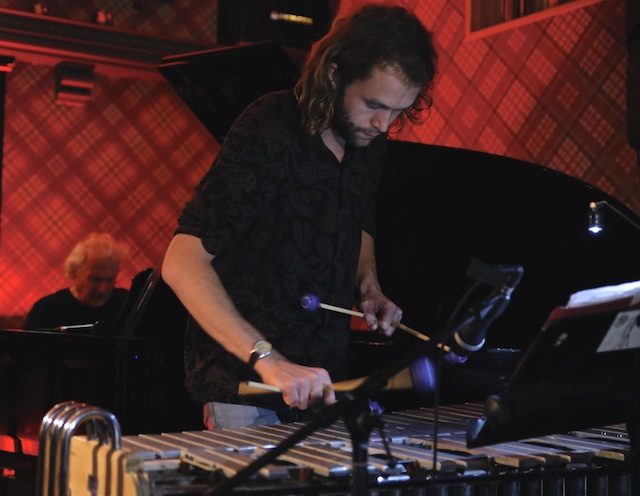
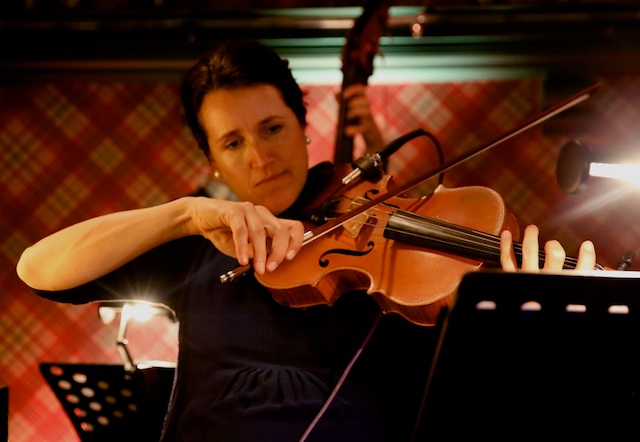 I met Besser briefly during Natalia Mann’s ‘Pacif.ist’ tour and later at the Auckland Art Gallery during the opening of Billy Apples ‘Sound Works’ exhibition. On that occasion, the Nathan Haines Quartet played Besser’s innovative compositions. I really hope that someone recorded that. It was extraordinary music, based upon prescribed letters of the alphabet. These were then allocated using the 12 tone scale as a formula to locate equivalent notes. The order of Billy Apple’s words dictating the order of notes.
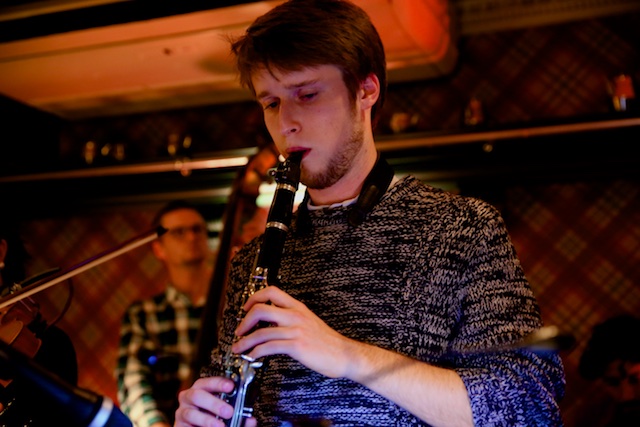 The music was not Klezmer and later I asked Besser about his influences – were there strong Jewish influences? “I am a Jewish man and I used Jewish scales, but apart from that no. I draw upon many, sources”. It interested him that I heard Argentinian references. “I have done Tango projects in the past and that is possible”. It was partly the combination of instruments, the delicious overlay of melancholia and the accents – not so far from the music of master musician Dino Saluzzi.
 The segments of music making up the suite seldom lasted longer than 4 minutes. The spaces between them brief. The mood seldom deviated from the wistful, evoking a sense of intangible longing – for something remembered – but just out of reach, a nostalgia as ancient as time itself. There were a few cheerful pieces as well, but I preferred the former. The Zestniks update themselves regularly, this time adding Caro Manins vocal lines, her wordless vocals followed the viola or clarinet in gentle unison. No one is better suited to this than Manins – she has worked with the likes of Norma Winstone after all.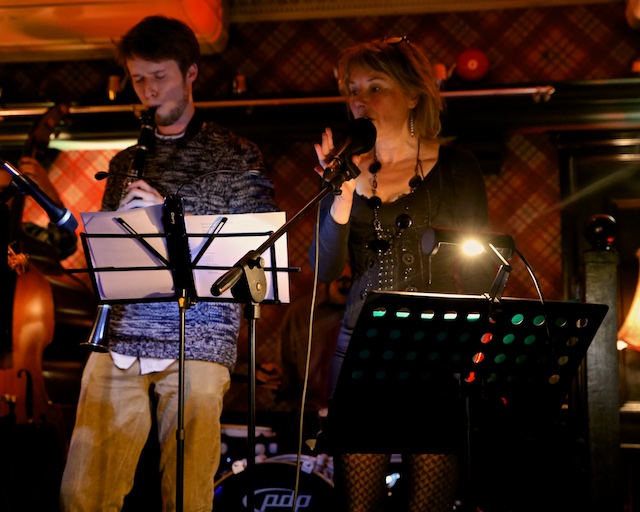
 As I write this it is International Jazz Day, a UNESCO sponsored day honouring the diversity and depth of the world improvising scene. It was, therefore, serendipitous that Carl Dewhurst and Simon Barker brought ‘Showa 44’ to town – especially in the days immediately preceding the big celebration. This gig offered actual proof that the restless exploration of free-spirited improvisers, lives on undiminished. I have sometimes heard die-hard Jazz fans questioning free improvisation, believing that the music reached an unassailable peak in their favourite era. To quote Dexter Gordon. “Jazz is a living music. It is unafraid …. It doesn’t stand still, that’s how it survives“. While a particular coterie prefers their comfort zone, the music moves on without them. Younger ears hear the call and new audiences form. Life is a continuum and great art draws upon the energies about it for momentum. Improvised music is not a display in a history museum.
 It is through listening to innovative live music that our ears sharpen. When sitting in front of a band like this the mysteries of sound become visceral. This was an extraordinary gig, at times loud and confronting, mesmerising, ambient and always cram-packed with subtlety. Fragments of melodic invention and patterns formed. Then subtly, without our realising it, they were gone, tantalising, promise-filled but illusory. We seldom noticed these micro changes as they were affected so skillfully – form and space changing minute by minute, new and yet strangely familiar – briefly reappearing as quicksilver loops before reinventing themselves.
 With the constraints of form and melody loosened new possibilities emerge. In inexperienced hands, the difficulties can overwhelm. In the hands of artists like these the freedom gives them superpowers. Time is displaced, tonality split into a prism of sound, patterns turned inside out. The first set was a single duo piece, ‘Improvisation one’ – unfolding over an hour and a quarter; Dewhurst and Barker, barely visible in the low light. This was about sculpting sound and seeing the musicians in shadow added a veneer of mystique. Dewhurst began quietly, his solid body guitar lying face up on his lap. The sound came in waves as he stroked and pushed at the strings, moving a slide – ever so slightly at first, causing microtonal shifts or new harmonics to form, modulating, striking the strings with a mallet or the palm of his hand. The illusion created, was of a single drone repeating. In reality, the sound was orchestral. As you listened, really listened, microtones, semitones and the occasional interval appeared over the drone. Barker providing multiple dimensions and astonishing colour, responding, reacting, crafting new directions.
 In this context, the drummer took on many roles, a foil to the guitarist, creating silken whispers, insistent flurries of beats and at times building to a heart-stopping crescendo. I found this music riveting and the audience obviously shared my view. In the quiet passages, you could hear a pin drop. If that’s not an indication of the musical maturity of modern Jazz audiences, nothing is. One of the prime functions of art is to confront, to challenge complacency. This music did that while gently leading us deeper inside sound itself. No one at the CJC regretted being on this journey. This is territory loosely mapped by the UK guitarist Derek Bailey, the Norwegian guitarist Aivind Aaset and the American guitarist Mary Halvorson. They may take a similar path, but this felt original, perhaps it is an Australian sound (with a Kiwi twist in Manins). The long multifaceted trance-like drones suggest that.
 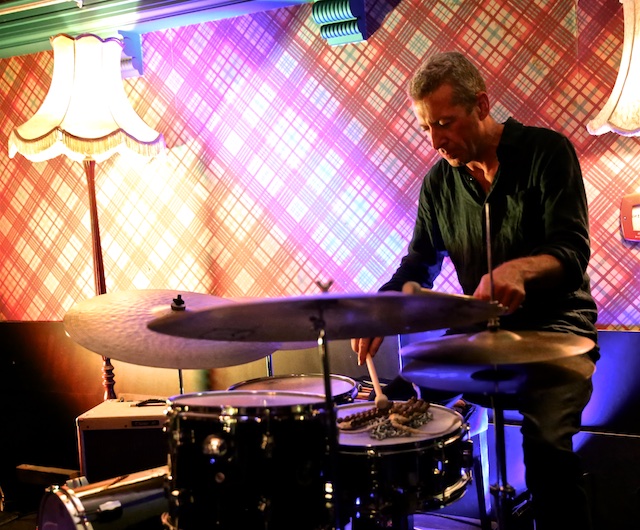 The second set was shorter, ‘Improvisation two’ had Roger Manins aboard. I should be immune to Manins surprises but he frequently catches me off guard. His breadth and depth appear limitless. ‘Improvisation Two’ began with a broader melodic palette. Dewhurst and Barker set the piece up and when Manins came in there was a stunning ECM feel created. Barker tap-tapping the high-hat and ride. Achingly beautiful phases hung in the air – then, surprisingly they eluded us, unravelling as Manins dug deeper – dissecting them note by note. These interactions give us a clue as to how this music works, each musician playing a phrase or pattern and then re-shaping it, passing the baton endlessly.
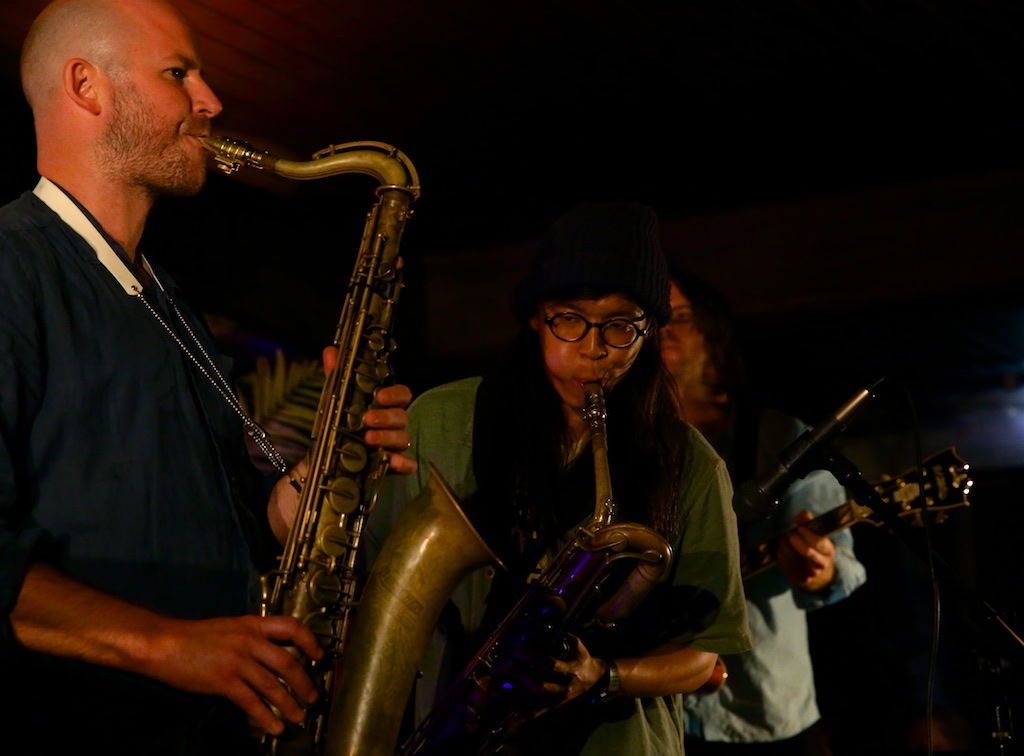 As a group of the worlds leading astrophysicists excitedly ran one last check. At the precise moment that the astonishing mathematical proofs confirmed Einstein’s theory of ‘gravitational waves’, the Circling Sun hit the CJC. This rare cosmic event released fresh gravitational waves which pulsed throughout central Auckland; altering the molecular structure of any ear within radius. It was an appropriate evening for the Sun to manifest this ‘climatic singularity’, preceded as it was by a dog-day as hot as any on record.
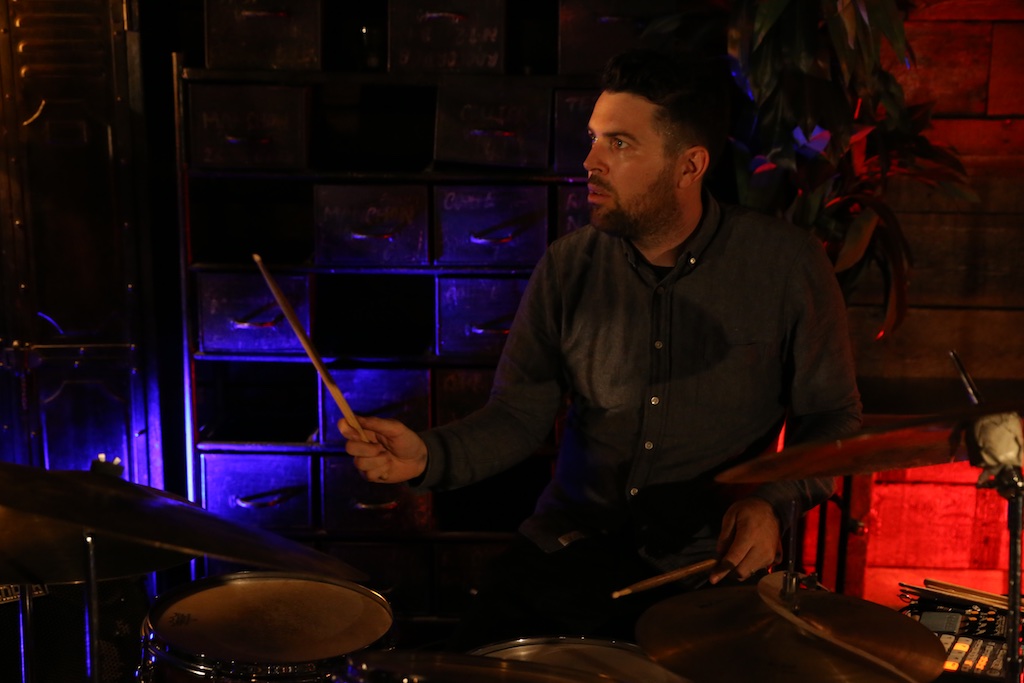 The Circling Sun is more a phenomena than a group. They defy musical form and yet exist convincingly in their own orbit; circling an altered reality. As with all wonders there is much to appreciate. The intricacy of their many machines, the indelible sonic footprint and the sheer joy they bring. I took some guests down to the club that night. Flamenco artists Isabel Cuenca and Ian Sinclair (and Ian’s wife Zarina). I wondered how they would react to this wild unconstrained mix of free improvisation and world beat psychedelic Jazz. Isabel the Flamenco dancer was quick to respond. ‘This is amazing, it has deep passion’. Passion is the heart of many musics and like authenticity it is a vital component. Long live the avant-garde – long live passionate music – whatever the genre.
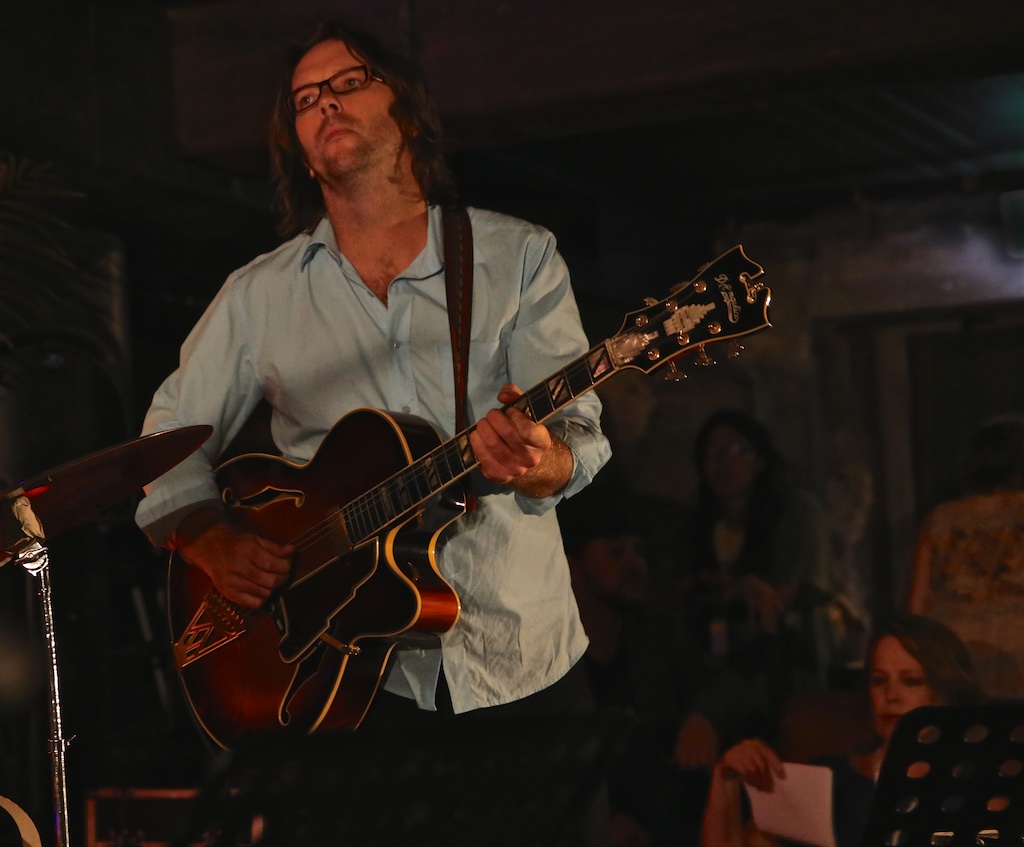 In his seminal work “This is Your Brain on Music’ neuroscientist Daniel Levitin reveals the following. ‘A liking for dissonance is a development arising from deeper listening and on attaining musical maturity. A very young child prefers consonance over dissonance, the mature listener increasingly values contrast and enjoys having expectations confounded. After spending time listening to deeper or more complex music, lightweight consonant passionless music becomes boring. There is a neural basis for this’.
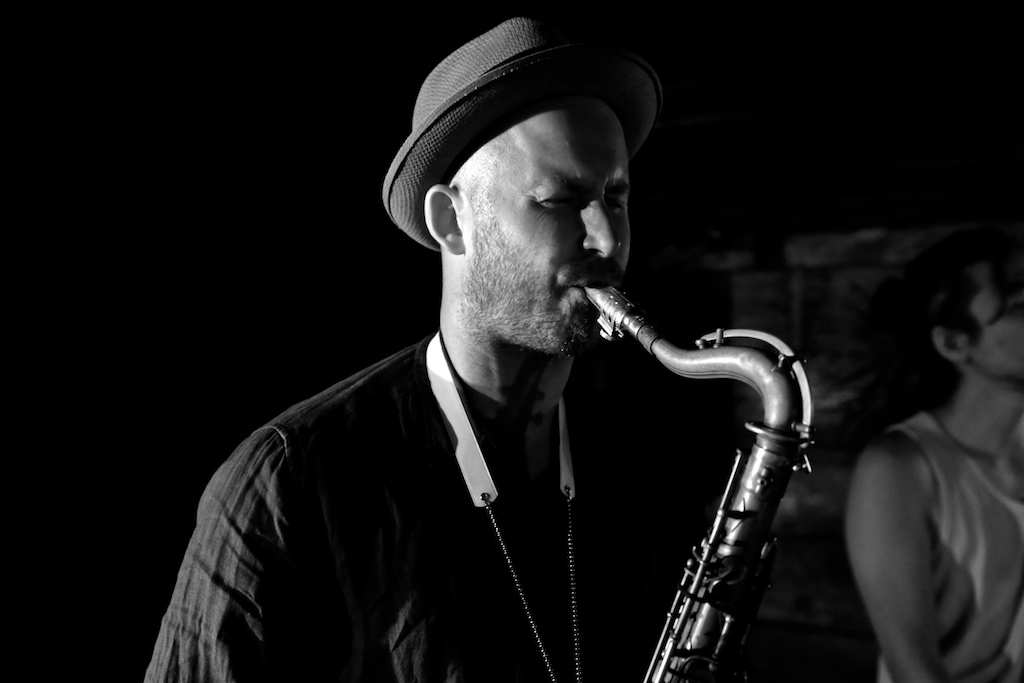 The Montreal born Dyne was just the drummer for a band like this. His musical credentials are impeccable. His expertise extends well beyond the kit to that of producer and forward-looking experimentalist; electronic future beats, hip hop, house, afro beats, boogie funk and instrumental jazz. His work with Ladi6 has brought him to wider attention, but his own Lord Julien recordings and his deeply funky ‘Down in the Basement’ (Vol 2) cuts are well worth checking out. This band has few constraints and it gives him ample room to stretch.
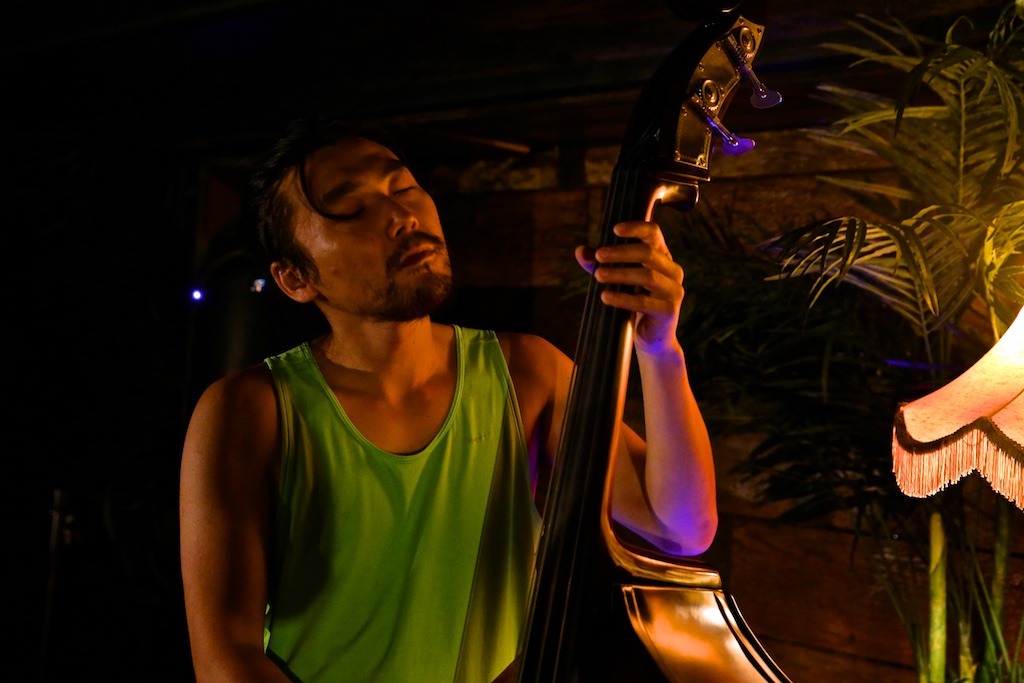 I have long been a Watson fan. The man is fearless and his musical ideas cross territory few others dare to traverse. His increasing mastery of the pedal steel already sets him apart, but his ventures into the experimental avant-garde with the instrument are unique in the New Zealand context. While an accomplished studio musician his preferred gigs are those without boundaries. With Watson you get Americana, blues, Jazz psychedelia or wild forays referencing Marc Ribot & Sonny Sharrock. The Sun suits his wild eclecticism.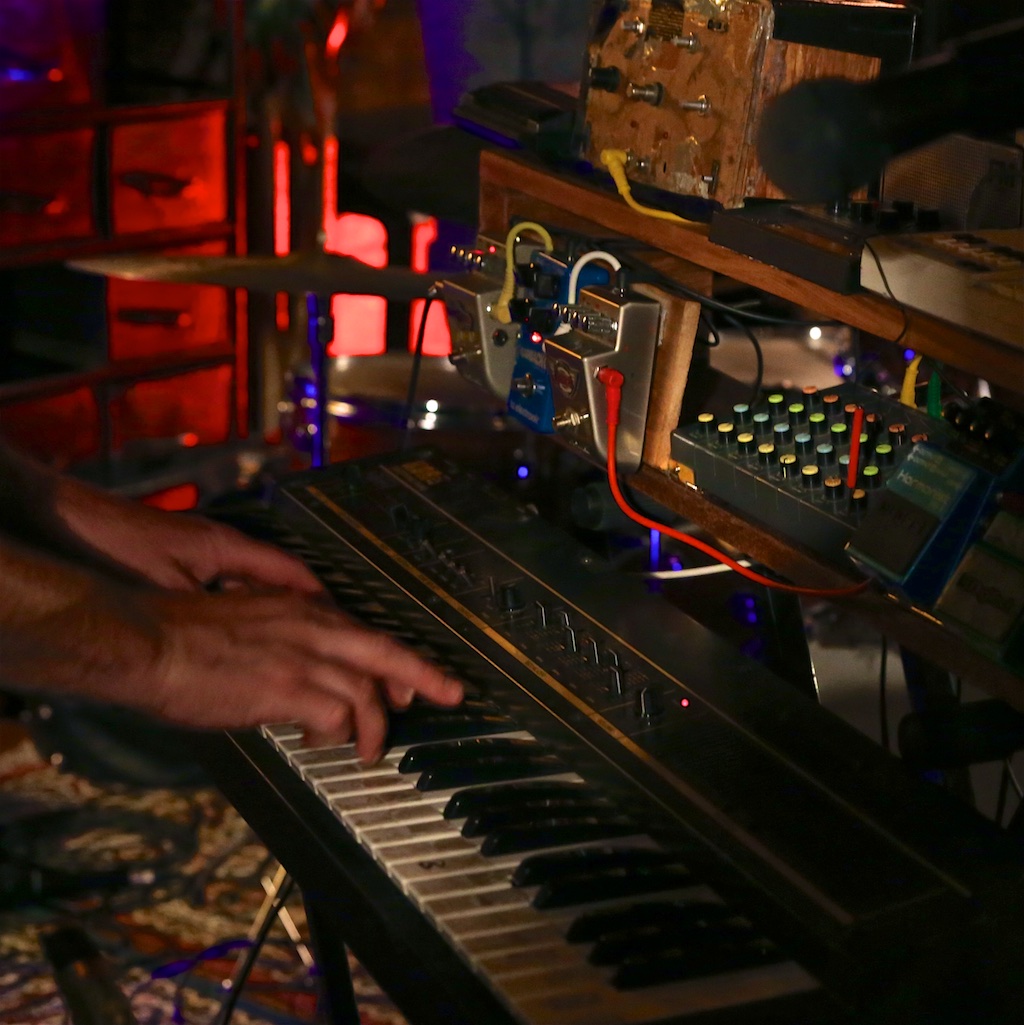
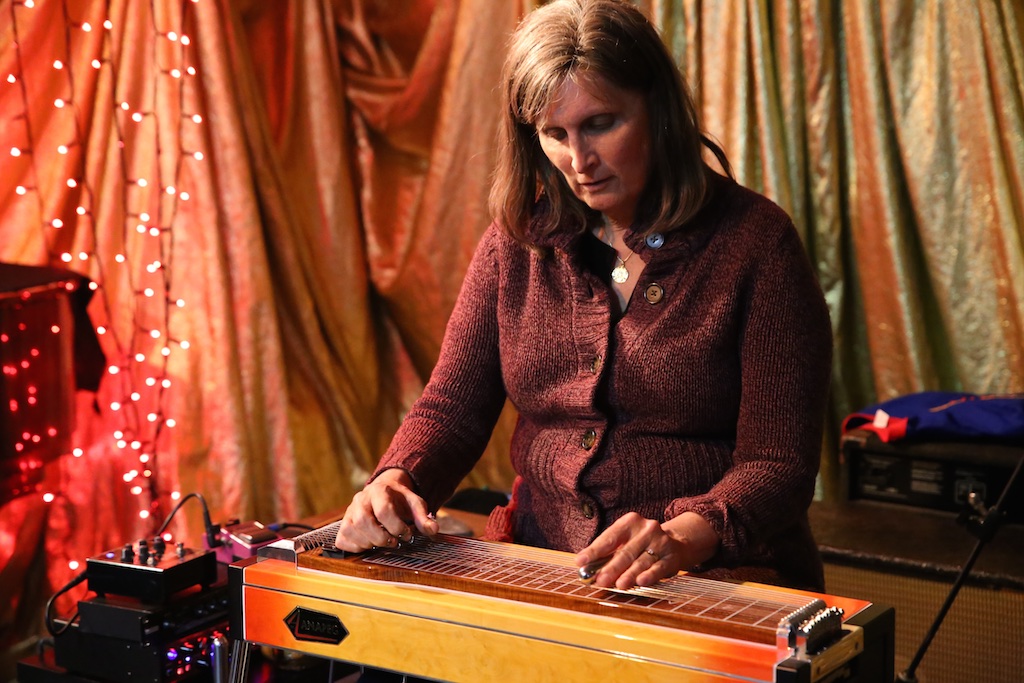 Lately I have attended a number of music workshops. Although not a musician I gain a lot. They offer fascinating insights into the artists creative process and if your lucky, insights into a particular instrument. With music, the more you listen, learn, observe and delve, the more you gain. My reason for attending Susan Alcorn’s workshop was probably different from most attendees. The majority were guitarists anxious to glean practical information or wanting to be convinced that this complex instrument was for them. A handful of others sought knowledge for knowledges sake – dipping another toe in the water of sonic learning.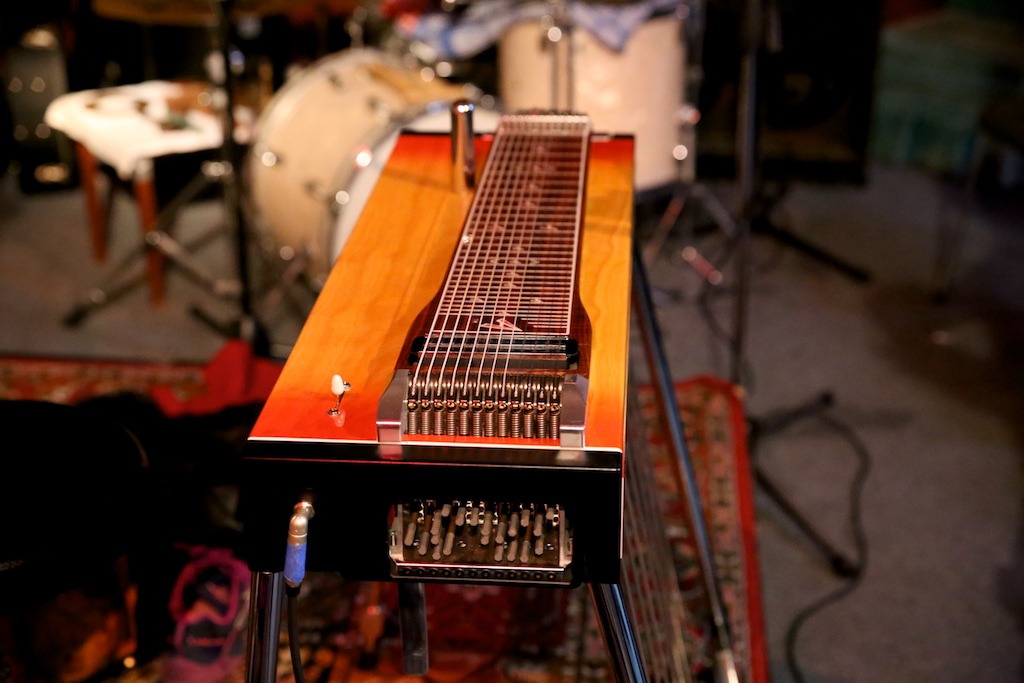

 By the time the second week of the Auckland Jazz Festival arrived, I began to feel my age. I had already experienced a number of late night gigs and a further week of music stretched ahead of me. This was no time to flag, as some interesting and innovative music lay ahead. The festival programme structure provided audiences with variety. The depth and breadth of the improvising scene was on show and I wanted to see everything possible. The week started well with the Meehan/Griffin/Manhire poetry project (see earlier review for this). That gig brought a new audience and I was still
  buzzing come Tuesday.
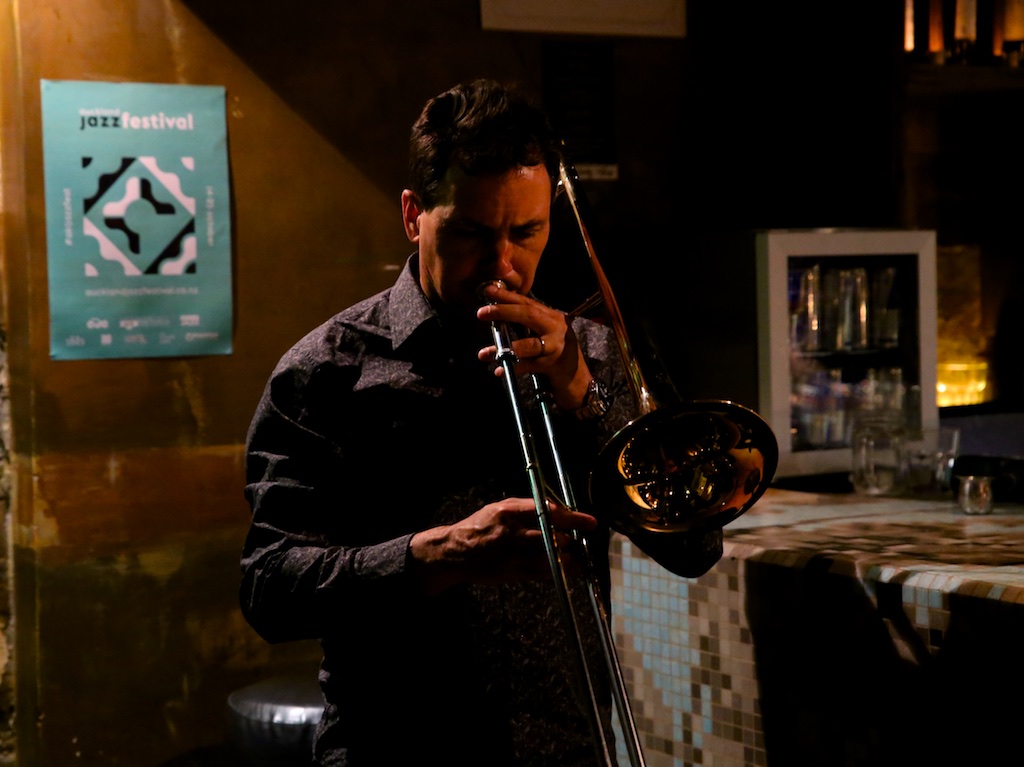 I had volunteered for door duty that night, turning up early to help. I enjoy the Jazz orchestra set-up process – in this case nineteen musicians and a conductor configuring a behemoth in an impossibly small space. It was like witnessing Nasa scientists beginning the launch sequence. Instruments and gauges checked, tapped and rechecked, cabling run out; each adding a layer to the criss-cross tangle of shoes, stands and chairs. Soon there were rows of brassy instruments standing in an (almost) orderly line, with the odd human interloper spoiling their symmetry. Random buzzing sounds came from warming up lips; and all punctuated with honks and plucked notes from far-flung corners of the room. this is the counterfactual of the sounds that follow.
 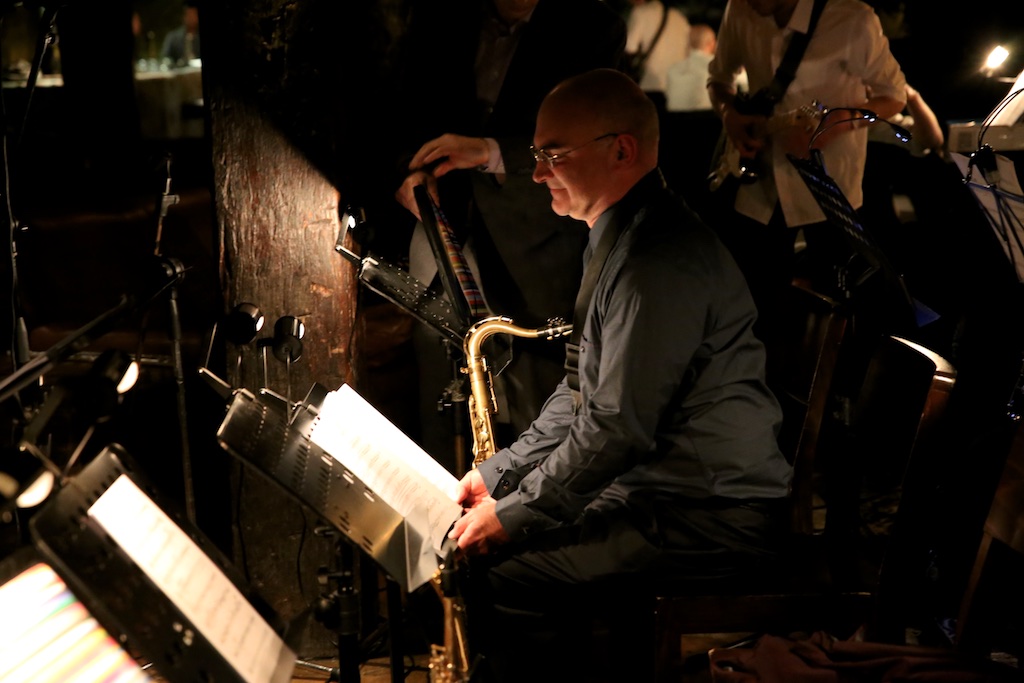 Band leader Tim Atkinson composed and arranged the suite. He has carefully shaped this ground breaking project as befitting a work of this importance. This is a modern piece of music in the mould of Darcy James Argue. Richly textured, evocative of the title and especially in the warm multi layered dissonance that swells out of the quieter passages. The work has captured a mood and an orchestra going places. This is a moment which benchmarks the growing maturity of the Auckland Jazz scene and I am truly glad to have witnessed it. The overall performance on the night was flawless, but if anyone stood out it was altoist Callum Passels. His solo on ‘The Dark Passenger’ was wonderful. it was a feat of story telling, of mood and it oozed freedom – as if he had somehow escaped the confines of room and orchestra. Importantly, he managed this without once deviating from the logic of the composition. I urge people to purchase this album and I guarantee that you will play it over and again.
 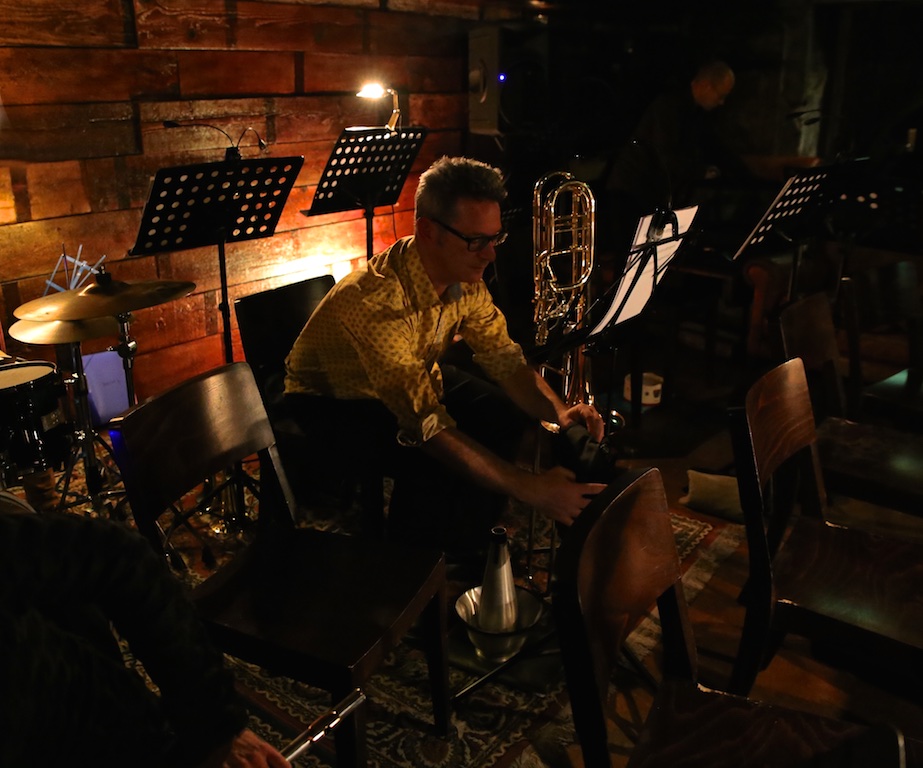 On Wednesday I spent time with the
 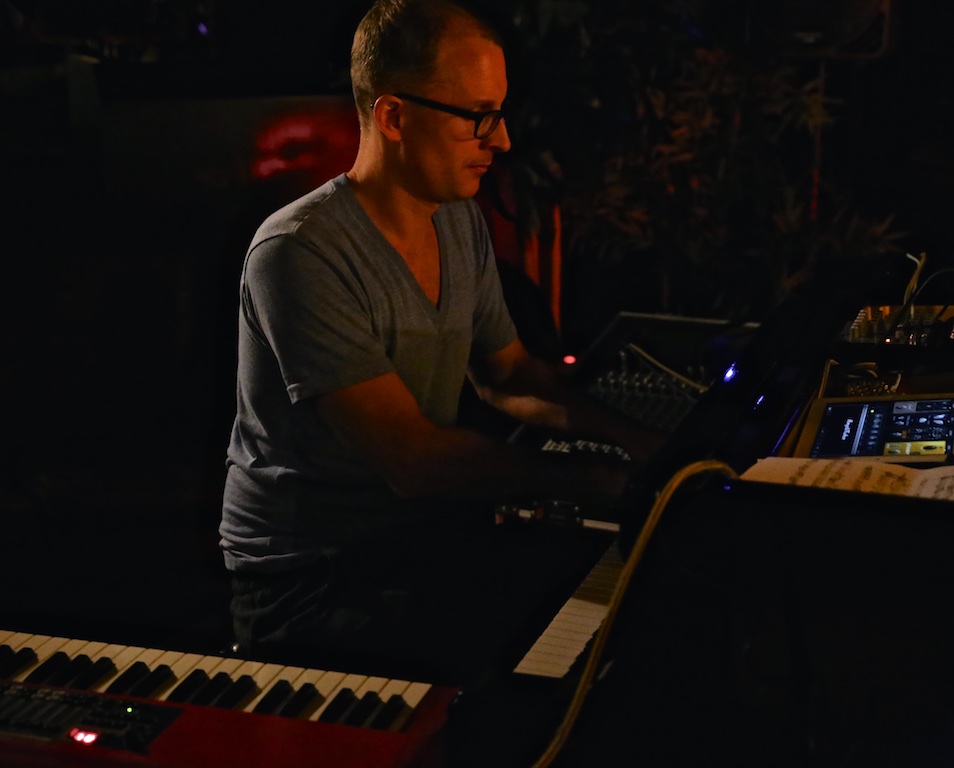 The trio’s set list was a mix or originals and some very interesting covers. What was not composed by Lackner or by the drummer Chazarenc, were often unexpected tunes; Brahms, Cold Play, David Bowie, Rodriguez and Jimmy Hendrix. ‘If Six were Nine’ was simply stunning. Warmly familiar to those of us who remembered the rock original. Taking the bones of a 1960’s tune and infusing it with edgy lines and modern harmonic conceptions. I have long-held the view that the new standards will come from material exactly like this. None of the band were alive when this acid blues classic was cut in 1969, but their joy at performing it was evident. Jimi would have loved it.
 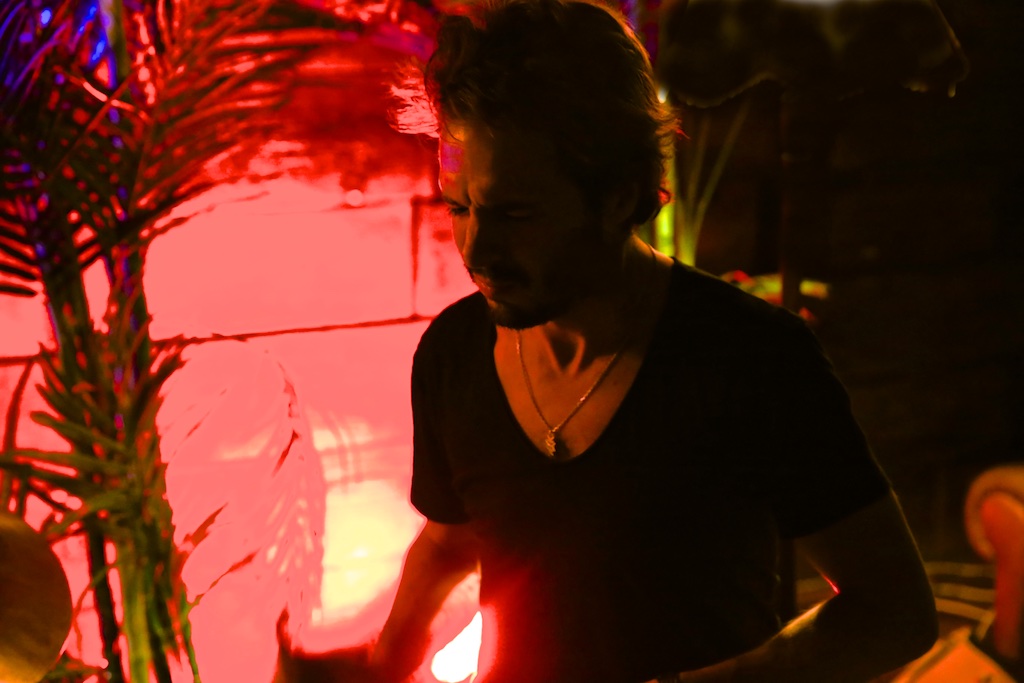 The bass player on this trip was Bruno Schorpe. When offered an upright bass he declined – choosing to remain on electric bass throughout. I’m glad that he did because the instrument had the bite to act as counterweight. Balancing out well the electronics and various effects of Lackner’s keyboards. Then there was drummer Matthieu Chazarenc. He has accompanied Lackner on previous trips and to my ears he is directly out of a great tradition. French Jazz drummers have a sound that is distinct. Like many of his compatriots Chazarenc’s sound is crisp, even dry; utilising dynamics in ways that younger drummers are often incapable of. A label like ACT must surely pick the trio up sometime soon. They would be a perfect fit – much as they would for ECM.
 ‘The Green Room
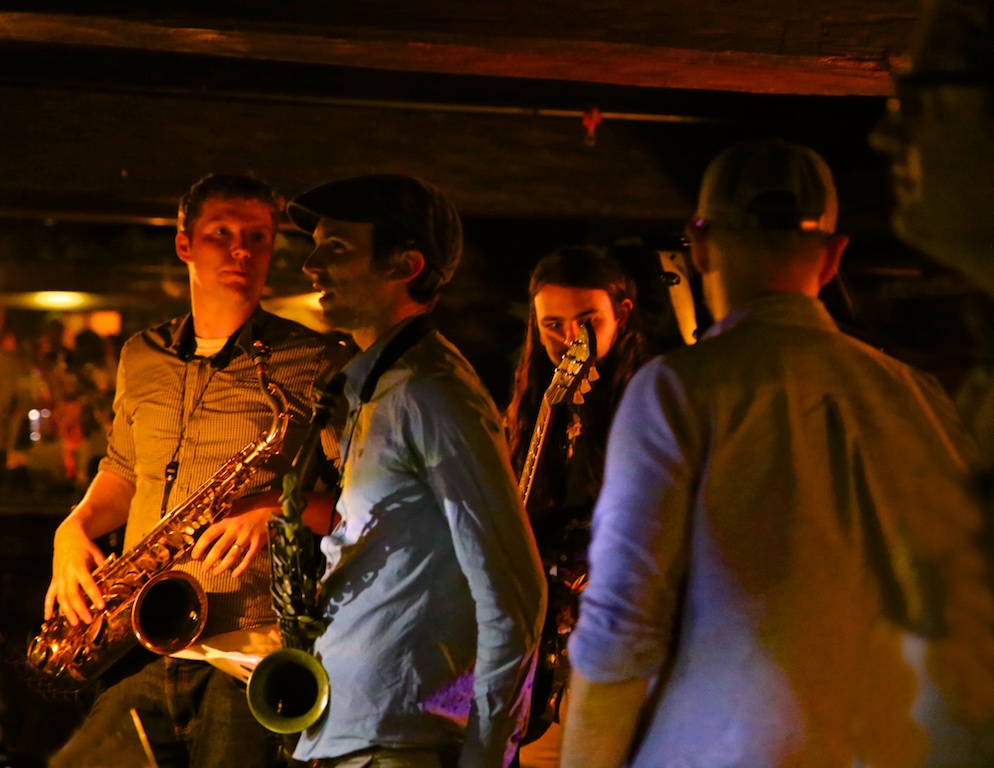 It is almost overkill to single out soloists with a cohesive group like this as every one is notable in some way or another. Altoist Jake Baxendale is their nominal leader and three of the compositions on the album are attributed to him (including the title track). If any number captures the essence of the group it is this. The solo on his tune Andalucia also captures a strong sense of place. I know Andalucia well and this is a convincing testimony.
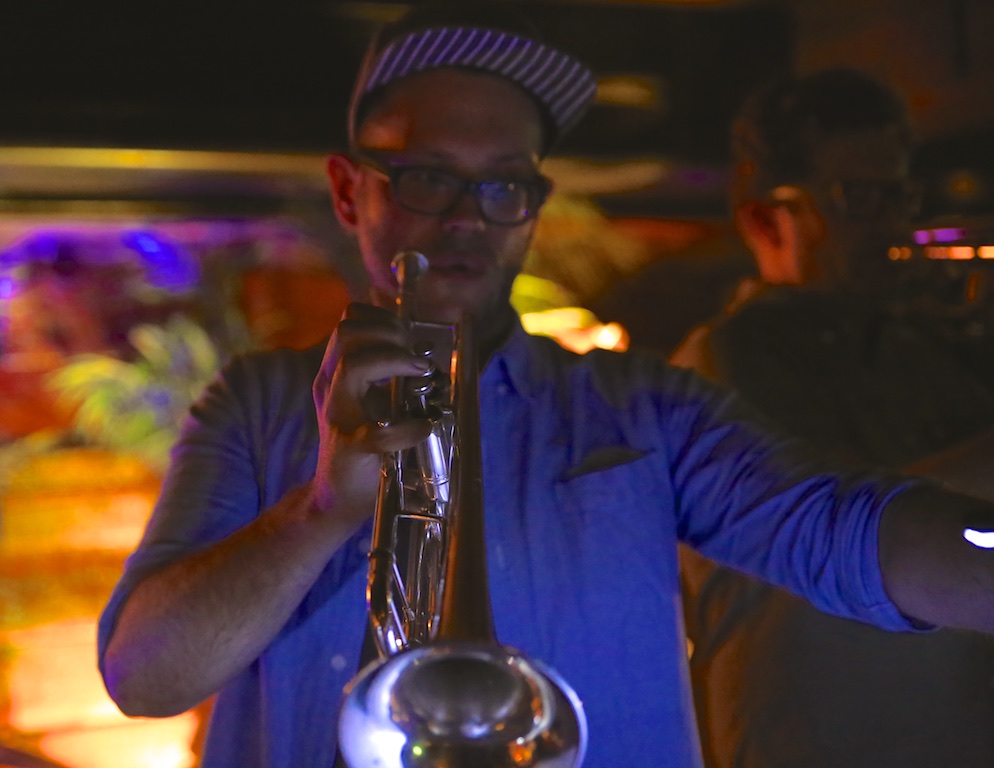 It is hard to know where to start with Callum Allardice; he grows as a musician every time I hear him. His compositions are stunning and his guitar work so fluid and exciting that it defies belief. These are performances that stop you in your tracks and few New Zealand guitarists capture that particular sound. Lex French is another spectacular performer and we would hardly expect otherwise. He is now the leading local voice on that horn. Perhaps the most experienced player is Nick tipping who never puts a foot wrong. On the new album we hear him at his best.
 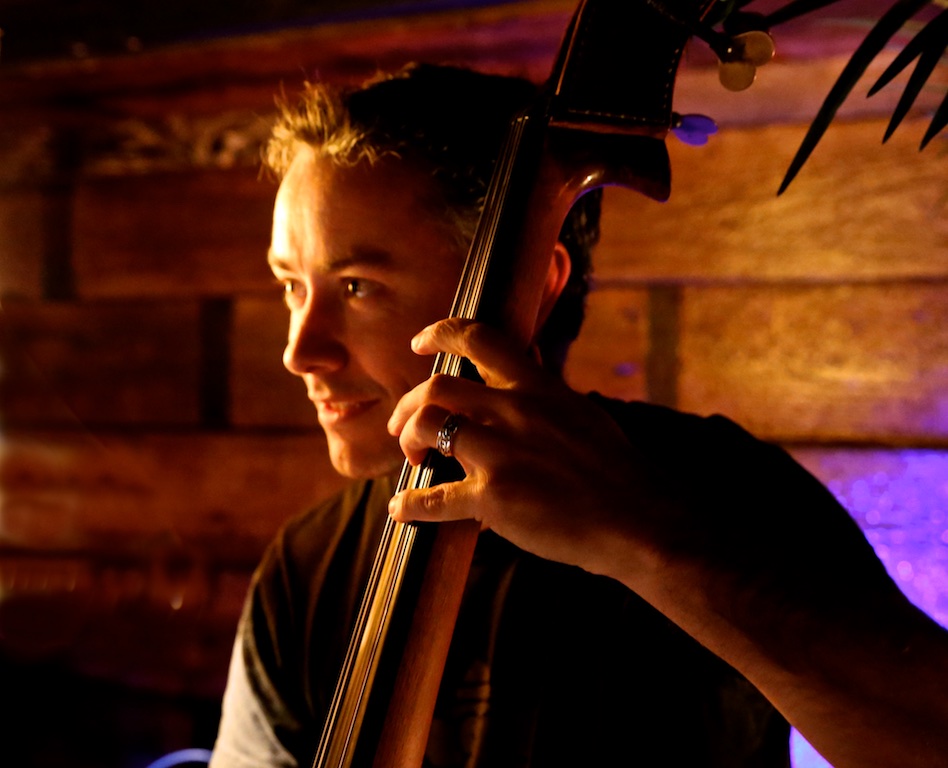 Convincing contributions by the likes of Chris Buckland, Matthew Alison and Shaun Anderson reinforce the view that this is an all-star band. Lastly there is pianist Daniel Milward. He has recently moved to Melbourne and his voice is particularly strong on the recording; more so than on the first album. Not a showy pianist but an extremely tasteful one who gets it just right. I have put up a sound clip of the Allardice Composition ‘The Heist’, as I have loved it since first hearing it (probably at the Tauranga Jazz Festival).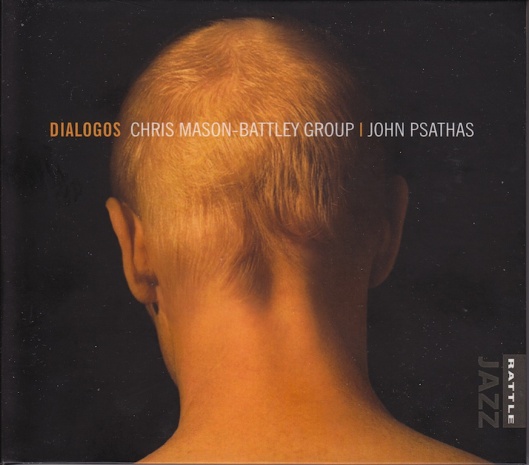
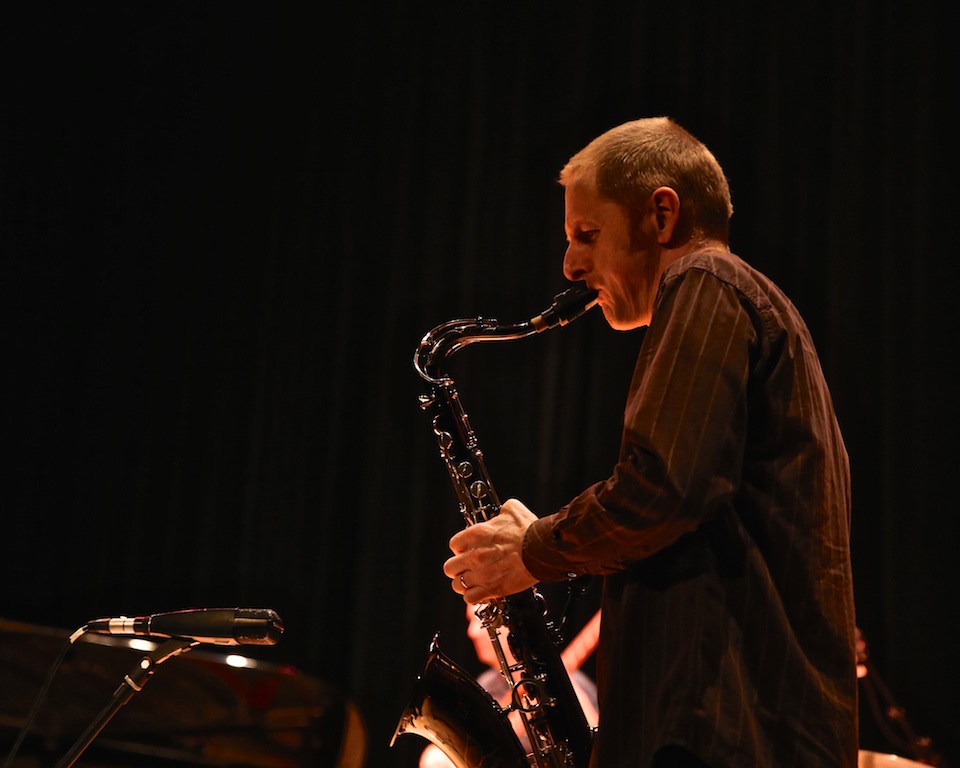 In Psathas words, “it is not arranging or adapting…(rather) a continuing of the composing process”. There are works or arrangements which re-imagine and examine a work from an outside perspective. That is not the case here. This is part of a developing story and the Psathas vision remains at its heart. I recently read a trilogy by a famous and highly respected author. He had intended to write a fourth volume but died before he could proceed. A year later another author picked up where the original author left off and achieved something extremely rare. He added to the body of work seamlessly; continuing the narrative in ways that were his own and entirely consistent with the original. Although a more serious work, DIAGOLOS was an unmitigated triumph.
 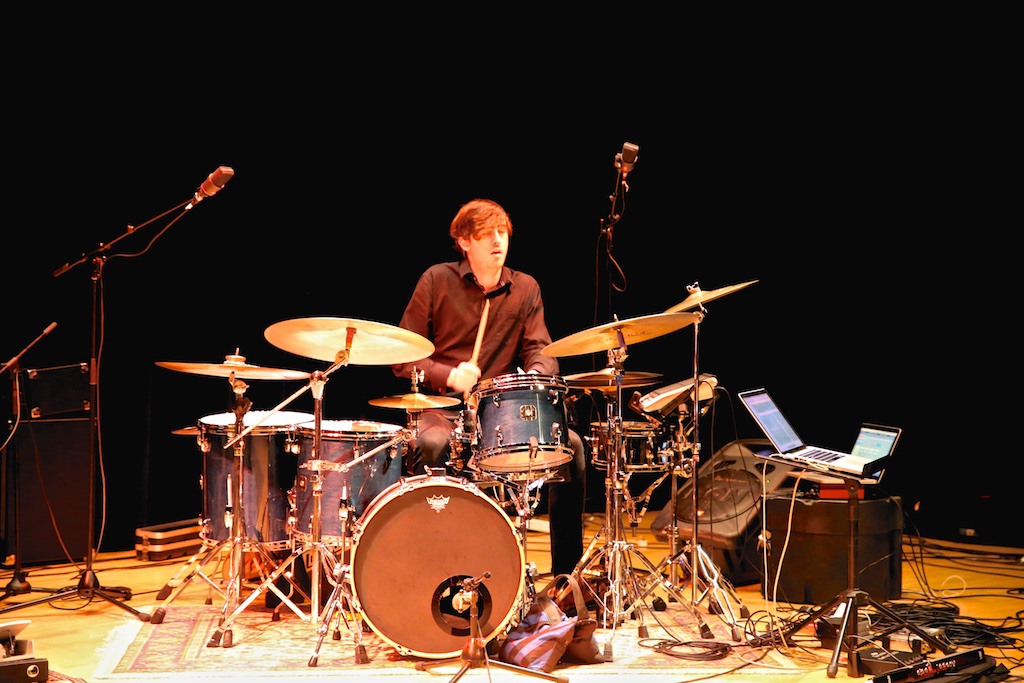 Mason-Battley is a thoughtful gifted musician, but we don’t see him perform about town very often. Any new project gets his undivided attention and that was the case here. Counter intuitively, it is his careful preparation which affords him the extraordinary freedom he demonstrates on the bandstand. During this performance he took us right to the edge; you gained the sense listening that he was pushing himself a little further with each phrase. It is at times like this that great music emerges. While adventurous with electronics, he evokes a classic Coltrane sound on his Soprano. There are a number of local musicians who double on soprano but few (if any) sound like Battley.
 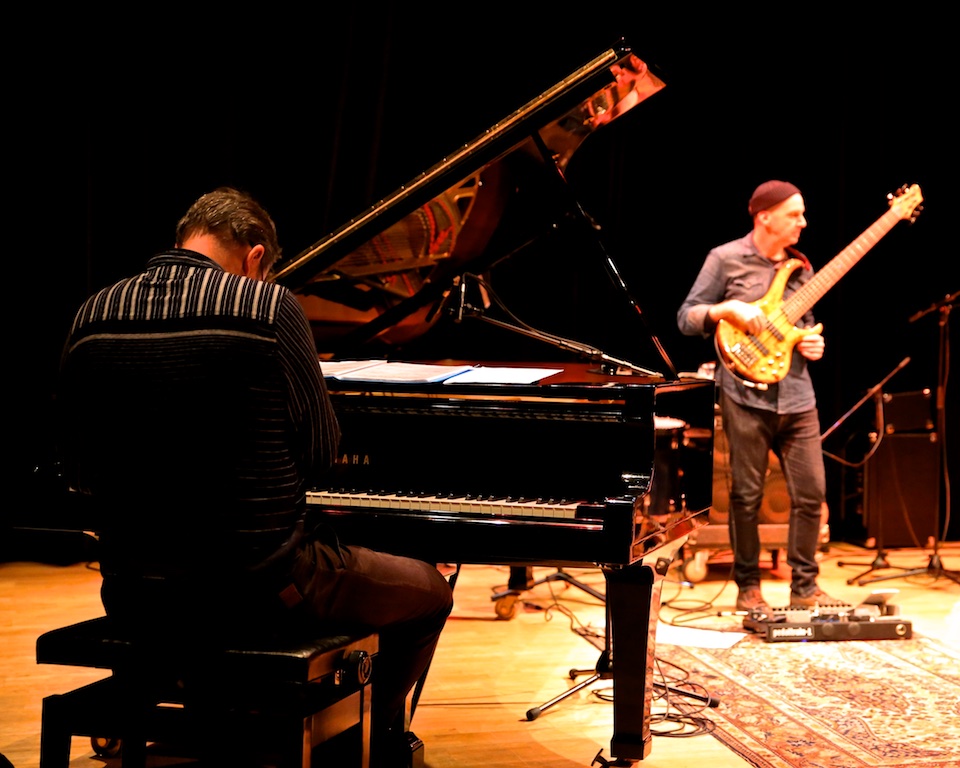 The Chris Mason-Battley Group has been around for some time and the original group set New Zealand records for the number of downloads and albums purchased. For this project core members David Lines, Sam Giles and Mason-Battley remain with the addition of drummer Stephen Thomas. Unlike earlier configurations, there is no guitar. Bringing Thomas into the mix has worked extremely well. The drummer of choice for many gigs and a gifted percussionist in the fullest sense. Psathas music calls for sensitive drum work and Thomas has exactly the right approach. His understanding of subtle dynamics, time awareness and overall sensitivity to the project were very much on display. I also appreciated David Lines piano. Lines early classical training was evident in places and again this made him a very good choice for the project. The work required a pianist with a particular chordal approach. At times he was minimalist and with a particular approach to voice leading. Lines like the other four were indispensable to the project. Lastly there was Sam Giles – an electric bass player I wish I heard more often. Giles often leans towards the avant-garde and innovative projects. That is where he shines.
 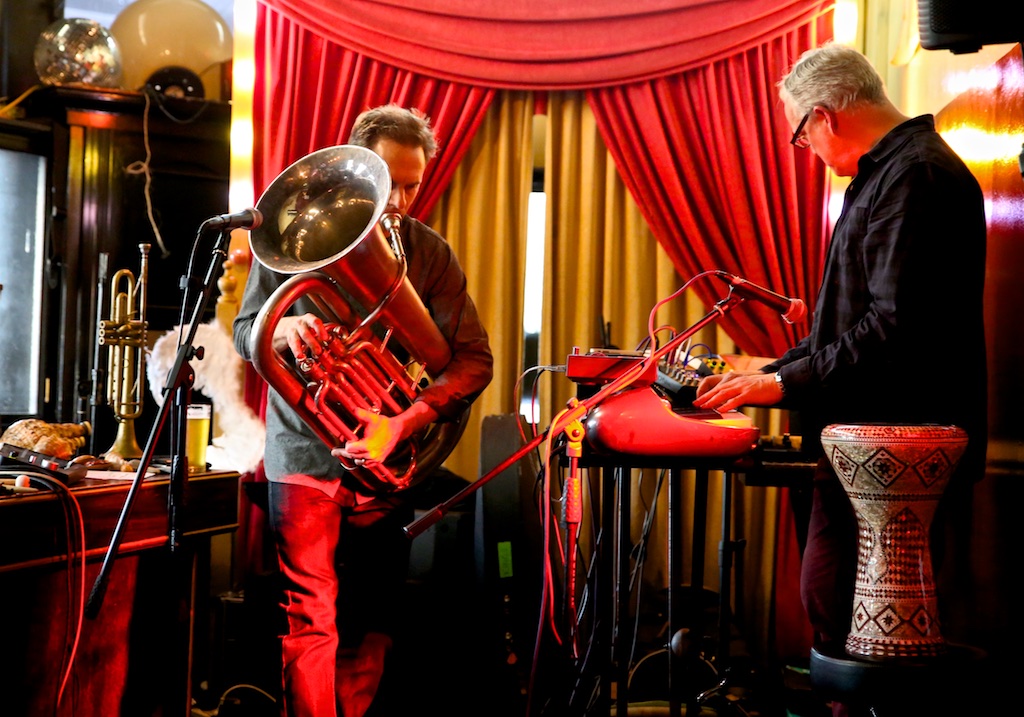 The Last Auckland Jazz Festival gig I attended was the Alan Brown/Kingsley Melhuish
 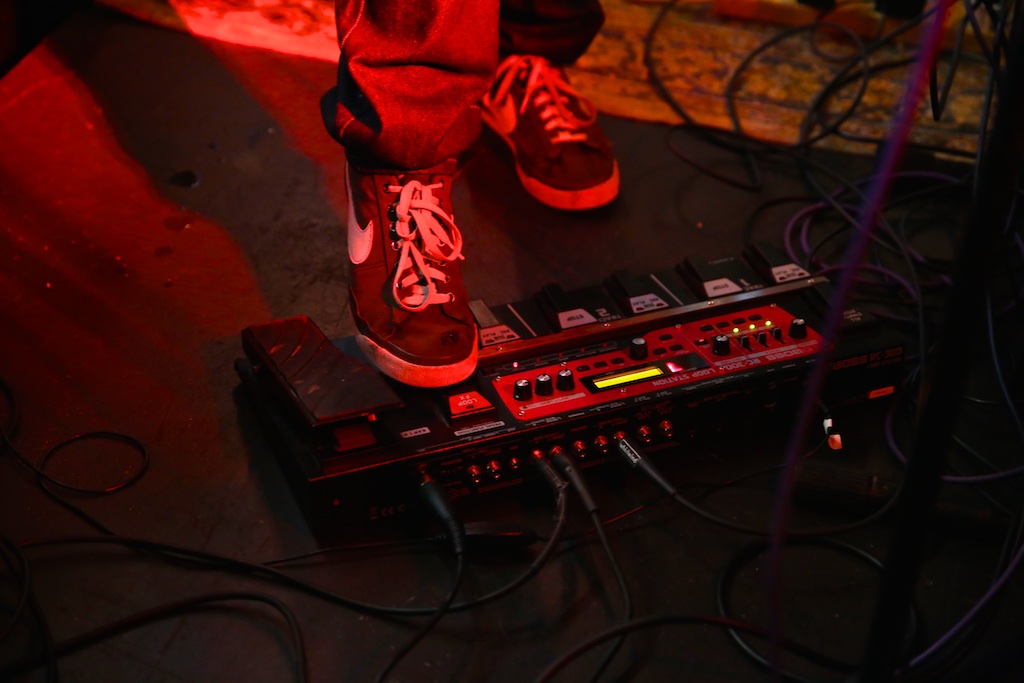 This has been an interesting Jazz Festival and although it is cliched, there was something for everyone. From manouche through to the avant-garde. I loved that it retained the feeling of local and of intimacy – even when showcasing offshore bands. The CJC (Creative Jazz Club), Rattle Records, 1885 Britomart, Auckland University, Golden Dawn, Portland Public House, Hallertau, Ostro, Lot 23, One2One, Hotel DeBrett, Lewis Eady, The Refreshment Room, the Vic, The Wine Cellar and other venues deserve our heartfelt thanks. Above all its
 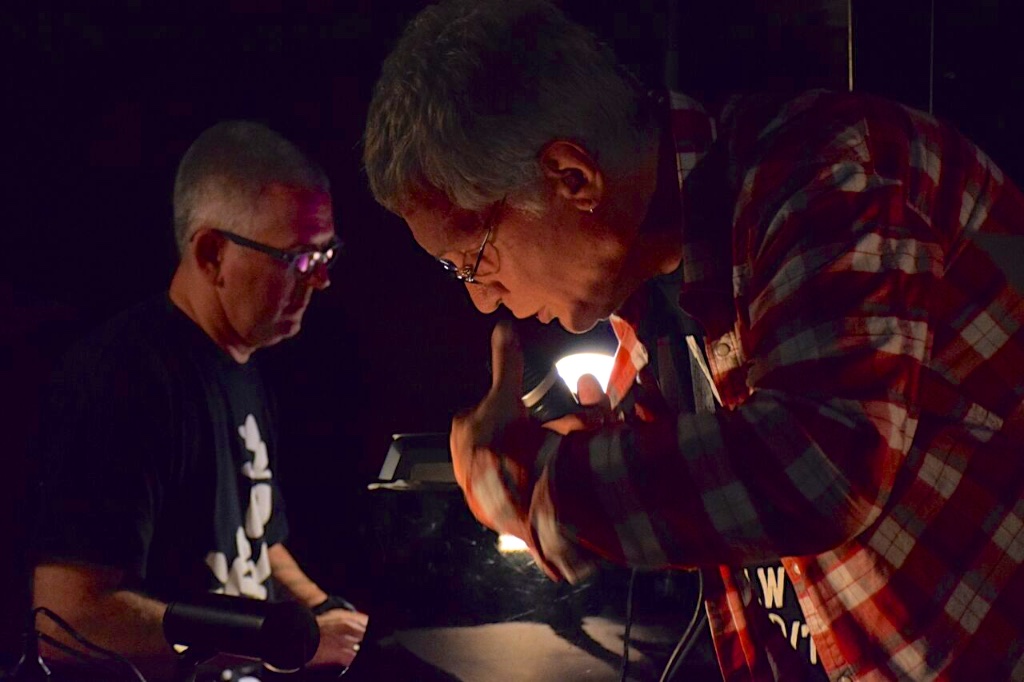 I made up my mind days before the Mexico City Blues gig that I would not, could not review it. It is some kind of crazy to review a gig where you’re in the band. Logic and custom sensibly warns you to walk swiftly in the opposite direction. The gig passed and I asked others if they would do the review; “You’re wrong man” they said, “You absolutely have to do it, but do it differently – tell a story about what it felt like performing for the first time, and what it felt like as a non musician being part of a high quality improvising band”. I thought about it for a while and gave in. In truth I had a world of stuff churning about in my brain and the subconscious urge to outline the experience was gnawing at me; my thoughts and impressions always seem to spill onto the page somehow (or into a poem) – so hell why not. It’s Gonzo journalism in its purest form; outlining crazy, using ones-self as the hapless protagonist.
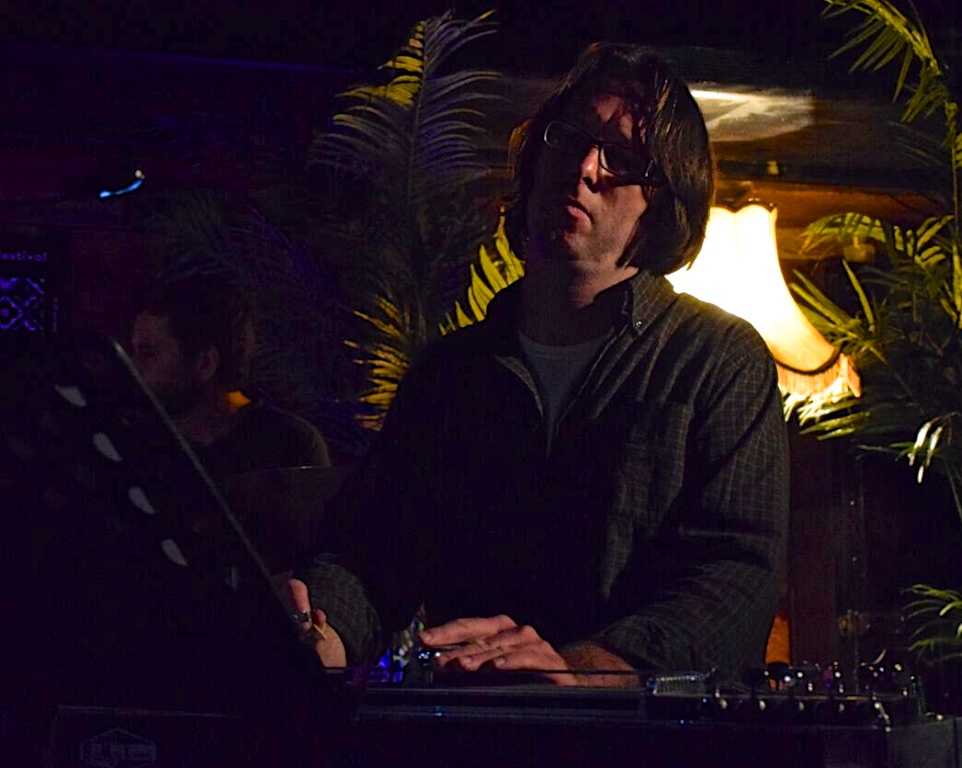 I confided my fears to a few knowledgeable friends, Chris Melville and poet Iain Sharp. Both were very sensible and reassuring in their advice; “Just own who you are man, own your voice. You know this stuff backwards and you know the music”, they said. When I explained the hazards of fitting existing verse to music, drummer Ron Samson told me, “Don’t worry man, we will follow you – your safe with us”. I discussed it further with Stephen and he gave me a set list. From that list I chose three poems that roughly matched the rhythms of tunes. For ‘Goodbye Pork Pie Hat’ (Mingus) I chose Kerouac’s chorus 66 from ‘Orizaba 210 Blues’, for ‘Blue in Green’ (Evans/Davis) I selected the beautiful mystical 1st chorus of ‘Desolation Blues’. I was sure that two poems would be more than enough, but as a precaution I prepared a third as back up – verse 116 of ‘Mexico City Blues’ to Horace Silvers ‘Peace’.
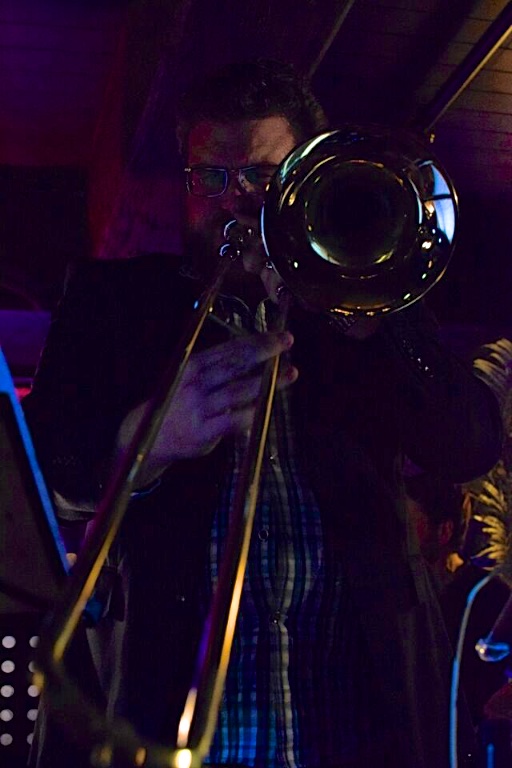 Jazz gig rehearsals tend to follow a formula, but viewing this process from the outside and being part of it are two very different things. From the inside your inbuilt detached observer gets fired from the cannon of weirdness. You realise just how random Jazz rehearsals are. They begin what becomes a slow descent into the controlled accident. The first hour of any rehearsal is a ‘hang’, insider jokes, war stories and talk of gear and gizmos. Then a sudden flurry of activity follows; disembodied items of musical machinery miraculously forming into new shapes. If the rehearsals are in a Jazz club the activity takes place in semi darkness. Instruments, microphones and amplifiers joined by a spaghetti of wires as the musicians stumble over precarious piles of instrument cases and zip bags. “Oh shit this channel is dead – (from out of the darkness) – don’t worry its the cable – have another in my car – its parked a few streets away. Can we route the cable through the Hadron-Collider? – clip click – sorry false alarm”.
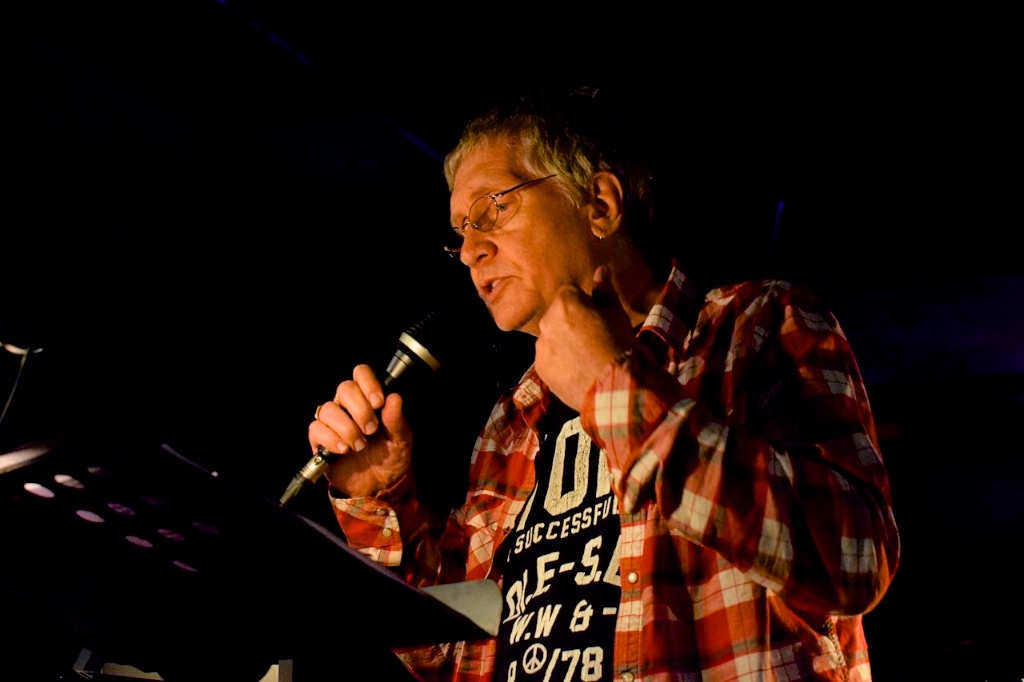 Then came the truly random bit. “We can cue you in on each piece, or just dive in where ever you think best – we can follow”. The words ‘each piece’ threw me a curve ball. “I have only three poems printed off” I added lamely (or four if you counted a crumpled excerpt from ‘Desolation Angels’ tucked into the back of the folder). “No matter – just say anything – you’re a poet – it will be fine” said Stephen. Then I remembered the paperback of Kerouac’s ‘Book of Blues’ in my bag. “Great” said Stephen, “just pick the poems randomly – do it at the last-minute while we run through the head of each tune – perfect”. This was a band leader channeling the Zen Master – a role quite appropriate to a 1959 referencing gig – throwing me a Koan, an improbable musical puzzle, no escape route possible. When we got to the tune ‘Peace’ I gained confidence, “Ah I have something for this – yeah – Horace Silver”. At this point Stephen casually informed me that they were actually doing Ornette Coleman’s ‘Peace”, another tune entirely. Ornette, ORNETTE – holy crap – panic. Next the gig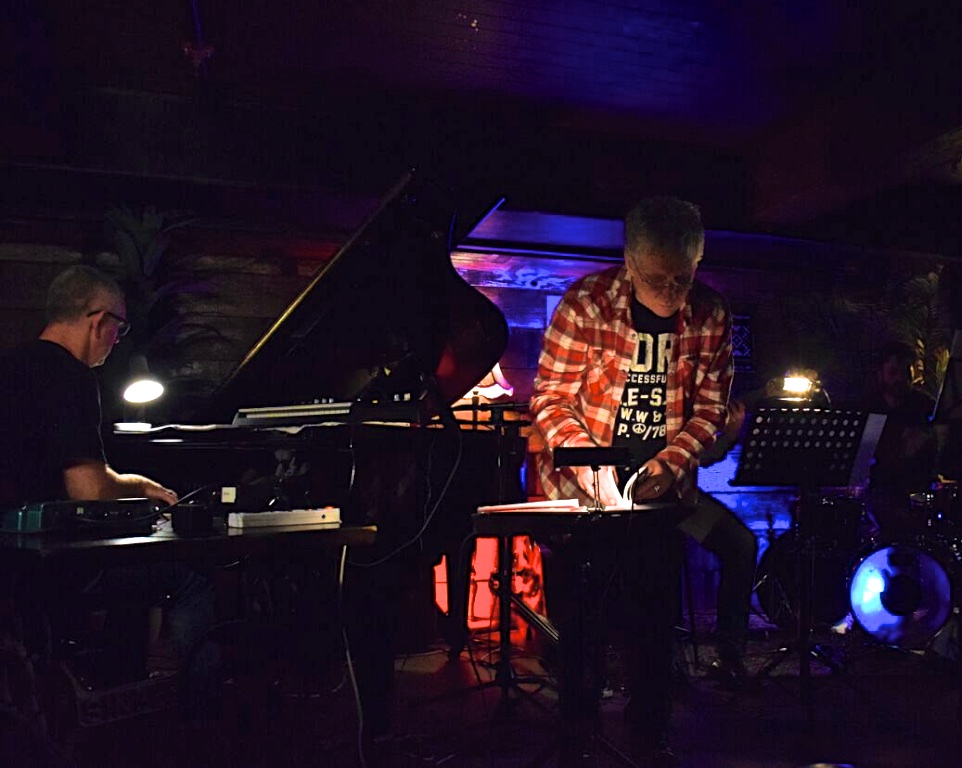
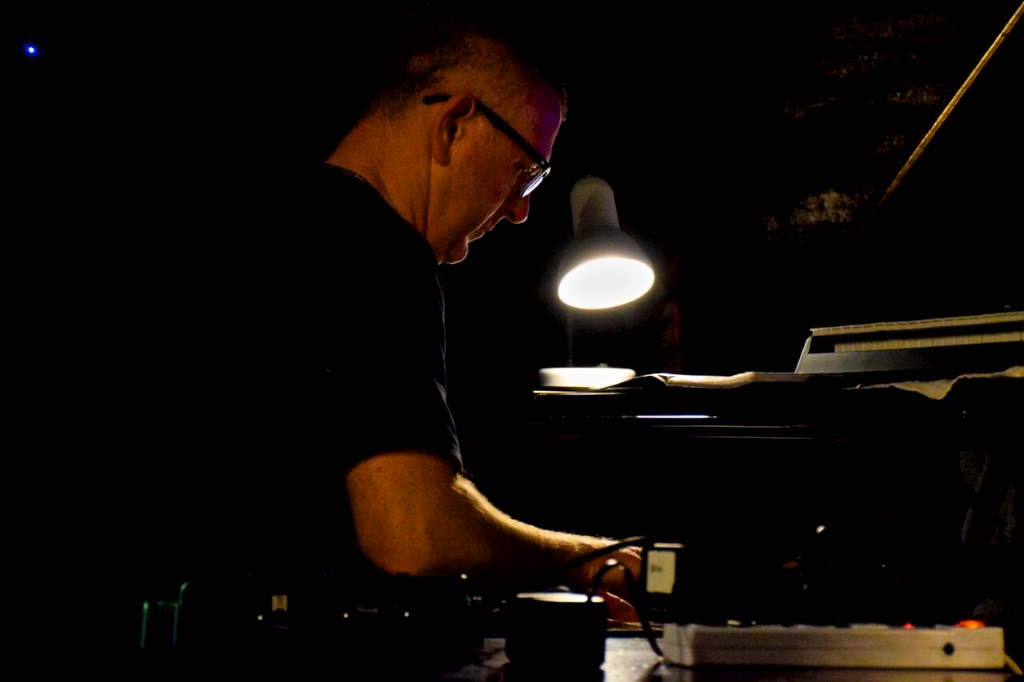
 There are a lot of interesting stories on the Jazz circuit and some of them more improbable than others. None more so than a gig dedicated to the Manukau Harbour mud crab Grg67 (Varunidae:Helice). This ten legged estuarine creature has inspired Roger Manins to name a band after him and to compose a significant number of tunes
 in his honour. I could say that environmental activism fuelled the gig (and in part it was), but the affection and respect Manins exhibits towards these crustaceans is more complex than that. It is the respect of a dedicated Flounder fisherman; coloured by the quirkiness of an improvising musician. To quote: “When we play these compositions there are sharp claws and a soft underbelly; at times we can move unpredictably sideways at great speed”. Manins demonstrated this to great effect as he swiftly shuffled in alternate directions. You couldn’t make this stuff up. As the gig unfolded he delighted the audience with his antics and with the subsequent ‘crab’ influenced compositions.
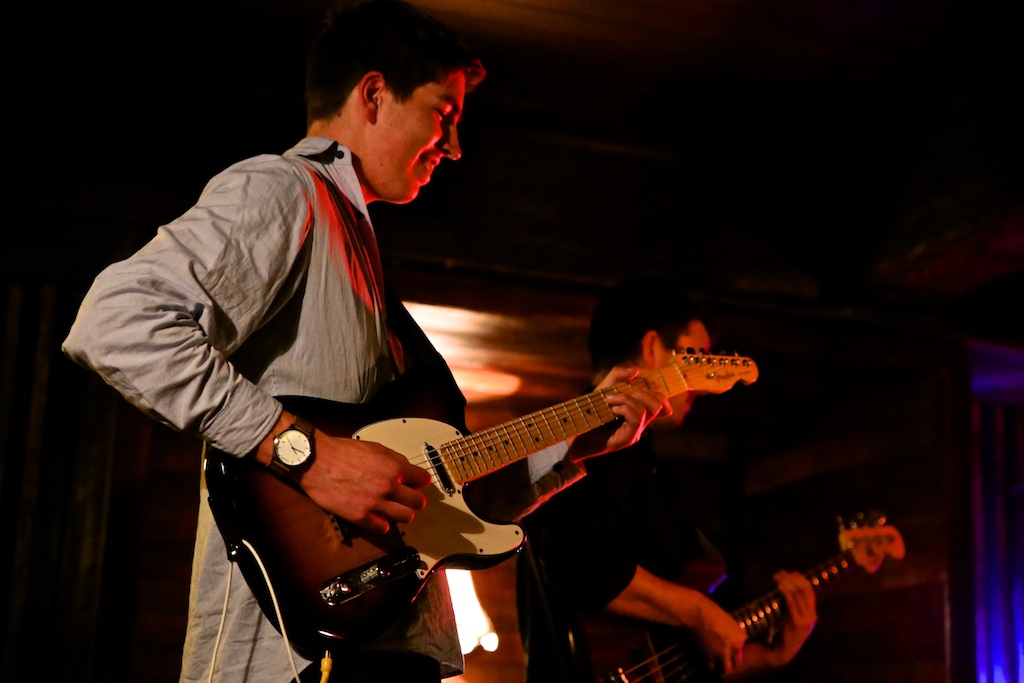 Underneath the crusty carapace were a bunch of good tunes and as Manins inferred, they were tangentially tricky and replete with interesting musical twists. Good improvisers are always on the look out for new challenges, new ways to interpret the world about them. In putting together ‘Grg67’ a fresh vehicle for improvisation is born. By bringing in several less experienced musicians Manins has fulfilled an older imperative. To challenge and encourage those beginning the improvising journey. This is how it should work, but many older musicians forget that and remain in their comfort zones. Everyone stepped up here under Manins watchful eye.
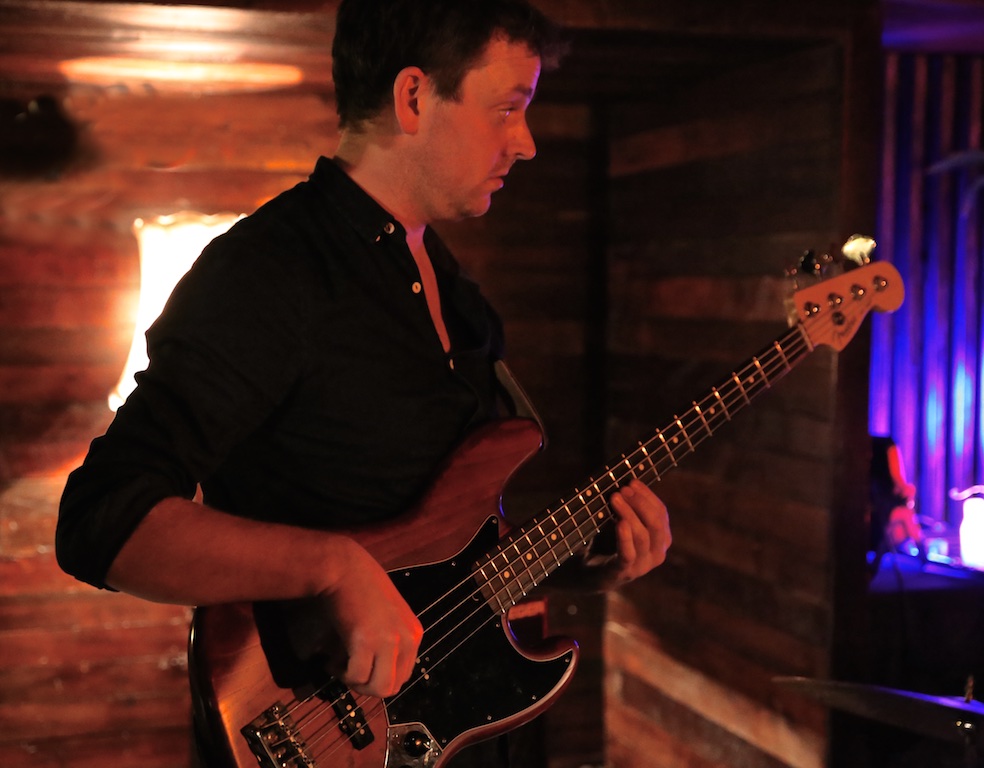 The crab which is the central focus of these sets is Greg, but as Manins so eloquently explains “Crabs don’t use the letter ‘E’. It something to do with their waste not want not utilitarianism”. Other tunes had titles like ‘Crab Empathy’. These tunes and the stories that surrounded them evoked powerful mental images. As the music washed over us you could sense the ebb and flow of the tides. You could easily imagine a predatory Flounder sending the ever watchful crabs scuttling into their burrows (Flounder are none too bright according to net fisherman).
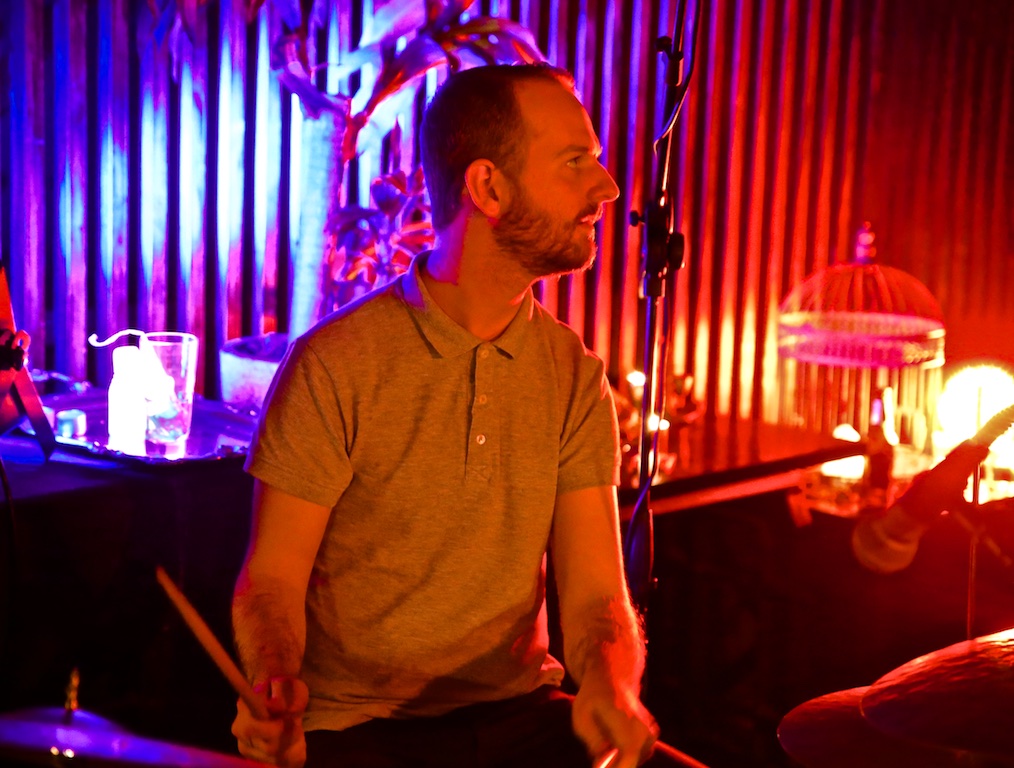 Michael Howell and Tristan Deck are the youngest members of the ensemble. Howell is a Jazz student and with each month his guitar work grows more impressive. As his confidence grows he stretches himself and playing with Manins is exactly what he needs. He is ready for the deep end of the crab pool. On this gig he played a borrowed Fender and it sat well with him. That Tristan Deck played so well did not surprise me at all; his career trajectory assured as he increasingly takes his place among the better Jazz drummers of the city. He was good when I saw him two years ago; now he is very good. For the second time this month Mostyn Cole appears at the CJC. This time he held the groove with electric bass. He is reliable and multi faceted. Again Manins showed how seamlessly he slots into very different situations. He presented a complex set of tunes to good effect, navigating break-neck tempos and fusing complexities with an inexhaustible supply of good humour.
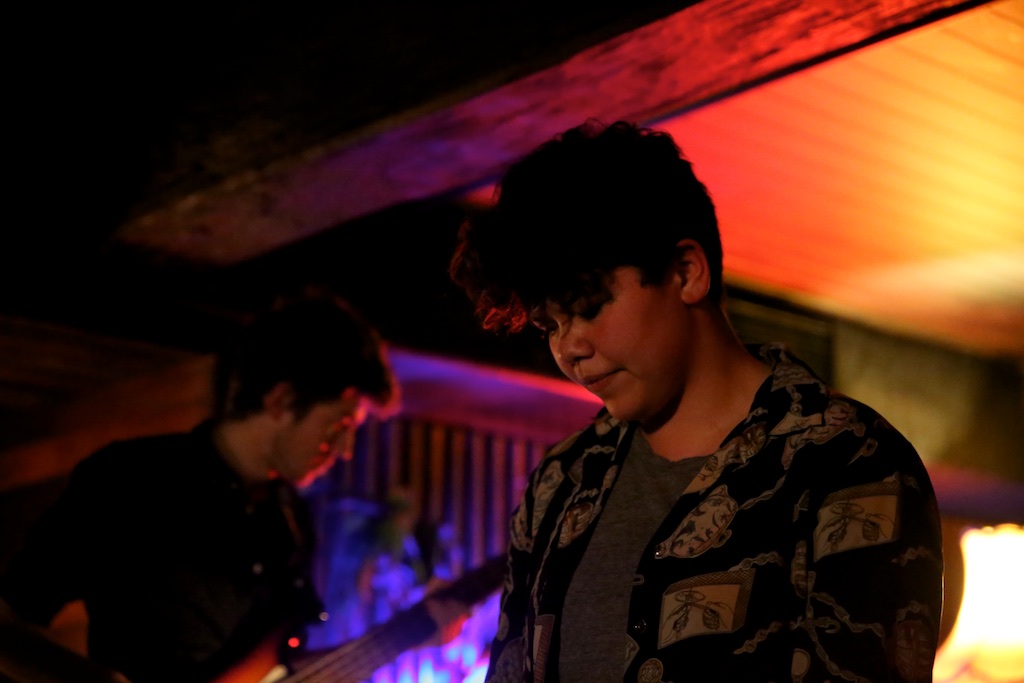 Last Wednesday the CJC took a step towards Robert Glasper’s ‘Black Radio’ project. At the time of its release the Glasper project shocked a few purists and delighted many others. It all depended on your point of view and your understanding of Jazz history. That particular album brought the ‘now’ of the urban streets into a Jazz recording; rap and urban soul coexisting with jazz keyboard harmonies. It is surprising that it shocked anyone! Surely this is an old story in the retelling. It is not hard to find earlier examples. George Russell’s ‘New York N.Y.’ and Gil Scott Heron’s output spring to mind. Words as poems, wordless vocals and instrumental Jazz are inextricably linked and always will be. Siobhan Leilani brought a Kiwi version of that to the Jazz club and we loved it. It felt in place and the nimble-footed danced. This constant reconnection with the streets is an essential part of our music and we forget it at our peril.
 The first set to play was the Andy Smith Trio. Smith has played at the club as sideman a number of times, but it has been quite a few years since he brought us a project of his own. I have always enjoyed his slick guitar work and especially when he plays with an Alan Brown band. This gig was different as it reached deeper into the modern Jazz guitar bag. Smith has always used pedals convincingly but this time he dialled the effects right back. This was a purer form of modern Jazz guitar and in taking that route the music must stand on its own. It did. I like his approach to harmony and his compositions are compelling vehicles for improvisation.
 The gig undoubtedly benefitted from having the gifted Stephen Thomas on drums. While a regular in the club it has been a few months since we saw him. Thomas is a drummer’s drummer and he can tackle any project and shine. He constantly pushed the others to greater heights and his solos were tasteful, un-showy and tightly focused. The bass player Russell McNaughton was new to me, but I will be mindful of his presence in future. I particularly liked his arco bass work on ‘The Gypsy’s Dress’. The first number ‘CJC’ (Smith) was a good opener. There were plenty of meaty hooks to reel us in and an ever radiating warmth to dispel the chill rain outside. When they played a tune named ‘Awakening’ I recognised it instantly, but couldn’t recall where I’d heard it (or which group played it). It is actually an older tune of Smith’s and I had remembered it from three or more years ago. Again a solid composition and the fact that it had stuck with me after one hearing underlines that. A very nice trio.
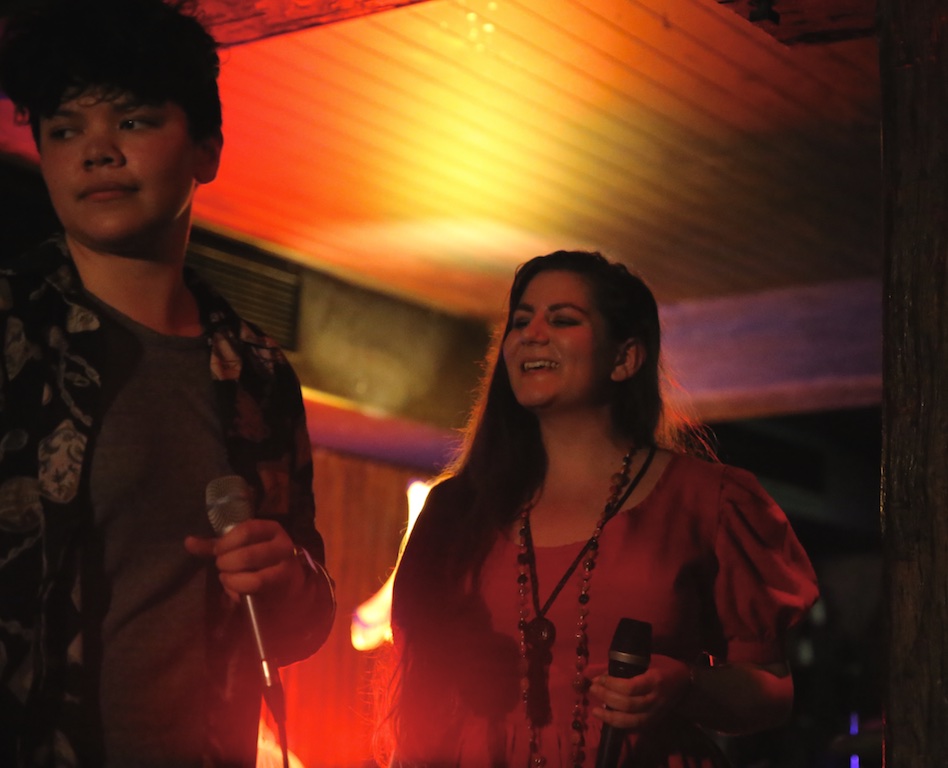 Siobhan Leilani (Siobhan Grace) is an interesting musician and one I hope we see a lot more of. Her association with the UoA Jazz school has yielded dividends. She utilised the services of former and current students for this gig; her guest Chelsea Prastiti most notably. There is an inherent risk in putting a soulful Jazz rapper together with an experimental improvising vocalist. The risk was well worth taking. These two feed off each others energy on up numbers and a force field of ‘happy’ seemed to emanate from them. The opening numbers were more in the soul/Jazz idiom and these were compelling in very different way. The lyrics spoke of angst and identity and this worked well for Leilani. What impressed me most was the authenticity. The language and sentiments were honest; heart-felt and purely ‘street’. I am only sorry that she was not a little louder in the mix (when it comes to vocals my hearing is not as sharp as it once was). This was poetry and good poetry. Word play, syllables stressed for emphasis, cadence; telling a story in an original way.
 On piano was UoA student Sean Martin-Buss. He caught me completely by surprise with his confident piano accompaniment. I had only seen him perform once previously and that was on bass clarinet. He mostly took a two-handed approach, soloed well on two occasions and engaged in a brief but effective call and response routine with Prastiti. The drummer and electric bass player were unknown to me but again they gave good a good account of themselves. The pumping drum and bass groove was right for the music. On electric bass was Joshua Worthington-Church, on drums Olie O’Loughlin.
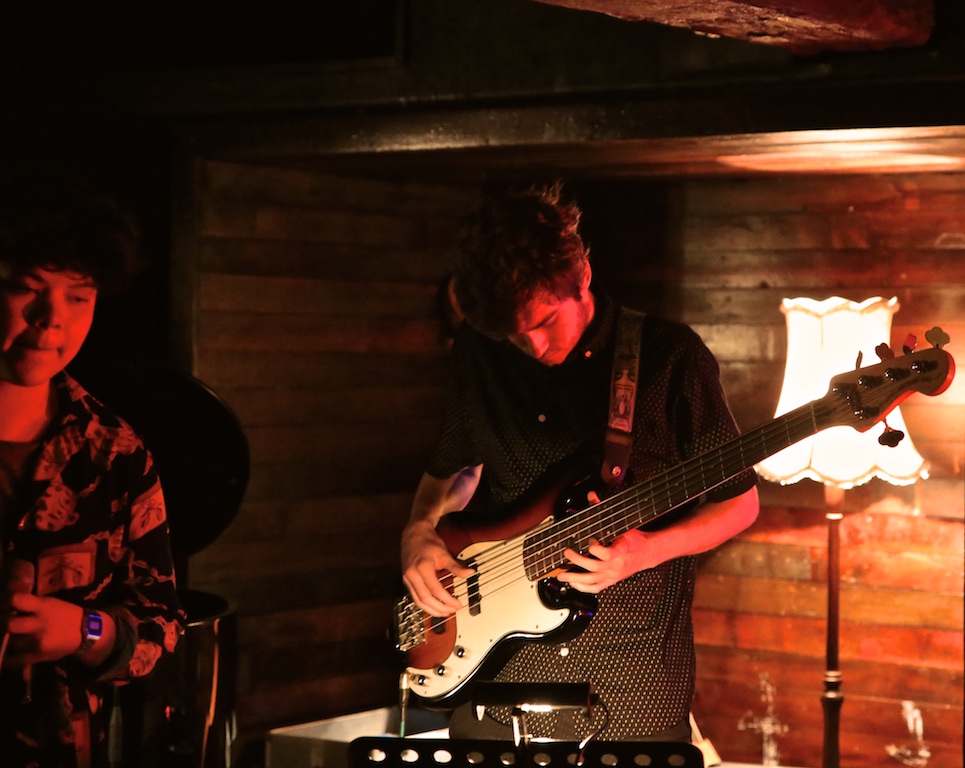 This was another testament to the gig programming at the CJC. With rare exceptions every Wednesday night brings an original project. The decision to encourage innovation and originality pays off time and again. The audience now expects it and they wouldn’t turn up week after week for a diet of well-worn standards. With gigs like this a bitter Winter is flying by.
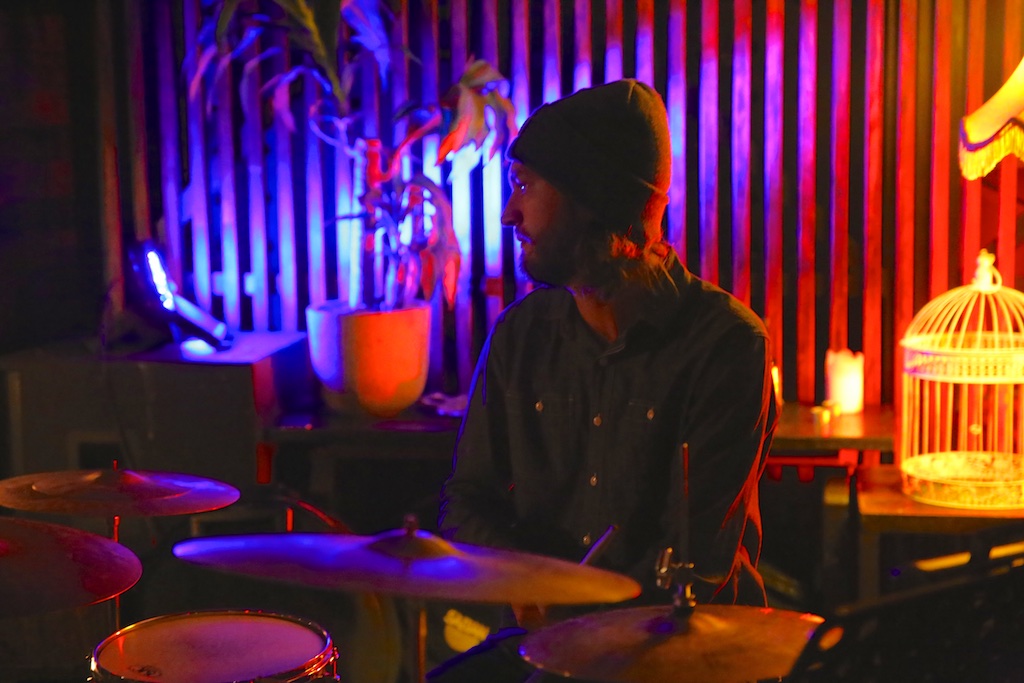 Footnote:’lyrics and poetry are two sides of the same thing‘ (Levitin). Poetry purists often express disdain for song lyrics and especially rap lyrics. The same can occur in reverse when a rapper dismisses poetry as high brow. There is only good poetry and bad poetry. The earliest surviving piece of literature ‘The Gilgamesh’ was written in poetic form. The greatest epics in any language are Homers Iliad and the Odyssey; also written in verse and probably sung. If you want ancient earthy lyrics sung or chanted by a woman then try Sappho: Stuffy (male) scholars have tried for two and a half millennia to purify her verse. “Batter your breasts with your fists girls/tatter your dresses/its no use mother dear/I can’t finish my weaving/you may blame Aphrodite soft as she is/she has almost killed me for love of that boy” – Sappho born 612 BC
 JazzLocal32.com