Brian Smith is a legendary figure in New Zealand Jazz, achieving career highs that few others attain. Normally artists of this stature settle overseas and are seldom seen after that. It was our good fortune that Smith moved back to New Zealand and in consequence, we get to hear him perform locally. It’s a moot point whether good musicians ever truly retire (luckily, the answer is seldom). Not so long ago he formed a quintet and since then he has been performing at venues around town. While Smith is a regular at the CJC, this is the first time that we have seen the current quintet in action. The event was predominantly a standards gig and a band of veterans is the right vehicle where standards are concerned. When you bring a selection of loved tunes back into orbit, comparisons are inevitably made. Therefore it pays to choose well and to perform them well and that’s exactly what the Brian Smith quartet did.
Smith possesses an authoritative air on his horn, the end result of considerable experience and his well-acknowledged chops. Consequently, he always sounds great and always looks comfortable on the bandstand. Behind him in the darkness was Frank Gibson, Jr on drums. Gibson and Smith go back a long way and he is exactly the right drummer to lift these warhorse tunes to glory; most of them coming from the hay-day of Jazz. While Gibson has many strings to his bow, this is his forte. Up front was multi brass and reeds player Chris Nielson. It was good to hear Nielson again and especially on trombone, a horn that has sadly been disappearing from small ensembles since the 60’s. Nielson also brought other horns with him, favouring an American cornet, an instrument which in his hands, produced a strong rounded tone. On bass was Bruce Lynch, a highly competent electric and acoustic bass player who is well-known as a music producer and as a former member of the Cat Stevens band. Almost hidden on the right side of the bandstand was Dean Kerr on guitar. His guitar work was strongly chordal and supportive of the others, providing well-placed contrast for Smith and Neilson as he comped.
Among the standards were ‘In Walked Bud’ (Monk), Stolen Moments (Nelson), There is no Greater Love’ (Jones), Freddie Freeloader and All Blues (Miles), Killer Joe (Golson), St Thomas (Rollins). I have posted a clip of the perennial favourite ‘Softly as in a Morning Sunrise (Romberg/Hammerstein). There was also a nice tune by Smith which think is titled ‘Short Shift.
The gig took place at the Thirsty Dog for the CJC Creative Jazz Club on March 7, 2018. Brian Smith (leader, tenor saxophone), Frank Gibson Jr. (drums), Chris Nielson (trumpets, flugelhorn, trombone), Dean Kerr (guitar), Bruce Lynch (upright bass).
Oli Holland is one of the leading bass voices in New Zealand. He formed Jazz Attack just over a year ago and since its inception, he has been writing new charts and expanding the lineup. Holland writes interesting charts; often complex but always compelling and his last gig showcased a number of these. This was an expanded lineup – adding three of Auckland’s heavyweights for a quartet segment in the first set. His bass is a powerhouse presence and his ringing melodic lines always distinctive. During solos, his vocalised unison lines fleshed out the tone, drew us deeper in – perhaps even influencing his improvisational choices. It is well established that vocalising while improvising on an instrument, fires up the human brain in new and interesting ways.
This is predominantly a young band but nicely balanced by two seasoned regulars (Holland as leader and Finn Scholes on trumpet). Adding a segment featuring Roger Manins (tenor saxophone), Kevin Field (keys) and Ron Samson (drums) provided an interesting contrast. When Misha Kourkov joined Manins in the first set we saw this exemplified. After the head, the two tenors each took solos, Kourkov’s was thoughtful with a nice sense of space while Manins dived in and let his long years of experience and no prisoners approach guide him. The two solos worked very well together and it was nice to see a two-tenor spot which avoided the formulaic line-for-line battle formation.
While the Holland, Manins, Field, Samsom, segments stung with intensity, the core band used the charts to flesh out the compositions. Nick Dow on the piano was interesting in this regard. His solos short but perfectly formed and his often understated comping lightening the density of the ensemble. Michael Howell on guitar also took a thoughtful approach – both chordal instruments providing depth due to their approach. The two main horns were Kourkov and Scholes (foundation members). Kourkov is rapidly maturing into a fine player and I really enjoyed his contribution. Scholes is always interesting and capable of a great variety of expressions. On this night, his solo’s achieved edge and warmth in balance.
As always with Holland, there were a number of funny stories preceding the tunes, improbable seques which hinted at his motivation in naming them but inviting us to fill in the gaps for ourselves. Holland is widely recorded and has recently recorded in Europe with leading musicians. Any gig featuring Holland is well worth attending and this was no exception.
I have posted a clip titled ‘Van Dumb’. The gig took place at the Thirsty Dog for the CJC (Creative Jazz Club) on the 28th February 2018.
The heart of the modern improvised and experimental music scene is always an interesting place to be. Audiences tend to be open-eared and accustomed to music from a wide variety of sources. Improvising musicians have always drawn on diverse influences and it is a narrow-minded few who whine about dilution or the good old days. We should never undercut the deeper purpose of music, which is to share stories, communicate on a primal level, interpret. We tell stories to live and how we listen or react to music speaks to our musical maturity. When Simona Minns performed in Auckland last week, she brought with her a variety of influences. and all were approached with integrity.
She is billed as a Jazz Singer, composer, arranger and artistic director, and she is unafraid to mash up or blend genres. All of the above descriptors were on show when she performed at the Backbeat Bar and everything she did, communicated an innate sense of fun and adventure. She is a natural performer, but behind that lies careful preparation. Her easy-going confidence disarms, but it arises out of hard work and commitment. A good example of the care she brings to her art lies in her charts. The musicians all commented on how beautifully they were crafted and judging by the solo’s, they were not constrained by them. We heard Jazz standards, old Lithuanian folk songs, tunes from her musical ‘A Hunger Artist’ and some jazz-mashed classic rock. The audience loved it all and got the musical jokes embedded therein. The fact that she was cleverly comedic in her introductions, enhanced the overall effect.
I first read Franz Kafka as a 14-year-old, and once read, his tales cannot easily be forgotten. They are dystopian and thus disturbing, but a mature reading reveals clever questions, posed for our consideration. Kafka’s ‘A Hunger Artist’ is just such a tale – disturbing, yet raising important issues for all times. Issues which cut to the heart of performance art itself.
The tunes from Minns musical were delightful, and the fact that she could frame them without overdoing the pathos reminded us of the deeper questions posed. Her choice of standards appeared commonplace until you heard them and then they took on a life of their own. All were either re-harmonised or arranged in unique ways. As if to underline this point of difference she created mash-ups from them – blending classic rock and Jazz; often dancing as she delivered her lively performances.
She had a very fine Jazz unit backing her – a truly superb band and ideal for the task. Alan Brown on keyboards, Cameron McArthur on bass and Stephen Thomas on drums. She also played a classic Lithuanian harp (the Kanklas). While it is a small instrument, it is capable of producing extraordinary melancholic sounds. The sort you hear throughout the eastern block (and even down as far as Turkey or Greece). My favourite number was her mash-up of Gershwin’s Summertime. The band really broke loose on that number and the effects were electrifying. An Alan Brown band in full flight is a wonder to behold indeed.
Simona Minns was born in Lithuania where she obtained a music degree, later moving to Berklee (Boston, USA) where she obtained a degree in composition. She also founded ‘Syntheatre’ a performance company in Boston. Her albums can be sourced from her website or from iTunes or the various streaming platforms. Her website is simonaminns.com The Performance was at the Backbeat Bar in K’Road and presented by the CJC (Creative Jazz Club) and the Auckland Fringe Festival on Tuesday 20, February 2018.
I have posted a short clip of her performing a song from the Kafka inspired ‘A Hunger Artist’ – where she plays the Kanklas.
Good Music always says something interesting; it’s a form of communication where a musical statement begins a process and a listener responds. With any innovative musical form, we need to bring something of ourselves to the equation. The more open our ears the better the experience. Gifted improvisers of all cultures understand these fundamentals and because of this they mostly tell old stories in new ways. Rarely and bravely, musicians hit us with stories not yet fixed in the popular imagination. Steve Barry and his collaborators have a foot in both camps. While this is adventurous material, it is also approachable to anyone with open ears. What we heard at the CJC was innovative but the archetypes of all music were located deep in the compositional structure. A careful listening revealed trace elements from composers like Stravinsky or Bley and perhaps even of indigenous music.
The first piece they opened with was titled ‘Grind’ – a composition inspired by Sydney traffic (much as Tristano utilised every street sound that floated through his NY window). The piece began as journeys do with determined momentum – a degree of clarity followed by a more frenetic stop-start feel as the piece progressed – then reflection. It appealed to me greatly and twelve minutes in, I knew that I was hearing something similar to the approach used by Bley/Guiffre/Swallow in ‘Freefall’. There are moments in musical history when profound change is signalled and that album was one of them. The critics of the time hated it of course but modern Jazz audiences have caught up. The new Barry album ‘Blueprints and Vignettes’ will not be regarded as controversial but as vital and forward-looking. Back then clubs took fright and closed their doors but no club owner worth their salt would miss booking this group.
Barry is an interesting pianist and composer and this project may be his best to date. At the CJC he was confronted with a basic upright piano, but he somehow transformed it into a new instrument entirely. Many in the audience were fascinated and approached him afterwards to enquire how he achieved this slight of hand. Clever miking and a constant repetitive damping of the soft pedal was evident, but I suspect that his rapid-fire staccatissimo touch contributed as much to the effect. I know that Barry has also explored Bartok and the classical modernists and this may hold some clues as well. Whether by happenstance or contrivance, the overall effect was enormously pleasing. There were set patterns and themes, but these altered, developed, as fresh ideas arose from them.
I was delighted to finally catch up with Dave Goodman (PhD), having heard him last at the 505 in Sydney (along with Mike Nock, Rog Manins, James Muller and Cameron Undy). Goodman is an enormously versatile drummer and a popular educator. His role here is varied, but often that of ‘colourist’. Rolling his sticks over the drum heads, or providing contrast with irregular taps on the snare or a muted ride cymbal – and entering these interesting conversations as an equal. The other trio member was Jeremy Rose on reeds (his horns, the alto saxophone and bass clarinet). He was just superb and every bold sound or whispered breath added new dimensions. It is seldom that we hear a bass clarinet and to hear one in a trio setting of this kind is even rarer. The clarinets woodiness and rich harmonics added texture, the alto, a hawk awaiting its moment then swooping purposefully. In spite of the varying tempos and moods, the album imparts a delicacy from start to finish. Live, they got the best out of the acoustics and venue piano. What a perfect sound palette Barry has chosen for this project and whether live or recorded, how satisfying the realisation.
The album ‘Blueprints and Vignettes’ is available from stevebarrymusic.bandcamp.com or from retail and online sources (I recommend Bandcamp). The album features Max Alduca on bass. The live gig took place at the Thirsty Dog for the CJC (Creative Jazz Club) – February 21, 2018.
It was a good way to begin a year of music, a good way to breathe life into two enervating steamy nights. Hayden Chisholm was back in the country and around him formed various duos, trios, and quartets. He performed two gigs in Auckland and the first was at the Audio Foundation in Poynton Lane. The venue has long been an important source of innovative music and each time I descend the stairs to the sub-basement I find interesting changes to the clubs configuration. It really is an excellent venue and perfect for what it offers. At first glance, the two nights appeared quite different. One free improvised and the other a set of reflective ballads. In reality, both gigs were reflective, melodic and approachable. The open-hearted humanity and communication skills of the participants made it so.
When Norman Meehan, Paul Dyne, and Hayden Chisholm appeared last year in the UoA Jazz School auditorium, the audience was taken aback by the sheer beauty of the performance. The alto saxophone is heard less often than its fatter sounding big brother the tenor and it is seldom heard like this. There was something about that particular performance that stopped people in their tracks. The beauty of the tone and the way the sound informed the improvisational approach. It’s not as if we had never heard an alto and piano before, but the unusual clarity and the perfect juxtaposition between horn and Meehan’s tasteful minimalism made it special. Unsurprisingly there were good audiences at both of the 2018 Auckland gigs.
At the Audio Foundation, there were no charts and only the briefest of interactions between musicians prior to the performance. The sets were mostly duos – one with John Bell on vibraphone, followed by another with experimental vocalist Chelsea Prastiti and lastly Jonathan Crayford on piano. Chisholm also recited prose and played over a drone on his Sruti Box. The final number of the evening was a quartet made up of all four musicians.
I have never witnessed a free gig quite like that as the communication was so exquisitely personal. More than musicians finishing each other’s sentences. More than the flow of fresh ideas; there was a sense of musicians revealing something intangible. From out of the fading harmonics and the quiet spaces came that extra something. The quiet revealing something on the edge of consciousness, something we often miss. Arising from – evocative like a Rilke poem – or a haiku. Bell stroked his mallets across the bars or responded with staccato – or soft taps and clicks, Prastiti offered cries and bell-like utterances, framed as wordless questions, Crayford explored resonant possibilities by using extended technique or by mesmerizing with darkly descending chords – opening up a dialogue which was met in kind – sometimes gentle, at other times like a flow of coloured sparks.
The Thirsty dog gig on the following night featured the trio of Chisholm, Meehan, and Dyne (adding drummer Julien Dyne in the second half). Late last year the core trio released their album titled ‘Unwind’. Many of the tunes we heard last Wednesday and last year are on the album – plus a few new compositions. The album is released on Rattle Records and is highly recommended. If you like thoughtful, beautiful music with integrity, this is for you. The compositions are all by Meehan and Chisholm (with the exception of an arrangement of Schumann’s ‘Sei Gegrusst Viel Tausendmal’ (arranged by Chisholm). On Wednesday we also heard a delightful composition by Paul Dyne the Bass player. Adding the younger Dyne in the second half changed the mood and again the contrast between the duo, trio and quartet added to the whole. Julien Dyne is a fine drummer and I wish he appeared more often.
I must also comment on Chisholm’s playing over the Srusi Box drones. I love to hear good musicians playing over a drone and the quieter and multi-harmonic effects of the Srusi Box provided subtle wonders. Several times while the drone was sounding, Chisholm took the saxophone away from his lips and appeared to blow across the reed from a distance. As he did, a disembodied whistling sound emerged from nowhere – adding to the fading harmonics of the drone. I have no idea how he did this but it was spellbinding. To a microtonal pioneer, this is probably bread and butter – to an entranced audience it was no less than magic. I hope to put up a clip from one or both gigs later – check back in a few weeks.
The live gigs on the 13th/14th February 2018 featured Hayden Chisholm, Norman Meehan, Paul Dyne, Julien Dyne, Jonathan Crayford, John Bell and Chelsea Prastiti.
The Australian saxophonist Paul Van Ross is a regular visitor to New Zealand, but there was a four-year gap between his recent Auckland gigs. He is a talented improviser, an interesting composer and an artist brimming with ideas, so his gigs are always worth catching when he passes through. As he did last time, he toured with drummer Mark Lockett, a friend and longtime collaborator. They were joined in Auckland by the in-demand bass player Cameron McArthur. Van Ross’s last visit featured Alan Brown on organ; this trip, however, was pianoless, providing him with clear skies and lots of space to stretch out in. All three grabbed at the opportunity enthusiastically and the audience benefited from the subsequent aerobatics.
While the tour focussed on his trio chops there was a secondary purpose; to showcase his Cuban Album “Mi Alma Cubana’. The trio played mostly originals and a number of tunes from the album. As much as I enjoyed the trio (and I did), it was the Cuban septet which really floored me. I have put up a video excerpt from the chordless trio gig, and I can’t resist adding two sound clips from the album. What an album this is – what unbounded joy and groove. It was almost impossible to choose which track to put up as they are all so great – ‘Break a Tune’ (an earlier composition), La Negra Tomasa (G. Rodriguez) the only non-original, the ballad ‘Melody for Mum? In the end I opted for ‘Swami in the house’ and ‘Hacienda de la Salsa’ (the latter containing hints of tango under infectious Cuban rhythms – a truly spicy salsa.
‘Mi Alama Cubana’ was recorded in Cuba during a visit in 2013. All of the musicians were hired in Cuba and the recording took place over two days in the EGREM studios Havana. In between tunes, Van Ross regaled us with stories of the recording session. No wonder the album turned out so well. The picture he painted was compelling; tales of wonderfully colourful musicians; the epitome good humour and remembered with real fondness. The pianist who didn’t need charts. the scantily clad percussionist, the innate professionalism.
It is our good fortune that these talented people came together at this time and that they injected such joyful enthusiasm into the Van Ross Australian/Cubano project. I highly recommend the album – it will make you smile and cause your feet to move unbidden. The weave of the clave will work its magic on body and soul. making summer that little bit brighter. It is important to support such endeavours right now; each time we embrace this extraordinary music we give a one finger salute to the bigotry that keeps such projects away from our ears.
Trio: Paul Van Ross (saxophones, compositions), Mark Lockett (drums), Cameron McArthur (bass). CJC Creative Jazz Club, Thirsty Dog, Auckland, 13 Dember 2017
Mi Alma Cubana: Paul Van Ross (saxophones, flute), Alejandro Falcon (piano), Jorje Aragon (piano 3-5), Gaston Joya Perellada (bass), Oliver Valdes (drums), Jose Luis Quintana (timbales), Yoraldy Abreu Robles (conga, shekere, shaker, guiro)
The album was crowd-funded and released by the artists. Purchase from iTunes or from the Paul Van Ross website.
With emerging artists gigs you modify your expectations, but in this case, it was completely unnecessary. Both sets showcased great musicianship and originality. The first set was Manjit Singh and Takadimi; an Indian music/Jazz fusion project. Manjit Singh is not an emerging artist in the strictest sense, he is a highly experienced tabla player, composer and teacher in the two main traditional schools of Indian music (Northern and Carnatic). He has recently been doing a Jazz studies course at the UoA and this project arises from that. The traditional music he teaches is not that dissimilar to Jazz, as it has improvisation aspects and complex interwoven rhythms at its core. Singh also gave us an insight into another tradition, the ecstatic Sufi-influenced music of northwest India, Pakistan and central Asia – Again, a tradition that has fed the rich streams of Indian music and more recently, Jazz.
His first number was a Dhafer Youssef composition ‘Odd Elegy’, to my ears the ultimate expression of Jazz, middle eastern fusion. When Singh opened with a Konnakol to establish the metre, the tune took on a more Indian feel and it worked well. This verbal method of laying down rhythmic patterns at the start of a piece has often been adopted by Jazz musicians; notably John McLoughlin and Tigran Hamasyan. The inclusion of a drum kit added to the complexity of the rhythmic structure, but the two percussionists navigated these potentially perilous waters with aplomb (Singh setting the patterns and Ron Samsom working colour and counter rhythms around that).
The rest of Takadimi were younger musicians, but they handled the charts and the improvisational opportunities well. With bass player Denholm Orr anchoring them, the two chordal instruments and saxophone (Markus Fritsch) handled the melodic lines; mostly playing in unison, and in keeping with the music style – relying more on melodic interaction than on harmonic complexity. Michael Howell used his pedals judiciously, winding the reverb and sustain right back, his guitar sounding closer to an Oud. The pianist Nick Dow was a pleasant surprise to me. He had an intuitive feel for this complex music. After ‘Odd Elegy’ we heard an original composition of Singh’s, then a wonderful Trilok Gurtu composition. This project is worthy of continuance – I hope that the talented Manjit Singh builds on what he has begun here.
The second set was guitarist Michael Gianan’s first CJC gigs as a leader. Again you’d hardly have known it. He looked comfortable on the bandstand and this confidence manifested in his playing. He had the finest of Auckland musicians backing him and while this can enhance a performance it can also expose a less experienced player. He fitted into the unit perfectly and the band obviously enjoyed playing his material. His set was nicely paced and offered contrast, but he favoured the stronger numbers – those with bite.
Gianan is clearly a modernist in his approach, but the history is there also. His compositions providing plenty of ideas for the more experienced musicians to work with. You could see Olivier Hollands enthusiasm as he expanded on the themes and responded to phrases. I am a long time fan of Jazz guitar and I anticipate good things ahead for Gianan. His bandmates: Kevin Field (piano & Rhodes), Olivier Holland (upright bass) and Ron Samsom (drums).
Takadimi: Manjit Singh (Tabla, Konnakol), Michael Howell (guitar), Nick Dow (piano), Marcus Fritsch (saxophone), Denholm Orr (bass), Ron Samsom (drums)
Michael Gianan Quartet: Micael Gianan (guitar), Kevin Field (piano, Rhodes), Olivier Holland (bass), Ron Samsom (drums).
The last time the Jelly Rolls Jelly Rolls played at the CJC was two years ago and they are just the right band for a pre-Christmas 2017 gig. To my ears, nothing sounds more like Christmas than the Jelly Rolls. Forget your formulaic Christmas albums – this is good times music and you can feel it deep in your bones. The Jelly Rolls are important for a number of reasons, but not least because of their outreach to both provincial and urban New Zealand. The year has gone well for them and after touring the band to unlikely corners of the Island, they arrived in Auckland in peak form. Their particular brand of swing-infused music is seldom heard live and it’s a delight to hear it done (and done so well). To a new generation of listeners, this is often an eye-opener and so it should be. Their playlist comprises originals but also showcases an all but forgotten improvised treasure trove.
Much of the Jelly Rolls music comes from an important moment in the development of Jazz. It digs into the repertoire of musicians like Erroll Garner, Fats Waller, Ahmad Jamal, Jack Teagarden and Oscar Peterson. These musicians were far more important than mere historical footnotes – they were vital stepping-stones to where we are today; larger than life musicians who entertained and made us smile. In the Jelly Rolls hands, all of the above are referenced; not in a ‘let’s do some retro stuff’ way but by encapsulating style and essence. Those who know their music history will pick up these threads but will also enjoy the immediacy. This is music to be enjoyed in the now, enjoyed at a visceral level; foot-tapping body-swaying music. Some of what we heard, the swing material, was from their earlier ‘Live in Cromwell’ album (I love that title).
When I last saw Ben Wilcock he was about to move to Rotorua. His new location among the lakes and geothermal marvels prompted him to write some fresh material. The Phantom Canoe is an ambitious project focusing on Te Arawa legends of the central North Island. In deference to local Iwi and Hapu, he consulted elders as the project unfolded. Armed with their blessings and advice, he told the stories in his own voice. The album arising out of that project is on data-card and it includes a short video. There is a piece about a Taniwha, the epic of Hinemoa and Tutanekai is told in several parts but the most dramatic tale is the title track ‘The Phantom Canoe’. Beautifully paced, gently evocative of the landscape and the mysterious story behind it.
A Phantom Canoe appeared on Lake Tarawera on the 13th May 1886 and it was seen by the wiser Maori inhabitants as a portent of the coming eruption. The volcano erupted violently 10 days later, obliterating the villages around the shore and the iconic pink and white terraces. No such canoe had ever been on the lake and those in the canoe were dressed in traditional shrouds. Michael Barker’s vibraphone melody over a repeat pattern on piano and bass was just right for this, Wellington drummer John Rae completing the piece nicely as he evoked the final eruption sequence. It was obvious that the band enjoyed performing together and the audience picked up on that and responded. The line up on Squeaky Weasel, an earlier Jelly Rolls album, was as now Wilcock, Rae and bass player Yeabsley. The addition of Michael Barker on percussion and vibraphone is an evolution that makes perfect sense. Trumpeter Finn Scholes joined them for one number and delivered a well thought through high energy solo. To pick up a copy go to Ben Wilcock Thick Records Ltd – www.thickrecords.co.nz They appeared at the CJC Creative Jazz Club, Thirsty Dog Tavern, K’Road, Auckland on 29 November 2017
There is no way of calculating the number of subatomic particles routinely passing through a Neutrino Funk Experience, but we can safely quantify the delight on the faces of their audience. There is something about the structure of this unit that inclines them towards extreme risk-taking; the sort of risk-taking that transforms a band into an irregular elemental force. It is rumoured that a ‘play it safe’ memo was issued at their last venue, but the band either mislaid it or opted for willful disobedience. The only reasonable explanation for this hyper-energised, off the grid performance, is to blame it on passing Neutrinos. The band kicks arse with hobnail boots.
The NFE were once upstairs regulars at the Albion and later they became CJC favourites. This year has been quieter for them gig wise, but the group’s energy levels have continued to rise during their hiatus. From the first note on Wednesday they nailed it to the floor. Swooping on our unprepared sensibilities and taking complete control of the room. It is hard to say who creates the most sparks as they continually feed off each other’s energy. Roger Manins is always a towering presence on the bandstand; his ad-lib asides and gestures acting as prequels to his wild solos. Eyes always follow him as he moves about the stage, but this time he had competition; the über kinetic actions of Grant Winterburn – vying with him gesture by gesture for visual and sonic supremacy.
Ron Samsom and Cam McArthur were located behind Manins and Winterburn. In spite of being partially obscured and located in the darker recesses, you’d have thought they were playing in the chair beside you. While the band is loud, it is not unduly so; it is something else that projects them. The sound is in front, behind, inside, outside – neutrino laden energy, everywhere and nowhere – passing through the observers and imperceptibly, transforming them in a quantum fashion.
In the Bimhuis in Amsterdam, I saw Han Bennink put his boots on the kit during a drum solo. Samsom prefers his upper body and especially his elbows. Manins has some leg action. Winterburn, however, took the Bennink route and added a few wrinkles of his own. He sat on the keys, he walked on the keys and he shook his Nord until it cried out for mercy; and all of the while Samsom locked down a groove beat so tight that it became dark matter. This group not only understand group dynamics but they know how far they can go while taking the audience with them.
Towards the end of the first set, I was handed the microphone, reading one of my poems while they played softly beneath me, accenting keywords, moving where I did. I was so delighted at performing with this band that I forgot to press the record button – such is life. It takes real skill for a band to take risks while staying within a groove framework. I hope they keep doing what they do and perhaps they will record again soon? Their earlier album ‘Ace Tone’ is still available at Rattle Records so grab a copy for Christmas before the stock disappears. Dancing dementedly around the Christmas tree would not be the same without it.
The Neutrina Funk Experience: Ron Samsom (drums), Roger Manins (tenor saxophone), Grant Winterburn (organ), Cameron McArthur (upright bass). CJC (Creative Jazz Club), Thirsty Dog, Wednesday 22nd November 2017.
New Zealand is an incubator of creative spirits and many of the best are hidden in plain sight. They deserve better attention but we fail to notice them because the soulless dazzle of consumerism obscures our sight lines. Last week Richard Hammond, an important New York bass player flew into Auckland and a lucky few got to hear him play live. Hammond is a legend in music circles, but many who are familiar with his work don’t realise that he is an ex-pat New Zealander; raised in the North Kaipara region and establishing himself on the New Zealand music scene while still at high school. Later he won a scholarship to attend the prestigious Berklee School of Music in Boston. After moving to New York he studied at the Manhattan School of Music where he completed a Masters. Hammond has toured with many significant artists; he gigs regularly in New York clubs, works in Broadway shows and is a first call bass player in the recording studios.
When I learned that he would be recording in Auckland, I made sure that I had an invitation to the recording session. My head was still spinning after a crazy two weeks in Australia, but I wasn’t going to pass up an opportunity to hear him play. The recording session took place at the UoA School of Music in Shortland Street, where Maggie Gould was laying down a few cuts for an album. On this session, Hammond played upright bass, extracting a beautifully rounded tone from a ‘seen better days’ borrowed instrument; living proof that good musicians sound good on any old instrument. Recording sessions are not concerts, but they are never the less fascinating places for those beguiled by the process of music making. What strikes me on a good recording session is the heightened collaborative element; the way an artist gives without invading another’s space, and all of this in slow motion as they mull over playbacks. I positioned myself behind Hammond (who was well baffled) and I watched, listened and photographed between takes. Photography in a studio or a rehearsal is generally easier than at a gig.
The CJC, sensing an opportunity and knowing that they had only a few days, organised a special one-off Richard Hammond gig and billed it as an all-star event. The programming fell to keys player Kevin Field. Field playing Rhodes, Ron Samsom on drums, Nathan Haines and Roger Manins on saxophones and Marjan on vocals. Hammond alternated between upright bass and electric bass and he wowed us on both instruments. On upright bass, he has a tone to die for; one that only the best bass players locate; on electric bass his lines bite, speaking the language of Jaco or Richard Bona.
The tunes were mostly Field’s and Haines, but it was also a pleasure to hear Marjan’s evocative Desert Remains performed again. Every time she sings her vocal and compositional strengths astound listeners. She gains fans every time she steps up to the microphone. The gig was held at the Backbeat Bar in K’Rd, the venue packed to capacity. The musicians were all in excellent form; clearly feeding on the shouts of encouragement from an enthusiastic audience. First up was Haines, who goes back with Hammond at least 20 years – Hammond appearing on Haines first album ‘Shift Left’. You could sense the old chemistry being rekindled as they played. I also enjoyed Manins playing, especially on one of the Field tunes. Perhaps because they hit their stride so early, and made it look such fun, it was the trio of Hammond, Field and Samsom that will stick in my mind. These cats talk music in the dialect of joy. In this troubled world, we need a lot of that.
Richard Hammond: (upright and electric bass)
The All Stars: Kevin Field (Fender Rhodes), Nathan Haines (Tenor saxophone, soprano saxophone, flute), Roger Manins (tenor saxophone), Marjan (vocals), Ron Samsom (drums). Backbeat Bar, K’Road, Auckland Central, 21 November 2017
Bass player Nathan Brown is a rising New York Jazz star and he is very much in demand these days. The people he has worked with, underscore that point nicely. Notable among them are; Wes ‘Warmdaddy’ Anderson, Randy Brecker, Carl Allen, John Faddis, Wycliffe Gorden, Lewis Nash and Paquito D’Rivera. Of interest to us, he has also had a long collaboration with the New Zealand born drummer Mark Lockett. After years of performing with his regular trio at the ‘Cleopatra’s Needle Jazz Club’, he decided that it was time to record some of the material that they had been performing. The synergy between the artists was already great but what upped the ante were their influences. The trio guitarist Felix Lemerie was influenced by Grant Green; his drummer Peter Traunmuller by Philly Joe Jones and Brown by bassist Paul Chambers. These influences although not aligned stylistically, led Brown to ponder; what if all three had played together; what would such a trio sound like?. Out of that idea came the ‘This is the moment’ album and the next step was to take the music on the road. Thanks to Brown’s association with Lockett, New Zealand was included in an Australasian leg of the tour.
Throughout the tour, Brown kept to the original bass, guitar and drums format (with the exception of Auckland, where pianist Kevin Field was substituted). Lockett and Brown were the constants, with local guitarists stepping in along the way.
Just before he started the tour, I sent him a few questions to answer:
Q. Do you see your trio as a groove unit, a blended approach or something quite fresh and different?
For this particular album, I would have to say groove unit. the entire vibe of this album is heavily steeped in the hard-bop tradition coming out of the Blue note records of the 50’s
Q. I am fascinated in reading through your bio that you initially played Euphonium and Tuba. These have been used extensively for bass lines in the pre-amplification past and that tradition has continued with modern avant-garde units, nonets and Jazz orchestras. Bill Crow (from the Jerry Mulligan bands ) started on brass instruments like the tuba and valve trombone. Then he was encouraged (pushed) into changing to string bass. Do the brass bass lines inform your approach at all?
So much of the evolution of bass lines is tied directly to the string bass that playing the Tuba doesn’t really affect my approach to bass lines. The idiomatic bass line motions arose out of the technicalities What it does help me with however is a better understanding of brass and wind instruments. This is very useful when writing and arranging music for these instruments
Q. Any move from a sideman to a leader, will inevitably change things from a compositional point of view. I have seen bass player leaders happy to remain well back in the mix – leading from within, but that is less usual. What is your approach.?
I like to believe that jazz music is a collective effort. everyone involved should get a chance to shine. With my trio, I’m happy to play some in the forefront of the mix at points, but I also think it a necessity to play in the back of the mix at points to let me comrades come through with their musical statements.
Q. What were your thoughts, your aims, when assembling this trio?
There was no grand plan when I first assembled my trio. I’d been hosting a steady weekly gig at a well-known jazz club in New York City called Cleopatra’s Needle for years. At first, I would rotate my musician friends onto the band every week. I tried dozens of combinations of players over the course of a year. I finally settled upon Felix and Peter, we really communicated well musically. At that point, I started using them exclusively. I then started to take each of our influences (Grant Green for Felix, Philly Joe Jones for Peter, and Paul Chambers for me) and began composing music that channelled this together.
Q. Who among the artists that you have performed with have you enjoyed most.
I would say my first great mentor and teacher Wess “Warmdaddy” Anderson. Even after two strokes, he still has the ability to lift the musicianship and spirit of everyone performing on stage with him, and in turn, lift the spirit of the audience.
I didn’t get to hear the guitar trios live but with Kevin Field on board the swing and groove feel was maintained with ease. It was a pleasure to experience a gig that was so warm and soulful. The music was transporting, like an old friend; reminding us of a shared experience but then telling the stories in ways that were fresh to our ears. A good example was the groove tune Curly’s revenge. On the album, with guitar, it took you to Montgomery Land and then right to Grant Green’s doorstep. With piano, it had a delicious and unmistakable Bobby Timmons vibe. I love tunes like this; they hint of the familiar, then tell you something else; fragmentary quotes which flashed past before you could grab at them, morphing beautifully into new tunes and always with that deep swing feel.
It was obviously a good time for Brown to emerge as a leader. The right time because his material is superb and his bass playing is burnished by years of gigging and absolutely compelling. His compositions also stood out. While the recorded trio would have been superb, we didn’t miss out. Field is an interesting musician, adaptable to any situation and always at the top of his game. The same goes for Lockett who is open-eared and responsive to nuance. Listening to Lockett is listening to history, but always with quirky asides thrown in to leaven the loaf.
For copies of the album visit nathanbrownmusic.com or Gut String Records. The gig was organised at this end by Mark Lockett of the WJC. His work on these tours is greatly appreciated as it dovetails nicely with the CJC Creative Jazz Club’s programmes and tours. The Venue was the Thirsty Dog in K’Rd Auckland, I November 2017.
I like South American music and the more I hear, the deeper I am drawn in. A rich and ancient fusion of African, European and Amerindian music, each coast and region nurturing distinct flavours. There are also highly localised variations; all rhythmically complex and all deeply infectious. This week the CJC featured the highly respected Brazilian musician Nanny Assis and New Zealand born vocalist Maggie Gould. Assis was born in Salvador, North Eastern Brazil; a region especially rich in musical traditions and heavily influenced by African rhythms. The coast below Bahia nurtured Tom Jobim, Roberto Menescal and a cohort of like-minded innovators; the creators of the Bossanova (new music) form. In a world where saccharine versions of great music often assail us, it is necessary to return to the source from time to time in order to refresh our ears. Listening to Tom Jobim and Elis Regina on the album ‘Elis & Tom’ – ‘Chovendo Na Roseira’ especially, is a good place to start. The time feel is subtly different from North American versions and the unique rhythmic tensions dance with life. Jobim is long gone but authentic practitioners of the various traditions are still there if we look. Assis is just one of these; a master of rhythm and of the many distinct Bahia styles.Gould was a successful photojournalist in an earlier life. When the pressures of that lifestyle became too much, she decided to abandon the frenetic media world and follow her passion instead. Rekindling a youthful dream she became a Jazz vocalist and has followed that path ever since. Eventually, her journey took her to New York where she met Assis and a musical collaboration began. While living in New York Gould has performed with a number of luminaries, notably the pianist John de Martino (who has also recorded with Assis). Gould and Assis have just toured New Zealand, appearing in festivals and clubs throughout the two Islands. They have toured with great musicians and they intend to record soon in Auckland. When they do, the well-known New York-based ex-pat Kiwi bass player Richard Hammond will join them.
It was not only the gentle Bossa rhythms that we heard on Wednesday but other livelier types of South American influenced music as well. These were danceable and energy fueled treats. During one such number, the room morphed into a seething mass of swaying bodies, hands raised as they danced. The last number, Magalena was a type of North-Eastern Brazilian rap – fast-paced and reminiscent of Jon Hendricks’ scatting. There were also quieter numbers, some Brazillian and a few from the USA; the standout among the latter being Gould singing the gorgeous ‘Some other time’ (Bernstein). On that, Roger Manins added whispering fills and Kevin Field provided the perfect understated accompaniment on piano. It is said that Latin American music is ‘the other swing music’. That makes for great synergies between Jazz and Latin musicians. It can work well, but only if the musicians have the ears and the courage to submit to the weave. Utilising the considerable skills of pianist Kevin Field, Alex Griffiths on 5 string bass and drummer Ron Samsom (plus for the CJC gig, saxophonist Roger Manins). The mix of Jazz musicians and Brazilian created a spark. Alex Griffiths is obviously well versed in Brazilian rhythms as his lines could not have been better placed. Field has for some time been immersed in this music and he is no stranger to the various clave rhythms either. His understated delicate lines in place of comping held the echoes of Jobim’s own tasteful piano accompaniment. During solo’s he gave both hands full reign in clave rich explorations. Samsom is a talented drummer and throughout the night, he and Assis worked in concert. With Assis on percussion and Samsom on the kit, a wonderfully rich sound scape emerged. At one point Assis beat a cowbell to hold the centre – allowing Samsom additional freedom to move. This was a moment of pure magic.
I read once, that a Jazz drummer playing Bossa or Samba is doing three basic things; the right hand replaces the shaker or cowbell, the left hand has the clave pattern and the kick drum follows the bass line. Add in actual congas shakers or cowbell and the interplay has the magnitude of a sonic earthquake.The number that I have posted is ‘O Barquinho’ or ‘My Little Boat(of Love)’ – a tune by Roberto Menescal and sometimes wrongly attributed to Jobim. It is a nice example of the Brazilian Bossa rhythms; rich in subtlety and contrast. It is a long-held tradition in this music to have a female and a male voice – call and response. Gould in English, imparting the wistfulness of the lyrics – Assis in Portuguese – taking me back to the master Joao Gilberto. The Portuguese language is extremely pleasant to the ear, while often masking incredibly sad songs. We didn’t need a dictionary or interpreter on Wednesday as we were transported without them. Nanny Assis’s voice, like his percussion and guitar playing, is pure magic – together the musicians gave us a great night.
They open the Wellington Jazz Festival this year on 30 November. The bottom photograph is by Reuben – the top 3 are mine.
Nanny Assis (percussion, vocals, guitar), Maggie Gould (vocals, arrangements), Alex Griffiths (electric six-string bass), Kevin Field (piano), Roger Manins (tenor saxophone), Ron Samsom (drums) – at the Thirsty Dog, CJC Creative Jazz Club, 25 October 2017
The fourth Auckland Jazz Festival was appropriately launched at the Thirsty Dog Tavern in Karangahape Road. A welcoming venue, nestled among ethnic food joints, strip clubs and private art galleries. It is timely that we pay tribute to the Thirsty Dog, who a year ago, generously offered the CJC (Creative Jazz Club) a regular Wednesday night slot. This occurred when the club most needed it. It is a good performance space and many visiting musicians have remarked on the rooms warm vibe.The first festival gig I attended was the Jennifer Zea group. The last time I saw her perform I liked by her Latin interpretations of the standards, but I particularly liked her rendering of the songs particular to her region (Cuba/Venezuela). She introduced more standards this time but it was the second set; a set of Venezuelan and bossa fused music that had the audience enthralled. These tunes were so infectious that they followed me home. I even woke up with one of them singing in my head the next morning. ‘Moliendo Cafe’ (Blanco/Perroni) has been popular in Venezuela (and the wider world) since 1959. Everyone from Jose Feliciano on has benefited from it. As Zea sang this wonderfully infectious tune, she danced to its rhythms, and along the back wall, a chorus of her countrymen and women sang along in unison. We seldom hear music like this and it is her forte. I have posted a bolero, Lagrimas Negras (or Black Tears – by Matamoras) a Cuban tune from the 1920’s. She was ably assisted by Kevin Field, Mostyn Cole and the wonderful Miguel Fuentes on percussion.
The next night was the Guy Buttery gig, a World musician who appeared at Backbeat. Buttery is a renowned acoustic guitarist from South Africa and a distinctive stylist. His musical influences are varied but always harnessed to his own vision. Although he played a six-string guitar (a truly beautiful instrument), he often reminded me of Egberto Gismonti (or perhaps Ralph Towner). His mastery of the instrument was simply astounding and his choice of material perfect for the occasion. He memorably played a saw at one point and accompanied the piece with a delightful story. Evidently, the piece has been adopted as a theme by a group of Roswell styled ‘alien watchers’. There were many devoted fans in the room and some who had travelled a long way to hear him. His gift is sound shaping, every harmonic given voice, every note sublimely resonant. The sounds he coaxed from his instrument were at times orchestral. All who came were delighted with the performance.
Two days later I picked up the Belgium pianist Jef Neve and his crew from the airport. I spent the next three days with them and wrote about the experience in my previous post. I got home at around midnight on Saturday after sitting through nearly 5 hours of rehearsal and a two-hour concert. I loved every second of it. If that makes me an improvised music geek then so be it. jazzlocal32.com/2017/10/18/jef-neve-spirit-control/
On Tuesday, Marjan appeared with the ‘Experience Band’ at the Auckland Jazz and Blues Club. The Experience Band is an 11 piece ensemble and consequently, it provided a very different flavour to her appearance with a quartet at the CJC last month. Her voice has real power and she’s a compelling performer; easily able to adjust to the bigger sound. The audience loved her. Her set list was skillfully tailored to the room as the audience was older than the CJC crowd. In particular, her cheeky take on ‘Making Whoopie’ brought the house down. At one point she paid tribute to her high school music teacher, saxophonist Markas Fritsch, who was in the front line of the ensemble. She credits him with steering her towards Jazz – something we should all thank him for.On Wednesday, the third headline festival act was presented at the Thirsty Dog. It has been over a year since the world-renowned bassist David Friesen was in New Zealand. During last years tour, his trio was recorded at the 1885 venue. The night was captured perfectly in the newly released Rattle album ‘Another Time Another Space’. Frieson is an improvised music celebrity and it was good to have him back. He has a unique approach to composition and performance and he caps that off with his engaging and witty bandstand banter. He was again accompanied by Dixon Nacey on guitar and Reuben Bradly on drums. This trio communicates superbly, reacting to each other like old friends. The recording is amazingly good, especially so considering that it was captured in the 1885, which is an acoustically lively space. Nacey’s singing lines blend perfectly with Frieson’s – the sort of woody resonance that high-end luthiers aim for.On Friday the Chris Mason-Battley band returned to the Thirsty Dog. I really like this band with their predilection for tasty modal grooves. There is no one in New Zealand who plays quite like the Mason-Battley – and as an entity, the group have a distinct footprint. I have written about them recently and I suggest you check them out if you get the chance – they are not heard about town very often and more’s the pity. As with the last gig; on the keyboard was David Lines, on electric bass Sam Giles and on drums the innovative Stephen Thomas. There is now talk of a new CMB project and perhaps one with more electronics? Friday nights are the hard-yards for Jazz musicians and this one was no exception. Throughout the performance, you could hear two blokes yakking, obviously pleased to be catching up and seemingly unaware that this was a listening gig. A number of ray-like stares were beamed in their direction but they proved quite impervious to hints. Loud chatting seldom happens on a mid-week night where listeners and improvisers own the space.The last gig at the Auckland Jazz Festival was Jim Langabeer’s ‘Secret Islands’ album release’. This is another Rattle album and the musicianship is stunning. A project which arose out of Langabeer’s multi-phonics explorations at Auckland University. There is a lot that is referred to as fusion these days and most of it is not. In this case, the term could be a good descriptor. Indigenous instruments, multiple reeds and winds; pedal steel guitar and fender; beautiful melodies placed in Mingus like settings. While the album sits comfortably on the Jazz spectrum, the material takes us way beyond that. With the authoritative elder statesman Langabeer at the helm, and assisted by Rosie Langabeer, Roger Manins, Eamon Edmundson-Wells, Neil Watson and Chris O’Connor, what else would you expect. For this and other ‘Rattle’ recordings, go to www.rattlerecords.net/
Music listeners split into two main camps; active and passive listeners. Those who listen to improvised music incline towards active, deep-listening. We know that the brains of improvising musicians light up in unusual ways when playing. Much the same applies to listening Jazz audiences. On Wednesday night a saxophone trio played at the Thirsty Dog; no chordal instruments, no lingering over familiar melody lines, a trio which worked within a broader musical architecture, following the changes where ever they led. Nick Hempton is an interesting player and the right person to take us on this journey.This sort of gig works well with listening audiences because it invites active participation. On Wednesday, each piece began with a few lines from a familiar standard, often just implied; then, a few bars in, the lines evolved into new melodies based on the changes. As the trio responded the horn led the others to various way-points: places where the music changed course. Fragments of new standards were discovered, unravelled, abandoned. The human brain is hard-wired for pattern recognition, but we love the puzzles that arise from the search. Settling for the familiar is not how we evolved. We evolved by following the risk takers, marvelling at their daring. Following this musical risk-taker, was our delight.The point was not so much the standards themselves but the opportunities they presented. Appearing and disappearing in medley form was; ‘Night in Tunisia’, ‘Body and Soul’ A Sony Rollins waltz, ‘Exactly Like You’ and ‘Rhythm a Ning’ – these and more were examined. Standing alone was the lovely ballad ‘When I Grow too old to Dream’ (Romberg) and in Hempton’s hands, it was beautifully realised. There was also a great rendition of ‘Just Squeeze Me (don’t tease me)’ (Ellington) – I have posted that. The last trio piece was ‘Poor Butterfly (Hubbell [Puccini])’; followed by Roger Manins joining the trio for two last two numbers. As is often the case when two tenors appear on the same stage, a delightfully upbeat and riotous vibe emerges. Friendly sparring matches like this always go down well.
Hempton is a fixture on the New York scene and regularly performs at the popular Smalls Jazz Club in the Village. His pick up band in Auckland was Cameron McArthur (bass) and Chris O’Connor (drums). I was delighted to see McArthur back after his extended time overseas. O’Connor is always a good choice when imaginative drumming is required. The trio did not rehearse – Hampton sent them a list of possible tunes before the gig and nothing more. This allowed for spontaneity and unconstrained exploration. Ever striking out for new ground, Hempton released his recent ‘Catch & Release’ album incrementally – one track at a time. It is available from nickhemptonband.com
Nick Hempton (tenor saxophone), Cameron McArthur (upright bass), Chris O’Connor (drums) – guest Roger Manins (tenor saxophone). CJC Creative Jazz Club, Thirsty Dog, K’Road, Auckland, 4 October 2017.
Jamie Oehlers is a tenor saxophone heavyweight who earns widespread respect. His playing is conversational, and like all good conversationalists, he listens as well as he articulates his own point of view. An unashamed melodicist, a musician of subtlety, a dream weaver with a bell-like clarity of tone. Oehlers tours regularly and we are lucky enough to be on his touring circuit. This trip, he was accompanied by Tal Cohen; an Israeli born, New York-based pianist; an artist increasingly coming to the favourable attention of reviewers; an artist praised by fellow musicians. Cohen and Oehlers have been playing together for years and over that time they have built an uncanny rapport. Out of that has emerged something special; their 2016 duo album titled ‘Innocent dreamer’.As far as I know, this was Cohen’s first visit to New Zealand and it was certainly his first visit to the CJC. He’s a compelling pianist and the perfect counter-weight for Oehlers. On duo numbers, they responded to each other as good improvisers should, each giving the other space and expanding the conversation as the explorations deepened. Intimate musical exchanges of this type work best when the musicians care deeply about the project. They work best between friends. We saw two sides to Cohen on this tour. The thoughtful, unhurried, deep improviser and the percussive player who found a groove and worked it to the bone. The second half of the gig brought a rhythm section to the bandstand; Olivier Holland and Ron Samsom. Having such an interesting contrast between sets made both halves work better. The second set was approached with vigour; Oehlers digging into a standard, often preceded by a nice intro, through the head and then… boom. This was when the fireworks happened.
The chemistry between Oehlers and Cohen was obvious in the duo set, but adding in the hard-swinging Holland and on-fire Samsom shook up the dynamic once again. Suddenly there were new and wild interactions occurring, short staccato responses, dissonant asides, crazy interjections; these guys were bouncing off each other and above all, they were enjoying themselves. When musicians live in the moment, and the audience feels that magic, they feed it back. The virtuous loop that sustains all performance art. I spoke to Cohen later and talked about playing styles. He is not impressed by pianists who strive to sound like the past. You can respect the past, bring it to your fingertips but still sound like your taking it somewhere new. He did. This night was the proof of the pudding; the standards performed were all living breathing entities.The first set opened with a heartfelt ‘Body & Soul’ (Green) which set the tone. The tune that really took my attention though was Oehlers ‘Armistice’. A beautiful piece conjuring up powerful images and telling its story unequivocally. There was also a nice tune referencing Cohens family. The first set finished with the lively Ellington tribute – ‘Take the Coltrane’ . The second set (the quartet) opened with the lovely ‘It could happen to You’ (Van Heusen), followed by a tune that Oehlers has made his own; ‘On a Clear Day’ (Learner/Lane) – (a recent Oehlers album title). Next, the quartet performed ‘Nardis’ (Evans/Davis) – this was wonderful and it reminded me of the endless re-evaluation and probing of that tune by Evans in his final years. This version did not sound like Evans – it was born again – if any modal tune deserves to live forever, it is surely this one.
Lastly, and in keeping with their tradition, Oehlers invited tenor player Roger Manins to the stand. After a quick discussion, they settled on ‘I remember April’ (de Paul). Back and forth they went, weaving arpeggios in and out of each other’s lines – moving like dancers; counterpoint, trading fours, all of the band responding to the challenge and reacting in turns. A KC set piece at the bottom of the Pacific.
Jamie Oehlers (tenor saxophone), Tal Cohen (piano), plus Olivier Holland (bass) and Ron Samsom (drums) – for the CJC Creative Jazz Club, Thirsty Dog, K’Rd Auckland, 27 September 2017. Google Jamie Oehlers Bandcamp.com for a copy of the album.
At some point in human evolution, the majority of humans decided to stay put. In consequence, the hunter-gatherers and the pastoral nomads became outliers. As civilizations grew, agriculture grew and large enclosures and granaries grew along with them. Beyond the walls and the jumble of enclosures; largely unnoticed, often unseen, foraging continued unabated. The homeless on the streets forage, philosophers forage, writers forage, wild and domestic animals forage and above all improvisers forage.
Martin Kay’s gig was a tribute to foraging; highlighting the activities of foraging animals, creatures large and small and to the improbable life lessons, they impart. It was about cultivating absurdity and profundity in equal parts, it was about following the ancient herds using postmodern skills. It nibbled at reality until you saw it afresh, building on overlooked narratives, finding the things we often miss; a Zen Koan wrapped in sound.I first saw Kay in 2013 with ‘Song FWAA’. The post from then and the accompanying sound clip is still available on this site (use site search, type in Song FWAA). On Wednesday, his charts were for a larger ensemble. This time offering fresh insights; taking us further down the Rabbit hole. The pieces were of variable lengths and sometimes in parts. At some point during the second set, he played a piece titled ‘Ligeti’s Goat (I first heard that back in 2013). While the piece has melodic hooks and a basic structure, it is more, a surrealistic journey. A place where imagining, spoken narrative and musical narrative meet. Ligeti’s goat is vividly embedded in my memory; it is not a piece easily forgotten, a goat wandering through pastures, locating carrots (perhaps forbidden carrots), digesting the vegetables in that mysterious way of all ruminants.
There was a piece titled puffer fish, another called ‘Thrice mice’ (that chart in a minuscule script like mice prints) and a vampire piece titled ‘Once bitten once shy’. There was also an appealing piece about a tracker dog, selling his skills to those who might have need of them. None of this was an invitation to anthropomorphize – Kay’s animals spoke for themselves. He spends much of his time in New Zealand these days as his wife works here. For this project, he selected a group of local improvisers to form the ensemble; younger players with an open approach to improvisation. In this respect, the location favoured him, bringing the gifted Callum Passels into the group. Also featuring Crystal Choi, Michael Howell, Eamon Edmuson-Wells and Tristan Deck; each one of these having a stake in explorative improvised music. The only non-original piece was ‘Turkish Bath’ by the innovative trumpeter Don Ellis. For material similar to Kays, you need not look any further than Ellis or perhaps Henry Threadgill. It is good to have Kay in our midst, as he’s an interesting, often challenging and worthwhile composer. I have put up two clips – Turkish Bath and narrative about the Tracker Dog.
Let’s go – much as that dog goes / intently haphazard….not direction, ‘but each step an arrival’ (poet Denise Levertov 1923- 1997)
Forage: Martin Kay (tenor saxophone, compositions), Callum Passels (alto saxophone), Crystal Choi (keys), Eamon Edmunson-Wells (bass), Tristan Deck (drums). CJC Creative Jazz Club, Thirsty Dog, K’Rd, Auckland, 20 September 2017
Rob Luft is one of those rare musicians who has seldom put a career foot wrong, first coming to attention at the age of fifteen in the (UK) National Youth Jazz Orchestra. From then on he has regularly come to notice and although still in his early twenties he is now a musical force to be reckoned with. Anyone who has heard him play will know that the growing number of accolades are well deserved. As each year passes he garners fresh awards, last year, second place in the Montreux Jazz guitar competition and recently receiving the coveted Kenny Wheeler Award.
A little over a month ago, Luft released ‘Riser’ and it is hard to believe that this is a debut album. While incorporating a variety of Jazz guitar styles it is definitely forward-looking. Like many post-millennial improvisers, Luft reaches across styles and genres with ease. Mike Moreno and John McLaughlin are obvious reference points, but the album moves beyond such comparisons. His innate skills and good taste have enabled him to craft beautiful charts and out of this comes a unique sound. The first number of the album,’Night Songs’, is a cornucopia of wonders, a lesson in virtuosity, a seamless but ever-shifting voice of the London streets. The organ adding warmth, the rest of the band texture and heart, and Luft soaring above like a patrolling night-hawk. ‘Slow Potion’ has a dreamy surf guitar vibe, other tracks bubble with street life (Jamaican and African influences in evidence), while ‘Riser’ and ‘Different colours of silence’ invoke the more ambient hued Nordic Jazz. While the influences are varied the album has a strong cohesive feel, nothing is out-of-place here. Luft’s project has also benefited from his choice of band mates and from deft hands in the studio and the mastering. When he played in New Zealand last year, he wowed the audiences. Rumour has it that he will return next year. For updates keep an eye on JazzLocal32.com CJC Creative Jazz Club or Wellington Jazz Cooperative.
The artists: Rob Luft (guitars, compositions), Joe Wright (tenor saxophone), Joe Web (Hammond organ, piano, harmonium), Tom McCredie (bass), Corrie Dick (drums).
To sample or purchase the album visit Bandcamp www.robluft.bandcamp.com or Google Edition Records Ltd UK.
During the apartheid era in South Africa, a heady brew of danceable Jazz bubbled up from the townships. The all white National Party hated it and a game of ‘whack-a-mole’ followed. As soon as one venue was shut down by the police, another would spring up. The music was resilient and hopeful. No racist or repressive regime likes Jazz because it has rebellion, hope and joyous defiance in its DNA. The Zimbabwean born Thabani Gapara imbibed South African Jazz from his earliest days, eventually taking up the saxophone, that most anti establishment of instruments. Since then, he has performed in Zimbabwean, South African and New Zealand projects.
The powerful influence of Cape Town Jazz is especially evident – the cradle of South African improvised music. Since coming to live in New Zealand he has collaborated with many well-known musicians; The Hipstamatics, Batucada Sound Machine, Stan Walker and others. He has recently completed a B. Mus. in Jazz at the New Zealand School of Music and after graduating, he formed this group. Unbelievably, this was their first gig.
There were a few ballads during the night but the music was mainly of a danceable, high-octane, delightfully groove based type. The key to the vibe was leader Thabani Gapara. What a great stage presence he has; the ready smile that he flashes when someone mines a groove. It is also his tone on all three horns, the marvellous compositions and tight arrangements. His compositions all reference his life’s journey and they strike a nice balance between groove hooks and flights into melodic ecstasy. I am always drawn to musicians who dance while they play. This is not an easy thing to pull off; it can affect concentration and in a reeds or winds player, it can affect the embouchure. Gapara skillfully utilises body movements to enhance the groove and he does so without a hint of contrivance. He wowed them and the audience gave back, and during that interaction, the spirit of live improvised music glowed like a fire.
There is no doubt that the band was well rehearsed. No group can generate that sort of energy or negotiate changes or tricky rhythms without being comfortable with each other. I have heard guitarist Nathan James once before; on this gig he was wonderful. The interplay between he and Gapara was conversational, the sort of conversation that friends might have on good night out. When his solo’s intensified they never strayed far from the groove. The other chordal instruments were played by Peter Leupolu, nice effects and in the pocket; subtly pushing the others; urging them on. Lastly, we come to electric bass player Issac Etimeni and drummer Elijah White. The audience was wildly enthusiastic about both. The punchy post-Jaco electric bass; the groove-based drumming bravura.
They played a number of Gapara’s compositions; ‘The Journey’ (which I have posted), ‘Places and Faces’, ‘Tears’, ‘Family’, and ‘On The Beach’. All of these strongly referenced Southern African Jazz. To my delight, they also played Roy Hargrove’s fabulous ‘Strasbourg St Denis’ – a great tune and executed with such verve and Joy. The remaining numbers were, ‘Spanish Joint’ (D’Angelo), ‘Time Will Tell’ (Bobby Watson), ‘I Can’t Help It’ (Stevie Wonder), and ‘I Want You Back’ (Jackson Five). I still have a 45rpm of that at home (the Jacksons first’ break-through Motown recording).
After the gig, I talked to Gapara about his music. I told him that I had experienced this style in Paris where it thrives in clubs like the New Dawn: played by the likes of Etienne Mbappe, Hugh Masekela etc. He agreed, saying that Paris is the new centre for experiencing these Jazz blended, bass heavy, African influenced styles. Now, as migration increases, the styles are evolving again; evolving as they move around the planet. Influences are never static; they bounce back and forth endlessly.
If you see this group playing anywhere, grab a ticket and experience the fun. They truly deserve to do well and I hope they stay together for the long haul. Another great night, in an already wonderful CJC, Thirsty Dog season. Get down there on a Wednesday folks.
Thabani Gapara Project: Thabani Gapara (alto, tenor, soprano saxophones), Issac Etimeni (electric bass), Peter Leupolu (keyboard & piano), Nathan James (guitar), Elijah White (drums) – CJC Creative Jazz Club, Thirsty Dog, K’Rd Auckland, 13 September 2017.
When Marjan stepped up to the microphone, she owned the room from that moment on. Her previous association with the Jazz club had been peripheral, but this gig changed everything. I have sometimes engaged with her about Persian music or Sufi poetry and I have heard her performing in the Kevin Field ‘A List’ band. She is always impressive when she sings, but this was impressive in a different way. It was her first Jazz club gig as a leader and suddenly, here she was delighting a capacity audience, every bit the seasoned professional; exuding an easy-going confidence. It was tempting to think that she had magically transformed herself into this fully formed artist, but her back story offers deeper insights. Marjan is of Persian descent and while this breathes exoticism into her music, it is only a fragment of her story. In truth, she has been a performer for much of her life; an established presence in the world of film, an in-demand voiceover artist, a teacher of music, dance, and drama. She draws on many strengths but on Wednesday they coalesced; a marvellous voice and a formidable stage presence the outcome.If her choice of a first number was to make a bold statement, then she succeeded admirably. Stepping out from behind the black curtains, accompanied by a shimmering Rhodes, she embarked on her engrossing journey. The first few bars of her ‘Desert Remains’ were straight out of the Sufi Jazz tradition; it was a call for universal tolerance: arising from her belief that music provides a pathway to transcend the banal. Almost imperceptibly, the tune became a love song, settling into new and funky rhythms. This was a nice piece of writing and the rhythmic interplay gave her much to work with. The influences in many of her compositions are generational; Stevie Wonder, Michael Jackson, Brian Wilson and of course her indigenous roots. All of this is filtered through a Jazz lens. Although her approach is modern, she doesn’t shy away from the traditional fare of Jazz singers.Looking to popular music for new material is not a recent phenomenon for Jazz vocalists. Ella tackled ‘A Tisket a Tasket’, Louis appropriated a multitude of pop songs. The great American songbook is a selection of one-time popular songs. It is what Jazz musicians do; explore, steal and transform. The more diverse the influences the richer the music. When she tackled the lovely Jazz standard ‘Detour Ahead’ (Ellis/Frigo) she owned it completely. That hint of smokey voice, that delicate phrasing; being adventurous while showing deep respect to the composition. It was hard not to think of Norah Jones; an artist who is traditional and modern in equal parts. I would also give her top marks for her set list; the numbers included ‘The look of love’ (Burt Bacharach), ‘God only knows’ (Brian Wilson), ‘I’ll be free’ (Donny Hathaway) and of course her own compositions and one of Kevin Field’s.
To sound your best you need fine musicians backing you and she had that with Keven Field on Rhodes and piano, Michael Howell on guitar, Mostyn Cole on bass and Stephen Thomas on drums. Everyone on the Auckland scene is familiar with Field, Cole and Thomas – they never fail to please. I would like to single out Howell here as he gave us a great performance. It was tightly executed, appropriately modulated and exactly what was required. Nice fills, tastefully brief solos and well executed pedalling. It can take years for a chordal accompanist to learn these skills. In a younger artist, it shows real maturity. It seems certain that Marjan’s singing career can only gain pace from here. Her grace, good sense, great vocal chops and confidence will see to that.
Marjan (vocals, compositions, arrangements), Kevin Field (piano, co-arranger), Michael Howell (guitar), Mostyn Cole (bass), Stephen Thomas (drums) – CJC Creative Jazz Club, Thirsty Dog, K’Rd Auckland, 6th September 2017.
Behind the doors of the beautiful Kauri villa, down the long corridor and the wide descending staircase, past the crush of people eagerly awaiting a significant and unique musical event, we edged forward; shuffled by the crowd, finding ourselves in a surprisingly large room; large enough to hold seventy people, a gorgeous warmly lit room with mirrored walls – an old dance studio brought back to life. As we crossed the room Jay Rodriguez greeted us, behind him, Jonathan Crayford shuffled through sheet music; both framed by an elegant grand piano and an array of horns on stands. I had interviewed Rodriguez earlier and had attended his sell out gig at the CJC Creative Jazz Club. There was never any doubt that this night, like the one a few nights earlier would deliver something special.If ever two musicians were destined to play duo format, it is these two. It is a challenging format as the safety nets are gone; it is deep level communication and frighteningly intimate. It requires deep listening and empathy as much as storytelling; it requires conversational dexterity. This was a night never to be forgotten, a night when great music became sublime. Rodriguez and Crayford have been friends for a long time, meeting up in New York in the late 90’s and forming an instant connection; Rodriguez’ ‘Groove Collective’ and other projects the meeting ground. They refer to each other as musical brothers and their communication during the last three days underscored that. The first time I saw them together was around eight years ago. The gig stuck in my mind for many reasons, but especially because of one tune; Bob Dylan’s ‘I pity the poor immigrant’. It spoke directly to me as it oozed with humanity. When I interviewed Rodriguez I teased out this a theme; pointing to the set lists, the tunes which cut to the heart of the human condition, tunes communicated with deep empathy. For example, their rendition of Keith Jarrett’s ‘The rich (and the poor)’, Coltrane’s ‘Alabama’. The former, a blues, reminding us that the blues is more than just a musical form. In their hands, it informs us about inequality, discrimination, hurt and hope. The human condition again. The latter, ‘Alabama’, moved me to tears. Jazz lovers know this story, but it has seldom been told so well. The piece is based on the cadences of a Martin Luther King speech, a speech given immediately after four little girls were killed as they worshipped, murdered by an unrepentant KKK. The musicians dived straight into the emotion of this awful tale; the incomprehension and anger, then a plea for humanity, an exhortation to do better, the hope; it was all in there.
In answer to the question about humanism, Rodriguez pointed out the realities of American life. “We are living through hard times back home and the blues is about reality. Expressing life from the heart is something that can’t be taught in Jazz school. Jazz school gives you the basics, but your voice is something else, you have to search; some never find it”. He told me that he had been lucky enough to find his own musical voice early on and he was comfortable with it. He can play in many styles with ease and the key to this is the man himself. He is intelligent, open-minded and well-informed, but it’s his friendliness and warmth that impresses most. The man and his music are one.He is a multi-reeds and winds player and his command of each instrument is strong. I asked him if he favoured one horn over another or had been tempted to double less? This was prompted by a similar discussion with Bennie Maupin. Maupin’s answer had cut to the point, “It’s mostly about dedication, hard work and five times the amount of practice”. Rodriguez answer was a little different. “Man, I love these instruments, every single one of them, and I couldn’t abandon any of them”. It is impressive to hear an artist sounding so strong and so individualistic on so many instruments; bass clarinet, tenor saxophone, soprano saxophone, flute (he also doubles on alto and baritone saxophone). His bass clarinet is rich and woody with a tone production like John Surman – his tenor can range from low down raspy bluesiness to the light vibrato-less sound of ‘Pres’; and all of this in a clear authentic voice.
Crayford is an extraordinary musician, but last week he pulled out something extra. This was about personal chemistry (or perhaps alchemy). It was largely down to him that the project was conceived and he certainly made the most of it. He is the New Zealand ‘Tui’ Jazz artist of the year, a respected international troubadour, a pioneer reaching beyond the stars. The CJC quartet gig was a satisfying and joyous occasion but there was even better to come. When I interviewed Rodriguez a few days later he and Crayford invited me to a private event; the mysterious duo gig: so here I was in this amazing space, the mirrored dance studio, an oasis hidden in deep suburbia. As soon as they began playing the conversation deepened, each revealing new subtleties and wearing their hearts on the sleeves; … humanity. As far as I know, none of it was recorded and while that is sad, perhaps it is only right. Sometimes magic should be left well alone – left untrammelled, lest it changes like Schroedinger’s cat. During the dance studio gig, their song choices delighted and astonished. For example, Monk’s ‘Epistrophy’, A Puccini aria, Michel Legrand’s ‘You must believe in spring’, McCartney’s ‘Long and winding road’; all in all an improbable and extraordinary journey. The CJC set list included Yusef Lateef’s stunningly beautiful ‘Morning’, Victor Young’s ‘Golden Earrings’ Keith Jarrett’s ‘Rich (and the poor man)’ – from the Dewey Redman/Jarrett/Haden Impulse era, John Coltrane’s ‘Alabama’ and a lovely original by Rodriguez (I think it was titled ‘Your Sound’). Mostyn Cole and Ron Samsom were amazing as well. They are both fine musicians and a good choice for this line-up.
When you look at the Jay Rodriguez discography or bio, it is no wonder he is so comfortable in such a variety of musical spaces. He started on saxophone as a child and soon came under the tutelage of the greats. His mentors along the way included Paquito D’ Rivera, Phil Woods, Sir Roland Hannah, Barry Harris, Kenny Werner, George Coleman, Joe Henderson, John Gilmore, Gil Goldstein and so it goes on. It reads like the history of Jazz. I can think of few players who have worked with both Doc Cheatham and John Zorn (yes he evidently played Cobra and has performed at the Knitting Factory). He is Grammy nominated and has guested on the Jimmy Fallon show.
Music is a universal language, but its primal source is often overlooked. Scientists tell us that it is, the original and most profound form of communication; it is the lingua franca of our polyglot planet. All too often we focus on the scaffolding or the dialect; all too often we marvel at technical skills or frown at the lack thereof. The older I grow, the more I desire something different; the sound of the human spirit; communication straight from the heart. While Jay Rodriguez and Jonathan Crayford possess a grab bag of wizardry, they also transform notes into an unforgettable life experience. Long may this collaboration continue.
Rodriguez/Crayford Quartet: Jay Rodriguez (tenor saxophone, soprano saxophone, bass clarinet, Flute), Jonathan Crayford (Rhodes, electronics), Mostyn Cole (upright bass), Ron Samson (drums). 30th August 2017, CJC Creative Jazz Club, Thirsty Dog, Auckland.
Rodriguez/Crayford Duo: Jay Rodriguez (tenor saxophone, soprano saxophone, bass clarinet, flute) – Jonathan Crayford (piano). 1st September 2017, Grey Lynn.
The popularity of ‘hardbop’ is enduring but we seldom hear it on the band stand. The probable reason is its very familiarity; if you play this music you will be judged against the source. There is also the evolutionary factor: improvised music strives to outlive its yesterdays. It is even less common for musicians to write new music in that idiom or to create a vibe that calls back the era. Such an enterprise invariably falls to experienced musicians; those with the wisdom to reverence the glories without it being merely slavish. Booth and Walters are especially well suited to that task. They have the chops, charts and the imagination and above all, they make things interesting. If you closed your eyes during this gig, you could easily imagine that you were listening to an undiscovered Blue Note album. It was warm, swinging and accessible. Booth and Walters are gifted composers and on Wednesday the pair reinforced their compositional reputations. Some of Booth’s tunes have appeared recently in orchestral charts. Walters’ tunes while heard less often are really memorable (‘as good as it gets’ stuck in my head a long time ago). These guys write and arrange well. Notable among Booth’s compositions were ‘Deblaak’, “A Kings Ransome’ and ‘On track’. From Walters; ‘Begin Again’, ‘Queenstown’ and ‘Wellesley Street Mission’. There was also a lovely version of the Metheney/Scofield ‘No Matter What’ from the ‘I Can See Your House From Here’ album. I have posted Booth’s ‘A Kings Ransom’ as a video clip, as it captures their vibe perfectly. Booth has such a lovely burnished tone – a sound production that no doubt comes with maturity and a lot of hard work.The last number was Walters ‘Wellesley Street Mission’ and I would have posted that, but my video battery ran out. This is a clear reference to the appalling homeless problem which blights our towns and cities. The bluesy sadness and the deep compassion just flowed out of Walters’ horn – capturing the issue and touching our innermost beings, challenging our better selves. I may be able to extract a cut of this and post it later – we’ll see!
While the gig felt like classic Blue Note Jazz it was not time-locked. As the tunes unwound, the harmonies became edgy and modern and with Kevin Field on piano, they could hardly be otherwise. Here a sneaky clave move, there, an understated flurry, (even a few fourths); mainly though, his typical wild exuberance. Again we saw the maturity and effortless cool of drummer Stephen Thomas. This guy is exceptionally talented. On Wednesday he played like a modern drummer, but somehow, and wonderfully, he managed to include some Art Blakey and Philly Joe Jones touches (crisp pressed rolls and asymmetrical rim shots). Wednesday was the third time that I have heard bass player Wil Goodinson. We should pay attention to this young artist – he is a rapidly developing talent. His tasteful solo’s and his effortless bass lines were great. Lastly, there was that mysterious dancer, appearing from nowhere, drawing sustenance from the music until the street swallowed her again.
Walters & Booth Quintet: Craig Walters (tenor saxophone), Mike Booth (trumpet and flugelhorn), Kevin Field (piano), Wil Goodenson (upright bass), Stephen Thomas (drums) @ CJC Creative Jazz Club, Thirsty Dog, K’Rd, Auckland, 23rd August 2017.
Roger Manins uncoupled the microphone and looked around the club. It was winter outside but you wouldn’t have known it. The windows were steamed up from the heat of a capacity crowd; all eyes were fixed on the stage and the stocky man holding the tenor saxophone. “You know how lucky you are …. right,” Manins asked the audience? A loud cheer went up accompanied by whistles and foot stomping. George Garzone was in town and no one was in any doubt.
The Garzone phenomenon is hard to pin down, there are so many facets to it. While incredibly famous in Jazz education circles, revered by elite saxophonists; loved by club audiences and improvising musicians, he is under-mentioned in the Jazz press. The reason for this apparent contradiction cuts right to the heart of the man himself. Garzone has always plotted his own course and his playing reflects this. He travels less than most musicians of his stature, but he has never the less carved out a unique space; that of the underground hero, the musician to have on your tenor player bucket list, the artist that is talked of in hushed whispers, ‘the guy’. While a monster player, he is always happy to share his knowledge and to share the bandstand. Most of the tunes were in long form and most were Garzone originals. All were perfect for the occasion. As you might expect, the Garzone tunes were springboards for deep improvisation; the heads, however, were memorable and so well-arranged that they stood out. I failed to catch all of the titles because the applause often drowned out the announcements. There was a catchy tune referencing Bourbon Street, A moving tribute to his friend Michael Brecker and a tune titled ‘The Mingus that I know’. They all had pithy stories attached. The two standards were Billy Eckstine’s ‘I want to talk about you’ and a wonderful earthy take on John Coltrane’s ‘Impressions’. I read somewhere that Garzone plays like he talks, in a Bostonian/Calabrian dialect. The cadences and rhythms of speech are part of who we are, it is, therefore, logical that they encompass how musicians express themselves and especially on a vocal instrument like the saxophone.His pick up band were Kevin Field, Ron Samsom, Mostyn Cole and Roger Manins. Like every international who passes through, he heaped praise on the local musicians. Coming from Garzone this really counts. He and Manins go back a way and the synergies between them are evident (the Garzone influence is worldwide and Manins is no exception). Whether playing in unison or in counterpoint, they sounded right together – tenors who knew just how to compliment or when to keep clear. This was a very big sound and when trading fours they cajoled each other as friends might. The rhythm section was energised as well; Cole, Samsom and Field providing rhythmic and harmonic trickery. And at one point, ‘Hey great, I heard some Salsa in that solo’, said Garzone looking in Fields direction.
The tour was put together by Roger Manins on behalf of the CJC Jazz Club and other clubs throughout the New Zealand Jazz touring circuit. Those who attended the two master classes at the Backbeat Bar and the two sold out Thirsty Dog gigs certainly knew how lucky they were. This was the night that Boston’s best; one of Americas finest tenor-men, came to town and blew like crazy. You had to be there to fully comprehend it, but this was a night to tell our grandchildren about.
George Garzone (tenor saxophone, compositions, arrangements), Roger Manins (tenor saxophone), Kevin Field (piano), Mostyn Cole (upright bass), Ron Samsom (drums). CJC Creative Jazz Club at the Thirsty Dog, Auckland, K’Rd 16th August 2017.
Last week brought us another emerging artist’s gig and this time it featured a Wellington band followed by an Auckland band. Each brought different aspects of improvised music to the bandstand and in a very nice touch, jammed together at the end; a happy meeting place between approaches. With so many international acts scheduled over coming months, it was great to see these young emerging bands given a shot: Again, this was good programming by the CJC.The Leo Coghini Quartet from Wellington took a straight ahead approach and it was obvious from the first number by Coghini, a solo rendering of ‘It Could Happen To You’ (Van Heusen/Burke), that he was an interesting pianist. He is classically trained, but with a good feel for swing oriented tunes. There were some nice originals in the set, but they were most comfortable on standards. I particularly liked the way they played Parker’s latin infused classic ‘My Little Suede Shoes’, also Kenny Garrett’s ‘Wayne’s Thang’. Both were approached in interesting ways (especially the nicely phrased Parker tune). The last number the quartet played was Stevie Wonders swinging groove classic ‘Isn’t She Lovely’ (which I have posted). In relation to ethnicity and gender, the modern New Zealand Jazz scene is increasingly reflective of the wider population; It is, therefore, good to see women picking up instruments that were once regarded as being exclusively in the male domain. Louisa Williamson was up front on tenor. She overcame some initial nervousness and played well. The other band members were electric bassist Zane Hawkins and Jeremy Richardson drums (both accomplished players).
The second group, a quintet, had a very different approach. Their set list was entirely originals; they also took a loose no prisoners route. The set was clearly owned by the leader, altoist Daniel Cho. During his introduction, he placed a firm marker down; I am on a lifelong spiritual journey and this informs my music. While some ballads were played, he clearly favoured the ecstatic; that mood was reinforced throughout as he embarked on a very Coltrane fueled journey; and late Coltrane at that. His modal approach on some numbers would often move outside, at times leaning toward microtonality. In listening to him, one thing cut through above everything else, the deeper intent of the music; something beyond melody or harmony. This is a brave path for a young musician to take and one that requires enormous self-belief. He certainly possessed that attribute and he communicated it with a confidence beyond his years. Communicating intent is a hard thing to do; it’s selling an impression; it also requires audience deep listening.The tune ‘Within Hymn’ had clear references to Coltrane, but it was also interestingly modern. Although there were distinct parts to it, the piece made more sense as an entirety. It began with a bold statement on the horn, then unwound as it momentarily descended into chaos; next came the body of the piece, a building story, a probing at an idea, then changing again and ending with a climax. None of this would have been possible without the right support. Crystal Choi’s percussive chromaticism as she stabbed at the keyboard, the fourths, dissonant flurries; sometimes swinging as if to provide a counterbalance. Her solo was immaculate and each time I hear her now I’m amazed. Watching her musical journey encompass the avant-garde end of town and everywhere on the way is a treat. It was not just Choi who made this work, but Denholm Orr and Dean Rodrigues as well. Watch the clip through and judge for your self – these guys are amazing. Now a few bars of arco bass, now free or walking bass, and all the while, edgy polyrhythms dancing underneath. I was also pleased to see Kathleen Tomacruz on guitar – a very credible first gig for her.
.
The stylistic divergence was fused in the last two numbers when the bands became one on the bandstand. The way they achieved such unity in an impromptu jam says a lot about them all. Big ups to the musicians.
Leo Coghini Quartet: Leo Coghini (piano), Louisa Williamson (tenor saxophone), Zane Hawkins (electric bass), Jeremy Richardson (drums).
Daniel Cho Quintet: Daniel Cho (alto saxophone), Crystal Choi (piano), Kathleen Tomacruz (guitar), Denholm Orr (bass), Dean Rodrigues (drums).
During the first half of 2017, a significant number of respected international artists and established local artists appeared at the CJC Creative Jazz Club. While everyone enjoys such a cornucopia of riches, it is also important to keep sight of emerging artists, those who are just below the radar. No local venue manages to showcase the rich diversity of improvising talent as well as the CJC. This is no accident, as there is a guiding philosophy behind the programming of gigs. No artist, however good, gets an ongoing residency; the gigs, therefore, are different every week, are identifiable projects, and this keeps the audiences engaged. An important part of this is showcasing emerging artists.
Sam Swindells recently completed an Honours degree at the University of Auckland Jazz School and although not a new-comer to the scene, it is his first gig at the CJC. I recall someone telling me that his Honours recital created a buzz; that those who attended were impressed by it. On Wednesday he brought us that project and it was well received. One of the exciting things about the New Zealand Jazz scene is the growing strength of the writing and arranging. In Swindells case, he has taken a path less trodden; arranging and composing for an unusually configured brass-heavy octet. His inspiration was the stunning 1990’s John Scofield octet album ‘Quiet’.
When arranged music is at its best, the skillful management of contrasts is at its heart; tension and release, textural variance, tricks of modulation, surprise, clarity emerging from density; and if done well, presented as a coherent whole. This was an ambitious project, but in spite of that it worked. I would like to see Swindells develop the concept further, write or arrange more material like this, coral a group of musicians and rehearse them to within an inch of their lives. I have long thought that the nonet/octet ensemble form is under represented in Auckland (better represented in Wellington).
There are some marked stylistic differences between the Scofield ‘Quiet’ band and Swindells’. Scofield used an expanded ensemble, which at times numbered eleven and included tubas, French horns, English horns and bass clarinets (and an acoustic guitar). Swindells worked with a smaller palette and in spite of being brass-heavy, he managed to achieve a delightful airiness. With fewer instruments utilised, the arrangements were closer to Frisell’s ‘This Land’ in effect. The combination of brass instruments (flugelhorn, trumpet, and two trombones) acted as a counterweight to his guitar and that required skillful arranging.The first number was ‘Tulle’ from the Scofield album, after that we heard a number of his own compositions interspersed with standards. His ‘Who is Kenneth Meyers?’ appealed as did an angular rendition of ‘Surrey with the Fringe on Top (Hammerstein). Given the project in hand, it was unsurprising that he included ‘Boplicity’ by Miles Davis; ‘Birth of The Cool’ being the springboard from which all such arranging sprang. In the second half we heard trumpeter Mike Booth’s ‘Major Event’ – Booth is a skilled arranger and an experienced ensemble composer. It is possible that he has also influenced Swindells’ direction.
The octet was a mixture of older hands and younger musicians. The ever popular Finn Scholes on trumpet, Mike Booth on trumpet and flugel, Jonathan Tan and Jonathan Brittain trombones, Roy Kim alto saxophone and flute, Wil Goodinson bass and Tom Leggett drums. The stand out instrument was the guitar – A confident and competent performance from Swindells throughout.
Hearing people talk about the Chris Mason-Battley Group reminds me of the Hindu parable – the blind man and the Elephant. “Oh yeah, that guy has a smooth sweet sound’ one said as if that settled the matter. Well yes, he has got a smooth sound when playing a ballad, but anyone who thinks that defines his music has simply not been paying attention. This band has enormous depth; playing anything from a melodic ballad to music that is way off the grid. What we experienced on Wednesday was music with integrity; at times raw and inventive, drawing us into its heart, emotionally engaging and above all satisfying. The first number was ‘Mountain Song’ (by CMB); then they moved to a series of pieces from the CMB John Psathas project ‘Dialogos’ (progressing through excerpts from ‘Song for Simon’ and ‘Demonic Thesis’). As that set progressed we heard a new composition or two and lastly ‘Tahuna Caravan Park’ from his ‘Two Tides’ album. This gave us a broad sweep of his past projects and the Psathas album in particular. Dialogos was widely acclaimed as an exciting and bold step forward for the band – I can highly recommend the album (out on Rattle). Before the band left the stage for a break, Mason-Battley said; “That was the nice half – the second set is nasty half” (quoting from an album titled ‘The Jaberwocky comes to Town’ which had a ‘nice side’ and a ‘nasty side’.) As pleasing as the band were in the first set, they reached much deeper for the second; pulling out an utterly engaging and masterful performance. It began with several of the blacker pieces from ‘Dialogos’, ‘The Calenture Suite’. The drummer Stephen Thomas must be mentioned at this point – His work was integral to the overall performance and it underlined his maturity as a musician. At times subtle, at others incredibly complex – and all made to look easy in his hands. Thomas was extraordinary throughout and although a relative newcomer to this long-established band, his searing flames licked at their underbelly, an indispensible presence. In perfect contrast to the complex drum flurries was Sam Giles on electric bass. Giles is a master of the ostinato – repeated motifs, perfect time feel and the voodoo factor writ large. He is also an influence on the bands direction; favouring Zorn like explorations and paths less trodden. The CMB Group keyboardest is David Lines, an intersting and in my view under-rated musician. On this gig he played a Roland RD-700. What a beautiful piano and Rhodes sound. A machine hardly heard these days, replaced by the Nord Stage or modern Korgs. While the newer keyboards have more bells and whistles, I am unconvinced that their piano sound is an improvement. Perhaps it sounded so good because of Lines touch? He is not a busy pianist and every note counts, in this gig his often voice leading role was perfect for the project (his solos were stunning). I only wish we saw him more often.
As good as the rest were, Mason Battley stood out; especially on soprano and alto. He has a real stage presence and his luminous lines are always well conceived. It is great to hear him reaching ever deeper as time goes by. The number I have posted is a tune of his titled ‘Drum Dance 4 (Psathas)’; a Coltrane-esk exploration that exemplifies a way-point on their interesting journey. On that tune, everything is in perfect balance, Thomas taking a leading role while the others work off that, each bar taking us deeper, highly charged and sparse. The last tune of the evening was free and political. It was titled ‘The Emperor Has No Clothes’; an obvious reference to the greedy authoritarian amoral elites that hold sway in the world; particularly the Trump administration. It was free and it was raw emotion – in the background a loop recited ‘billions and billions’ – then, faintly at first, we heard the strains of ‘The Star Spangled Banner’. The band read the mood of the audience well with that one – people stomped and cheered afterwards as if someone had taken the words right out of their mouths and rendered them into abstract musical form.
CMB Group: Chris Mason-Battley (soprano, alto, tenor saxophones, compositions arrangements, electronics), David Lines (keyboards), Sam Giles (electric bass), Stephen Thomas (drums) @ CJC Creative Jazz Club, Thirsty Dog, K’Rd, Auckland, July 26, 2017
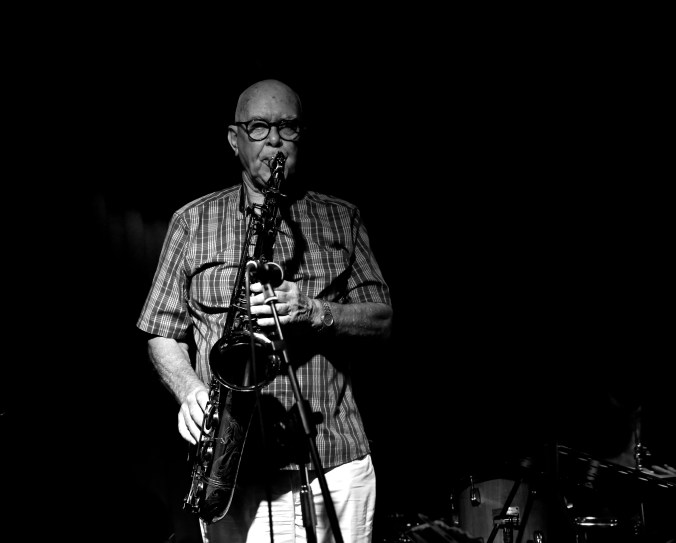 Brian Smith is a legendary figure in New Zealand Jazz, achieving career highs that few others attain. Normally artists of this stature settle overseas and are seldom seen after that. It was our good fortune that Smith moved back to New Zealand and in consequence, we get to hear him perform locally. It’s a moot point whether good musicians ever truly retire (luckily, the answer is seldom). Not so long ago he formed a quintet and since then he has been performing at venues around town. While Smith is a regular at the CJC, this is the first time that we have seen the current quintet in action. The event was predominantly a standards gig and a band of veterans is the right vehicle where standards are concerned. When you bring a selection of loved tunes back into orbit, comparisons are inevitably made. Therefore it pays to choose well and to perform them well and that’s exactly what the Brian Smith quartet did.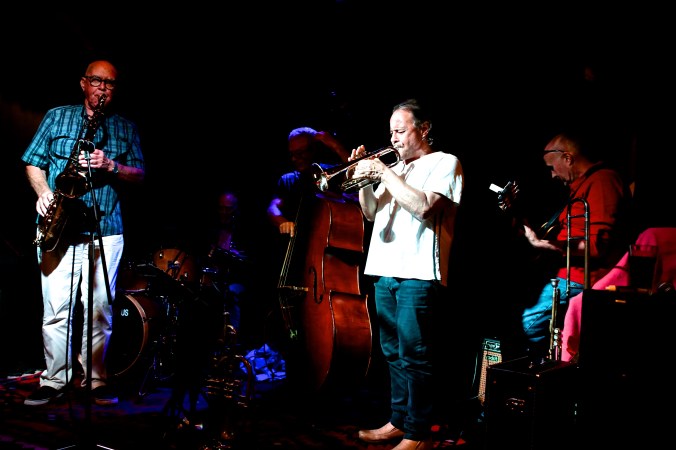
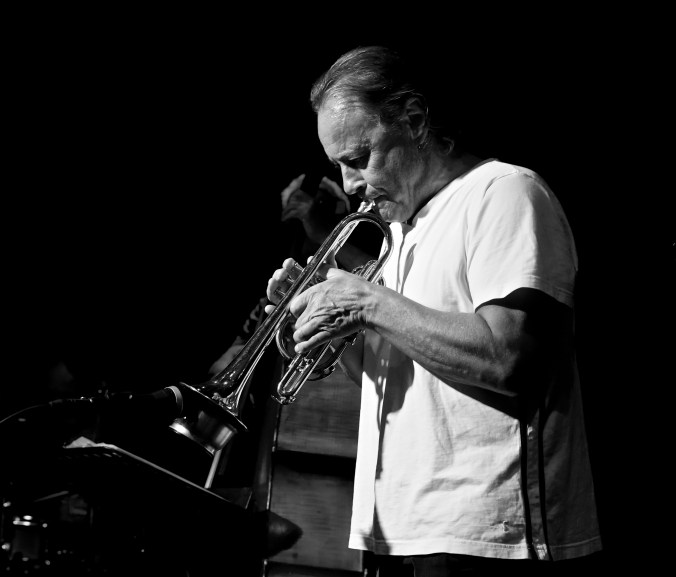
 Oli Holland is one of the leading bass voices in New Zealand. He formed Jazz Attack just over a year ago and since its inception, he has been writing new charts and expanding the lineup. Holland writes interesting charts; often complex but always compelling and his last gig showcased a number of these. This was an expanded lineup – adding three of Auckland’s heavyweights for a quartet segment in the first set. His bass is a powerhouse presence and his ringing melodic lines always distinctive. During solos, his vocalised unison lines fleshed out the tone, drew us deeper in – perhaps even influencing his improvisational choices. It is well established that vocalising while improvising on an instrument, fires up the human brain in new and interesting ways.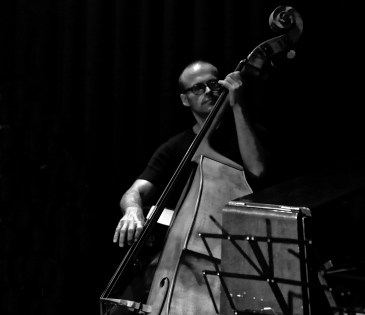

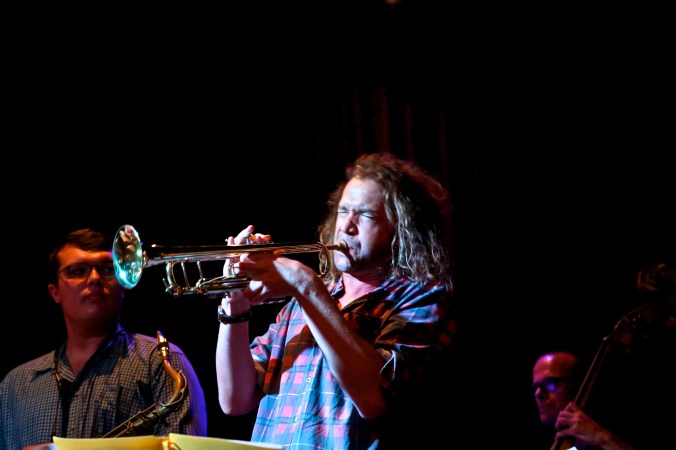
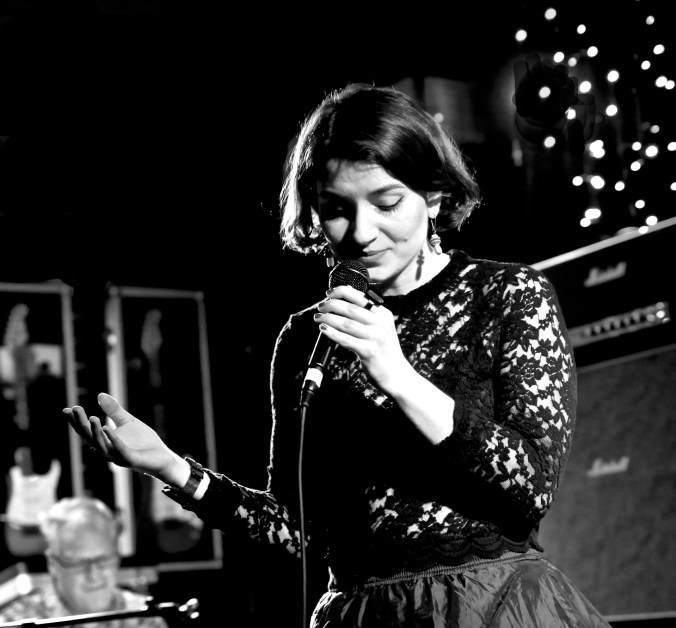 The heart of the modern improvised and experimental music scene is always an interesting place to be. Audiences tend to be open-eared and accustomed to music from a wide variety of sources. Improvising musicians have always drawn on diverse influences and it is a narrow-minded few who whine about dilution or the good old days. We should never undercut the deeper purpose of music, which is to share stories, communicate on a primal level, interpret. We tell stories to live and how we listen or react to music speaks to our musical maturity. When Simona Minns performed in Auckland last week, she brought with her a variety of influences. and all were approached with integrity.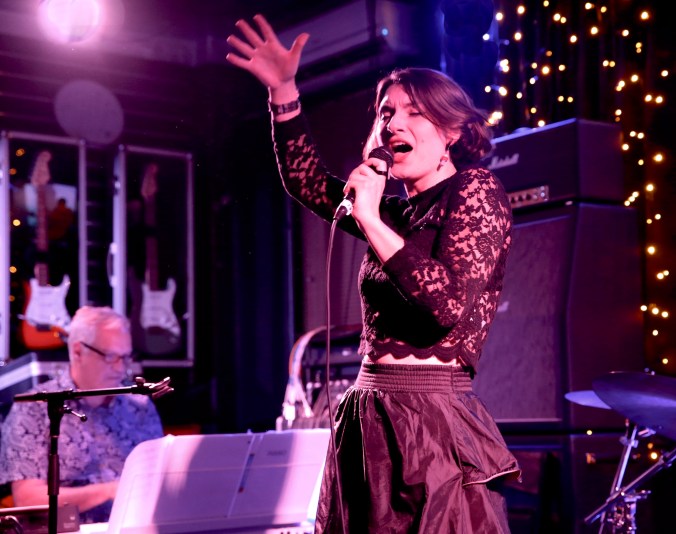
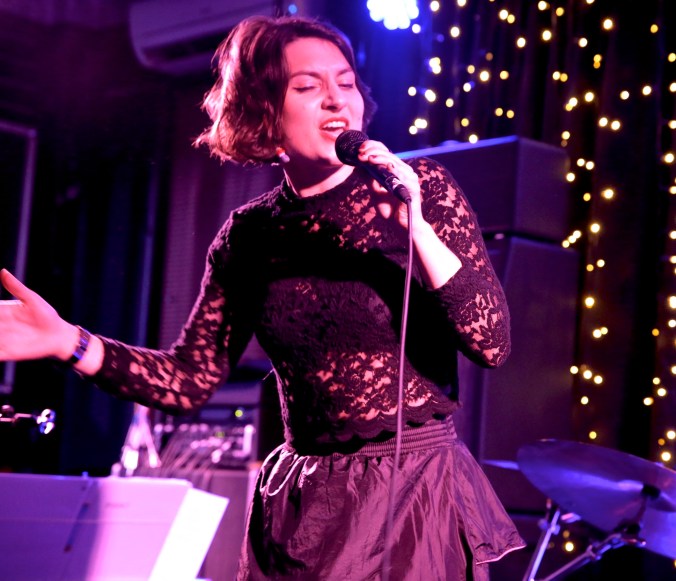
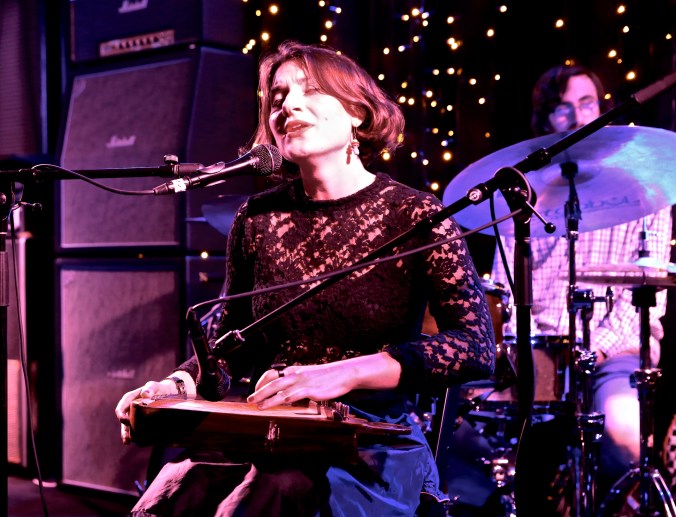
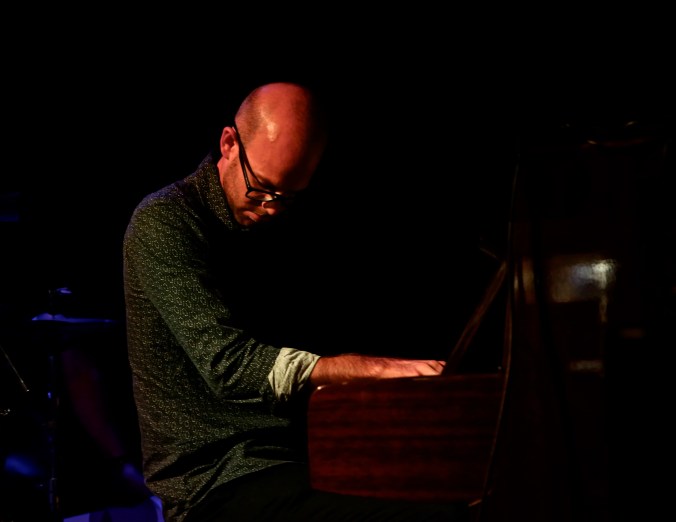 Good Music always says something interesting; it’s a form of communication where a musical statement begins a process and a listener responds. With any innovative musical form, we need to bring something of ourselves to the equation. The more open our ears the better the experience. Gifted improvisers of all cultures understand these fundamentals and because of this they mostly tell old stories in new ways. Rarely and bravely, musicians hit us with stories not yet fixed in the popular imagination. Steve Barry and his collaborators have a foot in both camps. While this is adventurous material, it is also approachable to anyone with open ears. What we heard at the CJC was innovative but the archetypes of all music were located deep in the compositional structure. A careful listening revealed trace elements from composers like Stravinsky or Bley and perhaps even of indigenous music.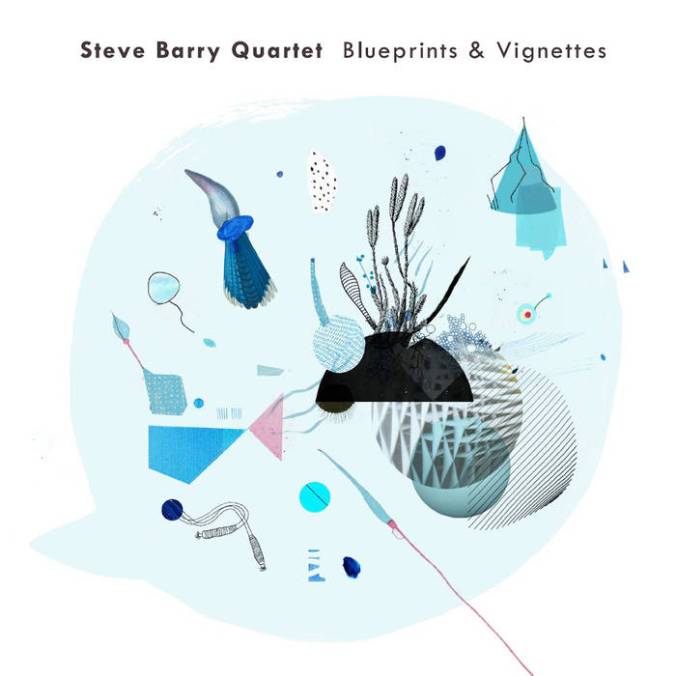
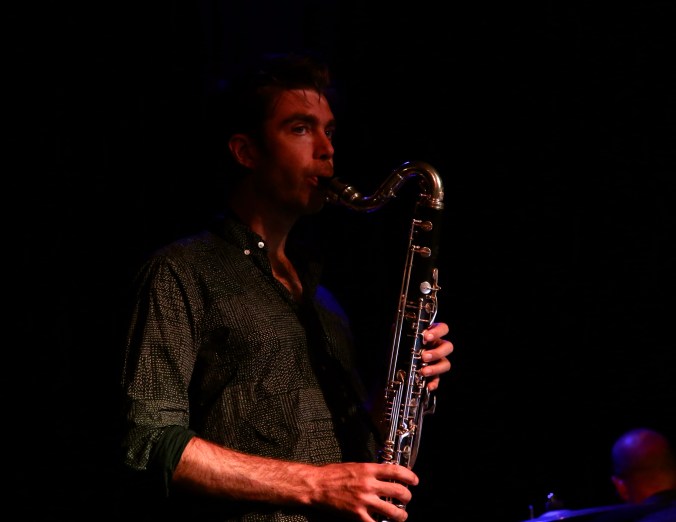
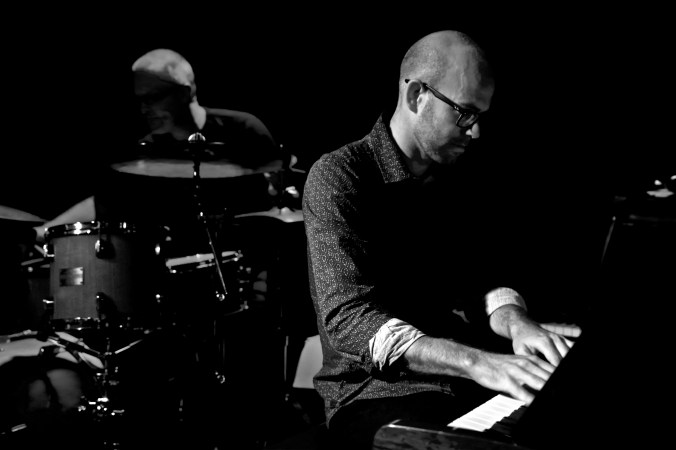
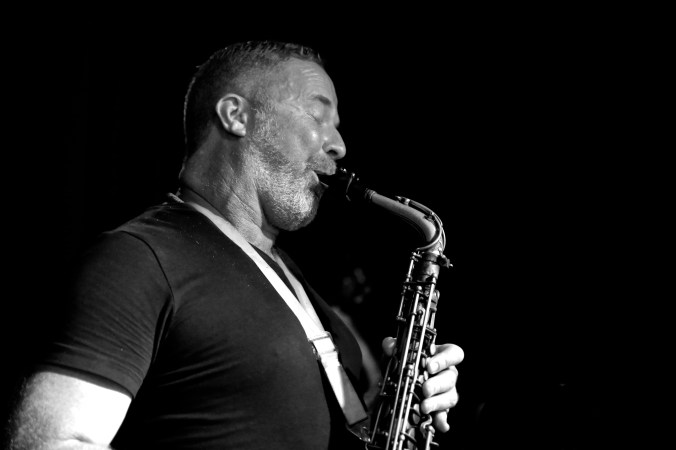 It was a good way to begin a year of music, a good way to breathe life into two enervating steamy nights. Hayden Chisholm was back in the country and around him formed various duos, trios, and quartets. He performed two gigs in Auckland and the first was at the Audio Foundation in Poynton Lane. The venue has long been an important source of innovative music and each time I descend the stairs to the sub-basement I find interesting changes to the clubs configuration. It really is an excellent venue and perfect for what it offers. At first glance, the two nights appeared quite different. One free improvised and the other a set of reflective ballads. In reality, both gigs were reflective, melodic and approachable. The open-hearted humanity and communication skills of the participants made it so.
 I have never witnessed a free gig quite like that as the communication was so exquisitely personal. More than musicians finishing each other’s sentences. More than the flow of fresh ideas; there was a sense of musicians revealing something intangible. From out of the fading harmonics and the quiet spaces came that extra something. The quiet revealing something on the edge of consciousness, something we often miss. Arising from – evocative like a Rilke poem – or a haiku. Bell stroked his mallets across the bars or responded with staccato – or soft taps and clicks, Prastiti offered cries and bell-like utterances, framed as wordless questions, Crayford explored resonant possibilities by using extended technique or by mesmerizing with darkly descending chords – opening up a dialogue which was met in kind – sometimes gentle, at other times like a flow of coloured sparks.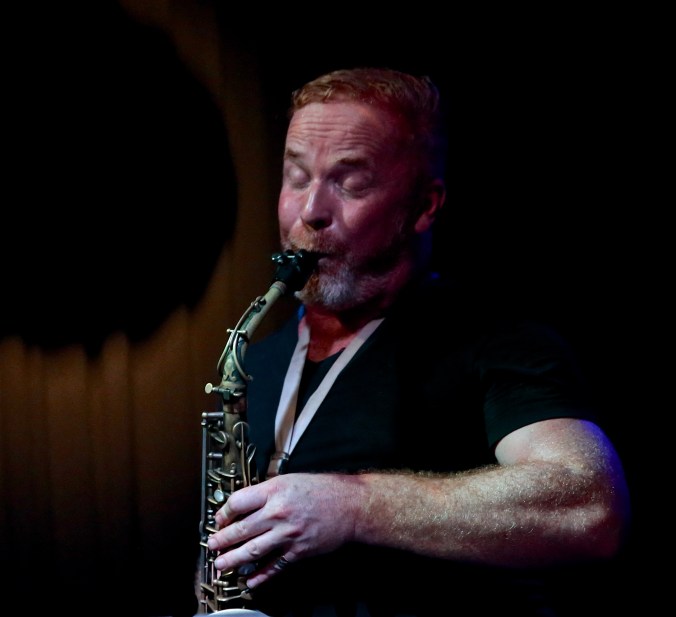
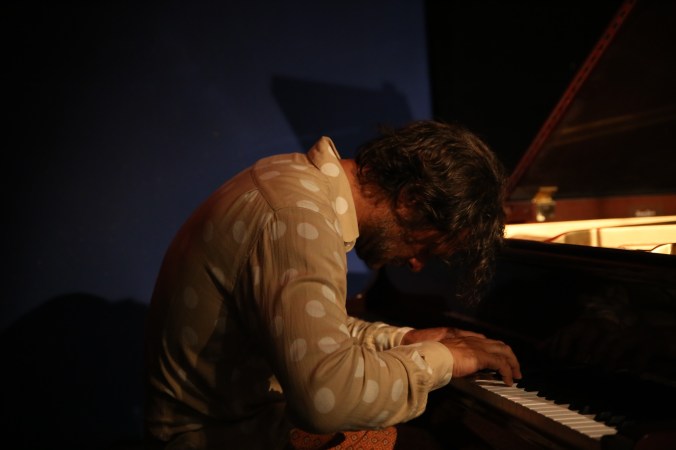
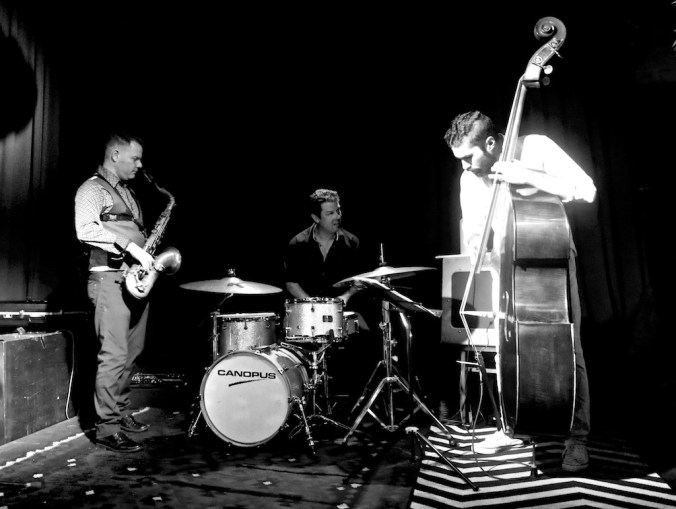
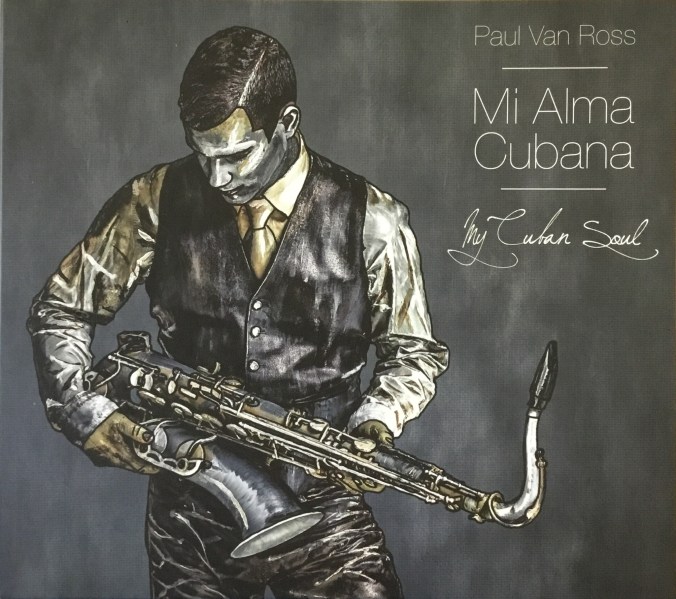
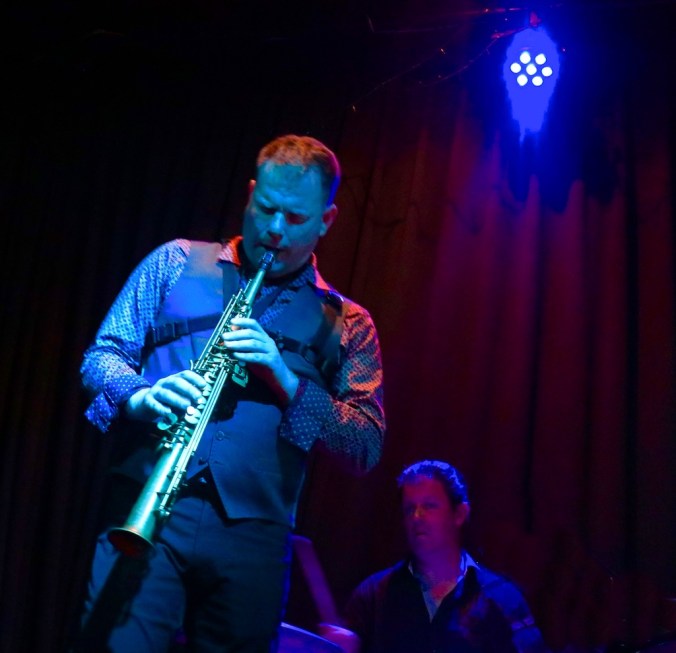
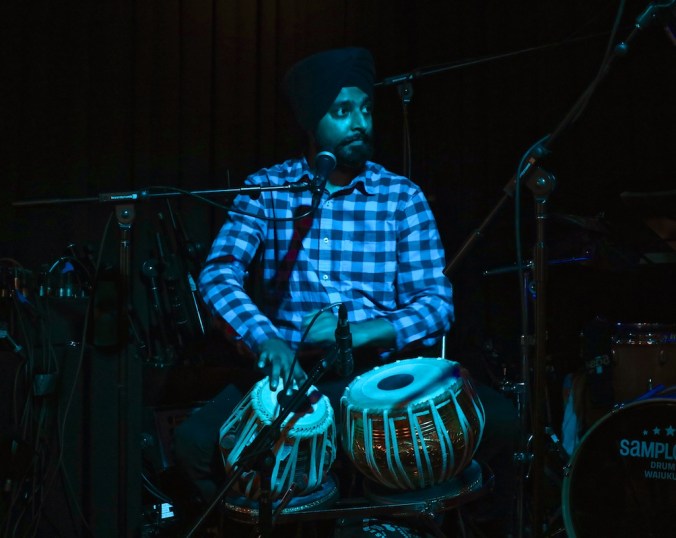 With emerging artists gigs you modify your expectations, but in this case, it was completely unnecessary. Both sets showcased great musicianship and originality. The first set was Manjit Singh and Takadimi; an Indian music/Jazz fusion project. Manjit Singh is not an emerging artist in the strictest sense, he is a highly experienced tabla player, composer and teacher in the two main traditional schools of Indian music (Northern and Carnatic). He has recently been doing a Jazz studies course at the UoA and this project arises from that. The traditional music he teaches is not that dissimilar to Jazz, as it has improvisation aspects and complex interwoven rhythms at its core. Singh also gave us an insight into another tradition, the ecstatic Sufi-influenced music of northwest India, Pakistan and central Asia – Again, a tradition that has fed the rich streams of Indian music and more recently, Jazz.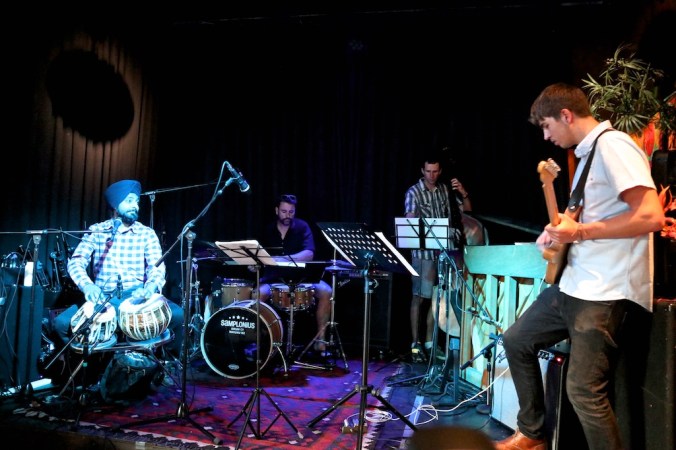
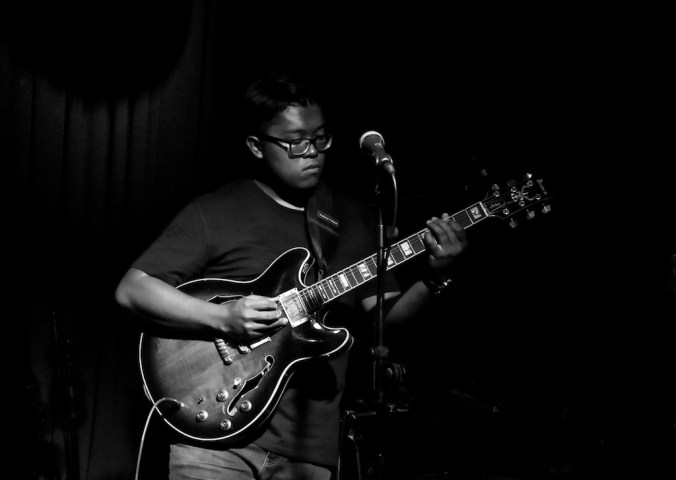
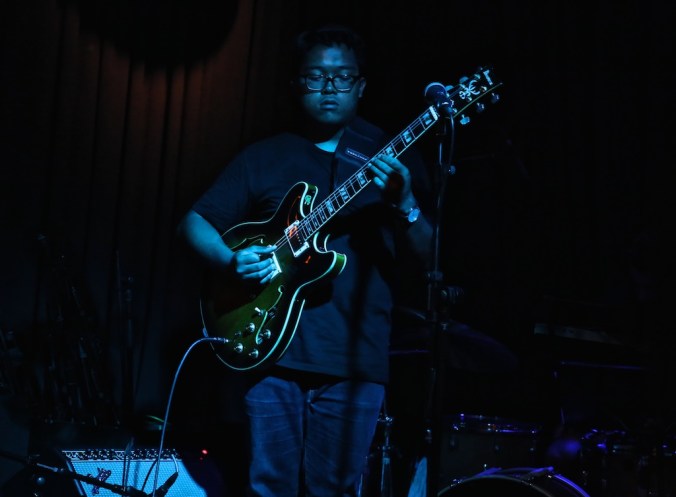
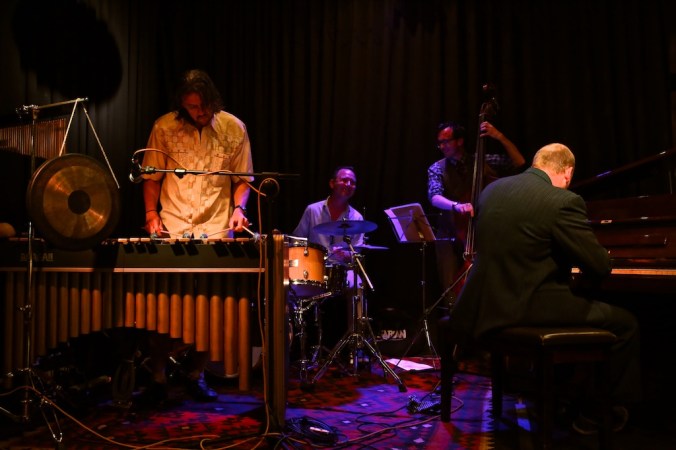
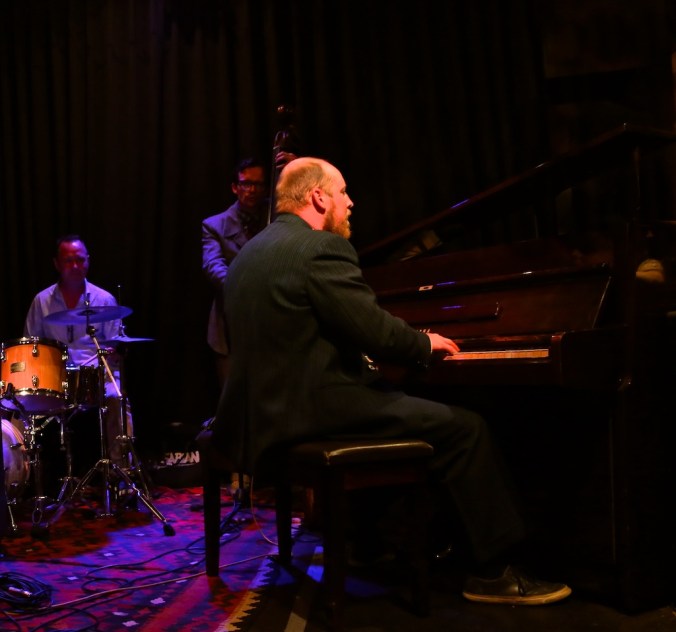
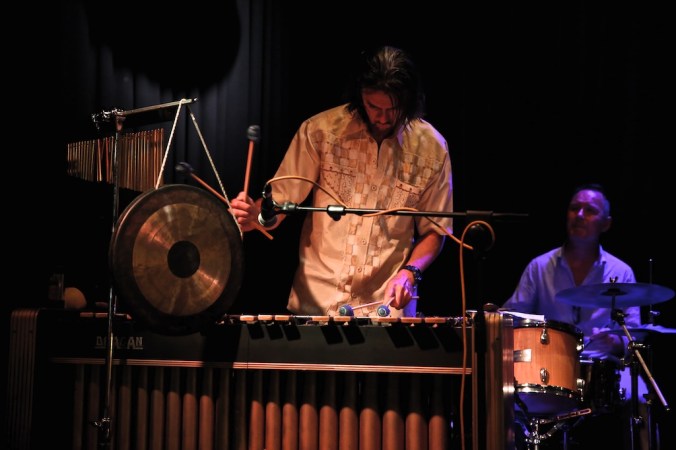
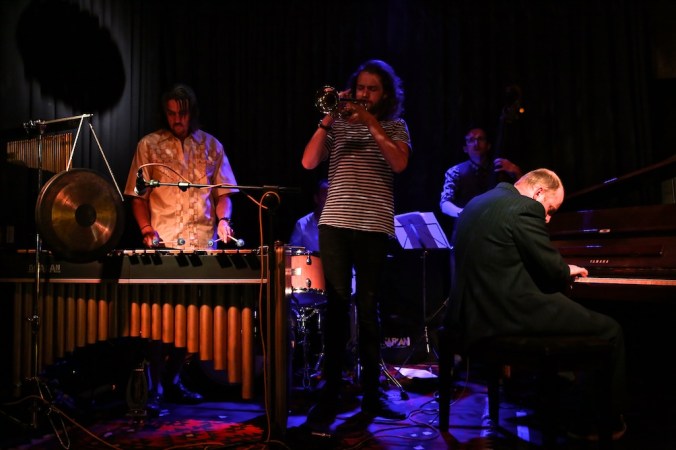 The line up on Squeaky Weasel, an earlier Jelly Rolls album, was as now Wilcock, Rae and bass player Yeabsley. The addition of Michael Barker on percussion and vibraphone is an evolution that makes perfect sense. Trumpeter Finn Scholes joined them for one number and delivered a well thought through high energy solo. To pick up a copy go to Ben Wilcock Thick Records Ltd –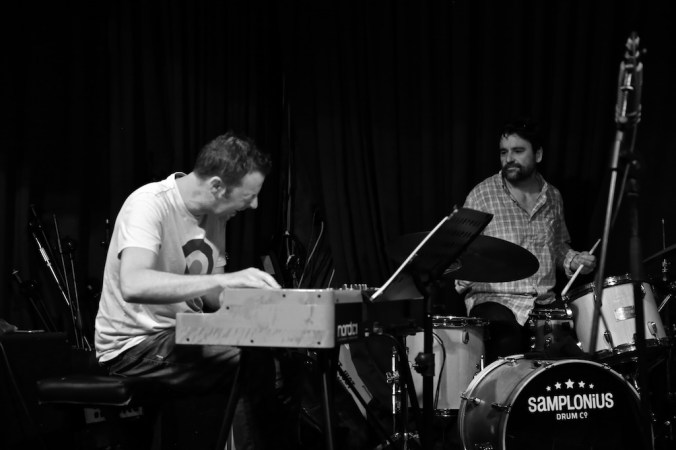
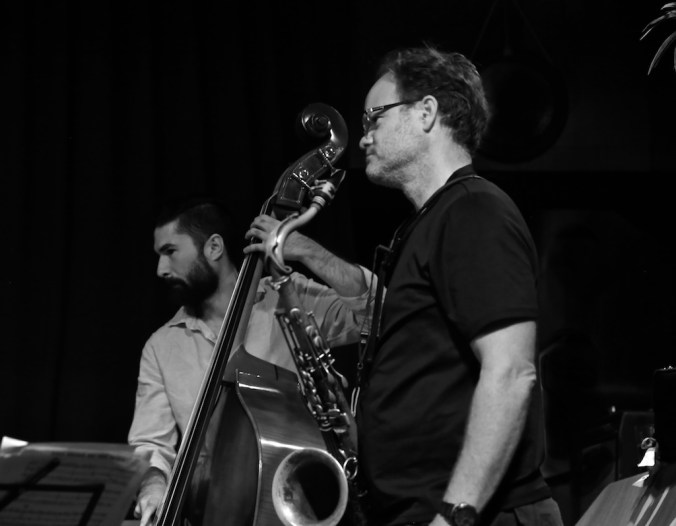
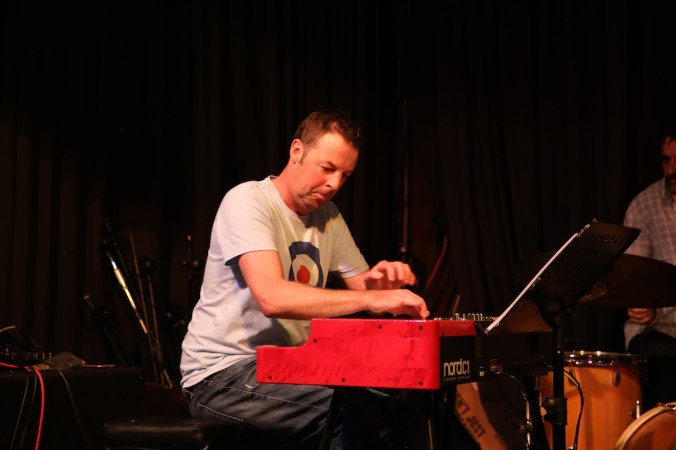
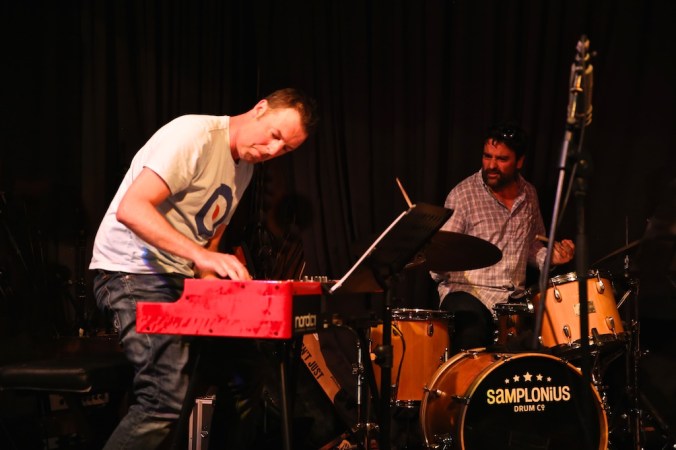
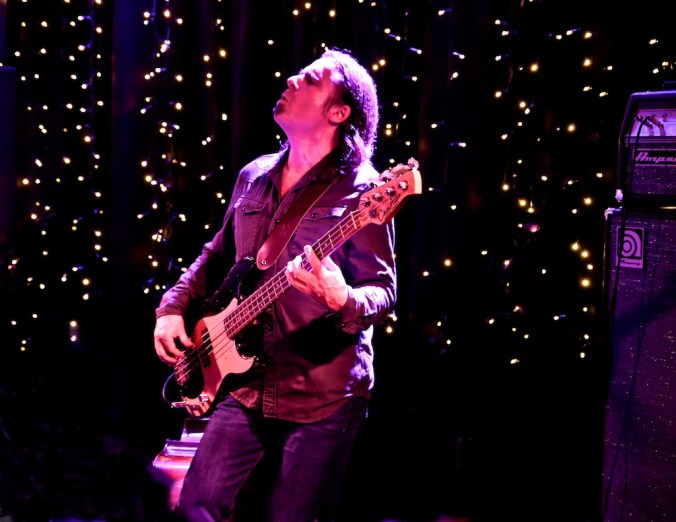
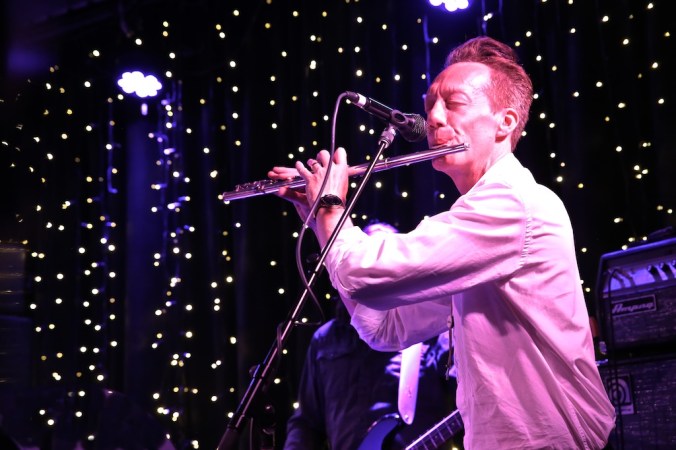

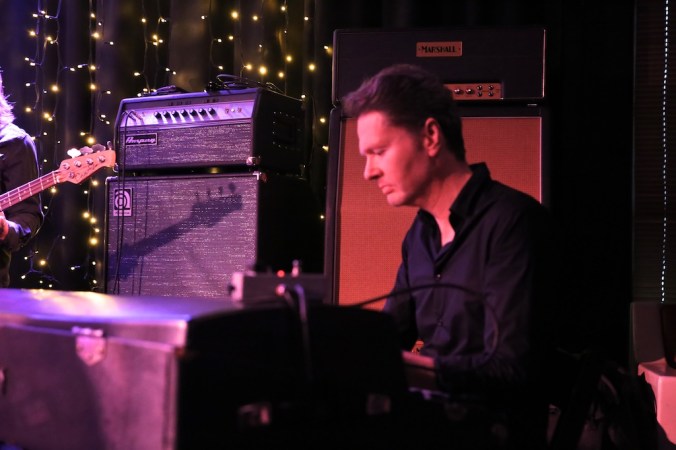 The CJC, sensing an opportunity and knowing that they had only a few days, organised a special one-off Richard Hammond gig and billed it as an all-star event. The programming fell to keys player Kevin Field. Field playing Rhodes, Ron Samsom on drums, Nathan Haines and Roger Manins on saxophones and Marjan on vocals. Hammond alternated between upright bass and electric bass and he wowed us on both instruments. On upright bass, he has a tone to die for; one that only the best bass players locate; on electric bass his lines bite, speaking the language of Jaco or Richard Bona.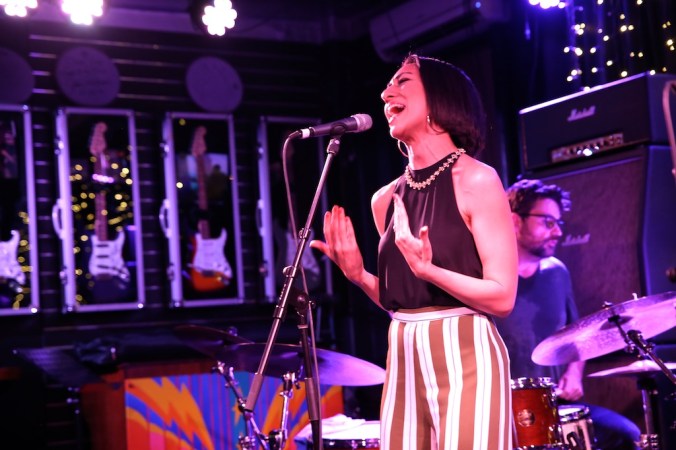
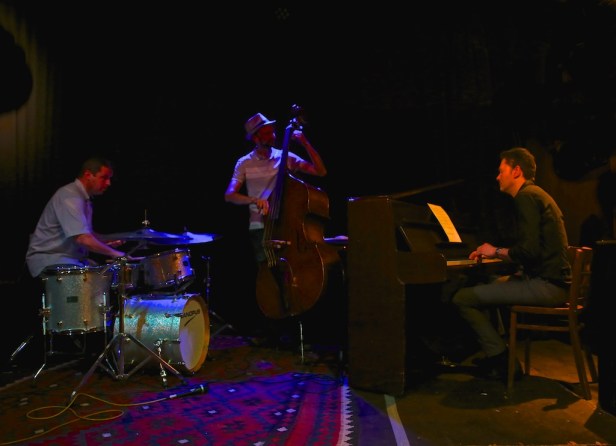
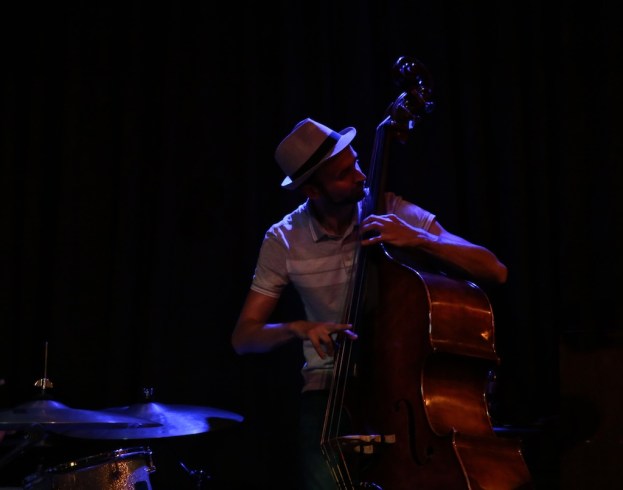
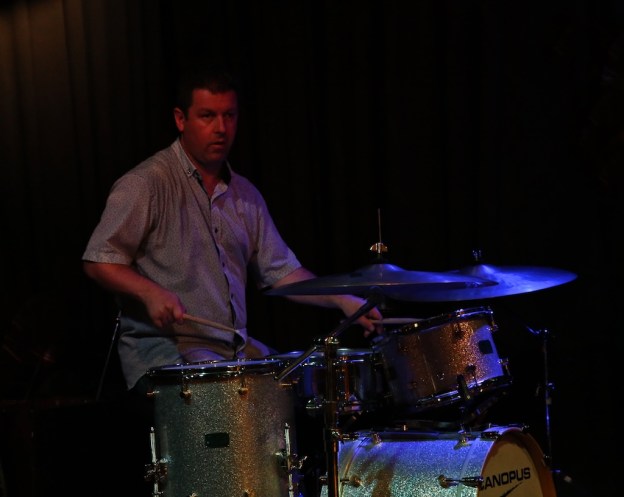
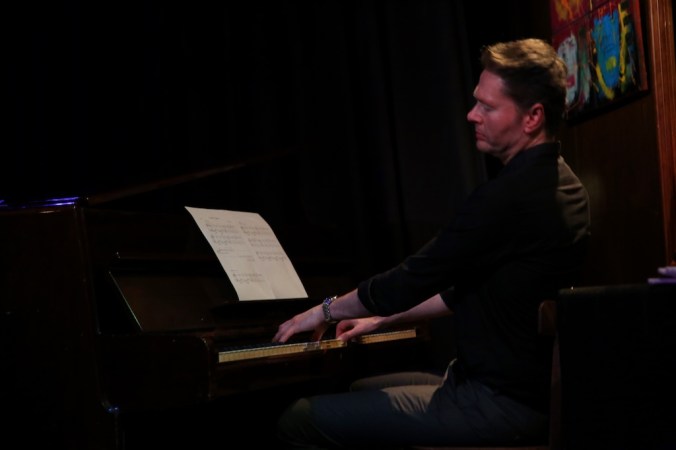
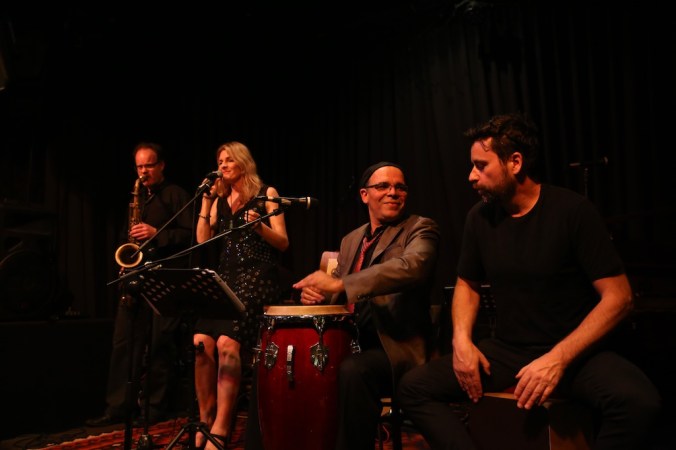 I like South American music and the more I hear, the deeper I am drawn in. A rich and ancient fusion of African, European and Amerindian music, each coast and region nurturing distinct flavours. There are also highly localised variations; all rhythmically complex and all deeply infectious. This week the CJC featured the highly respected Brazilian musician Nanny Assis and New Zealand born vocalist Maggie Gould. Assis was born in Salvador, North Eastern Brazil; a region especially rich in musical traditions and heavily influenced by African rhythms. The coast below Bahia nurtured Tom Jobim, Roberto Menescal and a cohort of like-minded innovators; the creators of the Bossanova (new music) form. In a world where saccharine versions of great music often assail us, it is necessary to return to the source from time to time in order to refresh our ears. Listening to Tom Jobim and Elis Regina on the album ‘Elis & Tom’ – ‘Chovendo Na Roseira’ especially, is a good place to start. The time feel is subtly different from North American versions and the unique rhythmic tensions dance with life. Jobim is long gone but authentic practitioners of the various traditions are still there if we look. Assis is just one of these; a master of rhythm and of the many distinct Bahia styles.
 Gould was a successful photojournalist in an earlier life. When the pressures of that lifestyle became too much, she decided to abandon the frenetic media world and follow her passion instead. Rekindling a youthful dream she became a Jazz vocalist and has followed that path ever since. Eventually, her journey took her to New York where she met Assis and a musical collaboration began. While living in New York Gould has performed with a number of luminaries, notably the pianist John de Martino (who has also recorded with Assis). Gould and Assis have just toured New Zealand, appearing in festivals and clubs throughout the two Islands. They have toured with great musicians and they intend to record soon in Auckland. When they do, the well-known New York-based ex-pat Kiwi bass player Richard Hammond will join them.
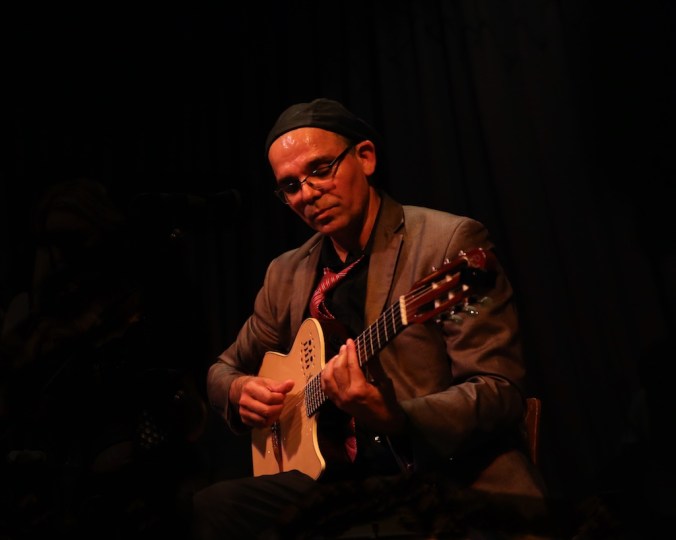 It is said that Latin American music is ‘the other swing music’. That makes for great synergies between Jazz and Latin musicians. It can work well, but only if the musicians have the ears and the courage to submit to the weave. Utilising the considerable skills of pianist Kevin Field, Alex Griffiths on 5 string bass and drummer Ron Samsom (plus for the CJC gig, saxophonist Roger Manins). The mix of Jazz musicians and Brazilian created a spark. Alex Griffiths is obviously well versed in Brazilian rhythms as his lines could not have been better placed. Field has for some time been immersed in this music and he is no stranger to the various clave rhythms either. His understated delicate lines in place of comping held the echoes of Jobim’s own tasteful piano accompaniment. During solo’s he gave both hands full reign in clave rich explorations. Samsom is a talented drummer and throughout the night, he and Assis worked in concert. With Assis on percussion and Samsom on the kit, a wonderfully rich sound scape emerged. At one point Assis beat a cowbell to hold the centre – allowing Samsom additional freedom to move. This was a moment of pure magic.
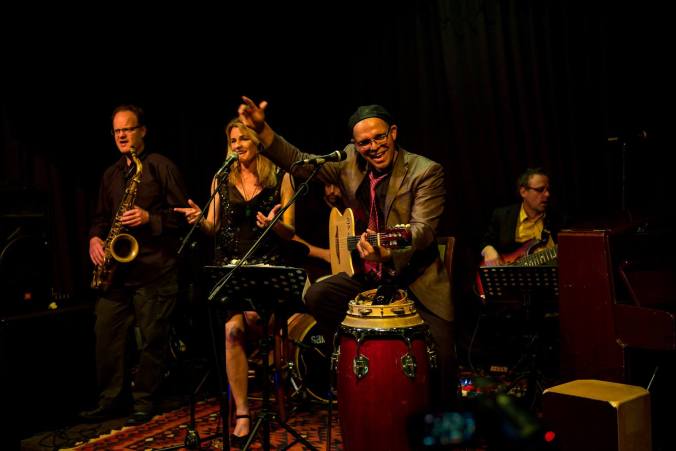 I read once, that a Jazz drummer playing Bossa or Samba is doing three basic things; the right hand replaces the shaker or cowbell, the left hand has the clave pattern and the kick drum follows the bass line. Add in actual congas shakers or cowbell and the interplay has the magnitude of a sonic earthquake.The number that I have posted is ‘O Barquinho’ or ‘My Little Boat(of Love)’ – a tune by Roberto Menescal and sometimes wrongly attributed to Jobim. It is a nice example of the Brazilian Bossa rhythms; rich in subtlety and contrast. It is a long-held tradition in this music to have a female and a male voice – call and response. Gould in English, imparting the wistfulness of the lyrics – Assis in Portuguese – taking me back to the master Joao Gilberto. The Portuguese language is extremely pleasant to the ear, while often masking incredibly sad songs. We didn’t need a dictionary or interpreter on Wednesday as we were transported without them. Nanny Assis’s voice, like his percussion and guitar playing, is pure magic – together the musicians gave us a great night.
  The fourth Auckland Jazz Festival was appropriately launched at the Thirsty Dog Tavern in Karangahape Road. A welcoming venue, nestled among ethnic food joints, strip clubs and private art galleries. It is timely that we pay tribute to the Thirsty Dog, who a year ago, generously offered the CJC (Creative Jazz Club) a regular Wednesday night slot. This occurred when the club most needed it. It is a good performance space and many visiting musicians have remarked on the rooms warm vibe.
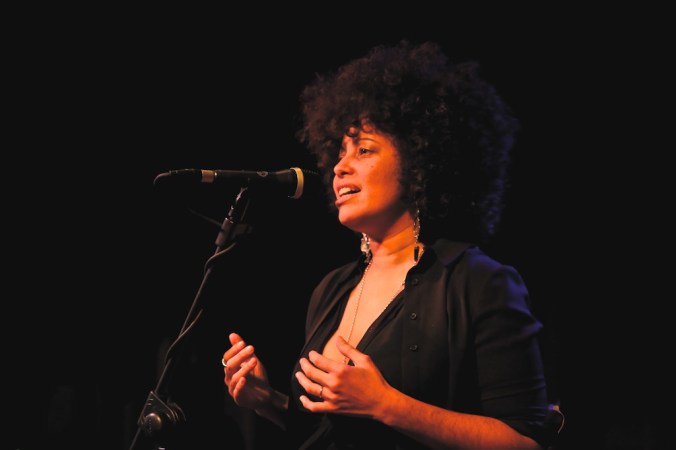 The first festival gig I attended was the Jennifer Zea group. The last time I saw her perform I liked by her Latin interpretations of the standards, but I particularly liked her rendering of the songs particular to her region (Cuba/Venezuela). She introduced more standards this time but it was the second set; a set of Venezuelan and bossa fused music that had the audience enthralled. These tunes were so infectious that they followed me home. I even woke up with one of them singing in my head the next morning. ‘Moliendo Cafe’ (Blanco/Perroni) has been popular in Venezuela (and the wider world) since 1959. Everyone from Jose Feliciano on has benefited from it. As Zea sang this wonderfully infectious tune, she danced to its rhythms, and along the back wall, a chorus of her countrymen and women sang along in unison. We seldom hear music like this and it is her forte. I have posted a bolero, Lagrimas Negras (or Black Tears – by Matamoras) a Cuban tune from the 1920’s. She was ably assisted by Kevin Field, Mostyn Cole and the wonderful Miguel Fuentes on percussion.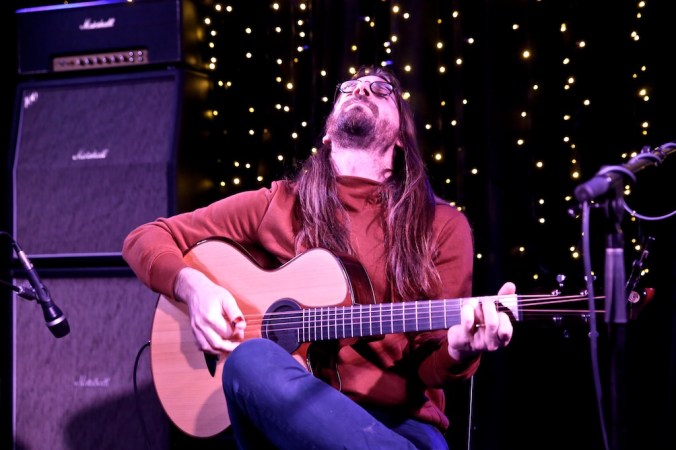
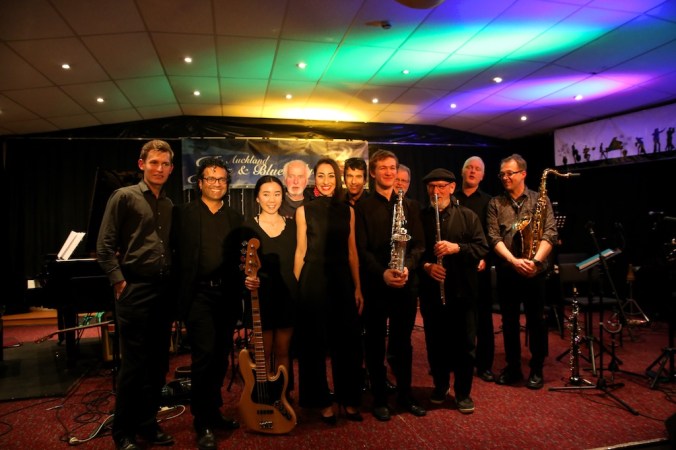 On Tuesday, Marjan appeared with the ‘Experience Band’ at the Auckland Jazz and Blues Club. The Experience Band is an 11 piece ensemble and consequently, it provided a very different flavour to her appearance with a quartet at the CJC last month. Her voice has real power and she’s a compelling performer; easily able to adjust to the bigger sound. The audience loved her. Her set list was skillfully tailored to the room as the audience was older than the CJC crowd. In particular, her cheeky take on ‘Making Whoopie’ brought the house down. At one point she paid tribute to her high school music teacher, saxophonist Markas Fritsch, who was in the front line of the ensemble. She credits him with steering her towards Jazz – something we should all thank him for.
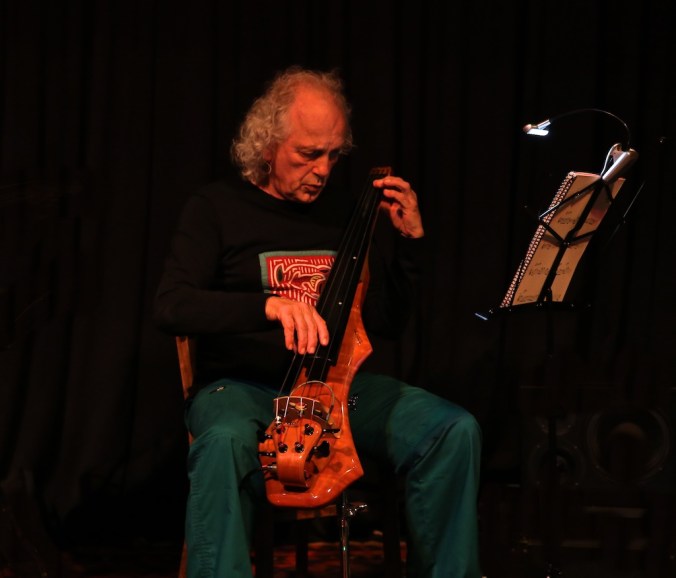 On Wednesday, the third headline festival act was presented at the Thirsty Dog. It has been over a year since the world-renowned bassist David Friesen was in New Zealand. During last years tour, his trio was recorded at the 1885 venue. The night was captured perfectly in the newly released Rattle album ‘Another Time Another Space’. Frieson is an improvised music celebrity and it was good to have him back. He has a unique approach to composition and performance and he caps that off with his engaging and witty bandstand banter. He was again accompanied by Dixon Nacey on guitar and Reuben Bradly on drums. This trio communicates superbly, reacting to each other like old friends. The recording is amazingly good, especially so considering that it was captured in the 1885, which is an acoustically lively space. Nacey’s singing lines blend perfectly with Frieson’s – the sort of woody resonance that high-end luthiers aim for.
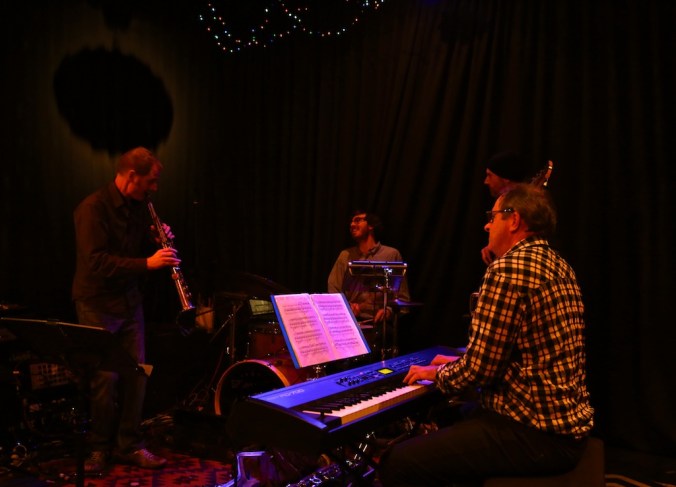 On Friday the Chris Mason-Battley band returned to the Thirsty Dog. I really like this band with their predilection for tasty modal grooves. There is no one in New Zealand who plays quite like the Mason-Battley – and as an entity, the group have a distinct footprint. I have written about them recently and I suggest you check them out if you get the chance – they are not heard about town very often and more’s the pity. As with the last gig; on the keyboard was David Lines, on electric bass Sam Giles and on drums the innovative Stephen Thomas. There is now talk of a new CMB project and perhaps one with more electronics? Friday nights are the hard-yards for Jazz musicians and this one was no exception. Throughout the performance, you could hear two blokes yakking, obviously pleased to be catching up and seemingly unaware that this was a listening gig. A number of ray-like stares were beamed in their direction but they proved quite impervious to hints. Loud chatting seldom happens on a mid-week night where listeners and improvisers own the space.
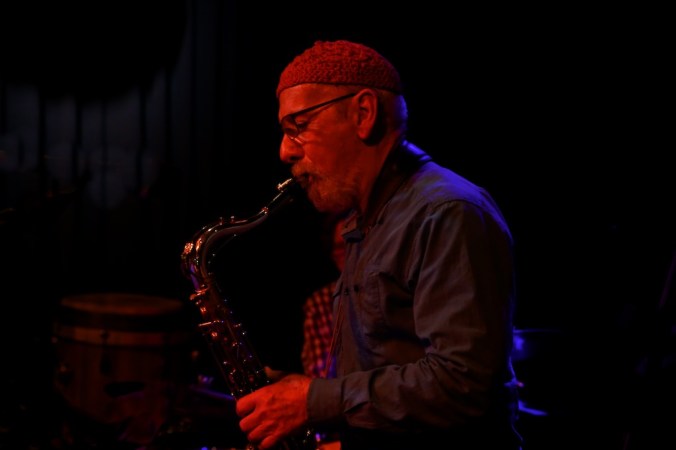 The last gig at the Auckland Jazz Festival was Jim Langabeer’s ‘Secret Islands’ album release’. This is another Rattle album and the musicianship is stunning. A project which arose out of Langabeer’s multi-phonics explorations at Auckland University. There is a lot that is referred to as fusion these days and most of it is not. In this case, the term could be a good descriptor. Indigenous instruments, multiple reeds and winds; pedal steel guitar and fender; beautiful melodies placed in Mingus like settings. While the album sits comfortably on the Jazz spectrum, the material takes us way beyond that. With the authoritative elder statesman Langabeer at the helm, and assisted by Rosie Langabeer, Roger Manins, Eamon Edmundson-Wells, Neil Watson and Chris O’Connor, what else would you expect. For this and other ‘Rattle’ recordings, go to
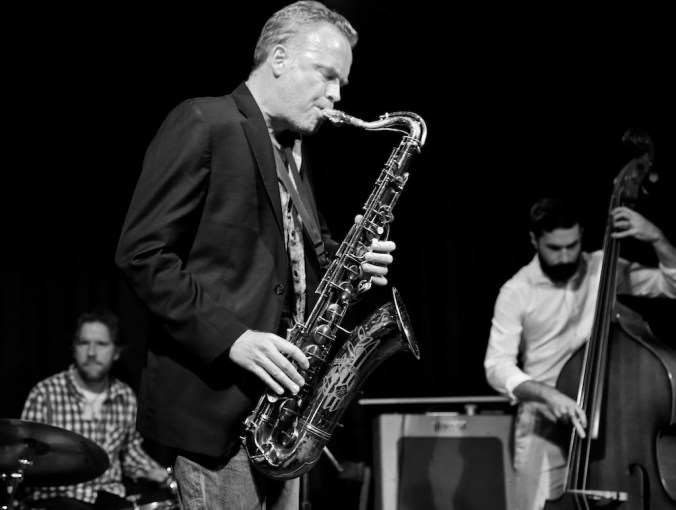 Music listeners split into two main camps; active and passive listeners. Those who listen to improvised music incline towards active, deep-listening. We know that the brains of improvising musicians light up in unusual ways when playing. Much the same applies to listening Jazz audiences. On Wednesday night a saxophone trio played at the Thirsty Dog; no chordal instruments, no lingering over familiar melody lines, a trio which worked within a broader musical architecture, following the changes where ever they led. Nick Hempton is an interesting player and the right person to take us on this journey.
 This sort of gig works well with listening audiences because it invites active participation. On Wednesday, each piece began with a few lines from a familiar standard, often just implied; then, a few bars in, the lines evolved into new melodies based on the changes. As the trio responded the horn led the others to various way-points: places where the music changed course. Fragments of new standards were discovered, unravelled, abandoned. The human brain is hard-wired for pattern recognition, but we love the puzzles that arise from the search. Settling for the familiar is not how we evolved. We evolved by following the risk takers, marvelling at their daring. Following this musical risk-taker, was our delight.
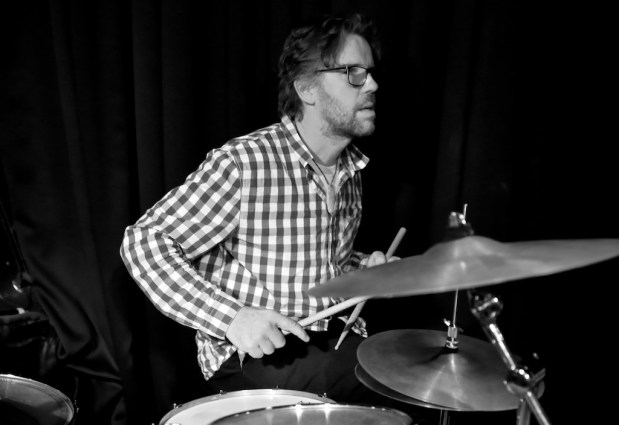 The point was not so much the standards themselves but the opportunities they presented. Appearing and disappearing in medley form was; ‘Night in Tunisia’, ‘Body and Soul’ A Sony Rollins waltz, ‘Exactly Like You’ and ‘Rhythm a Ning’ – these and more were examined. Standing alone was the lovely ballad ‘When I Grow too old to Dream’ (Romberg) and in Hempton’s hands, it was beautifully realised. There was also a great rendition of ‘Just Squeeze Me (don’t tease me)’ (Ellington) – I have posted that. The last trio piece was ‘Poor Butterfly (Hubbell [Puccini])’; followed by Roger Manins joining the trio for two last two numbers. As is often the case when two tenors appear on the same stage, a delightfully upbeat and riotous vibe emerges. Friendly sparring matches like this always go down well.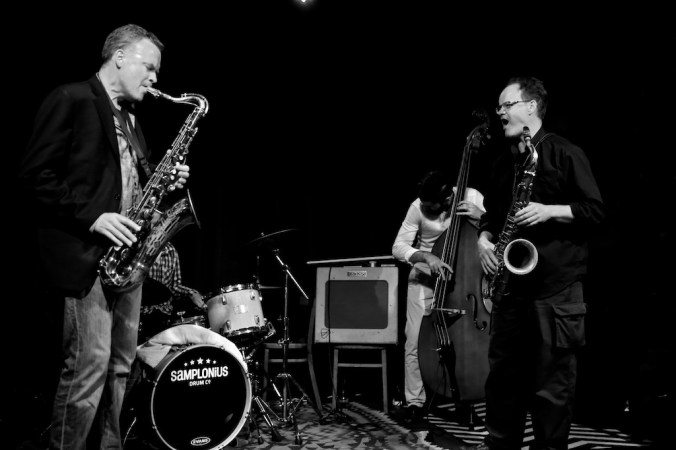
 Jamie Oehlers is a tenor saxophone heavyweight who earns widespread respect. His playing is conversational, and like all good conversationalists, he listens as well as he articulates his own point of view. An unashamed melodicist, a musician of subtlety, a dream weaver with a bell-like clarity of tone. Oehlers tours regularly and we are lucky enough to be on his touring circuit. This trip, he was accompanied by Tal Cohen; an Israeli born, New York-based pianist; an artist increasingly coming to the favourable attention of reviewers; an artist praised by fellow musicians. Cohen and Oehlers have been playing together for years and over that time they have built an uncanny rapport. Out of that has emerged something special; their 2016 duo album titled ‘Innocent dreamer’.
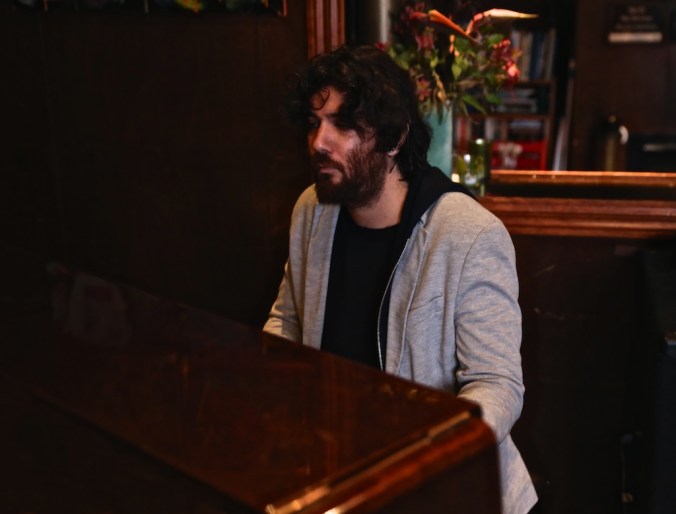 As far as I know, this was Cohen’s first visit to New Zealand and it was certainly his first visit to the CJC. He’s a compelling pianist and the perfect counter-weight for Oehlers. On duo numbers, they responded to each other as good improvisers should, each giving the other space and expanding the conversation as the explorations deepened. Intimate musical exchanges of this type work best when the musicians care deeply about the project. They work best between friends. We saw two sides to Cohen on this tour. The thoughtful, unhurried, deep improviser and the percussive player who found a groove and worked it to the bone. The second half of the gig brought a rhythm section to the bandstand; Olivier Holland and Ron Samsom. Having such an interesting contrast between sets made both halves work better. The second set was approached with vigour; Oehlers digging into a standard, often preceded by a nice intro, through the head and then… boom. This was when the fireworks happened.
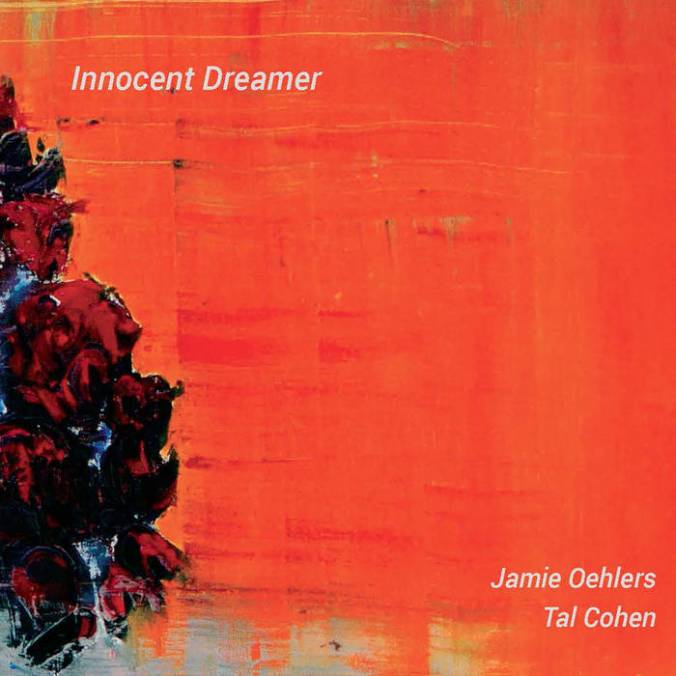 The first set opened with a heartfelt ‘Body & Soul’ (Green) which set the tone. The tune that really took my attention though was Oehlers ‘Armistice’. A beautiful piece conjuring up powerful images and telling its story unequivocally. There was also a nice tune referencing Cohens family. The first set finished with the lively Ellington tribute – ‘Take the Coltrane’ . The second set (the quartet) opened with the lovely ‘It could happen to You’ (Van Heusen), followed by a tune that Oehlers has made his own; ‘On a Clear Day’ (Learner/Lane) – (a recent Oehlers album title). Next, the quartet performed ‘Nardis’ (Evans/Davis) – this was wonderful and it reminded me of the endless re-evaluation and probing of that tune by Evans in his final years. This version did not sound like Evans – it was born again – if any modal tune deserves to live forever, it is surely this one.
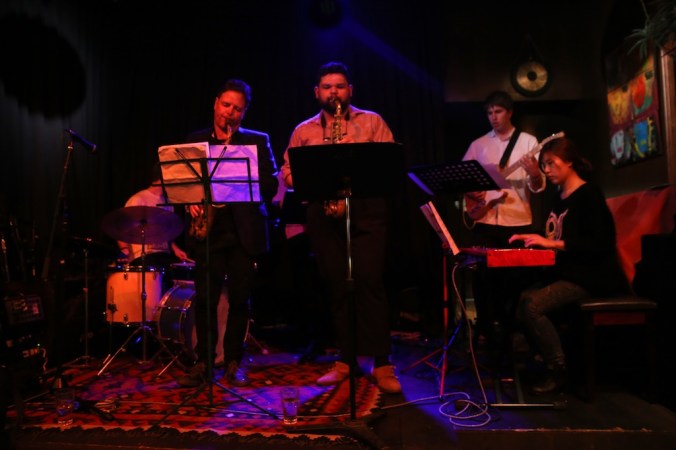 At some point in human evolution, the majority of humans decided to stay put. In consequence, the hunter-gatherers and the pastoral nomads became outliers. As civilizations grew, agriculture grew and large enclosures and granaries grew along with them. Beyond the walls and the jumble of enclosures; largely unnoticed, often unseen, foraging continued unabated. The homeless on the streets forage, philosophers forage, writers forage, wild and domestic animals forage and above all improvisers forage.
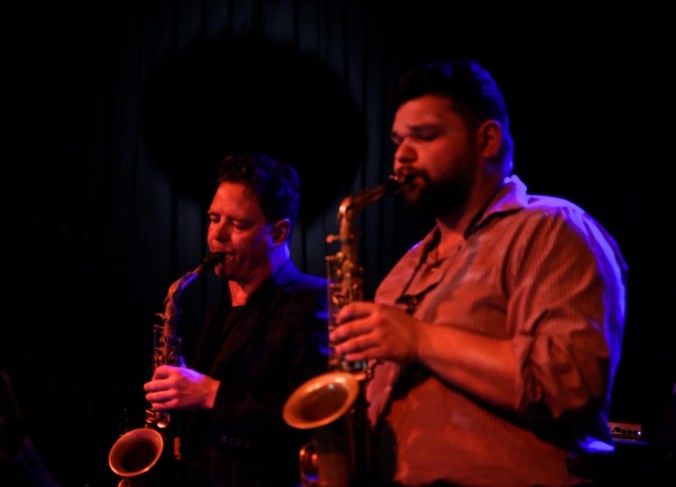 On Wednesday, his charts were for a larger ensemble. This time offering fresh insights; taking us further down the Rabbit hole. The pieces were of variable lengths and sometimes in parts. At some point during the second set, he played a piece titled ‘Ligeti’s Goat (I first heard that back in 2013). While the piece has melodic hooks and a basic structure, it is more, a surrealistic journey. A place where imagining, spoken narrative and musical narrative meet. Ligeti’s goat is vividly embedded in my memory; it is not a piece easily forgotten, a goat wandering through pastures, locating carrots (perhaps forbidden carrots), digesting the vegetables in that mysterious way of all ruminants.
 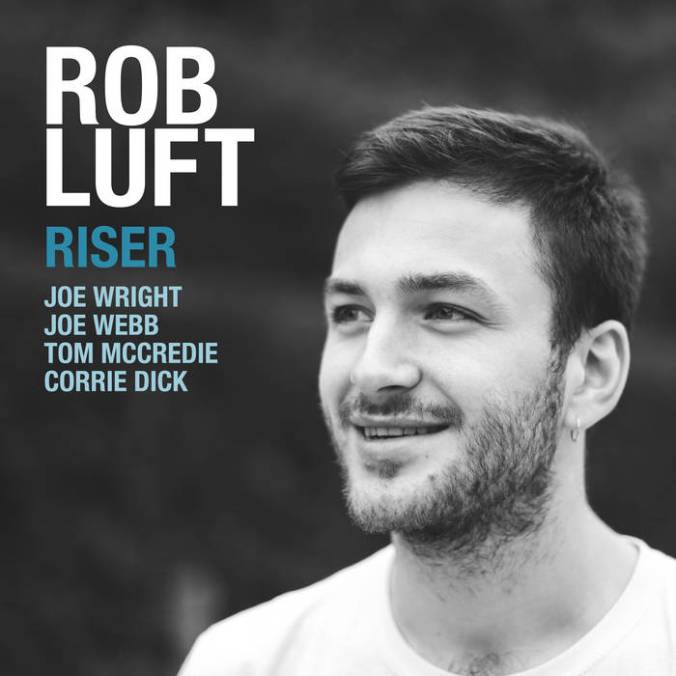 Rob Luft is one of those rare musicians who has seldom put a career foot wrong, first coming to attention at the age of fifteen in the (UK) National Youth Jazz Orchestra. From then on he has regularly come to notice and although still in his early twenties he is now a musical force to be reckoned with. Anyone who has heard him play will know that the growing number of accolades are well deserved. As each year passes he garners fresh awards, last year, second place in the Montreux Jazz guitar competition and recently receiving the coveted Kenny Wheeler Award.
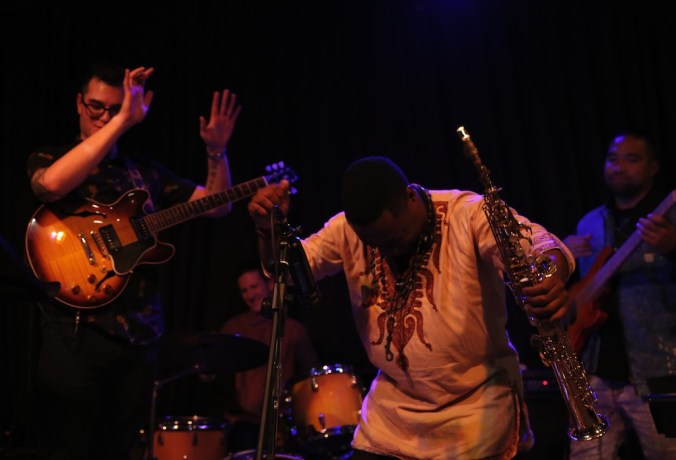 During the apartheid era in South Africa, a heady brew of danceable Jazz bubbled up from the townships. The all white National Party hated it and a game of ‘whack-a-mole’ followed. As soon as one venue was shut down by the police, another would spring up. The music was resilient and hopeful. No racist or repressive regime likes Jazz because it has rebellion, hope and joyous defiance in its DNA. The Zimbabwean born Thabani Gapara imbibed South African Jazz from his earliest days, eventually taking up the saxophone, that most anti establishment of instruments. Since then, he has performed in Zimbabwean, South African and New Zealand projects.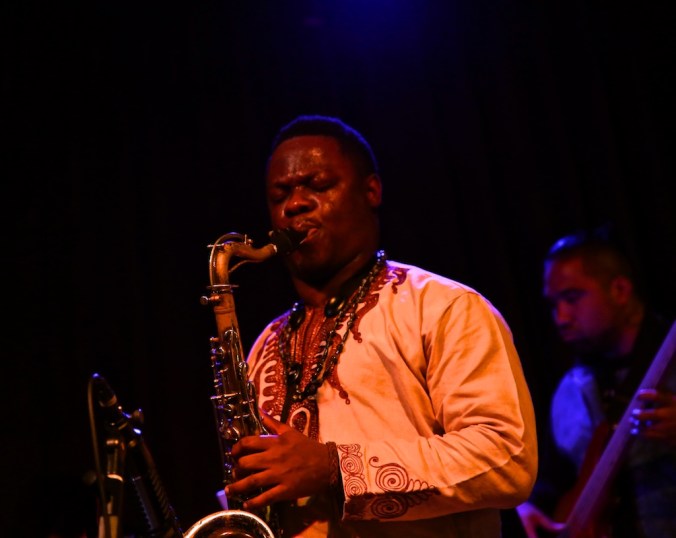


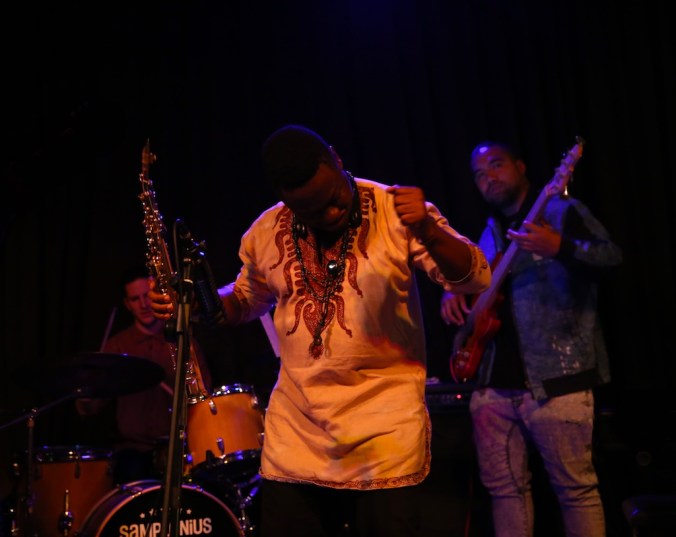
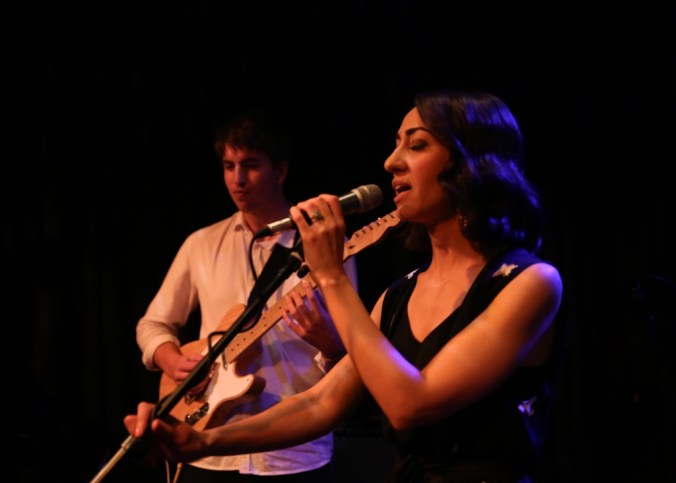 When Marjan stepped up to the microphone, she owned the room from that moment on. Her previous association with the Jazz club had been peripheral, but this gig changed everything. I have sometimes engaged with her about Persian music or Sufi poetry and I have heard her performing in the Kevin Field ‘A List’ band. She is always impressive when she sings, but this was impressive in a different way. It was her first Jazz club gig as a leader and suddenly, here she was delighting a capacity audience, every bit the seasoned professional; exuding an easy-going confidence. It was tempting to think that she had magically transformed herself into this fully formed artist, but her back story offers deeper insights. Marjan is of Persian descent and while this breathes exoticism into her music, it is only a fragment of her story. In truth, she has been a performer for much of her life; an established presence in the world of film, an in-demand voiceover artist, a teacher of music, dance, and drama. She draws on many strengths but on Wednesday they coalesced; a marvellous voice and a formidable stage presence the outcome.
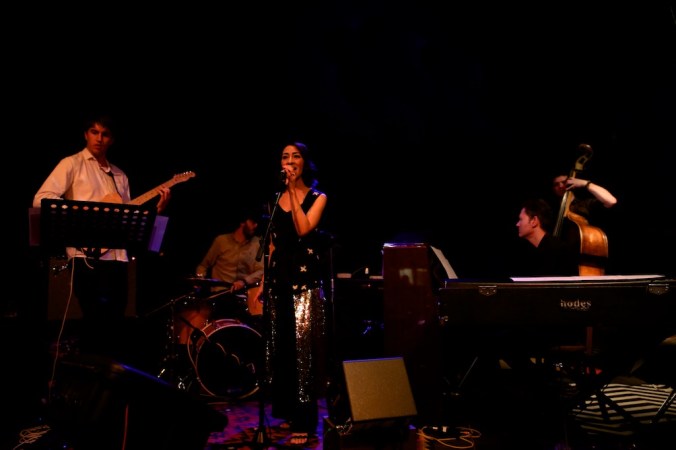 If her choice of a first number was to make a bold statement, then she succeeded admirably. Stepping out from behind the black curtains, accompanied by a shimmering Rhodes, she embarked on her engrossing journey. The first few bars of her ‘Desert Remains’ were straight out of the Sufi Jazz tradition; it was a call for universal tolerance: arising from her belief that music provides a pathway to transcend the banal. Almost imperceptibly, the tune became a love song, settling into new and funky rhythms. This was a nice piece of writing and the rhythmic interplay gave her much to work with. The influences in many of her compositions are generational; Stevie Wonder, Michael Jackson, Brian Wilson and of course her indigenous roots. All of this is filtered through a Jazz lens. Although her approach is modern, she doesn’t shy away from the traditional fare of Jazz singers.
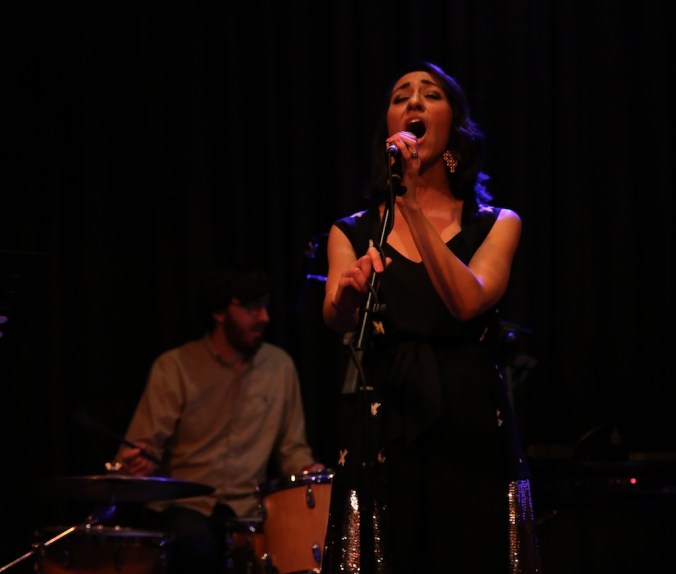 Looking to popular music for new material is not a recent phenomenon for Jazz vocalists. Ella tackled ‘A Tisket a Tasket’, Louis appropriated a multitude of pop songs. The great American songbook is a selection of one-time popular songs. It is what Jazz musicians do; explore, steal and transform. The more diverse the influences the richer the music. When she tackled the lovely Jazz standard ‘Detour Ahead’ (Ellis/Frigo) she owned it completely. That hint of smokey voice, that delicate phrasing; being adventurous while showing deep respect to the composition. It was hard not to think of Norah Jones; an artist who is traditional and modern in equal parts. I would also give her top marks for her set list; the numbers included ‘The look of love’ (Burt Bacharach), ‘God only knows’ (Brian Wilson), ‘I’ll be free’ (Donny Hathaway) and of course her own compositions and one of Kevin Field’s.
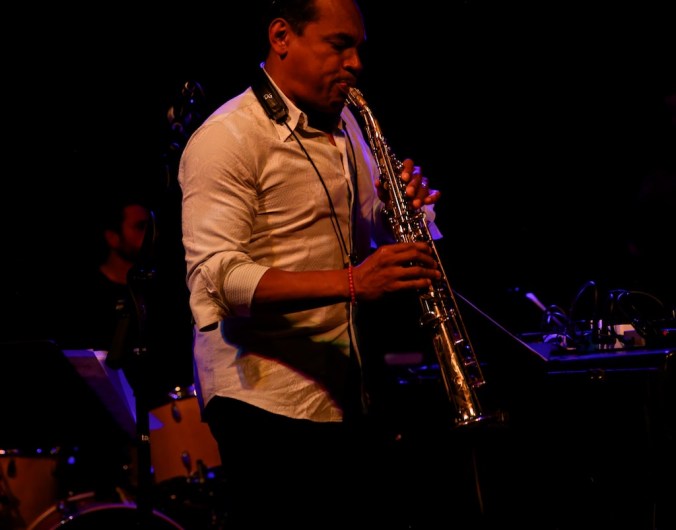 Behind the doors of the beautiful Kauri villa, down the long corridor and the wide descending staircase, past the crush of people eagerly awaiting a significant and unique musical event, we edged forward; shuffled by the crowd, finding ourselves in a surprisingly large room; large enough to hold seventy people, a gorgeous warmly lit room with mirrored walls – an old dance studio brought back to life. As we crossed the room Jay Rodriguez greeted us, behind him, Jonathan Crayford shuffled through sheet music; both framed by an elegant grand piano and an array of horns on stands. I had interviewed Rodriguez earlier and had attended his sell out gig at the CJC Creative Jazz Club. There was never any doubt that this night, like the one a few nights earlier would deliver something special.
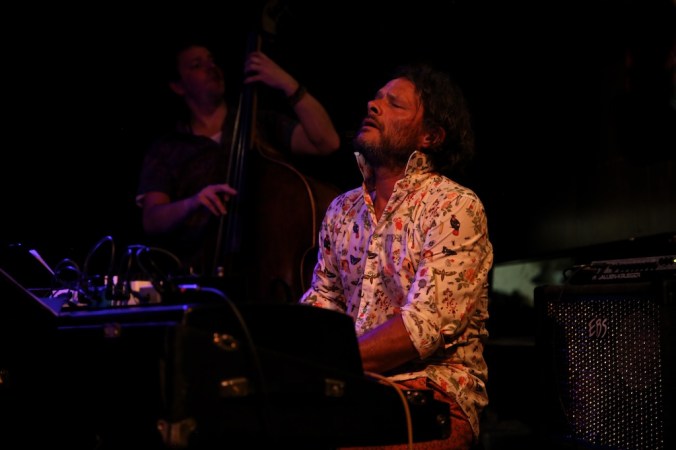 If ever two musicians were destined to play duo format, it is these two. It is a challenging format as the safety nets are gone; it is deep level communication and frighteningly intimate. It requires deep listening and empathy as much as storytelling; it requires conversational dexterity. This was a night never to be forgotten, a night when great music became sublime. Rodriguez and Crayford have been friends for a long time, meeting up in New York in the late 90’s and forming an instant connection; Rodriguez’ ‘Groove Collective’ and other projects the meeting ground. They refer to each other as musical brothers and their communication during the last three days underscored that.
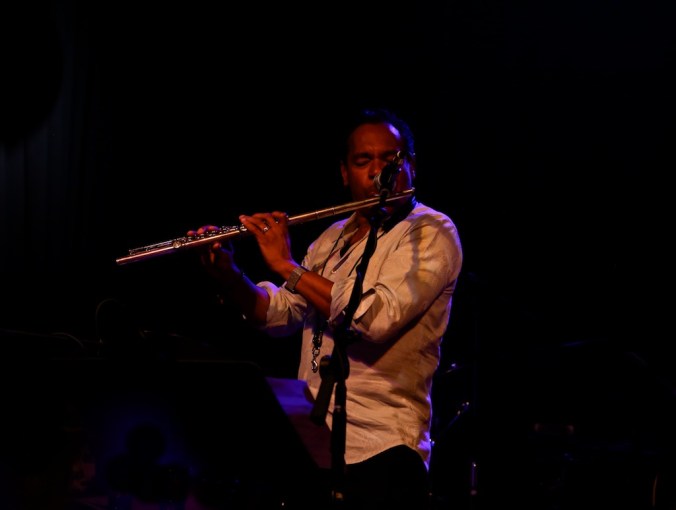 The first time I saw them together was around eight years ago. The gig stuck in my mind for many reasons, but especially because of one tune; Bob Dylan’s ‘I pity the poor immigrant’. It spoke directly to me as it oozed with humanity. When I interviewed Rodriguez I teased out this a theme; pointing to the set lists, the tunes which cut to the heart of the human condition, tunes communicated with deep empathy. For example, their rendition of Keith Jarrett’s ‘The rich (and the poor)’, Coltrane’s ‘Alabama’. The former, a blues, reminding us that the blues is more than just a musical form. In their hands, it informs us about inequality, discrimination, hurt and hope. The human condition again. The latter, ‘Alabama’, moved me to tears. Jazz lovers know this story, but it has seldom been told so well. The piece is based on the cadences of a Martin Luther King speech, a speech given immediately after four little girls were killed as they worshipped, murdered by an unrepentant KKK. The musicians dived straight into the emotion of this awful tale; the incomprehension and anger, then a plea for humanity, an exhortation to do better, the hope; it was all in there.
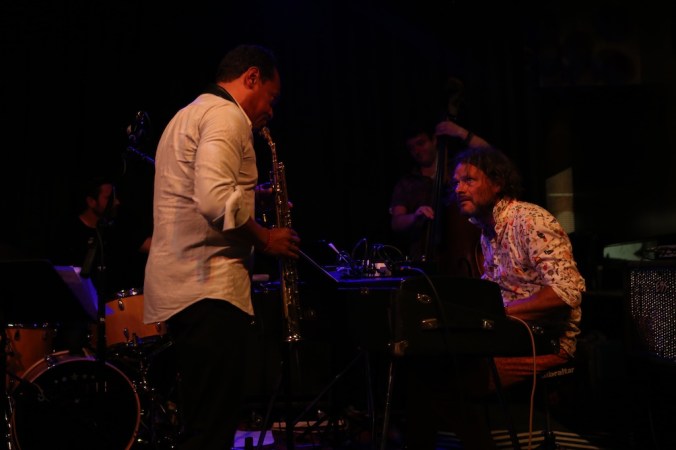 He is a multi-reeds and winds player and his command of each instrument is strong. I asked him if he favoured one horn over another or had been tempted to double less? This was prompted by a similar discussion with Bennie Maupin. Maupin’s answer had cut to the point, “It’s mostly about dedication, hard work and five times the amount of practice”. Rodriguez answer was a little different. “Man, I love these instruments, every single one of them, and I couldn’t abandon any of them”. It is impressive to hear an artist sounding so strong and so individualistic on so many instruments; bass clarinet, tenor saxophone, soprano saxophone, flute (he also doubles on alto and baritone saxophone). His bass clarinet is rich and woody with a tone production like John Surman – his tenor can range from low down raspy bluesiness to the light vibrato-less sound of ‘Pres’; and all of this in a clear authentic voice.
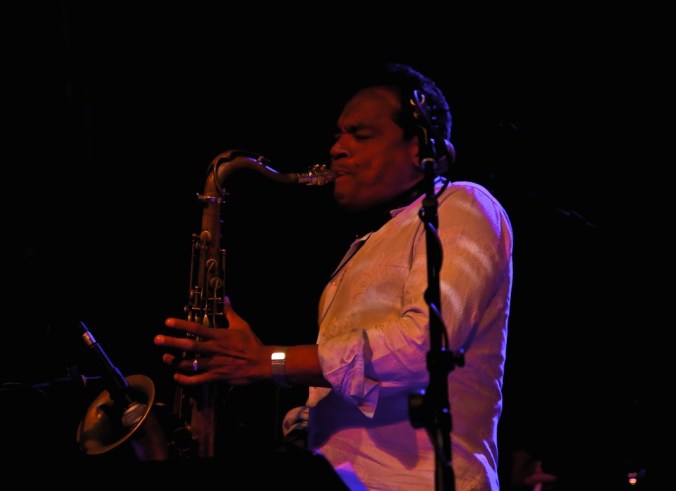 During the dance studio gig, their song choices delighted and astonished. For example, Monk’s ‘Epistrophy’, A Puccini aria, Michel Legrand’s ‘You must believe in spring’, McCartney’s ‘Long and winding road’; all in all an improbable and extraordinary journey. The CJC set list included Yusef Lateef’s stunningly beautiful ‘Morning’, Victor Young’s ‘Golden Earrings’ Keith Jarrett’s ‘Rich (and the poor man)’ – from the Dewey Redman/Jarrett/Haden Impulse era, John Coltrane’s ‘Alabama’ and a lovely original by Rodriguez (I think it was titled ‘Your Sound’). Mostyn Cole and Ron Samsom were amazing as well. They are both fine musicians and a good choice for this line-up.
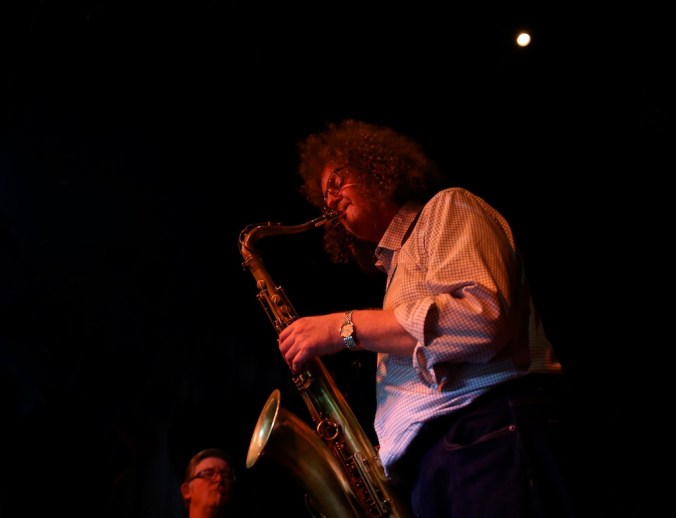 The popularity of ‘hardbop’ is enduring but we seldom hear it on the band stand. The probable reason is its very familiarity; if you play this music you will be judged against the source. There is also the evolutionary factor: improvised music strives to outlive its yesterdays. It is even less common for musicians to write new music in that idiom or to create a vibe that calls back the era. Such an enterprise invariably falls to experienced musicians; those with the wisdom to reverence the glories without it being merely slavish. Booth and Walters are especially well suited to that task. They have the chops, charts and the imagination and above all, they make things interesting. If you closed your eyes during this gig, you could easily imagine that you were listening to an undiscovered Blue Note album. It was warm, swinging and accessible.
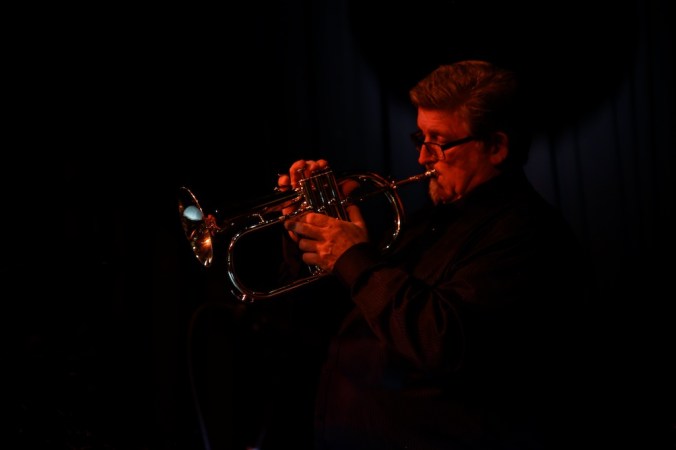 Booth and Walters are gifted composers and on Wednesday the pair reinforced their compositional reputations. Some of Booth’s tunes have appeared recently in orchestral charts. Walters’ tunes while heard less often are really memorable (‘as good as it gets’ stuck in my head a long time ago). These guys write and arrange well. Notable among Booth’s compositions were ‘Deblaak’, “A Kings Ransome’ and ‘On track’. From Walters; ‘Begin Again’, ‘Queenstown’ and ‘Wellesley Street Mission’. There was also a lovely version of the Metheney/Scofield ‘No Matter What’ from the ‘I Can See Your House From Here’ album. I have posted Booth’s ‘A Kings Ransom’ as a video clip, as it captures their vibe perfectly. Booth has such a lovely burnished tone – a sound production that no doubt comes with maturity and a lot of hard work.
 The last number was Walters ‘Wellesley Street Mission’ and I would have posted that, but my video battery ran out. This is a clear reference to the appalling homeless problem which blights our towns and cities. The bluesy sadness and the deep compassion just flowed out of Walters’ horn – capturing the issue and touching our innermost beings, challenging our better selves. I may be able to extract a cut of this and post it later – we’ll see!
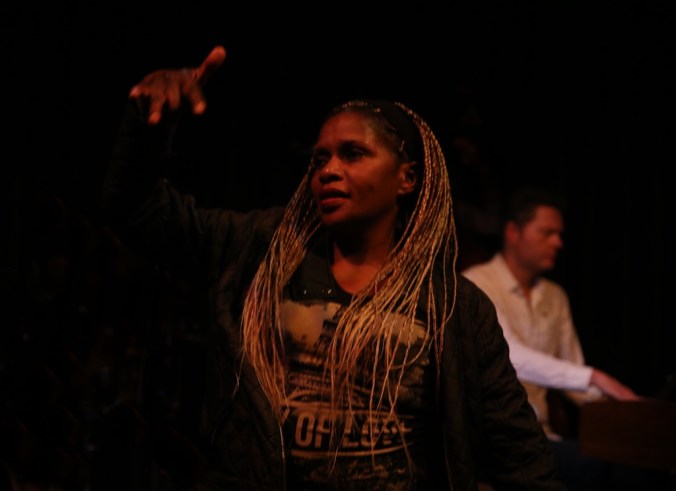 Lastly, there was that mysterious dancer, appearing from nowhere, drawing sustenance from the music until the street swallowed her again.
 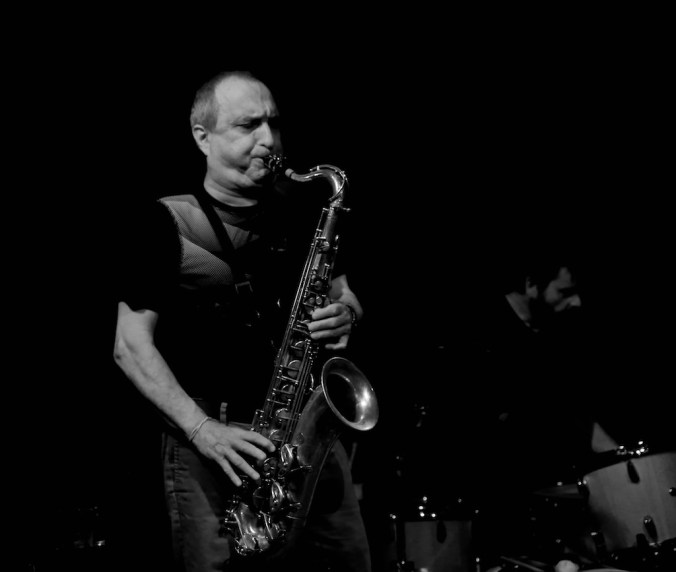 Roger Manins uncoupled the microphone and looked around the club. It was winter outside but you wouldn’t have known it. The windows were steamed up from the heat of a capacity crowd; all eyes were fixed on the stage and the stocky man holding the tenor saxophone. “You know how lucky you are …. right,” Manins asked the audience? A loud cheer went up accompanied by whistles and foot stomping. George Garzone was in town and no one was in any doubt.
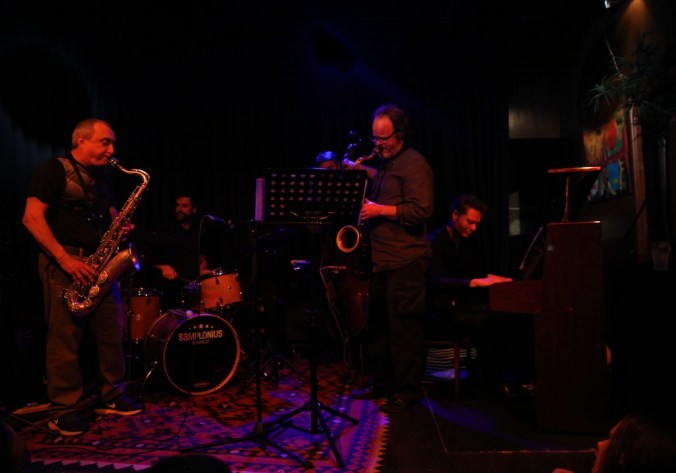 Most of the tunes were in long form and most were Garzone originals. All were perfect for the occasion. As you might expect, the Garzone tunes were springboards for deep improvisation; the heads, however, were memorable and so well-arranged that they stood out. I failed to catch all of the titles because the applause often drowned out the announcements. There was a catchy tune referencing Bourbon Street, A moving tribute to his friend Michael Brecker and a tune titled ‘The Mingus that I know’. They all had pithy stories attached. The two standards were Billy Eckstine’s ‘I want to talk about you’ and a wonderful earthy take on John Coltrane’s ‘Impressions’. I read somewhere that Garzone plays like he talks, in a Bostonian/Calabrian dialect. The cadences and rhythms of speech are part of who we are, it is, therefore, logical that they encompass how musicians express themselves and especially on a vocal instrument like the saxophone.
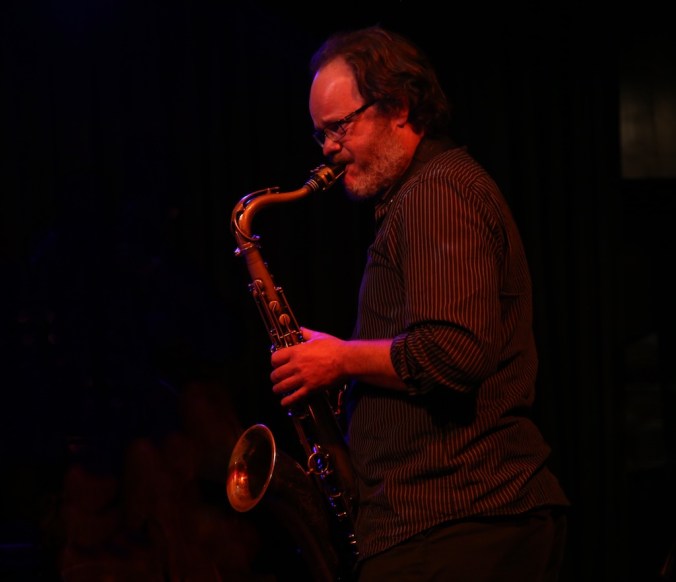 His pick up band were Kevin Field, Ron Samsom, Mostyn Cole and Roger Manins. Like every international who passes through, he heaped praise on the local musicians. Coming from Garzone this really counts. He and Manins go back a way and the synergies between them are evident (the Garzone influence is worldwide and Manins is no exception). Whether playing in unison or in counterpoint, they sounded right together – tenors who knew just how to compliment or when to keep clear. This was a very big sound and when trading fours they cajoled each other as friends might. The rhythm section was energised as well; Cole, Samsom and Field providing rhythmic and harmonic trickery. And at one point, ‘Hey great, I heard some Salsa in that solo’, said Garzone looking in Fields direction.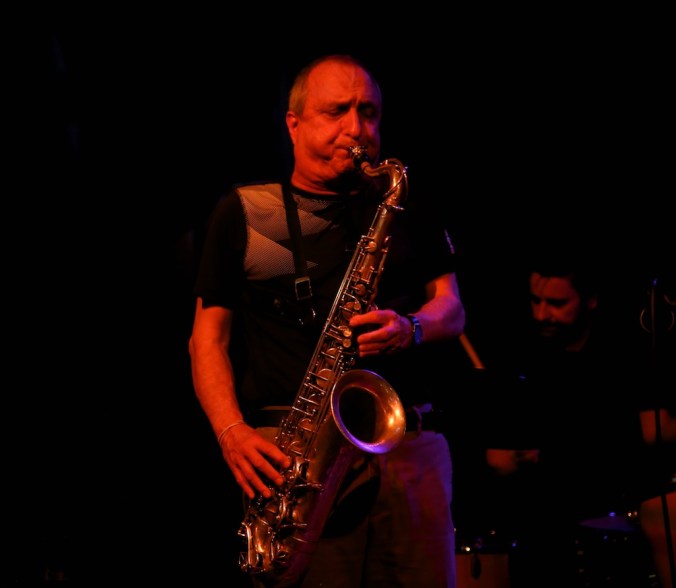
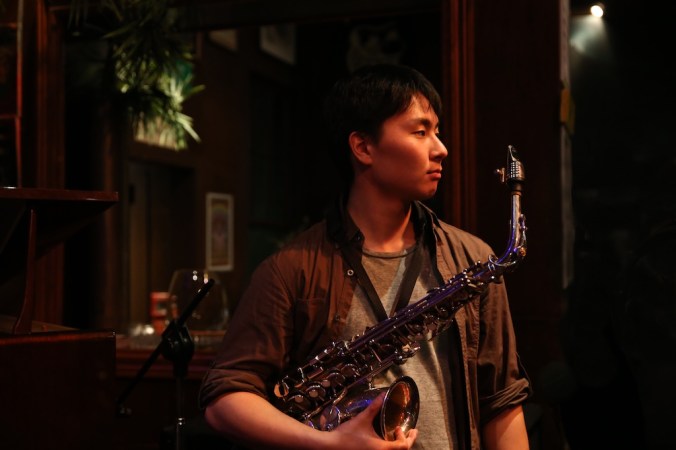 Last week brought us another emerging artist’s gig and this time it featured a Wellington band followed by an Auckland band. Each brought different aspects of improvised music to the bandstand and in a very nice touch, jammed together at the end; a happy meeting place between approaches. With so many international acts scheduled over coming months, it was great to see these young emerging bands given a shot: Again, this was good programming by the CJC.
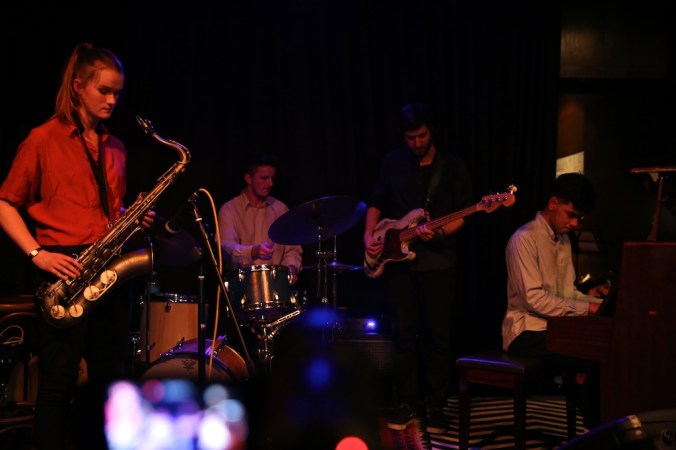 The Leo Coghini Quartet from Wellington took a straight ahead approach and it was obvious from the first number by Coghini, a solo rendering of ‘It Could Happen To You’ (Van Heusen/Burke), that he was an interesting pianist. He is classically trained, but with a good feel for swing oriented tunes. There were some nice originals in the set, but they were most comfortable on standards. I particularly liked the way they played Parker’s latin infused classic ‘My Little Suede Shoes’, also Kenny Garrett’s ‘Wayne’s Thang’. Both were approached in interesting ways (especially the nicely phrased Parker tune). The last number the quartet played was Stevie Wonders swinging groove classic ‘Isn’t She Lovely’ (which I have posted).
 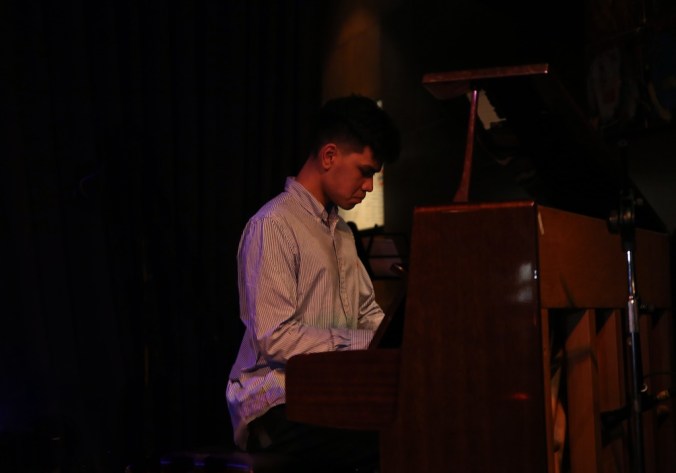 In relation to ethnicity and gender, the modern New Zealand Jazz scene is increasingly reflective of the wider population; It is, therefore, good to see women picking up instruments that were once regarded as being exclusively in the male domain. Louisa Williamson was up front on tenor. She overcame some initial nervousness and played well. The other band members were electric bassist Zane Hawkins and Jeremy Richardson drums (both accomplished players).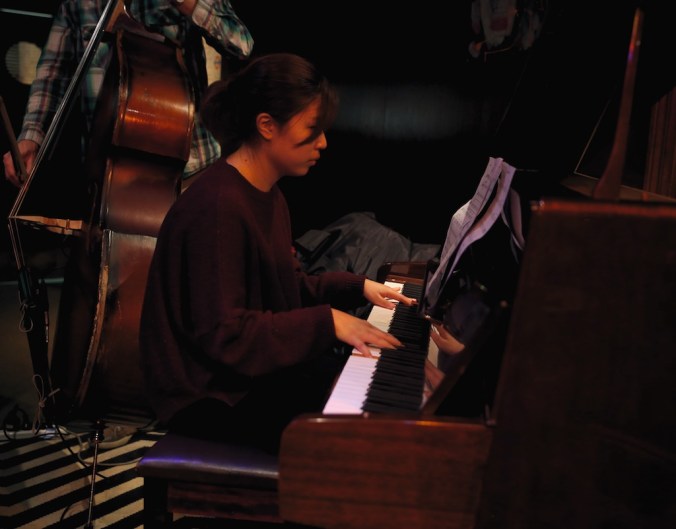
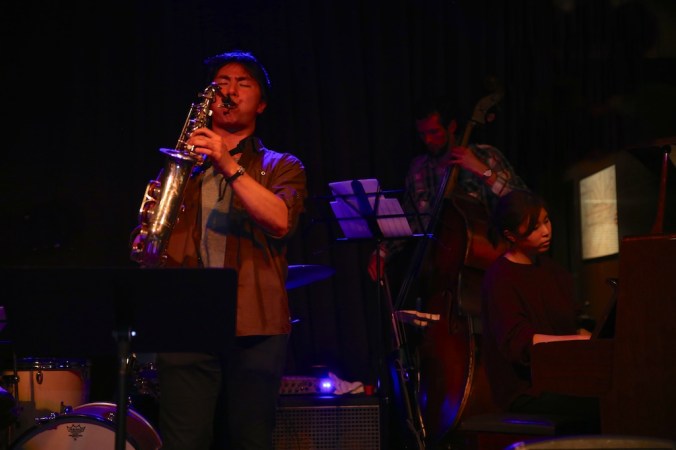 The tune ‘Within Hymn’ had clear references to Coltrane, but it was also interestingly modern. Although there were distinct parts to it, the piece made more sense as an entirety. It began with a bold statement on the horn, then unwound as it momentarily descended into chaos; next came the body of the piece, a building story, a probing at an idea, then changing again and ending with a climax. None of this would have been possible without the right support. Crystal Choi’s percussive chromaticism as she stabbed at the keyboard, the fourths, dissonant flurries; sometimes swinging as if to provide a counterbalance. Her solo was immaculate and each time I hear her now I’m amazed. Watching her musical journey encompass the avant-garde end of town and everywhere on the way is a treat.
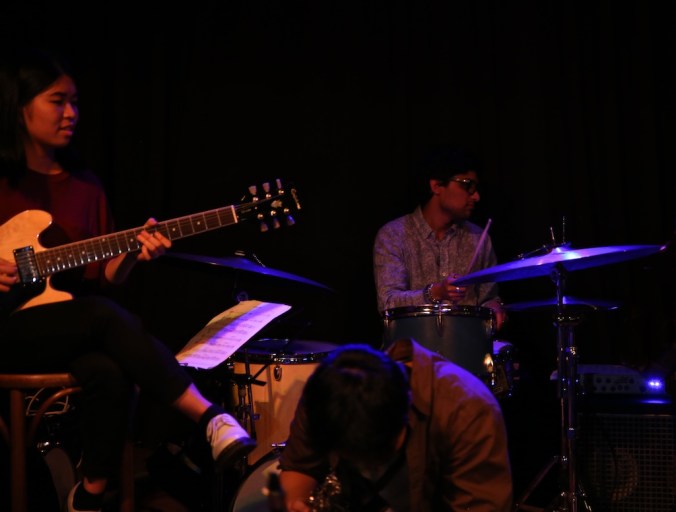 It was not just Choi who made this work, but Denholm Orr and Dean Rodrigues as well. Watch the clip through and judge for your self – these guys are amazing. Now a few bars of arco bass, now free or walking bass, and all the while, edgy polyrhythms dancing underneath. I was also pleased to see Kathleen Tomacruz on guitar – a very credible first gig for her.
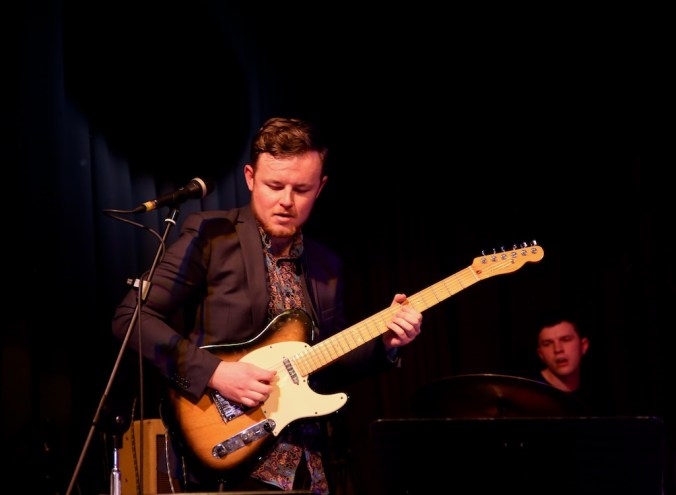 During the first half of 2017, a significant number of respected international artists and established local artists appeared at the CJC Creative Jazz Club. While everyone enjoys such a cornucopia of riches, it is also important to keep sight of emerging artists, those who are just below the radar. No local venue manages to showcase the rich diversity of improvising talent as well as the CJC. This is no accident, as there is a guiding philosophy behind the programming of gigs. No artist, however good, gets an ongoing residency; the gigs, therefore, are different every week, are identifiable projects, and this keeps the audiences engaged. An important part of this is showcasing emerging artists.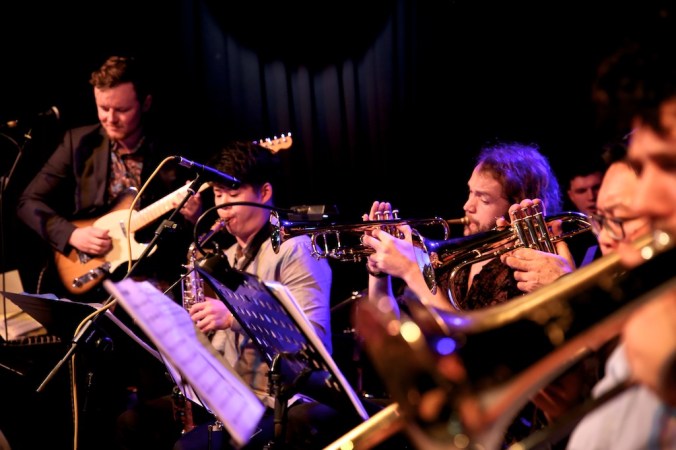
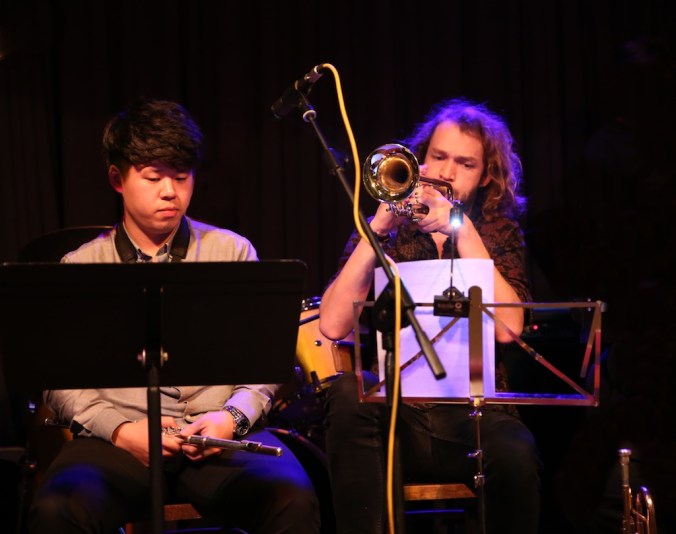
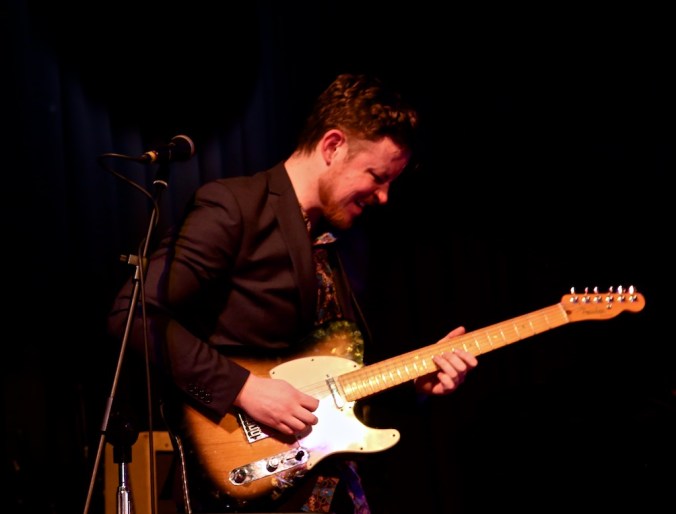 The first number was ‘Tulle’ from the Scofield album, after that we heard a number of his own compositions interspersed with standards. His ‘Who is Kenneth Meyers?’ appealed as did an angular rendition of ‘Surrey with the Fringe on Top (Hammerstein). Given the project in hand, it was unsurprising that he included ‘Boplicity’ by Miles Davis; ‘Birth of The Cool’ being the springboard from which all such arranging sprang. In the second half we heard trumpeter Mike Booth’s ‘Major Event’ – Booth is a skilled arranger and an experienced ensemble composer. It is possible that he has also influenced Swindells’ direction.
 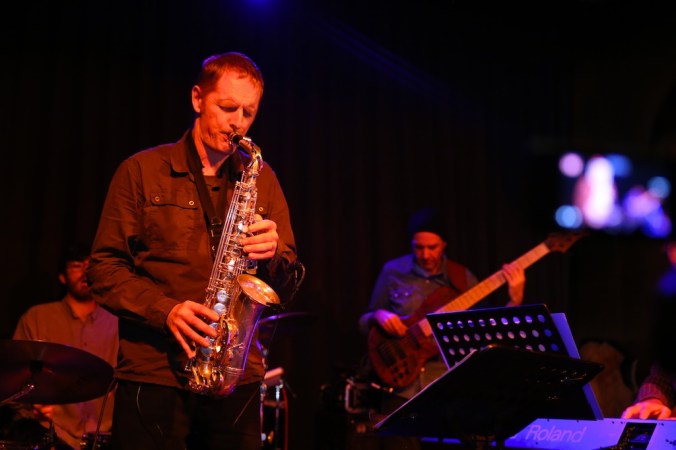 Hearing people talk about the Chris Mason-Battley Group reminds me of the Hindu parable – the blind man and the Elephant. “Oh yeah, that guy has a smooth sweet sound’ one said as if that settled the matter. Well yes, he has got a smooth sound when playing a ballad, but anyone who thinks that defines his music has simply not been paying attention. This band has enormous depth; playing anything from a melodic ballad to music that is way off the grid. What we experienced on Wednesday was music with integrity; at times raw and inventive, drawing us into its heart, emotionally engaging and above all satisfying.
 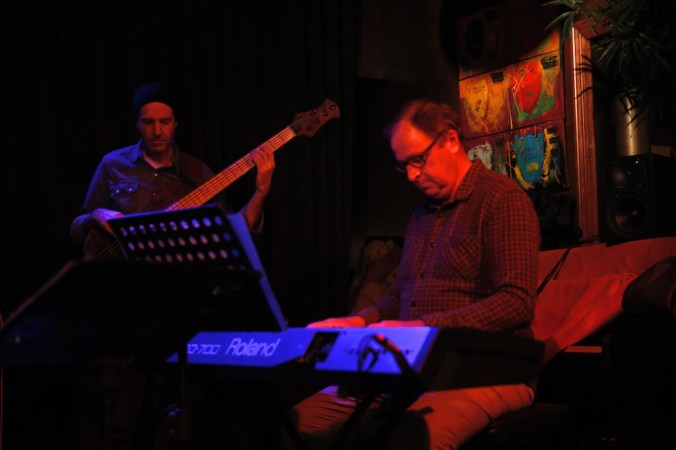 The first number was ‘Mountain Song’ (by CMB); then they moved to a series of pieces from the CMB John Psathas project ‘Dialogos’ (progressing through excerpts from ‘Song for Simon’ and ‘Demonic Thesis’). As that set progressed we heard a new composition or two and lastly ‘Tahuna Caravan Park’ from his ‘Two Tides’ album. This gave us a broad sweep of his past projects and the Psathas album in particular. Dialogos was widely acclaimed as an exciting and bold step forward for the band – I can highly recommend the album (out on Rattle). Before the band left the stage for a break, Mason-Battley said; “That was the nice half – the second set is nasty half” (quoting from an album titled ‘The Jaberwocky comes to Town’ which had a ‘nice side’ and a ‘nasty side’.)
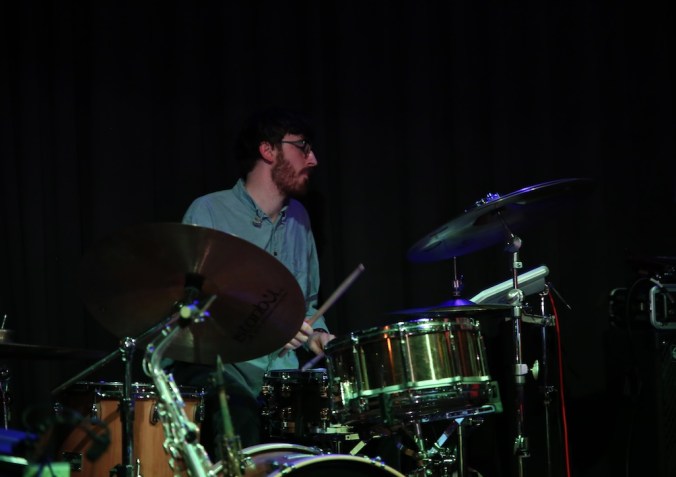 As pleasing as the band were in the first set, they reached much deeper for the second; pulling out an utterly engaging and masterful performance. It began with several of the blacker pieces from ‘Dialogos’, ‘The Calenture Suite’. The drummer Stephen Thomas must be mentioned at this point – His work was integral to the overall performance and it underlined his maturity as a musician. At times subtle, at others incredibly complex – and all made to look easy in his hands. Thomas was extraordinary throughout and although a relative newcomer to this long-established band, his searing flames licked at their underbelly, an indispensible presence. In perfect contrast to the complex drum flurries was Sam Giles on electric bass. Giles is a master of the ostinato – repeated motifs, perfect time feel and the voodoo factor writ large. He is also an influence on the bands direction; favouring Zorn like explorations and paths less trodden.
 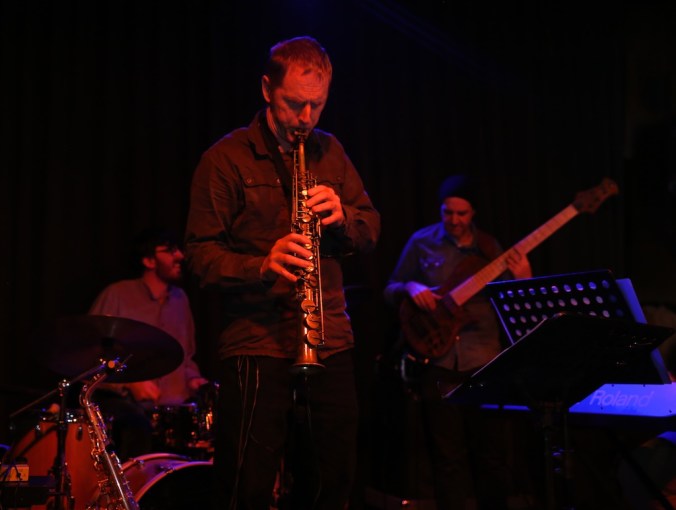 The CMB Group keyboardest is David Lines, an intersting and in my view under-rated musician. On this gig he played a Roland RD-700. What a beautiful piano and Rhodes sound. A machine hardly heard these days, replaced by the Nord Stage or modern Korgs. While the newer keyboards have more bells and whistles, I am unconvinced that their piano sound is an improvement. Perhaps it sounded so good because of Lines touch? He is not a busy pianist and every note counts, in this gig his often voice leading role was perfect for the project (his solos were stunning). I only wish we saw him more often.
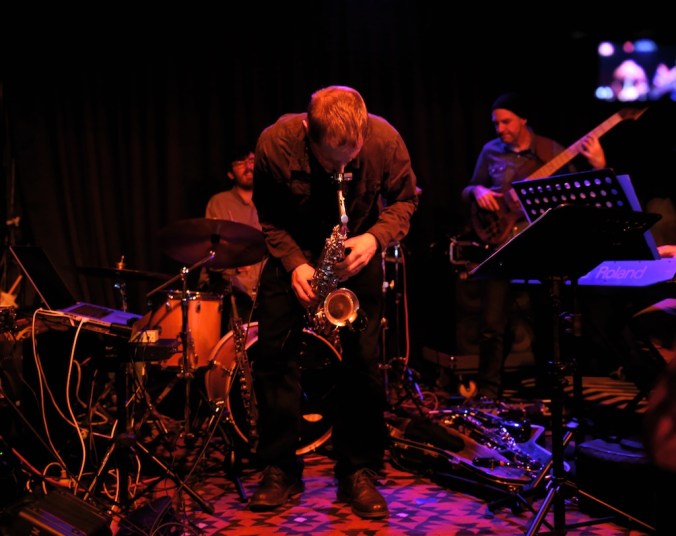 The last tune of the evening was free and political. It was titled ‘The Emperor Has No Clothes’; an obvious reference to the greedy authoritarian amoral elites that hold sway in the world; particularly the Trump administration. It was free and it was raw emotion – in the background a loop recited ‘billions and billions’ – then, faintly at first, we heard the strains of ‘The Star Spangled Banner’. The band read the mood of the audience well with that one – people stomped and cheered afterwards as if someone had taken the words right out of their mouths and rendered them into abstract musical form.
  JazzLocal32.com