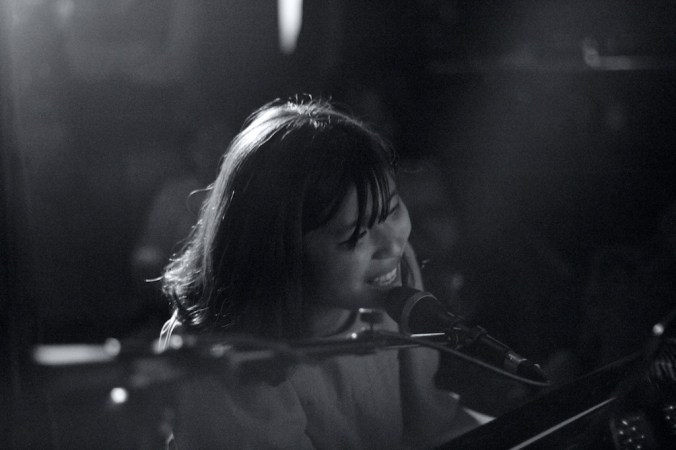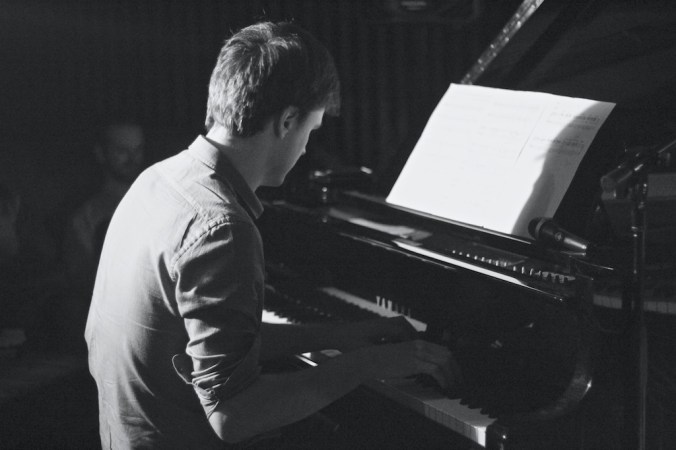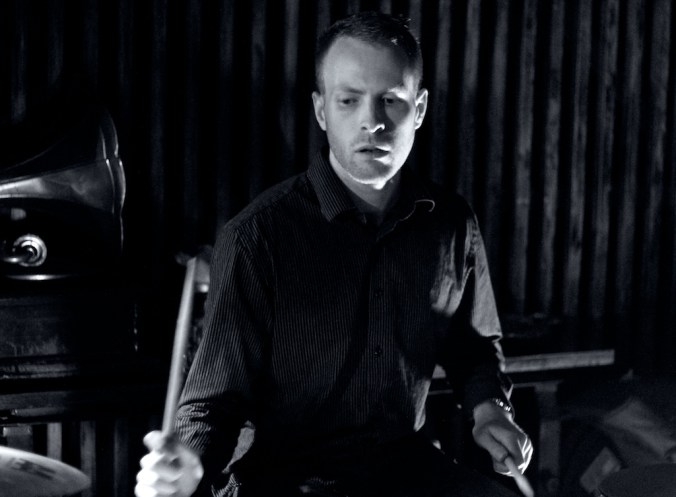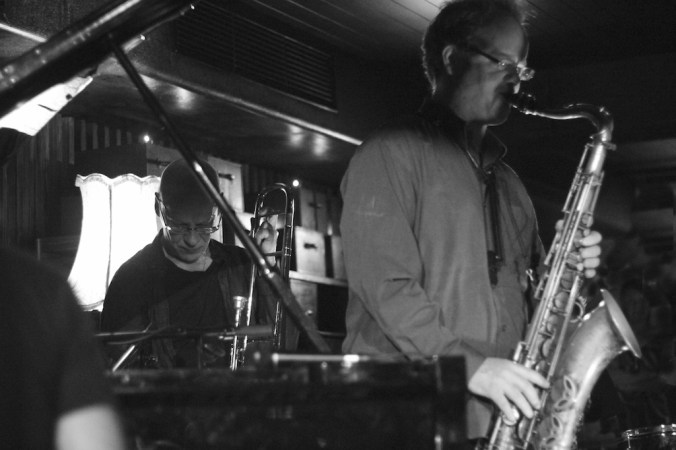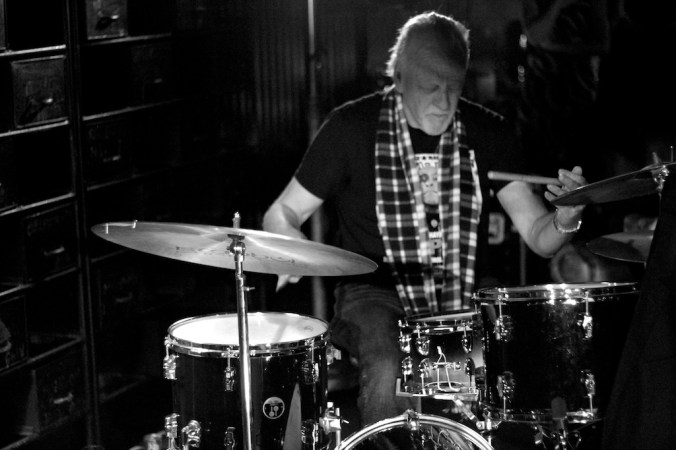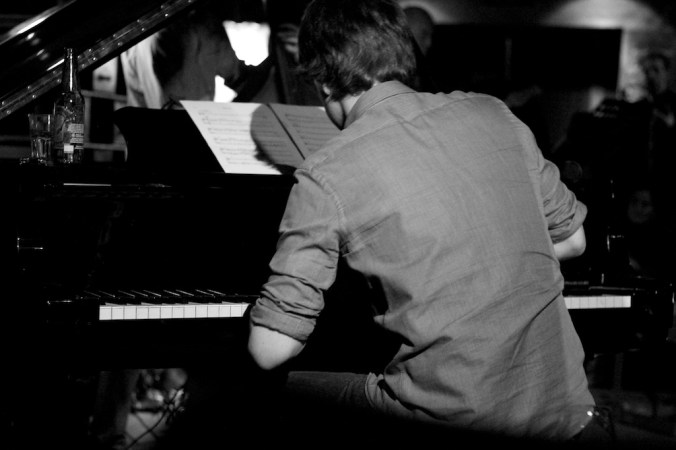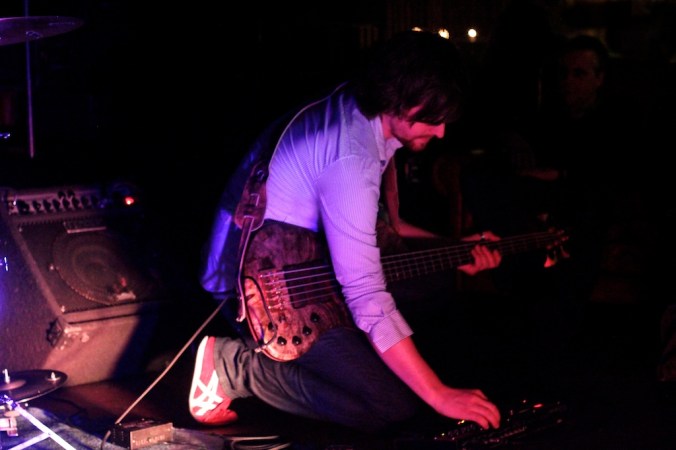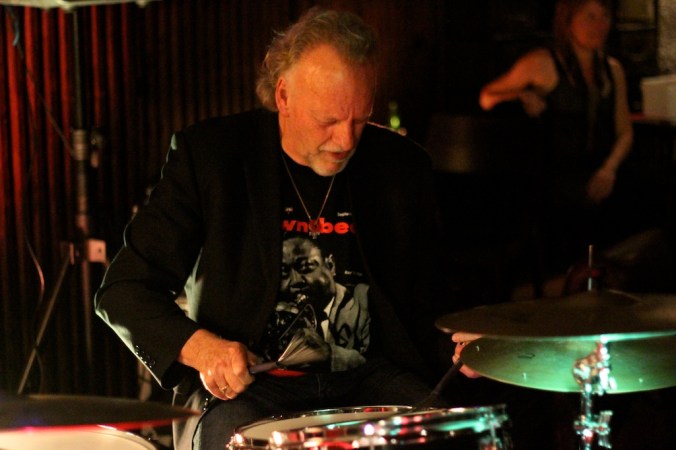
Hardbopmobile @ CJC Dec 2013

IMG_8879 - Version 2

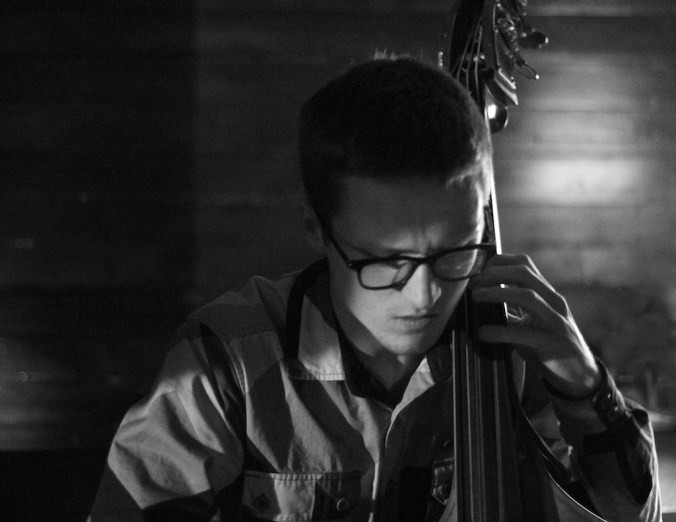
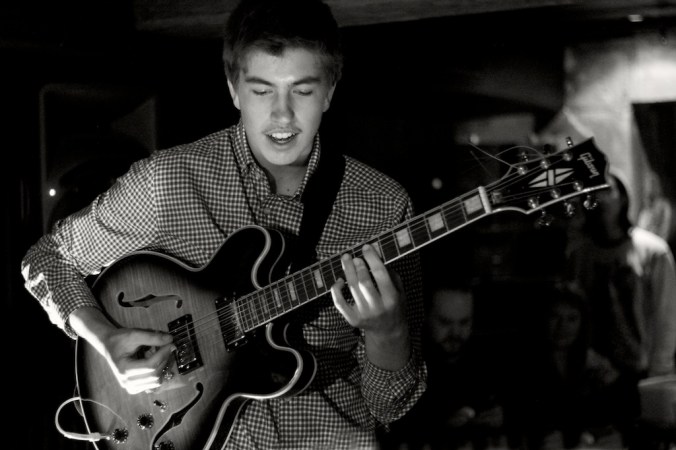
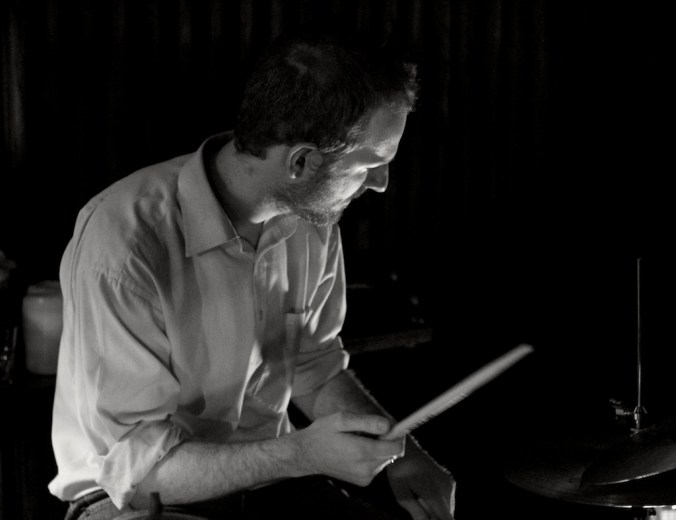
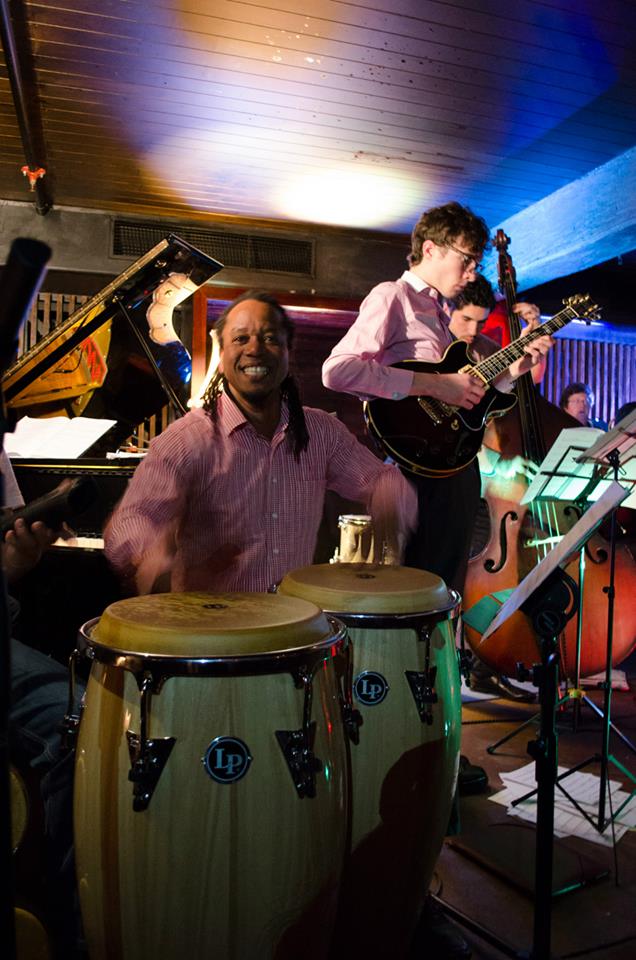
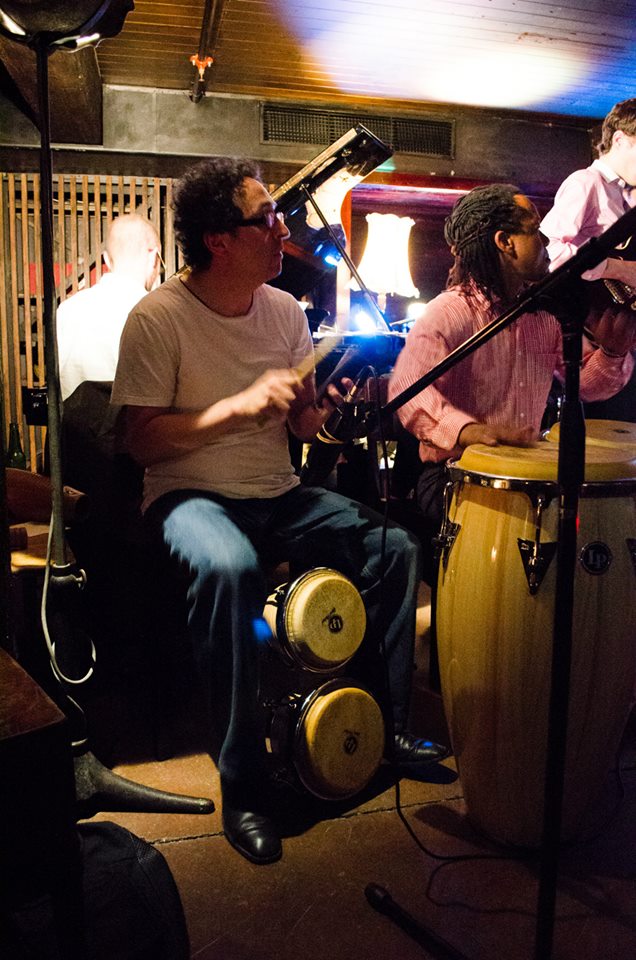
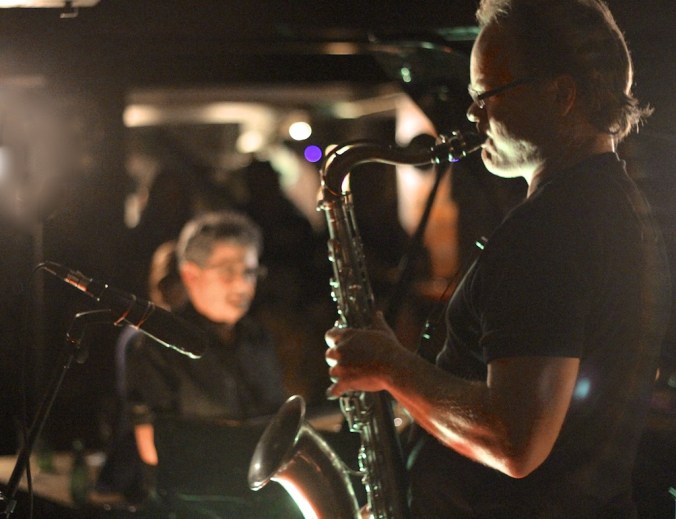
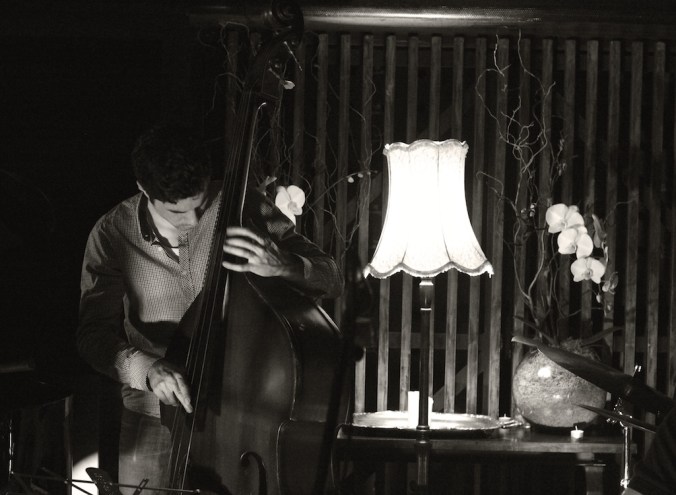
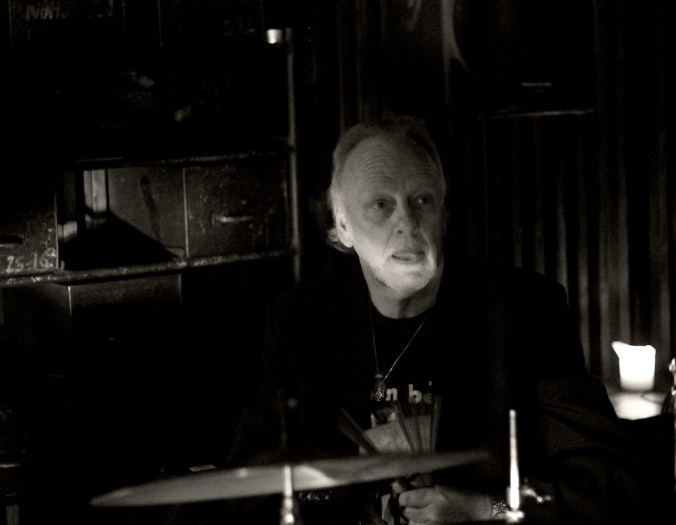
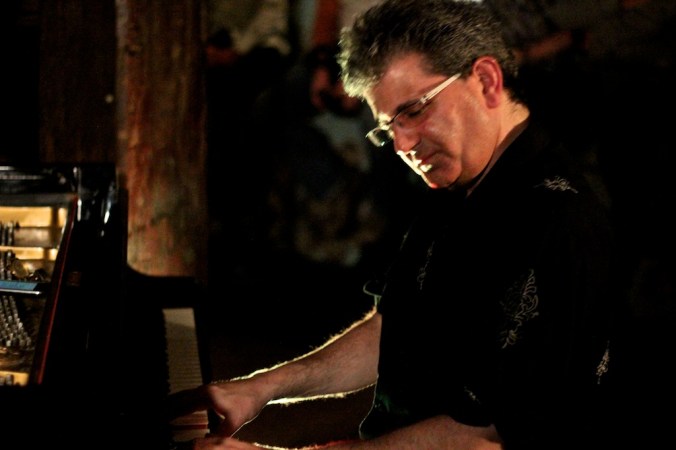
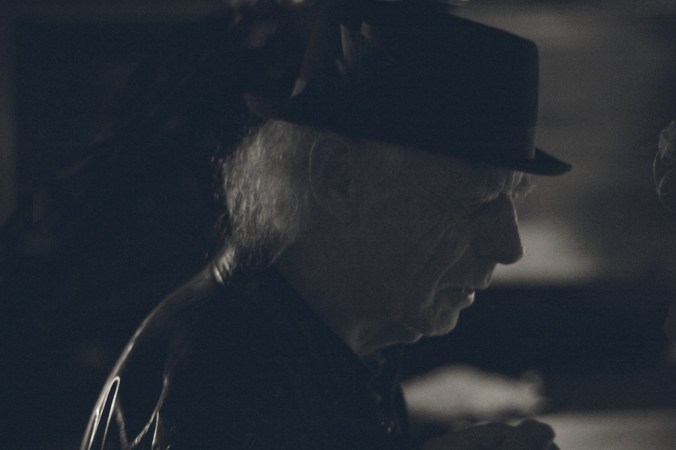
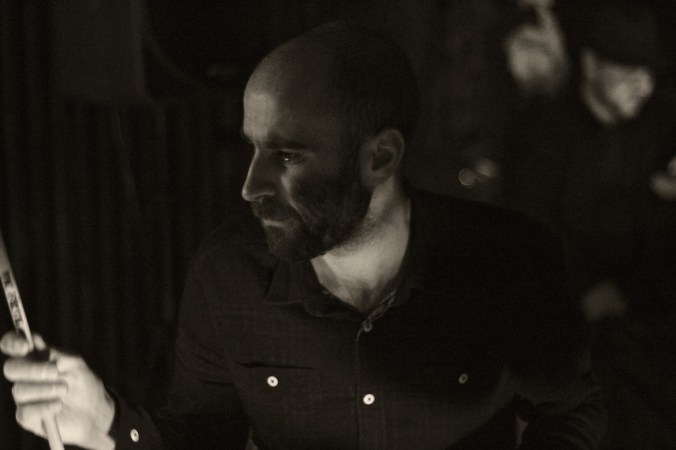
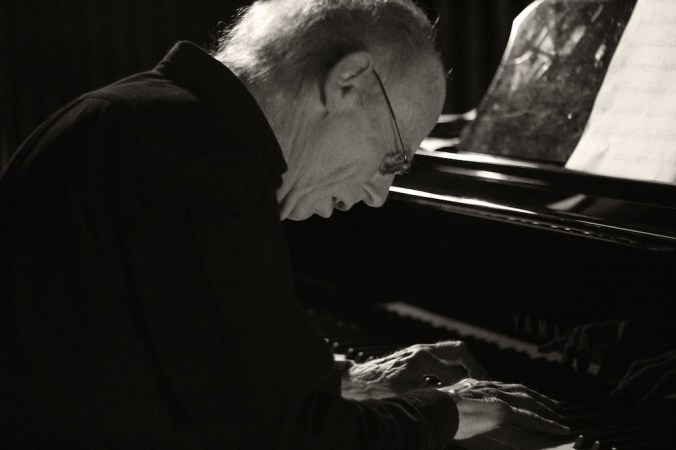
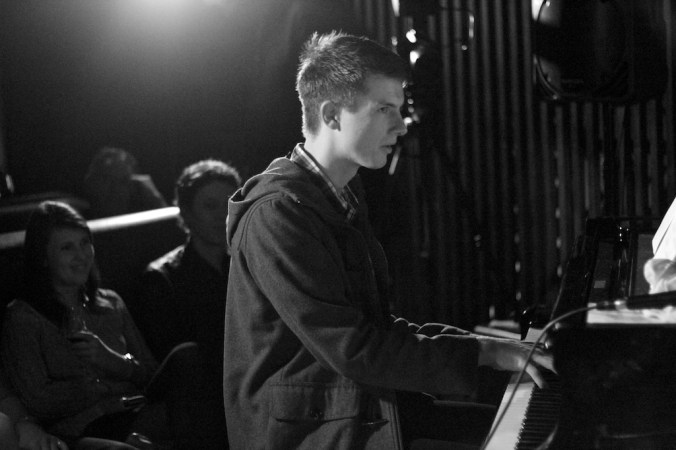
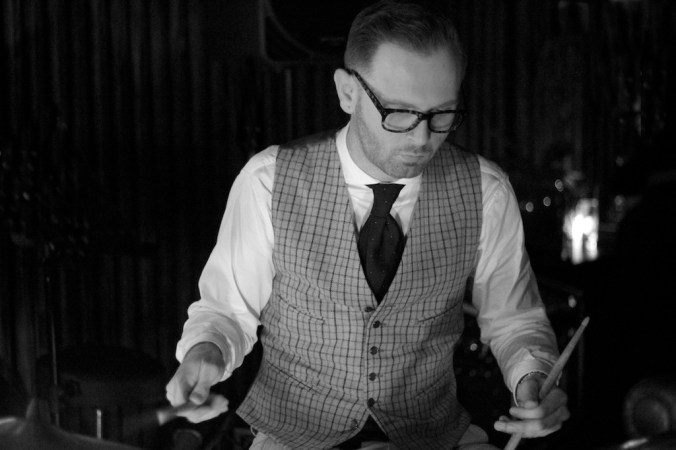
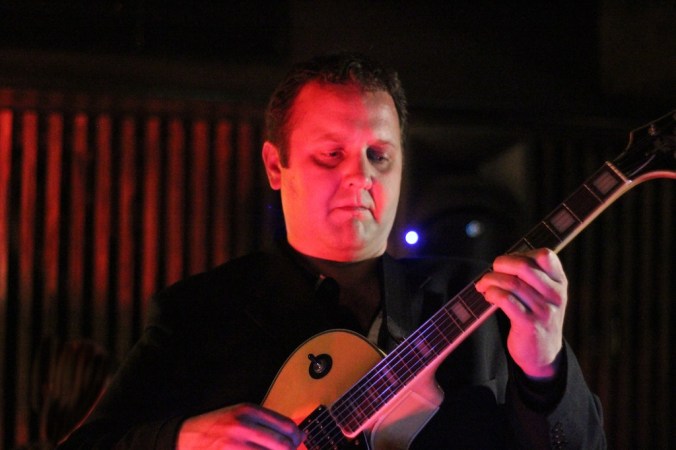
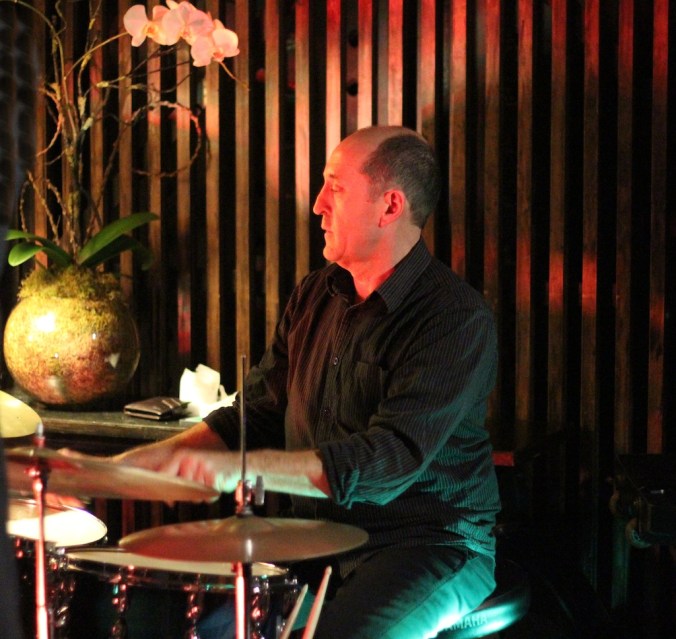
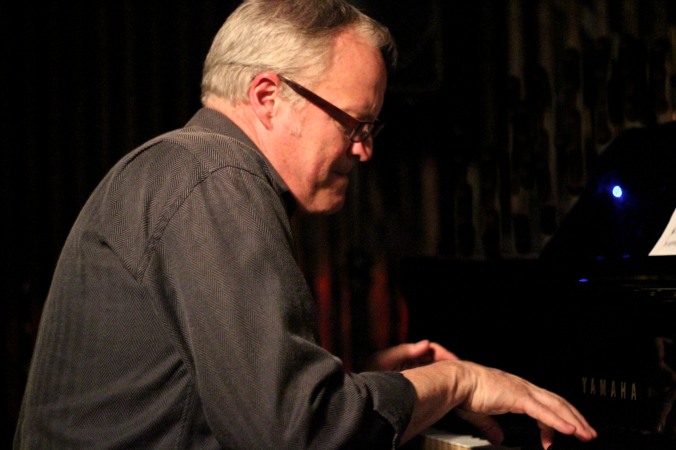
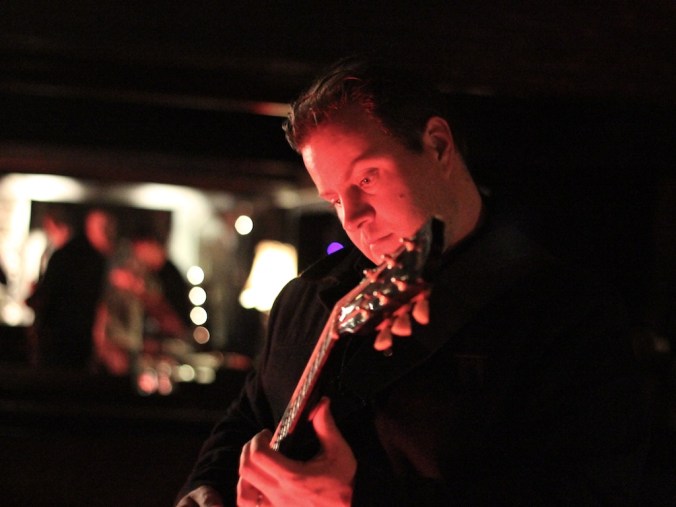
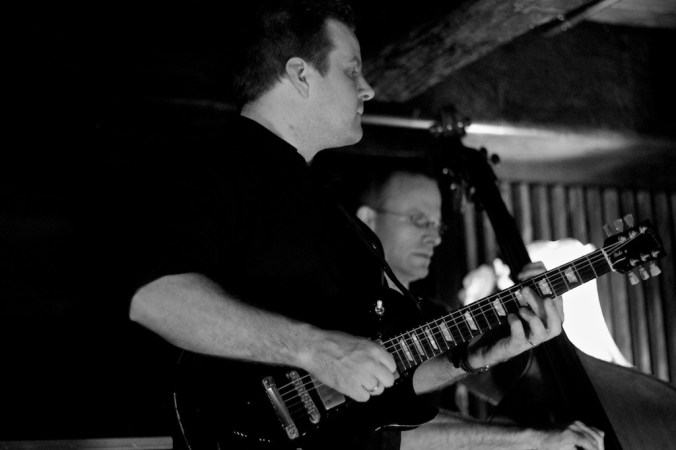
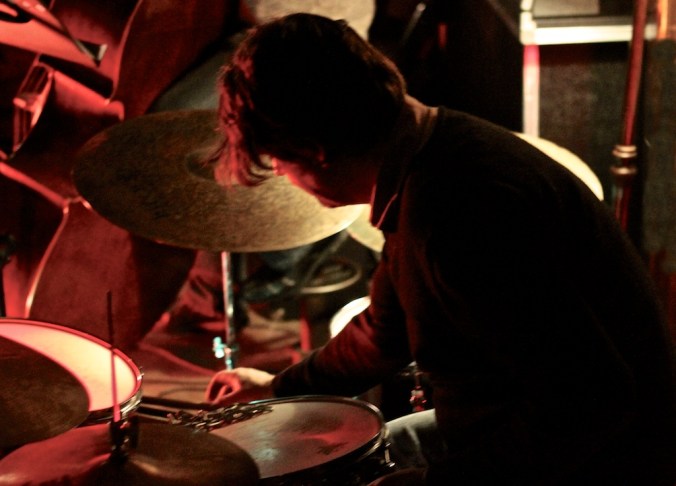
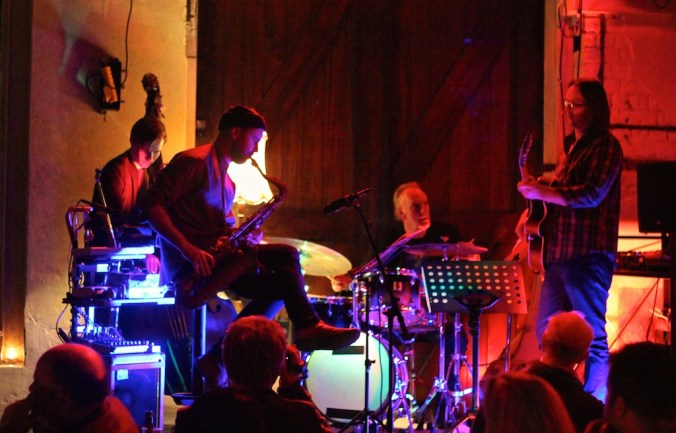
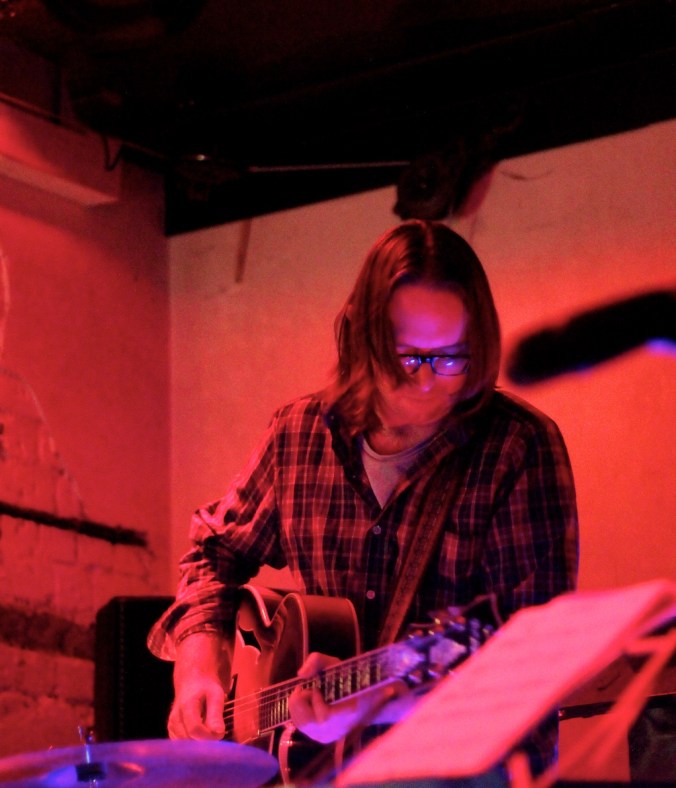
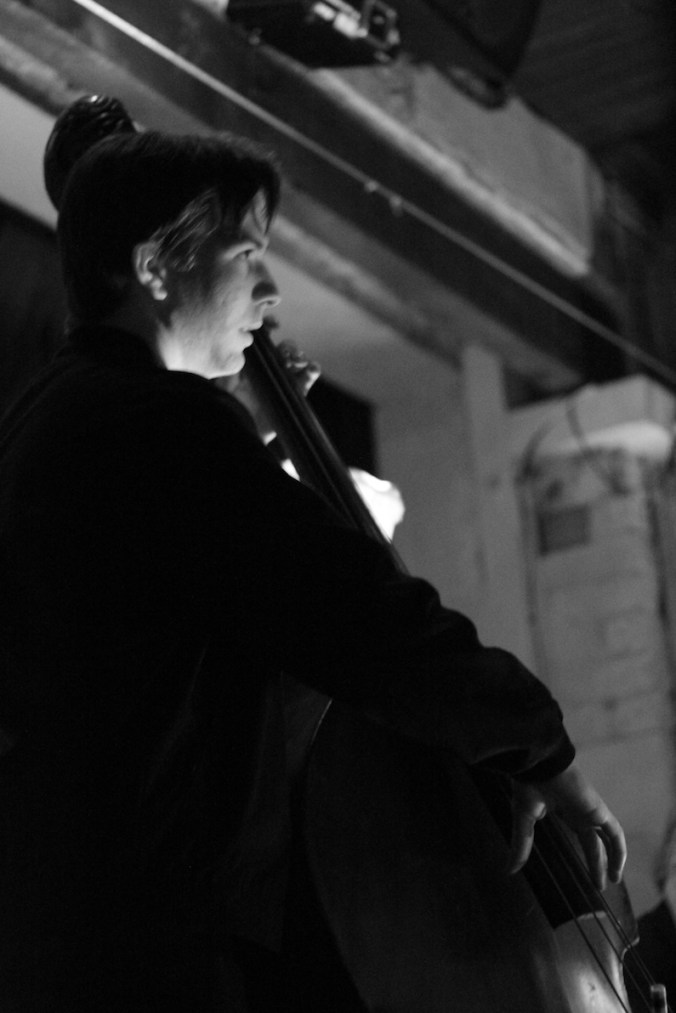
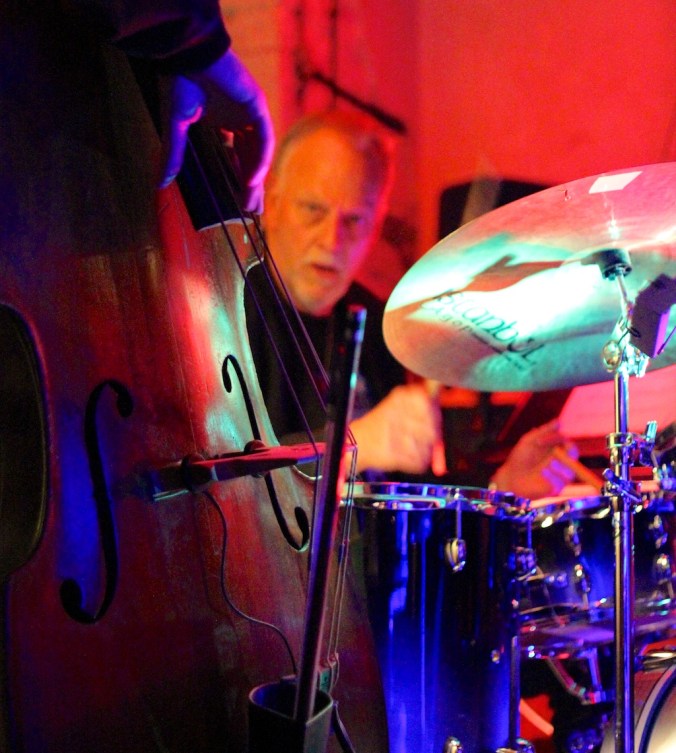
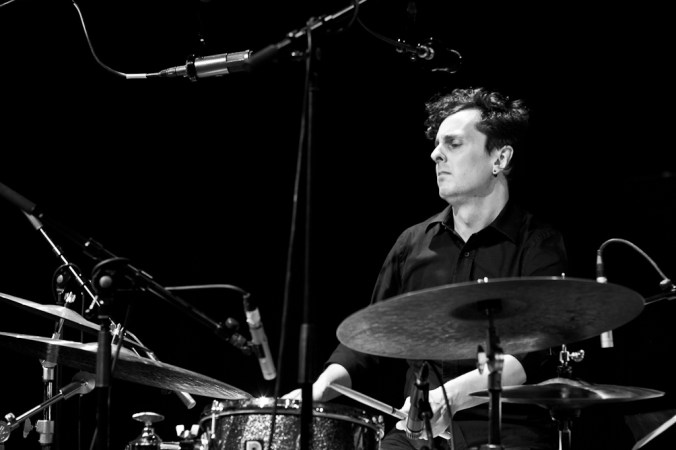
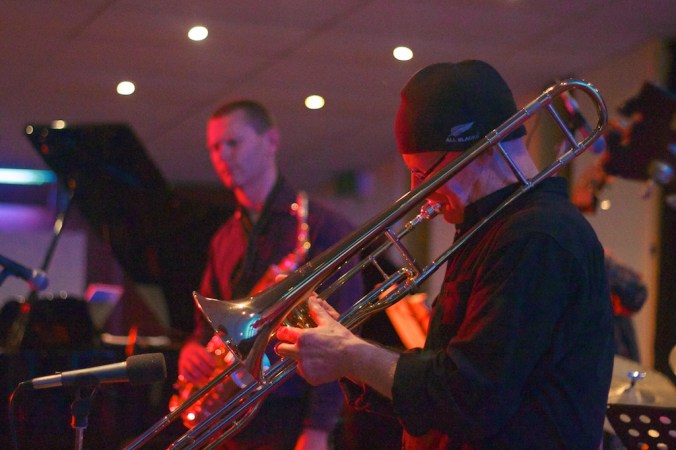
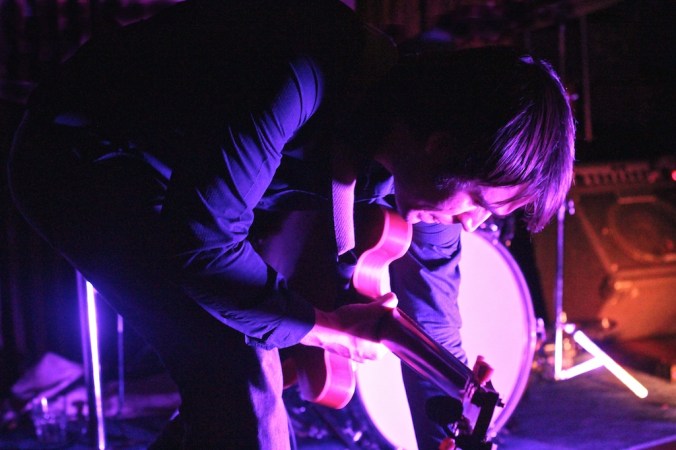
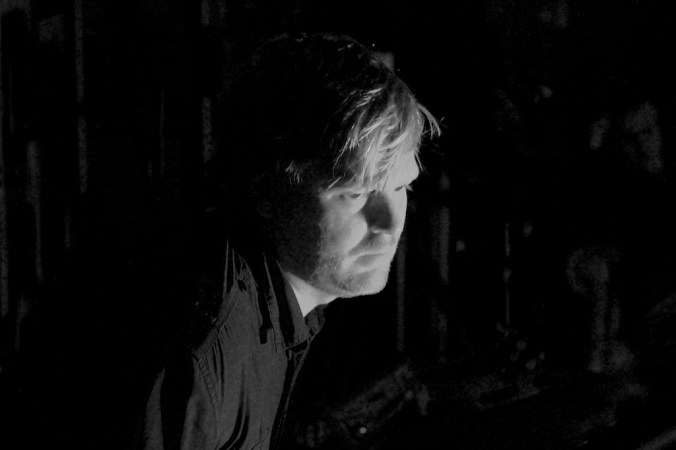
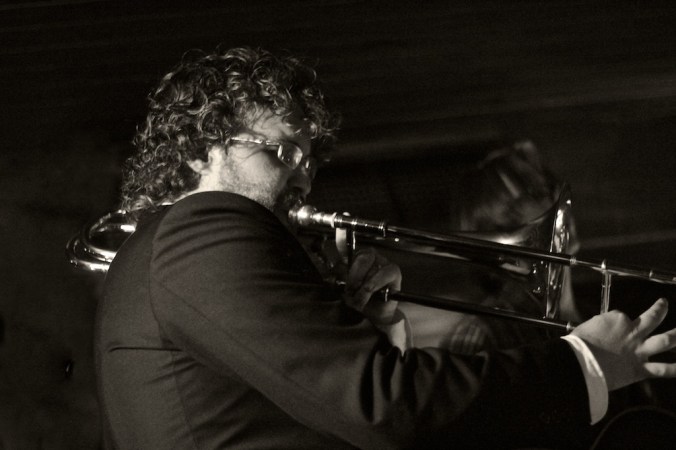
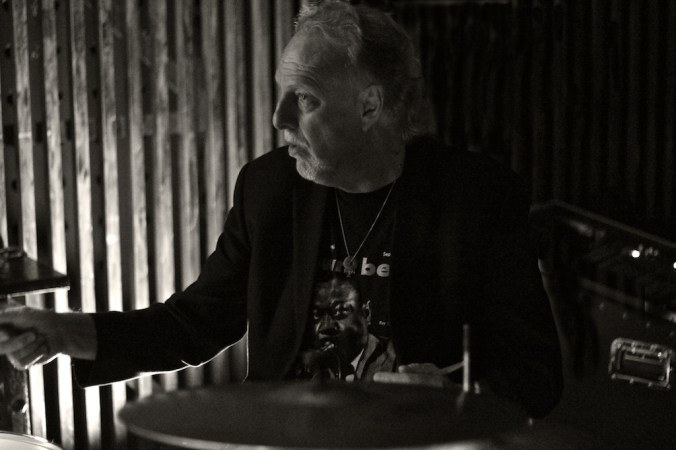
Hardbopmobile has been around for some years and the longest collaboration is between leader drummer Frank Gibson and guitarist Neil Watson.   This pair are particularly well matched and their ability to capture the mood and vibe of the hardbop era in a fresh way makes for a great night out out.  The group had experienced two personnel changes since I last saw them and in spite of liking the old configuration, this one worked extremely well.  Cameron Allen the regular tenor player was unavailable and so Frank decided to add a different horn.  Replacing the tenor player with a trombonist might seem a little unusual, but when you look back at those iconic lineups from the hardbop era it makes perfect sense.  There is no better drummer to underpin this music than Frank and he opened all the stops for this gig.  IMG_8866 - Version 2
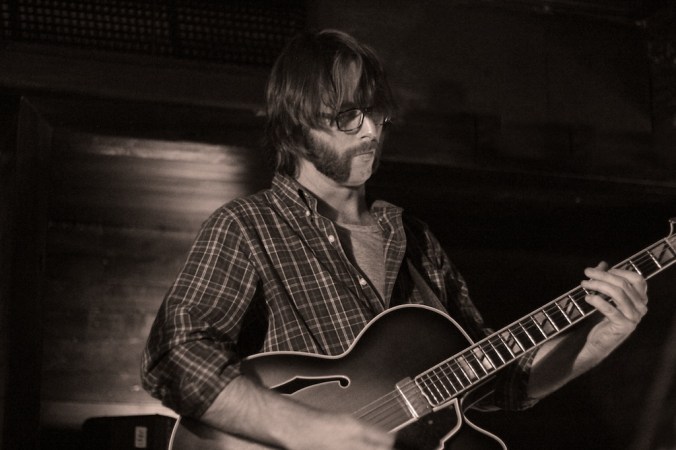
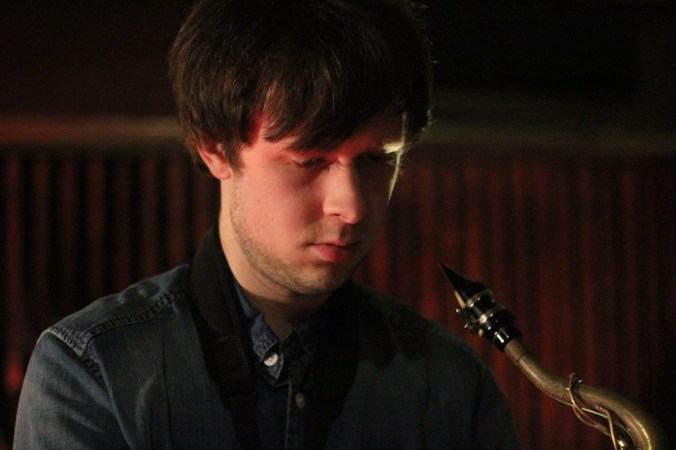
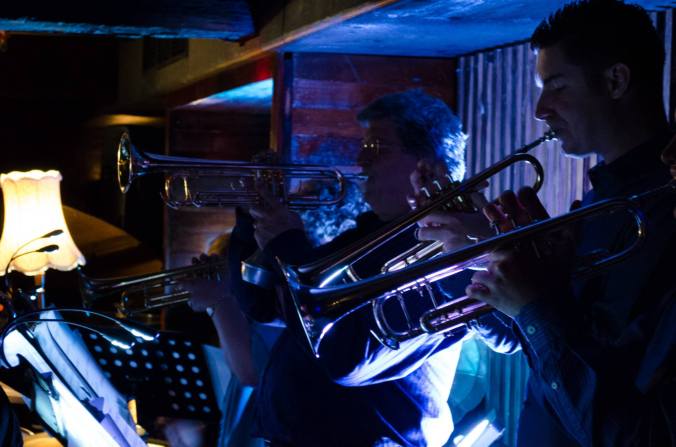
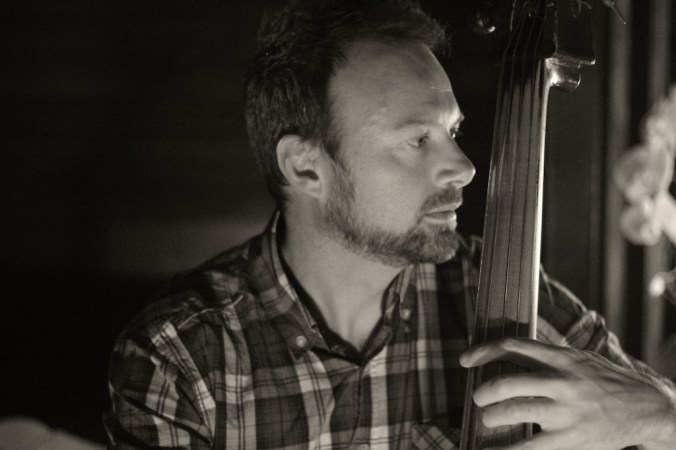
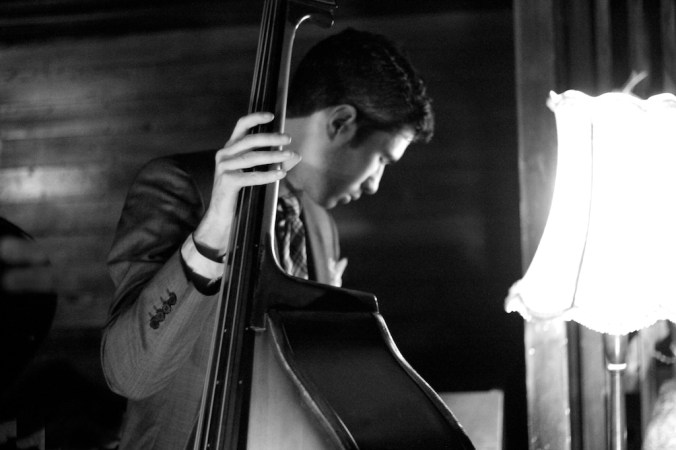
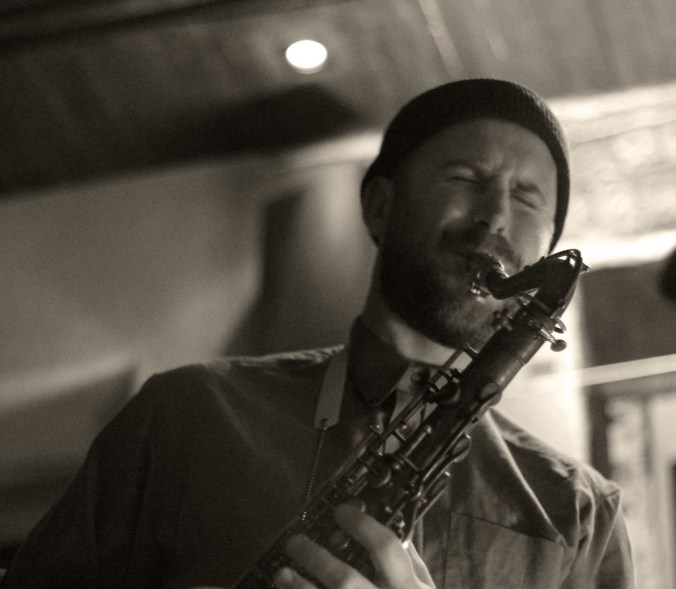
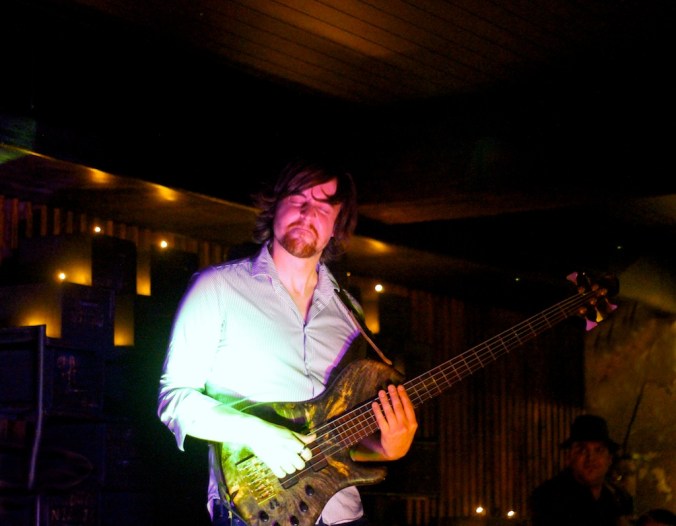
Haydyn Godfry was perfect for this role as his formidable chops and his engaging solo’s gave the band new dimensions to explore.   The rich full sound of the trombone blended perfectly with guitar and bass and it brought back memories of J. J. Johnson and others.   The other change was the replacement of Bassist Junior Turua with Tom Dennison.  This in itself was a fortuitous choice as Tom is hugely respected about town.   The stage was set for good music and happy memories and that is exactly what we got.

Frank had selected a great set list with mainly fast paced burners, but with a few ballads thrown in to balance things out.  There was the expected favourites like Horace Silver’s ‘Filthy Mcnasty’ but also the unexpected, such as a soulful rendering of Danny Boy (trad).   It also come as a pleasant surprise that of all the Monk tunes on offer he selected ‘Mysterioso’.  I recall hearing piano trio and saxophone led versions of this marvellous classic but never one involving an interchange between drums, bass, guitar and trombone.  The quirky nature of the composition with its delightfully quizzical asides, hung in the air as the tune unfolded, a joy to hear.  IMG_8837 - Version 2
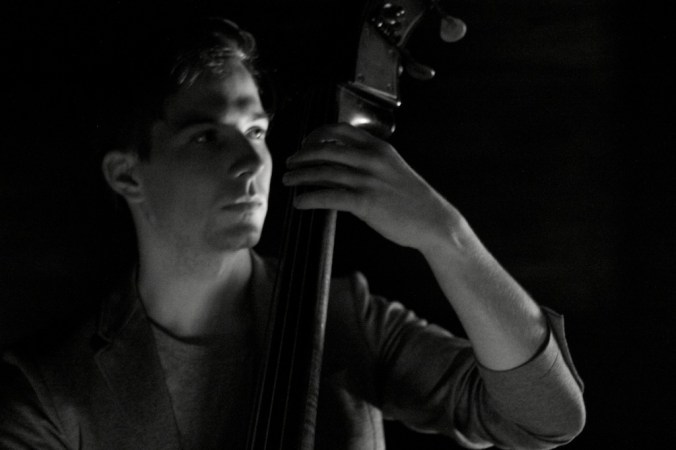
During the second set the quartet numbers were interspersed with a trio number and a duo.   The trio (Neil Frank and Tom) played ‘Danny Boy’ and in Neil’s hands this traditional ballad was reinterpreted as Jazz Americana at its best.  Neil showed us his versatility during this gig and he left us in no doubt that his hardbop-guitar credentials are second to none.  Another treat was a duo between Hadyn Godfry and Tom Dennisson.   They played the well loved standard ‘Softly as a morning sunrise’ and it was simply superb.  So inventive were the solos and so skilful was the counterpoint that it immediately put me in mind of Bob Brookmeyer’s duo work with Jim Hall.  They nailed it and gave us a killing performance.
IMG_8868 - Version 2

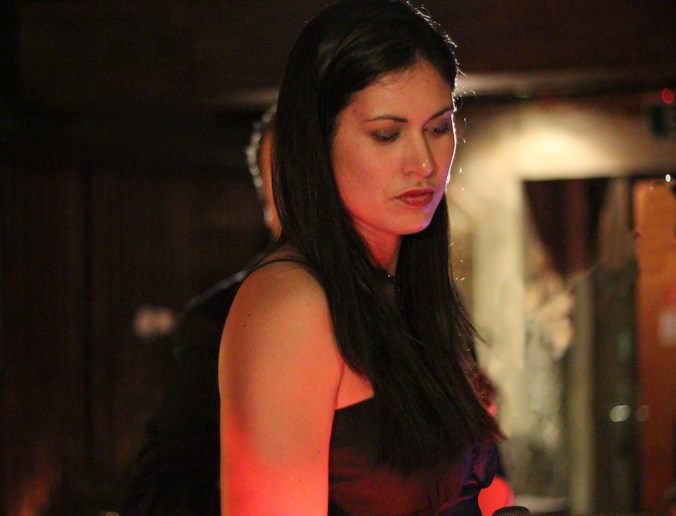
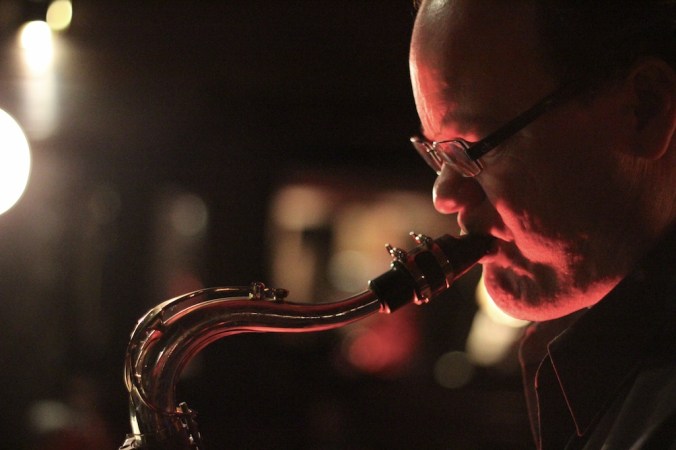
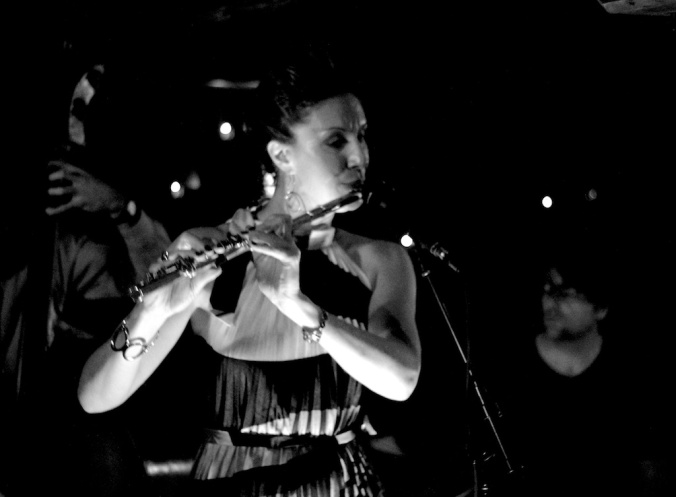
The last two numbers were a tribute to Caroline Manins (Moon) and Roger Manins for their commitment to making the gigs happen.  To my delight Caro sang one of my favourite tunes ‘Jeannine’ (Duke Pearson).   A forgotten hardbop treasure often played by Cannonball and Nat Adderley.   Roger played the last number ‘Weaver of Dreams’ (Young/Elliot) and his beautiful gently swinging rendering took me back to Cannonball Adderley and Kenny Burrell, who made this number their own so many years ago.
IMG_8838 - Version 2

Frank has a winning formula here and long may it continue.

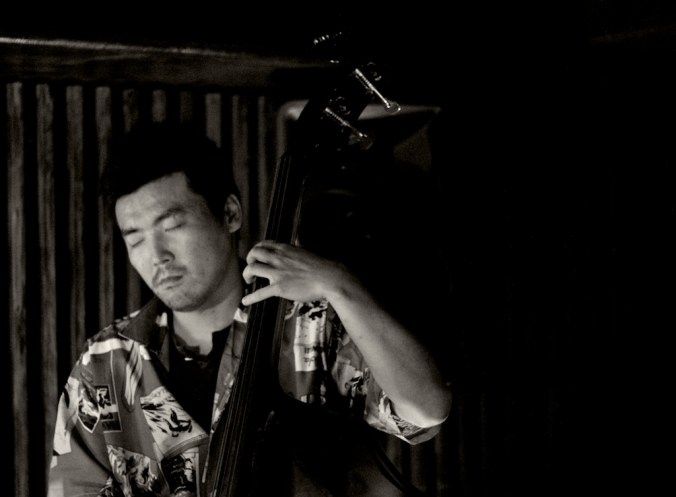
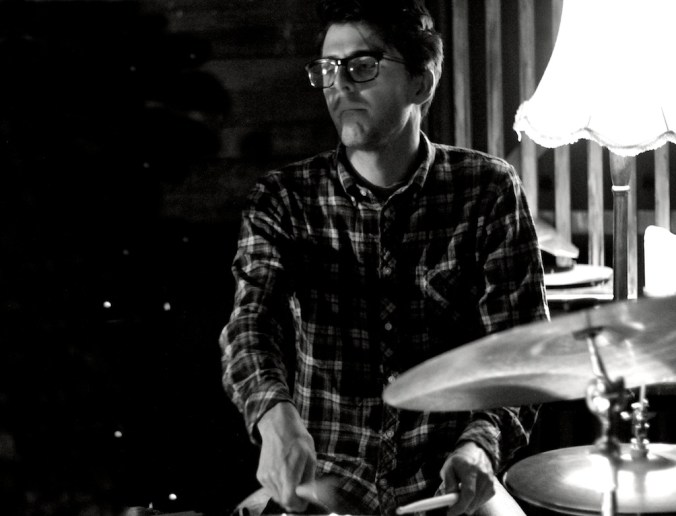
Who: ‘Hardbopmobile’ with Frank Gibson (leader, drums), Neil Watson (guitar), Tom Dennison (bass), Hadyn Godfry (trombone). + Caroline Manins (vocals) and Roger Manins (tenor saxophone).

Where: CJC (Creative Jazz Club) 1885 Britomart, Auckland
Steve Barry Trio@CJC November 2013

IMG_8799 - Version 2

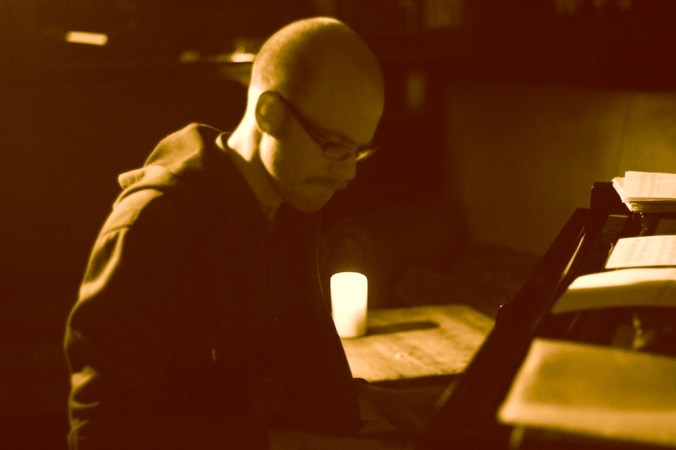
I have watched the career trajectory of Steve Barry for sometime and with each passing year the acclaim grows.  Just over a year ago he won the prestigious Bell Ward.  More recently he obtained second place in the ‘Australian Jazz artist of the year’ awards at Wangaratta 2013.  After winning a generous grant, enabling him to concentrate on his writing, he took time out for wood-shedding and further study.  He also travelled extensively.  He made use of this time by studying under piano masters like John Taylor.  From the outside his rise has the appearance of an effortless ascendancy, but the success of Steve’s trio arises from dedication and hard work.  His years of intensive study and relentless practice are now paying off.  As a result he plays with a maturity that is rare in younger artists and his unique approach to form is especially evident in his own reworked compositions and the often obscure but well-chosen ballads that he plays.

IMG_8782 - Version 2

There are two equally valid Jazz traditions around forming up combo’s and both can produce in-the-moment music.  At one end of the spectrum are groups formed just prior to a gig.   Hasty truncated rehearsals take place if time allows, but in some cases the musicians do not meet each other until they hit the bandstand.  At the other end are the groups like Jarretts Standards Trio, who are so familiar with each other that communication becomes intuitive.   Both situations have their pitfalls as the overly familiar can produce a certain complacency (Evans was sometimes guilty of this), while the seat of the pants line-ups can result in cues being missed.  Even good musicians fall at these hurdles but not so this trio.  The Steve Barry Trio has been together for over two years and they deliver royally.   The music sounds incredibly fresh each time we hear them and there is no lack of invention.   This is a special group with a unique ability to react to and challenge each other.   They are one of the finest piano trios in Australasia.

IMG_8794 - Version 2

I have heard Steve’s compositions many times, but on Wednesday it all seemed new.  They were the same familiar tunes with their complex time signature and moments of intense ostinato but they had somehow evolved.  Steve Barry is not an artist to rest on his laurels or to recycle old licks.  The most obvious changes occurred with the intro’s, which probed new pathways and took us on compelling journeys until we were again on familiar ground.   His intro’s and outro’s are something I look forward to, as they balance the pulse and swing.

I loved every note but the piece that really stood out was the seldom heard standard ‘More than you know’ (Vincent Youmans -1929).  This was covered by Teddy Wilson, Billie Holiday and others.  It is not heard much these days.  This slowly paced intensely beautiful ballad proved a good vehicle for improvisation and in the hands of this trio it was wonderful.  Steve stated the melody upfront and the richness of his voicings took my breath away.  There were subtle asides as the tune progressed, like a fine filigree partly obscuring the form.  Then about five minutes in a gentle swing section.

IMG_8814 - Version 2

You could not wish for better collaborators than Alex Boneham on bass and Tim Firth on drums.   Both are truly exceptional musicians.  There is a rich fatness to Alex Boneham’s tone which is all the more surprising as he was playing an old upright bass from the Auckland University School of Music.  In the hands of a master bassist, even an average instrument sounds rich and full toned.  His feel for time and note placement is perfect; deeply engaged and listening with big ears for every nuance.

Tim Firth also creates a buzz when he is in town and local drummers especially love to hear him.  Few can handle complex time signatures like he does and while he can play high octane tunes with edginess and fire, he can also execute brush work perfectly.   His brush work on ‘More than you know’ was understated (as it should be on a ballad) but as the tune progressed you were in no doubt about the value of his contribution.

This was one of those nights that gives Jazz a good name.

Who: The Steve Barry Trio – Steve Barry (leader and piano), Alex Boneham (upright bass), Tim Firth (drums)

Where: CJC (Creative Jazz Club), 1885 Britomart, Auckland on the 27th November 2013

The Doughboys @ CJC

IMG_8738 - Version 2

Whenever Neil Watson and Cameron Allen appear one thing is certain.   The boundaries between realty and the surreal will be seriously blurred.  Their attempts to kick down the barriers between musical genres arises from a genuinely subversive urge.  This has nothing to do with academic posturing, as the music comes from raw passion.   People sometimes ask me why I listen to Zorn, Sun Ra, Ribot and others.   It is because those people understand something very important, ‘Art should disturb the comfortable and comfort the disturbed’.  Neil and Cameron understand this and their collaborators do also.

IMG_8736 - Version 2

The unsettling rumours started circulating a few months ago.   Evidently there was an improvising band around town called the ‘Doughboys’.  Musical blackguards.  Few knew where they played and most dared not enquire further lest the blackest rumours were true.  They fitted no particular niche and worse, they could veer dangerously across genres without signalling a warning.   What might scare some, only served to tantalise me.  Any band that plays foul piratical sea shanties, Hawaiian music, Americana, ancient country ballads, Hank Williams and Johnny Cash in a Jazz voice is going to interest me.

IMG_8742 - Version 2

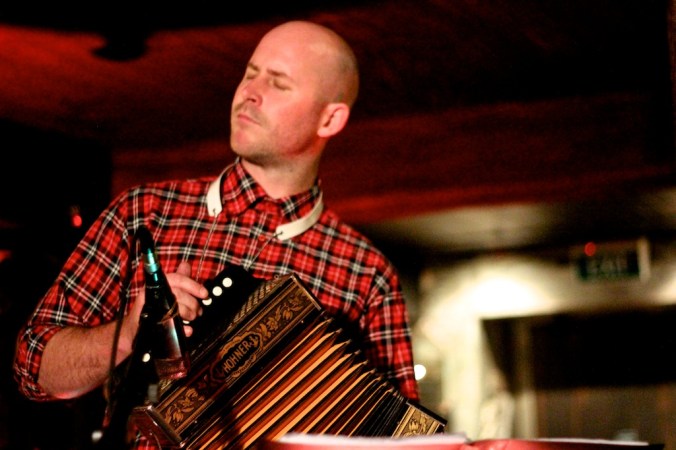
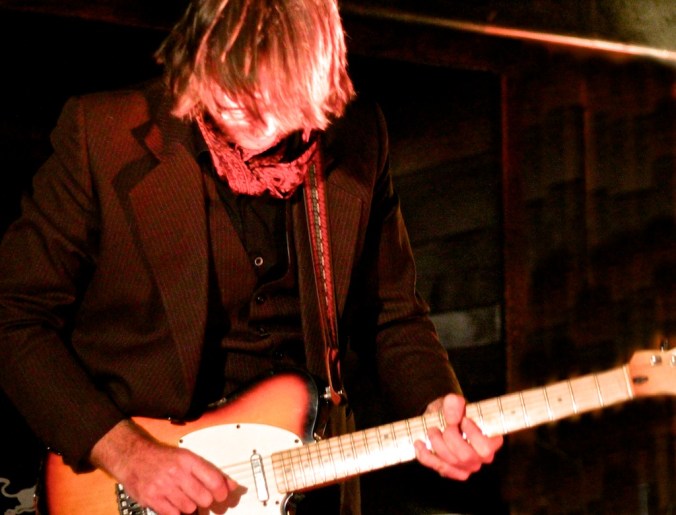
As with all vagabonds they eventually washed into the CJC (Creative Jazz Club) one blustery night.   Roger Manins, a steadfast soul, well able to withstand the vicissitudes of public opinion booked them.  On the night they stood brazenly arrayed, defiant as piratical adventurers can be.  Ready to sing and to wildly improvise, often using the voicings and tropes of psychedelic jazz.   Either that or they played a song dead straight just to confound.  The instruments were as left-field as the bands dress sense.  Neil Watson had an array of stringed instruments and some pedals mounted on a plank.  He used a Mexican Fender ‘Stratocaster’, a ‘Hobner’ Guitar (this is a top-of-the-range knock off of a Hofner which he purchased in an Indian street stall) and lastly a Chinese made ‘special’ steel guitar.  Cameron Allen played an old melodeon squeeze box, a tenor saxophone and a ‘virtual’ Doogan (it was not visible to the audience).   Alex Freer and Rui Inaba lulled us into a false sense of security by playing relatively ordinary looking instruments, but when you looked closely there were frightening pirate fetishes tied to the them.

IMG_8743 - Version 2

I thought that they were terrific and Neil Watson’s hint of Neil Young (subverted by Bill Frisell voicings) worked for me.   At times they played the tunes dead straight and this only added to the surrealism of the evening.  Once they sung a hearty ditty but I was not fooled.  As I suspected, this softening up was precursor to a king hit.  In this case a punked out rendering of the ancient sea shanty ‘Spanish Ladies‘ which I will post as a video.  This is the sort of music that the downtown avant-garde cuts its teeth on.  Where else would you hear an authentic version of ‘Pearly Shells‘ followed by something Pink Floyd might have done if they’d studied under Marc Ribot.  Bless their black pirate hearts.

photo copy 5 - Version 2

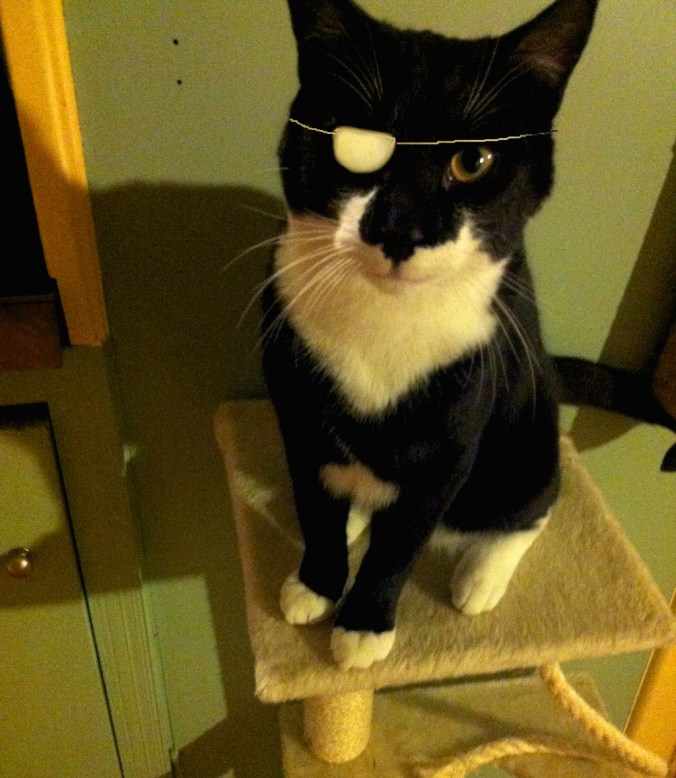
Disclaimer: No cats were harmed in the photoshopping of the above picture – the pirate cat is named Zirky 

What: The Doughboys at the CJC (Creative Jazz Club) 1885 Britomart, Auckland 20th November 2013
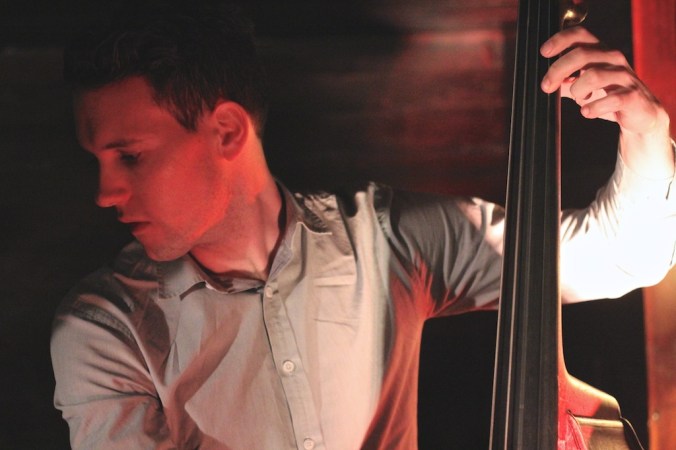
Who: Neil Watson – aka ‘Geetar Scrim’ (guitars), Cameron Allen aka ‘Lee Shawnuff’ (melodion and tenor saxophone), Rui Inaba aka “Pork Baster’ (bass), Alex Freer aka ‘Daddy Gaucho’ (drums).

Emerging Artists Matt Bray & Crystal Choi

IMG_8709 - Version 3

It’s an institution that the CJC (Creative Jazz Club) dedicates a handful of gig nights to emerging-artists.  This is often the musicians first public performance.  Performing in a club is a step up for any emerging artist, as audience expectations must be confronted.  In a Jazz club they’re expected to entertain; communicate something special.  It is not an exercise in ticking the ‘must demonstrate chops’ box.  Audiences have to like what you’re doing, rather than thinking how clever.

The sets attracted good crowds and that is important.  Supporting this music starts by supporting its emerging artists.

IMG_8689

The first set up was Matt Bray’s, who varied his pieces to reflect his many influences.   There were standards, original compositions and even a ‘Radiohead’ number.  Matt plays guitar and he has been keen explore the tonal and voicing possibilities of that instrument.  We saw him on the bandstand only the week before, as he plays in the AJO (Auckland Jazz Orchestra).  With the AJO he had tackled complex Cuban melodies and rhythms.  On this gig he was free to explore a wider vista; looking to modern guitarists like Kurt Rosenwinkel whose influence was evident.  He had chosen his band mates well and especially with the experienced and multi faceted drummer Cameron Sangster.  Cameron is the resident drummer with the AJO, but he is also featured to advantage in several well-known local bands.

IMG_8678 - Version 2 (1)

Conner McAneny was on piano (+keys) and he’s already performed several gigs at the CJC.  He’s a reliable performer and well able to keep out-of-the-way of the guitar, while shining in solo spots.   The last band member was Eamon Edmundson-Wells who recently graduated from the Auckland University Jazz School.   He was in both sets and is unfailingly impressive.   At the rate he is going he will soon be chasing Cameron McArthur and the fact that he is stepping into the gig slots normally taken up by Cameron (who is playing in the Chicago Musical pit band) tells its own story.

IMG_8683 - Version 2

The second set was Crystal Choi’s and it puzzled me that I had not met her until recently.   Crystal is a very fine pianist and she oozed confidence and style (she started her studies as a classical pianist but wanted more freedom to explore music).   She has emerged from the Auckland University Jazz school as a well formed and supremely confident pianist and to hear her perform it was hard to get my head around the fact that it was her first club performance.  I tracked her down later and put a few questions to her.   What year was she? (A third year graduate); had she performed with this trio/quintet outside of the Jazz School? (No).  She said that she had not felt ready before, but now she did.   Well she certainly showed us ‘ready’ that night.   The audience went wild after her set and kept yelling for an encore.  A superb first outing by any measure.

IMG_8685 - Version 2

The first number up was Bud Powell’s ‘Un Poco Loco’ and she skilfully moulded it to to her purpose.  This was a burner with plenty of flash, but a lot of soul besides.  I wondered if her handling of a ballad would be as assured, because ballads can reveal weaknesses quicker than any fast paced number.  I soon found out that ballads were no obstacle either and in addition her own compositions took interesting directions.   Her quintet was Peter Ruddell (tenor saxophone), Michael Howell (guitar), Eamon Edmundson-Wells (bass) and Tristan Deck (drums).

IMG_8698

The charts were textured and interesting; often augmented by Crystal singing unison lines.  I have chosen a clip of Crystals rendering of the standard, ‘In Your Own Sweet Way’ (Dave Brubeck).   I was impressed by this as it was slightly reharmonised and the implied notes spoke as clearly as the notes played.  When a musician knows what to leave out and what not to, they are well on the way.

IMG_8704 - Version 3 (1)

Michael Howell certainly caught my attention, as his clean soaring lines told me that he was a modernist but with a good sense of history.   Tristan Deck I have heard before and so I was not surprised to see how seamlessly he handled the changes in mood and texture.  A good drummer to have on board.   The remaining band member was Peter Ruddell on Tenor saxophone.   He only played briefly but he had a lovely tone and his lines were clean and imaginative.  This band played well together.   They we’re tight, but they never once strangled the music.

IMG_8705 - Version 2

I look forward to hearing Matt Bray and Crystal Choi as they develop further.

What & Where: Emerging Artists gig @ CJC (Creative Jazz Club) 1885 Britomart, Auckland 13th November 2013
Who first set: Matt Bray (leader, guitar), Connor McAneny (piano, keys), Eamon Edmundson-Wells (bass), Cameron Sangster (drums)

Who second set: Crystal Choi (leader, piano), Peter Ruddell (tenor saxophone), Michael Howell (guitar), Eamon Edmundson-Wells (bass), Tristan deck (drums).

No Square @ CJC

IMG_8653 - Version 2

Auckland’s CJC (Creative Jazz Club) hosted two European Jazz Acts in as many months.  The most recent band ‘No Square’, is from Switzerland.  This is a top rated European unit who have been together since 1994 and their tightness, focus and intuitive interactions reflected that.  Having played many European festivals to acclaim, they ventured further afield, assisted by the Francophile cultural organisation the Alliance Francaise.  Michel Benebig is another artist often supported by this worthy organisation.

IMG_8665 - Version 2 (1)

The journey down from Europe is particularly gruelling and even with New Zealand gigs tagged onto an Australian tour it requires a big commitment from the musicians.   I am not sure whether New Zealand audiences always grasp that.   After hearing about how poorly attended the Wellington ‘No Square’ gig was I cringed in embarrassment.   This is a truly amazing band and they deserved the respect of an attentive and decent sized audience.  Thankfully the audience at the CJC was reasonable, (but it could have been better).  If we don’t support visitors then why should they support our musicians who travel?   It is too easy to blame the lack of promotion, as our web-based and word of mouth networks are generally sufficient to pack out gigs.   All that’s required is a commitment to get off the damn couch.   Roger Manins goes to great effort to organise offshore acts and the audiences must respond in kind.  If we love this music we should pay it the respect of attendance.

IMG_8645 - Version 2

Europe has been deeply involved in the Jazz world since the early 1900’s and it was so popular that Hitler banned it as depraved.   There could be no higher recommendation.  Euro Jazz is not a slavish imitation of American Jazz, as each region has developed distinct flavours of their own.   This is particularly pronounced in the Mediterranean region and with the ebb and flow of migration the process has accelerated.  France was arguably the original centre of Euro Jazz but her near neighbours Switzerland, Spain, Germany, Belgium, UK and Italy have all contributed significantly to the development of the music.  This band originates from French-speaking Switzerland, with their most recent album recorded in beautiful Lausanne on Lac Lemon.    While they referenced Coltrane it was also evident that middle eastern rhythms and themes informed their work as well.   This well-travelled band is extremely tight as a unit.  Whatever twists and turns the music took they intuitively coalesced around each new theme.   No charts needed here.

IMG_8641 - Version 2

The first few numbers were denser and more complex than what followed, but as the evening progressed an airy feel and a deeper groove established.   I could discern many European and American influences from Debussy to Coltrane.  This distinctive original music was Euro Jazz at its best.  Andre Hahne (bass) took care of the introductions  (presumably because he has more English than the others), but the band is billed as a collective of equals.   It would be impossible to single out any particular musician as they all shone in one way or another.   On saxophones was Matthieu Durmarque, piano Matthieu Roffe and drums Alexandre Ambroziak.

This was not a night to miss.

Where: CJC (Creative Jazz Club) 1885 Britomart, Auckland
Who: ‘No Square‘ – Andre Hahne (bass), Matthieu Durmarque (saxophones), Matthieu Roffe (piani), Alexandre Ambroziak (drums)

What: Their 8th Album ‘The Laws of ephemerae’ (Les Lois de L Ephemere)

Natalia Mann update from Marseille

1467391_10201084445817972_2075128796_n

I interviewed Natalia Mann after the release of her very successful Rattle album ‘Pacif’ist’ and since then we have kept in touch .  Improvising harp players are a rare commodity, but things are slowly changing.  This year the Columbian harpist Edmar Castaneda won a major Jazz poll.  Natalia is simply killing at whatever she undertakes but her new trio brings her squarely into the jazz orbit.   Having gained a considerable reputation playing with various symphony orchestras and after undertaking a number experimental music projects, she is more than ready to enhance her improvisational credentials.   She has recently been playing to critical acclaim at Mediterranean Jazz festivals and this video clip was made for the AKBANK Jazz festival in Istanbul.  Her compositions are beguiling and exotic, while retaining an elusive mysterious quality.   This is music that leaves you wanting more.

Natalia is of Samoan Kiwi extraction but for some years she has lived in Istanbul.  She’s married to the Turkish percussionist Izzet Kizil who appears in the clip below.  She was most recently the recipient of the ‘ARts Pacifica’ award in her hometown of Wellington.  Having recently studied Jazz at Skopje University she is now engaging frequently with the improvising world.   This stunningly beautiful piece swings to its own pulses and rhythms; aided by solid bass work from Dine Donneff (Greece) and the perfectly executed percussion of husband Izzet Kitil (Turkey).

I have promised to take her to the CJC next time she is in Auckland and just maybe if we are lucky, we could talk her into performing?

Natalia is in Marseilles at present and she sent me this clip of her new Jazz trio a few days ago.   Kiwi musicians certainly do well in the world.

Gai Bryant’s Cubanos w/ AJO

1384091_600507700006367_150868797_n

We get a lot of interesting overseas acts passing through these days but seldom do we see Cuban musicians.  This is not about what they have to offer or even about the tyranny of distance, but more about politics.  When this band was booked it was a bigger lineup, but getting short-term visas to enter Australia and New Zealand proved an insurmountable  barrier for some of their number.  In my view this is an arcane and ludicrous legacy of the cold war.   In spite of an easing of sanctions by the EU and others, those old suspicions remain.   These talented musicians are the very best of ambassadors for their country and their indigenous music.  Its time to get real Australasian immigration.  The few that were allowed into the country gave us a great nights entertainment and not one sought asylum from John Key.

1376607_600507913339679_1439448025_n

The tour was organised by Australian band leader Gai Bryant and she arrived here with barely enough time to hold a few brief rehearsals with the AJO (Auckland Jazz Orchestra).  I am a fan of the AJO as they always tackle interesting projects.   They are a Jazz Orchestra with great dynamics and under the direction of Tim Atkinson, Mike booth and others they continue to produce the goods.   The personnel had changed a bit since I last saw them and especially the front horn line.  Even though it was dark and crowded I could make out a number of the long-term AJO regulars such Jo Spiers, Callum Passells, Cameron Sangster, Mike Booth, Jono Tan, Cameron McArthur and Matt Steele.   This band is scandalously under utilised and the city fathers and corporates should be engaging them for important occasions.

904366_600505893339881_1292230811_o

I am picking that this music would have been testing for them, as very few Auckland musicians have had a chance to work in authentic Cuban styles before.  It is one thing to play a Rumba or Bolero in a looser jazz idiom but quite another to follow charts like these.   At the heart of Cuban music is a set of complex mesmerising counter rhythms and the clave.  This is a delicious fusion music and the most influential of all of the ‘world musics’.   It reaches deep into the shameful slave past of Cuba.  West African musicians had retained knowledge of the ancient percussion instruments, chants and melodies which had travelled with them.  Along the way a plethora of other influences enriched and extended their music.  There is a strong Spanish influence and a French influence among others.  These influences were absorbed into the polyrhythmic music of West Africa.  At the very heart is often the clave rhythms and central to that is the five beat pattern so much emulated in popular music and Jazz.  These days the forms are codified and so jumping into this as a novice is a big ask.  I don’t know enough about Cuban music to judge this performance against others, but suffice to say I enjoyed it immensely.

I was deeply impressed by the percussionists but also by Cameron Sangster (drums), who took his cues so well from the Cubans.  Other notable moments were delivered by Callum Passells (alto), Cameron McArthur (bass) and Matt Steele (piano).

With the percussion instruments playing and the orchestra and soloists weaving around the beat it was easy to see how those old stories of voodoo and trance music took hold.  These beats defied all attempts to rationalise the sound.  The rhythms entered every pore, almost like body blows, driving me out of self and into the arms of some universal force.  An ancient joyful celestial dance from which there was mercifully no escape.

Who: Gai Bryant’s Cubanos (the photos on this gig were all taken by Ben McNicoll)

Where: The CJC (Creative Jazz Club) 1885 Britomart, Auckland, Wednesday 30th October 2013

NOiCE @ CJC

Rosie Langabere

The North Island Creative Ensemble is a project dear to Rosie Langabeer’s heart and one of many projects that she has on the go.   Rosie has been out of New Zealand for some time although NOiCE did perform at the CJC over a year ago.  Her musical journey most recently took her to the USA where she worked for three years with leading experimental improvisers and artists.   Her compositions and playing have won various awards and so I made certain that I there as I missed the last NOiSE gig.

This is music that is hard to pin down, as it deliberately defies conventions while somehow flirting with them.   There is a sense of structure which provides a touch stone, but don’t grasp too firmly as the forms will dissolve as quickly as they appeared.  This is music which carries you forward if you let it, holding you in the eternal moment.

NOiCE is an assembly of highly creative musicians; coming from a variety of North Island towns and cities.  The music is experimental in nature and it is definitely adventurous.  Most of these musicians are well-known and leaders in the field of New Zealand experimental music.   Jim Langabeer (Rosie’s father) is a stalwart of the Auckland Jazz scene, but he has also worked with international musicians like Gary Peacock, Sammy Davis Jr and even the Bee Gees.   He is a multi reeds and winds player and because of his proficiency on a variety of instruments he has been in demand over the years.  I recently saw his name come up in the music credits of the New Zealand film ‘Mr Pip’.   His innovative flute work is probably what he best known for.

IMG_8589 - Version 2

Jeff Henderson is also a multi reeds player and he is at the very heart of Auckland’s experimental music scene.   He can often be seen at ‘Vitamin S’, a small club dedicated to experimental music located just off Karangahape Road, Auckland.   Jeff has worked with a large number of cutting edge musicians over the years, William Parker, Steve Lacey, Mike Nock and many others.   He delights in pushing against the boundaries and when he performs he seldom holds back.  While his scalding solos often reach beyond mere form, his ability to integrate seamlessly into an ensemble creates a filigree of contrasts and textures.   A delicious aura of inventive unpredictability hangs over him.  IMG_8613 - Version 2

Chris O’Connor (drums) is a firm favourite with CJC audiences.  A recipient of the Chapman Tripp Award for original music, he has also worked with the soprano saxophonist Steve Lacey, avant-garde pianist Marilyn Cryspel, Don McGlashan and numerous other well-known groups or individuals.   Chris is one of those drummers that other drummers revere and the last time we saw him at the CJC was with vibist John Bell.

IMG_8633 - Version 2

IMG_8629 - Version 2 (1)

IMG_8587 - Version 2 (1)

Ben McNicoll (reeds and winds), Joe Callwood (guitar), Gerard Crewdson (brass) and Kingsley Melhuish (brass), Nicky Wuts (vibes) and Patrick Bleakley (bass) round out the ensemble.   They are all experienced musicians and most of them have worked with NOiCE for some time.  Ben McNicolls is the best known to CJC audiences as both the technical director of the club and a frequent performer.  A good reader with a nice sound he, is happy to take on any project, from standards gigs to out-ensembles.   Gerard Crewdson and Kingsley Melhuish are versatile and sought after brass players and both have played the CJC before.   The musicians that I was less familiar with were Patrick Bleakley (bass), Joe Callwood (guitar) and Nikky Wuts (Vibraphone).

I’m relieved to see another mallets player on the scene as New Zealand has very few of them.   John Bells departure earlier in the year left a yawning chasm.

IMG_8640 - Version 2 (1)

All contributed something unique as this is a truly democratic ensemble.  One where individual voices rise and then subside; emerging seamlessly into the collective consciousness of the group


Alan Brown trio + 1@ CJC Oct 2013

IMG_8570 - Version 2

Alan Brown is such a gifted musician that we always expect something special from his club gigs.   The October gig not only lived up to expectations but found something extra to offer us.  Alan is always on safe ground with Dixon Nacey on guitar and Josh Sorenson on drums, as these musicians don’t need any warm up.  They have played together so often that their understanding of what is required is intuitive.  Deep energised mesmerising grooves are quickly established and maintained.  As we progressed through the first number, the warm grooves took us somewhere else.  Transported on mass to a place where winter became a distant memory.

 A state of grace, suspended somewhere between reality and a multi hued dream state.  This is a place where the familiar is transformed into the extraordinary and we felt incredibly happy about that.

IMG_8538 - Version 2

As I watched the interplay between these three I could not help wondering how that felt.  How it felt making that music, in that way and with that much soul.  The looks on their faces gave me the answer.  They also knew that this was one out of the bag and that some special chemistry was happening.   The Alan Brown trio were on fire and we were not just witnesses but integral to the performance.  There was a shared collective energy and we were each and every one of us connected in a web of pure creation.

I have written a lot about Alan over the last two years and he deserves every accolade thrown his way.   If this sounds like hyperbole I will quickly argue otherwise.  He consistently delivers performances and compositions that grab the attention and on nights like this he finds something extra.  The audiences from the High Street days have never forgotten ‘Blue Train’ and the fact that Alan keeps the crowds coming; still creating new audiences, speaks volumes.   This is not about reliving the glory days, but about bringing fresh and exciting perspectives to an ever unfolding musical output.

IMG_8544

Dixon Nacey is another musician who always pleases.   When ever I see that beautiful Godin guitar I know that something extraordinary could happen and this was just such a night.  Dixon is a musician who can communicate as much by his body language as by his soaring inventive solos.  You know how deeply he observes and engages because the evidence is in his face and at his fingertips.  When exchanges are being traded with drummer or keyboards, his expressions mirror the intensity.   When the solo or the interplay really works well, a huge smile lights up the bandstand.   That smile and those magical voicings tell us so much about the man and his music.

IMG_8545 - Version 2

The remaining trio member is Josh Sorenson and I have heard him on two or three previous occasions.  Josh has specialised in groove drumming and he is exceptionally good at it.  This is a specialist skill as there are a million deceptive subtleties built into it when done well.   I spoke to Josh at some length about this and what he told me was illuminating.  It is very hard work and although it sometimes appears straightforward it is not.  I gathered the impression that a night of holding such tight grooves together is more exhausting than bebop or rock drumming.  The concentration required to move around the kit while holding a tight multi faceted beat together is tremendous.  It is not just the concentration required, but the ability to sink into a beat in an almost trance like fashion.

Towards the end of the final number Josh launched into a drum solo and what unfolded was almost supernatural.  As he moved all over the kit, the deep-groove pulse never wavered by a fraction.  I have never seen this done before and I found it incredibly impressive.   That solo and in fact the whole number ‘Inciteful’ (had the audience on their feet, whooping and shouting with enthusiasm).  Sadly I had run out of video tape by then, but I did capture some of the magic.  IMG_8550 - Version 2

Part way through the gig we had another treat in store when the soulful Jazz Singer Chris Melville came to the band stand.  I like male Jazz singers and I worry that their numbers are so few.  Chris has a terrific voice and he tackled the old Juan Tizol standard  ‘Caravan’ in a mature and engaging way.   I enjoy listening to his interpretations and to the timbre of his voice, but noticed that it had a tendency to become a little lost in the acoustics of the room.  Some small adjustments to the sound levels would remedy that.   As the extraordinary Mark Murphy steps back and the fabulous velvety baritone Andy Bey performs less, there are other male singers coming forward like Jose James, Kurt Elling and Gregory Porter.  It is a tradition worth keeping and I  hope that we see continue to see singers like Chris keeping the faith.

We heard old favourites like ‘Shades of Blue’, some new material and even a rock classic from Led Zeppelin ‘No Quarter’.   ‘Charlie’s Here’ cast a warm bluesy aura over the room and I have put that up as a video link.   The kicker however was definitely ‘Inciteful’.  It was an amazing rendition packed with high-octane solos, clever ideas and groove so deep that even speleologists could never hope to explore it.

The organ was a Hammond SK2 which is not Alan’s usual keyboard.   Coupled to a Leslie Unit and the resulting sound was perfect.   This lighter modern offshoot of the C3/B3 certainly earned its stripes on this night.  It was just right for the room.

Who: Alan Brown (SK2 Hammond organ), Dixon Nacey (guitar), Josh Sorenson (drums).

Where: The (CJC) Creative Jazz Club), Britomart 1885 building, Auckland 16th October 2013

Benny Lackner (Germany) @ CJC

IMG_8492 - Version 2

I missed the Benny Lackner trio when they came last year and I had subsequently been besieged with the inevitable, “man you missed a great gig”.   This time I made sure that was able to attend.  Benny Lackner is from Berlin, Germany and his touring schedule has taken him round the world a number of times.  His brand of jazz is forward-looking and has a distinctly modern-European feel about it.   I am a fan of European styled Jazz although surprisingly it is often overlooked by American Jazz fans.  This is ironic because American Jazz musicians have always relied heavily on European tours and are hugely supported there.

This trip Benny came without his trio and teamed up with Cameron McArthur and Ron Samsom for the Auckland gig.   As the gig approached a problem arose, when the building owners required the downstairs room for a function.   The room with the lovely grand piano in it and the better acoustics.  An urgent call went out for a Fender Rhodes and before long Mark Bains had lent one, along with a nice keyboard.   The upstairs venue has a nice feel to it but the acoustics are more difficult to manage.  Such obstacles are quickly dealt with by experienced musicians who are quite used to playing in a wide variety of settings.

IMG_8525 - Version 2

The sets were mainly centred on Benny’s own compositions, but interestingly he had thrown in some modern pop tunes, mined for their improvisational worth.   There was a Bowie number and a Radiohead number, both of which went down extremely well with the audience.  Gone is that awkwardness that the 50’s Jazz musicians often exhibited when they tackled the popular tunes of the day.   From Miles onwards and through to Brad Muhldau ( a mentor of Benny’s) the game has changed.   American musicians like Bob Frisell and others will routinely interpret modern tunes or rock classics.   In many cases the vocabulary of rock is appropriated.  The Europeans however are the masters of this and artists like Mathius Eik, Esbjorn Svensson and Marcin Wasilewski have blazed a clear trail ahead.  He also tackled Monk’s ‘Bemsha Swing’ which I have posted.  EST played this often and this version takes the tune even further out.

IMG_8518 - Version 2

Benny Lackner approaches his material obliquely and to my ear there is no hint of the Evans legacy in his voicings.  He often plays big percussive chords, but he can also show real sensitivity as he negotiates the well constructed tunes.  The Radiohead number worked particularly well on the dominant sounding Rhodes, with the slightly softer voicings emanating from the smaller keyboard.  You get the feeling watching Benny at the keyboard that he views each performance as an open-ended adventure.  I am only sorry that we never got to hear him on the clubs grand piano.

He told us that he was very pleased with his new band mates and why wouldn’t he be.   Ron Samsom is such a fine drummer that you expect a top-level performance from him.   Ron has a world of experience behind him and so many local and visiting overseas acts benefit from his multi faceted traps work.  I have never seen him falter in any setting and the diverse styles required of him only appear to urge him on to greater heights.

As has been the case so often in recent months, Cameron McArthur filled the bass slot and all of the experience he is gaining is now paying dividends.  This guy is a crowd pleaser, with the chops and ears to provide the goods.   We also heard some very nice solos from him.

This has been a big tour for Benny.  From Berlin his hectic schedule took him through South East Asia, Australia and New Zealand.  Although he was born in Berlin he also lived in the USA for many years.  The many influences absorbed along the way have moulded him into an original and interesting pianist.

Who: Benny Lackner (leader, keys, compositions), Cameron McArthur (bass), Ron Samsom (drums)

Where: The CJC (Creative Jazz Club), 1885 building, basement, Britomart, Auckland 9th October 2013
Mark Isaacs @ CJC

IMG_8432 - Version 2

Pianist and composer Mark Isaacs has a rapidly growing international reputation and we were lucky to get him here.  Once again it was down to Roger Manins, who has wide connections in the Jazz world and we are eternally grateful for it.  Mark Isaacs has toured the world extensively and not only fronted a number of prestigious Jazz festivals, but also recorded with many world-renowned Jazz musicians.  Artists like Kenny Wheeler, Roy Haines, Adam Nussbaum and Dave Holland have appeared on his albums but as if that were not enough, he has two parallel musical careers.   Mark is also a classical pianist/composer of some stature and the conductor Vladimir Ashkenazy said this of his extraordinarily beautiful ‘Children’s Songs’.  “This wonderful cycle is highly inventive and inspiring, accessible to children and adults alike.  Very enjoyable and touching“.

The first thing to strike you about Mark is his intense passion for music, but his focus and drive have not in any way deterred him from exhibiting a cheerful, often extroverted demeanour.  He engaged easily with the CJC audience and his level of report with the band and especially Roger, made the gig all the more enjoyable.  Even though he had not played with drummer Frank Gibson Jr or Bass player Cameron McArthur before it felt like an established band.  He and Saxophonist Roger Manins go back a long way and perhaps because of this long-standing connection, what was billed as a standards gig, soon became so much more.  IMG_8456 - Version 2 (1)

The set kicked off with ‘Gone With the Wind’ (Allie Wrubel – 1937).  By coincidence this once popular but seldom heard tune was performed here by Mike Nock only months earlier.   Both artists appeared to briefly reference the brilliant but somewhat obscure Brubeck version, but each approached the tune in very different ways.  Mark Isaacs is another musician who has the history Jazz piano under his finger tips and as he worked his way into the tune I could hear brief echoes of the past greats.  I love this tune and especially when interpreted this well.

As the set list unfolded I realised that most of the standards were from the 1930’s.   It is not hard to fathom why, as the Great American Songbook tunes written in this period were second to none.  The gig,  subtitled as ‘Pennies From Heaven’, was later explained as being an inside joke.  Roger and Mark had embarked upon just such a project a decade ago and in their view the title scared off the potential audience.  More fool those who failed to turn up because this number in their hands was fresh, funny and satisfying.  ‘Pennies from Heaven’ (Johnny Burke/Arthur Johnston) is also from the 1930’s.

IMG_8441 - Version 2 (1)

The tune that I have posted is the perennial favourite ‘Someday My Prince Will Come’ (Frank Churchill – 1937).  Although non Jazz audiences would only associate this tune with Disney, it has a long and distinguished Jazz history.  Among the 100’s of well-loved versions are those by Oscar Peterson, Miles Davis, Dave Brubeck, Bill Evans, Wynton Kelly and Grant Green.  Playing a classic standard like this to a savvy Jazz audience can have its pitfalls as comparisons are inevitable.  The audience however lapped it up and from the stating of the melody through to the open-ended interpretation near the end, it was fabulous.  With Roger egging the band on and Mark responding in kind it could hardly be otherwise.

IMG_8428 - Version 2 (1)

There was a very nice solo by Cameron McArthur who astonishingly just keeps improving between gigs.  Frank Gibson Jr met Mark years ago but in spite of them trying to organise a gig it never happened until now.  In the event it was a happy confluence of inventiveness, exuberance and great musicianship.  Roger Manins was on form as usual, delivering fiery energised solos in a post Coltrane manner.

Mark Isaacs has the technique and the hunger to continually reach beyond.   Whether gently comping under a melodic bass solo or unwinding the melody to explore what lies beneath he engages us.  His probing left hand often pulls slightly back on what his right hand is playing and the tension created gives added impetus.  While his Classical compositions are informed by Jazz, the opposite is also true.  He will surely continue to do well in both worlds.

IMG_8473 - Version 2

As I left the club I picked up a copy of his Resurgence band’s ‘Duende’ album and put it on during the drive home.  It is an album of his own compositions.  What was immediately apparent was how well crafted the compositions were.  It was the sort of album that ECM might have released and the quality of the recording added to that impression.  As I listened on I heard some beautiful guitar work, not over stated but clean, inventive and crystalline.  Then I heard a human voice, wordlessly singing arranged lines as part the ensemble.  Easing over to the curb I picked up the album cover and flipped it over.

The personnel list would stop anyone in their tracks.  Mark Isaacs (piano), James Muller (guitars), Matt Keegan (reeds and percussion), Brett Hirst (bass), Tim Firth (drums), Briana Cowlishaw (vocal).  Matching this dream line up with those compositions was a masterstroke.   Muller and Isaacs communicate so very well.  It all made sense, the Kenny Wheeler connection, the skilled arranging and the promise of what may follow.   Mark Isaacs has the ears to absorb and the smarts to compose what works best for him.  This album certainly does.

Who: Mark Isaacs (piano, compositions, leader), Roger Manins (tenor saxophone), Cameron McArthur (upright bass), Frank Gibson Jr (drums).

Where: CJC (Creative Jazz Club), Britomart, 1885 Basement, Auckland, New Zealand on 2nd October 2013.

Album and contact details: ‘Duende’ (Gracemusic GROO4)

Mike Nock’s Australian Trio @ CJC 2013

IMG_8335 - Version 2 (1)

A lot’s been written about Mike Nock and he is well recorded.   In spite of this there is so much more to say and the unfolding story has come to define Australasian Jazz.  It would be accurate to describe him as one of the greatest musicians New Zealand has produced, but Mike Nock deserves evaluation on a much wider stage than Oceania.  As lucky as we feel owning him, he is a citizen of the world, highly ranked among the best that global Jazz has to offer.  IMG_8361 - Version 2

This was summed up by one of the audience; an American who has been following the international Jazz Scene for many years.  He shook his head in amazement and said “That was the best performance I have heard in ages”.  He asked about Mike’s history and I gave him a potted version.   “Oh yeah” he said.  “Well all of those years in America have given him that deep blues feel that only top players realise”.

I caught up with Mike before the gig and he was his usual friendly self.   Over dinner there were jokes and numerous war stories.  Because I have attended too many loud gigs my hearing is not quite as good as it was.  At one point the drummer James Waples said something to me which I missed entirely.  I apologised, explaining that my eyesight and hearing were failing me.   Mike leapt on the comment as quick as lightning, saying, “Man don’t worry.  That’s exactly what we like in a critic”.

There was the briefest of discussions between the band members about the set list, which ended in Mike saying, “We’ll figure it out as we go and you’ll know when you hear me start to play”.  While this is not unusual among Jazz musicians, it was evident that Mike would be digging into some obscure and unrehearsed standards during the evening.

IMG_8357 - Version 2

The spirit of Bernie McGann hung over us as he had passed the previous evening.  Mike spoke movingly of him and then he played one of Bernie’s compositions followed by ‘Bernie’s Tune’ (Bernie Miller) and the lovely old standard ‘No Moon at All’ (David Mann).  ‘No Moon at all’ is hardly ever played these days but it was once very popular.  It was famously recorded by Julie London, Nat Cole, Mel Torme and Anita O’Day.  There are more recent versions by Karrin Alyson and Brad Mehldau.  In Mike Nock’s hands this jaunty mid-tempo classic took on a deep bluesy feel and as it unfolded he achieved something that only the Jazz greats can manage.

The tune turned into something else; it was somehow transformed into ‘every tune’.  From the first few bars everyone smiled and many whispered in the dark, “Oh I must know this but I can’t recall the name”.  Like many probing improvisers Mike hummed and sang as he played.  As the piece unfolded something extraordinary happened.  People started quietly humming along with the trio; a deep connection  was made and it was primal.  I’m certain that many in the audience had never heard the tune before, but they thought that they had.   Keith Jarrett has often invoked this state of grace, finding a hidden place deep within the music.  So has Mike Nock.  Several musicians later commented that he had moved in and out of the song form and that the bluesy overlay had been utterly effective.  Another delightful old tune that the trio played was ‘Sweet Pumpkin’ (Ronnell Bright).

IMG_8370 - Version 2

On Drums was James Waples and he certainly lives up to his reputation.   He has featured on several of Mike’s albums and goes back a long way with Mike.   There is a subtlety to his drumming that is hard to put into words.  He is a powerful presence whether executing the softest brushwork or a driving upbeat tempo.  He has a great ear and knows when to push the others or hold back.  He is perfect for a multi faceted piano trio like this and I would go out of my way to hear him again.

Many Kiwi’s have forgotten (and many Australians will deliberately overlook the fact), but Brett Hirst is an expat New Zealander.   He is highly regarded on the Australian scene and like James he has had a long association with Mike.  When these three are in lockstep it is extraordinary.  Like the others Brett is a deep listener and clearly at ease in this open-ended format.  At one point in the program Mike stopped and said, “What shall we play now, something unexpected?”.   Then he added, “Oh I know, I will try this”.   Brett asked hopefully, “Can we know?”  The number had started before an answer could be given and he was immediately there.  Brett was up to handling any curve balls thrown and clearly relished them.

During the second set the trio were ready to take things further out and we sensed that they were in a zone where the communication is telepathic.  It is during these explorations that we see another side of their music.  Every interplay however subtle conveys layers of meaning and the spaces between the notes communicates a profundity.   This is art-music at its very best but for all that it is never far from its blues roots.   I have listened to Jazz across the globe and you would never, never hear better than this.

Who: Mike Nock (piano), Brett Hirst (bass), James Waples (drums).  www.mikenock.com

Where: CJC (Creative Jazz Club), Brittomart basement 1885 building, Auckland, New Zealand.

When: 18th September 2013

Emerging Artists Series: Alex Ward / Allana Goldsmith

IMG_8305 - Version 2

Two or three times a year the CJC reserves a gig night for emerging artists. On Wednesday there was a double billing and while they could legitimately be termed emerging artists, they showed a confidence and polish that bespoke experience. In fact both have been performing about town and in Allana’s case for some time. This was a moment to show a discriminating Jazz audience what they are about and they delivered.

IMG_8303 - Version 2

First up was pianist Alex Ward. He has recently graduated with honours from the NZSM Massy campus. I last saw Alex play just over a year ago and he showed real promise then. Now the hard work and years of study are bearing fruit. He appears to play with even greater confidence and this obvious self belief has influenced his performance. His set was mainly a showcase for his own compositions and they were interesting and varied. There were ballads, uptempo burners and a (new) standard on offer. Standards always give us points of comparison and his rendering of Robert Glasper’s ‘Yes I’m Country (and that’s Ok)’ from the Blue Note, Double Booked album did just that. It was flawlessly executed and delivered with real heartfelt exuberance. Among his own compositions I really liked ‘Litmus Test’ for its edgy hard bop feel and the more reflective ‘Lighthouse Keeper’ (a recently written tune). There was also a reharmonisation of ‘Beautiful Love’ but with dark voicings and with an oblique approach to the melodic structure. These tunes while all quite different, hung together well as a set.

IMG_8295 - Version 2

On Bass he had the gifted Cameron McArthur and on drums Ivan Lukitina (who I had heard about but not seen before now). They both provided solid support for Alex and delivered good performances during solos. Cameron was particularly energised during ‘Litmus Test’ and Ivan was right there with him. Ivan excelled on ‘Yes I’m Country (and thats OK)”.

This should be a right of passage for Alex and he will surely become a fixture about town if he continues performing at this level.

IMG_8320 - Version 2

Allana Goldsmith has appeared in a number of bands and her musicality and stage presence are pleasing to ear and eye. I have heard Allana a number of times now and on those occasions her role as ‘part of a lineup’ gave me a brief taste of what could be. She has performed with various sized bands but most often as part of a duo with guitarist.

She is a current member of the ‘Sisters of Swing’, which is an Andrews Sisters tribute band and co-member Trudy Lile speaks highly of her abilities. I recently saw her with Peter Scotts ‘Bad Like Jazz’ project and I was very impressed; especially as she sang a stunning rendition of ‘Freedom Jazz Dance’ (Eddie Harris). It is this preparedness to take on challenging projects and to do them well that sticks with you. Her voice is strong without being loud and in many ways she is reminiscent of the great singers of the past. What is not redolent of past singers however, is her preparedness to tackle adventurous modern projects. IMG_8310

For this gig Allana had selected a few well-known and some lessor performed standards and to stamp her own mark on them, sung often in Te Reo Maori. While Whirimako Black has already moved into this territory, Allana has her own unique approach to the music. Hers is an original voice. It is tempting to think of songs sung in Te Reo Maori as being different or apart from European traditions. In Allana’s case that is not so as she has maintained the integrity of both traditions. The best illustration of this was her brilliant rendition of the Miles Davis tune, ‘In a Silent Way’. This was the first tune of her set and she used it as a Karakia or blessing. The notion of using this open, spiritual number to unify us all and to call down blessings was a perfect beginning.

IMG_8322 - Version 2

Her band was Ben McNicholl (tenor sax), Dave Fisher (guitar), Cameron McArthur (bass), Jason Orme (drums).

IMG_8313 - Version 2

I have always rated Ben highly on ballad material. His concise soloing and the atmospheric vibe that he created behind Allana worked well. When backing a singer on a ballad, tasteful minimalism trumps busy, every time. This sort of restraint is counter intuitive to a musician, but the balance between Ben and Allana was pitched just right. I know that he took care to select just the right reed for the job in hand.

I thought that I knew all of the Jazz guitarists about town, but clearly I don’t. Dave Fisher has played with Allana for some time and he picks up on her every nuance. The voicings that he uses are those of the skilled accompanist and the warmth of his tone caresses and underpins her vocals perfectly. This was mostly chordal work, which shifted, swung and shimmered like the guitarists of an earlier era. It was an effect deliberately aimed for and it was easy on the ear. His guitar is an Epiphone Hollowbody of the sort used by Joe Pass and that made sense as well.

Cameron McArthur was also the bass player on this second set. Because he works so often about town he has developed a keen ear and had no trouble fitting into this different groove. Unlike the earlier piano trio gig, with challenges thrown down and returned in kind, he needed to keep more out-of-the-way here. Seeing him perform so well in such a variety of situations certainly increases my respect for him.

The remaining band member was drummer Jason Orme and I am very familiar with his playing. Oddly though, I had never seen him playing in this sort of situation, which at times required a very nuanced approach. His skills in such a setting were immediately apparent and his brush work was especially fine. Like the guitarist and the tenor he focused on the singer, enhancing every inflection of voice or following every whispered line. Each accent delivered with a quiet flurry on the snare or a tap on a muted cymbal.

Allana is currently studying performance at the NZSM Massey and this was her first CJC gig. She will certainly be back.

* Thanks to Dennis Thorpe for the high quality video material

Wh0 (first set): Alex Ward (piano), Cameron McArthur (bass), Ivan Lukitina (drums).

Who (second set): Allana Goldsmith (vocals), Ben McNicholl (tenor sax), Dave Fisher (guitar), Cameron McArthur (bass), Jason Orme (drums).

Where: CJC (Creative Jazz Club), 1885 Brittomart Building, basement, Auckland
When: 11th September 2013

Michel Benebig ‘Yellow Purple’ review

Yellow Purple

When Michel Benebig played at the CJC late last year I learned about his coming tour of the West Coast of America.  Because I was going to San Francisco over January I arranged to meet him there, as I knew that he and Shem would have a new band on the road.   We kept in touch over the weeks that followed and he was getting a very good reception as he toured around.  It confirmed what I was reading; that B3 (with drums and guitar) bands are genuinely popular again.  This regained popularity is great news for Jazz audiences as the B3 line up is one of most audience pleasing and accessible in Jazz.  This comeback has not occurred by accident but it is due to the gifted players who are now emerging on the scene.  Michel Benebig is surely one of these and his name often crops up in the same breath as titans like Dr Lonnie Smith.  IMG_4556 - Version 2

I was staying in Bush Street which is in the ‘Lower Nobs Hill’ area of Frisco; just above Union Square.  When I got an update of Michel and Shem’s itinerary, it surprised me to see that one of his gigs was in that very street and so my son and I duly headed off there on the appointed night.  By ingrained habit we skirted the ‘Tenderloin’ and descended toward Hayes Valley.  A wisp of escaping sound told us that we had arrived and we entered a nicely appointed modern building, wedged in between two deco ones.  Leaving the temperate San Francisco winters night we wound down into the basement.  The warm sound of the B3, groove guitar and drums washing away any vestige of the night air.  My sons eyes lit up.  “Wow” he said.  “This sounds great” and it surely did.  This was the new band I had been keen to hear.

That particular band is almost the same as on the recent ‘Yellow Purple’ album (with the exception of the drummer Akira Tana).  Akira Tana is well-known around San Francisco where he had just recorded his big band album, followed by a gig at Yoshi’s.   With Michel on B3 (and such a beautiful machine it was to) and Shem on vocals they couldn’t go wrong.

IMG_4553 - Version 2

On guitar they had Carl Lockett who is an ideal groove merchant.   It was immediately obvious that his blues filled licks blended well with Michel’s and that indicated a great night was before us.  Carl Lockett has been a favourite with groove musicians for years having toured with Joey defrancesco, Jimmy Smith, Jimmy McGriff and Randy Crawford to name but a few.   With more than 15 recordings under his belt he was the right choice for this gig and for the ‘Yellow Purple’ album.  The album does not feature Akira Tana but instead the respected West Coast drummer James Levi appears.   He lays down a tight insistent groove and swings in ways that only truly experienced groove drummers can.   When you listen to the album you will notice how these guys listen to each other: in fact it’s hard to believe that the band hasn’t been together for years.  IMG_3289 - Version 2

Shem gave her usual polished performance whether delivering the Bessie Smith’s slow burner ‘It Won’t be You’ or the more uptempo ‘Keep it to Yourself’ by Sonny Boy Williamson.  She only features in two numbers on the album, but at the gig she sang many of her own compositions.   Shem is an engaging performer and especially when singing in her native French tongue.

All of the other compositions on ‘Yellow Purple’ are Michel’s and these are as much a strength as his killing organ work.   He is absolutely astonishing on B3 and to hear him is to be instantly transported back to the days of Jimmy McGriff or Brother Jack Macduff.   His ability to work those pedals, milk the grooves and swing so hard that it makes your head swim, marks him out as a true master.   The tracks ‘Yellow Purple’ and ‘Sunlight Special’ are especially strong.

New Caledonia can rightly feel proud of Michel.  He is reaching wider audiences every day and one day the South Pacific could lose him to the USA.  Grab a piece of this master musician now and be sure to buy this and any other of his albums as they become available (see below).   Anyone in Wellington early next month can see him in person so watch for the gigs announcements or contact Nick Granville.

What: ‘Yellow Purple’ – Michele Benebig (B3), Shem Benebig (vocals), Carl Lockett (guitar), James Levi (drums, percussion).

Where to buy: www.michelbenebig.com

Reuben Derrick’s Hound Dogs @ CJC

IMG_8243 - Version 2

Dog bands are a recurring theme in New Zealand jazz.  There was Neil Watson’s ‘Zen Dogs’, ‘Dr Dog’ (Roger Manins, Kevin Field, Oli Holland & Ron Samsom) and now Reuben Derrick’s ‘Hound Dogs’.   To redress any perceived species imbalance, I was glad to see that visiter Mike Stern recently put out an album titled ‘Who Let the Cats Out’.

Reuben has played in Auckland before but I missed that gig.  I was glad that I did not miss this one.   With the exception of Alan Brown, all of the band have either lived in or have some strong connection with Christchurch.   Reuben Derrick is an important part of the Christchurch Jazz scene and with the Christchurch Festival underway very shortly we were lucky to lure him up for the gig.  In hound dog fashion he had tracked down an impressive set list, including several tunes each by Monk, Steve Lacy and Charles Mingus.  The two Monk tunes were ‘Ask me Now’ and ‘Bolivar Blues’.

IMG_8225 - Version 3

Both are familiar to me but it took me a moment to realise what they were.  They breathed new life into these much-loved but less-often-heard tunes and amazingly they made them sound as fresh as paint.  They did so without reharmonising, nor tackling them in an especially angular way (That would be pointless as you can’t out-Monk, Monk).  There were not so many jagged edges but these were great renditions.  Authentic and so accessible that their ‘Bolivar Blues’ has been singing in my head ever since.

Reuben plays an older instrument and the character of that tenor really suits his bluesy-earthy approach.   Some tenor players depart the melody before it is stated but Reuben stands on confident ground.  He is a an intensely melodic player but there is nothing clichéd about his approach.  This is most often seen in the older bop era players, who were able to stay close to the melody but still tell a great story.   Another thing that I liked was the way that his improvisations unfolded with an inner logic.  A logic that allowed you to trace the steps back in your mind.   A journey shared.

IMG_8239 - Version 2

I am not sure whether Alan Brown has played with Reuben before, but he couldn’t have fitted in better.   I have learned over the years that Alan is not only gifted on keys and piano but he is able to adapt to a multitude of styles.   I have not heard him play Monk before but he gave the band exactly what they required.   Solid decisive chord work and inventive solo’s.  He navigated Monk’s choppy lines with the same ease that he tackled the very different compositions of Steve Lacy.  IMG_8231 - Version 2

There were two familiar faces in the lineup, Andy Keegan and Richie Pickard.   Andy has played a number of gigs about town since moving up from Christchurch and he is often at the CJC.  He is a versatile drummer and we saw that demonstrated as he moved effortlessly from colourist to bop drummer during the gig.   I like his time feel and the fact that he lays down a solid beat without drowning out the others.  He plays to the room.   I often tease him by saying that he is a very photographer friendly drummer, as he often leans forward as he gets into a number.

IMG_8260 - Version 2 (1)

Ritchie has also played the CJC before and the last time I saw him was with Dixon Nacey.   This is very different material to the high-octane tunes that Dixon was playing and so I saw another side of him in the Hound Dogs.  I found him especially strong on the ballad material like the quirky ‘Ask Me Now’.   The other member of the Hound Dogs is guitarist Sam Taylor and he is not seen in the CJC very often.   That is a pity because his sound is different from many of the Auckland guitarists.  He draws more deeply on traditional Jazz guitar and he does so convincingly.  At times his comping was very reminiscent of Freddy Green’s; a quiet rhythmic strum that pulled back slightly on the beat and gave the number a deep swing feel.  His comping may reference swing but his lines are pure Be bop or Post bop.

These guys may not get together very often but when they do they are a solid unit.  With a great sound like that, I hope that they come and play the club again

Who: Reuben Derrick’s Hound Dogs:  Reuben Derrick (tenor), Alan Brown (piano), Sam Taylor (guitar), Richie Pickard (bass), Andy Keegan (drums).

Where: CJC (Creative Jazz Club), Brittomart 1885 Building Basement, Auckland 4th September 2013

The Nick Granville Group @ CJC

IMG_8160 - Version 2

On Wednesday the 21st of August ‘Rattle’ records launched Nick Granville’s ‘Refractions’ album.  Nick Granville needs no introduction to Wellington audiences, being a professional musician who works extensively throughout that city.  While he is not as well-known in Auckland, that is rapidly changing, as he has played a number of well received gigs here over the last year.  CJC audiences now look forward to his return.

IMG_8196 - Version 2

He is increasingly featured in the award-winning Roger Fox Wellington Jazz Orchestra and his recorded output as leader and sideman is growing by the year.  This latest album is definitely his best to date and there is every expectation that this upwards career trajectory will continue.  With this album his guitar chops are very much on display but it is the engaging warmth and unmistakable integrity that draws you into the project.  All of the numbers on the album are originals and all are either blues based or have a distinct blues feel.  Nick attributes this to the strong Scofield influence that has shaped his progress over the years.

There were mostly numbers from the current album featured at the CJC launch,  but we also heard a few updated older compositions.  As I am familiar with that material it gave some interesting points of comparison.  The stand out tune from that earlier period was ‘Somewhere You’ve Been’ which is a well crafted reharmonisation of the standard ‘Footsteps’.

IMG_8172 - Version 2

This album has a lot of strong points and compositionally it is a tour de force.   It pays a subtle but heart-felt homage to John Scofield without being slavishly imitative or needing to play Sco tunes.  Strong material like this just begs to played by the best musicians available and Nick has pulled this off.  Much of the material was composed while completing  his Masters at the Auckland University Jazz School, and this enabled him to utilise faculty members for the album.   The three who joined him on the album are Roger Manins (tenor sax), Oli Holland (bass) and Ron Samson (drums).   You would be hard put to find better musicians anywhere and they had obviously warmed to the task in hand.
A really good album is one that manages to sound familiar, yet original and Nick Granville has achieved this rare feat.

IMG_8166 - Version 2

Roger Manins has a busy schedule teaching, co-managing the CJC and gigging around New Zealand and Australia.   There is nothing that he can’t tackle as he is a very strong reader and a fearless improviser.  His storytelling ability and improvisational inventiveness mark him out.  Whether delivering a breathy ballad, where each gentle rasp of air counts,  or a fast burner where the furies rain down, he’s a phenomena.

Oli Holland had barely returned from a holiday in Germany, but he showed no sign of jet lag on the band stand.  He and Nick go back a way and so it was not surprising that he is on the album.  Oli is one of the strongest bass players in New Zealand.  At times he surprised as he delivered the sort of raunchy biting grooves that you would expect of an electric bass.  Mostly though we heard his deeply resonant fluid lines weaving skilfully throughout the mix.  photo copy 6 - Version 2

I always enjoy Ron Samsom’s drumming but he really stands out on this album.   When you listen to ‘Gloves off’ in particular you will hear what a multi faceted Jazz drummer can do.  This hard-driving funky tune is my personal favourite.  It has a punch to rival Jack Johnson’s and an edgy groove that delights.  It is one of the tracks that I return to again and again.  Throughout this album Ron Samsom is marvellous.

The other strength is the quality of the recording and this is largely down to ‘Rattle’s’ Steve Garden.  Every detail from the cover art to the sound quality is meticulously attended to.  When it comes to mixing and mastering Steve has a special touch and the results here attest to that.

Nick Granville has pulled one out of the bag here and I strongly advise people to grab a copy.

What: Nick Granville Band.  Nick Granville (guitar, leader, compositions), Roger Manins (tenor saxophone). Oli Holland (bass), Ron Samson (drums). Released by Rattle.

Where: the CJC (Creative Jazz Club), Wednesday 21st August 2013

Neil Watson Four @ CJC

IMG_8034 - Version 2

I love any music that can be termed ‘Space Jazz’ or ‘Space Funk’.  I have no idea if this is a real genre but I follow it anyhow.  Living through the era of Sputnik and being caught up in the excitement that followed I was nudged in that direction by the events of the day.  After that I zeroed in on space themed music.  Some of it was corny (Telstar) and some was grandiose (Gustav Holst’s ‘The Planets’).  Not long after this I stumbled across Jazz and the sonic explorations perfectly fitted my longing for a music that evoked the wonders of space while encompassing the quirks of our humanity.   Music performed by artists who stood in awe at the edge of the universe and then stepped free of its limits.  IMG_8030 - Version 2

The Neil Watson Four is a recently formed Auckland band who have no fear of galactic explorations.  With the aid of a doogon (explained later), tenor saxophone, drum kit, upright bass and four overly fertile imaginations, they bent and pulled at the fabric of the universe.  This is a band that defies the norms and swallows genres whole.  There is no sense of deliberate eclecticism here and no self-conscious navel gazing.  It is original and you get the sense that what happens sometimes surprises the musicians.
The feeling is often that of organised chaos, a loose organic vibe that works well because they have entered into a collective state of being.  While Neil Watson pilots the ship there is no heavy controlling hand but his benign presence presides.  He has gifted his vision and let the possibilities unravel as they may.  IMG_8057 - Version 2

Neil Watson is not only a great guitarist but his sense of humour is original.  A sort of postmodern Zen; dropping casual asides into the banter in ways that confound.   The You Tube clip that I will post is ‘Renamed’.  When Neil announced that tune he casually added, “I hated the original name”.  This sort of humour leaves you momentarily confused and then laughing out loud.  They also played a lot of tunes named after children, girlfriends or spouses.   The tunes were all great and particularly ‘Renamed’ (Watson), ‘Eleanor’ (Dennison), ‘Rosie My Dear’ (Gibson) and ‘Theo’ (Allen).  There were ballads and country fare as well.  their rendition of ‘Danny Boy’ was so poignant that any Scots in the audience would have been fumbling in their sporrans for a tartan hanky.

Neil Watson is an original guitarist and he is at his best when a leader.  He brings a rag-tag of interesting sounds and ideas to the bandstand and then knits them together.  There is also something akin to Zorn in much of this material.  Once the skeletal structure and the overall concept is in place the music is liberated.  The interactions between men and machines are fluid and what the audience sees will never be repeated.   For this to work well he needs the right collaborators and he has certainly struck gold this time.  IMG_8044

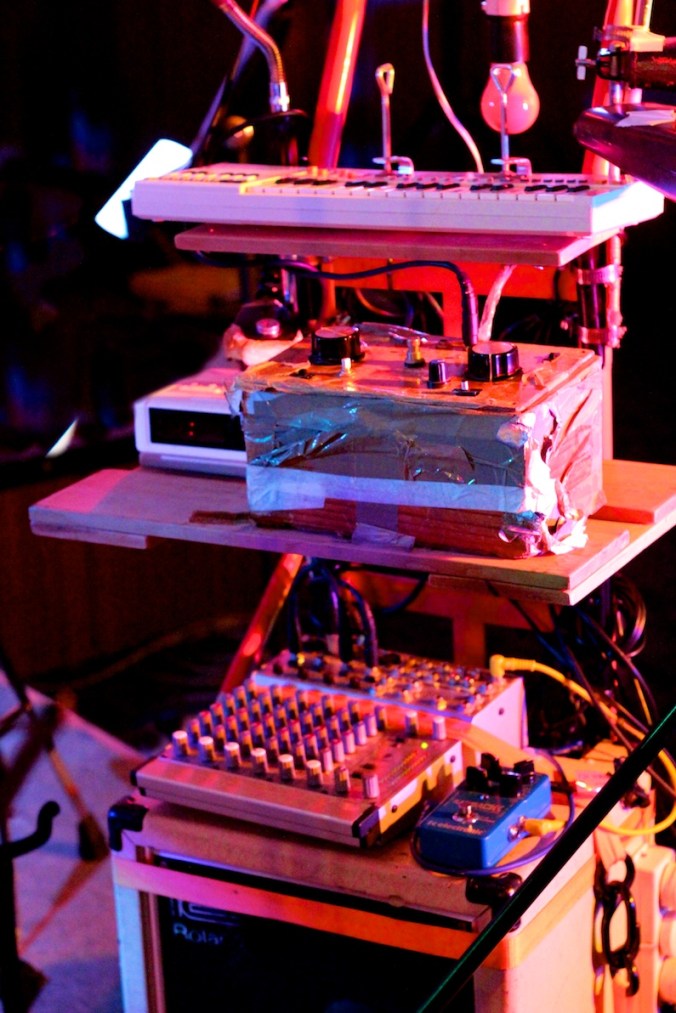
Cam Allen usually plays alto but he is also a fine tenor player.   I have also seen him manipulate a Moog to great effect.  On Wednesday night he played a Buescher ‘Big B’ Aristocrat and it gave out an earthy, and slightly raspy sound.  Word has it that it is a tricky beast to play but it sounded just right for this gig.   I risk committing heresy here but a Selmer would have been too clean for this music.  His interesting modal explorations and his flow of ideas mark him out as a gifted player.  This is hardly surprising as he honed his craft on the highly competitive American Jazz scene.  In this band he doubled on ‘doogon’.   This is very much a ‘Kiwi’ thing and it is best described as an array of electronic and acoustic sound enhancements strapped to a hardware-store hand truck.  Resembling a cross between a Dalek and an IED with its glowing blue lights, digital clock console and multiple knobs (many strapped on with duct tape); it can envelop the audience with shrieks that resemble a Banshee at a rocket launch.  IMG_8075 - Version 2

All of the instruments including the drums feed into this machine and the effects are astounding.  On upright bass was the respected Tom Dennison who used his arco technique to very good effect.  This bowing worked well with the Doogon, which under Allen’s guidance resonated in ways that would have astounded the instruments makers.  Dennison has a lovely rich tone and we heard plenty of that.  What can never be overlooked are his compositional skills (See an earlier post on his ‘Zoo’ album).  For this gig he contributed the lovely ‘Eleanor’ which he dedicated to his girlfriend.  He seldom appears at the CJC these days and it was a pleasure to see him there again.

Perhaps the biggest masterstroke was adding Frank Gibson Jr into the mix.  This inclusion of a drummer most known for his Post Bop chops may have raised a few eyebrows at first, but Gibson is no stranger to fusion.  He demonstrated just how perfectly he can execute this material and he showed us all what free and imaginative drumming looks like.  I heard a band member saying later that having Frank behind them, lifted the whole performance.   IMG_8050 - Version 2

I am an unreformed devotee of music like this and whether you call it Space Funk, Space Jazz, Eclectic Fusion or just wild music I will be its cheer leader.   This is an itch that just begged to be scratched and I am glad that Neil gave us a taste of it.  Besides the wilder numbers there were one or two ballads to balance out the program.  Overall it was a very satisfying experience.

It was somehow fitting that the band performed on the day that NASA verified that Voyager One had left our solar system and entered interstellar space.  

Who: The Neil Watson Four.  Neil Watson (guitar), Cam Allen (tenor, doogon), Tom Dennison (bass), Frank Gibson Jr (drums).

Where: The CJC (Creative Jazz Club), 1885 Building, Brittomart, Auckland.

Photographs by John Fenton & Ben McNicoll

Trudy Lile Quartet @ CJC

IMG_7997 - Version 2

Trudy Lile has unerring radar when it comes to locating tunes from the lessor known jazz lexicon.  Tunes that she skilfully transforms into glowing vibrant flute friendly arrangements. Her choice of ‘Steppin Out’ is a good example.  Kurt Elling recently sung this wonderful (but difficult) Joe Jackson tune on his ‘At The Gate’ album.  Not only was it a great choice and well executed but her new lineup rose to the occasion; giving her all the support she needed and more.

Trudy Lile last performed at the CJC about 8 months ago and she had a different line-up then.  Last Wednesday she had assembled a particularly solid rhythm section in Alan Brown (piano), Cameron McArthur (bass) and Ron Samsom (drums).  Trudy is often adventurous in her choice of material, mixing reworked standards, originals and virtually unknown tunes scavenged from interesting nooks and crannies.  On Wednesday she held to this course and it paid off.  IMG_8013 - Version 2

Among the other numbers performed was a beautiful rendition of ‘Niama’ (Coltrane), ‘Flute Salad’ (Lile) – I love this tune with its swinging happy vibe and another Lile original ‘Domestic Bliss’.   Trudy explained that this number was somewhat tongue in cheek, as her own experiences of domestic bliss at times resembled the TV character Miranda’s.

Trudy Lile is well-known about New Zealand as a gifted flutist.   While the flute is her prime instrument she also demonstrates impressive vocal skills.  We saw both on Wednesday.  I have always sensed a pied-piper quality to her work and as she dances and sways during the flute solos it is impossible not to be captivated.  Dedicated Jazz-flute players have been rare over the years and some critics have been disparaging about the lack of expression in that horn.   If they listened to Trudy they would shut up, sit down and recant.   In her hands the flute has all of the expression you could ever want

.IMG_8017 - Version 2

I must zero in on Alan Brown here as he was just superb.  OK, Alan always puts on a great performance but this facet of his playing is not seen as often.  Alan is rightly famous for his soul infused Jazz funk.  He was a power house of inventiveness on Wednesday,but more importantly he established beyond a shred of doubt that he is a stellar straight-ahead Jazz pianist.   His playing is always strongly rhythmic and that is what we expect from Alan, but to see him as an accompanist in this context was revealing.  Anyone hearing a Kurt Elling number such as ‘Steppin out’, notices his arranger and pianist Laurence Hobgood.   Hobgood is a dedicated accompanist of the highest order.   Alan communicated a special quality also.  He supported vocals (and flute) in the way Hobgood does and it was pure gold.  After seeing him in this context I would really like to hear him do a piano trio gig sometime, complete with a few straight-ahead standards.

Cameron McArthur has become the first choice bass player for Auckland gigs and every time he appears (which is often) he impresses afresh.   He is gaining a substantial group of supporters about town and his solos always elicit enthusiastic calls and strong applause.
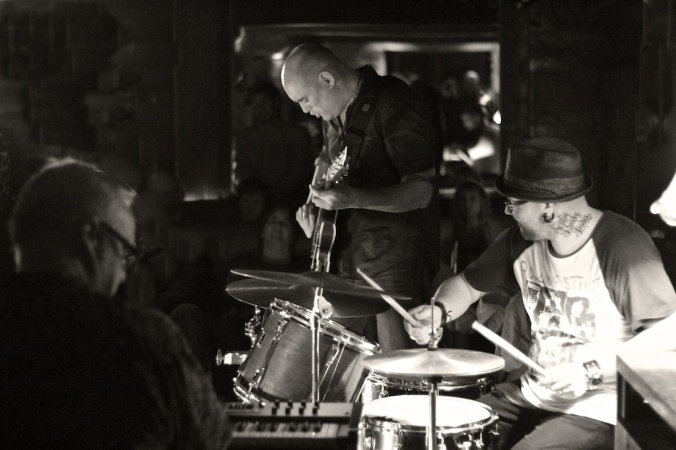
IMG_8012 - Version 2

Ron Samsom is quite simply the best there is on traps and his tasteful underpinning of any band is inspiring.  On this gig he alternated between quieter brush or mallets work and power house grooves which lifted the others to greater heights.   Sometimes when I hear Ron’s drumming I can discern a pulse that goes way beyond the room.  Perhaps it is the pulse of the Jazz tradition itself, the history and the future rolled together in a beat.

This band was the perfect foil for Trudy and she took full advantage of it.

Who: The Trudy Lile Quartet – Trudy Lile (leader, vocals, flute).  Alan Brown (piano), Cameron McArthur (bass), Ron Samsom (drums).

Where: The CJC (Creative Jazz Club) Brittomart 1885, Wednesday 7th August 2013.

Reuben Bradley trio @ CJC + Mantis Album

Reuben Mantis

After the success of ‘Mantis’ and ‘Resonator’, Auckland audiences were keen to see a Reuben Bradley band perform again.   Reuben is one of those musical drummers that Wellington seems to specialise in and he clearly has an eye for an epic project.  For ‘Mantis’ he engaged some real heavyweights.  Roger Manins (tenor), Matt Penman (bass), James Illingworth (piano), John Psathas (arrangements) and the New Zealand String Quartet.  The tunes were all Drew Menzies originals, with arrangements by Reuben Bradley and John Psathas.

Mantis is a celebration of the works of Drew Menzies, a highly respected bass player in both the Jazz and Classical spheres and whose compositions had never been recorded before.  What is well communicated during this project is the connection that the musicians have with the material and what also comes across is Reuben’s obvious affection for his departed friend.  Reuben’s liner notes give us a fascinating account how the pieces came back to life, drawing us into a kaleidoscope of quirky lead sheets and a musicians world.  In some cases the tunes re-evolved from embryonic beginnings, coaxed by Reuben’s pen.   I urge everyone to buy the album.  The tunes are fresh but at the same time strangely familiar and this quality anoints them as being timeless, potential local standards.

While no added incentives are needed to purchase ‘Mantis’, it is worth pointing out that the proceeds of the sale go to the Drew Menzies Memorial Scholarship for young New Zealand bass players.  ‘Mantis’ was featured as a key event at the recent Wellington Jazz festival and this week it was a highlight of the Nelson Jazz Festival.  Credit to Creative New Zealand for funding such an important project and to Rattle Records for the album.  It is hardly surprising that musicians of this quality delivered so royally, but a nod to John Psathas and the New Zealand String Quartet is appropriate here.  No matter how experienced a classical string quartet, there is always a challenge when playing Jazz compositions.   The quartet’s unmistakeable chops and John Psathas airy charts took this exactly where it needed to go.

Having Matt Penman aboard was a huge coup.  This expat Kiwi bass player is now one of the real heavyweights of the North American scene.  His work with the San Francisco Jazz Collective, James Farm, Kurt Rosenwinkel, Kenny Werner, Joe Lovano, Fred Hersch, plus his own ground breaking albums, mark him out as one New Zealand’s greatest Jazz exports.  His Bass playing on this album is simply wonderful and no superlatives can do it justice.   Drew would have been extremely pleased.

Reuben won the Tui Best Jazz Album of the Year with his ‘Resonator’ album in 2010.   Roger Manins was also on that album and these two musicians work together whenever possible.  Both of the above albums are adventurous and in their different ways lay down benchmarks for what’s good and original about New Zealand Jazz.

mantis_image-reuben-bradley_wjf13

When Reuben came to the CJC on the 31st July, the working unit was pared back to drums, tenor sax and bass.   On Sax was Roger Manins who has shown time and again that he can give of his best in any configuration.  This sort of trio is wide open for possibilities and the lack of any chordal underpinning leaves the musicians open to risk, but completely free to explore melody and form.  None of the trio were strangers to this format.

I have often watched Roger stepping free of the boundaries, like an anarchic motorist on some long empty highway who has just realised that the normal road rules will not apply there.  I was also delighted to see Roger using his Radio Model, Cigar Cutter Selmer for the first time.  A sleek silvery goddess of bygone years which oozes charm.  In Rogers hands it purrs dangerously like an ancient vixen, brought back to life to seduce us all.

Brett Hirst is a popular Australian bassist and a list his former band mates would read like the who’s who of Aussie Jazz.  He has a big sound and an instinctive rhythmic feel which lent itself perfectly to this gig.  In their usual fashion Australia has claimed him as their own but he is originally from New Zealand like so many artists doing well across the Tasman.

Reuben, Roger and Brett work extremely well together and so it was fitting that they should tackle the work of Drew Menzies from a fresh angle.   While there was a tune or so from ‘Resonator’ in the set list, the bulk of the material played was from ‘Mantis’.  It is Reuben’s hope that these tunes will become mainstays in the Kiwi Jazz repertoire and I hope that this comes to pass.  I have heard at least one rendition of ‘Ladies Man’ played recently at a gig and so the trend may gather steam.

Who: Reuben Bradley Trio – Reuben Bradley (drums) (arrangements), Roger Manins (tenor sax), Brett Hirst (bass).

What: ‘Mantis’ (and ‘Resonator’) both available from Rattle.

Where: CJC (Creative Jazz Club) Brittomart 1885 Building downtown Auckland
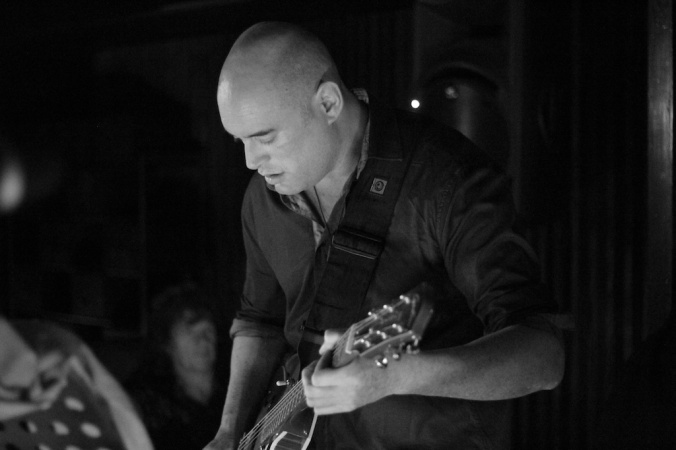
Mike Nock + Roger Manins, Frank Gibson@ CJC

IMG_7906 - Version 2

It was sometime in early June when I first heard the news.  I was sitting with Roger, talking music and shooting the breeze about who we rated.  Suddenly he half turned and said, “Mikes coming back to do a CJC gig”.  The words hung in the air like a siren song and for me the impatient waiting began from that moment.  If Mike Nock was coming to town there would be magic aplenty.  That’s what it meant.  That is what it has always meant.

The word seeped out, first to the music students and then to the wider world, like ripples in an ever-widening arc.  The club would be full that night.

Closer to the gig Roger asked Mike who he wanted in the band.  They quickly settled on a trio format, not your usual piano trio but one with piano, tenor saxophone and drums.   Roger Manins on tenor, Frank Gibson on drums.  Mike had jettisoned the anchor for this gig and he was quite definite about that, no bass.   This is a challenging lineup for a pianist (and for the other band members) because no-one is there to hold the centre.   If you slip there is greater distance to fall.  In this different space wonderful things can also happen and they did.  This was a night among nights.

IMG_7932 - Version 2

Barely able to contain my impatience I rolled into the club foyer three-quarters of an hour early.   The queue was already snaking back past the basement stairway and well into the upstairs bar.  A seething mass of eager faces.  When the doors finally opened there was Mike sitting sideways on the piano stool and Roger was blowing a few scales nearby.  The music stand sitting to one side abandoned, an unnecessary distraction, in a free ranging gig going where the music took it.

Before the first set I caught up with Mike, talking about his various projects (he was playing with a New Zealand string quartet the next night).  He told me that he was coming back to the CJC with his newest Australian trio in a few months.  Next time bass and drums.  We talked a bit about Jazz musicians from the past, Kiwi’s that he had played with and then the discussion shifted to the older pianists who straddled the swing to bop era.  Like all great pianists Mike lets the entire history of Jazz fall under his fingers and so I asked him about players like Hank Jones and Mary Lou Williams.  When I listen to them I hear such strong left hands, walking chords, syncopation, hinting at a time when ‘harlem stride’ was still an influence.  “The newer and stronger bass players changed that” said Mike.  “As the bass lines become stronger and pickups better the need for such dominant left hand work fell away.  There was too much conflict”.   As a non musician I had never considered that and it all made perfect sense.  I marvelled all the more that Be Bop/Post Bop greats like Hank Jones kept a touch of this earlier style and even when accompanied by strong bass players like Ray Brown, George Mraz and Ron Carter.   I wondered if we would ever see those strong left hand stylists again.   I soon got my answer.
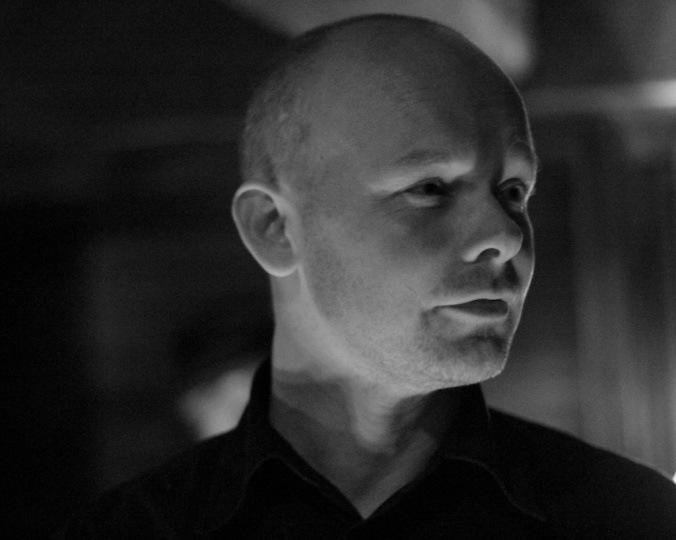
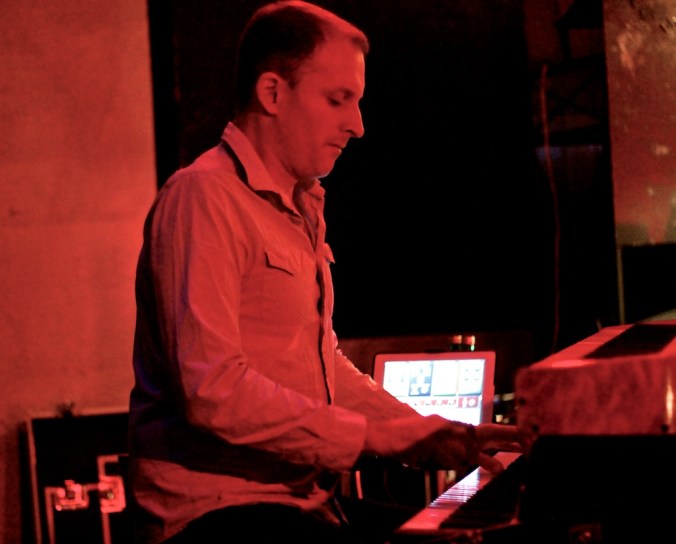
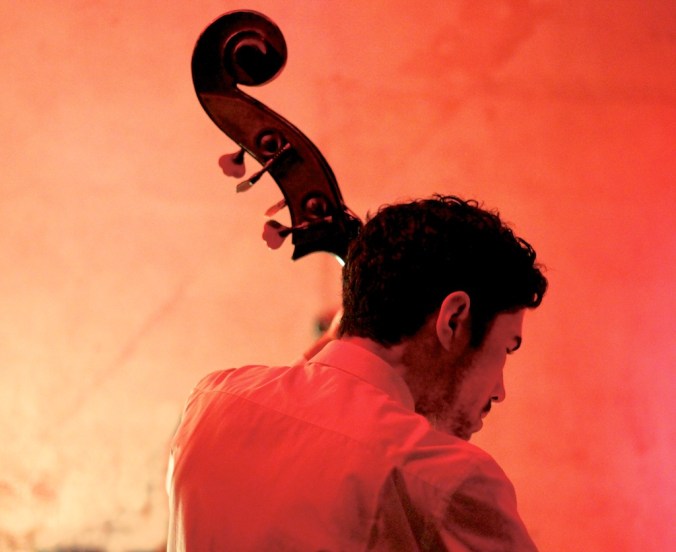
IMG_7897 - Version 2

The set list was not really planned and it changed and evolved as the evening wore on.   The numbers selected were all standards, but they were somehow fresh, as if revealed for the very first time.   The first number was ‘When Your Smiling’ (Shay/Fisher/Goodwin 1889) and the second number was ‘Gone With The Wind’ (Allie Wrubel 1937).  Those two numbers coming together had me wracking my brain as to where I had heard them, heard them played together.  Then it came to me, they were both on one of the earliest of the Brubeck Quartet albums.   ‘Dave Brubeck at Storyville 1954’ was a wild live recording that lacked polish but oozed soul and immediacy.  Afterwards Mike announced  that a Brubeck album had inspired him to play that number – bingo.  These are the connections we love.   If you ingest a large dollop of Jazz history the memories will reward you.  IMG_7901 - Version 2

As they played through the first set I realised that the lack of a bass had not impeded them at all.  There it was, that strong left hand of Hank Jones, working the mid lower register while wonderful modern chords and runs flew from his darting right hand.   This was a master class for the senses to grapple with, giving us an unparalleled taste of Jazz piano mastery from an oblique angle.  No matter what Mike threw his way Roger matched it as they danced in and out of reach like well matched prize fighters .  These two have an uncanny level of communication.  It was even more evident later when they played ‘Softly as a Morning Sunrise” (Romberg/Hammerstein).  They had been considering what to play next when Frank Gibson suggested it.  Heads nodded in agreement and Frank set the number up nicely with a melodic intro on his traps.   “We will just see where this goes” said Mike, “could be anywhere”and he proceeded to pick at the bones of the melody.   Where it went was somewhere wonderful.  This is where the magic truly occurred, a moment to be savoured by all present.

They had begun the number, sparingly at first, soon more purposefully.  The level of interplay increased as they unpicked the tune.  Soon all three were working and pulling at the tune like it was a joyful game.  As Roger soloed I watched the trio inching up the intensity by degrees.  At first Roger had tapped out time with his right foot as he played, now he was pawing at the ground like a bull about to charge.   Mike was rocking madly and then standing and dancing some crazy dance.  Frank too was rolling with the beat.  By now they were way outside – blowing free of all constraints.   It was a moment to savour.  The moment.

IMG_7891 - Version 2

As I watched these three, so attuned, a thought struck me,  Mike Nock is originally from Ngaruawahia, Roger from Waiuku.   These two small country towns are close to each other.  What are the odds that rural New Zealand would produce two musicians of this quality.  Maybe it was something in the upper Waikato water supply?

When Jazz musicians are enjoying themselves there are always moments of hilarity, but on this night the best moment came from an unexpected quarter.   The CJC was full, so full  that dozens of people were turned away at the door due to the fire regulations. Outside it was winter, but inside it was hot as hell.  Mike by now stripped to his T-shirt asked if there was any talcum powder for his hands, which were slippery from the exertion.   Caro Manins duly produced a talcum powder container.  Mike wrestled with the lid for a few minutes and then handed it to someone else to unscrew.   Bigger and younger blokes stepped forward in turn, each saying that they were up to the task, but none could dislodge that damn lid.  “Take it back to the shop” said one, “it’s a faulty product”.  At this point a diminutive young woman took the container from the frustrated men, gently flicked off the child proof lock and opened it.  Men often forget the golden rule in these situations, ask a woman.  IMG_7936 - Version 2

During the second set Kim Paterson and Brian Smith sat in for a number or two.   Kim and Brian go back a long way with Mike and both have recorded with him.

As the enjoyment washed over me I could hear the words of Sean Wayland from a month earlier as he announced his gig.  “New Zealand I would like to thank you for Mike Nock”.   With you on that brother.

Who: Mike Nock with: Roger Manins & Frank Gibson Jr.

Where: CJC (Creative Jazz Club) 24th July 2013

And a clip by Jen Sol from the same gig:

Conner McAneny @ CJC (+Nacey/McArthur/Samsom)

IMG_7813 - Version 2

Conner McAneny has played at the CJC on previous occasions, but this is the first time that he has done two sets as leader.  He was ably abetted by the Dixon Nacey trio (with Ron Samsom and Cameron Mc Arthur).   The sets were a mix of standards and originals.   It was particularly nice to hear the fabulous Dixon Nacey composition ‘The Lion’ played again and even better to hear Connor tackle the Lennon/McCartney composition ‘And I love Her’.

For me these two tunes stood out, but for very different reasons.   ‘The Lion’ is from Oxide the second Samsom/Nacey/Haines album and it is a great composition.   The tune moves through several distinct phases, drawing the listener ever deeper as the melody unfolds.  The structure lends itself well to improvisation.  Conner took a different approach to that of Kevin Field (who appeared with Dixon, Ron and Kevin Haines on Oxide) and it worked well.  I like to see local compositions being taken up by other local bands , especially if they are compelling.  We must create our own standards, because we have musicians with good writing skills in our midst.  Having two of the Oxide band in his support group made this an obvious choice.

IMG_7804 - Version 2

The Lennon/McCartney composition ‘And I Love Her’ worked very well as a Jazz ballad and if the arrangement was Connors particularly big ups to him.   I can clearly recall the Diana Krall version (2009), arranged beautifully by John Clayton.  There was also a John Abercrombie version from around that time.  Both were terrific in different ways, but the Sarah Vaughn cover of 1969 sits very awkwardly in her repertoire.  As much as I love Sarah Vaughn, this particular rendering sank like a stone.

I think time is the vital ingredient here.   It was as if there was a musical ‘Wallace Line’ that separated older players from younger in this regard.   For my generation (those alive when the Beatles arrived on the scene) the idea of their material ever becoming jazz standards was strange.  When musicians of the 50’s and 60’s attempted Beatles or Rolling Stones tunes there was an awkwardness and a self-consciousness about what they were attempting.   This is not at all evident in a younger generation of musicians like Uri Caine whose ‘Blackbird’ (McCartney) from the 2001 album ‘Solitaire’, stands up perfectly against any Tin Pan Ally tune.  In my view only a Brad Mehldau could pull off a version of ‘Hey Joe’ so convincingly.  He is young enough to see the tune for what it is and what it could be.  My generation saw such massive hits as the enemy of Jazz; brilliant, compelling but still the enemy.  Perhaps Gil Evans was the exception.  IMG_7799 - Version 2

Connor works hard at his craft and each time he appears we see a more rounded artist.   I have often written about the skills of the other band members and suffice to say, where they go good improvised music follows.

What: Conner McAneny (piano) with Dixon Nacey (guitar), Cameron McArthur (bass), Ron Samsom (drums).

Where: The CJC (Creative Jazz Club), 1885 Basement, Auckland July 10th 2013

Aaron Blakey (Sydney) @ CJC

IMG_7744

Aaron Blakey is someone you warm to instantly.  He communicates with ease and has a relaxed manner about him.  The same applies to his approach to music.  I have heard pianists who feel that they must astound with every note and while that is all well and good, it can be exhausting for everyone.  The more experienced musicians understand that performance is not only about original ideas, but also about communication.  The latter involves working with an audience while you tell an interesting musical story.  I would place Aaron in that category.

Aaron left Auckland for Japan in 2008 and he gigged regularly around Tokyo.  After a few years he returned to study in Auckland before moving to Sydney in 2011.   On this gig his accompanists were Roger Manins on tenor saxophone, Cameron McArthur on bass and Adam Tobeck on drums.  Roger Manins is at the peak of his powers and after his very successful stint with the JMO in New Zealand and Australia, he is more on fire than ever.   He is one of the best saxophonists in Australasia and so having him in any group lifts their game.  Putting him with a fine musician like Aaron Blakey produces especially rewarding results.  IMG_7746 - Version 2
Anyone who has read these reviews or spent some time at Auckland Jazz gigs in the last six months will know just how swiftly Cameron McArthur is rising through the ranks.    He is one of a small handful of must-have bass players when visitors come to town.   Adam Tobeck is fast becoming a regular at the CJC and his abilities were evident at this gig
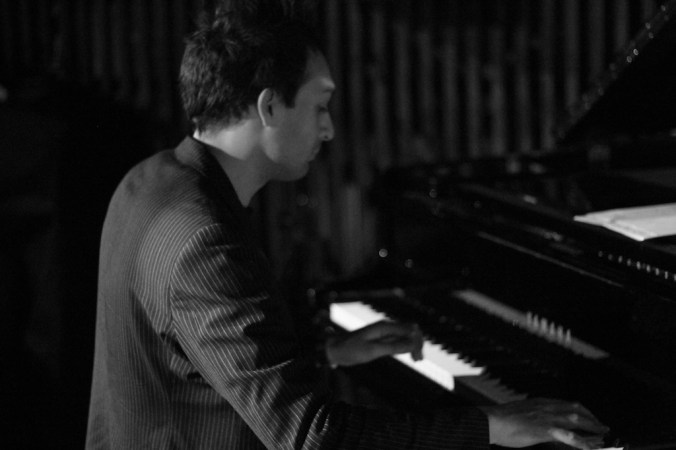
With two notable exceptions Aaron played his own material and the compositions were all named after people he knows.  With each song, we were ushered into Aaron’s private world.  A world peopled by close friends, eccentric waiters, babies and delightful dancing children.  At the end of the two sets I felt that I would recognise these people if I saw them; so convincing was the imagery.  Live improvised music creates shapes and forms which you can almost grasp, but which evaporate and dissolve in unpredictable ways.  What remains is a series of impressions, a filigree journey imprinted on the ether.  IMG_7759 - Version 2

A good example of this was a tune called ‘Sinclair’s Routine’.  Aaron named this after a waiter who worked at a  busy Surrey Hills restaurant.  He was using the establishments piano to practice one morning and trying out a few ideas, when the waiter said, “I like that, it helps me to go about my routine” .    Not your usual musical commentary but it ended up as great tune and gave us a window into that particular moment in time.   It worked for me on several levels but primarily because I could picture and hear the event in my mind’s eye.   There was a song ‘Jonathan B’ dedicated to an old friend from New Zealand.  As Aaron was explaining the origins of the tune he looked up and said, ” Oh there he is, he just walked in – hi man”,  Once again we connected the song to time and place and this gave added weight to the number.

The track that I have recorded on video is “One for Steve”, which is a dedication to the much admired Steve Barry.   This was certainly a connection that hung in the air as the band played through the number.  Steve (another ex-pat Aucklander) had been playing that very piano only a few weeks earlier and the echo of his gigs was relived through the tribute.

The first of two standards was ‘My Song’ (Keith Jarrett).  It amazes me that ‘My Song’ is hardly ever performed.  There is a view that Jarrett’s three recorded versions are so contained, that musicians shy away from it.  More is the pity because most jazz lovers rate it highly.  During the introduction Roger Manins helpfully suggested that Aaron would actually be doing the Elton John “My Song’.   This was a solo performance and you could have heard a pin drop.  It was great to hear it done and great to hear it done so well.  IMG_7719

The second standard was the Cole Porter tune ‘I Love You’ from the musical Mexican Hayride, placed squarely in the Jazz Lexicon by John Coltrane (Lush Life album).  While Coltrane’s version was with Saxophone, Bass and drums, The version on this night was a duo featuring piano and tenor saxophone (Manins and Blakey).   That these two have been friends for years and that they have worked together many times before, became evident on this number.   The sensitive interplay between them was truly extraordinary and although they took quite different approaches to the task in hand the synergy was uncanny.  It was one of the wow moments which Jazz audiences live for and to my annoyance I had run out of HD video-tape just a moment before it started.   I am sure that they will play it again sometime, as Aaron has promised to return. We hope that he will not leave it two and a half years this time.

For those wanting more there was a Roger Manins gig down at Frankie’s Bar in Wyndom Street two nights later.   This was a similar lineup, but with premier drummer Ron Samsom at the kit.  For this gig Aaron had brought his Fender Rhodes along.  They swung mightily and as I listened I could hear Ron pulling back on the beat.  There is some fine music around Auckland.  All it needs is our continued support.

Who: Aaron Blakey (piano) with – Roger Manins (tenor sax), Cameron MacArthur (bass), Adam Tobeck (drums).

Where: The CJC (Creative Jazz Club) Auckland 3rd July 2013
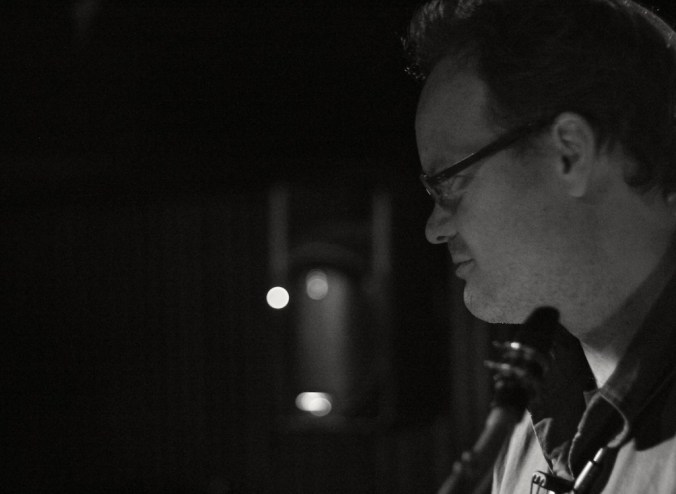
Mike Nock – albums reviewed

photo - Version 2

Mike Nock: Hear & Know / Kindred

Mike Nock is always capable of surprising and this has long been his hallmark.  A restless innovator and improviser who never settles on his laurels, Nock is surpassing himself yet again.  ‘Hear and Know’ was recorded in 2011 following his aptly named and deeply satisfying ‘Accumulation of Subtleties’ album.

On ‘Hear & Know’ he is again accompanied by brothers Ben Waples (Bass) & James Waples (drums).  There is an unmistakable synergy between these three and so adding Karl Laskowski (tenor sax) and Ken Allars (trumpet) had its risks.  While there is a different dynamic and altered textural qualities, the magic of intimacy is maintained.   It carries over much of the subtle interplay of the earlier album but creates a different range of moods as well.

I was always impressed by the subtle and profound sub-divisions of mood in the ancient Japanese Haiku.  The almost untranslatable ‘wabi-sabi’ are the moods invoked when we can almost touch something profound, sense it and appreciate the mood, but know that it will be forever illusive.  A further subdivision is ‘yugen’, which is the sense of mystery which underpins profound moments.  To define them more accurately is to lose the moment.    Mike Nock has achieved this for me compositionally and through his recording.   The moods are profound invoking deep and somehow unnamable emotions.

I felt this most strongly on the beautifully named and wonderfully crafted ‘The Sibylline Fragrance’ and later while listening to ‘After Satie’.   In the former piece there was an obvious reference to memory and our sense of smell, which is closely aligned with that.  Beyond that was something else, a sense of the history of this music.  Touching briefly on the past but rooted firmly in the now.   When music achieves this it is especially satisfying.   I have seen the trio performing and I have seen Ken Allars with the wonderful Jazzgroove  Mothership Orchestra.  Karl Laskowski was not previously known to me.   All of these musicians must feel pleased with this album.

‘Kindred’ is the more recent album and one with a pared back line up.  Featuring just Mike Nock on piano and drummer Lorenz Pike, this album seems denser in texture and more introspective.  Lorenz Pike is an interesting drummer and well-chosen; he is obviously colourist in tendency and that is the only choice for this music.  Once again Mike Nock has made a virtue out of contrast.  First impressions are often deceptive though and there is a degree of space and subtlety if we listen.  The stories unfolding are at times free and open but there is always an underlying thread.  The titles also fascinate me as they refer (as with the previous album) to a mixture of things past (references to the classical world), nature untamed and various private worlds.  I am a strong believer that improvised music benefits from narratives, not to define, but to augment the journey.

Mike has created subtle narratives out of the whole, which sit in the consciousness like Haiku.  There is something special about these two albums and I am certain that only Mike Nock could tell these particular stories.

What: Mike Nock – ‘Hear & Know’ and ‘Kindred’ albums FWM Records or visit http://www.mikenock.com

Where: You be able to hear Mike Nock in Auckland on Tuesday 23rd July 2013 at the CJC (Creative Jazz Club).

Dream Weaver – Murray McNabb 1947 – 2013

IMG_7710 - Version 2

Murray McNabb left us on the 9th June 2013, just missing his scheduled gig at the Auckland Jazz & Blues Club.  His keyboards may have fallen silent but not so the band who played on out of respect. Mike Walker an old friend, was approached by Murray just days before he died, to stand in if he didn’t make the gig.  The gig may have invoked a plethora of memories and been tinged with sadness, but it was clear that Murray would live on through his musical legacy.  This was a musician who fearlessly patrolled the outer reaches of the sonic universe and I like to think that his ‘Astral Surfers’ album will be poured over by intergalactic cosmonaut’s as they look for clues or perhaps navigation hints from ‘Ancient Flight Texts’.
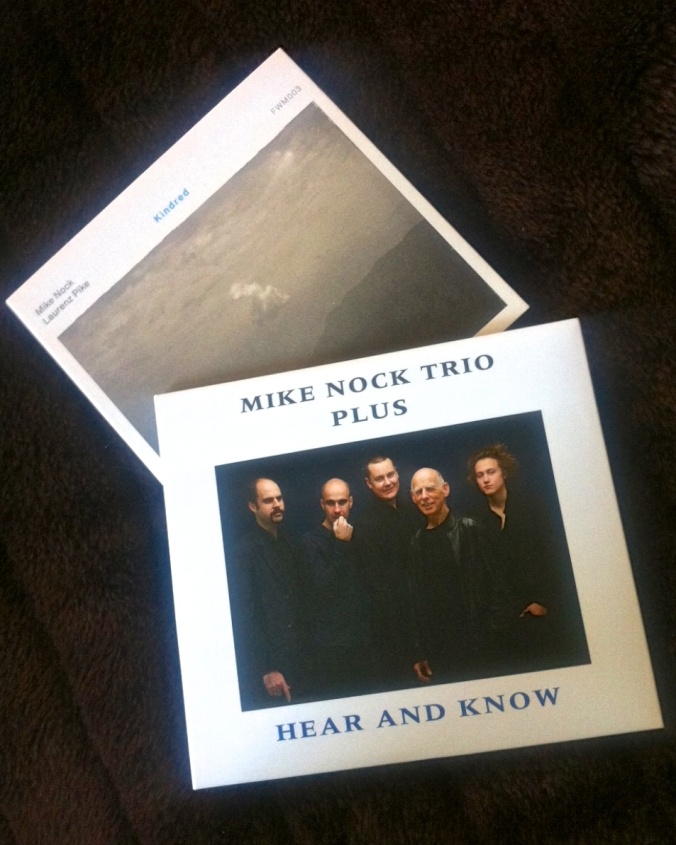
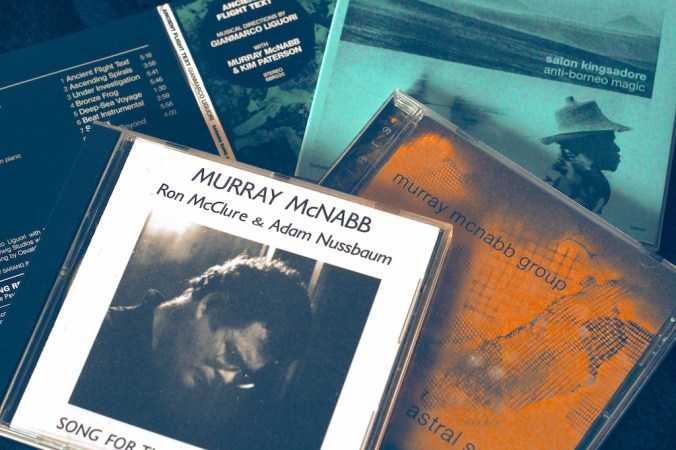
Frank Gibson Jr

Frank Gibson Jr

I was at Mt Albert Grammar at the same time as Murray and Frank Gibson, but they were more than a year ahead of me and both were prefects.  I was deeply into Jazz as a school boy and I knew that they were as well, but the gap between a fifth and a seventh former is sadly too far to bridge.  Fifth formers just didn’t hang with prefects and I regret that now.   I have followed Murray’s (and Franks’s) career ever since.

Murray McNabb was at the heart of the Auckland Jazz Scene and everyone respected his prodigious musical output.  The key to his music lies with the man, as music made him happy and improvised music even more so.  He was a man perpetually on the edge of a great adventure, navigating only by his innate sense of groove and an inner vision of the boundless vista’s that lay ahead.  Like Mike Nock he never settled for the ordinary, always pushing hard against the boundaries.   As much as I like his straight ahead records such as the lovely ‘Song for the Dream Weaver’, it is to his ‘out’ offerings that I return to again and again.

A largely self-taught keyboardist, he continued to explore the possibilities of Synths (and his beloved Fender Rhodes) during a period when others weren’t so keen.  In many ways improvised music has now come full cycle, as a younger generation continue the explorations, aided by clever machines and astonishing pedals.  Murray can take much credit for enabling a younger generation of local musicians to pick up on that.  His collaborations with Gianmarco Liguori in particular come to mind.  I regard ‘Ancient Flight Text’, a Liguori directed collaboration between him, Murray and Kim Paterson as a masterpiece.   If released by ECM, wide acclaim would follow.

Murray is known to all New Zealanders whether they realise it or not, as his collaborations with Murray Grindly produced film scores (e.g. Once were Warriors, Greenstone) and countless well-known TV adverts.  He never spoke ill of this work as it allowed him to simultaneously pursue his Jazz career.

The gig at the Auckland Jazz & Blues club was part wake (as old friends came up one by one to perform or to read eulogies) and part concert.   In my view it was Murray’s closest collaborators who stole the show and spoke for him best.  Frank Gibson Jr (drums), Kim Paterson (valve trombone), Neil Watson (guitar),  Denny Boreham (bass) and Stephen Morton-Jones (sax).   In Murray’s place was Mike Walker on piano.  During the second set the band played a Jazz fusion number composed by Murray years earlier.   Frank Gibson started the pulse with an insistent clipped beat similar to that used in Pharaohs Dance (Bitches Brew).  One-two, one-two, one-two, one-two.  The others moved in and out of the mix, weaving short phrases around the beat and creating layers of haunting sound.  No complex melody, harmonies that shimmered, as illusive as a mirage.  Out of this tribute I formed the strongest view of Murray’s output.  He seldom relied upon complex changes to achieve his ends.  Many of his compositions had no bridge or recognisable head.  He could say more by improvising against a drone or by working a simple vamp than almost anyone else on the scene.

Kim Paterson - Stephen Morton-Jones

Kim Paterson – Stephen Morton-Jones

Murray was a joyful explorer and he worked best when there was little chance of rescue.   His music was wonderful and he took that last step as bravely as he embarked upon all of his journeys.

For his recordings contact: www.sarangbang.co.nz

‘The Grid’ off the grid at the CJC

Tim Jago

Tim Jago

This band shakes all conceptions in the known musical universe and they do it by pillaging pieces of reality and cunningly re-assembling them into new and abstract forms. They are as brilliant as they are disarming. Getting under your skin with outrageous banter and constantly evolving story lines. Perhaps this is the future, laughing back at us, as we live in our bubbles of musical complacency?

It’s a little hard to define ‘The Grid’ by using existing musical terminology, so I will do so by drawing upon disparate references. If you were to add a pinch of Marc Ribot, Dvorak, R2D2, Kraftwork, Radiohead, Andre 3000, Willie Nelson and John Zorn into a crucible, you might create something approximating this band. In spite of the bands modernity, they have embarked upon a musical odyssey of classical proportions. Like Odysseus they’re building strange narratives as they navigate Siren’s and Cyclopes. Ever drifting into uncharted waters.

IMG_7621 - Version 2

The first number up was ‘Commodore 64’ from their first album. Since its inception this story has evolved into a saga (see video clip). The setting is somewhere in the future at a time when humans are replaced by robotic machines. The cyber children of these evolving machines have become bored with life and in order to alleviate that boredom they start copying human pop culture. A hipster culture develops and the young male machines start attending nightclubs in order to pick up cool hipster machine chicks. The goal is locating their ideal, a female robot dressed as a ‘Commodore 64’. I don’t think that Phillip K Dick could have bettered that storyline and the music is machine referencing, freaked out cyber nostalgia.

IMG_7612 - Version 2

Some other outrageous story-lines were as follows: Ben Vanderwal; “Don’t you just hate it when people make pretentious statements like – If Bach were alive today he would be an improviser” or “If Charlie Parker were alive today he would be in a ‘metal’ band“. He proceeded to say how distasteful and silly this sort statement was and then with a straight face announced his next tune as Dvorak’s third Symphony, the scherzo movement. Pausing before launching into their digitally enhanced heavy-metal tinged phantasy he added, “Of course if Dvorak were alive today he would be playing in this band”. Another tune intro was; “I am proud to relate that UNESCO has just voted this the tune most likely to bring about world peace”. They also told us that they would be playing a number from Ellington’s occult period ‘Satan’s doll’. It took a minute to sink in but when we heard the opening chords of Satin Doll we fell about laughing.

IMG_7608 - Version 2

There is much more to this band than outrageous humour, there is also outrageous music. They can slip between Willie Nelson and thrash-punk hardcore in ways that defy logic and in spite of the yawning stylistic chasms it all makes perfect sense at the time. It is later when the enormity of what you have just witnessed sinks in and you find yourself sitting in a confused state on the edge of your bed that you mutter WTF.

There is electronic wizardry aplenty at their disposal but that is not what stays with you. It is their musicality, their ability to connect and their cleverness. This band really can play and they impart strangely apposite history lessons as they go. The music can also turn on a dime, moving from the outer reaches of sanity to a gentle jazz ballad played over clever loops. I am absolutely certain that this sub genre of guitar trio will soon become more mainstream. Marc Ribot (Ceramic Dog) and Australia’s Song FWAA tread similar paths.

This is intelligent music and it requires mastery of the instruments plus mastery of a bewildering array of pedals, rattly things and clips. Making drums imitate machines or making guitars imitate an angel or a banshee is not a job for amateurs. All three band members are highly regarded on the world scene where they have gathered a multitude of accolades, awards and scholarships. Individually they have accompanied the cream of American artists such as Terrance Blanchard, Chris Potter, Chic Corea, Victor Wooten, Joe Lovano and others.

The Grid is primarily known as a Perth Band, but the USA could also claim them. In reality the band members now live in three cities and two countries. Ben Vanderwal (drums) is originally from Perth and so is Dane Alderson (electric bass) but Tim Jago (guitar) is from the USA where he lives and works at present. He has recently been working on a doctorate and teaching in Miami. Ben Vanderwal (who told the stories at the CJC) regularly plays with top US musicians and our own Frank Gibson Jr is credited as being his original teacher. Dane Alderson is the son of a jazz drummer and the winner of various prestigious awards. He plays an Aryel 5 string bass and like Tim Jago conjures up a world of wonderful sounds. My final comment on The Grid is; I hope that they comeback….soon.

Both of these clips are from earlier gigs – the stories and the instruments have evolved since then. The music is great as always.

Where: The CJC Creative Jazz Club 12th June 2013

What: The Grid

Who: Tim Jago, Ben Vanderwal, Dane Alderson