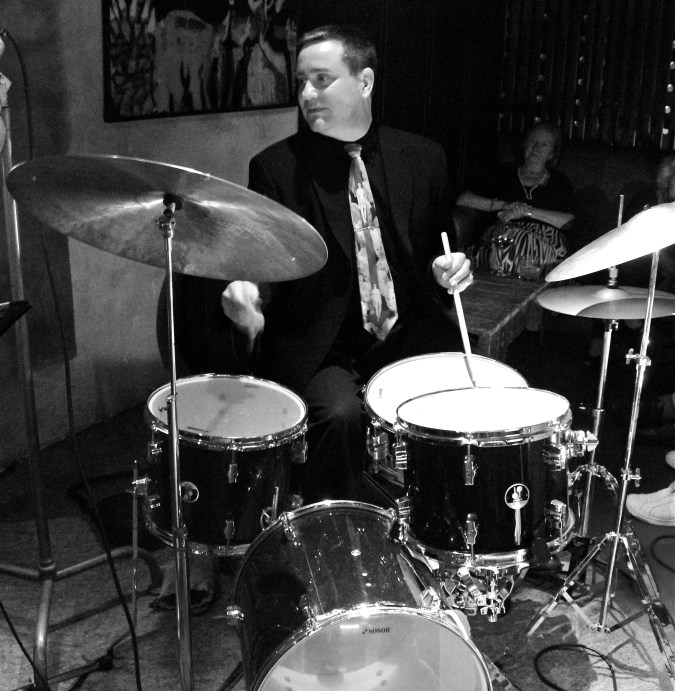
Alain Koetsier Band @ Finding Kiwi ‘Standards’

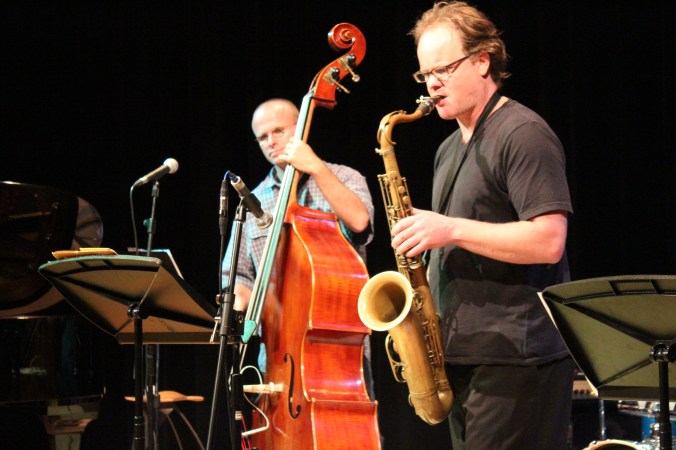
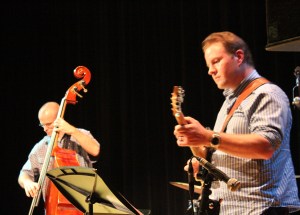
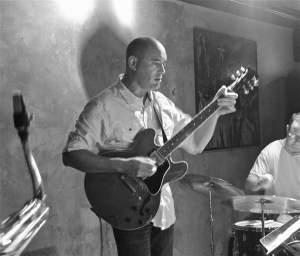
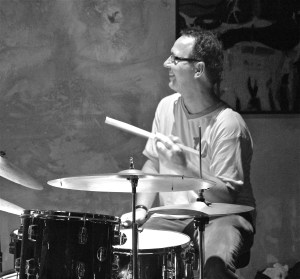
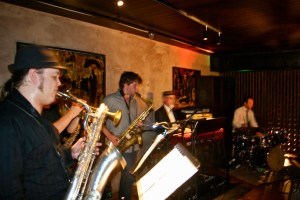
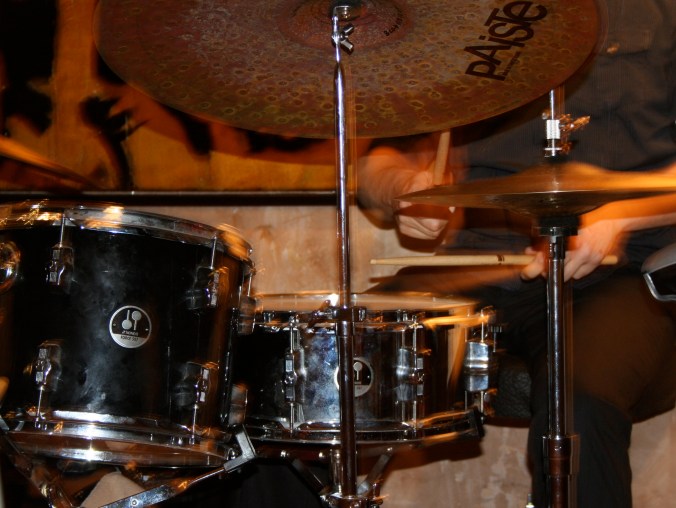
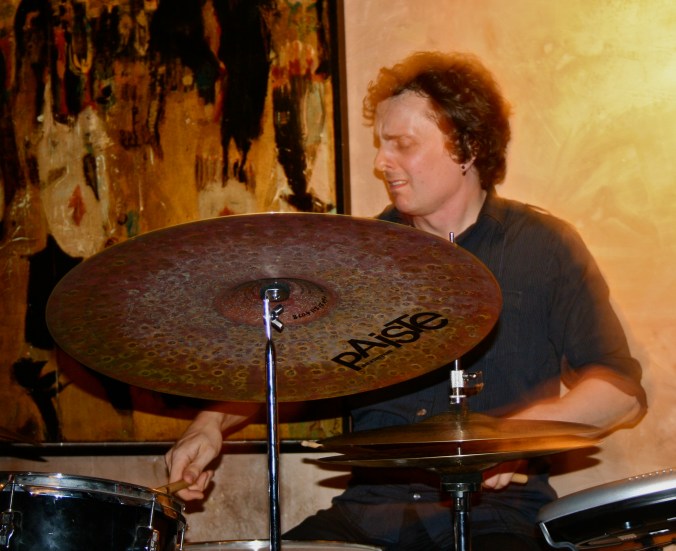
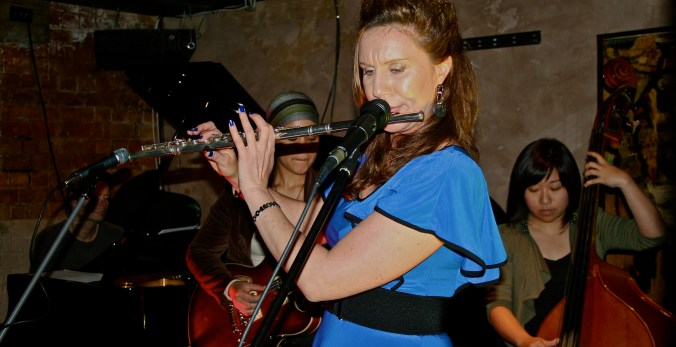
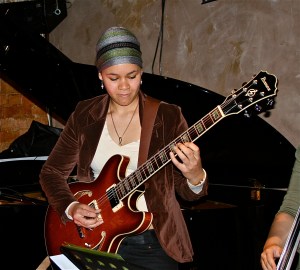
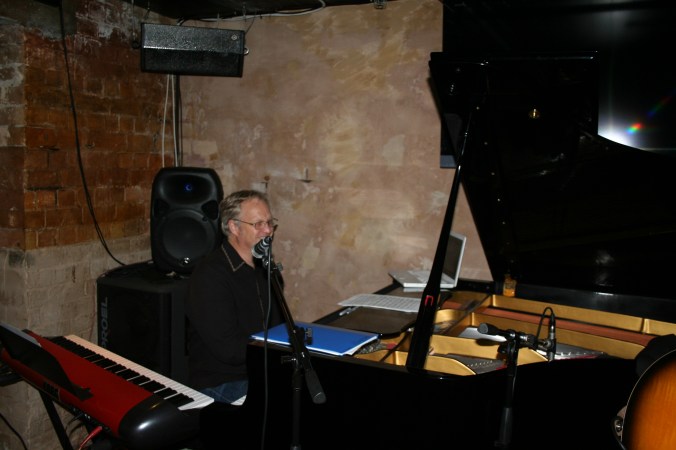
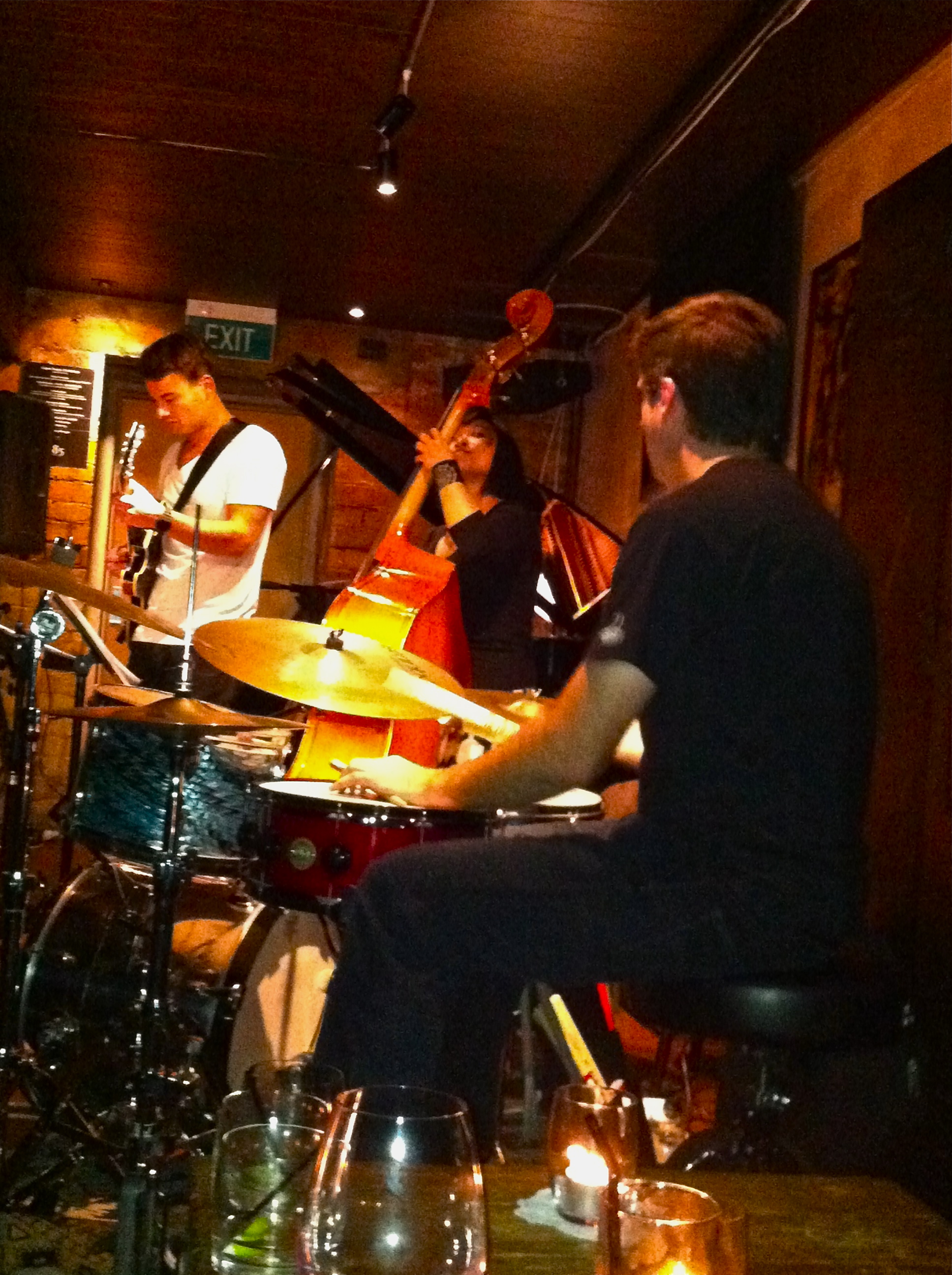
I have watched drummer Alain Koetsier perform over the last year and his credentials on the traps are unimpeachable.  Alain is a drummer with a modern feel and it is plain to see why so many of our top Jazz groups utilise him.  This was probably his first outing as leader and he had chosen wisely on two fronts.  His band mates were consummate professionals and their approach to the music was intuitive.  They interacted as if with one mind.  The second thing Alain did well was to select a set list of recent compositions by New Zealand Jazz Musicians.  I liked the concept.

People expect a band to play their own originals but when a set list focuses on a wider spectrum of Kiwi Jazz compositions it feels respectful.  It somehow lifts the tunes to another level of availability; a place of wider appreciation.  Doing this is a good start point in identifying our own ‘standards’ and some of the tunes played could well reach that bench mark.  As the scene continues to mature this will surely happen.

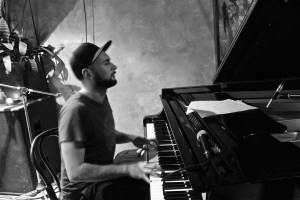
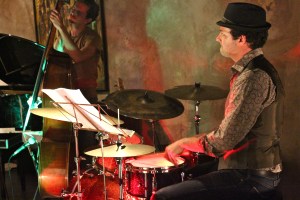
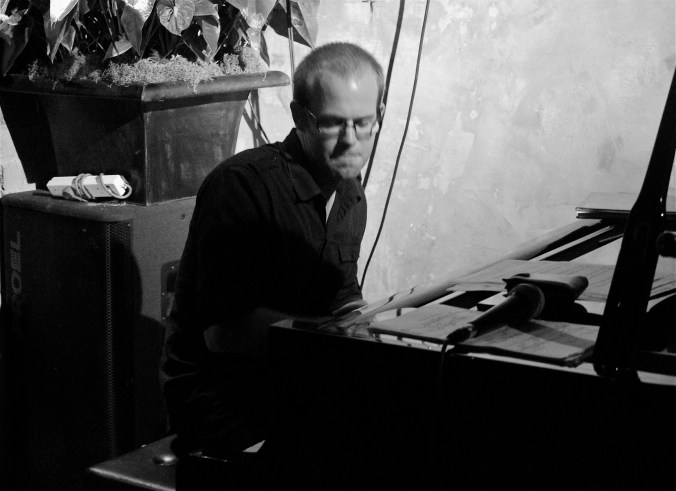
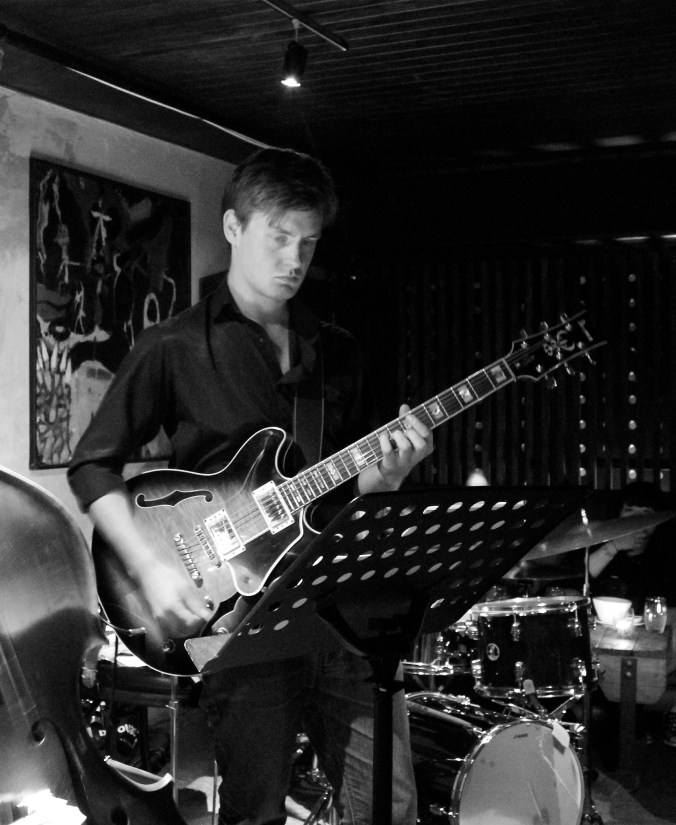
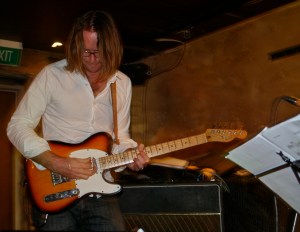
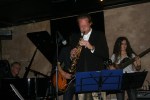
Alain & Dixon

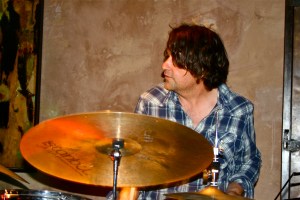
Alain & Dixon

I was pleased to hear two tunes which had impressed me at recent gigs; ‘Dicey Moments’ by Oli Holland and the wonderful ‘Ancestral Dance’ by Nathan Haines.   Both of these new compositions are distinctive, clever and memorable.  Dixon Nacey compositions also catch the attention as he has a knack for locating the right hooks while providing a solid base for improvisation.The first set had contained ‘Bad Lamb’ (Dixon Nacey).    The tune had nice chordal voicings and the way it unfolded led us easily into the heart of the tune.

Another memorable number was ‘Tree Hugger’ by the Auckland-born bass player Matt Penman.   Matt has moved into the upper echelons of Jazz bass, occupying a respected place on the world scene.   Maybe he will return the compliment one day and acquaint North America with a few of the other compositions.

The gig was fun to experience and obviously fun to play as the musicians enjoyment of what they were doing was easy to discern.  Like many Jazz gigs there was a high degree of spontaneity and perhaps this came from being thrown in at the deep end.   Working musicians seldom have a lot of time to rehearse and when confronted by complex charts they appear to relish the prospect.

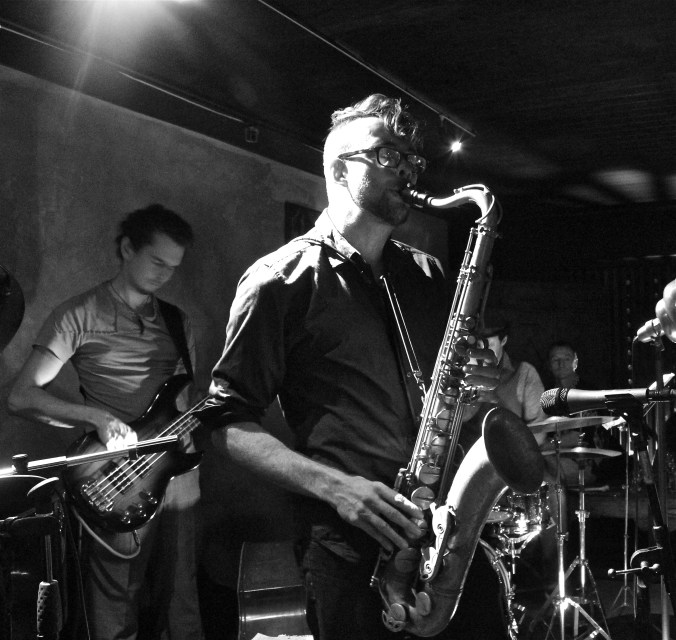
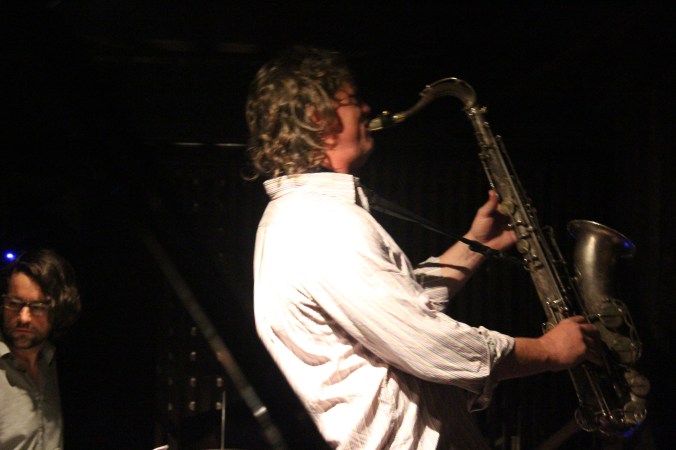
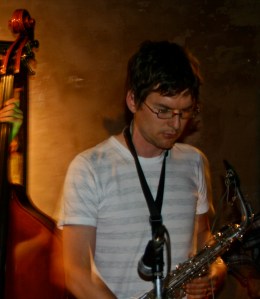
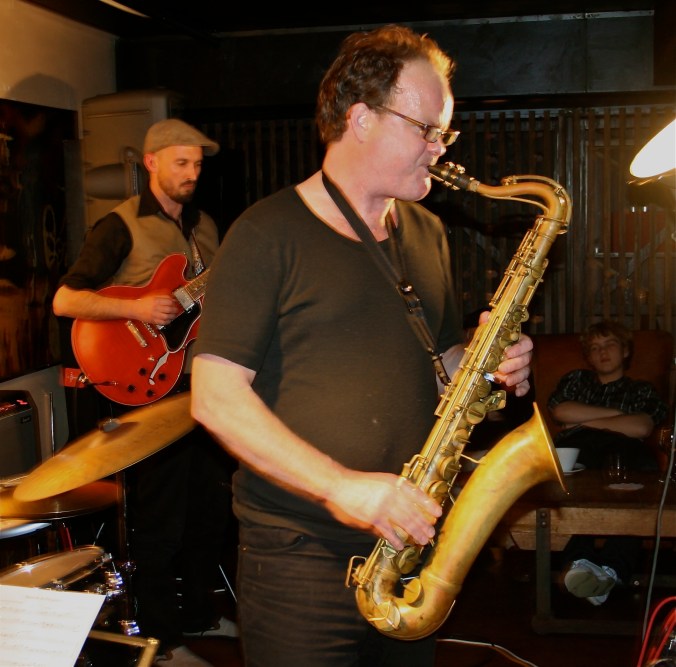
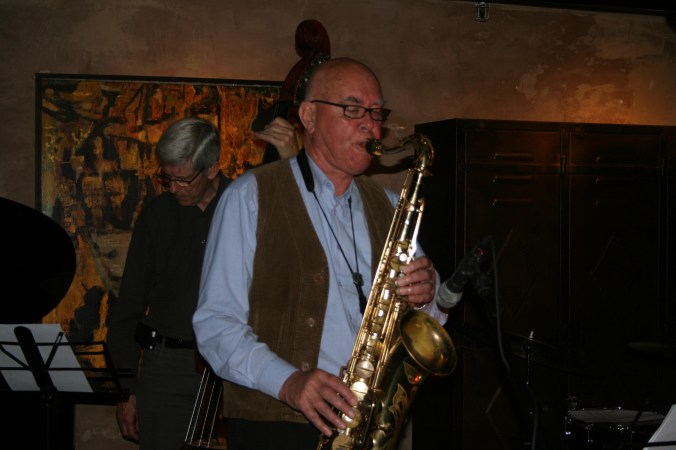
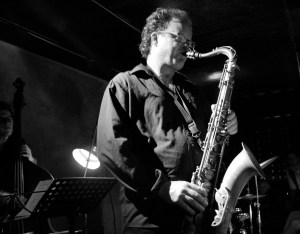
The musician that I was unfamiliar with was Pete France on tenor.   I know that he has played the CJC before and my friends tell me that they had hoped for his return one day.    His tone is rich and full and his improvised lines meaningful.   He is also relaxed on the bandstand and when you consider the calibre of his band mates this ease of manner speaks volumes.

Oli Holland

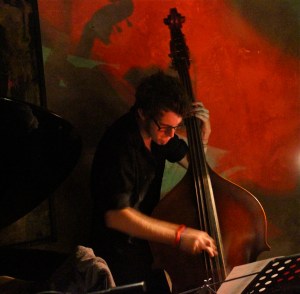
The band featured Oli Holland on bass.  His approach and focus drew you in inexorably as he demonstrated chops, impeccable timing and melodic invention.  His skills are considerable, as he can move from contrapuntal walking bass to melodic invention in an eye blink.   Oli gave his best, but then he always dies.

Pete France & Oli's hand

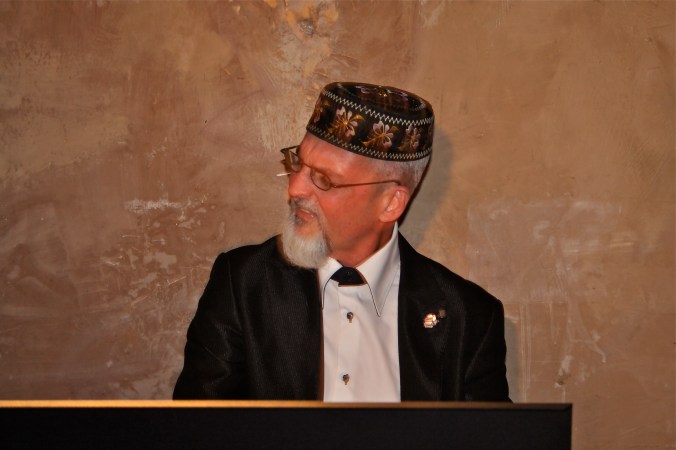
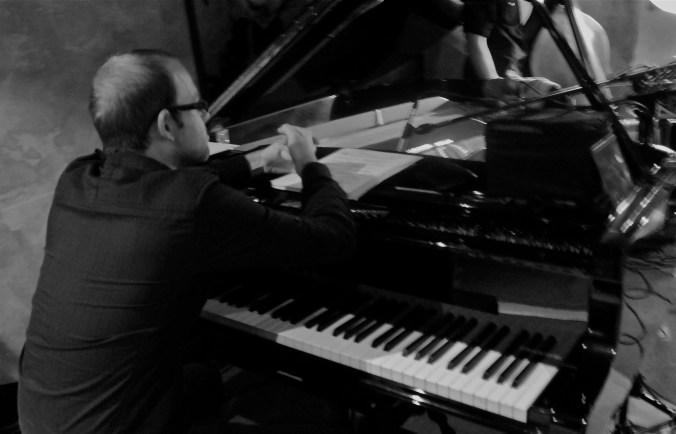
Lastly I come to Dixon Nacey.  His playing is widely appreciated throughout the NZ Jazz scene. As good as he is, he always strives to do better.   His compositions sing to us and his chordal work and rapidly executed lines astound.    It is good to be in a town where this man is playing and long may it continue.

Well done Alain – more please.

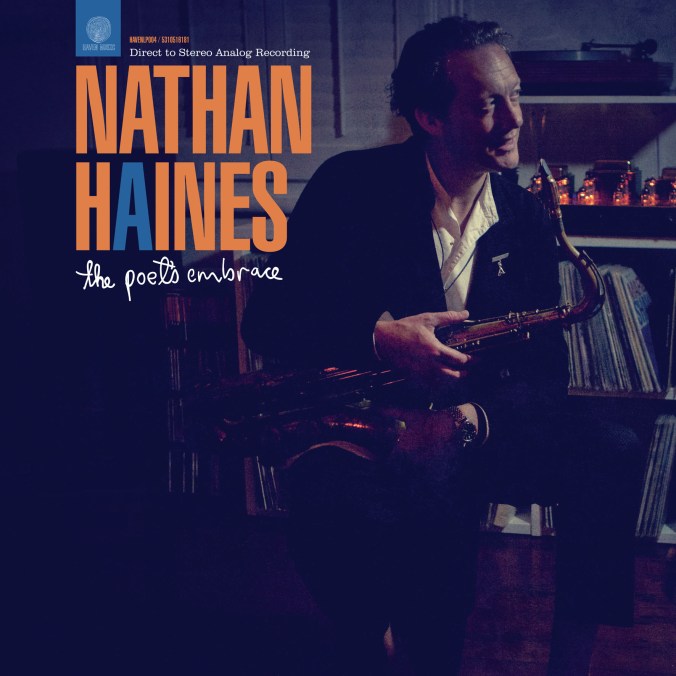
Nathan Haines – ‘The Poets Embrace’

On the 29th November 2011, those lucky enough to be at Nathan Haines CJC gig heard him playing ‘The Poets Embrace’ material.  As far as I know, this was the first public outing for the band and everyone who attended quickly grasped the importance of the event.   Hearing Nathan exclusively playing tenor (and not just any tenor) was intriguing because he is noted for being a multi reeds and winds player.   This gig was somehow different and it had a focus that was palpable.  It was about authenticity and it was about a deeper exploration of Nathan’s music.

Nathan’s approach to his music is a comment on his professionalism.  He divides his time between the UK and New Zealand and he recently headlined at Ronny Scotts Jazz Club in London.  Nathan is one our most talented musicians and I have learned that he never does things half heartedly.

Following that gig Nathan and the band cut an album.     The producer was flown in from London, the vinyl was pressed at Abbey Road, the tenor was a Selmer Mk 6 (ex Brian Smith), The piano was a Steinway B, The recording was made at the York Street studios on analog equipment and using classic microphones….I think you get the picture….glowing valves….absolute authenticity.     Above all this is terrific music and it may become the bench mark for future New Zealand Jazz albums.  The album will be released by Haven Records a division of Warners Music and it should be widely available.

The album is to be released on the 19th March (available on CD or limited edition vinyl)  The promo video is also worth watching as it conveys a real sense of the music we are about to experience.   The attention to detail is evident and one senses that the narrative is an important part of this journey.  People should book now for the launch, which is on Friday March 23rd, 8pm at the Monte Christo Room (behind the TVNZ building Nelson Street).    The entry price for the official launch is $25 pre-sales/$30 at door.  For those who are otherwise engaged on Friday why not get down to JB Hi Fi between 12pm – 12:30pm (any day 19th – 23rd).  If you do you will hear the full band.   It is impressive that a mainstream outlet like JB’s has been so supportive.    Please turn up if you can and this will encourage the store to support more Jazz releases in the future.  If it is wet outside so what, there is no cost to attending and what could be better; Jazz on an Autumn Day.

 These are all great musicians as you will soon hear.  They are; Nathan Haines (ts), Kevin Field (p), Thomas Botting (db) Alain Koetsier (d).

For the gig review see my earlier blog post “The Nathan Haines Fourtet”.

Oli Holland’s Shortland Street Gig

Oli Holland - Roger Manins

I recently received an invitation to Jazz Bassist Olivier Hollands DMA (Doctor of Musical Arts) recital.  It was titled ‘Dicey Moments’.  The gig was held in the Kenneth Myers centre at the top of Shortland Street.   This ornate crenellated building has a solid place in the history of New Zealand Music as it was formerly the home of the old Shortland Street TV studios. In its time the studio had hosted various radio orchestras and a few Jazz programs had emanated from there.  Stephen Small

When an experienced musician and gifted educator like Oli is performing a Doctorate recital it is bound to be an extraordinary gig.  Just playing a few standards would never cut it as the judging panel would certainly be looking for something unique and innovative.  In my view the performance easily met the required standard and all those who attended (mainly musicians) were deeply impressed.  Oli had written a number of complex charts for the recital and these conveyed a profound understanding of how improvised music can work.  While they were undoubtedly a challenge to play, they were still incredibly accessible to the listener.  The tunes flowed as fresh as a mountain stream and better yet they provided wonderful vehicles for the musicians to interpret and blow over.  Ron Samsom

I assume that the brief would be to choose band mates with considerable experience, solid reading skills and depth.  Band mates who would augment the vision, excel, but never overpower the lead instrument or the music.  These musicians were among the best on offer and they understood very well that this was about the music.  Oli remained firmly in control while encouraging the musicians and loosening the reigns when required; this is what a good leader does.

Oli had split the recital into two district halves; so to achieve a chiaroscuro effect and the appropriate contrast in styles, he had chosen two different bands.  One was a straight ahead jazz unit with Roger Manins on tenor, Kevin Field on piano and Ron Samsom on drums (Oli on upright bass).    The second unit was a fusion band with Dr Stephen Small keys, Nick Granville solid body guitar and Stephen Thomas drums.  Once again Oli played an upright bass, which worked exceptionally well, as the slap and bite provided a real contrast to the non acoustic instruments.  In the manner of all good leaders he joked with the audience.   “I used to agonise about the tune titles” he said, “but one day I had the profound realisation that it doesn’t matter what you name a tune. The next tune title has nothing what-so-ever to do with the music”.

The musicians gave their best and I have seldom heard any of them play better. The fusion half had the audience gasping in delight, as Nick Granville’s guitar, soared around Stephen Smalls fusion keyboard flurries.  The success of this recital is a tribute to the musicians but above all it is a tribute to Oli Holland.  His bass lines whether soloing or underpinning his charts worked perfectly.  Dr Oli it is then.

Nick & Oli

Nick Granville & Oli Holland

‘Seven’ – Tim Hopkins Trio

Interaction - Tim & Dixon

I purchased a copy of ‘Seven’ from Rattle Records not long after it was completed.   The cover art portrayed black sand, which is strange to those unfamiliar with it.   For those who have not encountered it before, black sand can also be surprising.  Subtle light-shifts can throw up a myriad of purple and blue hues, and the textures revealed by the drift patterns are in constant flux.   ‘Seven’ reflects Tim Hopkins’ music in much the same way.

Tim Hopkins is well-known to those us who have followed the New Zealand Jazz diaspora.   He has recorded extensively as a sideman with the likes of Mike Nock (and many others) and he has recorded a significant number of albums as leader.  Tim lived in Sydney for many years but he eventually returned to New Zealand where he is now based.  He teaches and performs in the capital city.  His long experience as a tenor player has taught him to throw caution to the wind.   He is adept at developing free-flowing Post Bop lines, but he is not limited by that.  While quite capable of playing sweet and low he does not invite complacency, as he can just as suddenly deliver a scalding declamation.   His style is to conduct an honest conversation with the audience and few punches are pulled.  This is not to say that he is too serious for he has a highly developed sense of humour which he uses to advantage.

Tim started the gig by explaining some of the concepts behind the ‘Seven’ band.   “Someone is missing from this band” he said gesturing behind him and I initially thought that he was referring to Richard Nunns (who had appeared on a few tracks of the album).  Tim meanwhile continued to explain, “He wasn’t invited, (pausing) it is the bass player”.   A bass player is the compass and when a band plays adventurous and complex music the lack of a bass places a heavier burden on the remaining musicians.  These guys were fully aware of the job in hand.   It is often the case that an experienced leader will develop an uncanny knack for selecting just the right sidemen and this was evident here.

Dixon Nacey is not only a versatile and superb guitarist but he is a musical free spirit.   His eyes light up when he is thrown a challenge and he soon throws a challenge back.    This guy is one of our finest musicians and the younger guitarists watch his every move.    I suspect that a lot of the weight fell to Dixon in this gig, but you wouldn’t have known it to see him smiling as he dared Tim or John to answer his challenges.    This was call and response at its best.

Dixon Nacey

The drummer was also perfect for the role.  It was the first time that I had seen John Rae on traps and I hope that it will not be the last.  He is unlike many of the drummers we see, as his approach is loose and organic.  If he wants to up the ante he will suddenly shout at the others; exhorting them to give even more.  He is also far from a locked-in drummer as he will punctuate and change the groove at will.  I really liked this approach as it was the ideal foil to Tim and Dixon.

I also sensed that the band was unafraid of being overt and about confronting the political realities of our times.  This flowed through the music and I loved that about them.

At the beginning of the second set Tim was about to introduce the number when he looked into the audience and said, “Can someone bring a bouncer and throw out that old man talking in the front row”. The talking continued and Tim said in a slightly menacing northern Irish accent, “old man – go home to your wife – go home to your children”.   A short silence followed and then “Dad shut up”.   The smiling offender was Tony Hopkins his father.   Tony is much-loved on the Auckland scene for his skillful drumming.    I saw him when I was young and I would like to acknowledge his influence on my generation and beyond.

Another good example of Tim not taking himself too seriously was the introduction to ‘23rd century love song‘.   He explained that this was the result of endless navel gazing and that the market he was aiming for was probably chemistry professors.

While aspects of the gig were challenging, the night has left me with a lot to think about.   Music should occasionally challenge us and it should make us think.   I find myself going back to the album to re-examine a track or a phrase and this is a good thing. The communication is still happening.  John Rae

The numbers that have stuck with me are ‘Road From Perdition’, ‘All Blacks & Blues’ and the lovely ‘The Sleeping Giants’.   for a copy of this go directly to Rattle Records at http://www.rattle.co.nz – failing that try ‘Real Groovy’ ‘JB HiFi’ or ‘Marbecks’.

The Jam: After the gig there was a jam session and it quickly morphed into a mammoth affair.    Drummers, saxophonists, guitarists and singers crowded the band stand while fours and honks were traded to the delight of the audience.  I don’t think that I could name everyone who played but I will try: Roger Manins(ts), Tim Hopkins(ts), Noel Clayton(g), Aron Ottignon(p), Matt Steele(p) Tyson Smith(g), Dan Kennedy(d), Tony Hopkins(d), Tim ?(d), a young drummer (?), Dixon Nacey(g), Callum Passells(as), Holly Smith(v).    Roger played a lovely breathy Ben Webster sounding ‘Sunny Side if The Street’, Holly sung a fabulous bluesy ‘Summertime’ while Tony played just like he always does.  Sitting just a fraction behind the beat and in perfect time.

Ottignon Bros Tour – Crazy in the moment

Ottignon band @ CJC

Matt, Eden & Dan

Seeing the Ottignon Brothers perform is to be put in mind of a very clever vaudeville act. There may have been more gags in a vaudeville act (well that is not strictly true) but the interaction between band and audience was honed to perfection.  The jokes were often of a musical nature and none of them missed the mark. This was great fun, highly inventive music and above all top class entertainment.

I first saw the Ottignon brothers when they were living in New Zealand and again some years later after they had moved to Australia. Aron was regarded as a prodigy on piano and I recall seeing Matt performing high wire saxophone acts somewhere. The brothers are now scattered around the globe, with Aron living in Paris and Eden & Matt based in Sydney (but gigging all over). The Australasian tour gave us a chance to connect with their new music and for the brothers it was a chance to play together again after 8 years.   The audiences responded by packing out their gigs.

Watching them communicate on stage was fascinating because they didn’t appear to need the cues that others rely on.   This apparent telepathy was advantageous to them as they responded to each other with lightning speed. The spontaneous twists and turns of the gig required them to be fleet-footed.

Aron

The way they had arrived at their set list was fairly post-modern and to lesser musicians it would have been challenging.  Only days away from the first gig in Australia they had put up a Facebook post; requesting ‘friends’ to nominate the tunes they should play. To be selected, each tune needed to attract at least two votes and predictably the suggestions were quirky. ‘Black and Crazy Blues’ (Roland Kirk), ‘Eden’s ukulele Song’ (Eden singing with ukulele, composed days before the gig), ‘African Mailman’ (Nina Simone), ‘Running Up That Hill’ (Kate Bush), a Medley of Sly & The Family Stone numbers, The poem ‘Trees’ which had been suggested by their Grandmother (Edwardian war poet Joyce Kilmer), ‘God save the Goat’ etc.  You get the idea.

The diversity of the material held the audience’s attention throughout, but it was their good humour and the solid musicianship which clinched the deal.Eden & Dan

Each number was a little crazier than the last but there were a few numbers which will linger in my memory for quite some time.  When Matt played the ‘Sly and the Family Stone’ medley the tone on his tenor morphed into a deep breathy rich sound.   On ‘Its a Family Affair’ he reminded me of Pharaoh Sanders and I asked him about that after the gig.   He told me he had been taking an interest in some Ethiopian tenor players of late and that they cultivated that particular sound.  The other number that I liked was more of a novelty and that was when Matt played his iPhone using the ‘Gyro Synth’ app.   This looked easy but it is not (I know because I have the app).  Matt has played with Lou Reed, Brain Wilson and Mike Nock among others.

Throughout Aron laid down solid percussive grooves on the piano and lived up to his considerable reputation.  In Europe he fronts a group called ‘Aronas’ and is featured in a number of well-known bands.   Eden showed his chops on double bass and electric bass, but also ventured into song and ukulele as the set list demanded.   Eden is the leader of the ‘Sun Searchers Collective’.  Dan Kennedy was on drums for the New Zealand leg of the tour and Kiwi’s are familiar with his tight propulsive, energetic style.    Dan is a favourite at the CJC and they could not have picked better for this gig.

Matt performing on iPhone.

http://youtu.be/eSDbUwLIuXE

Aron pleasing large crowds in the South of France

http://youtu.be/O9ARpmvWrHU

James Ryan – Jazz without a parachute

James Ryan is a Sydney based tenor player and he has appeared at the CJC before.  On Wednesday nights gig he fronted a trio of saxophone, drums and bass.   In configurations like this where chordal instruments are absent, a band is taking a more adventurous route.   Guitars, pianos, horn-sections and jazz orchestras provide a safety net for horn soloists and in addition they tend to fill in much of the soundscape with colour and a variety of textures.  Without this underpinning, clean open spaces can be revealed and the bones of melodies can be unraveled or looked at afresh in their raw beauty.    This is jazz without a parachute.

The precedent for such trios goes back a long way.   Gerry Mulligan came close with his famous piano-less quartet of the 1950’s, but the addition of another horn (Chet Baker or Bobby Brookmeyer) allowed for chords and complex counterpoint.  The most notable historic piano-less trios were Sonny RollinsWay Out West‘, Lee Konitz, ‘Motion’ and the drummer led Elvin Jones ‘Ultimate’.    There are many others and I should also mention the Max RoachDizzy Gillespie duos with just trumpet and drums.  Our own Roger Manins has also explored saxophone trios and his well received album ‘Hip Flask’ is a notable example.

I did not hear James the last time he appeared, but I was soon to be impressed by what was on offer.  His choice of band-mates proved to be fortuitous as Tom Botting (bass) and Ron Samsom (drums) rose to the challenge with enthusiasm.   In this blue-sky environment each artist knew what needed to be done and more importantly what must be avoided.  The was no overplaying and the flow of musical ideas was engaging.

James introduced the first set by playing solo for a number of bars and we could hear immediately that he was brim full of interesting ideas.  This was a good way to open because when the bass and drums came in, their addition filled the space with possibilities.  The fourth tune of the night ‘Micky B’ (Ryan) was a good example of this interplay.   In this case the tune had been set up by the bass and it soon developed into a hard-driving bluesy exploration of the theme.   James drove deeper and deeper into the changes and freed of the need to avoid piano or guitar, he took the music where he wanted it to go.   While James took care of business Tom Botting found just the right responses and Ron Samsom showed us again why he is a master of the drum kit.

After a number of interesting originals had been performed the band switched seamlessly to the well-known standard ‘You and The Night And The Music”.    James explained afterward that this had not been on the set list, but because Tom had quoted from it during an earlier bass solo he added it on impulse.   It is when we hear a standard that  we can form the strongest views and make comparisons.    The audience will know where the tune has gone before and be interested to see just where this band is taking it.   This particular exploration was inventive without being disrespectful.   It had an element of surprise in the familiar and that is what the best Jazz is about.

As is so often the case when Ron Samsom is on the bandstand, the percussion work was extraordinary.   His use of mallets and his inventiveness riveted the audience again and again.   He can play tightly in the pocket or with an understated but completely engaging looseness.  We saw him as more than a drummer in this set up.  He was an instrumentalist capable of filling any space.

There was one free number during the night and it was a riot.    James announced that he would play a tune of his titled ‘Rocket No 7’.    This was an homage to Sun Ra and his much admired composition ‘Rocket No 9’.   A few bars in James just let rip and the band quickly followed him into what were obviously unchartered waters.  This decoupling from the changes was soon evident and the organic freedom took us on a wild and delightful ride.   While the music was as free as a skylark it was never directionless.    Both band and audience were smiling at the end and everyone in the room knew that they had experienced something special.

After the number James wiped the sweat from his brow and pulled the mike towards him.   “That was nothing like ‘Rocket No 7” he said to our delight.

As with many of the Australian visitors we look forward to his return.

Natalia Mann interview

Hi Natalia,

I would like to thank you for agreeing to this written interview as I know how busy you are.   This will serve as an addenda to the post on your album ‘Pacif.ist‘ and give context to the Pacifica/Turkish connection.  Above all it will provide an insight into the charts and your choice of ancient and modern instruments. (read in conjunction with previous blog)
Q. Can you tell me a little about the harp you played at the launch?     It seemed smaller like the Celtic harp and wonderfully ornate.  Was that the one that you played on the recording?
Hi John.
 The harp I played at the launch is a nylon strung harp made by Andrew Thom in Tasmania.  It is a standard size for larger celtic harps – 36 strings –  though they can come in any size.  The ornamentation is actually quite industrial – a silver aluminium frame with black dots, and some subtle functional wooden detail. It has a carbon fiber soundboard and an aluminium soundbox covered with leather. But the shape of the arch and column itself is amazingly organic, comparable to dripping glass, with a koru curl.  The “Holden Red” colour makes it quite sexy, like a stiletto.
I played this harp on one piece on the album – Time.  Although most of the pieces were written on lever harp, when it came to recording I preferred to use the concert harp – the sound is richer and deeper.  I used the lever harp on Time because the composition includes string bends that are a sounds you get particularly with levers.  For the rest of the recordings I used my Lyon & Healy Style 23 Concert Grand (a big classic ornate wooden harp like those you see in the orchestra).
Q. Is some of that music improvised or were you following a score (or Jazz chart)?
There is improvisation in all of the pieces except for Interlude for Grozda, which I wrote out very quickly one day and I played that from the notes because I really liked them.  Usually I make a kind of jazz chart with melody, and we go from there.  Generally my aim is to improvise, so we’ll play the first round from the sheet and then expand on the ideas after that.  I love the way Aksam Duasiturned out because there’s so much improvisation in it.  It had one of the most minimal charts.   Greenstones is a piece that is usually ‘set’, ie, I usually play pretty much the same thing every time. In this version on the album, there was an extra melody chasing me all the way to the studio that day.  It wanted to be included in the recording. So when I got there, I tried to make room for the extra phrase.  It resulted in an improvised introduction of 2 or 3 minutes which I think worked very nicely with Richard NunnsTaonga Puoro.
I love improvising, and if I’m not improvising, I don’t mind making mistakes so that I have to improvise my way out of them.  Even if I’m playing the set tune, it’s still got to feel like an improvisation.  That’s the good music.  That’s what I’m chasing.
Q. Were those compositions originals or created out of traditional motifs?
That begs the question ‘Is there such a thing as a completely original work’?  I try to keep things as original as possible.  I try to let the music tell me how it goes rather than the other way around.
The only piece in which I really used a particular template is the first part of Akşam Duasi (Evening Prayer).  That melody came about one day when Izzet and I were looking at a traditional Turkish rhythm called Hafif which is a single bar of 32 counts.  You say “Dum tek tek, Dum tek tek, Du-um te-ka du-um tek tek-a…”  like this.  I made up a melody to help me remember the rhythm, we liked it and it became one of our tunes.  The second half of that piece came about when we were having a lukewarm jam one afternoon and the ezan (call to prayer) began. Suddenly the instruments got hot and took off as if on their own accord, jamming along with the ezan.  It’s simple and it feels good – familiar but from where?
Certainly in my early compositions, I used things that were ‘evocative’ for me, colours and feels from genres I’m familiar with. Greenstones has obvious Celtic influences, but begins with what for me is a bassy Polynesian rowing rhythm.  I recall now that it’s melody was influenced by speech and the motivic nature of the Kanun (Turkish zither).  As I got more comfortable with composing, I became more excited by melodic or harmonic movements that would surprise me.  These days I spend more time trying to figure out what it is that I wrote.
Q. The quality of the percussion work was extraordinary and I gather that your husband is the drummer.   How many percussion instruments were used apart from a normal drum kit.
Yes, Izzet Kizil is an extraordinary percussionist, and is my husband, and is a big influence on my work.  He has a very advanced, distinctive, intuitive personal style.  In fact he is not really a drummer, even though he played kit on these recordings.  He specialises in Middle Eastern hand percussions.  His main instrument is the Turkish Darbuka.  The other instruments he used were Turkish Bendir (a frame drum similar to the Irish Bodhran, which he plays with hands and brushes),  Daf, a Kurdish and Persian frame drum like the bendir but with dangling rings on the inside of the drum which makes the thunder sound that I love.  You can hear him play Kanjira (a small hand-held Indian drum with one zil) and Kup or Gattam (Indian clay pot) on Uc Adim.  He also plays a number of small effects percussions like clusters of seeds and bells.  He sets himself up a little kit made of the above instruments and a small snare and cymbals, which he plays with hands, brushes and sticks.  In Butterfly Effect he also plays percussion with his voice and fingers hitting his mouth and throat.
There is another drummer on the album and that is Riki Gooch.  Because Izzet isn’t a regular drummer, Riki noticed that some of the grooves could use some firmer ‘laying down’, (Gul Cayi, Sunshine Sister, Uc Adim), and he added in some very sensitive cymbal and highhat to complement what Izzet had already done.  Riki and Izzet met in Wellington, spent time and played together, so it was a nice vibe rhythm section even though the recordings happened on either side of the globe.
Q. Is there any connection between your music and the Sufi musical tradition.    Many Jazz groups in southern Europe now use an Oud (Italy especially) and some extraordinary Sufi trained musicians like Dhafer Youseff are having an impact.   I have seen him perform twice and it was a profound musical experience.
I have been very influenced by the sounds of Sufi music and musicians in Turkey, primarily the guitarist Erkan Ogur, and his albumsFuad and  Hiç, the title of which is a Sufi concept meaning ‘anything and nothing’.  In fact Mevlana or Rumi, the father of Sufism, was based in the town of Konya in southern Turkey during his enlightenment period with the philosopher Şemş.  Today Konya is called ‘the kitchen’ of pure Turkish classical music particularly because it is connected strongly with the study of Mevlana.  When I first came to Istanbul, I played mainly with Turkish classical musicians in Sufistic concerts. I will add here that the reason I was very attracted to Turkish music was not only for it’s beauty, but also the fact that it is an artform which melds improvisation with the written note. Recently I performed repertoire from the Sufi composer Yunus Emre with a singer at a Mystical Music Festival.  At that performance I was encouraged to improvise deeply and generously, because this is one of the expressions of union with the divine.
Izzet comes from a Sufistic tradition – his father played percussion for religious reasons. Sufism is a liberal and mystical branch of Islam. Living in an Islamic country with lots of philosophical artists around, Sufism is an underlying feeling.  I think it has been entwined in the development of Turkish music over the centuries, recognisable in the sense of expansive space and melodies of emotional longing for the divine.  I work towards deepening this kind of energy in my music.
Q. Is there a strong Jazz community in Turkey?
Yes there is. It’s relatively small but dedicated.  There’s a club in Istanbul called Nardis which is a dedicated seven night quality jazz place where lots of great Turkish musicians play.   Izzet plays for a group called “Ilhan Erşahin’s Istanbul Sessions” which is a New York-Istanbul jazz triphop outfit which is very popular.  A lot of international jazz artists tour through Istanbul. There are lots of great Jazz festivals going on, musicians coming over from Europe and the states.
Q. I understand that you were born in New Zealand and are of Samoan descent.  Is that correct?   Is there a Pacific influence in your music?
I was born and grew up in Wellington, witha seven stint in Los Angeles in my childhood. My mother is Samoan and my father is Australian – Scottish English descent.  The album is entitled Pasif.ist because I think of it as Istanbul through a Pasifikan’s experience.  The music is my response to the local environment as someone who is from ‘somewhere else’ and far away.  This is the manner of the Pacific influence in my music.  It is also in the concept of feeling the vibe of the environment and being in harmony with it.  Taonga Puoro is the ultimate example of this in my opinion.  If I’m in Aotearoa with a harp, I’m inclined to play clean air music with intervals inspired by tui calls. In the Pacific Islands I’m inspired by the warmth and rhythms of the water and trees.  In fact, these experiences are my references.  The antipodes are fierce with nature.  So moving into the densely populated, polluted, urban environment and foreign soundscape of Istanbul, I both absorbed the experience and reacted to it.
Some things that are particularly Pacific to me are the introduction of Migration, inspired by bird calls and contemporary NZ classical music.  Greenstones is another one.  Seeing the social-political situation between Kurdish and Turkish communities here, it made me think about Maori and the other communities which have journeyed to Aotearoa.  In that piece I always imagine the West Coast of NZ, clear starry skies and cold air. Sunshine Sister (my homesick song) is a sunny island tune about laughing and joy, as is the second part of Aksam Duasi.  Like that, the influence weaves its way through the music.
One of the reasons I started writing tunes here was to find a middle ground where I could communicate better with my Turkish musician friends. One time at a first gig, I said to the band, “let’s just jam this one on a dub groove.”  Well, I started, the bass player came in with something slightly different, the drummer joined with something different again, the violinist changed it more and by the time it got to the second tabla player, I had no idea what we were playing, but it wasn’t any kind of dub that I recognised.  There were suddenly all these alien rhythms my ears were trying to process. It was pretty funny.  So I figured out that we all have different vocabularies according to our experiences. I wrote music that mixed my perspective with a local vibe – where there weren’t too many preset rules and everyone could bring their own interpretations.
Q How many strings on the violin like instrument?  It sounds similar to the Chinese Erhu.
The violin like instrument is the Classic Kemençe (keh-men-cheh) played by Sercan Halili.  It has a three string and a four string version, and in Time, Sercan plays an Alto Kemençe which he had designed for himself.  It is the first and only recording of that instrument.  I love it because it sounds like a raspy old man.  I love all the kemençes for their soulful vocal sound – so etheric.  The instrument is played with a bow, but balances between the knees rather than on the shoulder.  It has gut strings, and the tones are created by pressing against the strings with the backs of the fingernails. It is a very highly regarded Turkish instrument for its delicate and emotional nature. Mostly it is played in Turkish classical music settings; Sercan is quite adventurous.  He is a talented young player fluent in the Turkish classical world and working on a number of cross-over projects.
Q Have you considered doing an even more Jazz influenced album one day?   Your music on Pacif.ist swings.
Thanks man.  I like swinging. I love jazz.  I’m doing a Masters degree in Jazz at the moment, so I reckon there will be a few new tunes popping out that are more jazz influenced.
In fact the first piece of the next album is a jazz tune already.  We were going to put it on this album but felt it needed more time to mature.  That was a session with the great bass player Dine Doneff (aka Kostas Theodorou) from Thessaloniki.  I met him out in Skopje which is where I study jazz with the guitarist Toni Kitanovksi.  Dine later came to Istanbul to record on some pieces and it was such a great experience working with him.
Q.  Could you tell me your link with Rattle Records?   Steve is doing a fabulous job of recording NZ Music and a number of those albums are absolutely world-class (‘Zoo’ by Tom Dennison is my very favourite).
Steve Garden and Rattle Records have been fantastic.  I approached them with my demo a couple of years ago and asked if they’d be interested to release it on their label.  Happily, they said yes, and they’ve been really supportive throughout the process.  There are many artists for whom I have huge respect and admiration on the Rattle label, so I’m honoured to have my album in the same catalogue.  The recent output by Rattle of artists and new music is phenomenal and gorgeous.  Really a cool support for art music in NZ.  Many thanks to them.
Q. What is your connection to Bic – I gather that you have been recording with her?
I’ve been playing with Bic Runga since about 2006, when we did the Acoustic Winery Tour and I played in her band.  Since then we’ve worked together when we get the opportunity.  I recorded on Belle, the title track of her new album.  She invited me to play support for her recent national tour.  So I did the support performance, releasing Pasif.ist, and then I joined her and the band on stage for a couple of numbers.  We had a great tour, with Kody Neilsen and Michael Logie in the band.  I admire Bic’s stellar output and her musicality.  She’s always encouraged me to get my music out there.
I must thank you for the thought that you put into your answers Natalia.   I look forward to your next visit home and to any future albums.
Best wishes
John (Jazz Local 32)
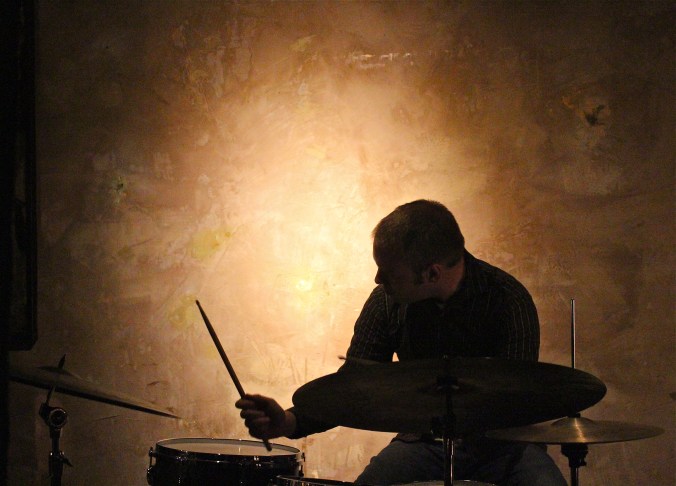
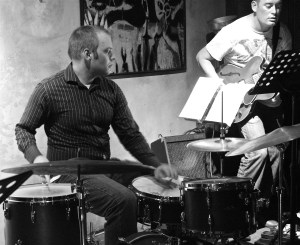
Steve Barry – PJ Koopman Quartet

We had been expecting the official release of Tom Dennisons ‘Zoo’ album but instead we got two musicians from that group in a new and exciting configuration.   While we were saddened that the ‘Zoo’ date was postponed, we could not complain as we were treated to a slice of Jazz heaven under the skillful co-leadership of Steve Barry and P J Koopman.

I make no bones about my enthusiasm for Steve Barry’s piano as I have heard him and reviewed him twice before.    Steve was back in town for two gigs only and the first of them under the leadership of premier Australian drummer Andrew Dickeson, had been a success by any measure.   This time Steve was appearing as co-leader and so many of his own compositions got an airing.  He and the much respected guitarist P J Koopman were also able to stretch out on some well-chosen and seldom heard compositions gleaned from the Jazz song book.

The other two quartet members were Oli Holland (bass) and Ron Samsom (drums).    This dream lineup gave us our moneys worth and a whole lot more.

The first number was the 1935 Jerome Kern/Oscar Hammerstein classic ‘I’ve Told Every Little Star’.   It started with the bones of the melody and swiftly evolved into a swinging medium tempo number.  The composition should perhaps be credited to a small melodic bird, as it came to Kern when he heard a rare finch with a beautiful name singing on his windowsill (Melospiza Melodia).  It was also the last thing Kern sang from his death-bed.   In the hands of this band both bird and composer could not have failed to appreciate the updating.

The next number was a rendition of the moody atmospheric ‘Mantra’ by Kendrick Scott.   This is the perfect vehicle for guitar and piano and its deep penetrating lines were used to advantage by the band.    It is also a number where the drums (with mallets) and bass can be brought right up in the mix and this was certainly not a band to miss such an opportunity.  As they moved through the set list the audience were transfixed.  The guitarist PJ Koopman was at his best that night and it was a joy to see how well he and Steve Barry interacted.    An imperative for piano/guitar configurations is for each to keep out of the others way and they did that instinctively as they have played together over many years.   With a tasteful drummer like Ron Samsom and a skillful bassist like Oli Holland underpinning the chordal instruments, it was never going to be anything but satisfying.

As the set progressed they played two of Steve’s compositions – ‘Untitled 3’ and ‘Unconscious-Lee’.    The latter composition was dedicated to Lee Konitz and his tune ‘Subconscious-Lee’ which he so famously played with Warne Marsh.   It was here that we saw Steve’s writing skills come to the fore and above all experienced the fluidity of P J’s guitar.   I have often been told by guitarists how difficult this Lenny Tristano stuff is to do.   Long unison lines performed to metronome like timing (Tristano hated flashy drummers and famously said that his preference was for a metronome as time-keeper – he would not have minded Ron I’m sure).  There are real subtleties in this music and in lessor hands the message could have been subsumed in the detail.  P J and Steve ran their lines perfectly and when I closed my eyes I could hear an echo of Billy Beaur (g) and Lenny Tristano (p).

The last set begun with ‘Parks’ (Steve Barry) and I have heard him play this before. The tune had stuck fast in my head from the first time I heard it and so I had always wanted to know more about it. It was composed as a tribute to Aaron Parks during a period in which Steve had been listening to a lot of his music (you can find Aaron on the ‘James Farm’ albums along with top rated ex-pat kiwi bassist Matt Penman – sampled on Sound Cloud). Once again Ron Samsom used his mallets to great advantage with Oli Holland’s bass lines weaving skillfully throughout. I will never tire of hearing this complex but satisfying tune.

It was probably the penultimate number of the night which will linger longest in the minds of the audience. A friend commented on how utterly beautiful it was and cursed the fact that her bus was due to leave before the number was finished. The tune was a medley beginning with ‘Iris’ (Wayne Shorter) and segueing into ‘Clusters’ by Steve Barry. It was a good choice on so many levels as it was a more reflective number; allowing the band to showcase their melodic skills, improvisational skills and mastery of the Jazz vocabulary. This was a tune where the subtlety of the exchanges between guitar, piano, drums and bass was paramount. To maintain subtlety while stretching out is always a hard ask but they managed it perfectly. Of note were PJ with his stunningly beautiful chord work and Ron Samsom with his colourist mallet work. Ron is one of our best Kiwi drummers and certainly my favourite. Like all good drummers he understands that less is sometimes more and he is extremely tuneful. I watch his moves closely on gigs and to see him use all parts of the stick or mallet (and even use a beer bottle rolled across the cymbal) is fascinating.

Steve Barry has just been awarded a scholarship and so he will be extremely busy in Sydney over the next three years. What with that and giging his timetable will be full but we hope that he will remember his home town and visit as often as he is able. P J Koopman next returns to NZ to perform at the Tauranga Jazz festival and we look forward to that.

Other tunes performed were ‘P J B’ by Sean Wayland, ‘Cyclic Episode’ by Sam Rivers and ‘Cheryl’ by Charlie Parker.

As our best and brightest move offshore others step up in their place – Sam, Eli (and friend Rachel) gave us a taste of that in the late night Jam session following the gig.

Oli Holland & Ron Samsom (all photography by John Fenton)

Weaver of Dreams – Andrew Dickeson Quintet

For those Aucklanders addicted to live Jazz, the month over which the CJC Jazz club was closed for Christmas seemed like an eternity.   The first of the New Years bookings made up for it though as premier Australian drummer Andrew Dickeson came to town and he brought with him a solid lineup (including a couple of ex-pat New Zealanders now living in Australia).  It was Andrews first time at the CJC but it will hopefully not be his last.
Andrew Dickeson is one of the most respected drummers in Australasia and in stepping out as a leader he has enhanced his already solid credentials.   Andrew has for some time been regarded as the drumming lynch pin of the Australian Jazz scene and when a visiting artist requires a percussionist he would be the first choice.

The band began with the fabulous number ‘Ill Wind‘ (Arlen/Koehler) and it was obvious from the get-go that the tasteful drumming was a cushion of energy powering the group.   As good as the musicians were it was the drummer that caught the attention first; not by showing off his chops but by his sheer musicality.   You were also aware of his powerhouse propulsive swing.   The drums managed to preside without ever overwhelming the rest of the band and to achieve this takes real skill.    This is the sort of maturity that experienced drummers like Jeff Hamilton bring to their gigs and it was nice to witness.

A point which illustrates this perfectly occurred when I spoke to Andrew the next day.    After listening to the CD I had wondered how he had managed to obtain such a crisp but soft sound from his ride cymbal on the ‘Weaver of Dreams’ track (Young/Elliot).    I asked him if he had muffled the cymbal in some way or ‘miked’ it down during mixing.   “No’ he said, “It is all about awareness of the situation.  I just play very gently when that is required”.    I had not known that you could play so gently on a ride cymbal without losing clarity of sound.   At this point Roger Manins leaned over and said, “this is what separates a good drummer from a great drummer.  The ability to fit perfectly into any given situation and to adjust your volume accordingly”.

Those appearing on the album are: Andrew Dickeson (drums, leader, arranger), Roger Manins (tenor sax), Steve Barry (piano), Alex Boneham (bass), Eamon McNelis (trumpet).    For this gig the latter two were replaced by Tom Botting (bass), Pete Barwick (trumpet, flugal horn).  The two acquitted themselves well.

Andrew had used Roger Manins on the album and witnessing his performance at this gig it was easy to see why.    Roger is undoubtably the best tenor man in New Zealand but we sometimes forget how well-regarded he is beyond these shores.    I have written about his playing many times and each time I see him I wonder if he will better his last performance.  He usually does.   As a born story-teller he can captivate from the first few phrases, but the magic he weaves is also due in part to his stage presence.   On ‘Ill Wind’ the pianist had laid-out for a number of bars and in this space Roger mined the bones of the tune to the marrow.  That is his way and as the solo developed there was an increasingly ecstatic quality to his performance.   I have witnessed this before and it draws me to his playing again and again.   In Jazz authenticity is everything.

Pianist Steve Barry grew up in Auckland but he later migrated to Australia in search of greater opportunity.   He is no stranger to the CJC and his occasional gigs at the club are happily anticipated by his ever-increasing fan base.   For some years now he has been working on the Australian scene and he is exceptionally well-regarded there.   Some pianists have an X-factor and Steve is one of those.   The history of Jazz piano is somehow referenced in his playing but he is more than that.  While unafraid of the past he is not owned by it.   This is a journey of stylistic development that we are privileged to witness and it is an ongoing story.    In this setting he was not only a good soloist but the perfect sideman, as his comping and sense of timing were superb.   We get one more chance to hear Steve before he returns to Australia; next week he is co-leader of a quartet performing at the club.

Tom Botting and Pete Barwick had been engaged for this one gig and they fitted in seamlessly.   I had not seen Pete Barwick play before tonight but he handled the charts with ease and performed each solo convincingly.   His strongest performance was on the Strayhorn balad ‘Isfahan.    His burnished ringing tone and clear articulation were just great.   Tom was a fixture at the club before moving to Australia and his bass playing is familiar to CJC attendees.     He is a reliable time-keeper but he can also be adventurous when challenged.  On this night he injected a sense of urgency into the uptempo numbers.  Sitting in for Alex Boneham would be quite intimidating to many bass players but Tom took it in his stride.   He had returned to New Zealand in disguise (no beard and shorter hair) but his signature bandstand persona was fully in tact.   Tom always looks and sounds extremely convincing and it is nice to have him back for a few weeks.

The other stand out number was ‘Soy Califa’ (Dexter Gordon).   To have Roger play a Dexter Gordon number is a no brainer.  He aced it and then some.  This was a great night out and once again it reinforced the strength of the Trans-Tasman Jazz alliance.

This album is well worth buying : ‘Weaver of Dreams’ – The Andrew Dickeson Quintet – Rufus Records (a division of Universal Music group).     rufusrecords.com.au – or  – andrewdickeson.com

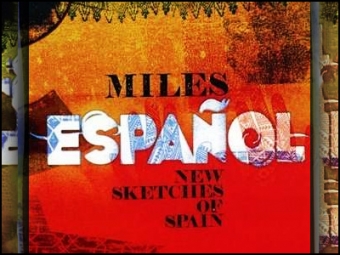
Miles Espanol – New Sketches of Spain

Late last year as I was reading Jazz Times I spotted an article about Bob Belden’s new ‘Miles Espanol’ project.  I like Bob Belden’s work but my first thoughts were, why mess with perfection?  I need not have worried because he has created something quite fresh and original; using ‘Sketches of Spain’ as a springboard into the now.

Like many Jazz listeners I had been deeply immersed in Miles Prestige recordings and his seminal ‘Kind of Blue’.    Soon after that ‘Sketches of Spain’ came into my life and along with ‘The Maids of Cadiz’, ‘Flamenco Sketches’ and ‘Teo/Neo’; Miles (and Gil’s) Spanish tinged music was seldom off my turntable.  As a guitar fan I was already quite familiar with Rodrigo’s ‘Concierto de Aranjuez’ and Flamenco.

Miles Davis and Gil Evans took this wonderful material and reworked it in ways that only master musicians could.  This was visionary and a new type of jazz – perhaps a fore-runner of the ECM Jazz which a decade later would unselfconsciously  absorb the music of cultures far removed from the American heartland.   Miles later described this Flamenco music as a type of blues – the voice of a people’s struggle against oppression.   I had not realised it before writing this, but my fascination in recent years with Mediterranean Jazz (and particularly Sufi/Moorish/Italian/Spanish Jazz) probably began right there.

This was a mammoth project to take on, but Bob Belden has a track record of realising such crazy visions.  He also has serious pull with musicians and industry players.

First on board appears to have been Chick Corea and Jack DeJohnette soon followed.   After that things came together in an organic fashion – each artist seeming to recommend the next.  He had not initially planned to ask 33 musicians to participate, but that is how it ended up.

Bob Belden is a well-known horn player producer/arranger/composer.  On this double album he does not play his warm-toned tenor sax (only Timpani and Marimba on one track).   As arranger producer his presence is never-the-less over-arching; like a Gil Evans for our times.   While he has guided the 33 musicians firmly towards the realisation of his vision, he also appears to have known exactly when to loosen the reins.

The artists were flown into New York from a number of countries but mainly from Spain, North Africa and South America.   The American musicians are mostly Miles alumni – a who’s who of Jazz royalty.   Chick Corea (p), Jack DeJohnette (d), John Scofield (g), Sonny Fortune (f), Ron Carter (b), Vince Wilburn jnr (d).  Add into that heady mix; Tim Hagans (t), Gonzalo Rubalcaba (p) Eddie Gomez (b), Antonio Sanchez (d), Alex Acuna (d) (perc), Jerry Gonzalez (fh) (c) and more -(the full list of musicians is at the bottom of the post).

Of note is the well know Jazz-Flamenco pianist Chano Dominguez (p).   I first obtained an album of his in the nineties and he is very impressive.    Other notable Mediterranean musicians are Rabih Abou Khalil (oud), Edmar Castineda (harp), Nino Joseles (g), Lou Marini (fl)(bass flute), Jorge Pardo (f), Christina Pato (Spanish bagpipe).

My favourite small group tracks are; (1) ‘Trampolin’ (by Chic Corea) – Chic Corea (p),Jorge Pardo (f), Ron Carter (b) Antonio Sanchez (d).  This builds in intensity until the grove is rock solid and it swings hard without losing the complex polyrhythms.   Chick understands this music very well. (2) Spantango (by John Scofield).

Larger pieces; Saeta/Pan Piper (Gil Evans- traditional)

The concept is so big that the overall album lacks a little in cohesion, however the tracks range from very good to marvelous.

Full listing of musicians: Bob Belden, Ron Carter, Jack DeJohnette, Sonny Fortune, Eddie Gomez, Gonzalo Rubalcaba, John Scofield, Rabih Abou-Khalil, John Clark, Tim Hagans, Jerry Gonzalez, Adam Rudolph, Jorge Pardo, Alex Acuña, Carlos Benavent, John Benítez, Chick Corea, Sammy Figuerova, Scott Kinsey, Lou Marini, Michael Rabinowitz, John Riley, Antonio Sanchéz, Vince Wilburn J, Mike Williams, Chano Domínguez, Luisito Quintero, Charles Pillow, Edsel Gomez, Jaco Abel, Dominick Farinacci, Victor Prieto, Cristina Pato, Edmar Castaneda, Brahim Fribgame, Niño Joseles.

Final Score 2011

A personal view on the best of the best Jazz albums of 2011.

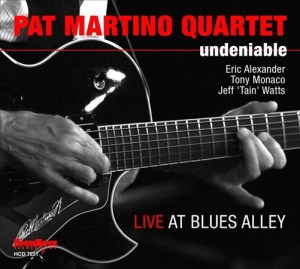
(1) My pick for best album of the year is – ‘Undeniable’Pat Martino Quartet – Live at Blues Alley *****. This is as close to a perfect album as it is possible to get and the move from ‘Blue Note’ to the ‘High Note’ label has worked well for Pat. Because it is a live recording and because there is a magical interplay between the band members and the audience the band drops deeper into the groove than ever. I love Jazz guitar and I love Pat Martino for his warm groove vibe. He is always superb but on this album he has reached new heights.

The trade mark sound is still there but the musical ideas appear fresh and exciting. While every track is near perfect, the last track ‘Side Effect’ is simply astonishing. After two listens I realised that the tune was based upon the changes to Cal Massey’s ‘These are Soulful Days’. Lee Morgan Played this tune and for a while it dropped out of the repertoire. It later appeared on a Joey DeFrancesco album on which Pat was the guest artist. It hardly seems possible to improve upon that groove Jazz classic but Pat has done so. Late last year I heard this band play in Birdland and during the break I spoke to Pat. For months ‘These are Soulful Days’ had been stuck in my brain and I could not recall who had recorded it. Thinking it was Grant Green or Wes Montgomery I asked him. ‘Oh I think it cropped up on a Joey D’ album’, he said. Then it all came back to me – it was Pat on guitar on that CD. I felt embarrassed and said, ‘you were on guitar I recall’. He smiled and told me that he had been working on a new version with a changed head. Now I realise that this was the tune Pat spoke of and that is the icing on the cake for me.

It is not only Pats extraordinary soloing but his comping that commands attention here. When the others are soloing he appears to comp a walking bass line in unison with the foot pedal bass line of Tony Monaco’s fiery B3. To me this comping feels as solid as Freddie Greens. The other band members are Tony Monaco (B3), Eric Alexander (ts), Jeff ‘Tain’ Watts (drums). Tony Monaco just gets better and better and my friend B3 player Michel Benebig regards him as being up there with the all time greats. Eric Alexander is also superb here. He has had a long tenure with Pat and Tony and he is the perfect fit for this music. Lastly there is Jeff ‘Tain’ Watts. His credentials are second to none and because he is such a versatile drummer he was the perfect choice. His drumming is responsive and inventive and it may be his inclusion that lifts the album to perfection.

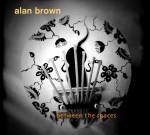
(2) My pick of first equal for the best New Zealand Jazz Album of the year is Alan Brown’s – Between The Spaces. **** For a review of this album see my earlier post. I play this album every week and my enjoyment has not diminished over the months of listening. I have purchased a number of copies to give to family as Christmas presents. Support New Zealand Jazz and purchase a few copies for presents now. There are copies available from JB Hi Fi in Queen Street. Other than that order from Ode Records online. The recipients will love you for it and you will put a groove into Christmas that can never be erased.

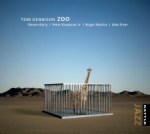
(3) The other pick for the best New Zealand Jazz album of the year (first equal) is Tom Dennison’s –Zoo. **** This album works on so many levels and every New Zealand Jazz lover should rush out and buy a copy. For more information read my review in an earlier post in this blog. I especially enjoyed writing that review and even though I may have resorted to hyperbole it was justified. The CD launch of ‘Zoo‘ is to be held at the CJC on Wednesday 25th January 2012. Again I would urge you to rush out to JB Hi Fi and grab a few copies as gifts. You can also purchase from Rattle Records online or download. Your Christmas holidays would be the poorer without these two albums and so if you want the love and admiration of your most difficult relatives – buy New Zealand Jazz as gifts.

(4) Best Jazz Club of the Year; no contest – the CJC. Thanks Roger, Caro and Ben for the music and the place to enjoy it in.

(5) Best New Zealand Record label – Rattle Records. Keep doing what you do Steve you are growing our music in the best possible way. You have the touch and the vision.

(6) Best World Music/Jazz album – Natalia Mann’s – Pacif.ist. This is also recorded by Rattle Records and it is an extraordinary and exotic journey to embark on. I will be doing a review of this fabulous album shortly. One rainy night I turned up to the launch of this album and was entranced from the first chord. Natalia Mann plays harp and on this album she is accompanied by 10 musicians (mostly Turkish musicians playing traditional instruments). Her husband is the drummer and the array of Turkish percussion instruments at his command is impressive.

(7) Best Jazz House Party of the year was when Roger Manins rocked Mt Wellington to its core with the help of Michel & Shem Benebig (B3 and voice) – plus a large and very enthusiastic horn section. It took me nearly a month to get ‘Every Day I Sing The Blues’ out of my head. I am not complaining though.

(8) Best Jazz anecdote of the year is from Peter Kings new biography on living the Jazz life. Peter is an alto player and he was playing at one of the better London clubs in the early 60’s when a very drunken Peter O’Toole sauntered over during a break and plonked himself down at the drum kit. The drummer yelled “Hey get off now” to which O’Toole starchily informed him that he was Peter O’Toole the actor. The drummer fired back immediately, “I don’t care if you’re Lawrence of Arabia, you can get off those fucking drums immediately”.

Lastly I must thank the musicians, many of whom have become close friends. Jazz musicians are the unsung heroes of music because they reach beyond the ordinary every time they play. They do this for the sake of creating something magical and best of all we get to participate in that magic. None gets rich or even earn a basic living from their playing but they do it anyhow. When walking a tightrope, backwards steps are not an option.

Thanks to all who read this blog which has been running now for around ten months. I have had over 6000 hits during that time and that is what keeps the momentum. The site has followers from many countries and that is satisfying, as it promotes New Zealand Jazz beyond these shores. Keep visiting the site, make comments and forgive my occasional typos. This blog is about promoting and analyzing the music we all love – Jazz and improvised music in all its forms.

These are soulful days – Pat Martino in 2009.               

Yours in the Music and have a happy and safe Festive Season.

John Fenton – Jazz Local 32.

Joel Haines trio

Joel Haines is a well-known and established New Zealand guitarist.  He also comes from an exceptionally talented musical family and this carries additional expectations.  While this was very much a funk-Jazz gig Joel had brought a little of the rock-god to the bandstand.   Many post Jim Hall Jazz guitarists bring elements of the Rock dialect into Jazz and in this case we certainly heard strong hints of that.   Accompanying him was veteran funk Jazz organist Alan Brown on a Hammond B3 portable (XK-3C) and Stephen Thomas on a classic 1960’s Rogers drum kit.   Joel played his stunningly beautiful Ibenez hollowbody guitar on all numbers except one.

The gig was always going to be loud (and it was) but interestingly not as much as some bands when playing in this confined club space.   I was surprised by this as I was in the front row.   The answer may lie in the fact that Joel uses an older style valve amp which he did not feed into a PA.    Alan Brown used a Lesley Unit with valve amplification and at one point I could hear someone in the audience say appreciatively – “look at the glow and pulse of those valves”.   It was brother Nathan.  It is possible that hearing analogue uncompressed sound is more pleasant to the ear.

The set began with one of Alan’s compositions ‘Minor Avalanche’.    The tune has a solid vamp which builds and builds.   Over that Joel played his funky bluesy lines with Stephen locking into the groove.     The second number (‘Ferret droppings’ – by Noel Haines) was slower and in consequence we saw more of what the trio was capable of.    There was time to construct well thought-out solo’s and the drumming was a little looser, with more cymbal work and less kick drum.   Needless to say Alan always acquits him self well with a Jazz audience as he smilingly punches out his signature staccato chords while dazzling with his right hand.

On the third track, Alan Brown’s ‘Shades of Blue’ we struck the mother lode.    I have loved this tune from the minute I first heard it on the Alan Brown trio album ‘About That Time’ – Ode Records.    ‘Shades of Blue’ is a great tune and above all it is a perfect vehicle for improvisation.    Several bars into the number there are a couple of compelling hooks and nice as they are they are not overdone; leaving you wanting more.  Alan certainly knows how to write good charts.   It was on this number that we saw Joel at his best.    His solo was fabulous and every note counted.   As he bent the strings and worked his pedals you could hear echos of ‘Electric Ladyland’.  Not sounding like a clone of Hendrix but taking the sounds deep into a Jazz context.

Joel’s ‘Live at Wembley’ was a nice ballad with long melodic lines and his other contributions were tunes interestingly titled ‘Who Flung Dung’ and ‘Hangover’.

Yes there were plenty of licks and tricks of technique but the band took us way beyond cliché.

‘Zen Dogs’ unleashed by Neil Watson

There are any number of moods that a band can capture when fronting a Jazz gig and all are valid in their way.   Where this band is concerned fun is the most obvious descriptor because Neil Watson’s ‘Zen Dogs’ were clearly there to enjoy themselves.   Everyone was soon drawn in and the enjoyment was palpable throughout the club.

The band had a loose feel and that is not to say that they were casual in their approach to the music because they nailed every tune and then some.  I am sure that the Zen Dogs name is tongue-in-cheek, but that in-the-moment relaxed approach brought the music home in a very Zen-like way; ‘stop trying so hard and suddenly you are there’.

From the onset Neil bantered with the audience and band in that good-natured way that jazz audiences love.   After the second number he told the audience “We are the Zen Dogs and we wear small emblazoned gold rings with secret symbols inset.  We form a circle and touch these together before playing, in order to charge each other with Zen power’.    To that the saxophonist Lewis McCallum asked nervously, “What did you say we had to touch together”?

The first tune up was ‘Booga Gee‘ (Watson) which communicated that Lou Donaldson Boogaloo feel.   The jive walking pace and accented beats set the night up perfectly.    Next was ‘Lime House Blues‘ which took us back further to the earliest days of two-beat Jazz.  That tune was written in 1922 (Furber/Braham) and had a famous 1930’s film was named after it.   Many have showcased this popular Jazz standard; Louis Armstrong, Sydney Bechet, Ella Fitzjerald, Les Paul (the latter with Chet Atkins).    While it is possible that the tune has been played before on a (Mexican) Fender Telecaster, I am unaware of it.   What is certain is that we heard a fresh and spirited interpretation on Wednesday.    This version was true to the original, but riotous and filled with the joyous abandon – a ‘mad and bad’ blues as the lyrics state.

Also among the offerings was a tribute to Wes Montgomery called ‘Wes de Money‘ (Watson), an astonishing evocation of Charles Mingus on ‘Meters to Go‘ and a Jelly Roll Morton tribute titled ‘Jelly Roll‘.    Throw in Monk’s ‘I Mean You‘ and a few more originals and you have the set list.   To play such an eclectic mix of tunes was a bold move (drawing as they did from the entire Jazz spectrum).  In the hands of this band the choices knitted together and not every band could have pulled this off so convincingly.    The key to attaining such cohesion was three-fold; they communicated their enjoyment of the material, their musicianship was superb and they held the audience from start to finish.

The band were Neil Watson (guitar, leader),   Louis McCallum (alto sax, clarinet & electronic effects), Olivier Holland (bass), Ron Samsom (drums).

Neil handled his slim necked Fender as if it was an extension of his own limbs.    This effortless skill has been gained from his many years working as a professional musician (both here and overseas).   There is the hint of rock-god in his act but it is delivered with a cheeky grin.   This guy does not take himself too seriously but he does invest everything into the music.   A friend of mine recalls seeing him play at the Tauranga Jazz festival when Neil was barely a teenager and he was impressed back then.

Louis McCallum played straight alto sax, clarinet and at times his alto sound was electronically altered by a small Korg analogue box.   Rather than choosing a modern synthesized saxophone he had purchased a $3 mini microphone and strapped it below the mouthpiece.    This simple approach produced interesting effects, but unlike the synthesized sax the effects can be turned off and on at will.    Using his clarinet in juxtaposition to Neil’s Fender gave ‘Lime House Blues’ the feel of being ultra modern while remaining respectful of a trusty old war-horse.  Louis also demonstrated an ability to deliver the BeBop and Post-Bop lines that some of the tunes called for.

Oli Holland is a fine bass player and he performed extremely well in this line-up.  He is certainly no mere journeyman as he showed amply during the night.   At times he would feed lines back to Neil and his performance on the Charles Mingus number is something I won’t easily forget.  Only an artist deeply versed in the history of Jazz could have captured the Mingus bass lines in the way that he did.   He also told the Mingus story in fresh way.  The Mingus oeuvre is interesting, as it sits slightly outside of the mainstream.   Hints of the anarchic and loose nature of that music were communicated well and I wish more bands would do this material.   Perhaps it is just too hard?

The remaining band member was drummer Ron Samsom.   If a band wanted to explore a wide spectrum of music and still retain a modern feel then he would be the drummer of first choice.   That is because he is freer, looser in style and more open than many drummers.   Because he has the ears of a seasoned professional he is able to respond well in any given situation.   To hear him play on ‘Lime House Blues‘ and ‘Jelly Roll‘ was to hear a modern stylist demonstrating that he could channel the two-beat style of a Baby Dodds or Poppa Joe Jones.   On the Mingus number he ‘dropped bombs’ and sat on the ride cymbal.   Ron never sounds complacent on the kit and perhaps that’s what sets him apart.    To have Ron and Oli together in a band is to add an x-factor.

The night had been billed as psychedelic jazz swinging by the early days of the music.   That is a fair description as it indicates the entire Jazz spectrum traversed.     The oft used phrase serious-fun is all that I can add to that.   The band have been recording this material and will lay down additional tracks early in the New Year – the album when it is completed will certainly be on my wish list.

Nathan Haines Fourtet – live@CJC

Some weeks ago it was posted on the CJC website that Nathan Haines would be bringing his new band to the club and that this particular band was to be an acoustic Jazz lineup.   The talk among local musicians was that Nathan had been wrestling with some bold musical ideas and that after a trip to France and three months of wood-shedding he was now ready to unleash those ideas on a Jazz audience.

Anyone interested in the Auckland music scene will have followed Nathan Haines career and know that he has wide crossover appeal (here and overseas).   As a multi-reedist and flutist he is proficient on a number of horns and for a while people wondered which instrument he would play for this gig.  That was soon made clear when the details were posted.  He would be playing a classic 1963 Selmer Mk VI – purchased from Brian Smith earlier in the year.   This is an instrument with real provenance and in a way that set the bar even higher.        

The acoustic feel that the band are striving for goes way beyond the choice of instruments, because they intend to record in a few weeks and will wherever possible avoid using modern equipment.    It is Nathan’s view that recording technology has deteriorated over the years and so they are intending to use old style Neuman mics, the fabled EMI Neve desk and to record directly to tape with no mixing or overdubs.  There is also talk of them hiring a Steinway B for the recording.

As the threads of information gradually came together it was clear that this would not be any run of the mill gig and in line with expectations the band attracted the biggest crowd the club has yet seen.

The members of this band are all well-known to club attendees, but Nathan Haines and Kevin Field (piano) are obviously the veterans here.    The name Kevin Field alone is enough to pull a good crowd, but couple his name with Nathan Haines and a capacity standing room only audience is the result.  On bass was Thomas Botting (who has recently taken Movember to its extreme limits).    He may be young but he is a terrific bass player.   I often stay back for the Jam Sessions just to hear Thomas and his friends, (usually playing alongside Peter Koopman and Dan Kennedy).    Thomas can edge up the tension by executing a well placed pedal point or walk his bass lines in a way that is reminiscent of Jimmy Garrison.   This makes him a good choice for this uber-acoustic hard-driving lineup.    The remaining band member is drummer Alain Koetsier.  This is the third time that I have seen Alain play and I have always been impressed.   His ability to lay down complex polyrhythms and push a band hard is well-known.   On this night he was at his fiery best.

The first number ‘Universal Man’ (by Nathan Haines) was intense and up tempo and this signaled the get-down-to business mood of the band.    They were ready for this gig and clearly ready to push at the boundaries.  While they conveyed a strong sense of purpose this did not constrict them in any way as they ate up the changes; hungry for the next layer of the tune to be unraveled.   Nathan soared on this and on other numbers, reaching into the past for reference points but more importantly bringing all of his recent experience and learning to the moment.    This was a 2011 version of a classic jazz lineup.

Next came a ballad ‘Poet’s embrace’ which was both lyrical and deeply probing.   Nathan continuously mined the tune for newer and deeper meanings.   His tone was luminous and his playing (even on the ballads) conveyed the intensity of the moment.

That chiaroscuro effect established the vibe; which became a hallmark of the programme.    These contrasts in tempo and mood were well placed as they kept the audience focused.    Two pieces perfectly illustrate this skillful placement.

While Nathan had written and arranged most of the pieces, the fourth number, Ravel’s Pavan (Pavane pour une infante défunte) deserves comment.     This famous piece was a miniature of perfection.     To have added another bar or even another note would have ruined the mood.     Very few bands can resist the inclination to over-egg-the-pudding in situations like this and I congratulate the band for keeping to the spirit of the piece.    What was added was subtle and it revealed a deep understanding of the music.    Colourist drumming, well placed bass lines and skilful minimalist chord placement; giving Nathan the platform he needed.  This illustrated perfectly the maxim that less is sometimes more.

The last piece ‘Consequence’ was a powerhouse performance.   So intense was the mood and so up-tempo was the pace that the audience seemed to lean back; as if a freight train was passing.   Each instrument soloing often and with each solo the tension increasing.    The drumming was so powerful that one of the audience swore that the kit remained airborne throughout.   This was an in-the-pocket performance and over that crescendo of sound Nathan blew up a storm.

At one point Brian Smith had joined the band and to see him and Nathan performing Wayne Shorter’s  ‘Speak no Evil’ was great (I have always loved Shorter’s material).   Two of our best tenor players belting out the unison lines and constantly challenging each other during solos.    Kevin Field had also contributed one piece ‘Raincheck’.  Kevin’s compositions are well constructed and appealing.

The band finished after two long sets looking exhausted but satisfied. So were we.

I will await the new recording with great interest.  This was a performance that it would be hard to improve on, but with a band this focused that may just occur.

Michel Benebig: soul on Pacific soul

Noumea resident Michel Benebig is a mavin of the B3 and its compact love-child the Nord C2. He is the sort of musician that sets the world to rights and sets your feet tapping.

He is a story-teller on the B3 organ (C2) and through his fingers flows the history of this wonderful instrument. The chords that he uses are rich and warm and capture the instruments journey from the African-American southern church’s to the Jazz heartland. While his voicings contain hints of the greats that he references like Brother Jack McDuff, Jimmy McGriff and Jimmy Smith; Michel is comfortably settled in his own style. He speaks with the unmistakable authority of a South Pacific Soul-Jazz master and it reinforces the view that Pacific Islands like New Caledonia and New Zealand have unique contributions to make to this music.

Michel was accompanied on tour by Shem Benebig (his wife) and the French drummer Johan Cazalas. Shem is a fabulous singer and she knows how to enhance the mood by a lowered tone, a hand gesture and a quick smile. When others were soloing she would stand a little to one side and dance; her movements contained more than a hint of the sensuous Kanak rhythms. Shem guided the proceedings with the consummate skill of a professional; holding the attention or directing it to the other musicians as required. No audience is ever going to be disappointed when this husband and wife team are performing. Johan was an observant and tasteful drummer. He would watch during a solo and lift the performance exactly when it was required. Never over-crowding the others and always supportive.

The band had a Kiwi horn section to assist them and if I heard correctly these guys had not seen the charts until a few hours before the performance. If that is true they did doubly well. The horns provided added heft to an already powerhouse sound and in doing so followed the best traditions of the Soul-Jazz genre. Ben McNicoll (Baritone sax), Chris Neilson (trumpet, flugal horn, alto sax), Jimmy Garden (tenor sax). The tight ensemble playing and a particularly lovely baritone solo by Ben earned them good applause.

The first set had begun with a tune called ‘Mr Jim‘. One full-throated blast from the organ and we were immediately locked into a warm soul-Jazz groove that never abated. As the night progressed we heard slow burners and heart stopping up tempo tunes. My favourite was a tribute to Jack McDuff titled ‘Captain Jack‘. This was not only a fitting tribute to the long departed B3 master, but an up-to-date comment on the Pacifica Jazz renaissance. Another tune Papillon about a tiny butterfly was a perfect vehicle for Shem and it tapped right into the ‘rythmes Kaneka‘. Michel could move from a quiet soulful chord to a stuttering tidal wave of sound in an eye blink and that is partly because of his chops and because of the unique qualities of this instrument.  An organist has to control many things at the same time but he is particularly required to control the following; Swell pedal, bass pedals and the two keyboards. When you consider what improvisers must do mentally and add in the above, this becomes a truly impressive feat.

I spoke to Michel at length during the break, and at the house-party a few days later. He is in the mould of great Jazz Musicians everywhere. Self effacing and engaging as a conversationalist. Full of wonderful stories about Joey DeFrancesco, Jimmy McGriff, Tony Monaco, Lewis Nash and others. As we talked I mentioned my liking for the great French B3 player great Eddy Louiss. “Oh yes Eddy Louiss is a monster” he said dropping his voice to a reverential whisper. “I met him in France a few years ago and it made my knees weak just to be in his presence”. I suspect that many up-and-coming B3 players will find meeting Michel has the same effect on them.

When music like this is playing it is good to be alive.

Resonator; Reuben Bradley

It is well-known on the New Zealand Jazz scene that Resonator won this years ‘Jazz Tui’ award.  As this is drummer Reuben Bradley’s first album that is no mean feat.  The band played at the CJC earlier in the week as part of their Australasian tour and pulled a good audience for the gig.

The band we saw on Wednesday did not have the full complement of band members present on the album, as the pianist Miles Crayford who had played piano, Fender Rhodes & synth had been replaced by guitarist Tyson Smith.   Also absent were guest artists Tom Callwood (arco bass), James Illingworth (synth) and Kirsten Te Rito (vocals).

This was a paired down hard-driving unit and they took the high energy, high volume route.   The band was: Reuben Bradley (drums, percussion), Mostyn Cole (electric bass), Roger Manins (tenor saxophone) Tyson Smith (guitar).   It was also obvious that this was a drummers band because Reuben seemed to direct all aspects of the music; the band taking their cues from the complex rhythms he was laying down.   I had heard much about his ascendancy as a drummer and his chops were certainly evident at this gig.    He was also an engaging presence as he bantered with the audience.  Jazz musicians are capable of delivering knock out one liners, self-deprecating asides and sly insider jokes from the bandstand.   I am happy to see that tradition continue at the CJC.

While most of the pieces swiftly morphed into full-on blowing numbers there was one ballad.    In situations like this a band could not do better than call on Roger Manins to execute the key lines and he delivered in spades.   Reuben introduced the number by saying, ” I had always wanted to write a dark evil sounding ballad because I figured that there was a real market for this”.    This number ‘Search in progress’ gave us an insight into the subtler aspects of the band’s repertoire.

Every Kiwi (and offshore) Jazz fan should contact ‘Rattle Records’ http://www.rattlejaz.com and purchase the ‘Resonator’ album.   It can also be purchased at ‘Marbecks Records’, ‘Slow Boat Records’ and ‘Parsons Records & Books’ and is available as a download on iTunes.   ‘Rattle Records Ltd.’ are to be congratulated for their burgeoning catalogue of top quality NZ Jazz and I urge all Jazz lovers to support this label.    It must be pleasing to the band that Mike Nock has praised the group. He saw this album as being ample evidence that “The new generation of New Zealand Jazz musicians have moved up several notches”.

After the gig I sought out Mostyn Cole the bass player to apologise for wrongly naming him as the bassist at the previous weeks gig.   I could not find him but the guitarist Tyson Smith said, “It doesn’t matter man because I am credited as being in the band but I was not on the album we are touring to promote and so it all equals out”.   That caused me to recall Roger Manins tongue in cheek announcement the previous week. “We believe in truth in advertising tonight and this is one of the rare examples where the people on the album are actually the people performing on the promotional tour,  Get a signed copy of the CD now as this may never happen again”.    Jazz humour is the best.

‘Melancholy Babes’ + Eric Boeren – out cats@CJC

Any club that was attempting to present a wide spectrum of Jazz styles would commit a sin of omission if they failed to include some of the more experimental Jazz on offer.    The CJC management have open ears and so on Wednesday they offered up the well-respected Wellington based new-jazz ensemble the ‘Melancholy Babes’ (plus guests).  The Melancholy Babes are: Jeff Henderson (alto sax), Anthony Donaldson (drums), Tom Callwood (bass) – [replaced by Gerard Crewdson (tuba)]. – special guest Eric Boerens (trumpet), John Bell (vibraphone).
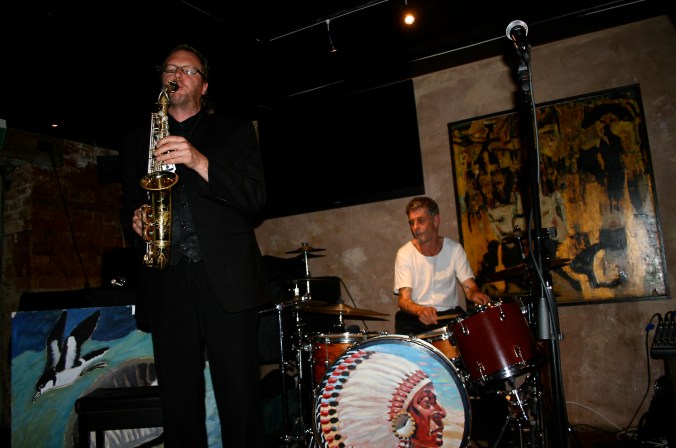
The ‘Melancholy Babes’ appeared with guest trumpeter Eric Boeren of Amsterdam, who has long been touring the world and setting audiences on fire with his free ranging improvisation.    Eric has a long history in avant-garde music having played with titans like ‘Malachi Favors and  Roscoe Mitchel (of Art Ensemble of Chicago & AACM fame).   The usual Bass player (Tom Callwood) had been replaced for this gig by Gerard Crewdson on Tuba and a vibraphone was added for the last number (which occupied the entire second set). In Auckland we seldom get the chance to hear such groups, as Wellington is the New Zealand home of the experimental music scene.

In experimental music you are seldom going to get a gentle melodic swinging introduction to a tune and this is perhaps the point of the music.    It will find its own rhythms and develop an organic logic as the pieces progress.   The band opened with an explosion of sound and the force of it was initially startling.  The quick runs on the horns rose and fell, often ascending into squalls of sound or multi-phonic effects.  The insistent propulsive drum beats and the steady pulse of the tuba sent them even further out.     While the music was often wild, it took the sometimes incredulous audience along with it and as the journey progressed we felt ourselves to be part of what was unfolding.

At times the band would mysteriously coalesce into a gentler incarnation of its wilder self and in this reflective space, miniatures or tiny motifs would be crafted.  Perfect creations that stood apart, but somehow augmented the whole.  I was surprised at just how drawn into the process I had become and others felt the same.    We were hearing hints of something vaguely recognisable and intriguing, but for a number or two, just what, remained elusive .    Then it hit me; this felt like the history of Jazz and improvised music unfolding.    Rambunctious would be Buddy Bolden‘s swaggering up an ancient New Orleans street as the crowd egged them on.   1930’s Harlem bands, Hoe-downs & Jigs, raggedy defiant funeral marches.   They were all in the mix and our collective Jazz memory was being teased and refreshed.     I was not alone in arriving at this realisation as my friends Jason and Catherine and Sarah heard similar echoes arising from the music.

Having the Tuba was inspired as it gave the music a depth and a foothold in history that it would otherwise have lacked.   The Tuba nearly always took up the bass line in early Jazz as the bass would not have been heard above the brass dominant bands.   It was not until the advent of better recording techniques and amplification that double bass replaced it.   Tuba player Gerard Crewdson has solid credentials on the experimental scene and he understood exactly what was required.   There was also an element of word Jazz when Gerard intoned the story of the Melancholy Babe, while turning the pages of what looked like a very large comic book.  Like the music this was anarchic and humorous.  Many sacred cows were savaged on this night and if any cobwebs had been hiding in corners of the club they would have been blown away by the night’s performance.

Both Anthony and Jeff are well-known on the experimental music scene and I will hunt them out in Wellington one day soon.    Afterwards I talked to the band for some time and I was surprised to learn just how active the experimental Jazz scene is.   Anthony and I talked about Annette Peacock, the Black Saint label, Hat Art, the Art Ensemble of Chicago and Free Jazz music in general.    This sub-genre is certainly very well-respected around Europe, but in the USA it has a stronger following in some cities than in others.    Wellington it appears is solidly in the mix.

The night was fun and it was challenging.   I am glad I went. 

Brian Smith Band & Hard Bop heaven

Brian Smith - CJC gig

To list all of the famous artists that Brian Smith has accompanied in the Jazz/Soul/Pop world would make this a very long post. To name a few (Soul) Gladys Knight & the Pips, Dusty Springfield, (Jazz) Jon Hendricks, Annie Ross, Nat Adderly, Mark Murphy. Brian was also a founder member of ‘Nucleus’ with Ian Carr. He was for many years one of our most successful Jazz/Soul exports but in 1980 he returned to New Zealand. His ‘Moonlight Sax’ (1990) went platinum, was the album of the year and sold over 40,000 copies which is astounding for a Kiwi Album.

Last night this Jazz icon played at the CJC and with him were a number of well-known New Zealand Jazz musicians. The band was; Brian Smith (tenor sax, soprano sax), Kevin Field (piano), Kevin Haines (double bass), Frank Gibson Jnr (drums). They started with one of Brian’s own compositions titled ‘Blues for Teo‘ and the band got down to serious business immediately. They are a hard swinging unit and as they unpicked the tunes they wove a collective magic.

Brian was a commanding presence in the mix (which was hardly surprising) but his band-mates could not be faulted either for their ability to shine beside him. It struck me (and not for the first time) just how strong a presence Kevin Haines is. He and Frank were obviously on comfortable ground and they pushed boundaries because they could, and because they found new and interesting things to say. I have seldom heard Frank play better. Kevin Field is a very popular and talented local pianist and to have him in any band is simply to have the best. His crisp chord work and soaring solos are never less than perfect.

Jazz Musicians are often natural comedians and Brian is no exception. When introducing the second tune he said, “the band will practice for four bars and by then we should have a hang of it”. The tune was a George Chisholm original and in spite of the intro we heard no missteps. The tune ‘Seriously flawed (floored?)‘ was the first of a number of new charts by George Chisholm. These were great vehicles for the band and when they played the lovely Chisholm ballad ‘One for Martin‘ they struck the mother-lode. This piece was penned in remembrance of the much-loved Kiwi Jazz guitarist Martin Winch who died in May of this year. It was suggested to me recently that we only have the sudden influx of very promising Jazz guitarists around Auckland because of Martin’s influence and example.

This and other Chisholm tunes deserve to be played often (plea to local musicians). * George is a well-known trumpeter from the local scene having recorded in his own right and as a sideman with locals like Phil Broadhurst.

We heard fresh versions of standards like ‘My Funny Valentine‘ and best of all a few Wayne Shorter tunes. The darkly brooding and deep Shorter compositions are favourites of mine and any group who attempts them and executes them well has my appreciation. The groups rendition of ‘Black Nile‘. ‘Lester Leaves Town‘ and ‘Speak no Evil‘ were well done and as these are difficult tunes to get inside of, they must be commended.

The New Fuse Box – The Wakem/Nielson Project

The Wakem/Nielson Project

When I received this CD in the post I knew very little about ‘The new Fuse Box‘ as I had only seen a few mentions of them online.     Happily I will never be in that state of ignorance again.     While this may not be your typical Jazz offering it is never-the-less highly enjoyable and as the Jazz scene in Auckland matures we are learning to appreciate a diversity of soundscapes.     This is not quite the raw and highly energised music of a live band but it is enjoyable, well arranged and beautifully articulated.   The music has a depth that may elude the listener at first play, but listen again and it will get under your skin and stay there.

This is essentially Kiwi music (Auckland music), and a sense of space and sunlight pervades the album.   Over the years I have come to recognise that there is a certain discernible quality when Jazz has developed in remote-from-the-centre locations; this sense of place exists in juxtaposition to the usual traditional aspects.    Scandinavian,  French, Italian, Sardinian, Spanish and German Jazz all have a unique something that would not have arisen had the music been made in America.   New Zealand Jazz is now claiming its own space.

There are fifteen tracks on the album and they skillfully mine a number of vibes.   There are funk infused tracks and soulfully slow tracks but they all seem to work as part of a cohesive whole.   Above all this music does not take itself too seriously as there is musical humour as well.   While I have many favourite tracks I simply cannot resist the intentionally over-the-top and utterly delightful ‘Bossa Tossa‘.     This track will put a big smile on your face.   There is also a filmic quality to this material and the best of Jazz movie-score writing is conjured up here.

All of the material has been composed and arranged by Lindsay Wakem (horns arranged by Chris Nielson).   Lindsay is terrific on piano and keyboards and I hope that he will give us longer solos on future releases as the piano is often back in the mix.   His piano playing has a crispness and clarity to it and I am keen to hear more.   ‘The New Fuse Box‘ is a multi- talented band and Chris Nielson the co-leader needs a mention at this point.   When I looked at the credits and I saw, ‘horns- Chris Nielson’ I was puzzled.   I phoned Lindsay and asked him if there were uncredited horn players.   I quickly learned that Chris is not only the trumpet section but that he plays all of the saxophone parts as well.   The charts are gorgeous and the multi-tracking so seamless that it is a struggle to imagine him playing all of these parts.   The drummer, on all tracks except one, is the well known and much respected Jason Orme (Blue Train etc).  Jason can take on any task in Jazz drumming and he is a an asset here.  The bass player is Phil Scorgie.  He and Lindsay go back a long way.  Other artists appear on single tracks and they are guitarists, Dean Kerr & Frans Huysmans – Kody Nielson drums.

Jazz is a music which teaches us something of history and struggle, but more importantly it is a music founded in the desire for change.   It is not a museum piece and so it should always explore and challenge the world around it.   This album does that and I look forward to more from them.   The ACT and ECM labels (both German) have profiled this sort of jazz to great advantage.     There is a real market for this material and I hope to see more of it.

ACT’s Lars Dannielson, Blue Note’s Bob Beldon and ECM’s Mathias Eick have paved the way and our own bands should now be welcomed into this interesting space.   The album is self produced and so for a copy contact:  lgwakem@xtra.co.nz

Trudy Lile Quintet – CJC

Trudy Lile Quartet @ CJC

Trudy Lile is well-known around the New Zealand music scene as her multi genre flute playing skills take her into a number of diverse musical worlds.

On Wednesday she brought her new Jazz Quintet to the CJC . The lineup was: Trudy Lile (flute, vocals, leader), Kevin Field (piano), Andrea Groenewald (guitar, vocals), Jo Shum (bass) and Steve Harvey (drums). Many will already be familiar with her Latin/Jazz ‘Mojave’ Quartet. The only carry over from Mojave’s line up is the brilliant Auckland pianist Kevin Field. On the ‘Mojave’ ‘Well Dressed Standards‘ CD Trudy sings in addition to her flute work and her voice is well suited to the material she has chosen. Not surprisingly her flute work and singing are slightly more restrained on CD; but when she is playing in a Jazz club there is no hold back.

At the CJC Trudy’s band loosened up as Jazz audiences are used to a freer and more improvisational approach. As the evening progressed we were treated to snatches of overblown flute (often with vocal effects in the style of Sam Most or Rashaan Roland Kirk). The range of flute sounds evoked could shift from smooth-as-silk melodic lower register offerings to peppery high-end declamations that fired up the band. It was obvious that she liked the material she was presenting and that enthusiasm communicated well to the audience.

Unlike Trudy’s recent album (which is all standards), the set list on this night was mainly originals; mixed in with tunes like Herbie Hancock’s ‘Butterfly‘ and ‘Precious‘ by Esperanza Spalding. On those two numbers and others she and Andrea sang in duet and the contrast between their voices gave added colour. The material was beautifully executed and the band worked extremely well together.

Having pianist Kevin Field in a band is always a good thing and especially so where there is a singer to be accompanied. Kevin is not only a trio leader and innovator but he has that rare skill of being the perfect accompanist. Like Laurence Hobgood or Oscar Peterson he can place just the right notes and chords behind a singer while keeping out-of-the-way until his solo. I always enjoy seeing Andrea Groenewald perform and she sung and played well on this night. Her own tune ‘Paint the Sky‘ turned into a tour de force for the band and her guitar solo was a knock out. I have seen this performed a number of times and it keeps getting better, with Trudy’s flute adding new and interesting dimensions. Jo Shum was obviously enjoying herself as well and she and drummer Steve Harvey took some nice solos. Jo Shum (bass) was especially good on ‘Precious‘ (Esperanza Spalding) and the drum work on ‘Beverly ‘(Lile) impressed.

The flute is a relative late comer to Jazz – probably entering the music’s mainstream via its contacts with Latin American music. Frank Wess was one of the earlier practitioners of Jazz flute but names like Buddy Collette, Bud Shank, Sam Most, Rashaan Roland Kirk, Jerome Richardson, Eric Dolphy, James Spaulding and Charles Lloyd have established it firmly in the mainstream. While many of the above were flute specialists they were mostly saxophone players doubling on flute. Many modern practitioners do not double on reeds as the flute is their main axe.

This was a night when the gender diversity and musical diversity of the Auckland Jazz scene was manifest. The Auckland Jazz scene is growing rapidly and as it grows it brings with it maturity that comes from having real choice.

Andrea soloing@CJC - Trudy Lile band

Fig by Trudy Lile

Alan Brown-‘Between the Spaces’ – CJC

Alan Brown at Keyboards - CJC

If this was a law court I would have to recuse myself immediately because I have a heavy bias in favour of anything Alan Brown does musically. Having said that it was hard to imagine how this very different lineup would sound, because the ‘Blue Train‘ magic has long been etched into my brain as the archetypal groove unit.

Alan is a superb keyboardist and band leader but above all he is a brilliant arranger and composer. It is the latter skills that have especially come to the fore with this band and the title track ‘Between the Spaces‘ gives more than a hint of the musical direction. ‘Blue Train‘- has always been a tightly focused hard-driving Jazz funk band and one which makes your feet tap uncontrollably. This band builds on that vibe but with new soundscapes opening up, endless possibilities are there to be tapped. Alan’s already impeccable writing skills have been surpassed here, because these charts are everything that an improvising band could hope for. It is ECM meets Funk and surprisingly it works perfectly. In my view Ode Records should talk to ECM’s Manfred Eicher about this group, as everyone would gain by the exchange.

As this was the launch of the ‘Between the Spaces‘ album I had been determined to get to the club early because I knew that seats would be hard to find. I was right because the club filled to capacity before the band had played a note. As with previous Alan Brown gigs the ages of those attending ranged from 18 to 60 plus.

The opening number ‘Sounding Out‘ was a foretaste of the great music that we were to hear throughout the two hours. Over the course of the evening we heard all of the tracks on the album in extended form plus two additional numbers that had not made the final cut. I was fascinated by the textures, rhythms and the colour tones that the new lineup was evoking. As each number unfolded, tight insistent bass lines were being laid down by Marika Hodgson while Alan would often set up a vamp; his left hand authoritatively setting the tone and rhythmic feel. He has an uncanny knack for capturing the essence of a tune while leaving adequate space for the others to build upon it. His deep in the pocket funky chords worked perfectly against his darting upper register flurries.

A treat for me was guitarist Andy Smith. He used quite a few pedals and his tone was midpoint between the Jazz and Rock spectrum. This is a territory well mapped out in modern Jazz guitar and Andy executed the twists and turns without overdoing it. He reminded me of Terje Rypdal at times but his obvious virtuosic abilities were kept tastefully in check and he is to be commended for that. I was especially pleased by his occasional use of the ‘chika-woka’ wah-wah effect when comping against multi layered grooves. Jono Sawyer (d) is already well-known about town and his musicality and his ability to support the band on a cushion of insistent beats rounded off a perfect unit. This group understood very well that great music demands some space between the notes.

As good as this band was, it was the inclusion of the guest musicians that lifted them to perfection. Their addition to the sound pallet showcased the shear brilliance of Alan’s concept and the pieces on which the three-piece string section and well-known saxophonist and flutist Nathan Haines played, lifted the performance into the realm of the sublime.

I have two favourite tracks on the album: The first is the angular, and wonderfully funky “The Dancer & Chess”. This number has complex time signatures but it is so well constructed that an implied centre imparts a level of simplicity that belies the more complex polyrhythms whirling around the changes. This is performed by the core quartet and the counterpoint between band members works well.

The second highly recommended piece is ‘Epilogue’ which features Nathan Haines extraordinary flute work. He weaves in and out of the tunes with such skill, beauty and dexterity that I was left open-mouthed. As if this were not riches enough, the swell of the violins and cello added a perfect layer into the mix. The slightly tart voicings of the strings showed Alan to be a master of composition. He had understood perfectly what was needed and ensured that any hint of sirup was eradicated by using just enough discord. Thomas Botting also featured in two numbers and he fitted seamlessly into the mix. Having an upright bass did not detract in any way from the well established vibe.

Immediately after descending the stairs I had purchased the first copy of ‘Between the Spaces’ put out for sale and it has not been off my Hi Fi since getting it home. If you have any love of Jazz Funk buy this CD and if you don’t buy it anyway because someone you know will be happy to appropriate it.

The core band is: Alan Brown (piano, Keyboards, arr, comp). Andy Smith (electric guitar), Marika Hodgson (electric 5 string bass), Jono Sawyer (drums) – string section; Stella Kim (violin) Annika Balzat (violin) Sally Kim (cello). Guest appearances; Thomas Botting (bass), Nathan Haines (soprano saxophone , flute).

Susan Gai Dowling – CJC

Thelonious Monk, Minton's Playhouse, New York,...

Image via Wikipedia

Wednesdays offering at the CJC was Australian based Jazz singer Susan Gai Dowling.    Susan’s sidemen were Kiwi Jazz veterans Mike Walker (p), Pete McGregor (b), and Frank Gibson Jnr (d).   After hearing her sing I could understand why she was in demand on the Sydney scene after so many decades.    Her voice is warm and slightly smokey and above all it is a real Jazz voice.   At her command were all of those tricks of articulation that tend to separate Jazz singers out from the straight-ahead variety.    To underscore her Jazz credentials she announced that she would mainly sing ‘Monk’ tunes.  To up the anti even further there was also an extremely difficult Brubeck number thrown in, ‘Raggy Waltz’ ; in addition we heard ‘Very Early‘ (Bill Evans), Lady Bird, (Tad Dameron) and ‘Girl Talk‘ (Bobby Troupe).

Thelonious Monk was a genius of composition, but singing his tunes is arguably a risky business with all of those spiky  rhythms to contend with.  Others have put words to Monk and Carmen McRae was the standout in my view.    McRae has set a high bar to what is already a difficult proposition, but Susan approached the task with confidence.    She opened with a standard. ‘Old Devil Moon‘ and then tackled ‘Blue Monk‘.     As she progressed through the eight Monk tunes it was obvious that she was more than up to the task.     Like McRae her intonation and her ability to deal with the complexity of the tunes was impressive.  Mike Walker dealt with the angular percussive accents in the way that an accompanist should.  Not over-bearing and leaving enough room for the singer to tell her story.   The rest of the band got right in behind the singer and they deserve credit for their flawless performance because they had not been able to rehearse because of the tight timeframe.

Next was the lovely melody ‘Ask Me Now’.  It was a real treat and it enhanced the singers credentials as she captured the raw beauty and emotion of the tune.   The other Monk tunes were ‘Well You Needn’t‘, ‘Ugly Beauty‘, ‘In Walked Bud‘, ‘Ruby My Dear‘, ‘Monks Dream‘, & ‘Round Midnight‘.   ‘Ruby My Dear’ was lovingly executed and this iconic tune along with her rendition of the Evans classic ‘Very Early‘ were highlights.

Susan Gai Dowling and Mike Walker were off this week to play a gig in New York’s ‘Birdland’ club.

Phil Broadhurst Quartet – CJC ‘Delayed Reaction’ launch

This was a special night because the band was simply superb and it was a special night because the music paid tribute to Michel Petrucciani.   Phil Broadhurst the leader of the quartet needs no introduction to New Zealand musicians as he has been the familiar face of Auckland Jazz forever. Whether playing as resident pianist in the London Bar ,accompanying visiting musicians or performing his role as senior tutor at the Massey University School of Jazz, Phil has been at the epicentre of the New Zealand Jazz scene.   He is a gifted artist and a prime enabler.

Wednesday was the official launch of the ‘Delayed Reaction’ CD which marked a milestone in what has been a long and interesting journey.   Not only for Phil, but also for those of us devoted to the music of Michel Petrucciani and who now get to share in the journey.   Phil has probably studied Petrucciani’s body of work more extensively than any other and this music is the evidence.

The quartet is: Phil Broadhurst (piano, leader, arr), Roger Manins (tenor sax), Olivier Holland (bass),  Alain Koetsier (drums).  – *guest Mike Booth (flugal horn)

The first set opened with ‘Brazilian like‘, a well-known Petrucciani composition.   This medium tempo number paid tribute to the original but Phil and Roger gave it a slightly more bluesy feel which added interesting dimensions to the tune.   When I listened to that particular track on the album, I realised that Phil had achieved a rare thing.   The voicing and percussive attack were unmistakably Petrucciani, but in managing to add some of the feel and spaciousness of the New Zealand musical landscape he made ‘Brazilian Like‘ ours as well.

Next was the title tune ‘Delayed Reaction'(Broadhurst).  The number built-in intensity without losing any of its beauty and the quartet were obviously focused on treating this original with the same respect as the Petrucciani compositions.   Throughout the two sets there was a perfect juxtaposition between Petrucciani compositions and Broadhurst originals.  Phil had reworked many of the Petrucciani tunes and the result was to create a very satisfying melange.    Other Petrucciani tunes played were; ‘Guadeloupe‘, and the wonderful ‘Looking up‘ – a tune brim full of exuberance and always conjuring up Michel Petrucciani’s infectious good humour which he maintained against all odds.  He would have liked what this band offered up.

Of the Broadhurst originals I particularly liked ‘Oranje‘ (so titled because it was the birthplace of M.P.) and the lovely trio piece titled ‘Matai Bay‘.   During this last evocative number the considerable skills of Olivier Holland (b) and  Alain Koetsier (d) were particularly in evidence.   On the rest of the numbers Roger Manins (ts) shone with his story-telling bluesy intensity.   His performances are consistent in this regard and it is my observation that any group he plays in, is lifted up a notch.

We also heard a few standards and the rendition of ‘You Walked Out of a Dream‘ was fabulous.  Phil increasingly threw challenges at the others and they responded in ways that had us on the edge of our seats.  Roger soon exploded into his solo and the exultant soulful wailing as he seemed to depart from the upper register, had everyone spellbound.   Mike Booths (fh) contribution was on ‘If I Should Lose you‘ and this was also well executed.

A few years ago my partner Darien and I were traveling through the ‘Loire Valley’ France and I spotted a road sign indicating that we were close to ‘Blois’ a town famous for its castles, château and its Houdini association.   It was not those things that drew me to stay there but its association with Michel Petrucciani.     He wrote a wonderful suite about the place; one section was titled ‘Night Sun in Blois‘.   Sitting on the ramparts of that ancient and stunningly beautiful city at dusk I could hear that piano piece echoing in my head as the sun filtered through the now dark mass of the surrounding  forest.    The Loire river was a shinning golden reflection way below us and I wondered if Petrucciani had sat on this very spot when he was inspired to write that tune.

That powerful memory had faded with time but it was sharply brought back to me as I listened to this tribute and I thank the quartet for that.

The album ‘Delayed Reaction’ is on ‘Independent Artists’, a New Zealand label associated with ‘Rattle’ records.

Chateau by night near Blois

Tricolour's above Blois

Trio White – CJC

Trio White @ CJC gig

I am a big fan of Jazz guitar and so I need no arm twisting to get me along to a Jazz Guitar gig.   Last Wednesday the CJC featured a local guitar trio (+ piano in second half).    I was not previously aware of ‘Trio White’ and so I was intrigued.    I soon learnt that this band knew exactly what they were about as they launched into the first set with fiery determination.

Trio White is composed of; Ben White (guitar), Joanne Shum (bass), Steve Harvie (drums)

From an overheard conversation I learned that they had been keen to play at the CJC for a while and were hungry to play in front of more Jazz audiences.   They have been together for a while and according to their promotional material formed in order to explore the most contemporary sounds of Jazz.

On Wednesday the group performed their own material,  but they do mention Kurt Rosenwinkel as an influence and I am not surprised.

While they treated us to some slower and more melodic numbers, the main thrust of their music was intense hard-driving; blowing jazz.  Their was no mistaking that Ben White was the leader and he worked the band hard as he executed his rapid fire runs up and down the neck of the guitar.   He also demonstrated some skillful chord work and comped when the bass took a solo, but the thrust of this hard-driving music came from the intense lines he tossed out.

It was hard to catch the song titles as the band did not pay terribly much attention to introducing tunes.   They began by launching straight into the music and only brief announcements followed; almost as an aside.    They were primed to play and that was all that mattered.

For the second set they were joined by Dr Stephen Small on piano and as you would expect a slightly more reflective vibe took over.   Having a piano added to a guitar trio changes the dynamic and the musicians have to be more aware of creating room for each other.   It can also free up a guitarist, as chords are less of an issue to be factored into the mix.

One number I did catch the title of was the ironically named ‘Untitled Tune‘.   For me it was the best number of the evening.    I loved it from start to finish – thoroughly enjoyable music.   The band communicated as a unit and were more aware of each other; responding in the best possible way to the challenges being laid down.

Following that was a slow burning groove number with a walking bass line that drove the tune relentlessly.   Joanne Shum held the centre and for this one track she and drummer Steve Harvie ruled the roost.    Dr Stephen Smalls piano was excellent as well and he did exactly what was expected of a pianist joining a piano trio.

In last weeks blog I speculated that this might well be the golden era of Auckland Jazz.   If that is the case then it is down to this CJC Jazz club and the dedication of Caroline, Roger, Ben and the others who work at this so tirelessly.     Keep them coming please, the magic is apparently endless.

Steve Barry Trio – CJC – The Golden Era of Kiwi Jazz?

Steve Barry

A jazz friend said to me after the Steve Barry gig, “perhaps this is the golden era of New Zealand Jazz”?   That stopped me in my tracks because I had posed the same question to another friend three weeks earlier – same words – same sentiment behind it.      We were shaking our heads in wonder at what we had just heard – seriously good Jazz at the CJC led by pianist Steve Barry and accompanied  by Alex Boneham (b) and Tim Firth (d).   Once again a Kiwi born artist was dazzling us with incredible music and it arguably matched the fare of a good New York venue.

These days Steve Barry is a fixture on the Sydney Jazz scene but his fame has spread beyond Antipodean shores.    That he is especially well known and greatly respected by musicians is hardly surprising as his chops are exceptional.   This is probably Jazz for grown ups as it tends toward the cerebral.   To those immersed in this music, treats like this are to be savoured and surprisingly they have come our way fairly frequently this year.

The first number opened with a complex interplay of polyrhythms – like a screw being tightened by degrees as the tension slowly built.   As the band coalesced,the momentum shifted and the air was filled with textured sheets of sound being skillfully laid down one atop the other.   The second track ‘Ambulation’ took a route that Brad Mehldau or Keith Jarrett might have taken – utterly modern in its approach.    This was a band that surprised again and again and for those paying attention to what was unfolding, there was a big pay-off.    Next we were treated to a few Jazz standards; the first of which was George Shearing’s ‘Conception‘.   After that the band moved to a slower paced offering as they executed one of the nicest versions of ‘I’ve grown accustomed to her Face‘ (Lerner & Loewe) that I have ever heard.   Gentle and exquisitely voiced piano, perfect brush work on the drums and a bass solo that worked perfectly.  The piece closed with a lovely arco bass and mallets and it was not hard to see why this juxtaposition of complex songs with gentle standards was pleasing to the audience.

What an adventurous pianist like this needs is risk taking partners and he had certainly chosen well with Alex Boneham and Tim Firth.   Boneham’s abilities were amply matched by Firth, who could move from colourist to hard-driving power-house with ease.  Some of his work on the snare left us genuinely astonished.

Although it hardly seemed possible the second set was pitched at a greater intensity than the first.     Those sitting near me were watching intently as each move by the musicians revealed new wonders.    The last number ‘706 Blues’ was riotous and fun, but as with the earlier numbers it was music with a twist.

This is indeed a golden era of Kiwi Jazz.

To listen go to:http://www.stevebarrymusic.com/live/