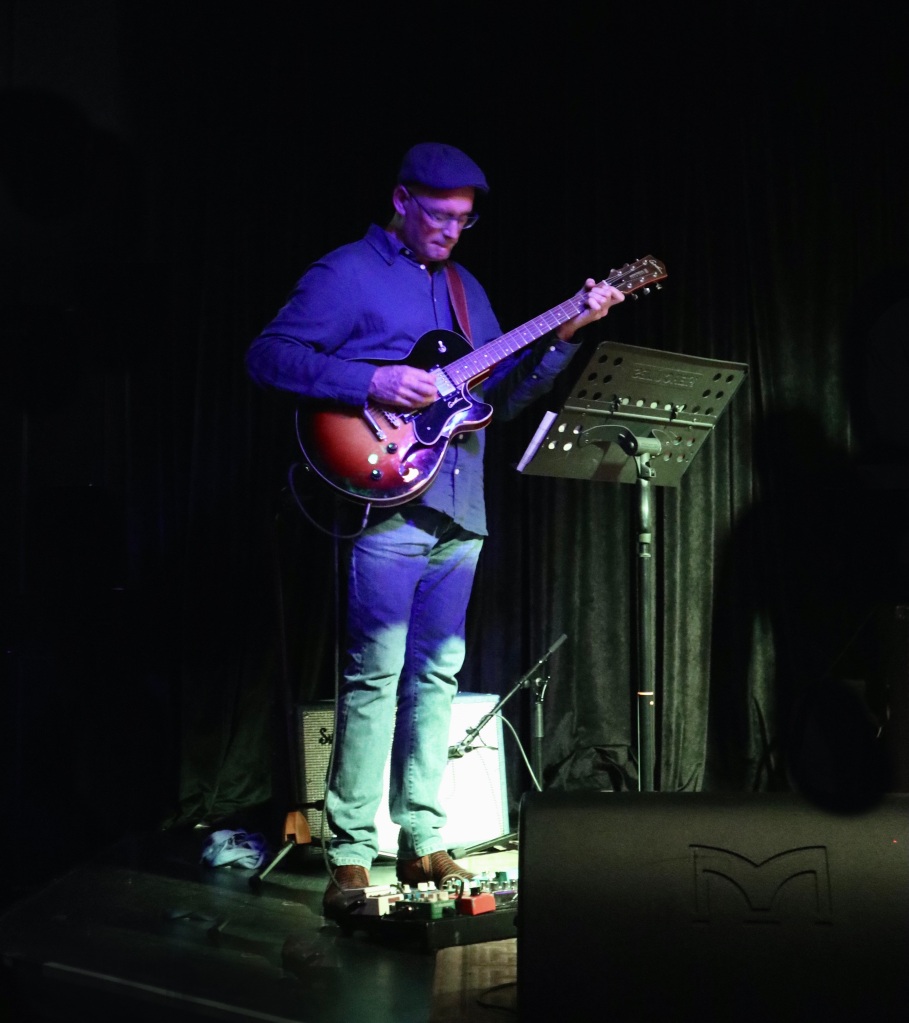
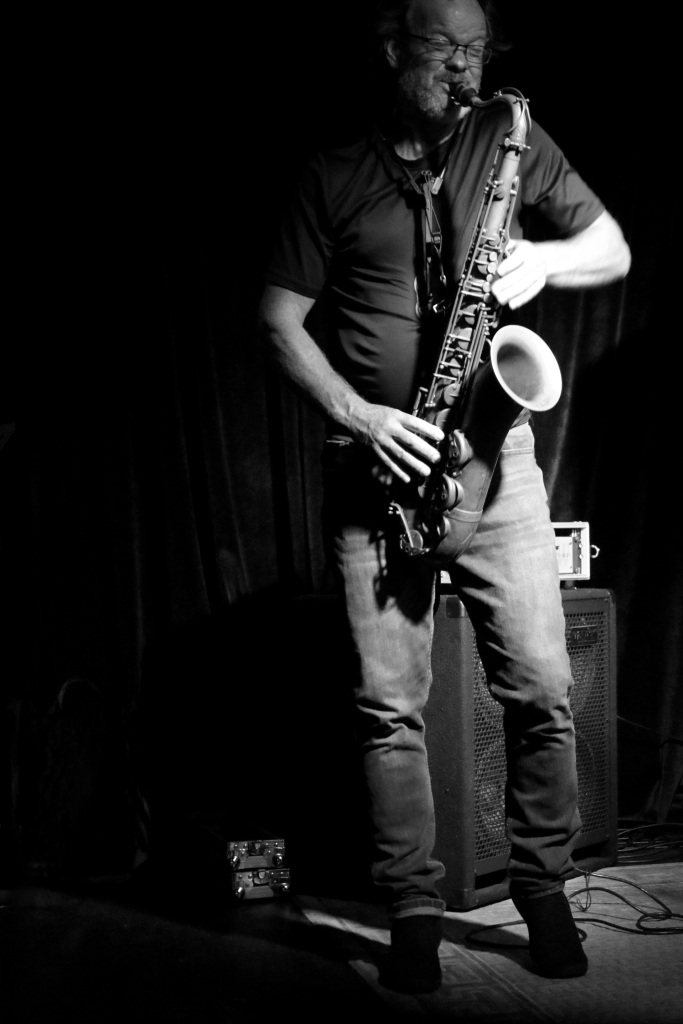
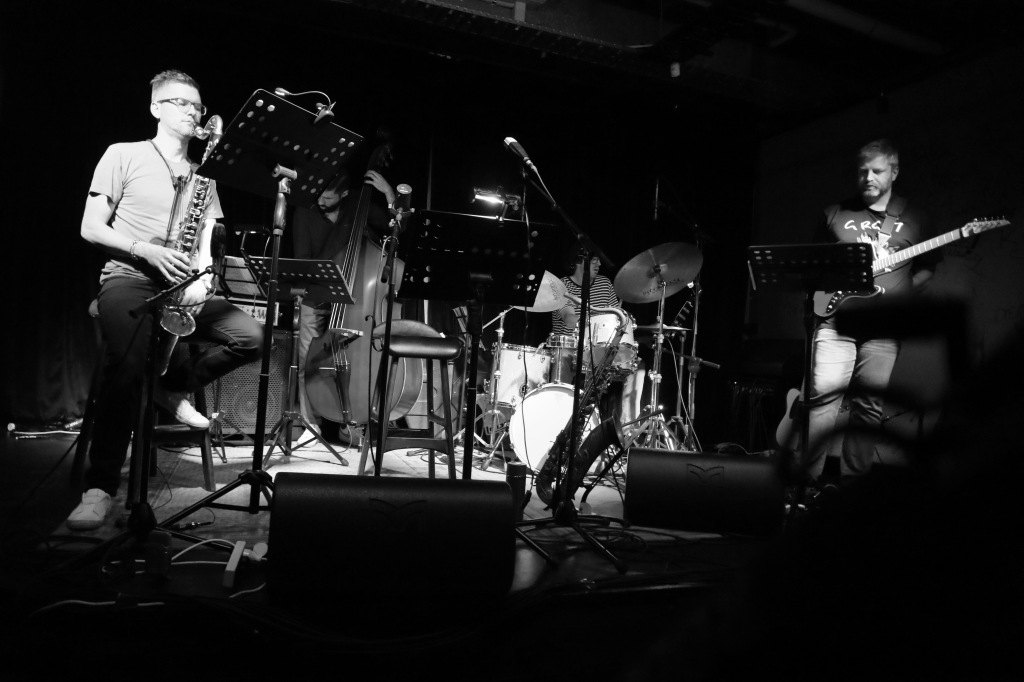
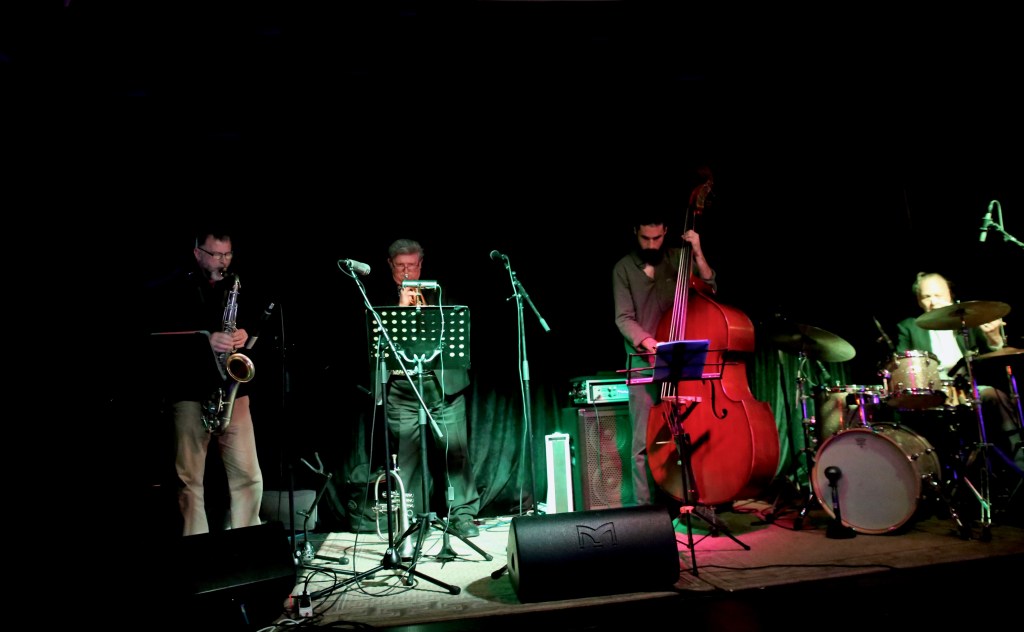
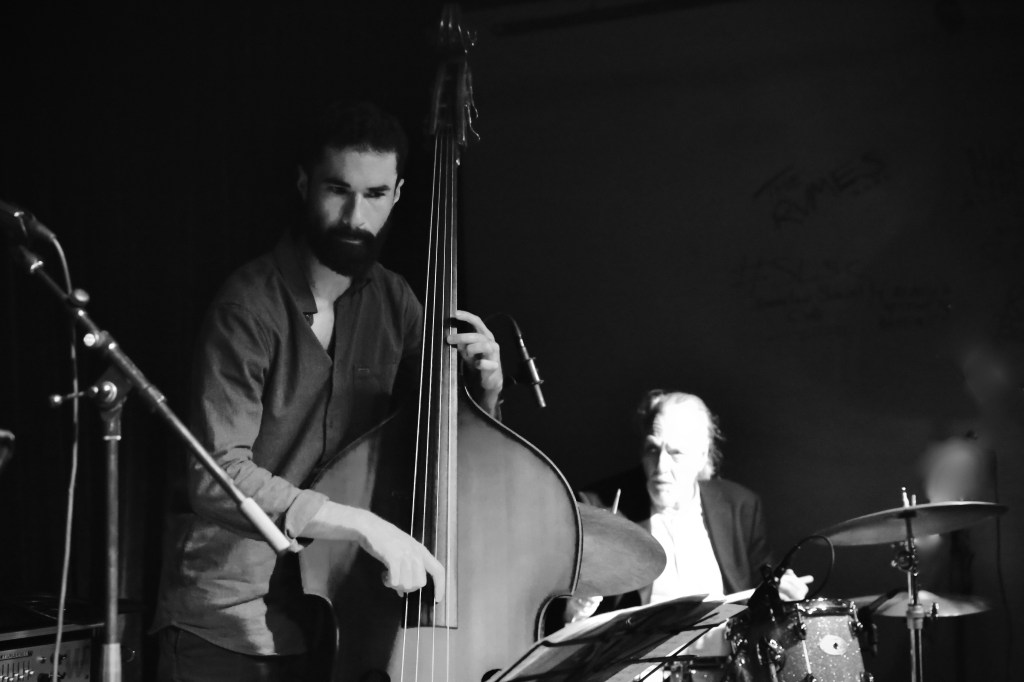
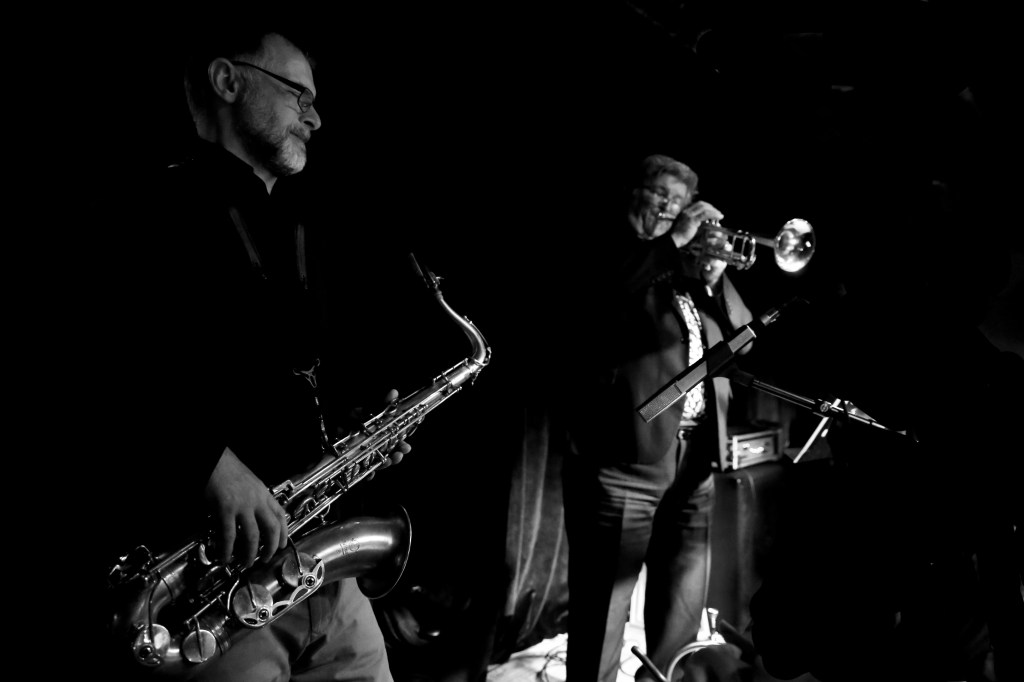
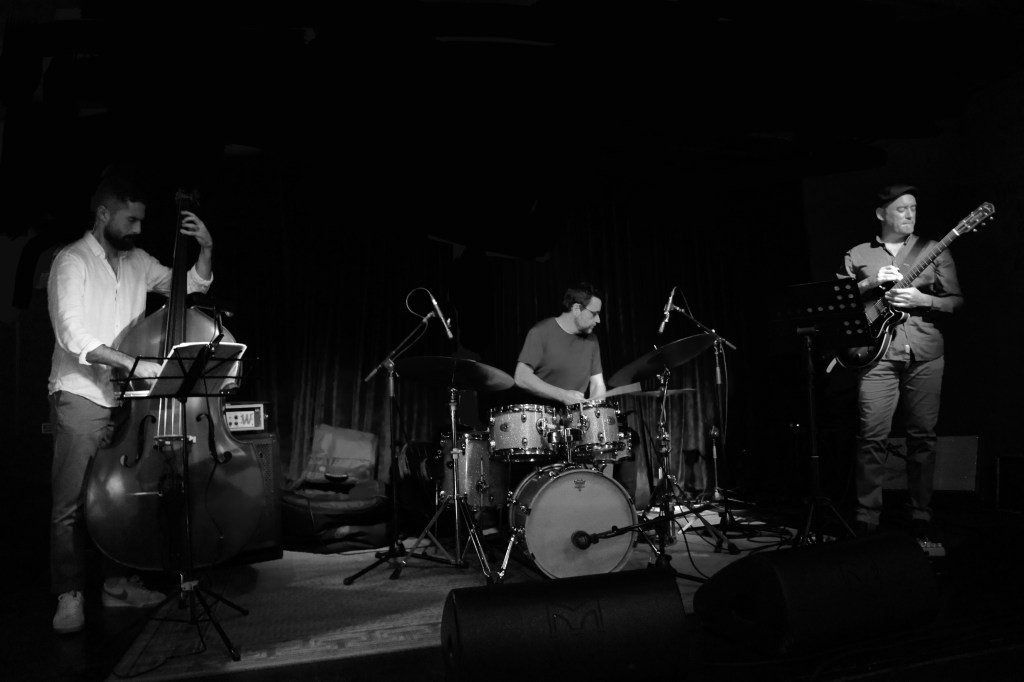
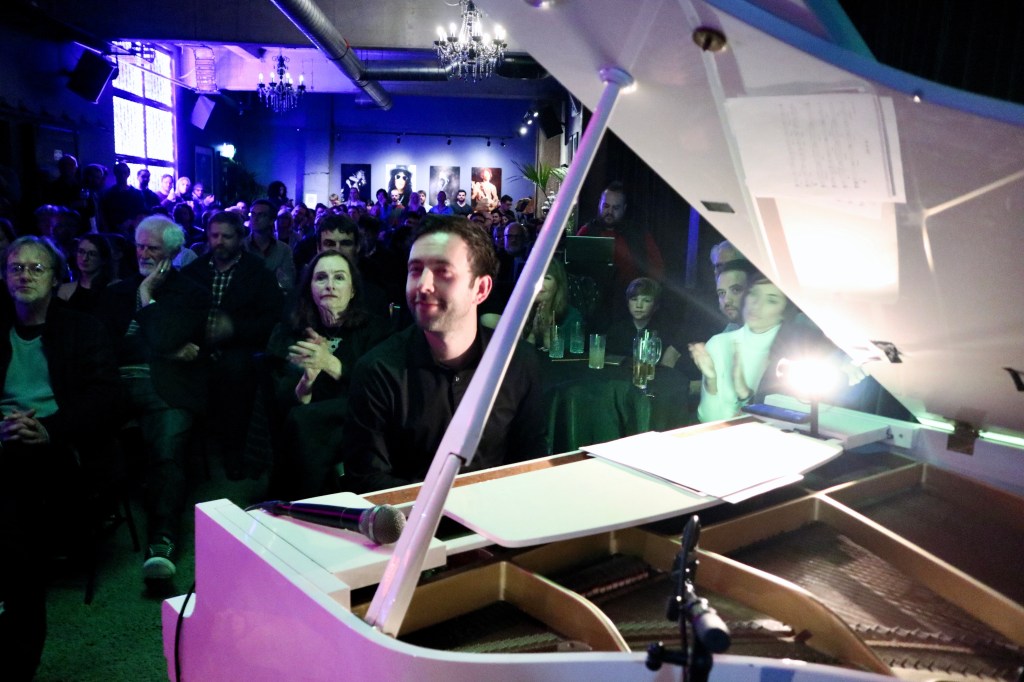
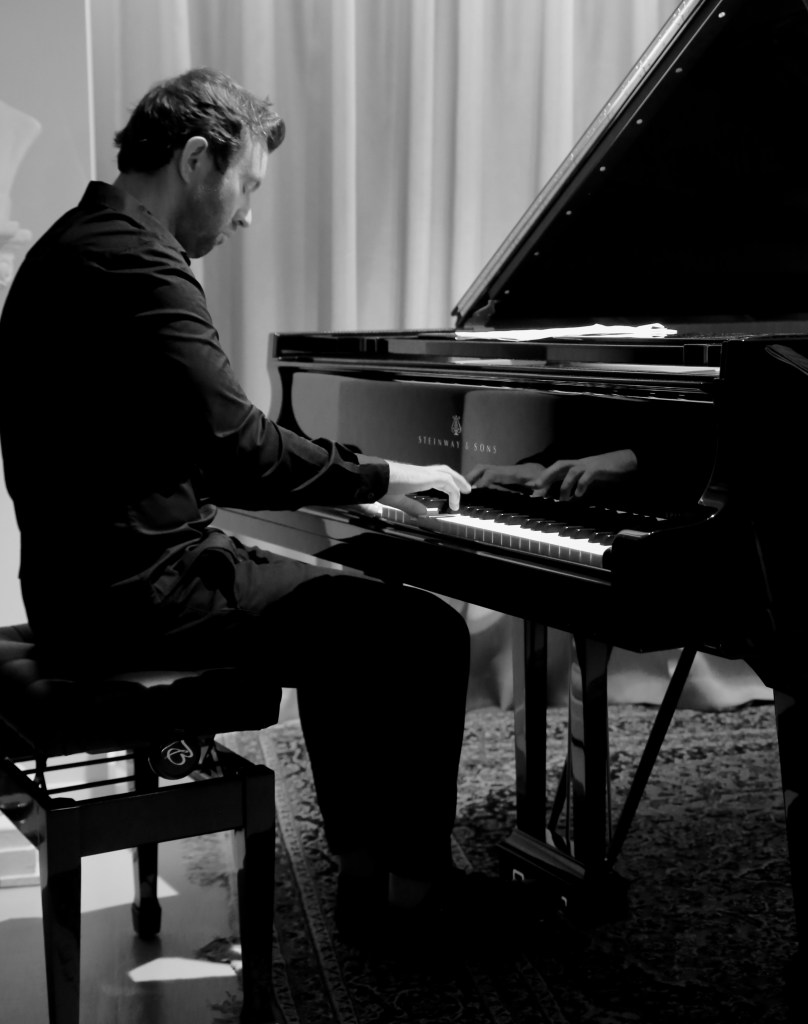
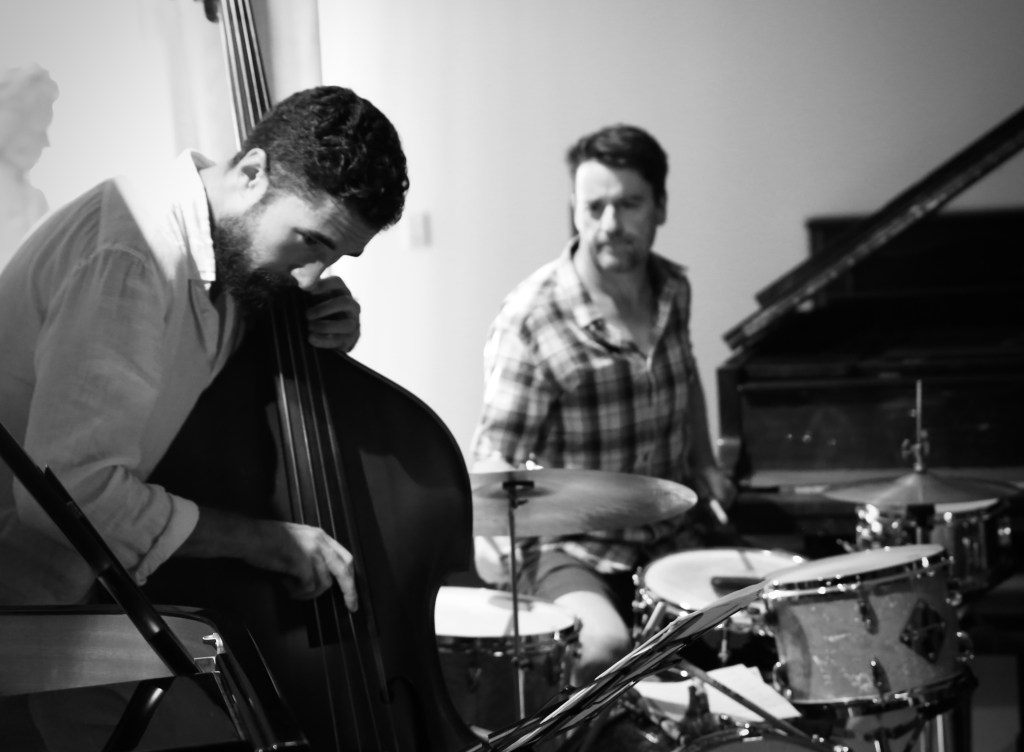
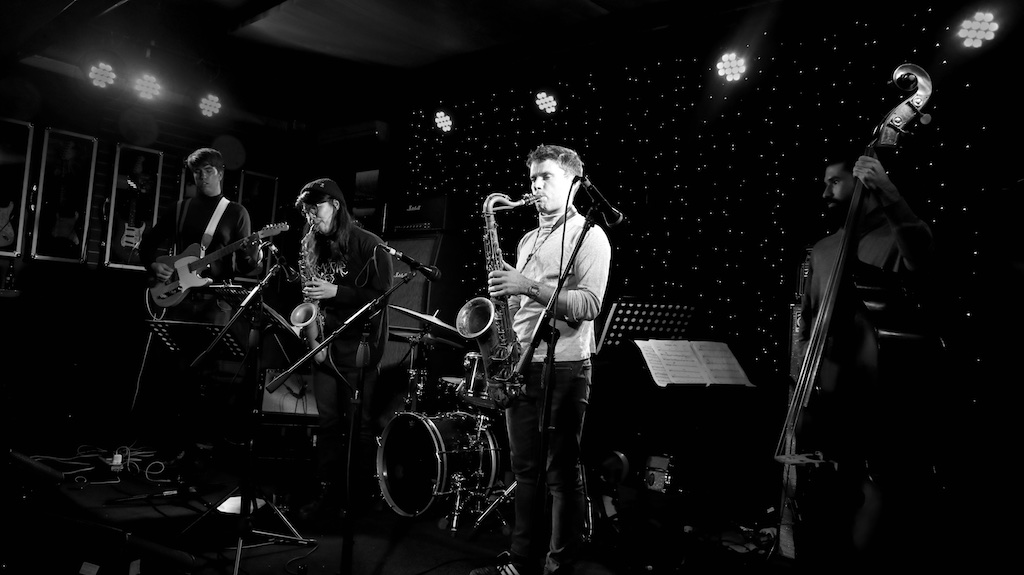
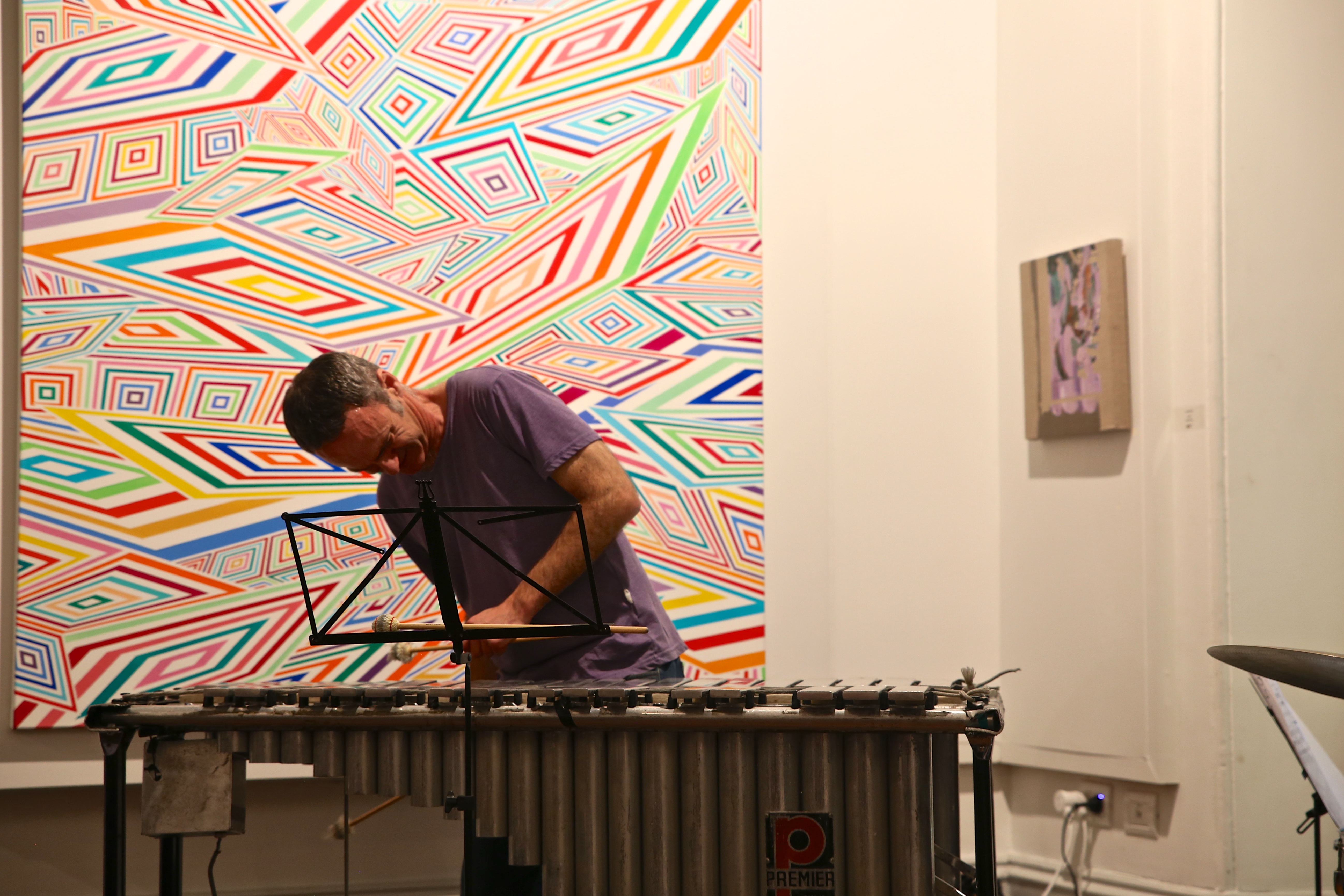
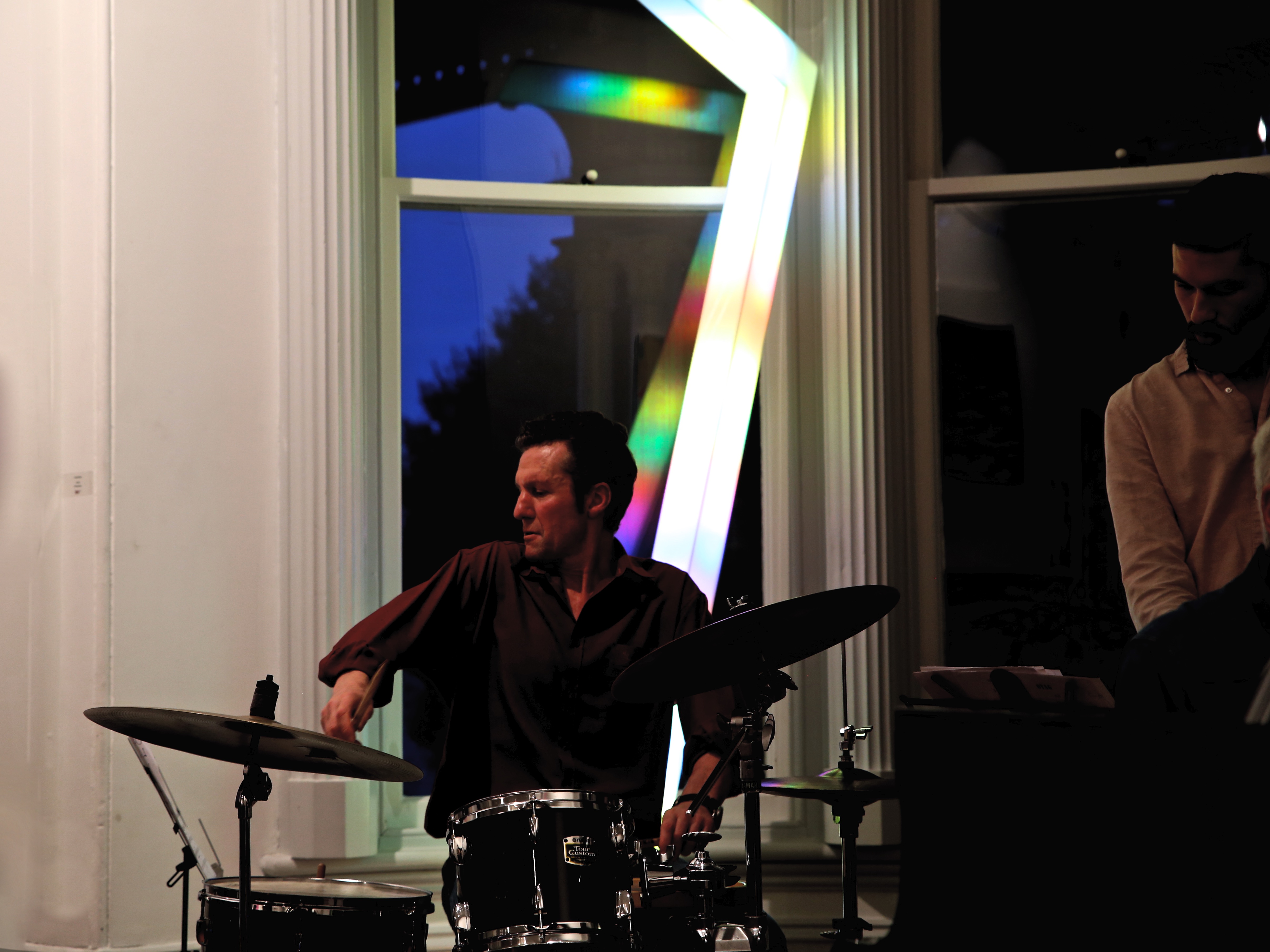
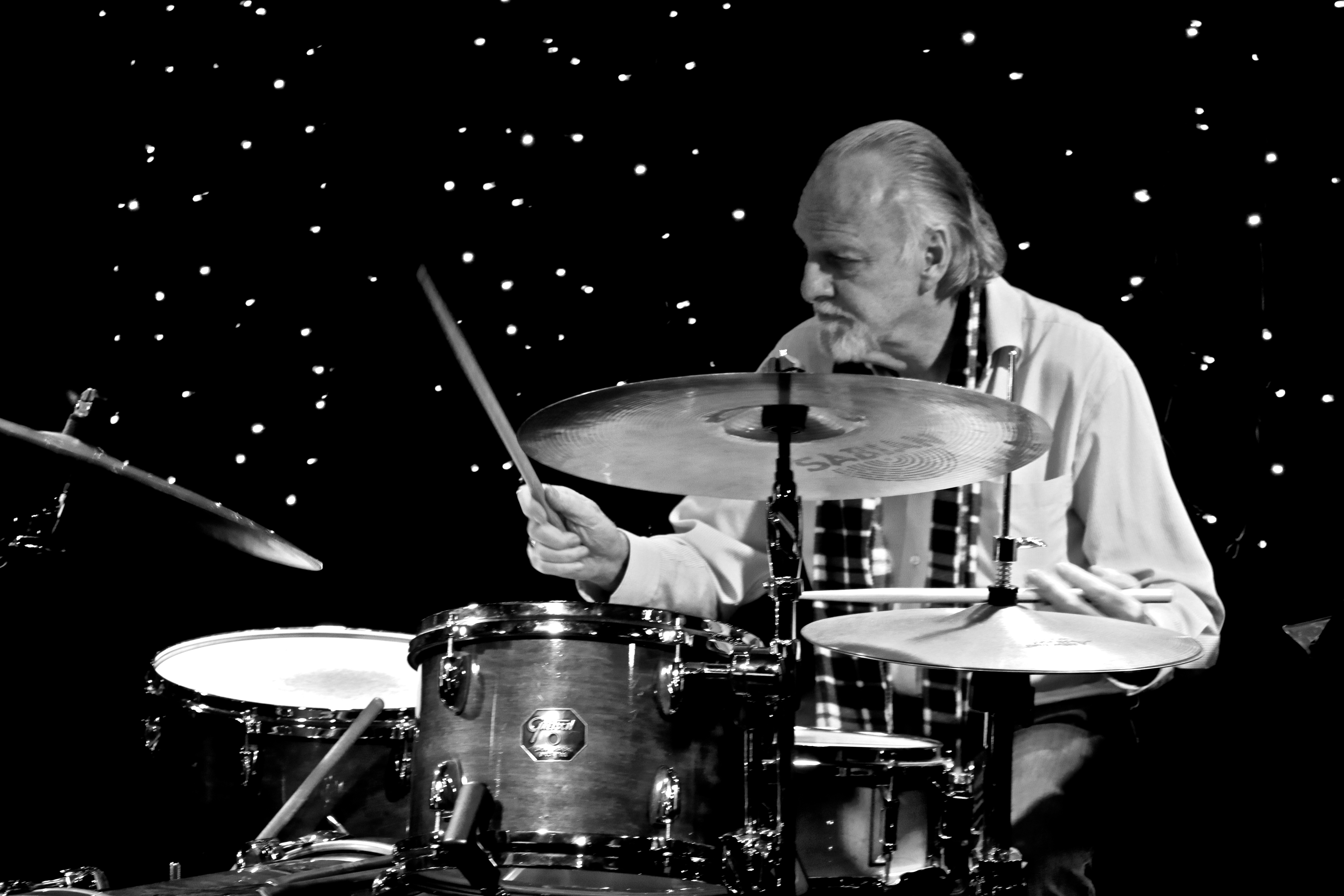
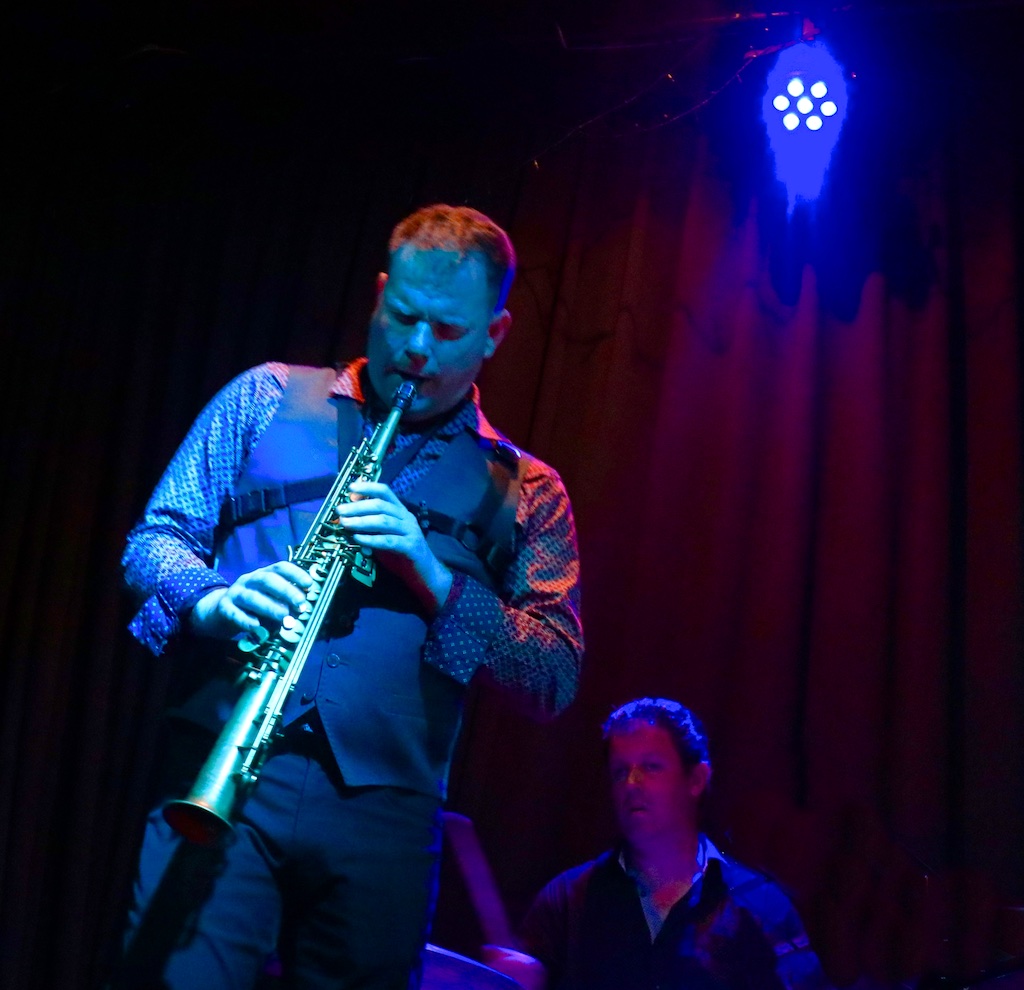
Jonathan Crayford Trio Christmas 2021

After a hundred and seven days in isolation, five days of equivocation and an anxious twenty minutes hunting for a parking space, there I was in the front row of the CJC Jazz Club; poised expectantly as the pianist’s fingers were about to descend. It was not as if I had been deprived of music during lockdown because my ears had been exploring a mélange of sounds. In fact, my noise-cancelling headphones had become such a fixture that I felt awkward without them. So what had I missed? I had missed sitting with friends, the hushed buzz of conversation before a first set and that feeling of joy as the lights lower. Live Jazz in an intimate setting is a unique experience, and for me, an addictive one. As Nietzsche said, a life lived without music would be a mistake.

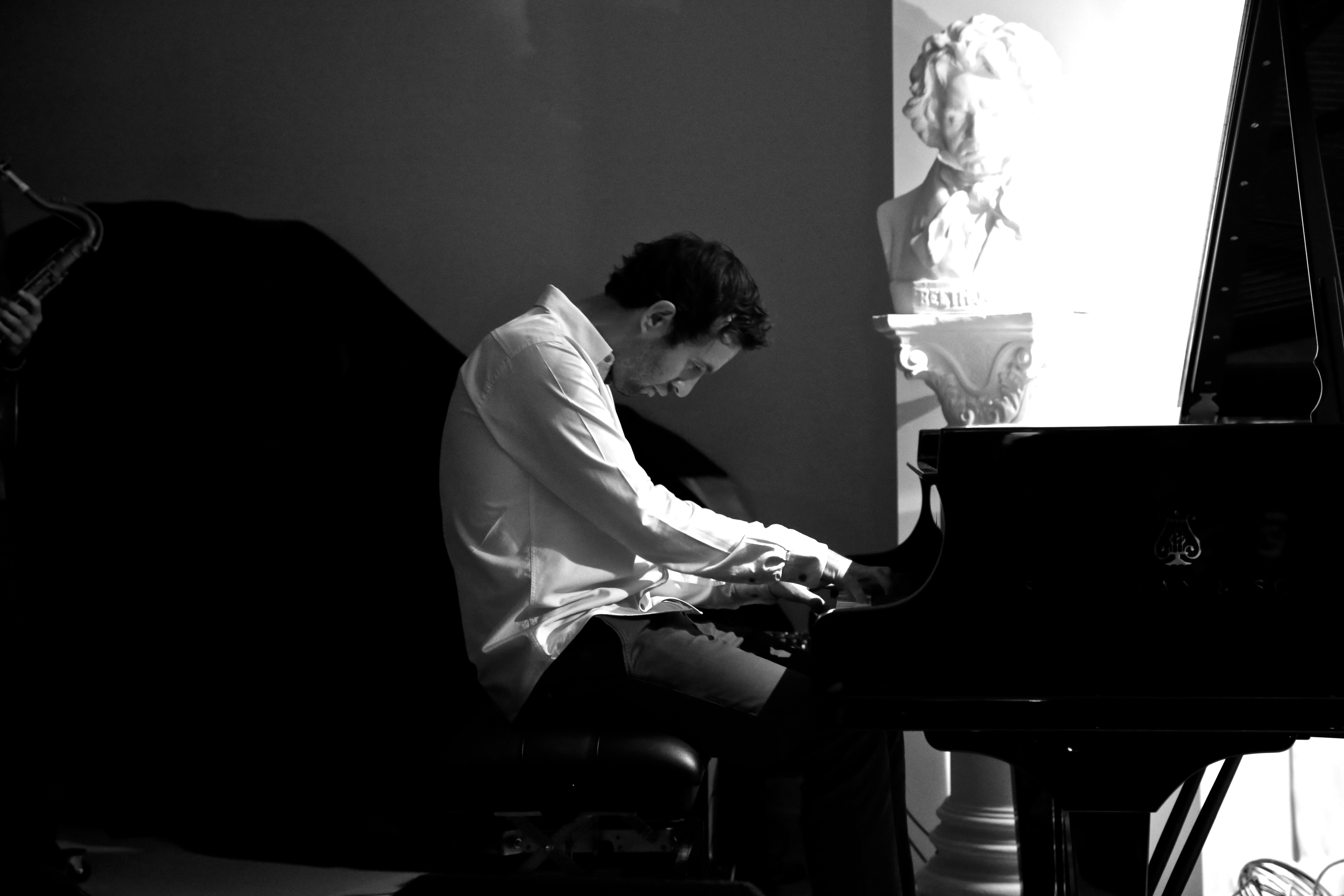
I approach Jonathan Crayford gigs with high expectations and I am never disappointed. Even the occasional gigs in crowded streetside bars yield gold; but in a listening venue with a nice piano, you get the best of him. All good musicians feed on an enthusiastic audience, but with Crayford, there is a discernable x-factor, something quite beyond the ordinary. It is difficult to put into words, and I have approached this on previous occasions. You can see it in his gaze as he leans toward a piano, but it is also in his verbal engagements with an audience. When he talks and plays he is reaching beyond. Beyond a room, a city, a country. Gazing into the cosmos for inspiration.

His talk is peppered with a sense of place, or with improbable events and observations as he weaves them into intimate and odd narratives. A park bench in Central Park, a book read in Paris, a philosophical discussion with a homeless person. Pavement tee-shirt manufacturing — bikes in space! He talks as if new worlds and indeed the cosmos falls easily under his gaze and that is reflected in his music. To make extraordinary music requires seeing beyond the mundane. The interesting thing, however unexpected, is that for a moment, we hear through brand new ears. That is his gift. 

The gig featured a selection of Crayford’s compositions and all were extracted from his acclaimed New York Trio albums on Rattle. Anything from East-West Moon or Dark Light will please and fresh interpretations with a newly configured trio are always welcome. All three musicians were obviously pleased to be gigging again and I know that drummer Ron Samsom and bass player Cameron McArthur relished the opportunity to tackle these works. All three dug in and delivered as I knew they would.
If by some unfortunate oversight you have not heard East-West Moon or the earlier album, Dark Light, you need to remedy that over the Christmas break. I would urge you to bypass the streamers and purchase the album, or at least download it in WAV from www.rattle-records.bandcamp  Support Kiwi music. 

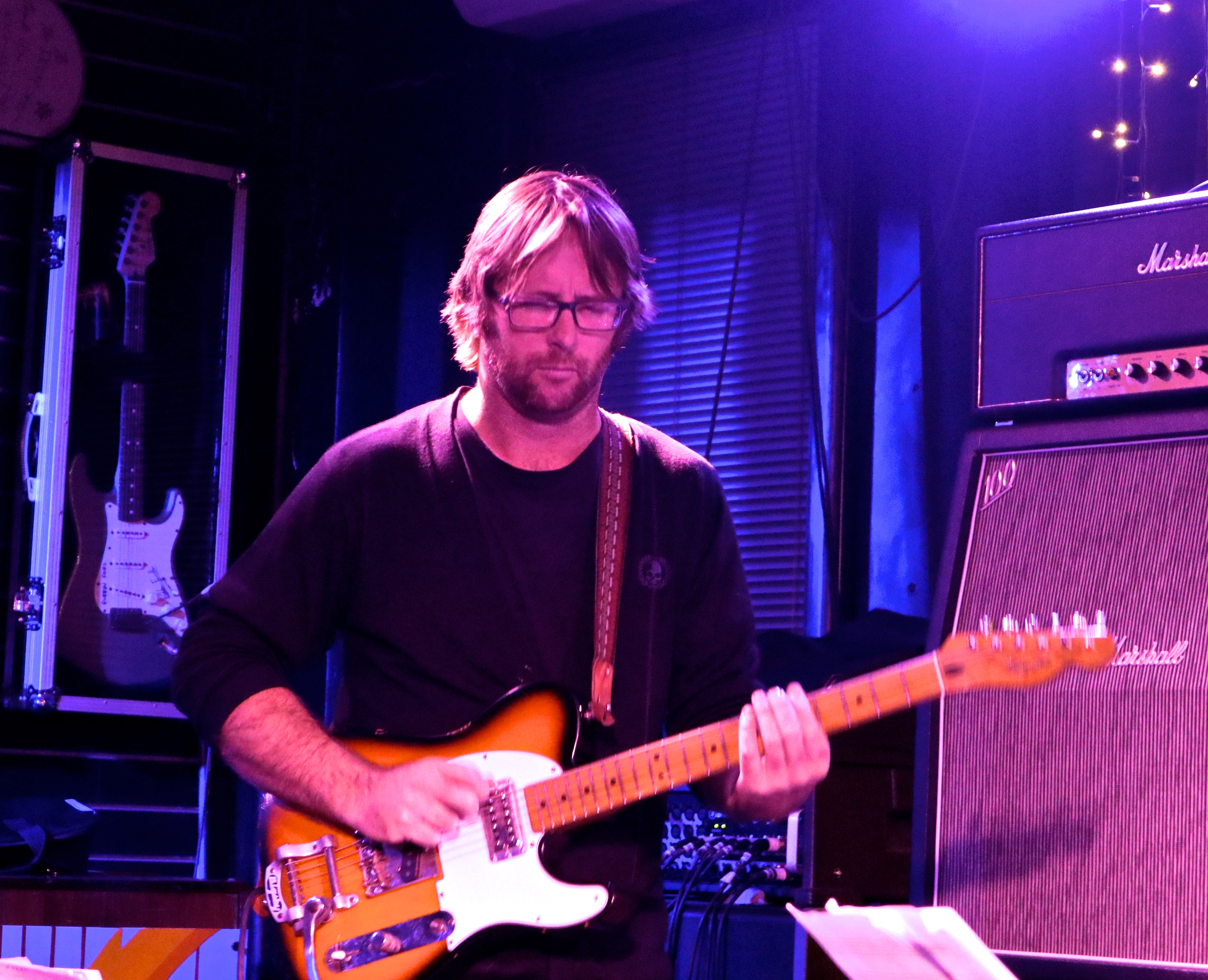
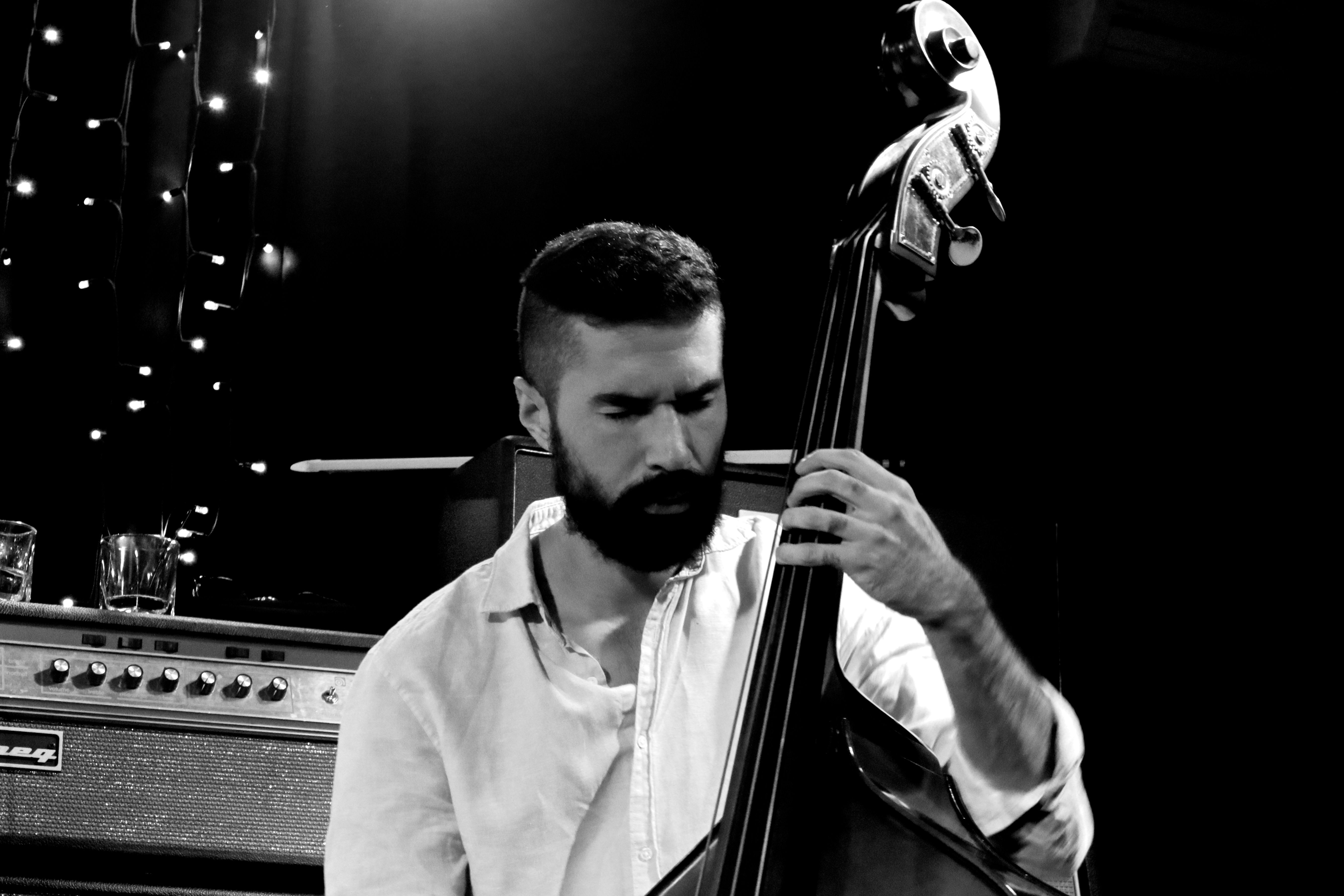
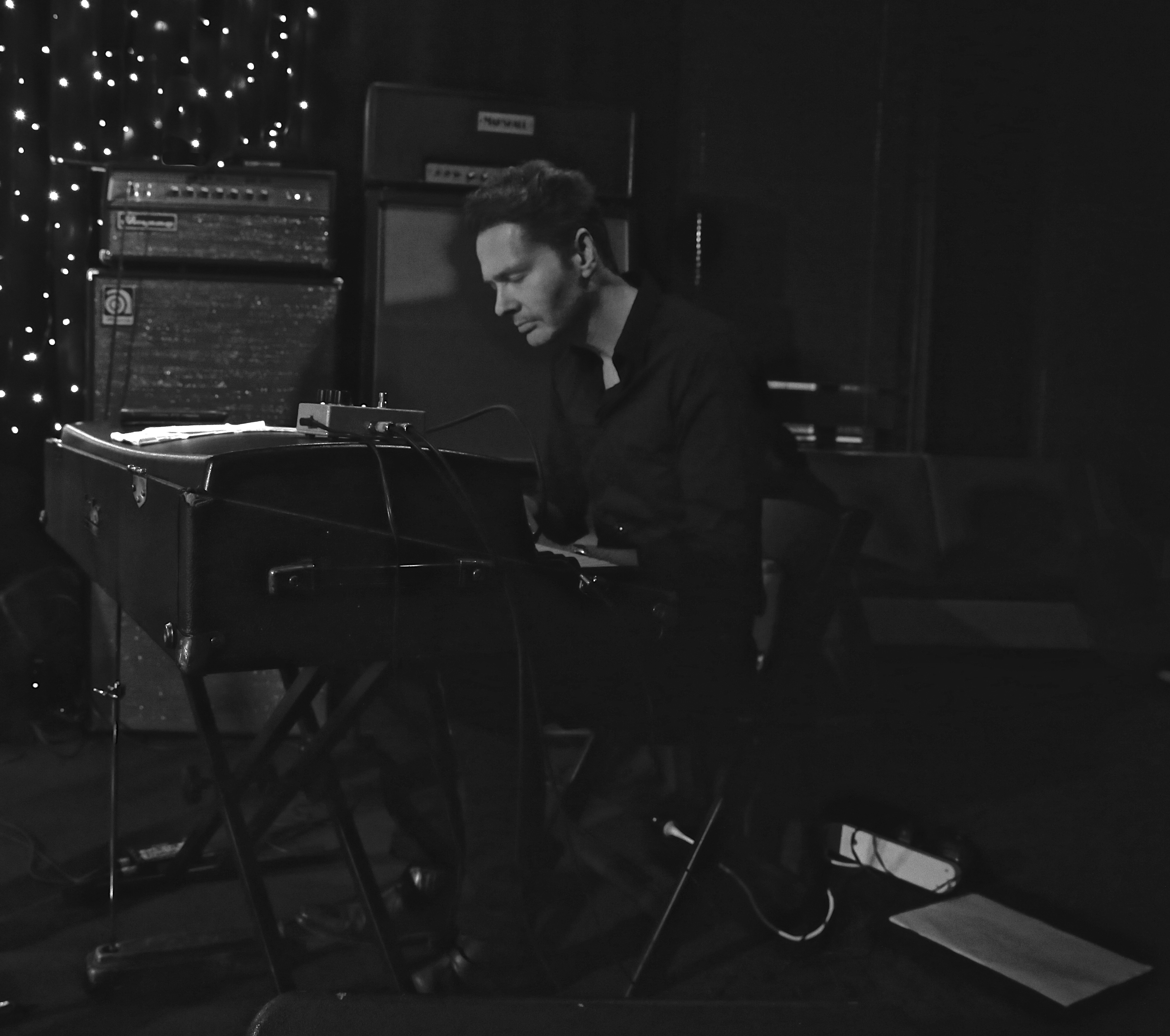
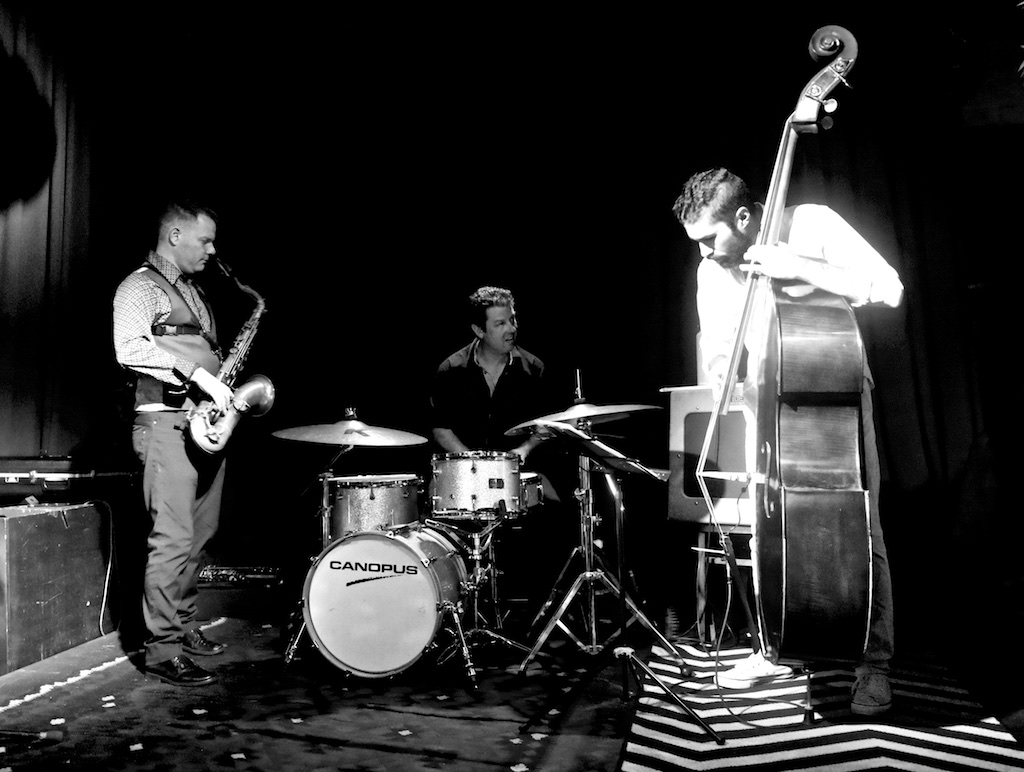
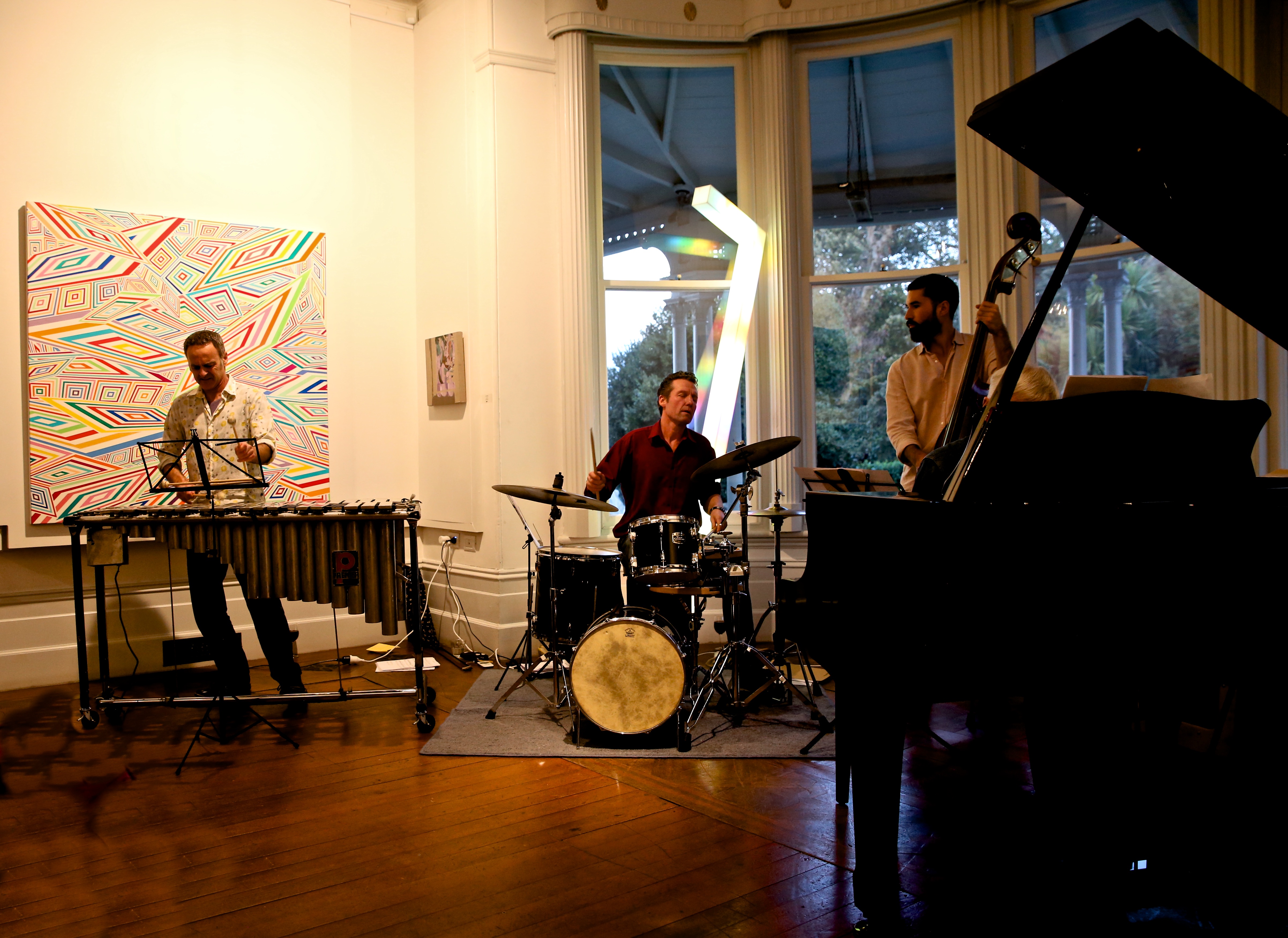
The CJC live trio: Jonathan Crayford (piano), Cameron McArthur (bass), Ron Samsom (drums) 

The NY album trio: Jonathan Crayford (piano), Ben Street (bass), Dan Weiss (drums) – Rattle Records (Rattle Jazz)

JazzLocal32.com is rated as one of the 50 best Jazz Blogs in the world by Feedspot. The author is a professional member of the Jazz Journalists Association, poet & writer.Some of these posts appear on related sites

Steve Barry Quartet

I clearly recall the first time I heard Steve Barry. It was around eleven years ago at the1885. He was not long back from Australia, bringing with him bass player Alex Boneham and drummer Tim Firth. At that time the Creative Jazz Club was located in a dark atmospheric basement; an ill-lit venue bordering on gloomy and perfect for a Jazz club. You would grab a drink, sink into a well-worn leather armchair with broken webbing and wait for the band to begin. 

The music that night was unforgettable. Somewhat denser than I was accustomed to at the time, but never-the-less fully engaging and exciting. When the second tune was announced I pushed record on my iPhone because I knew that I was hearing a piece of music that merited further attention. It was a tune that he was working on and it would appear on his first album a short time later. That was the year of Aaron Parks and his Invisible Cinema, and Barry’s tune was titled ‘Parks’. I listened to that phone clip an awful lot over the following months and I could hear the future. 

Each time Barry has appeared in New Zealand he has showcased fresh ideas. He is a forward-thinking and innovative composer/pianist and as such he never rests on his laurels. Although born in New Zealand, Australia claimed him long ago. He is popular there, has obtained a doctorate and awards there and teaches at the Sydney Con. As expected, he brought us new compositions this visit, but as I listened I was also reminded of that first gig. While he moves on constantly and is not composing or playing in the way he did back then, there is still a hint of that younger player. Of past learnings gathered and picked through as he builds fresh iterations, crafted in part from the bones. I am not surprised that he studied with Craig Taborn.

His compositions are no doubt demanding and require good responsive players. He had assembled just such a crew for his CJC Anthology gig. Callum Passels on alto, Cameron McArthur on bass and Ron Samsom on drums. Local musicians of the highest quality. Passels has a gorgeous tone, but what sets him apart is his ability to push at the boundaries. His best work occurs when playing compositions that afford him certain freedoms and these compositions worked well for him. At times he would run over the lines which contrasted nicely with his tight unison playing. The sort of advanced musical thinking I associate with Warne Marsh. Perhaps because this was a quartet, the music also felt more spacious. The density and serialism were still evident but as always with Barry, there were fresh vistas revealed at each turn. 

The gig took place at Anthology K’Road for the (CJC Creative Jazz Club). 2 June 2021. For Barry’s album visit Rattle Records or stevebarrymusic.bandcamp.com

JazzLocal32.com was rated as one of the 50 best Jazz Blogs in the world by Feedspot. The author is a professional member of the Jazz Journalists Association, poet & writer. Some of these posts appear on related sites.

Michal Martyniuk Trio + Dixon Nacey

The old adage ‘good things are worth waiting for’ proved correct last Wednesday. After two lockdown cancellations, the Michal Martyniuk Trio (+ Dixon Nacey), finally performed their long-awaited CJC gig. There had been much anticipation as the band is popular, and when the gig finally happened, everyone was excited. The European continent is a long way away and so we don’t hear many European bands live. The Martyniuk Trio (whether playing alongside Kiwi or Polish musicians), always manages to capture a piece of that northern vibe for us. 

I have previously reviewed Martyniuk gigs and they never disappoint. I like them because they are uplifting. I like them for their melodic and harmonic richness. Martyniuk is a gifted pianist, but his compositions and arrangements are real standouts. The Awakening, The Opening’ Jazz Dance etc. His tunes feel like modern standards and I never tire of hearing them interpreted afresh. He doesn’t rest on his laurels either, bringing memorable new tunes to the bandstand with each gig. 

A case in question was a soulful tribute to Lyle Mays (For Lyle). A reflective ballad, celebrating a creative giant now lost to us. The tune, captured the essence of Mays the musician while evoking sadness at his untimely passing. It was also somehow fitting that Martyniuk’s own tunes should be bookended by two Metheny tunes. Metheny’s and Martyniuk’s had been the last gigs I attended in the hours prior to the first lockdown. When tours stopped I recall wondering; when will I ever hear live music again? I listened to both Metheny and Martyniuk over the turbulent months that followed and recaptured the joy of those events. We are lucky to have live music again, and especially when so many others are deprived of it.

Another obvious reason for adding Metheny tunes to a programme of originals was the inclusion of Dixon Nacey in the band. Nacey’s interpretations of Metheny tunes are standouts. During recent gigs, he has introduced many of these into his repertoire and to much acclaim. He was very much on form last week and his soaring smooth as silk delivery filled the room. His warm sound also complimented the richness of the Martyniuk compositions. One of Nacey’s own compositions was also played.

Videoing this gig proved extremely difficult, as the room was dark and the sightlines impossible. It was also a packed house and so capturing the sound from a suitable location was compromised Those who want to hear more of the group should buy an album or go see them live.

The remaining band members, Cameron McArthur (bass) and Ron Samsom (drums) have long been part of the Martyniuk trio (NZ), having played with him for years and having appeared with him at ‘Java Jazz’. They are highly experienced musician’s and familiar with the material so they can explore its facets.  

Dixon Nacey

My recommendation is to buy Martyniuk’s records and to check out some of the recent YouTube vids captured in his native Poland or Auckland. I don’t know how long he will remain in New Zealand as his career in Poland is on the rise. While he remains here, do check his band out.  It’s a treat you should not deny yourself – from michalmartyniuk.bandcamp.com

The gig was at Anthology, CJC Creative Jazz Club, Wed 14 2021. Michal Martyniuk (piano), Dixon Nacey (guitar), Cameron McArthur (bass), Ron Samsom (drums).  

JazzLocal32.com was rated as one of the 50 best Jazz Blogs in the world by Feedspot. The author is a professional member of the Jazz Journalists Association, poet & writer. Some of these posts appear on related sites.
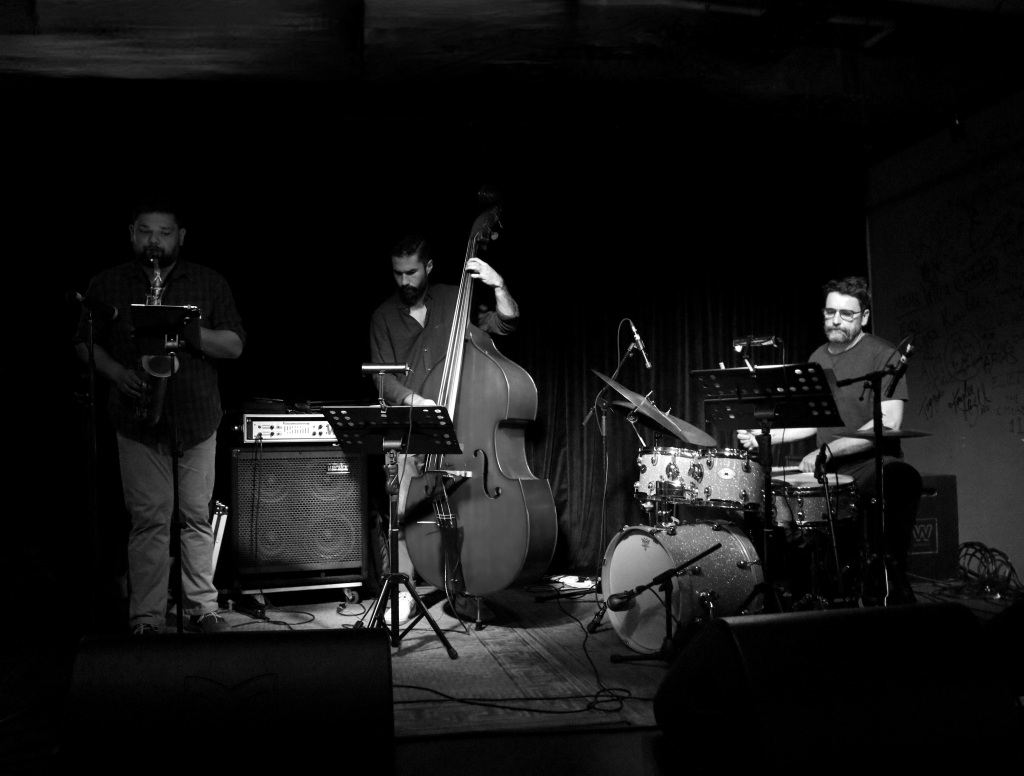
Hot Foot @ Creative Jazz Club

Happenstance is the midwife to surprise and in the musical universe, random events occur often. They appear unheralded, bringing chaos or joy and for seasoned improvisers, they are welcome visitors. So it was with Hot Foot, a band cobbled together in haste; a sonic singularity, a concentration of energy. The advertised gig was an organ trio, but at the last minute, that event was rescheduled, so with hours to spare, Roger Manins revived Hot Foot and how fortuitous that turned out to be. 

There is provenance to Hot Foot, but the details remain sketchy. Leader Manins hinted that they had once played at a village market but a long time ago. He introduced the trio with a story about a Sydney band of similar configuration. A saxophone trio he’d played in as a much younger man. For him, that had been a formative experience, a chance to play without the safety net of a chordal instrument. A chance to cut his musical teeth alongside more experienced players and to road test the Sonny Rollins Way Out West trio thing. 

On Wednesday, the spirit of Rollins hung over the proceedings, the way Manins gnawed away at a tune and tugged at its fabric without losing the form. We were treated to long intros where a familiar melody was hinted at, then abandoned to a flurry of arpeggios. It was riveting to watch and to hear. There were clear signals and subtle hints as the intros unfolded; sometimes accompanied by verbal exclamations or questions directed at the audience or to Jazz School students. The solos were extracted from the tunes by paring them back and then exposing the naked ideas; sometimes stopping at the brink of freedom. If this sounds chaotic it was not. It was a masterclass for Jazz lovers and it was realised in a spirit of joy and levity.

A saxophone trio reveals the melodic lines unadorned, but in doing so there are specific responses required from a bass player and a drummer. Cameron McArthur’s bass gave us some pared-back harmonic references and more importantly, he centred the trio. In this instrumental configuration, it is important that a bass player holds the form, and McArthur did so admirably. This not only gave the saxophonist the room he needed but opened up opportunities for the drummer.

Drummer Ron Samsom made the most of his space and his musical intelligence came to the fore. His was a modulated voice as there was nothing that intruded or jarred, there was a pulse but it was mainly implied. He explored the kits melodic possibilities and added flashes of colour. Improvisers function best in a high trust environment and that was what we saw last week. It is here where experience counts and where a band manifests personality. 

The gig also unleashed Manins alter ego, Comedian Roger. There are often flashes of humour in his musical performances and it is especially evident when he introduces tunes. He never takes himself too seriously and this balances his serious commitment to his art form. His humour is unplanned and you never know what is coming next. The CJC audiences love to see this side of him. The clip I have posted is a Monk tune titled ‘Ask Me Now’. This is a favourite of mine and judging by the whoops of delight when the coda morphed into the tune, it is an audience favourite also. The bravura, the exploration, the verbal interactions; Among the tunes played were songbook standards like favourite ‘Sunny Side of the Street’ (Dorothy Fields/ Jimmy McHugh), Strode Rode (Rollins) and an Australasian Jazz standard, the blistering rendition of Bernie McGann’s ‘Latitude’. Ask Me Now is a question I am happy to answer. Yes, this was a very good night.   

Hot Foot Saxophone Trio: Roger Manins (tenor saxophone), Cameron McArthur (upright bass), Ron Samsom (drums)

The gig took place at Anthology, CJC (Creative Jazz Club), Auckland. March 2021

Bonita ~ Chelsea Prastiti

Chelsea Prastiti’s Bonita gig was a phantasmagoria of warm evocative sounds. I have the greatest respect for her work and in this case, she curated something rare; she conjured up the vibe from another place and time, and she did so without a hint of contrivance. The Brazil of the sixties and seventies with its Bossa Nova soundtrack was an era of infinite possibility. In the end, the dream was stolen by a repressive authoritarian regime but the music, a timeless gift to the world, lived on. Over the last half-century, the Jobim songbook, in particular, has remained popular, and while some interpretations have been breathtaking, others, have been pale imitations. 

What Prastiti has done here is both respectful and innovative. She has composed a suite of tunes that nails the vibe as it taps into the essence of New Wave Brasileira while evoking the founding era. The concept for this gig and many of the tunes were conceived years ago. Prastiti had other projects cooking back then, and so she waited her time. As it turns out, she timed it perfectly. With our borders closed, the desire for high-quality Kiwi music is at an all-time high. Audiences are not being distracted by ‘once again and for the very last time’ tours by fading greats, and the realisation is dawning that homegrown is often better. 

Stars above water below

Another plus for holding the gig now was that her friends and collaborators were all within reach: notably, Elizabeth Stokes and Ben Sinclair of ‘The Beths’. The recent winners in the Best Group category at the NZ Music Awards would probably have been back on a world tour right now, but the pandemic curtailed that. The ensemble members all go back quite a way with Prastiti and I believe that the warmth they radiate arises from those long-held connections. 

Cassandra

The ten-piece ensemble oozed a Brazilian vibe, with its flute players and fingerstyle acoustic guitar. Add to this the unmistakable rhythms of Samba and Bossa Nova and the course was set. There was a horn section of trumpet and a tenor saxophone and one of the flute players doubled on clarinet. Behind them was an upright bass, drum kit and percussion and in the darkness, and to one side, a piano. The arrangements were beautifully textured and the harmonies absolutely gorgeous. As well as the instrumental harmonies, there were vocal harmonies contributed by two of the instrumentalists (one being Stokes, who has a fabulous voice – the success of the Beths underscores that). Prastiti composed all of the tunes and arranged most of them. The other credits go to Sinclair who arranged Prism, Callum Passells who arranged Bumblebee and Kenji Iwamitsu-Holdaway who is co-credited for the composition titled ‘Stars Above and Water Below’. 

Chelsea Prastiti is one the most innovative vocalists to appear on the local scene and she is never afraid to take risks or to explore new territory. The rest of her ensemble were: Elizabeth Stokes on trumpet and vocals, Crystal Choi, who appeared last week, this time on piano and vocals; bringing a beautifully voiced minimalism to the proceedings and echoing Tom Jobim’s delicate spidery lines. Roger Manins was on tenor saxophone with fills and some tasteful solos – J Y lee played an edgy melodic flute (it is not his primary, but he brought expression to an instrument that in the wrong hands can lack it). Beside him was Ben Sinclair (bass guitarist from the Beths), alternating between clarinet and flute, the ever-reliable Adam Tobeck was on the drum kit, with Ron Samsom on percussion. Lastly, and hidden in the shadows was Michael Howell, utilising the voicings and fingerstyle of the Brazilian acoustic guitar. He absolutely nailed those warm pulsing rhythms which fell about us like a warm summer shower.  

Eleven years ago, I began this Jazz blog and one of my first posts was an opinion piece about this era. I looked back at it today for the first time since writing it, and apart from a few missing commas, it stands up. I was worried when I wrote it that it might get something wrong, but a Brazilian musicologist messaged me to thank me for it. Anyone wanting to gain an additional sense of this era could follow the link to my original post. It is an opinion piece, but it could serve as a springboard to more authoritative, Brazilian-sourced information. https://jazzlocal32.com/2011/06/07/wave-antonio-carlos-jobim/

The gig took place at Anthology K’Road for the CJC Creative Jazz Club, November 25, 2020

JazzLocal32.com was rated as one of the 50 best Jazz Blogs in the world by Feedspot. The author is a professional member of the Jazz Journalists Association. Many of these posts also appear on Radio13.co.nz – check it out.

Kevin Field ~ Soundtology

With closed borders and venue restrictions biting, the release date for Kevin Field’s ‘Soundtology’ album became a movable feast. The original proposal would have seen some of his New York band appear, but because of the pandemic, that plan was ditched. If he was flustered by these frustrating circumstances it didn’t show. Making a virtue out of necessity he engaged local musicians and launched his album anyway. It was a night to remember.

Field is one of our finest musicians and his reputation stretches far beyond these shores. He has previously recorded with highly-rated New York Jazz musicians and also with the best of New Zealand’s improvisers. As an adventurous musician, Field eschews stasis and his developmental arc is particularly evident with this latest album. He is an artist who arrives at a successful formula and then turns it on its head. With each album, he makes references to his earlier works, and then he moves foreword. Everything that has gone before becomes a springboard to a new moment and each iteration is better than that preceding it. 

There is a lot to like about Fields new album ‘Soundtology’. The tunes are sublimely melodic, and as always, his trademark harmonic developments astound. I have always enjoyed his avoidance of cliche and in this case, there is something else. Even when upbeat, the tunes feel more contemplative, and the space afforded, lets the music speak with clarity.  This is the album of a mature composer and it is deserving of wide acclaim.

‘Good Friday’ Live in Auckland

The album has eleven tunes and features two quartets (alternating throughout). This provides contrast while not affecting the flow and continuity. All of these tunes belong together and each unit locates something special. The first quartet features Field (Piano Rhodes),  Nir Felder (guitar), Orlando Le Fleming (bass) and Charles Haynes (drums). The second quartet has Field (piano, Rhodes) Mike Moreno (guitar), Matt Penman (bass) and Nate Wood (drums). These are heavy hitters and Field could not have chosen better crews to spin gold out of his compositions. I was immediately drawn to the inclusion of Moreno, one of the worlds great guitar improvisers. I once flew to Sydney just to catch a concert of his. 

‘Soundtology’ is a beautifully presented album and it was recorded to perfection.  It is an album to be enjoyed on many levels; for its beauty and freshness and for its accessibility. If ever there was an example of complex music made to sound easy, it is here. The tunes are beguiling and memorable, but underlying them are twists and turns which elevate the tunes into listening adventures. A good example is the first track Quintus Maximus. It opens over an ostinato sequence, where a broken rhythmic pattern is established by bass and Rhodes. The intro is a teaser as it hints at possible directions without necessarily committing to them; then the melody soars and brings it together until the underlying ostinato phrases reappear. An interesting and enjoyable piece of music. 

The second tune, ‘Good Friday’ is a great composition. It is among the most melodic of Fields tunes and it has been around since he first recorded it on his 2012 Warner release ‘Field of Vision’. Back in 2012, the tune was a slower-paced offering. Over the last few years, I have heard it performed often; now, it has emerged as a punchier version of its former self. It is fascinating to hear good tunes like this under constant development. This is what Field does and it is his impulse toward reinvention that elevates him beyond the pack.  It is not surprising that he was recently awarded a doctorate.

There is no better example of its ongoing trajectory than the version of Good Friday we heard at Wednesday’s live performance. It had been rearranged to include a bass clarinet and a soprano saxophone. There were two guitarists as in the album, but the addition of the horns gave us yet another vantage point from which to examine the composition. A band member told me afterwards that the charts were interestingly structured. They forced the soloists to think outside of the square and to avoid any formulaic approach. 

‘People factory’ was the perfect vehicle for Moreno, Penman and Wood. This number is like silk in a ruffling breeze, I have never heard Moreno sound better (and he always sounds good). The responsiveness Field extracts from Wood and Penman is also marvellous. This is seamless interplay at its best.  Actually, everything is great on this album and there’s plenty of variety.  This one is 4.5 stars. My advice is, buy multiple copies and impress everyone with your hip good taste.

‘Soundtology’ by Keven Field ~ Released on TimezoneRecords.com 2020

Album: Keven Field (piano, Fender Rhodes), Mike Moreno, Nir Felder (guitar), Matt Penman, Orlando Le    Fleming (bass), Charles Hayes, Nate Wood (drums).   

Live gig: Kevin Field (piano, Fender Rhodes), Michael Howell & Kieth Price (guitars), Nathan Haines (tenor, soprano saxophones), Lewis McCallum (bass clarinet), Cam McArthur (bass), Stephen Thomas (drums).

The live gig took place at Anthology K’Road for the CJC Creative Jazz Club, November 11, 2020

JazzLocal32.com was rated as one of the 50 best Jazz Blogs in the world by Feedspot. The author is a professional member of the Jazz Journalists Association. Many of these posts also appear on Radio13.co.nz – check it out.

Frank Gibson Jr ~ New Bop Quintet

Frank Gibson Jr is a legendary figure on the New Zealand Jazz scene. A drummer like his father before him and a Jazz touchstone throughout much of my life. He and I attended the same Grammar school and although he and Murray McNab were two years ahead of me, they were known even then as being cool Jazz- guys. Gibson’s love of Monk and of the Hard Bop era has always been his thing, and it is evidenced in his gigs. No one about town does it better. 

With the New Bop Quintet, we get a fresh Gibson line up this time; within minutes of hitting the stage, they’d recaptured the joy of that era. The setlist was broad and included a few tunes that we seldom hear; it also included a nicely penned original by bass player Cameron McArthur titled ‘Three Up, Three Down’. There was only one Monk tune (Straight no Chaser), and the applause after that was thunderous. Everyone loves Monk. 

As an opener, the band gave a crackling rendition of a favourite Shorter tune ’Speak No Evil’ and there is no better way to commence a standards gig. Gibson is a strong drummer and his style exemplifies this era; his bop-influenced grooves being unmistakable. In this unit, he has changed things up by including some different musicians. This gave the gig an interesting edge and it worked a treat.  Keven Field could fit into any line-up, but he is seldom in a Hard Bop unit. His distinctive harmonic approach edged the sets into new territory, and everyone stepped up to meet the challenge. 

You could not have a Hard Bop gig without featuring Benny Golson tunes; there were two of them, ‘Along Came Betty’ and ‘Stablemates’. These are essential Hard Bop classics, and no one ever tires of them. The tune which really stood out though was a seldom played composition by Dexter Gordon, ’Soy Califa’. This was the opening track on his ‘A Swingin’Affair’ album and once heard, loved forever. To do justice to a tune like this requires chops and bravery and the evidence of both was very much on display last Wednesday.  

On ‘Soy Califa’, the opening drum beats and the tightly executed head arrangement hooked us, then Pete France took it to a different level entirely. He and Mike Booth gave memorable solos. It is a common complaint that we see too little of France (a Scottish born saxophonist). He is highly regarded about town and when his tenor-saxophone sings, it is wonderful to behold.  I have posted a clip of New Bop’s ‘Soy Califa’.

Soy Califa (Gordon)

There were also flawless performances from Mike Booth, as this is the style and era where we hear the best of him. He and France were very well matched and as the band played on, you could feel their enjoyment and their deep love for this music. Field and McArthur while hidden in darkness, were the essential ingredients that rounded off a heady brew.

Whether it’s playing with locals or with Jazz greats, travelling or teaching, Gibson has achieved much in his life; to top that off he has recently gained a doctorate.  This was the first CJC gig as we emerged from the second lockdown and it attracted a capacity audience. It was great to have the music back and nice to have it ushered in by a quality Hard Bop unit like this. 

New Bop Quintet: Frank Gibson (drums), Mike Booth (trumpet), Pete France (tenor saxophone), Kevin Field (piano), Cameron McArthur (upright bass). The gig took place at the CJC (Creative Jazz Club), Anthology, K’Road, Auckland. September 30, 2020. 

Keith Price Double Quartet

Last week saw the welcome return of Canadian born guitarist Kieth Price to the bandstand. This time with his re-formed Double Quartet. The question that immediately arises, is an octet a double quartet? If you were looking for a point of difference, it is hard to find in dictionaries, as the terms are generally interchangeable, but a doubling up of a particular voice is often indicated for the latter. That brings us to the Kieth Price Double Quartet: two drummers two keyboards and two bass players. A big sound.

Two drummer gigs are well established in the lexicon, becoming more prominent with the arrival of the New Thing and Hard Bop; similarly with the doubling up of keyboards and bass. Ornette Coleman had a notable double quartet. Doubling up like this can be tricky, but skilful writing and good musicianship mitigate such difficulties. Loud and strong, but not leaden, is the aim. 

The Canadian recorded Double Quartet and the contemporary Auckland unit, both convey raw power. Price summed it up with his tongue in cheek comment on Wednesday.

‘I couldn’t make enough noise with a single quartet’.

It was loud but it was also nuanced, drummers blending as if one or finishing each other’s sentences, crafting a rhythmic polyphony.  The keyboards keeping out of each other’s way, but adding accents throughout. The upright and an electric bass taking different roles, balanced against  guitar and a tenor saxophone. 

While not strictly fusion, the band had a funky fusion feel and would have been welcome at Bill Graham’s Fillmore gigs. There were interesting contrasts in the music, and the interplay between the stylings was especially appealing to those who like full-on adventurous music.

It is unusual to see Olivier Holland on the electric bass, but he obviously relished the chance. The audience enjoyed it also. Instead of pedals, he fed his bass through a laptop. This gave him interesting options and he deployed them enthusiastically.  The blending of electric bass and Cam McArthur’s upright was seamless. 

Many of the tunes conveyed a deep-funk feel, driven by punchy interwoven bass lines. When Kevin Field took his piano solos, Joe Kaptein, on keys, laid out, and when Kaptein soloed, he brought a classic 70s analogue vibe to the proceedings. The pairing created texture, and best of all, the fabulous club Yamaha piano was back. With Ron Samsom and Malachi Samuelu on drums, and with Roger Manins’ channelling a wild saxophone funk, you were soon cocooned inside a spacious and warm soundscape.   

It was Price’s deft hand guiding all of these interactions as he cued the musicians. While not quite free jazz, it was freedom within walls, and it sounded free. The springboard for the solos, the solid grooves sitting underneath the lead instruments. Price providing an interesting contrast as his playing was deliberate and at a lower volume. When he ran unison lines with Roger Manins crazy it set up the mood for what was to follow. It was a good gig to catch.

Keith Price Double Quartet, Canada (CD): 

available from www.keithprice.ca

Keith Price: Guitar

Neil Watson: Alto saxophone

Jeff Preslaff: Keyboards

Dallas Nedotiafko: Keyboards & synthesiser 

Marty Thiesson: Electric Bass

Julian Bradford: Acoustic Bass

Jamie Carrasco: Drums

Kevin Waters: Drums

Keith Price Double Quartet ( Auckland)

Keith Price: Guitar

Kevin Field: Piano

Joe Kaptein: Keys & Synth

Roger Manins: Saxophone

Olivier Holland: E-bass

Cameron McArthur: upright bass

Ron Samsom: Drums

Malachi Samuelu: Drums

The Auckland gig took place at CJC, Anthology, K’Road Auckland, 15 July, 2020

For a fuller version, go to Radio13 – Portions of the above have been excerpted from that article which can be located at Radio13.co.nz

Now, Where Were we?

Michal Martyniuk reprised.

The last live gig that I attended was just before the level 3 lockdown. That seems like forever ago now, but in truth, it was only in March. Now, in the closing days of June, here I was, strolling down Karangahape Road; the home of indie music and the Creative Jazz Club. Live improvised music was back. 

I can remember every moment of my last pre lockdown gig and I savoured the memories during my period of isolation. As the weeks rolled into months, I managed the interregnum well, but the absence of live music cut deep. I missed its sweet voice in my ear, so music, please never leave me again. 

By a strange coincidence, the last band I heard, the one on that March night, was the Michal Martyniuk Trio. Now, here they were, performing the very first post lockdown gig. As I dashed across K’Road to avoid the rainstorm I wondered if the weather would affect the turnout. The restaurants and the streets were eerily empty, but huddled in the stairwell of Anthology were people shedding raincoats and talking excitedly. Long before the gig started the club had filled to capacity. 

The trio was now a quartet, having added 2020 Tui Award-winning guitarist Dixon Nacey to their number. It turned out to be a match made in heaven. Four highly rated and award-nominated artists merged into one killer unit.

After months of being deprived of live gigs, the musicians were pumped and similar energy flowed from the audience. When expectations are this high, what stretches ahead, is a dangerous high wire act. Also, the piano had been idle for months, lonely and unloved. In truth, the instrument is a difficult beast, but Martyniuk soon found his way to its heart and he coaxed it to sing again. Harnessing unruly forces is the anvil on which good improvisers produce their best work. 

Most of the tunes were Martyniuk’s and although his music is quite different from Nacey’s, the contrast worked nicely. Martyniuk’s post-bop European voicings and memorable melodies were gifted an interesting edge.  Nacey’s tunes, which often feature surprising twists and rhythmic complexity, were turned in fresh directions. Out of contrast comes the best Jazz and this was truly the sound of surprise.  

Michal Martyniuk Quartet: Michal Martyniuk (piano), Dixon Nacey (guitar), Cameron McArthur (bass), Ron Samsom (drums). The clip recorded is Martyniuks Polish unit (not the Auckland band as reviewed above)

michalmartyniuk.bandcamp.com  

Jazz On Lockdown ~ Hear it Here ~ Exiles

Michal Martyniuk

At the beginning of the pandemic, it all seemed so far away. As of today 1/3 of the world’s population are in lockdown and New Zealand with them. A busy South Pacific Island was suddenly disconnected from the world; adrift except for an undersea fibre-optic cable. As confusion dominated the interim period, aircraft were grounded without warning and among the travellers unable to proceed was a touring musician; an improvising exile. Now, we are all exiles from our former lives and major cities have fallen silent.

I refer above to the Polish Pianist Michal Martyniuk, here on holiday and about to return to Poland. Luckily, he has family here and a reason to feel safe in New Zealand. With East European travel curtailed, he organised a gig at the only place he could find, a showroom. This was the last gig I attended before the curtain of isolation fell and it is therefore special to me. 

The venue was the Lewis Eady piano showroom with space for only a dozen chairs, the audience encompassed by a circle of Steinways. Beautiful instruments all; dark polished lacquer and keys gleaming like fashion-models teeth. We were all beginners at social distancing and a few random hugs occurred. After greeting friends, I approached Martyniuk to ask about the format. 

 ‘Eadys have provided me with their finest Steinway B and the acoustics here are so good that the piano will not be mic’d. Nor will the bass or drums naturally’. 

Although the floors were marble, the soft curtains and the cavalcade of pianos soaked up any liveliness. I was able to record the entire concert (mostly Martyniuk originals plus three standards). When leaving home I had realised that I had no video equipment ready, so I grabbed a Zoom recorder and a high-end Rhode mic. They sat on a wooden chair a metre away from the piano.

Cameron McArthur and Ron Samsom completed the line-up; both players having a long association with Martyniuk, accompanying him at Java Jazz and on an album. A few days ago I uploaded the material, savoured the experience. I might not experience live music for quite some time to come. This recording may be unmixed but it sounds special to me.

Michal Martyniuk Trio (NZ). Michael Martyniuk (piano), Cameron McArthur (upright bass), Ron Samsom (drums). recent album Resonance – michalmartyniuk.bandcamp.com

The lockdowns won’t stop jazz! To assist musicians who’ve had performances cancelled, get their music heard around the globe. There Jazz Journalists Association created a Jazz on Lockdown: Hear it Here community blog. for more, click through to https://news.jazzjournalists.org/catagory/jazz-on-lockdown/ 

Griffin / Chisholm / Meehan

Norman Meehan and Hayden Chisholm are always well received when they perform at Aucklands CJC Creative Jazz Club. There have been various iterations of their line ups over recent years and all of them compelling in different ways. The Unwind quartets attract big audiences and rightly so. This particular band was co-led by Chisholm, Meehan and Griffin, with Julien Dyne and Cameron McArthur rounding off the quintet. I was particularly delighted to see Hannah Griffin on the bill, as she occupies a unique and interesting musical space among improvising vocalists. The gig showcased iconic twentieth century New Zealand poets and Griffin’s impressive vocal skills were exactly what was required.   

Jazz lovers of a certain age often categorise vocalists according to how well they enunciate their lines. Whether that is important or not is debatable and it depends very much on context. I am generally more focused on phrasing and time feel and I like to hear a word stretched to fit an interpretation. If it’s a standard, then we know the words and having them messed with is part of the joy. I also listen to a lot of wordless vocal improvisors like Sidsel Endresen. 

When it comes to interpreting poems though, the clarity of the words does matter and Hannah Griffin gave a master class in balancing the many aspects of vocalisation. She does not merely intone a poem, she is part of the band and her melodicism is paramount in the mix. She can enunciate and still pay phrasing its due.

The first thing about this band is the way they respond to each other, sometimes finishing each others musical sentences. This seamless interaction is especially evident between the three leaders. Meehan is a master of understatement and his gentle swing can quickly bring a smile.  His default minimalism always serves the music well but it is on reflection that you realise just how powerful and judiciously placed those chords and sparkling runs are. He doesn’t require a percussive touch to make a big statement. I suspect that most of the arrangements are his as well. 

Chisholm always takes your breath away and from the first note, the emotional content in his playing is quite unmistakable. This is the sort of gorgeous alto playing seldom heard and you dwell on each note and phrase, marvelling at the purity of tone and the compelling story telling. His ability to deploy his multi-phonic technique, simply jaw dropping.

The other thing which grabs you is the sheer beauty of the bands sound. By that, I do not mean just pretty for it goes well beyond that. All of the emotions are engaged and the effect on a room is noticeable. Dyne is a popular local drummer who works across genres and who is sought after  around town. He has played with Meehan and Chisholm previously. Griffen has appeared predominantly with Meehan and in gigs similar to this. McArthur was the new-comer to this particular lineup but you wouldn’t think so. His reading abilities and his intuitive grasp of the music maintaining his usual high standard.   

At the previous Griffin, Chisholm, Meehan gig the band had Bill Manhire on stage, and as icing on the cake he introduced the poems. Gigs like that are hard acts to follow, but fast forward to 2020 and the band more than pulled it off. By extending the range of poets and poems our interest was engaged in new ways. My greatest pleasure was hearing more poems by the much lamented Dave Mitchell. More gigs like that please. You can purchase albums featuring these artists from Rattle Records at rattle-records.bandcomp.com

JazzLocal32.com was rated as one of the 50 best Jazz blogs in the world by Feedspot. The author is a professional member of the Jazz Journalists Association. 

Talbot/Dunbar-Wilcox @ CJC

Emerging Artists (Wellington) Talbot-Dunbar (1)

As Wednesday nights at the new Anthology venue move into high gear, a tried and trusted CJC programming philosophy remains constant. To provide a quality venue for local and international musicians to showcase their original projects, and to provide a performance space that up and comers can aspire to. As before, two or three gig slots are kept for emerging artists, and this year those slots have expanded to include Wellingtonian and Christchurch improvisers. Performing on Wednesday were Wellington musicians Frank Talbot and Ella Dunbar-Wilcox. Both sets had the same rhythm section; pianist Kevin Field, Bassist Cam McArthur, and drummer Adam Tobeck.

First up was Frank Talbot. A tall tenor player with a clean tone and nimble articulation. Talbot is a recent graduate of the New Zealand School of Music and he is currently completing his honours degree. New Zealand produces many good tenor players and judging by Talbot’s confident performance on Wednesday, he will go from strength to strength. He is certainly making all of the right moves and testing himself in varied situations, so he will certainly be one to watch.  On his setlist, there were all originals and I have posted his interesting tune ‘Inquisition’. I also liked ‘Intervalic’ and a moving tune (which I heard as) ‘Steak and kidney pies, no goodbyes’. The latter was dedicated to his mother who is going through very tough times health wise. A nice heart-felt tribute. Talbot-Dunbar

The second set featured Ella Dunbar-Wilcox. A vocalist in her third year of studies (also at the New Zealand School of Music). Her performance showed considerable maturity as she tackled some challenging arrangements and tunes. Not many emerging vocalists would tackle the more upbeat Coltrane tunes or a tricky stop-start McLorin Salvant arrangement. She navigated these charts with ease. I also liked the balance in her set list which provided us with pleasing contrasts. The cheerful, upbeat (and rarely heard) Bobby Timmons number ‘That There’. This followed her own ballad ‘Lonely Eyes’.  Then there was ‘Night Hawks’, a reference to the Edward Hopper painting and capturing perfectly that sense of isolation and ennui.  I have put up her interpretation of ‘I didn’t know what time it was’.

Engaging a quality local rhythm section for both sets was a sensible move. Field, McArthur, and Tobeck are adept accompanists and used to working with unfamiliar musicians. And more importantly, all have worked extensively with vocalists. This draws upon very different skills and in this regard especially, Field is superb.

Frank Talbot (tenor saxophone)

Ella Dunbar-Wilcox (vocals)

Rhythm Section: Kevin Field (piano), Cameron McArthur (upright bass), Adam Tobeck (drums) The gig was for the CJC (Creative Jazz Club) @ Anthology, K’Road, Auckland, 3 July 2019 

TTTenor on tour in New Zealand

TTT (1)Andy Sugg’s collaborative album ‘TTTenor’ was cut in Melbourne back in 2006 and rightly, it has garnered praise. In a land of significant horn-players, the tenor triumvirate of Sugg, Oehlers, and Wilson was a standout. Three gifted saxophonists who capitalised on the imaginative charts to showcase their formidable skills. Completing the original sextet was an immaculate rhythm section – Paul Grabowsky (piano), Gary Costello (bass) and Andrew Gander (drums). Since then, Sugg has recorded other albums like ‘The John Coltrane Project’ ‘The Berlin Session’ ‘Brunswick Nights’ ‘Wednesday at M’s’ and ‘Tenorness’.  He has also been involved in numerous International projects (including writing and lecturing). He was an adviser during the making of the John Coltrane feature-length documentary film ‘Chasing Trane’. All of the above have brought him critical acclaim.       
In spite of Sugg’s busy schedule, the ‘TTTenor’ project was never retired. Last week he teamed up with Auckland’s Roger Manins and Canberra’s John Mackey to present a new and exciting iteration of the TTTenor group. To complete the sextet were, Mark Lockett on drums, Kevin Field on piano and Cameron McArthur on upright bass.  This was not a reprise of the older material as new compositions and interesting charts had been created.  This time, the different stylistic approaches from the three tenor players gave added contrast during solos and a rich texture was noticeable during the head arrangements. Three-tenor-gigs are not commonplace and I suspect that writing for three instruments occupying the same total range presents challenges.  Throughout the head arrangements, the skillful voicing was evident. Dense beautiful harmonies which set the mood for the solos which followed. Inviting the soloists to mark out their points of difference in that space.  

Sugg is a versatile artist and on many of his albums, the influence of Coltrane is unmistakable. It is there in spades on soprano offerings but on tenor, there is an added something that perhaps draws on earlier influences. He is a muscular player and the phrases which flow from his horn seem so right that it is hard to imagine any other possible note choices. This fluidity when storytelling is perhaps his greatest gift. Manins while also a muscular player takes a different path. He is a disciplined reader in an ensemble situation and it, therefore, amazes those unfamiliar with his playing when he dives into his solos, urgently seeking that piece of clear sky ahead and reaching for joyous crazy. While there is considerable weight to his sound, he frequently defies gravity when the excitement of his solos bursts free of the expected.  John Mackey was previously unknown to me, but I found him compelling. His approach to solos was thoughtful, leaving lots of space as he backed into a piece. His storytelling developed methodically, taking you with him as he probed the possibilities. His skillful use of dynamics, a softer tone early in his solos and during ballads. His solo destinations were often heart-stopping in their intensity. This Contrasted with the other tenor solos and gave the project added depth.   

The pianist Grabowsky is a very hard act to follow but Field managed to carve his own space with ease. His signature harmonies and rhythms giving the others much to work with. His own solos a thoughtful reprise from the front line horns. Cameron McArthur is a first choice Auckland bassist and he lived up to his reputation on this gig.

Mark Lockett is an original drummer and perfect for the gig as he has worked with Sugg before. He certainly pleased the audience last week, accenting phrases and pushing them to greater heights. Near the end, he gave an extraordinary solo, not a fireworks display but a master class of melodic and rhythmic invention, aided by gentle and occasional interjections from Field and McArthur. 

This was the first gig at the new venue. The attendance was good and everyone appeared wowed by what was on offer. This gig sets the bar high and why not. Australasian Jazz produces some amazing talents. I have put up a clip ‘TTTenor’ playing John Coltrane’s ‘Naima’ – the sound quality is less than perfect as the bass drops right out once the tenors begin – I am working on that – spacious new venues can definitely be a challenge, sound wise.

‘TTTenor’ was: Andy Sugg (tenor saxophone), Roger Manins (tenor saxophone), John Mackey (tenor saxophone), Kevin Field (piano), Cameron McArthur (upright bass), Mark Lockett (drums).   5 June 2019, Anthology K’Road – CJC Creative Jazz Club

Purbayan Chatterjee + Takadimi

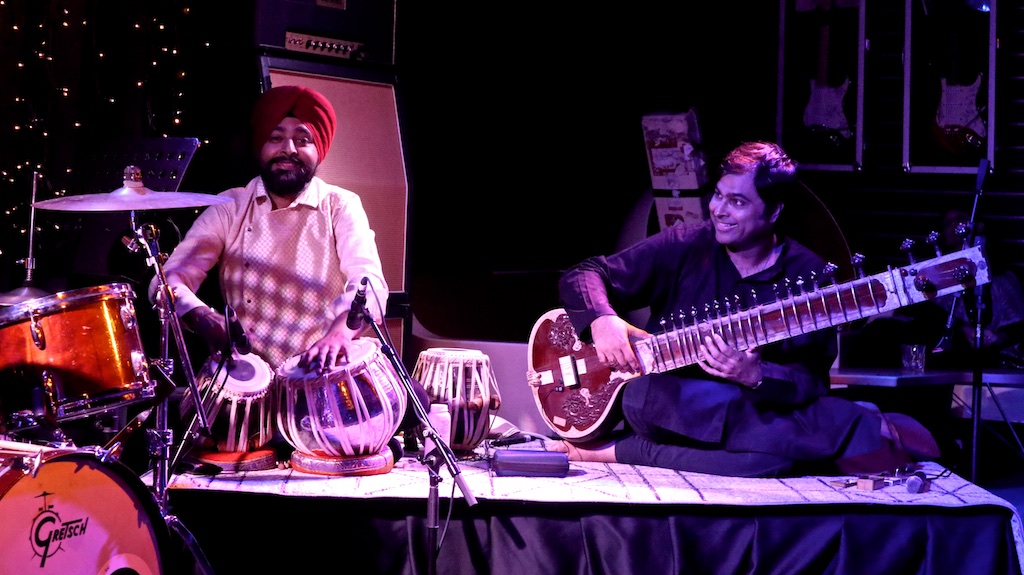
Chattergee (1)Again, the CJC Creative Jazz Club has made good on its promise to deliver diverse and interesting projects.  Last week saw a collaboration between the Bengali born sitar maestro Purbayan Chatterjee and the Auckland based World-Jazz fusion group Takadimi.  What at first glance may appear to be an improbable collaboration – a famous Indian classical master and a Jazz fusion group was, in fact, a perfect alignment.  Having Alan Brown on keys with Cam McArthur on bass and with the nimble, talented Daniel Waterson on drum kit, plus leader Manjit Singh on tabla – we expected and heard excellent music.
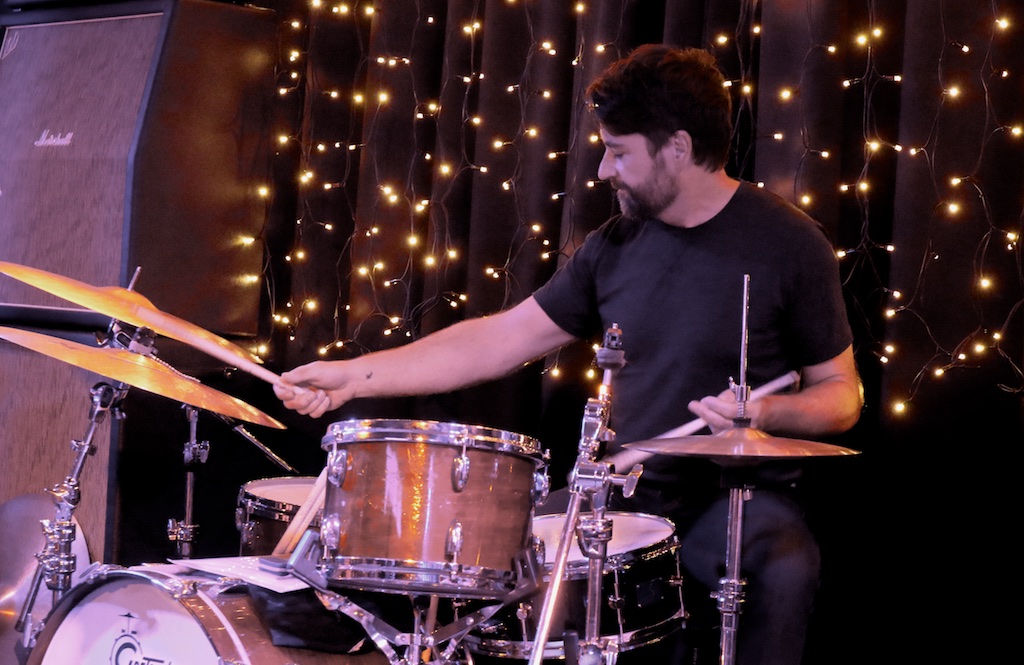
These two great improvising traditions, one ancient, the other emerging just over 100 years ago, are able to comprehend each other’s basic forms. Both traditions produce talented and versatile musicians who are thoroughly trained in song cycles, scales, and rhythms. A perfect illustration of this occurred last Wednesday when Maestro Chatterjee and Takadimi decided to create a spontaneous improvisation. With nothing prearranged, it began with an audience member asking about an ancient Greek scale called the Lydian Mode. All of the musicians were familiar with this mode and Maestro Chatterjee said that it was practically identical to the fundamentals of a particular Raga mode. He fingered the scale briefly on his sitar and then asked Alan Brown to form a motif using that scale. Thus began a cross-discipline, cross-cultural musical conversation like few I have heard. 

Purbayan Chatterjee is a Bengali born musician residing in Mumbai. He has an international reputation and has performed in concert halls all over the world. The recipient of prestigious awards including the President of India award and with a discography which includes best selling albums. He was trained from a young age in the Northern or Hindustani School of Indian classical music. Like the famous tabla player Ustad Zakir Hussain (who he has performed with), he has frequently ventured into the Jazz/World fusion space. Auckland’s Takadimi, under the able leadership of the highly respected tabla player Manjit Singh, has for some years been exploring that same fusion space. Putting Maestro Chatterjee together with Takadimi was inspired. Together, they brought transcendent joy to our club and in a troubled world, this is a precious commodity.

The tone of the evening was set by the first offering which was a beautiful meditative raga performed in a classical style on sitar and tabla. I have been listening to Indian classical music since age 14, but I am certainly no authority. To the best of my knowledge, the basics are as follows. There are two main branches, the northern Hindustani and the southern or Carnatic branch. These, in turn, have many sub-genres and sub-styles, especially in the North. Both schools use the raga (usually a 7 note scale) performed over a drone. The structure begins with the Alap (in 3 sections) which is performed without the tabla and is a preparation or gradual development towards a climax. In this first phase, melodic ornaments and shapes are formed.  The second major segment is the Gat (and Dhrupad) which is where the tabla joins in. The tabla introduces the complex meters that characterise Indian classical music and these are called tala (a cycle of weak and strong beats). Improvisation and interplay occur mainly in this second stage. Although the music is referred to as classical it does not refer to a fixed point in time. It is a constantly evolving music and new styles are still being developed within the classical framework.

I have posted an excerpt from the raga and also the spontaneous improvisation piece. This intensely beautiful music brought fitting closure to our tenure at Backbeat. We will miss the staff and the small club vibe, but it’s time to move to our new home, Anthology. The audiences have followed the club to new venues 5 times over the last 11 years. With such great music on offer, I am sure that this will continue. Purbayan Chatterjee summed up the vibe perfectly when he praised the audience. He plays in the worlds great concert halls but he told us that intimate clubs like this, with engaged cheerful audiences, are the best of places. His gift of the raga – perhaps an evening raga, felt like it was performed just for such an occasion. Thank you musicians – see you at Anthology for the All-Star, 3 Saxophone opening night. Click through to the CJC Creative Jazz Club web site.

Neutrino Funk Experience / Music Soup & the ​healing vibe

Neutrinos (2)March fifteenth began as good days should, with sunshine, a cool breeze off the ocean, and a message from a Jazz Journalist colleague in Australia. ‘Would I like to meet some award-winning Greek Jazz musicians’? I had stuff planned, but the plans were easily shelved and I drove from my leafy hilltop retreat into the city. The musicians had flown into Auckland to join a passing cruise ship and were only in town for eight hours. Ahead of them lay four months of playing standards, original material (if lucky), and the inevitable but often regrettable requests. We met up in a central city cafe. ‘John’, they yelled as I walked around the corner. For the briefest second, I wondered how they had recognised me, ascribing it to a Jazz sixth sense, then remembering my tee shirt was emblazoned with the words Prahu Jazz. We introduced ourselves, and headed for the waterfront at my suggestion, chatting as if we’d known each other for years. That’s the way in the Jazz community. You travel to a place you’ve never been before and someone will message you with the contact details of ‘cats’ to hang with. Such hangs generally follow a well-trodden path. ‘Do you know this or that cat – killing?’ Always followed by outrageous road stories and laughter.     
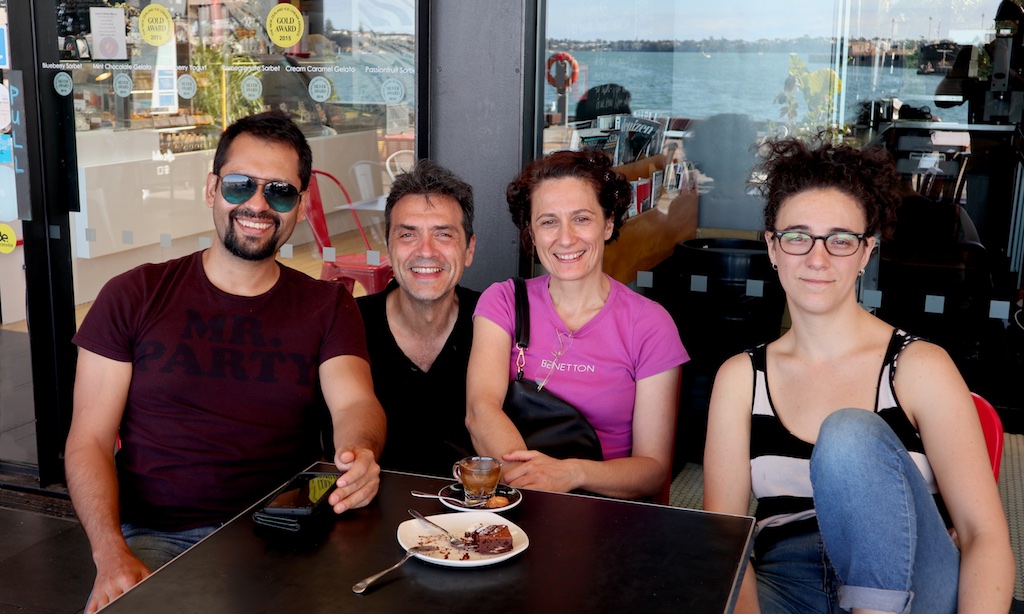
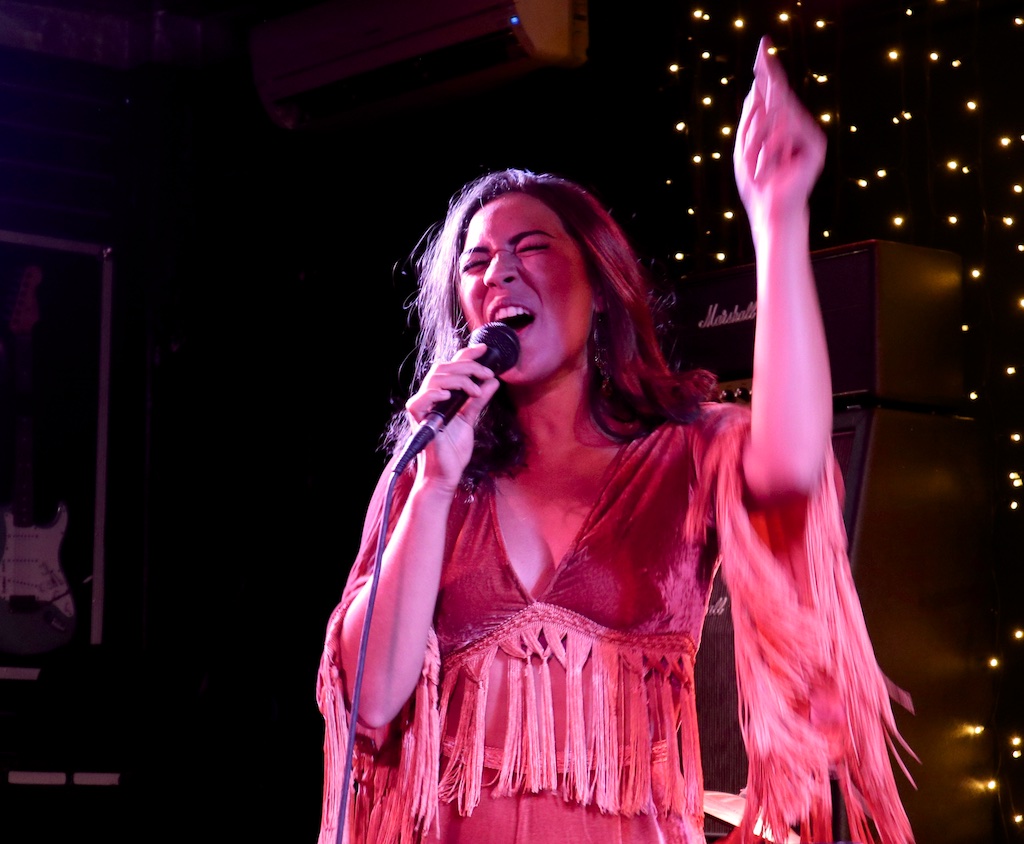
Evgenia Karlafti is a B3 organist, pianist, and vocalist. Her husband Nester Dimopoulos is a guitarist. They were joined on the cruise by Argentinean bass player Julia Subatin and Mexican drummer Gerardo Lopez. Everyone spoke English which is lucky because I have no Greek or Spanish. After hours of discussing music, the topic took a political turn. Earlier the musicians had made a point of referencing the peaceful laid back Auckland vibe. I recall boasting that our geographical isolation, independent foreign policy, and nuclear-free legislation protected our Island from many of the problems besetting other parts of the world. “We are an independent social democracy very like Norway,” I said, little realising how strong the synergies were. I pointed towards the Pacific ocean at our doorstep, adding, “trouble is inclined to lose its way long before it reaches our shores”. We discussed the Greek political situation and I asked how the Syrian refugee situation had impacted on everyday life. We discussed compassion and the problem of compassion fatigue. We discussed Turkey and the unhelpful belligerence of President Recep Erdogan. Neutrinos (3)

Evgenia and Nestor promised me a physical copy of their latest album titled ‘Cut to the chase’, messaged me a link and we agreed to meet up again when the ship was in port next. After we had parted I grabbed my phone and listened to a track from their album titled ‘Senior Citizen’. Perfect. As I drove home I recall thinking that this was a day among days and then I turned on the car radio. The news spoke of an attack on a Muslim community. I am used to hearing such reports. Tragedies which occur elsewhere – reported on by Christiane Amanpour or Lyse Doucet. In this case, I heard a tearful Kiwi voice. Had one of our foreign correspondents been caught up in a terror attack in London or Paris? The word Christchurch soon dispelled that notion and numbness set in as more facts emerged. A massacre of fifty innocents was happening on our soil and perpetrated by an Australian Neo-Nazi white supremacist. The carnage had started at around the exact time I was boasting about our immunity from such horrors. I don’t remember driving the rest of the way home.

Our amazing Prime Minister set the tone for what followed while we glued ourselves to the TV sets silently grieving. Why here we all asked and the Prime Minister gave us the answer we needed.  For those of you who are watching at home tonight, and questioning how this could have happened here, we, New Zealand, we were not a target because we are a safe harbour for those who hate. We were not chosen for this act of violence because we condone racism, or because we are an enclave for extremism. We were chosen for the very fact that we are none of those things. Because we represent diversity, kindness, compassion. A home for those who share our values. Refuge for those who need it. And those values will not and cannot be shaken by this attack”. Norway and New Zealand were now linked in more ways than I had ever imagined. 

The next day New Zealand fell silently numb as people watched TV or visited the local mosque with flowers and cards. The Prime Minister’s words “They are us” rang out as we donated millions of dollars to the survivors and their families. Biker gangs offered themselves as bodyguards and our sadness grew as we contemplated the fifty innocents slain in our midst. Powerful images flashed across our screens. Jewish Rabbis, Imams, Anglicans, Catholics, Buddhists, Hindus and Coptic Christians arm in arm outside the Mosques. For the first time, our police carried weapons in public as our terror alert went from low to high. It had never been anything else but low. The unusual spectre of armed police, softened by the policewomen wearing headscarfs and clutching roses to their weapons. An entire nation heard the muezzin call the Adhan when the Islamic prayer rang from our Parliament the next day and from our public broadcast outlets. Surely, one of the most beautiful and evocative pieces of music ever conceived. For a day, following the lead of the Prime Minister, secular and Christian woman donned the hijab out of respect.  

This was an outrage hard to talk about; it was so new to us and so raw. We let the images guide us through our grief and as if urged by an unspoken force, started to debate our colonist past. The evils of racism and wrongs yet to be righted. Some days later I was back in our local Jazz club and the place was packed. There was no mention of the horror but it hung in the air. We had come there to be transported and to heal. Albert Ayler put it well when he said, ‘Music is the healing force of the universe’. On offer was Ron Samsom’s much-loved band ‘The Neutrino Funk Experience’. The band, understanding the vibe went absolutely wild as they sent their crazy danceable tunes heavenward. They turned happy into crazy happy and the barman, moved by it all, turned on the rock-effect strobe lighting. Each funk ridden note healed our bruised souls. We didn’t need overly complex or sad tunes; we just needed this.

Ted Gioia recently tweeted a finding by scientists, indicating that music may possess mass. A day later I read a piece by a prominent scientist reminding us of the absolute interconnectedness of life forms. It is likely then, that music is the glue; music that most ancient of languages. In my world, improvised music is super glue and the balm for all life’s ills.  I have played both the Neutrino Funk Experience album and the Music Soup album endlessly during the last few weeks and with each hearing, my belief in humankind restores.  

Dedicated to the victims of the Christchurch Massacre and to the musicians who heal us.  

With thanks to Rom Samsom, Roger Manins, Grant Winterburn and Cam McArthur of The Neutrino Funk Experience & to Evgenia Karlafti and Nestor Dimopoulos of Music Soup.

Lou’ana (Whitney) @ CJC Auckland

Lou'ana (2)Lou’ana is a vocalist on route to wider recognition. During the last few years she has been performing at festivals throughout the country and she is billed to appear at the Waiheke Jazz Festival this month.  He vocal style has general appeal as it blends elements of Jazz, Soul, and Funk. Her smokey nasal intonation and back on the beat phrasing carry echoes of Amy Winehouse.  Out of this brew comes a sound that is recognisably her own and it is refreshing to see how comfortable she is with that. At the CJC gig, an opener for her tour, she had wisely chosen the material which favoured her preferred register, rather than trying to dazzle with pointless pyrotechnics. In her case, vocal-gymnastics would be quite superfluous as her well-chosen phrasing and smouldering delivery give her plenty to tell a story with.   
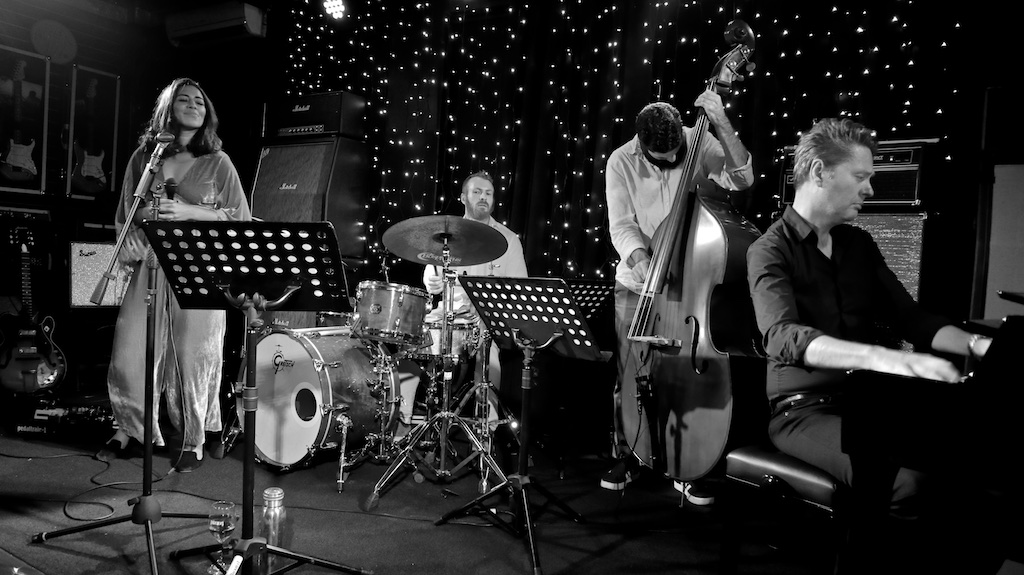
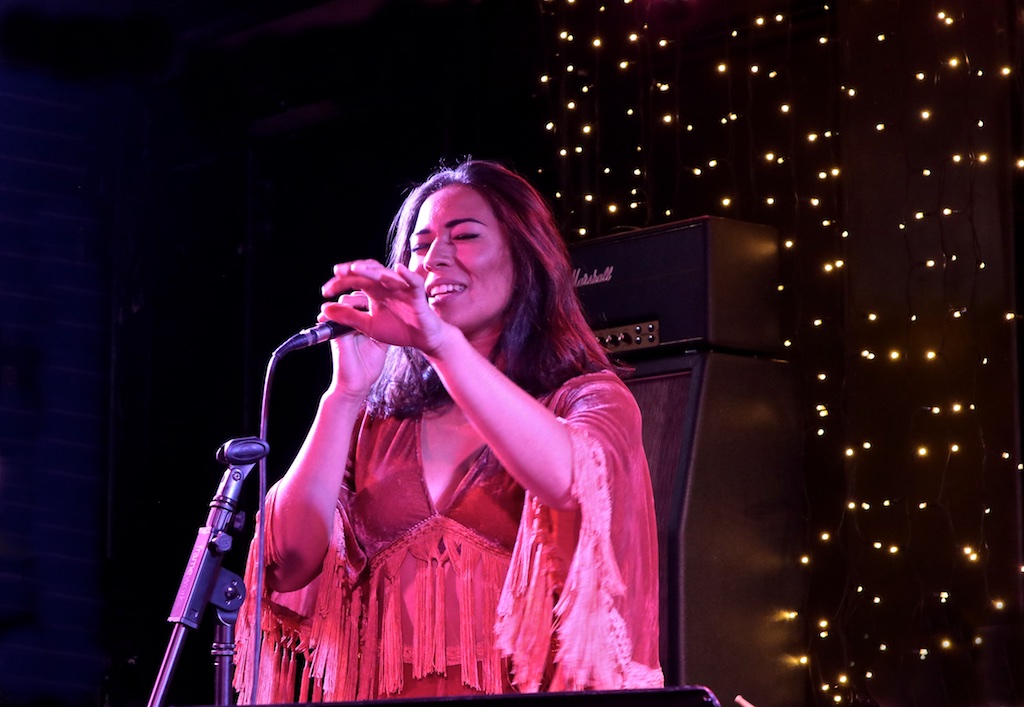
The first set was mostly her favourite standards; often songs that she had heard as a child when her musical family played them for her (e.g. ’Just Squeeze Me’). Her approach to Autumn leaves was particularly interesting as she sang it in Samoan – the challenge being, that there is no Samoan word for Autumn. Her linguistic translation flowed beautifully and the essence of the tune transcended all mere words.  I know that her biggest audience lies elsewhere, but I hope that she will keep working on these Jazz tunes. A smokey voice and a Jazz standard belong together. During the first set, she was accompanied on piano by special guest Kevin Field (and for the last number of that set joined by her regular guitarist Jason Herbert).  Field is arguably New Zealand’s premier Jazz piano accompanist and I could detect his arranging skills in at least one piece.

The second set contrasted the first as it featured a funkier, rockier selection. These are the tunes that undoubtedly please her wider audience. In spite of that, they also pleased her Jazz audience. Who can resist a Hendrix number done well? Especially when the vocalist slams out the opening bars on guitar before giving us a Janis Joplin like rendering of the tune. Who can resist a homespun ‘viper’ song with its Waller like lyrics or a soulful funk number accompanied by soaring guitar, organ and gut-punchy bass lines?  Her bass player was the ever popular Cam McArthur, who switched from upright to electric bass for the second set. Both sets featured drummer Cam Sangster – a versatile drummer, equally at home in the popular funk, Indie rock, and Jazz worlds.

Her first set was great but she visibly relaxed into the music during her second set. Perhaps because of the familiar material and because she had her regular keyboards player and guitarist with her.  These two players, along with Sangster have been alongside her for much of the journey. On keyboards and organ was Dillon Rhodes and with more than a hint of the rock god, Jason Herbert on guitar. Together they had a great sound and one that I suspect will endure over time. The audience however never took their eyes off Lou’ana. She has an allure, and her charm on stage will serve her well as she gains wider recognition.

Lou’ana (vocals, compositions), Kevin Field (piano), Cam McArthur (electric & upright bass), Cam Sangster (drums), Dillon Rhodes (keys & organ), Jason Herbert (guitars),  The gig was at the CJC Creative Jazz Club, Backbeat, Auckland, 27 March 2019

The Turtlenecks @ CJC Backbeat

Garden (1)In the late 1950s and early ’60s, anyone with an ounce of cool wore a coarse-knit black polo neck jersey. While they sat there feeling cool their necks would start to itch and angry red rashes would creep up to their chins. Chins made all the itchier by the regulation chinstrap beards or ‘hip’ goatees.  Then in act of blatant cultural appropriation, Playboy invited the middle class to co-opt some of that hipness. Along the way, ‘Hef’ sensibly revised the polo neck jersey requirement, which morphed into a white cotton turtleneck and slim white jeans. Anyone who has seen David Hemmings in Antonioni’s arthouse movie ‘Blowup’ (one of the best films ever made), will quickly realise that sleazy old ‘Hef’ got it right. The Beatniks, on the other hand, got it woefully wrong. The better option had us wearing scratch free cotton turtlenecks and ‘Hef’s’ crowd wearing the itchy coarse knit jerseys (they never kept them on for long anyhow). So, when I saw that a band called the Turtlenecks was appearing in a Jazz joint and in cotton, I yelled Hallelujah. At last a serious wrong turn is being corrected.
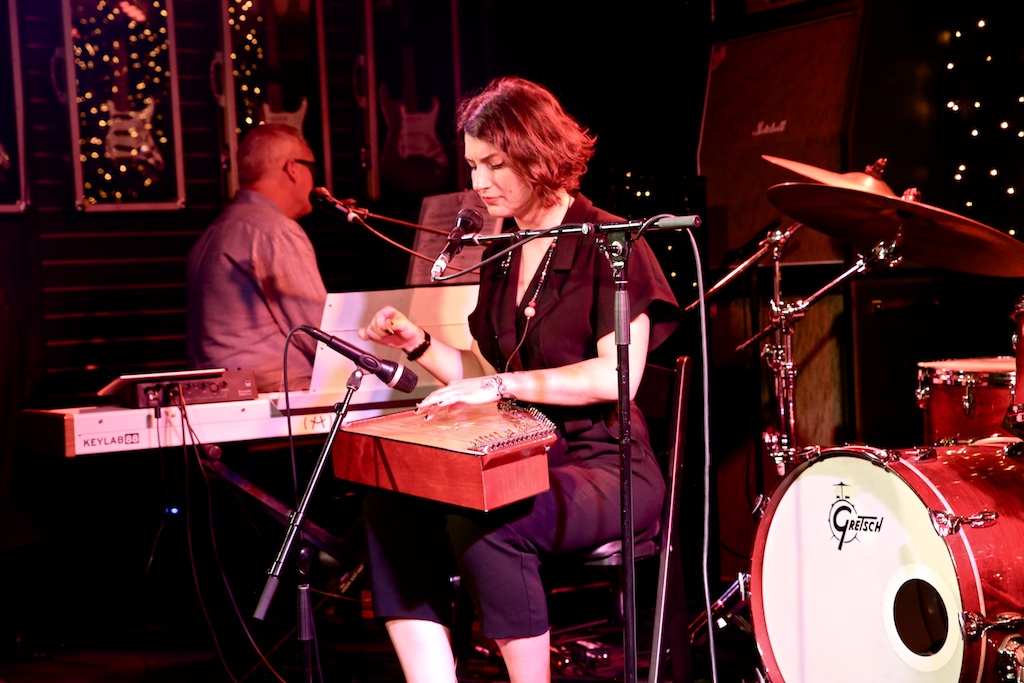
The band was formed by saxophonist Jimmy Garden, a musician who obtained his wings in Auckland, then flew away to join the Australian scene for a number of years. Upon his return he formed the ‘Turtlenecks’, aided and abetted by musicians from his cohort.  I recall his departure well, as a lot of gifted musicians left around then. Thomas Botting, Peter J Koopman, and Steve Barry to name a few. This cohort, be they ‘leavers’ or ‘remainers’, were a hothouse of improvisational experimentation and it is always good to see them back among us. A few of those friends joined him on the bandstand Wednesday night.  

The compositions, all by leader Garden, are catchy and with more than a nod to groove.  There is also a pinch of humour evident and this informed last weeks performance. Although they are competent musicians, they never tried to overwhelm with cleverness.  What was more evident was their joy of playing together and that bonhomie overshadowed all else. They did what (cotton clad) Turtlenecks should. They played without a hint of itchiness.

The band has a number of drum, bass and guitar personnel it can call upon, while the two horns remain constant.  The personnel at the CJC gig were leader Jimmy Garden – tenor saxophone (tasteful), J Y Lee – alto saxophone (always a pleasure to hear), Michael Howell – (a popular local guitarist), Cam McArthur (one of our finest NZ bass players), and Adam Tobeck (a versatile drummer, well-known about NZ). The gig was at Backbeat K’Road, CJC Creative Jazz Club, 20 March 2019

Simona Minns, Auckland 2019

Simona (1)This was New York artist, Simona Minns second visit to the CJC, her appearances occurring one year apart to the day. Her 2018 show ‘The Hunger Games’ referenced a Kafka short story. This tour was billed ‘My Urban Spells’, expanding her ever-evolving themes of universality and free-spirited improvisation.  Minns musical education and life, have gifted her with many powerful themes to draw upon and out of these, she has crafted a powerful synthesis. Her initial training as a classical Lithuanian Zither player is never far from what she does, but neither are the Jazz and Rock worlds she discovered when she emigrated to America.
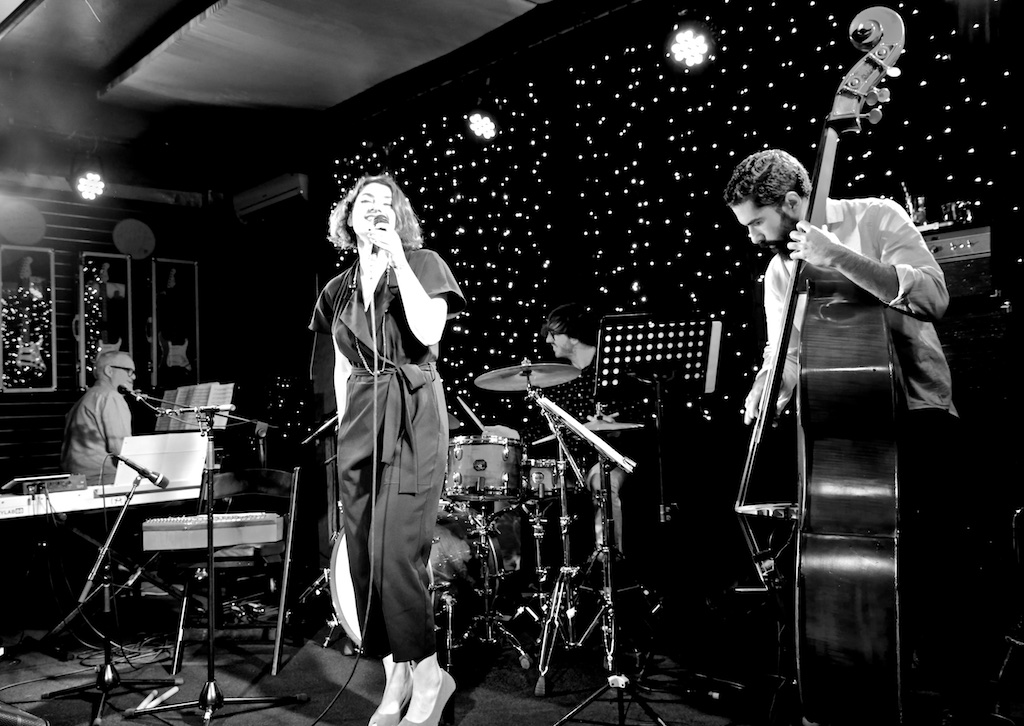
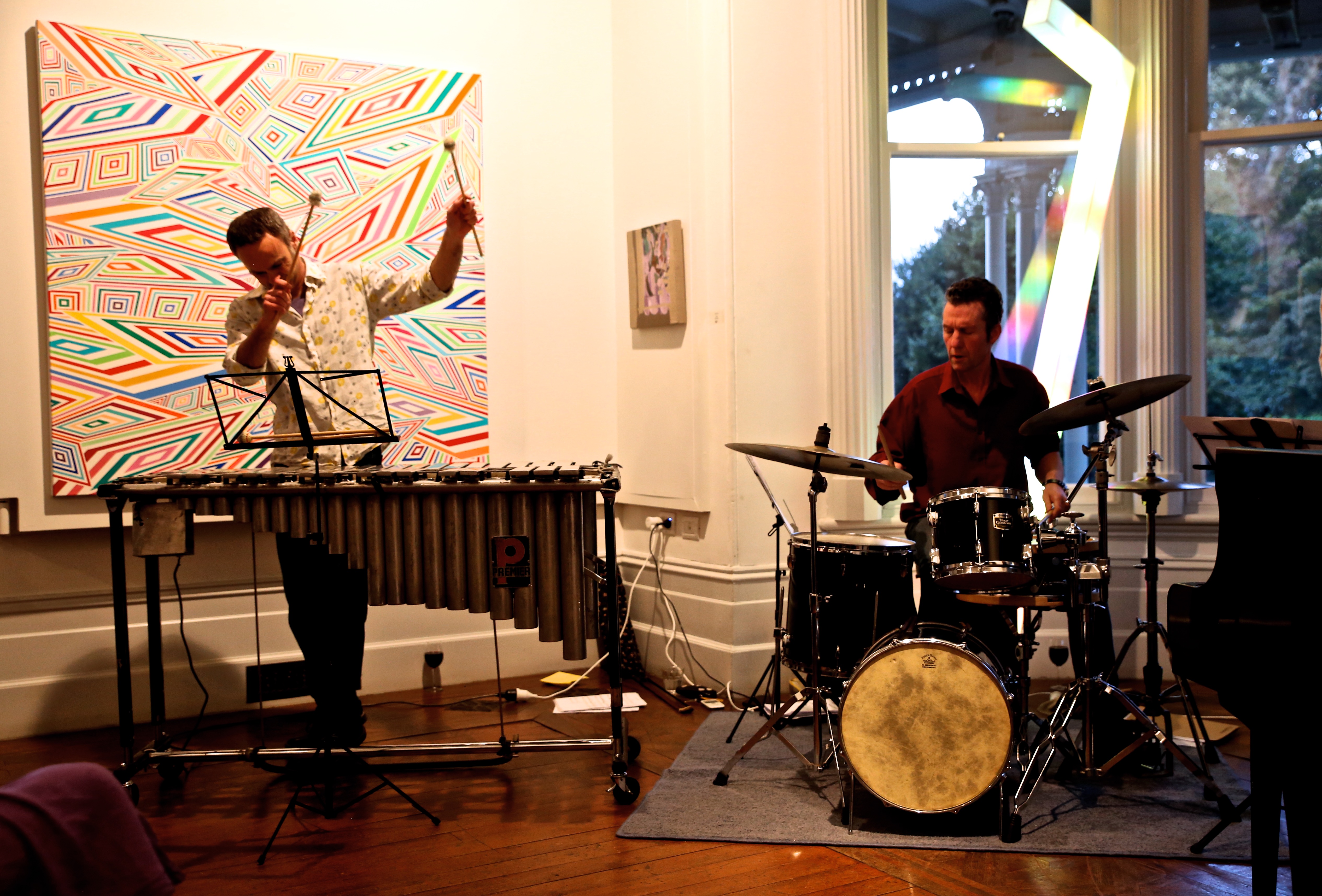
Minns is a compelling performer and this underpins her shows. There is always an engaging theatrical element to her stage presence; something akin to an off-Broadway show. When you factor in her vocal chops, fine compositions, and originality you get an enjoyable whole. It is more than a mere cobbled eclecticism, it is well-judged performance art. Simona

Like last time, she was accompanied by Alan Brown on Keyboards, Cameron McArthur bass and Stephen Thomas on drums. Because this was the bands second time around (and because they can), they stretched out more and Minns let them, confident in their abilities.  Brown in particular is accustomed to reaching into new musical spaces. His beyond Jazz explorations into ambient and ethnic music equipping him perfectly.  Some of the tunes were standards reinterpreted, others were Jazz/Rock mash-ups with electric guitar (Minns). It was though, when she sang her own compositions in her own mother tongue that she shone brightest.  Her ethnically fused Jazz, enormously appealing.

Simona Minns (vocals, compositions, guitar, zither), Alan Brown (keyboards), Cameron McArthur (upright bass), Stephen Thomas (drums) – Backbeat, CJC (Creative Jazz Club) 20 February 2019.

Aldebaran Quartet @ Wallace Arts Trust

Bell Aldebaran (1)While pop music briefly looked up and saw satellites and Rock music headed for the dark side of the moon, Jazz musicians lifted their vision further, aiming beyond Voyager and reaching for the farthest corners of deep space. Exploring those regions is the beautifully realised Aldebaran Quartet, an ensemble which pleases me greatly. It’s not often that I encounter a band like this and I can’t wait for them to record.  Bell Aldebaran (2)
I first reviewed them in March of this year, hoping that this would not be a one-off project and thankfully it wasn’t. They are fresh, modern and original while conjuring up memories of an era that I am still passionate about. 70’s Modal Jazz – Space Funk, Alice Coltrane, Bobby Hutcherson, Bernie Maupin and Eddie Henderson. This was an era of space dreams and old analogue machines. It stretched the imagination beyond known horizons and in so doing, encapsulated the true ethos of improvised music. Happily, this band is true to the original mission directive; reach beyond fearlessly.Bell Aldebaran

Aldebaran is an Arabic word meaning follower and it refers to the giant orange star Aldebaran which follows the Pleiades Constellation into the night sky; sitting somewhere to the left of Orion’s Belt. It has long exited the human imagination. The Egyptians, Greeks Persians and others were particularly fascinated by its presence as it is the largest entity in the Taurian configuration. It is a mere 65.3 light years away from Earth and 7 billion years old. It is therefore entirely fitting that an improvising unit pays reverent homage to the ‘Watcher of the East’.Bell Aldebaran (3)

We caught a piece of luck when vibist John Bell returned to our shores and that was reinforced by the return of drummer Steve Cournane. It also coincided with the return of the pianist Phil Broadhurst who had been sojourning in Paris for a while. Add in either Eamon Edmundson-Wells or on this gig Cameron McArthur on bass, and you have a winning combination. At the Wallace Arts Trust gig, we heard new compositions by Bell and one each by Broadhurst and Cournane. We also heard the premiere of a new Bell composition ‘Corona’, a suite in four parts. I have posted the last two parts as the entire suite nears 20 minutes in length. It is so beautifully composed that ‘Corona’ could easily be extended even further without ever taxing an audience.

If you get a chance to catch this band, do so. The journey that they will take you on is very worthwhile. This was only their second public performance and judging by their form to date, we can look forward to what follows with happy anticipation. The Aldebaran Quartet on this gig was: John Bell (vibraharp), Phil Broadhurst (piano), Steve Cournane (drums) and Cam McArthur (bass). The gig was held at the Wallace Arts Trust 19 August 2018.


Watson meets Ward @ Backbeat Bar

Watson & WardIt is not often that you attend a gig where a set list covers such a range of styles but still pays due respect to each. If anyone could pull off such a gig; traversing the heights of Monk, Murray McNabb, Frantz Casseus, Bill Frisell and Ornette Colman it was these two. In lesser hands, the trajectory would have faltered, the items come across as disembodied. Here, the connecting threads, however improbable, made perfect sense. The centre held and the arc of the journey was a joyous adventure. Watson & Ward (1)

Neil Watson is a musician who musicians flock to hear. He breaks rules and strikes out in directions where few dare to follow. Everyone from Sharrock to Montgomery is referenced in his sound; with a generous pinch of Ribot thrown in for good measure. He sometimes hides in pit bands backing dancing fools, tours with famous country stars, opens for people like Marc Ribot, but whatever he does, he does convincingly. In recent years he purchased a pedal steel guitar and that is now an essential part of his repertoire. He exudes real warmth on stage, both as a storyteller and a musician.

I have only seen David Ward play on the odd occasion but it is always a treat. Like Watson, he is a master of diverse styles and he is particularly noted for his award-winning theatre compositions. He has toured extensively and gained a formidable reputation over the years. In Jazz and alternative music circles, it is the improvising band RUKUS that we mostly associate him with. RUKUS has featured a who’s who of adventurous improvisers such as Chris O’Connor, John Bell, Jeff Henderson, Eamon Edmundson-Wells, Cameron Allen, Finn Scholes & Rui Inaba. Watson & Ward (2)

The pairing of Watson and Ward guaranteed that creative sparks would fly.  It was always on the cards that they would perform together but until now the opportunity had not presented itself. I am certain that this project will develop from here –  logic tells me it has to. The quality of their musicianship was very much on display at the Backbeat Bar. On the three Monk tunes, they either ran unison lines or interwove an intricate counterpoint, and miraculously, the jagged phrases often created a fat Monkish dissonance; each guitarist deliberately landing on different voicings- creating a piano cluster chord effect. This was a quality band as Watson & Ward were backed by Cameron Allen (tenor and Baritone saxophones) Cameron McArthur (upright bass) and Chris O’Connor (drums). Understanding exactly what was required here the three left the lion’s share of the limelight to the guitarists. O’Connor displayed his usual eclectic virtuosity as the drum styles required were many and varied. Watson & Ward (3)

At one point Watson played solo, a composition by Frantz Casseus (a folksy classical guitarist who has influenced the likes of Marc Ribot). Out of his Fender came a delicate classical guitar sound – a moment of whispering clarity and magic. The pair also showcased their own compositions and again these contrasted in a good way. Ward’s ‘Mango’, ‘Shebop’ and ‘Hip replacement’ – Watson’s ‘Trash talkin’ (a Western Swing) and his extraordinarily ‘Murray’ – an apt tribute to the lost lamented and much-loved Jazz musician Murray McNabb. Among the tunes, we heard some heartfelt Americana (rare in New Zealand Jazz clubs and it is especially rare to hear Western two-beat Swing).

The high points were many, but I will put up two clips; The first is a Bill Frisell number ‘I am not a farmer’ from his moody atmospheric album ‘Disfamer’. The second up is a short clip where Watson plays a Frantz Casseus tune ‘Improvisations’ solo on Fender.

The gig took place at the Backbeat Bar, K’Road Auckland for the CJC Creative Jazz Club, 15 August 2018.


Frank Gibson Plays Thelonius Monk

FrankEvery Jazz club needs a Monk night on their calendar and when it comes to Monk the local go-to person is definitely the well-known drummer Frank Gibson Jr. Gibson and the various iterations of his bands have long made a point of keeping the Hardbop era and Monk firmly on our radar. While the setlist was not exclusively Monk, the Monk tunes chosen were a solid mix of seldom-heard compositions and old favourites. Frank (2)
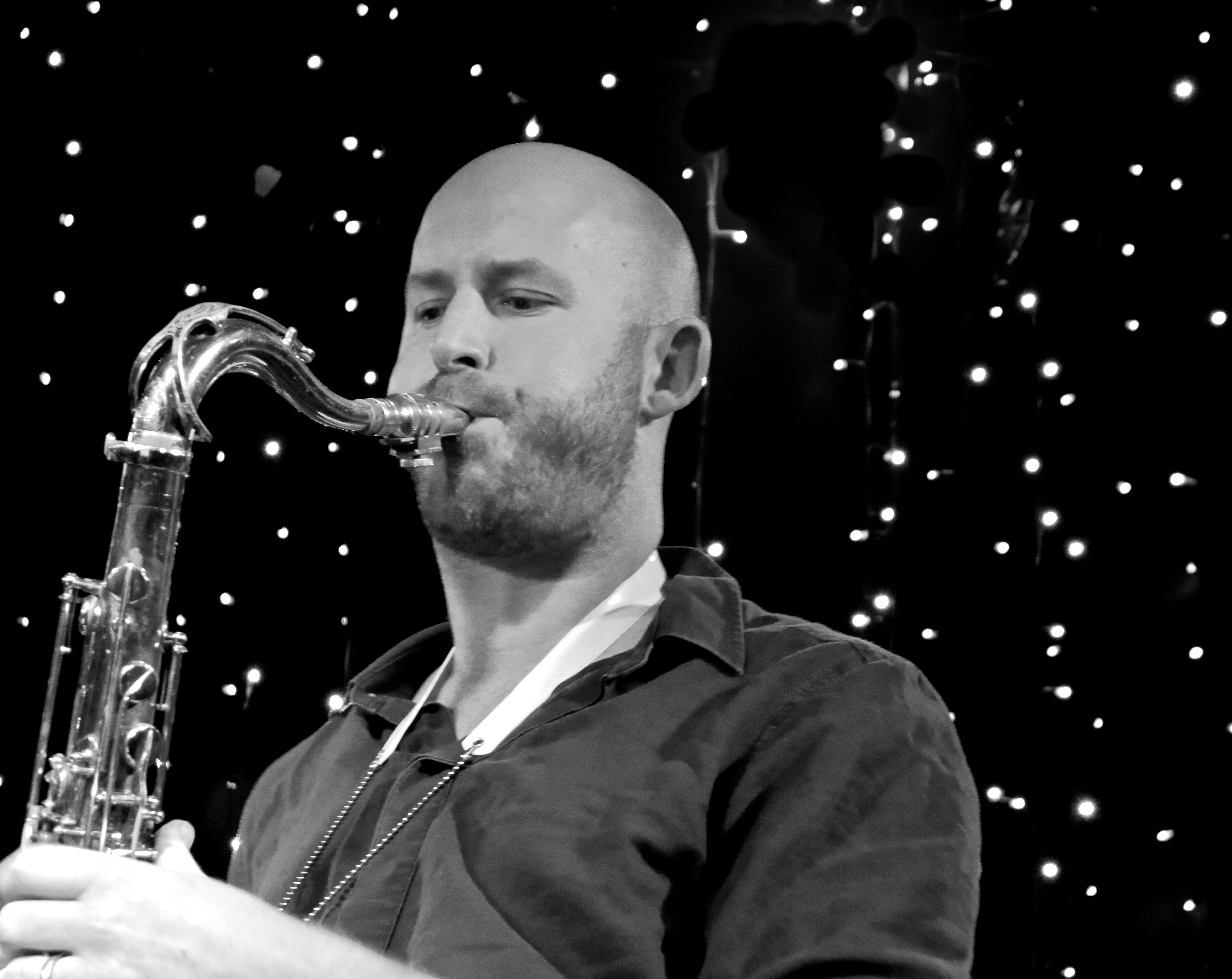
A good example of the former was Eronel which memorably featured on the Criss Cross album. I heard Jonathan Crayford play this number solo a few weeks ago and I recall thinking then – why is this wonderful tune not played more often? We also heard the tune Criss Cross, the title track from that album.  ‘Criss Cross’ with its atypical rhythmic displacement is an interesting and bold composition and one which took Monk into new territory. It occurred at the height of his fame. Another lessor known tune was Light Blue, which appears on Thelonius Monk in Action (at the Five Spot).  Others like ‘Rhythm-a-Ning’ and ‘I Mean You’ are well-known all were enthusiastically received. Frank (3)

Among the other tunes played were ‘Bessie’s Blues’ by John Coltrane, ‘Beatrice’ by Sam Rivers and an interesting Harold Danko tune titled ‘Tidal Breeze’. The band featured veteran guitarist Neil Watson and Bass player Cameron McArthur, but a newcomer to this particular lineup was Cameron Allen on tenor saxophone. Allen added that nice earthy-brass touch that Monk gigs benefit from. The gig occurred during an intense and devastating storm. Surprisingly, the audience braved horrendous weather to get there, navigating their way through fallen trees, power outages, flooding and through the debris which littered the city streets. It is always right to head for the music in troubled times and Monk is a force of nature in his own right. Frank (1)

The gig took place at the Backbeat Bar for the CJC Creative Jazz Club, Auckland, New Zealand, April 11, 2018.

Kim Paterson

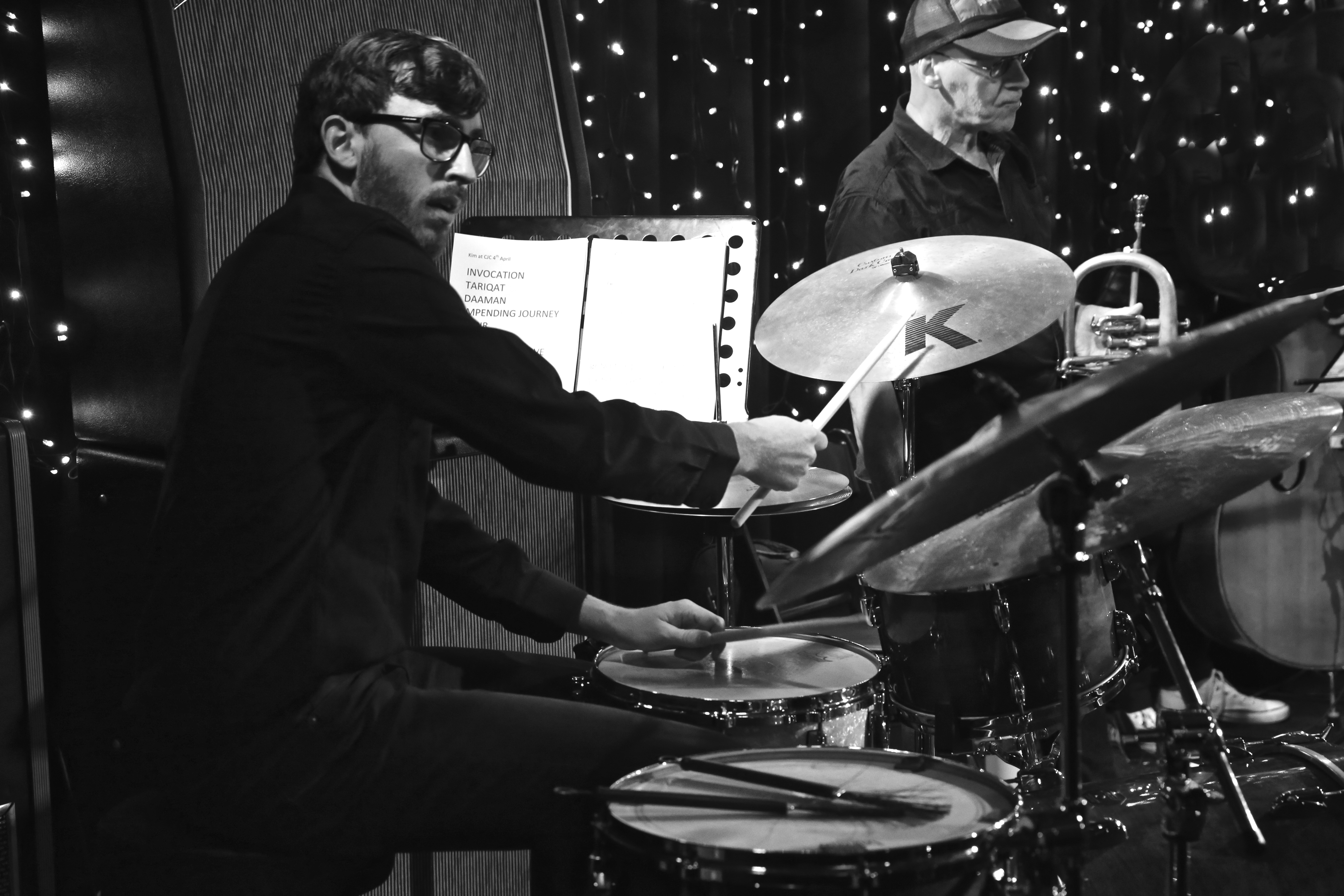
KimAfter a long gloomy week of intense storm weather, 200 kph winds, polar darkness and zero electricity, I am finally back in front of my computer. A few days before the storm I was sitting in the warm, well-lit, electricity charged Backbeat Bar and listening to the Kim Paterson Band – by far the preferable option. Jazz trumpeter, Paterson, has been on the New Zealand Jazz scene for as long as I can remember and his name is forever associated with legendary figures like Mick Nock. When I was a teenager I knew many people that he knew and he always seemed to lead an exciting life: gigging in Australia or further afield and travelling to India on a shoestring (our generation regarded that as an essential rite of passage). Out of that rich life experience and long years of devotion to his artform, has come a book of marvellous compositions. These compositions were the focus of his CJC gig and his bandmates gave them the respect they deserved. Kim (2)It is hardly surprising that Paterson selected his bandmates well, all experienced musicians and all with a feel for the texturally rich, open-ended compositional structures. I was particularly delighted to see Lewis McCallum on the bandstand, having missed an earlier gig of his and regretting it. He played tenor and soprano and the unmistakable influence of Coltrane’s conceptions shone through. Although not the leader, McCallum was a powerful presence. It was obvious that he regarded this project highly and his guiding hand was repeatedly acknowledged by Paterson. His tone was biting, but not harsh; his ideas were communicated with clarity.Kim (3)Keven Field was on Rhodes and as always his contribution was impeccable. The Rhodes was exactly the right keyboard for this project and Field, the best keyboardist to bring out its strengths. Somehow he always manages to tease hidden beauty from a Rhodes. Cameron McArthur was on bass and like Field, a first call musician. McArthur is so well established and well respected that no one is surprised when turns out a stellar performance. The remaining band member was Stephen Thomas and again a very fine musician. Thomas works across a number of genres now, but his Jazz chops and good taste are always on show. Kim (4)
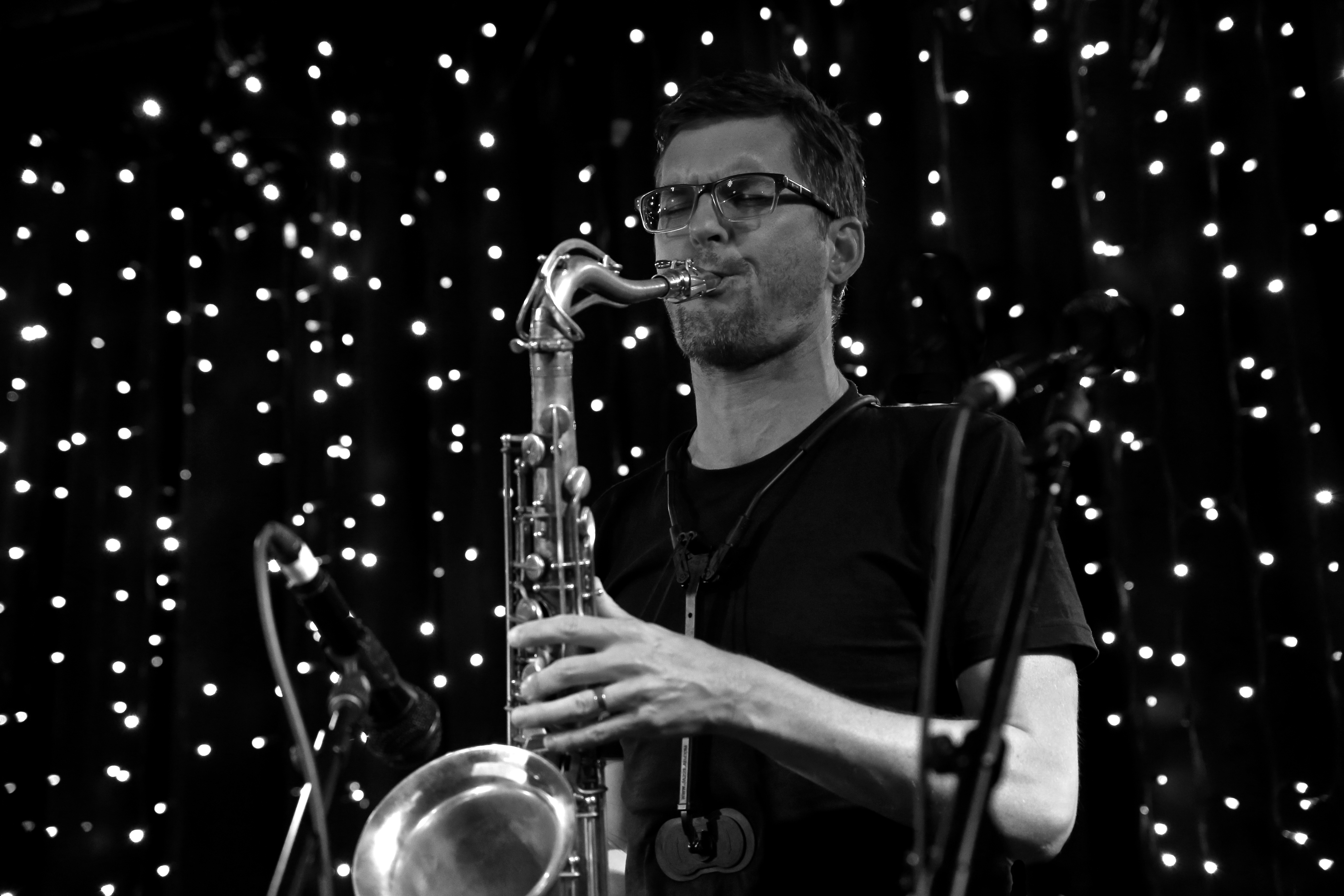
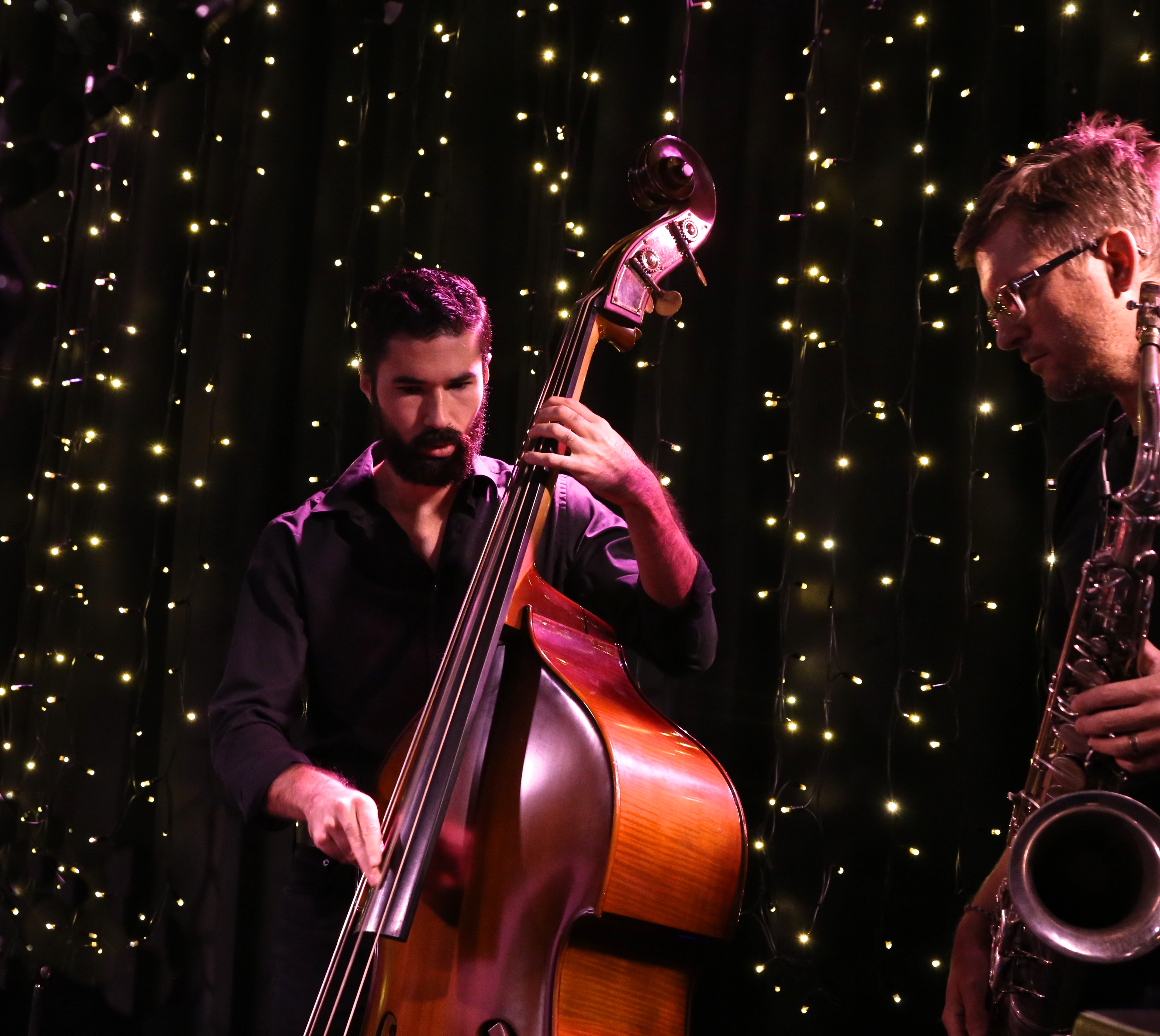
Kim (5)

These compositions are long overdue for recognition. They were mostly composed in the late sixties and seventies and they certainly have that feel about them; an era of Jazz that I have a great affinity with. One title references Patterson’s earliest trip to India and the other titles give us clues as to the overall vibe: Invocation, Tariqat, Kabir, Mani etc. Paterson, although better known as a trumpeter stuck to flugelhorn on this date and doubled on percussion. The complexity of rhythms on a few of his Latin-infused pieces, enhanced by his percussion. I was glad to hear these tunes and they were well received. There was enough warmth in them to see me through the brewing storm.

Kim Paterson: (flugelhorn, Compositions, leader), Lewis McCallum (tenor & soprano saxophones), Kevin Field (Rhodes), Cameron McArthur (bass), Stephen Thomas (drums). The gig took place in the Backbeat Bar for the CJC Creative Jazz Club, Auckland. 4th April 2018.

Michal Martyniuk Trio + Jakub Skowronski

Martyniuk (1)When Michal Martyniuk left Auckland for Poland last year, it was hot on the heels of a successful appearance at Java Jazz; the biggest Jazz festival in the world.  It was always on the cards that Martyniuk’s Auckland trio would fare well, as they are the epitome of an inventive, high energy unit and all of that is wrapped up in a very European sound.
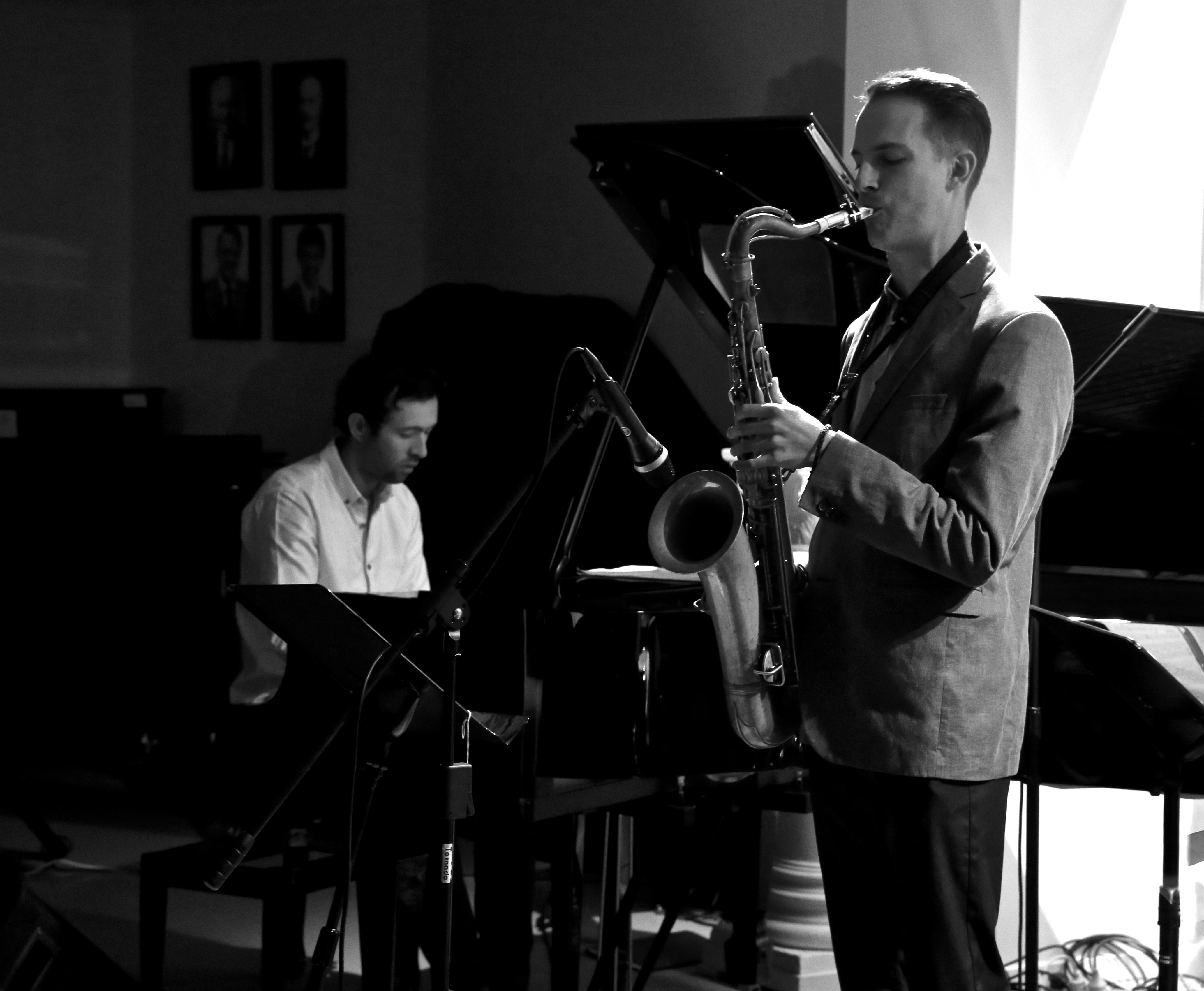
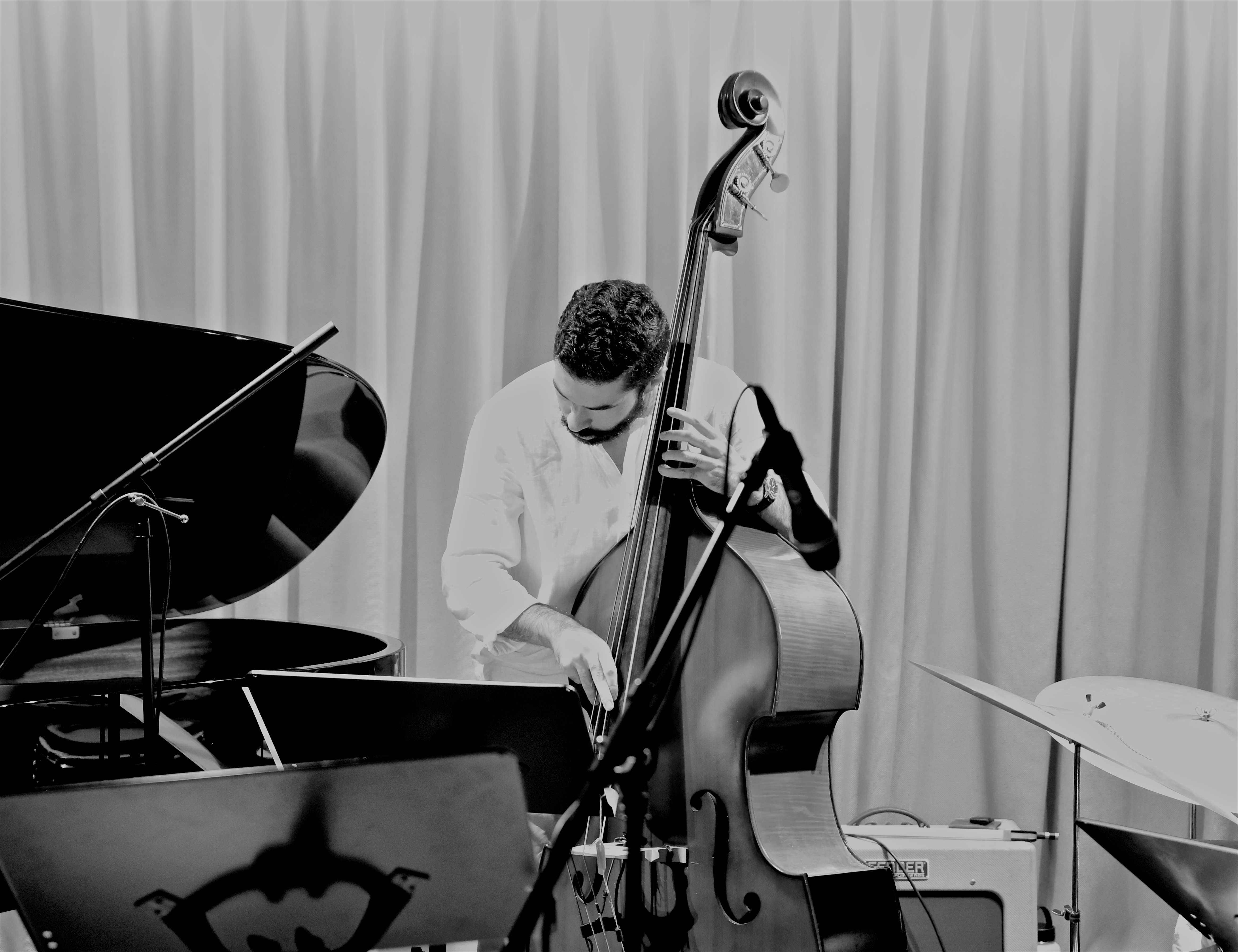
While it was obvious to Kiwis and to the enthusiastic Java Jazz festival goers, I wondered how Martyniuk would be received in Europe. I have travelled there often and there are thousands of good Jazz musicians and many fine trios vying for attention. Jazz is valued there, especially in the northeast, and audiences are inclined to be very discriminating. I got my answer shortly after Martyniuk’s arrival, as notifications of media events, club gigs, radio and TV interviews started appearing. He had broken through the clamour and received acclaim in his birthplace. His co-released warm as toast Jazz-soul-funk album ‘After ‘Ours’ and his Jazz gigs, equally acclaimed.  Martyniuk (2)

The journey back to the country of his birth had been important for Martyniuk and he has returned with heightened confidence, exuding a sense that anything is possible. This was evidenced by the trio’s live performance at the Lewis Eady showroom. Many New Zealand improvising bands have a laid back organic feel as that is generally our thing. In contrast, this band is tightly focussed, but without that in any way detracting from its appeal. The tunes by Martyniuk are melodic and often rhythmically complex. This is counterbalanced nicely by Samsom and McArthur who create contrast and interwoven texture. The first set was a mix of old and new tunes. His older tunes like The Awakening and New Beginning, familiar in the same way standards are – always pleasing, always yielding up something fresh. His more recent compositions a mix of burners and ballads. Martyniuk (3)

The Lewis Eady gig was augmented by the addition of visiting Polish saxophonist Jakub Skowronski. Skowronski has a beautiful even tone on tenor and like Samsom and McArthur, he’s the perfect foil for Martyniuk. While he made it all look effortless, his solos took us deep inside the music. These guys were made to play together and I hope they remain a unit. They have a lot more to tell us yet and with any luck, we will get to enjoy the continuing story as it unfolds. Those who wish to be part of this journey can contribute via a recently set up ‘Kickstarter’ campaign following this link. There was some really exciting new material recorded in Poland over the last year and the Kickstarter campaign is about getting that released into the world. No one ever regretted supporting great music like this.

.

Michal Martyniuk (piano, compositions, leader), Cameron McArthur (upright bass), Ron Samsom (drums, percussion) + Jakub Skowronski (tenor). You can follow this band and order albums from Empire Agency Co. Bands / Michal Martyniuk Trio


Simona Minns ‘A Hunger Artist’

IMG_6628 - Version 2The heart of the modern improvised and experimental music scene is always an interesting place to be. Audiences tend to be open-eared and accustomed to music from a wide variety of sources. Improvising musicians have always drawn on diverse influences and it is a narrow-minded few who whine about dilution or the good old days. We should never undercut the deeper purpose of music, which is to share stories, communicate on a primal level, interpret. We tell stories to live and how we listen or react to music speaks to our musical maturity. When Simona Minns performed in Auckland last week, she brought with her a variety of influences. and all were approached with integrity.
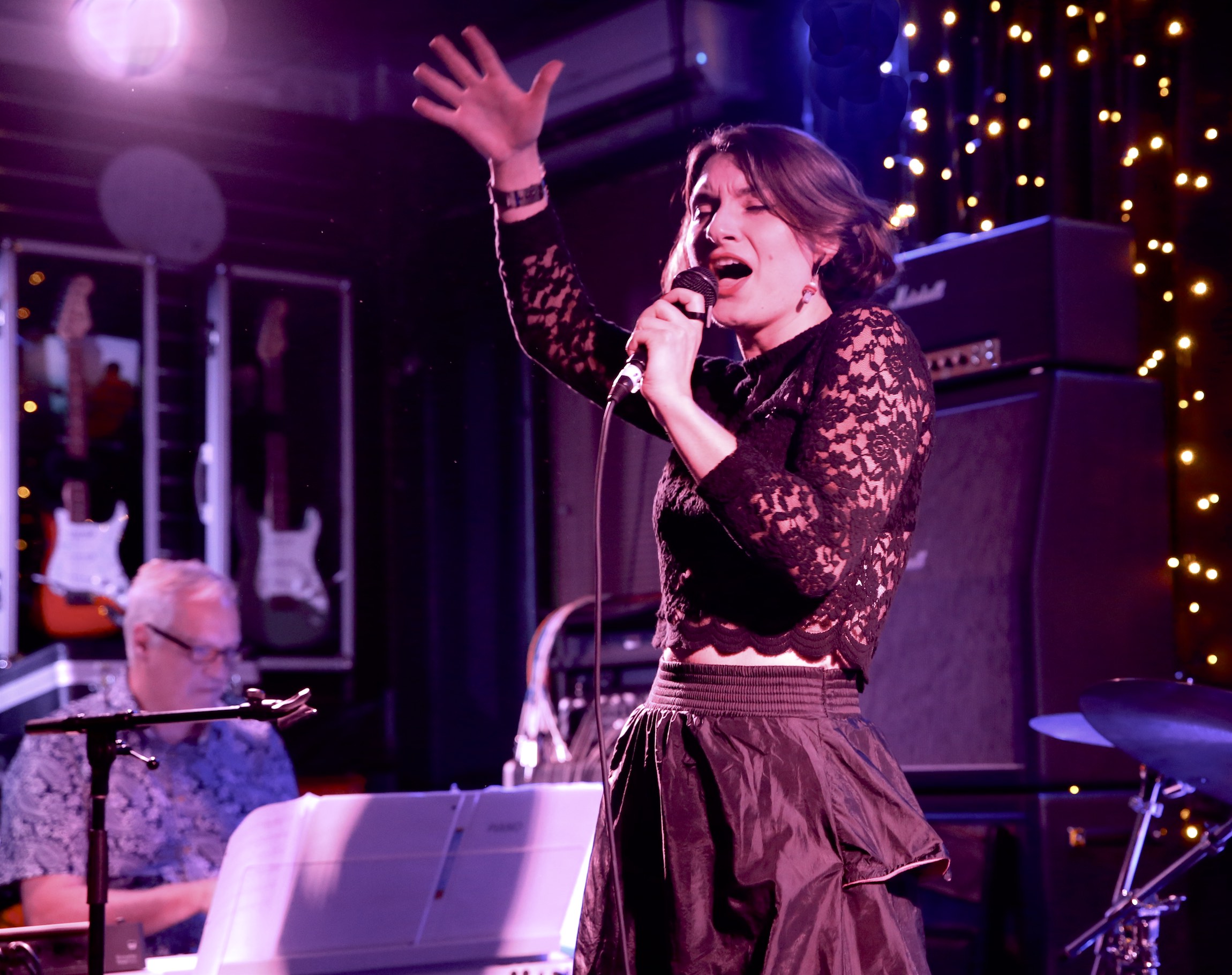
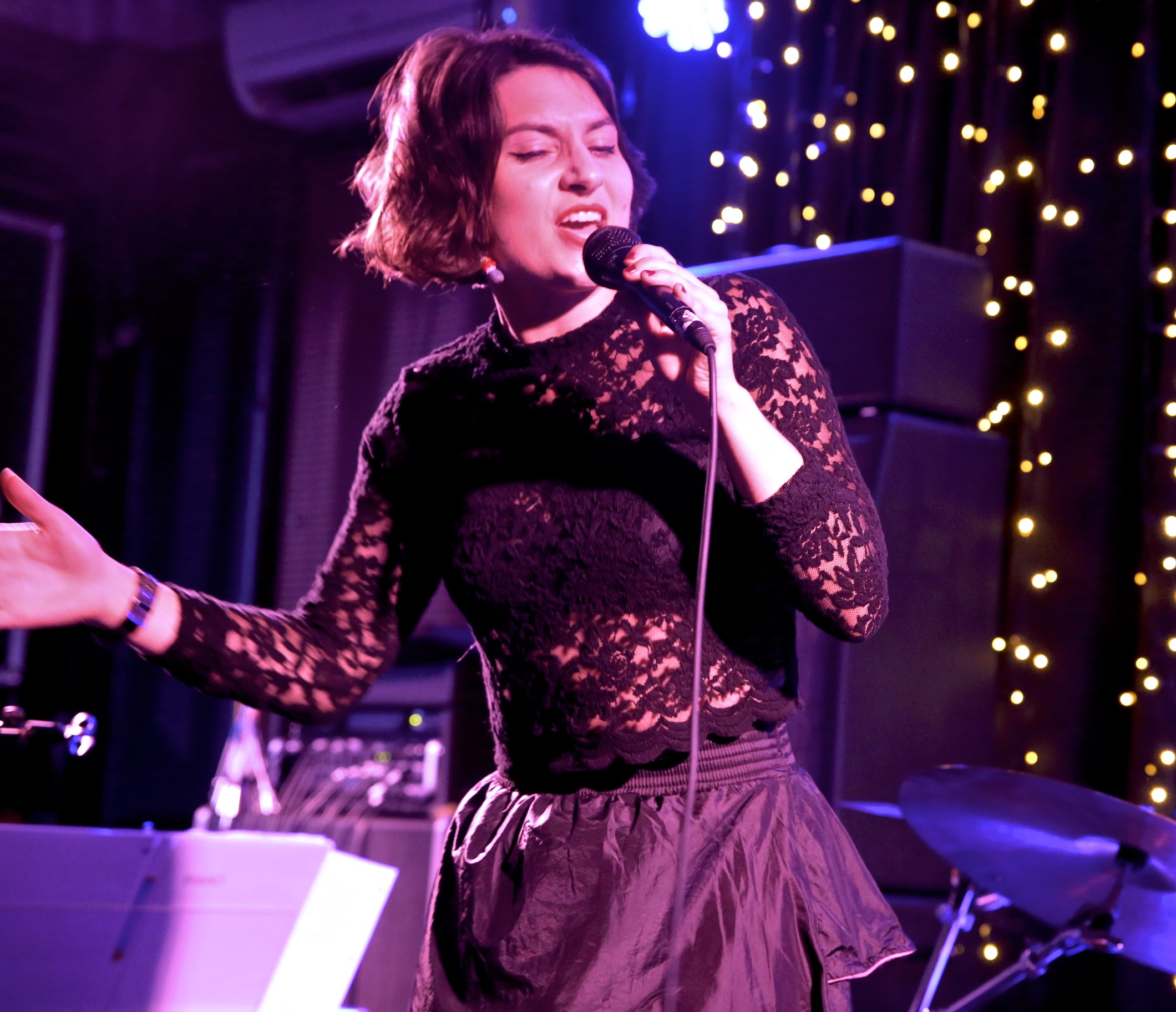
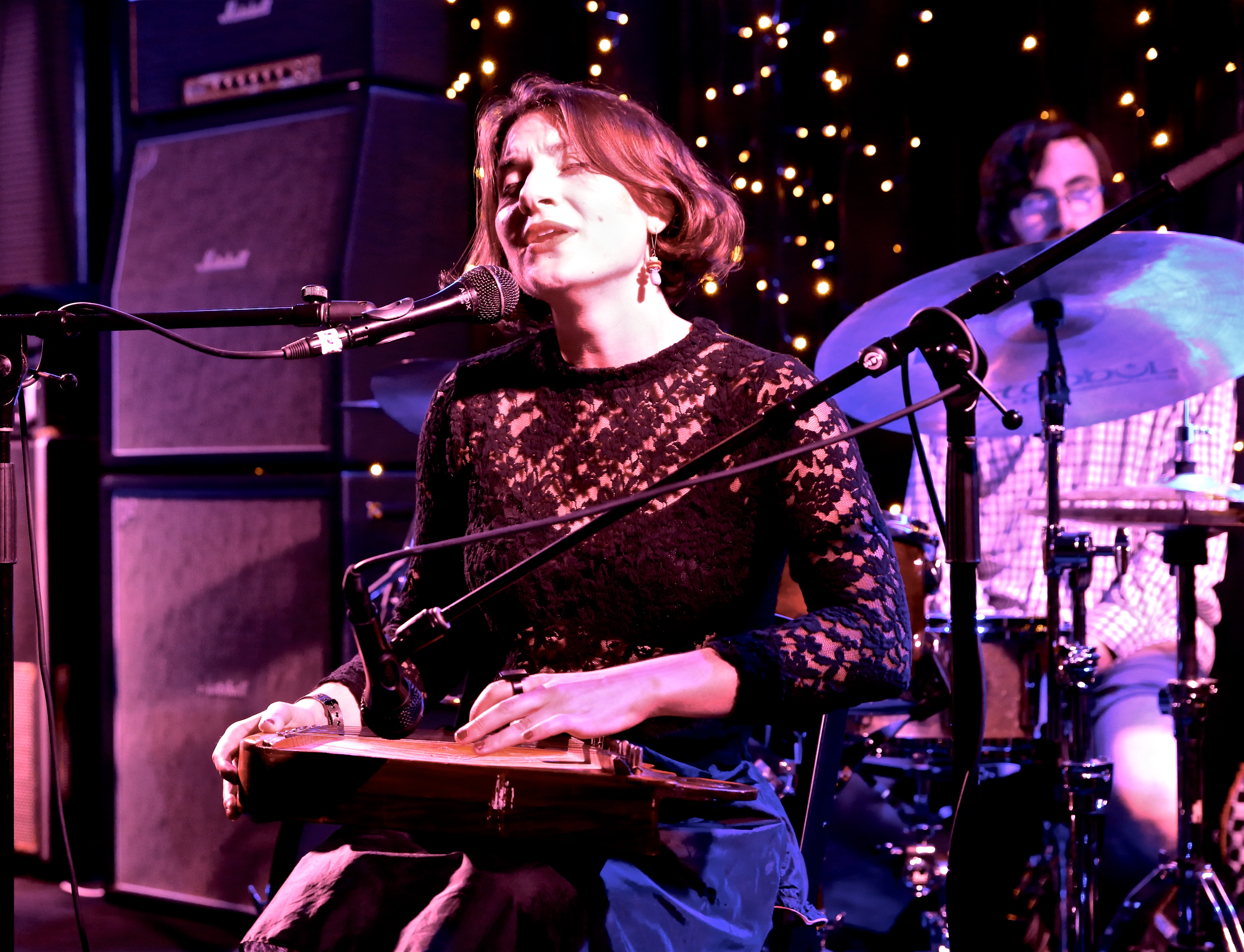
She is billed as a Jazz Singer, composer, arranger and artistic director, and she is unafraid to mash up or blend genres. All of the above descriptors were on show when she performed at the Backbeat Bar and everything she did, communicated an innate sense of fun and adventure. She is a natural performer, but behind that lies careful preparation. Her easy-going confidence disarms, but it arises out of hard work and commitment. A good example of the care she brings to her art lies in her charts. The musicians all commented on how beautifully they were crafted and judging by the solo’s, they were not constrained by them. We heard Jazz standards, old Lithuanian folk songs, tunes from her musical ‘A Hunger Artist’ and some jazz-mashed classic rock.  The audience loved it all and got the musical jokes embedded therein. The fact that she was cleverly comedic in her introductions, enhanced the overall effect. IMG_6586

I first read Franz Kafka as a 14-year-old, and once read, his tales cannot easily be forgotten. They are dystopian and thus disturbing, but a mature reading reveals clever questions, posed for our consideration. Kafka’s ‘A Hunger Artist’ is just such a tale – disturbing, yet raising important issues for all times. Issues which cut to the heart of performance art itself.

The tunes from Minns musical were delightful, and the fact that she could frame them without overdoing the pathos reminded us of the deeper questions posed. Her choice of standards appeared commonplace until you heard them and then they took on a life of their own. All were either re-harmonised or arranged in unique ways. As if to underline this point of difference she created mash-ups from them – blending classic rock and Jazz; often dancing as she delivered her lively performances.  IMG_6612 - Version 2

She had a very fine Jazz unit backing her – a truly superb band and ideal for the task. Alan Brown on keyboards, Cameron McArthur on bass and Stephen Thomas on drums. She also played a classic Lithuanian harp (the Kanklas). While it is a small instrument, it is capable of producing extraordinary melancholic sounds. The sort you hear throughout the eastern block (and even down as far as Turkey or Greece). My favourite number was her mash-up of Gershwin’s Summertime. The band really broke loose on that number and the effects were electrifying. An Alan Brown band in full flight is a wonder to behold indeed. S Minns (11)

Simona Minns was born in Lithuania where she obtained a music degree, later moving to Berklee (Boston, USA) where she obtained a degree in composition. She also founded ‘Syntheatre’ a performance company in Boston. Her albums can be sourced from her website or from iTunes or the various streaming platforms. Her website is simonaminns.com  The Performance was at the Backbeat Bar in K’Road and presented by the CJC (Creative Jazz Club) and the Auckland Fringe Festival on Tuesday 20, February 2018.

I have posted a short clip of her performing a song from the Kafka inspired ‘A Hunger Artist’ – where she plays the Kanklas.

Paul Van Ross trio & Cuban album

Van Ross

The Australian saxophonist Paul Van Ross is a regular visitor to New Zealand, but there was a four-year gap between his recent Auckland gigs.  He is a talented improviser, an interesting composer and an artist brimming with ideas, so his gigs are always worth catching when he passes through. As he did last time, he toured with drummer Mark Lockett, a friend and longtime collaborator. They were joined in Auckland by the in-demand bass player Cameron McArthur. Van Ross’s last visit featured Alan Brown on organ; this trip, however, was pianoless, providing him with clear skies and lots of space to stretch out in. All three grabbed at the opportunity enthusiastically and the audience benefited from the subsequent aerobatics. P V Ross

While the tour focussed on his trio chops there was a secondary purpose; to showcase his Cuban Album “Mi Alma Cubana’. The trio played mostly originals and a number of tunes from the album. As much as I enjoyed the trio (and I did), it was the Cuban septet which really floored me.  I have put up a video excerpt from the chordless trio gig, and I can’t resist adding two sound clips from the album. What an album this is – what unbounded joy and groove. It was almost impossible to choose which track to put up as they are all so great – ‘Break a Tune’ (an earlier composition), La Negra Tomasa (G. Rodriguez) the only non-original, the ballad ‘Melody for Mum? In the end I opted for ‘Swami in the house’ and ‘Hacienda de la Salsa’ (the latter containing hints of tango under infectious Cuban rhythms – a truly spicy salsa.  

‘Mi Alama Cubana’ was recorded in Cuba during a visit in 2013. All of the musicians were hired in Cuba and the recording took place over two days in the EGREM studios Havana. In between tunes, Van Ross regaled us with stories of the recording session. No wonder the album turned out so well. The picture he painted was compelling; tales of wonderfully colourful musicians; the epitome good humour and remembered with real fondness. The pianist who didn’t need charts. the scantily clad percussionist, the innate professionalism. Van Ross (2)

It is our good fortune that these talented people came together at this time and that they injected such joyful enthusiasm into the Van Ross Australian/Cubano project. I highly recommend the album – it will make you smile and cause your feet to move unbidden. The weave of the clave will work its magic on body and soul. making summer that little bit brighter. It is important to support such endeavours right now; each time we embrace this extraordinary music we give a one finger salute to the bigotry that keeps such projects away from our ears.

Trio: Paul Van Ross (saxophones, compositions), Mark Lockett (drums), Cameron McArthur (bass). CJC Creative Jazz Club, Thirsty Dog, Auckland, 13 Dember 2017

Mi Alma Cubana: Paul Van Ross (saxophones, flute), Alejandro Falcon (piano), Jorje Aragon (piano 3-5), Gaston Joya Perellada (bass), Oliver Valdes (drums), Jose Luis Quintana (timbales), Yoraldy Abreu Robles (conga, shekere, shaker, guiro)

The album was crowd-funded and released by the artists. Purchase from iTunes or from the Paul Van Ross website.