Rebecca Melrose Super Band @ CJC

IMG_6272

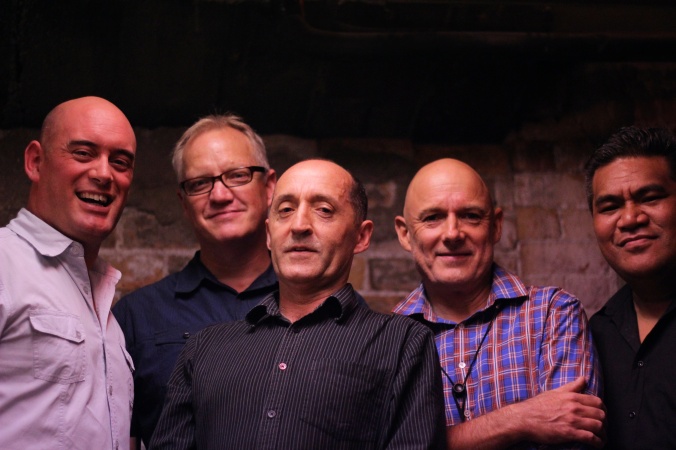
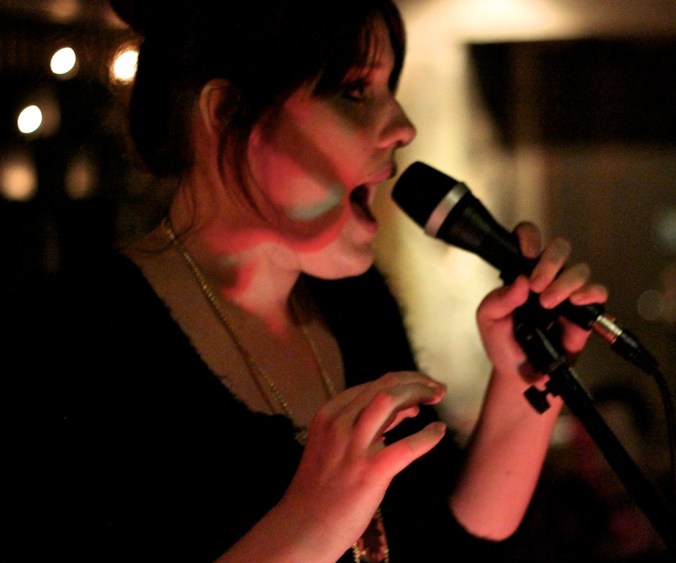
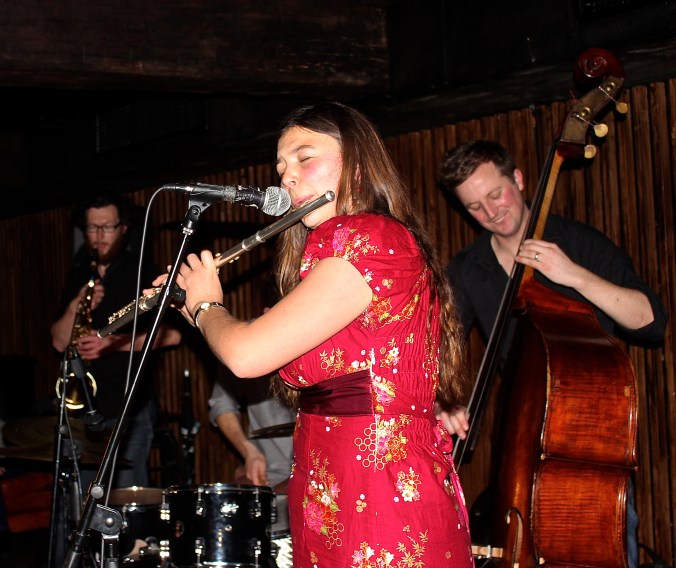
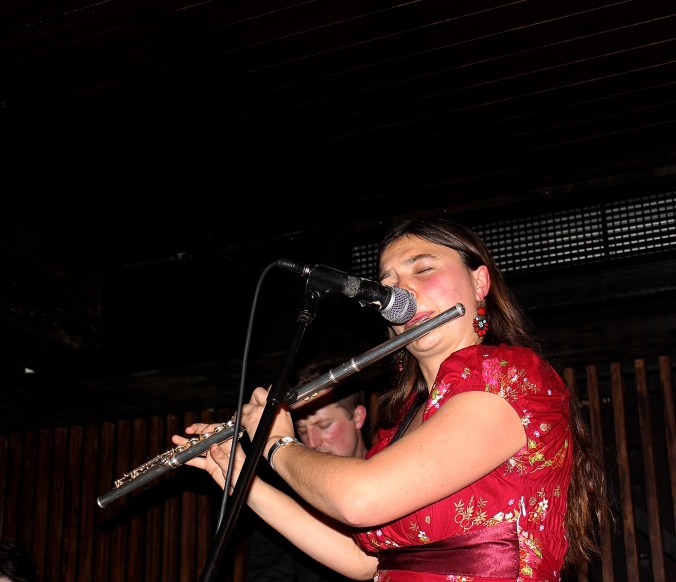
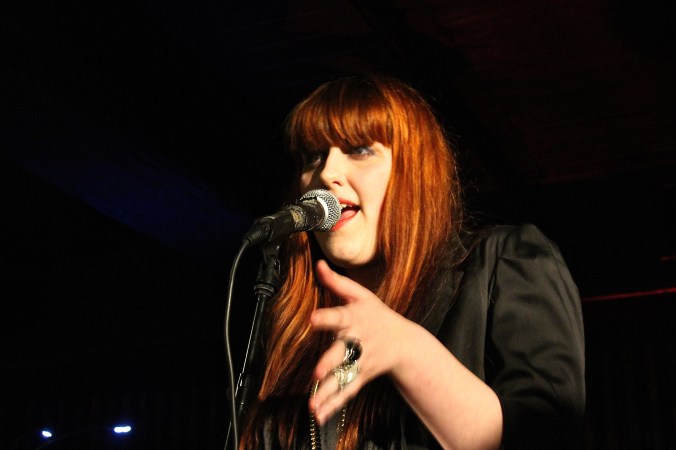
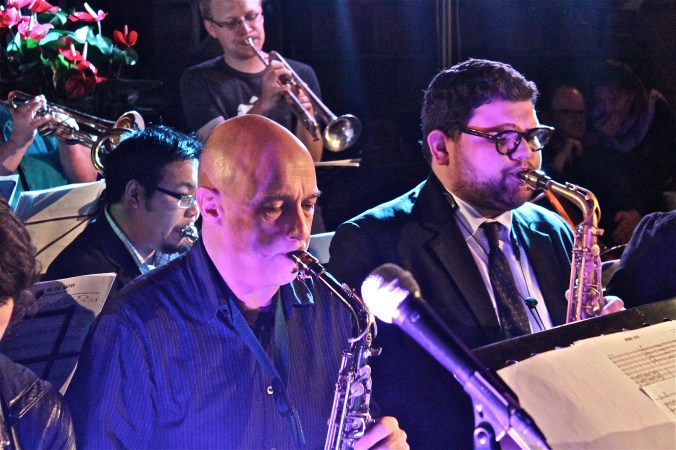
Rebecca Melrose is fairly new to the Auckland scene but she is already gaining a reputation for excellence about town.  Although young she has several recordings under her belt and her career is gaining momentum.  She is a singer/songwriter with an engaging voice and this gives her considerable scope.  It means that her own material gets aired alongside that of Gretchen Parlato and Esperanza Spalding during a gig.  This was her second performance at the CJC (Creative Jazz Club)

Parlato and Spalding are clearly strong influences for her but she can also sing challenging standards from an earlier era.  She not only choses well when adding standards but executes tricky numbers superbly.  Like many emerging singers of the post millennium she has a multi genre appeal and whether she moves into a more ‘soul’ space is a moot point.   On this night she was a primarily a jazz singer and if the enthusiasm of the audience is anything to go by that route will work very well for her.

IMG_6268 - Version 2

Last year she was more tentative during her between number introductions, but that hesitancy has now fallen completely away.   The Rebecca that we saw tonight was sassy, confident and on top of her game.   She played with the audience and tried out various lines of patter.   Not all of the jokey asides worked as intended (some went over very well) but it didn’t matter a damn and her good-natured handling of the audience captivated everyone.   She is on the right track here and I encourage her to keep going in this vein.   Music is a performance art after all and Jazz and banter go together like the reverse sides of a rich tapestry.  IMG_6273

The last time I saw her perform she had Dixon Nacey on guitar and Andrew Keegan on drums.  This time with a much bigger line up she utilised the additional scope that this afforded her .  She performed several times with singer Chelsea Prastiti (once in duo doing the Esperanza Spalding arrangement of the Jobim Tune ‘Inutil Paisagem‘ – which was magical to say the least ).  In other numbers as a quartet, quintet or octet  This set list struck out for higher ground and the risk paid off.

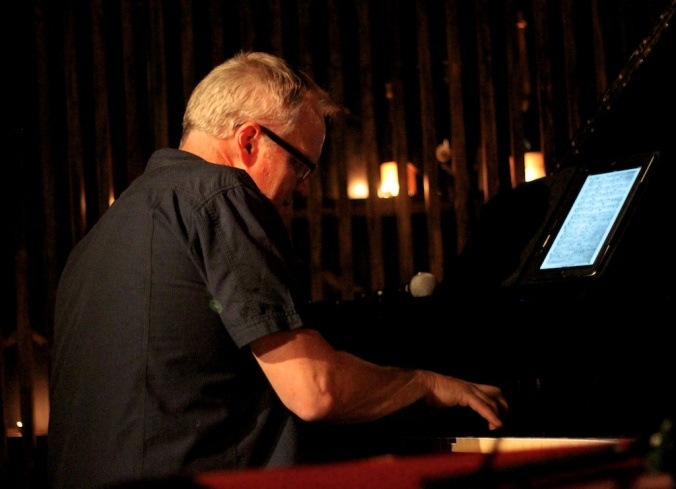
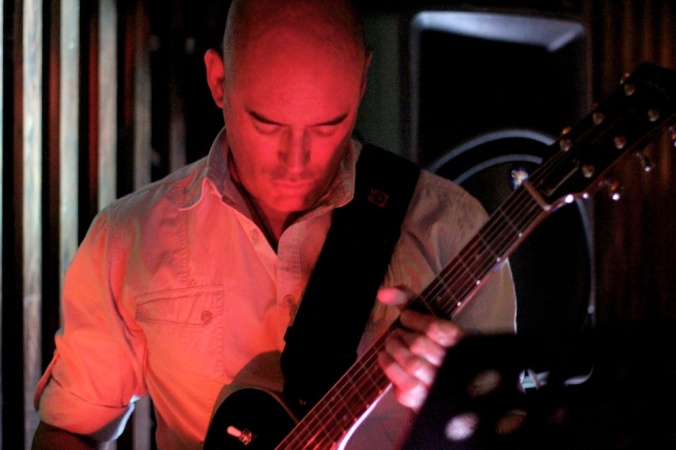
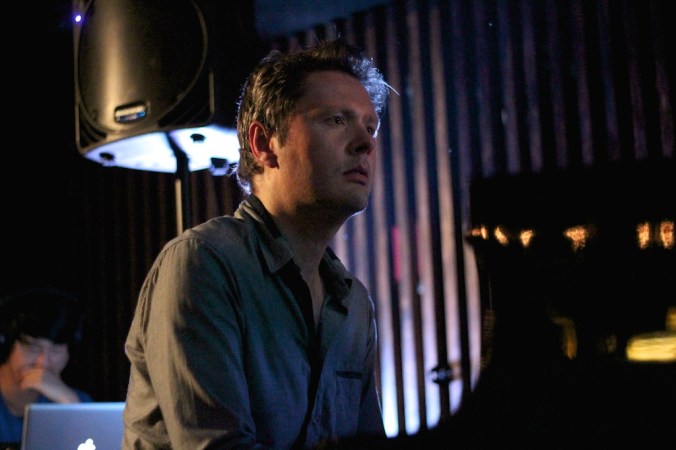
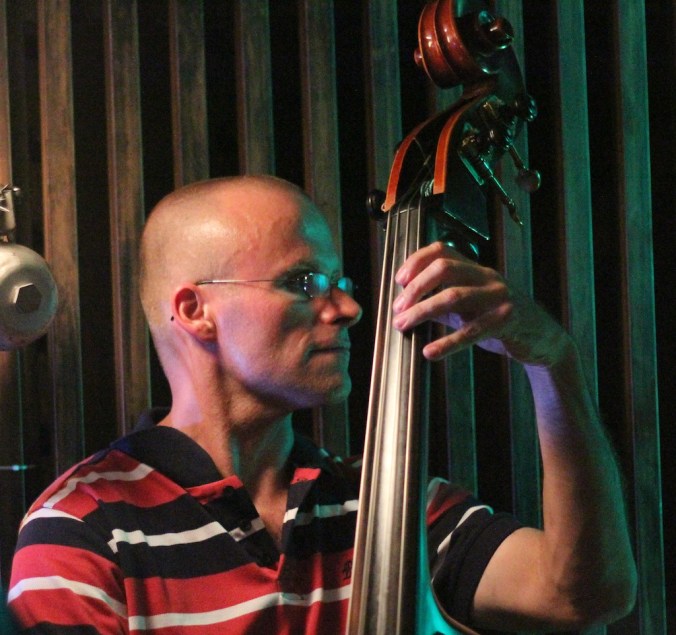
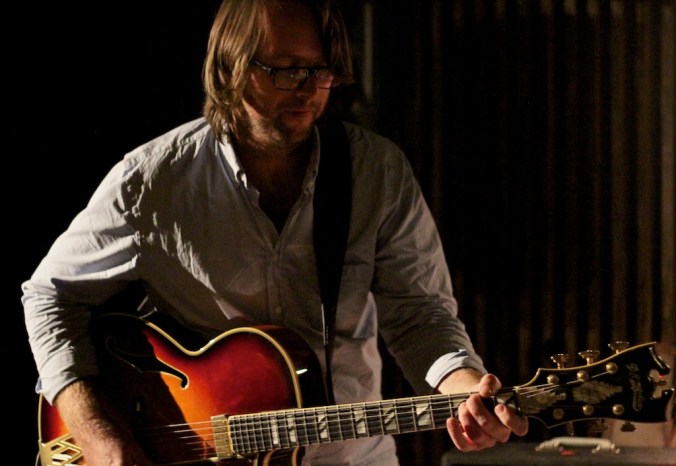
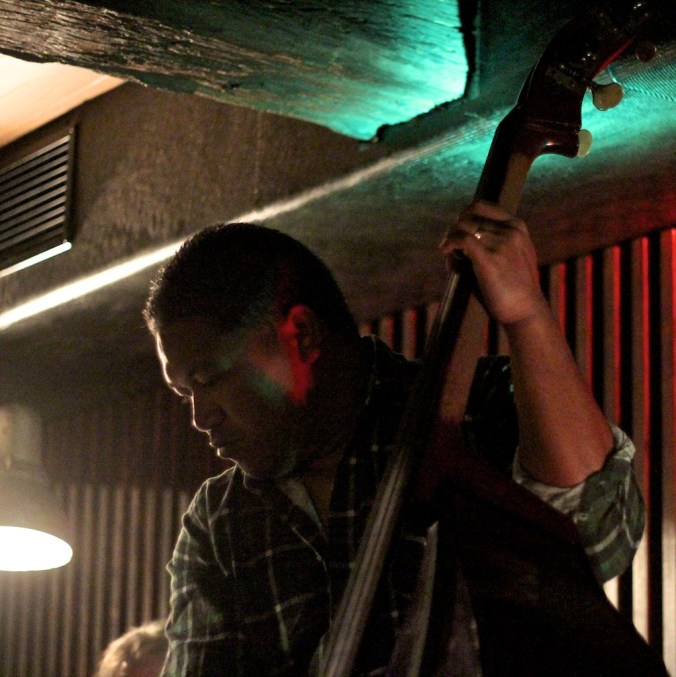
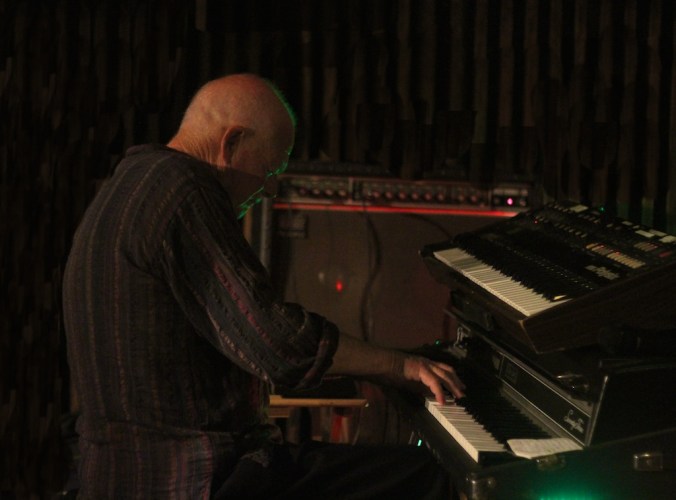
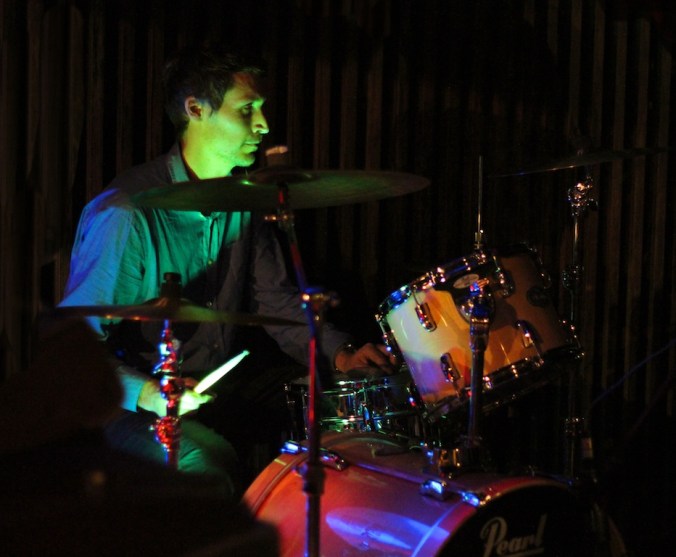
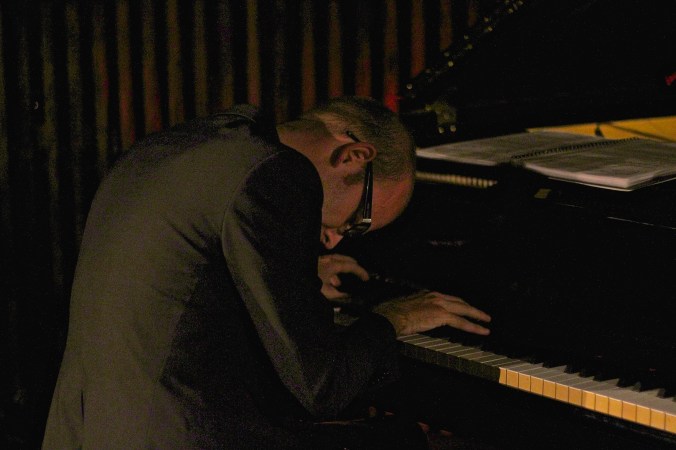
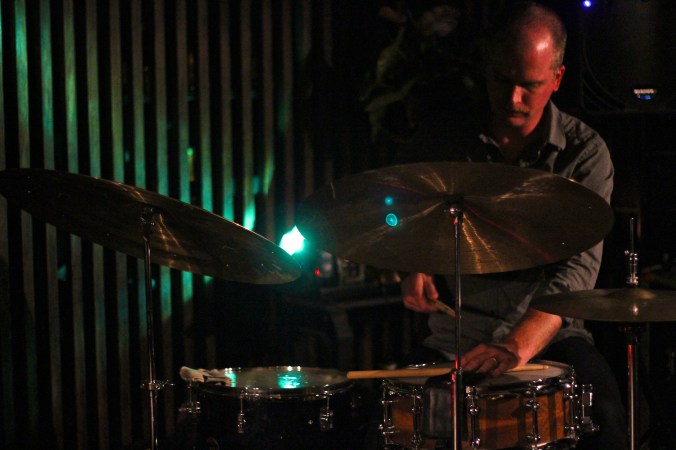
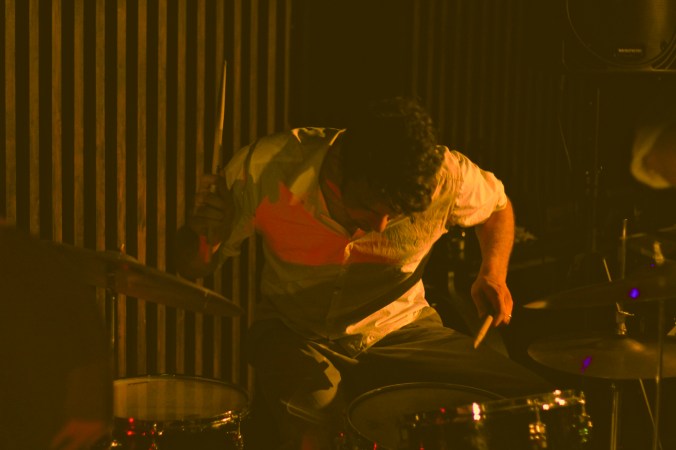
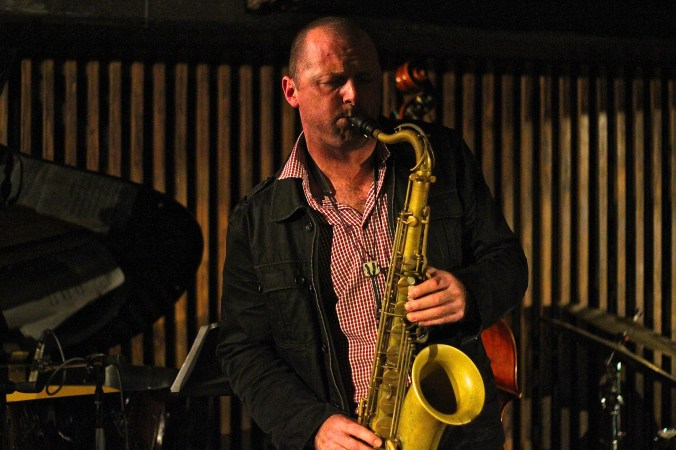
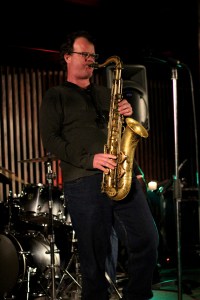
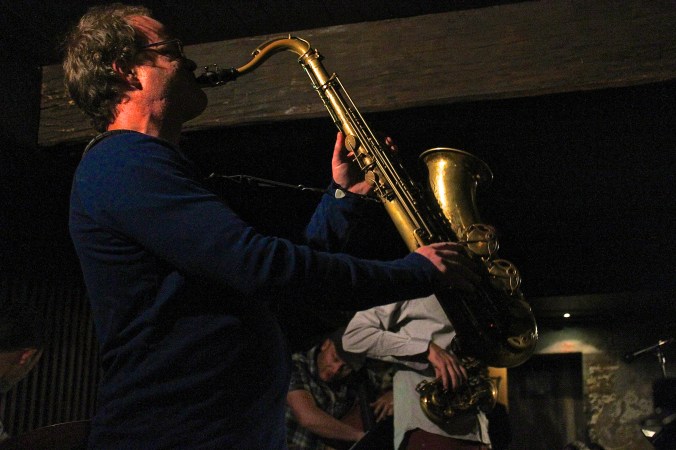
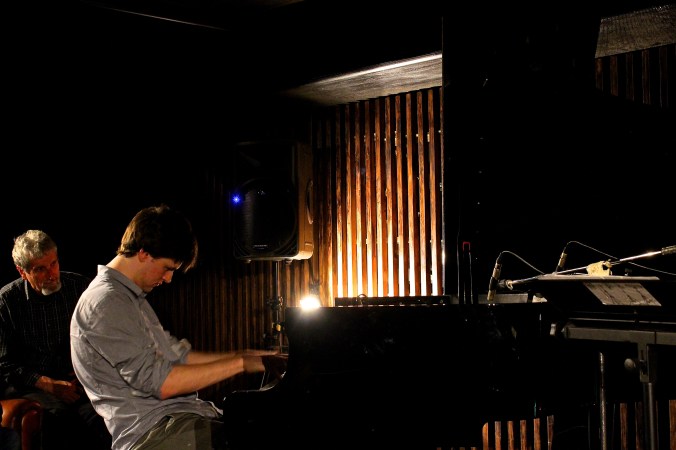
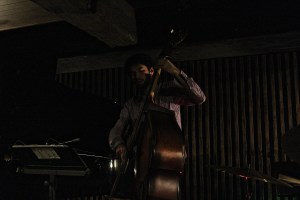
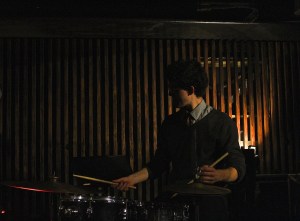
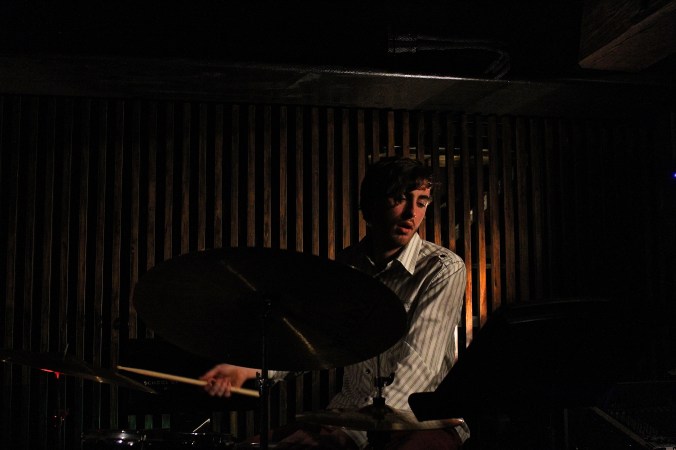
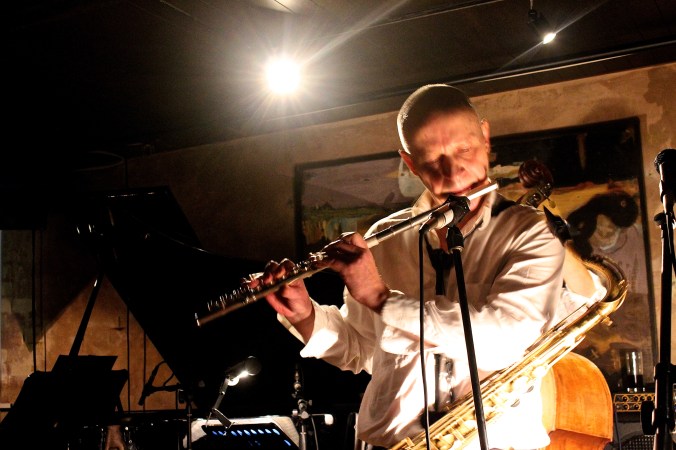
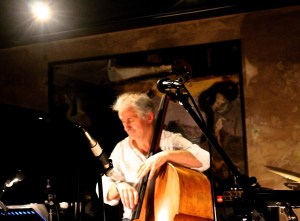
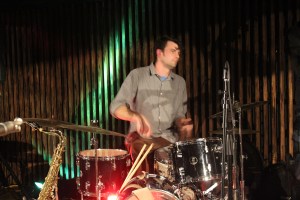
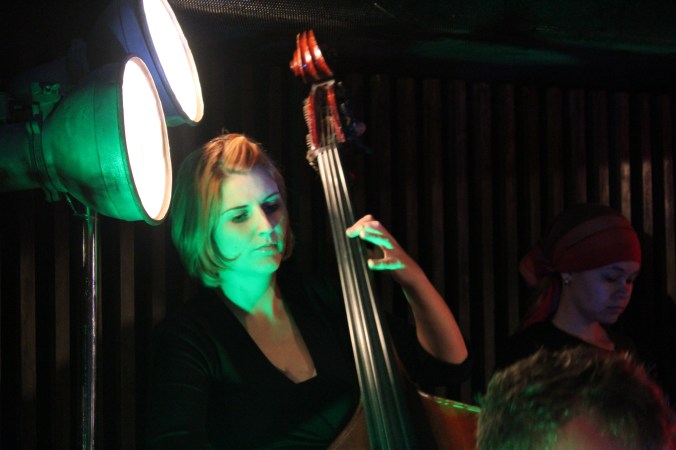
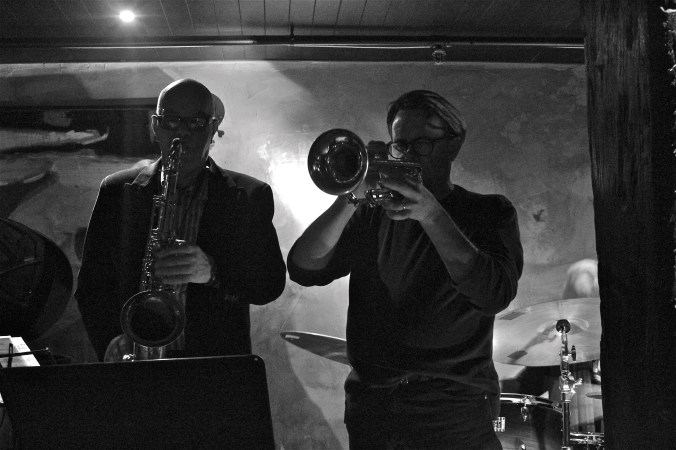
On trumpet and flugal was Liz Stokes, who stepped up with an impressive solo in the second set.  Alex Ward did a great job on piano and especially on ‘Lush Life‘.  I have not seen him play very often and enjoyed his contribution as he tackled numbers that were often demanding.  It was also good to see Jarad Desvaux de Marigny (drums) and Eamon Edmunson-Wells (bass) teamed up again.  This pair work extremely well together and have a more subtle colourist approach which is especially suited to singers and the less percussive of piano players.  On guitar,Manaf Ibrahim and on Tenor Scott Thomas.

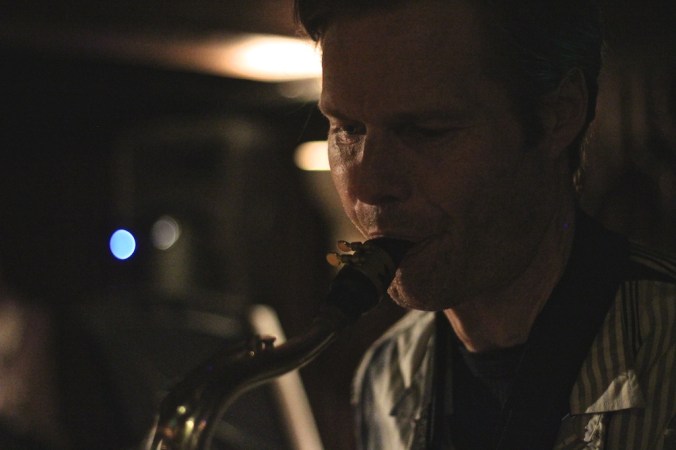
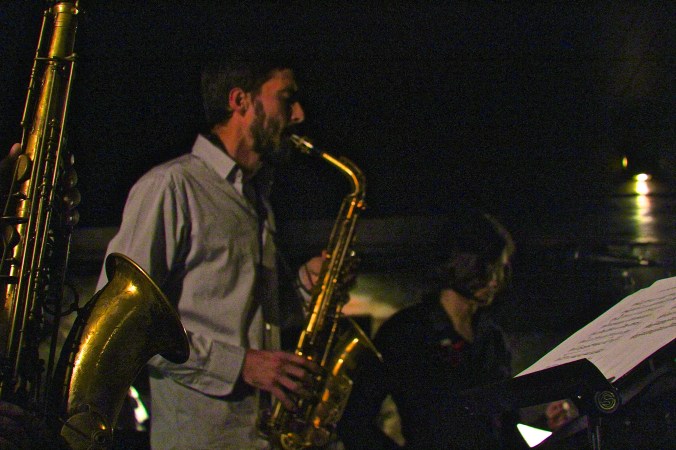
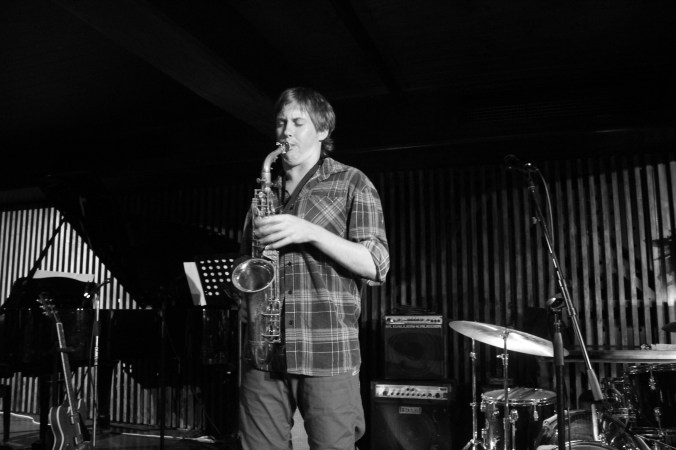
In guest spot was Callum Passells who played a couple of numbers which absolutely floored me; especially his masterful alto solo on ‘Lush Life‘.   Every note in that solo was perfectly placed and with the rhythm section meeting the challenge, we were given a rare treat.   I will say more about Lush life later.  IMG_6288 (1)

Rebecca’s own compositions are interesting as are the modern standards she likes, but I have especially singled out the two older standards for praise.  ‘Tea for Two‘ is not terribly challenging as written, but as a singer you immediately fall under the shadow of Ella, Anita and Frankie.   The tune was written in 1930 by Tin Pan Alley song plugger Vincent Youmans,who was unsure if he liked it at first.  The lyricist Irving Caesar later admitted that his lyrics were intended only as a stop-gap. they never were replaced thank goodness.  The song is from the musical ‘No, No, Nanette‘ and it quickly became a runaway success.   Why this song works so well for Jazz is exactly for the reason Youmans worried about it; a simple form.  There is so much an improvising musician can do with it.  Before long Art Tatum had played it (1933), Benny Goodman (1937), Fats Waller (1937),  Django Reinhardt (1937), Dave Brubeck (1949), Bud Powell (1950) and Thelonious Monk 1963.   The singers who performed it were legion but Anita O’Day absolutely tagged it as her own in ‘Jazz on a Summers Day‘.   Rebecca quoted from Anita, took the number at the same fast pace, but wisely interpreted it in her own way.

The other track that I can’t resist posting is Rebecca’s ‘Lush Life‘ by Billy Strayhorn.  This song is the antithesis of  ‘Tea for Two‘ as it didn’t emerge from the Great American Songbook and it is very challenging to perform.   To my sensibilities it is almost the perfect song.  This is one of the great Jazz Standards and apart from Frank Sinatra’s version it has not been sung much outside of Jazz.  Sinatra only performed it once and refused thereafter, which is one of the enigmas of his musical life.  Recently unearthed rehearsal tapes from the recording session with Nelson Riddle provide an answer.  He struggled with it and at one stage blamed fly dirt on the page for making ‘a very hard song harder’ (Google Sinatra, ‘Lush Life’ and you can hear that rehearsal).

The definitive version for most is probably the Johnny Hartman/John Coltrane Impulse recording (1958).   IMG_6286 (1)My personal favourite is the more recent Fred Hersch /Andy Bey version (from the ‘Passion Flower’ album on Nonsuch) – quietly dedicated to gay Jazz musicians past and present.   Strayhorn was of course an out-gay man at a time when this was almost unheard of.   Ellington revered Strayhorn and regarded him as his chief calibrator (‘my other hand’).   Oddly this tune which written in 1936 remained unperformed until 1948 when Strayhorn performed it in a duet with Kay Davis.   The song was never adopted into the Ellington repertoire and did not become famous until the 50’s.   Its gay innuendoes is probably one reason but its sophisticated complexity is certainly the other.  Well done Rebecca and well done her accompanists’.    Callum Passell’s alto solo was to die for as he breathed the musical history of the song into the solo.   I liked the drums and bass contributions and especially Alex Ward’s sensitive but firm rendition.

Rebecca is a young woman with a big voice.   It will be interesting to see whether she keeps her Jazz chops honed or whether she’s tempted toward singing mostly soul.  Either way the best of luck to her.

IMG_6261 (1)

Where: CJC (Creative Jazz Club) 1885 Bar Auckland

When: 27th March 2013

Who: Rebecca Melrose Super Band

Dr Dog Unleashed @ CJC

IMG_4413 (1)

A few weeks ago someone had whispered, “Dr Dog is back”.  What started as a mere dog whistle soon became an insistent rumour; confirmed beyond doubt when I saw a red van cruising the streets with ‘who let the dogs out’ emblazoned on its side.    I checked the CJC (Creative Jazz Club) website and sure enough there was the gig listing.   Dr Dog are the business or as the vernacular will have it ‘the dogs bollocks’.   We had all been hanging out for this return gig.  This was a risky outing for them as there would almost certainly be an attempt to capture them live during the performance.  The sight of determined looking technicians carrying a tangle of cables and heavy suitcases down the 1885 staircase club confirmed this.  IMG_6222

‘Dr Dog’ are some of the best musicians that the Auckland Jazz Scene has to offer.   Roger Manins – tenor,  Kevin Field – piano, Oli Holland – bass and Ron Samsom – drums.   They all teach at the Auckland University Jazz Studies course where Ron Samsom is program director.    They are teachers, but they also gig regularly.   These guys have honed their skills over many years of playing with the best.  Suffice it to say that expectations are always high when any one of them performs, but when all four appear on the same stage it is a noteworthy event.

Dr Dog is a showcase for the talents of the four band members, all of whom have written original material for the occasion.  I suspect that these compositions are not for the faint hearted and a sneak look at the heavily annotated scores confirmed that.   It was dog eat dog on the bandstand as each musician tried to outdo the other.  Heads would occasionally bend low over the charts in mock dismay and between numbers quick animated conferences were held.  This was not a set list designed to give band members an easy ride.   It was the audience who got the best of these exchanges and while the sweat poured off the band we lapped up the music.  This was a rare treat, just as we knew it would be.

IMG_6219

As you would expect from a dog band there were cool licks a playful approach to the music, a meat raffle and stick chasing.   I filmed most of the sets and I was particularly impressed with the first number up.  It was obvious that these guys had their eye on the ball.  I have put up that clip titled ‘Dideldideldei’.   Being Oli Holland’s composition I knew that it would be well written and have a back story (perhaps involving fishing?).  Oli has a strong sense of irony which is in his titles.   Dideldideldei was evidently a phrase uttered by a Jazz hating apartment dweller in a German comedy, who had the misfortune to live above a Jazz club.  He would shower the band with rotten fruit while yelling, “this is not music it’s just dideldideldei”.    All of the tunes had equally illusive or improbable titles and that only added to the fun.

IMG_6243

Roger contributed ‘Peter the Magnificent’ which he had written in honour of Peter Koopman and tune called ‘Evolution’ (dog evolution).  He gave an explanation of the titles but as I was near the back I couldn’t hear because the people up front were laughing so hard.  Kevin contributed a few tunes and one named ‘Synaesthesia’ referenced the unusual condition which he tells me afflicted one of the great classical composers.  Synaesthesia is a rare condition where colours are heard as sounds or sounds as colours.   Pat Martino Jazz guitar master uses this affliction as a vehicle to assist his improvisation.  In the end I lost track of who had composed what because the dogs only wanted to play.    While this was occurring they were captured by a sound man named John.  An album and a properly attributed track list should result from that.   This band is long overdue in recording and I am hoping that the live take is adequate to purpose.  If the sound is not good enough then they should shake their tails and get to the studio ASAP.   I for one can’t wait.

IMG_6235 - Version 2

Who: Dr Dog – Roger Manins, Kevin Field, Oli Holland, Ron Samson

Where: CJC Creative Jazz Club February 20th 2013

Dixon Nacey – Zauberberg IV

IMG_6080

Dixon Nacey always exudes enthusiasm.   He is one of those musicians who you cannot think of separately from his music.   He is articulate, a family man and a thoroughly well-rounded human being, but music never the less defines him.  He is one of New Zealand’s great guitar talents and so people trip over themselves to attend his gigs.  Dixon appears in a variety of contexts: teacher, composer, sideman (to the likes of Alan Brown and sometimes up & coming musicians like Rebecca Melrose) but most often as leader or co-leader.   This is the guitar go to guy.

IMG_6081

We tend to associate Dixon with the more up tempo pieces where the changes are gleefully eaten up, but like Marc Ribot he can surprise with thoughtful acoustic offerings.  When this occurs there is a hush because the nuanced story telling and the rich voicings take us to warmer place than we ever imagined possible.   We heard both facets during the Zauberberg IV sets and the contrast spoke volumes about Dixon.  A number of originals (composed by  he and Oli Holland) were reharmonised versions of standards.   ‘Gutted and Gilled’ could only have come from the pen of Ollie Holland the obsessive fisher.   It is a metaphor for what this band can do with a tune; paring it to the bone.  Dixon’s red Gibson was no where to be seen and he playing another brand of guitar during the 13th February CJC gig.  He was trying out a handsome looking custom-made guitar (the name alludes me).   This was a wonderful instrument with the warmth of a Les Paul and the bite of Strat.

IMG_6067

‘Day and Night’ made references to ‘Night & Day’ but they emerged as glimpses arising from a darker tapestry.   ‘Conversations with Dr Small’, (another great title) had quirky adventurous twists and pointed squarely at Dr Stephen Small (pianist), who I presume this number was referencing.  ‘If I Should Lose You’, ‘Recordame’, ‘Everything Happens to Me‘, ‘Softy as a Morning Sunrise” and ‘Have You Met Miss Jones were a sampling of the standards played.  ‘Softly as a Morning Sunrise’ was played with such high-octane and at such a velocity that we were pulling ‘G’ forces.  On the other hand the beautiful ballad ‘Everything Happens to Me’ was approached in a loving and respectful manner.  Jason Jones has a gorgeous tone and when Dixon comped behind him with warm soft chords the mood was perfect.   It is right to place such numbers in juxtaposition, as contrast is a vital ingredient of any rich palette.  IMG_6079

Oli Holland on Bass has long occupied an unassailable position on the Auckland scene.  It was a good day for New Zealand when a long sea voyage washed him up on our shores.  He is increasingly providing compositions for the more experienced musicians about town.   Compositions which both challenge and please.   I have often witnessed band members commenting, “Oh this is challenging”, but the results speak for them selves.

Andrew Keegan on drums may be a relative newcomer to Auckland but he has made his mark already.   He brings with him a wealth of experience (including from offshore).  CJC audiences are always pleased to welcome him back.  His posture when drumming is compact and that makes him great to photograph.   It is as if he is drawing all of his energy into a circumscribed arc before unleashing its power.

Jason Jones is the last member of the group and he is somewhat of an enigma.   People who have been around the scene for a while remember him well, but his public appearances have been scant in recent years.   He teaches at the Auckland University Jazz School and was Berklee Trained.

There is often an interesting back story to a band and so I asked Dixon hoping to get gain a few insights.  His reply was typically self effacing but actually yielded rich pickings.  Many years ago Oli had been in a band in Germany named the ‘Zauberberg III’ and they had recorded several times.   This gig was actually booked over a year ago as the ‘Alain Koetsier Quartet’s’ second appearance.    That particular line up was Alain, Dixon, Pete France and Oli (see earlier review).  As the time got closer Alain unexpectedly found himself booked for a week of recording for the second Nathan Haines Warners album.  Pete France had to drop out suddenly and that left Oli Holland and Dixon Nacey with a week to go and short by two band members.   When in doubt re-invent yourself and above all improvise.   The new name came from Oli, Jason Jones was coaxed back into performing and the often complex set list (typical of Dixon and Oli) emerged in the nick of time.

Jazz line ups are often conjured out of thin air and I have witnessed quite a few such manifestations.   It is my observation that flying by the seat of your pants can  often yield the best results.   This is how humankind has always moved the paradigm: our advances over the millennia have always come from risk taking.  In life and Jazz improvisation is everything.

I have posted the Matt Denis tune because it is so beautiful that I even managed to shed a tear through a very bad cold.

Where: Creative Jazz Club Auckland

When: 13th February 2013

What: Zauberberg IV

Frank Gibson – HardBopMobile

IMG_5926

Drummer Frank Gibson Jr has been a feature of the New Zealand Jazz scene for over 40 years.  He has accompanied and recorded with many of the greats and was one of a small cadre of Jazz musicians who remained visible at a time when Jazz was going through some very lean years.  These days we are most likely to hear him performing with his own unit the ‘HardBopMobile’ or with long time friends like keyboardist Murray McNabb or Neil Watson.

.  IMG_5940

I have seen this line up quite a few times and they offer up a solid programme of Hard Bop as the name suggests.   While they sometimes play perennial favourites, they generally prefer to dig into the overlooked tunes by the likes of Joe Henderson, Horace Silver or Monk.   With this material the band is on very firm ground.  Because of their familiarity with the genre and the material, they are able to bring fresh interpretations to the tunes.  Their approach is often surprisingly oblique.

Neil Watson

Neil Watson

Neil Watson is always adventurous on guitar and he has a joyfully quirky approach to tunes, while Cameron Allen (who is a well-respected saxophonist about town) approaches them from a more angular perspective.  The remaining band member is the popular Ben Turua (bass) and this turned out to be his last CJC (Creative Jazz Club) gig as he left for Australia soon after.

The gig was heavy on Monk compositions which were explored and probed from every angle.  It is not often that Monk’s ‘Hackensack’ is played; by a guitarist even less so.  To take it further out they loosened up the vibe and gave it a New Orleans feel.  This worked particularly well.  Other Monk tunes such as ‘Brilliant Corners’ (why this is not done more is beyond me) and ‘Ask Me Now’ occupied much of the set material.    They played Wes Montgomery’s ‘Jingles’, Ge Gee Gryce’s ‘Minority’ and a Sonny Sharrock tune ‘Little Rock’.  The free guitarist Sonny Sharrock is seldom heard these days and more is the pity.  Perhaps his hard edge and free fusion infused lines have faded with his passing?  I detect Neil’s deft hand in this last choice as he has a great liking for Sharrock.  Neil Watson also contributed a composition of his own and this probably confirms the rumour that he has been writing some new material of late.

IMG_5921 - Version 2

Nathan Haines 2013

IMG_5887 - Version 2

My recent travels to the USA led to many musical adventures, but as good as those experiences were I had missed the CJC (Creative Jazz Club) and our local musicians.   There is a passion and sometimes a raw edge in New Zealand Jazz which I find compelling.

The first gig I attended upon my return was the Nathan Haines CJC gig.  This had been widely anticipated and after the success of ‘Poets Embrace’ the rumours of a new album had started to circulate.   Just before Christmas Nathan Haines returned from London for a month or so and not long after Alain Koetsier returned from China.  The rumours became fact as there is definitely a new album in the making.  The band was well received at London’s ‘Ronnie Scotts‘ last year and an overwhelmingly positive review appeared in the influential ‘London Jazz’.  That gig had reunited most of the ‘Poets Embrace’ band.  IMG_5880 - Version 2

By the time of the ‘Ronny’s’ gig Nathan had moved back to London, while Kevin Field and Alain Koetsier flew in to join him.  When a good band like this travels exposure to wider markets occurs.  This can bring rewards.  Having Warners behind Nathan proved fortuitous and ‘Poets Embrace’ has now been released in Europe as well as Australasia.  With a follow-up album coming the expectations are rising again.

Nathan is no stranger to success (here or offshore) but to break into a difficult market releasing analogue classic 50’s style Jazz demonstrates his appeal.  This is not just a lucky break but the result of hard work, Savvy, skilfully written charts and knowing who to choose as bandmates.   Although Alain Koetsier (drums) has been working in China for a year he had already gained a solid reputation in New Zealand before he left.  He can be heard on a number of top quality recordings where his chops and musicality are self-evident.   Pianist Kevin Field has released a few albums of his own as leader and of particular note is his  last release ‘Field of Vision’ (Produced by Nathan and released on the Warners label).    The original bass player Thomas Botting is no longer with the band and in his place is the talented Ben Turua.   This is the second time that I have seen Ben play with this band and he is a good choice.  Sadly he is moving to Sydney after the recording.

On the night of the CJC gig we heard a mix of tunes from ‘Poets Embrace’ and some new compositions.   Some were so new that they had never been played before in public.   I assume that at least a few of these will end up on the new album.  The first set started with a selection from Poets Embrace and it was immediately obvious that they were back on familiar ground and ready to notch it up a level.   Nathan quickly established the melody and just as quickly moved to explore what lay beyond.  Together they mined the material for new stories and the level of confidence was noticeable. The newer material was a little more tentative but this was a first outing.    With the recording session due very shortly I have no doubt that we will hear an album every bit as exciting as the last.   This music has its echoes in the era of 50’s Coltrane and others but here’s the interesting thing;  Nathan has a young and an older fan base.   This is a timeless music for the universal man (and woman).  IMG_5902 - Version 2

Nathan is hopefully going to include a few of the vocal numbers he performed on the new album.  His song ‘Impossible Beauty’ from ‘Sound Travels’ was an attractive haunting tune that stuck in the memory.  I rate his (slightly husky) voice highly and I hope he adds vocals to his repertoire more often.  The male Jazz singer is sadly an endangered species.

Last weekend the band played ‘The Sawmill’ in Leigh.   The seats sold out quickly and to all accounts the gig was amazing.  If there is anyone who hasn’t yet purchased a copy of ‘Poets Embrace’ do so immediately and grab up the new album upon release (in Vinyl or CD).  I can promise you endless replays.

Who: Nathan Haines Band with Kevin Field, Alain Koetsier & Ben Turua.

Where: The CJC (Creative Jazz Club) the basement 1885 -Britomart – downtown Auckland

When: Wednesday 30th January 2013

Alan Brown Band – The interview part two

The interview with Alan Brown & his band continued………

David Hodkinson 004

Q.  Alan the world and its dog loves ‘Blue Train’.   Is there any truth to the buzz about town that there will be a Blue Train reunion in 2013?

A.  At least somewhat of a reunion concert is planned for the Waiheke Jazz Festival in Easter. Steve Sherriff, Jason Orme and myself recently played a lot of the Blue Train tunes at the Taste Of Auckland festival, and it all felt really good, so I thought “why not?” Once I also found out that Aaron Nevezie will be in town at the time, and was keen to do the gig, I made it happen. Aaron played guitar on the Never You Mind album back in 1998 and is a fantastic musician, and engineer/producer based in New York with his own studio, Bunker Studios. Bassist Matt Gruebner will also be visiting but won’t be here at Easter, and will only have a window of a couple of days when he and Aaron will both be here, but if I can wrangle another gig in that time frame, I will!

Q.  I would love to do an updated photo essay on Blue Train.  Do you have much archival material of this seminal Auckland Jazz Groove band?

A.  Yes I do – I have a box of clippings, magazine articles etc, going right back to the early days when a young Matt Penman was playing with us! I also have a lot of print-outs documenting our success on the former mp3.com website back around 2000. So you’re welcome to have a sift through all that.

Q.  You own the Jazz Groove space in Auckland and you are enormously well-respected about town.   Do you feel a little cheated that music as well received and as popular as yours has not been picked up for wider distribution?

A.  Thanks John. As Blue Train we did reasonably well and had a certain amount of recognition, but I guess it was hard for venues, labels etc to categorise us – not traditional ‘jazz’ enough for some, or too jazz for the groove crowd. Not having a singer also limited our ‘acceptance’ in the gig scene. You need to remember that NZ is still quite small, and even though there are fantastic jazz musicians and bands around, the general public don’t really get exposed to the diversity that exists. So the average New Zealanders perception of jazz is fairly limited and safe, thus it’s hard for many great artists to get a voice or get picked up. Yes it can be frustrating, but I really appreciate what people like Roger & Caroline are doing with CJC to raise the profile of what’s happening in NZ. I’ve seen many jazz bars come and go, but these guys have got it right. If anything,THEY need the wider exposure! However, I know the market is much bigger overseas, and when you check out sites like nextbop.com, you realise just how much incredible cutting-edge jazz is out there. The international market is definitely somewhere I will be focussing more on in 2013. In any case, the ability to create, produce and play ones own music is such an incredible privilege, and at the end of the day, as long as it touches or inspires even one other person, I’m happy.

Q.  Tell me about a few of your favourite local musicians both in and out of your band.

A.  In the band? Well, everyone! Truly, each of these players are inspiring to me, which is why I chose to work with them. Jono is an incredible drummer with an intuitive grasp of time, so with the odd-time stuff, he was the perfect choice. Plus, he shares a similar passion for Radiohead, and has a lot of good musical input, hence his assistant production role on the album. Marika has just an amazing feel and sense of groove – she knows precisely where to put the notes but also has a strong melodic sensibility. And Andy has all the rock, jazz influences but is unique. He’s a stunning guitarist and has a playfulness which works so well in this context. I have been working with David Hodkinson in bass duties of late, and he’s also a very good, keen, passionate player. He has slotted in perfectly with the band.

Outside of the band? There honestly are SO many local musicians that have inspired, or continue to inspire me. Of course Matt Penman was an early inspiration, and still is. It’s been inspiring just to see his incredible growth as a musician over the years, and he’s such a nice guy. Brian Smith was also a big inspiration – we did a number of gigs together in my early jazz years, and I learned so much from just playing with him. The list goes on: Dixon Nacey, Kevin Field, Roger Manins, Nathan & Joel Haines…in fact I really draw inspiration from all of the local players!  Some of the young players coming through now, like Matt Steel, just blow me away too.

Q.  You have a deep interest in many of the cutting edge Israeli Jazz musicians and in Middle Eastern folk melody.   You were recently doing a masters and focusing on these works.  Tell us a little about Yaron Herman and others?

A.  Actually I haven’t completed my Masters yet! Still a work in progress. I did my Honours study on Avishai Cohen, as I was fascinated how he managed to blend the Middle Eastern elements of rhythm & melody, with classical and jazz, and create something that was very fresh and exciting. I’ve had a long-term love of Middle eastern music, especially the rhythm, but also the structure of it in terms of the various modes or maqams; the use of quarter-tones etc. So discovering artists like Cohen, Tigran Hamasyan, Shai Maestro & Yaron Herman has been an epiphany in jazz for me! My Masters study is partly on Yaron’s music, but also on the way he was taught.

He only starting learning piano at age 16, under the tutelage of Opher Brayer, who used mathematics, philosophy & psychology! At age 18, with a scholarship, he went to Berklee music school in the US, decided he didn’t like it, returned home via Paris, and at a jam session was offered a gig then and there. How Yaron so quickly reached such an incredible level interests me, but also the use of aspects such as psychology in the process – obviously it enabled Yaron to connect on a deep level which I’m sure is part of his rapid development. Shai Maestro, who played piano with Avishai Cohen for a while, also was taught under Opher Brayer. I’m also really digging Tigran Hamasyan at the moment – he incorporates Armenian folk tunes into his tunes, but is an incredible and passionate player. Very exciting stuff.

Q.  Your music is very contemporary and reflects new streams of Jazz influence.  Finally tell us about your interest in and the use of material by Bjork, Radio Head, Parks etc?

A.  I’ve touched on some of these artists in terms of how aspects of their styles has been a direct influence on writing for the quartet, but I guess what attracts me is their total uniqueness, and in many cases, such as Bjork, flying in the face of trends and expectations. Radiohead did the same with Kid A. Their writing also resonates with me – and aside from adapting specific aspects of that, the emotional & spiritual affinity I have with the music is what moves and inspires me. My goal is to similarly express my heart & passion in the most complete way I can – whatever musical form that takes.

Thank you for your time Alan.  Best wishes for 2013.

Andy Smith

I also asked drummer Jono Sawyer the following questions:

Q.  Jono you have played with Alan Brown for a long time and certainly from the beginning of the ‘Between the Spaces’ lineup.  How did you two team up?

 A.  Alan was actually a key part of my love of jazz as I grew up – I used to listen to the cassette of the debut ‘Blue Train’ album in the car with my Dad when I was about 6 or so! (This album also featured my great drum teacher Jason Orme). Alan and I got to play together after I approached him to see if he’d be interested in playing on my first Honours recital when I was studying at NZSM, and I think he liked the tunes I was hoping to do for the performance so he agreed. I was actually really nervous when I approached him and never thought he’d actually do it, here was a guy I listened to from when I was a boy and helped to shape my love of music, yet he was super into it! We’ve been playing together a lot ever since cause I think we both are on the same wavelength when it comes to contemporary jazz and the exciting stuff coming out of the modern scenes, particularly New York.

Q.  One day I asked you about your role in playing a groove beat across differing time signatures.  You told me then that it was instinctive.   Are you able to articulate the process of locating those grooves?

A. Half of the grooves are actually already written in their basic form when Alan brings a new tune to the group. He’ll demo a tune up on Logic so we get a good idea of the vibe he’s going for, and then as we practice the tune the groove becomes more refined and I add my own variances and subtleties to make it into the product… Of course, what Alan, Andy and Marika were doing would shape this; I remember the groove from ‘Sustainable Resources’ being slightly less related to the bass line at first, but as we jammed it just felt right to really articulate most of the bass line between the kick and snare, which in turn helped the flow of the tune, despite it being in 15/8 – I guess that’s where the instinct part comes in!

Q.  Tell me a little about who impresses you the most from among modern drummers.

A. I have a real passion for odd time playing through my love of 70s prog rock particularly, but what really impresses me from guys like Eric Harland, Ari Hoenig and this drummer called Gavin Harrison, is how they can navigate these odd times with such flow and ease. As well as this, they never let what they’re doing get in the way of the groove and the overall musicality of the tune. Ari is certainly one of my favourite players he has such control over the drum set that he can essentially play anything he wants! But also understands that sometimes, laying back on the groove, whether it be swing or more contemporary stuff, can be all that’s necessary for a tune to become perfection. All of these great players also have a wide knowledge of the greats that have come before them, and I’m finally starting to understand the importance of this too.

Q.  Where to from here?

A. Hopefully another Alan Brown album! I know Alan’s really passionate about trying to get some international gigs under our belt so that will be exciting if we get some dates lined up. I’m also keeping busy with Batucada Sound Machine, and we’re looking ahead to our European summer tour… I’m also involved in a project with the APO for a concert they’re doing in May, which should be good fun!  Lots of work to do for all those things though so I’d better get practicing.

Jono Sawyer 006

Lastly I interviewed David Hodkinson about his role on bass

I thought that I would ask a few of the other band members questions as well. The newest member of the lineup is David Hodkinson who plays electric bass. The original BTS album had Marika Hodgson on it and she had quite a following as her intense goove lines were compelling. David has seemlessly stepped into the role which was big ask and so I asked him what that was like.

Q.  David, I am impressed by how you handle your bass duties in this band.  How are you enjoying playing with an Alan Brown band?

A. I am really loving being a part of this group, the combination of a strong groove, interesting harmony, and odd meters make it fun on many levels! Also I consider these guys a ‘dream team‘ to play with, I have a huge amount of respect for them.

Q.  How did that happen.  Were you recommended by a friend, apply or were you approached directly?

A. I have known Alan for some time now, through University and playing with Trudy Lile/Mojave when he had filled in. I met Andy and Jono whilst studying too, and played in Andy’s Masters Combo. I was very excited when Alan approached me to be a part of it.

Q.  Tell a me a little about who impresses you most and your influences.

A. I am a big fan of Juan Nelson from Ben Harpers ‘Innocent Criminals’ band, also players like Bakithi Kumalo from the Graceland album, and Incognito. A big thing for me in regards to musicians is what kind of person they are, I would rather work with an absolute beginner with a good attitude than the opposite.

As far as influences go, I grew up playing Jamiroquai, Red Hot Chilli Peppers, Rage Against the Machine, and then it was really Paul Norman who introduced me to jazz/funk. I credit Paul as the biggest influence in my musical life. I was lucky enough to go through Avondale College and witness players like Ben Turua, and have Max Stowers as my tutor, so I was very fortunate.

Q.  I watched you play those bass groove lines once when you had no drummer in the Alan Brown band.  That is a lot of weight to fall on a bass players shoulders.   Was that a challenge?

A. It wasn’t really a challenge, just a shift in method. I try to get the pulse in my body through movement, which can then give me the seperation mentally to process it in the same way as if there was a drummer, good fun!

Q.  Where to from here?

A. Well I’ve bought some pedals so have been enjoying experimenting with different sounds. I play in the bands dDub, and Spiral as well so I am quite content at the moment. I have also been enjoying playing double bass again so I would like to do more of that in the future.

I would like to thank Alan Brown and his band for their indulgence with this.  I believe it to have been an incredibly worthwhile exercise as it gives insights into an important aspect of music within the Auckland Jazz spectrum.  Sadly Andy Smith was out of town but his contribution is considerable and acknowledged here.

John Fenton

Jazz Local 32.com

Alan Brown interview & part one

IMG_3131 - Version 2

Interview with Alan Brown:  Leader, Composer Jazz/Groove Musician

Alan, thank you for agreeing to this interview – On behalf of Jazz Local 32 I would like to gain a few insights into your music and your primary influences.

Q. I have seen various configurations of your bands over the years but I would first like to concentrate on the ‘Between the Spaces’ album.   As the composer and leader are you able to reflect on just what this particular body of work means to you?

A. It’s the culmination and articulation of ideas that had been floating around in my head for a while. They didn’t really solidify until I decided on a format (i.e. the quartet and choice of musicians thereof). Once I had that sorted, a lot of the ideas took shape, as I could hear how they would work with this line-up and the particular strengths of each musician. It also represents a new freedom in my writing, that of allowing all my various influences equal voice. Previously I had felt a bit stifled in my writing as I was constantly aware of ‘trying’ to write in a more ‘jazz’ style (whatever that is).

I was often aware of feeling the (self-imposed) pressure to make harmonies more complex where, in many cases, it wasn’t needed and took away from the purely creative and spontaneous aspect of writing. I mean I know there’s always an editing and fine-tuning that happens but sometimes I found I was just trying too hard to be ‘jazz’. Upon hearing some of the younger generation of jazz composers who were not afraid to push the boundaries but also use rock, RnB compositional ideas and harmony, I discovered a new freedom in my own work, and allowed the classical and pop/rock influences which were an early part of my growth, to be heard – without fear!

Q. This has the feel a well-conceived album, which is largely built around finite concepts.   Is that just my impression or was there a compositional focus?

A. There was definitely a compositional focus, even though a few of the tunes were older pieces I had written. The new writing freedom, along with a strong picture of the quartet sound I had in mind, and especially what each player was bringing to it, gave me a focus that I hadn’t had for a long time. There is a strong odd-time and polyrhythmic element to many of the tunes, which was partly inspired by what I was listening to at the time, such as Avishai Cohen et al. However, I distinctly remember one of the first tunes I wrote for the quartet, Captivated (which sadly never made it to the album, but is available on-line), was built from an idea I had for a while but just couldn’t get anywhere with.

One day I thought to try the idea in 7/4 rather than 4/4, and basically the rest of the tune wrote itself! I guess the excitement and challenge of the odd-time signatures propelled the writing burst that followed, although I never tried to force odd-times etc to fit – it still had to feel right no matter what was happening in the tunes. I was also inspired by the writing of bands like Radiohead in terms of song structure and dynamics, so the inclusion of forms such as coda sections to my tunes are a direct result of that. However there are also techniques I have used in my writing since the Blue Train days (and earlier!) present in these tunes, hence the groove element especially.

Q. What are the primary influences behind the BTS compositions?

A. Artists such as Avishai Cohen, as I already mentioned, in relation to the fresh combination of Middle Eastern rhythms and classical influences in his writing; Aaron Parks in terms of sound, structure and the strong sense of melody; Radiohead with regards to structure as I mentioned, but also harmony and again, strong melodic ideas.

The emotion that is present in Radiohead songs is something I was searching for in presenting these tunes in the quartet form I chose; Classical music plays a big part in my upbringing so much of the harmonic sense comes from that, especially in tunes like Eastern and Tableau. The latter tune also includes an obvious nod to minimalist classical composer, Philip Glass.

Q. Those touches of orchestration where you added strings and flute sounded so good.   It put me in mind of the CTI label of Creed Taylor where expanded works and orchestrations by Don Sebesky were the norm.  How did it feel working with an expanded sound palette?

A. I loved it! It presented its own challenges in terms of writing and understanding how the textures work together but it’s something I definitely want to explore further and include in subsequent compositions. Again it’s a sound that has strong ties to my classical influences, and therefore presents an emotional canvas that really resonates with me.

I particularly love the modern orchestration on Brad Mehldau’s Highway Rider album in terms of the close harmonies and inner movement within the strings, creating a vibrant, sometimes dissonant, but compelling texture. I recently found out that Brad was influenced by the the work of Francois Rauber in his work with Jacques Brel, and Bob Alcivar in his work with Tom Waits. I am starting to check these orchestrators out myself now.

Q.The complex rhythms, counterpoint and multi textural nature of the tunes must add a degree of difficulty.   Every band member has to work a different groove while keeping in mind what is happening elsewhere.  Is that a hallmark of the Alan Brown sound?

A. Yes and no. I mean, it was definitely something I had in mind for this album but I’m always wanting to stretch myself and be open to other influences, so I don’t want to be confined to a particular sound or approach. However, every writer does have their own signature style which is something that should come through unconsciously, but the vehicle for expression should be open to whatever provides the creative ‘spark’ at the time. In saying that though, I do love the multi dimensional nature of what happens in these tunes, that there are elements that one can focus on and think “that’s cool”, but that they’re still part of the whole. In other words, it’s got to groove no matter how difficult or ‘clever’ it may appear.

Q. Is there a ‘Between The Spaces two’ planned?

A. I’d like to think so! I have been slowly writing some more tunes, at this stage with the quartet in mind, but as I mentioned, I’d also like to explore various palettes more, especially with strings. Some of the writing is with my Masters study focus, but is still very much what resonates emotionally with me.

Part two and a short review to follow in the next post:

Salon Kingsadore @ CJC

Murray McNabb

It had been a very busy week for me and I had not paid too much attention to the CJC (Creative Jazz Club) website.   All I could recall about the gig was that it would be something different.   The instruments came into view as I descended the stairs and as my eyes accustomed to the gloom I saw Murray McNabb.   Murray is a veteran of the New Zealand Jazz scene and ‘different’ is exactly what he does best.  There was a bank of keyboards, numerous pedals, leads everywhere, a drum kit and two guitars barely visible in the back ground.  I quickly learned that this was the release gig for the second album by Salon Kingsadore – ‘Anti Borneo Magic’.  Yes the title gave more than a hint of what we were in for.  An exotic improvised trance like dreamscape.   After a hectic week that was exactly what I needed and from the first vamp I relaxed into the music.

Salon Kingsadore was formed in 2004 to write a soundtrack for a play and their works are styled – spontaneous cinematic compositions.  Not long after that first album they were invited to perform at a film release in Italy.  These projects appear to be under the creative guidance of Murray McNabb (keyboards) and Gianmarco Liguori (guitars).  The other band members are Hayden Sinclair (bass) and Steven Tait (drums).  Murray McNabb is a successful film score composer having written for films like ‘Once were Warriors’.  Steven Tait

I have seen Murray perform many times and his own compositions are notable for the way in which he mines simple themes in subtle and deceptively complex ways.  He is the master of ostinato.  There are often references to modal music in his compositions (Turkish Like) but tonight the fare was more tightly focused.  At first listen there was an impression that the drums, bass and guitar were playing the same motif over and again while Murray developed the themes and added fills and colour.   This was not the case as subtle variants and accented changes could be determined if you listened properly.  Continuous and spontaneous improvisation over a vamp requires certain disciplines and foremost among these is a keen awareness of space and dynamics.  This interactive process requires everyone to participate actively and when that happens the repetitive transforms itself into something profound.

This is music that takes some right out their comfort zone as it references such diverse sources as John Zorn, film music, African music, psychedelic fusion and even surf music.   Someone asked me if it was Jazz.  I would certainly place it within the spectrum of jazz, but as an outlier with strong filmic qualities.  I have listened to a lot of John Zorn, Manfred Schoof and psychedelic Jazz Fusion over the years and so this was never going to scare me.

After a long week I quickly relaxed into the aural dreamscape unfolding.  This is music that you can dive into, swim away from shore and float free in.

WHAT: Salon Kingsadore – ‘Anti-Borneo Music’. Album release.

WHERE: CJC Creative Jazz Club – 1885 Brittomart

WHO: Murray McNabb (keys), Gianmarco Liguori (guitars), Hayden Sinclair (bass), Steven Tait (drums). Sarang Bang Records www.sarangbang.co.nz

WHEN: December 5th 2012

Steve Barry trio @ CJC – Album Release Tour

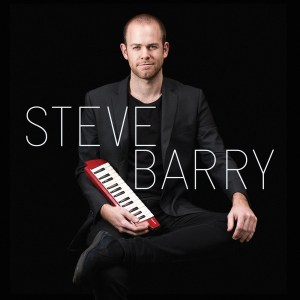
Steve Barry

Steve Barry the Auckland born Jazz pianist left New Zealand a few years ago and with him he carried our highest expectations.  That can be a distraction to an emerging artist, but Steve possesses a faculty that overrides distractions.  He is one of the better pianists that I have heard and there is a back story to that.  His focus is unwavering to the point of obsession and he is an artist that won’t be  hurried.  We impatiently awaited his first album, the eponymously named ‘Steve Barry‘; always urging him to record.  He resisted all entreaties, practicing and refining while an innate sense of timing guided him.

He was right and we were wrong – now is the perfect time.  The album launch at the CJC (Creative Jazz Club) and the album itself fulfilled every expectation.

This is an artist who puts the integrity of the music before any rapid career path.  This is the right time for the album release, placed as it is firmly within the ambit of work being done by Aaron Parks, Matt Penman, Kurt Rosenwinkel and other ground breaking younger artists.  This new sound is gaining ascendency and with adherents like Will Vinson, Lage Lund and Mike Moreno it will continue to do so (‘James Farm’ are perhaps the epitome).  This music is mainstream Jazz but it references sources as diverse as Lenny Tristano, Indie Rock and even Hip Hop.  The fractured and complex rhythms are juxtaposed with soaring fluid guitar lines.  Against that are the textures and layers of melody.   Only the best musicians can pull this material off and only the best composers can write such material.

While Steve is clearly influenced by this ‘new sound’ he is no slavish imitator.   He has found something that often alludes younger pianists; a recognisable and original voice.Tim Firth

One listen to this album explains everything about this artist and this incredible band.  All of the tunes on the new album are composed by Steve Barry and the compositions are sometimes dense and multi-layered.  This is a musical journey of the profoundest sort.  One that demands your fullest attention and perhaps a little knowledge of what is happening in the Jazz world.  The highest rewards in Jazz occur when we understand something of what is going on.   This is not background music for cocktail parties.  This is up to the minute real.

Jazz musicians tell me that the ones who succeed are those with an almost monomaniacal focus; Steve is such a musician.  He works harder than most as do the band members.   These guys have been playing together for a number of years and they respond to each others every nuance.   If you close your eyes when Tim Firth is playing, you blink them open just to make sure that Eric Harland hasn’t jumped into the drum chair.  His ability to chop up rhythms and channel trip-hop beats is nothing less than astonishing.  I have seen drummers watch him in open-mouthed amazement.  He can also launch a flurry of quiet brush work which is never-the-less as propulsive as a whispering rocket.

Alex Boneham is another stellar musician and he has long been a favourite with New Zealand bass players and Jazz fans.  He is the glue holding these often complex compositions in place and he does so with unwavering certainty.  As the charts unfold the musicians pull away from the known – taking different routes as they stretch against the boundaries.  In spite of the complexity and the risk taking, the implied centre always holds firm.   One musician said to me that he had never heard a band hold such a tight centre while reaching so far into the unknown.  Alex Boneham

The program was nicely balanced and to do this the band deviated from the album on occasion.   There were three lessor known standards performed on the night and the one that stood out was Wayne Shorter’s achingly beautiful ballad ‘Teru’ (from ‘Adams Apple’).   There were two Shorter tunes and that did not surprise me.  Shorter’s works are deceptively complex and they fitted tidily into the repertoire.   As nice as the Shorter was, Steve Barry’s own compositions are the most deserving of praise.   Many of us in Auckland are familiar with these as he has been refining them over several years.  Each time I hear a tune like ‘Parks’, Unconcious-lee (yes referencing Tristano) or ‘Clusters’, I find that the works have evolved.   This is what good Jazz is about.  A restless exploration into the heart of the music.

The highlight of the evening came at the beginning of the second set.   The trio launched into a spirited up-tempo number ‘Changes’ which segued into a long probing introduction.   The solo introduction was of a quality that we seldom hear – no one breathed as the piece unfolded delicately.  The new tune was ‘Vintage’ (also from the album).  At a point so delicately balanced that no one saw it coming we suddenly became aware of the pulse of brushes.  The moment was so perfectly executed  that a gentle gasp arose from the audience.  There were fleeting glances left and right as everyone acknowledged the moment they had witnessed.  The brushes played a solid 4/4 groove over the tune which is in 7/4.

An older woman next to me had tears of joy in her eye; “It was so wonderful that I dared not breathe” she said.  “I was his original piano teacher and as a pupil he was one in a thousand.  He worked harder than most and was relentlessly passionate about music”.  This confirmed the source of the magic, hard work endless commitment….and chops.

There is an additional member on the album who did not make the New Zealand leg of the release tour, Carl Morgan.   His work is also extraordinary and very much in the style of Lage Lund, Kurt Rosenwinkel and Mike Moreno.  The album deserves to do well and if it’s distributed widely enough it will.   Don’t just take my word for it; buy a copy and judge for yourself.   Be quick because the copies will go fast.  This is a must for any Jazz Lovers stocking whether you’re from Oceania or further afield.     CD Art - Front Cover

WHAT: ‘Steve Barry’ Cd  Jazz Groove Records, http://www.stevebarrymusic.com

WHO: Steve Barry (piano), Alex Boneham (bass), Tim Firth (drums), Carl Morgan (Guitar 3,4,9)

WHERE: Launch tour at CJC (Creative Jazz Club)

WHEN: November 28-11-2012

Sean Coffin (AUS)@ CJC

On Wednesday the 24th October we had an overseas visitor playing at the club, tenor saxophonist Sean Coffin.   This has been a great year for the Auckland Jazz scene and especially for the CJC (Creative Jazz Club) as a number of interesting local bands, out-of -towner’s, and overseas acts have appeared.  It’s the clubs imperative to offer genuine diversity, and this has caused the CJC to extend its reach.   Because Roger Manins has such a well established Australasian reputation and because the CJC is increasingly seen as a great club to play in, the net is ever-widening.   We are on the Oceania Jazz circuit fair and square.  

Sean Coffin is known in his native Australia for his stellar educational work, but it is his high level tenor playing that draws people to him.  He is among the best that Australia has to offer.   For many years he has been accompanied by his brother Greg (piano) and the work of this formidable pair is well recorded.   Sean studied at the Berklee School of Music and later as a postgraduate at the Manhattan  School of Music.  Among his many teachers I would single out George Garzone, as this world leading tenor player appears to have created a cadre of exceptional students in Australasia.  

At the CJC Sean showcased his most recent compositions and they were mostly themed around his children.  This proved a good source of inspiration as the numbers ranged from heart-felt ballads to some faster paced offerings (one referenced children at play).   These lovingly drawn compositions were well crafted and executed and no one had difficulty relating to them.   It is arguably risky to focus exclusively on family material, but the gamble paid off because the improvisations were tender without once descending into introspective noodling.   The integrity of the compositions as Jazz vehicles was always evident.  A lovely ballad to ‘Garz’ (dedicated to George Garzone) rounded things off nicely.

A local rhythm section was put together for this gig and in due deference to the visitor he was given the best.  Ron Sampsom (drums) and Oli Holland (upright bass).  With Kevin Field overseas, Dr Stephen Small took the piano chair.  No one needs to puzzle over my views on Ron Sampson and Oli Holland as my support for their work has been constant over time.  These two go way beyond the merely competent; they are solid, reliable musicians and they are also gutsy enough to handle new challenges without flinching.   Listening to them live or in a recorded situation will tell you everything you need to know.

Seeing Stephen Small again was an unexpected pleasure, as the patch he normally patrols is on the periphery of the Jazz world.  Because he teaches classical piano at Auckland University it would be easy to overlook the fact that he has other strings to his bow.   He is a madman on keyboards and I have seen him cut loose on banks of synthesisers during a Jazz fusion gig.   To say that his fusion performance was riveting would be an understatement.  He created textural layers of sound which swirled and soared alternatively.  Put him together with a fusion versed guitarist like Nick Granville or Dixon Nacey and he will take your ears apart in the best possible way.  Stephen is also a highly talented, straight-ahead, post-bop pianist and judging by the whoops of delight as he negotiated his solo’s he needs to get down to the CJC more often.   I am casting my vote for one of his Jazz fusion gigs.

Sean worked hard all evening and at the end he invited Roger Manins to the bandstand.   There was obvious respect between the two men but that didn’t stop them from going hard out.  When the best tenor players occupy the same bandstand, it generally ends up being a joyful celebration rather than a cutting contest.   This was respectful but no quarter was given.

Spoilers of Utopia / Ruckus@CJC

The way that music is interpreted by the human brain is understood up to a point, but there are many mysteries remaining. The topic interests neuroscientists, fans and musicians alike. While pattern recognition is one the of the main hooks drawing us deeper into a piece of music, we also become bored if the pattern remains relentlessly familiar. That doesn’t rule out repeated notes or a vamp as the points of variance are incredibly subtle; groove music or John Cage compositions bear this out. Whether subtle or overt, educated Jazz audiences prefer music that challenges, delights, reveals or amazes.

Good Jazz and improvised music does this despite the few fans who slavishly confine themselves to a single era or style. Live gigs will drag you out of your comfort zone and here’s the thing. Music is a language and we learn by hearing the unfamiliar and comparing it with what we know. Learning language is an innate skill possessed by all humans. As we listen to what we are unsure of, our tastes grow proportionally. These days Dolphy, Ornette Coleman, Art Ensemble of Chicago, Carla Bley and Zorn have a solid foothold in our consciousness; just as Jackson Pollack makes overwhelming sense when seen on a gallery wall. Jazz listeners should always want more than sonic wallpaper.

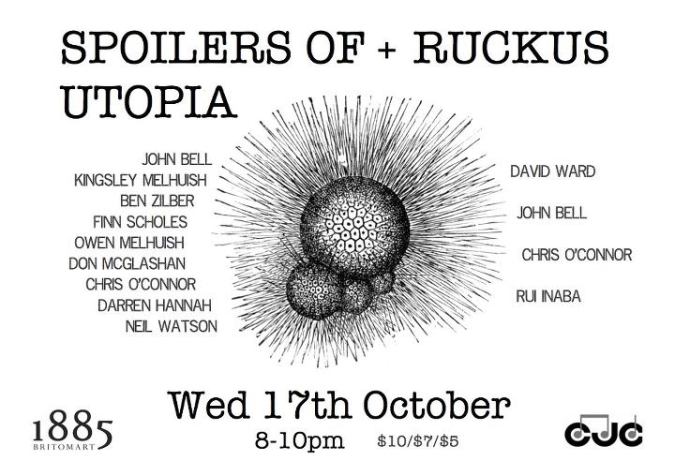
In keeping with Roger Manins enlightened approach as program director of the CJC (Creative Jazz Club), he had booked two very interesting groups to play on the 17th October 2012. First up was ‘Ruckus’, a quartet that was anything but run of the mill. The second was the out-brass ensemble (+ four), ‘Spoilers of Utopia’. What we got was joyful, challenging and outrageously humorous music. Music that was fiendishly clever without once resorting to introspective navel gazing.

‘Ruckus’ led by David Ward, a fine guitarist who has assimilated a dozen guitar styles and then stepped free of them. He composed the tunes Ruckus played and they were a metaphor for the inventiveness and vibrancy of the New Zealand Jazz scene. The set list was interesting and the group showed real guts in their interpretations. No one cruised through this material and consequently the collective pulse was quickly amped to a point of high intensity. Some of this material was reminiscent of a Fellini soundtrack, while still managing to evoke real-time global references. It was modern in the best possible way while hinting at its musical origins. I like musical surprises and this music surprised me.

Club goers recognised two well-known locals in ‘Ruckus’, Chris O’Connor (d) and John Bell (vibes). I do not recall seeing the bass player Rui Inaba before but this unit really did come together. Chris and John had double duties this night as they were not only in ‘Ruckus’ but in the ‘Spoilers of Utopia’ as well.

Chris is a drummer that I am very familiar with as his multifaceted approach to traps and percussion makes him a favourite on a number of scenes. He is one of the most talented, open and interesting drummers in New Zealand and it is always fascinating to watch how other drummers flock to hear him. Chris never rushes to fill any void as he understands how complete an implied or missed beat is. He has such a well honed sense of time that he can push at the fabric of reason without losing momentum . He also knows how to remain relaxed at the kit and how to say more with less. The fact that he is one of the nicest cats on the music scene is an added bonus.

John Bell is an extraordinary vibes player and he generally favours the free over the straight ahead. In Ruckus he showed that he is comfortable moving between both worlds. He can swing like ‘Hamp’ then merge that groove seamlessly into an irregular pulse. The one thing that stands out however is his musical courage. John shows an integrity that few vibists do. While a lovely ringing vibrato is what we most often associate with the vibes (early Gary Burton or Bags), the instrument is capable of more besides. He is recapturing the history of the vibraphone while showing us a possible future path. The vibraphone is a percussion instrument and that can easily be forgotten.

The Spoilers of Utopia (also ‘Tparty Spoilers of Utopia’) are a brass heavy ensemble and they are marching resolutely into new territory. While the charts are initially familiar they are never quite what you think. The genius of this music is its kaleidoscopic quality, as it reflects a thousand fractured images while somehow keeping the whole intact. We feel that we can almost grasp the essence; only to find the familiar deconstructed. A pack of travelling Jesters has skilfully woven a new cloth from the old and what was once orderly descends into a pleasant chaos. We follow the twists and turns and just as we fear we are lost…. a disciplined brass band marches out of the haze. This is a new take on tension and release and it really works for me.

The ‘Spoilers of Utopia’ are usually a nonet and as anyone who knows me will verify, I just love a nonet. They are big enough to create to create the illusion of a larger unit but small enough to leave a sense of airiness. To balance out the five brass instruments there was Vibraphonist (John Bell), guitarist (Neil Watson), bass player(Darren Hannah) and drummer (Chris O’Connor). The Brass section were Kingsley Melhuish, Ben Ziber, Finn Scholes, Owen Melhuish, (Don McGlashan absent that night).

I know Finn Scholes having been wowed by his facility on the trumpet (or flugal horn) before. Neil Watson is also a familiar figure at the CJC and I noted how well his solid-body guitar sound fitted the brass dominant ensemble. I liked his contributions enormously and knowing his quirky offbeat take on life and music, it must have been a no-brainer to include him in the mix. There was also a degree of unison playing and with the unusual instrumental configurations, the timbre of the instruments merged to create a richer sound. George Shearing and Tristano grasped this long ago. Having Piano, vibes and/or guitar playing unison lines changed the sound. Putting vibes and guitar with brass was to produce a wonderful contrast. As the ensemble moved from order to chaos and back again I could feel the guiding spirit of John Bell at work: the demented dance instructor shimmering in darkness.

The track that I have selected from the ‘Spoilers of Utopia’ set is so good that I have watched it over and over. The tune is a hymn beloved of the Salvation Army bands, ‘We’re Marching to Zion’ (Sankey). Someone decided on the spot that a drum solo should occur in the middle. As the band proceeded the overall effect of this anarchic but strangely reverential wizardry brought us to our feet? The audience showed wild enthusiasm (and if you peered into the darkness and listened carefully, I swear you could hear Sankey laughing).

This comes from where Jazz began; brass marching bands and random instruments merging to form a new and riskier sound.

Thank you to Jen Sol for providing the video material (as I stupidly forgot my camera bag on that night)

Trudy Lile Quartet @ CJC

Jazz Flute is sometimes relegated to a place of lessor importance in the scheme of things and a few say that the instrument lacks the expression of the more ubiquitous reeds.   As with all things in Jazz it depends entirely on who is playing the instrument and how they apply themselves to the task.  If such naysayers had witnessed Trudy Lile on Wednesday the 10th of October 2012 at the CJC (Creative Jazz Club) they’d have swallowed their words.   This was expressive and extremely lively flute playing and no one with half a brain could doubt Lile’s supremacy on the instrument.  She is a master of extended flute technique but the effects are always applied tastefully.  

As well as being a premier Jazz flutist, Trudy Lile is also a composer and vocalist .  These three skills were all evident at the CJC gig as she showcased many of her own compositions.   The numbers were engaging and tended toward the melodic (as you would expect of flute compositions).

I have selected one of these compositions as a typical example (see You Tube clip).   Her ‘Kingston 787’ has a well-arranged head, which as it develops, becomes the perfect springboard for extended improvisation. With the vague promise of summer in the offing I was in the mood for this type of number.  Swinging and soaring like a skylark – a tune that pleased the ear and invited you along for the journey without losing you before the end.

‘Kingston 787’ is a great composition, referring to the famous South Island steam engine of that name.  There is ample precedent in Jazz for writing charts about steam trains and two of the most notable examples are Gerry Mulligan’s ‘The Age of Steam’ (who could forget ‘K-9 Pacific) and Oscar Peterson’s memorable ‘Night Train’.   Trains and jazz have always been linked as musicians rushed between gigs; writing charts to the clickity-clack.  

While there were a few numbers by other people there were seven Trudy Lile originals.   First up was a feisty tune named ‘Flute Salad’ (Lile), followed by ‘Winter Wind’ (Parlato), ‘Night Bird’ (Enrico Pieranunzi), ‘Emily’ (Lile), ‘If I Fell’ (Lennon/McCartney), ‘Kingston 787’ (Lile), ‘Hammond Sandwich’ (Lile), ‘The Laughing Song’ (Lile), ‘Smile Like That’ (E.Spaulding), ‘Frodo’s Mojo’ (Lile), ‘Gone By Lunchtime’ (Lile).  The choice of lessor known tunes by well-known musicians worked well as a contrast.  It offered comparisons and her own compositions stood up well against the likes of Pieranunzi.  For ‘If I Fell’ Trudy played piano and sang, accompanied only by a first year student Sam Swindells on guitar.  

Her regular band is Mark Baynes (piano), Jo Shum (upright bass) and Jason Orme (drums).   This unit has been together for some time and it shows.   I have caught Jo and Jason many times at gigs but this was the first time that I had heard Mark.   It proved a good introduction to his playing and the musical rapport between he and Trudy worked well.  Mark’s touch and voicings are different from the pianists we see regularly at the club and it is encouraging to see such stylistic diversity in our city.   Mark is a keen student of Brad Mehldau and this focus has undoubtedly shaped his approach to the instrument.

Jo gets better and better every time I see her as she has the ability to provide a solid cushion beneath the piano and flute – freeing up both as she holds the centre.  By contrast her soloing was highly melodic and perhaps it is this which makes her so right for working with Trudy.  When her amp failed mid number her loss from the mix was noticeable although the rest of the band played on without faltering.

Jason Orme is the other regular and he and Trudy go back a long way.   Jason is a versatile drummer who knows exactly what his job is.   For this gig he shared the drum duties with first year student Michael Harray.  Michael played drums for one number and percussion for several more.   On ‘Kingston 787’ we heard both drums and percussion.   They worked extremely well together – I like gigs with a percussionist and a drummer and Michael was superb.

Another student Joel Griffin played alto on one number and a jazz choir joined Trudy on another.   None of these students let Trudy down.

There is a significant thing to appreciate about Trudy Lile and that is her role as an enabler.   She teaches Jazz studies at the NZSM Massey Campus and is on a perpetual quest to promote, challenge and push her students into playing in situations like this.  Sharing your prized gigs with beginning students has its risks but the rewards are far greater.   It is only through being tested against more experienced players that they learn.

Trudy gives a lot to the Jazz scene but I’m not sure that it is always acknowledged.  When it comes to the academic world such dedication is all too often overlooked.  I have pondered this and wonder if old fashioned misogyny is at play.

The leading Jazz flute players in the world are now predominately women (Nicole Mitchell and Jamie Baum just won the Down Beat critics poll).   The students understand this issue perfectly as many have voiced it to me.   Progression in teaching or on the bandstand must be merit based and gender blind.

The CJC and especially Roger Manins set a very good example in this regard.

P J Koopman quartet (with James Wylie)@ CJC

P J Koopman and Thomas Botting joined the ‘music drain’ exodus to Australia two years ago but Auckland still draws them back from time to time.  When they do return they are always booked at the CJC Jazz Club and this invariably draws old friends and new.   PJ Koopman is one of those guitarists who makes it look easy, but like all dedicated musicians he works extremely hard at his craft.  The CJC gig on the 3rd of October featured many of the fast flowing post bop tunes that PJ excels at, but there was something else in the mix.  His repertoire soon expanded to include some country tinged material of the sort Bill Frisell and Bruce Forman exemplify and while there were only two such numbers, it gave the evening a flavour that it would otherwise not have had.  This had the feel of an interesting project in the making.  

Thomas may not have put on any physical weight but he has certainly beefed up his compositional credentials .   After a week of listening to Americana just prior to returning to New Zealand, he has composed a tune, which I will now include as a You Tube clip.   This is a great composition and one which they executed well.   The tune called ‘Wylie Coyote’  had been written to honour alto saxophonist James Wylie, who joined the band for this one gig.   James is an ex-pat Kiwi who lives in Thessaloniki Greece and was due to return there within hours of the gig finishing.   James is well-known for his oblique takes on country tunes and so this title was appropriate on so many levels.   His out of left field rendition of Wichita Lineman is a perennial favourite.  

P J Koopman was exactly the right guitarist to tackle this tune and I’m certain Thomas had that firmly in mind when he composed it.  I had not heard PJ do this type of material before, but the fact that he did it so well is scarcely surprising.   He has open ears, good mentors, great chops and above all taste.   His Frisell like slurred chords portrayed the roots of the genre (and perhaps his other influences); but without sacrificing his originality.  The other country tune was the gorgeous ‘Tennessee Waltz’ and the first few chords took me back to a film I saw in the 70’s.  Antonioni’s movie Zubritzki Point was a portrayal of the youth counterculture and its soundtrack has outlived the popularity of the movie.  The soundtrack featured Pink Floyd (‘Heart Beat Pig Meat’ – who could forget the exploding food in slow motion), The Grateful Dead and Jerry Garcia solo (playing etherial improvised licks while the actors writhed in a strange love-making frenzy which stirred up lots of desert dust).  best of all was the version of Tennessee Waltz which twanged out sweetly while tumbleweeds blew past a silent desert bar.    This track conjured up all that happy madness again and this is the power of good music.  

The drummer on the gig was Andrew Keegan, who has recently moved up from Christchurch to Auckland .   Andrew is an invaluable asset to the Auckland scene.   ‘Wylie Coyote’ was in 4/4 time but the feel was different because of the way the beats were accented.   Andrew handled his traps like he had been playing with these cats for months.   Nice work all round.

Jamie Oehlers NZ quartet@CJC

There are good gigs, bad gigs, predictable gigs and everything in between. Mostly we appreciate what is before us but just occasionally, we attend a gig that is every kind of wonderful. This was it.

Jamie Oehlers has the sort of reputation that scares aspiring tenor players and creates life-long fans. This man is a monster on the tenor saxophone and no amount of scrambling for adjectives on my part is ever going to capture the intensity of his performance. Luckily I filmed much of the gig and so I will put up a number of cuts on You Tube over the coming weeks. This gig won’t be forgotten as it fizzed and washed over us like a blissful tsunami of sound.

Typical of many Australasian musicians Jamie Oehlers is self-effacing, and quietly humorous, but his down to earth persona remains intact only until he puts the horn in his mouth. Then we see confidence, elegance, fire-breathing and effortless virtuosity of a sort that almost defies belief. He is one of those musicians who reaches beyond the known, bringing the rhythm section and the audience along with him. His solos have an almost mystical coherence; as if guided by a universal logic that he is able to share with the audience.

Those who saw the performance at the CJC on the 19th September 2012 will understand exactly what I am saying.

As marvellous as Jamie was, his local rhythm section was there for him every inch of the way. Not for the first time I marvelled as Kevin Field (piano) responded to every challenge, managing to inject a sense of originality and invention into a number of almost unassailable standards. Kevin stands out as a pianist as he understands perfectly which chords to accent, when to lay out and when to work harder behind the soloist. He is exactly the right pianist to play behind a talented visitor.

Oli Holland was so good during this gig that I embarrassed him with a bear hug afterwards. He could have been Reggie Garrison at one point as the urgent stabbing notes from his bass propelled the others on. Listen to the first clip below and particularly where Kevin is soloing. This unit was never less than in perfect lockstep.

Frank Gibson on drums was equally marvellous. You never know how drummers will respond to high-octane material like this but he responded by reaching deep within and capturing every nuance of the set. I have never heard him perform better.

The first set began with the standard ‘On a Clear Day’ (Lane), ‘Alina’ AKA ‘Variation 11 from Suspended Night’ (Tomasz Stanko) [one of my favourite tunes], ‘Aisha’ (John Coltrane), ‘Take the Coltrane'( Ellington-Coltrane) , Portrait in Black and White ( Jobim) and more.

Near the end of the second set the band decided to play John Coltrane’s ‘Resolution’ from ‘A Love Supreme’ (1962). ‘A Love Supreme’ is hardly ever played and more is the pity. This avoidance relates to the holy grail status of ‘A Love Supreme’ among post Coltrane saxophonists. My view is that we should honour it and especially in this week. John Coltrane was born on September 23rd. It is a shame not to have all four movements performed together though; ‘Resolution’ is after all only a part of a mystical four piece puzzle which makes perfect sense when heard in its entirety.

Jamie stated the theme over and again, but each time working in subtle re-harmonisations and embarking upon brief angular explorations. We knew intuitively that we would end up in a place of almost unbearable intensity and we were on the edges of our seats in expectation. This was not a gate to be rushed and although we understood that, the anticipation was palpable. Tension and release is at the very essence of Jazz and Jamie achieve this end by stalking his prey in measured steps like a confident hunter.

‘Resolution’ is an Everest of a tune utilising Coltrane’s new-found ideas which were somewhere between hard bop and free. Jamie interpreted intelligently without trying to out do Coltrane. He made it his ‘Resolution’ as well. Kevin field was the same, as he took a more oblique approach than McCoy Tyner. This was a perfect homage without being a slavish imitation.

At the end of the gig we received an additional treat when Jamie asked Roger Manins to play. The best moment was when they played ‘On Green Dolphin Street‘ (Washington). With these two masters working the changes and probing every hidden corner of the melody, it reminded us that standards interpreted with integrity can sound as fresh as at first hearing.

Jamie Oehlers lives in Australia where he runs a Jazz School. He has so many awards that storage must be problem (including being judged winner of the ‘World Saxophone Competition’ in Montreux by Charles Lloyd and Bruce Lundvall of Blue Note). He has put out 10 albums as leader as well as being sideman for the whose who of the Jazz world.

I ran into Jazz guitarist Dixon Nacey as I was leaving and he summed it up nicely. “Man I have just received a series of Jazz upper-cuts”.

James Wylie & Friends@CJC

James Wylie is a respected saxophonist, clarinetist and composer who has played, studied and taught all over the world. He initially studied in Wellington where he attended the New Zealand School of Music. One and a half years ago he moved to Berlin and soon after that to Thessaloniki in Greece.

Those reading the CJC webpages eagerly look out for returning expats, as they very often bring new ideas back with them while still retaining a core of that ‘New Zealand sound’. James played alto saxophone on this gig and he demonstrated why the alto is rapidly becoming a popular instrument again. For years the popularity of the alto waned but happily that is no longer the case. Improvised music often gives the impression of being a ‘blue skies’ horizon where no boundaries exist. All freedom comes from discipline and it is the knowledge of what works best in a given situation that marks players apart. Chops count but musical taste counts too. James showed an intuitive understanding of this.

Tonal and textural contrasts add considerable depth to a performance and in this we were well served. We not only heard the multiple facets of James Wylie’s tasteful alto playing, but we benefited from the addition of Roger Manins tenor. This was a double dose of saxophone magic. The quartet was completed by two Christchurch expats, Richie Pickard on upright bass and Andrew Keegan on drums.

While their first number ‘The Mooche’ (Ellington) got our attention, the second number ‘Just in Time Contrafact’ (Wylie) simply demanded it. It was an outright cooker. Roger Manins particularly shines in these situations and as he and James worked the changes and stretched out, there were enthusiastic cheers from the audience. The sets contained a couple of originals, some well-known standards and seldom played tunes by Jazz greats like Monk. Best of all were the tunes we have never heard in a Jazz setting. ‘Wichita Lineman’ (Campbell-Webb) – [It is a little known fact but Glenn Campbell was one of the original Beach Boys], ‘I can’t help falling in Love With You’ (Elvis) , and a memorable version of the standard ‘For All We Know’.

Nat Cole and Billie Holliday sung this so memorably (and hauntingly) that post 50’s bands often shied away from it. That is a pity because it can still evoke all of the emotions that made it a popular classic. The band approached it in the way that the late 50’s piano-less quartets did. Playing contrapuntally while extracting the maximum beauty from the melody. In this style of playing the bass is pivotal and Richie Pickard was perfect.

While the horns naturally took centre stage I never-the-less had my attention drawn to drummer Andrew Keegan again and again. The quality of New Zealand drummers often amaze and Andrew is a traps player I will keep an eye on. He is not overly busy but he has an in-the-pocket propulsive style. He listens carefully to what the others are doing and reacts in kind.

The last portion of the second set featured James interpretations of traditional Greek songs. My love of Mediterranean infused Jazz is constant and hearing Greek music was a treat. James interpreted the lovely melodic tunes (in crazy time signatures) with an ease that can only signify his deep interest in this music. In this portion he accompanied Greek singer Egli Katsiki. Her voice while a little soft at times resonated perfectly with the keening alto and between them they reached deep into the hearts of the spellbound listeners.

It was nice to have James here and I am keen to see where his musical journey takes him next (back here soon I hope).

Connor McAneny Trio – Matt Steele Trio@CJC

Connor@CJC

This gig was signalled by CJC Jazz club some months ago and as I am a real fan of piano trio’s I had looked forward to it.  It was hinted that this would be a duel, but both trio’s approached the gig from quite different perspectives and this makes comparisons a little redundant.   It was perhaps surprising as these are Auckland University Jazz Studies students and you would not expect to find such interesting stylistic diversity in young pianists.

While the gig was a tribute to Connor and Matt (and their sidemen), it was also a tribute to Kevin Field their teacher.   A gifted pianist who obviously encourages students to find their own voice.

The first up was the Connor McAneny trio.   Connor (piano), Cameron McArthur (bass) and Chris Wratt (drums).   The set began with the famous medium tempo hard bop classic ‘Inner Urge’ (by tenor man Joe Henderson).  There were also a number of interesting originals played with intriguing titles (e.g. Black Monday, Underwear) but my pick was the fabulous Lennie Tristano tune ‘317 East 32nd Street’.  I love Tristano tunes with their long probing lines and relentless forward propulsion.  When Lennie was around his drummers had to keep a subdued metronome-like beat, but that approach has gradually faded into the mists of time.   This is a tune that begs interpretation and interplay between piano, bass and drums is now a part of that exploration.  The constant however is the rhythmic momentum of the piano.  This is not an easy tune to play, but Connor executed it extremely well.  Chris Wratt met the challenge interestingly, as he kept the pulse while working hard against the bass lines.

Cameron McArthur has been noticeably stepping up this year and that he played in both trios while dealing effortlessly with the differing approaches is an indication of his growth as a musician.  Only a fortnight has passed since he played with the AJO at the Bennie Maupin, Dick Oatts concert where he acquitted himself well (Matt Steele also played with the AJO on that gig).  Cameron’s solo on ‘317 East 32nd Street’ was memorable.

Matt Steele is a pianist that I have been watching for some time and I have made no secret of my enthusiasm for his rapid progress as a musician.  With each passing month he navigates increasingly difficult territory and being challenged in a variety of gig situations is working for him.  There is a hint of the European Jazz pianists like Marcin Wasilewski in his playing, but there is also a boldness and clarity that is not often heard in a student.  It is partly the way he approaches a piece (allowing compositions room to breathe) and it his clean melodic touch.  He is a particularly animated player (making him hard to photograph) but the movement appears to give his tunes a strong sense of swing.   It was therefore no surprise when the first tune in his set was ‘Little One’ (Tomasz Stanko).   It originated from ‘Suspended Night – Variation v1’ but this version is a later incarnation.    That is why I was sure that knew it well, but could not place the title.  Matt also played some compositions of his own and these showed promise.

Once again Cameron Arthur was on bass and he dealt with this different material as adeptly as he dealt with Connors.

I had expected Matt to bring his usual Trio, but instead he used Cameron and well-respected Auckland drummer Stephen Thomas.  Stephen’s inclusion was inspired, as he brought a very different feel to the numbers.  While Jared had been adept in subtle colourist drumming, Stephen ramped up the proceedings by throwing constant challenges in the direction of the bass and piano.   That is not to say that his drumming was overly busy, but he did exactly what a drummer on a live gig should do; laid down a perfect improvisational platform while throwing in a few twists and turns of his own.

The trio communicated beautifully and they never lost sight of each other musically. 

I love to see emerging pianists in action and especially when they deliver.   The above trios convinced a seasoned audience that they were both worthy of future attention.

Paul Nairn’s Phantom Quartet@CJC

When I saw Paul Nairn’s name on the CJC website I wrongly jumped to the conclusion that he was unknown to me.   I had actually met Paul when a friend introduced me several months ago.  Perhaps it was the CJC promotional picture that threw me.    The picture is very clever as it appears to reference one of the giants of the post-war West Coast tenor scene.  Harold Land (‘Harold in the Land of Jazz’ album).  Harold is pictured with a controversial steel sculpture framing the shot; Paul against a large steel electricity pylon.  I am geeky enough about Jazz history and Jazz cover art to love the reference, as the juxtaposition is so tongue in cheek and so Kiwi.    Anyone with knowledge of ‘Land’ or Jazz artwork will have smiled in delight at the sight of it.   I would be amazed if the reference was accidental but who knows.

Paul has a reputation for being somewhat reclusive when it comes to gigging but he is one of the go-to people when it comes to horn maintenance.  He should step into the limelight more often because it was a pleasure to spend an evening with his Phantom Band.  The band delighted the audience with many lessor known standards and in some cases seldom heard arrangements of very familiar standards (such the lovely Naima by John Coltrane).  What works best for me is musicians enjoying the material they are playing and making no apologies for it.  ‘God Save the Weasel’ could work as a Jazz vehicle if musicians committed themselves to the task in hand.  This band enjoyed what they were doing.

The Phantom band are all veterans, with the ever popular Phil Broadhurst on piano, Alberto Santorelli on bass and Frank Gibson Jnr on drums.

They played compositions by John Coltrane, Cedar Walton, Wayne Shorter, Gato Barbieri and an original by Phil Broadhurst.   The Phil Broadhurst composition ‘Tuneless’ was a vehicle for piano and drums interaction.  The bass and sax laid out.  While Phil developed his attractive ostinato lines, Frank Gibson responded with colourist, Paul Motian like filigree.    It worked nicely as a contrast to the standards. 

I was torn between posting a video of Naima (Coltrane) or the Gato Barbieri number ‘Last Tango in Paris‘.   I chose the latter for a number of reasons.  It was played beautifully, it was deeply evocative and it is a tune that is seldom heard these days (to my regret).   ‘Last Tango in Paris’ comes from the famous 1972 movie and while millions would recognise the tune they would have no idea who the Argentinean Barbieri was.   It was one of those rare moments where a Jazz performance passed deep into the heart of popular culture without the public realising it.   If anyone hasn’t seen this extraordinarily well acted and confronting movie starring Marlin Brando and Marie Schneider they should remedy that.  In the hands of Bernardo Bertolucci a plethora of romantic and erotic issues were traversed and the sales of condiments soared.  Barbieri was nominated for a Grammy and Brando was hailed as the greatest actor of all time.  ‘El Gato Barbieri’ (the cat) spent the subsequent years as an A & R man and in pursuing his avant-garde dreams.   Thanks for the memory Paul.  

b

The Silhouette of Mr Pink @ CJC

On the 25th July 2012 the Christchurch band ‘The Silhouette of Mr Pink ‘ fronted the CJC.   I had heard Roger Manins speak enthusiastically about the ‘New Music Collective’ and of Tamara Smith, but I had not yet encountered her music (I don’t think that Tamara or the band have recorded although they featured on Colette Jansen’s ‘Jazz Footprints’ program earlier in the year).

It is becoming commonplace for small groups to omit chordal instruments and this group was essentially a flute led trio/quartet.   The variety of instrumental configurations popping up around the country tells me that New Zealand Jazz audiences are increasingly open to adventurous and quirky Jazz.

Tamara is a real presence on stage and her personality and chops leave you in no doubt that she could play solo flute and still hold the attention of an audience.  

The band opened the first set as a trio, with Tamara on C & Alto flutes, Andrew Keegan on drums and Mike Story on bass.  Tamara’s compositions were reworked for the gig and they emanated from a long sojourn in Paris when she was younger.  The compositions sounded fresh and in many ways unexpected as they tallied perfectly with the stories that Tamara told.   Her musical and verbal vignettes spoke of exotic locations and they reminded me of haiku.  Perfectly contained miniatures – pebbles of sound hitting a pond and spreading like ripples.  It was up to us to interpret and we did; this drew the audience nicely into the creative process.

As the evening progressed the fourth member of the band Chris Burke (tenor sax) joined in.  In keeping with the smaller group he tended to favour unison lines unless either he or Tamara were soloing.

The track that I have put up “Cheeky Monkey” was composed by Tamara and it gives a good account of the group’s dynamics.   It begins with her playing unaccompanied (although you would hardly know that, so full is the sound).   Many of the modern flute techniques can be heard such as her singing in parallel harmony and in producing a multitude of extended flute techniques too numerous to mention.  The multi-phonic effects added real depth the sound.  

b

Rebecca Melrose band /New Collective Experiment@CJC

Wednesday 18th July was a double bill and the first up was ‘The New Collective Experiment’ – Adam Larson (alto), Ross Larson (electric bass), Frank Conway (drums).   The band had stated their intention from the first few notes and having marked out their wide open territory they dug deep.   The act was billed as ‘creating music out of the moment’ and that is exactly what they did.   The saxophonist spun out a kaleidoscope of images while the bass and drums responded.  The strength of the Alto brought it to the forefront and while the interplay was a little less even during the longest pieces, the horn held the focus.   There was one number at the end of the first set in which Dixon Nacey was invited onto the bandstand.   Having Dixon on the bandstand will ultra enhance any performance.

The second act on the billing was the Rebecca Melrose band (an octet).   This was her first CJC gig as leader.   Rebecca (vocals, leader) gives Jazz numbers a hint of soul.  What quickly becomes evident though is her preparedness to confront more challenging Jazz material unflinchingly.   Like a number of young singers she can scat with ease and it is during these moments that her inventiveness comes to the fore.  I was intrigued by the choice of material which ranged from the easy-going to the braver forays. A case in point was the wonderful ‘Zhivago’ by Kurt Rosenwinkel.    She had wisely chosen to do this number as a duo with Dixon Nacey.

If you can’t get Kurt Rosenwinkel to fly in then go straight to Dixon.   My god he was wonderful and his fans in the audience were delighted to hear him eating up the changes of this deceptively complex song.  He knew just where to place those chords and when to back off.   Rebecca knew that she had a unique situation on her hands and she responded extremely well.    This is the clip that I have put up (especially after a number of people in the audience emailed me their wish lists).  The sound in the clip is a little guitar heavy but that is the fault of my HD Video equipment.  It was more balanced in reality.  This is a new standard for those with the chops to take it on.  I really liked the lyrics but had never heard them before – I learned that Rebecca had penned them and that all other compositions were hers.

The octet created a nice rounded sound and when they hit the sweet spot it was a joy to listen to them.   I have heard the Bass Player Eamon Edmunson-Wells and the drummer Jared Desvaux de Marigny before and they both impress.   Jared appears capable of fitting into many diverse situations and he managed this one with consummate ease.   Liz Stokes on trumpet is also a frequent performer at the CJC.   The remaining band members were: Ben Devery (piano), Manaf Ibrahim (guitar), Scott Thomas (tenor sax).  The venue was the Creative Jazz Club of Aotearoa (CJC)

‘Troubles’ hit the CJC

John Rae exhorting everyone; call & response

It has always been said that troubles arrive in pairs.   In this case the old adage was woefully awry as ‘The Troubles’ arrived in nonet form.  Their arrival may have ‘Rattled’ us somewhat, but we are built of stern stuff in Auckland.   We fortified our ourselves with strong liquor and pep talks, adjusted our parental lockout settings to allow for some serious swearing and settled in for the realpolitik of John Rae’s and Lucien Johnson’s crazy-happy Jazz.     ‘Oh Yeah’, we told ourselves, ‘We are ready to handle anything a Wellington band can throw our way’.

The Troubles-  call & response

There are bands that I like, bands that I respect and bands which drive me wild with pleasure.   ‘The Troubles’ are of the latter kind.   I’m besotted with this band and their deliberately ragged, madly political, quasi-serious satire.    This band digs deep into the well-springs of life and what bubbles up is a joyous lake of barely controlled madness.   The anarchic overtones are deliberate, but there is a scream-in-your-face humour that overshadows all else.   This is about chiaroscuro; a bunch of opposites vying with each other for attention.

This band is about plunging us without warning into the troubled spots of the world and then showing us humour where we thought none existed.  The overt political messages were a joy to me as I have never quite understood why this space is not filled more often.   The history of Jazz is intensely political and to describe ‘The Troubles’ music as a continuation of the work done by Carla Bley, Charlie Haden and especially Charles Mingus (even Benny Goodman) is not too far-fetched.    This band is a talented group of clowns shaking us by the scruff and saying; laugh or cry but for god’s sake look at the world about you.   There is no solace for Lehman Bros, Merrill Lynch, Barclay’s or John Key here.  For Jazz lovers with big ears there is joy aplenty.

This band is about call & response; not just between instrumentalists, but by the band vocally responding to John Rae’s trade mark exhortations.  Although he leads from the drum kit, that doesn’t prevent him standing up and shouting at the band (or the audience) to elicit stronger reactions.  During one of the middle Eastern sounding numbers (which appeared to lay the Wests hypocrisy bare), he shouted in what I can only assume was faux Arabic.  A flow of equally Arabic sounding responses flowed back .   It was the string section verbally responding as they wove their melodies around the theme.

On another occasion John Rae announced that we would be celebrating an often ignored trouble spot.   “I will now express solidarity with the North Americans”, he announced.  “The Sioux, Cherokee, Iroquois, Apache, Mohave etc”.   He began with a corny war dance drum beat which quickly morphed into a tune from ‘Annie Get Your Gun’.   As the melodic structure unwound into free-Jazz chaos we all understood the history lesson and laughed at the outrageousness of the portrayal.

Another Tango melody written by Lucien gradually reached a joyous fever pitch.  During the out-chorus the instruments dropped out one by one and as each instrument stopped playing the musicians raised a closed fist in a revolutionary salute.   Although it was quite dark in the club we had all picked up the cues.  This was a musical night beyond glib definition.
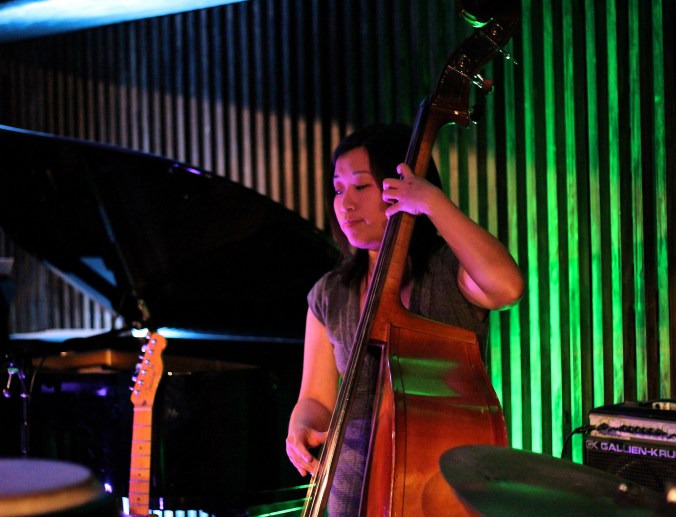
Like life, the music gave us lighter and then more thoughtful moments.  Musically it was amazing fun and after a difficult week I was suddenly glad I was alive.

Mission accomplished I think John and Lucien – keep shaking us up please.

John Rae (drums, co-leader, co-writer, co-arranger).  Lucien Johnson (sax, co-leader, co-arranger, co-writer).  Patrick Bleakley (double bass).  Daniel Yeabsley (Clarinet). Jake Baxendale (saxes). Hanna Fraser (violin). Charley Davenport (cello), Tristan Carter (violin). Andrew Filmer (viola).   Buy a copy of ‘The Troubles’ today at Rattle Records Ltd.  Venue – CJC Jazz Club Auckland.

Mark Lockett Trio – album launch @ CJC

Alex Boneham and Mark Lockett

Drummer led bands have never been commonplace and drummer led trio’s even less so.  Just because the leader is a drummer does not mean any more or less than it would if the leader was a bass player or a saxophonist.  A leader is there to impart a creative vision and this trio rose to the task.

On Wednesday the 4th of July the Rattle Records/ ‘Sneaking Out After Midnight’ launch tour arrived at the CJC in Auckland.   The prior and subsequent tweets or Facebook posts have pointed to the success of the gigs, which have been well received throughout New Zealand.  To read my earlier review see below ‘Mark Lockett – Sneaking Out After Midnight’ from this blog site.

Alex Boneham

The band that toured New Zealand may not have featured New Yorker’s, Joel Frahm (sax) or Orlando Le Fleming (bass) but we did extremely well with their replacements.  Mark had wryly commented that the former were unable to tour ‘for tax reasons’.    The Australian Alex Boneham replaced Orlando Le Fleming and his work is already well-known to the Auckland Jazz community.    Alex has previously toured here with the Steve Barry trio and I doubt that any of us will ever forget the telepathic interplay between Steve Barry (piano), Alex Boneham (bass) and Tim Firth (drums).   This is an in-demand bass player who recently won the ‘Best young Australian musician of the year award’.  He is both attentive and inventive and what you get is skillful interplay and adventurous improvisation.
The third trio member was Australian alto player Julian Wilson, who has worked with Mark Lockett for many years.   He acquitted himself well.

Julien Wilson

What particularly struck me was just how musical Mark’s drumming was and when he and Alex fell into lockstep it was riveting.   To purchase copy of ‘Sneaking Out After Midnight’ contact Rattle Records Ltd  (link).

I have streamed one track from the album titled ‘Mr Pickles’.  Mr Pickles is the story of Mark Lockett’s cat and an unfortunate neighbour – a hapless man who thought that he could outsmart a cat.   Being a great respecter of cats and their place in the Jazz story I could not help but include this.  This is as good a cat story as you will hear.

The Auckland Jazz Orchestra @ CJC 20th June

Steve Sheriff & Callum Passells (Altos)

I love Jazz big bands and couldn’t have been more pleased when Roger engaged the AJO to play on awards night. It is more than possible that I had dropped a hint. Nothing underscores an occasion like a Jazz orchestra and having a 17 piece band in an intimate space is the best of listening experiences. Those surges of raw power always please, but it is something else that I look for. It is their collective agility , the tension and release and the quality of their ensemble playing. This is quickly revealed if the charts are well written, and they were.

People like to compare big bands and as a spectator sport it has some currency. I can’t help wondering however if eggs are always being compared with eggs. There are rehearsal bands like the Village Vanguard Orchestra (Thad Jones Big Band) who meet once a week (but with ever-changing personnel). Less common are the professional or semi professional units who get regular work and whose core personnel are less likely change (The WDR, Mingus Big Band, Roger Fox Big Band). Lastly there are all-star bands which come together for a recording, a gig, a concept or just for fun (Bob Beldens ‘Miles Espanol’ Jazz Orchestra, The Kenny Wheeler Big Band).

The AJO falls mostly into the first group but there is another dimension to what they do: they are a writing band and part of their reason for existence is to write charts and/or to create original arrangements. Quite a few in the band write and that gives the band an Auckland flavour. The compositions tell our city’s story. As a city we need to value them more and ensure that they get the work and the recognition they deserve. The City Council needs to have them on their radar and call on them for appropriate official functions? Knowing Jazz musicians pay packets, the public purse would be left largely intact if they did.

Mike Booth

The AJO is a mix of seasoned players and new talent and this gives them a certain flavour. With their unfamiliar charts they perform a high wire act and because of that there is a hint of risk; to pull this off and at the same time entertain, requires a deftness of touch. The AJO has this as the co-founders Tim Atkinson and Mike Booth manage to inspire and guide without stifling creativity.

During the night we heard tight ensemble playing, a number of nice solos (particularly from Mike Booth, Theo Clearwater, Steve Sherriff, Andrew Hall, Callum Passells, Jono Tan and Matt Steele). Vanessa McGowen was terrific on bass and her presence was felt in just the right way. Andrea Groenewald on guitar demonstrated her soloing and comping skills. The latter added just the right Freddie Green touch to the overall mix. Swinging a big band is not always easy but this band swung.

There were two sets and thirteen numbers – among them were ‘It doesn’t Snow There’ – Atkinson, ‘On the Water’ – Booth, ‘All the things you are‘ – Kern/Hammerstein, ‘Those Nights’ – Hall. I have included a You Tube clip of there AJO performing Tim Atkinson’s composition and arrangement of ‘It Doesn’t Snow There’ – see below.

The AJO’s personnel are: Mike Booth (lead trumpet, arranger, composer, co-founder), Tim Atkinson (conductor, arranger, composer, co-founder)

Tim Atkinson

Altos; Steve Sheriff, Callum Passells – Tenors; Andrew Hall, Teo Clearwater – Baritone; Andrew Baker – Trumpets; Matthew Verrill, Mike Booth, Jo Spiers, Oliver Furneaux – Trombones; Mike Young, Mike Ashton, Jono Tan, Darrell Farley – Guitar; Andrea Groenewald – Piano; Matt Steele – Bass; Vanessa McGowen – Drums; Cameron Sangster

The AJO on awards night

Vanessa McGowan

AJO @ JJA Awards celebration

Front line of the AJO

 Stop Press: Tonight Auckland held its inaugural Jazz Journalists Association Awards Satellite Party.     The Creative Jazz Club of Aotearoa (CJC) hosted the event and the club was packed to capacity.  The CJC is the first Jazz club in the world to see the moon as there is nothing much between the club door and the International Date Line except ocean.   In spite of the wet outside it soon became apparent that the Auckland Jazz community was going to turn up in force.  No Jazz lover in their right mind would let an opportunity like this slip away and the club was soon filled up with a seething mass of Jazz fans; check to jowl with the who’s who of Auckland Jazz musicians.

Brian Smith & Roger Manins

During the evening Roger Manins was awarded the JJA Jazz Hero Award and this met with strong approval from the audience.  Roger has been a popular choice as his work in promoting Jazz, teaching, mentoring and acting as programme director for the CJC have endeared him to everyone.  Then there is his musicianship which astonishes and inspires, while setting the bar high.  The work that Roger, Caroline and Ben do in running the CJC should not be overestimated.  Having Roger in town and having a club like the CJC has been a game changer.  More and more students are emerging from the Jazz schools and they need clubs like this to play in.  Being tested is part of the journey.

Jazz musicians are the alchemists of the modern age: they forge a raw beauty out of the world about us.  Musicians like Roger are the keepers of the magic.

This was a night of magic from start to finish and the Auckland Jazz Orchestra were superb.  This nimble hard-swinging seventeen piece orchestra played its heart out and the audience never stopped smiling or tapping their feet.  Sitting in front of a Jazz orchestra and feeling that surge of  power is like nothing else I know.  Tonight Auckland felt like the luckiest city on the planet.

Credit must go to the JJA who have been incredibly supportive throughout.   Auckland is proud to have hosted its first JJA Jazz Awards Satellite Party and this is only the beginning.

The party continued long after the AJO had packed up and before long a Jam session was in full swing.  To have Roger Manins (tenor), P J Koopman (guitar) and Brian Smith (tenor) on the band stand together was the icing on the cake.   One by one the students got up to join them.  Some looked nervous but they got up anyway.  It is nights like this that guarantee the viability of this music we love.

A full review will follow soon – thanks to Jenny and Deepak for assisting.

The AJO

Callum Passells

Matt Steele

John & Roger (centre)

Brian Smith Quintet featuring Pete Barwick @ CJC

Brian Smith & Pete Barwick

Lets face it, no one will be disappointed by a Brian Smith Band and this particular lineup was an all-star affair.  Man did they deliver.

You expect Brian to deliver royally as he has had such a successful output as evidenced by his 2006 (Taupo’ album).   This also goes for Kevin Field (‘Field of Dreams’ album), Kevin Haines (‘Oxide’ album) and Frank Gibson Jnr (‘Rainbow Bridge‘ album), but a question mark may have lingered in some minds over Pete Barwick’s inclusion as he was the lessor known band member.  He is a veteran sideman and widely respected among musicians; Brian knew exactly what he was doing.  Pete was amazing on the night and he more than earned his place in this star studied lineup.

Brian Smith

In spite of their respective pedigree’s this was a band of equals and out of that amalgam came a night of exceptional Jazz.  A Hard Bop devotee in the audience said after the show, “I have been to Jazz clubs and concerts all over the world, but this may have been the best I have seen”.

The band played a number of Hard Bop standards as expected, but there were a few new originals as well.  An original number featured at the end of the first set titled ‘CJC’ delighted everyone.   Brian had penned this composition in the weeks preceding the gig and he dedicated it to Roger & Caroline Manins.  Before playing the number Brian paid tribute to them and to the CJC club.  The crowd loved this and applauded wildly.

In fact the audience was enthusiastic throughout the night and as tunes by Horace Silver, Heyman/Green, Brian Smith and others filled the club they could not have been happier.

The Creative Jazz Club (CJC) came into being for the express purpose of enabling such interactions and on nights like this both musicians and audiences are especially thankful for the clubs existence.

Pete Barwick

If any of you haven’t yet obtained a copy of Brian Smiths 2006 album ‘Taupo’ (Ode label) you need to remedy that situation immediately.   This last gig may begin a buying frenzy and as the world has recently learned to its cost regarding in demand commodities – scarcity drives prices up.  It is truly a marvelous album.  If you can’t find a copy in Marbecks or JB HiFi then try Real Groovy Records or Trade Me – just buy it.

Motif – (Norway)

Motif

We get a number international acts breezing through Auckland and a few of them play at the CJC.  On Wednesday 6th June we were lucky enough to have the Norwegian ensemble Motif at the club and they lived up to their considerable international reputation.   This is a band which plays highly original but accessible improvised/composed avant-garde music .   They are a killing band and above all they are highly entertaining.
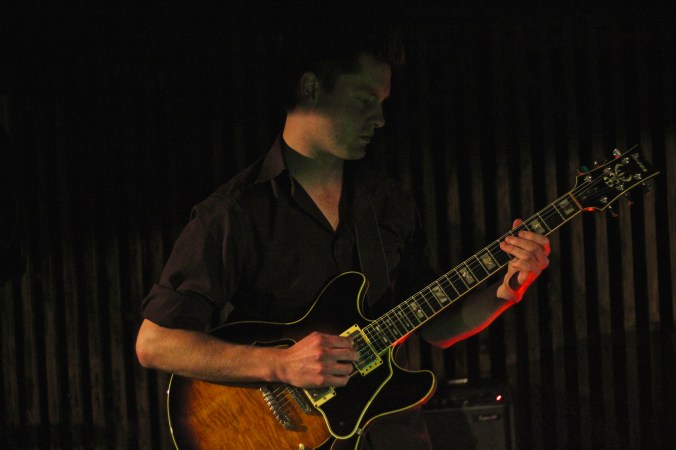
Motif played in America a few years ago where they received excellent reviews in the New York Times (Nate Chinen), Jazzwise and in All About Jazz.  They have been around since 1999 in one form or another and were founded by the seriously out-cat Ole Morten Vagan.

Ole & Atle

It is obvious that this group has big ears as their compositions contain the distant echoes of American and Euro-centric Jazz while still sounding fresh and original.   This is as far from a covers band as you could get, because they gather in the myriad of sounds about them and fashion these into a fresh and exciting soundscapes.  The band may have achieved critical acclaim but they are certainly not above poking fun at themselves.  Ole Mortan Vagan joked several times about their earning potential.   This is a group of musicians who do what they do well and primarily perform for the love of the music.

Havard Wiik

The music was often rambunctious, but the band always drew you back to a collaborative theme after their stratospheric flights of fancy.   The magic woven by individual performers during solos was never at the expense of the ensemble.  It was organised chaos in the best possible way.

I was also delighted to discover that Norwegian humor translates perfectly for a New Zealand audience.  The music was leavened with countless jokes which had us in fits of laughter.   Ole Morten Vagan said that his father had recently accused him of being a bohemian.  When he asked his father to explain he was told, “A bohemian is someone who regards the rent as an unforeseen event”.

The band members were all incredible musicians whether playing as an ensemble or exploring the edge of reason.
The band was: Ole Morten Vagan (bass, jokes), Atle Nymo (saxophone), Eivind Lonning (Trumpet), Harvard Wiik (piano), Hakon Johansen (drums).

At the end of the second set they filed off the band-stand to the sounds of loud enthusiastic applause.  The clapping eventually subsided, but a few determined souls carried on until the band reappeared for a last number.    “That was strange”‘ said Ole.   “At first we heard clapping followed by what sounded like half a dozen potatoes rolling down the stairs – then clapping again.
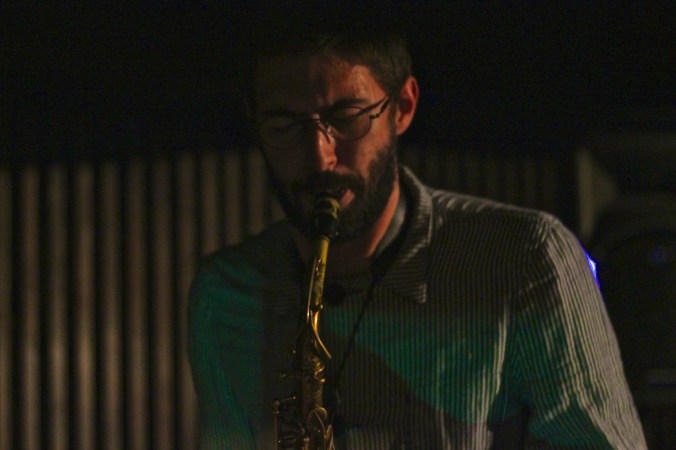
Roger Manins summed it up perfectly in a recent Face Book post: “Just a heads up for those in Sydney Tomorrow.  MOTIF will be at SIMA– and seriously worth checking out. They were at CJC in Auckland last week and were great– very funny guys too”.    I concur.