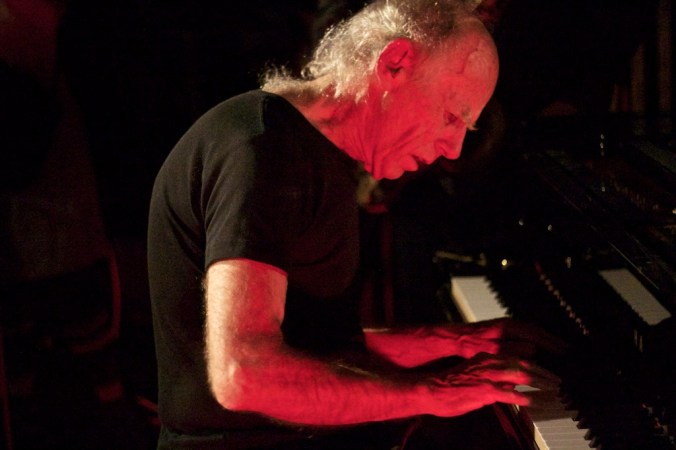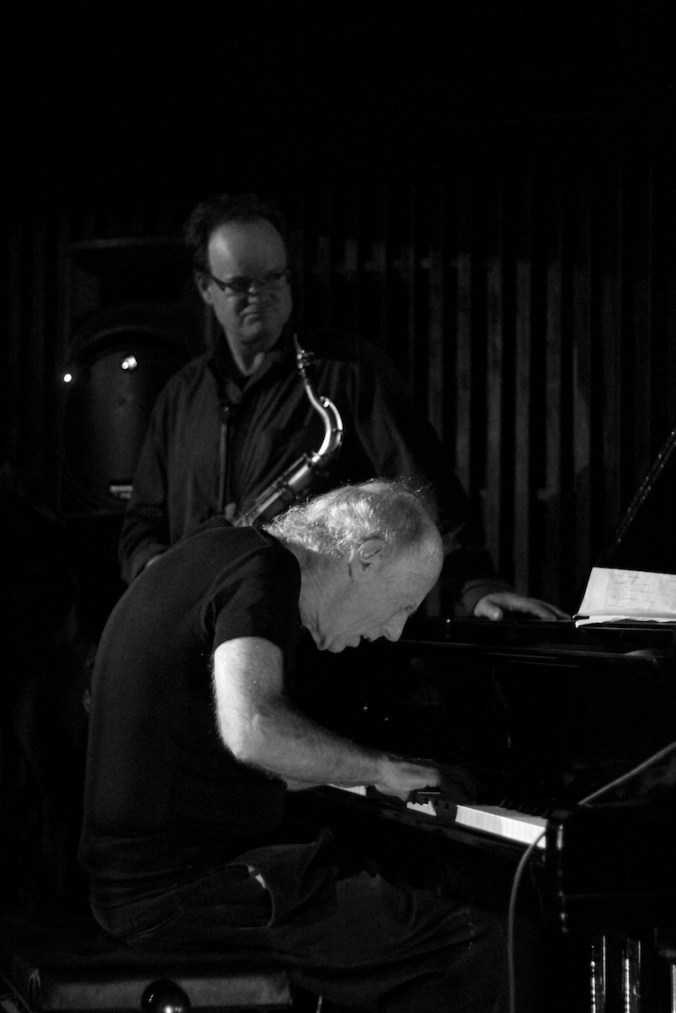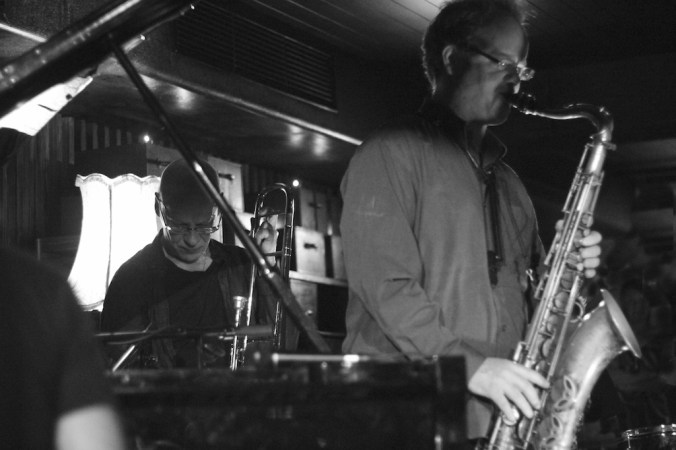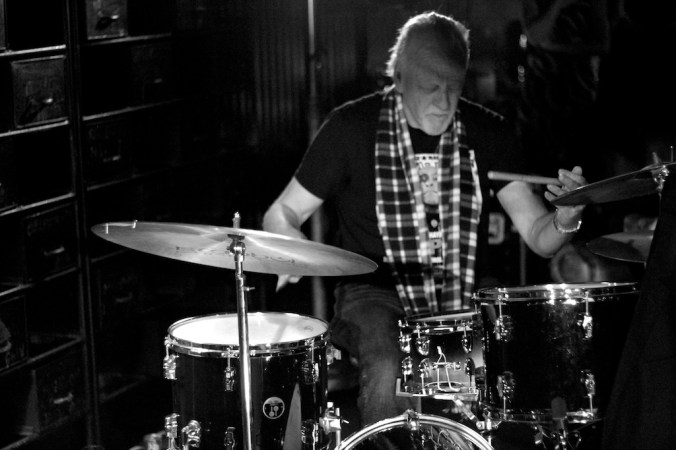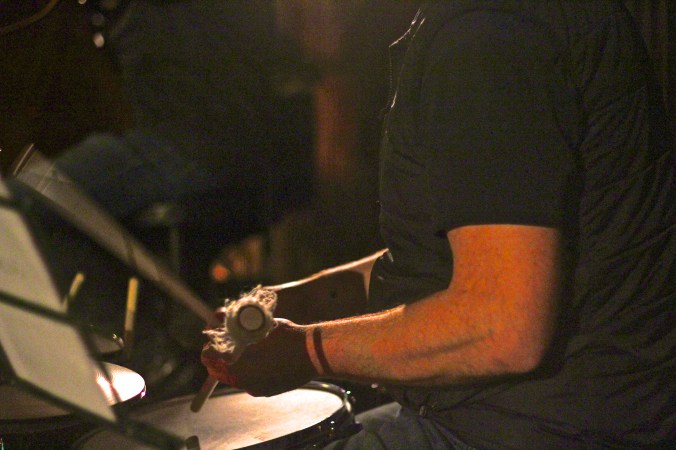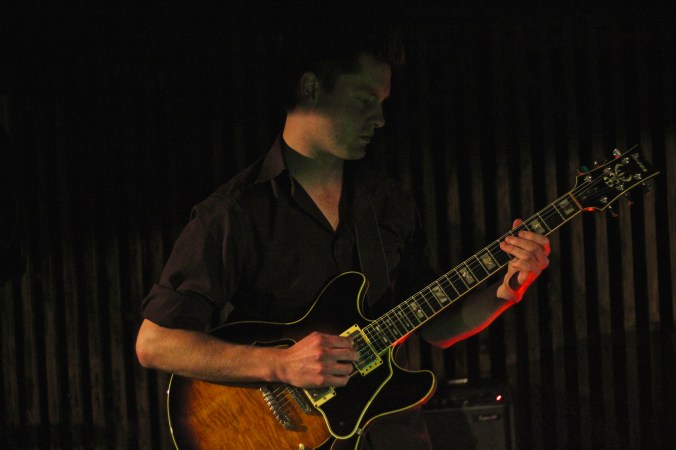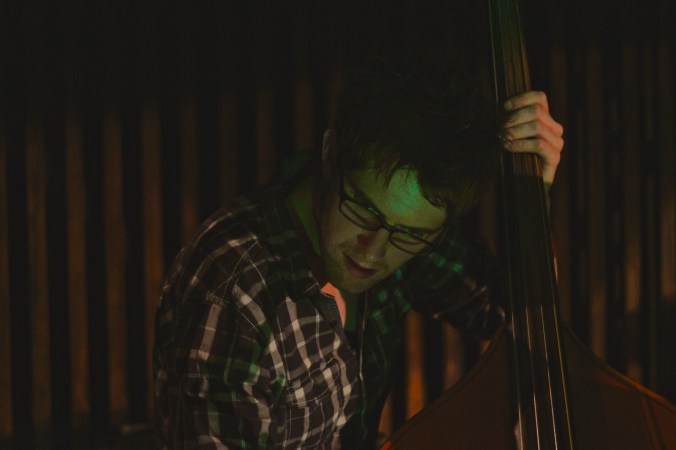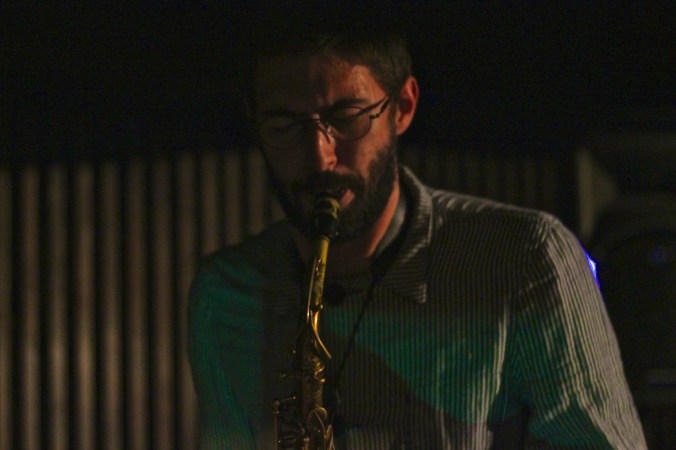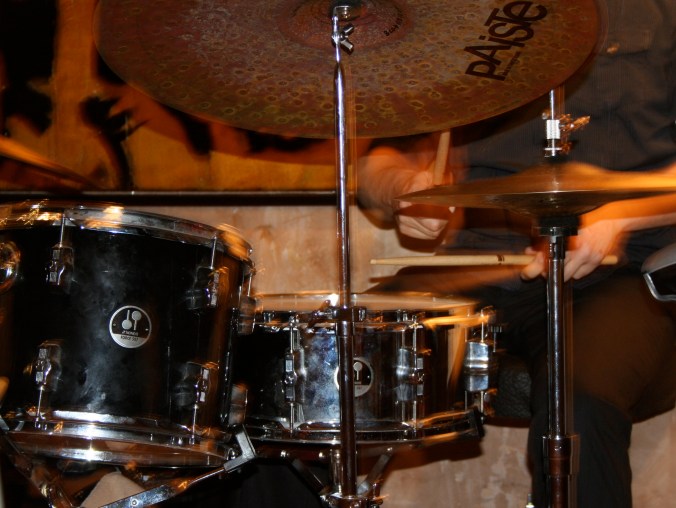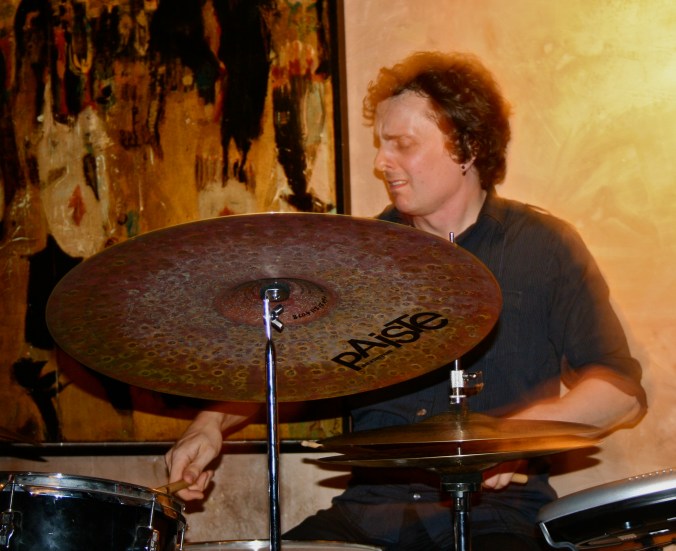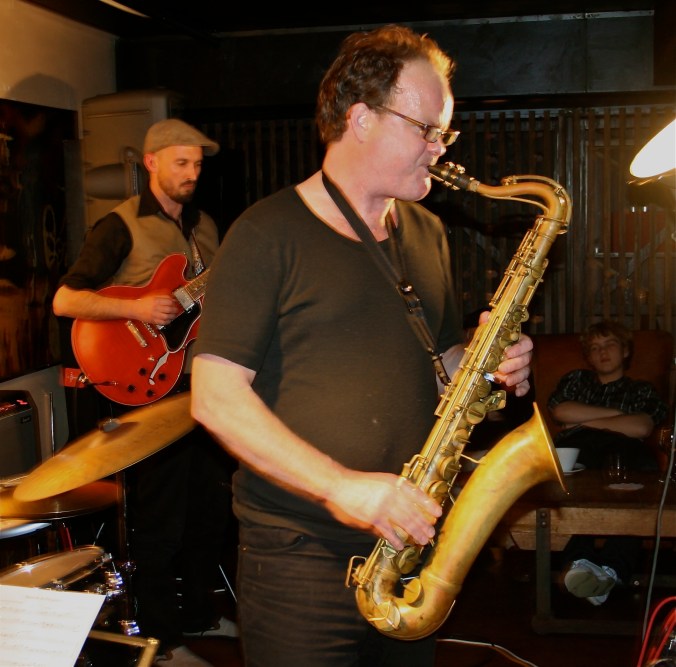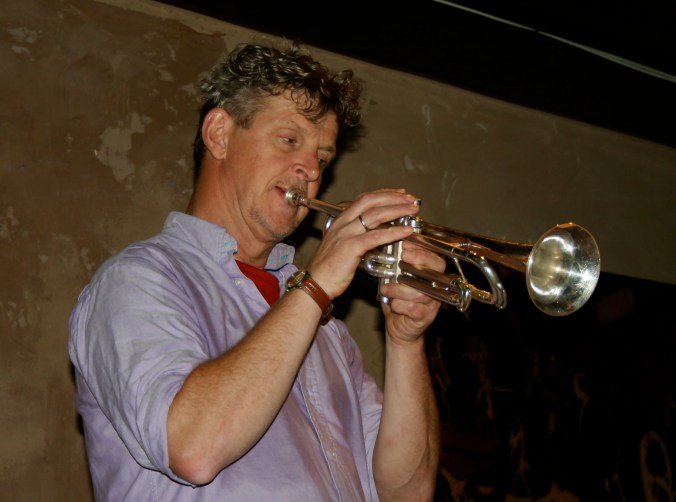
Reuben Bradley trio @ CJC + Mantis Album

Reuben Mantis

After the success of ‘Mantis’ and ‘Resonator’, Auckland audiences were keen to see a Reuben Bradley band perform again.   Reuben is one of those musical drummers that Wellington seems to specialise in and he clearly has an eye for an epic project.  For ‘Mantis’ he engaged some real heavyweights.  Roger Manins (tenor), Matt Penman (bass), James Illingworth (piano), John Psathas (arrangements) and the New Zealand String Quartet.  The tunes were all Drew Menzies originals, with arrangements by Reuben Bradley and John Psathas.

Mantis is a celebration of the works of Drew Menzies, a highly respected bass player in both the Jazz and Classical spheres and whose compositions had never been recorded before.  What is well communicated during this project is the connection that the musicians have with the material and what also comes across is Reuben’s obvious affection for his departed friend.  Reuben’s liner notes give us a fascinating account how the pieces came back to life, drawing us into a kaleidoscope of quirky lead sheets and a musicians world.  In some cases the tunes re-evolved from embryonic beginnings, coaxed by Reuben’s pen.   I urge everyone to buy the album.  The tunes are fresh but at the same time strangely familiar and this quality anoints them as being timeless, potential local standards.

While no added incentives are needed to purchase ‘Mantis’, it is worth pointing out that the proceeds of the sale go to the Drew Menzies Memorial Scholarship for young New Zealand bass players.  ‘Mantis’ was featured as a key event at the recent Wellington Jazz festival and this week it was a highlight of the Nelson Jazz Festival.  Credit to Creative New Zealand for funding such an important project and to Rattle Records for the album.  It is hardly surprising that musicians of this quality delivered so royally, but a nod to John Psathas and the New Zealand String Quartet is appropriate here.  No matter how experienced a classical string quartet, there is always a challenge when playing Jazz compositions.   The quartet’s unmistakeable chops and John Psathas airy charts took this exactly where it needed to go.

Having Matt Penman aboard was a huge coup.  This expat Kiwi bass player is now one of the real heavyweights of the North American scene.  His work with the San Francisco Jazz Collective, James Farm, Kurt Rosenwinkel, Kenny Werner, Joe Lovano, Fred Hersch, plus his own ground breaking albums, mark him out as one New Zealand’s greatest Jazz exports.  His Bass playing on this album is simply wonderful and no superlatives can do it justice.   Drew would have been extremely pleased.

Reuben won the Tui Best Jazz Album of the Year with his ‘Resonator’ album in 2010.   Roger Manins was also on that album and these two musicians work together whenever possible.  Both of the above albums are adventurous and in their different ways lay down benchmarks for what’s good and original about New Zealand Jazz.

mantis_image-reuben-bradley_wjf13

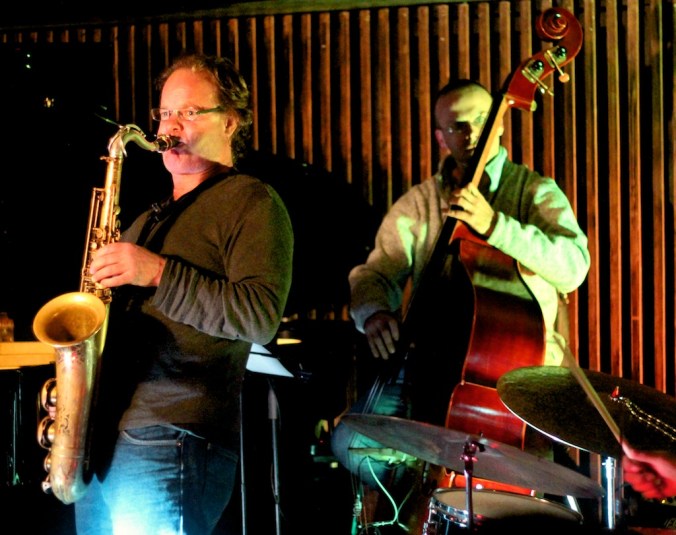
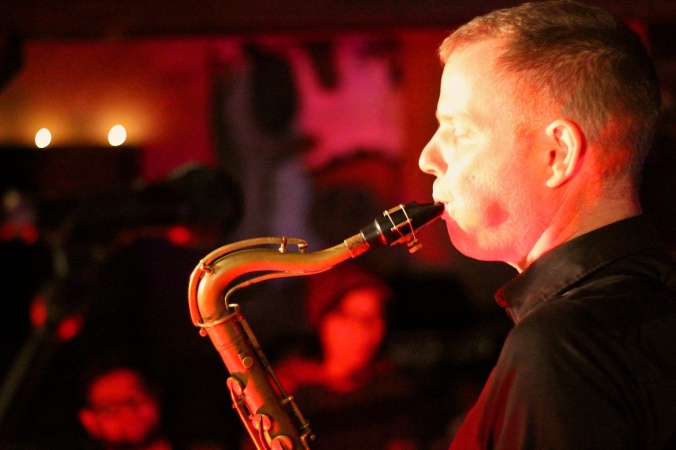
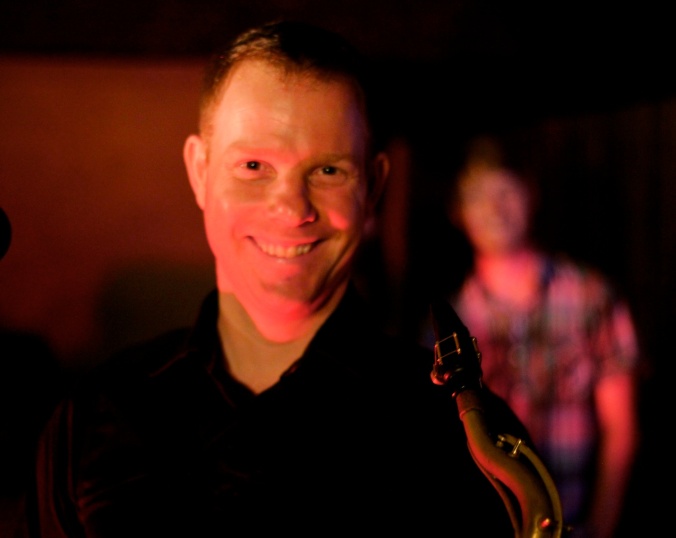
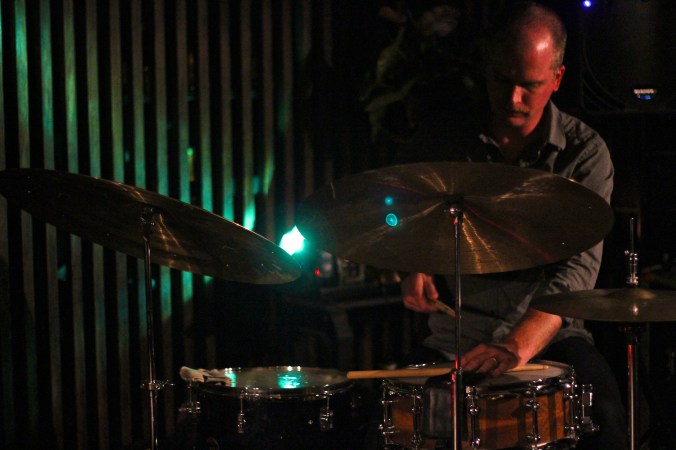
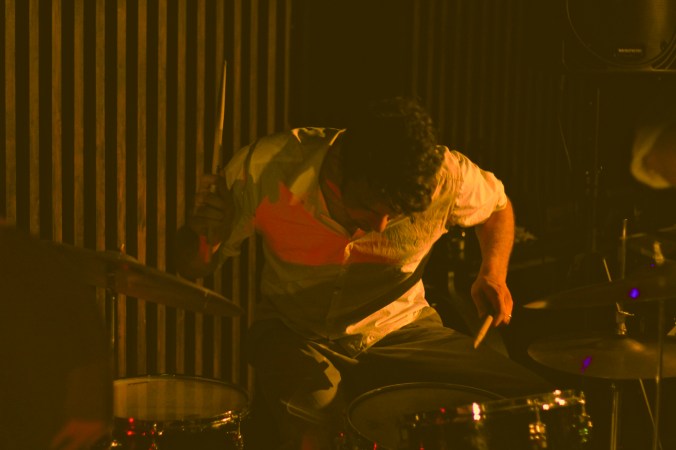
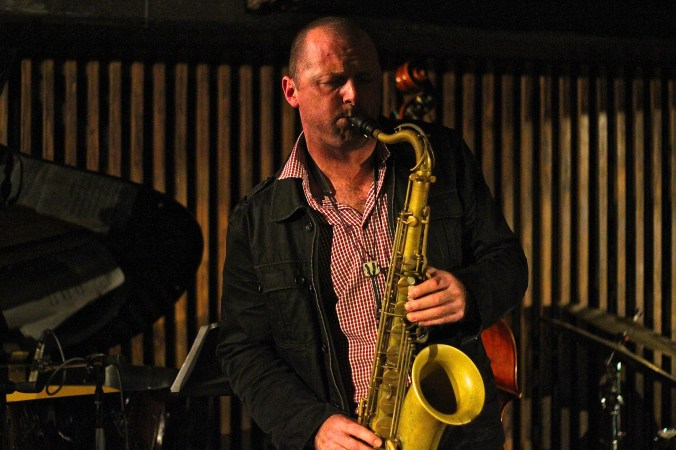
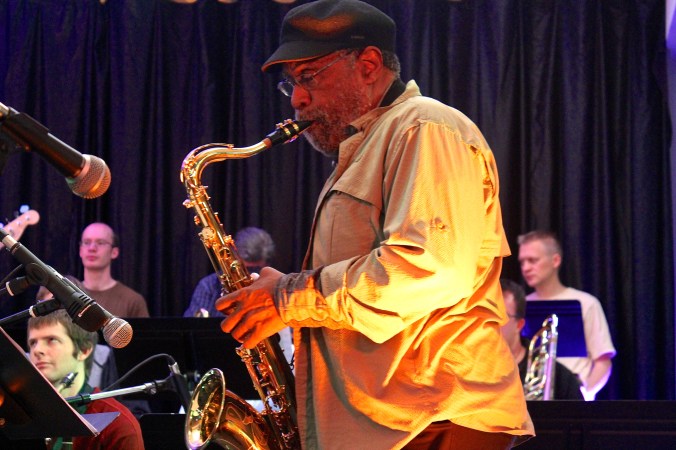
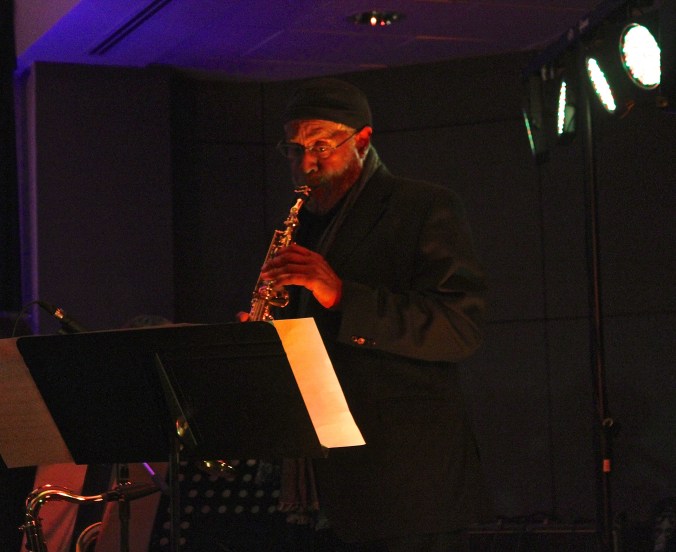
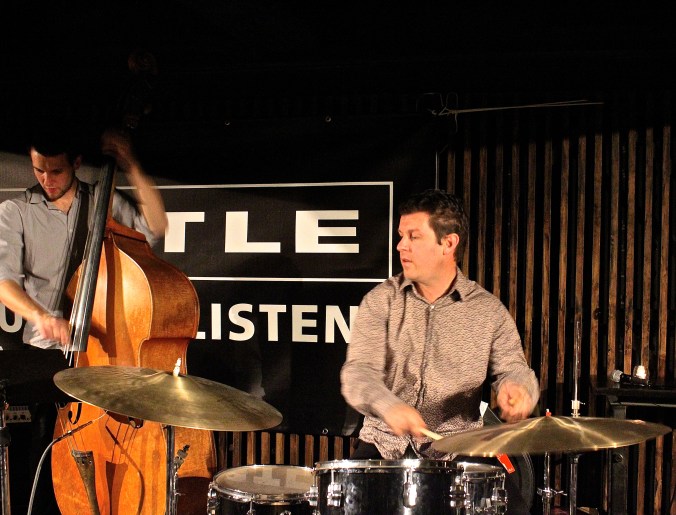
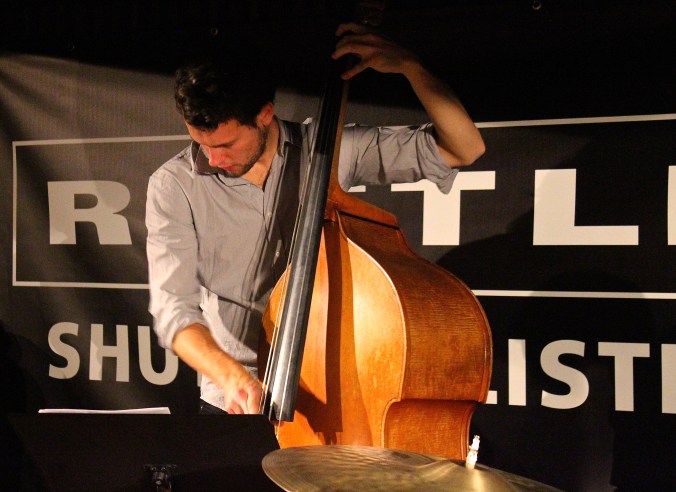
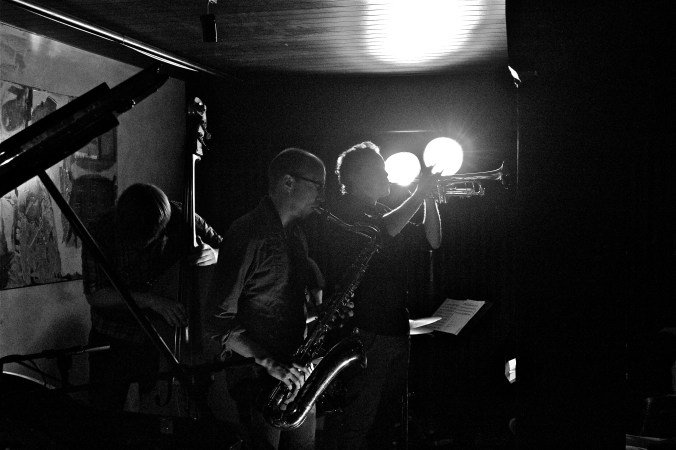
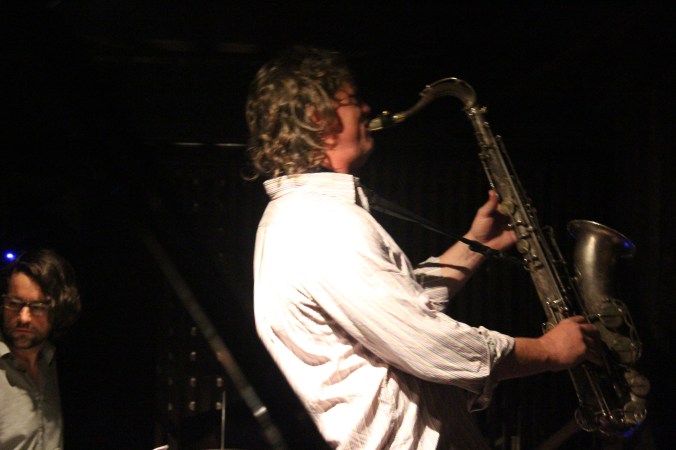
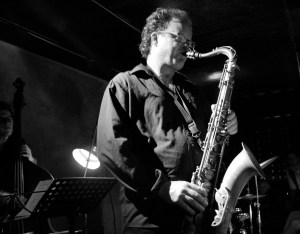
When Reuben came to the CJC on the 31st July, the working unit was pared back to drums, tenor sax and bass.   On Sax was Roger Manins who has shown time and again that he can give of his best in any configuration.  This sort of trio is wide open for possibilities and the lack of any chordal underpinning leaves the musicians open to risk, but completely free to explore melody and form.  None of the trio were strangers to this format.

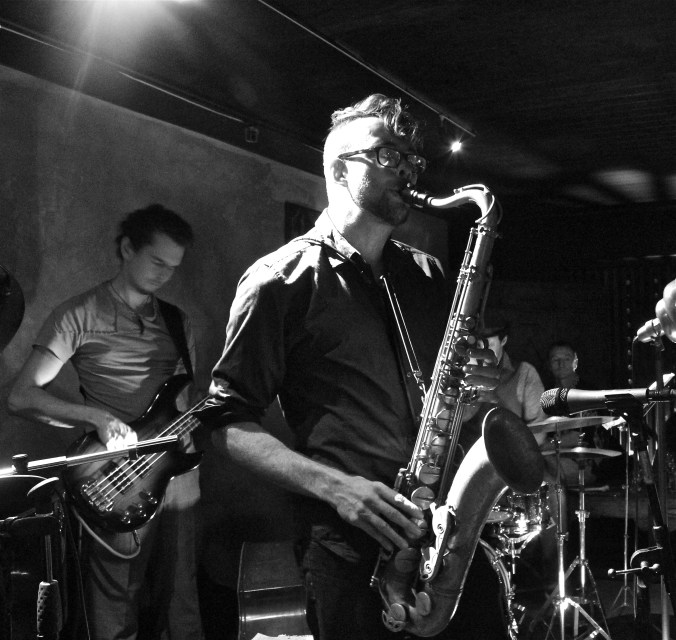
I have often watched Roger stepping free of the boundaries, like an anarchic motorist on some long empty highway who has just realised that the normal road rules will not apply there.  I was also delighted to see Roger using his Radio Model, Cigar Cutter Selmer for the first time.  A sleek silvery goddess of bygone years which oozes charm.  In Rogers hands it purrs dangerously like an ancient vixen, brought back to life to seduce us all.

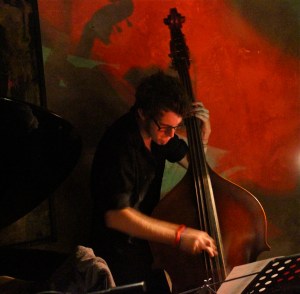
Brett Hirst is a popular Australian bassist and a list his former band mates would read like the who’s who of Aussie Jazz.  He has a big sound and an instinctive rhythmic feel which lent itself perfectly to this gig.  In their usual fashion Australia has claimed him as their own but he is originally from New Zealand like so many artists doing well across the Tasman.

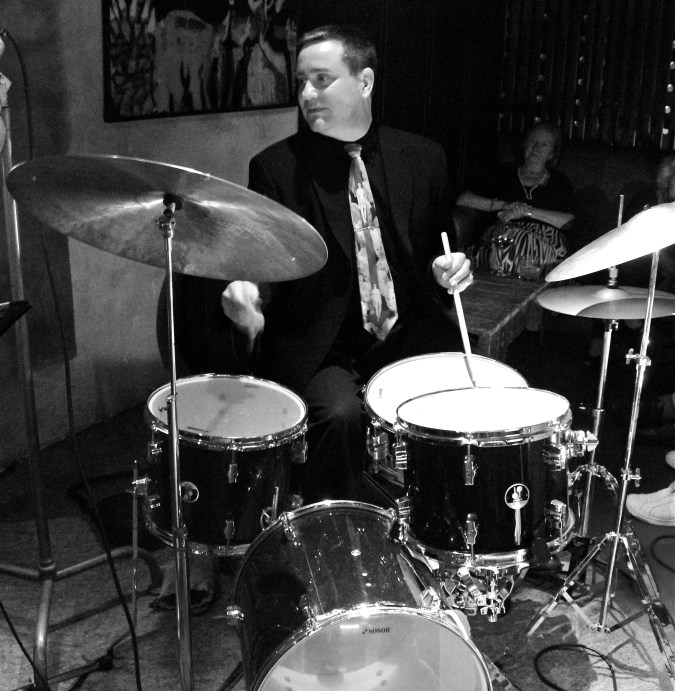
Reuben, Roger and Brett work extremely well together and so it was fitting that they should tackle the work of Drew Menzies from a fresh angle.   While there was a tune or so from ‘Resonator’ in the set list, the bulk of the material played was from ‘Mantis’.  It is Reuben’s hope that these tunes will become mainstays in the Kiwi Jazz repertoire and I hope that this comes to pass.  I have heard at least one rendition of ‘Ladies Man’ played recently at a gig and so the trend may gather steam.

Who: Reuben Bradley Trio – Reuben Bradley (drums) (arrangements), Roger Manins (tenor sax), Brett Hirst (bass).

What: ‘Mantis’ (and ‘Resonator’) both available from Rattle.

Where: CJC (Creative Jazz Club) Brittomart 1885 Building downtown Auckland

Mike Nock + Roger Manins, Frank Gibson@ CJC

IMG_7906 - Version 2

It was sometime in early June when I first heard the news.  I was sitting with Roger, talking music and shooting the breeze about who we rated.  Suddenly he half turned and said, “Mikes coming back to do a CJC gig”.  The words hung in the air like a siren song and for me the impatient waiting began from that moment.  If Mike Nock was coming to town there would be magic aplenty.  That’s what it meant.  That is what it has always meant.

The word seeped out, first to the music students and then to the wider world, like ripples in an ever-widening arc.  The club would be full that night.

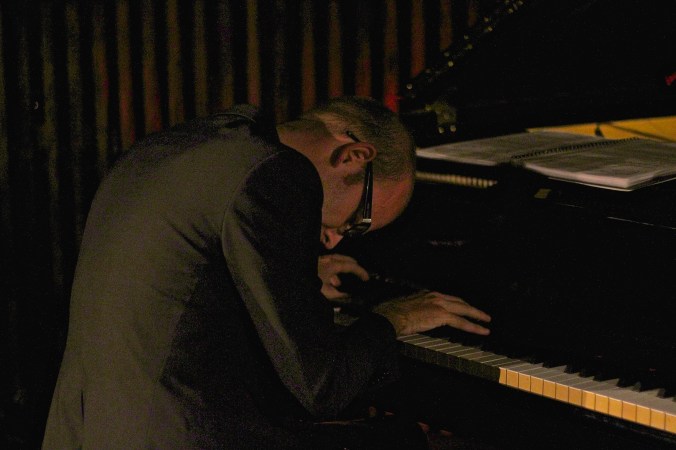
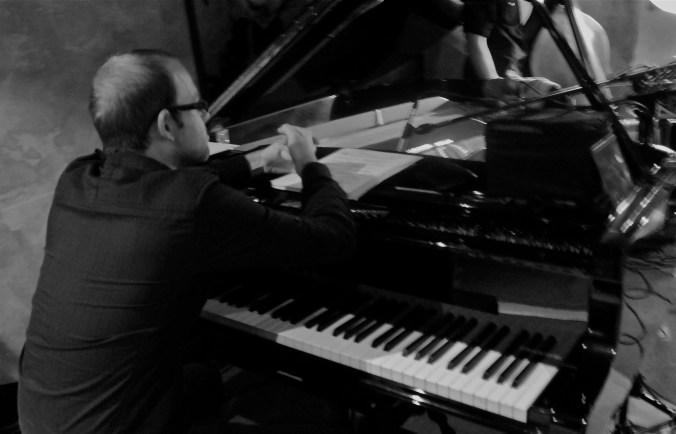
Closer to the gig Roger asked Mike who he wanted in the band.  They quickly settled on a trio format, not your usual piano trio but one with piano, tenor saxophone and drums.   Roger Manins on tenor, Frank Gibson on drums.  Mike had jettisoned the anchor for this gig and he was quite definite about that, no bass.   This is a challenging lineup for a pianist (and for the other band members) because no-one is there to hold the centre.   If you slip there is greater distance to fall.  In this different space wonderful things can also happen and they did.  This was a night among nights.

IMG_7932 - Version 2

Barely able to contain my impatience I rolled into the club foyer three-quarters of an hour early.   The queue was already snaking back past the basement stairway and well into the upstairs bar.  A seething mass of eager faces.  When the doors finally opened there was Mike sitting sideways on the piano stool and Roger was blowing a few scales nearby.  The music stand sitting to one side abandoned, an unnecessary distraction, in a free ranging gig going where the music took it.

Before the first set I caught up with Mike, talking about his various projects (he was playing with a New Zealand string quartet the next night).  He told me that he was coming back to the CJC with his newest Australian trio in a few months.  Next time bass and drums.  We talked a bit about Jazz musicians from the past, Kiwi’s that he had played with and then the discussion shifted to the older pianists who straddled the swing to bop era.  Like all great pianists Mike lets the entire history of Jazz fall under his fingers and so I asked him about players like Hank Jones and Mary Lou Williams.  When I listen to them I hear such strong left hands, walking chords, syncopation, hinting at a time when ‘harlem stride’ was still an influence.  “The newer and stronger bass players changed that” said Mike.  “As the bass lines become stronger and pickups better the need for such dominant left hand work fell away.  There was too much conflict”.   As a non musician I had never considered that and it all made perfect sense.  I marvelled all the more that Be Bop/Post Bop greats like Hank Jones kept a touch of this earlier style and even when accompanied by strong bass players like Ray Brown, George Mraz and Ron Carter.   I wondered if we would ever see those strong left hand stylists again.   I soon got my answer.

IMG_7897 - Version 2

The set list was not really planned and it changed and evolved as the evening wore on.   The numbers selected were all standards, but they were somehow fresh, as if revealed for the very first time.   The first number was ‘When Your Smiling’ (Shay/Fisher/Goodwin 1889) and the second number was ‘Gone With The Wind’ (Allie Wrubel 1937).  Those two numbers coming together had me wracking my brain as to where I had heard them, heard them played together.  Then it came to me, they were both on one of the earliest of the Brubeck Quartet albums.   ‘Dave Brubeck at Storyville 1954’ was a wild live recording that lacked polish but oozed soul and immediacy.  Afterwards Mike announced  that a Brubeck album had inspired him to play that number – bingo.  These are the connections we love.   If you ingest a large dollop of Jazz history the memories will reward you.  IMG_7901 - Version 2

As they played through the first set I realised that the lack of a bass had not impeded them at all.  There it was, that strong left hand of Hank Jones, working the mid lower register while wonderful modern chords and runs flew from his darting right hand.   This was a master class for the senses to grapple with, giving us an unparalleled taste of Jazz piano mastery from an oblique angle.  No matter what Mike threw his way Roger matched it as they danced in and out of reach like well matched prize fighters .  These two have an uncanny level of communication.  It was even more evident later when they played ‘Softly as a Morning Sunrise” (Romberg/Hammerstein).  They had been considering what to play next when Frank Gibson suggested it.  Heads nodded in agreement and Frank set the number up nicely with a melodic intro on his traps.   “We will just see where this goes” said Mike, “could be anywhere”and he proceeded to pick at the bones of the melody.   Where it went was somewhere wonderful.  This is where the magic truly occurred, a moment to be savoured by all present.

They had begun the number, sparingly at first, soon more purposefully.  The level of interplay increased as they unpicked the tune.  Soon all three were working and pulling at the tune like it was a joyful game.  As Roger soloed I watched the trio inching up the intensity by degrees.  At first Roger had tapped out time with his right foot as he played, now he was pawing at the ground like a bull about to charge.   Mike was rocking madly and then standing and dancing some crazy dance.  Frank too was rolling with the beat.  By now they were way outside – blowing free of all constraints.   It was a moment to savour.  The moment.

IMG_7891 - Version 2

As I watched these three, so attuned, a thought struck me,  Mike Nock is originally from Ngaruawahia, Roger from Waiuku.   These two small country towns are close to each other.  What are the odds that rural New Zealand would produce two musicians of this quality.  Maybe it was something in the upper Waikato water supply?

When Jazz musicians are enjoying themselves there are always moments of hilarity, but on this night the best moment came from an unexpected quarter.   The CJC was full, so full  that dozens of people were turned away at the door due to the fire regulations. Outside it was winter, but inside it was hot as hell.  Mike by now stripped to his T-shirt asked if there was any talcum powder for his hands, which were slippery from the exertion.   Caro Manins duly produced a talcum powder container.  Mike wrestled with the lid for a few minutes and then handed it to someone else to unscrew.   Bigger and younger blokes stepped forward in turn, each saying that they were up to the task, but none could dislodge that damn lid.  “Take it back to the shop” said one, “it’s a faulty product”.  At this point a diminutive young woman took the container from the frustrated men, gently flicked off the child proof lock and opened it.  Men often forget the golden rule in these situations, ask a woman.  IMG_7936 - Version 2

During the second set Kim Paterson and Brian Smith sat in for a number or two.   Kim and Brian go back a long way with Mike and both have recorded with him.

As the enjoyment washed over me I could hear the words of Sean Wayland from a month earlier as he announced his gig.  “New Zealand I would like to thank you for Mike Nock”.   With you on that brother.

Who: Mike Nock with: Roger Manins & Frank Gibson Jr.

Where: CJC (Creative Jazz Club) 24th July 2013

And a clip by Jen Sol from the same gig:

Aaron Blakey (Sydney) @ CJC

IMG_7744

Aaron Blakey is someone you warm to instantly.  He communicates with ease and has a relaxed manner about him.  The same applies to his approach to music.  I have heard pianists who feel that they must astound with every note and while that is all well and good, it can be exhausting for everyone.  The more experienced musicians understand that performance is not only about original ideas, but also about communication.  The latter involves working with an audience while you tell an interesting musical story.  I would place Aaron in that category.

Aaron left Auckland for Japan in 2008 and he gigged regularly around Tokyo.  After a few years he returned to study in Auckland before moving to Sydney in 2011.   On this gig his accompanists were Roger Manins on tenor saxophone, Cameron McArthur on bass and Adam Tobeck on drums.  Roger Manins is at the peak of his powers and after his very successful stint with the JMO in New Zealand and Australia, he is more on fire than ever.   He is one of the best saxophonists in Australasia and so having him in any group lifts their game.  Putting him with a fine musician like Aaron Blakey produces especially rewarding results.  IMG_7746 - Version 2

Anyone who has read these reviews or spent some time at Auckland Jazz gigs in the last six months will know just how swiftly Cameron McArthur is rising through the ranks.    He is one of a small handful of must-have bass players when visitors come to town.   Adam Tobeck is fast becoming a regular at the CJC and his abilities were evident at this gig

With two notable exceptions Aaron played his own material and the compositions were all named after people he knows.  With each song, we were ushered into Aaron’s private world.  A world peopled by close friends, eccentric waiters, babies and delightful dancing children.  At the end of the two sets I felt that I would recognise these people if I saw them; so convincing was the imagery.  Live improvised music creates shapes and forms which you can almost grasp, but which evaporate and dissolve in unpredictable ways.  What remains is a series of impressions, a filigree journey imprinted on the ether.  IMG_7759 - Version 2

A good example of this was a tune called ‘Sinclair’s Routine’.  Aaron named this after a waiter who worked at a  busy Surrey Hills restaurant.  He was using the establishments piano to practice one morning and trying out a few ideas, when the waiter said, “I like that, it helps me to go about my routine” .    Not your usual musical commentary but it ended up as great tune and gave us a window into that particular moment in time.   It worked for me on several levels but primarily because I could picture and hear the event in my mind’s eye.   There was a song ‘Jonathan B’ dedicated to an old friend from New Zealand.  As Aaron was explaining the origins of the tune he looked up and said, ” Oh there he is, he just walked in – hi man”,  Once again we connected the song to time and place and this gave added weight to the number.

The track that I have recorded on video is “One for Steve”, which is a dedication to the much admired Steve Barry.   This was certainly a connection that hung in the air as the band played through the number.  Steve (another ex-pat Aucklander) had been playing that very piano only a few weeks earlier and the echo of his gigs was relived through the tribute.

The first of two standards was ‘My Song’ (Keith Jarrett).  It amazes me that ‘My Song’ is hardly ever performed.  There is a view that Jarrett’s three recorded versions are so contained, that musicians shy away from it.  More is the pity because most jazz lovers rate it highly.  During the introduction Roger Manins helpfully suggested that Aaron would actually be doing the Elton John “My Song’.   This was a solo performance and you could have heard a pin drop.  It was great to hear it done and great to hear it done so well.  IMG_7719

The second standard was the Cole Porter tune ‘I Love You’ from the musical Mexican Hayride, placed squarely in the Jazz Lexicon by John Coltrane (Lush Life album).  While Coltrane’s version was with Saxophone, Bass and drums, The version on this night was a duo featuring piano and tenor saxophone (Manins and Blakey).   That these two have been friends for years and that they have worked together many times before, became evident on this number.   The sensitive interplay between them was truly extraordinary and although they took quite different approaches to the task in hand the synergy was uncanny.  It was one of the wow moments which Jazz audiences live for and to my annoyance I had run out of HD video-tape just a moment before it started.   I am sure that they will play it again sometime, as Aaron has promised to return. We hope that he will not leave it two and a half years this time.

For those wanting more there was a Roger Manins gig down at Frankie’s Bar in Wyndom Street two nights later.   This was a similar lineup, but with premier drummer Ron Samsom at the kit.  For this gig Aaron had brought his Fender Rhodes along.  They swung mightily and as I listened I could hear Ron pulling back on the beat.  There is some fine music around Auckland.  All it needs is our continued support.

Who: Aaron Blakey (piano) with – Roger Manins (tenor sax), Cameron MacArthur (bass), Adam Tobeck (drums).

Where: The CJC (Creative Jazz Club) Auckland 3rd July 2013

Pretty in Blues – Molly Ringwald @ The Tuning Fork

SCCZEN_050613HOSSPLRINGWALD1_460x230

A month ago an LA based Jazz Journalist friend emailed me to say that Molly Ringwald was coming to Auckland.  I learned that she would be singing a selection of Jazz Standards from the ‘Great American Songbook’.  He suggested that I should hook up with her arranger and pianist Peter Smith and we duly made contact.   After that I watched for the promotional material to hit the papers and I was not surprised to see that there was a heavy focus on Molly’s former life as an actress.  It is almost a reflex action for the print media to pose the question;  yes she is a Hollywood celebrity and we loved her in this and that role,but can she sing?  I determined from that point on that I would focus solely on the music and leave the Hollywood trivia to the experts.

There are a number of things that can make or break a vocal artist and foremost among these is their ability to connect emotionally with an audience.  Their choice of material and arrangements and the quality of the supporting musicians is also paramount.   It should not surprise anyone to learn that Molly Ringwald can sing well, because she has been singing all of her life.   First as a child with her Jazz Pianist father Bob Ringwald and later in big Broadway productions.   Being multi-talented is not that unusual in the acting fraternity.   Singing Jazz however is a riskier path and one that is not embarked upon lightly.  It is seldom if ever the road to riches and the audiences are filled with armchair critics.  Especially if the vocalist is a movie star.

Molly can sing beautifully.  She also found ways to connect with her audience by telling a mixture of personal anecdotes and engaging stories about the songs.  The choice of material was also solid, as it mixed the well-known with the lessor known ‘songbook’ standards.  All of the material suited her voice but some especially so.

She opened with Dorothy Fields ‘exactly like you’ but it was the second number that really caught my attention.  It was Hoagy Carmichael’s  ‘I get along without you very well’.  I pride myself on knowing the stories behind standards, but this ‘songbook’ story as told by Molly was quite new to me.  Evidently a woman in the audience had thrust a poem into Hoagy’s hand after a concert.  He forgot about the poem and then rediscovered it months later.  After reading the poem he felt that he had to record a version and so he wrote music for it.  The problem that then presented itself was how to find this unknown lyricist.  That’s where broadcaster Walter Winchell came in.  The woman was eventually located and it turned out that the poem was not about a relationship that had gone sour, but about dealing with loss after her husband died.  After this poignant story the song took on a new life for me and Molly managed to convey that well.

Next up was ‘They Say Its Spring’ (Marty Clark/Bob Haymes).  Blossom Dearie absolutely owned this song and while this version was not a slavish copy of Blossom’s , it clearly alluded to that version.   I loved it.  As the sets unfolded we heard; ‘My Old Flame’ (Johnson/Coslow), Don’t Explain (Billie Holliday), ‘Mean to Me’ (Fats Waller), ‘I’ll Take Romance’ (Rogers/Hart) , ‘It Never Entered My Mind’ (Rogers/Hart), ‘If I were a Bell’ (Frank Loessor), ‘The Very Thought of You’ (Ray Noble), ‘Just You Just Me’ (Greer/Klages), and ‘Ballad of The Sad Young Men’ (Landesman/Wolf).  Not from the songbook was a carefully arranged version of ‘Don’t You Forget About Me’ (Simple Minds)

I like many versions of ‘Ballad of the Sad Young Men’, but Anita O’Day, Roberta Flack, and Keith Jarrett’s versions are particularly fine.  Molly Ringwald’s version compares very favourably with these.  This is not a torch song but a world-weary reflection on the emptiness that consumed the lives of many young men after the war (like ‘Lush Life’ in sentiment).  Delivering such a powerful song to an audience expecting a lighter fare requires courage and skill and Molly nailed it.

Behind these songs were some very clever arrangements and with charts written specifically for the album and tour.  These are the work of the respected LA pianist/arranger Peter Smith.   Peter has worked with Molly for some time and so he understood exactly what is required.   He is a talented pianist with great chops but he followed the most basic rule of all.  An accompanist must never get in the way of the singer.  It is matter of utilising just the right voicings and the chord placement must accent the singer’s performance not dominate it.  Whether comping or taking a brief solo Peter was always tasteful.   Not every accompanying pianist knows how to perform their duties so skilfully.  The next night I invited Peter to a newly opened Jazz venue and he sat in with local musicians.   In this situation he was able to let loose and he did, keyboards not withstanding.

Two well-known Auckland musicians completed the rhythm section for the Auckland leg of the tour; Tom Dennison (bass) and Frank Gibson Jr (drums).  Tom has worked with many international artists and his fulsome rich tone and perfect base lines added enormous value to the performance.  He often works with vocalists.  Frank is also very experienced at working with offshore visitors and like Tom he has worked with many vocalists over the years.   His brush work on this night was especially fine as it whispered and propelled in equal turns.  Together they made for a good swinging lineup.

For just a moment I had a window into that glamorous world long past where the likes of June Christy mesmerised audiences.   And yes Molly Ringwald is still stunningly beautiful.   The 16-year-old Molly with the red hair and the alluring smile still shines through her more mature self.  Her stage presence won’t hurt her Jazz career a bit, but it is her ability to keep singing at this level that will keep her recording and us listening.

What: ‘Except Sometimes’ by Molly Ringwald

Where: ‘The Tuning Fork’, Vector Arena Auckland 13th June 2013

Sean Wayland & David Berkman @ CJC Winter International Series

Sean Wayland

Sean Wayland

We don’t get many offshore Jazz pianists visiting New Zealand, but we have seen quite a few over recent weeks. This particular gig comes hot on the heals of hearing Sean Wayland appearing as featured guest artist with the marvellous Jazzgroove Mothership Orchestra. Sean had impressed me at the JMO gig and so I really looked forward to hearing him play at the CJC (Creative Jazz Club).

Before he had played a note Sean Wayland won us over with his easy-going banter. Especially when he thanked us for Mike Nock and mentioned band mate Matt Penman. These are two of Auckland’s best-loved sons and I suspect that Kiwi’s, like Canadians, enjoy our worth acknowledged by the big country next door. This generous acknowledgement by a respected New York based (Aussie born) pianist reveals an interesting truth about Australasian Jazz.

There may be a struggle to meet the financial realities, deal with lack of good pianos and the paucity of gigs, but the two scenes continually produce world-class Jazz musicians. The Scenes are in fact so intermingled that it is often hard to know who is an Aussie and who is a New Zealander. Steve Barry and Mike Nock illustrate this perfectly as they live and work in Australia. Roger Manins lives in New Zealand but gigs across the Tasman every other week.

In spite of the difficulties there is no lack of great music coming out of Australasia and the main problem is that of distribution. An upside of this changing business model is that bands travel more. For the keen Jazz fan live music is once again king. We don’t have to wait for a multi-national recording label to tell us what we should or shouldn’t like, we can explore ‘You Tube’ or ‘Bandcamp’ and hear from the artists directly.

IMG_7530 - Version 2

Sean Wayland is a hugely respected figure on the Australian scene and in New Zealand as well. He is a very modern pianist, as he moves in circles where new approaches are constantly being explored and new sounds developed. After listening to his compositions I was not in the least surprised to find him supported by the likes of Matt Penman, Jochen Rueckert, Will Vinsen, and James Muller. This is essentially the Rosenwinkel generation. While he speaks that language fluently he is unmistakably an individual stylist. No one sounds quite like Sean.

Sean’s tunes are very melodic. Often unfolding over a simple bass line as with ‘eenan’ off his ‘Lurline’ album. What sounds catchy and accessible can actually be quite complex as his approach to rhythm gives the tunes that unique feel. This is tension and release at its sophisticated best. I have put up a version of ‘eenan’ as a ‘You Tube’ clip which unfolds in subtle and beguiling ways. So beguiling in fact that I dreamed the tune two nights in row. Such powerful hooks are not accidental but the result of careful craftsmanship. There is a strong sense of pulse or swing to his tunes, but approached from a different perspective to that of the more traditional pianist.

This intergenerational shift is one that I hear more often as the changing of the guard occurs. Other tunes played to great effect were his, ‘Trane plus Molly equals countdown” and the solo piece ‘Little Bay’. Both of those tunes are found on the ‘Expensive Habit’ album. ‘Trane plus Molly equals countdown’ hints at McCoy Tyner, but you quickly realise that the voicings have very modern in feel. I can however certainly imagine Kurt Rosenwinkel doing the tune. It is an extraordinary composition where the left hand continuously punctuates the flow with oblique accents. I was left wanting more than the single set and I certainly hope that we get to see Sean again on his next trip back to Australia.

IMG_7520 - Version 2 (1)

Accompanying Sean were Cameron MacArthur (bass) and Jason Orme (drums). Both accomplished musicians who quickly slotted into the challenges of supporting a world-class and highly inventive pianist.

The next artist up was David Berkman. He has been to New Zealand before and anyone who saw him last time would have jumped at the opportunity of seeing this top flight New York Pianist in action. There is a fluidity to his playing and above all an impeccable sense of timing. This hard-driving post bop fluidity and the big bluesy chords is what most characterises his work.

The Kiwi members of the quartet were Roger Manins (tenor), Olivier Holland (bass) and Ron Samsom (drums). Together they formed a powerhouse of inventiveness and Roger in particular seemed to benefit from this grouping. His solo’s were so incendiary as to cause gasps of surprise and from an audience who are used to such pyrotechnics. While we expect Rogers high wire acts he is always able to surprise us and this night saw him really on fire. David Berkman certainly knows how to amp up the tension and his ability to extol a horn player to reach deeper and deeper is impressive. He worked the room with as much enthusiasm as he would have done in a prime New York club and everyone there appreciated that commitment. This was the kind of gig where you sat back and let the sound wash over you, tapping your feet uncontrollably and yelling enthusiastically between numbers.

David Berkman

David Berkman

David Berkman’s repertoire was a well-balanced mix of his own compositions and some lessor known standards. During the gig he talked about his mentor, the much respected pianist Mulgrew Miller (who sadly passed away that very evening). He has worked with a wide variety of artists such as trumpeters Tom Harrell and Dave Douglas and his contribution to Jazz education is well-known. Having moved to New York some years ago he quickly settled into the routines of gigging, recording and teaching and since then he has been a fixture on the local scene. He travels extensively and is a Palmetto recording artist.

IMG_7554 - Version 2

The two pianists were very different, but both were amazing in their way. In David Berkman we heard the history of the post bop era and in Sean Wayland we glimpsed the future.

What: Sean Wayland and David Berkman Winter International Series.

Who: Sean Wayland (p) (leader) Cameron McArthur (b) Jason Orme (d). – David Berkman (p) (leader), Roger Manins (s), Oli Holland (b), Ron Samsom (d)

Where: CJC (Creative Jazz Club) 29th May 2013

Jazzgroove Mothership Orchestra – CJC Winter International Series 2013

IMG_7493 - Version 2

Travelling with an 18 piece jazz orchestra is an exercise in logistics that would confound military experts. Luckily this herculean task was assigned to Jazz musicians who have no idea about what is possible and impossible. As they have done for the past 10 years the Jazzgroove Mothership Orchestra (JMO) set out on tour, but this time, as if to tempt the fates, they decided to cross an ocean. The trip across the Tasman was certainly not without mishap, as one of the orchestra members had become ill at the airport and an urgent replacement was required. The first New Zealand concert was to begin in a matter of hours. I am unsure of just how much panic ensued, but the bands Director David Theak was tasked with locating a trumpeter. They required an excellent reader who could play some of the most difficult charts ever devised and with little or no rehearsal time.

It was guest conductor, ‘ringleader’ and composer Darcy James Argue (who is evidently also a magician) who proposed the solution. He quickly conjured up the brilliant New York based trumpet player Nadje Noordhuis who just happened to be attending a wedding in Australia. She had worked with Darcy for many years and was familiar with his work. Nadja changed her plans and flew to join the JMO in Auckland. I can only surmise that various music gods received generous offerings that day. IMG_7516 - Version 2

The ‘Jazzgroove Mothership Orchestra‘ is one of the most valuable creative assets that Australia has on offer and since its inception 10 years ago it has picked up many scholarships and prizes. It is regarded as the best Jazz Orchestra in Australia and it has gained a solid international reputation. Because of the respect the orchestra garners it is now able to attract the best soloists, conductors, arrangers and composers. World acclaimed Jazz masters like John Hollenbeck and Maria Schneider are just two examples of guest arrangers invited to work with the JMO. While drawing upon a myriad of inspirational sources from offshore, the orchestra still maintains a strong focus on showcasing the best of Australian Artists. Recent programs have featured the works of Mike Nock and the New York based Australian born pianist Sean Wayland.

Our own Roger Manins plays tenor saxophone for the current JMO tour and he will appear as guest artist with them at the Melbourne Festival (with the incomparable and frequent poll winning Maria Schneider conducting). Roger is a typical self-effacing Kiwi male who seldom talks up his own achievements (I will happily take on that job). This is big news and he is to be congratulated. Better yet fly to Melbourne and enjoy the JMO with Roger and Maria.

The first concert was at the Kenneth Meyers Centre and I watched with interest as the various musicians about town tweeted words like ‘freaking amazing’ and ‘wow’. The main Auckland gig was on the next night at the Auckland Jazz & Blues Club located in the Point Chevalier Returned Services Association. This large rectangular space has acoustics that are often challenging for smaller bands but not so for the sonic blast of an 18 piece orchestra. By the time I turned up the venue was packed. Everyone there looked expectant, understanding that a rare treat was in store.

IMG_7482 - Version 2

The gig was split into two distinct halves with the first set featuring Sean Wayland’s music. I have long heard praise of Sean and to my shame I had not previously checked him out as thoroughly as I should have. He’s a revered figure on the Australian Jazz scene and with good reason. He often plays with the cream of New York musicians and his discography is jaw-droppingly impressive. Sean’s compositions have a particular ebb and flow that works well with an orchestra like this.  For all that, he is a friendly approachable guy and this easygoing manner communicates itself well to an audience. Sean has worked with the JMO before and it is not surprising that they invited him back as guest pianist, composer and arranger. IMG_7503 - Version 2

The second set featured the works of guest conductor Darcy James Argue who like Sean Wayland lives in Brooklyn. He has steadily been amassing tributes over recent years, first for his ‘Infernal Machines’ album and more recently for ‘Brooklyn Babylon’. Darcy James Argue describes himself variously as ringmaster, composer, arranger and head of a ‘Secret Society’. Dan Brown can’t hold candle to this guy, as he tells better stories and navigates the social media like a latter-day Machiavelli.

When Darcy was ushered onto the bandstand he emerged in true Secret Society fashion. Swirling out the shadows and giving the appearance of being 7 feet tall. My only disappointment was that he didn’t have a cape. According to rumours the Secret Society first aired their music in a small punk bar in Brooklyn, violating fire and safety regulations in the process. As with all the best secrets word soon leaked out and as time went by they performed at the Lincoln Centre and many other key venues. It must be troubling for a secret society to become so famous, but that is exactly what has happened. They are five-time winners of the DownBeat Critics Poll, a JJA best-of award, appearing in innumerable best-of-the-year lists, and being nominated for both GRAMMY and JUNO awards. IMG_7515 - Version 2

This is a composer who understands musical alchemy.  Under his pen and baton a new form of magic has emerged. The textures, orchestral voicings and raw energy carry the listener to places unimagined. It feels fresh and exciting, but somehow (and perhaps this is the essence of the magic) the past is still evident in ways that are never hackneyed. Warmth and vibrancy vie with starkness, gentle and raucous coexist. These are the sounds of a big city in the twenty-first century, but a big city constantly examining its roots. It is hard to adequately describe the impact of this, but a careful listener will discern hints of Copeland, Rock music, Thad Jones and even Cage. More importantly they are drawn forever into the strangely accessible but deceptively complex world of Darcy James Argue and his co-conspirators.

Darcy James Argue has woven us a convincing narrative and his multi media smarts are an integral part of this journey. His websites lead listeners inexorably to the music in pied piper fashion, where they are held fast. He is positioned exactly where he should be, at the cutting edge of new orchestral Jazz.

I sat down with Sean Wayland after to gig and watched with interest as he ordered a schooner. “We don’t have those in New Zealand love” said the barmaid.”What do you call a big glass of beer then?” asked Sean. “A glass” she said. Aussies abbreviate everything (a barbecue is a ‘barbi’ and Melbourne is ‘Melbs’) but this is the only time that I have seen an Australian out-abbreviated by a Kiwi. Sean is an easy guy to talk to and from him I gained a number of interesting insights into the performance. “Was Darcy’s material difficult to play”, I asked him. “Yes” he said, “Almost impossible. To do it real justice it needs to be played a lot and then memorised”. Sean’s piano parts sounded just fine to my ears, he is after all well-known for his work with unique harmony and rhythm.

Where: Point Chevalier RSA, Auckland New Zealand – brought to you by the CJC (Creative Jazz Club), The Auckland Jazz and Blues Club and Pete McGregor Entertainment on the 28th May 2013

Who: The Jazzgroove Mothership Orchestra with Sean Wayland and Darcy James Argue

Song FWAA@CJC – A Jazz April Event

IMG_6836 - Version 2

The Auckland Jazz gigs during Jazz April have been high quality (see last four posts).  Above all they have encompassed the breadth of improvised music.  Song FWAA from Australia was therefore a perfect choice to round off a smorgasbord of tasty events.  They (Song FWAA) are quite possibly the illegitimate love children of ‘Sun Ra‘ and while no DNA evidence has validated that theory the lineage is manifest in their music.

As a scene matures listening ears get tweaked through exposure to new sounds.  The demand for a wider range of musical experiences follows that.   This doesn’t happen by accident.  It begins with musicians stepping into uncharted territory and ends with the listener reacting.  The mere mention of ‘adventurous music’ can cause cold sweats from venue management and all the more so if an ‘out’ gig is proposed.  Happily for us Roger Manins of the CJC (Creative Jazz Club) takes some risks  and as the club audiences continue to grow that policy is vindicated.  It is the job of artists to confront or challenge and listeners should welcome this.  Settling for bland entertainment leads to musical confection, not jazz, not art.  Some people are perfectly happy leading the lush life in some small piano bar, but that is not where the music develops.  Improvised music is as much about audience engagement as about performing and without the feedback loop a musical project would become an unheard conversation between band members.  Those who heard Song FWAA, heard edge, originality and musical humour so cunning that no weasel could better it.  IMG_6812 - Version 2

The band has garnered rave revues around Australia and their 2011 album ‘Ligeti’s Goat’ is highly recommended.  If you listen to the album you feel that you are listening to a much bigger unit.  At first this seems attributable to the rhythm instrument, which is of the guitar family but quite different in timbre.  This is a specially made 8 string ‘Frame’ played by David Reaston.  The voicings, pickups and pedals used (i.e Moog pedal) give it distinct and very different sound.  Not loud but other-worldly; a strangely subtle sound that can impart real richness.

Martin Kay plays alto saxophone and although this is a standard instrument he also manages to coax a range of different sounds from it.  Martins multi-phonics and extended techniques give depth to the performance, just as drummer Jamie Cameron’s colourist approach and extended drum technique added depth.  At the end of the evening I felt that the musicianship more than the instrumentation created this special groove.

The gig (and the album) was replete with compositional parables about animals and their epic adventures.   Martin is adept at telling these tales; which have a ‘Hunter S Thompson’ quality about them.   ‘Ligeti’s Goat‘ the title track for instance explores the eating-cycle of a goat.   “Tonight” said Martin, “we will only be playing the second section – ‘digesting carrots’ “.   Another number was a moving tribute to a peripatetic Polar Bear.  To quote from the liner notes regarding the tune ‘Olefeig’ (AKA that which should not be shot): ‘Documents the transformation of scenery through the eyes of a Polar Bear, drifting on a shard of ice from Greenland to Iceland, where his destiny finds a bullet’.   IMG_6811 - Version 2 

A number titled ‘Mugwump‘ was most enjoyable.  The gist of the introduction by Martin was that Aliens had come to earth to seek Moroccan desert fuel and somehow this referenced William Burroughs and the Dogon people of neighbouring Mali.  He had me hooked as soon as he mentioned Morocco and Burroughs.

Song FWAA’s  music is at times ‘free’ and at other times working long ostinato grooves.   This moving ‘outside’ one minute and then playing ‘inside’ or following a melodic hook to its conclusion works.  The group has something to say and they say it with genuine originality.  I hope that they come back soon and share more animal sagas with us.

Their promo material describes them as the ‘wrong band for the right people’.  I love that descriptor, but the one sour note struck was their failure to paint their faces ‘Art Ensemble of Chicago Style’ for the gig.   This is how their webpage profile shows them and we are mature enough in NZ to handle that.  As Roger Manins says, ‘truth in advertising is at the heart of jazz’.  I have no idea what that means but we do love face paint.

What & Who: ‘Song FWAA‘ – Martin Kay (alto sax), David Reaston (frame guitar), Jamie Cameron (drums). Buy the album from www.songfwaa.com

Where: CJC (Creative Jazz Club), 1885 Building, Brittomart Auckland 24th April 2013

This was a CJC Jazz April gig

Paul Van Ross – Album Release

IMG_6497

On Wednesday 27th March several visitors arrived in town from Melbourne Australia.  Visitors but not strangers, because saxophone player Paul Van Ross has played in New Zealand four or five times previously and drummer Mark Lockett is an expat New Zealander, originally from Wellington.

These are very friendly guys.  Actually I find most Jazz musicians unfailingly cheerful and friendly.  It is unlikely that this good humour arises from job security or because they have just managed to upgrade the Porsche .  I stick cameras in their faces, ask searching questions during set breaks and pin them down for set lists when they are suffering from jet lag.   Instead being told to clear off they indulge me.  This goodwill must be pumped through the air conditioning unit of the CJC (Creative Jazz Club).  It is a place like ‘Cheers’ where everyone has a smile and ‘everybody knows your name’.

IMG_6492

One of those who indulges me is Steve Garden of Rattle records.  A few weeks ago I received a tidy package of CD’s from him and among them was ‘The Buck Stops Here‘ led by Paul Van Ross.  I had a lot of material to write-up at the time and I was working on the ‘Jazz Month’ program with the Jazz Journalists Association.  I played my way slowly through the pile of releases as time allowed.  It was not until I had received the CJC newsletter that I realised that Paul Van Ross would be doing an album release there in three days.   I sorted through the CD’s and put it out to listen to but it was not until the day before the gig that it finally reached my Hi Fi.   It was a really great album and I played it through three times.

How had a missed this I thought.  This should have been one of the first things that I put on.  Apart from a John Zorn obsession, I also suffer from an excessive liking for B3 combos.  This album featured B3, guitar, drums and saxophone.  I listened over and again while the textures and compositions reeled me further in.  This is a very good example of the ‘new sound’ in organ/guitar/saxophone/drums.

IMG_6463

Make no mistake, I love ‘chitlin circuit’ groove Jazz of the sort that Brother Jack, Joey ‘D’, Pat Martino, Wes and Grant Green created.  My friend Michel Benebig is a B3 master in this field and he can groove you to the depths of your soul.   That music will roll you out of bed and have you dancing like a fool before you gain your sea legs.

There is however another type of B3 sound and that reaches for new horizons.  Jamie Saft (Zorn’s Dreamers), Tom Watson (Manu Katche’s new album) and Dr Lonnie Smith (Jungle Soul album),  come to mind.    The music still has a deep groove but there are no locked in drums and this subtle loosening up of the vibe makes space for a particular type of guitar work and gives a horn some room for exploration.  This is a sound that absorbs influences from a diverse Jazz palette while still retaining a solid groove context.  The Paul Van Ross Trio (and quartet) are of this latter kind.  Their music draws on a wide spectrum of post and pre millennial Jazz; not just tugging at the heart and feet, but engaging the intellect as well.

Paul Van Ross is an exciting tenor player and I can’t help wondering if he studied under George Garzone.   There is something different about tenor players who have studied under Garzone and Paul fits that bill.  His rapid fire lines and fluidity never obscure the musical ideas that flow from his horn.  On ballads he could wring a tear from a walnut and when playing uptempo he navigates the terrain with ease.  His compositions are engaging.

The CJC launch gig employed a smaller lineup than on the album.   Organist Alan Brown subbed for Kim Kelaart on the New Zealand leg of the tour and he needs no introduction to New Zealand audiences.  Alan is another musician who takes the groove genre to new and exciting places.  His keyboard skills are legendary.   Choosing him was a sensible choice and while his style is a little different to Kelaart’s, it afforded Ross and Lockett opportunities to stretch out in different ways.  Mark Lockett is a delight as he imparts humour into everything he does.   His drumming is quirky in the best possible way and he is the drummer of choice for many bands.  Like Paul Van Ross and Alan Brown he has also recorded as leader.

IMG_6455

The first track on the album is the title track ‘The Buck Stops Here”.  It was the first number up on the night (all of the material has been written by Ross).  On this track in particular Lockett’s contribution was noteworthy.  A solid New Orleans beat is laid down while edgy post-bop lines blow over that; the organ under Alan’s hands comps insistently in the background and this gave the tune a great feel.  I saw a ‘second line’ parade in San Francisco a few months ago and this particular drum beat tells that kind of story.  A story about a beat that bounced between the Americas and Africa until it became pure voodoo.  I like everything on this album and so choosing video clips was hard.   In the end I have opted for ‘The Buck Stops Here’ (filmed by Jenny Sol).   Other standout tunes from the album are ‘Swami in the House’ and the beautiful ballad “Uncle DJ’.  A number performed on the night but which is not on the album is ‘Break a Tune’ (filmed by John Fenton)

I must also mention the guitarist Hugh Stuckey who knows when to shine and when to merge into the mix.  His lines are clean and impressive, with an approach to melody that is modern.  This is the direction that Rosenwinkel and Moreno mapped out and it sits well with this lineup.   A guest guitarist Craig Fermanis appears on track one only.

You can buy the album now from ‘Rattle‘ at http://www.rattle.co.nz        I recommend it highly.

Who: Paul Van Ross trio; Paul Van Ross – tenor sax, Alan Brown – C3 hammond organ, Mark Lockett – drums ( add Hugh Stuckey and Craig Fermanis – album)

Where: The CJC (Creative Jazz Club) Auckland.

What: Album Release by ‘Rattle‘.

John Fenton

Member-button

jazzapril-rectangle

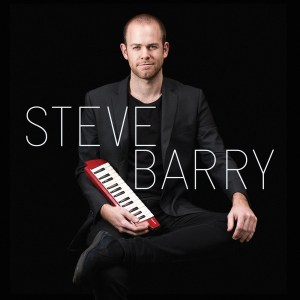
Steve Barry trio @ CJC – Album Release Tour

Steve Barry

Steve Barry the Auckland born Jazz pianist left New Zealand a few years ago and with him he carried our highest expectations.  That can be a distraction to an emerging artist, but Steve possesses a faculty that overrides distractions.  He is one of the better pianists that I have heard and there is a back story to that.  His focus is unwavering to the point of obsession and he is an artist that won’t be  hurried.  We impatiently awaited his first album, the eponymously named ‘Steve Barry‘; always urging him to record.  He resisted all entreaties, practicing and refining while an innate sense of timing guided him.

He was right and we were wrong – now is the perfect time.  The album launch at the CJC (Creative Jazz Club) and the album itself fulfilled every expectation.

This is an artist who puts the integrity of the music before any rapid career path.  This is the right time for the album release, placed as it is firmly within the ambit of work being done by Aaron Parks, Matt Penman, Kurt Rosenwinkel and other ground breaking younger artists.  This new sound is gaining ascendency and with adherents like Will Vinson, Lage Lund and Mike Moreno it will continue to do so (‘James Farm’ are perhaps the epitome).  This music is mainstream Jazz but it references sources as diverse as Lenny Tristano, Indie Rock and even Hip Hop.  The fractured and complex rhythms are juxtaposed with soaring fluid guitar lines.  Against that are the textures and layers of melody.   Only the best musicians can pull this material off and only the best composers can write such material.

While Steve is clearly influenced by this ‘new sound’ he is no slavish imitator.   He has found something that often alludes younger pianists; a recognisable and original voice.Tim Firth

One listen to this album explains everything about this artist and this incredible band.  All of the tunes on the new album are composed by Steve Barry and the compositions are sometimes dense and multi-layered.  This is a musical journey of the profoundest sort.  One that demands your fullest attention and perhaps a little knowledge of what is happening in the Jazz world.  The highest rewards in Jazz occur when we understand something of what is going on.   This is not background music for cocktail parties.  This is up to the minute real.

Jazz musicians tell me that the ones who succeed are those with an almost monomaniacal focus; Steve is such a musician.  He works harder than most as do the band members.   These guys have been playing together for a number of years and they respond to each others every nuance.   If you close your eyes when Tim Firth is playing, you blink them open just to make sure that Eric Harland hasn’t jumped into the drum chair.  His ability to chop up rhythms and channel trip-hop beats is nothing less than astonishing.  I have seen drummers watch him in open-mouthed amazement.  He can also launch a flurry of quiet brush work which is never-the-less as propulsive as a whispering rocket.

Alex Boneham is another stellar musician and he has long been a favourite with New Zealand bass players and Jazz fans.  He is the glue holding these often complex compositions in place and he does so with unwavering certainty.  As the charts unfold the musicians pull away from the known – taking different routes as they stretch against the boundaries.  In spite of the complexity and the risk taking, the implied centre always holds firm.   One musician said to me that he had never heard a band hold such a tight centre while reaching so far into the unknown.  Alex Boneham

The program was nicely balanced and to do this the band deviated from the album on occasion.   There were three lessor known standards performed on the night and the one that stood out was Wayne Shorter’s achingly beautiful ballad ‘Teru’ (from ‘Adams Apple’).   There were two Shorter tunes and that did not surprise me.  Shorter’s works are deceptively complex and they fitted tidily into the repertoire.   As nice as the Shorter was, Steve Barry’s own compositions are the most deserving of praise.   Many of us in Auckland are familiar with these as he has been refining them over several years.  Each time I hear a tune like ‘Parks’, Unconcious-lee (yes referencing Tristano) or ‘Clusters’, I find that the works have evolved.   This is what good Jazz is about.  A restless exploration into the heart of the music.

The highlight of the evening came at the beginning of the second set.   The trio launched into a spirited up-tempo number ‘Changes’ which segued into a long probing introduction.   The solo introduction was of a quality that we seldom hear – no one breathed as the piece unfolded delicately.  The new tune was ‘Vintage’ (also from the album).  At a point so delicately balanced that no one saw it coming we suddenly became aware of the pulse of brushes.  The moment was so perfectly executed  that a gentle gasp arose from the audience.  There were fleeting glances left and right as everyone acknowledged the moment they had witnessed.  The brushes played a solid 4/4 groove over the tune which is in 7/4.

An older woman next to me had tears of joy in her eye; “It was so wonderful that I dared not breathe” she said.  “I was his original piano teacher and as a pupil he was one in a thousand.  He worked harder than most and was relentlessly passionate about music”.  This confirmed the source of the magic, hard work endless commitment….and chops.

There is an additional member on the album who did not make the New Zealand leg of the release tour, Carl Morgan.   His work is also extraordinary and very much in the style of Lage Lund, Kurt Rosenwinkel and Mike Moreno.  The album deserves to do well and if it’s distributed widely enough it will.   Don’t just take my word for it; buy a copy and judge for yourself.   Be quick because the copies will go fast.  This is a must for any Jazz Lovers stocking whether you’re from Oceania or further afield.     CD Art - Front Cover

WHAT: ‘Steve Barry’ Cd  Jazz Groove Records, http://www.stevebarrymusic.com

WHO: Steve Barry (piano), Alex Boneham (bass), Tim Firth (drums), Carl Morgan (Guitar 3,4,9)

WHERE: Launch tour at CJC (Creative Jazz Club)

WHEN: November 28-11-2012

Sean Coffin (AUS)@ CJC

On Wednesday the 24th October we had an overseas visitor playing at the club, tenor saxophonist Sean Coffin.   This has been a great year for the Auckland Jazz scene and especially for the CJC (Creative Jazz Club) as a number of interesting local bands, out-of -towner’s, and overseas acts have appeared.  It’s the clubs imperative to offer genuine diversity, and this has caused the CJC to extend its reach.   Because Roger Manins has such a well established Australasian reputation and because the CJC is increasingly seen as a great club to play in, the net is ever-widening.   We are on the Oceania Jazz circuit fair and square.  

Sean Coffin is known in his native Australia for his stellar educational work, but it is his high level tenor playing that draws people to him.  He is among the best that Australia has to offer.   For many years he has been accompanied by his brother Greg (piano) and the work of this formidable pair is well recorded.   Sean studied at the Berklee School of Music and later as a postgraduate at the Manhattan  School of Music.  Among his many teachers I would single out George Garzone, as this world leading tenor player appears to have created a cadre of exceptional students in Australasia.  

At the CJC Sean showcased his most recent compositions and they were mostly themed around his children.  This proved a good source of inspiration as the numbers ranged from heart-felt ballads to some faster paced offerings (one referenced children at play).   These lovingly drawn compositions were well crafted and executed and no one had difficulty relating to them.   It is arguably risky to focus exclusively on family material, but the gamble paid off because the improvisations were tender without once descending into introspective noodling.   The integrity of the compositions as Jazz vehicles was always evident.  A lovely ballad to ‘Garz’ (dedicated to George Garzone) rounded things off nicely.

A local rhythm section was put together for this gig and in due deference to the visitor he was given the best.  Ron Sampsom (drums) and Oli Holland (upright bass).  With Kevin Field overseas, Dr Stephen Small took the piano chair.  No one needs to puzzle over my views on Ron Sampson and Oli Holland as my support for their work has been constant over time.  These two go way beyond the merely competent; they are solid, reliable musicians and they are also gutsy enough to handle new challenges without flinching.   Listening to them live or in a recorded situation will tell you everything you need to know.

Seeing Stephen Small again was an unexpected pleasure, as the patch he normally patrols is on the periphery of the Jazz world.  Because he teaches classical piano at Auckland University it would be easy to overlook the fact that he has other strings to his bow.   He is a madman on keyboards and I have seen him cut loose on banks of synthesisers during a Jazz fusion gig.   To say that his fusion performance was riveting would be an understatement.  He created textural layers of sound which swirled and soared alternatively.  Put him together with a fusion versed guitarist like Nick Granville or Dixon Nacey and he will take your ears apart in the best possible way.  Stephen is also a highly talented, straight-ahead, post-bop pianist and judging by the whoops of delight as he negotiated his solo’s he needs to get down to the CJC more often.   I am casting my vote for one of his Jazz fusion gigs.

Sean worked hard all evening and at the end he invited Roger Manins to the bandstand.   There was obvious respect between the two men but that didn’t stop them from going hard out.  When the best tenor players occupy the same bandstand, it generally ends up being a joyful celebration rather than a cutting contest.   This was respectful but no quarter was given.

P J Koopman quartet (with James Wylie)@ CJC

P J Koopman and Thomas Botting joined the ‘music drain’ exodus to Australia two years ago but Auckland still draws them back from time to time.  When they do return they are always booked at the CJC Jazz Club and this invariably draws old friends and new.   PJ Koopman is one of those guitarists who makes it look easy, but like all dedicated musicians he works extremely hard at his craft.  The CJC gig on the 3rd of October featured many of the fast flowing post bop tunes that PJ excels at, but there was something else in the mix.  His repertoire soon expanded to include some country tinged material of the sort Bill Frisell and Bruce Forman exemplify and while there were only two such numbers, it gave the evening a flavour that it would otherwise not have had.  This had the feel of an interesting project in the making.  

Thomas may not have put on any physical weight but he has certainly beefed up his compositional credentials .   After a week of listening to Americana just prior to returning to New Zealand, he has composed a tune, which I will now include as a You Tube clip.   This is a great composition and one which they executed well.   The tune called ‘Wylie Coyote’  had been written to honour alto saxophonist James Wylie, who joined the band for this one gig.   James is an ex-pat Kiwi who lives in Thessaloniki Greece and was due to return there within hours of the gig finishing.   James is well-known for his oblique takes on country tunes and so this title was appropriate on so many levels.   His out of left field rendition of Wichita Lineman is a perennial favourite.  

P J Koopman was exactly the right guitarist to tackle this tune and I’m certain Thomas had that firmly in mind when he composed it.  I had not heard PJ do this type of material before, but the fact that he did it so well is scarcely surprising.   He has open ears, good mentors, great chops and above all taste.   His Frisell like slurred chords portrayed the roots of the genre (and perhaps his other influences); but without sacrificing his originality.  The other country tune was the gorgeous ‘Tennessee Waltz’ and the first few chords took me back to a film I saw in the 70’s.  Antonioni’s movie Zubritzki Point was a portrayal of the youth counterculture and its soundtrack has outlived the popularity of the movie.  The soundtrack featured Pink Floyd (‘Heart Beat Pig Meat’ – who could forget the exploding food in slow motion), The Grateful Dead and Jerry Garcia solo (playing etherial improvised licks while the actors writhed in a strange love-making frenzy which stirred up lots of desert dust).  best of all was the version of Tennessee Waltz which twanged out sweetly while tumbleweeds blew past a silent desert bar.    This track conjured up all that happy madness again and this is the power of good music.  

The drummer on the gig was Andrew Keegan, who has recently moved up from Christchurch to Auckland .   Andrew is an invaluable asset to the Auckland scene.   ‘Wylie Coyote’ was in 4/4 time but the feel was different because of the way the beats were accented.   Andrew handled his traps like he had been playing with these cats for months.   Nice work all round.

Jamie Oehlers NZ quartet@CJC

There are good gigs, bad gigs, predictable gigs and everything in between. Mostly we appreciate what is before us but just occasionally, we attend a gig that is every kind of wonderful. This was it.

Jamie Oehlers has the sort of reputation that scares aspiring tenor players and creates life-long fans. This man is a monster on the tenor saxophone and no amount of scrambling for adjectives on my part is ever going to capture the intensity of his performance. Luckily I filmed much of the gig and so I will put up a number of cuts on You Tube over the coming weeks. This gig won’t be forgotten as it fizzed and washed over us like a blissful tsunami of sound.

Typical of many Australasian musicians Jamie Oehlers is self-effacing, and quietly humorous, but his down to earth persona remains intact only until he puts the horn in his mouth. Then we see confidence, elegance, fire-breathing and effortless virtuosity of a sort that almost defies belief. He is one of those musicians who reaches beyond the known, bringing the rhythm section and the audience along with him. His solos have an almost mystical coherence; as if guided by a universal logic that he is able to share with the audience.

Those who saw the performance at the CJC on the 19th September 2012 will understand exactly what I am saying.

As marvellous as Jamie was, his local rhythm section was there for him every inch of the way. Not for the first time I marvelled as Kevin Field (piano) responded to every challenge, managing to inject a sense of originality and invention into a number of almost unassailable standards. Kevin stands out as a pianist as he understands perfectly which chords to accent, when to lay out and when to work harder behind the soloist. He is exactly the right pianist to play behind a talented visitor.

Oli Holland was so good during this gig that I embarrassed him with a bear hug afterwards. He could have been Reggie Garrison at one point as the urgent stabbing notes from his bass propelled the others on. Listen to the first clip below and particularly where Kevin is soloing. This unit was never less than in perfect lockstep.

Frank Gibson on drums was equally marvellous. You never know how drummers will respond to high-octane material like this but he responded by reaching deep within and capturing every nuance of the set. I have never heard him perform better.

The first set began with the standard ‘On a Clear Day’ (Lane), ‘Alina’ AKA ‘Variation 11 from Suspended Night’ (Tomasz Stanko) [one of my favourite tunes], ‘Aisha’ (John Coltrane), ‘Take the Coltrane'( Ellington-Coltrane) , Portrait in Black and White ( Jobim) and more.

Near the end of the second set the band decided to play John Coltrane’s ‘Resolution’ from ‘A Love Supreme’ (1962). ‘A Love Supreme’ is hardly ever played and more is the pity. This avoidance relates to the holy grail status of ‘A Love Supreme’ among post Coltrane saxophonists. My view is that we should honour it and especially in this week. John Coltrane was born on September 23rd. It is a shame not to have all four movements performed together though; ‘Resolution’ is after all only a part of a mystical four piece puzzle which makes perfect sense when heard in its entirety.

Jamie stated the theme over and again, but each time working in subtle re-harmonisations and embarking upon brief angular explorations. We knew intuitively that we would end up in a place of almost unbearable intensity and we were on the edges of our seats in expectation. This was not a gate to be rushed and although we understood that, the anticipation was palpable. Tension and release is at the very essence of Jazz and Jamie achieve this end by stalking his prey in measured steps like a confident hunter.

‘Resolution’ is an Everest of a tune utilising Coltrane’s new-found ideas which were somewhere between hard bop and free. Jamie interpreted intelligently without trying to out do Coltrane. He made it his ‘Resolution’ as well. Kevin field was the same, as he took a more oblique approach than McCoy Tyner. This was a perfect homage without being a slavish imitation.

At the end of the gig we received an additional treat when Jamie asked Roger Manins to play. The best moment was when they played ‘On Green Dolphin Street‘ (Washington). With these two masters working the changes and probing every hidden corner of the melody, it reminded us that standards interpreted with integrity can sound as fresh as at first hearing.

Jamie Oehlers lives in Australia where he runs a Jazz School. He has so many awards that storage must be problem (including being judged winner of the ‘World Saxophone Competition’ in Montreux by Charles Lloyd and Bruce Lundvall of Blue Note). He has put out 10 albums as leader as well as being sideman for the whose who of the Jazz world.

I ran into Jazz guitarist Dixon Nacey as I was leaving and he summed it up nicely. “Man I have just received a series of Jazz upper-cuts”.

Bennie Maupin & Dick Oatts Massey University

Lovers of this music with a sense of its history will be aware that there have been markers of excellence laid down along the way. This is not about commercial success but a deeper and infinitely more subtle thing. A powerful vibe that seeps into the DNA of the music, acknowledged by all who have the ears to hear it. Bennie Maupin has laid down a number of such markers in his long career.

I have been listening to Bennie Maupin for most of my life but I suppose that it was Lee Morgan‘s ‘Live at the lighthouse’ album (Blue Note) that made me pay particular attention. The album had been cut at Hermosa Beach (Howard Rumsey’s ‘Lighthouse’) in July 1970. If I were to single out two tracks from that album they would be ‘Peyote’ which Bennie wrote and ‘Beehive’ by Harold Maybern. The former is a wonderful piece of lyrical writing with highly melodic hooks and subtle shifts in intensity which pull you ever deeper into the tune. The latter is a fiery burner that immediately tells you that Bennie is gazing at limitless improvisational horizons and flying free of known constraints.

Later that year he played so memorably on Miles ‘Bitches Brew’ (Columbia) and his bass clarinet on that album continued the groundbreaking work of Eric Dolphy. During the next decade he alternated between Herbie Hancock (‘Mwandishi’, ‘Headhunters’) and Miles (‘A Tribute to Jack Johnson’, ‘On The Corner’, ‘Big Fun’); while cutting his own first album as leader in 1974. ‘The Jewel in the Lotus’ (ECM) has been one of the most sought after albums in Jazz until its re-issue a few years ago. After that came ‘Slow Traffic to the Right’, ‘Moonscapes’, ‘Driving While Black on Intuition’, ‘Penumbra’ and ‘Early Reflections’. As a sideman he has played with the who’s who of the classic Jazz world including Horace Sliver and McCoy Tyner.

Immediately I heard about the Massey University concert featuring Dick Oatts and Bennie Maupin I asked the organisers if I could have a few words with the visitors. No Jazz writer would want to overlook an opportunity like this. I had been quite ill that week but no illness was going to stand in the way of this day.

Late Sunday morning on the day of the concert we met at a coffee bar near the Massey campus and while we ate I began a series of short conversations that ended up lasting until midnight. Dick is a friendly man with a big smile and a hint of the raconteur about him. Bennie is a little quieter, but you soon sense that he is taking everything in and he reveals an inner warmth as he gets to know you.

I had been burning to ask Bennie about his uncanny abilities as a multi reeds and winds player. “Why are there so few that master a range of horns” I asked? Like Dolphy before him Bennie has been extraordinarily proficient on all of his horns. When he was 18 years of age Eric Dolphy had handed him his flute saying, “show me how you play”. He then gave him an impromptu 40 minute flute lesson. What Bennie learned about technique in that short lesson was never forgotten.

He looked at me and said with deep reverence, “Dolphy was the greatest. Being a multi reeds and winds player is the path I was encouraged to take by those around me and in particular by my teacher Buddy Collette. There is no magic bullet, just very hard work. If you don’t maintain the maximum effort on each horn you quickly lose your edge”.

Because I loved ‘ Live at the Lighthouse ‘ so much I asked him about Harold Maybern’s ‘Beehive’. It is an incendiary tune bursting at the seams with raw energy. “Oh that tune was very hard the first time we played it”, said Bennie. “It was the velocity, but by the time we got to the ‘Lighthouse’, we were on top of it. That gig was recorded live and so we understood, no second takes. We could not even check the recording afterwards”. What Bennie, Jymie Merritt, Mickey Roker, Harold Maybern and Lee Morgan fused together was an energy infused miracle.

As we didn’t have much time before rehearsals we discussed his recordings as leader. ‘The Jewel in the Lotus’ (ECM 1974) is a gentle but profound masterpiece. The layering of instruments creates a soundscape that has space and incredible depth. In my mind this is not a fusion album but a manifesto of the spiritual mores of the 1970’s Jazz world. As with Herbie Hancock and Wayne Shorter, Bennie follows Nichiren Buddhism. An unpretentious spirituality quietly informs his work.

I learned that a Big Band version of the title track ‘The Jewel in the Lotus’ (Maupin), was to be played that night. They would also be playing ‘Water Torture’ (Maupin). This was transcribed and orchestrated by Mike Booth for the performance and Mike would be one of the few Kiwi musicians who could take on such a task in the limited timeframe. The result was praiseworthy and with Bennie on board it soared.

Dick Oatts (alto sax and other reeds) will be well-known to anyone who has followed the incarnations of the famous Thad Jones/Mel Lewis Big Band (Village Vanguard Orchestra). He is a mainstay of that orchestra and as I was soon to learn, his writing skills were honed to perfection. He has been to Auckland before and his return engagement was received with great enthusiasm. His extensive recordings as leader culminated with ‘Two Hearts’ (2009). This man is really across his music and his phenomenal chops, his focus and his writing skills all revealed themselves as the day proceeded.

Phil Broadhurst and the musicians then asked if I would like to attend the rehearsal. No second invitation needed.

What I witnessed was a highly informative music lesson. It is commonplace in Jazz for musicians who have never collaborated before to be thrown together. This is what Jazz musicians do. In these situations a musicians reading skills, memory and concentration are tested. When backing an iconic figure like Bennie Maupin or a gifted altoist like Dick Oatts, the risks intensify. This is when less experienced band members have to step up and the stretch is often a big one. The local musicians met that challenge on Sunday. In Jazz all higher learning stems from such experiences.

The program had been split into two segments. The first half was a sextet featuring Phil Broadhurst (piano), Frank Gibson Jnr (drums), Alberto Santorelli (bass), Neil Watson (guitar) – Bennie Maupin and Dick Oatts (saxophones). The second half was the Auckland Jazz Orchestra; first on their own and then with the visitors. Trudy Lile was featuring on Jazz Flute in a beautiful piece titled ‘Sogur Fjord’; a flute and orchestra chart which Mike Booth had brought back from Scandinavia some years ago.

When Bennie heard Trudy play he informed her. You will play up front with us in the first half as well. He then sat down and proceeded to write some parts for her. This writing on the fly was a feature of the afternoon and Dick Oatts was forever adjusting and rewriting charts to suit the instrumentation. This is a valuable skill that experienced professionals possess. In rehearsing the band Bennie would quietly raise his hand and ask for a subtle change. This was music under constant revision and aiming for the best outcome – an ideal improvisational vehicle.

Trudy had looked stunned for the briefest second and then she had focussed. She gave it everything and performed brilliantly.

The concert began at 8pm and it all came together as planned. The sextet plus Trudy played ‘Water Torture’ (Maupin), a reharmonisation of ‘Just Friends’ (‘Just Us’ Oatts) and several more numbers culminating with an impromptu performance of ‘Straight No Chaser’ (Monk). The second segment began with the AJO and Trudy, who were soon joined by Bennie and Dick.

If someone asked me today to choose my ten Desert Island tracks I would reel off nine and then add….oh and give me that Massey Concert AJO/Maupin version of ‘The Jewel and the Lotus’. To say that I enjoyed the tune would be a gross understatement.

The last number was ‘Naima’ and Dick Oatts was superb. He wove in all of the elements of the tune and then took it to new places. This was a display of passion and chops second to none. The performances on the night were all great and the AJO had raised the bar yet again.

Later as I ran Bennie and Dick back to their hotel I could not help but think. This has been the best of days.

I dedicate this post to Dr Cranshaw and to Kay, who kicked my ass and convinced me that I would find the strength to go.

Mark Lockett Trio – album launch @ CJC

Alex Boneham and Mark Lockett

Drummer led bands have never been commonplace and drummer led trio’s even less so.  Just because the leader is a drummer does not mean any more or less than it would if the leader was a bass player or a saxophonist.  A leader is there to impart a creative vision and this trio rose to the task.

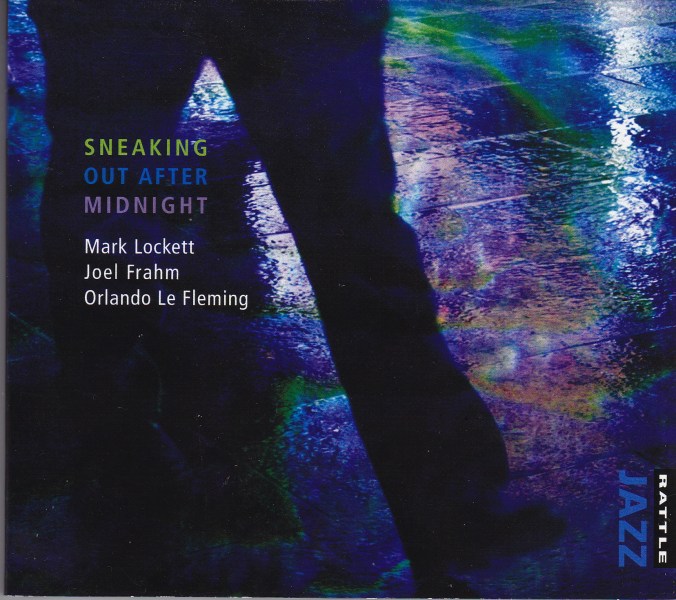
On Wednesday the 4th of July the Rattle Records/ ‘Sneaking Out After Midnight’ launch tour arrived at the CJC in Auckland.   The prior and subsequent tweets or Facebook posts have pointed to the success of the gigs, which have been well received throughout New Zealand.  To read my earlier review see below ‘Mark Lockett – Sneaking Out After Midnight’ from this blog site.

Alex Boneham

The band that toured New Zealand may not have featured New Yorker’s, Joel Frahm (sax) or Orlando Le Fleming (bass) but we did extremely well with their replacements.  Mark had wryly commented that the former were unable to tour ‘for tax reasons’.    The Australian Alex Boneham replaced Orlando Le Fleming and his work is already well-known to the Auckland Jazz community.    Alex has previously toured here with the Steve Barry trio and I doubt that any of us will ever forget the telepathic interplay between Steve Barry (piano), Alex Boneham (bass) and Tim Firth (drums).   This is an in-demand bass player who recently won the ‘Best young Australian musician of the year award’.  He is both attentive and inventive and what you get is skillful interplay and adventurous improvisation.

The third trio member was Australian alto player Julian Wilson, who has worked with Mark Lockett for many years.   He acquitted himself well.

Julien Wilson

What particularly struck me was just how musical Mark’s drumming was and when he and Alex fell into lockstep it was riveting.   To purchase copy of ‘Sneaking Out After Midnight’ contact Rattle Records Ltd  (link).

I have streamed one track from the album titled ‘Mr Pickles’.  Mr Pickles is the story of Mark Lockett’s cat and an unfortunate neighbour – a hapless man who thought that he could outsmart a cat.   Being a great respecter of cats and their place in the Jazz story I could not help but include this.  This is as good a cat story as you will hear.

Motif – (Norway)

Motif

We get a number international acts breezing through Auckland and a few of them play at the CJC.  On Wednesday 6th June we were lucky enough to have the Norwegian ensemble Motif at the club and they lived up to their considerable international reputation.   This is a band which plays highly original but accessible improvised/composed avant-garde music .   They are a killing band and above all they are highly entertaining.

Motif played in America a few years ago where they received excellent reviews in the New York Times (Nate Chinen), Jazzwise and in All About Jazz.  They have been around since 1999 in one form or another and were founded by the seriously out-cat Ole Morten Vagan.

Ole & Atle

It is obvious that this group has big ears as their compositions contain the distant echoes of American and Euro-centric Jazz while still sounding fresh and original.   This is as far from a covers band as you could get, because they gather in the myriad of sounds about them and fashion these into a fresh and exciting soundscapes.  The band may have achieved critical acclaim but they are certainly not above poking fun at themselves.  Ole Mortan Vagan joked several times about their earning potential.   This is a group of musicians who do what they do well and primarily perform for the love of the music.

Havard Wiik

The music was often rambunctious, but the band always drew you back to a collaborative theme after their stratospheric flights of fancy.   The magic woven by individual performers during solos was never at the expense of the ensemble.  It was organised chaos in the best possible way.

I was also delighted to discover that Norwegian humor translates perfectly for a New Zealand audience.  The music was leavened with countless jokes which had us in fits of laughter.   Ole Morten Vagan said that his father had recently accused him of being a bohemian.  When he asked his father to explain he was told, “A bohemian is someone who regards the rent as an unforeseen event”.

The band members were all incredible musicians whether playing as an ensemble or exploring the edge of reason.

The band was: Ole Morten Vagan (bass, jokes), Atle Nymo (saxophone), Eivind Lonning (Trumpet), Harvard Wiik (piano), Hakon Johansen (drums).

At the end of the second set they filed off the band-stand to the sounds of loud enthusiastic applause.  The clapping eventually subsided, but a few determined souls carried on until the band reappeared for a last number.    “That was strange”‘ said Ole.   “At first we heard clapping followed by what sounded like half a dozen potatoes rolling down the stairs – then clapping again.

Roger Manins summed it up perfectly in a recent Face Book post: “Just a heads up for those in Sydney Tomorrow.  MOTIF will be at SIMA– and seriously worth checking out. They were at CJC in Auckland last week and were great– very funny guys too”.    I concur.

Mark Lockett – ‘Sneaking Out After Midnight’

Some weeks ago I received Rattle Records latest release.  It was Mark Lockett’s ‘Sneaking Out After Midnight’.   

It is a while since Mark left Wellington and he has obviously achieved much since then.   He is an educator, an innovator and a drummer with great chops.   When you look at who he has played with in the last decade and who his own teachers have been, the narrative falls into place.   This is an album that could not have been made by a lessor musician.

Mark is joined by two fine New York musicians; Joel Frahm (sax) and Orlando le Fleming (bass).   Joel Frahm has been around for a while and his album with Bill Charlap is one that immediately comes to mind.   He has been very much in demand around New York.    Orlando le Fleming (who was born in the UK) is equally impressive having also played with Bill Charlap and an impossibly long list of jazz notables.    These three were never going to be anything less than great when they joined forces.

It’s a nicely presented album with great artwork and even though cover art shouldn’t matter – actually it does.  Rattle always tries to present a complete package.

Good albums strive to break free of formulaic constraints and when a musical story is told in a fresh way this is achieved.   This is an album with an open, joyful and honest sound.   It is also Mark’s fourth album, which has allowed him to push harder at the musical boundaries.   His writing skills and his vision have made this a worthwhile journey.  

The Interview:


Q. Apart from the obvious subdivisions of genre do you have a view on what if anything makes NZ drummers so diverse in sound?

A. One of the many great things about being a musician in NZ is that you have to find your own voice and because there’s less competition musicians don’t have to perform to a certain technical level as to the all the other guys working on the same street as a musician in Melbourne or NY for that matter. Musicians in NZ have an opportunity like almost nowhere else in the world to find their own voice without being inhibited and from this a beautiful raw energy often emerges.

Q. Many drummers are writing now and in fact some of the most innovative compositions around are coming from the likes of John Hollenbeck, Matt Wilson, Eric Harland and Marilyn Mazur,who took the baton from Paul Motian and Jack DeJohnette. Why do you think this is as a drummer/composer?

A. I don’t often like compositions written by drummers and I think this is because they lack harmonic direction having said that I believe that more drummers are having lead their own bands these days to remain busy and employed and I don’t think this is a bad thing. Playing standards is great and I love doing it but when you play and tour a lot you can’t help but start looking for other musical vehicles from which to improvise.

Q. I have known about Joel Frahm for some time as he brought out an album with Bill Charlap (they are old friends). Orlando Le Fleming is an exciting bass player who has often worked with the amazing Lage Lund and Will Vincent among others. How did the collaboration come about?

A. A good friend of mine Aaron Choulai (piano player) got a chance to record with Tim Ries (sax player at the time with the rolling stones) in NYC some years back I first met Joel through that connection down at smalls jazz club. We bumped into each other several times over the years and I’ve always dug his playing. Another friend of mine happened to have Joel’s number so I called him up and he was really into it. Orlando was recommended to me by another great friend of mine and my current drum teacher Ari Hoenig.

Q. How was it working with these New Yorker’s.

A. Working with Joel and Orlando was the most amazing experience and one I’ll never forget.  These cats are true professionals in every sense of the word and two of the nicest, normal and most down to earth people one could wish for.

Q. How are things going in Australia for you?

A. I live in Melbourne and things are going great I’m very busy at present playing in several Peoples projects and planning my tour to NZ to promote the new cd dates are 3 July Wgtn Havana, 4th July Auck CJC and 5th July ChCh NMC at the conservatorium.

Q. Working without a chordal instrument brings different challenges and rewards. What are your feelings about working and recording with a sax, drum & bass trio.

A. I love this combination because it allows for a lot of musical freedom. It’s hard to find guitarists and piano players who are really skilled in comping.

Q. Is there anything that you would like to add about the album?

A. This album is my fourth release and I’m so excited about it, I think because it was a lot of fun to make and I grew up listening to these master musicians recorded with my hero’s eg Bill Stewart, Brian Blade etc I mean I use to sit in my flat in Wgtn in the 90’s and dream of playing with these cats and now a dream come true.

Thanks man we look forward to seeing you on your tour of NZ.    

Aucklander’s note; Mark will appear at the CJC 5th July

W: www.marklockett.com.au

E: mark@marklockett.com.au

Craig Walters/Mike Booth Project @ the CJC in Auckland

Craig Walters

During Jazz Week it was appropriate that the Creative Jazz Club (CJC) featured a band that was in some ways a metaphor for the greater Auckland scene.   Jazz week is about Jazz in our neighborhoods but it also about how we connect to the wider Jazz community.

  The co-leader of this nights band, Craig Walters has lived in Australia since 1985.    Craig has an impressive background in Jazz, as he trained at the Berklee School of Music before going on the road as an in demand tenor player.  He has performed world-wide and with top rated acts.  Over the years he has earned a place as one of Australia’s foremost tenor players.   Australia claims him because he has lived and worked there for the last 27 years, but he was actually born in New Zealand.   

Mike Booth (trumpet player & co-leader) has a story that in some ways parallels Craig’s because he also travelled overseas and ended up working in the European Jazz scene for a decade or more.  Unlike Craig he returned to New Zealand a few years ago and since then he has been busy teaching, gigging and running a big band in Auckland.

The band was completed by a local rhythm section, Phil Broadhurst (piano), Oli Holland (bass) and Alain Koetsier (drums).   With this rhythm section in your corner the sound is going to be great and the band will back you up exactly when you want them to.  They are among our best.  As for Craig Walters and Mike Booth, they have known each other for years and this collaboration is merely an extension of their earlier projects.

Why do I consider this band to be a metaphor for the Auckland Jazz scene?  Craig Walters was born here and started playing tenor here.   I am fairly certain that there were no Jazz Schools in the city then and so he eventually ended up in the USA where he studied at the Berklee School of Music.   This is roughly the route that Mike Nock , Alan Broadbent and Matt Penman took (stellar musicians who left the Auckland scene to conquer the world).  This is what generally happens to our best and brightest but they do return.

The pianist Phil Broadhurst is a stalwart of the NZ scene but he was born in the UK and so his story is the reverse of the above.  Oli Holland is also overseas born, as he was an established bass player in Germany before migrating to NZ.  Lastly there is Alain Koetsier who is the youngest in the band.  This was his last gig in Auckland as he departs for foreign shores in two weeks.  Such is the ebb and flow of the New Zealand Jazz scene but in many ways this disruption brings benefits.  Almost all of the musicians that we lose to Australia or to the USA eventually return and they enrich us with what they bring back.  Now that we have two Jazz schools and a youthful vibrant Jazz scene in the city (and a great club), the future is promising.  I also have no doubt that the departing musicians take a special something with them which is Auckland.

Craig and Mikes band were great and as long as these ex-pat to local match ups keep occurring we will be just fine.

This gig occurred at the Creative Jazz Club (CJC)  in Auckland, New Zealand on the 11th April 2012.  Remember to keep visiting the Jazz Journalists Association (JJA) pages during the next few months as there are a number of activities that will include us. These are; the Jazz week Blogathon, International Jazz day 30th April – Jazz heroes announcement, JJA Awards in June – Auckland Satellite party.

Ottignon Bros Tour – Crazy in the moment

Ottignon band @ CJC

Matt, Eden & Dan

Seeing the Ottignon Brothers perform is to be put in mind of a very clever vaudeville act. There may have been more gags in a vaudeville act (well that is not strictly true) but the interaction between band and audience was honed to perfection.  The jokes were often of a musical nature and none of them missed the mark. This was great fun, highly inventive music and above all top class entertainment.

I first saw the Ottignon brothers when they were living in New Zealand and again some years later after they had moved to Australia. Aron was regarded as a prodigy on piano and I recall seeing Matt performing high wire saxophone acts somewhere. The brothers are now scattered around the globe, with Aron living in Paris and Eden & Matt based in Sydney (but gigging all over). The Australasian tour gave us a chance to connect with their new music and for the brothers it was a chance to play together again after 8 years.   The audiences responded by packing out their gigs.

Watching them communicate on stage was fascinating because they didn’t appear to need the cues that others rely on.   This apparent telepathy was advantageous to them as they responded to each other with lightning speed. The spontaneous twists and turns of the gig required them to be fleet-footed.

Aron

The way they had arrived at their set list was fairly post-modern and to lesser musicians it would have been challenging.  Only days away from the first gig in Australia they had put up a Facebook post; requesting ‘friends’ to nominate the tunes they should play. To be selected, each tune needed to attract at least two votes and predictably the suggestions were quirky. ‘Black and Crazy Blues’ (Roland Kirk), ‘Eden’s ukulele Song’ (Eden singing with ukulele, composed days before the gig), ‘African Mailman’ (Nina Simone), ‘Running Up That Hill’ (Kate Bush), a Medley of Sly & The Family Stone numbers, The poem ‘Trees’ which had been suggested by their Grandmother (Edwardian war poet Joyce Kilmer), ‘God save the Goat’ etc.  You get the idea.

The diversity of the material held the audience’s attention throughout, but it was their good humour and the solid musicianship which clinched the deal.Eden & Dan

Each number was a little crazier than the last but there were a few numbers which will linger in my memory for quite some time.  When Matt played the ‘Sly and the Family Stone’ medley the tone on his tenor morphed into a deep breathy rich sound.   On ‘Its a Family Affair’ he reminded me of Pharaoh Sanders and I asked him about that after the gig.   He told me he had been taking an interest in some Ethiopian tenor players of late and that they cultivated that particular sound.  The other number that I liked was more of a novelty and that was when Matt played his iPhone using the ‘Gyro Synth’ app.   This looked easy but it is not (I know because I have the app).  Matt has played with Lou Reed, Brain Wilson and Mike Nock among others.

Throughout Aron laid down solid percussive grooves on the piano and lived up to his considerable reputation.  In Europe he fronts a group called ‘Aronas’ and is featured in a number of well-known bands.   Eden showed his chops on double bass and electric bass, but also ventured into song and ukulele as the set list demanded.   Eden is the leader of the ‘Sun Searchers Collective’.  Dan Kennedy was on drums for the New Zealand leg of the tour and Kiwi’s are familiar with his tight propulsive, energetic style.    Dan is a favourite at the CJC and they could not have picked better for this gig.

Matt performing on iPhone.

Aron pleasing large crowds in the South of France

James Ryan – Jazz without a parachute

James Ryan is a Sydney based tenor player and he has appeared at the CJC before.  On Wednesday nights gig he fronted a trio of saxophone, drums and bass.   In configurations like this where chordal instruments are absent, a band is taking a more adventurous route.   Guitars, pianos, horn-sections and jazz orchestras provide a safety net for horn soloists and in addition they tend to fill in much of the soundscape with colour and a variety of textures.  Without this underpinning, clean open spaces can be revealed and the bones of melodies can be unraveled or looked at afresh in their raw beauty.    This is jazz without a parachute.

The precedent for such trios goes back a long way.   Gerry Mulligan came close with his famous piano-less quartet of the 1950’s, but the addition of another horn (Chet Baker or Bobby Brookmeyer) allowed for chords and complex counterpoint.  The most notable historic piano-less trios were Sonny RollinsWay Out West‘, Lee Konitz, ‘Motion’ and the drummer led Elvin Jones ‘Ultimate’.    There are many others and I should also mention the Max RoachDizzy Gillespie duos with just trumpet and drums.  Our own Roger Manins has also explored saxophone trios and his well received album ‘Hip Flask’ is a notable example.

I did not hear James the last time he appeared, but I was soon to be impressed by what was on offer.  His choice of band-mates proved to be fortuitous as Tom Botting (bass) and Ron Samsom (drums) rose to the challenge with enthusiasm.   In this blue-sky environment each artist knew what needed to be done and more importantly what must be avoided.  The was no overplaying and the flow of musical ideas was engaging.

James introduced the first set by playing solo for a number of bars and we could hear immediately that he was brim full of interesting ideas.  This was a good way to open because when the bass and drums came in, their addition filled the space with possibilities.  The fourth tune of the night ‘Micky B’ (Ryan) was a good example of this interplay.   In this case the tune had been set up by the bass and it soon developed into a hard-driving bluesy exploration of the theme.   James drove deeper and deeper into the changes and freed of the need to avoid piano or guitar, he took the music where he wanted it to go.   While James took care of business Tom Botting found just the right responses and Ron Samsom showed us again why he is a master of the drum kit.

After a number of interesting originals had been performed the band switched seamlessly to the well-known standard ‘You and The Night And The Music”.    James explained afterward that this had not been on the set list, but because Tom had quoted from it during an earlier bass solo he added it on impulse.   It is when we hear a standard that  we can form the strongest views and make comparisons.    The audience will know where the tune has gone before and be interested to see just where this band is taking it.   This particular exploration was inventive without being disrespectful.   It had an element of surprise in the familiar and that is what the best Jazz is about.

As is so often the case when Ron Samsom is on the bandstand, the percussion work was extraordinary.   His use of mallets and his inventiveness riveted the audience again and again.   He can play tightly in the pocket or with an understated but completely engaging looseness.  We saw him as more than a drummer in this set up.  He was an instrumentalist capable of filling any space.

There was one free number during the night and it was a riot.    James announced that he would play a tune of his titled ‘Rocket No 7’.    This was an homage to Sun Ra and his much admired composition ‘Rocket No 9’.   A few bars in James just let rip and the band quickly followed him into what were obviously unchartered waters.  This decoupling from the changes was soon evident and the organic freedom took us on a wild and delightful ride.   While the music was as free as a skylark it was never directionless.    Both band and audience were smiling at the end and everyone in the room knew that they had experienced something special.

After the number James wiped the sweat from his brow and pulled the mike towards him.   “That was nothing like ‘Rocket No 7” he said to our delight.

As with many of the Australian visitors we look forward to his return.

Natalia Mann interview

Hi Natalia,

I would like to thank you for agreeing to this written interview as I know how busy you are.   This will serve as an addenda to the post on your album ‘Pacif.ist‘ and give context to the Pacifica/Turkish connection.  Above all it will provide an insight into the charts and your choice of ancient and modern instruments. (read in conjunction with previous blog)
Q. Can you tell me a little about the harp you played at the launch?     It seemed smaller like the Celtic harp and wonderfully ornate.  Was that the one that you played on the recording?
Hi John.
 The harp I played at the launch is a nylon strung harp made by Andrew Thom in Tasmania.  It is a standard size for larger celtic harps – 36 strings –  though they can come in any size.  The ornamentation is actually quite industrial – a silver aluminium frame with black dots, and some subtle functional wooden detail. It has a carbon fiber soundboard and an aluminium soundbox covered with leather. But the shape of the arch and column itself is amazingly organic, comparable to dripping glass, with a koru curl.  The “Holden Red” colour makes it quite sexy, like a stiletto.
I played this harp on one piece on the album – Time.  Although most of the pieces were written on lever harp, when it came to recording I preferred to use the concert harp – the sound is richer and deeper.  I used the lever harp on Time because the composition includes string bends that are a sounds you get particularly with levers.  For the rest of the recordings I used my Lyon & Healy Style 23 Concert Grand (a big classic ornate wooden harp like those you see in the orchestra).
Q. Is some of that music improvised or were you following a score (or Jazz chart)?
There is improvisation in all of the pieces except for Interlude for Grozda, which I wrote out very quickly one day and I played that from the notes because I really liked them.  Usually I make a kind of jazz chart with melody, and we go from there.  Generally my aim is to improvise, so we’ll play the first round from the sheet and then expand on the ideas after that.  I love the way Aksam Duasiturned out because there’s so much improvisation in it.  It had one of the most minimal charts.   Greenstones is a piece that is usually ‘set’, ie, I usually play pretty much the same thing every time. In this version on the album, there was an extra melody chasing me all the way to the studio that day.  It wanted to be included in the recording. So when I got there, I tried to make room for the extra phrase.  It resulted in an improvised introduction of 2 or 3 minutes which I think worked very nicely with Richard NunnsTaonga Puoro.
I love improvising, and if I’m not improvising, I don’t mind making mistakes so that I have to improvise my way out of them.  Even if I’m playing the set tune, it’s still got to feel like an improvisation.  That’s the good music.  That’s what I’m chasing.
Q. Were those compositions originals or created out of traditional motifs?
That begs the question ‘Is there such a thing as a completely original work’?  I try to keep things as original as possible.  I try to let the music tell me how it goes rather than the other way around.
The only piece in which I really used a particular template is the first part of Akşam Duasi (Evening Prayer).  That melody came about one day when Izzet and I were looking at a traditional Turkish rhythm called Hafif which is a single bar of 32 counts.  You say “Dum tek tek, Dum tek tek, Du-um te-ka du-um tek tek-a…”  like this.  I made up a melody to help me remember the rhythm, we liked it and it became one of our tunes.  The second half of that piece came about when we were having a lukewarm jam one afternoon and the ezan (call to prayer) began. Suddenly the instruments got hot and took off as if on their own accord, jamming along with the ezan.  It’s simple and it feels good – familiar but from where?
Certainly in my early compositions, I used things that were ‘evocative’ for me, colours and feels from genres I’m familiar with. Greenstones has obvious Celtic influences, but begins with what for me is a bassy Polynesian rowing rhythm.  I recall now that it’s melody was influenced by speech and the motivic nature of the Kanun (Turkish zither).  As I got more comfortable with composing, I became more excited by melodic or harmonic movements that would surprise me.  These days I spend more time trying to figure out what it is that I wrote.
Q. The quality of the percussion work was extraordinary and I gather that your husband is the drummer.   How many percussion instruments were used apart from a normal drum kit.
Yes, Izzet Kizil is an extraordinary percussionist, and is my husband, and is a big influence on my work.  He has a very advanced, distinctive, intuitive personal style.  In fact he is not really a drummer, even though he played kit on these recordings.  He specialises in Middle Eastern hand percussions.  His main instrument is the Turkish Darbuka.  The other instruments he used were Turkish Bendir (a frame drum similar to the Irish Bodhran, which he plays with hands and brushes),  Daf, a Kurdish and Persian frame drum like the bendir but with dangling rings on the inside of the drum which makes the thunder sound that I love.  You can hear him play Kanjira (a small hand-held Indian drum with one zil) and Kup or Gattam (Indian clay pot) on Uc Adim.  He also plays a number of small effects percussions like clusters of seeds and bells.  He sets himself up a little kit made of the above instruments and a small snare and cymbals, which he plays with hands, brushes and sticks.  In Butterfly Effect he also plays percussion with his voice and fingers hitting his mouth and throat.
There is another drummer on the album and that is Riki Gooch.  Because Izzet isn’t a regular drummer, Riki noticed that some of the grooves could use some firmer ‘laying down’, (Gul Cayi, Sunshine Sister, Uc Adim), and he added in some very sensitive cymbal and highhat to complement what Izzet had already done.  Riki and Izzet met in Wellington, spent time and played together, so it was a nice vibe rhythm section even though the recordings happened on either side of the globe.
Q. Is there any connection between your music and the Sufi musical tradition.    Many Jazz groups in southern Europe now use an Oud (Italy especially) and some extraordinary Sufi trained musicians like Dhafer Youseff are having an impact.   I have seen him perform twice and it was a profound musical experience.
I have been very influenced by the sounds of Sufi music and musicians in Turkey, primarily the guitarist Erkan Ogur, and his albumsFuad and  Hiç, the title of which is a Sufi concept meaning ‘anything and nothing’.  In fact Mevlana or Rumi, the father of Sufism, was based in the town of Konya in southern Turkey during his enlightenment period with the philosopher Şemş.  Today Konya is called ‘the kitchen’ of pure Turkish classical music particularly because it is connected strongly with the study of Mevlana.  When I first came to Istanbul, I played mainly with Turkish classical musicians in Sufistic concerts. I will add here that the reason I was very attracted to Turkish music was not only for it’s beauty, but also the fact that it is an artform which melds improvisation with the written note. Recently I performed repertoire from the Sufi composer Yunus Emre with a singer at a Mystical Music Festival.  At that performance I was encouraged to improvise deeply and generously, because this is one of the expressions of union with the divine.
Izzet comes from a Sufistic tradition – his father played percussion for religious reasons. Sufism is a liberal and mystical branch of Islam. Living in an Islamic country with lots of philosophical artists around, Sufism is an underlying feeling.  I think it has been entwined in the development of Turkish music over the centuries, recognisable in the sense of expansive space and melodies of emotional longing for the divine.  I work towards deepening this kind of energy in my music.
Q. Is there a strong Jazz community in Turkey?
Yes there is. It’s relatively small but dedicated.  There’s a club in Istanbul called Nardis which is a dedicated seven night quality jazz place where lots of great Turkish musicians play.   Izzet plays for a group called “Ilhan Erşahin’s Istanbul Sessions” which is a New York-Istanbul jazz triphop outfit which is very popular.  A lot of international jazz artists tour through Istanbul. There are lots of great Jazz festivals going on, musicians coming over from Europe and the states.
Q. I understand that you were born in New Zealand and are of Samoan descent.  Is that correct?   Is there a Pacific influence in your music?
I was born and grew up in Wellington, witha seven stint in Los Angeles in my childhood. My mother is Samoan and my father is Australian – Scottish English descent.  The album is entitled Pasif.ist because I think of it as Istanbul through a Pasifikan’s experience.  The music is my response to the local environment as someone who is from ‘somewhere else’ and far away.  This is the manner of the Pacific influence in my music.  It is also in the concept of feeling the vibe of the environment and being in harmony with it.  Taonga Puoro is the ultimate example of this in my opinion.  If I’m in Aotearoa with a harp, I’m inclined to play clean air music with intervals inspired by tui calls. In the Pacific Islands I’m inspired by the warmth and rhythms of the water and trees.  In fact, these experiences are my references.  The antipodes are fierce with nature.  So moving into the densely populated, polluted, urban environment and foreign soundscape of Istanbul, I both absorbed the experience and reacted to it.
Some things that are particularly Pacific to me are the introduction of Migration, inspired by bird calls and contemporary NZ classical music.  Greenstones is another one.  Seeing the social-political situation between Kurdish and Turkish communities here, it made me think about Maori and the other communities which have journeyed to Aotearoa.  In that piece I always imagine the West Coast of NZ, clear starry skies and cold air. Sunshine Sister (my homesick song) is a sunny island tune about laughing and joy, as is the second part of Aksam Duasi.  Like that, the influence weaves its way through the music.
One of the reasons I started writing tunes here was to find a middle ground where I could communicate better with my Turkish musician friends. One time at a first gig, I said to the band, “let’s just jam this one on a dub groove.”  Well, I started, the bass player came in with something slightly different, the drummer joined with something different again, the violinist changed it more and by the time it got to the second tabla player, I had no idea what we were playing, but it wasn’t any kind of dub that I recognised.  There were suddenly all these alien rhythms my ears were trying to process. It was pretty funny.  So I figured out that we all have different vocabularies according to our experiences. I wrote music that mixed my perspective with a local vibe – where there weren’t too many preset rules and everyone could bring their own interpretations.
Q How many strings on the violin like instrument?  It sounds similar to the Chinese Erhu.
The violin like instrument is the Classic Kemençe (keh-men-cheh) played by Sercan Halili.  It has a three string and a four string version, and in Time, Sercan plays an Alto Kemençe which he had designed for himself.  It is the first and only recording of that instrument.  I love it because it sounds like a raspy old man.  I love all the kemençes for their soulful vocal sound – so etheric.  The instrument is played with a bow, but balances between the knees rather than on the shoulder.  It has gut strings, and the tones are created by pressing against the strings with the backs of the fingernails. It is a very highly regarded Turkish instrument for its delicate and emotional nature. Mostly it is played in Turkish classical music settings; Sercan is quite adventurous.  He is a talented young player fluent in the Turkish classical world and working on a number of cross-over projects.
Q Have you considered doing an even more Jazz influenced album one day?   Your music on Pacif.ist swings.
Thanks man.  I like swinging. I love jazz.  I’m doing a Masters degree in Jazz at the moment, so I reckon there will be a few new tunes popping out that are more jazz influenced.
In fact the first piece of the next album is a jazz tune already.  We were going to put it on this album but felt it needed more time to mature.  That was a session with the great bass player Dine Doneff (aka Kostas Theodorou) from Thessaloniki.  I met him out in Skopje which is where I study jazz with the guitarist Toni Kitanovksi.  Dine later came to Istanbul to record on some pieces and it was such a great experience working with him.
Q.  Could you tell me your link with Rattle Records?   Steve is doing a fabulous job of recording NZ Music and a number of those albums are absolutely world-class (‘Zoo’ by Tom Dennison is my very favourite).
Steve Garden and Rattle Records have been fantastic.  I approached them with my demo a couple of years ago and asked if they’d be interested to release it on their label.  Happily, they said yes, and they’ve been really supportive throughout the process.  There are many artists for whom I have huge respect and admiration on the Rattle label, so I’m honoured to have my album in the same catalogue.  The recent output by Rattle of artists and new music is phenomenal and gorgeous.  Really a cool support for art music in NZ.  Many thanks to them.
Q. What is your connection to Bic – I gather that you have been recording with her?
I’ve been playing with Bic Runga since about 2006, when we did the Acoustic Winery Tour and I played in her band.  Since then we’ve worked together when we get the opportunity.  I recorded on Belle, the title track of her new album.  She invited me to play support for her recent national tour.  So I did the support performance, releasing Pasif.ist, and then I joined her and the band on stage for a couple of numbers.  We had a great tour, with Kody Neilsen and Michael Logie in the band.  I admire Bic’s stellar output and her musicality.  She’s always encouraged me to get my music out there.
I must thank you for the thought that you put into your answers Natalia.   I look forward to your next visit home and to any future albums.
Best wishes
John (Jazz Local 32)
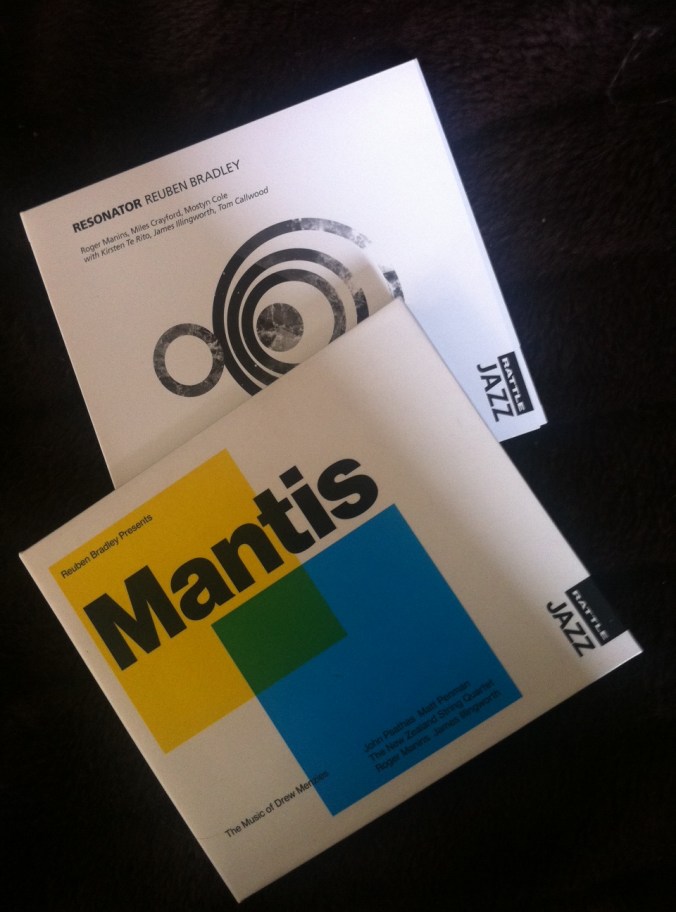
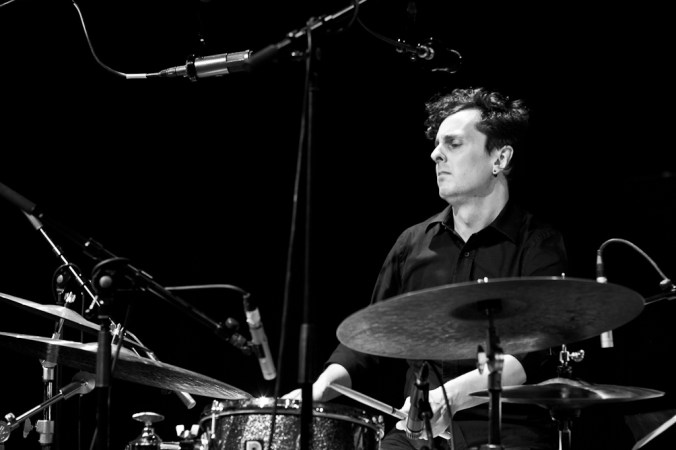
Weaver of Dreams – Andrew Dickeson Quintet

For those Aucklanders addicted to live Jazz, the month over which the CJC Jazz club was closed for Christmas seemed like an eternity.   The first of the New Years bookings made up for it though as premier Australian drummer Andrew Dickeson came to town and he brought with him a solid lineup (including a couple of ex-pat New Zealanders now living in Australia).  It was Andrews first time at the CJC but it will hopefully not be his last.

Andrew Dickeson is one of the most respected drummers in Australasia and in stepping out as a leader he has enhanced his already solid credentials.   Andrew has for some time been regarded as the drumming lynch pin of the Australian Jazz scene and when a visiting artist requires a percussionist he would be the first choice.

The band began with the fabulous number ‘Ill Wind‘ (Arlen/Koehler) and it was obvious from the get-go that the tasteful drumming was a cushion of energy powering the group.   As good as the musicians were it was the drummer that caught the attention first; not by showing off his chops but by his sheer musicality.   You were also aware of his powerhouse propulsive swing.   The drums managed to preside without ever overwhelming the rest of the band and to achieve this takes real skill.    This is the sort of maturity that experienced drummers like Jeff Hamilton bring to their gigs and it was nice to witness.

A point which illustrates this perfectly occurred when I spoke to Andrew the next day.    After listening to the CD I had wondered how he had managed to obtain such a crisp but soft sound from his ride cymbal on the ‘Weaver of Dreams’ track (Young/Elliot).    I asked him if he had muffled the cymbal in some way or ‘miked’ it down during mixing.   “No’ he said, “It is all about awareness of the situation.  I just play very gently when that is required”.    I had not known that you could play so gently on a ride cymbal without losing clarity of sound.   At this point Roger Manins leaned over and said, “this is what separates a good drummer from a great drummer.  The ability to fit perfectly into any given situation and to adjust your volume accordingly”.

Those appearing on the album are: Andrew Dickeson (drums, leader, arranger), Roger Manins (tenor sax), Steve Barry (piano), Alex Boneham (bass), Eamon McNelis (trumpet).    For this gig the latter two were replaced by Tom Botting (bass), Pete Barwick (trumpet, flugal horn).  The two acquitted themselves well.

Andrew had used Roger Manins on the album and witnessing his performance at this gig it was easy to see why.    Roger is undoubtably the best tenor man in New Zealand but we sometimes forget how well-regarded he is beyond these shores.    I have written about his playing many times and each time I see him I wonder if he will better his last performance.  He usually does.   As a born story-teller he can captivate from the first few phrases, but the magic he weaves is also due in part to his stage presence.   On ‘Ill Wind’ the pianist had laid-out for a number of bars and in this space Roger mined the bones of the tune to the marrow.  That is his way and as the solo developed there was an increasingly ecstatic quality to his performance.   I have witnessed this before and it draws me to his playing again and again.   In Jazz authenticity is everything.

Pianist Steve Barry grew up in Auckland but he later migrated to Australia in search of greater opportunity.   He is no stranger to the CJC and his occasional gigs at the club are happily anticipated by his ever-increasing fan base.   For some years now he has been working on the Australian scene and he is exceptionally well-regarded there.   Some pianists have an X-factor and Steve is one of those.   The history of Jazz piano is somehow referenced in his playing but he is more than that.  While unafraid of the past he is not owned by it.   This is a journey of stylistic development that we are privileged to witness and it is an ongoing story.    In this setting he was not only a good soloist but the perfect sideman, as his comping and sense of timing were superb.   We get one more chance to hear Steve before he returns to Australia; next week he is co-leader of a quartet performing at the club.

Tom Botting and Pete Barwick had been engaged for this one gig and they fitted in seamlessly.   I had not seen Pete Barwick play before tonight but he handled the charts with ease and performed each solo convincingly.   His strongest performance was on the Strayhorn balad ‘Isfahan.    His burnished ringing tone and clear articulation were just great.   Tom was a fixture at the club before moving to Australia and his bass playing is familiar to CJC attendees.     He is a reliable time-keeper but he can also be adventurous when challenged.  On this night he injected a sense of urgency into the uptempo numbers.  Sitting in for Alex Boneham would be quite intimidating to many bass players but Tom took it in his stride.   He had returned to New Zealand in disguise (no beard and shorter hair) but his signature bandstand persona was fully in tact.   Tom always looks and sounds extremely convincing and it is nice to have him back for a few weeks.

The other stand out number was ‘Soy Califa’ (Dexter Gordon).   To have Roger play a Dexter Gordon number is a no brainer.  He aced it and then some.  This was a great night out and once again it reinforced the strength of the Trans-Tasman Jazz alliance.

This album is well worth buying : ‘Weaver of Dreams’ – The Andrew Dickeson Quintet – Rufus Records (a division of Universal Music group).     rufusrecords.com.au – or  – andrewdickeson.com

Michel Benebig: soul on Pacific soul

Noumea resident Michel Benebig is a mavin of the B3 and its compact love-child the Nord C2. He is the sort of musician that sets the world to rights and sets your feet tapping.

He is a story-teller on the B3 organ (C2) and through his fingers flows the history of this wonderful instrument. The chords that he uses are rich and warm and capture the instruments journey from the African-American southern church’s to the Jazz heartland. While his voicings contain hints of the greats that he references like Brother Jack McDuff, Jimmy McGriff and Jimmy Smith; Michel is comfortably settled in his own style. He speaks with the unmistakable authority of a South Pacific Soul-Jazz master and it reinforces the view that Pacific Islands like New Caledonia and New Zealand have unique contributions to make to this music.
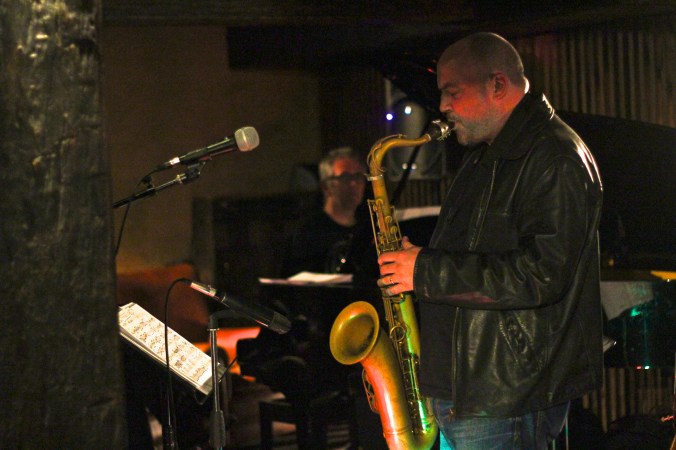
Michel was accompanied on tour by Shem Benebig (his wife) and the French drummer Johan Cazalas. Shem is a fabulous singer and she knows how to enhance the mood by a lowered tone, a hand gesture and a quick smile. When others were soloing she would stand a little to one side and dance; her movements contained more than a hint of the sensuous Kanak rhythms. Shem guided the proceedings with the consummate skill of a professional; holding the attention or directing it to the other musicians as required. No audience is ever going to be disappointed when this husband and wife team are performing. Johan was an observant and tasteful drummer. He would watch during a solo and lift the performance exactly when it was required. Never over-crowding the others and always supportive.
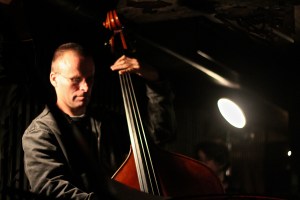
The band had a Kiwi horn section to assist them and if I heard correctly these guys had not seen the charts until a few hours before the performance. If that is true they did doubly well. The horns provided added heft to an already powerhouse sound and in doing so followed the best traditions of the Soul-Jazz genre. Ben McNicoll (Baritone sax), Chris Neilson (trumpet, flugal horn, alto sax), Jimmy Garden (tenor sax). The tight ensemble playing and a particularly lovely baritone solo by Ben earned them good applause.

The first set had begun with a tune called ‘Mr Jim‘. One full-throated blast from the organ and we were immediately locked into a warm soul-Jazz groove that never abated. As the night progressed we heard slow burners and heart stopping up tempo tunes. My favourite was a tribute to Jack McDuff titled ‘Captain Jack‘. This was not only a fitting tribute to the long departed B3 master, but an up-to-date comment on the Pacifica Jazz renaissance. Another tune Papillon about a tiny butterfly was a perfect vehicle for Shem and it tapped right into the ‘rythmes Kaneka‘. Michel could move from a quiet soulful chord to a stuttering tidal wave of sound in an eye blink and that is partly because of his chops and because of the unique qualities of this instrument.  An organist has to control many things at the same time but he is particularly required to control the following; Swell pedal, bass pedals and the two keyboards. When you consider what improvisers must do mentally and add in the above, this becomes a truly impressive feat.

I spoke to Michel at length during the break, and at the house-party a few days later. He is in the mould of great Jazz Musicians everywhere. Self effacing and engaging as a conversationalist. Full of wonderful stories about Joey DeFrancesco, Jimmy McGriff, Tony Monaco, Lewis Nash and others. As we talked I mentioned my liking for the great French B3 player great Eddy Louiss. “Oh yes Eddy Louiss is a monster” he said dropping his voice to a reverential whisper. “I met him in France a few years ago and it made my knees weak just to be in his presence”. I suspect that many up-and-coming B3 players will find meeting Michel has the same effect on them.

When music like this is playing it is good to be alive.

Resonator; Reuben Bradley

It is well-known on the New Zealand Jazz scene that Resonator won this years ‘Jazz Tui’ award.  As this is drummer Reuben Bradley’s first album that is no mean feat.  The band played at the CJC earlier in the week as part of their Australasian tour and pulled a good audience for the gig.

The band we saw on Wednesday did not have the full complement of band members present on the album, as the pianist Miles Crayford who had played piano, Fender Rhodes & synth had been replaced by guitarist Tyson Smith.   Also absent were guest artists Tom Callwood (arco bass), James Illingworth (synth) and Kirsten Te Rito (vocals).

This was a paired down hard-driving unit and they took the high energy, high volume route.   The band was: Reuben Bradley (drums, percussion), Mostyn Cole (electric bass), Roger Manins (tenor saxophone) Tyson Smith (guitar).   It was also obvious that this was a drummers band because Reuben seemed to direct all aspects of the music; the band taking their cues from the complex rhythms he was laying down.   I had heard much about his ascendancy as a drummer and his chops were certainly evident at this gig.    He was also an engaging presence as he bantered with the audience.  Jazz musicians are capable of delivering knock out one liners, self-deprecating asides and sly insider jokes from the bandstand.   I am happy to see that tradition continue at the CJC.

While most of the pieces swiftly morphed into full-on blowing numbers there was one ballad.    In situations like this a band could not do better than call on Roger Manins to execute the key lines and he delivered in spades.   Reuben introduced the number by saying, ” I had always wanted to write a dark evil sounding ballad because I figured that there was a real market for this”.    This number ‘Search in progress’ gave us an insight into the subtler aspects of the band’s repertoire.

Every Kiwi (and offshore) Jazz fan should contact ‘Rattle Records’ http://www.rattlejaz.com and purchase the ‘Resonator’ album.   It can also be purchased at ‘Marbecks Records’, ‘Slow Boat Records’ and ‘Parsons Records & Books’ and is available as a download on iTunes.   ‘Rattle Records Ltd.’ are to be congratulated for their burgeoning catalogue of top quality NZ Jazz and I urge all Jazz lovers to support this label.    It must be pleasing to the band that Mike Nock has praised the group. He saw this album as being ample evidence that “The new generation of New Zealand Jazz musicians have moved up several notches”.

After the gig I sought out Mostyn Cole the bass player to apologise for wrongly naming him as the bassist at the previous weeks gig.   I could not find him but the guitarist Tyson Smith said, “It doesn’t matter man because I am credited as being in the band but I was not on the album we are touring to promote and so it all equals out”.   That caused me to recall Roger Manins tongue in cheek announcement the previous week. “We believe in truth in advertising tonight and this is one of the rare examples where the people on the album are actually the people performing on the promotional tour,  Get a signed copy of the CD now as this may never happen again”.    Jazz humour is the best.

‘Melancholy Babes’ + Eric Boeren – out cats@CJC

Any club that was attempting to present a wide spectrum of Jazz styles would commit a sin of omission if they failed to include some of the more experimental Jazz on offer.    The CJC management have open ears and so on Wednesday they offered up the well-respected Wellington based new-jazz ensemble the ‘Melancholy Babes’ (plus guests).  The Melancholy Babes are: Jeff Henderson (alto sax), Anthony Donaldson (drums), Tom Callwood (bass) – [replaced by Gerard Crewdson (tuba)]. – special guest Eric Boerens (trumpet), John Bell (vibraphone).
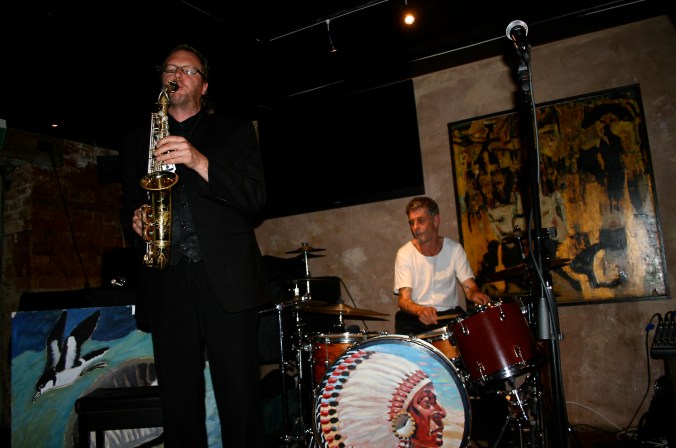
The ‘Melancholy Babes’ appeared with guest trumpeter Eric Boeren of Amsterdam, who has long been touring the world and setting audiences on fire with his free ranging improvisation.    Eric has a long history in avant-garde music having played with titans like ‘Malachi Favors and  Roscoe Mitchel (of Art Ensemble of Chicago & AACM fame).   The usual Bass player (Tom Callwood) had been replaced for this gig by Gerard Crewdson on Tuba and a vibraphone was added for the last number (which occupied the entire second set). In Auckland we seldom get the chance to hear such groups, as Wellington is the New Zealand home of the experimental music scene.

In experimental music you are seldom going to get a gentle melodic swinging introduction to a tune and this is perhaps the point of the music.    It will find its own rhythms and develop an organic logic as the pieces progress.   The band opened with an explosion of sound and the force of it was initially startling.  The quick runs on the horns rose and fell, often ascending into squalls of sound or multi-phonic effects.  The insistent propulsive drum beats and the steady pulse of the tuba sent them even further out.     While the music was often wild, it took the sometimes incredulous audience along with it and as the journey progressed we felt ourselves to be part of what was unfolding.

At times the band would mysteriously coalesce into a gentler incarnation of its wilder self and in this reflective space, miniatures or tiny motifs would be crafted.  Perfect creations that stood apart, but somehow augmented the whole.  I was surprised at just how drawn into the process I had become and others felt the same.    We were hearing hints of something vaguely recognisable and intriguing, but for a number or two, just what, remained elusive .    Then it hit me; this felt like the history of Jazz and improvised music unfolding.    Rambunctious would be Buddy Bolden‘s swaggering up an ancient New Orleans street as the crowd egged them on.   1930’s Harlem bands, Hoe-downs & Jigs, raggedy defiant funeral marches.   They were all in the mix and our collective Jazz memory was being teased and refreshed.     I was not alone in arriving at this realisation as my friends Jason and Catherine and Sarah heard similar echoes arising from the music.

Having the Tuba was inspired as it gave the music a depth and a foothold in history that it would otherwise have lacked.   The Tuba nearly always took up the bass line in early Jazz as the bass would not have been heard above the brass dominant bands.   It was not until the advent of better recording techniques and amplification that double bass replaced it.   Tuba player Gerard Crewdson has solid credentials on the experimental scene and he understood exactly what was required.   There was also an element of word Jazz when Gerard intoned the story of the Melancholy Babe, while turning the pages of what looked like a very large comic book.  Like the music this was anarchic and humorous.  Many sacred cows were savaged on this night and if any cobwebs had been hiding in corners of the club they would have been blown away by the night’s performance.

Both Anthony and Jeff are well-known on the experimental music scene and I will hunt them out in Wellington one day soon.    Afterwards I talked to the band for some time and I was surprised to learn just how active the experimental Jazz scene is.   Anthony and I talked about Annette Peacock, the Black Saint label, Hat Art, the Art Ensemble of Chicago and Free Jazz music in general.    This sub-genre is certainly very well-respected around Europe, but in the USA it has a stronger following in some cities than in others.    Wellington it appears is solidly in the mix.

The night was fun and it was challenging.   I am glad I went. 

Susan Gai Dowling – CJC

Thelonious Monk, Minton's Playhouse, New York,...

Image via Wikipedia

Wednesdays offering at the CJC was Australian based Jazz singer Susan Gai Dowling.    Susan’s sidemen were Kiwi Jazz veterans Mike Walker (p), Pete McGregor (b), and Frank Gibson Jnr (d).   After hearing her sing I could understand why she was in demand on the Sydney scene after so many decades.    Her voice is warm and slightly smokey and above all it is a real Jazz voice.   At her command were all of those tricks of articulation that tend to separate Jazz singers out from the straight-ahead variety.    To underscore her Jazz credentials she announced that she would mainly sing ‘Monk’ tunes.  To up the anti even further there was also an extremely difficult Brubeck number thrown in, ‘Raggy Waltz’ ; in addition we heard ‘Very Early‘ (Bill Evans), Lady Bird, (Tad Dameron) and ‘Girl Talk‘ (Bobby Troupe).

Thelonious Monk was a genius of composition, but singing his tunes is arguably a risky business with all of those spiky  rhythms to contend with.  Others have put words to Monk and Carmen McRae was the standout in my view.    McRae has set a high bar to what is already a difficult proposition, but Susan approached the task with confidence.    She opened with a standard. ‘Old Devil Moon‘ and then tackled ‘Blue Monk‘.     As she progressed through the eight Monk tunes it was obvious that she was more than up to the task.     Like McRae her intonation and her ability to deal with the complexity of the tunes was impressive.  Mike Walker dealt with the angular percussive accents in the way that an accompanist should.  Not over-bearing and leaving enough room for the singer to tell her story.   The rest of the band got right in behind the singer and they deserve credit for their flawless performance because they had not been able to rehearse because of the tight timeframe.

Next was the lovely melody ‘Ask Me Now’.  It was a real treat and it enhanced the singers credentials as she captured the raw beauty and emotion of the tune.   The other Monk tunes were ‘Well You Needn’t‘, ‘Ugly Beauty‘, ‘In Walked Bud‘, ‘Ruby My Dear‘, ‘Monks Dream‘, & ‘Round Midnight‘.   ‘Ruby My Dear’ was lovingly executed and this iconic tune along with her rendition of the Evans classic ‘Very Early‘ were highlights.

Susan Gai Dowling and Mike Walker were off this week to play a gig in New York’s ‘Birdland’ club.