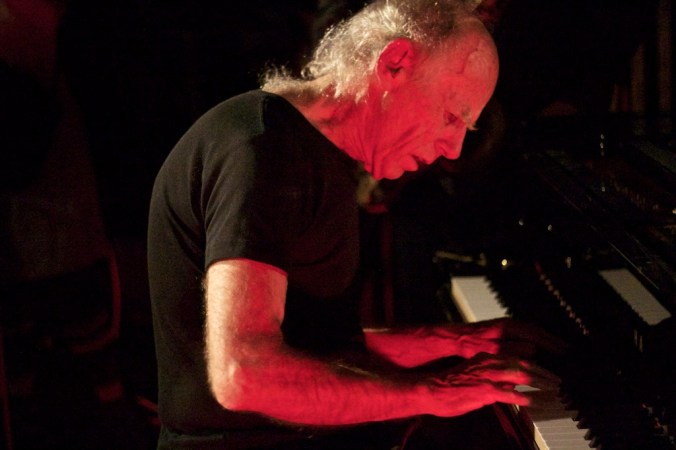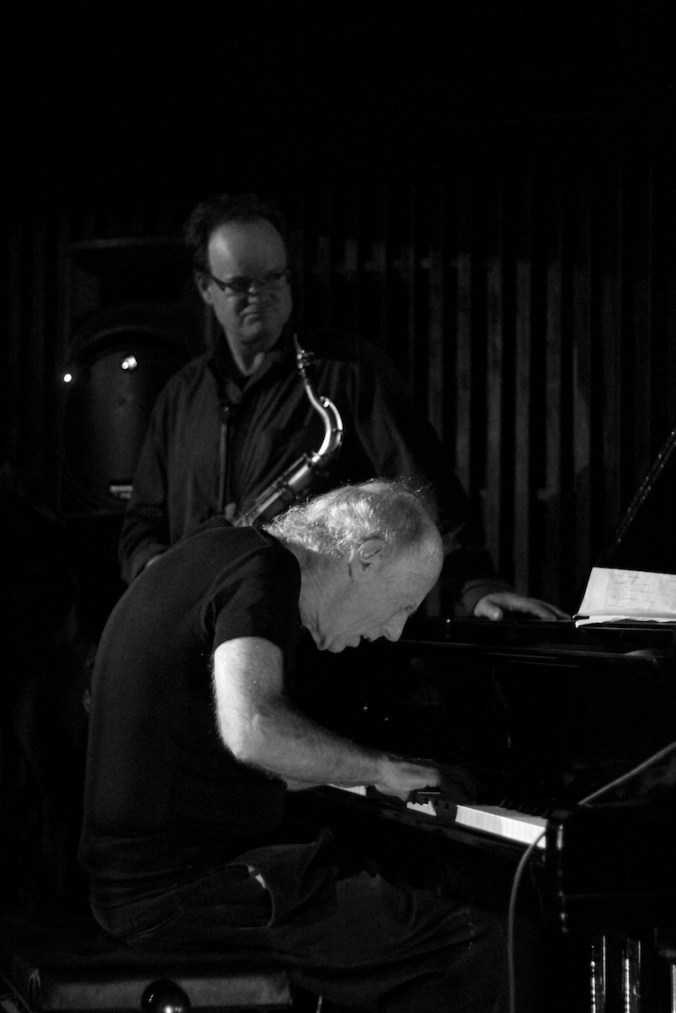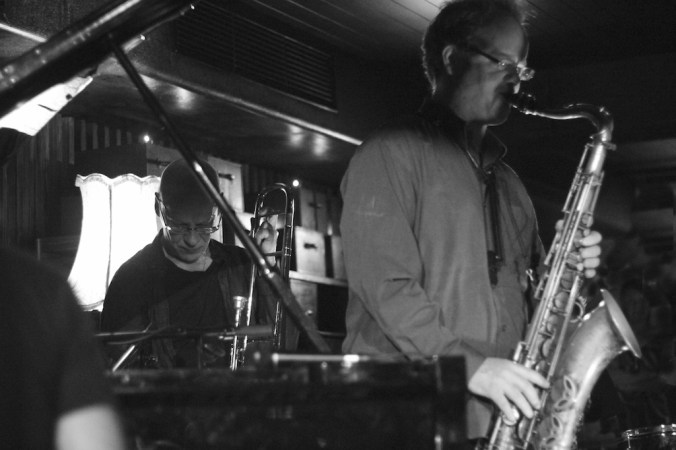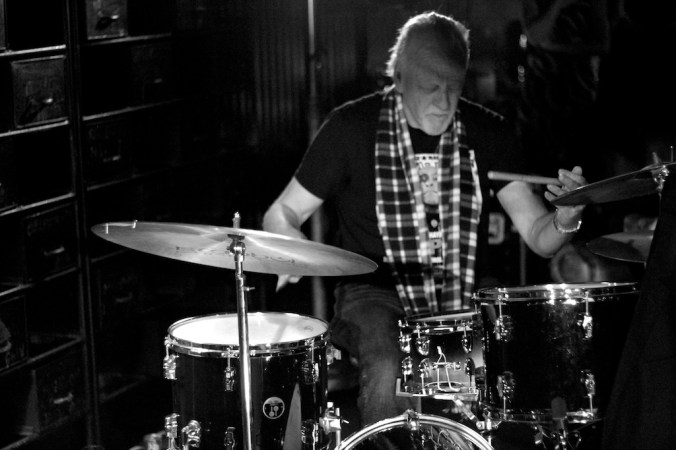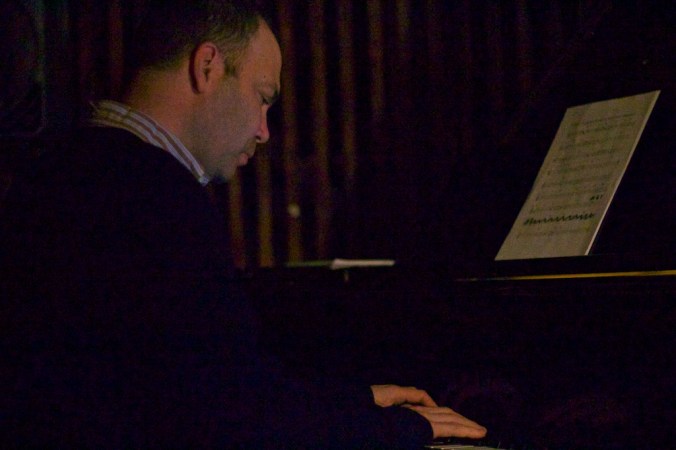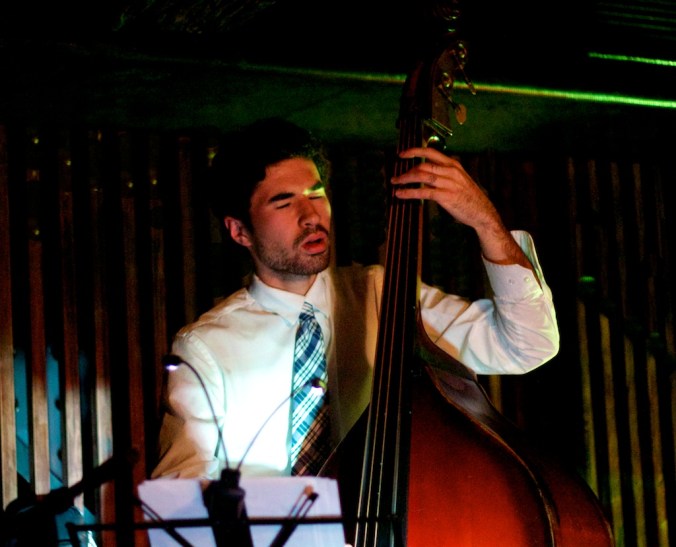
Reuben Bradley trio @ CJC + Mantis Album

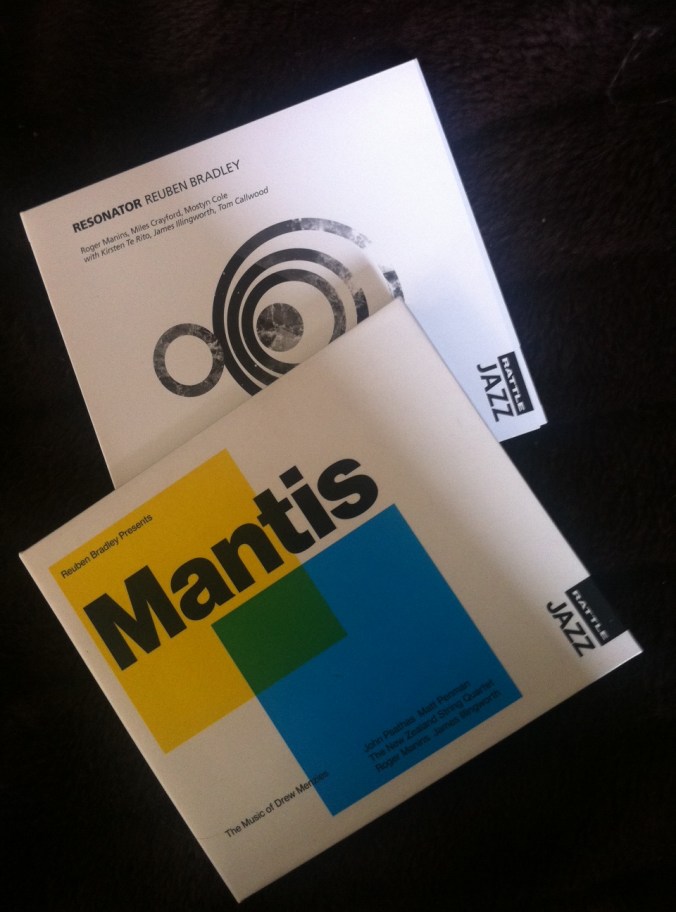
Reuben Mantis

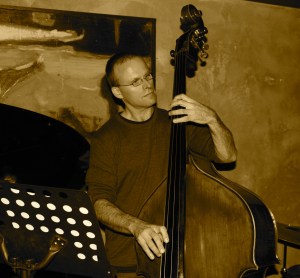
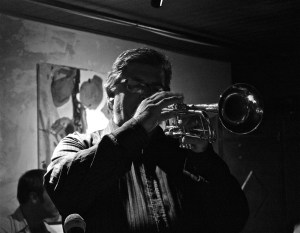
After the success of ‘Mantis’ and ‘Resonator’, Auckland audiences were keen to see a Reuben Bradley band perform again.   Reuben is one of those musical drummers that Wellington seems to specialise in and he clearly has an eye for an epic project.  For ‘Mantis’ he engaged some real heavyweights.  Roger Manins (tenor), Matt Penman (bass), James Illingworth (piano), John Psathas (arrangements) and the New Zealand String Quartet.  The tunes were all Drew Menzies originals, with arrangements by Reuben Bradley and John Psathas.

Mantis is a celebration of the works of Drew Menzies, a highly respected bass player in both the Jazz and Classical spheres and whose compositions had never been recorded before.  What is well communicated during this project is the connection that the musicians have with the material and what also comes across is Reuben’s obvious affection for his departed friend.  Reuben’s liner notes give us a fascinating account how the pieces came back to life, drawing us into a kaleidoscope of quirky lead sheets and a musicians world.  In some cases the tunes re-evolved from embryonic beginnings, coaxed by Reuben’s pen.   I urge everyone to buy the album.  The tunes are fresh but at the same time strangely familiar and this quality anoints them as being timeless, potential local standards.

While no added incentives are needed to purchase ‘Mantis’, it is worth pointing out that the proceeds of the sale go to the Drew Menzies Memorial Scholarship for young New Zealand bass players.  ‘Mantis’ was featured as a key event at the recent Wellington Jazz festival and this week it was a highlight of the Nelson Jazz Festival.  Credit to Creative New Zealand for funding such an important project and to Rattle Records for the album.  It is hardly surprising that musicians of this quality delivered so royally, but a nod to John Psathas and the New Zealand String Quartet is appropriate here.  No matter how experienced a classical string quartet, there is always a challenge when playing Jazz compositions.   The quartet’s unmistakeable chops and John Psathas airy charts took this exactly where it needed to go.

Having Matt Penman aboard was a huge coup.  This expat Kiwi bass player is now one of the real heavyweights of the North American scene.  His work with the San Francisco Jazz Collective, James Farm, Kurt Rosenwinkel, Kenny Werner, Joe Lovano, Fred Hersch, plus his own ground breaking albums, mark him out as one New Zealand’s greatest Jazz exports.  His Bass playing on this album is simply wonderful and no superlatives can do it justice.   Drew would have been extremely pleased.

Reuben won the Tui Best Jazz Album of the Year with his ‘Resonator’ album in 2010.   Roger Manins was also on that album and these two musicians work together whenever possible.  Both of the above albums are adventurous and in their different ways lay down benchmarks for what’s good and original about New Zealand Jazz.
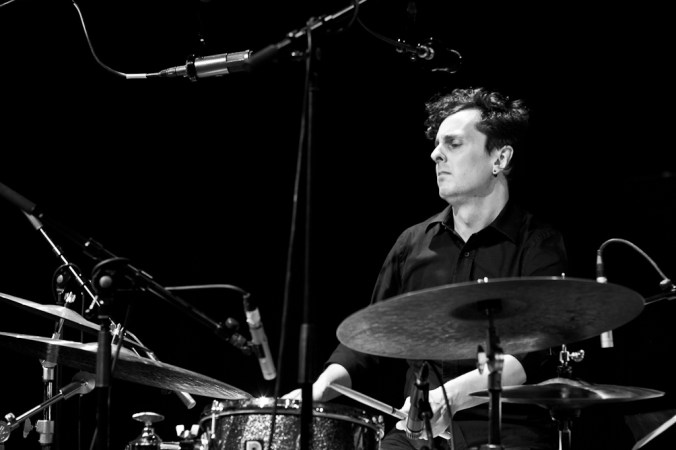
mantis_image-reuben-bradley_wjf13

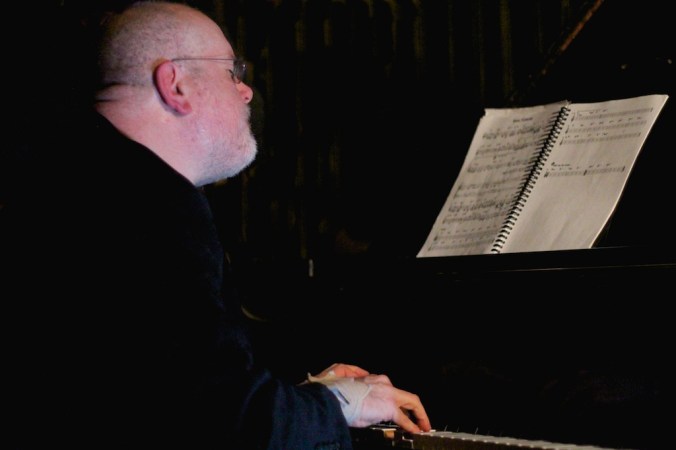
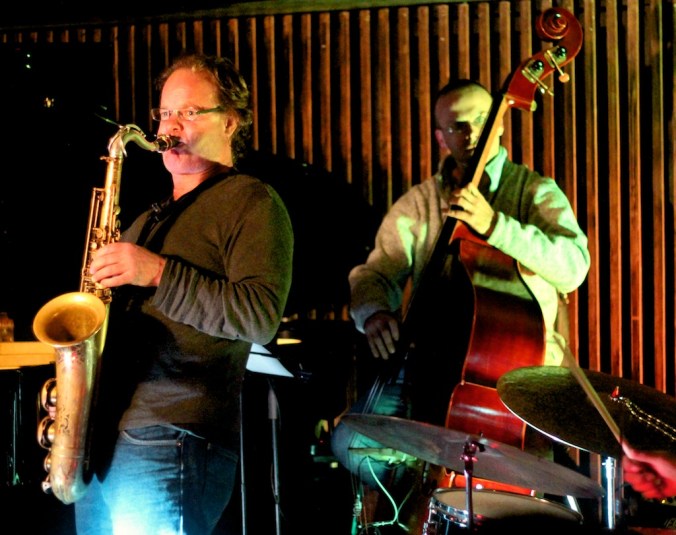
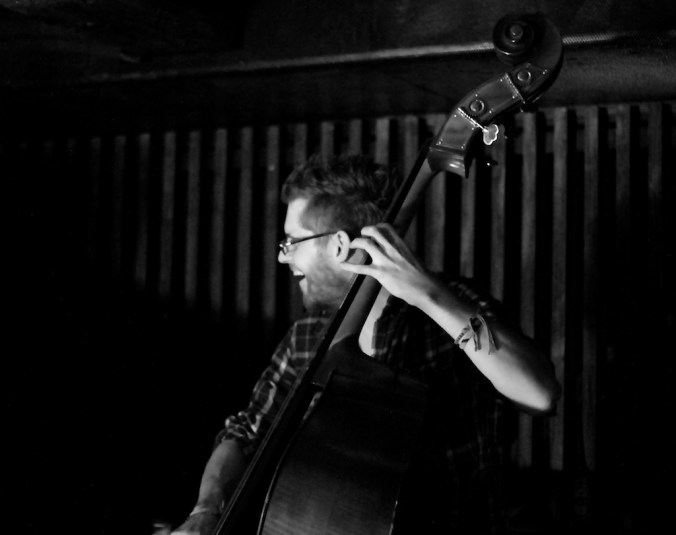
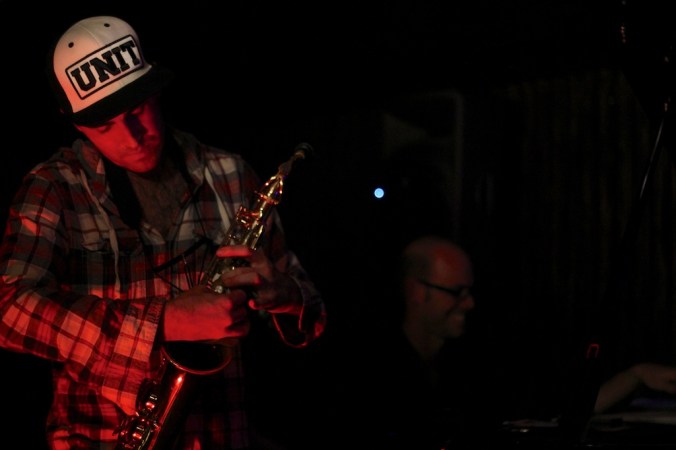
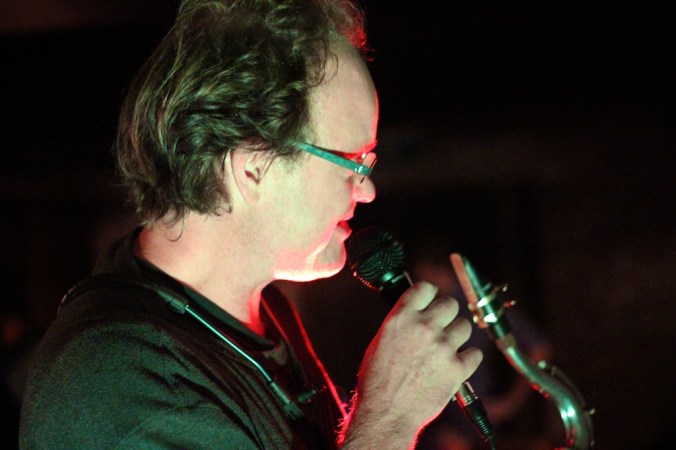
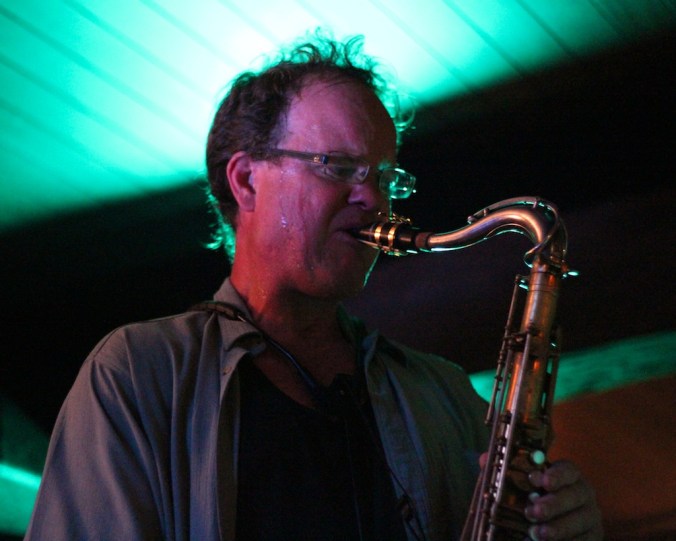
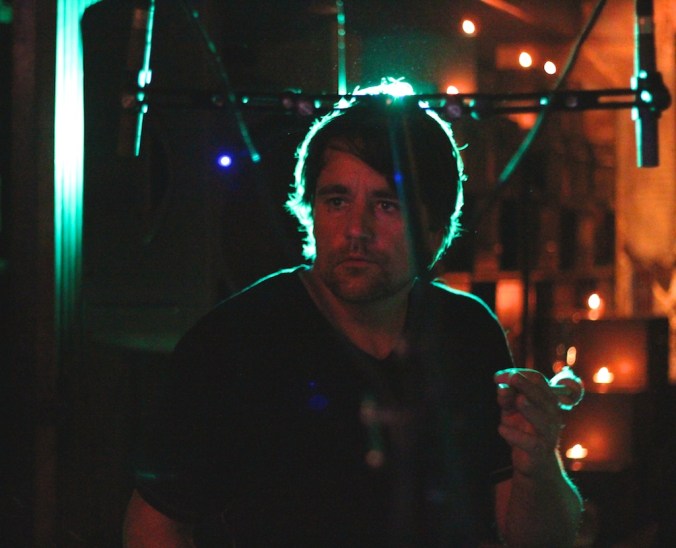
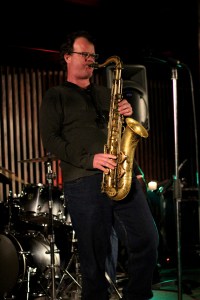
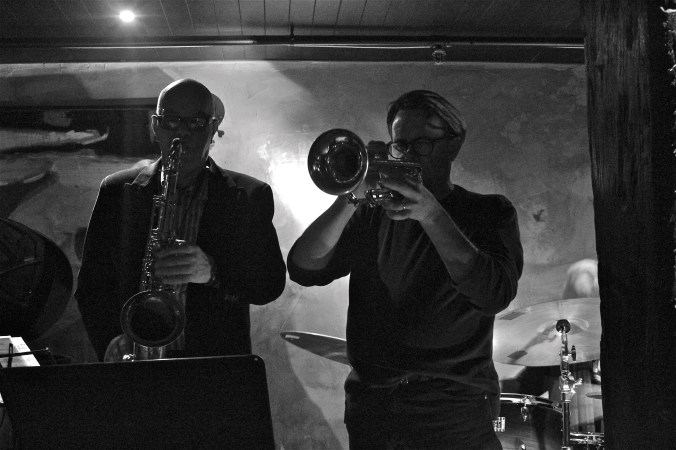
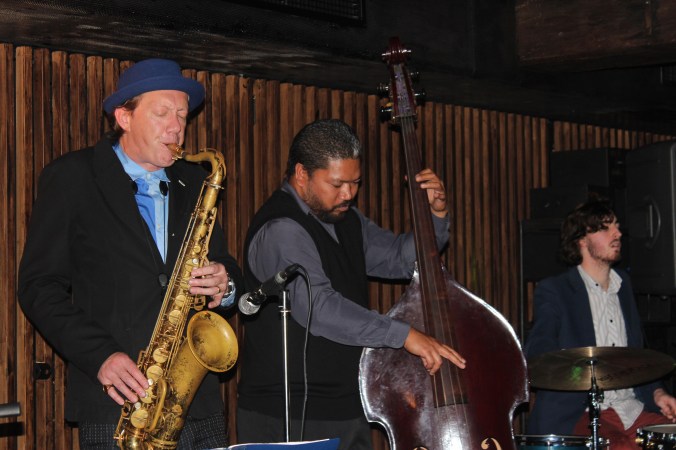
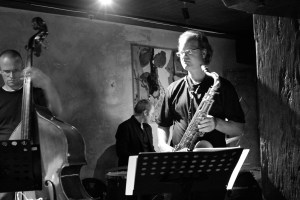
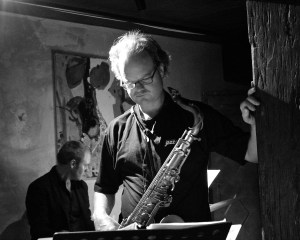
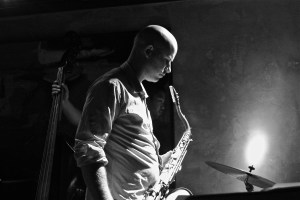
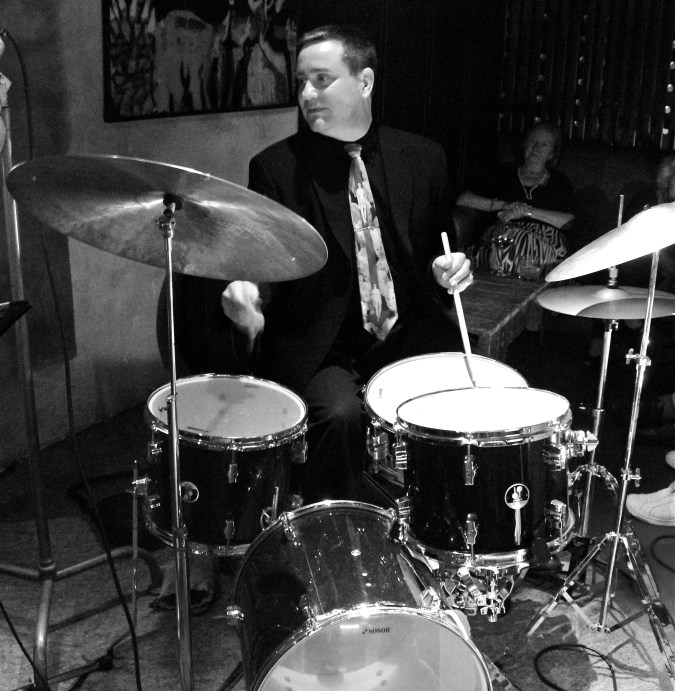
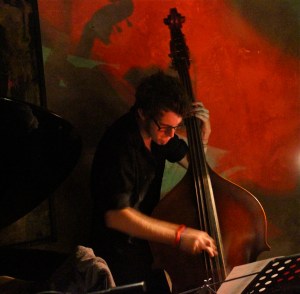
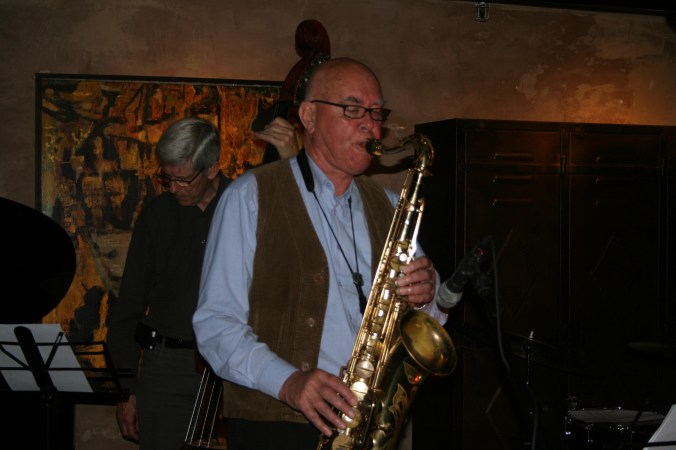
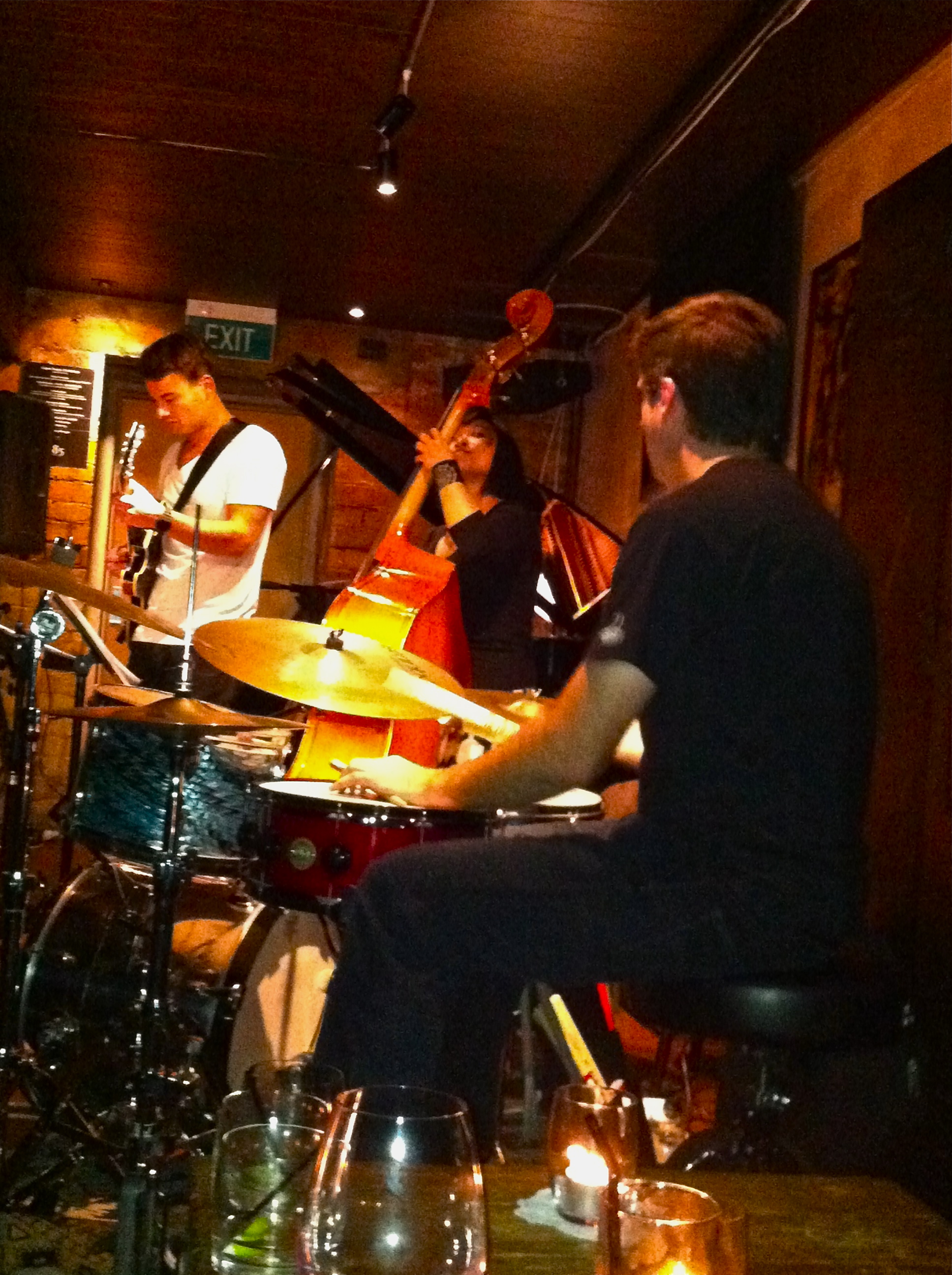
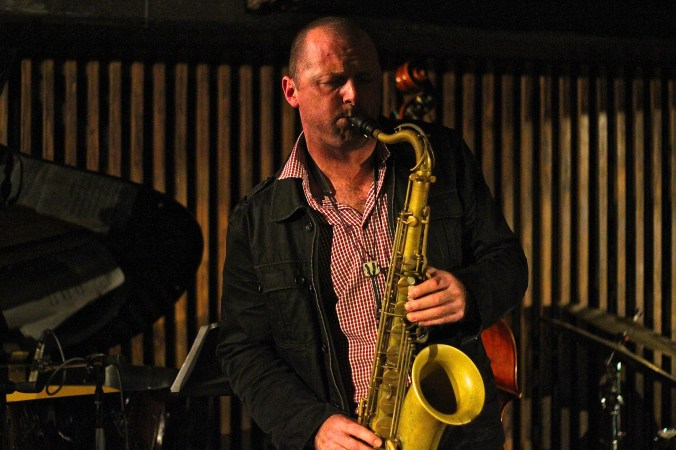
When Reuben came to the CJC on the 31st July, the working unit was pared back to drums, tenor sax and bass.   On Sax was Roger Manins who has shown time and again that he can give of his best in any configuration.  This sort of trio is wide open for possibilities and the lack of any chordal underpinning leaves the musicians open to risk, but completely free to explore melody and form.  None of the trio were strangers to this format.

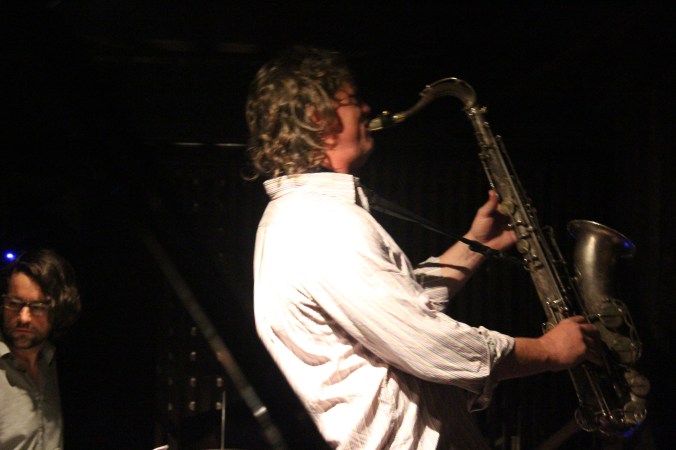
I have often watched Roger stepping free of the boundaries, like an anarchic motorist on some long empty highway who has just realised that the normal road rules will not apply there.  I was also delighted to see Roger using his Radio Model, Cigar Cutter Selmer for the first time.  A sleek silvery goddess of bygone years which oozes charm.  In Rogers hands it purrs dangerously like an ancient vixen, brought back to life to seduce us all.

Brett Hirst is a popular Australian bassist and a list his former band mates would read like the who’s who of Aussie Jazz.  He has a big sound and an instinctive rhythmic feel which lent itself perfectly to this gig.  In their usual fashion Australia has claimed him as their own but he is originally from New Zealand like so many artists doing well across the Tasman.

Reuben, Roger and Brett work extremely well together and so it was fitting that they should tackle the work of Drew Menzies from a fresh angle.   While there was a tune or so from ‘Resonator’ in the set list, the bulk of the material played was from ‘Mantis’.  It is Reuben’s hope that these tunes will become mainstays in the Kiwi Jazz repertoire and I hope that this comes to pass.  I have heard at least one rendition of ‘Ladies Man’ played recently at a gig and so the trend may gather steam.

Who: Reuben Bradley Trio – Reuben Bradley (drums) (arrangements), Roger Manins (tenor sax), Brett Hirst (bass).

What: ‘Mantis’ (and ‘Resonator’) both available from Rattle.

Where: CJC (Creative Jazz Club) Brittomart 1885 Building downtown Auckland

Mike Nock + Roger Manins, Frank Gibson@ CJC

IMG_7906 - Version 2

It was sometime in early June when I first heard the news.  I was sitting with Roger, talking music and shooting the breeze about who we rated.  Suddenly he half turned and said, “Mikes coming back to do a CJC gig”.  The words hung in the air like a siren song and for me the impatient waiting began from that moment.  If Mike Nock was coming to town there would be magic aplenty.  That’s what it meant.  That is what it has always meant.

The word seeped out, first to the music students and then to the wider world, like ripples in an ever-widening arc.  The club would be full that night.

Closer to the gig Roger asked Mike who he wanted in the band.  They quickly settled on a trio format, not your usual piano trio but one with piano, tenor saxophone and drums.   Roger Manins on tenor, Frank Gibson on drums.  Mike had jettisoned the anchor for this gig and he was quite definite about that, no bass.   This is a challenging lineup for a pianist (and for the other band members) because no-one is there to hold the centre.   If you slip there is greater distance to fall.  In this different space wonderful things can also happen and they did.  This was a night among nights.

IMG_7932 - Version 2

Barely able to contain my impatience I rolled into the club foyer three-quarters of an hour early.   The queue was already snaking back past the basement stairway and well into the upstairs bar.  A seething mass of eager faces.  When the doors finally opened there was Mike sitting sideways on the piano stool and Roger was blowing a few scales nearby.  The music stand sitting to one side abandoned, an unnecessary distraction, in a free ranging gig going where the music took it.

Before the first set I caught up with Mike, talking about his various projects (he was playing with a New Zealand string quartet the next night).  He told me that he was coming back to the CJC with his newest Australian trio in a few months.  Next time bass and drums.  We talked a bit about Jazz musicians from the past, Kiwi’s that he had played with and then the discussion shifted to the older pianists who straddled the swing to bop era.  Like all great pianists Mike lets the entire history of Jazz fall under his fingers and so I asked him about players like Hank Jones and Mary Lou Williams.  When I listen to them I hear such strong left hands, walking chords, syncopation, hinting at a time when ‘harlem stride’ was still an influence.  “The newer and stronger bass players changed that” said Mike.  “As the bass lines become stronger and pickups better the need for such dominant left hand work fell away.  There was too much conflict”.   As a non musician I had never considered that and it all made perfect sense.  I marvelled all the more that Be Bop/Post Bop greats like Hank Jones kept a touch of this earlier style and even when accompanied by strong bass players like Ray Brown, George Mraz and Ron Carter.   I wondered if we would ever see those strong left hand stylists again.   I soon got my answer.

IMG_7897 - Version 2

The set list was not really planned and it changed and evolved as the evening wore on.   The numbers selected were all standards, but they were somehow fresh, as if revealed for the very first time.   The first number was ‘When Your Smiling’ (Shay/Fisher/Goodwin 1889) and the second number was ‘Gone With The Wind’ (Allie Wrubel 1937).  Those two numbers coming together had me wracking my brain as to where I had heard them, heard them played together.  Then it came to me, they were both on one of the earliest of the Brubeck Quartet albums.   ‘Dave Brubeck at Storyville 1954’ was a wild live recording that lacked polish but oozed soul and immediacy.  Afterwards Mike announced  that a Brubeck album had inspired him to play that number – bingo.  These are the connections we love.   If you ingest a large dollop of Jazz history the memories will reward you.  IMG_7901 - Version 2

As they played through the first set I realised that the lack of a bass had not impeded them at all.  There it was, that strong left hand of Hank Jones, working the mid lower register while wonderful modern chords and runs flew from his darting right hand.   This was a master class for the senses to grapple with, giving us an unparalleled taste of Jazz piano mastery from an oblique angle.  No matter what Mike threw his way Roger matched it as they danced in and out of reach like well matched prize fighters .  These two have an uncanny level of communication.  It was even more evident later when they played ‘Softly as a Morning Sunrise” (Romberg/Hammerstein).  They had been considering what to play next when Frank Gibson suggested it.  Heads nodded in agreement and Frank set the number up nicely with a melodic intro on his traps.   “We will just see where this goes” said Mike, “could be anywhere”and he proceeded to pick at the bones of the melody.   Where it went was somewhere wonderful.  This is where the magic truly occurred, a moment to be savoured by all present.

They had begun the number, sparingly at first, soon more purposefully.  The level of interplay increased as they unpicked the tune.  Soon all three were working and pulling at the tune like it was a joyful game.  As Roger soloed I watched the trio inching up the intensity by degrees.  At first Roger had tapped out time with his right foot as he played, now he was pawing at the ground like a bull about to charge.   Mike was rocking madly and then standing and dancing some crazy dance.  Frank too was rolling with the beat.  By now they were way outside – blowing free of all constraints.   It was a moment to savour.  The moment.

IMG_7891 - Version 2

As I watched these three, so attuned, a thought struck me,  Mike Nock is originally from Ngaruawahia, Roger from Waiuku.   These two small country towns are close to each other.  What are the odds that rural New Zealand would produce two musicians of this quality.  Maybe it was something in the upper Waikato water supply?

When Jazz musicians are enjoying themselves there are always moments of hilarity, but on this night the best moment came from an unexpected quarter.   The CJC was full, so full  that dozens of people were turned away at the door due to the fire regulations. Outside it was winter, but inside it was hot as hell.  Mike by now stripped to his T-shirt asked if there was any talcum powder for his hands, which were slippery from the exertion.   Caro Manins duly produced a talcum powder container.  Mike wrestled with the lid for a few minutes and then handed it to someone else to unscrew.   Bigger and younger blokes stepped forward in turn, each saying that they were up to the task, but none could dislodge that damn lid.  “Take it back to the shop” said one, “it’s a faulty product”.  At this point a diminutive young woman took the container from the frustrated men, gently flicked off the child proof lock and opened it.  Men often forget the golden rule in these situations, ask a woman.  IMG_7936 - Version 2

During the second set Kim Paterson and Brian Smith sat in for a number or two.   Kim and Brian go back a long way with Mike and both have recorded with him.

As the enjoyment washed over me I could hear the words of Sean Wayland from a month earlier as he announced his gig.  “New Zealand I would like to thank you for Mike Nock”.   With you on that brother.

Who: Mike Nock with: Roger Manins & Frank Gibson Jr.

Where: CJC (Creative Jazz Club) 24th July 2013

And a clip by Jen Sol from the same gig:

Aaron Blakey (Sydney) @ CJC

IMG_7744

Aaron Blakey is someone you warm to instantly.  He communicates with ease and has a relaxed manner about him.  The same applies to his approach to music.  I have heard pianists who feel that they must astound with every note and while that is all well and good, it can be exhausting for everyone.  The more experienced musicians understand that performance is not only about original ideas, but also about communication.  The latter involves working with an audience while you tell an interesting musical story.  I would place Aaron in that category.

Aaron left Auckland for Japan in 2008 and he gigged regularly around Tokyo.  After a few years he returned to study in Auckland before moving to Sydney in 2011.   On this gig his accompanists were Roger Manins on tenor saxophone, Cameron McArthur on bass and Adam Tobeck on drums.  Roger Manins is at the peak of his powers and after his very successful stint with the JMO in New Zealand and Australia, he is more on fire than ever.   He is one of the best saxophonists in Australasia and so having him in any group lifts their game.  Putting him with a fine musician like Aaron Blakey produces especially rewarding results.  IMG_7746 - Version 2

Anyone who has read these reviews or spent some time at Auckland Jazz gigs in the last six months will know just how swiftly Cameron McArthur is rising through the ranks.    He is one of a small handful of must-have bass players when visitors come to town.   Adam Tobeck is fast becoming a regular at the CJC and his abilities were evident at this gig

With two notable exceptions Aaron played his own material and the compositions were all named after people he knows.  With each song, we were ushered into Aaron’s private world.  A world peopled by close friends, eccentric waiters, babies and delightful dancing children.  At the end of the two sets I felt that I would recognise these people if I saw them; so convincing was the imagery.  Live improvised music creates shapes and forms which you can almost grasp, but which evaporate and dissolve in unpredictable ways.  What remains is a series of impressions, a filigree journey imprinted on the ether.  IMG_7759 - Version 2

A good example of this was a tune called ‘Sinclair’s Routine’.  Aaron named this after a waiter who worked at a  busy Surrey Hills restaurant.  He was using the establishments piano to practice one morning and trying out a few ideas, when the waiter said, “I like that, it helps me to go about my routine” .    Not your usual musical commentary but it ended up as great tune and gave us a window into that particular moment in time.   It worked for me on several levels but primarily because I could picture and hear the event in my mind’s eye.   There was a song ‘Jonathan B’ dedicated to an old friend from New Zealand.  As Aaron was explaining the origins of the tune he looked up and said, ” Oh there he is, he just walked in – hi man”,  Once again we connected the song to time and place and this gave added weight to the number.

The track that I have recorded on video is “One for Steve”, which is a dedication to the much admired Steve Barry.   This was certainly a connection that hung in the air as the band played through the number.  Steve (another ex-pat Aucklander) had been playing that very piano only a few weeks earlier and the echo of his gigs was relived through the tribute.

The first of two standards was ‘My Song’ (Keith Jarrett).  It amazes me that ‘My Song’ is hardly ever performed.  There is a view that Jarrett’s three recorded versions are so contained, that musicians shy away from it.  More is the pity because most jazz lovers rate it highly.  During the introduction Roger Manins helpfully suggested that Aaron would actually be doing the Elton John “My Song’.   This was a solo performance and you could have heard a pin drop.  It was great to hear it done and great to hear it done so well.  IMG_7719

The second standard was the Cole Porter tune ‘I Love You’ from the musical Mexican Hayride, placed squarely in the Jazz Lexicon by John Coltrane (Lush Life album).  While Coltrane’s version was with Saxophone, Bass and drums, The version on this night was a duo featuring piano and tenor saxophone (Manins and Blakey).   That these two have been friends for years and that they have worked together many times before, became evident on this number.   The sensitive interplay between them was truly extraordinary and although they took quite different approaches to the task in hand the synergy was uncanny.  It was one of the wow moments which Jazz audiences live for and to my annoyance I had run out of HD video-tape just a moment before it started.   I am sure that they will play it again sometime, as Aaron has promised to return. We hope that he will not leave it two and a half years this time.

For those wanting more there was a Roger Manins gig down at Frankie’s Bar in Wyndom Street two nights later.   This was a similar lineup, but with premier drummer Ron Samsom at the kit.  For this gig Aaron had brought his Fender Rhodes along.  They swung mightily and as I listened I could hear Ron pulling back on the beat.  There is some fine music around Auckland.  All it needs is our continued support.

Who: Aaron Blakey (piano) with – Roger Manins (tenor sax), Cameron MacArthur (bass), Adam Tobeck (drums).

Where: The CJC (Creative Jazz Club) Auckland 3rd July 2013

Mike Nock – albums reviewed

photo - Version 2

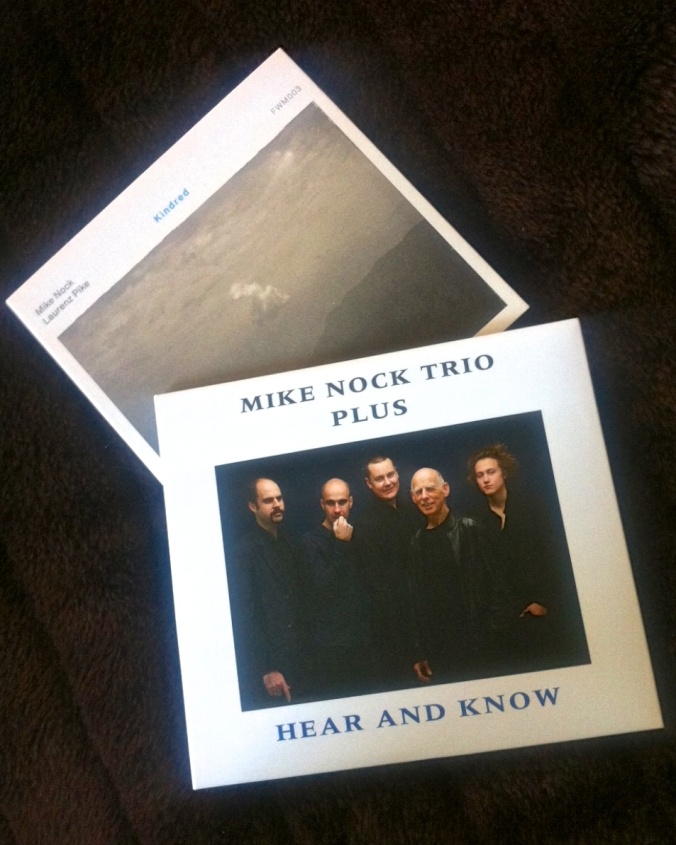
Mike Nock: Hear & Know / Kindred

Mike Nock is always capable of surprising and this has long been his hallmark.  A restless innovator and improviser who never settles on his laurels, Nock is surpassing himself yet again.  ‘Hear and Know’ was recorded in 2011 following his aptly named and deeply satisfying ‘Accumulation of Subtleties’ album.

On ‘Hear & Know’ he is again accompanied by brothers Ben Waples (Bass) & James Waples (drums).  There is an unmistakable synergy between these three and so adding Karl Laskowski (tenor sax) and Ken Allars (trumpet) had its risks.  While there is a different dynamic and altered textural qualities, the magic of intimacy is maintained.   It carries over much of the subtle interplay of the earlier album but creates a different range of moods as well.

I was always impressed by the subtle and profound sub-divisions of mood in the ancient Japanese Haiku.  The almost untranslatable ‘wabi-sabi’ are the moods invoked when we can almost touch something profound, sense it and appreciate the mood, but know that it will be forever illusive.  A further subdivision is ‘yugen’, which is the sense of mystery which underpins profound moments.  To define them more accurately is to lose the moment.    Mike Nock has achieved this for me compositionally and through his recording.   The moods are profound invoking deep and somehow unnamable emotions.

I felt this most strongly on the beautifully named and wonderfully crafted ‘The Sibylline Fragrance’ and later while listening to ‘After Satie’.   In the former piece there was an obvious reference to memory and our sense of smell, which is closely aligned with that.  Beyond that was something else, a sense of the history of this music.  Touching briefly on the past but rooted firmly in the now.   When music achieves this it is especially satisfying.   I have seen the trio performing and I have seen Ken Allars with the wonderful Jazzgroove  Mothership Orchestra.  Karl Laskowski was not previously known to me.   All of these musicians must feel pleased with this album.

‘Kindred’ is the more recent album and one with a pared back line up.  Featuring just Mike Nock on piano and drummer Lorenz Pike, this album seems denser in texture and more introspective.  Lorenz Pike is an interesting drummer and well-chosen; he is obviously colourist in tendency and that is the only choice for this music.  Once again Mike Nock has made a virtue out of contrast.  First impressions are often deceptive though and there is a degree of space and subtlety if we listen.  The stories unfolding are at times free and open but there is always an underlying thread.  The titles also fascinate me as they refer (as with the previous album) to a mixture of things past (references to the classical world), nature untamed and various private worlds.  I am a strong believer that improvised music benefits from narratives, not to define, but to augment the journey.

Mike has created subtle narratives out of the whole, which sit in the consciousness like Haiku.  There is something special about these two albums and I am certain that only Mike Nock could tell these particular stories.

What: Mike Nock – ‘Hear & Know’ and ‘Kindred’ albums FWM Records or visit http://www.mikenock.com

Where: You be able to hear Mike Nock in Auckland on Tuesday 23rd July 2013 at the CJC (Creative Jazz Club).

Sean Wayland & David Berkman @ CJC Winter International Series

Sean Wayland

Sean Wayland

We don’t get many offshore Jazz pianists visiting New Zealand, but we have seen quite a few over recent weeks. This particular gig comes hot on the heals of hearing Sean Wayland appearing as featured guest artist with the marvellous Jazzgroove Mothership Orchestra. Sean had impressed me at the JMO gig and so I really looked forward to hearing him play at the CJC (Creative Jazz Club).

Before he had played a note Sean Wayland won us over with his easy-going banter. Especially when he thanked us for Mike Nock and mentioned band mate Matt Penman. These are two of Auckland’s best-loved sons and I suspect that Kiwi’s, like Canadians, enjoy our worth acknowledged by the big country next door. This generous acknowledgement by a respected New York based (Aussie born) pianist reveals an interesting truth about Australasian Jazz.

There may be a struggle to meet the financial realities, deal with lack of good pianos and the paucity of gigs, but the two scenes continually produce world-class Jazz musicians. The Scenes are in fact so intermingled that it is often hard to know who is an Aussie and who is a New Zealander. Steve Barry and Mike Nock illustrate this perfectly as they live and work in Australia. Roger Manins lives in New Zealand but gigs across the Tasman every other week.

In spite of the difficulties there is no lack of great music coming out of Australasia and the main problem is that of distribution. An upside of this changing business model is that bands travel more. For the keen Jazz fan live music is once again king. We don’t have to wait for a multi-national recording label to tell us what we should or shouldn’t like, we can explore ‘You Tube’ or ‘Bandcamp’ and hear from the artists directly.

IMG_7530 - Version 2

Sean Wayland is a hugely respected figure on the Australian scene and in New Zealand as well. He is a very modern pianist, as he moves in circles where new approaches are constantly being explored and new sounds developed. After listening to his compositions I was not in the least surprised to find him supported by the likes of Matt Penman, Jochen Rueckert, Will Vinsen, and James Muller. This is essentially the Rosenwinkel generation. While he speaks that language fluently he is unmistakably an individual stylist. No one sounds quite like Sean.

Sean’s tunes are very melodic. Often unfolding over a simple bass line as with ‘eenan’ off his ‘Lurline’ album. What sounds catchy and accessible can actually be quite complex as his approach to rhythm gives the tunes that unique feel. This is tension and release at its sophisticated best. I have put up a version of ‘eenan’ as a ‘You Tube’ clip which unfolds in subtle and beguiling ways. So beguiling in fact that I dreamed the tune two nights in row. Such powerful hooks are not accidental but the result of careful craftsmanship. There is a strong sense of pulse or swing to his tunes, but approached from a different perspective to that of the more traditional pianist.

This intergenerational shift is one that I hear more often as the changing of the guard occurs. Other tunes played to great effect were his, ‘Trane plus Molly equals countdown” and the solo piece ‘Little Bay’. Both of those tunes are found on the ‘Expensive Habit’ album. ‘Trane plus Molly equals countdown’ hints at McCoy Tyner, but you quickly realise that the voicings have very modern in feel. I can however certainly imagine Kurt Rosenwinkel doing the tune. It is an extraordinary composition where the left hand continuously punctuates the flow with oblique accents. I was left wanting more than the single set and I certainly hope that we get to see Sean again on his next trip back to Australia.

IMG_7520 - Version 2 (1)

Accompanying Sean were Cameron MacArthur (bass) and Jason Orme (drums). Both accomplished musicians who quickly slotted into the challenges of supporting a world-class and highly inventive pianist.

The next artist up was David Berkman. He has been to New Zealand before and anyone who saw him last time would have jumped at the opportunity of seeing this top flight New York Pianist in action. There is a fluidity to his playing and above all an impeccable sense of timing. This hard-driving post bop fluidity and the big bluesy chords is what most characterises his work.

The Kiwi members of the quartet were Roger Manins (tenor), Olivier Holland (bass) and Ron Samsom (drums). Together they formed a powerhouse of inventiveness and Roger in particular seemed to benefit from this grouping. His solo’s were so incendiary as to cause gasps of surprise and from an audience who are used to such pyrotechnics. While we expect Rogers high wire acts he is always able to surprise us and this night saw him really on fire. David Berkman certainly knows how to amp up the tension and his ability to extol a horn player to reach deeper and deeper is impressive. He worked the room with as much enthusiasm as he would have done in a prime New York club and everyone there appreciated that commitment. This was the kind of gig where you sat back and let the sound wash over you, tapping your feet uncontrollably and yelling enthusiastically between numbers.

David Berkman

David Berkman

David Berkman’s repertoire was a well-balanced mix of his own compositions and some lessor known standards. During the gig he talked about his mentor, the much respected pianist Mulgrew Miller (who sadly passed away that very evening). He has worked with a wide variety of artists such as trumpeters Tom Harrell and Dave Douglas and his contribution to Jazz education is well-known. Having moved to New York some years ago he quickly settled into the routines of gigging, recording and teaching and since then he has been a fixture on the local scene. He travels extensively and is a Palmetto recording artist.

IMG_7554 - Version 2

The two pianists were very different, but both were amazing in their way. In David Berkman we heard the history of the post bop era and in Sean Wayland we glimpsed the future.

What: Sean Wayland and David Berkman Winter International Series.

Who: Sean Wayland (p) (leader) Cameron McArthur (b) Jason Orme (d). – David Berkman (p) (leader), Roger Manins (s), Oli Holland (b), Ron Samsom (d)

Where: CJC (Creative Jazz Club) 29th May 2013

The Dilworths@CJC Winter International Series

IMG_7394 - Version 2

When the CJC (Creative Jazz Club) posted information about their Winter International Series, the first group up was the ‘Dilworths’.   I quickly scanned the information and zeroed in on the two Kiwi band members.  Not just because they are Kiwi’s but because they are superb musicians and well known to me.  The Dilworths current Pianist Steve Barry is an expat Aucklander, as is bass player Tom Botting.   Both had established solid reputations for themselves before leaving this city and both have since built new ones in Sydney.  On that basis alone locals knew that this was the sort of gig that you brave a rainy night for.   Steve Barry in particular has strong audience pulling power in Auckland and many are aware that he has just won the prestigious Bell Award.

IMG_7381 - Version 3 (1)

Sydney-sider Eamon Dilworth was relatively unknown to me prior to the Dilworths tour, but it is not a name that I will forget in a hurry.  His band is something else.  Eamon plays a formidable trumpet and he has long been recognised as a musician with much of interest to communicate.  He is a Bell award nominee and the recipient of various scholarships which have led to him traveling overseas and studying in Italy.  He has performed in Romania, Austria, Italy and England and his compositions reflect some of the influences that he has soaked up on those journeys.  While we have some terrific trumpeters around New Zealand we can not match the breadth and depth of the Australians.  Having a trumpeter of this calibre visiting is a rare treat.

Leaders need to exert a strong sense of influence but at the same time they need to know when to stand back and let things happen organically.  The Dilworths appear to have the settings just right.  The camaraderie and the consequent collective output is what works so well for them.  This is at least the second line up for the band and the mix is perfect.  The observant will have noticed how carefully these guys listen to each other, tossing challenges and giving support in equal measure.   What is also evident is how much fun they are having.  There is nothing more off-putting than being confronted by a grim-faced group of musicians whose only purpose is convincing you just how seriously they take their music.  This band was fun, lively and extraordinary.  We all felt that we had witnessed a great show and more importantly been part of one.   This is the essence of good performance and of good Live Jazz

.  IMG_7404 - Version 2 (1)

Everyone in the band contributed at least one tune to the gig and the set list was fluid.   The band would play a few numbers and then quickly confer on what to play next.  They had a grab bag of compositions to draw upon and although a random selection process was applied, the set lists formed a surprisingly cohesive whole.  Thomas Botting’s ‘Balclutha’ was just great with Tom and Steve working a groove to the marrow while Dave Jackson (alto sax), Paul Derricott (drums) and Eamon Dilworth (trumpet) created delicious mayhem.  Tom has a following in New Zealand and deservedly so.  IMG_7391 - Version 2

Steve Barry’s pianistic and compositional skills are greatly admired in New Zealand and anyone who has purchased his album ‘Steve Barry‘ (Jazzgroove) will understand why.  Last Wednesday we saw yet another facet to his playing.  Not as leader or accompanist but as ‘A’-grade ensemble member.  As with all of this line up he added maximum value without overcrowding his band mates.  Paul Derricott also contributed a great composition and his album ‘Big Sea-Arrow’ (Jazzgroove) is really worth purchasing.  I have hardly had it off my Hi Fi since picking up a copy.  These are all bands to track down and see again and again.  Altoist Dave Jackson is a great soloist, with a lyricism that sets him apart.  There is also something compelling about his tone production (quite like John Surmon’s alto sound).  He and Eamon often crouch on the floor when others are soloing.  I like this as it signals the ebb and flow of performance; as if choreographed.  I love musicians who move and dance and these guys executed their dance moves perfectly.

The influences were many and varied and while you could hear flashes of Eick, Stanko, Douglas and many others, the band still sounded very Australasian.  I have come to value this local sound and I miss it when I travel.   There is an honesty that comes from living so far from the so-called mainstream Jazz world.  Jazz is now finding a universal voice and New Zealand and Australia are feeding into that just as the Europeans have done for some years.  Good music has no borders.  While comparisons are often redundant I do have one to make.  It came to me while I was listening to the Dilworths EP.  They have captured a vibe very close to that of the 65 Miles Quintet.  In short they had a controlled looseness that can only arise when a band intuitively knows exactly where they need to be minute by minute.   ‘If I were a Bell’ was the one standard of the night, with the melody barely expressed before they were paring it back to the bone.  Using the changes as occasional touchstones, working with space, colour and texture as if they were commodities not to be squandered.    IMG_7445 - Version 2

Most of the tunes were fast paced but we did have one or two ballads to round them out.  The last set finished with a tune by Eamon.   The musicians put their instruments aside and chanted and we were instantly mesmerised.  While it had some of the feel of an ancient Peyote chant it was subtler than Jim Peppers Witchi-Tai-To.   We loved it and many of us are still talking about it a week later.  The perfect out chorus to a perfect evening.

What: The Dilworths (Australia)

Where: CJC (Creative Jazz Club) Winter International Series – 1885 building basement, Auckland, New Zealand.  Wed 22nd June 2013

Purchase Details: Jazzgroove records

Phil Broadhurst ‘Flauberts Dance’@CJC

IMG_6910 - Version 3

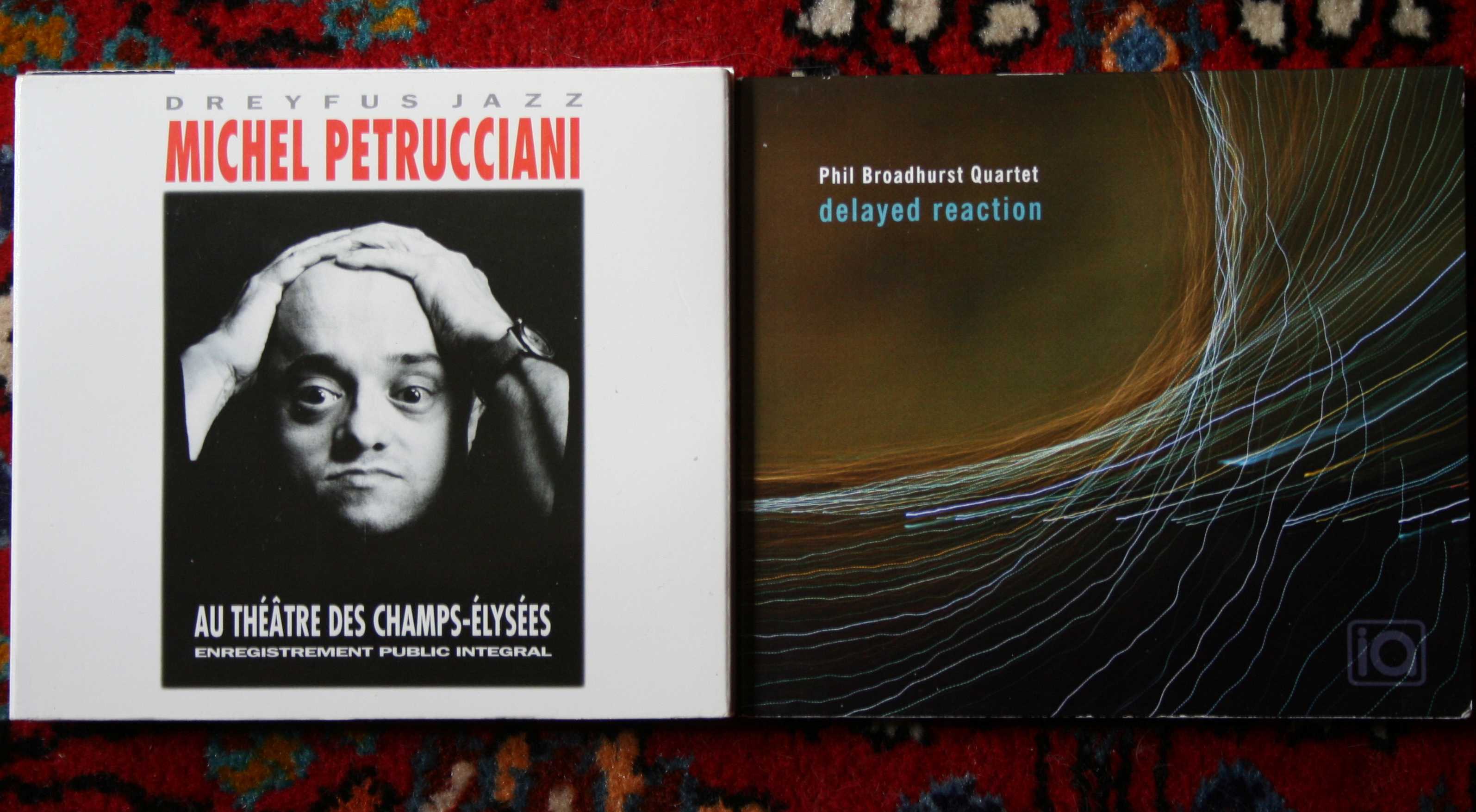
Phil Broadhurst is a regular at the CJC (Creative Jazz Club) just as he was at the ‘London Bar’ in its hey day.   He is also the compiler and presenter of the well-known Jazz radio slot ‘The Art of Jazz’.  His last album titled ‘Delayed Reaction’ was well received and shortlisted in the Jazz Tui Awards.  It was dedicated to the music of Michel Petrucciani, the diminutive and wonderfully brilliant French pianist whose life was blighted by ‘brittle bone syndrome’.  That project was obviously a labour of love, as Phil had long been immersed in Petrucciani’s music.  The album, (out on IA-Rattle), outlined a very personal journey for Phil and while showcasing the project about New Zealand he must have pondered ‘what next’?   The what-next is ‘Flaubert’s Dance’.

IMG_6870 - Version 2

From ‘Delayed Reaction’ it was a logical step to examine other artists who had influenced him and for whom he had a deep affinity.  Not all are pianists but all take a pianistic approach to their music.  All are currently at the top of their game.  The compositions on ‘Flauberts Dance are all Phil Broadhurst’s and they are dedicated to the following musicians:  Herbie Hancock, Manu Katche, Enrico Pieranunzi, Eliane Elias, Kieth Jarrett and Tomasz Stanko.   What these artists have in common is striking originality, a modern approach to harmony and the fact that none of them are easy to compartmentalise.  They are consequently quite different from each other.    A Tomasz Stanko tune and a Manu Katche tune could hardly be confused even though they have worked together.  IMG_6922 - Version 2

It is obvious from the above list that Phil often reaches outside of the Americas for musical inspiration.  While Jarrett and Hancock have influenced most modern pianists their ubiquitous presence tends to eclipse others of equal importance.   It is therefore fitting that the latin infused Brazilian born Eliane Elias and the two Europeans give counterweight to the North Americans.   The composition ‘First Shot’ dedicated to Hancock looks at a particular tune rather than the scope of his career to date.   I truly like this number as it has the distinct feel of a European or an Antipodean acknowledging Herbies work, not an American.

Phil has had no trouble in assembling top class musicians for the album and with Roger Manins (tenor sax), Olivier Holland (bass)  and Cameron Sangster (drums) his quartet had depth and experience.   He also enlisted trumpeter Mike Booth for three numbers.

The title track on the album is dedicated to the scandalously underrated and utterly brilliant Italian Pianist Enrico Pieranunzi.   This track ‘Flaubert’s Dance’ had everyone listening in rapt silence and even though the club filled to bursting point you could have heard a  pin drop.  With unerring accuracy he has dived right into the essence of the man he pays homage to.   The voicings, the phrasing and a unique sense of weightless swing that is so European.  When Roger Manins comes in the Pieranunzi connection deepens.  Bringing to mind the Italian tenor player Stefano de Anna who along with Hein Van de Geyn featured so strongly on the classic Pieranunzi album ‘Don’t Forget the Poet’.  IMG_6927 - Version 2

Tenor player Roger Manins always gives of his best and he showed us once again that he can wring deep sentiment and even prettiness out of ballads while never sounding cliched.  In the mid tempo tunes he imparts that intensity and locomotive drive that he is so well-known for.  When the tunes are explorations, it is only fitting to have a born story-teller like Roger onboard.  Olivier Holland (bass) has often played in Phil Broadhurst line ups and his approach is that of the consummate professional.   These days it is not uncommon to hear bass players vocalising lines an octave above the pitch.   Once the preserve of Major Holley and Slam Stewart, Oli has increasingly been employing that technique (but not so much arco bass).   His improvisational approach has always been solid but the vocalising appears to extend that.   It is perhaps like a saxophone player having the words of a standard firmly in their head as they lay down the melody.   It changes the dynamic in positive ways.   Cameron Sangster (drums) works across many genres and he is one of the few drummers to appear regularly with big bands in Auckland.   He has a strong sense of space and dynamics and can switch to a more colourist mode if the number requires that.   He is also able to moderate his sound to a room.   A tasteful drummer.  The remaining band member is trumpeter Mike Booth who played on three numbers.  His soloing and ensemble work is great and musicians about town are often utilising him for his impressive and varied skills.   He and Roger in lock-step are a force to behold.   Both the quartet and quintet gave Phil Broadhurst adequate room to shine and he did.

What: The Phil Broadhurst Quartet

Who: Phil Broadhurst (piano), Roger Manins (tenor sax), Olivier Holland (bass), Cameron Sangster (drums) – guest Mike Booth (trumpet).

Where and What: ‘Fauberts Dance’ album released by Rattle Records  –   CJC (Creative Jazz Club) basement 1885 Brittomart building, Auckland

Number filmed by Jennie Sol

Dr Dog Unleashed @ CJC

IMG_4413 (1)

A few weeks ago someone had whispered, “Dr Dog is back”.  What started as a mere dog whistle soon became an insistent rumour; confirmed beyond doubt when I saw a red van cruising the streets with ‘who let the dogs out’ emblazoned on its side.    I checked the CJC (Creative Jazz Club) website and sure enough there was the gig listing.   Dr Dog are the business or as the vernacular will have it ‘the dogs bollocks’.   We had all been hanging out for this return gig.  This was a risky outing for them as there would almost certainly be an attempt to capture them live during the performance.  The sight of determined looking technicians carrying a tangle of cables and heavy suitcases down the 1885 staircase club confirmed this.  IMG_6222

‘Dr Dog’ are some of the best musicians that the Auckland Jazz Scene has to offer.   Roger Manins – tenor,  Kevin Field – piano, Oli Holland – bass and Ron Samsom – drums.   They all teach at the Auckland University Jazz Studies course where Ron Samsom is program director.    They are teachers, but they also gig regularly.   These guys have honed their skills over many years of playing with the best.  Suffice it to say that expectations are always high when any one of them performs, but when all four appear on the same stage it is a noteworthy event.

Dr Dog is a showcase for the talents of the four band members, all of whom have written original material for the occasion.  I suspect that these compositions are not for the faint hearted and a sneak look at the heavily annotated scores confirmed that.   It was dog eat dog on the bandstand as each musician tried to outdo the other.  Heads would occasionally bend low over the charts in mock dismay and between numbers quick animated conferences were held.  This was not a set list designed to give band members an easy ride.   It was the audience who got the best of these exchanges and while the sweat poured off the band we lapped up the music.  This was a rare treat, just as we knew it would be.

IMG_6219

As you would expect from a dog band there were cool licks a playful approach to the music, a meat raffle and stick chasing.   I filmed most of the sets and I was particularly impressed with the first number up.  It was obvious that these guys had their eye on the ball.  I have put up that clip titled ‘Dideldideldei’.   Being Oli Holland’s composition I knew that it would be well written and have a back story (perhaps involving fishing?).  Oli has a strong sense of irony which is in his titles.   Dideldideldei was evidently a phrase uttered by a Jazz hating apartment dweller in a German comedy, who had the misfortune to live above a Jazz club.  He would shower the band with rotten fruit while yelling, “this is not music it’s just dideldideldei”.    All of the tunes had equally illusive or improbable titles and that only added to the fun.

IMG_6243

Roger contributed ‘Peter the Magnificent’ which he had written in honour of Peter Koopman and tune called ‘Evolution’ (dog evolution).  He gave an explanation of the titles but as I was near the back I couldn’t hear because the people up front were laughing so hard.  Kevin contributed a few tunes and one named ‘Synaesthesia’ referenced the unusual condition which he tells me afflicted one of the great classical composers.  Synaesthesia is a rare condition where colours are heard as sounds or sounds as colours.   Pat Martino Jazz guitar master uses this affliction as a vehicle to assist his improvisation.  In the end I lost track of who had composed what because the dogs only wanted to play.    While this was occurring they were captured by a sound man named John.  An album and a properly attributed track list should result from that.   This band is long overdue in recording and I am hoping that the live take is adequate to purpose.  If the sound is not good enough then they should shake their tails and get to the studio ASAP.   I for one can’t wait.

IMG_6235 - Version 2

Who: Dr Dog – Roger Manins, Kevin Field, Oli Holland, Ron Samson

Where: CJC Creative Jazz Club February 20th 2013

Dixon Nacey – Zauberberg IV

IMG_6080

Dixon Nacey always exudes enthusiasm.   He is one of those musicians who you cannot think of separately from his music.   He is articulate, a family man and a thoroughly well-rounded human being, but music never the less defines him.  He is one of New Zealand’s great guitar talents and so people trip over themselves to attend his gigs.  Dixon appears in a variety of contexts: teacher, composer, sideman (to the likes of Alan Brown and sometimes up & coming musicians like Rebecca Melrose) but most often as leader or co-leader.   This is the guitar go to guy.

IMG_6081

We tend to associate Dixon with the more up tempo pieces where the changes are gleefully eaten up, but like Marc Ribot he can surprise with thoughtful acoustic offerings.  When this occurs there is a hush because the nuanced story telling and the rich voicings take us to warmer place than we ever imagined possible.   We heard both facets during the Zauberberg IV sets and the contrast spoke volumes about Dixon.  A number of originals (composed by  he and Oli Holland) were reharmonised versions of standards.   ‘Gutted and Gilled’ could only have come from the pen of Ollie Holland the obsessive fisher.   It is a metaphor for what this band can do with a tune; paring it to the bone.  Dixon’s red Gibson was no where to be seen and he playing another brand of guitar during the 13th February CJC gig.  He was trying out a handsome looking custom-made guitar (the name alludes me).   This was a wonderful instrument with the warmth of a Les Paul and the bite of Strat.

IMG_6067

‘Day and Night’ made references to ‘Night & Day’ but they emerged as glimpses arising from a darker tapestry.   ‘Conversations with Dr Small’, (another great title) had quirky adventurous twists and pointed squarely at Dr Stephen Small (pianist), who I presume this number was referencing.  ‘If I Should Lose You’, ‘Recordame’, ‘Everything Happens to Me‘, ‘Softy as a Morning Sunrise” and ‘Have You Met Miss Jones were a sampling of the standards played.  ‘Softly as a Morning Sunrise’ was played with such high-octane and at such a velocity that we were pulling ‘G’ forces.  On the other hand the beautiful ballad ‘Everything Happens to Me’ was approached in a loving and respectful manner.  Jason Jones has a gorgeous tone and when Dixon comped behind him with warm soft chords the mood was perfect.   It is right to place such numbers in juxtaposition, as contrast is a vital ingredient of any rich palette.  IMG_6079

Oli Holland on Bass has long occupied an unassailable position on the Auckland scene.  It was a good day for New Zealand when a long sea voyage washed him up on our shores.  He is increasingly providing compositions for the more experienced musicians about town.   Compositions which both challenge and please.   I have often witnessed band members commenting, “Oh this is challenging”, but the results speak for them selves.

Andrew Keegan on drums may be a relative newcomer to Auckland but he has made his mark already.   He brings with him a wealth of experience (including from offshore).  CJC audiences are always pleased to welcome him back.  His posture when drumming is compact and that makes him great to photograph.   It is as if he is drawing all of his energy into a circumscribed arc before unleashing its power.

Jason Jones is the last member of the group and he is somewhat of an enigma.   People who have been around the scene for a while remember him well, but his public appearances have been scant in recent years.   He teaches at the Auckland University Jazz School and was Berklee Trained.

There is often an interesting back story to a band and so I asked Dixon hoping to get gain a few insights.  His reply was typically self effacing but actually yielded rich pickings.  Many years ago Oli had been in a band in Germany named the ‘Zauberberg III’ and they had recorded several times.   This gig was actually booked over a year ago as the ‘Alain Koetsier Quartet’s’ second appearance.    That particular line up was Alain, Dixon, Pete France and Oli (see earlier review).  As the time got closer Alain unexpectedly found himself booked for a week of recording for the second Nathan Haines Warners album.  Pete France had to drop out suddenly and that left Oli Holland and Dixon Nacey with a week to go and short by two band members.   When in doubt re-invent yourself and above all improvise.   The new name came from Oli, Jason Jones was coaxed back into performing and the often complex set list (typical of Dixon and Oli) emerged in the nick of time.

Jazz line ups are often conjured out of thin air and I have witnessed quite a few such manifestations.   It is my observation that flying by the seat of your pants can  often yield the best results.   This is how humankind has always moved the paradigm: our advances over the millennia have always come from risk taking.  In life and Jazz improvisation is everything.

I have posted the Matt Denis tune because it is so beautiful that I even managed to shed a tear through a very bad cold.

Where: Creative Jazz Club Auckland

When: 13th February 2013

What: Zauberberg IV

Nathan Haines 2013

IMG_5887 - Version 2

My recent travels to the USA led to many musical adventures, but as good as those experiences were I had missed the CJC (Creative Jazz Club) and our local musicians.   There is a passion and sometimes a raw edge in New Zealand Jazz which I find compelling.

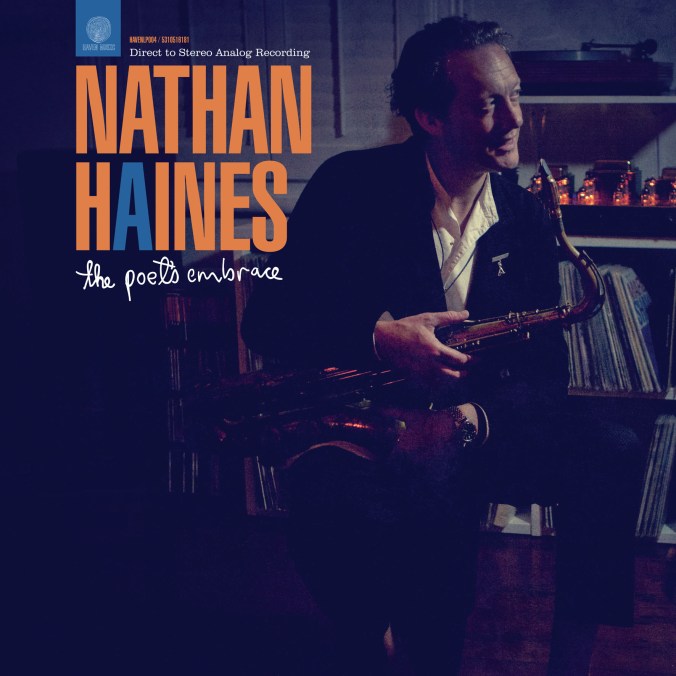
The first gig I attended upon my return was the Nathan Haines CJC gig.  This had been widely anticipated and after the success of ‘Poets Embrace’ the rumours of a new album had started to circulate.   Just before Christmas Nathan Haines returned from London for a month or so and not long after Alain Koetsier returned from China.  The rumours became fact as there is definitely a new album in the making.  The band was well received at London’s ‘Ronnie Scotts‘ last year and an overwhelmingly positive review appeared in the influential ‘London Jazz’.  That gig had reunited most of the ‘Poets Embrace’ band.  IMG_5880 - Version 2

By the time of the ‘Ronny’s’ gig Nathan had moved back to London, while Kevin Field and Alain Koetsier flew in to join him.  When a good band like this travels exposure to wider markets occurs.  This can bring rewards.  Having Warners behind Nathan proved fortuitous and ‘Poets Embrace’ has now been released in Europe as well as Australasia.  With a follow-up album coming the expectations are rising again.

Nathan is no stranger to success (here or offshore) but to break into a difficult market releasing analogue classic 50’s style Jazz demonstrates his appeal.  This is not just a lucky break but the result of hard work, Savvy, skilfully written charts and knowing who to choose as bandmates.   Although Alain Koetsier (drums) has been working in China for a year he had already gained a solid reputation in New Zealand before he left.  He can be heard on a number of top quality recordings where his chops and musicality are self-evident.   Pianist Kevin Field has released a few albums of his own as leader and of particular note is his  last release ‘Field of Vision’ (Produced by Nathan and released on the Warners label).    The original bass player Thomas Botting is no longer with the band and in his place is the talented Ben Turua.   This is the second time that I have seen Ben play with this band and he is a good choice.  Sadly he is moving to Sydney after the recording.

On the night of the CJC gig we heard a mix of tunes from ‘Poets Embrace’ and some new compositions.   Some were so new that they had never been played before in public.   I assume that at least a few of these will end up on the new album.  The first set started with a selection from Poets Embrace and it was immediately obvious that they were back on familiar ground and ready to notch it up a level.   Nathan quickly established the melody and just as quickly moved to explore what lay beyond.  Together they mined the material for new stories and the level of confidence was noticeable. The newer material was a little more tentative but this was a first outing.    With the recording session due very shortly I have no doubt that we will hear an album every bit as exciting as the last.   This music has its echoes in the era of 50’s Coltrane and others but here’s the interesting thing;  Nathan has a young and an older fan base.   This is a timeless music for the universal man (and woman).  IMG_5902 - Version 2

Nathan is hopefully going to include a few of the vocal numbers he performed on the new album.  His song ‘Impossible Beauty’ from ‘Sound Travels’ was an attractive haunting tune that stuck in the memory.  I rate his (slightly husky) voice highly and I hope he adds vocals to his repertoire more often.  The male Jazz singer is sadly an endangered species.

Last weekend the band played ‘The Sawmill’ in Leigh.   The seats sold out quickly and to all accounts the gig was amazing.  If there is anyone who hasn’t yet purchased a copy of ‘Poets Embrace’ do so immediately and grab up the new album upon release (in Vinyl or CD).  I can promise you endless replays.

Who: Nathan Haines Band with Kevin Field, Alain Koetsier & Ben Turua.

Where: The CJC (Creative Jazz Club) the basement 1885 -Britomart – downtown Auckland

When: Wednesday 30th January 2013

Jamie Oehlers NZ quartet@CJC

There are good gigs, bad gigs, predictable gigs and everything in between. Mostly we appreciate what is before us but just occasionally, we attend a gig that is every kind of wonderful. This was it.

Jamie Oehlers has the sort of reputation that scares aspiring tenor players and creates life-long fans. This man is a monster on the tenor saxophone and no amount of scrambling for adjectives on my part is ever going to capture the intensity of his performance. Luckily I filmed much of the gig and so I will put up a number of cuts on You Tube over the coming weeks. This gig won’t be forgotten as it fizzed and washed over us like a blissful tsunami of sound.

Typical of many Australasian musicians Jamie Oehlers is self-effacing, and quietly humorous, but his down to earth persona remains intact only until he puts the horn in his mouth. Then we see confidence, elegance, fire-breathing and effortless virtuosity of a sort that almost defies belief. He is one of those musicians who reaches beyond the known, bringing the rhythm section and the audience along with him. His solos have an almost mystical coherence; as if guided by a universal logic that he is able to share with the audience.

Those who saw the performance at the CJC on the 19th September 2012 will understand exactly what I am saying.

As marvellous as Jamie was, his local rhythm section was there for him every inch of the way. Not for the first time I marvelled as Kevin Field (piano) responded to every challenge, managing to inject a sense of originality and invention into a number of almost unassailable standards. Kevin stands out as a pianist as he understands perfectly which chords to accent, when to lay out and when to work harder behind the soloist. He is exactly the right pianist to play behind a talented visitor.

Oli Holland was so good during this gig that I embarrassed him with a bear hug afterwards. He could have been Reggie Garrison at one point as the urgent stabbing notes from his bass propelled the others on. Listen to the first clip below and particularly where Kevin is soloing. This unit was never less than in perfect lockstep.

Frank Gibson on drums was equally marvellous. You never know how drummers will respond to high-octane material like this but he responded by reaching deep within and capturing every nuance of the set. I have never heard him perform better.

The first set began with the standard ‘On a Clear Day’ (Lane), ‘Alina’ AKA ‘Variation 11 from Suspended Night’ (Tomasz Stanko) [one of my favourite tunes], ‘Aisha’ (John Coltrane), ‘Take the Coltrane'( Ellington-Coltrane) , Portrait in Black and White ( Jobim) and more.

Near the end of the second set the band decided to play John Coltrane’s ‘Resolution’ from ‘A Love Supreme’ (1962). ‘A Love Supreme’ is hardly ever played and more is the pity. This avoidance relates to the holy grail status of ‘A Love Supreme’ among post Coltrane saxophonists. My view is that we should honour it and especially in this week. John Coltrane was born on September 23rd. It is a shame not to have all four movements performed together though; ‘Resolution’ is after all only a part of a mystical four piece puzzle which makes perfect sense when heard in its entirety.

Jamie stated the theme over and again, but each time working in subtle re-harmonisations and embarking upon brief angular explorations. We knew intuitively that we would end up in a place of almost unbearable intensity and we were on the edges of our seats in expectation. This was not a gate to be rushed and although we understood that, the anticipation was palpable. Tension and release is at the very essence of Jazz and Jamie achieve this end by stalking his prey in measured steps like a confident hunter.

‘Resolution’ is an Everest of a tune utilising Coltrane’s new-found ideas which were somewhere between hard bop and free. Jamie interpreted intelligently without trying to out do Coltrane. He made it his ‘Resolution’ as well. Kevin field was the same, as he took a more oblique approach than McCoy Tyner. This was a perfect homage without being a slavish imitation.

At the end of the gig we received an additional treat when Jamie asked Roger Manins to play. The best moment was when they played ‘On Green Dolphin Street‘ (Washington). With these two masters working the changes and probing every hidden corner of the melody, it reminded us that standards interpreted with integrity can sound as fresh as at first hearing.

Jamie Oehlers lives in Australia where he runs a Jazz School. He has so many awards that storage must be problem (including being judged winner of the ‘World Saxophone Competition’ in Montreux by Charles Lloyd and Bruce Lundvall of Blue Note). He has put out 10 albums as leader as well as being sideman for the whose who of the Jazz world.

I ran into Jazz guitarist Dixon Nacey as I was leaving and he summed it up nicely. “Man I have just received a series of Jazz upper-cuts”.

Brian Smith Quintet featuring Pete Barwick @ CJC

Brian Smith & Pete Barwick

Lets face it, no one will be disappointed by a Brian Smith Band and this particular lineup was an all-star affair.  Man did they deliver.

You expect Brian to deliver royally as he has had such a successful output as evidenced by his 2006 (Taupo’ album).   This also goes for Kevin Field (‘Field of Dreams’ album), Kevin Haines (‘Oxide’ album) and Frank Gibson Jnr (‘Rainbow Bridge‘ album), but a question mark may have lingered in some minds over Pete Barwick’s inclusion as he was the lessor known band member.  He is a veteran sideman and widely respected among musicians; Brian knew exactly what he was doing.  Pete was amazing on the night and he more than earned his place in this star studied lineup.

Brian Smith

In spite of their respective pedigree’s this was a band of equals and out of that amalgam came a night of exceptional Jazz.  A Hard Bop devotee in the audience said after the show, “I have been to Jazz clubs and concerts all over the world, but this may have been the best I have seen”.

The band played a number of Hard Bop standards as expected, but there were a few new originals as well.  An original number featured at the end of the first set titled ‘CJC’ delighted everyone.   Brian had penned this composition in the weeks preceding the gig and he dedicated it to Roger & Caroline Manins.  Before playing the number Brian paid tribute to them and to the CJC club.  The crowd loved this and applauded wildly.

In fact the audience was enthusiastic throughout the night and as tunes by Horace Silver, Heyman/Green, Brian Smith and others filled the club they could not have been happier.

The Creative Jazz Club (CJC) came into being for the express purpose of enabling such interactions and on nights like this both musicians and audiences are especially thankful for the clubs existence.

Pete Barwick

If any of you haven’t yet obtained a copy of Brian Smiths 2006 album ‘Taupo’ (Ode label) you need to remedy that situation immediately.   This last gig may begin a buying frenzy and as the world has recently learned to its cost regarding in demand commodities – scarcity drives prices up.  It is truly a marvelous album.  If you can’t find a copy in Marbecks or JB HiFi then try Real Groovy Records or Trade Me – just buy it.

Nathan Haines ‘Poets Embrace’ reprise

Nathan, Ben, & Steve

Last week saw the Nathan Haines Fourtet return to the CJC with an altered line-up.  Alain Koetsier the former drummer is now running a language school in China and Thomas Botting has packed up his bass and moved to Australia.   Above all we knew that this would also be the last time that we would see Nathan for while as he moves back to the UK in July.

In place of the departed musicians we heard Stephen Thomas on drums and Ben Turua on bass.    There had also been some changes made in the club configuration and it was surprising how the rearrangement of furniture subtly altered the sound.    The sight lines were also greatly improved for those standing along the bar and near to the entrance.     I have heard this material at four different gigs now, but for accessibility and quality of sound this gig worked the best for me.  It was great to be able to watch Kevin Field at work as the piano was no longer obscured by the bar.

Kevin Field

Those of us who have been listening to the ‘Poets Embrace’ album for months knew the material backwards, but with new personnel, such keen improvisers and an extremely enthusiastic audience we were always going to get something different.  We did.

I like every track on the album but if pushed I would single out ‘Ancestral Dance’ as a favourite.  The version on the night was blistering and it captured the drive and ethos of the band perfectly.   As Nathan mines deeper into this material he constantly finds new ideas and it has been a real privilege to watch this project grow from its inception to this final CJC gig three-quarters of a year later.

This album has achieved a rare feat in New Zealand.   It rose to number three on the best-selling album list and tracks from the album rocketed up the charts to unprecedented heights.  To those of us who have rated the album highly this has not been surprising, but here’s the interesting thing.  This is no-holds-barred model jazz of the sort that came out on the Impulse Label.

Younger listeners found this no barrier and embraced it whole heartedly, which was evidenced by the age of the audience at the gigs.   Nathan has always had a diverse following, but this journey took us to a new place in our Kiwi Jazz journey.  For that he deserves our deepest respect and we wish him the best as he returns to London.   This era that is so faithfully evoked was the high water-mark of analogue sound and the warmth and glow is evident in the recording (see earlier blogs on Jazz Local 32 for the methodology of ‘The Poets Embrace’ recording).

An undoubted highlight of the evening was the tenor battle between Nathan and Roger Manins.   It was our own version of the Sony Stitt and Gene Ammons tenor sessions.   The crowds whooped in delight as this full-throated exchange occurred.   It was a night never to be forgotten.

The clip I have included here was filmed in the weeks before Alain left for China and so Stephen is not yet in the band.  The lineup on the night was Nathan Haines (tenor sax), Kevin Field (piano), Ben Turua (bass), Stephen Thomas (drums) – guest Roger Manins (tenor sax).

‘Dr Dog’ takes the Jazz Pulse of Auckland

Animal lovers, children and Jazzers alike were delighted to learn that the ‘Dr Dog’ Jazz quartet would be performing in the Creative Jazz Club (CJC). This was somewhat of a dream band as it featured ‘I cani popolari‘ from the halls of academia; Roger Manins (tenor), Kevin Field (piano, Rhodes), Oli Holland (Bass) and Ron Samsom (drums).

The band having no clear leaders could follow their noses, but in spite of that they worked as one throughout the evening. In Jazz-dog years they represented around 317.4 years of experience and so their ability to act in a disciplined manner was hardly surprising. They took their lead from each other.

Roger had managed to sniff out the microphone first and so the job of introducing the band members and the numbers fell to him. An endless stream of puns and dog stories followed and at one point some frank observations on the variability of dog intelligence risked causing serious offense to Afghan owners. As none appeared to be present the crises was averted and the dog related compositions flowed in happy succession.

If anyone thought this to be a frivolous exercise, they should be disabused of that notion. This was a band which had ‘chops’ (OK I had to put that in), the ability to delight a crowd and a string of intelligent compositions to shine over.

It is expected that the canine metaphors and jokes will continue to dog this band for some years; peaking around 2014 before eventually subsiding. As a departure from the normal CD prize there was a meat raffle. A cat named Jason took that prize.

The music that we heard was so good that a few of us are going to lay a trail of sausages; leading from the Auckland University School of Music Jazz Programme to the nearest recording studio (Yorkie Street studios or Ratter Records).

In researching this Canine Jazz phenomena I recalled another dog band which had performed at the CJC . Guitarist Neil Watson’s ‘Zen Dogs’ performed at the club about a year ago. When I ran into Neil months later I asked him if ‘Zen Dogs’ would be performing again soon. He answered in that enigmatic way of all Zen masters. “Oh that was a concept band”. “But will they be performing again”, I asked?. “No the band was literally a concept – not an actual band”. Confused and pondering the meaning of this Koan, I could not help wondering. Had I imagined the entire gig?

‘Dr Dog’ on the other hand is a band grounded in realty. A cartoon dog band entirely relevant to our times.

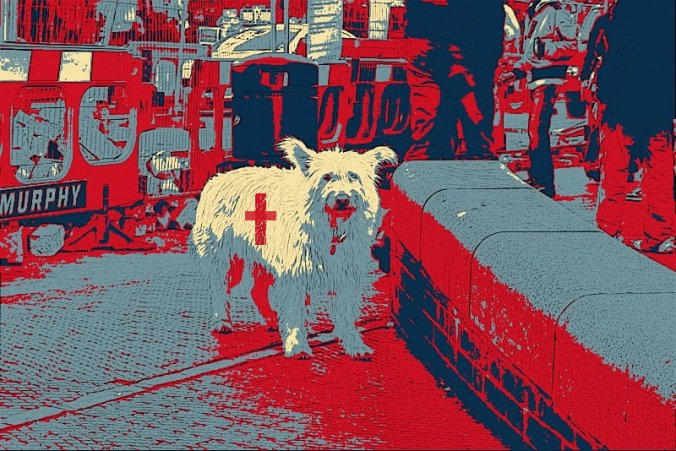
Footnotes: I have used sepia photographs to show respect, as they add a certain gravitas befitting the age and experience of the band. All photos are mine including ‘Dr Dog’ who was caught in Chelsea London and subjected to Photoshop without his permission. You will be pleased to learn that I managed to avoid using the following: barking up the wrong tree, woofers and Roger was a wag.

Craig Walters/Mike Booth Project @ the CJC in Auckland
Craig Walters

During Jazz Week it was appropriate that the Creative Jazz Club (CJC) featured a band that was in some ways a metaphor for the greater Auckland scene.   Jazz week is about Jazz in our neighborhoods but it also about how we connect to the wider Jazz community.
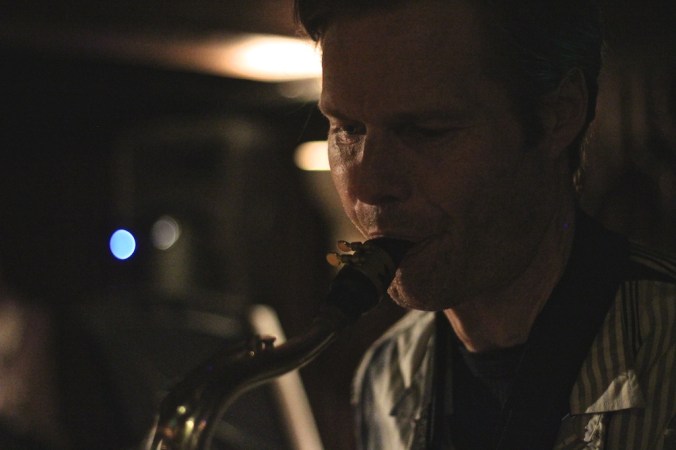
  The co-leader of this nights band, Craig Walters has lived in Australia since 1985.    Craig has an impressive background in Jazz, as he trained at the Berklee School of Music before going on the road as an in demand tenor player.  He has performed world-wide and with top rated acts.  Over the years he has earned a place as one of Australia’s foremost tenor players.   Australia claims him because he has lived and worked there for the last 27 years, but he was actually born in New Zealand.   

Mike Booth (trumpet player & co-leader) has a story that in some ways parallels Craig’s because he also travelled overseas and ended up working in the European Jazz scene for a decade or more.  Unlike Craig he returned to New Zealand a few years ago and since then he has been busy teaching, gigging and running a big band in Auckland.

The band was completed by a local rhythm section, Phil Broadhurst (piano), Oli Holland (bass) and Alain Koetsier (drums).   With this rhythm section in your corner the sound is going to be great and the band will back you up exactly when you want them to.  They are among our best.  As for Craig Walters and Mike Booth, they have known each other for years and this collaboration is merely an extension of their earlier projects.

Why do I consider this band to be a metaphor for the Auckland Jazz scene?  Craig Walters was born here and started playing tenor here.   I am fairly certain that there were no Jazz Schools in the city then and so he eventually ended up in the USA where he studied at the Berklee School of Music.   This is roughly the route that Mike Nock , Alan Broadbent and Matt Penman took (stellar musicians who left the Auckland scene to conquer the world).  This is what generally happens to our best and brightest but they do return.
The pianist Phil Broadhurst is a stalwart of the NZ scene but he was born in the UK and so his story is the reverse of the above.  Oli Holland is also overseas born, as he was an established bass player in Germany before migrating to NZ.  Lastly there is Alain Koetsier who is the youngest in the band.  This was his last gig in Auckland as he departs for foreign shores in two weeks.  Such is the ebb and flow of the New Zealand Jazz scene but in many ways this disruption brings benefits.  Almost all of the musicians that we lose to Australia or to the USA eventually return and they enrich us with what they bring back.  Now that we have two Jazz schools and a youthful vibrant Jazz scene in the city (and a great club), the future is promising.  I also have no doubt that the departing musicians take a special something with them which is Auckland.
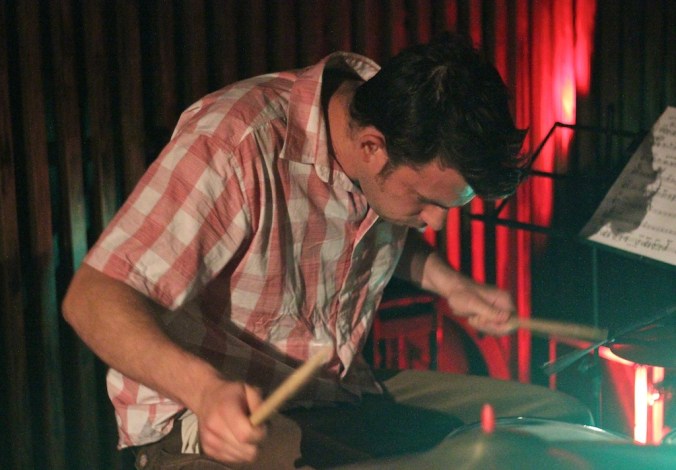
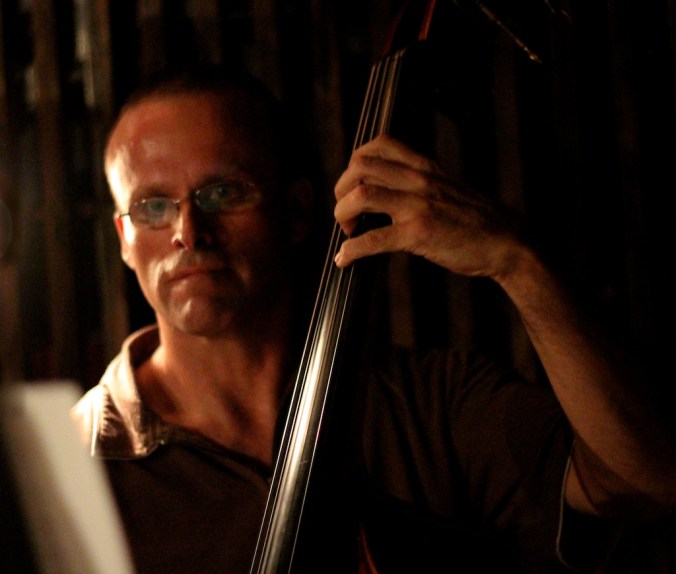
Craig and Mikes band were great and as long as these ex-pat to local match ups keep occurring we will be just fine.

This gig occurred at the Creative Jazz Club (CJC)  in Auckland, New Zealand on the 11th April 2012.  Remember to keep visiting the Jazz Journalists Association (JJA) pages during the next few months as there are a number of activities that will include us. These are; the Jazz week Blogathon, International Jazz day 30th April – Jazz heroes announcement, JJA Awards in June – Auckland Satellite party.
Phil Broadhurst Quartet updated

Phil Broadhurst

I last saw this band at the launch of Phil’s ‘Delayed Reaction’ album.    That was September 25th 2011 and things have moved on apace since than.   For a start the album has had universally good reviews, reasonable airplay and attracted interest from offshore.  For a number of reasons it was bound to do well.  I suspect that the quality of the interpretations and the musicianship of the band clinched the deal.    While a number of well-chosen Petrucciani tunes are featured in the album, it is Phil’s own material that best focuses us on the diminutive masters work.

Oli, Alain & Roger

It is ironic that it has taken someone from the antipodes to put a fine lens on the inner workings of Petrucciani’s music.  Step by step as the material progresses we are granted the most intimate of glimpses.  Guided into a private world that only Phil Broadhurst has been able to reveal. This is the power of Jazz at its best.  Being able to dive deeper into the meaning of a tune as inner forms and colours unfold.   What is already wonderful is somehow made better or revealed afresh.

Petrucciani may have been small in stature but his percussive playing and unusually bold voicings have marked him out as a heavyweight.  His legacy is in fact so strong as to be virtually unassailable.  A few European tribute bands have recycled his compositions but there are few if any sound-a-likes (as happened with Evans).  Phil and the band made no attempt at slavish imitation; they did better than that.  They captured the essence of the music.

I suspect that Phil Broadhurst is one of the worlds foremost authorities on Michel Petrucciani and this is our good fortune.

We heard many of the tunes from the album, such as Phil Broadhurst’s own composition ‘Orange’ and Petrucciani’s  ‘Brazilian like’.   The material had not only been updated but we also heard some new material which Phil had written.  The band was playing up a storm and it was great to see Roger back after a successful trip gigging in Australia.  His tenor is always on fire and Phil and he sparked off each other as the night progressed.  Roger always watches the others carefully during gigs.  He watches them until he is ready to solo.  Then he leans back and takes off like a Titan rocket, leaving an open-mouthed audience in his slipstream.

Roger laying out before he unleashes hellfire

With Alain on drums delivering a flurry of beats, a fiery solo or whispering poetically on brushes the traps could not have been in better hands (he has become a favourite of mine and he will be missed when he goes overseas).  Oli’s playing is always worth hearing and he delivered strong bass lines and gave the band the support they needed.  He had been a little low in the mix for the first few numbers and that is a pity because what he has to say is worth hearing.   Once the sound had been adjusted it was if the jazz universe had suddenly fallen into place.

This was to be the bands last outing before Tauranga.  The group is finalists in the Jazz Tui awards and a play-off will occur Saturday night between The Phil Broadhurst Quartet (Delayed Reaction), The Tim Hopkins Trio (Seven) and the Roger Fox Big Band (Journey Home).  I have heard and reviewed all three bands and I know most of the musicians. This will be a tough call for the judges.

The Band is: Phil Broadhurst (leader, comp, piano), Roger Manins (tenor), Oli Holland (bass), Alain Koetsier (drums).

Callum Passells, trio, quartet, quintet

Callum, Cameron & Adam

A few days ago the CJC presented the Callum Passells group.   Callum is a third year student at the Auckland University School of Music (Jazz Studies) and so are his band mates.  If anyone harboured the briefest thought that this group should be cut some slack on account of age or experience, forget it.   What we saw was a slick act, a great programme and the sort of discipline that generally comes with seasoned performers.   This band did the business and they held us in the palm of their hand throughout.
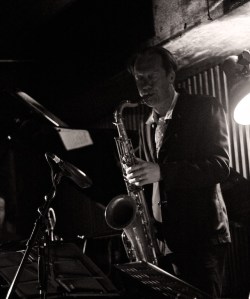
I had only seen Callum perform a few times; once at a house party and once during a jam season.  Those brief encounters had not been enough for me to form a clear view of his abilities and so I arrived with an open mind and no fixed expectations.   I now recall Roger Manins saying that Callum was a terrific saxophonist and that he had the hunger to succeed.  That should have clued me up.

Cameron

Callum is a very nice altoist and his tone is as sweet or as hard-edged as the tune calls for.  Once in a while I could hear a hint of Cannonball Adderley.  Not a copied lick, but more of a bluesy swagger and the stuttering way that he would burst into a phrase.  During one such moment I must have uttered the word ‘Cannonball’ to myself.  The person sitting next to me suddenly said, “yeah, I heard that too”.

The band was well rehearsed and they had paid attention to the smallest of details including how they presented themselves on the bandstand.  Their programme was quite varied and each number fitted into its place and told its own story.   There were piano-less trio numbers, quartet numbers and quintet numbers.   The tunes were all originals and they were well written.

I have to comment on the quintet arrangements which were simply sublime.  Some of the better arrangers like Marty Paich or Kenny Wheeler could arrange tunes in such a way that smaller ensembles sounded as if they were much bigger.   The advantage of this is that it leaves the listener with a feeling of airiness.  A sense of the space around each instrument.   

When I first heard the quintet I was surprised at how big the sound was.  There were only two horns, Cullam Passells (as) and Liz Stokes (t, fh).   This is the illusion created by good arranging.  Liz Stokes was especially fluent in the second set and a Wheeler-esk slur added colour to the performance.

I have seen Cameron play before and he really stepped up a notch with this gig.  I think that he enjoyed it and it was a challenging workout for bass.  The drummer Adam Tobeck was comfortable throughout and he pushed himself harder in the second half.   A blistering solo earned him his stripes with the CJC audience.

The band member I am most familiar with is Matt Steele.   I have liked his playing from the first time I heard it and he was even better at this gig.   He has a mature style but it is different to many of the pianists I hear as his touch is often light and crisp.   His comping is breathtaking as he urges the soloists to greater heights.  While you are always aware of his right hand soaring in chromatic invention during his solos, his left hand weaves its own chordal magic.  If I needed a single word to describe his playing it would have to be melodic.  

The set list was a work of art in itself.  On the page it read like an Imagist poem by Langston Hughes or William Carlos Williams.

The set list was as follows:

Race-car Red Red Race-car, Molasses, What the Fuck is a Persimmon, Money Grubber, I’ve, So This is What it’s Like,  Magnetic North, Wrack, Candied Carrots, Elysium, Greens Waltz, Up Up Down Down Left Left Right Right AB

The band was in order of appearance – Trio:  Callum Passells (leader, arranger, composer, alto saxophone), Cameron MacArthur (double bass), Adam Tobeck (drums).  Quartet add; Matt Steele (piano), Quintet add: Liz Stokes (trumpet flugal horn).

Callum presided over the night with that easy confidence of a born leader. He told very funny stories (especially the WTF is a Persimmon story) and he encouraged his band in a way that ensured they gave their best.   If that is the calibre of students emerging from the city’s Jazz schools then we are in for an exciting future.   Big ups to the band and especially to Callum.


Frank Gibson – ‘Hardbopmobile’

Frank Gibson Jnr

Frank Gibson Jnr is New Zealand’s best known drummer as he has been playing and teaching for most of his life. He has accompanied numerous artists such as Milt Jackson, Emily Remler, Sonny Stitt, Joe Henderson, Randy Brecker, Slide Hampton, Mike Nock and the list goes on. He has also occupied the drum chair for many of Alan Broadbent’s recordings. Whether laying down sensitive brush work or powering an orchestra, Frank has long been a presence on the scene. He is a seasoned leader and it was in this role that he returned to the CJC with his ‘Hardbopmobile’ band. As leader he was able guide the proceedings without being overly dominant. He trusted his band to do the business and they responded in kind.

The ‘Hardbopmobile’ lineup is: Frank Gibson Jnr (leader, drums), Neil Watson (guitar), Ben Turua (double bass), Cameron Allen (tenor saxophone).

Neil and Frank have been playing together for some time and the ease with which they communicate on the band stand is translated into good musical outcomes. I noticed straight away that Neil was not playing his usual solid-body Fender, but he was stroking chords and runs out of a modern version of the D’Angelo 1947 arch-top. Man it looked beautiful, just lying on the piano during set-up.

The set list was mostly out of the Hardbop songbook but a few earlier placed numbers were tackled as well (‘Boplicity’ – Miles Davis). A spirited Wes Montgomery tune was played early on and Neil negotiated the changes and the octave chords in the best possible way. A straight out imitation would have sounded clichéd, but this was a respectful modern take on a classic sound. Like all gifted guitarists, he is able to negotiate complex tunes with apparent ease; dancing and leaning into the music as he delivers a storm of fresh ideas. This is wonderful to listen to, great to watch and but the very devil to photograph.

Two monk tunes were played: ‘Ask Me Now’ and ‘I Mean You’. This is where the tenor player Cameron Allen took the lead. In the former tune he took an angular approach, unravelling it as improvisers do and then diving deep inside the melody. I should probably have been aware of this tenor player before now, because he is very good. We appear to have a tradition of producing good saxophone players in New Zealand – getting wider recognition for them and finding them enough gigs is the real problem.

A couple of hard bop classics were played; Joe Henderson’s ‘Isotope’ and Horace Silvers ‘Senior Blues’. The band interpreted these tunes in their own way and to hear a ‘Hendrix’ like riff being mixed into ‘Senior Blues’ was as surprising as it was effective. I would also like to mention the bass player Ben Turua here. He took a few solos and above all he swung hard.

D'Angelo Archtop

Nathan Haines – ‘The Poets Embrace’

On the 29th November 2011, those lucky enough to be at Nathan Haines CJC gig heard him playing ‘The Poets Embrace’ material.  As far as I know, this was the first public outing for the band and everyone who attended quickly grasped the importance of the event.   Hearing Nathan exclusively playing tenor (and not just any tenor) was intriguing because he is noted for being a multi reeds and winds player.   This gig was somehow different and it had a focus that was palpable.  It was about authenticity and it was about a deeper exploration of Nathan’s music.

Nathan’s approach to his music is a comment on his professionalism.  He divides his time between the UK and New Zealand and he recently headlined at Ronny Scotts Jazz Club in London.  Nathan is one our most talented musicians and I have learned that he never does things half heartedly.

Following that gig Nathan and the band cut an album.     The producer was flown in from London, the vinyl was pressed at Abbey Road, the tenor was a Selmer Mk 6 (ex Brian Smith), The piano was a Steinway B, The recording was made at the York Street studios on analog equipment and using classic microphones….I think you get the picture….glowing valves….absolute authenticity.     Above all this is terrific music and it may become the bench mark for future New Zealand Jazz albums.  The album will be released by Haven Records a division of Warners Music and it should be widely available.

The album is to be released on the 19th March (available on CD or limited edition vinyl)  The promo video is also worth watching as it conveys a real sense of the music we are about to experience.   The attention to detail is evident and one senses that the narrative is an important part of this journey.  People should book now for the launch, which is on Friday March 23rd, 8pm at the Monte Christo Room (behind the TVNZ building Nelson Street).    The entry price for the official launch is $25 pre-sales/$30 at door.  For those who are otherwise engaged on Friday why not get down to JB Hi Fi between 12pm – 12:30pm (any day 19th – 23rd).  If you do you will hear the full band.   It is impressive that a mainstream outlet like JB’s has been so supportive.    Please turn up if you can and this will encourage the store to support more Jazz releases in the future.  If it is wet outside so what, there is no cost to attending and what could be better; Jazz on an Autumn Day.

 These are all great musicians as you will soon hear.  They are; Nathan Haines (ts), Kevin Field (p), Thomas Botting (db) Alain Koetsier (d).

For the gig review see my earlier blog post “The Nathan Haines Fourtet”.

James Ryan – Jazz without a parachute

James Ryan is a Sydney based tenor player and he has appeared at the CJC before.  On Wednesday nights gig he fronted a trio of saxophone, drums and bass.   In configurations like this where chordal instruments are absent, a band is taking a more adventurous route.   Guitars, pianos, horn-sections and jazz orchestras provide a safety net for horn soloists and in addition they tend to fill in much of the soundscape with colour and a variety of textures.  Without this underpinning, clean open spaces can be revealed and the bones of melodies can be unraveled or looked at afresh in their raw beauty.    This is jazz without a parachute.

The precedent for such trios goes back a long way.   Gerry Mulligan came close with his famous piano-less quartet of the 1950’s, but the addition of another horn (Chet Baker or Bobby Brookmeyer) allowed for chords and complex counterpoint.  The most notable historic piano-less trios were Sonny RollinsWay Out West‘, Lee Konitz, ‘Motion’ and the drummer led Elvin Jones ‘Ultimate’.    There are many others and I should also mention the Max RoachDizzy Gillespie duos with just trumpet and drums.  Our own Roger Manins has also explored saxophone trios and his well received album ‘Hip Flask’ is a notable example.

I did not hear James the last time he appeared, but I was soon to be impressed by what was on offer.  His choice of band-mates proved to be fortuitous as Tom Botting (bass) and Ron Samsom (drums) rose to the challenge with enthusiasm.   In this blue-sky environment each artist knew what needed to be done and more importantly what must be avoided.  The was no overplaying and the flow of musical ideas was engaging.

James introduced the first set by playing solo for a number of bars and we could hear immediately that he was brim full of interesting ideas.  This was a good way to open because when the bass and drums came in, their addition filled the space with possibilities.  The fourth tune of the night ‘Micky B’ (Ryan) was a good example of this interplay.   In this case the tune had been set up by the bass and it soon developed into a hard-driving bluesy exploration of the theme.   James drove deeper and deeper into the changes and freed of the need to avoid piano or guitar, he took the music where he wanted it to go.   While James took care of business Tom Botting found just the right responses and Ron Samsom showed us again why he is a master of the drum kit.

After a number of interesting originals had been performed the band switched seamlessly to the well-known standard ‘You and The Night And The Music”.    James explained afterward that this had not been on the set list, but because Tom had quoted from it during an earlier bass solo he added it on impulse.   It is when we hear a standard that  we can form the strongest views and make comparisons.    The audience will know where the tune has gone before and be interested to see just where this band is taking it.   This particular exploration was inventive without being disrespectful.   It had an element of surprise in the familiar and that is what the best Jazz is about.

As is so often the case when Ron Samsom is on the bandstand, the percussion work was extraordinary.   His use of mallets and his inventiveness riveted the audience again and again.   He can play tightly in the pocket or with an understated but completely engaging looseness.  We saw him as more than a drummer in this set up.  He was an instrumentalist capable of filling any space.

There was one free number during the night and it was a riot.    James announced that he would play a tune of his titled ‘Rocket No 7’.    This was an homage to Sun Ra and his much admired composition ‘Rocket No 9’.   A few bars in James just let rip and the band quickly followed him into what were obviously unchartered waters.  This decoupling from the changes was soon evident and the organic freedom took us on a wild and delightful ride.   While the music was as free as a skylark it was never directionless.    Both band and audience were smiling at the end and everyone in the room knew that they had experienced something special.

After the number James wiped the sweat from his brow and pulled the mike towards him.   “That was nothing like ‘Rocket No 7” he said to our delight.

As with many of the Australian visitors we look forward to his return.

Weaver of Dreams – Andrew Dickeson Quintet

For those Aucklanders addicted to live Jazz, the month over which the CJC Jazz club was closed for Christmas seemed like an eternity.   The first of the New Years bookings made up for it though as premier Australian drummer Andrew Dickeson came to town and he brought with him a solid lineup (including a couple of ex-pat New Zealanders now living in Australia).  It was Andrews first time at the CJC but it will hopefully not be his last.
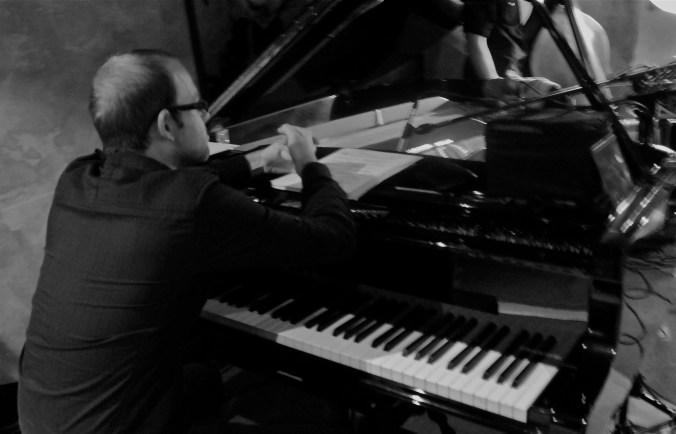
Andrew Dickeson is one of the most respected drummers in Australasia and in stepping out as a leader he has enhanced his already solid credentials.   Andrew has for some time been regarded as the drumming lynch pin of the Australian Jazz scene and when a visiting artist requires a percussionist he would be the first choice.

The band began with the fabulous number ‘Ill Wind‘ (Arlen/Koehler) and it was obvious from the get-go that the tasteful drumming was a cushion of energy powering the group.   As good as the musicians were it was the drummer that caught the attention first; not by showing off his chops but by his sheer musicality.   You were also aware of his powerhouse propulsive swing.   The drums managed to preside without ever overwhelming the rest of the band and to achieve this takes real skill.    This is the sort of maturity that experienced drummers like Jeff Hamilton bring to their gigs and it was nice to witness.

A point which illustrates this perfectly occurred when I spoke to Andrew the next day.    After listening to the CD I had wondered how he had managed to obtain such a crisp but soft sound from his ride cymbal on the ‘Weaver of Dreams’ track (Young/Elliot).    I asked him if he had muffled the cymbal in some way or ‘miked’ it down during mixing.   “No’ he said, “It is all about awareness of the situation.  I just play very gently when that is required”.    I had not known that you could play so gently on a ride cymbal without losing clarity of sound.   At this point Roger Manins leaned over and said, “this is what separates a good drummer from a great drummer.  The ability to fit perfectly into any given situation and to adjust your volume accordingly”.

Those appearing on the album are: Andrew Dickeson (drums, leader, arranger), Roger Manins (tenor sax), Steve Barry (piano), Alex Boneham (bass), Eamon McNelis (trumpet).    For this gig the latter two were replaced by Tom Botting (bass), Pete Barwick (trumpet, flugal horn).  The two acquitted themselves well.

Andrew had used Roger Manins on the album and witnessing his performance at this gig it was easy to see why.    Roger is undoubtably the best tenor man in New Zealand but we sometimes forget how well-regarded he is beyond these shores.    I have written about his playing many times and each time I see him I wonder if he will better his last performance.  He usually does.   As a born story-teller he can captivate from the first few phrases, but the magic he weaves is also due in part to his stage presence.   On ‘Ill Wind’ the pianist had laid-out for a number of bars and in this space Roger mined the bones of the tune to the marrow.  That is his way and as the solo developed there was an increasingly ecstatic quality to his performance.   I have witnessed this before and it draws me to his playing again and again.   In Jazz authenticity is everything.

Pianist Steve Barry grew up in Auckland but he later migrated to Australia in search of greater opportunity.   He is no stranger to the CJC and his occasional gigs at the club are happily anticipated by his ever-increasing fan base.   For some years now he has been working on the Australian scene and he is exceptionally well-regarded there.   Some pianists have an X-factor and Steve is one of those.   The history of Jazz piano is somehow referenced in his playing but he is more than that.  While unafraid of the past he is not owned by it.   This is a journey of stylistic development that we are privileged to witness and it is an ongoing story.    In this setting he was not only a good soloist but the perfect sideman, as his comping and sense of timing were superb.   We get one more chance to hear Steve before he returns to Australia; next week he is co-leader of a quartet performing at the club.

Tom Botting and Pete Barwick had been engaged for this one gig and they fitted in seamlessly.   I had not seen Pete Barwick play before tonight but he handled the charts with ease and performed each solo convincingly.   His strongest performance was on the Strayhorn balad ‘Isfahan.    His burnished ringing tone and clear articulation were just great.   Tom was a fixture at the club before moving to Australia and his bass playing is familiar to CJC attendees.     He is a reliable time-keeper but he can also be adventurous when challenged.  On this night he injected a sense of urgency into the uptempo numbers.  Sitting in for Alex Boneham would be quite intimidating to many bass players but Tom took it in his stride.   He had returned to New Zealand in disguise (no beard and shorter hair) but his signature bandstand persona was fully in tact.   Tom always looks and sounds extremely convincing and it is nice to have him back for a few weeks.

The other stand out number was ‘Soy Califa’ (Dexter Gordon).   To have Roger play a Dexter Gordon number is a no brainer.  He aced it and then some.  This was a great night out and once again it reinforced the strength of the Trans-Tasman Jazz alliance.

This album is well worth buying : ‘Weaver of Dreams’ – The Andrew Dickeson Quintet – Rufus Records (a division of Universal Music group).     rufusrecords.com.au – or  – andrewdickeson.com

Nathan Haines Fourtet – live@CJC

Some weeks ago it was posted on the CJC website that Nathan Haines would be bringing his new band to the club and that this particular band was to be an acoustic Jazz lineup.   The talk among local musicians was that Nathan had been wrestling with some bold musical ideas and that after a trip to France and three months of wood-shedding he was now ready to unleash those ideas on a Jazz audience.

Anyone interested in the Auckland music scene will have followed Nathan Haines career and know that he has wide crossover appeal (here and overseas).   As a multi-reedist and flutist he is proficient on a number of horns and for a while people wondered which instrument he would play for this gig.  That was soon made clear when the details were posted.  He would be playing a classic 1963 Selmer Mk VI – purchased from Brian Smith earlier in the year.   This is an instrument with real provenance and in a way that set the bar even higher.        

The acoustic feel that the band are striving for goes way beyond the choice of instruments, because they intend to record in a few weeks and will wherever possible avoid using modern equipment.    It is Nathan’s view that recording technology has deteriorated over the years and so they are intending to use old style Neuman mics, the fabled EMI Neve desk and to record directly to tape with no mixing or overdubs.  There is also talk of them hiring a Steinway B for the recording.

As the threads of information gradually came together it was clear that this would not be any run of the mill gig and in line with expectations the band attracted the biggest crowd the club has yet seen.

The members of this band are all well-known to club attendees, but Nathan Haines and Kevin Field (piano) are obviously the veterans here.    The name Kevin Field alone is enough to pull a good crowd, but couple his name with Nathan Haines and a capacity standing room only audience is the result.  On bass was Thomas Botting (who has recently taken Movember to its extreme limits).    He may be young but he is a terrific bass player.   I often stay back for the Jam Sessions just to hear Thomas and his friends, (usually playing alongside Peter Koopman and Dan Kennedy).    Thomas can edge up the tension by executing a well placed pedal point or walk his bass lines in a way that is reminiscent of Jimmy Garrison.   This makes him a good choice for this uber-acoustic hard-driving lineup.    The remaining band member is drummer Alain Koetsier.  This is the third time that I have seen Alain play and I have always been impressed.   His ability to lay down complex polyrhythms and push a band hard is well-known.   On this night he was at his fiery best.

The first number ‘Universal Man’ (by Nathan Haines) was intense and up tempo and this signaled the get-down-to business mood of the band.    They were ready for this gig and clearly ready to push at the boundaries.  While they conveyed a strong sense of purpose this did not constrict them in any way as they ate up the changes; hungry for the next layer of the tune to be unraveled.   Nathan soared on this and on other numbers, reaching into the past for reference points but more importantly bringing all of his recent experience and learning to the moment.    This was a 2011 version of a classic jazz lineup.

Next came a ballad ‘Poet’s embrace’ which was both lyrical and deeply probing.   Nathan continuously mined the tune for newer and deeper meanings.   His tone was luminous and his playing (even on the ballads) conveyed the intensity of the moment.

That chiaroscuro effect established the vibe; which became a hallmark of the programme.    These contrasts in tempo and mood were well placed as they kept the audience focused.    Two pieces perfectly illustrate this skillful placement.

While Nathan had written and arranged most of the pieces, the fourth number, Ravel’s Pavan (Pavane pour une infante défunte) deserves comment.     This famous piece was a miniature of perfection.     To have added another bar or even another note would have ruined the mood.     Very few bands can resist the inclination to over-egg-the-pudding in situations like this and I congratulate the band for keeping to the spirit of the piece.    What was added was subtle and it revealed a deep understanding of the music.    Colourist drumming, well placed bass lines and skilful minimalist chord placement; giving Nathan the platform he needed.  This illustrated perfectly the maxim that less is sometimes more.

The last piece ‘Consequence’ was a powerhouse performance.   So intense was the mood and so up-tempo was the pace that the audience seemed to lean back; as if a freight train was passing.   Each instrument soloing often and with each solo the tension increasing.    The drumming was so powerful that one of the audience swore that the kit remained airborne throughout.   This was an in-the-pocket performance and over that crescendo of sound Nathan blew up a storm.

At one point Brian Smith had joined the band and to see him and Nathan performing Wayne Shorter’s  ‘Speak no Evil’ was great (I have always loved Shorter’s material).   Two of our best tenor players belting out the unison lines and constantly challenging each other during solos.    Kevin Field had also contributed one piece ‘Raincheck’.  Kevin’s compositions are well constructed and appealing.

The band finished after two long sets looking exhausted but satisfied. So were we.

I will await the new recording with great interest.  This was a performance that it would be hard to improve on, but with a band this focused that may just occur.

Brian Smith Band & Hard Bop heaven

Brian Smith - CJC gig

To list all of the famous artists that Brian Smith has accompanied in the Jazz/Soul/Pop world would make this a very long post. To name a few (Soul) Gladys Knight & the Pips, Dusty Springfield, (Jazz) Jon Hendricks, Annie Ross, Nat Adderly, Mark Murphy. Brian was also a founder member of ‘Nucleus’ with Ian Carr. He was for many years one of our most successful Jazz/Soul exports but in 1980 he returned to New Zealand. His ‘Moonlight Sax’ (1990) went platinum, was the album of the year and sold over 40,000 copies which is astounding for a Kiwi Album.

Last night this Jazz icon played at the CJC and with him were a number of well-known New Zealand Jazz musicians. The band was; Brian Smith (tenor sax, soprano sax), Kevin Field (piano), Kevin Haines (double bass), Frank Gibson Jnr (drums). They started with one of Brian’s own compositions titled ‘Blues for Teo‘ and the band got down to serious business immediately. They are a hard swinging unit and as they unpicked the tunes they wove a collective magic.

Brian was a commanding presence in the mix (which was hardly surprising) but his band-mates could not be faulted either for their ability to shine beside him. It struck me (and not for the first time) just how strong a presence Kevin Haines is. He and Frank were obviously on comfortable ground and they pushed boundaries because they could, and because they found new and interesting things to say. I have seldom heard Frank play better. Kevin Field is a very popular and talented local pianist and to have him in any band is simply to have the best. His crisp chord work and soaring solos are never less than perfect.

Jazz Musicians are often natural comedians and Brian is no exception. When introducing the second tune he said, “the band will practice for four bars and by then we should have a hang of it”. The tune was a George Chisholm original and in spite of the intro we heard no missteps. The tune ‘Seriously flawed (floored?)‘ was the first of a number of new charts by George Chisholm. These were great vehicles for the band and when they played the lovely Chisholm ballad ‘One for Martin‘ they struck the mother-lode. This piece was penned in remembrance of the much-loved Kiwi Jazz guitarist Martin Winch who died in May of this year. It was suggested to me recently that we only have the sudden influx of very promising Jazz guitarists around Auckland because of Martin’s influence and example.

This and other Chisholm tunes deserve to be played often (plea to local musicians). * George is a well-known trumpeter from the local scene having recorded in his own right and as a sideman with locals like Phil Broadhurst.

We heard fresh versions of standards like ‘My Funny Valentine‘ and best of all a few Wayne Shorter tunes. The darkly brooding and deep Shorter compositions are favourites of mine and any group who attempts them and executes them well has my appreciation. The groups rendition of ‘Black Nile‘. ‘Lester Leaves Town‘ and ‘Speak no Evil‘ were well done and as these are difficult tunes to get inside of, they must be commended.

Phil Broadhurst Quartet – CJC ‘Delayed Reaction’ launch

This was a special night because the band was simply superb and it was a special night because the music paid tribute to Michel Petrucciani.   Phil Broadhurst the leader of the quartet needs no introduction to New Zealand musicians as he has been the familiar face of Auckland Jazz forever. Whether playing as resident pianist in the London Bar ,accompanying visiting musicians or performing his role as senior tutor at the Massey University School of Jazz, Phil has been at the epicentre of the New Zealand Jazz scene.   He is a gifted artist and a prime enabler.

Wednesday was the official launch of the ‘Delayed Reaction’ CD which marked a milestone in what has been a long and interesting journey.   Not only for Phil, but also for those of us devoted to the music of Michel Petrucciani and who now get to share in the journey.   Phil has probably studied Petrucciani’s body of work more extensively than any other and this music is the evidence.

The quartet is: Phil Broadhurst (piano, leader, arr), Roger Manins (tenor sax), Olivier Holland (bass),  Alain Koetsier (drums).  – *guest Mike Booth (flugal horn)

The first set opened with ‘Brazilian like‘, a well-known Petrucciani composition.   This medium tempo number paid tribute to the original but Phil and Roger gave it a slightly more bluesy feel which added interesting dimensions to the tune.   When I listened to that particular track on the album, I realised that Phil had achieved a rare thing.   The voicing and percussive attack were unmistakably Petrucciani, but in managing to add some of the feel and spaciousness of the New Zealand musical landscape he made ‘Brazilian Like‘ ours as well.

Next was the title tune ‘Delayed Reaction'(Broadhurst).  The number built-in intensity without losing any of its beauty and the quartet were obviously focused on treating this original with the same respect as the Petrucciani compositions.   Throughout the two sets there was a perfect juxtaposition between Petrucciani compositions and Broadhurst originals.  Phil had reworked many of the Petrucciani tunes and the result was to create a very satisfying melange.    Other Petrucciani tunes played were; ‘Guadeloupe‘, and the wonderful ‘Looking up‘ – a tune brim full of exuberance and always conjuring up Michel Petrucciani’s infectious good humour which he maintained against all odds.  He would have liked what this band offered up.

Of the Broadhurst originals I particularly liked ‘Oranje‘ (so titled because it was the birthplace of M.P.) and the lovely trio piece titled ‘Matai Bay‘.   During this last evocative number the considerable skills of Olivier Holland (b) and  Alain Koetsier (d) were particularly in evidence.   On the rest of the numbers Roger Manins (ts) shone with his story-telling bluesy intensity.   His performances are consistent in this regard and it is my observation that any group he plays in, is lifted up a notch.

We also heard a few standards and the rendition of ‘You Walked Out of a Dream‘ was fabulous.  Phil increasingly threw challenges at the others and they responded in ways that had us on the edge of our seats.  Roger soon exploded into his solo and the exultant soulful wailing as he seemed to depart from the upper register, had everyone spellbound.   Mike Booths (fh) contribution was on ‘If I Should Lose you‘ and this was also well executed.

A few years ago my partner Darien and I were traveling through the ‘Loire Valley’ France and I spotted a road sign indicating that we were close to ‘Blois’ a town famous for its castles, château and its Houdini association.   It was not those things that drew me to stay there but its association with Michel Petrucciani.     He wrote a wonderful suite about the place; one section was titled ‘Night Sun in Blois‘.   Sitting on the ramparts of that ancient and stunningly beautiful city at dusk I could hear that piano piece echoing in my head as the sun filtered through the now dark mass of the surrounding  forest.    The Loire river was a shinning golden reflection way below us and I wondered if Petrucciani had sat on this very spot when he was inspired to write that tune.

That powerful memory had faded with time but it was sharply brought back to me as I listened to this tribute and I thank the quartet for that.

The album ‘Delayed Reaction’ is on ‘Independent Artists’, a New Zealand label associated with ‘Rattle’ records.

Chateau by night near Blois

Tricolour's above Blois

Trio White – CJC

Trio White @ CJC gig

I am a big fan of Jazz guitar and so I need no arm twisting to get me along to a Jazz Guitar gig.   Last Wednesday the CJC featured a local guitar trio (+ piano in second half).    I was not previously aware of ‘Trio White’ and so I was intrigued.    I soon learnt that this band knew exactly what they were about as they launched into the first set with fiery determination.

Trio White is composed of; Ben White (guitar), Joanne Shum (bass), Steve Harvie (drums)

From an overheard conversation I learned that they had been keen to play at the CJC for a while and were hungry to play in front of more Jazz audiences.   They have been together for a while and according to their promotional material formed in order to explore the most contemporary sounds of Jazz.

On Wednesday the group performed their own material,  but they do mention Kurt Rosenwinkel as an influence and I am not surprised.

While they treated us to some slower and more melodic numbers, the main thrust of their music was intense hard-driving; blowing jazz.  Their was no mistaking that Ben White was the leader and he worked the band hard as he executed his rapid fire runs up and down the neck of the guitar.   He also demonstrated some skillful chord work and comped when the bass took a solo, but the thrust of this hard-driving music came from the intense lines he tossed out.

It was hard to catch the song titles as the band did not pay terribly much attention to introducing tunes.   They began by launching straight into the music and only brief announcements followed; almost as an aside.    They were primed to play and that was all that mattered.

For the second set they were joined by Dr Stephen Small on piano and as you would expect a slightly more reflective vibe took over.   Having a piano added to a guitar trio changes the dynamic and the musicians have to be more aware of creating room for each other.   It can also free up a guitarist, as chords are less of an issue to be factored into the mix.

One number I did catch the title of was the ironically named ‘Untitled Tune‘.   For me it was the best number of the evening.    I loved it from start to finish – thoroughly enjoyable music.   The band communicated as a unit and were more aware of each other; responding in the best possible way to the challenges being laid down.

Following that was a slow burning groove number with a walking bass line that drove the tune relentlessly.   Joanne Shum held the centre and for this one track she and drummer Steve Harvie ruled the roost.    Dr Stephen Smalls piano was excellent as well and he did exactly what was expected of a pianist joining a piano trio.

In last weeks blog I speculated that this might well be the golden era of Auckland Jazz.   If that is the case then it is down to this CJC Jazz club and the dedication of Caroline, Roger, Ben and the others who work at this so tirelessly.     Keep them coming please, the magic is apparently endless.