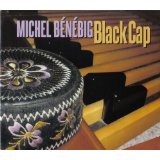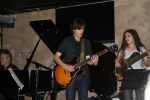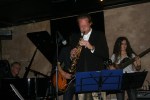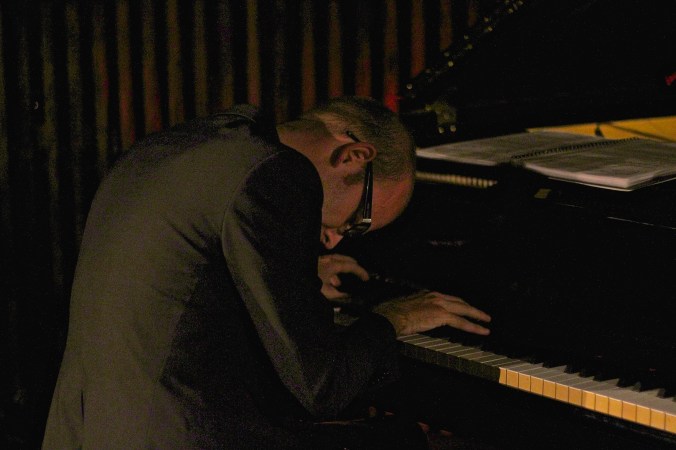
Michel Benebig B3 Master: Review of ‘Black Cap’ Album

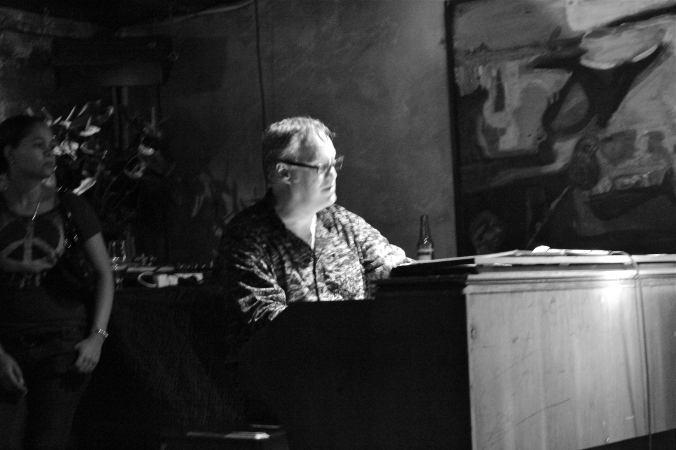
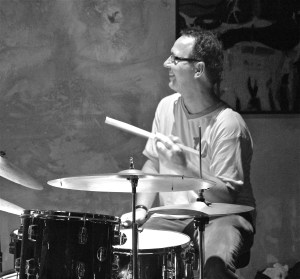
This album confirms what those on the Pacific rim have long known and what is just dawning on the wider Jazz world.   We have a fully fledged B3 master in our midst and the time for proper acknowledgement is due.   ‘Black Cap’ should gain Michel Benebig the wider recognition that he deserves.

Michel has always been an artist with astonishing chops but like all great musicians he also has good judgement.  He knows when to lay out, when to comp gently and when to lay down a burning foot-thumping groove.  If you listen carefully you will hear how totally in the pocket this man is.  He sounds as if he could swing with one hand tied behind his back.  This is about timing, an innate sense of swing, a relentlessly propulsive groove but above all taste.    This is a sound that many aim for but few can master.

I will also mention his pedal work, which lays down such solid walking-bass lines that you shake your head in disbelief.  It made me pick up the album cover to see if I had missed a bass player .  This album has come to the attention of organ trio/quartet specialists and their praise for it has been strong.  The various comments have invariably drawn attention to the astonishing pedal work.

The numbers on ‘Black Cap’ are all Michel’s compositions and the track list is carefully balanced.   This is great groove music and that would be enough, but the album possesses an extra something – a presiding spirit that holds you until the last note.  I was already familiar with his ‘Brother Jack’; a tribute to Brother Jack McDuff.  On the album this is fast paced and crackling with energy.  In perfect contrast is the slow burner on track 6 – titled ‘Black Groove’.

These days Michel spends a lot of time away from his native New Caledonia, gigging up and down the western seaboard of the USA.  The other musicians on the album are all from the west coast and the line up is very impressive.

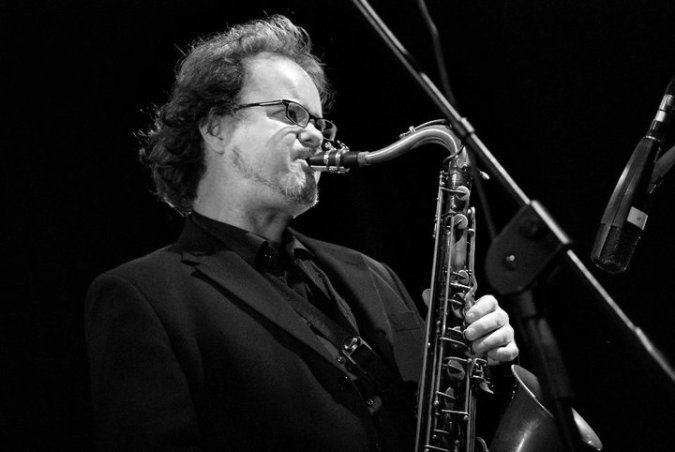
These guys are serious Los Angeles heavyweights and their biographies are simply staggering.  Saxophonist Doug Webb has played and recorded with everyone from Horace Silver to Quincy Jones and has worked on several Clint Eastwood films including ‘Mystic River’ and ‘Million Dollar Baby’.

Frank Potenza on guitar is well-known for his years with pianist Gene Harris.  He has played with Dizzy Gillespie, Harry ‘Sweets’ Edison (long a favourite of mine), James Moody and more.  He was a protegé of the immortal Joe Pass and no guitarist can carry higher credentials than that.

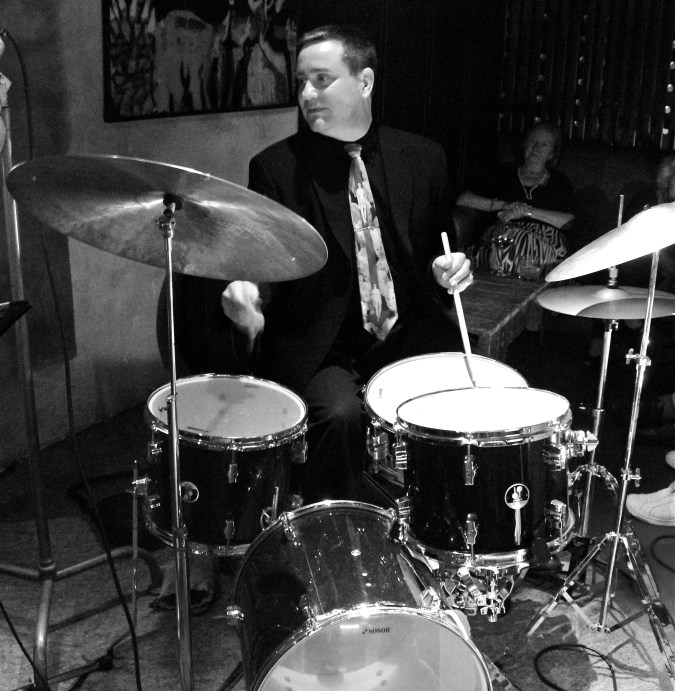
Lastly there is drummer Paul Kreibich.   He has worked with Carmen McCrae, Red Rodney, Kenny Burrell, The Woody Herman band and dozens of luminaries.  He was Ray Charles drummer for three years and spent considerable time with the Gene Harris quartet.  These are the very musicians to have in your corner if you have something special to say.  Michel does.

I would defy any lover of B3 Groove jazz to fault this album.  In this world of financial turmoil and endless conflict, this is the eternal balm.  Order it from Amazon as a CD or download – do it now.

Also an older review is located onhttps://jon4jaz.wordpress.com/2011/11/19/michel-benebig-soul-on-pacific-soul/

What: ‘Black Cap’

Where: Recorded in Pasadena USA 2012 – distributed by Rhombus Records – iTunes or Amazon

Who: Michel Benebig (leader, B3 organ, composer)

With: with Doug Web (sax) , Frank Potenza (guitar), Paul Kreibich (drums)

Andrea Lisa – R & B album ‘So Sweet’

Mid summer 2011 I was walking in the Wynyard Quarter (Auckland’s waterfront area) when the warm sounds of Jazz guitar voicings drew me into a courtyard.  The guitar was being played by a diminutive young woman with a lovely Ibenez JSM hollow-body guitar.  I soon learned the name of the guitarist and introduced myself.   This was my first meeting with Andrea Lisa Groenewald.

Between the sets we spoke of Pat Martino, John Scofield and groove anthems like ‘Sunny’ and its reharmonised form ‘Red Clay’.  I also learned that South African born Andrea had just graduated from the NZSM Massy Jazz School.   We exchanged the odd email and before long I received a notification that the ‘Alex Churchill- Andrea Lisa Band’ would be playing two sets at the CJC – emerging talent night.    That night established Andrea’s Jazz chops before a wider Jazz audience as she and Alex convincingly tackled a mixture of their own material and some complex tunes like Pat Metheny’s ‘Have You Heard’.  To hear this so skillfully executed by guitar, keys, voice and sax playing unison lines was a rare treat.  (see earlier reviews)

Andrea playing with AJO

Fast forward to late 2011 and Andrea cut an R & B EP titled ‘So Sweet‘.  Andrea was always going to do well.  She is a great guitarist, has a smokey ‘Nora Jones’ type voice, writes interesting material and she looks the part on the band stand.  Since playing that first gig at the CJC, she has gigged extensively around Australasia and has toured with the famous Jonathon Butler Band.   Jonathon Butler is a well-known R & B/Jazz Fusion singer (also hailing from Capetown).   Andrea and the band have been touring Sydney, Perth and Brisbane where they have established quite a following.  They return to Australia this week.

The EP has six tracks: two of them instrumental.   ‘Paint the Sky’ (Groenewald) is the tune that I am most familiar with.   This has been a tour-de-force for Andrea and in more wide open contexts it has been a good vehicle for improvisation.   The other tracks are ‘So Sweet'(two versions), ‘Imaginary Me’, ‘Love Thang’ and ‘Ambition’.  This disk is squarely aimed at the R & B market and because of that I must put in a disclaimer here.  I am probably not qualified to make critical forays into that genre.  What is quite evident however is that this is a terrific album.  Andrea has had impeccable Jazz training and because of that she is very well equipped to embark upon this new journey.  As a singer songwriter she will find a ready market, because she has talent and because she has her own compelling story to tell.  The band members are: Andrea Lisa – electric and acoustic guitar, vocals.  Alex Churchill – keyboards, alto & tenor sax. Nicholas Taylor – bass, Lenny Church – drums.   Guest artist: Lewis McCallum – flute.

The EP is available on iTunes as a download, or you can follow the group on facebook.com/andrealisag

I just had to add this last clip in.   As you will see it is a shaky phone recording of Andrea soloing at a Sydney gig.   Taking on Chick Corea’s ‘Spain’ is challenge enough, but to construct such an amazing solo is mind-blowing.   I saw this clip minutes after the gig and watch it often.

A Plea:  You were great with the AJO two weeks ago and you owned ‘Spain’.   I wish you the very best in your R & B Career Andrea, but come home and play for us occasionally – we like your stretched-out hard blowing Jazz as well – spare us a Jazz moment when you can.

Kevin Field – ‘Field of Vision’ gig & album

Some die-hard Jazz fans complain that the modern jazz scene doesn’t produce enough music that sounds like that of the ‘classic era’.    This mythical era that they remember so fondly didn’t exist in the way they thought.  They forget that Louis Armstrong accused Dizzy Gillespie of playing ‘Chinese music’ and that Bill Evans was accused of not swinging.

The Jazz in any defined era has always sounded surprisingly different from the music that preceded it.   Jim Hall circa 2012 sounds nothing like the Jim Hall of the early ‘Pacific Jazz’ Era and why should he.   This is not a music to be set in aspic or to be kept in a hermetically sealed container to protect it from impurities.  Jazz is not a fragile dying art form but a vibrant improvised restless music that lives perpetually in the now.  As Whitney Balliett so famously said it is ‘the sound of surprise’.

Kevin Fields new album illustrates this premise perfectly. 

On Wednesday 25th April the CJC (Creative Jazz Club of Aotearoa) featured pianist Kevin Field as he promoted his ‘Field of Vision’ album.   Being a fan of Kevin’s, I had been quick to obtain a copy of the album and I was delighted by what I heard.  This was music with a deep groove and an unmistakable pulse.  The banks of synthesizers, the singers and the electric bass lines had given it a distinct Soul Jazz context.  Out of this came a series of mesmerizing grooves, which engulfed us in a way that made definitions quite meaningless.  As the band played at the CJC we sunk happily into a warm vibe that made the Autumn night seem very far away.  

The club gig kicked off with ‘See Happen’; a number that drew us deeper and deeper into a vamp while figures on the piano created a pleasing filigree by way of contrast.   The next number ‘imaginary friend’, opened the vistas wider.  On the album this was especially noticeable as the Steinway Grand, Fender Rhodes, Prophet T8 and Roland Jupiter 8 worked beautifully over the four piece string section

It had an almost cinematic feel to it and I could not help but be reminded of the work of Creed Taylor’s CTI label.  Instead of CTI’s Don Sebesky this album had utilised the services of Wayne Senior who arranged the string section.   The first airing of this material had been in the Kenneth Myers Centre and it was therefore fitting that Wayne Senior had been involved as his connection with the KMC goes back a long way.

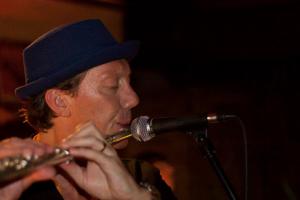
The album was produced by Nathan Haines and his handiwork is evident throughout.  He plays alto flute, an ARP synth and is credited as co-composer on 4 of the 11 numbers.  The rest of the numbers were written by Kevin and they are probably his best work to date.

The band that Kevin brought to the CJC was a smaller unit than on the album and that is just as well because the club was packed.  A small club has a very different sound to a recording studio and the warmth and intimacy is the obvious benefit of being in that space.   When you buy the disk (and you should) you will notice a broader sound palette, a bigger line up and a crisper sound.  Both experiences are complimentary and anyone attending who has also purchased the album will count themselves lucky.  

Stephen Thomas had been brought in as drummer for the CJC gig and he had sweetened the deal by a congratulatory email that he sent to Kevin after the initial release.   “Man those were some sick grooves” he had messaged.  Kevin immediately confirmed him as right drummer for the gig.  Stephen is a terrific drummer and the choice was a good one.

Once again we saw Dixon Nacey perform and as always we watched open-mouthed.   This man is so good that it is frightening.  Completing the lineup were guests; Nathan Haines, Marjan Gorgani and Clo Chaperon (the latter had great soul voices).   All added something essential to the rich mix and in Nathan’s case this is only to be expected.

I would also like to mention Karika Turua.  He played a big Fender bass and his grooves although loud, were as big as his guitar.

There were a few quieter piano passages as well and on these we hear the crisp touch, the harmonic exploration and the crunched chords that have become so familiar to us in Kevin’s playing.  Kevin has many fans in New Zealand and most will have heard his previous piano trio album ‘Irony’ (Rattle Records).  Although different I would regard both as essential purchases as we follow Kevin Fields career.

The CJC band was: Kevin Field (Leader, Yamaha piano, Fender Rhodes, Synth) – Dixon Nacey (guitar) – Stephen Thomas (drums) – Karika Turua (bass) – Marjan Gorgani / Clo Chaperon (vocals) – guest Nathan Haines (alto flute, soprano sax).

On the album were: Kevin Field (Leader, Steinway piano, Fender Rhodes, Roland Jupiter 8, ARP Odyssey,Prophet T8  ) – Nathan Haines (ARP Odyssey, alto flute) – Dixon Nacey (guitar) – Joel Haines (guitar) – Mickey Ututaonga (drums) – Migual Fuentes (percussion) – Karika Turua (bass) – Bex Nabouta/ Marjan Gorgani/Kevin Mark Trail (vocals) – Cherie Matheson (backing vocals) – Miranda Adams/Justine Cormack (violins) – Robert Ashworth Viola) – Ashley Brown (Cello) – Chris Cox – (drum programming).

This album can be purchased in any major record store or for more information contact ‘Haven Music’ a division of ‘Warners Music NZ’.

All photographs by Peter Koopman – Gig venue/CJC Jazz club Auckland

Auckland Jazz Hero – Roger Manins – World Jazz Day 30th April

Auckland Celebrates World Jazz Day

 The 30th of April 2012 has recently been designated World Jazz Day by UNESCO. This significant recognition of our music is great and we will be celebrating this in Auckland along with the worldwide Jazz Community.

The Jazz Journalists Association is actively celebrating this world event and as part of their programme, members have been asked to nominate a Local Jazz Hero. To follow events go to www.jjajazzawards.org/.  Here in Auckland, New Zealand we have nominated Saxophonist, Jazz educator Roger Manins as our first Jazz Hero. Roger is also the programme director and co-founder of the not-for-profit ‘CJC ‘Creative Jazz Club of Aotearoa’ (along with his wife Carolina Moon and friend Ben McNicoll).

Roger has been nominated for a number of reasons. He is certainly one of New Zealand’s (and indeed Australasia’s) best tenor players and as such he is an inspiration to up and coming Jazz Musicians. Of equal importance though is his role as an educator and enabler. Roger lived and worked extensively in Australia for 10 years (he also lived in New York for 2 years), and even though he returned to NZ in 2004 he is still very much in demand across the Tasman, gigging and touring at regular intervals. 

Roger teaches at the Auckland University School Of Music Jazz Programme. Anyone who listens to Roger will quickly identify him as a person with killer chops, but he also has the ability to tell a compelling story on his horn.

“He is an outstandingly gifted musician with a warmly passionate sound, remarkable instrumental ability and total musical integrity”. Mike Nock

This story telling in almost any given context draws listeners to him again and again – a skill that was very evident in the likes of Lester Young or Dexter Gordon, but which is not always evident in modern players. Roger can play convincingly in any Jazz genre from free through post bop to mainstream traditional.

Roger is often generous with his time when it comes to nurturing up-and-comers. He will encourage and push those who he thinks need that, while gently insisting that they meet the required standard. With lots of younger players coming out of the two local Jazz Schools, it is essential that they get this real-world feedback in a way that keeps them challenged but not discouraged.

Having a world-class venue is part of this mix and the CJC is just that. Its vision is to stimulate and encourage the development of excellence in the creative improvised / jazz scene, and as programme director, Roger ensures that the diversity of the music scene is represented. The gigs are varied every week and feature prominent ex-pat Kiwis and international artists as well as national and local talents. It is Roger’s connections with the wider scene and the esteem in which musicians hold him that helps to make this happen.

Finally, I want to mention his very Kiwi sense of humour, which is evident both on and off the bandstand. He often slips in sly jokes or asides when introducing acts and his You Tube videos on ‘How to Play Smooth Jazz’ are simply hilarious. These have a cult following in NZ and Australia and the tongue in cheek delivery is so convincing that pupils of smooth jazz sometimes contact him to seek instruction without realising that it is all a delicious joke.

Roger is in demand in both Australia and New Zealand as a tenor player, multi reeds and winds player. He has recorded on many albums as an essential sideman and also as leader. He is married to fellow musician Carolina Moon (Manins) and has a daughter Milli.

His discography and website is: www.rogermanins.com

Selected Discography

Personal Recordings

Trio – Rattle Records 2010

Latitude – Roger Manins featuring Bernie McGann / Rufus Records (Aus) 2010

Roger Manins – Hip Flask Jazzgroove (Aus) 2002 / Ode Records (NZ) 2005

Recordings as Sideman

Andrew Dickerson Quintet – Weaver of Dreams

Resonator – Reuben Bradley

Carolina Moon – Mother Tongue

Phil Broadhurst – Delayed Reaction

Tom Dennison – Zoo

Solar – Bernie McGann Quintet featuring Roger Manins

James Muller Quartet -Thrum

Jazzgroove Mothership Orchestra with Florian Ross – Dreamwheel Ashley Turner – Beautiful Open Spaces

Mike Nock’s Big Small Band – Live

Carolina Moon – East of the Sun

Andrew Atwill – 3 Sides of the Same Coin

Leonie Cohen Plus – Jerusalem

Simon Sweeney – Emerald CityBlues

Vaughn Roberts – Grrreat Stuff

Paul Dyne – Shelter of the Ti Tree

Jann Rutherford – The Scented Garden

Julie Mason – 12 O’ Clock Tales

Steve Hunter – Condition Human

Karen Hunter- Rubble

D Dub- Awake at Dawn

Trans Tasman – a journey into New Zealand music compilation CD

Pending Release, Manins/Muller/Nock/Bradley

John Fenton

Jazz Journalists Association  /  Jazz Local 32 (Blog)

Alan Brown@CJC (KMC Live launch)- C3 organ/guitar/drums

Alan Brown & C3

When ever Alan Brown brings a band to the CJC, the club fills to capacity.  Alan is well-known, deeply respected and he swings like crazy.  The ‘KMC Live’ release was always going to be a significant musical occasion, but on this night the sparks of inspiration flew between the band members and we witnessed something transcendent .  This was an incendiary gig that lifted our spirits; causing us to tap our feet uncontrollably and for some, to dance with abandon in the flickering shadows.   Alan had arrived earlier in the day, because dragging a heavy C3 organ down into a basement presented challenges.   The patience of Job and the strength of Hercules are required.  These wonderful organs with their bass pedals, wood-paneled console and double keyboard have probably caused preachers to swear when moving then.   It would not surprise me if some elected to rebuild the church round the organ rather than drag it up front.  It is our gain entirely that Alan achieved the translocation.   Hearing the wonderful bluesy phrases flow effortlessly from his fingers as they flew over the keyboards and seeing his feet pedaling out compelling bass lines was a rare treat.

Josh Sorenson

Dixon Nacey is without a shadow of doubt one of the best guitarists in New Zealand and it is a joy to watch him solo and interact with the other musicians.  During solos he will often close his eyes while weighing up the next step and his facial expressions reveal his commitment to the process as he dives ever deeper into the tune.  It is also a revelation to watch him in call and response situations.    When he and Alan are batting each other ideas, this often turns into good-natured un-armed combat.    Dixon watches intently while waiting for a challenge.  Occasionally calling to the others as if to say, “do your worst”.  When a musical phrase is tossed into the air he will smile gleefully and pounce on it, turning it about until it is fashioned into a thing of his own.  Josh Sorenson proved to be the perfect groove drummer as he locked down the beat and pulled the unit together.    This type of drumming requires specialist skills and Josh most certainly possesses these.

Tonight was the launch of Alan’s album ‘Live at the KMC’.   This was recorded at the Kenneth Meyers Centre back in September 2010 and choice of venue was fortuitous.    The venue is of historic importance as it has nurtured radio and TV in its infancy.    It is now part of the Auckland University School of Music (Creative Arts Section).  An acoustic gem.  Alan had recorded this gig thinking only that it could prove useful as a private resource.   One listen convinced him that he needed to release the material at some future date.

The set list at the CJC gig (and on the album) was a mix of Alan’s original tunes with three standards thrown in.   The standards  were ‘Maiden Voyage‘(Herbie Hancock) and ‘All Blues‘ (Miles Davis) and ‘Chank’ (John Scofield) – all arranged by Alan.   The rest of Alan’s compositions were; ‘Mr Raven’ (from the Blue Train days), ‘Charlie’s Here’, ‘Shades of Blue’, ‘In Fluence’, ‘Slight Return’, ‘Inciteful’.    ‘Shades of Blue’ was the best known of the originals while Alan’s interpretation of ‘Maiden Voyage’ was delightfully brooding and moody.  It was a nice take on this well-loved tune.  If I had to choose which of the tunes I liked best however I would probably say ‘Inciteful’.   This was played in extended form and it teased every ounce of inventiveness and musicianship out of the band.

On this night the stream of ideas kept coming, as fresh musical vistas were revealed.   Each one holding us in suspense until the next gem appeared.  This was organ/guitar/drum music at its best; intelligent, highly charged and full of joyous abandon.  A groove jazz trio of the sort you might find in East Philly or Montreal had been formed on our own doorstep.  This gig took place at the Creative Jazz Club (CJC) in Auckland New Zealand on the 18th April 2012

Dixon Nacey

Phil Broadhurst Quartet updated

Phil Broadhurst

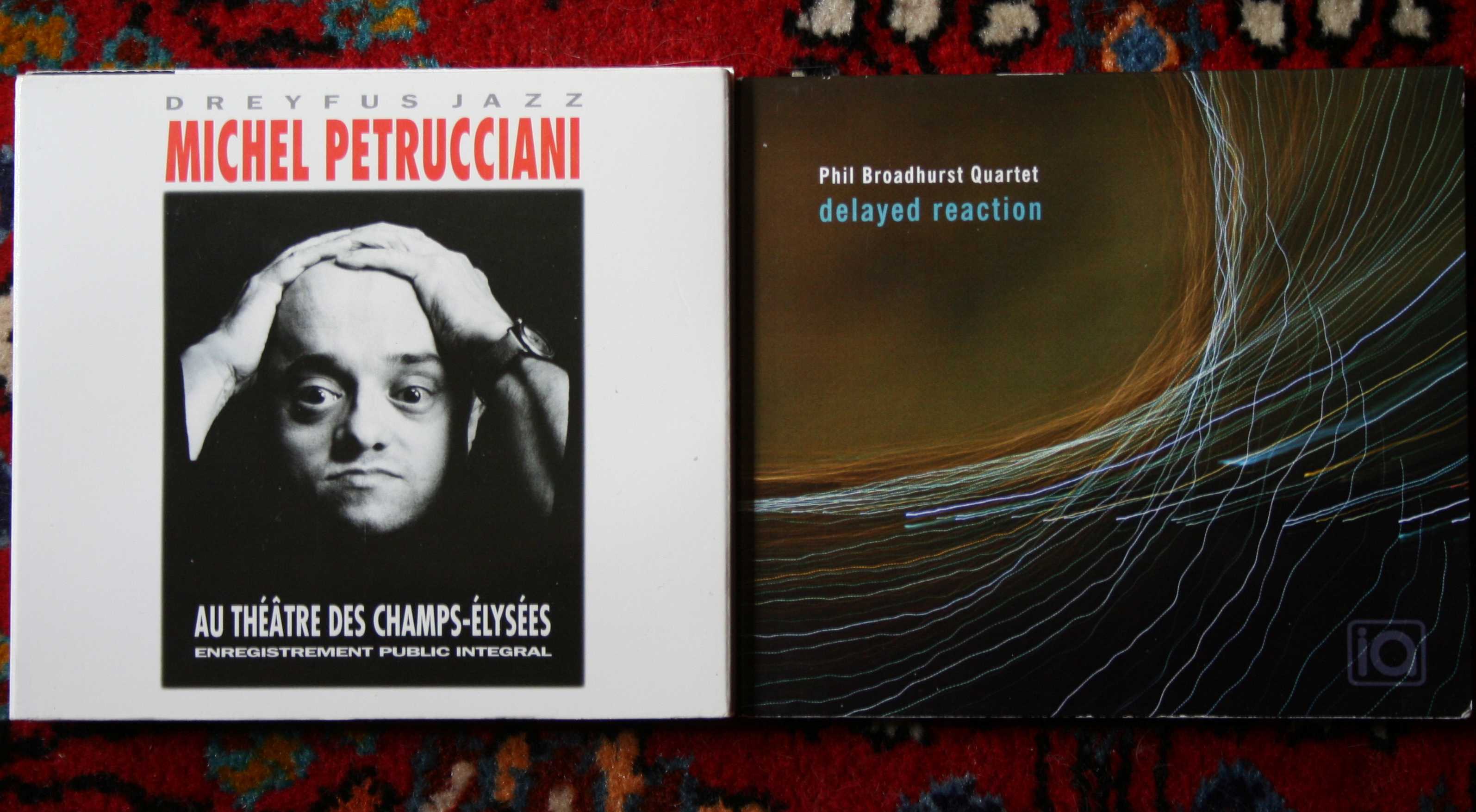
I last saw this band at the launch of Phil’s ‘Delayed Reaction’ album.    That was September 25th 2011 and things have moved on apace since than.   For a start the album has had universally good reviews, reasonable airplay and attracted interest from offshore.  For a number of reasons it was bound to do well.  I suspect that the quality of the interpretations and the musicianship of the band clinched the deal.    While a number of well-chosen Petrucciani tunes are featured in the album, it is Phil’s own material that best focuses us on the diminutive masters work.

Oli, Alain & Roger

It is ironic that it has taken someone from the antipodes to put a fine lens on the inner workings of Petrucciani’s music.  Step by step as the material progresses we are granted the most intimate of glimpses.  Guided into a private world that only Phil Broadhurst has been able to reveal. This is the power of Jazz at its best.  Being able to dive deeper into the meaning of a tune as inner forms and colours unfold.   What is already wonderful is somehow made better or revealed afresh.

Petrucciani may have been small in stature but his percussive playing and unusually bold voicings have marked him out as a heavyweight.  His legacy is in fact so strong as to be virtually unassailable.  A few European tribute bands have recycled his compositions but there are few if any sound-a-likes (as happened with Evans).  Phil and the band made no attempt at slavish imitation; they did better than that.  They captured the essence of the music.

I suspect that Phil Broadhurst is one of the worlds foremost authorities on Michel Petrucciani and this is our good fortune.

We heard many of the tunes from the album, such as Phil Broadhurst’s own composition ‘Orange’ and Petrucciani’s  ‘Brazilian like’.   The material had not only been updated but we also heard some new material which Phil had written.  The band was playing up a storm and it was great to see Roger back after a successful trip gigging in Australia.  His tenor is always on fire and Phil and he sparked off each other as the night progressed.  Roger always watches the others carefully during gigs.  He watches them until he is ready to solo.  Then he leans back and takes off like a Titan rocket, leaving an open-mouthed audience in his slipstream.

Roger laying out before he unleashes hellfire

With Alain on drums delivering a flurry of beats, a fiery solo or whispering poetically on brushes the traps could not have been in better hands (he has become a favourite of mine and he will be missed when he goes overseas).  Oli’s playing is always worth hearing and he delivered strong bass lines and gave the band the support they needed.  He had been a little low in the mix for the first few numbers and that is a pity because what he has to say is worth hearing.   Once the sound had been adjusted it was if the jazz universe had suddenly fallen into place.

This was to be the bands last outing before Tauranga.  The group is finalists in the Jazz Tui awards and a play-off will occur Saturday night between The Phil Broadhurst Quartet (Delayed Reaction), The Tim Hopkins Trio (Seven) and the Roger Fox Big Band (Journey Home).  I have heard and reviewed all three bands and I know most of the musicians. This will be a tough call for the judges.

The Band is: Phil Broadhurst (leader, comp, piano), Roger Manins (tenor), Oli Holland (bass), Alain Koetsier (drums).

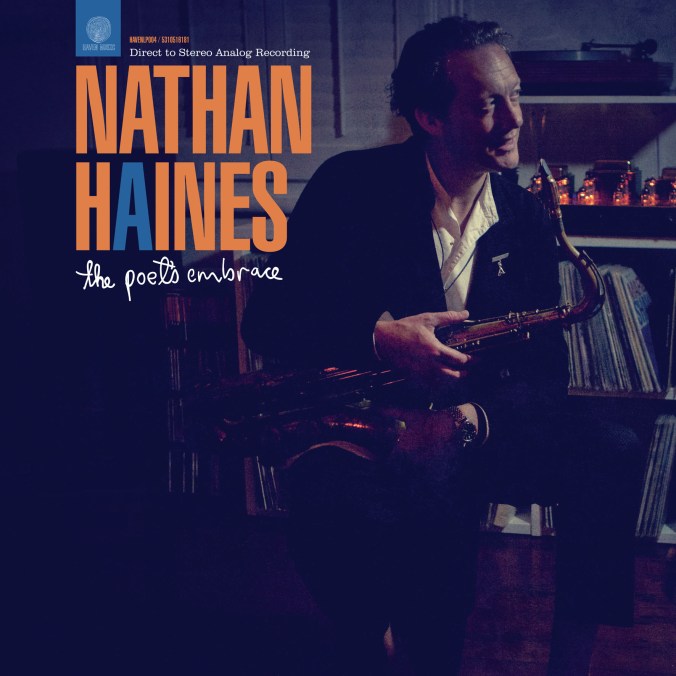
Nathan Haines – ‘The Poets Embrace’

On the 29th November 2011, those lucky enough to be at Nathan Haines CJC gig heard him playing ‘The Poets Embrace’ material.  As far as I know, this was the first public outing for the band and everyone who attended quickly grasped the importance of the event.   Hearing Nathan exclusively playing tenor (and not just any tenor) was intriguing because he is noted for being a multi reeds and winds player.   This gig was somehow different and it had a focus that was palpable.  It was about authenticity and it was about a deeper exploration of Nathan’s music.

Nathan’s approach to his music is a comment on his professionalism.  He divides his time between the UK and New Zealand and he recently headlined at Ronny Scotts Jazz Club in London.  Nathan is one our most talented musicians and I have learned that he never does things half heartedly.

Following that gig Nathan and the band cut an album.     The producer was flown in from London, the vinyl was pressed at Abbey Road, the tenor was a Selmer Mk 6 (ex Brian Smith), The piano was a Steinway B, The recording was made at the York Street studios on analog equipment and using classic microphones….I think you get the picture….glowing valves….absolute authenticity.     Above all this is terrific music and it may become the bench mark for future New Zealand Jazz albums.  The album will be released by Haven Records a division of Warners Music and it should be widely available.

The album is to be released on the 19th March (available on CD or limited edition vinyl)  The promo video is also worth watching as it conveys a real sense of the music we are about to experience.   The attention to detail is evident and one senses that the narrative is an important part of this journey.  People should book now for the launch, which is on Friday March 23rd, 8pm at the Monte Christo Room (behind the TVNZ building Nelson Street).    The entry price for the official launch is $25 pre-sales/$30 at door.  For those who are otherwise engaged on Friday why not get down to JB Hi Fi between 12pm – 12:30pm (any day 19th – 23rd).  If you do you will hear the full band.   It is impressive that a mainstream outlet like JB’s has been so supportive.    Please turn up if you can and this will encourage the store to support more Jazz releases in the future.  If it is wet outside so what, there is no cost to attending and what could be better; Jazz on an Autumn Day.

 These are all great musicians as you will soon hear.  They are; Nathan Haines (ts), Kevin Field (p), Thomas Botting (db) Alain Koetsier (d).

For the gig review see my earlier blog post “The Nathan Haines Fourtet”.

‘Seven’ – Tim Hopkins Trio

Interaction - Tim & Dixon

I purchased a copy of ‘Seven’ from Rattle Records not long after it was completed.   The cover art portrayed black sand, which is strange to those unfamiliar with it.   For those who have not encountered it before, black sand can also be surprising.  Subtle light-shifts can throw up a myriad of purple and blue hues, and the textures revealed by the drift patterns are in constant flux.   ‘Seven’ reflects Tim Hopkins’ music in much the same way.

Tim Hopkins is well-known to those us who have followed the New Zealand Jazz diaspora.   He has recorded extensively as a sideman with the likes of Mike Nock (and many others) and he has recorded a significant number of albums as leader.  Tim lived in Sydney for many years but he eventually returned to New Zealand where he is now based.  He teaches and performs in the capital city.  His long experience as a tenor player has taught him to throw caution to the wind.   He is adept at developing free-flowing Post Bop lines, but he is not limited by that.  While quite capable of playing sweet and low he does not invite complacency, as he can just as suddenly deliver a scalding declamation.   His style is to conduct an honest conversation with the audience and few punches are pulled.  This is not to say that he is too serious for he has a highly developed sense of humour which he uses to advantage.

Tim started the gig by explaining some of the concepts behind the ‘Seven’ band.   “Someone is missing from this band” he said gesturing behind him and I initially thought that he was referring to Richard Nunns (who had appeared on a few tracks of the album).  Tim meanwhile continued to explain, “He wasn’t invited, (pausing) it is the bass player”.   A bass player is the compass and when a band plays adventurous and complex music the lack of a bass places a heavier burden on the remaining musicians.  These guys were fully aware of the job in hand.   It is often the case that an experienced leader will develop an uncanny knack for selecting just the right sidemen and this was evident here.

Dixon Nacey is not only a versatile and superb guitarist but he is a musical free spirit.   His eyes light up when he is thrown a challenge and he soon throws a challenge back.    This guy is one of our finest musicians and the younger guitarists watch his every move.    I suspect that a lot of the weight fell to Dixon in this gig, but you wouldn’t have known it to see him smiling as he dared Tim or John to answer his challenges.    This was call and response at its best.

Dixon Nacey

The drummer was also perfect for the role.  It was the first time that I had seen John Rae on traps and I hope that it will not be the last.  He is unlike many of the drummers we see, as his approach is loose and organic.  If he wants to up the ante he will suddenly shout at the others; exhorting them to give even more.  He is also far from a locked-in drummer as he will punctuate and change the groove at will.  I really liked this approach as it was the ideal foil to Tim and Dixon.

I also sensed that the band was unafraid of being overt and about confronting the political realities of our times.  This flowed through the music and I loved that about them.

At the beginning of the second set Tim was about to introduce the number when he looked into the audience and said, “Can someone bring a bouncer and throw out that old man talking in the front row”. The talking continued and Tim said in a slightly menacing northern Irish accent, “old man – go home to your wife – go home to your children”.   A short silence followed and then “Dad shut up”.   The smiling offender was Tony Hopkins his father.   Tony is much-loved on the Auckland scene for his skillful drumming.    I saw him when I was young and I would like to acknowledge his influence on my generation and beyond.

Another good example of Tim not taking himself too seriously was the introduction to ‘23rd century love song‘.   He explained that this was the result of endless navel gazing and that the market he was aiming for was probably chemistry professors.

While aspects of the gig were challenging, the night has left me with a lot to think about.   Music should occasionally challenge us and it should make us think.   I find myself going back to the album to re-examine a track or a phrase and this is a good thing. The communication is still happening.  John Rae

The numbers that have stuck with me are ‘Road From Perdition’, ‘All Blacks & Blues’ and the lovely ‘The Sleeping Giants’.   for a copy of this go directly to Rattle Records at http://www.rattle.co.nz – failing that try ‘Real Groovy’ ‘JB HiFi’ or ‘Marbecks’.

The Jam: After the gig there was a jam session and it quickly morphed into a mammoth affair.    Drummers, saxophonists, guitarists and singers crowded the band stand while fours and honks were traded to the delight of the audience.  I don’t think that I could name everyone who played but I will try: Roger Manins(ts), Tim Hopkins(ts), Noel Clayton(g), Aron Ottignon(p), Matt Steele(p) Tyson Smith(g), Dan Kennedy(d), Tony Hopkins(d), Tim ?(d), a young drummer (?), Dixon Nacey(g), Callum Passells(as), Holly Smith(v).    Roger played a lovely breathy Ben Webster sounding ‘Sunny Side if The Street’, Holly sung a fabulous bluesy ‘Summertime’ while Tony played just like he always does.  Sitting just a fraction behind the beat and in perfect time.

‘Pasif.ist’ Natalia Mann – an Oriental Dreamscape

The music I cover here may not be Jazz in the purest sense but it is music that transcends the limitations of musical boundaries.  It has its own pulses and rhythms and it is improvised around themes.    This is a delicious orientalist dreamscape of the sort painted by Lord Leighton, Alma Tadema, Edward Lear and Eugene Delacroix.  It is redolent of sultry afternoons in an Ottoman palace or of the winding streets of Istanbul.   In the unfolding subtleties, one can hear the merest snatches of older themes; Constantinople and even Byzantium are hinted at but never confined.   This is not traditional Turkish music but an exotic vision of a landscape just beyond our reach.  This achieves what all great music does – connects us with a world that we would want to explore further.

In early December I received an email from Rattle Records inviting me to the ‘Pacif.ist’ CD launch and at that point I had scant information on the event.    I had every intention of requesting more details but the workaday world drowned me in trivia and I soon forgot.    One week later I was sitting in a meeting when the reminder flashed up on my iPhone; the launch was starting in an hour.

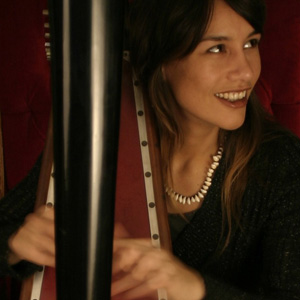
The venue was the spectacular Iron Bank building.   An imposing piece of modernist architecture towering far above the rainy Auckland streets.   The launch was held in an intimate minimalist space and the invited guests were mainly musicians associated with Rattle.  To one side of the dimly lit room was a beautiful red lacquered harp and beside it the barest bones of a drum kit (snare and cymbals).   Soon, harpist, Natalia Mann sat down to conduct a brief sound check and when she had finished I spoke to her about the lovely voicings that she was creating as she plucked and stroked the strings.   They were pianistic Jazz chords, but with all of the extensions added.   In the conversation that followed, we spoke of BeBop harpist Dorothy Ashby and of the later avant-garde stylist Alice Coltrane.   At this point, I was intrigued to hear the music, as this was a gap in my musical knowledge that I was very happy to fill.

I have long been a fan of Mediterranean, Middle Eastern Jazz and its Jazz/World Music offshoots, but I can’t recall ever hearing Turkish Musicians.   The launch used only a duo but they captured the mood perfectly – Natalia Mann (harp) and the well-known local, multi-instrumentalist Kody Neilson on drums. The album could perhaps be described as improvised World-Music but with Jazz inflexions – the sort that ECM presents so convincingly.   With top rated musicians like Tigran Hamasyan and Dhafer Youssef bridging the World/Jazz continuum we will see a lot more of this music on offer.   If you open your ears Jazzers and listen carefully, this gentle melodic music with its rich percussion will get to you.

After Natalia had returned to her busy life in Istanbul I conducted an email interview with her and this will be posted as an addendum to this post in a few days.

The Album Pacif.ist is available in download or hard copy from Rattle Records.    I would strongly urge buying the CD, as the artwork and liner notes are so good that it would be a crime against art to circumvent them. http://www.rattle.co.nz

The musicians on the album are; Natalia Mann (harp, compositions), Izzet Kizil (percussion & drums), Sercan Halili (classic Kemence & Alto Kemence), Abdullah Shakar (fretless bass & electric bass), Dine Doneff (double bass), Richard Nunns (taonga puoro [6]), Lucien Johnson (soprano & tenor sax [3]), Riki Gooch (percussion [1,2,3]), Naomi Jean O’Sullivan (gongs [9], co- writer), Serdar Pazarcioglu (violon [5]), Deniz Gungor (aqua [5]).   The album was mainly recorded in Turkey but with some instruments recorded in New Zealand.  That rich-voiced exotic string instrument you hear is the ancient Kemence (see interview).

After I had written this, I saw an article in the latest Downbeat about the growing Jazz scene in Turkey titled ‘Emerging Turks’.  The New York times has also highlighted this in a recent article.     Natalia is New Zealand born and of Samoan/European descent.   She is at present doing a master’s degree in Jazz at Skopje and is in demand with various European orchestras.   She loves Jazz and has projects on the way which will lean more in that direction.     

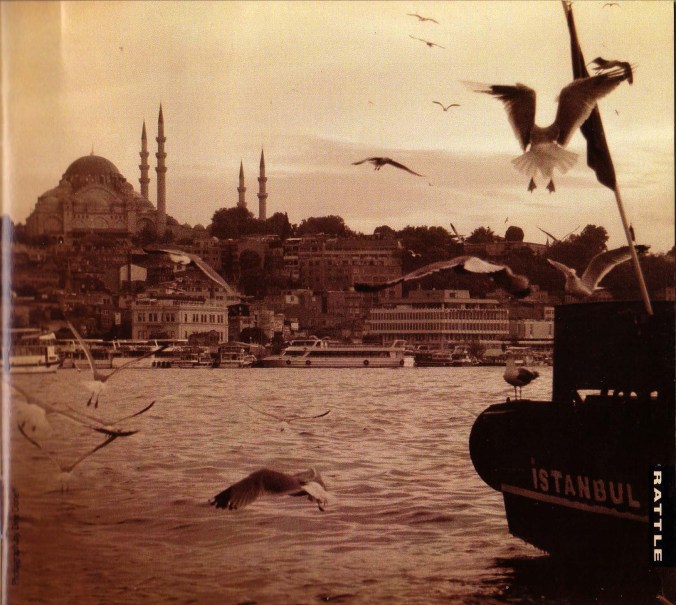
Istanbul – Pacif.ist cover art

Weaver of Dreams – Andrew Dickeson Quintet

For those Aucklanders addicted to live Jazz, the month over which the CJC Jazz club was closed for Christmas seemed like an eternity.   The first of the New Years bookings made up for it though as premier Australian drummer Andrew Dickeson came to town and he brought with him a solid lineup (including a couple of ex-pat New Zealanders now living in Australia).  It was Andrews first time at the CJC but it will hopefully not be his last.
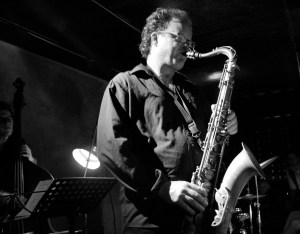
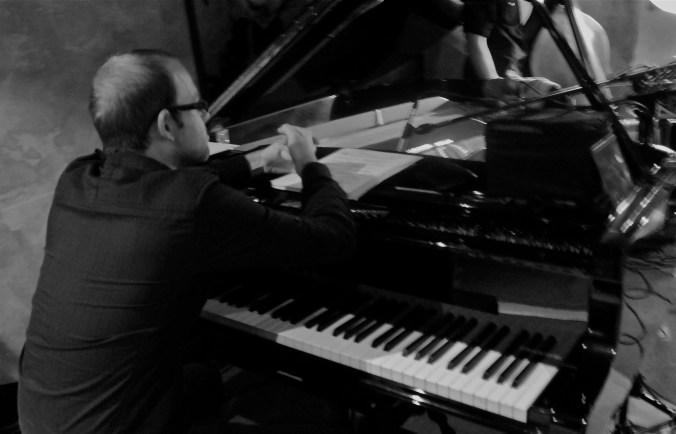
Andrew Dickeson is one of the most respected drummers in Australasia and in stepping out as a leader he has enhanced his already solid credentials.   Andrew has for some time been regarded as the drumming lynch pin of the Australian Jazz scene and when a visiting artist requires a percussionist he would be the first choice.

The band began with the fabulous number ‘Ill Wind‘ (Arlen/Koehler) and it was obvious from the get-go that the tasteful drumming was a cushion of energy powering the group.   As good as the musicians were it was the drummer that caught the attention first; not by showing off his chops but by his sheer musicality.   You were also aware of his powerhouse propulsive swing.   The drums managed to preside without ever overwhelming the rest of the band and to achieve this takes real skill.    This is the sort of maturity that experienced drummers like Jeff Hamilton bring to their gigs and it was nice to witness.

A point which illustrates this perfectly occurred when I spoke to Andrew the next day.    After listening to the CD I had wondered how he had managed to obtain such a crisp but soft sound from his ride cymbal on the ‘Weaver of Dreams’ track (Young/Elliot).    I asked him if he had muffled the cymbal in some way or ‘miked’ it down during mixing.   “No’ he said, “It is all about awareness of the situation.  I just play very gently when that is required”.    I had not known that you could play so gently on a ride cymbal without losing clarity of sound.   At this point Roger Manins leaned over and said, “this is what separates a good drummer from a great drummer.  The ability to fit perfectly into any given situation and to adjust your volume accordingly”.

Those appearing on the album are: Andrew Dickeson (drums, leader, arranger), Roger Manins (tenor sax), Steve Barry (piano), Alex Boneham (bass), Eamon McNelis (trumpet).    For this gig the latter two were replaced by Tom Botting (bass), Pete Barwick (trumpet, flugal horn).  The two acquitted themselves well.

Andrew had used Roger Manins on the album and witnessing his performance at this gig it was easy to see why.    Roger is undoubtably the best tenor man in New Zealand but we sometimes forget how well-regarded he is beyond these shores.    I have written about his playing many times and each time I see him I wonder if he will better his last performance.  He usually does.   As a born story-teller he can captivate from the first few phrases, but the magic he weaves is also due in part to his stage presence.   On ‘Ill Wind’ the pianist had laid-out for a number of bars and in this space Roger mined the bones of the tune to the marrow.  That is his way and as the solo developed there was an increasingly ecstatic quality to his performance.   I have witnessed this before and it draws me to his playing again and again.   In Jazz authenticity is everything.

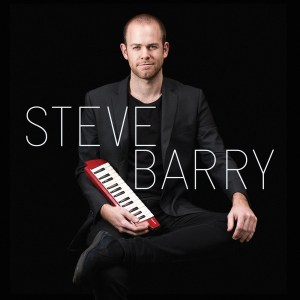
Pianist Steve Barry grew up in Auckland but he later migrated to Australia in search of greater opportunity.   He is no stranger to the CJC and his occasional gigs at the club are happily anticipated by his ever-increasing fan base.   For some years now he has been working on the Australian scene and he is exceptionally well-regarded there.   Some pianists have an X-factor and Steve is one of those.   The history of Jazz piano is somehow referenced in his playing but he is more than that.  While unafraid of the past he is not owned by it.   This is a journey of stylistic development that we are privileged to witness and it is an ongoing story.    In this setting he was not only a good soloist but the perfect sideman, as his comping and sense of timing were superb.   We get one more chance to hear Steve before he returns to Australia; next week he is co-leader of a quartet performing at the club.

Tom Botting and Pete Barwick had been engaged for this one gig and they fitted in seamlessly.   I had not seen Pete Barwick play before tonight but he handled the charts with ease and performed each solo convincingly.   His strongest performance was on the Strayhorn balad ‘Isfahan.    His burnished ringing tone and clear articulation were just great.   Tom was a fixture at the club before moving to Australia and his bass playing is familiar to CJC attendees.     He is a reliable time-keeper but he can also be adventurous when challenged.  On this night he injected a sense of urgency into the uptempo numbers.  Sitting in for Alex Boneham would be quite intimidating to many bass players but Tom took it in his stride.   He had returned to New Zealand in disguise (no beard and shorter hair) but his signature bandstand persona was fully in tact.   Tom always looks and sounds extremely convincing and it is nice to have him back for a few weeks.

The other stand out number was ‘Soy Califa’ (Dexter Gordon).   To have Roger play a Dexter Gordon number is a no brainer.  He aced it and then some.  This was a great night out and once again it reinforced the strength of the Trans-Tasman Jazz alliance.

This album is well worth buying : ‘Weaver of Dreams’ – The Andrew Dickeson Quintet – Rufus Records (a division of Universal Music group).     rufusrecords.com.au – or  – andrewdickeson.com

‘Keester Parade’ – ‘A Smooth One’

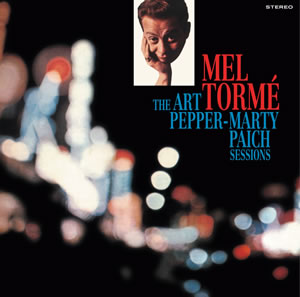
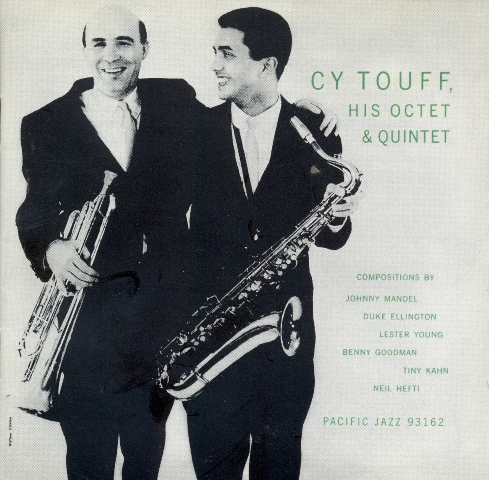
Listening to old friends like these is time well spent. The material comes from the swing era but these albums have a more modern feel as they were recorded at a time when bop and post bop music had gained ascendancy. The artists on the albums are a mix of the famous and not so famous, swing and boppers, East and West Coasters. When I run my eyes over the names on the track lists I marvel at the lineup and realise that many of these names are fading from our collective memory. Pepper, Mandel and Torme will never be forgotten but what of Cy Touf? He is a mere footnote in the Jazz lexicon and he only recorded a few times. Not withstanding that his Octet/Quintet album has remained a favourite with Jazz musicians and arrangers and this is probably because of the loose easy-going West Coast style arrangements by Johnny Mandel.

Even ‘Sweets’ Edison is fading from memory and few modern listeners would hunt for his name in a Basie band lineup (I do). Another great band leader and arranger was Marty Paich. His piano playing is probably what is termed arrangers piano but it still sounds fine to me. He has that minimalist touch and his arranging style owes a lot to Basie; sweet verses tart & hard swinging. I collect Marty Paich albums and never tire of his orchestration. He was called the Picasso of Big Band Jazz and his use of tonal colour was achieved to great effect. He allowed wonderful trumpeters like Jack Sheldon to shine and he is closely associated with Art Pepper. Lastly there is the Mel-Tones. Their origins go back to the Chico Marx Orchestra which Mel Torme joined up with in 1943. To modern ears their harmonising can sound old-fashioned, but this group (with Mel at the forefront) were big names in their day.

The albums date from 1955 and 1959 respectively and they star an almost unbelievable group of musicians. Only a few of these guys are still alive and that is sad because they once grooved their world (the famous Johnny Mandel is still an arranger par excellence and as a young man he also played the rare bass-trumpet like Cy Touf). To hear an incomparable ‘Sweets’ Edison solo with his signature lazy-feel, bluesy slurs or Art Pepper with his biting cut through on alto is still exciting to me.

These albums are a peephole into an era that is long gone but it is one that still deserves our respectful remembrance.

The albums;

Cy Touf his Octet and Quintet (Pacific Jazz 93162) featuring – #1 -4 Cy Touf (bass trumpet), Harry ‘Sweets’ Edison (trumpet) Conrad Gozzo (trumpet), Richie Kamuca (tenor sax), Matt Utal (alto and baritone sax), Russ Freeman (piano) (Pete Jolly (piano #3), Leroy Vinnegar (bass), Chuck Flores (drums). Johnny Mandel & Ernie Wilkins (arr).

Track one – Keester Parade (Johnny Mandel)

Track seven – A Smooth One (Benny Goodman)

Mel Torme- Art Pepper – Marty Paich Sessions: (Lonehill Jazz) Mel Torme (vocals) The Mel-Tones (vocal) Marty Paiche (piano) (celeste) (organ) (arranger) (Conductor) Orchestra featuring; Art Pepper (alto sax), Jack Sheldon (trumpet), Frank Rosolino (trombone), Bill Perkins (tenor sax), Victor Feldman (vibes), Barrney Kessel (guitar), Joe Mondragon (bass), Mel lewis (drums).

Track eighteen – Bunch of The Blues/ Keester Parade/ TNT/ Tiny’s Blues – (Mandel/Kahn).

Footnotes: The album track list that come up in iTunes gave ‘Keester Parade’ as ‘Easter Parade’. That would certainly have amused the musicians and especially Johnny Mandel. For those who don’t speak the lingua franca of the hipster 1950’s, a Keester is what you sit on. West Coast pianist Pete Jolly is credited in the Cy Touf album and he has a lot of loyal devotees in New Zealand. In the early 1960’s when tours by lessor known Jazz musicians were unheard of and when such journey’s were long and arduous, Pete Jolly and Ralph Pena visited here. The tour had been organised by Auckland Jazz fan Frank Collins and the subsequent fun has never been forgotten. Recordings from the gigs were carefully squirreled away by John Good (recently deceased) and these treasures were later released in the USA as a posthumous Pete Jolly album.

Miles Espanol – New Sketches of Spain

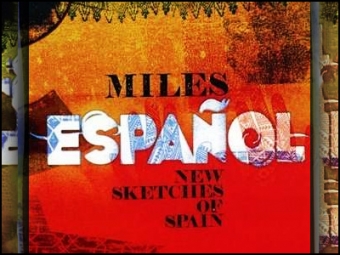
Late last year as I was reading Jazz Times I spotted an article about Bob Belden’s new ‘Miles Espanol’ project.  I like Bob Belden’s work but my first thoughts were, why mess with perfection?  I need not have worried because he has created something quite fresh and original; using ‘Sketches of Spain’ as a springboard into the now.

Like many Jazz listeners I had been deeply immersed in Miles Prestige recordings and his seminal ‘Kind of Blue’.    Soon after that ‘Sketches of Spain’ came into my life and along with ‘The Maids of Cadiz’, ‘Flamenco Sketches’ and ‘Teo/Neo’; Miles (and Gil’s) Spanish tinged music was seldom off my turntable.  As a guitar fan I was already quite familiar with Rodrigo’s ‘Concierto de Aranjuez’ and Flamenco.

Miles Davis and Gil Evans took this wonderful material and reworked it in ways that only master musicians could.  This was visionary and a new type of jazz – perhaps a fore-runner of the ECM Jazz which a decade later would unselfconsciously  absorb the music of cultures far removed from the American heartland.   Miles later described this Flamenco music as a type of blues – the voice of a people’s struggle against oppression.   I had not realised it before writing this, but my fascination in recent years with Mediterranean Jazz (and particularly Sufi/Moorish/Italian/Spanish Jazz) probably began right there.

This was a mammoth project to take on, but Bob Belden has a track record of realising such crazy visions.  He also has serious pull with musicians and industry players.

First on board appears to have been Chick Corea and Jack DeJohnette soon followed.   After that things came together in an organic fashion – each artist seeming to recommend the next.  He had not initially planned to ask 33 musicians to participate, but that is how it ended up.

Bob Belden is a well-known horn player producer/arranger/composer.  On this double album he does not play his warm-toned tenor sax (only Timpani and Marimba on one track).   As arranger producer his presence is never-the-less over-arching; like a Gil Evans for our times.   While he has guided the 33 musicians firmly towards the realisation of his vision, he also appears to have known exactly when to loosen the reins.

The artists were flown into New York from a number of countries but mainly from Spain, North Africa and South America.   The American musicians are mostly Miles alumni – a who’s who of Jazz royalty.   Chick Corea (p), Jack DeJohnette (d), John Scofield (g), Sonny Fortune (f), Ron Carter (b), Vince Wilburn jnr (d).  Add into that heady mix; Tim Hagans (t), Gonzalo Rubalcaba (p) Eddie Gomez (b), Antonio Sanchez (d), Alex Acuna (d) (perc), Jerry Gonzalez (fh) (c) and more -(the full list of musicians is at the bottom of the post).

Of note is the well know Jazz-Flamenco pianist Chano Dominguez (p).   I first obtained an album of his in the nineties and he is very impressive.    Other notable Mediterranean musicians are Rabih Abou Khalil (oud), Edmar Castineda (harp), Nino Joseles (g), Lou Marini (fl)(bass flute), Jorge Pardo (f), Christina Pato (Spanish bagpipe).

My favourite small group tracks are; (1) ‘Trampolin’ (by Chic Corea) – Chic Corea (p),Jorge Pardo (f), Ron Carter (b) Antonio Sanchez (d).  This builds in intensity until the grove is rock solid and it swings hard without losing the complex polyrhythms.   Chick understands this music very well. (2) Spantango (by John Scofield).

Larger pieces; Saeta/Pan Piper (Gil Evans- traditional)

The concept is so big that the overall album lacks a little in cohesion, however the tracks range from very good to marvelous.

Full listing of musicians: Bob Belden, Ron Carter, Jack DeJohnette, Sonny Fortune, Eddie Gomez, Gonzalo Rubalcaba, John Scofield, Rabih Abou-Khalil, John Clark, Tim Hagans, Jerry Gonzalez, Adam Rudolph, Jorge Pardo, Alex Acuña, Carlos Benavent, John Benítez, Chick Corea, Sammy Figuerova, Scott Kinsey, Lou Marini, Michael Rabinowitz, John Riley, Antonio Sanchéz, Vince Wilburn J, Mike Williams, Chano Domínguez, Luisito Quintero, Charles Pillow, Edsel Gomez, Jaco Abel, Dominick Farinacci, Victor Prieto, Cristina Pato, Edmar Castaneda, Brahim Fribgame, Niño Joseles.

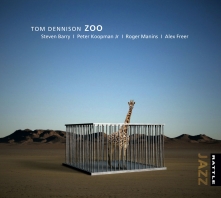
Zoo: Tom Dennison

‘Zoo’ is bassist Tom Dennison’s first album as leader and it is a thing of beauty. This is a concept album and such albums focus around a theme. The very best of them stimulate the imaginings as well; leading the listener into subtle dreamscapes that can shift and change endlessly. ‘Zoo’ does that.

Five of the seven tracks are named after animals, but we get no sense that these are the anthropomorphic playthings of humans. The Stingray, Owl, Llama, Cat and Antelope all gain distinct lives of their own; that not withstanding the whole is greater than the sum of its parts.

The first thing that the purchaser will notice is the exceptional art-work & design (by Caravan + Vivienne Frances Long). While the album can be purchased as a download, it would be a shame to miss out on the 3-fold cover or the best fidelity option. Every part of this album belongs together and perhaps that is its genius.

Once again the Auckland Jazz scene has surpassed itself and with these musicians it is hardly surprising. I know and admire most of the band members and Tom could hardly have picked better. There are a number of firsts as far as I can see and this being Toms debut album, the most obvious one. I have seen Tom Dennison play around town, but the first time I saw him was at an ‘Alan Broadbent‘ concert in the Auckland town hall. When the trio played ‘My Foolish heart‘ I could imagine Scotty La Faro nodding in approval – so perfectly did Tom execute the piece. He also played with pianist Mike Nock and not long after that went to New York to study with Larry Grenadier and the equally renowned Kiwi Bass player Matt Penman. It was after this sabbatical that he returned home to work on the ‘Zoo’ album and the results of his efforts are available for all Jazz lovers to enjoy. With chops and writing skills like this he was never going to disappoint.

I am pleased that the album features the New Zealand born but Sydney based pianist Steven Barry on piano. He is an astonishing musician and to have him recorded this well is pure bliss. While comparisons are often odious I cannot help but place him stylistically somewhere between Steve Kuhn and Brad Mehldau. When he played at the CJC a few months ago he floored us all. Those that knew him nodded with an “I told you so” look – while those who were less familiar became fans for life. This guy can breathe new life into any old warhorse and his own compositions amaze. He is a shaman of the keyboard and a perfect foil for the other players. He demonstrates this time and again as the album unfolds.

We also get to hear him in trio format on the final track. ‘The secret life of Islands‘ is intensely beautiful and it leaves you wanting more. This is the perfect bookend to the album. Introducing a song about an Island rounds off the ‘Zoo’ concept perfectly and gives it another Kiwi reference point. In my view the song could not have been written by anyone other than a Kiwi.

Also appearing is the gifted and much admired guitarist Peter Koopman Jr. Peter is both tasteful and innovative on this album and his long intelligent probing lines mark him out as a born improviser. His maturity as a player is more than evident here. Sadly for us he is to depart for Sydney in a week and that is Australia’s gain.

The veteran of the lineup is Roger Manins and he always pleases. We have come to expect Roger to play like there is no tomorrow and to play what is appropriate to whatever lineup he is in. On this recording he gives us his best and that is most evident on the ballad (track 5). Any song called the ‘The cat’ was always going to work for me and I was especially pleased with this composition. Roger plays this so convincingly that it sounds like a much-loved and familiar tune. That is also due to the skill of the writing.

The drummer Alex Freer is the remaining quintet member. I have not seen him play live, but he is like his band-mates, perfectly suited to the job in hand. I realise now that Alex, Tom, Peter and Steven have played together for a long time, because You Tube clips show them performing in their mid teens.

This album is New Zealand’s own version of ‘Empyrean Isles‘ and like Herbie’s album I am hoping that a ‘part two’ will be recorded someday . Perhaps featuring a rare and secretive pelagic bird like the New Zealand Storm Petrel?. Those particular birds were hidden in plain view and lived a secret life on nearby islands for 100 years. This album has been discovered from the moment of its inception and it will hopefully suffer no such fate.

Once again thanks to Rattle Records’ and to Steve Garden for recording this so beautifully. Order from http://www.rattlejazz.com

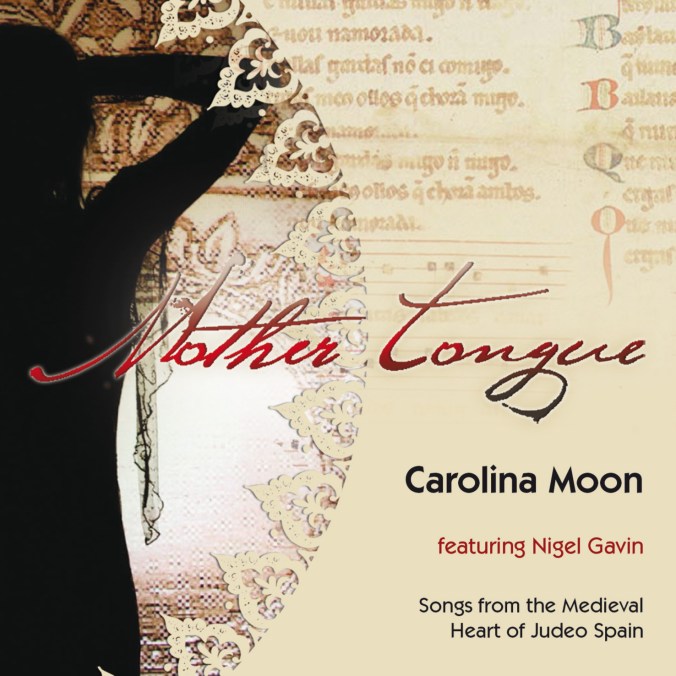
‘Mother Tongue’ – Carolina Moon (the Sephardic music of medieval Spain)

Carolina’s wonderful album ‘Mother Tongue’ is beguiling and all it takes is a single listen, for the mysterious beauty of this ancient music to stay with you forever.   This album speaks of medieval Spanish Sephardic culture with absolute authority and in partaking of the journey we are connected to a time and place most New Zealanders know little about.
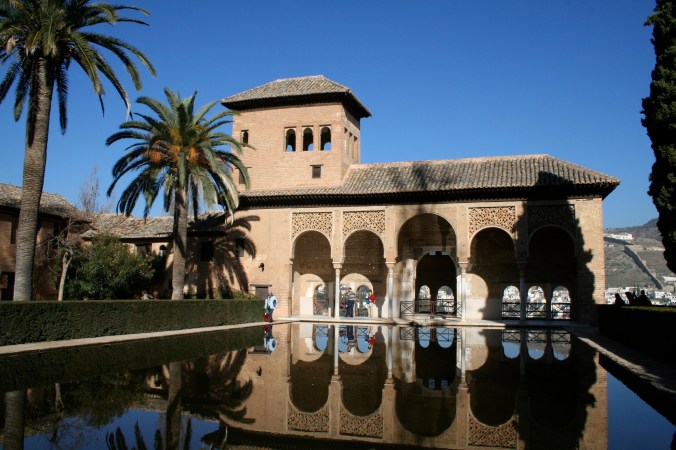
The Moors ruled much of Southern Spain (Al Andalus) for nearly 700 years and what is little known is that they welcomed the Jewish diaspora to live among them.     This tolerance by Islamic Spain lasted until the Reconquista by the Catholic Christian armies of the north and after their arrival (15th century), the Judeo-Spanish faced the ultimatum of expulsion, conversion or death.  The songs of the Sepahardic Jewish are rich in imagery and the cadences of their unique language are evident in these sensual and often wistful songs.     Contained in this music are the rhythms of Arab, Hebrew and Spanish life.    A truelly blended music that has been deeply enriched by the streams that have fed it.    Ladino (Latin) is the term for this ancient language, which has also helped form the distinct Catalan variant of Spanish.

Carolina Moon (Mannins) is a fine Jazz singer but she is also a multi-lingual singer and well versed in other musical genres.  She is British by birth but has worked extensively as a musician and music teacher in the UK, Australia and for some time now New Zealand.   This is our gain.   The excellent arrangements on ‘Mother Tongue’ are Carolina’s and it is this factor, coupled with her unmistakably rich voice,  that gives the album that extra depth and authenticity.  It is obvious that she has invested everything in these performances.   This has never been just another gig for her

I would like to make mention of several songs that are on the album.  The first is the wonderful ‘Ondas’ (13th century Spanish).  The word in Spanish means wave or ripple and she could not have chosen a better track to open with.  The timbre of her voice is rich and filled with the passion and longing of the song.   At certain points the emotion is so visceral that it sends a shiver down the spine.     I have not reacted to a voice in that way since I last heard Sassy on ‘tenderly’.  The second and contrasting song is ‘Tres Hermanicas’ (track 8).    This is a traditional Sephardic song and the full band is used to very good effect.    Because of the arrangement and the rhythm it sounds closer to the Manouche traditions.

The accompanying musicians are all top rated and many are the cream of the Jazz world.   New Zealand’s finest acoustic guitarist Nigel Gavin is the only choice for this music, as his Manouche credentials and guitar chops are impeccable.    Kevin Field is on piano and once again he has managed to be the perfect accompanist. Caroline’s husband Roger Manins weaves his usual magic and his abilities as a multi reedist are manifest here.   Ron Samsom and Chris O’Connor (percussion and drums), Jessica Hindin (violin), Matthias Erdrich, Mostyn Cole, Steve Haines (acoustic bass).

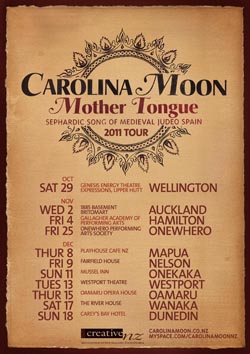
Every music lover should purchase a copy of this, which is produced and mixed by Steve Garden for Ode records (with the assistance of Creative NZ).    To learn more about this gifted artist go to;  http://www.moonmusik.com – better yet come and hear her perform live during the tour – underway at present.   The next performance is at the CJC (Basement of 1885 Galway St) Wednesday 2nd November.

Footnote: The first merger of western music and African Music was always thought to be Jazz, but musico- ethnologists are now pointing to Moorish Spain (over a 1000 years before), as the first time this occurred.    The improvising traditions are deep streams within all good music.

Alan Brown-‘Between the Spaces’ – CJC

Alan Brown at Keyboards - CJC

If this was a law court I would have to recuse myself immediately because I have a heavy bias in favour of anything Alan Brown does musically. Having said that it was hard to imagine how this very different lineup would sound, because the ‘Blue Train‘ magic has long been etched into my brain as the archetypal groove unit.

Alan is a superb keyboardist and band leader but above all he is a brilliant arranger and composer. It is the latter skills that have especially come to the fore with this band and the title track ‘Between the Spaces‘ gives more than a hint of the musical direction. ‘Blue Train‘- has always been a tightly focused hard-driving Jazz funk band and one which makes your feet tap uncontrollably. This band builds on that vibe but with new soundscapes opening up, endless possibilities are there to be tapped. Alan’s already impeccable writing skills have been surpassed here, because these charts are everything that an improvising band could hope for. It is ECM meets Funk and surprisingly it works perfectly. In my view Ode Records should talk to ECM’s Manfred Eicher about this group, as everyone would gain by the exchange.

As this was the launch of the ‘Between the Spaces‘ album I had been determined to get to the club early because I knew that seats would be hard to find. I was right because the club filled to capacity before the band had played a note. As with previous Alan Brown gigs the ages of those attending ranged from 18 to 60 plus.

The opening number ‘Sounding Out‘ was a foretaste of the great music that we were to hear throughout the two hours. Over the course of the evening we heard all of the tracks on the album in extended form plus two additional numbers that had not made the final cut. I was fascinated by the textures, rhythms and the colour tones that the new lineup was evoking. As each number unfolded, tight insistent bass lines were being laid down by Marika Hodgson while Alan would often set up a vamp; his left hand authoritatively setting the tone and rhythmic feel. He has an uncanny knack for capturing the essence of a tune while leaving adequate space for the others to build upon it. His deep in the pocket funky chords worked perfectly against his darting upper register flurries.

A treat for me was guitarist Andy Smith. He used quite a few pedals and his tone was midpoint between the Jazz and Rock spectrum. This is a territory well mapped out in modern Jazz guitar and Andy executed the twists and turns without overdoing it. He reminded me of Terje Rypdal at times but his obvious virtuosic abilities were kept tastefully in check and he is to be commended for that. I was especially pleased by his occasional use of the ‘chika-woka’ wah-wah effect when comping against multi layered grooves. Jono Sawyer (d) is already well-known about town and his musicality and his ability to support the band on a cushion of insistent beats rounded off a perfect unit. This group understood very well that great music demands some space between the notes.

As good as this band was, it was the inclusion of the guest musicians that lifted them to perfection. Their addition to the sound pallet showcased the shear brilliance of Alan’s concept and the pieces on which the three-piece string section and well-known saxophonist and flutist Nathan Haines played, lifted the performance into the realm of the sublime.

I have two favourite tracks on the album: The first is the angular, and wonderfully funky “The Dancer & Chess”. This number has complex time signatures but it is so well constructed that an implied centre imparts a level of simplicity that belies the more complex polyrhythms whirling around the changes. This is performed by the core quartet and the counterpoint between band members works well.

The second highly recommended piece is ‘Epilogue’ which features Nathan Haines extraordinary flute work. He weaves in and out of the tunes with such skill, beauty and dexterity that I was left open-mouthed. As if this were not riches enough, the swell of the violins and cello added a perfect layer into the mix. The slightly tart voicings of the strings showed Alan to be a master of composition. He had understood perfectly what was needed and ensured that any hint of sirup was eradicated by using just enough discord. Thomas Botting also featured in two numbers and he fitted seamlessly into the mix. Having an upright bass did not detract in any way from the well established vibe.

Immediately after descending the stairs I had purchased the first copy of ‘Between the Spaces’ put out for sale and it has not been off my Hi Fi since getting it home. If you have any love of Jazz Funk buy this CD and if you don’t buy it anyway because someone you know will be happy to appropriate it.

The core band is: Alan Brown (piano, Keyboards, arr, comp). Andy Smith (electric guitar), Marika Hodgson (electric 5 string bass), Jono Sawyer (drums) – string section; Stella Kim (violin) Annika Balzat (violin) Sally Kim (cello). Guest appearances; Thomas Botting (bass), Nathan Haines (soprano saxophone , flute).

Phil Broadhurst Quartet – CJC ‘Delayed Reaction’ launch

This was a special night because the band was simply superb and it was a special night because the music paid tribute to Michel Petrucciani.   Phil Broadhurst the leader of the quartet needs no introduction to New Zealand musicians as he has been the familiar face of Auckland Jazz forever. Whether playing as resident pianist in the London Bar ,accompanying visiting musicians or performing his role as senior tutor at the Massey University School of Jazz, Phil has been at the epicentre of the New Zealand Jazz scene.   He is a gifted artist and a prime enabler.

Wednesday was the official launch of the ‘Delayed Reaction’ CD which marked a milestone in what has been a long and interesting journey.   Not only for Phil, but also for those of us devoted to the music of Michel Petrucciani and who now get to share in the journey.   Phil has probably studied Petrucciani’s body of work more extensively than any other and this music is the evidence.

The quartet is: Phil Broadhurst (piano, leader, arr), Roger Manins (tenor sax), Olivier Holland (bass),  Alain Koetsier (drums).  – *guest Mike Booth (flugal horn)

The first set opened with ‘Brazilian like‘, a well-known Petrucciani composition.   This medium tempo number paid tribute to the original but Phil and Roger gave it a slightly more bluesy feel which added interesting dimensions to the tune.   When I listened to that particular track on the album, I realised that Phil had achieved a rare thing.   The voicing and percussive attack were unmistakably Petrucciani, but in managing to add some of the feel and spaciousness of the New Zealand musical landscape he made ‘Brazilian Like‘ ours as well.

Next was the title tune ‘Delayed Reaction'(Broadhurst).  The number built-in intensity without losing any of its beauty and the quartet were obviously focused on treating this original with the same respect as the Petrucciani compositions.   Throughout the two sets there was a perfect juxtaposition between Petrucciani compositions and Broadhurst originals.  Phil had reworked many of the Petrucciani tunes and the result was to create a very satisfying melange.    Other Petrucciani tunes played were; ‘Guadeloupe‘, and the wonderful ‘Looking up‘ – a tune brim full of exuberance and always conjuring up Michel Petrucciani’s infectious good humour which he maintained against all odds.  He would have liked what this band offered up.

Of the Broadhurst originals I particularly liked ‘Oranje‘ (so titled because it was the birthplace of M.P.) and the lovely trio piece titled ‘Matai Bay‘.   During this last evocative number the considerable skills of Olivier Holland (b) and  Alain Koetsier (d) were particularly in evidence.   On the rest of the numbers Roger Manins (ts) shone with his story-telling bluesy intensity.   His performances are consistent in this regard and it is my observation that any group he plays in, is lifted up a notch.

We also heard a few standards and the rendition of ‘You Walked Out of a Dream‘ was fabulous.  Phil increasingly threw challenges at the others and they responded in ways that had us on the edge of our seats.  Roger soon exploded into his solo and the exultant soulful wailing as he seemed to depart from the upper register, had everyone spellbound.   Mike Booths (fh) contribution was on ‘If I Should Lose you‘ and this was also well executed.

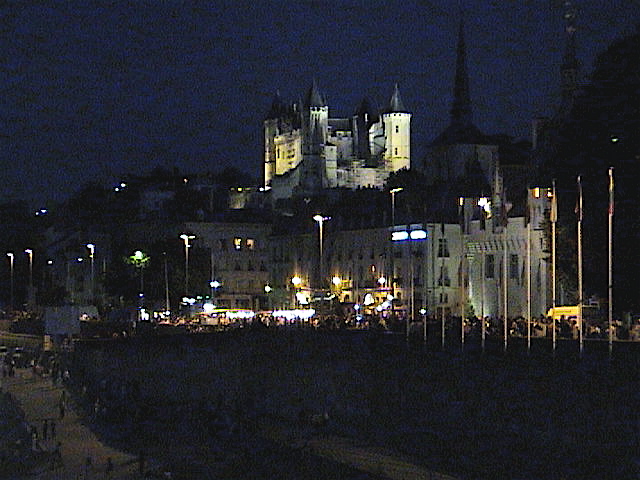
A few years ago my partner Darien and I were traveling through the ‘Loire Valley’ France and I spotted a road sign indicating that we were close to ‘Blois’ a town famous for its castles, château and its Houdini association.   It was not those things that drew me to stay there but its association with Michel Petrucciani.     He wrote a wonderful suite about the place; one section was titled ‘Night Sun in Blois‘.   Sitting on the ramparts of that ancient and stunningly beautiful city at dusk I could hear that piano piece echoing in my head as the sun filtered through the now dark mass of the surrounding  forest.    The Loire river was a shinning golden reflection way below us and I wondered if Petrucciani had sat on this very spot when he was inspired to write that tune.

That powerful memory had faded with time but it was sharply brought back to me as I listened to this tribute and I thank the quartet for that.

The album ‘Delayed Reaction’ is on ‘Independent Artists’, a New Zealand label associated with ‘Rattle’ records.

Chateau by night near Blois

Tricolour's above Blois

Alternate realities – ‘dreamsville’

THE BEAT GENERATION AND THE ANGRY YOUNG MEN

Image by roberthuffstutter via Flickr

The opening line of J.P. Hartley’s Edwardian based novel ‘The Go Between’ begins with the words, “The past is a foreign country, they do things differently there“.     I was mindful of that quotation when I recently spotted a link to a Jazz, culture and poetry blog.   The link was named ‘Like…Dreamsville’.   My first thoughts were of the ‘Mancini’ composition as played by ‘Grant Green’, ‘Wes Montgomery’ and ‘Pat Martino’ – all evocative renditions of the oh-so-slow groove anthem of that name.

As it turned out the site was not about the song but something altogether more ephemeral – the strange world of the 1950’s ‘Beatnik’.   That term ‘Beatnik’ has been so successfully parodied  that it can never appear less than corny and the establishment of the time delighted in making it so.    As a quasi-cultural movement it looked lame and contrived and so it was meant to look.

It portrayed the apparent boredom and ingratitude of American youth.    A youth in the process of rejecting the ultra-materialistic values of their ‘elders and betters’.    I suspect that the term ‘Beatnik’ was eventually allowed to die of embarrassment, as nothing kills a movement quicker than being absorbed into the popular consciousness as a joke.     ‘Mr Magoo’ and ‘Gilligan’s Island’ abetted in this (see ‘Like…Dreamsville’).

Lurking behind that was the voice of  the ‘Beats’ and what the mainstream press were so desperate to undermine was almost certainly the ‘Beat Generation‘.   That was another entity entirely.     Unlike the ‘Beatniks’, the ‘Beats’ were not a media invention (even though the name was probably ably assisted by the liberal media of the day).  The conservative establishment had long felt that a dangerous counter-culture existed in the orbit of Modern Jazz, Modern Art and Modern Poetry/Post War Literature.   This was a harder nut to crack, because the gifted writers, musicians, poets, philosophers and artists were perfectly capable of rising to the challenge and turning the ridicule right back on so-called civilised society.  I refer to the likes of Kerouac, Burroughs, Ginsberg, Snyder, Corso, Ferlinghetti, Kaufman, Kessy, Baraka, Pollack, Watts and many others.   Into this mix add musicians like Lester Young, Dizzy Gillespie, Harry the Hipster, Charlie Ventura, Paul Horn, Chico Hamilton and Charlie Parker.

The ‘Beat Generation’ used Jazz as its soundtrack and a lot of the hip vocabulary arose directly out of that music.   The new lexicon that arose was later twisted to become a weapon.   Like the ‘Hippy’s’ that followed in their wake, the ‘Beats’ danced to different drummers than their straight counterparts.    They were more likely to follow the slightly bemused Dr. D.T. Suzuki (Zen Buddhist author), Tang Poet ‘Han Shan’ or Lao Tzu than any home-grown Christian leader.    The poets, BeBop and the homeless freight-car hopping pilgrims had an infinitely higher currency than a suburban homebody.

This restless generation had open ears, open eyes and they moved to deeper rhythms than the static of suburban life .   Finding the ‘beat’ of life was an end in itself.     I confess that I was one of the youth who identified with the ‘Beat Generation’ and I am quite unrepentant.   More than 50 years on I still identify strongly with their cause.

In San Francisco, home of the ‘Beats’, poetry was a real commodity.  Signs saying, ‘poets wanted’ could be seen in the windows of  Jazz bars.    Pokey little book shops like ‘City Lights’ held regular poetry readings and ‘On The Road’ captured the hearts and minds of a footloose generation who looked beyond the material for deeper meaning.  This wave of anti-materialism was felt to threaten the post-war security and so the ridiculous hipster alter-ego was created – the ‘Beatnik’.   The joke even extended to Gilligan’s Island and Mr Magoo.

Do visit the ‘Like…Dreamsville’ site and try to reclaim the best part of that dream; at this distance the laughter is ‘coolsville’.   For those who like time travelling read ‘On The Road’ or read ‘Howl’ while listening to 1950’s Miles Davis.

Where did the suffix ‘nik’ come from?   Probably Sputnik.   Did terms like ‘cool’ survive?  yes … it is still way cool.

http://likedreamsville.blogspot.com/

Dizzy on the French Riviera

Dizzy Gillespie 1955

Image via Wikipedia

John Birks (Dizzy) Gillespie was a preeminent  force in the development of modern Jazz but his persona and the ‘Dizzy’ legend extended well beyond the notes he played.     For a number of reasons Dizzy was bigger than the music he lived for and this was no bad thing because all marginalized art-forms (as BeBop certainly was) needed someone like him.   Dizzy played with great technical facility but more importantly he told a new and interesting story.   He did this in part by making fun of the very underpinnings of the new music – an implied hi-brow intellectualism and a formidable technique.

He gently parodied the hip young Beatniks with their goatee beards and heavy-framed horn-rimmed glasses and became their hero in spite of it. Shops carrying ‘Dizzy Gillespie prescription-less horn-rimmed spectacles’ sold out in New York novelty shops and his bent-up trumpet bell and the accompanying story became part of the folk law of BeBop.

He was also be a relentless trickster and when playing as a sideman he was often in trouble over his antics.    Later on he scripted some of that slap-stick humour into his own bands routine and even though it can look a little dated now, it was part of the ‘Dizzy’ experience.    He wanted to make the music fun and yet profound; he succeeded in the in the best possible way.

Dizzy the man may have had some detractors but I have never heard of them.   Louis Armstrong once complained that BeBop was ‘chinese music’ and ‘Miles’ objected to negro bands clowning around on the band stand as it was allegedly demeaning.  Dizzy was too good-humoured to care about such niceties.    His personality was larger than life and in filmed or recorded interviews a deeply tolerant and a likable man was revealed.    He played with musical genius Charlie Parker for years and his attempts to steer Parker away from his self-destructive path eventually failed.  For much of his life Dizzy was a member of the peace-loving ‘Baha’i’ Faith and later he was a United Nations World Wide Ambassador for Peace.   It is obvious to me that this open-minded tolerance was a well-spring that was sourced deep within him.   Watch him interviewed in ‘A Great Day Out in Harlem’.

In the Forties Dizzy played with the ‘Cab Callaway Band’ and it was while there he came into contact with Cuban and other Latin American musicians.   He soon became the number one champion for Afro-Latin American Music and he is credited with setting the scene for that ever popular genre.  ‘Manteca‘ was a big hit for his bands and it is still played today.

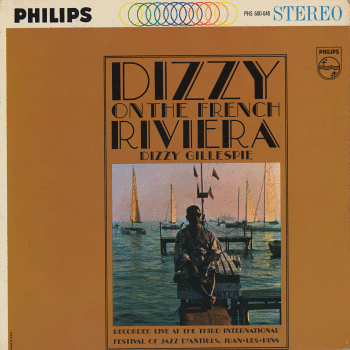
My absolute favourite recording of his is ‘Dizzy on the French Riviera‘ (1962).  It is acknowledged as a work of genius but it scandalously languished  in the vaults for nearly 40 years and was not put out as a CD until a year ago when ‘Verve’ re-issued it (only finding its way to New Zealand in recent months).   Shame on ‘Phillips Records’ and their successors for their laggard behavior .    A number of years ago we got sick of lamenting the lack of access to this joyful disk and so we took a well-worn ‘Mono’ LP version to a friend for de-clicking and digitizing.    Those two back-up copies are now consigned to the bin because the cleaned-up ‘Stereo’ version by Verve is fabulous.   They also corrected the miss-spelling of the name Lalo Schifrin from the mono LP cover.  I know completist  collectors who will now want both versions.    I would urge everyone who loves 60’s Jazz to grab a copy before it vanishes again (‘Amazon’ has them at bargain prices and the US dollar is our friend now).

The Band is:  Dizzy Gillespie (trumpet – vocal), Lalo Schifrin (piano – arranger), Leo Wright (alto saxophone-flute- vocal), Tzigone Elek Bacsik (guitar), Chris White (bass), Ruby Collins (drums),

Dizzy on the Riviera

Pepito Riestria (percussion).     The arranging on this album is masterful and the multi talented and soon to be famous Schifrin was a typical Dizzy Gillespie discovery.    His often bluesy and time displacing chords can subtly and swiftly merge into a ‘clave’ and he is a real power-house in this band.   Leo Wright is fabulous on both Alto and Flute and I dont know enough about his story to know why he was not heard more often.   That he could be impassioned, Dolphy like and romantic on the one disc is impressive.  I will include some information about Elek Bacsik as he is impressive also:

Bacsik was born in Budapest, the son of Arpad Bacsik and Erzsebet Pocsi. He was of Romani ethnicity and studied violin at the Budapest Conservatory, but found his primary musical inspiration in bebop pioneers Dizzy Gillespie and Charlie Parker. He was also the cousin of Django Reinhardt. In his early years he travelled as a musician to Lebanon, Spain, Portugal and Italy. He worked in Paris in the early 1960s and recorded with some well-known French musicians such as Jeanne MoreauSerge Gainsbourg and Claude Nougaro as well as making solo albums. In 1966, he went to work and live in the United States and played at Las Vegas. Bacsik recorded on guitar on Gillespie’s Dizzy on the French Riviera (1962) and later on violin with Gillespie at the Newport Jazz Festival in 1974. His bebop violin playing is featured on his two albums as a leader, I Love You (1974) and Bird and Dizzy: A Musical Tribute (1975).  – Wikipedia

The entire band is great and I love the happy sounds of children playing in the surf at Juan Les-Pins on the opening and closing tracks.    It is somehow appropriate given Dizzy’s love of humanity.  This is the well-loved Antonio Carlos Jobim song ‘No More Blues’ (Chega de Saudade).    I have also included a later version of the song with James Moody and Kenny Barron replacing Wright and Schifrin.

http://youtu.be/CVvAKIU5BT0

http://youtu.be/cWDxU813wd0

Oslo

A few days ago an extremist murdered 69 young Labour Party activists on Utoya Island and 7 more in central Oslo.  The purpose of this senseless massacre was to cower a nation and to stop the ruling Labour Party in its tracks.   Neither has occurred as Norway is made of sterner stuff than that and more than a million people gathered in Oslo to underscore their deeply held commitment to tolerance and humanism.   A sense of shared humanity will continue to steer this small nations course and no far-right fundamentalist will be able to derail that purpose.  By now most people get the bitter irony of this massacre, as the atrocity was perpetrated against one of the worlds most peace-loving and tolerant peoples (Oslo is the home of the Nobel Peace Prize and the Oslo Peace Accord).    Norway not only looks after its own citizens well, but it sets an example to the wider world when it comes to foreign aid.

This was no shadowy middle-eastern jihadi as a few foolish people had suggested, but an altogether more recognisable figure was resposible.   A pathetically deluded white male who professed  admiration for the worst genocidal killers of Europe.

Norway has produced many fine Jazz musicians and I have included several clips which can speak for themselves.    The first is the tune ‘Oslo‘ by ‘Mathias Eick‘.   What begins as an eerie trumpet call soon evolves into a gently swinging tribute to this peace-loving city.  The second is a tune by ‘Jan Garbarek‘ and ‘Shankar’ and is titled ‘paper nut’.   ‘Garbarek’ will need little introduction to Jazz audiences.

Sardegna Cool – Mare Nostrum Jazz

The Lost Chords find Paolo Fresu in Monaco. Fr...

Image via Wikipedia

Paolo Fresu, a Sardinian genius of the trumpet and flugelhorn is a gifted arranger/composer.    This quickly becomes evident when you listen to his multi faceted recordings, as he is equally fluent with mainstream, fusion, big-band orchestras or multi-phonic experimental Jazz.

Fresu was born on the sunny Mediterranean Island of Sardinia in 1961 (Berchidda).  By the age of 11 years he had picked up the trumpet and his course was set. Later he was admitted to the Cagliari Conservatory and the University of Performing Arts Bologna.

The signature Paolo Fresu sound hints at ‘Miles‘ in an unselfconscious way, but more importantly it is a very Italian sound and rooted deeply in the Sardinian landscape. Over recent years Fresu has showcased both Sardinia and more recently Corsica in his work (His latest ECM album has him improvising against the sounds of a traditional Corsican mens choir and the sound can only be described as haunting or other-worldly)

Paulo Fresu is a pillar of the modern Italian Jazz scene; he is extremely well-known across Europe and increasingly so in America. He records with ECM, EMI, Columbia, Blue Note and RCA, plus a number of smaller Italian and European labels. His disks are reasonably easy to obtain (through New Zealand record shops like Marbecks or Parsons) and Amazon has a wide range on offer. He has recorded with Carla Bley, Enrico Rava, Stefano Bollani, Dave Liebman, Tino Tracanna, Gianluigi Trovesi, Furio di Castri, Antonello Salis, Uri CaineRalph Towner and so the list goes on.

I have been lucky enough to visit Italy a number of times and from the first visit I was dazzled by the vibrant Italian Jazz scene.  It is fair to say that I was guided in this by my close friends Patrizia and Gianni and it was through them that I discovered a talented group of Sardinian Jazz musicians (Fresu and Tracanna among them).  Patrizia and Gianni live in Milano but ‘Patty’ was born in Sardinia and has connections to Jazz musicians from there.

The first clip is Paolo Fresu at his ballad playing best. The second is Paolo Fresu and the ‘Orchestra Jazz della Sardegna‘- George Gershwins Porgy & Bess (Summertime). Many will easily spot this as the Gil Evans/Miles Davis version – Gunther Schuller provided Paolo with the transcription.  The second piece is a TV clip of Paolo Fresu showing a DJ how trumpet multiphonics would work played against a sampled loop.

http://youtu.be/H75yUpi5wfw

Another highly recommended CD is ‘Kind of Porgy and Bess’.  In this a 5 piece band renders this music into utterly modern Italian Jazz (Fresu (t), Nguyen Le (g), Furio de Castro (d), Dhafer Youssef (oud,v), Antonio Salis (p,e-p,h), Roberto Gatto (b).  There is a world of enjoyment and excitement in Jazz Italia – don’t miss out.

Grazzie Paolo.

Fine & Mellow – achieving cult status

Label of a Commodore Records 78 record by Bill...

Image via Wikipedia

Lady Day - Griggs collection

Amongst Jazz fans this clip from a show called ‘The Sound of Jazz’ is legendary and I suspect that it could top the list of  ‘best short Jazz films ever made’.  While many will have seen this or already own a copy on DVD, it is a joy to be repeated over and again.    The song ‘Fine & Mellow’, is a blues written by Billie Holiday and her studio band just happens to contain some of the best musicians of the era.   In my view the film is dominated by Billie and ‘Pres’, but everyone here is note perfect.   There is more feeling in this clip than a hundred others of a similar nature and perhaps that is what has elevated it to cult status.

Each solo is about telling a story within a few minutes; because this was the discipline that was imposed upon pre 1950’s recording artists.    The 78 rpm recordings had limited space and certainly did not allow for John Coltrane like explorations of a theme.  This ability to tell a story succinctly and well was cultivated by the era’s Jazz greats and no one told those sweet stories like ‘Pres’ (Lester Young), Ben Webster or ‘Bean’ (Colman Hawkins).   Billie and ‘Pres’ had been extremely close for years, but for reasons never fully revealed they had fallen-out some time prior to this recording.   During the recording Billie smilingly acknowledges the band members as they solo; obviously loving their improvisations.   When ‘Pres’ plays though an expression of absolute love and appreciation is evident.    This was a moment out of time that has delighted Jazz fans ever since.

Billie was to die tragically within a year or so of recording this and her rendition of this blues is an extremely  poignant moment in Jazz history (as if she understood that her death was immanent).  The curse of over indulgence in narcotics and booze cut a terrible swathe through the best and brightest of the jazz scene around this time.

The slurred introduction by Billie is genuine but possibly spliced into the film later (which was made in a 1950’s studio setting and unlikely to have included a stoned Billie intro).  The band is: Ben Webster (ts), Lester Young (ts), Vic Dickerson (t), Gerry Mulligan (bs), Coleman Hawkins (ts), Roy Eldridge (t), Doc Cheatham (t), Danny Baker (g), Milt Hinton (b), Mal Waldren (p), Osie Johnson (d).

http://youtu.be/ZtgUbJN8oPE

Pat Martino – deep in the music

Pat Martino

Image via Wikipedia

Not too many months ago my Partner & I saw Pat Martino in ‘Birdland‘ and were captivated by his deep-in-the-groove East Philly style.    There could hardly have been a better place to hear him, as this is one of New York’s best Jazz clubs and a friendly intimate space.

Like most out-of-towners we loitered awhile in Times Square before walking the short block to ‘Birdland’.   I could hardly believe my luck at being able to see Pat in such a setting as I had become a fan some years earlier; having developed a taste for that whole Grant Green thing.

The first of the band members to step on stage was Tony Monaco the B3 player, quickly followed by the drummer Harvey Mason.   Soon Pat appeared with his shining custom-made black Benedetto guitar at the ready – a slightly built man who quickly lost himself deep within the music.  The band leapt into their first few numbers with an apparent relish.   Obviously enjoying what they do and perhaps that is the hallmark of this Chicago – East Philly guitar -organ-drum style.   Seeming to drop deeper and deeper into the groove and then characteristically locking into a phrase until the intensity becomes almost unbearable – then as suddenly dropping back into the melody again.

When Pat plays alongside Joey Defrancesco and Byron (Wookie) Landham the band is a force nine hurricane.    No drummer works as hard as ‘Wookie” with his powerhouse locked-in beat and no B3 player owns as much of the room as Joey D.   It was however just as interesting to hear Pat with this band and they proved to be solid performers.  Tony is great on the B3 and his tendency to grimace and mug as he reaches ever deeper into the groove did not unduly trouble me.   The drummer Harvey did what good groove-drummers do and locked into Pats sound.   After the faster offerings it was a pleasure to hear Pats well-loved version of ‘Blue in Green‘(Davis/Evans) and the warmth and perhaps the hint of sadness in his sound brought a tear to the eye.    The sound Pat gets from his specially wound strings is fat and warm and it hits you right where it should; in the heart.

I have just learned that Pat is about to play at ‘Yoshi’s‘ (Oakland) and I have urged my son and daughter-in-law to go if they can.  Pat may have an amazing and unique life story, but it is the warm looping bluesy sound that gets you in the end.

Hidden in plain sight; Joe Chambers

Sometimes we don’t see what is right under our noses and that was definitely the case with me and ace-drummer Joe Chambers.   We sometimes miss drummers or bass players because it is all too easy to be dazzled by the musicians on the horns or guitars.  In Joe Chambers’s case the leaders were cats who blazed with an almost unbearable intensity and this semi-eclipse had blinded me to the intricacies of a hard grooving and in-the-pocket drummer.

I was kicking back with a friend one night when he put on Chick Corea’s ‘Tones for Joan’s Bones’.   I had wanted to hear this album for years and now from the first bar the album got right under my skin; edgy, restless, forward-looking American 60’s Jazz  – featuring Chick Corea (p), Joe Farrell(ts)(fl), Woody Shaw (t), Steve Swallow (b) & Joe Chambers (d).   This was an era when Jazz, (no longer a popular music and competing with rock), let loose a tidal wave of open-ended creativity.  Caught between Ornette Coleman and a burgeoning rock scene, the confining ‘stays’ of Hardbop were suddenly loosened.    ‘Tones for Joan’s Bones’ is a truly great album of its type and the psychedelic art work on the cover is reason enough to buy a copy.   Chick Corea’s song ‘Litha’ with its chromatic mesmerizing energies was the big hook for me and as I listened I became hyper aware of the drummer.

The name Joe Chambers had been vaguely familiar and when I looked him up I was surprised to find that he was the drummer on dozens of my favourite albums.    Classic albums by Herbie Hancock, Bobby Hutcherson, Chic Corea and Freddy Hubbard etc.

As well as listening to the group as a whole we should also develop the ability to isolate the instruments as we listen.  When we do this it is possible to comprehend the levels of interaction and the individual flights of inventiveness.   Jazz is after all a collective enterprise that supports the individual in extraordinary ways.

There are circus acts where a reverse human pyramid is formed on the shoulders of a strongman.   While watching the climbers go higher and higher, we can forget that the whole formation would fail catastrophically if the person at the bottom were to miss-step.  Joe Chambers is the strongman who waits until everyone is standing on his shoulders and then raises them even higher.  This type of drummer carries a lot of weight and in moments of high tension, causes you to hold your breath in case he falls and the band tumbles to earth with him.   Such drummers can stretch time to breaking point as the tension increases and as quickly pull it in again when the outlier musicians need recalling.    Joe is a master of this tension and release.    I may have momentarily overlooked him but many modern rappers have not; zeroing-in frequently on his edgy rhythms.

Francis Wolf - Blue Note Records

Picture Francis Wolf - Blue Note

http://youtu.be/65LA1i6_LbE

Sonny Rollins: Way out West (Pacific)

Sonny Rollins

Image via Wikipedia

Back in January New Zealand Jazz lovers had been delighted to learn that Sonny Rollins would be in Wellington.   This band was the sole International act performing in the (temporarily truncated) Wellington Jazz Festival.  Sonny’s band is comprised of Bob Cranshaw (eb), Kobe Watkins (d) Sammy Figueroa (perc) Peter Bernstein (g).      As there are very few of the great 50’s tenor players remaining among us, my friends and I knew that we had to fly to Wellington to catch the act and had booked early.    It is lucky we did because the seats for the city’s Michael Fowler Center sold out quickly.    In an already busy Jazz year, the Sonny Rollins concert was a headline event in the New Zealand Jazz Calendar and as Sonny had turned 80 recently this was not an opportunity to be squandered.

When the band came on stage there was an initial cheer and then a slight hush as Sonny emerged – bent over and shuffling painfully.  We collectively held our breath as he shuffled to the microphone and uttered a few words.  Then a deafening roar of approval went up as the 80 year old put the golden saxophone to his lips.    It was as if a miracle had occurred because he appeared to grow in stature and from the very first note he was rejuvenated.    He played with a force and virility that would have been surprising in a 20 year old let alone an 80 year old. This was the Sonny of old.   The Saxophone Colossus of Brooklyn Bridge fame was again defying the gods of music; mocking them for trying silence him with age.

The band launched straight into the first number ‘D.Cherry’ which was hard driving and heavily accented by the powerful rhythm section.   Allowing only a 10 second break for the applause they ripped into the second number and apart from  a short introduction well into the concert there were few song announcements (nor an intermission).  This was the Sonny Rollins who had earned immeasurable respect over a lifetime of performance; powerfully taking the music to the edge of the possible.  Perhaps not always a pretty sound but absolutely typical of his vigorous, relentless improvising.  Sonny goes straight to the heart of a tune and then mines it for every ounce of meaning as he tells his story.  I recall a friend saying that his playing is like a dog gnawing on a bone until every morsel is gone.

The band had quickly hit their stride and were soon playing in lockstep.  What could not be denied though was that Sonny was more than the sum of the bands parts.   The versatile Bob Cranshaw is a well known bass player and he lived up to expectations.   The other musician I knew and rated was guitarist Peter Bernstein.   Peter has recorded as a leader a number of times and he is a regular fixture around the New York scene – especially with organ/guitar/drum trio’s in Manhattan clubs like ‘Smoke‘.  I would have liked Peter brought further forward in the mix, as his driving powerful lines are well worth hearing, but competing against the powerful drummer and the well miked-up percussionist was left to Sonny.    His powerhouse tenor sound rode over the top of the two with apparent ease.   The standout number for me was the ‘Annie get your gun’ (Irving Berlin) show tune ‘They say its wonderful’; which was…. wonderful.  Tiring after two energised hours; Sonny said goodnight and launched into ‘Don’t stop the carnival’, which sometimes quoted from his legendary calypso ‘St Thomas’.  The set list from the two hours plus concert was as follows: D. Cherry, Patanjali, Blue Gardenia, Serenade, Newark News, They Say It’s Wonderful, Tenor Madness and Don’t Stop the Carnival.

Sour note: As grateful as I was to Wellington for hosting Sonny, I am still annoyed at the funders for canceling the fuller Wellington International Jazz Festival this year.   I hope they realise how wonderful the last one was and never make that mistake again.   Rugby should never be allowed to negate such an important music festival – sport and music can co-exist if allowed to.

Wellington concert Sonny Rollins

Sonny in full flight Wellington concert

‘Wave’ – Antonio Carlos Jobim

Cover of

Cover of Wave

It was always easy to love Tom Jobim‘s music as it captured the very essence of cool; the exotic new Brazil of the 1960s and 70s.   While the music may not have captured the grim realities of the barrios, it spoke powerfully of the hope and dreams of a new generation; of the educated hip, urban Brazilians.

The media showcased endless white-sand beaches, beautiful bikini-clad girls and lost love under palm trees. But this was the era of exciting modernist architecture, best evidenced in the wonderfully executed, delightfully surreal, Brasilia city.  This city was the revolutionary vision of three men of genius and they curated it from where the jungle sprawled four years earlier.

The President’s futuristic dreams were eventually overrun by greedy money men, a military dictatorship, and powerful elites. The legacy of Brasilia and of that brave new world remains potently in the music. The visionaries were President – Juscelino Kubitschek, architect –Oscar Niemeyer and urbanist- Lucio Costa. It was into this hopeful world where anything seemed possible, that Antonio Carlos Jobim and Joao Gilberto appeared as forces of nature. Before long this unique sound reached larger North American audiences via Jazz super-stars Stan Getz, Charlie Bird (and others). The stories surrounding the Getz/Gilberto (‘Girl from Ipanema’) session are legendary; suffice to say that Astrud Gilberto wife of the talented and co-credited Joao Gilberto was not supposed to be on the session. She was reluctantly included at the last minute. From 60’s house-wife to stardom in the blink of an eye.

It was later while listening to a Rudy Van Gelder session (for Creed Taylor’s CTI label) that I looked deeper. The album ‘Wave‘, has a profound sense of place and everything about it is exotic and beguiling. I love the title song and I have a number of Jazz versions (Bossa Nova and otherwise). It swings like crazy in an authentic Brazilian way. When you listen to Tom Jobim and Elis Regina or to Tom with Brazilian musicians you realise that their time feel is subtly different from anything found in North American.

As with many Jobim albums, the recording is a heady mix of unashamed romanticism juxtaposed with a hint of minimalism (perhaps like Brasilia itself). This is partly due to Claus Ogerman’s arrangements, who remembered to leave open spaces for the individual musicians). The sense of unexpected space in the midst of such lush orchestration speaks directly to Jobim’s genius.

He was a great composer, and a great performing artist. His spidery piano lines and urgent up guitar rhythms are miniatures of perfection; not a single note too many.   ‘Wave’ captures the essence of Copacabna beach, Rio de Janeiro, and Brasilia. Jobim’s own renditions of ‘wave‘ changed with the years; one version on the Warner label ‘Terra Brasilis‘ sounds closer to Delius than to Jazz (until you hear the voicings).

The ‘Wave‘ album cover is a bookmark of the times; iridescent lime green sky, purple Giraffe (or other odd colours in later pressings). I have included an informal version of ‘Wave’ by Tom and a few of his friends. The 60’s clothes may appear strange at this distance, but the music is perfect.

In the late sixties, I saw the French film  ‘Our Man in Rio‘ staring Jean Paul Belmondo three times. I have not seen it since then but I would love to revisit it. It may well appear corny at this distance, as films do with the passing of time, but I will hold fast, as my visions of sixties Brazil cannot be tarnished. I have this album in my head and the mere thought of it induces the heady whiff of nostalgia.