With the opening of borders between New Zealand and Australia, it was hoped that improvising musicians could begin touring again. Apart from three returnees and several stragglers who chose to shelter in place, we had not seen an international for fifteen months. Unfortunately, the pandemic reestablished itself in Australia and that window closed within a week of its opening. There was, however, one musician who timed it perfectly and that was saxophonist Andy Sugg.
He flew out of Melbourne just days before another lockdown was announced and we were very pleased that he had slipped the net. Sugg is a gifted saxophonist with broad appeal and there was no better way to break the tour drought. The tour was billed as an album release but the setlist also included earlier compositions and two tasty standards. The album titled Grand & Union was recorded in New York in mid-2019 and released last year. For obvious reasons Sugg was unable to take to the road and certainly not with his New York-based bandmates.
Grand & Union is a rail hub in Brooklyn but it is also a metaphor for the album. ‘A musical intersection where styles and motifs merge before moving somewhere else’. It is an album of diverse stylistic influences but the musicians’ craft a tasteful amalgam from the underlying base metals. In the liner notes, the leader mentions Stravinsky as a prime inspiration and ‘The Rite Stuff’ with its deep propulsive groove is the most overt reference; a stunning piece, which evokes the now without jettisoning the history underpinning it.
Sugg is a particularly coherent improviser who takes a listener along as he tells his ear-catching stories, and his tone is particularly arresting. Warm as toast and seldom straying into the lower registers. On the soulful ‘Ruby Mei’, his sound reminded me of the great melodic improviser, Ernie Watts. Much credit is also due to his New York bandmates who are seasoned musicians all, and who worked as a tight cohesive unit.
His Auckland gig featured a local rhythm section and they also acquitted themselves well. The first set opened with the title track Grand & Union and was followed by Ruby Mei and other tunes from the album, Then came a more expansive offering in several sections. This enabled Sugg and the band to stretch out. This was a gig of highly melodic offerings and as an added treat, the second set featured two popular standards. A musician said to me recently; playing a popular standard to a discriminating audience, means, that you must play it extremely well and you must insert something of yourself into it. They did. The standards were the gorgeous ‘Someday My Prince Will Come (Churchill/Morey) and the much loved ‘In a Sentimental Mood’ (Ellington). The audience shouted their approval, obviously delighted. I have posted a YouTube clip from the Auckland gig.
While each of the local musicians has experience playing with offshore artists, considering how long that has been, they were very much on form. Of particular note was Wellington drummer Mark Lockett. I could hear people commenting enthusiastically about his drumming between numbers. They were right to comment as he pulled one out of the bag that night. He and Sugg go back a long way and the connection was obvious.
The gig took place at Anthology for the CJC Creative Jazz Club on 14 July 2021. I recommend the album and it’s worth checking out Sugg’s earlier album also. To order physical copies, download or stream, visit AndySugg.Bandcamp.com
The album personnel: Andy Sugg/tenor saxophone. Brett Williams/piano & keyboards, Alex Claffy/acoustic & electric bass, Jonathan Barber/drums.
Gig personnel: Andy Sugg/tenor saxophone, Keven Field/piano, Mostyn Cole/acoustic bass, Mark Lockett/drums
JazzLocal32.com is rated as one of the 50 best Jazz Blogs in the world by Feedspot. The author is a professional member of the Jazz Journalists Association, poet & writer.Some of these posts appear on related sites.
The genesis of DOG goes back a long way as I first reviewed them in 2012. Over that period they have gained various accolades and awards. They are Dr Lonnie Smith in reverse because the group began their journey as Dr DOG but then ditched the title to better accord with their egalitarian street-dog ethos. Their reputation extends well beyond New Zealand shores and their second album was recorded with guest Australian guitarist James Muller. They have two albums out on Rattle and both are exceptional.
Their first album featured the core group, and each of them contributed compositions: Roger Manins, Kevin Field, Oli Holland and Ron Samsom, The second album followed the same pattern, but with James Muller contributing as well. These are all exceptional players and the albums have allowed them to place a deeper focus on their writing skills. When musicians of this ability come together they are better able to push past arbitrary limits.
Ten years on there is a new guest in the lineup and as always there are new compositions from everyone. I hope that this recent gig is the prelude to a third album because together this iteration is crackling hot. With guitarist Keith Price on board, they moved into fresh territory and alongside the burners, there were touches of big-vista Americana. No wonder the gig was billed as the New Extra Strength Dog. At times it was Industrial strength.
Although the group is co-led, Roger Manins is the compare. Any gig that he fronts will have X-factor and this was no exception. The first set opened with a tune by Price and it was blistering. From the front row, it was like being in a jet-stream but it was not just bluster. Price is a terrific composer and this tune rode a freight train of tension and breathtaking harmonic shifts. It was initially titled #3unnamed, but now titled ‘Karangahape’ (a nearby street with interesting tensions). That set the pace.
With one exception (the encore), these were all new tunes and each complemented the other. This was a feast of good writing, tunes played and written by musicians at the top of their game. In spite of their long association, it is obvious that these guys enjoy playing together. The respect and warmth shine through the music. They are in sync because they respect the music and each other. The large club audience picked up on that, thus completing the virtuous circle.
I have posted the first and last gig tunes as YouTube clips. ‘Karangahape’ (Price) and ‘Schwiben Jam’ (Manins). Both of the DOG albums remain popular and they are available from stores or directly from Rattle (and on Bandcamp). If you don’t own copies grab one now, and if you do, buy one for a friend. We are lucky to have artists of this calibre in Auckland and if we show our support, more albums will surely follow. www.rattle-records.bandcamp.com
Keith Price
JazzLocal32.com was rated as one of the 50 best Jazz Blogs in the world by Feedspot. The author is a professional member of the Jazz Journalists Association, poet & writer.Some of these posts appear on related sites.
Jazz and Cinema are natural bedfellows and there was no better proof of this than with Keith Price’s Double Quartet gig. A few days ago the CJC held the New Zealand premiere of Price’s ‘New Improvised Soundtrack to The Good the Bad and the Ugly’ and what a rare treat that was. The two art forms have complemented each other since the early twentieth century. Even before the talkies, a pianist would sit watching a flickering screen while he or she would churn out improvised music. In the cinemas segregated for coloured audiences, there were aspiring Fats Wallers, and in the white-only theatres’ grandiose theme music was conjured out of thin air.
While seldom defined as Jazz it was never-the-less reactive to the moment and the first talkie was a (now) controversial film called ‘The Jazz Singer’. Soon after came some iconic Jazz themed movies and in the era of the Neo Realists, a Jazz soundtrack or an incidental jazz segment was indispensable: Elevator to the Scaffold (Miles), Breathless (Martial Solal), Blow Up [Herbie Hancock).
It is not always obvious that a Jazz musician has composed a movie soundtrack but a surprising number of films can lay claim to this connection. John Williams who wrote the Star Wars soundtrack (plus ET Jaws, Schindlers List etc) was a Juilliard trained Jazz pianist (who once worked as a Jazz musician in New York bars). We have Jazz musicians in our own community who often appear in the credits (Crayford, Langabeer etc)
In the case of Ennio Morricone, the reverse is true. He was never a Jazz pianist but his compositions have become jazz standards. I mention Morricone because he composed the original soundtrack to The Good the Bad and the Ugly. This work by Keith Price is not in any way based on Morricone’s score. Price has turned the concept on its head and created something vital and new, and in this case, drawing on the film images to blaze a new trail.
Here, the images are subordinate or equal to the music and there is no incidental music to enhance the segments of dialogue. And because there is no spoken narrative something extraordinary occurs. We feel the music and absorb the images in new ways. It comes to us through many senses, through ears, body and eyes.
This is a through-composed work, but with space and opportunity for the musicians to react to the images (and to each other). It features group improvisation, but there is nothing aimless about the work. Each segment is built on what proceeds it with the charts guiding the ensemble forwards as they interact.
Excerpts from the concert
The ensemble was a double quartet and this doubling up of instruments required skilful playing and very good writing. Luckily we got both, and although the gig was loud, the intensity never tumbled into chaos. Each musician took on agreed roles, resulting in a heady, textural mix. There were two keyboards (piano and digital), two drummers, two basses (one upright, the other electric), a tenor saxophone and a guitar.
Price was on guitar and guiding the music with prompts. In a semi-circle facing the screen and keeping an eye on the leader were, Ron Samsom (drums), Olivier Holland (electric bass), Mostyn Cole (upright bass), Malachi Samuelu (drums), Kevin Field (piano), Ben Gailer (keyboards) and Roger Manins (tenor saxophone).
Ben Gailer, Malachi Samuelu, Mostyn Cole & Eli
An unexpected plus for me was having the cinematography of Sergio Leone untethered from the screenplay. A new piece of music to a timeless movie. He was a towering genius of the cinema and it was nice to be reminded of that as we appreciated the preternatural framing of each shot. Leone drew on Samurai tales for his Dollar Trilogy and in doing so he reached beyond genre. These are ancient archetypes reframed and more profound than the faux wild west of John Wayne or ‘Hopalong’ Cassidy. The function of archetypes is to live on through reinterpretation and thanks to Keith Price, this story lives on.
JazzLocal32.com was rated as one of the 50 best Jazz Blogs in the world by Feedspot. The author is a professional member of the Jazz Journalists Association, poet & writer.Some of these posts appear on related sites.
With 2020 nearly done, the penultimate gig at the CJC was an optimistic signpost; signalling hope and possibility. After a long and turbulent year, the music had bounced back better than ever and in spite of the obstacles along the way new energies were flowing. In amongst the offerings from our up-and-coming artists were gigs and albums by our finest. Last Wednesday’s Dixon Nacey Band and the release of Kevin Field’s ‘Soundtology’, stand out as musical high points. In a year of plague and pestilence, the music only grew stronger. There is a thing about genuine creatives; when the bats start to circle, they work with the chaos and create better. Dixon Nacey is very much in that category; what an extraordinary musician.
Nacey appeared this time, with the same lineup that accompanied him on his Tui award-winning ‘Edge of Chaos’ album. There were numbers from the album, plus a few new tunes. In addition, he played a blues and two arrangements of Pat Metheny tunes which delighted everyone. I had missed his Ponsonby Road Metheny gig, which everyone who attended, raved about for weeks afterwards.
Punching Bag (Nacey)
Nacey is a musician who keeps moving forward, and with each passing year, he reaches new heights. He is less inclined these days to rely on pedals and an uncluttered spaciousness is evident in many of his compositions. What he has absorbed has now been internalised, so there is no over-thinking, and out of that comes clarity and a cleaner sound. This enables him to say more and to give deeper meaning to the notes and phrases and underlying everything is some great writing. Playing like this demonstrates the best features of his Godin guitar, which in return, reveals its best self. The tune above is a recent Nacey composition. New Zealand Jazz at its finest.
And Then I knew (Metheny)
The band were superb and the tricky unison lines were executed well. Roger Manins is an excellent reader, and you could not have slid a cigarette paper between his and Nacey’s lines in the head arrangements. And behind those, adding fills or comping unobtrusively was Kevin Field. Responding exactly as he should and consequently giving the music a floating quality. There were rhythmic complexities on many of the numbers, but because they were navigated so well, they were rendered as easy. One or two pieces came close to being a shuffle beat, but not quite. This was a layered sound and the complexity of the overlaying time signatures needed skilled craftsman to make them fit properly. The reason it held together so well was down to Oli Holland on bass and Andy Keegan on drums. This is how a tight unit should function. What we got was a superb night of engaging music and it brought us end-of-year joy.
Dixon Nacey: guitar, arrangements, compositions – Roger Manins : tenor saxophone – Kevin Field: piano – Olivier Holland : bass – Andy Keegan : drums
The gig took place at Anthology K’Road for the CJC Creative Jazz Club, December 9, 2020
JazzLocal32.com was rated as one of the 50 best Jazz Blogs in the world by Feedspot. The author is a professional member of the Jazz Journalists Association.Many of these posts also appear on Radio13.co.nz – check it out.
With closed borders and venue restrictions biting, the release date for Kevin Field’s ‘Soundtology’ album became a movable feast. The original proposal would have seen some of his New York band appear, but because of the pandemic, that plan was ditched. If he was flustered by these frustrating circumstances it didn’t show. Making a virtue out of necessity he engaged local musicians and launched his album anyway. It was a night to remember.
Field is one of our finest musicians and his reputation stretches far beyond these shores. He has previously recorded with highly-rated New York Jazz musicians and also with the best of New Zealand’s improvisers. As an adventurous musician, Field eschews stasis and his developmental arc is particularly evident with this latest album. He is an artist who arrives at a successful formula and then turns it on its head. With each album, he makes references to his earlier works, and then he moves foreword. Everything that has gone before becomes a springboard to a new moment and each iteration is better than that preceding it.
There is a lot to like about Fields new album ‘Soundtology’. The tunes are sublimely melodic, and as always, his trademark harmonic developments astound. I have always enjoyed his avoidance of cliche and in this case, there is something else. Even when upbeat, the tunes feel more contemplative, and the space afforded, lets the music speak with clarity. This is the album of a mature composer and it is deserving of wide acclaim.
‘Good Friday’ Live in Auckland
The album has eleven tunes and features two quartets (alternating throughout). This provides contrast while not affecting the flow and continuity. All of these tunes belong together and each unit locates something special. The first quartet features Field (Piano Rhodes), Nir Felder (guitar), Orlando Le Fleming (bass) and Charles Haynes (drums). The second quartet has Field (piano, Rhodes) Mike Moreno (guitar), Matt Penman (bass) and Nate Wood (drums). These are heavy hitters and Field could not have chosen better crews to spin gold out of his compositions. I was immediately drawn to the inclusion of Moreno, one of the worlds great guitar improvisers. I once flew to Sydney just to catch a concert of his.
‘Soundtology’ is a beautifully presented album and it was recorded to perfection. It is an album to be enjoyed on many levels; for its beauty and freshness and for its accessibility. If ever there was an example of complex music made to sound easy, it is here. The tunes are beguiling and memorable, but underlying them are twists and turns which elevate the tunes into listening adventures. A good example is the first track Quintus Maximus. It opens over an ostinato sequence, where a broken rhythmic pattern is established by bass and Rhodes. The intro is a teaser as it hints at possible directions without necessarily committing to them; then the melody soars and brings it together until the underlying ostinato phrases reappear. An interesting and enjoyable piece of music.
The second tune, ‘Good Friday’ is a great composition. It is among the most melodic of Fields tunes and it has been around since he first recorded it on his 2012 Warner release ‘Field of Vision’. Back in 2012, the tune was a slower-paced offering. Over the last few years, I have heard it performed often; now, it has emerged as a punchier version of its former self. It is fascinating to hear good tunes like this under constant development. This is what Field does and it is his impulse toward reinvention that elevates him beyond the pack. It is not surprising that he was recently awarded a doctorate.
There is no better example of its ongoing trajectory than the version of Good Friday we heard at Wednesday’s live performance. It had been rearranged to include a bass clarinet and a soprano saxophone. There were two guitarists as in the album, but the addition of the horns gave us yet another vantage point from which to examine the composition. A band member told me afterwards that the charts were interestingly structured. They forced the soloists to think outside of the square and to avoid any formulaic approach.
‘People factory’ was the perfect vehicle for Moreno, Penman and Wood. This number is like silk in a ruffling breeze, I have never heard Moreno sound better (and he always sounds good). The responsiveness Field extracts from Wood and Penman is also marvellous. This is seamless interplay at its best. Actually, everything is great on this album and there’s plenty of variety. This one is 4.5 stars. My advice is, buy multiple copies and impress everyone with your hip good taste.
Album: Keven Field (piano, Fender Rhodes), Mike Moreno, Nir Felder (guitar), Matt Penman, Orlando Le Fleming (bass), Charles Hayes, Nate Wood (drums).
Live gig: Kevin Field (piano, Fender Rhodes), Michael Howell & Kieth Price (guitars), Nathan Haines (tenor, soprano saxophones), Lewis McCallum (bass clarinet), Cam McArthur (bass), Stephen Thomas (drums).
The live gig took place at Anthology K’Road for the CJC Creative Jazz Club, November 11, 2020
JazzLocal32.com was rated as one of the 50 best Jazz Blogs in the world by Feedspot. The author is a professional member of the Jazz Journalists Association.Many of these posts also appear on Radio13.co.nz – check it out.
This has been a season of upheavals and delays, and Caitlin Smith’s album, ‘You Have Reached Your Destination’ was no exception’. The gig sold out long ago, but then it was delayed twice. It finally went ahead last Wednesday and there was a rush to get a good seat. In typical kiwi fashion, what passes for a queue had formed; a ragged line, reordering itself in illogical surges as it snaked across the footpath of K’ Road. Smith is popular and like many vocalists, she has followers from across the music spectrum.
She brought a medium-sized ensemble with her, including backing vocalists, piano, keyboards, two guitars, drums, basses and a pedal-steel/slide-guitarist. I am used to hearing Smith with her trio, but this was new to me.
The band had a warm and enveloping sound, with Smith, clearly relishing the energy surrounding her. She has a strong voice, and it cut through. The first number was pure Americana, not just because of the pedal steel guitar, but the organ and backing vocals, and above all the lyrics. On several of the later numbers, they were joined by the gifted Nigel Gavin, and if anyone can channel authentic Americana he can.
The setlist followed the album order (minus a few tunes). There were few introductions, and this was intentional. The night was about letting the music speak and to achieve that best it needed an uninterrupted flow. I enjoyed the gig and couldn’t wait to hear the recorded album.
The physical album comes in exceptionally beautiful packaging, and importantly, the front cover has a brail title. In doing so, the senses are immediately directed within, or as Smith puts it, ‘let your ears guide you through this experience without other sensual distractions’. It was an invitation to a deep listening experience. The first tune, Grand Companion, was the perfect start point and from that point on you are guided between tracks by footsteps.
Much as Joni Mitchel or Rickie Lee Jones did, Smith uses predominantly Jazz Musicians in her bands. Musicians who can respond to nuance and work with her (not just back her). On the album’s opening track, Grand Companion, you hear John Bell on vibes, and what an inspired choice. His silken fills adding textural contrast: and Keven Field on Rhodes and piano. The live gig featured 10 musicians, but the album has a bigger cast (for example, pedal steel guitarist Janek Croydon, other backing vocalists and drummers). Paul Symons picked up this role on Wednesday and he doubled on slide guitar and vocals. The well known Aaron Coddel on bass(s).
On both the album and at the gig, the interaction between the chordal instruments was central. What a delight to hear Alan Brown and Kevin Field finishing each other’s musical sentences or trading fills. And Dixon Nacey, a guitarist who can accompany a vocalist with incredible sensitivity and a first-choice musician for a gig like this.
Track two ‘The Story so Far’ has a southern soul feel and the backing singers are the icing on a beautiful cake. ‘No Mans Land’ picks up the overarching theme of the album which is self-realisation on a sometimes difficult journey. Prayer for a miracle reminds me of Patrice Rushen’s disco-funk, ‘Tug of War’ closer to a straight-ahead Jazz number.
This is an honest album that touches on loves lost, inner struggles and sobriety. Smith is sight impaired, but she never complains. It is part of who she is, and she occasionally jokes about it. In between numbers, a few band members slipped off stage to grab a drink and when it was time to call them back, she said, ‘I can see what you’re doing’. ‘What can you see’ yelled someone in the front row, ‘Very little actually’ she replied, grinning.
When I looked at the album liner notes, I was surprised to see when it was recorded. This album is a gem. It was worth the wait and I hope it puts Smith where she deserves to be; a widely acknowledged vocalist among our greatest. It has been over 10 years in gestation and now it has arrived. It is a credit to Smith and to all involved, and it also underscores just what magnificent work Roundhead Studios do. As I played it through, a tug of emotion brought a lump to my throat. The mahi paid off royally and the wait was worth it, we have our own Joni.
Album: Caitlin Smith (vocals, Wurlitzer, and compositions), Kevin Field (piano, Rhodes), Alan Brown (keys, B3), John Bell (vibes), Janek Croydon (pedal steel), Dixon Nacey (guitar), Aaron Coddel (bass), Nick Gaffaney (drums), Chris O’Connor (drums), Jeremy Hoenig (tabla loop), Finn Scholes (trumpet), Oliver Emmitt (trombone), vocal backing: Mate Ngaropo, Rebecca Le Harle, Callie Blood.
Gig: Caitlin Smith (vocals, piano), Kevin Field (piano), Alan Brown (keys), Dixon Nacey (guitar), Nigel Gavin (guitar), Aaron Coddel (bass), Paul Symons (pedal steel, slide guitar, vocals), Jono Sawyer drums, Callie Blood + Chelsea Prastiti (backing vocals).
The gig took place at Anthology K’Road for the CJC Creative Jazz Club, Nov 4, 2020. Order the album from stores or Caitlin Smith.com
JazzLocal32.com was rated as one of the 50 best Jazz Blogs in the world by Feedspot. The author is a professional member of the Jazz Journalists Association.Many of these posts also appear on Radio13.co.nz – check it out.
Last weeks CJC/Anthology gig brought the Christchurch Brad Kang/ Jimmy Rainey duo to Auckland. While I have heard both artists before, this gig was a step up for them. Both looked comfortable on the bandstand and their confidence was justified. It is always a pleasure to witness early promise being realised and while neither could be considered veterans, both have received a measure of favourable attention. Both are well travelled and tested in the wider Jazz world.
I am more familiar with guitarist Kang as he has gigged in Auckland several times. The last time he played here he was just about to depart for the USA and that and his other trips have yielded dividends. He was always a competent player but a noticeable change has occurred. He is now playing fewer notes and the way he phrases resonates. I know that he has studied with Mike Moreno and it showed. The virtuosity is still there, but never at the expense of the music itself.
The last time I heard Rainey was at a CJC emerging artists gig but much has happened since then. He has benefited from overseas experience and his exposure to new ideas; particularly in his writing. This is a duo that writes to their strengths and because they understand that, they can play up a storm in consequence. At one point Rainey studied in Amsterdam, a Jazz loving genre-diverse proving ground. Anyone who has attended ‘Bim’ gigs will know what I mean. There’s a lot of freedom and innovation happening in that city.
From the first to the last tune they held us. The tunes while of varying tempos and alternating between the two composers, all spoke of the now. This is the type of music that is owned by younger players. It was unselfconsciously forward-looking and immediately brought ‘James Farm’ to mind. It did not lean heavily on harmony but the harmonic development was implied; there were clean unison lines and above all, the melody dominated. It was evident on the tune Spiral, where the cascade of lines emerged in sonic waves, while behind them piano, bass and drums carved up the rhythms.
And this was made possible by the skilled anchoring of Tom Botting’s bass lines and by the steady pulse from drummer Adam Tobeck. With Field, comping minimally the effect was enhanced. Wise heads and good players always adjust to accommodate. If he was alive today, it is tempting to think that Tristano might have embraced this direction?
The first tune Herfst was a majestic and evocative composition by Rainey. Herfst is a Dutch word meaning August (majestic and the season). This was a good warm-up tune as it gave us an idea of what would follow and the course once set, remained steady. Other tunes that Rainey penned were ‘Daze’ and ‘jubilate’. As well as the piece that I have posted on YouTube (Spiral), Kang composed ‘Passing Thoughts’ ‘A Quiet Place’ and ’Five Five Four’.
Brad Kang|guitar, Jimmy Rainey|tenor saxophone, Kevin Field|piano, Tom Botting|bass, Adam Tobeck|drums. The gig took place at Anthology K’Road for the CJC Creative Jazz Club October14, 2020
JazzLocal32.com was rated as one of the 50 best Jazz Blogs in the world by Feedspot. The author is a professional member of the Jazz Journalists Association.Many of these posts also appear on Radio13.co.nz – check it out.
Frank Gibson Jr is a legendary figure on the New Zealand Jazz scene. A drummer like his father before him and a Jazz touchstone throughout much of my life. He and I attended the same Grammar school and although he and Murray McNab were two years ahead of me, they were known even then as being cool Jazz- guys. Gibson’s love of Monk and of the Hard Bop era has always been his thing, and it is evidenced in his gigs. No one about town does it better.
With the New Bop Quintet, we get a fresh Gibson line up this time; within minutes of hitting the stage, they’d recaptured the joy of that era. The setlist was broad and included a few tunes that we seldom hear; it also included a nicely penned original by bass player Cameron McArthur titled ‘Three Up, Three Down’. There was only one Monk tune (Straight no Chaser), and the applause after that was thunderous. Everyone loves Monk.
As an opener, the band gave a crackling rendition of a favourite Shorter tune ’Speak No Evil’ and there is no better way to commence a standards gig. Gibson is a strong drummer and his style exemplifies this era; his bop-influenced grooves being unmistakable. In this unit, he has changed things up by including some different musicians. This gave the gig an interesting edge and it worked a treat. Keven Field could fit into any line-up, but he is seldom in a Hard Bop unit. His distinctive harmonic approach edged the sets into new territory, and everyone stepped up to meet the challenge.
You could not have a Hard Bop gig without featuring Benny Golson tunes; there were two of them, ‘Along Came Betty’ and ‘Stablemates’. These are essential Hard Bop classics, and no one ever tires of them. The tune which really stood out though was a seldom played composition by Dexter Gordon, ’Soy Califa’. This was the opening track on his ‘A Swingin’Affair’ album and once heard, loved forever. To do justice to a tune like this requires chops and bravery and the evidence of both was very much on display last Wednesday.
On ‘Soy Califa’, the opening drum beats and the tightly executed head arrangement hooked us, then Pete France took it to a different level entirely. He and Mike Booth gave memorable solos. It is a common complaint that we see too little of France (a Scottish born saxophonist). He is highly regarded about town and when his tenor-saxophone sings, it is wonderful to behold. I have posted a clip of New Bop’s ‘Soy Califa’.
Soy Califa (Gordon)
There were also flawless performances from Mike Booth, as this is the style and era where we hear the best of him. He and France were very well matched and as the band played on, you could feel their enjoyment and their deep love for this music. Field and McArthur while hidden in darkness, were the essential ingredients that rounded off a heady brew.
Whether it’s playing with locals or with Jazz greats, travelling or teaching, Gibson has achieved much in his life; to top that off he has recently gained a doctorate. This was the first CJC gig as we emerged from the second lockdown and it attracted a capacity audience. It was great to have the music back and nice to have it ushered in by a quality Hard Bop unit like this.
New Bop Quintet: Frank Gibson (drums), Mike Booth (trumpet), Pete France (tenor saxophone), Kevin Field (piano), Cameron McArthur (upright bass). The gig took place at the CJC (Creative Jazz Club), Anthology, K’Road, Auckland. September 30, 2020.
Bass player Tom Botting recently returned to Aotearoa and his first Auckland gig was well received. Even as a gangly student he impressed, and the regular attendees at the CJC hold fond memories of those Britomart Jam Sessions where he featured so prominently. Soon after that, he moved overseas, gaining a doctorate at the Sydney Conservatory. Like many of our musical exports, he returning annually, and many of the tunes that we heard last Wednesday were first showcased during those back-home tours.
His compositions are always memorable and often evocative. Now, he has returned to weather out the pandemic, bringing with him some new tunes, and updated arrangements of older ones. They are no longer isolated in a disparate setlist but are played sequentially and in geographical alignment. While the tunes are not presented as a suite, they nevertheless evoke a strong sense of place. And whether intended it or not, they present a cinematic journey across our landscapes. Here, Botting has achieved what locals often cannot. His yearning from afar for our landscapes and archetypes has led him to create something sublime.
The tune titles in these sets speak of mountains or the places immediately in their shadow; Mitre Peak, Mt Aspiring, The Remarkables, Hamner Springs, etc. I have posted a YouTube clip titled Hidden Waterfall and it is one of his more recent compositions. It begins with a pedal tone on piano, around which the bass introduces striking motifs, and then, a new line is introduced by the alto.
The piece is simply captivating and clarity is achieved by ensuring that no instrument gets in the way of another. It’s not easy to strike that fine balance and it’s extremely clever writing. Each segment stands on its merits, and yet, sits comfortably within the arc of the overall composition. It is a good example of less being more or to put it another way, as something complex rendered into ear-grabbing approachability.
Botting is a superb bass player and he poured everything into his tunes. He was always one to absorb himself in his playing and that has not changed. As he plays you see nothing but hair and fingers, but what you hear is the essence of the man. Beside him was Callum Passells on alto and he pulled out a great performance. An approach at times reminiscent of Shorter, and always with that gorgeous tone. Partially hidden on the left of the stage was guitarist Michael Howell, and again a good performance from him. His newfound confidence is reaping dividends. To complete the quintet were Kevin Field and Jono Sawyer. Both are consummate professionals and they maintained the standard of playing that we have come to expect of them. Pick up bands of this quality make a visitor happy to return.
There is a rich tradition of pastoral music in Aotearoa, most notably Douglas Lilburn. There is also the extraordinarily beautiful Ondas Album (ECM) by our premier Jazz Export Mike Nock. It is good to see a body of work of this quality adding to that tradition. Botting had already performed a concert in Wellington prior to reaching Auckland and a recording from that gig may soon be in the offing. The Auckland concert was recorded by RNZ and those unable to make the gigs should watch out for the broadcast. This music will appeal to most Jazz lovers, whatever their preferences.
Tom Botting (upright bass, compositions), Kevin Field (piano), Michael Howell (guitar), Callum Passells (alto saxophone), Jono Sawyer (drums). The gig took place at Anthology, K’Road for the CJC Creative Jazz Club, 5 August 2020
Last week saw the welcome return of Canadian born guitarist Kieth Price to the bandstand. This time with his re-formed Double Quartet. The question that immediately arises, is an octet a double quartet? If you were looking for a point of difference, it is hard to find in dictionaries, as the terms are generally interchangeable, but a doubling up of a particular voice is often indicated for the latter. That brings us to the Kieth Price Double Quartet: two drummers two keyboards and two bass players. A big sound.
Two drummer gigs are well established in the lexicon, becoming more prominent with the arrival of the New Thing and Hard Bop; similarly with the doubling up of keyboards and bass. Ornette Coleman had a notable double quartet. Doubling up like this can be tricky, but skilful writing and good musicianship mitigate such difficulties. Loud and strong, but not leaden, is the aim.
The Canadian recorded Double Quartet and the contemporary Auckland unit, both convey raw power. Price summed it up with his tongue in cheek comment on Wednesday.
‘I couldn’t make enough noise with a single quartet’.
It was loud but it was also nuanced, drummers blending as if one or finishing each other’s sentences, crafting a rhythmic polyphony. The keyboards keeping out of each other’s way, but adding accents throughout. The upright and an electric bass taking different roles, balanced against guitar and a tenor saxophone.
While not strictly fusion, the band had a funky fusion feel and would have been welcome at Bill Graham’s Fillmore gigs. There were interesting contrasts in the music, and the interplay between the stylings was especially appealing to those who like full-on adventurous music.
It is unusual to see Olivier Holland on the electric bass, but he obviously relished the chance. The audience enjoyed it also. Instead of pedals, he fed his bass through a laptop. This gave him interesting options and he deployed them enthusiastically. The blending of electric bass and Cam McArthur’s upright was seamless.
Many of the tunes conveyed a deep-funk feel, driven by punchy interwoven bass lines. When Kevin Field took his piano solos, Joe Kaptein, on keys, laid out, and when Kaptein soloed, he brought a classic 70s analogue vibe to the proceedings. The pairing created texture, and best of all, the fabulous club Yamaha piano was back. With Ron Samsom and Malachi Samuelu on drums, and with Roger Manins’ channelling a wild saxophone funk, you were soon cocooned inside a spacious and warm soundscape.
It was Price’s deft hand guiding all of these interactions as he cued the musicians. While not quite free jazz, it was freedom within walls, and it sounded free. The springboard for the solos, the solid grooves sitting underneath the lead instruments. Price providing an interesting contrast as his playing was deliberate and at a lower volume. When he ran unison lines with Roger Manins crazy it set up the mood for what was to follow. It was a good gig to catch.
Some missing music for those missing music. Hear it Here
Mark de Clive-Lowe (keys) in Auckland’s CJC a few weeks ago with Brandon Combs (drums) and Marika Hodgson (bass)
‘Don’t Dream it’s Over (N Finn), Chelsea Prastiti (vocals), Kevin Field (piano), Mostyn Cole (bass), Stephen Thomas (drums), Mike Booth (trumpet). CJC Auckland at Alchemy Live
Bird Song (Smirnova) Simona Smirnova (vocals), Alan Brown (piano), Cameron McArthur (bass), Jono Sawyer (drums) at Auckland’s CJC, March 2020.
The lockdowns won’t stop jazz! To assist musicians who’ve had performances canceled, get their music heard around the globe. The Jazz Journalists Association created a Jazz on Lockdown: Hear It Here community blog. For more click through to https://news.jazzjournalists.org/category/jazz-on-lockdown/
My normal weekly post has been sitting in my ‘drafts’ folder for over two weeks. Since writing it, my attention has been focused elsewhere. Although in isolation, I am not referring to my personal situation but to the J JA‘Jazz on Lockdown’ project which has rallied Jazz Journalists from every corner of the globe and asked them to respond collectively to the pandemic. My colleagues and I are now working together using an online workspace and our individual blogs may be delayed. Those who are able to have volunteered to join an editing working group as we grapple with the challenges of a fast-moving situation. This is a Jazz Journalists Association project aimed at keeping improvised music current and to get updates to and from countries on lockdown.
Because of that, Spain first captured our attention. When the virus hit, a popular Jazz musician succumbed and soon every resident was under lockdown. As the virus spread, so did our focus and within days the problem had reached every country. One by one the great Jazz centres like New York closed and the iconic and much-loved Jazz clubs closed with them. When the city that never sleeps locks down, you know that you have urgent work to do. Jazz Journalists are not going to sit around moping; nor will we restrict ourselves to watching another era’s YouTube clips. It is the current musicians who need us the most. We are learning new ways of working and it is our intention to direct you to live gigs or the gigs of working musicians where we can.
We need Jazz fans and Improvised alternative music fans to keep buying current albums. If there is a live-stream concert with a tip-button give them a few dollars. This is a new version of the pass-the-bucket tradition which goes back to the earliest days of Jazz. Many of the live-streamed concerts will be free, some could be pay-per-view. Buy their music and on Bandcamp or their website if possible. ‘Jazz on Lockdown’ will inform you of the links.
The week before the virus arrived was a week of plenty in Auckland, but the above-named artists did not all appear in the same band. Nor at the same gig. They probably won’t mind if you think that though. Attending Ronnies a few years ago, I caught English pianist Kit Downes at the late show. This followed a sold-out earlier show featuring Kurt Elling. I informed Downes that my write up would begin ‘Elling opens for Downes at Ronnie Scotts’. He liked that.
Arriving in a rush, as if waiting for the cooler weather came Pat Metheny, Steve Barry, Mark de Clive-Lowe, Alchemy, Callum Passells, Trudy Lyle, Simona Smirnova, and Michael Martyniuk gigs. As always, painful choices were required.
Steve Barry Trio: Barry left Auckland many years ago; settling in Sydney and returning yearly to perform. Each time he visited there were new directions on offer, highly original material and each iteration offering glimpses of lesser-known composers. His recent albums have taken him into deeper waters still, moving beyond the mainstream. For those of us who like adventurous music, they have been compelling. Two albums were released last year. The first is on Earshift Music and the second on Rattle; both available on Bandcamp.
‘Blueprints and Vignettes’ trod a path reminiscent of 60’s Bley; boldly striking out for freer territory and edging its way confidently into the classical minimalist spaces. That album was followed by ‘Hatch’ which is an astonishing album of stark pared-back beauty. It is an album pointing to new possibilities in improvised music. This concert felt more exploratory, with denser compositions and jagged Monk-like moments. He played one Monk tune halfway through and this reinforced the connection.
Mark de Clive-Lowe: It was barely six months ago since de Clive-Lowe passed through Auckland during his ‘Heritage’ album release tour. He attracted capacity audiences then (and now). After years of living away from his home city, he is now reconnected to the Auckland improvised music scene and we hope that he will maintain that link. Having a room like ‘Anthology’ certainly helped, as its capacity is significant. During this tour, he treated us to a wider range of his innovative music; especially his Church Sessions. Showcasing the genre-busting underground gigs that he began in LA and which spread like wildfire throughout the world; giving fresh impetus to the improvised music scene and the endless possibilities looking forward.
On tour with de Clive-Lowe was the respected LA drummer Brandon Combs. A drummer who can hold down a groove beat while working it every which way; able to interact intuitively with the electronic beats generated by de Clive-Lowe as he dances across the multitude of keyboards and devices. Together with locals Nathan Haines and Marika Hodgson, they created wizardry of the highest order. This artist is the wizard of hybridity and we are happy to remind people that he came from this city. Live re-mix, dance, groove beats, jazz, whatever: it has all been captured, mined for its essence and released for our pleasure.
Alchemy Live: This was the first live performance of the ‘Alchemy’ project. It followed the successful release of the eponymous album which got good airplay and deserves ongoing attention. The concept was the brainchild of producer Mark Casey and its realisation by the musical director and Jazz pianist Kevin Field. The pianist has created some truly fine Jazz charts and the assemblage of musicians he brought into the project brought it home in spades. The tunes have been selected from the New Zealand songbook. Perennially popular and chart-busting classics like ‘Royals’ and ‘Glad I’m not a Kennedy’. Artists as diverse as Herbs, Split Enz and Phil Judd. Because of mounting travel restrictions, several of the artists on the recording were replaced for the live gig. New to us, was Jazz student vocalist Rachel Clarke and she won us over that night.
Pat Metheny: This concert had been long anticipated and it was only the second time that he has appeared in New Zealand. In spite of the looming health scare, the town hall was packed. This was a retrospective of sorts as it featured his best-known tunes. Who would not want to hear a fresh version of Song for Balboa or the joyous ‘Have you Heard’? I loved the concert but two quibbles. I didn’t like the way the piano was miked and mixed except for one number. Gwilym Simcock is a great pianist. It would be nice to hear him in a trio and with an acoustically mic’d up Steinway. The star of the show (Pat aside) was bass player Linda May Han Oh. How stunningly melodic and how sensitive she was in each situation she encountered; solos to die for.
Simona Smirnova: This was Smirnova’s third trip to Auckland. By the time she had arrived in the country, people were becoming cautious about attending crowded gigs. She still attracted a good audience and those who did come were delighted with her show. The setlist was similar to her last year’s show but in the bigger Anthology venue, it sounded stronger. Smirnova interacts extremely well with audiences and they respond in kind. Her beautiful ballads (accompanied on the Lithuanian Kanklas) and her upbeat Slavonic styled scatting were the highlights. Her material is delightfully exotic, being an original blend of Jazz, Lithuanian folk music and beyond. Her voice is simply beautiful and her zither playing beguiling. She was accompanied by Auckland veterans Alan Brown on keys, Cam McArthur on bass and this time, Jono Sawyer on drums & vocals). I have some nice footage which says it best.
Michal Martyniuk: The last gig I attended before isolating myself was the Michal Martyniuk Trio. I did not have video equipment with me but I captured the concert in high-quality audio. I will post on that shortly and will be adding sound clips. You can purchase Michal Martyniuk’s albums at michalmartyniuk.bandcamp.com His ‘Resonance’ album review can be viewed on this site if you enter his name in the search button.
‘Jazz On Lockdown‘ posts will now move to the principle page and the Jazz on Lockdown page will feature information and links from around the world as the information comes in.
The lockdowns won’t stop jazz! To assist musicians who’ve had performances canceled, get their music heard around the globe. The Jazz Journalists Association created a Jazz on Lockdown: Hear It Here community blog. For more click through to https://news.jazzjournalists.org/category/jazz-on-lockdown/.
The artists featured were:
Steve Barry (piano), Jacques Emery (bass), Alex Inman Hislop (drums),
Mark de Clive-Lowe (keys), Brandon Combes (drums), Marika Hodgson (bass), Nathan Haines (saxophones).
Marjan Nelson (v) Allana Goldsmith (v) Chelsea Prastiti (v) Lou’ana Whitney (v) Rachel Clarke (v) Kevin Field (piano), Roger Manins (saxophone), Mike Booth (trumpet), Mostyn Cole (bass) Ron Samsom (drums), Stephen Thomas (drums)
Pat Metheny, Gwilym Simcock, Antonio Sanchez, Linda May Han Oh
Simona Smirnova (v, Kanklas) Alan Brown (piano, keys), Cameron McArthur (bass), Jono Sawyer (drums).
Michal Martyniuk (piano), Cameron McArthur (drums), Ron Samsom (drums).
Have you ever heard one of New Zealand’s iconic pop songs and wondered how it would sound reimagined as Jazz? The journey from popular song to Jazz piece is a well-trodden path. Many tunes that we now refer to as ‘Jazz standards’ began their life as tunes written for broadway musicals or for the popular music market. For a tune to successfully cross that divide it needs to be well constructed and to lend itself to reharmonisation. With ‘Alchemy’, this elusive symmetry is realised.
In the late twentieth century, classic Beatles tunes or those of Michael Jackson, Prince and Stevie Wonder were effortlessly adapted as Jazz vehicles. If you hear Uri Caine, Brad Mehldau, Herbie Hancock or the Kiwi Jazz pianist Jonathan Crayford playing ‘Blackbird’ you might conclude that Blackbird was written with a Jazz pianist in mind. These crossovers are a tribute to the composer and to the transformational skills of arranging Jazz Musicians.
A few years ago the award-winning New Zealand writer/director/producer Mark Casey embarked on an ambitious project to recast a number of New Zealand’s best-loved pop songs as Jazz tunes. It was a significant and perhaps a risky undertaking but gradually the project gathered momentum. In mid-December, ‘Alchemy’ was released and immediately, it rose up the NZ music charts. This is a significant achievement but it is not down to Casey alone. His masterstroke was engaging leading New Zealand Jazz Pianist Kevin Field as the Musical Director. Field is not only a gifted Jazz Pianist and acknowledged Warner recording artist, but his skills as an arranger and vocal accompanist are beyond question. Creative New Zealand came to the party and backed the proposal.
As the project moved forward a variety of Kiwi Jazz musicians were approached, some working in New York, most local, and one by one they came aboard. When the album was about to be recorded, I was asked by Field and Casey if I would be interested in witnessing the recording process. I was. I seldom pass up a chance to become a fly-on-the-wall during recording sessions and this project fascinated me. Being an embedded observer in such situations is always intriguing. It affords a writer the opportunity to gain insights that would otherwise be invisible. As the musicians turned up to rehearsals and to recording day there was a palpable sense of enthusiasm. No one questioned Fields guidance as he tweaked the charts and made suggestions. And any sense of disconnect between the pop and Jazz world evaporated swiftly. This was not pop Jazzed up. It was Jazz, and although there were reharmonisations and Jazz rhythms, the integrity of original tunes remained intact.
In the recording studio were Auckland’s premier Jazz and Soul singers and a selection of experienced Jazz instrumentalists. On vocals were Caitlin Smith, Lou’ana Whitney, Chelsea Prastiti, Allana Goldsmith, Bex Peterson and Marjan Nelson. On piano and keyboards was Keven Field, Roger Manins was on tenor saxophone, Richard Hammond on electric and acoustic bass, Michael Howell on acoustic and electric guitar, Ron Samsom and Stephen Thomas on drums and percussion. In addition, there were two special guests, Michael Booth (trumpet) and Nathan Haines (soprano saxophone). This was serious firepower and thanks to the arrangements, all well deployed. The NY based ex-pat bass player Matt Penman had arranged tracks 7 & 12 and Marjan co-arranged tracks 4 & 8 with Field.
There are six vocalists on the album and they sing two tunes each. Careful thought had obviously been given to who would sing each song because the strengths of the individual vocalists were well matched to the tunes. For example, the warm but wistful lyricism of Chelsea Prastiti paired with ‘I’m glad I’m not a Kennedy’ (Shona Laing), the heartfelt reflectiveness of Caitlin Smith with ‘I hope I never’ (Tim Finn) or the engaging bell-like clarity of Marjan singing ‘Brown girl’ (Aradhna Patel). Together the musicians delivered something unique. This is a project which works and the more you listen to it the more you are beguiled. It is Kiwiana and it could be the perfect soundtrack for your summer.
‘Alchemy’ the album is available in New Zealand stores or from online sources.
This Dixon Nacey album has long been anticipated and although Nacey has previously recorded as co-leader, this is the first album to be released exclusively under his name. Nacey is firmly on the radar of Jazz loving Kiwis, but his fan base extends well beyond that. He is a professional musician of considerable standing, an in-demand teacher and in recent years the musical director of CocaCola Christmas in the Park. To up and comers he is a guitar legend and on this album, they have something to aspire to; twenty years of experience distilled into excellence.
The material arose from his Master’s degree which focused on advanced compositional techniques and which was completed last year at the UoA Jazz school. In the process, he gained important realisations and applied these to his art. As listeners, a music degree is not needed as the album has visceral appeal. Just follow your ears and you will get to the heart of things, and that is the point of compelling Jazz performance.
I have caught many of Nacey’s performances over the years and they never disappoint. I have also gained a sense of the man. He is generous, open-hearted, enthusiastic and very hard working. He takes his craft seriously, but never at the expense of his human qualities. All of the above are evident in his warm playing. The man and his music are not separate. He was aiming at a modern sound here and he has achieved this beautifully and done so without a hint of contrivance. This is how guitarists sound post-Rosenwinkel or Moreno, but he has made the sound his own. A more exact equivalency would be to place him alongside the top-rated Australian guitarists.
On the album, he is accompanied by former colleagues and friends and it reminds me how lucky we are to have such musicians in our city. Keven Field on Rhodes and piano, Roger Manins on tenor saxophone, Olivier Holland on upright bass and Andy Keegan on drums. One track features Chelsea Prastiti and Jonathan Leung on vocals. With friends like this to help him realise his vision, he has received an added boon. They are all in peak form here and Rattle Records has also done the artist proud. Steve Garden and UnkleFranc you are extraordinary.
The launch at the CJC Jazz Club, Anthology room had Alan Brown on Keys and piano instead of Keven Field. I looked into my database and learned that it was exactly six years ago to the night that Dixon Nacey led a band at the CJC, and as it was last Wednesday with Alan Brown on keys. It was a great night filled with enthusiastic applause as everyone bathed in the vibe; and the soaring runs which glissed and glowed like silken fire. As well as numbers from ‘The Edge of Chaos’ album we heard a few earlier Dixon compositions like ‘Sco’ and ‘The all Nighter’. I have posted a video of The all Nighter from the gig – how could I resist. To listen to a sample of the album go to Rattle Bandcamp where you can order a hard copy or download it in any format. Try a sample track and you will certainly buy. And while you are at it, take time to reflect on our extraordinary musicians.
Canadian Jazz guitarist Keith Price is a welcome addition to the Auckland scene. He brings with him fresh ideas and a musical connection to his hometown. Manitoba is associated with Lenny Breau and Neil Young who both grew up there. Perhaps it’s the proximity to the open spaces which echo in the music, that wide-open sound (and in Young’s case an overlay of dissonant melancholia)? Whatever it is, it certainly produces distinctive musicians. Lenny Breau is an important Jazz guitarist and one who is sadly overlooked, Hearing Price’s respectful acoustic homage on Wednesday, cast my ears in that direction again.
Before moving to New Zealand, Price recorded a collaborative album in his home state of Winnipeg and that material formed the basis of what we heard last Wednesday. While the album features Canadian musicians, it was released on our premier Kiwi label Rattle. ‘Upside Downwards’ is a terrific album and from the first track, you become aware of how spaciousness informs the compositions, a note placement and phrasing which allows the music to breathe deeply. This feeling of expansiveness is also underscored by a certain delicacy. In the first track especially, you marvel at the touch; the skilfully deployed dynamics grabbing your attention, but it is the artful articulation of Price’s playing that is especially evident. Listening through, it impossible not to feel the presence of the open plains and of Lenny Breau.
The co-leaders are perfectly attuned to each other throughout; playing as if one entity. There are no ego-driven flights here and in that sense, it reminded me of an ECM album. I had not come across either the pianist or the drummer before but they impressed deeply. From Jeff Presslaff, that delicate touch on the piano and the ability to use a minimalist approach to say a lot. The drummer Graydon Cramer a colourist and musical in the way Paul Motian was.
Wednesday’s gig was in part an album release, but Price also traversed earlier albums and played a short acoustic set. The album was a trio, but this time he brought four of Auckland’s best to the bandstand. The quintet format worked beautifully and his bandmates were clearly enjoying themselves. These guys always sound good, but it felt like they there were especially onboard for this. In the acoustic set, Price played what looked like a Martin (a Breau and a Young tribute). The other standard was a killing arrangement of Wayne Shorter’s Ju Ju. Why do we not hear that more often?
When setting up my video camera I made the mistake of locating myself near the bar and because of that, there is bleed-through from the air conditioners (the curse of all live recordings). The sightlines are also poor from that end. Never-the-less, I have put up a clip from the first set titled ‘Solstice/Zoom Zoom’. It was worth posting in spite of the defects. I have also posted a sound clip from the album titled ‘6 chords commentary’.
Album: Keith Price (guitar), Jeff Presslaff (Piano), Gradon Cramer (drums)
Auckland Quintet: Keith Price (guitars), Kevin Field (piano), Roger Manins (tenor saxophone), Olivier Holland (upright bass), Ron Samsom (drums). Anthology, CJC Creative Jazz Club, K’Road, 09 October 2019. Recoding available at Rattle Bandcamp.
Eve de Castro-Robinson is Associate Professor of Composition at the University of Auckland. She is well known as a New Zealand classical composer and although widely acknowledged in that field, she is strongly associated with the improvising and experimental music community.Those who attended the CJC Creative Jazz Club last Wednesday witnessed the scope of her compositional output, with compositions interpreted by a plethora of gifted improvisers. The night was a rare treat.Last year de Castro-Robinson released an album titled ‘Gristle of Knuckles’ and on Wednesday we experienced a live performance. When introducing it she explained, ‘although I am described as a contemporary classical composer, I am best placed at the ‘arts’ end of that spectrum’. In this space genres, overlap and artificial barriers are torn down. Out of these collisions comes original and vibrant music.
While de Castro Robinson is primarily seen as a composer, she is also an enabler and a canny collaborator; expanding her vision through skilled pedagogy. The above project has her engaging with colleagues from the UoA Jazz school plus a handful of gifted musicians from the diaspora of the avant-garde. The project comes close to being conduction; guiding the improvisers with a feather-light touch, letting them find their truth as her works are re-imagined.The pieces were composed over a period of years, taking us on a journey from the primal to the avant-garde.
The first set opened with Roger Manins and Ron Samsom playing ‘Doggerel’. A multi-phonic utterance which set the mood. That was followed by a moving ensemble piece featuring Don McGlashan, Kingsley Melhuish, Keith Price, Kevin Field and Ron Samsom titled ‘The Long Dream of Waking’ (a Len Lye poem). That juxtaposition, duo to quintet, worked well, in fact, most of the compositions were quite unlike those preceding them. These contrasts were an integral part of the ebb and flow and the contrasts worked to the advantage of the whole. There was also another factor in play and it was significant. Between numbers, de Castro-Robinson introduced the pieces, not in the usual way but by telling stories. She has a terrific stage presence and while I shouldn’t be surprised by that, I was. Her talk is peppered with wry humour, that understated self-deprecating Kiwi humour. She quickly had us eating out of her hand and although not playing an instrument, was very much a performer herself.
Everything was interesting, everything engaged. ‘Twitch’ featuring Kristian Larsen, a piece for piano (but kinetic and expansively sonic),‘Passion Flower’ played by Kevin Field, a work inspired by a painting and by ‘The March of Women’ composed by the suffragist Ethyl Smyth. The original is a feminist classic but under Fields fingers de Castro-Robinson’s tune it took on a moody reverential feel. Consciously or unconsciously and deep inside the voicings, it captured the mood of another ‘Passionflower’ the Billy Strayhorn masterpiece; a perfect alignment in my view. ConunDRUMS featured Samsom, Melhuish and Larsen, a delightful percussive exploration, a sculpture. ‘Stumbling Trains’ a fiery piece on cello played by Ashley Brown of NZTrio (and co-composed by him). Check out the embed and above all go to the Rattle site and check out Field’s interpretation of ‘Passion Flower’.
The second set opened with ‘Countercurrents’ a solo piece played by alto saxophonist Callum Passells. It began in a stairwell and moved among us, resonating beautifully as the figures and melodies filled the room progressively. ‘Small Blue’ had Field, Melhuish, Price and Samsom paired (a Tuba taking up a bass line), ‘Hau’ featured Mere Boynton on voice and crystal and Melhuish on Taonga Puora. This particular piece was a standout. An ancient-to-modern story of the passing of the spirit and told in a way that evokes New Zealand’s pre-colonial past. I defy anyone to listen to this and not experience a shiver run down the spine.‘Trouble Trouble Mind’ brought McGlashan back to the stage with Boynton, Price and Samsom. With two guitars a backing vocal and a raw bluesy feel, this was prime McGlashan territory. The vibe here hinted at a Dunedin punk sound. Rattle records Steve Garden also took to the stage with an array of vocal sounds on ‘The Gild’ (we often spot him launching a Rattle album but we forget that he is a drummer. His percussive vocalisations added quirky additions to the interactions between Samsom and Larsen).
On the face of it, the gig was a collection of interesting compositions, but it also felt a lot like theatre. However you describe it, it was great performance art and the audience loved it. The album can be purchased from Rattle at Bandcamp (as hard copies or high-quality downloads). The musicians were; Eve de Castro-Robinson (compositions and narration), Don McGlashan (guitar and voice), Kevin Field (piano), Roger Manins (tenor saxophone), Ron Samsom (drums and percussion),Kingsley Melhuish (conches, tuba, Tango Puora, tenor horn), Kristian Larsen (piano, live sound, gilded cello), Kieth Price (guitar), Mere Boynton (voice, crystal glass), Steve Garden (sounds), Callum Passells (alto saxophone), Ashley Brown (cello).The gig took place at Anthology, K’Road, CJC Creative Jazz Club, 28 August 2019.
Subject to availability, Richard Hammond is the kind of bass player that you would consider first for an important gig or recording.He is known for his musicality, authenticity and above all for his deep groove. His upright-bass chops are immaculate, deep in-the-pocket; his electric bass, as punchy as a kicking mule. It is therefore unsurprising that he works among the elite ranks of New Yorks first-call session musicians. He also gigs around NYC, tours with well-known vocalists and works on shows like Hamilton.Sometimes, when the luck falls our way, he visits Aotearoa. This time he returned primarily to play bass at Nathan Haines ‘Shift Left’ Civic Theatre gig.The above show has garnered rave reviews.
Hammond has real presence and his human qualities shine through all that he does.I refer there to his warm and engaging persona, his instinctive friendliness and generosity. I mention those qualities because they appear to inform his playing. In his case, the man and his music are as one. Of late this has been a theme in my posts. I find myself increasingly looking inside the music to see if I can locate the human being behind the instrument. Seeking a musicians ability (or inability) to show us something of themselves. Such a manifestation can change a listeners perception and with improvised music, it is the bread and butter of good interactions. Hammond spends most of his time in the studio but he has never forgotten these essential communication skills. In live performance, this can be critical. It could be termed as ‘character’ and inevitably it feeds musical choices. A room filled with notes is one thing, but a room bubbling with musical life is quite another.
The setlist was a tribute to Hammond’s homeland. Apart from the two tunes written by a US musician, the rest were composed by Kiwis.It was great to hear these tunes reprised and especially with a fresh and fired-up lineup. The most significant contributor was Kevin Field whose talent for composition and arranging is well known. Nothing appears to unsettle Field. At one point the sound was lost from a monitor (and from the piano). He immediately moved to the Rhodes and as usual, played at the top of his game. I have posted the version of his tune ‘Good Friday’. A familiar tune with numerous iterations but perhaps, never played as joyfully as this; the bass lines from Hammond giving it supersonic lift-off.
The band were Richard Hammond (electric and upright bass), Kevin Field (piano and Rhodes),Michael Howell (guitar),Roger Manins (tenor saxophone), Stephen Thomas (drums) and guest vocalist Marjan. Together, they celebrated aspects of New Zealand improvised music’ much of it upbeat and funk orientated. Marjan showcased some of her own tunes plus a well known New Zealand tune ‘Brown Girl’ which had been reimagined as a Jazz tune by Kevin Field (more on that in a future post).
This is Hammonds third visit home in as many years and I hope that he makes it a regular fixture. We seldom hear electric bass like that.The gig took place at the CJC Creative Jazz Club, Anthology, K’Road, Auckland, New Zealand on 21 August 2019
It was four years ago and almost to the day, that Kushal Talele was last at the CJC. Then, as now, he had just returned from a long period overseas. I heard him for the first time then and I was impressed. That was in the cellar of the 1885, a place now a fond but distant memory. A few days ago he returned to the CJC and although he played with a different band, his unmistakeable upwards trajectory was evident. There is nothing unduly flashy about Talele as he radiates calm and absorption. At the microphone, he talks quietly, but there is passion in those subdued tones.
It is especially evident when he plays, as you are taken directly to melody and it’s heartfelt melody carried on his distinctive sound. There were many influences evident last time, but on this gig one thing was clear. We were now hearing something closer to a modern New York tenor sound; the tonal qualities, the clarity of articulation when in full flow. On ballads, however, there was a hint of vibrato and at the end of phrases, the merest whisper of breath. Taken as a whole package, these stylistic approaches are appealing.
Talele does not play at high volume, or at least he didn’t on this gig. He stood back from the microphone and this emphasised a number of acoustic subtleties. Small flurries, slight changes in modulation, nothing demanding greater amplification. Playing at lower volume allowed for more interplay and the conversations between instruments were more nuanced. There was however one uptempo number and to everyone’s delight, that channelled a bebop vibe.
Talele’s compositions were also noteworthy and most of the tunes we heard were originals. In all of those, it was the melodic arc which grabbed your attention. Harmonically, they leaned toward romanticism, but every voicing was in service of the melody. Reinforcing this was his rhythm section, drawn from among the finest that Auckland has to offer; Kevin Field, Olivier Holland and Ron Samsom. Having the piano away from the bandstand is at times a little disconcerting, but Field always makes the best of any situation. He made that white piano sing and because the sound was well mixed, the proximity of the piano was not an issue.
This was an enjoyable gig and I hope that Talele gets to stay a while. New Zealand and Australian saxophonists are gradually developing their own distinct thing. They absorb what they hear elsewhere and bring an antipodean perspective to it. Perhaps a bit of the Chris Potter vibe, so evident in players like Talele will accelerate that process.
Kushal Talele (tenor saxophone), Kevin Field (piano), Olivier Holland (upright bass), Ron Samsom (drums). The gig took place at Anthology, CJC Creative Jazz Club, Auckland 7 August 2019.
As Wednesday nights at the new Anthology venue move into high gear, a tried and trusted CJC programming philosophy remains constant. To provide a quality venue for local and international musicians to showcase their original projects, and to provide a performance space that up and comers can aspire to. As before, two or three gig slots are kept for emerging artists, and this year those slots have expanded to include Wellingtonian and Christchurch improvisers. Performing on Wednesday were Wellington musicians Frank Talbot and Ella Dunbar-Wilcox. Both sets had the same rhythm section; pianist Kevin Field, Bassist Cam McArthur, and drummer Adam Tobeck.
First up was Frank Talbot. A tall tenor player with a clean tone and nimble articulation. Talbot is a recent graduate of the New Zealand School of Music and he is currently completing his honours degree. New Zealand produces many good tenor players and judging by Talbot’s confident performance on Wednesday, he will go from strength to strength. He is certainly making all of the right moves and testing himself in varied situations, so he will certainly be one to watch.On his setlist, there were all originals and I have posted his interesting tune ‘Inquisition’. I also liked ‘Intervalic’ and a moving tune (which I heard as) ‘Steak and kidney pies, no goodbyes’. The latter was dedicated to his mother who is going through very tough times health wise. A nice heart-felt tribute.
The second set featured Ella Dunbar-Wilcox. A vocalist in her third year of studies (also at the New Zealand School of Music). Her performance showed considerable maturity as she tackled some challenging arrangements and tunes. Not many emerging vocalists would tackle the more upbeat Coltrane tunes or a tricky stop-start McLorin Salvant arrangement. She navigated these charts with ease. I also liked the balance in her set list which provided us with pleasing contrasts. The cheerful, upbeat (and rarely heard) Bobby Timmons number ‘That There’. This followed her own ballad ‘Lonely Eyes’. Then there was ‘Night Hawks’, a reference to the Edward Hopper painting and capturing perfectly that sense of isolation and ennui.I have put up her interpretation of ‘I didn’t know what time it was’.
Engaging a quality local rhythm section for both sets was a sensible move. Field, McArthur, and Tobeck are adept accompanists and used to working with unfamiliar musicians. And more importantly, all have worked extensively with vocalists. This draws upon very different skills and in this regard especially, Field is superb.
Frank Talbot (tenor saxophone)
Ella Dunbar-Wilcox (vocals)
Rhythm Section: Kevin Field (piano), Cameron McArthur (upright bass), Adam Tobeck (drums) The gig was for the CJC (Creative Jazz Club) @ Anthology, K’Road, Auckland, 3 July 2019
Andy Sugg’s collaborative album ‘TTTenor’ was cut in Melbourne back in 2006 and rightly, it has garnered praise. In a land of significant horn-players, the tenor triumvirate of Sugg, Oehlers, and Wilson was a standout. Three gifted saxophonists who capitalised on the imaginative charts to showcase their formidable skills. Completing the original sextet was an immaculate rhythm section – Paul Grabowsky (piano), Gary Costello (bass) and Andrew Gander (drums). Since then, Sugg has recorded other albums like ‘The John Coltrane Project’ ‘The Berlin Session’ ‘Brunswick Nights’ ‘Wednesday at M’s’ and ‘Tenorness’.He has also been involved in numerous International projects (including writing and lecturing). He was an adviser during the making of the John Coltrane feature-length documentary film ‘Chasing Trane’. All of the above have brought him critical acclaim.
In spite of Sugg’s busy schedule, the ‘TTTenor’ project was never retired. Last week he teamed up with Auckland’s Roger Manins and Canberra’s John Mackey to present a new and exciting iteration of the TTTenor group. To complete the sextet were, Mark Lockett on drums, Kevin Field on piano and Cameron McArthur on upright bass.This was not a reprise of the older material as new compositions and interesting charts had been created.This time, the different stylistic approaches from the three tenor players gave added contrast during solos and a rich texture was noticeable during the head arrangements. Three-tenor-gigs are not commonplace and I suspect that writing for three instruments occupying the same total range presents challenges.Throughout the head arrangements, the skillful voicing was evident. Dense beautiful harmonies which set the mood for the solos which followed. Inviting the soloists to mark out their points of difference in that space.
Sugg is a versatile artist and on many of his albums, the influence of Coltrane is unmistakable. It is there in spades on soprano offerings but on tenor, there is an added something that perhaps draws on earlier influences. He is a muscular player and the phrases which flow from his horn seem so right that it is hard to imagine any other possible note choices. This fluidity when storytelling is perhaps his greatest gift. Manins while also a muscular player takes a different path. He is a disciplined reader in an ensemble situation and it, therefore, amazes those unfamiliar with his playing when he dives into his solos, urgently seeking that piece of clear sky ahead and reaching for joyous crazy. While there is considerable weight to his sound, he frequently defies gravity when the excitement of his solos bursts free of the expected.John Mackey was previously unknown to me, but I found him compelling. His approach to solos was thoughtful, leaving lots of space as he backed into a piece. His storytelling developed methodically, taking you with him as he probed the possibilities. His skillful use of dynamics, a softer tone early in his solos and during ballads. His solo destinations were often heart-stopping in their intensity. This Contrasted with the other tenor solos and gave the project added depth.
The pianist Grabowsky is a very hard act to follow but Field managed to carve his own space with ease. His signature harmonies and rhythms giving the others much to work with. His own solos a thoughtful reprise from the front line horns.CameronMcArthur is a first choice Auckland bassist and he lived up to his reputation on this gig.
Mark Lockett is an original drummer and perfect for the gig as he has worked with Sugg before. He certainly pleased the audience last week, accenting phrases and pushing them to greater heights. Near the end, he gave an extraordinary solo, not a fireworks display but a master class of melodic and rhythmic invention, aided by gentle and occasional interjections from Field and McArthur.
This was the first gig at the new venue. The attendance was good and everyone appeared wowed by what was on offer. This gig sets the bar high and why not. Australasian Jazz produces some amazing talents. I have put up a clip ‘TTTenor’ playing John Coltrane’s ‘Naima’ – the sound quality is less than perfect as the bass drops right out once the tenors begin – I am working on that – spacious new venues can definitely be a challenge, sound wise.
‘TTTenor’ was: Andy Sugg (tenor saxophone), Roger Manins (tenor saxophone), John Mackey (tenor saxophone), Kevin Field (piano), Cameron McArthur (upright bass), Mark Lockett (drums). 5 June 2019, Anthology K’Road – CJC Creative Jazz Club
Lou’ana is a vocalist on route to wider recognition. During the last few years she has been performing at festivals throughout the country and she is billed to appear at the Waiheke Jazz Festival this month.He vocal style has general appeal as it blends elements of Jazz, Soul, and Funk. Her smokey nasal intonation and back on the beat phrasing carry echoes of Amy Winehouse.Out of this brew comes a sound that is recognisably her own and it is refreshing to see how comfortable she is with that. At the CJC gig, an opener for her tour, she had wisely chosen the material which favoured her preferred register, rather than trying to dazzle with pointless pyrotechnics. In her case, vocal-gymnastics would be quite superfluous as her well-chosen phrasing and smouldering delivery give her plenty to tell a story with.
The first set was mostly her favourite standards; often songs that she had heard as a child when her musical family played them for her (e.g. ’Just Squeeze Me’). Her approach to Autumn leaves was particularly interesting as she sang it in Samoan – the challenge being, that there is no Samoan word for Autumn. Her linguistic translation flowed beautifully and the essence of the tune transcended all mere words.I know that her biggest audience lies elsewhere, but I hope that she will keep working on these Jazz tunes. A smokey voice and a Jazz standard belong together. During the first set, she was accompanied on piano by special guest Kevin Field (and for the last number of that set joined by her regular guitarist Jason Herbert).Field is arguably New Zealand’s premier Jazz piano accompanist and I could detect his arranging skills in at least one piece.
The second set contrasted the first as it featured a funkier, rockier selection. These are the tunes that undoubtedly please her wider audience. In spite of that, they also pleased her Jazz audience. Who can resist a Hendrix number done well? Especially when the vocalist slams out the opening bars on guitar before giving us a Janis Joplin like rendering of the tune. Who can resist a homespun ‘viper’ song with its Waller like lyrics or a soulful funk number accompanied by soaring guitar, organ and gut-punchy bass lines?Her bass player was the ever popular Cam McArthur, who switched from upright to electric bass for the second set. Both sets featured drummer Cam Sangster – a versatile drummer, equally at home in the popular funk, Indie rock, and Jazz worlds.
Her first set was great but she visibly relaxed into the music during her second set. Perhaps because of the familiar material and because she had her regular keyboards player and guitarist with her.These two players, along with Sangster have been alongside her for much of the journey. On keyboards and organ was Dillon Rhodes and with more than a hint of the rock god, Jason Herbert on guitar. Together they had a great sound and one that I suspect will endure over time. The audience however never took their eyes off Lou’ana. She has an allure, and her charm on stage will serve her well as she gains wider recognition.
Lou’ana (vocals, compositions), Kevin Field (piano), Cam McArthur (electric & upright bass), Cam Sangster (drums), Dillon Rhodes (keys & organ), Jason Herbert (guitars),The gig was at the CJC Creative Jazz Club, Backbeat, Auckland, 27 March 2019
The year has barely begun but musically 2019 is proving to be auspicious. Having survived January’s mid-summer improvised-music drought, we were anxious for the gig season to resume. Then, as if by magic, the CJC (Creative Jazz Club) was back in business again. With February the gigs came thick and fast. The first week brought us Chisholm/Meehan/Dyne/Dyne and two days later there was a special CJC event at the KMC. The event was titled Matt Penman & Will Vinson (with New Zealand friends). Matt Penman is one of the worlds premier Jazz bass players and because he hails from our city, we claim him as ours to anyone who’ll listen. We speak of him with the same pride that we do when we mention the likes of Mike Nock or Alan Broadbent. These are sons of Auckland and they rank among the finest of improvisers anywhere. A New York musician who I spoke with recently put it this way; there are a number of very good bass players in New York and then there are those like Penman who stand above the rest.
The CJC gig was doubly special as Penman brought with him the London born altoist Will Vinson. Those who follow the Jazz Press or visit New York clubs will be familiar with this musician. He and a few of his compatriots are reviving the popularity of the alto saxophone and elevating it to new heights. Like Penman, Vinson has a number of well-received albums to his credit and the company he keeps on those albums and the quality of the offerings talks volumes. His tone is never harsh but it never-the-less has a particular bite to it. As the notes flow, and the ideas develop you sense rare confidence. It is the sort of confidence that can only emanate from a musician completely at one with his horn. Even the way he holds the horn is instructive. A saxophonist sitting next to me put it this way. ‘You can’t get a unique sound or flow of ideas like that unless body and horn are as one’. The friends were, Kevin Field (piano), Steven Thomas (drums) and for one number Dixon Nacey (guitar). Field is no stranger to performing and recording with New York musicians (including Penman), Nacey is highly rated on the New Zealand music scene and the up and comer Thomas is eating up the competition as he rises like a rocket. The New Zealand cohort also have an interesting musical connection. The majority including Penman went through Avondale college. The far-reaching influence of gifted music teacher Paul Norman is astonishing. Together the band blazed like a perfect summers day and the gig was definitely one out of the bag.
The tunes played were from Matt Penman’s recent album ‘Good Question’, Will Vinson’s repertoire and to my joy the Tristanoite classic by Lee Konitz ‘Subconscious-Lee’. There are very few tunes that I like as much as that one and with the exception of Konitz’s own renditions, this version is truly the business. Subconscious-Lee’ was pianoless and rightly so – freeing Penman, Vinson, and Thomas to open out and enjoy the space.
Penman’s album ‘Good Question’ is a must purchase for all Jazz lovers. It is an in-the-moment testament from the New York scene and replete with the best of band mates. Penman has long been associated with Aaron Parks and on this album, Parks soars. Like Penman, he has an uncanny knack of making every voicing or phrase sound fresh. In this supportive role, he is also unafraid to fall back on delicate comping and minimalist painterly abstractions. The album also features tenor heavyweight Mark Turner, Obed Calvaire (bass), Nir Felder (guitar), Will Vinson (who was persuaded to exchange his alto for a soprano on track three) and Rogerio Boccato (percussion). There is so much to like about this album that I hardly know where to start. The track ‘Copeland’ is dazzling – a painting of a vast landscape, Big Tent, Little Tent is a deeply satisfying exploration of interplay. My favourite track, however, is ‘Blues & the Alternative Truth’ – a reference to the Oliver Nelson album ‘Jazz and the Abstract Truth’. To my ears, it also gives a gentle nod in the direction of Claude Thornhill’s 1941 standard Snowfall. This track like the album itself is a sonic journey and from start to finish, a pleasurable one.
The decision to review these two albums together makes sense for a number of reasons. They were both released on the Rattle Label earlier this year and both are quite exceptional. I predict that both albums will be nominated for Jazz Tui’s next year, it’s a no-brainer. Once again, Rattle has served us up a tasty fare. Albums that are beautifully presented and which compare favourably with the best from anywhere.
‘Eat Your Greens’ is an album by to the popular Wellington pianist and educator Anita Schwabe. It was recorded at the UoA Kenneth Myers Centre in Auckland during her recent tour. Her band also performed live before a capacity audience at Auckland’s CJC Creative Jazz Club and it was immediately obvious that they were in great form. Schwabe normally plays with Wellington musicians and regularly with the Roger Fox Big Band. The idea of recording in Auckland was formed while sharing gigs with Roger Manins earlier and it was with his assistance that the Kenneth Myers Centre was made available for recording.
The semi-muted acoustics in the KMC auditorium work well for smaller ensembles and especially when John Kim captures them. Schwabe is a delightful pianist and her swinging feel was elevated to the sublime by the inclusion of Manins on tenor saxophone, Cameron McArthur on upright bass and Ron Samsom on drums. Having such fine musicians working in sync is the first strength of the album; the other strength is the compositions.
The album is a hard swinger in the classic post-bop mould, and in spite of the references to past greats, the musicians insert a down to earth Kiwi quality. The compositions are superb vehicles for momentum and improvisation and the band wastes no opportunity in exploiting those strengths. In light of the above and unsurprisingly, a track from the album. ‘Spring tide’, won Schwabe an APRA Award for best New Zealand Jazz composition this year. As you play through the tracks you will be grabbed by Manins bravura performance during ‘Anger Management’ or by his sensitive playing on the lovely loping ‘The way the cards Lay’ (Manins is Getz like here); at how beautifully McArthur pushes that little bit harder in order to get the best from his bandmates or how finely tuned Samsom is to the nuances of the pulse (plus a few heart-stopping solos).
It is, however, every bit Schwabe’s album and it is her playing and her compositions that stay with you. I am particularly fond of ‘There once was a Time’ – a fond smile in Bill Evans direction and evocative from start to finish. That such a fine pianist should be so under-recorded is a mystery to me. Thanks to Rattle that may well change. This is an album that Jazz-lovers will play over and over and each time they do they will find something new to delight them.
Anita Schwabe: (piano, compositions), Roger Manins (tenor saxophone), Cameron McArthur (upright bass), Ron Samsom (drums). Released on Rattle
‘No Dogs Allowed’ is the follow-up to the acclaimed 2015 Jazz Tui winning album ‘Dog’. The earlier album set such a high standard that it was hard to contemplate that offering being improved on. This, however, is not a band to rest on their laurels and the restless creative forces driving their upward trajectory have resulted in another album that feels like a winner. This time around there is an Australian in the mix, as they have added the astonishingly gifted Adelaide guitarist James Muller as a guest. It was a brave move to mess with a winning combination and to expand the quartet to a quintet but anyone who has heard Roger Manins play alongside Muller will know that this addition was always going to work to their advantage.
While Muller has chops to burn and manifests a rare tonal clarity, you will never hear him deploy a note or a phrase needlessly. Here you have five master musicians speaking a common language and communicating at the highest level. Although each is a seasoned veteran and bursting with their own ideas, they harness those energies to the collective and the result is immensely satisfying. It must be hard for gifted musicians to set ego aside this way, but these five did just that.
While the album is the perfect example of Jazz as an elevated art form it is never for a moment remote or high brow. As with the 2015 album, the core Dog members shared compositional duties. There are two tunes each from Manins, Field and Holland and three from Samsom. Their contributions are different stylistically but the tracks compliment. Place Manins, Field, Holland and Samsom in a studio and the potion immediately starts to bubble. Add a pinch of Muller and the magical alchemy is complete. When you are confronted with a great bunch of tunes like this and have to pick one it’s hard. In the end, I chose Manins ‘Schwiben Jam’ for its warm embracing groove. The album and particularly this track connects your ears directly to your heart.
The Album is released on Rattle and was recorded in Adelaide at the Wizard Tone Studios. DOG: Kevin Field (piano and keys), Roger Manins (tenor saxophone), Olivier Holland (upright bass), Ron Samsom (drums) + James Muller (guitar).
After a long gloomy week of intense storm weather, 200 kph winds, polar darkness and zero electricity, I am finally back in front of my computer. A few days before the storm I was sitting in the warm, well-lit, electricity charged Backbeat Bar and listening to the Kim Paterson Band – by far the preferable option. Jazz trumpeter, Paterson, has been on the New Zealand Jazz scene for as long as I can remember and his name is forever associated with legendary figures like Mick Nock. When I was a teenager I knew many people that he knew and he always seemed to lead an exciting life: gigging in Australia or further afield and travelling to India on a shoestring (our generation regarded that as an essential rite of passage). Out of that rich life experience and long years of devotion to his artform, has come a book of marvellous compositions. These compositions were the focus of his CJC gig and his bandmates gave them the respect they deserved. It is hardly surprising that Paterson selected his bandmates well, all experienced musicians and all with a feel for the texturally rich, open-ended compositional structures. I was particularly delighted to see Lewis McCallum on the bandstand, having missed an earlier gig of his and regretting it. He played tenor and soprano and the unmistakable influence of Coltrane’s conceptions shone through. Although not the leader, McCallum was a powerful presence. It was obvious that he regarded this project highly and his guiding hand was repeatedly acknowledged by Paterson. His tone was biting, but not harsh; his ideas were communicated with clarity.Keven Field was on Rhodes and as always his contribution was impeccable. The Rhodes was exactly the right keyboard for this project and Field, the best keyboardist to bring out its strengths. Somehow he always manages to tease hidden beauty from a Rhodes. Cameron McArthur was on bass and like Field, a first call musician. McArthur is so well established and well respected that no one is surprised when turns out a stellar performance. The remaining band member was Stephen Thomas and again a very fine musician. Thomas works across a number of genres now, but his Jazz chops and good taste are always on show.
These compositions are long overdue for recognition. They were mostly composed in the late sixties and seventies and they certainly have that feel about them; an era of Jazz that I have a great affinity with. One title references Patterson’s earliest trip to India and the other titles give us clues as to the overall vibe: Invocation, Tariqat, Kabir, Mani etc. Paterson, although better known as a trumpeter stuck to flugelhorn on this date and doubled on percussion. The complexity of rhythms on a few of his Latin-infused pieces, enhanced by his percussion. I was glad to hear these tunes and they were well received. There was enough warmth in them to see me through the brewing storm.
Kim Paterson: (flugelhorn, Compositions, leader), Lewis McCallum (tenor & soprano saxophones), Kevin Field (Rhodes), Cameron McArthur (bass), Stephen Thomas (drums). The gig took place in the Backbeat Bar for the CJC Creative Jazz Club, Auckland. 4th April 2018.
Oli Holland is one of the leading bass voices in New Zealand. He formed Jazz Attack just over a year ago and since its inception, he has been writing new charts and expanding the lineup. Holland writes interesting charts; often complex but always compelling and his last gig showcased a number of these. This was an expanded lineup – adding three of Auckland’s heavyweights for a quartet segment in the first set. His bass is a powerhouse presence and his ringing melodic lines always distinctive. During solos, his vocalised unison lines fleshed out the tone, drew us deeper in – perhaps even influencing his improvisational choices. It is well established that vocalising while improvising on an instrument, fires up the human brain in new and interesting ways.
This is predominantly a young band but nicely balanced by two seasoned regulars (Holland as leader and Finn Scholes on trumpet). Adding a segment featuring Roger Manins (tenor saxophone), Kevin Field (keys) and Ron Samson (drums) provided an interesting contrast. When Misha Kourkov joined Manins in the first set we saw this exemplified. After the head, the two tenors each took solos, Kourkov’s was thoughtful with a nice sense of space while Manins dived in and let his long years of experience and no prisoners approach guide him. The two solos worked very well together and it was nice to see a two-tenor spot which avoided the formulaic line-for-line battle formation.
While the Holland, Manins, Field, Samsom, segments stung with intensity, the core band used the charts to flesh out the compositions. Nick Dow on the piano was interesting in this regard. His solos short but perfectly formed and his often understated comping lightening the density of the ensemble. Michael Howell on guitar also took a thoughtful approach – both chordal instruments providing depth due to their approach. The two main horns were Kourkov and Scholes (foundation members). Kourkov is rapidly maturing into a fine player and I really enjoyed his contribution. Scholes is always interesting and capable of a great variety of expressions. On this night, his solo’s achieved edge and warmth in balance.
As always with Holland, there were a number of funny stories preceding the tunes, improbable seques which hinted at his motivation in naming them but inviting us to fill in the gaps for ourselves. Holland is widely recorded and has recently recorded in Europe with leading musicians. Any gig featuring Holland is well worth attending and this was no exception.
I have posted a clip titled ‘Van Dumb’. The gig took place at the Thirsty Dog for the CJC (Creative Jazz Club) on the 28th February 2018.
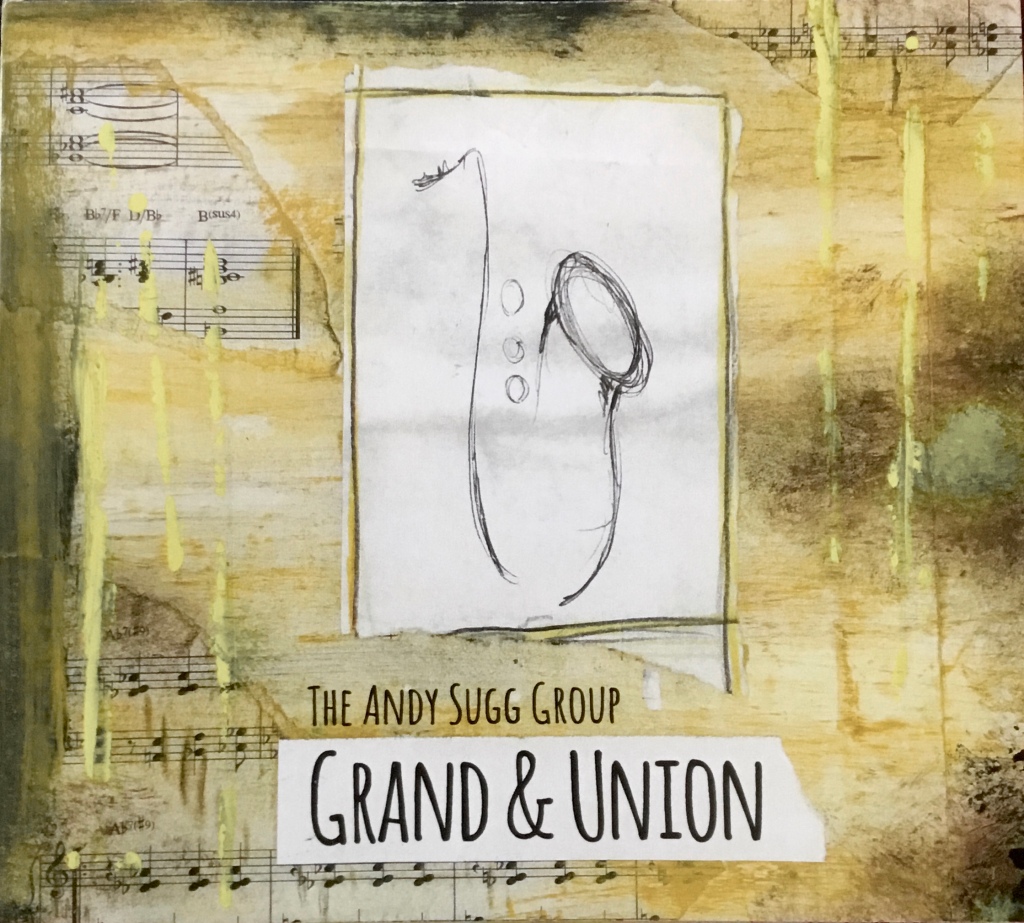


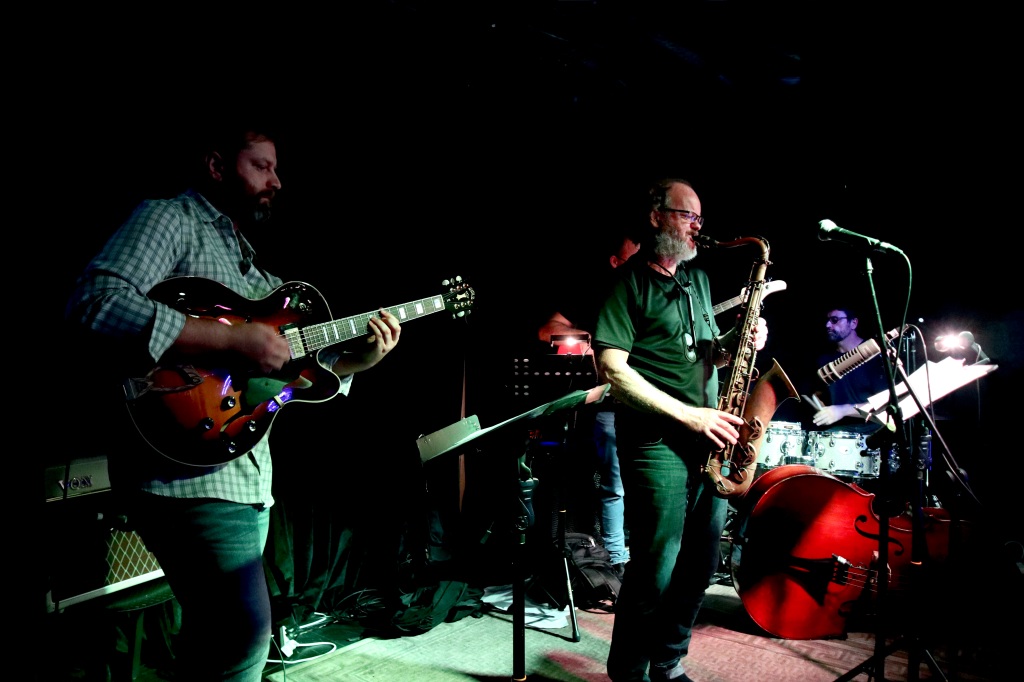

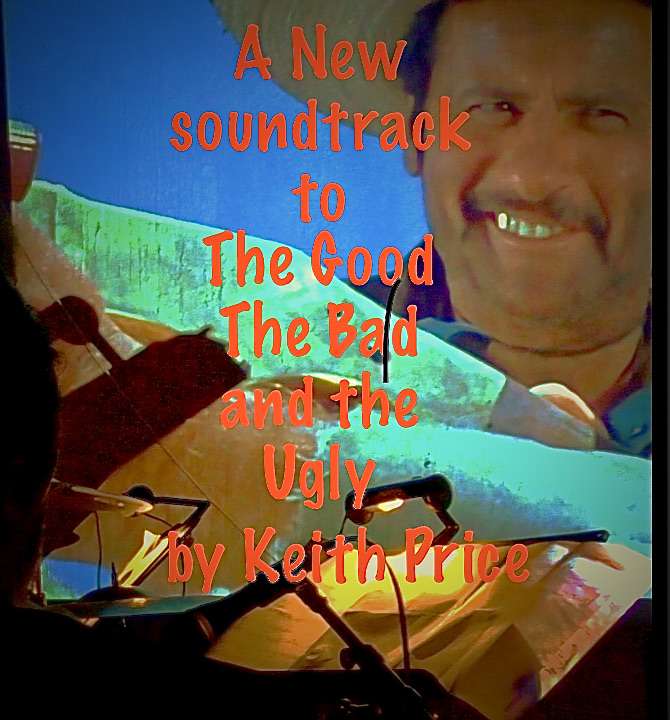
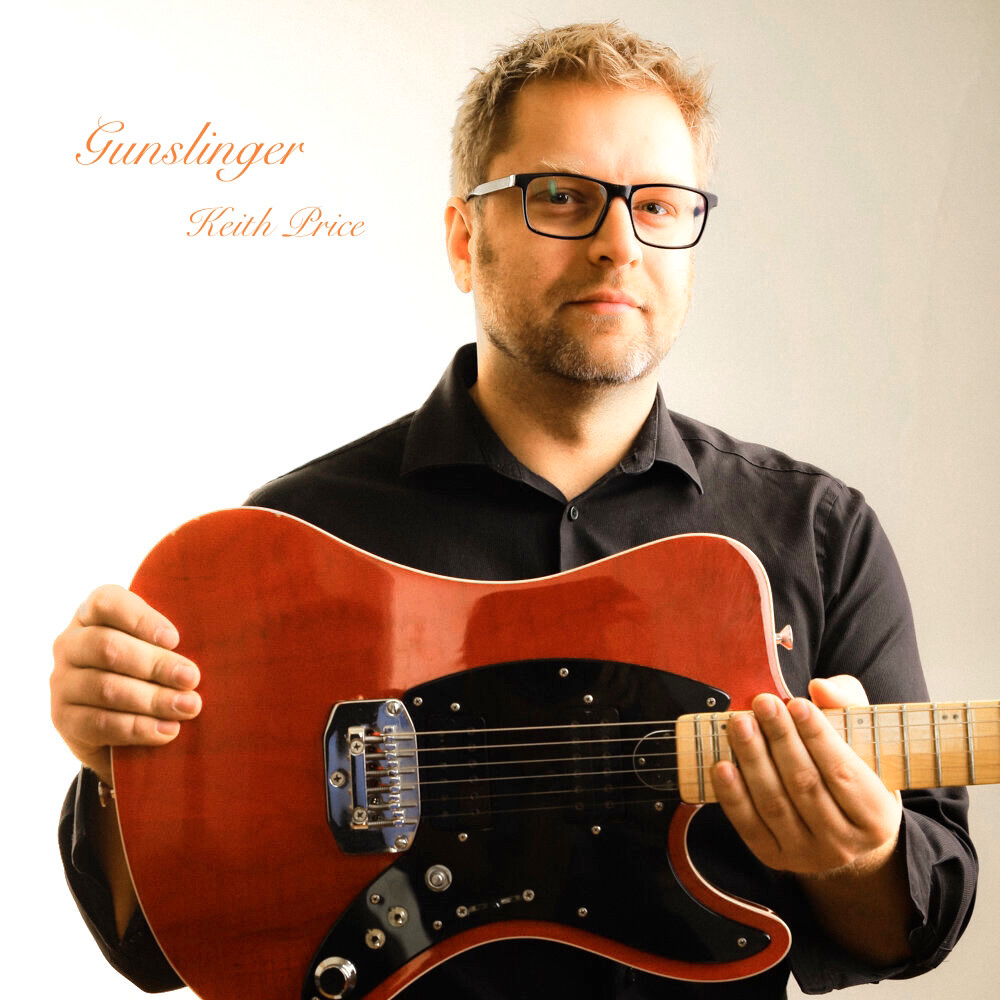
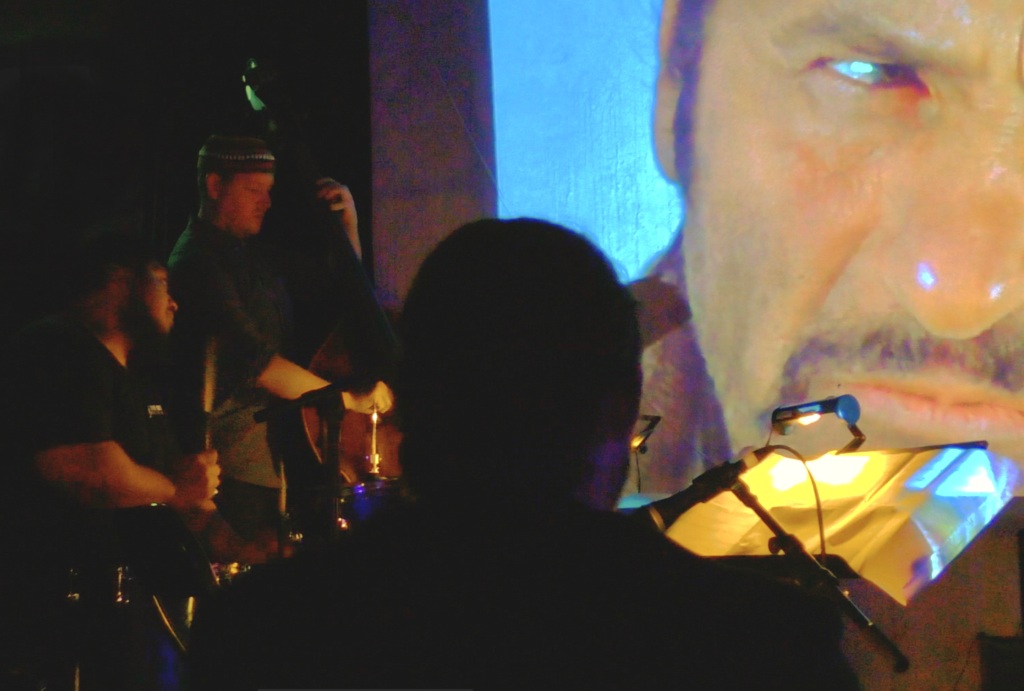

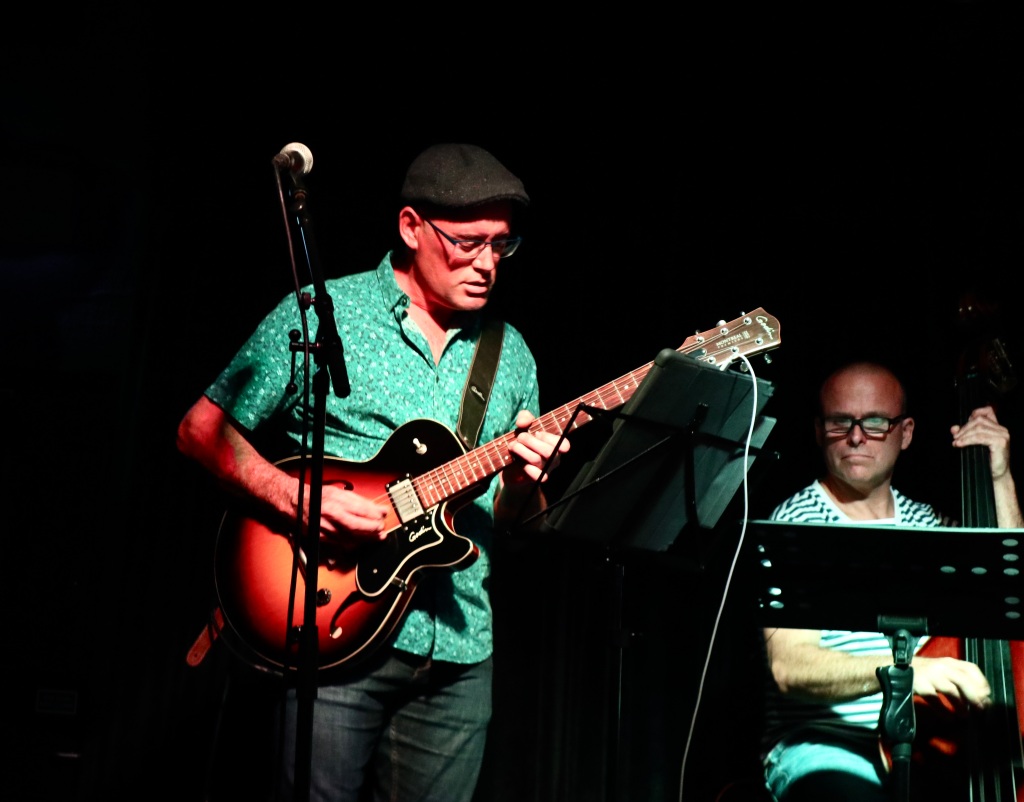


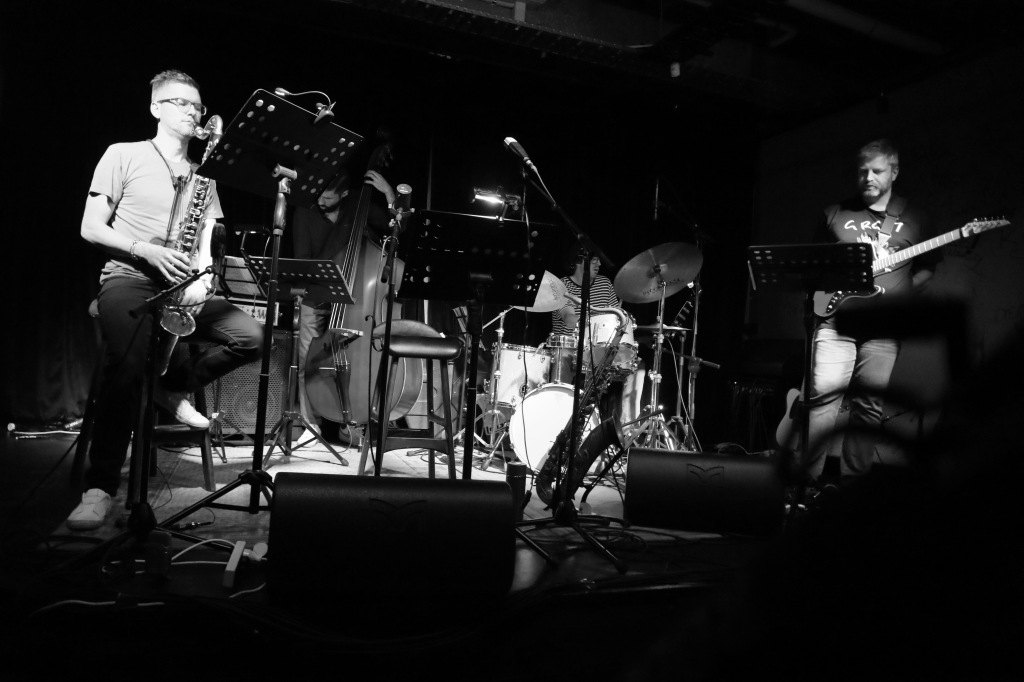
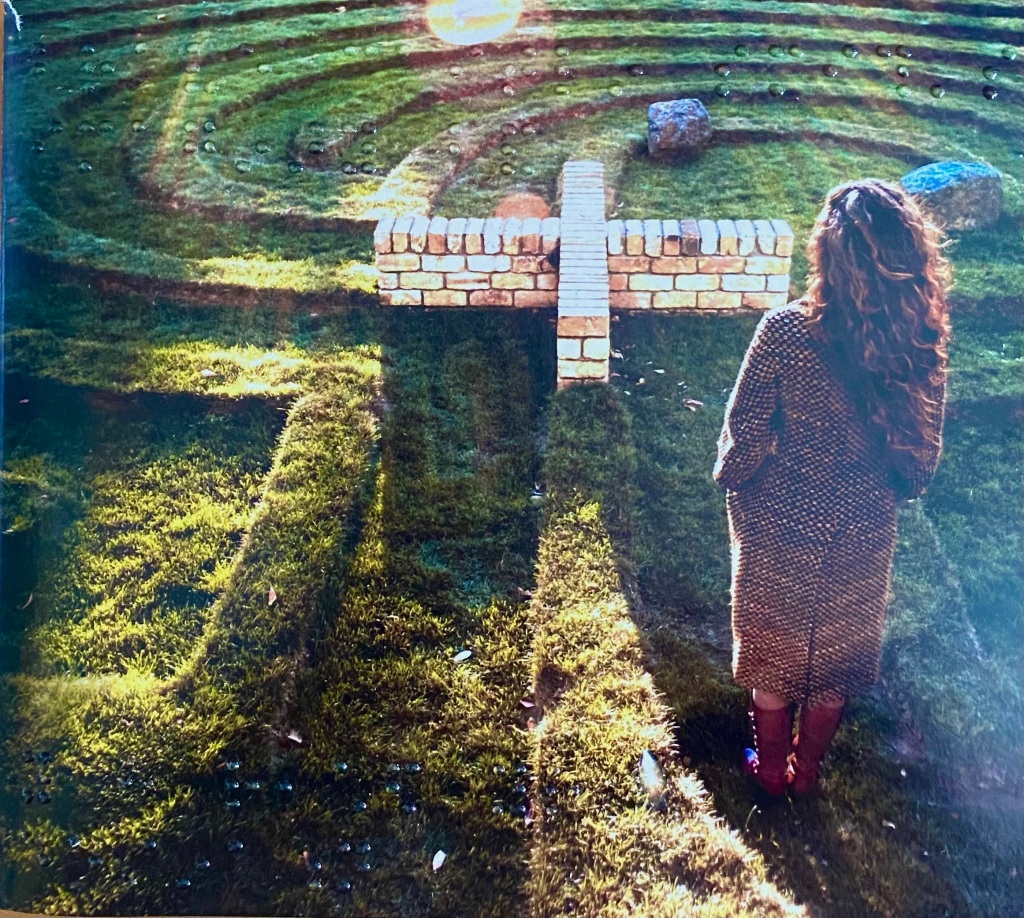
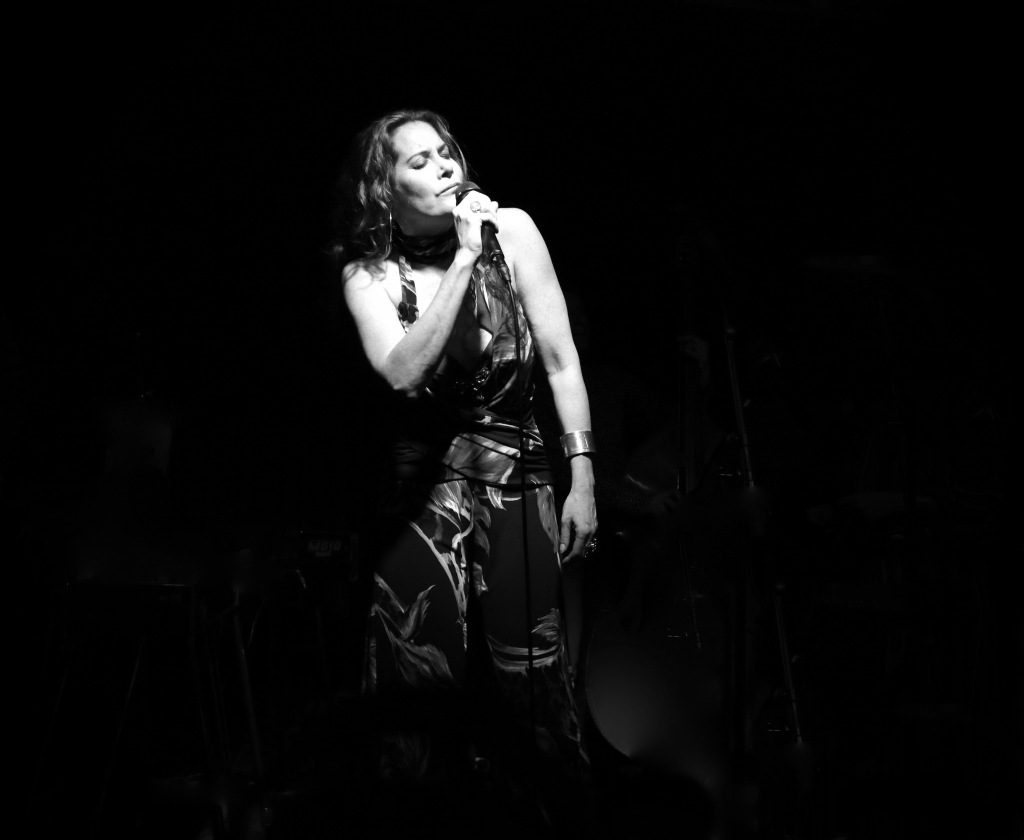
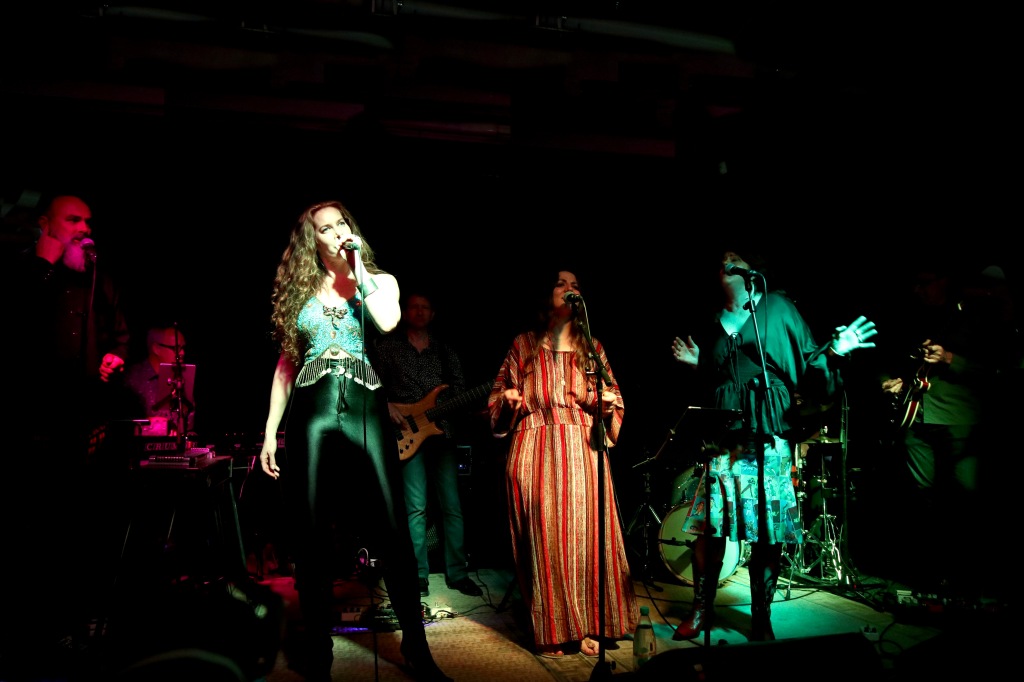
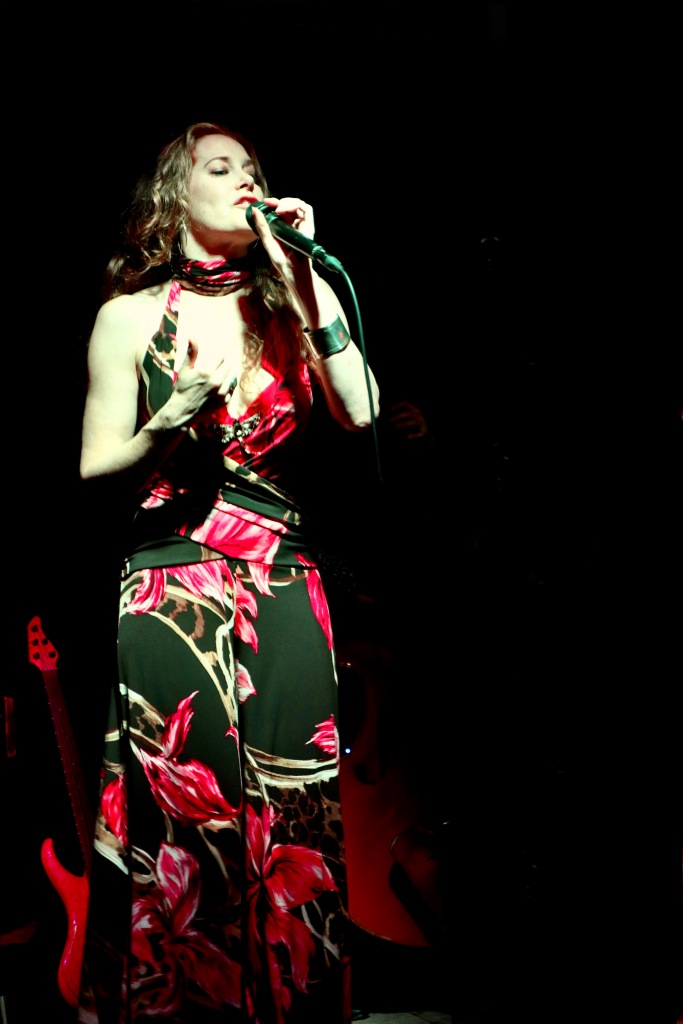


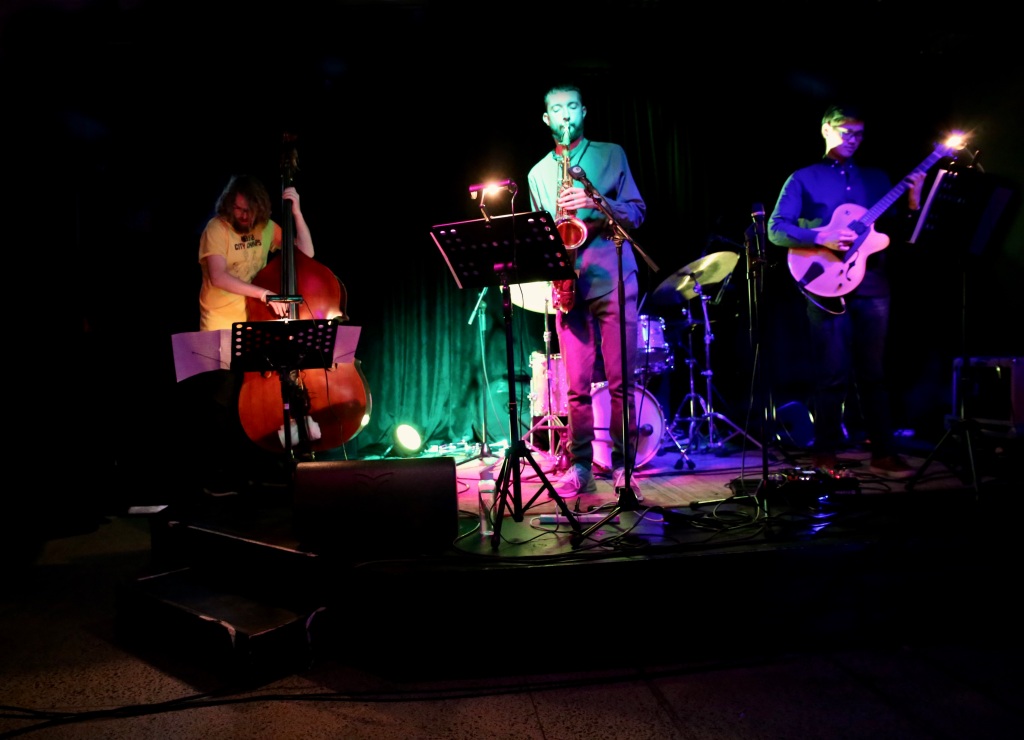
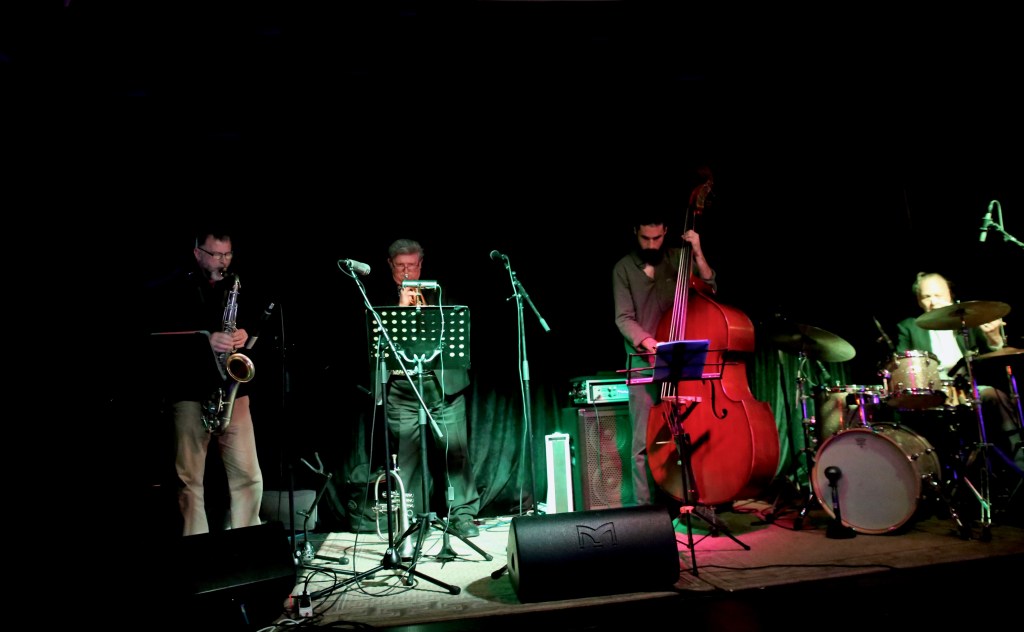
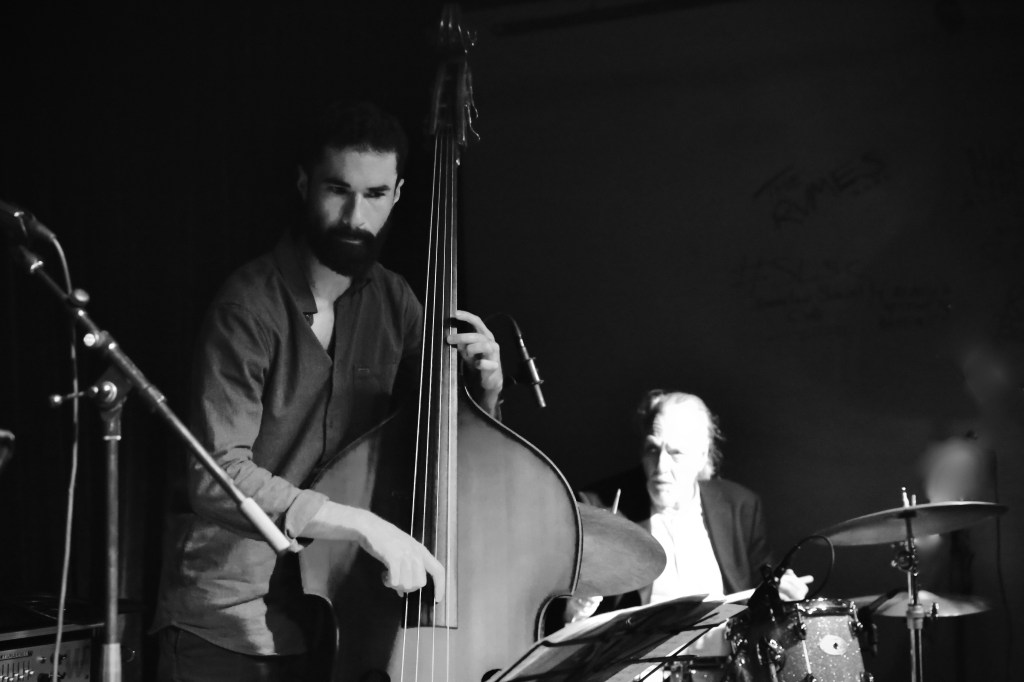
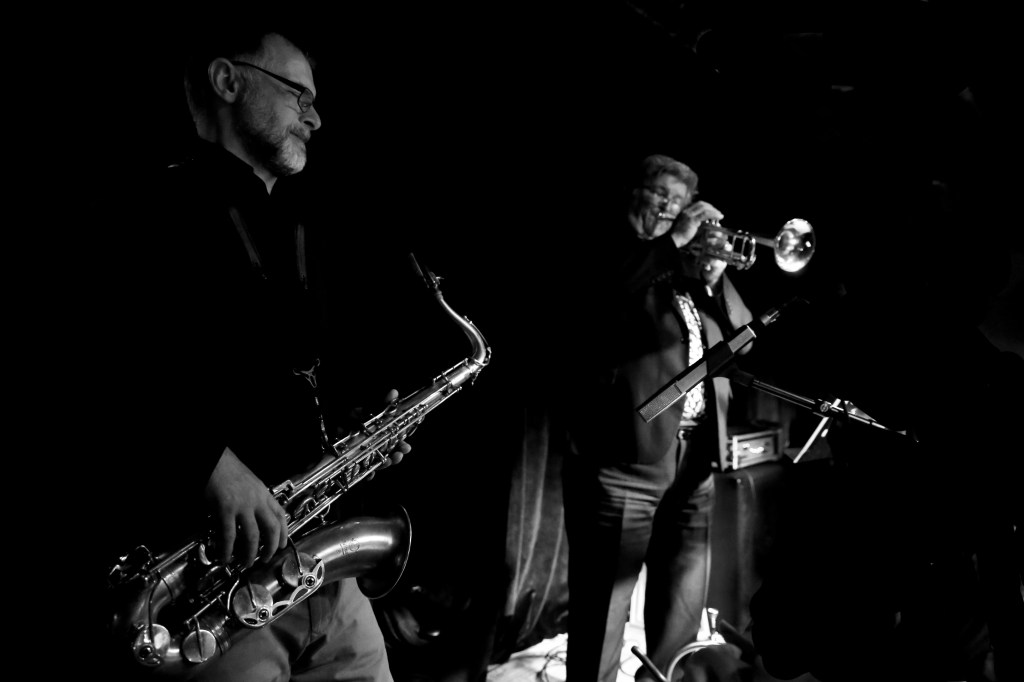
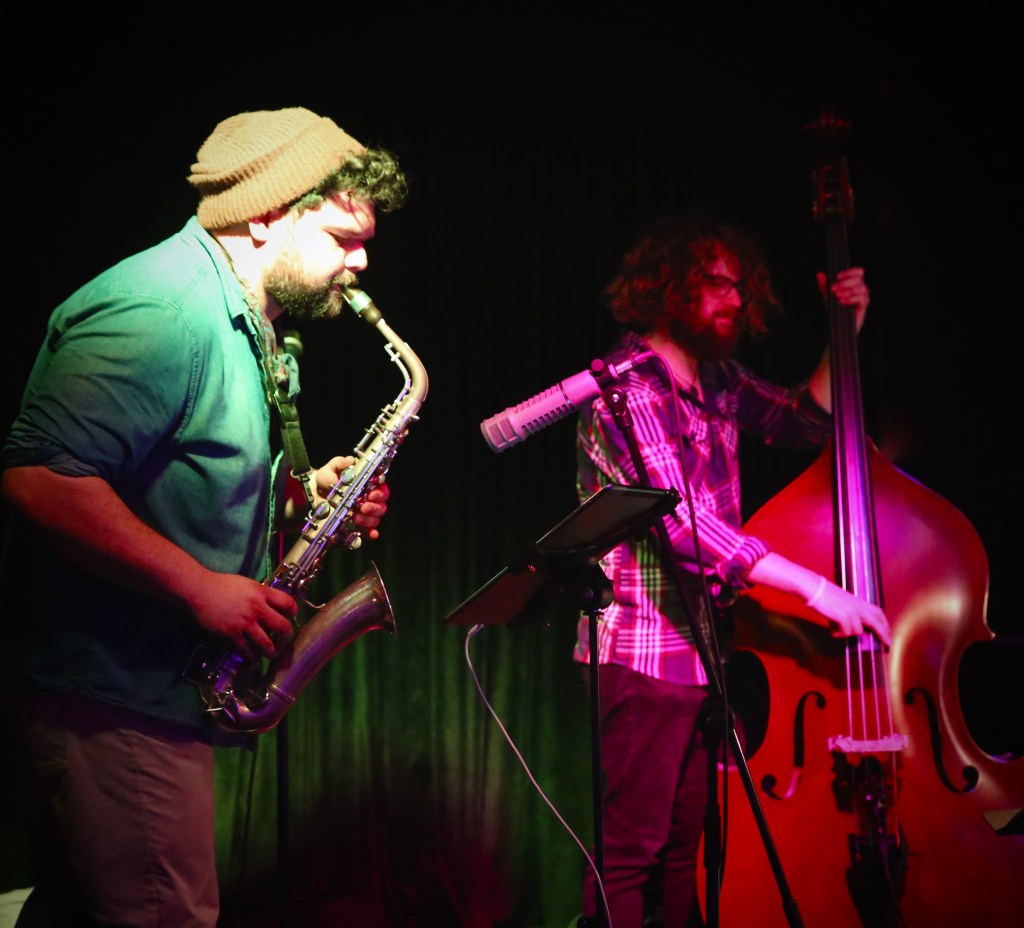
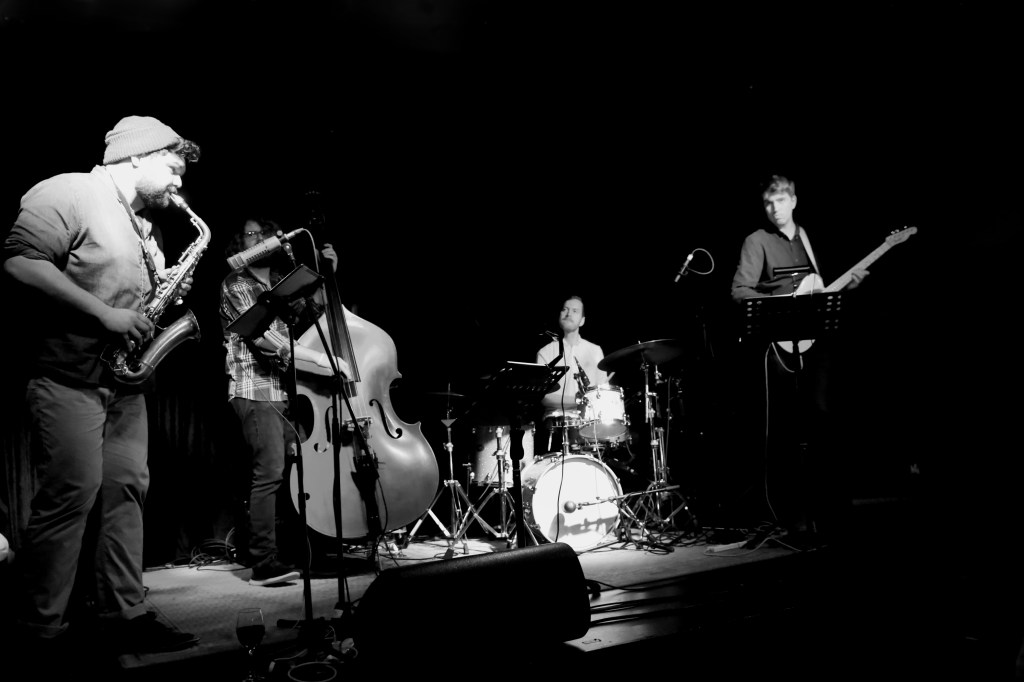


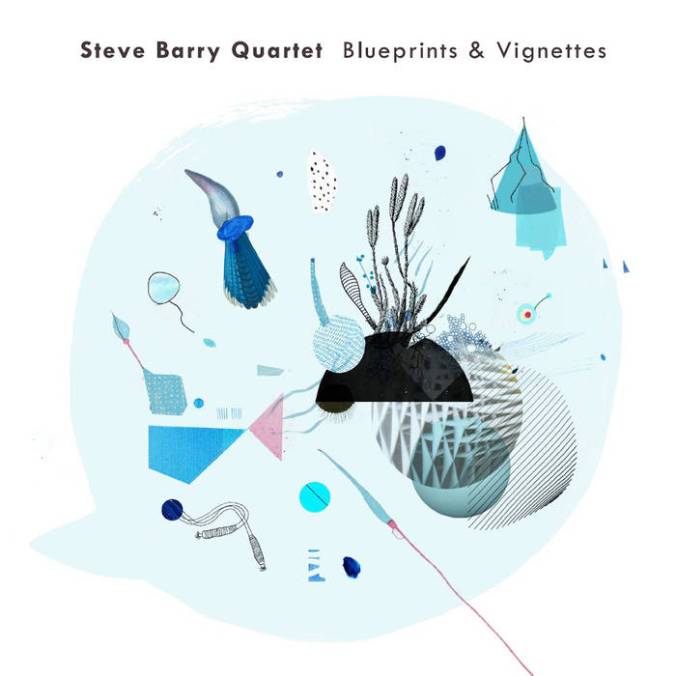
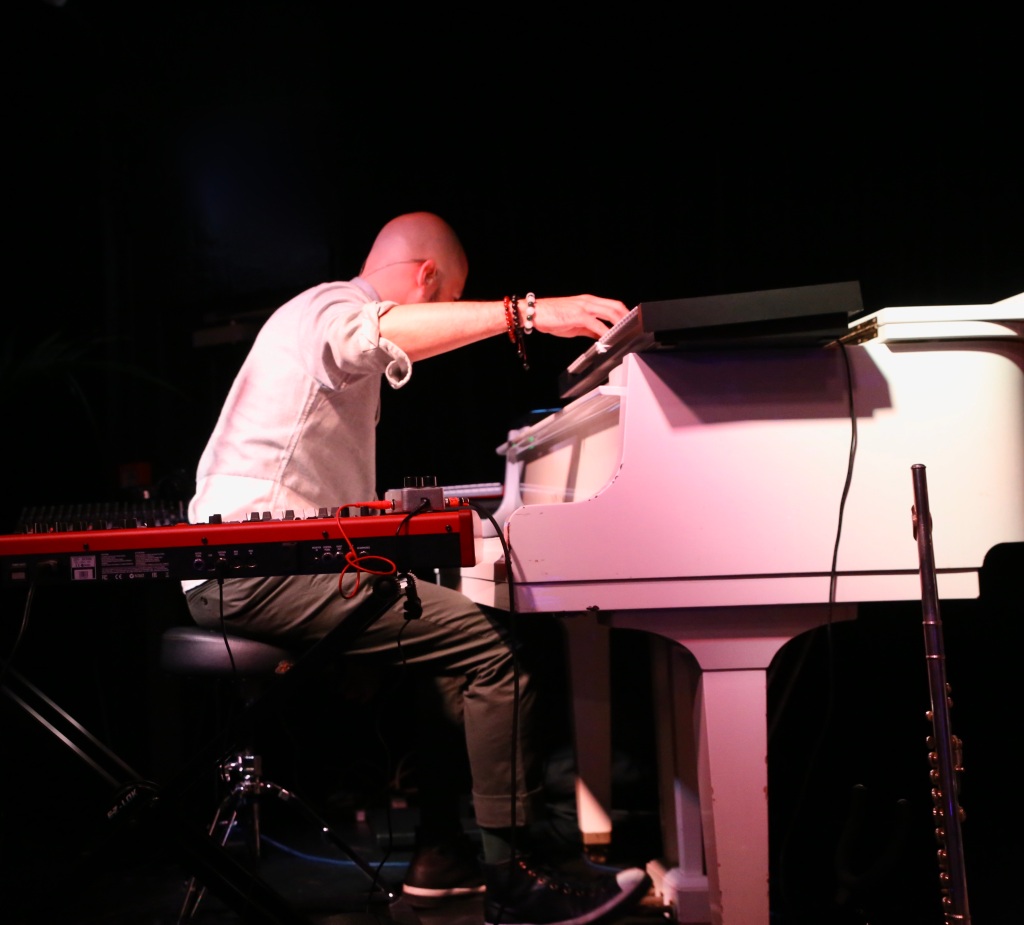
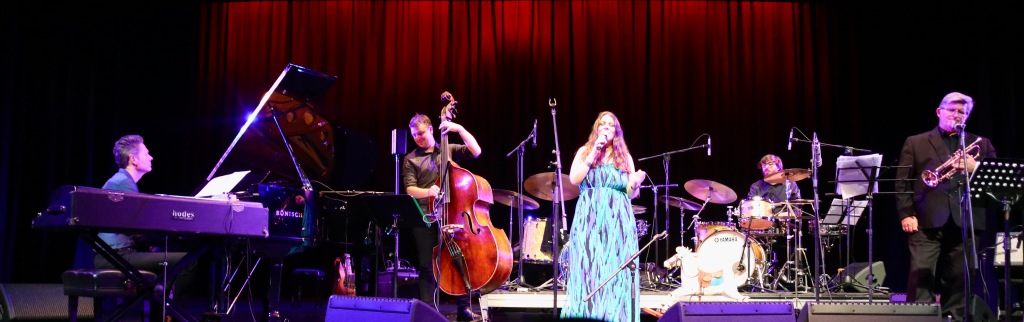
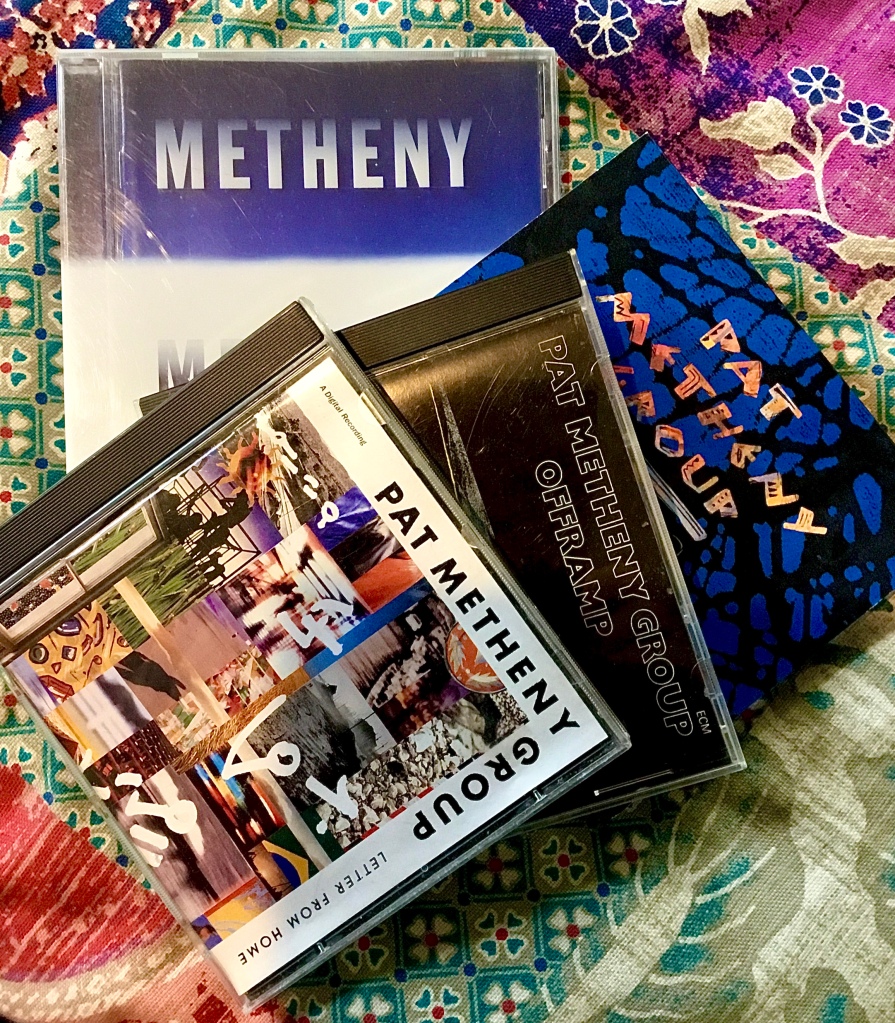
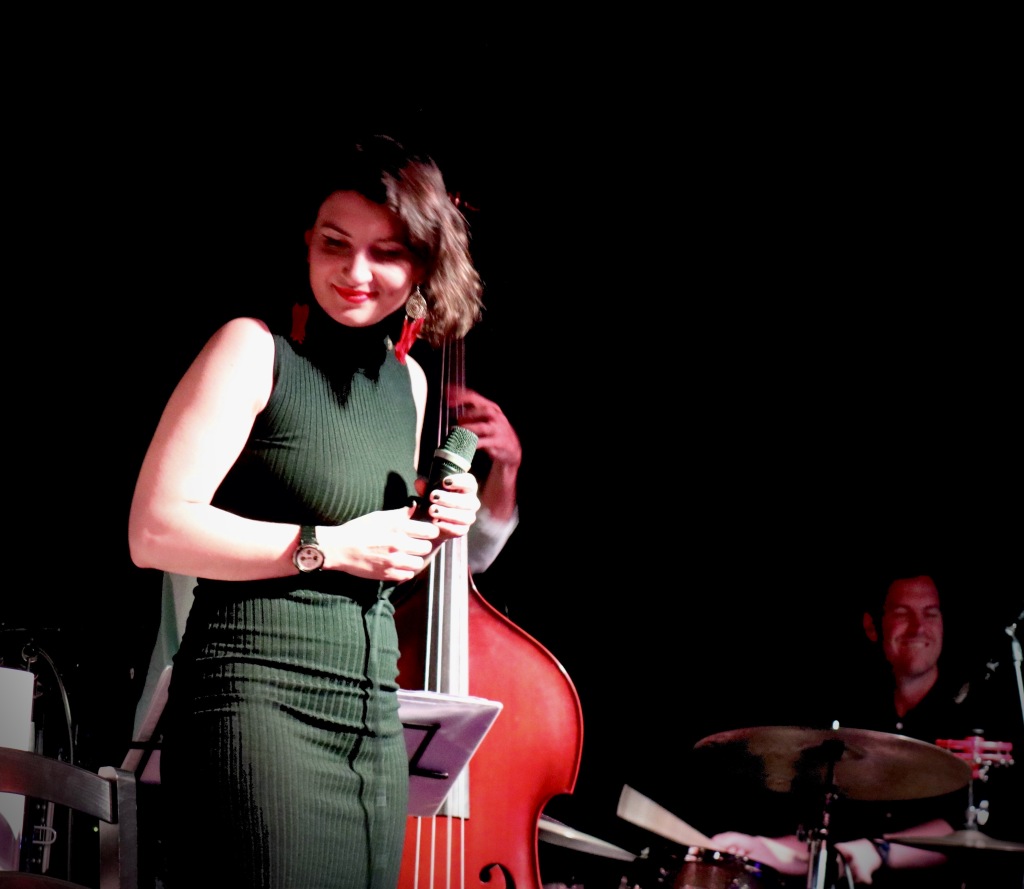
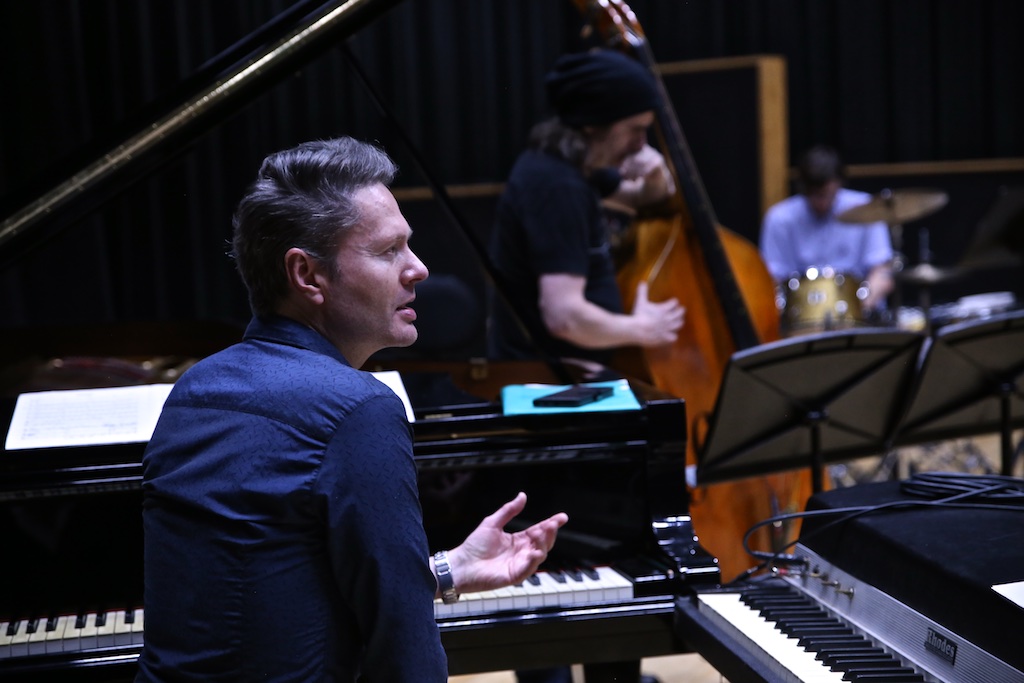 Have you ever heard one of New Zealand’s iconic pop songs and wondered how it would sound reimagined as Jazz? The journey from popular song to Jazz piece is a well-trodden path. Many tunes that we now refer to as ‘Jazz standards’ began their life as tunes written for broadway musicals or for the popular music market. For a tune to successfully cross that divide it needs to be well constructed and to lend itself to reharmonisation. With ‘Alchemy’, this elusive symmetry is realised.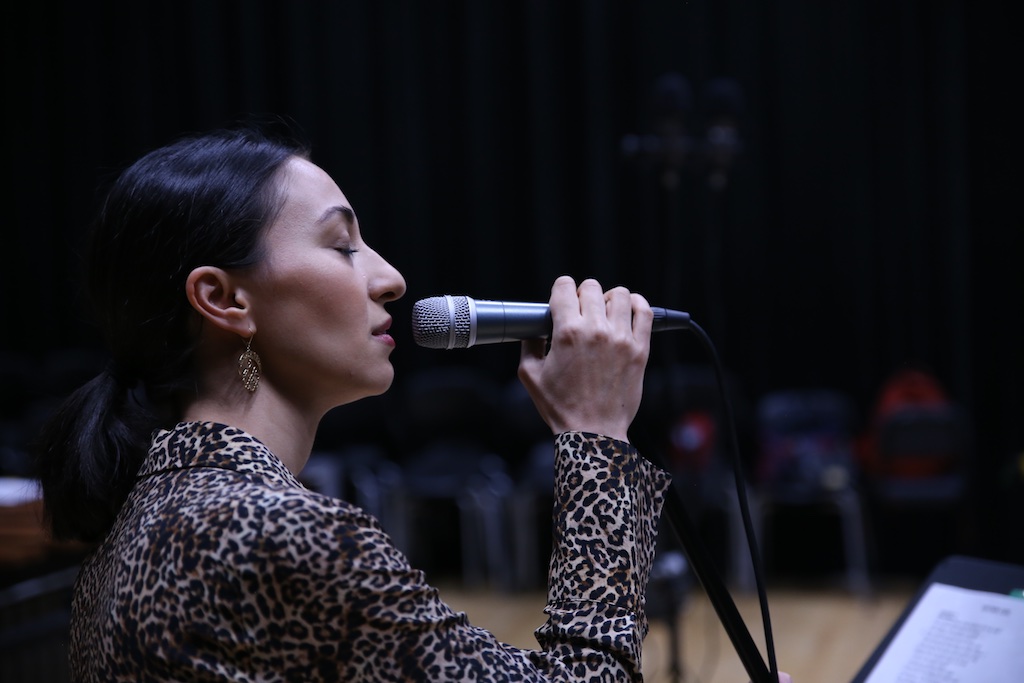
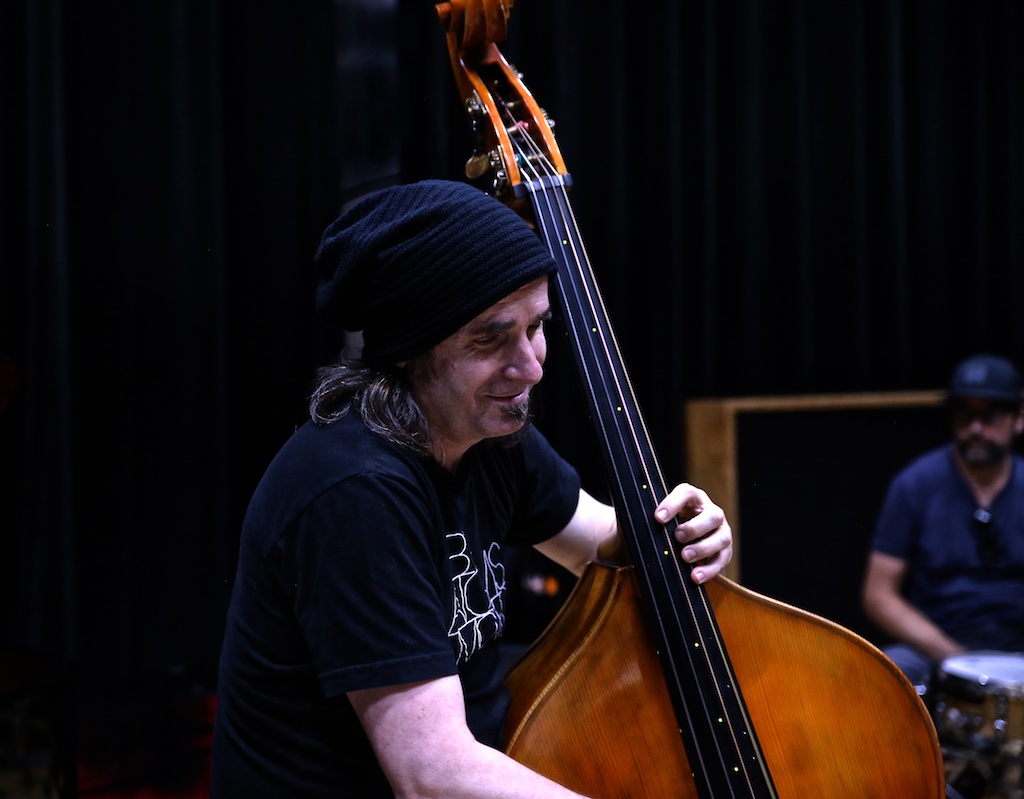
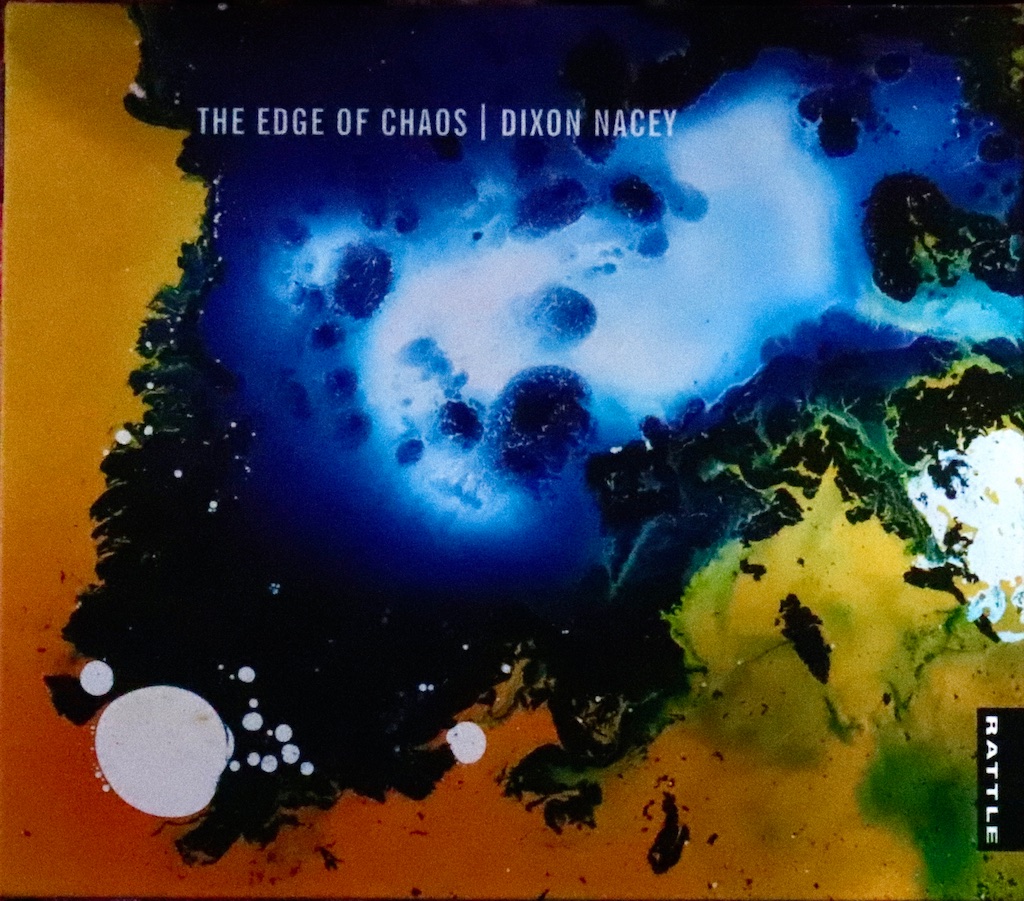 This Dixon Nacey album has long been anticipated and although Nacey has previously recorded as co-leader, this is the first album to be released exclusively under his name. Nacey is firmly on the radar of Jazz loving Kiwis, but his fan base extends well beyond that. He is a professional musician of considerable standing, an in-demand teacher and in recent years the musical director of CocaCola Christmas in the Park. To up and comers he is a guitar legend and on this album, they have something to aspire to; twenty years of experience distilled into excellence.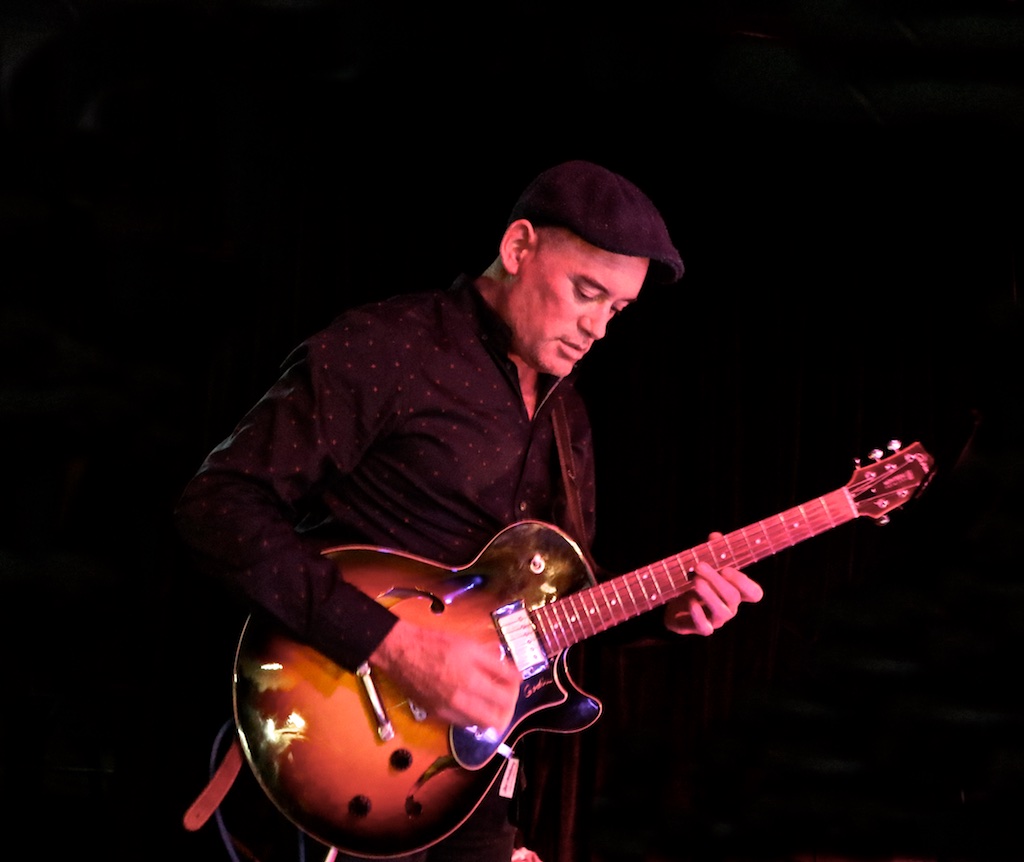
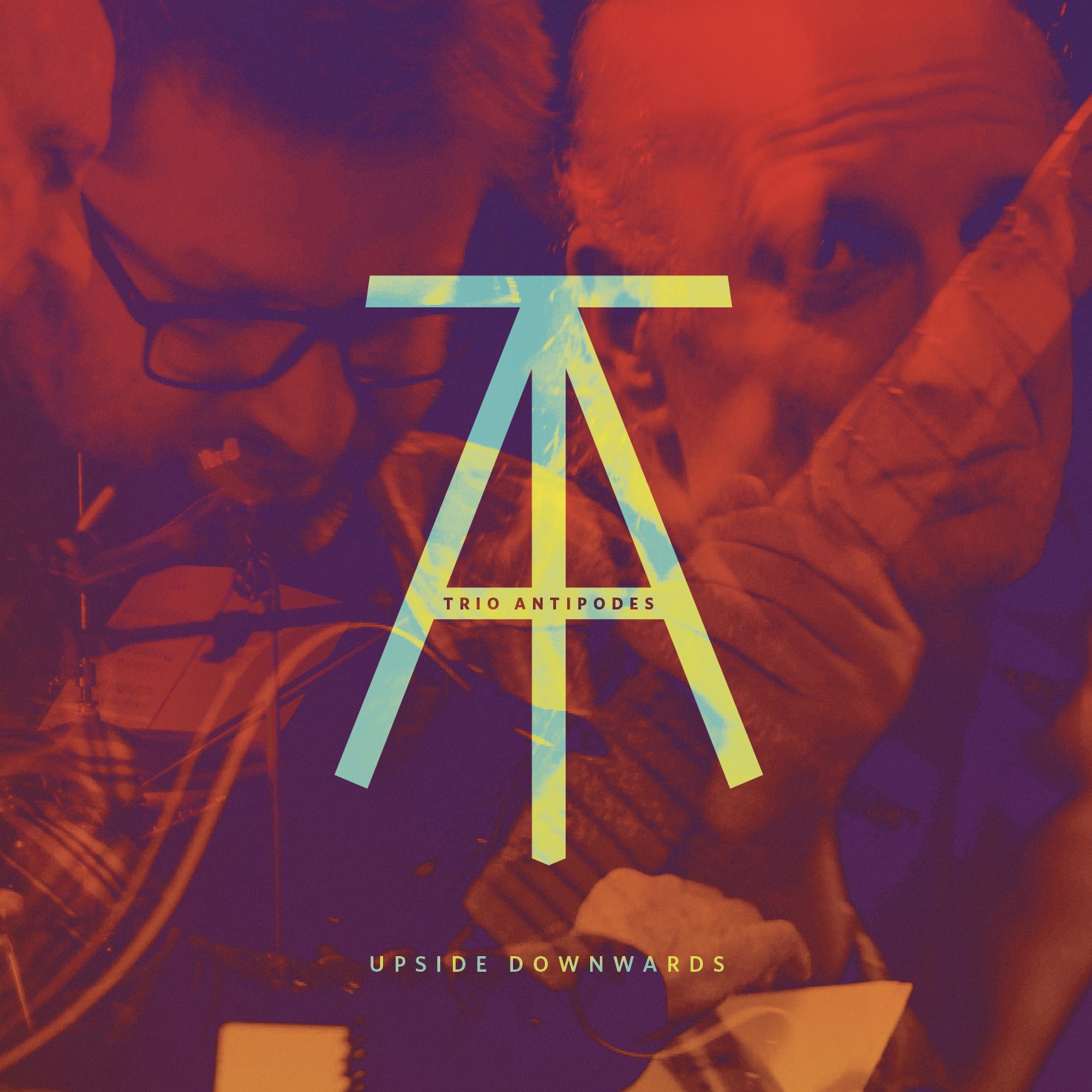 Canadian Jazz guitarist Keith Price is a welcome addition to the Auckland scene. He brings with him fresh ideas and a musical connection to his hometown. Manitoba is associated with Lenny Breau and Neil Young who both grew up there. Perhaps it’s the proximity to the open spaces which echo in the music, that wide-open sound (and in Young’s case an overlay of dissonant melancholia)? Whatever it is, it certainly produces distinctive musicians. Lenny Breau is an important Jazz guitarist and one who is sadly overlooked, Hearing Price’s respectful acoustic homage on Wednesday, cast my ears in that direction again.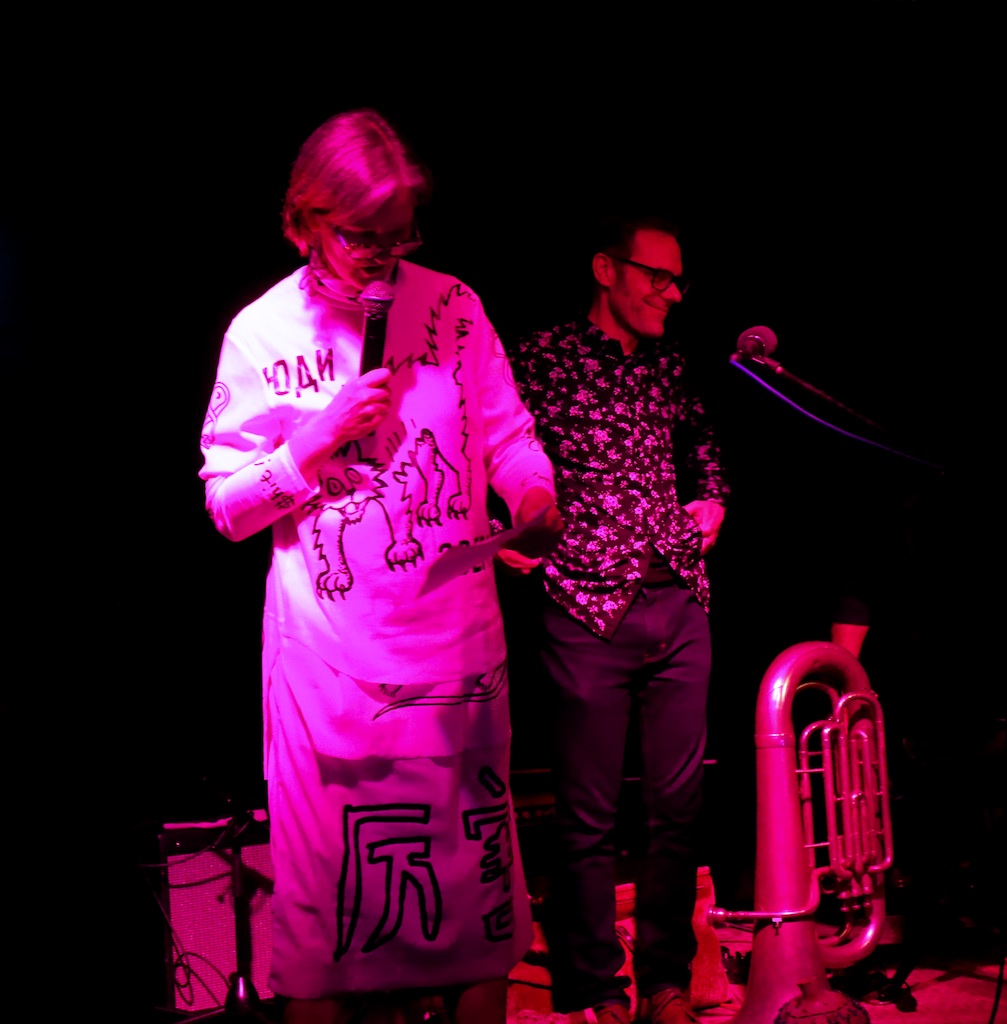

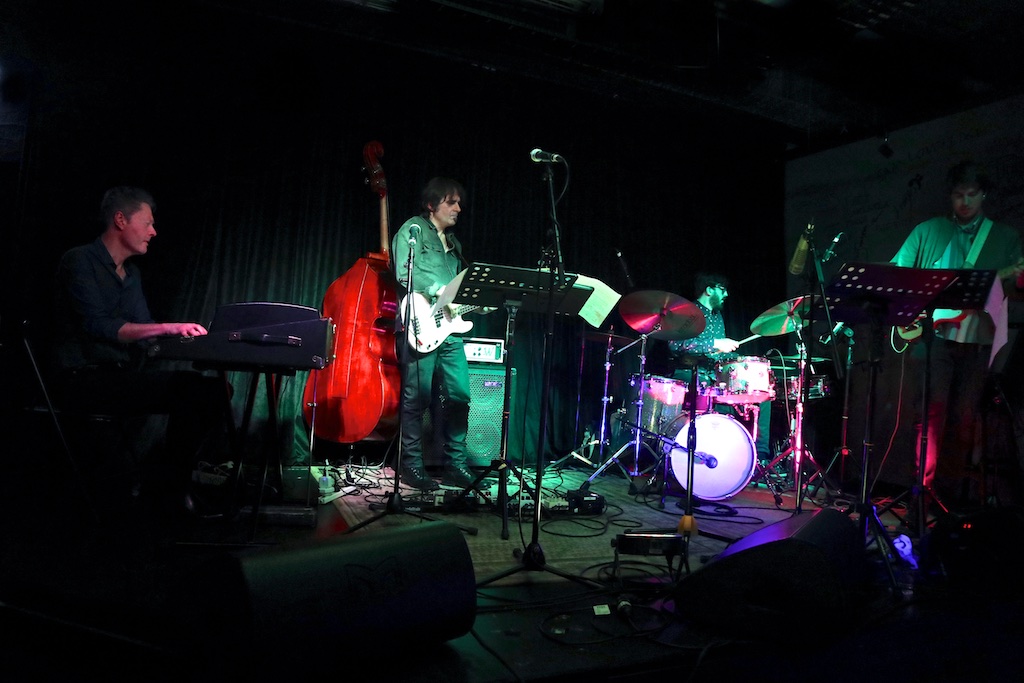 Subject to availability, Richard Hammond is the kind of bass player that you would consider first for an important gig or recording.
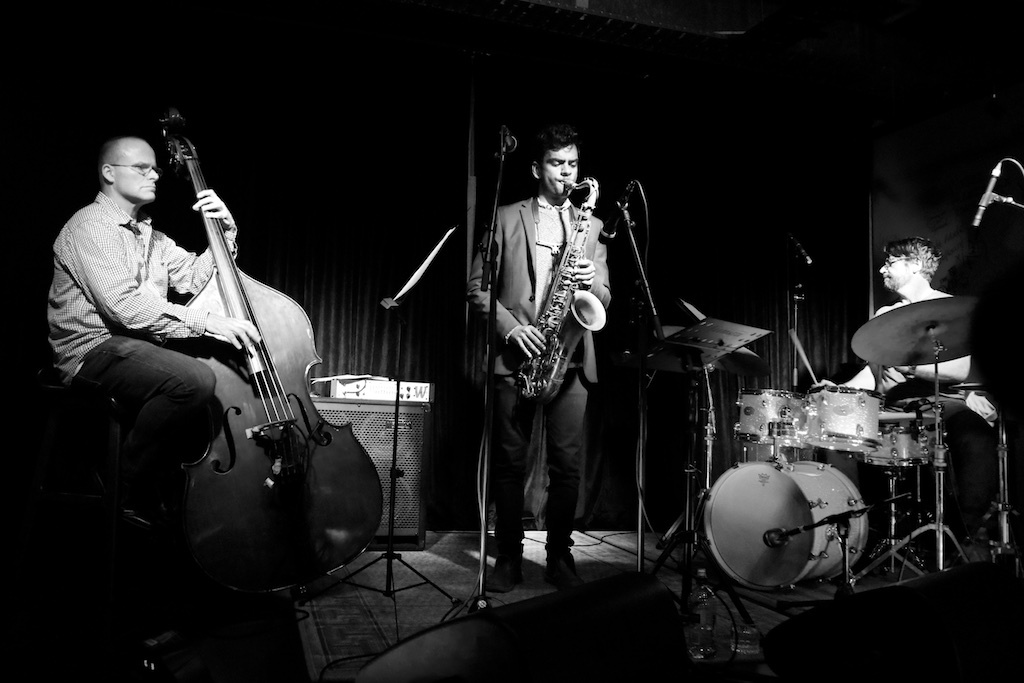 It was four years ago and almost to the day, that Kushal Talele was last at the CJC. Then, as now, he had just returned from a long period overseas. I heard him for the first time then and I was impressed. That was in the cellar of the 1885, a place now a fond but distant memory. A few days ago he returned to the CJC and although he played with a different band, his unmistakeable upwards trajectory was evident. There is nothing unduly flashy about Talele as he radiates calm and absorption. At the microphone, he talks quietly, but there is passion in those subdued tones.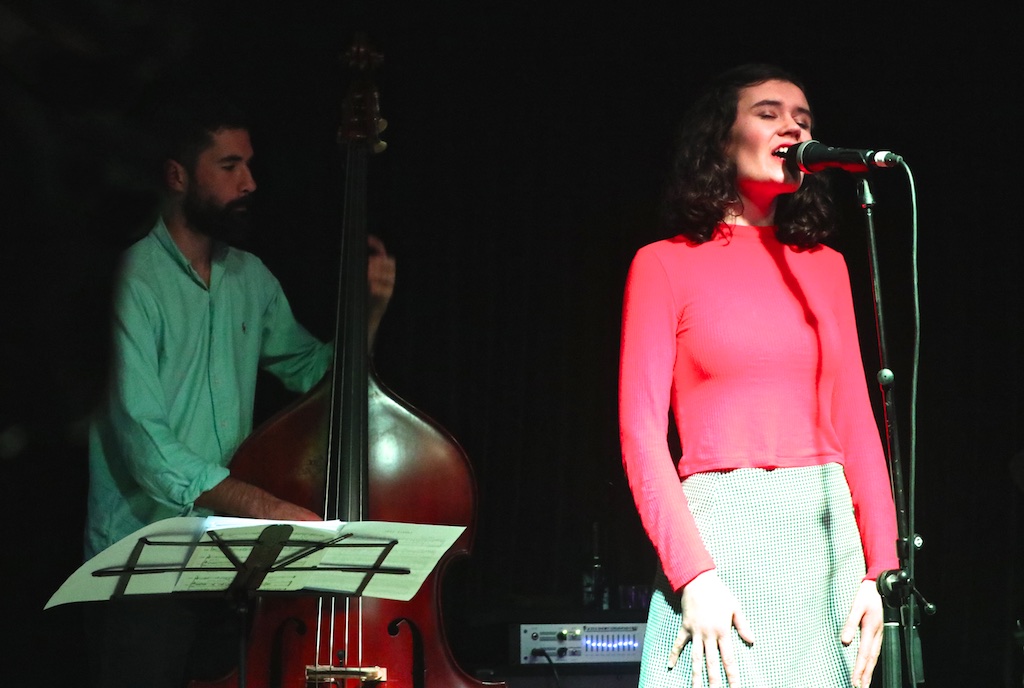

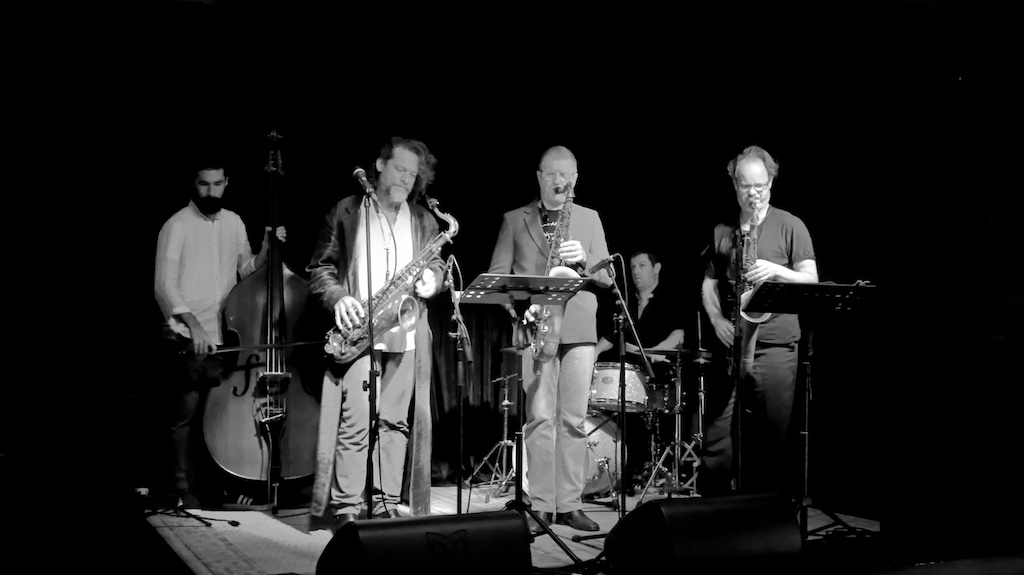 Andy Sugg’s collaborative album ‘TTTenor’ was cut in Melbourne back in 2006 and rightly, it has garnered praise. In a land of significant horn-players, the tenor triumvirate of Sugg, Oehlers, and Wilson was a standout. Three gifted saxophonists who capitalised on the imaginative charts to showcase their formidable skills. Completing the original sextet was an immaculate rhythm section – Paul Grabowsky (piano), Gary Costello (bass) and Andrew Gander (drums). Since then, Sugg has recorded other albums like ‘The John Coltrane Project’ ‘The Berlin Session’ ‘Brunswick Nights’ ‘Wednesday at M’s’ and ‘Tenorness’.
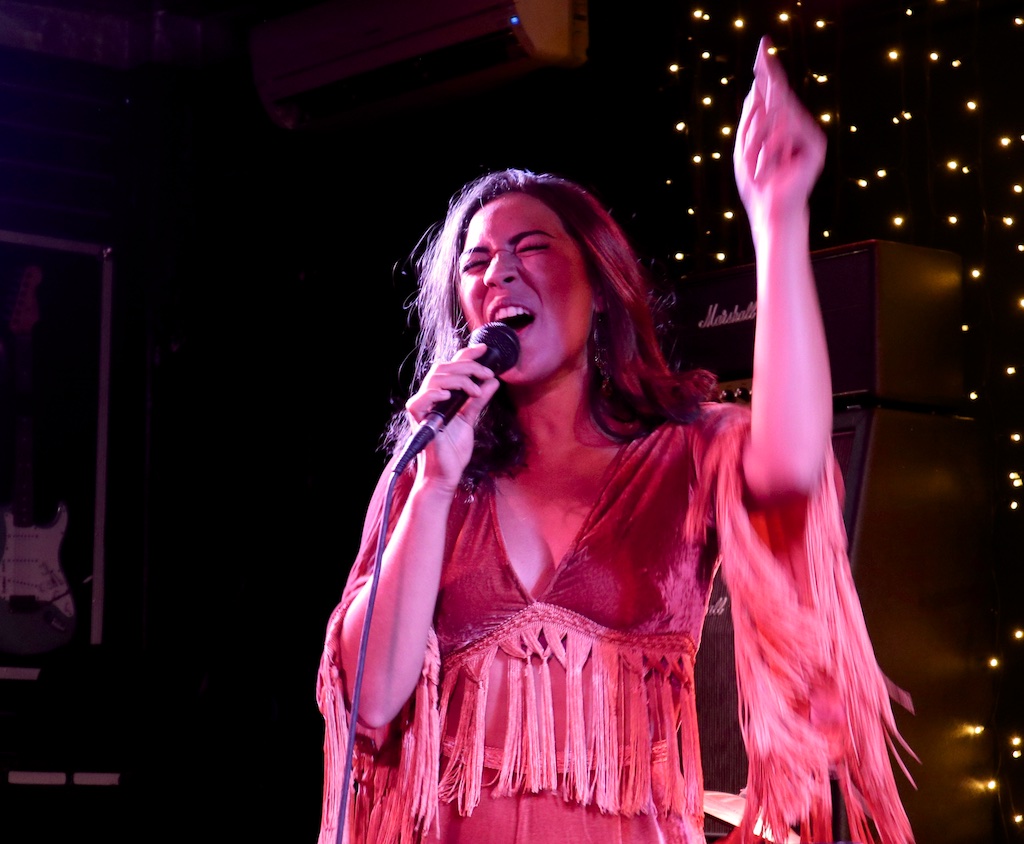 Lou’ana is a vocalist on route to wider recognition. During the last few years she has been performing at festivals throughout the country and she is billed to appear at the Waiheke Jazz Festival this month.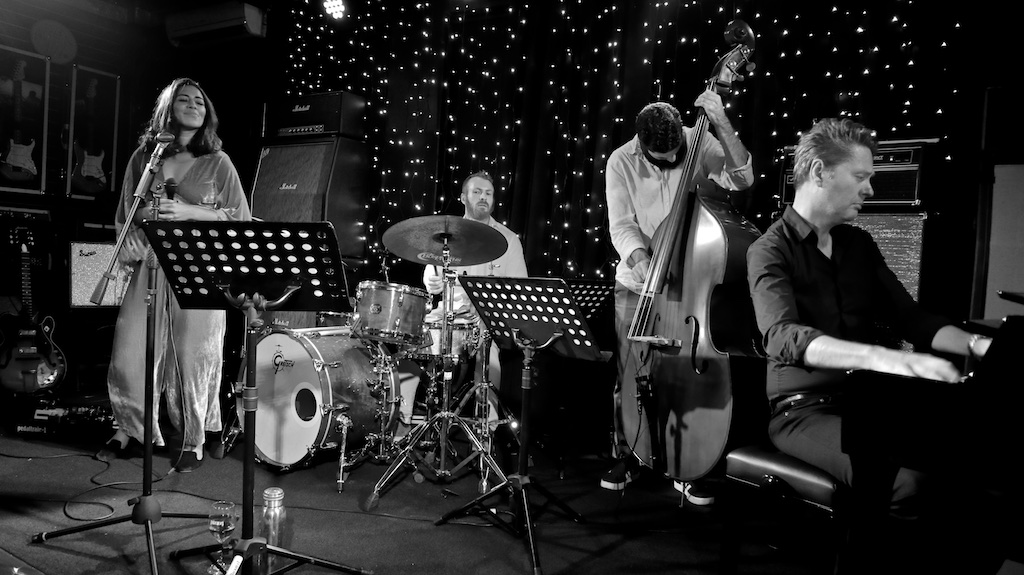
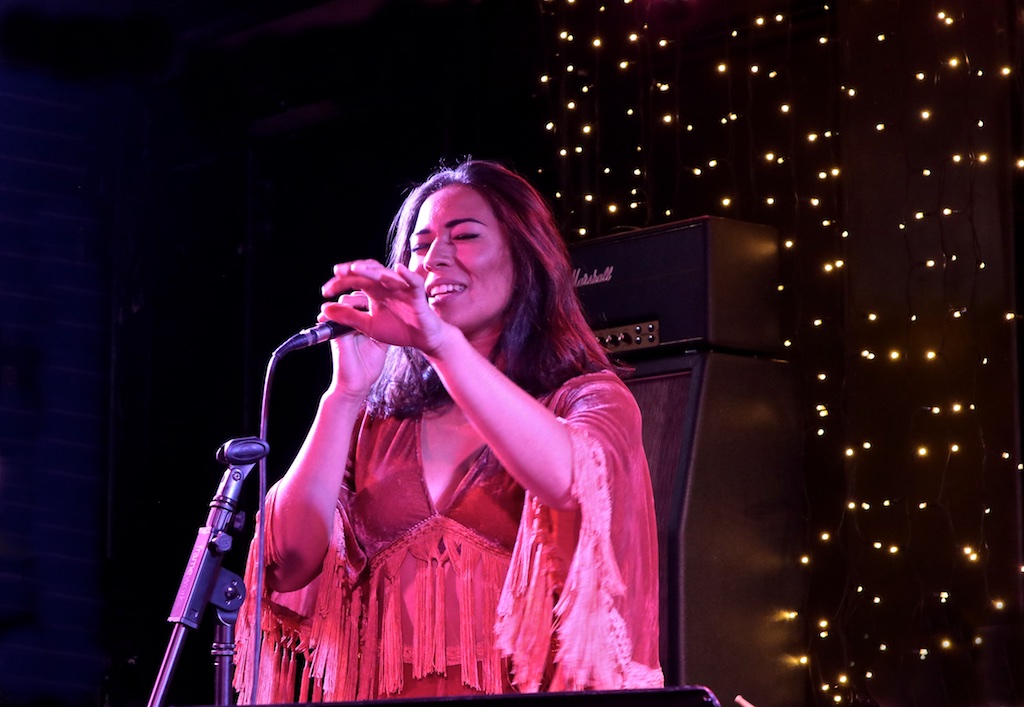
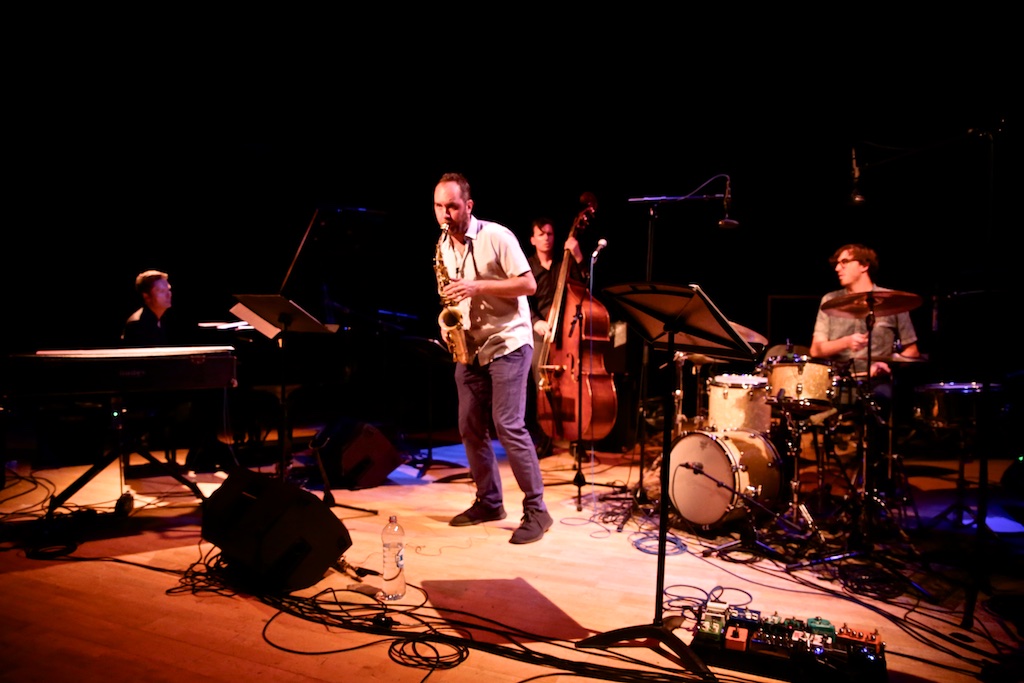
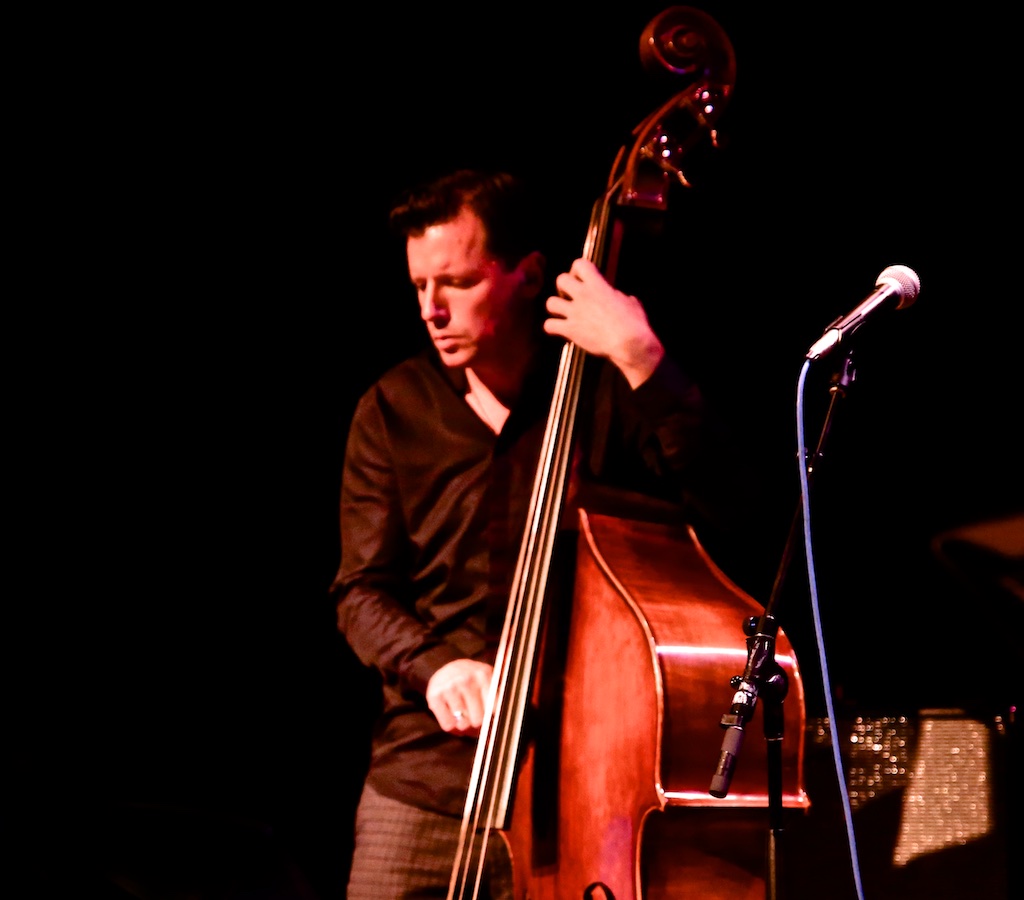
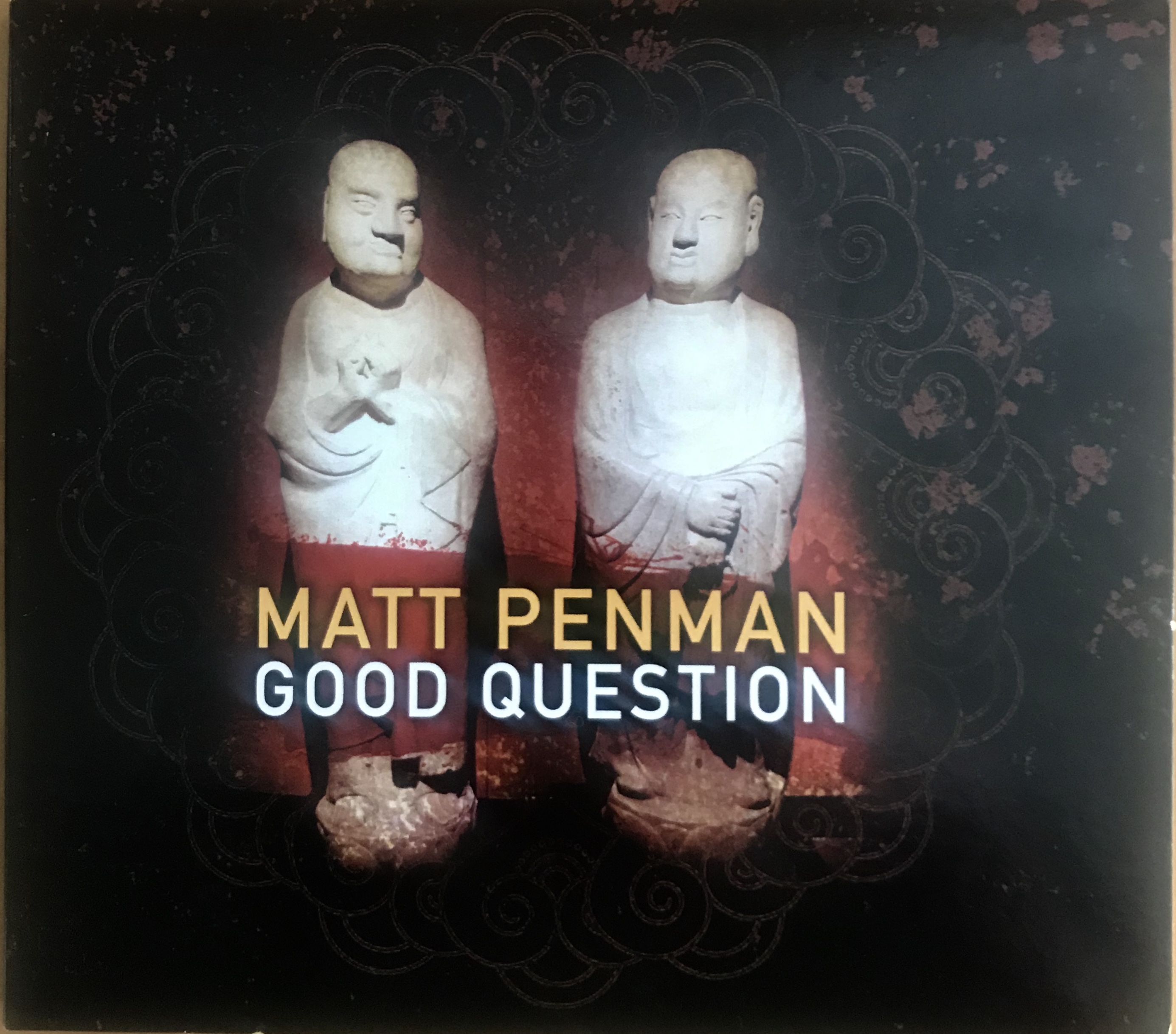
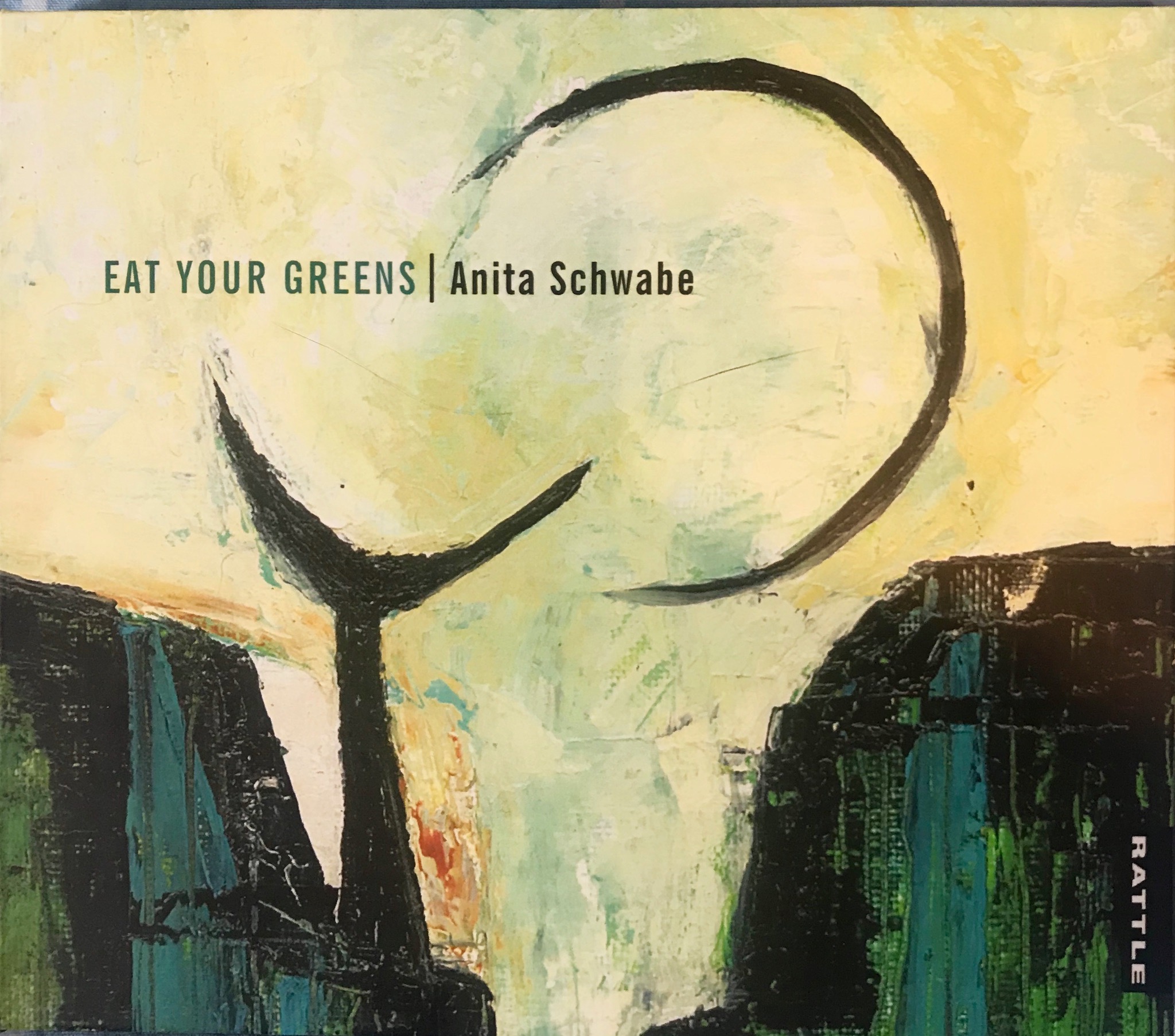 ‘Eat Your Greens’ is an album by to the popular Wellington pianist and educator Anita Schwabe. It was recorded at the UoA Kenneth Myers Centre in Auckland during her recent tour. Her band also performed live before a capacity audience at Auckland’s CJC Creative Jazz Club and it was immediately obvious that they were in great form. Schwabe normally plays with Wellington musicians and regularly with the Roger Fox Big Band. The idea of recording in Auckland was formed while sharing gigs with Roger Manins earlier and it was with his assistance that the Kenneth Myers Centre was made available for recording.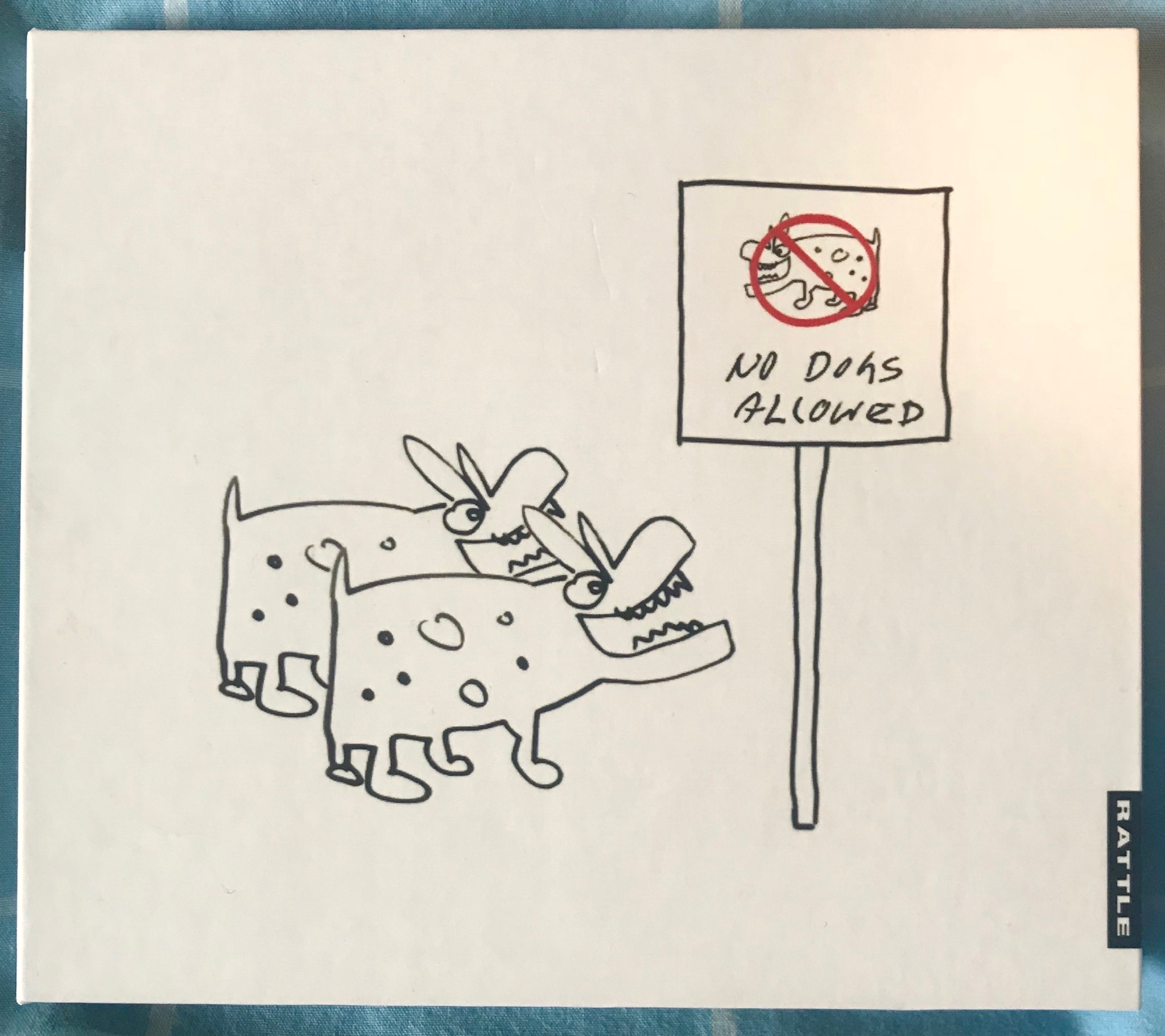
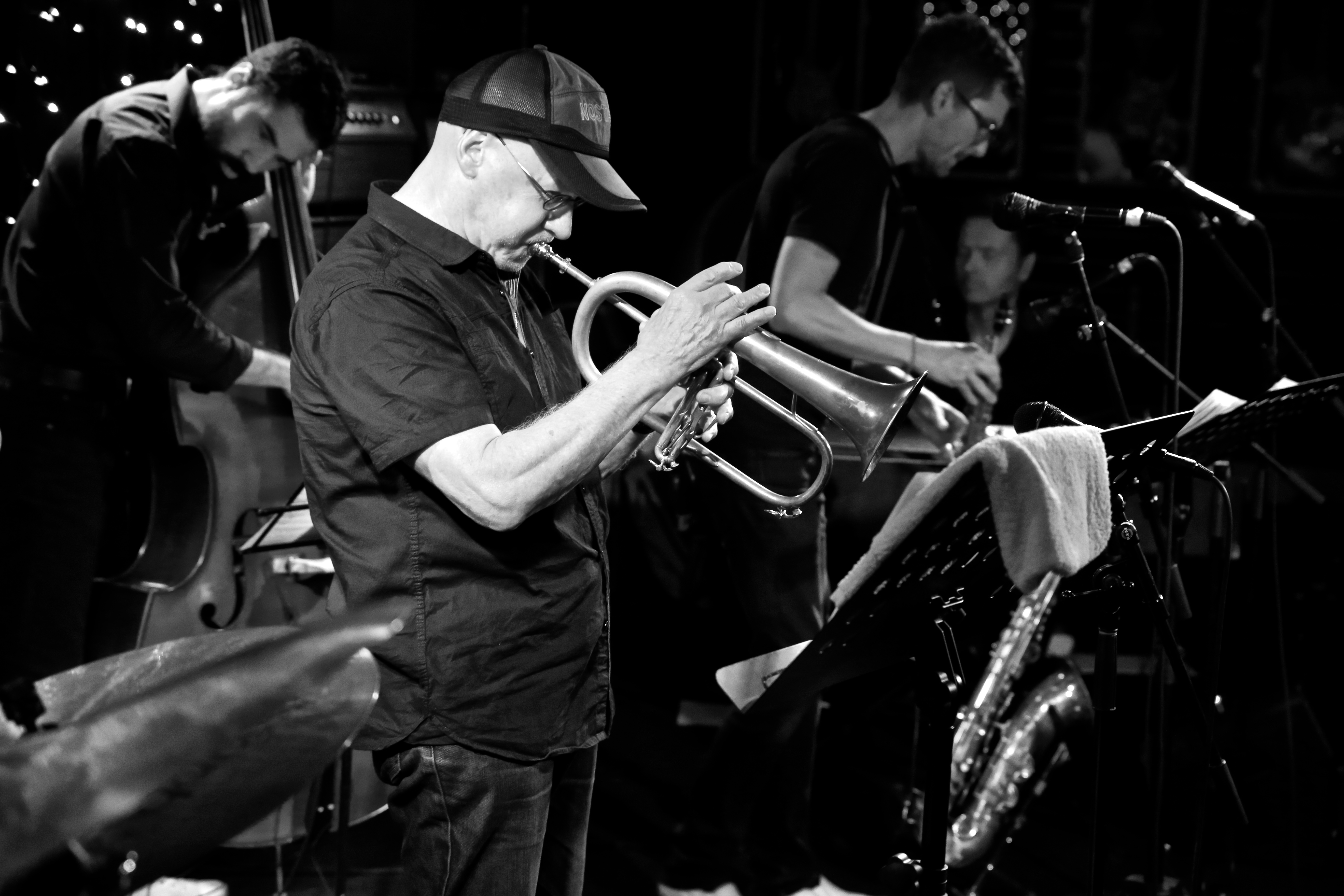 After a long gloomy week of intense storm weather, 200 kph winds, polar darkness and zero electricity, I am finally back in front of my computer. A few days before the storm I was sitting in the warm, well-lit, electricity charged Backbeat Bar and listening to the Kim Paterson Band – by far the preferable option. Jazz trumpeter, Paterson, has been on the New Zealand Jazz scene for as long as I can remember and his name is forever associated with legendary figures like Mick Nock. When I was a teenager I knew many people that he knew and he always seemed to lead an exciting life: gigging in Australia or further afield and travelling to India on a shoestring (our generation regarded that as an essential rite of passage). Out of that rich life experience and long years of devotion to his artform, has come a book of marvellous compositions. These compositions were the focus of his CJC gig and his bandmates gave them the respect they deserved.
 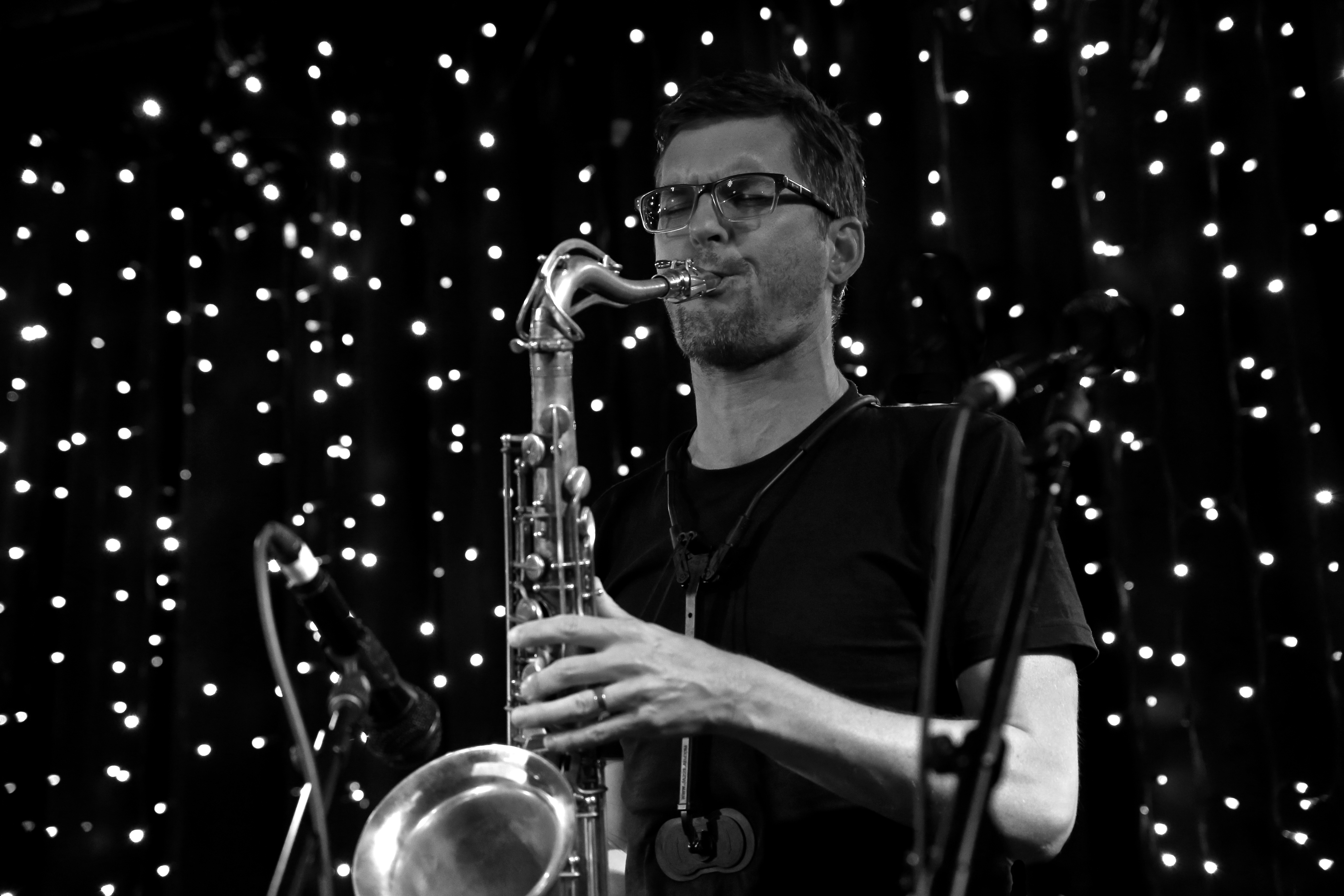 It is hardly surprising that Paterson selected his bandmates well, all experienced musicians and all with a feel for the texturally rich, open-ended compositional structures. I was particularly delighted to see Lewis McCallum on the bandstand, having missed an earlier gig of his and regretting it. He played tenor and soprano and the unmistakable influence of Coltrane’s conceptions shone through. Although not the leader, McCallum was a powerful presence. It was obvious that he regarded this project highly and his guiding hand was repeatedly acknowledged by Paterson. His tone was biting, but not harsh; his ideas were communicated with clarity.
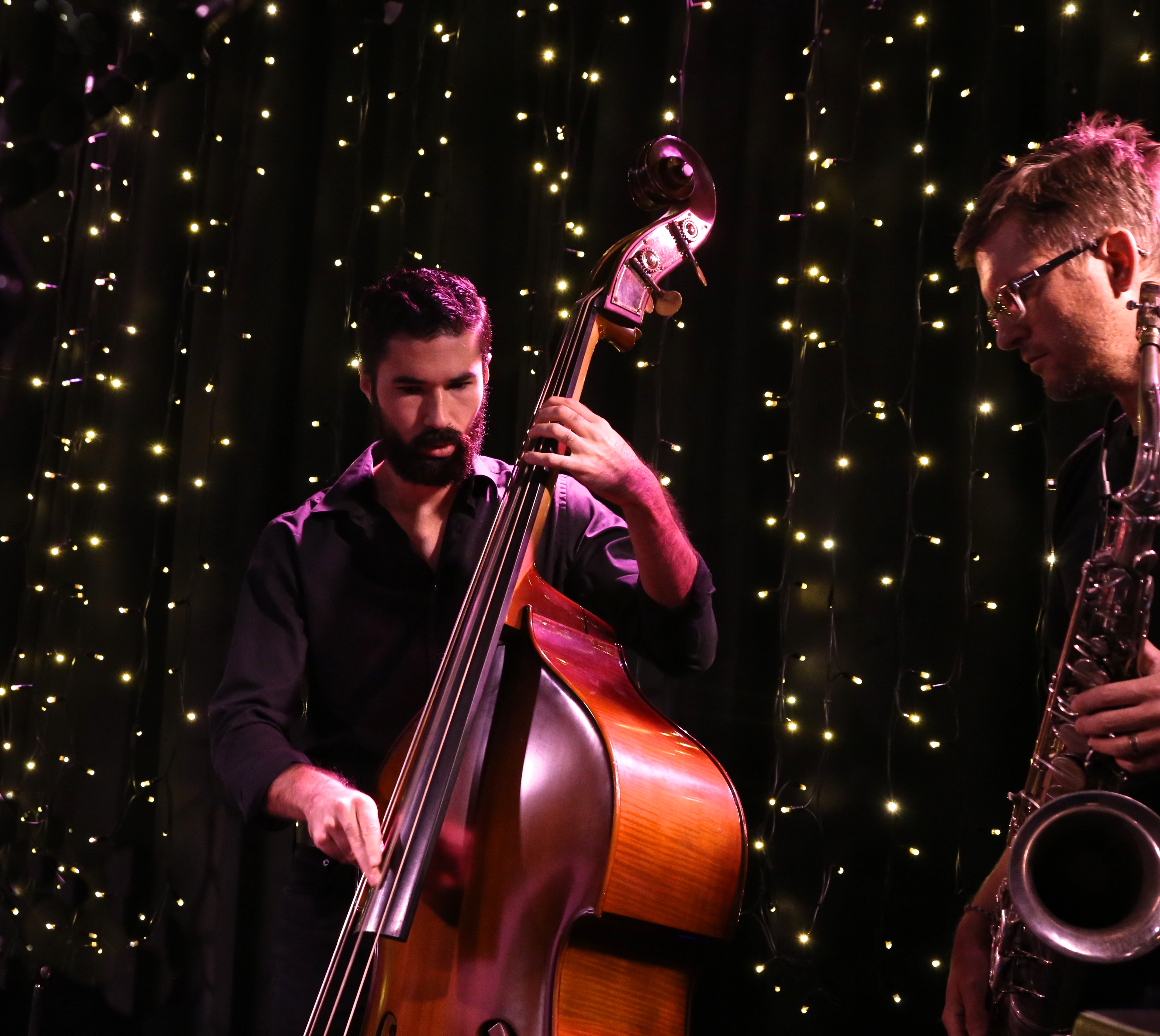 Keven Field was on Rhodes and as always his contribution was impeccable. The Rhodes was exactly the right keyboard for this project and Field, the best keyboardist to bring out its strengths. Somehow he always manages to tease hidden beauty from a Rhodes. Cameron McArthur was on bass and like Field, a first call musician. McArthur is so well established and well respected that no one is surprised when turns out a stellar performance. The remaining band member was Stephen Thomas and again a very fine musician. Thomas works across a number of genres now, but his Jazz chops and good taste are always on show.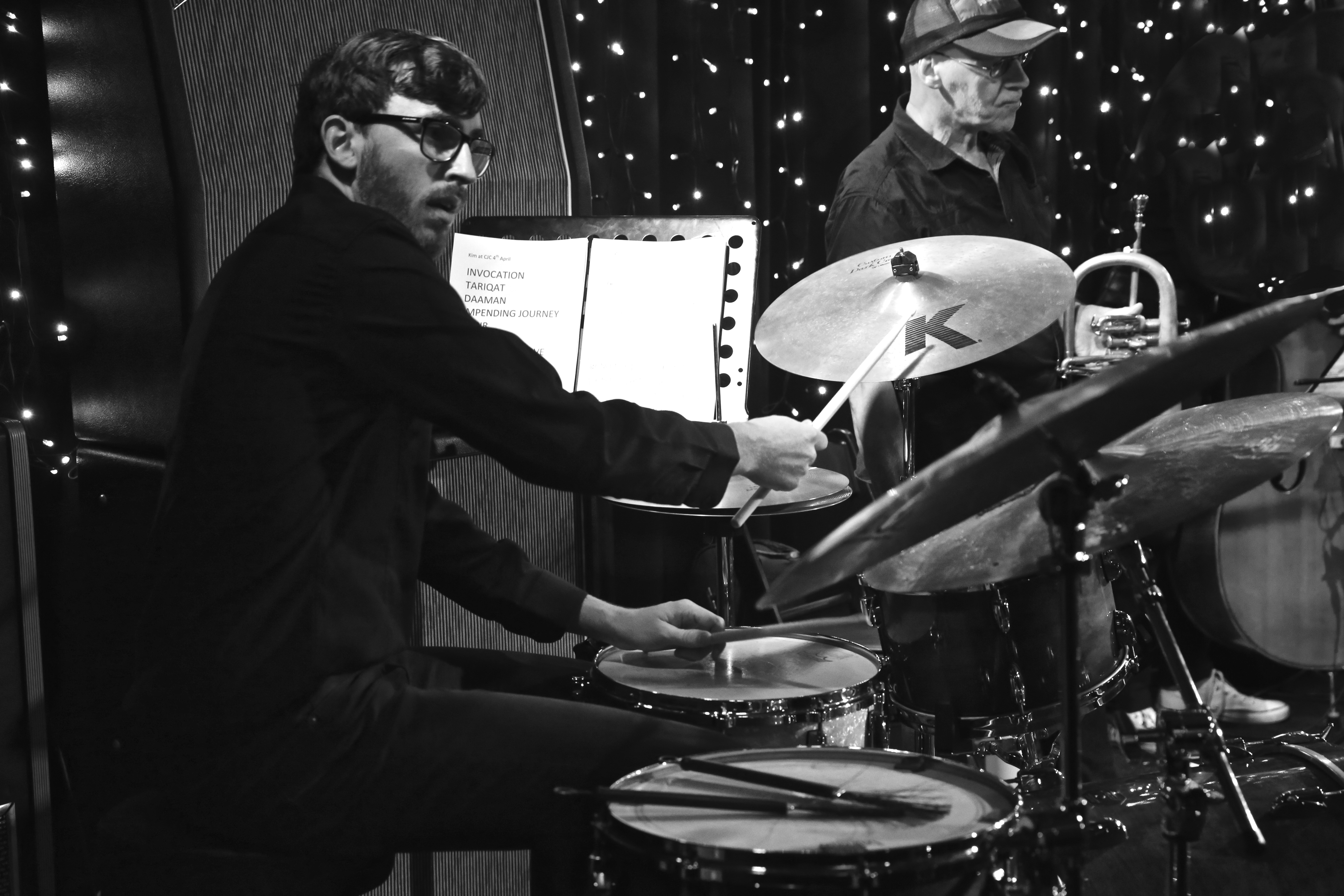
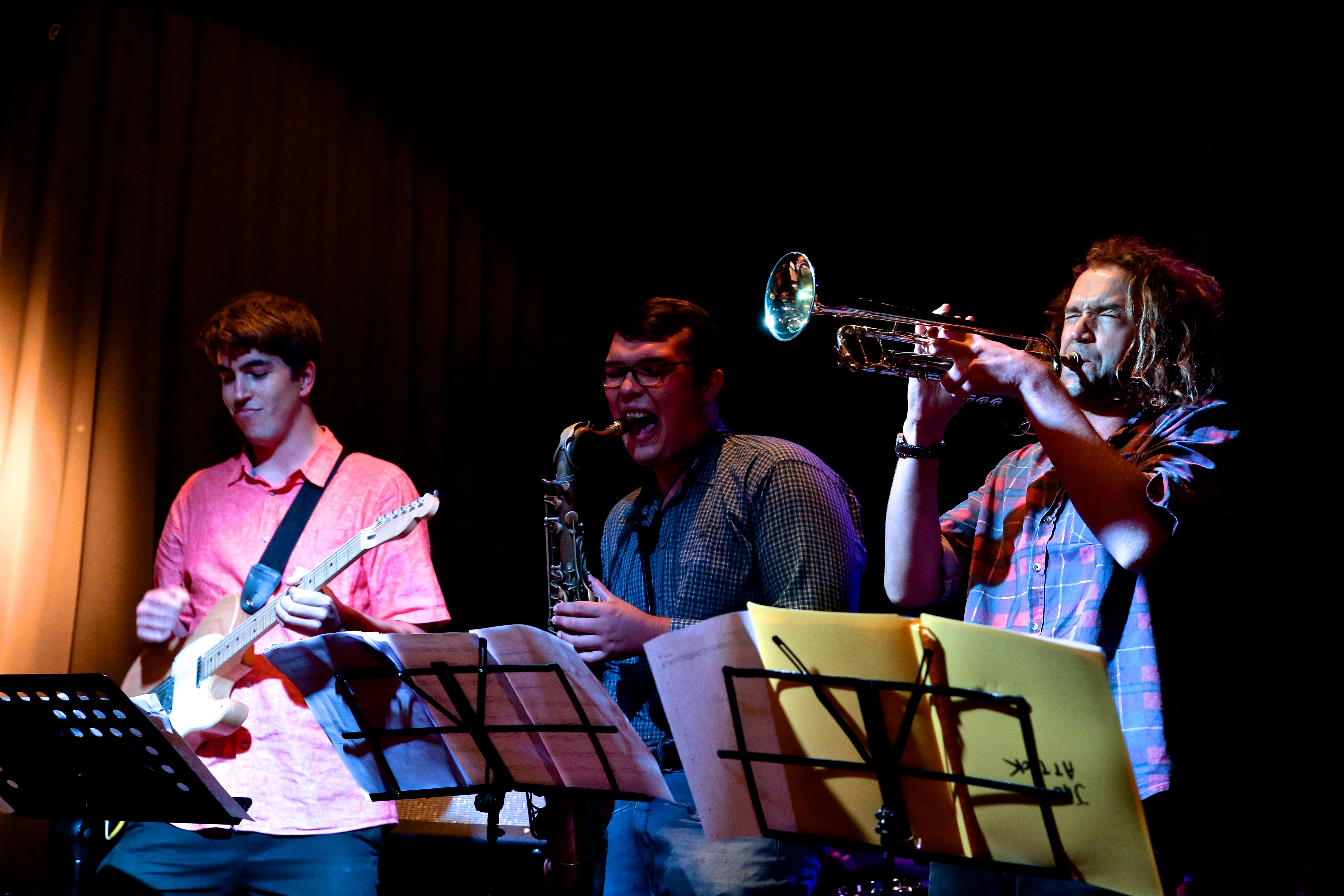 Oli Holland is one of the leading bass voices in New Zealand. He formed Jazz Attack just over a year ago and since its inception, he has been writing new charts and expanding the lineup. Holland writes interesting charts; often complex but always compelling and his last gig showcased a number of these. This was an expanded lineup – adding three of Auckland’s heavyweights for a quartet segment in the first set. His bass is a powerhouse presence and his ringing melodic lines always distinctive. During solos, his vocalised unison lines fleshed out the tone, drew us deeper in – perhaps even influencing his improvisational choices. It is well established that vocalising while improvising on an instrument, fires up the human brain in new and interesting ways.
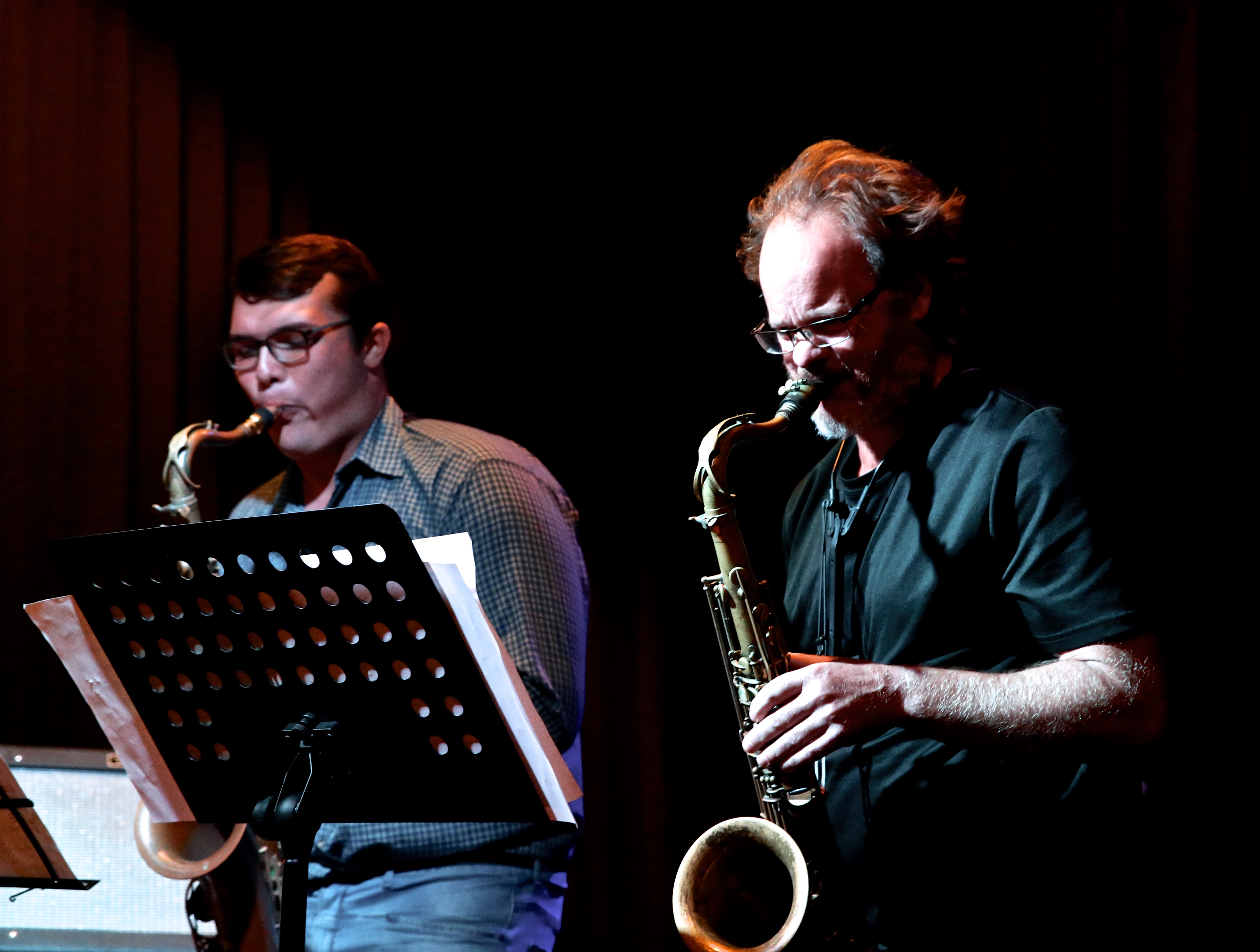
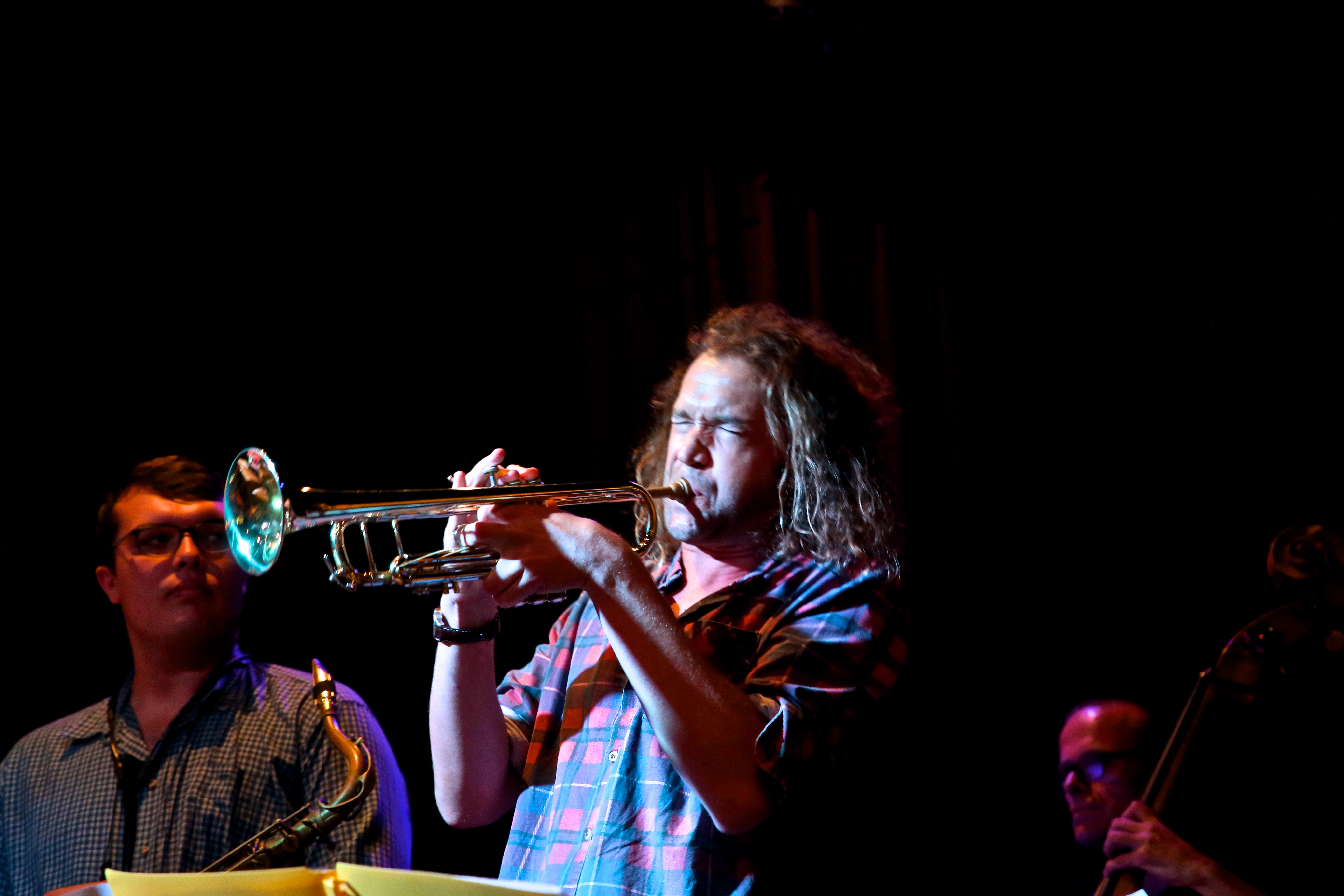
 JazzLocal32.com